Program Managers
Tool Kit
Sixteenth Edition (Ver. 1.0)
January 2011
DAU PROGRAM MANAGERS
TOOL KIT
Sixteenth Edition (Ver. 1.0) January 2011
For sale by the
U.S. Superintendent of Documents, Government Printing Office Internet: http://bookstore.gpo.gov/ Phone: 202-512-1800 Fax: 202-512-2250
Mail Stop: SSOP, Washington, DC 20402-0001 ISBN 978-0-16-087469-7, Stock Number 008-020-01604-7
PREFACE
This Sixteenth Edition (version 1.0) of the DAU Program Managers Tool Kit contains a graphic summary of acquisition policies and manage-rial skills frequently required by DoD program managers. It is a current version of a “Tool Box” that was first developed by Charles F. Schied of the Defense Acquisition University (DAU) Program Management Course (PMC) 92-1. The information in the Tool Kit is extracted from DAU course material and is based on DoDD 5000.01 (May 12, 2003), DoDI 5000.02 (December 8, 2008), the Defense Acquisition Guide-book (DAG), (August 5, 2010), CJCSI 6212.01E (December 15, 2008), CJCSI 3170.01G (March 1, 2009), the Joint Capabilities Integration and Development System Manual (July 31, 2009), and the Weapon Systems Acquisition Reform Act of 2009. Material from the DAU Acker Library and Knowledge Repository was also used.
Since the DAU Program Managers Tool Kit is a compilation of class-room presentation and teaching materials used in a number of different courses at DAU, the charts and tables vary in look and feel.
Users of the Tool Kit are reminded that this summary is a guide only and should not be used as a substitute for official policy guidance. Peri-odic review of official policy guidance is recommended.
An e-Toolkit has been developed which contains current updated ac-quisition guidance and direction (https://pmtoolkit.dau.mil). This (“hard-copy”) Tool Kit is current as of January 1, 2011 and is extracted from the e-Tool Kit. The hard copy Tool Kit can be found at http://www.dau. mil/pubscats/pages/tool%20kit.aspx.
ACKNOWLEDGMENTS
As sponsor of the Tool Kit, the Learning Capabilities Integration Center (LCIC) recognizes the following members of the DAU staff and faculty for their input to this Sixteenth Edition (Version 1.0):
• Bill Bahnmaier, formerly of DAU’s Program Management and Leadership Department, Capital and Northeast Region, for coordinating the input and editing the material received.
• Chuck Cochrane, formerly the DAU Program Management Center Director and currently a DoD contractor supporting DAU, for his significant contributions regarding current DoD acquisition policy. • Mike Dorohovich, CSC Corporation contractor supporting DAU, for
his contribution regarding the DAU knowledge sharing systems. • Andrea Reese, CSC Corporation contractor supporting DAU, for her
efforts in developing and updating the e-Tool Kit.
• The Defense Systems Management College – School of Program Managers (DSMC-SPM) for input, including Duane Tripp, international acquisition policy and guidance; Al Moseley, Diamond Card and Probability of Program Success Model; and Roberta Tomasini and John Krieger, budgeting and finance issues.
• The Learning Capabilities Integration Center and its Center Directors and Performance Learning Directors, including Sharon Jackson, Robert Pratt, Leslie Deneault, Bill Kobren, John Claxton, John Snoderly, George Prosnik, Bill Motley, and Larry Baker.
• Marty Sherman, DAU West Region, for his contribution regarding the Continuous Process Improvement/Lean Six Sigma processes. • The Visual Arts and Press Department, including Miracle Riese for
layout/graphics, Debbie Gonzalez for editing, and Frances Battle for serving as liaison with the printers.
Other significant contributors from the DAU faculty were John Kelley of the Program Management Department; Robert Carlson, Kim Hunter, Bob Gustavus, Gerry Land, and Miriam Cohe of the Business, Cost Estimating, and Financial Management Department; Tom Simcik of the Logistics Management Department; and Randy Zittel of the Engineer-ing and Technology Department. Dr. Paul Alfieri, professor for T&E also provided valuable information on test and evaluation processes.
Tim Shannon
Director, Learning Capabilities Integration Center
William Parker Director, Center for Acquisition Management
TABLE OF CONTENTS
Preface ...iii
Acknowledgments ... v
CHAPTER 1—ACQUISITION PROCESS AND RESOURCES ... 1
The Program Manager’s Bill of Rights and Responsibilities ... 2
Defense Acquisition Management System ... 3
Acquisition Categories (ACAT) ... 4
Acquisition Strategy Considerations... 5
Acquisition, Technology and Logistics (AT&L) Knowledge Management System ...6–8 Defense Acquisition Portal (DAP) ...6
Ask A Professor (AAP) ... 6
Acquisition Community Connection (ACC) ... 6
Defense Acquisition Guidebook (DAG) ... 7
ACQuipedia ... 7
Integrated Defense AT&L Life Cycle Management System Chart ...7–8 AT&L ACQuire ... 8
Best Practices Clearinghouse (BPCh) ... 8
Performance Learning Tools ... 8
Defense Acquisition Board Timeline Milestones B, C, and FRPDR ... 9
Milestone Decision Information—A Possible Construct ... 9
Requirements for Milestone/Decision Reviews ...10–11 Interoperability Certification ... 12
S&T Linkage to Defense Acquisition Process ... 13
Joint Capabilities Technology Demonstration (JCTD) ... 14
Acquisition Program vs. ATD and JCTD ... 15
Program Structure ... 16
INTERNATIONAL ACQUISITION ...17–18 DoD International Armaments Cooperation Policy ... 17
The Scope of Defense Cooperation ... 17
Defense Sales vs. Cooperative Acquisition ... 18
International Activities Associated with Defense Acquisition Phases ...18
FUNDS MANAGEMENT ...19–33 Resource Allocation Process—Overlap ... 19
PPBE—Planning Phase ... 20
PPBE—Program/Budget Review ... 20
Resource Allocation Process ... 21
Congressional Enactment Timetable ... 22
Procurement Appropriations (Account Numbers and Budget Activities) ... 23–24 Research, Dev., Test, and Eval. (RDT&E) Appropriations (Account Numbers) ... 25
RDT&E Appropriations (Relationship Between MFP 6 R&D Categories and RDT&E Appropriations Budget Activities) ... 25
CHAPTER 1—ACQUISITION MANAGEMENT (CONTINUED)
Sample Navy Appropriations and Budget Activities ... 26
Appropriation Life ... 27
Below Threshold Reprogramming Actions ... 27
Life Cycle Cost Composition ... 28
Product Improvements ... 28
Cost Estimating ... 29
Cost Estimating Relationships (CER)—Parametric ... 29
Cost Estimating Requirements ... 30
Program Cost and Schedule Breach Parameters ... 31
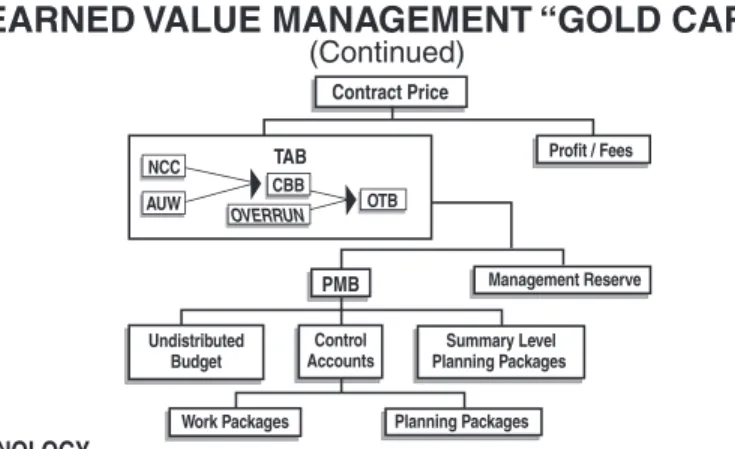
Earned Value Management “Gold Card” ... 32–33 CONTRACTING ...34–38 Contracting—Components of Contract Price ... 34
Types of Contracts ... 34
Contract Type Features ... 35–36 Pre-Solicitation Process ... 37
Post-Solicitation Process ... 37
Other Ways to Buy ... 38
DEFENSE INDUSTRY BUSINESS MANAGEMENT ...39–45 Contractor Profitability Ratios ... 39
Aerospace/Defense Industry Contractor Profitability Ratios ... 40
Lockheed Martin Corp.—Dupont Formula Analysis (An Example) ... 41
Cash Cycle... 42
Contractor Financing and Payments ... 42
Direct and Indirect Costs ... 43
Assigning Indirect Costs ... 43
Life Cycle of Indirect Cost Rates ... 44
Contractor’s Cost Proposal ... 44
Contractor Business Planning Process Outputs ... 45
LOGISTICS ...46–54 Life Cycle Logistics ... 46
Principal Life Cycle Logistics Goals/Objectives ... 46
Goal 1: Life Cycle Sustainment Metrics ...46–47 Goal 2: Affordable System Operational Effectiveness (SOE) ... 48
Goal 3: DoD Product Support Strategy Process Model ...48–49 Goal 4: Integrated Product Support Elements ... 49–50 Goal 5: Product Support Business Model (PSBM) ... 51
The Sustainment Chart ... 52
Logistics Management Community of Practice (LOG CoP) ... 52
Life Cycle Logistics Linkage to Defense Acquisition Process ... 53
Defense Acquisition Guidebook—Life Cycle Logistics ... 54
CHAPTER 1—ACQUISITION MANAGEMENT (CONTINUED)
ORGANIZATION ...55–56
Program Office Organization Structures (Examples) ... 55–56
“Traditional” or Functional Structure ... 55
“Pure” Product Structure ... 55
Matrix Structure ... 56
Integrated Product Teams ... 56
MANUFACTURING ...57–61 The Role of Manufacturing in the Acquisition Process ... 57
Common Production Risks That Greatly Impact Cost, Schedule, and Performance ... 57
Producibility ...58–61 Producibility (Defense Acquisition Guidebook) ... 58
Quality Management Systems (Defense Acquisition Guidebook) ... 59
Key Characteristics and Variation Reduction ...59–60 Production Readiness Review (PRR) ... 61
Additional Manufacturing Information Sources ... 61
TEST AND EVALUATION ...62–67 Test and Evaluation (T&E)—Types and Tasks ... 62
Test and Evaluation Nomograph ...63–64 Modeling and Simulation (M&S) Planning ... 65
Hierarchy of Models and Simulations ... 66
The Evolution of Modeling and Simulation ... 67
PLANNING AND CONTROL TOOLS ...68–75 Gantt Chart (Example) ... 68
Milestone Chart (Example) ... 68
Network Schedules ... 69
Network Schedules—General ... 69
Arrow Diagramming Method (ADM) ... 69
Precedence Diagramming Method (PDM) ... 69
Network Schedules (Example) ... 70
Examples of Network Scheduling Software ... 71
Schedule Development ... 72
Lead Time Chart ... 73
Line of Balance Technique ... 74
Acquisition Program Baseline ... 75
RISK MANAGEMENT ...76–79 Program Manager’s Checklist for Review of Tradeoff Planning and Studies ...76
Technical Performance Measurement ...76
DoD Risk Management Process Model ... 77
Root Cause Analysis... 77
Risk Management Process—Details ... 78
CHAPTER 1—ACQUISITION MANAGEMENT (CONTINUED)
SYSTEMS ENGINEERING ...80–98
What is Systems Engineering? ... 80
Systems Engineering Processes ... 80
Systems Engineering Policy in DoD ... 80
Systems Engineering Process—Technical Management Processes ...81
Defense Acquisition Management System—Technical “V” Activities ... 82
Materiel Solution Analysis Phase Systems Engineering SE Activities... 83
Technology Development Phase SE Activities ... 83
Engineering and Manufacturing Development Phase (SE) Activities ... 84
Production and Deployment Phase—SE Activities ... 85
Operations and Support Phase—SE Activities ... 85
Requirements (User Needs) Analysis Questions ... 86
Attributes of a Well-Defined Requirement ... 86
Systems Engineering Design Process Illustrated ... 87
Specification Development and Technical Reviews ... 88
Technical Management Processes Key Questions ... 89
Technical Review Definitions ... 90–91 Technical Review Best Practices ... 92
Program-Unique Specifications ... 93
Performance vs. Detail Specifications ... 94
Configuration Management ... 95
Interface Management ... 96
Interface Control Concept ... 96
Work Breakdown Structure (WBS) ... 97
How to Create a Work Breakdown Structure ... 98
Basic Purposes of WBS ... 98
SOFTWARE ...99–102 Software Development—Technical Review Relationships ... 99
Software Development—Key Life Cycle Review Factors ... 100
Candidate Software Measures (Metrics) ... 101
Quality Events for Software ... 101
Software Management Best Practices ... 102
Software Acquisition Worst Practices ... 102
CHAPTER 2—LEADERSHIP AND MANAGERIAL SKILLS ... 103
Management and Leadership... 103
Program Management “Diamond Card” ...104–105 Management ... 104
Leadership ... 104
Technology Readiness Levels ... 105
Empowerment, Delegation, and Coaching ...106–107 Coaching Skills ... 107
Generic Integrated Product Team (IPT) Process ... 108
Formula for Effective Team Performance ... 109
CHAPTER 2—LEADERSHIP AND MANAGERIAL SKILLS (CONTINUED)
Working Groups ...111–112
Team Development Wheel ...111
Typical Working Groups ... 112
Management Tradeoffs for Working Groups ... 112
Team Performance Model ... 112
Team Decision Making ... 113
Effective Meetings ... 114
Decision Briefing ... 115
Communications ...116–118 Counseling ... 118
Time Management ... 119
Management Tools and Techniques ...120–121 Continuous Process Improvement/Lean Six Sigma (CPI/LSS) ... 122
CHAPTER 3—PROBLEM-SOLVING TOOLS ... 123
Brainstorming ...123–124 Cause-and-Effect Diagram ... 125
Force Field Analysis ... 126
Histogram ... 127 Scatter Diagram ... 128 Surveys ... 129 Affinity Diagram ... 130 Pairwise Ranking ...131–132 Pareto Chart... 133 Benchmarking ... 134 Flowcharting ...135–136 Deployment Flowcharts ... 137
Nominal Group Technique (NGT) ...138–139 Creative Problem Solving ... 140
Responsibility Assignment Matrix (RAM) ... 141
Knot Chart ... 142
Qualitative Problem Solving ... 143
CHAPTER 1
ACQUISITION PROCESSES AND RESOURCES
• Things that make you go “Hmmm?...”
4 The only thing most auditors fix is the blame.
4 Experience is something you got just after you needed it. 4 People are smarter than they look; listen to them.
4 The last 10 percent of the performance sought generates one- third of the cost and two-thirds of the problems.
4 Never open a can of worms unless you want to go fishing. 4 Those who believe it cannot be done, will you please get out of
the way of those who are busy doing it? • Things we should always remember.
4 Be honest in everything you say, write, and do. 4 Be good to your people, and they will be good to you. 4 Forgiveness is easier to obtain than permission. 4 Keep everyone informed; when in doubt, coordinate. 4 Be the first to deliver bad news.
4 Bad news does not get any better with time.
4 If you are sitting at your desk, you are not managing your program.
THE PROGRAM MANAGER’S BILL OF RIGHTS
AND RESPONSIBILITIES
Rights:
Program Managers have the RIGHT to:
• a single, clear line of authority from the Defense Acquisition Executive;
• authority commensurate with their responsibilities; • timely senior leadership decisions;
• be candid and forthcoming without fear of personal consequences; • speak for their program and have their judgments respected; • receive the best available training and experience for the job; and • be given adequate financial and personnel resources.
Responsibilities:
Program Managers have the RESPONSIBILITY to:
• accept program direction from acquisition executives and implement it expeditiously and conscientiously;
• manage their programs to the best of their abilities within approved resources;
• be customer-focused and provide the user with the best, most cost-effective systems or capabilities;
• innovate, strive for optimal solutions, seek better ways to manage, and provide lessons-learned to those who follow;
• be candid about program status, including risks and problems as well as potential solutions and likely outcomes;
• prepare thorough estimates of financial and personnel resources that will be required to manage the program; and
• identify weaknesses in the acquisition process and propose solutions.
DEFENSE A
CQ
UISITION MANA
GEMENT SYSTEM
(DoDI 5000.02) A B C Pre-Systems AcquisitionUser Needs
Pr od uc tio n & De pl oy m en t O pe ra tio ns & Su pp or t En gi ne er in g an d M an uf ac tu rin g De ve lo pm en t FR P De ci si on Re vi ew Systems Acquisition Sustainment • Th e M ile st on e De ci si on A ut ho rit y w ill d et er m in e th e in iti al p ha se o f e nt ry a t t he Mat er ie l D ev el op m en t D ec is io n. • En tra nc e cr ite ria m us t b e m et b ef or e en te rin g ph as e. • Ev ol ut io na ry a cq ui si tio n or s in gl e-st ep s tra te gy is u se d to o bt ai n fu ll ca pa bi lit y. M at er ie l S ol ut io n An al ys is M at er ia l De ve lo pm en t De ci si on Program Initiation Te ch no lo gy D ev el op m en tTe
ch
no
lo
gy
O
pp
or
tu
ni
tie
s
&
Re
so
ur
ce
s
Po st -P DR As se ss m en t Po st -C DR As se ss m en t LR IP & IO T& E SC M PD IS D Li fe C yc le Su st ai nm en t Di sp os al De ci sion P oi nt Mile st on e De ci si on P oi nt if P DR is n ot c on du ct ed b ef ore M ile st on e B. IO C FO C LE G EN D: C D R — C rit ic al D es ig n R ev ie w FO C — Fu ll O pe ra tio na l C apab ilit y FR P— Fu ll-R at e Pr od uc tio n IO C — In itia l O pe ra tio na l C ap ab ilit y IO T& E— In itia l O pe ra tio na l T es t & E va lu at io n IS D — In te gr at ed S ys te m D es ig n LR IP — Lo w -R at e In itia l P ro du ct io n PD R — Pr el im in ar y D es ig n R ev ie w SC M PD — Sy st em C ap ab ilit y & M an uf ac tu rin g P ro ce ss D em on st ra tio nACQUISITION CATEGORIES (ACAT)
l DAB Review l Designated by USD(AT&L) l Decision by USD(AT&L) l Component Review l Designated by USD(AT&L)l Decision by Component Head/CAE
l ITAB Review l Designated by USD(AT&L)* l Decision by USD(AT&L)* l Component Review l Designated by USD(AT&L)*
l Decision by Component Head/CAE
l Does Not Meet ACAT I Criteria
l Designated by Svc Sec/CAE
l Decision by Svc Sec/CAE
l Does Not Meet ACAT I, IA, or II
Criteria
l Designated IAW Component
Policy
l Decision IAW Component Policy
l Not otherwise designated ACAT I,
IA, II, or III
l Designated IAW Navy Policy
l Navy/USMC ACAT IVT/IVM
l Decision at lowest appropriate level
ACAT ID: ACAT IC: ACAT IAM: ACAT IAC: ACAT II: ACAT III: ACAT IV: Major Defense Acquisition Programs Major AIS Acquisition Programs Major Systems All Others (except Navy and USMC) Navy USMC SECNAVINST 5000.2_ No Fiscal Criteria $140M RDT&E or $660M Procurement (FY 00 Constant $) $378M Life Cycle Cost or $126M Total Program Cost or $32M Program Cost in any single year (FY 00 Constant $) $365M RDT&E or $2.190B Procurement (FY 00 Constant $) * May be delegated LEGEND:
ACAT— Acquisition Category AIS— Automated Information System CAE— Component Acquisition Executive DAB— Defense Acquisition Board
ITAB— Information Technology Acquisition Board RDT&E— Research, Development, Test, and Evaluation USD(AT&L)— Under Secretary of Defense
ACQUISITION STRATEGY CONSIDERATIONS
(Defense Acquisition Guidebook, Chapter 2)NOTES: 1) The content of the Technology Development Strategy (TDS) due at Milestone A is very similar to the Acquisition Strategy due at Milestone B. 2) In addition to the Acquisition Strategy, there are five plans required: Acquisition Plan (FAR/DFARS), Program Protection Plan (PPP), Test and Evaluation Master Plan (TEMP) (DoDI 5000.02), Information Support Plan (ISP) (CJCSI 6212.01E ), and Systems Engineering Plan (DoDI 5000.02).
• Acquisition Approach
— Modular Open Systems Approach Summary
— Tailoring
• Source & Related Documents • Capability Needs
• Top-Level Integrated Schedule
— EMD Top-Level Schedule * — MS C & FRP Top-Level Schedule *
• Program Interdependency & Interoperability
Summary
• International Cooperation
— Test Requirements for Export of Defense Systems
• Risk & Risk Management • Technology Maturation
• Industrial Capability & Manufacturing
Readiness
— Industrial Capability
— Elevating Industrial Capability Issues — Industrial & Manufacturing Readiness — Sustaining Industrial Capabilities
• Business Strategy
— Small Business & Small Business Innovation Research
◆ Subcontracting Plan/Small Business Participation
◆ Performance Measurement ◆ Small Business Innovation Research
Considerations — Contract Approach
◆ Performance-Based Business Strategy
– Modular Contracting
◆ Contracting Bundling or Consolidation ◆ Major Contract(s) Planned
– Contract Type Selection
– Sustainment Procurement Strategy
◆ Multi-Year Contracting ◆ Contract Incentives ◆ Warranties
◆ Leasing
◆ Developmental Testing Requirements ◆ Incorporation of Systems Engineering
Requirements • Market Research • Competition
• Resource Management — PM Office Staffing & Support
Contractors — Cost & Funding — Cost Control & CAIV Plan — Earned Value Management — Advanced Procurement • Program Security Considerations
— Information Assurance
— Critical Program Information & Program Protection Plan Summary
— Anti-Tamper Measures
— Supply Chain Risk Management Key Practices
• Test and Evaluation • Data Management
— Data Management & Technical Data Rights
— Integrated Data Management
• Life-Cycle Sustainment Planning
— LCSP Executive Summary for Acquisition Strategy
• Life-Cycle Signature Support Plan • Chemical, Biological, Radiological and
Nuclear Survivability
• Human Resources Integration • Environment, Safety and Occupational
Health (ESOH)
• Military Equipment Valuation &
Accountability
— Proper Financial Accounting Treatment for Military Equipment
— Accounting Review
• Corrosion Prevention & Control Plan/
ACQUISITION, TECHNOLOGY AND LOGISTICS
(AT&L) KNOWLEDGE MANAGEMENT SYSTEM
< https://acc.dau.mil/at&lkm > (Composed of the following subsystems)
Defense Acquisition Portal (DAP)
The Defense Acquisition Portal (DAP) <https://dap.dau.mil/> was launched to replace the AT&L (Acquisition, Technology, and Logistics) Knowledge Sharing System (AKSS). Like its predeces-sor, DAP continues to provide acquisition information for all DoD service components and across all functional disciplines. DAP serves as the central point of access for all AT&L resources and information, and to communicate acquisition reform. As the primary reference tool for the Defense Acquisi-tion workforce, it provides a means to link together informaAcquisi-tion and refer-ence assets from various disciplines into an integrated, but decentralized, information source. Information is organized under eight major tabs: Home, Acquisition Process, Workforce, Policy, Communities of Practice, Training and Education, Industry, and DAU. DAP is one part of the AT&L Knowledge Management System (AKMS).
A major feature in DAP is the Acquisition Career Gateways <https://dap. dau.mil/career/Pages/Default.aspx>, where each acquisition career field provides specific career, training, and job-specific information and resourc-es. To tie it all together, the Search feature has been reengineered to make it easier to find specific learning assets or job support tools in the Portal.
Ask A Professor (AAP)
Ask a Professor (AAP) <https://akss.dau.mil/aap> is a service offered as part of AKMS. Users submit acquisition-related ques-tions and receive formal responses. In addition, the AAP contains a database of questions and answers that are categorized by subject area and can be browsed or searched.
Acquisition Community Connection (ACC)
The ACC <https://acc.dau.mil/> is the collaborative component of the AKMS that focuses on acquisition-related topics and disci-plines such as contracting, logistics, program management, and risk management. It consists of Communities of Practice, Special Interest Areas, and collaborative workspaces that:
• enable members to interact and share resources, ideas, and
experiences to support job performance and avoid duplication of effort; and
• identify partnership development opportunities.
Members may request workspaces in ACC, which provide a way for physi-cally dispersed individuals to centrally locate and share documents and references as well as manage team projects. To learn more, go to the ACC <https://acc.dau.mil/> and take the online virtual tour.
Defense Acquisition Guidebook (DAG)
The DAG <https://acc.dau.mil/dag> provides links to policy, law, and useful content housed in communities of practice. It allows users to navigate through the DAG via a document index, graphi-cal interface (Life Cycle System), or a search by topic.
ACQuipedia
The ACQuipedia <https://acquipedia.dau.mil/> is your acquisi-tion encyclopedia for common defense acquisiacquisi-tion topics. Each topic is identified as an article; each article contains a definition, a brief narrative that provides context, and links to the most pertinent policy, guidance, tools, practices, and training. Articles aggregate the most relevant references and learning assets to narrowly focus users and quickly provide high-value content.
Integrated Defense AT&L Life Cycle Management System Chart
This chart <https://acc.dau.mil/ifc> is a pictorial road map of key activities in the systems acquisition process. Users navigate through a graphical model of the three major acquisition process areas: Joint Capabilities Integration and Development System (JCIDS); De-fense Acquisition; and Planning, Programming, Budgeting, and Execution (PPB&E). The short title for this chart is Integrated Life Cycle (ILC) Chart.
AT&L ACQuire
ACQuire <https://acquire.dau.mil/> is a search tool focused on the specific needs of the Defense Acquisition Workforce. It uses the DAU acquisition taxonomy, trusted acquisition sites, and selected AT&L resources to enhance searches and derive better results. Searches can be conducted by individual or multiple sites; document titles; topic; con-tent, via an index of major categories; and subcategories.
Courseware is also searchable via ACQuire. Users can suggest additional AT&L sites that should be included in ACQuire crawls.
Best Practices Clearinghouse (BPCh)
The BPCh <https://bpch.dau.mil/Pages/default.aspx> is an inno-vative “clearinghouse” approach that will improve all DoD acquisi-tion processes by helping AT&L professionals select and imple-ment proven practices appropriate to the individual program needs. Initially, the BPCh will focus on software acquisition and systems engineering. The Clearinghouse provides:
• an authoritative source for practices, lessons learned, and risks to avoid;
• validated practices with consistent, verifiable information; • an active knowledge base to help with practice questions; • an intelligent front-end to quickly get to answers;
• useful information and tools to help find, select, and implement practices appropriate to specific programs; and
• living knowledge through a constantly updated, expanded, and refined database.
Performance Learning Tools
Performance Learning Tools (PLTs) link learning and job support assets to complicated process flow to help users create plans and other AT&L prod-ucts accurately and efficiently. The following PLTs have been developed:
• Pricing Support Tool <http://pricingtool.dau.mil/>
OIPT Review OIPT Review
Defense Acquisition Board Timeline
25 DAYS 2 WEEKS 20 DAYS 15 DAYS 10 DAYS 5 DAYS Milestone 45 DAYS 40 DAYS DAB DAB 21 DAYS 6 MONTHS Final Document Check for OIPT Final Document
to OSD AoA Results to
Dir, CAPE Final CCPto CAPE CAPE Briefs Final ICE to PM CAPE briefs Preliminary ICE to PM Draft CARD to CAPE 10 DAYS 3 DAYS DAB Read-Ahead LEGEND:
CAPE—Cost Assessment & Program Evaluation CARD—Cost Analysis Requirements Description CCE—Component Cost Estimate
DAB—Defense Acquisition Board ICE—Independent Cost Estimate
JROC—Joint Requirements Oversight Council
DAB Readiness Meeting DAB Planning Meeting JROC Review OIPT Report CAPE Report to OIPT
DEFENSE ACQUISITION BOARD TIMELINE —
MILESTONES B, C, AND FRPDR
MILESTONE DECISION INFORMATION —
A POSSIBLE CONSTRUCT
1
• Have I presented all necessary information? • Does the information flow logically?
2 WHAT? • Requirement • Analysis of Alternatives 3 HOW? • Acquisition Strategy RISKS?
• Risk Management Plan • Test & Evaluation Plan • Test & Evaluation Results
4 COSTS?
• CAIV Objectives • Life Cycle Cost Estimate • Independent Cost Estimate
5 MANAGEMENT?
• Program Management Office Structure • Integrated Product Team
• WIPT—OIPT Structure 6
AGREEMENT? • Acquisition Program Baseline • Acquisition Decision Memorandum
• Exit Criteria 7
WHY? • Threat • Capability
• Is the information clear and accurate? • Is it concise, executive-level information? LEGEND:
CAIV—Cost as an Independent Variable OIPT—Overarching Integrated Product Team WIPT—Working-Level Integrated Product Team
REQUIREMENTS FOR MILESTONE/DECISION REVIEWS
See encl 4, DoDI 5000.02Milestone/Decision Point Requirement MDD A B P-CDRA C FRP
Acquisition Decision Memorandum 5 X X X X X X
Acquisition Program Baseline 5 X X X
Acquisition Strategy 5 (see Page 5) X X X
Acquisition Information Assurance Strategy (all IT incl NSS) X X X X
Affordability Assessment X X
Alternate LF T&E Plan (programs with waiver from
full-up LFT&E) 2 X
Analysis of Alternatives (AoA) 3, 5 X X X X
AoA Study Guidance X
Benefit Analysis & Determination 1,8 (bundled acquisitions) X
Beyond LRIP Report 2 (incl MDAPs that are also MAIS) X
Capability Development Document (CDD) 5 X
Capability Production Document (CPD) X
Clinger-Cohen Act (CCA) Compliance 5,7 X X X X
Competition Analysis 1 ,8 (depot-level maintenance rule) X
CIO Confirmation of CCA Compliance
(DoD CIO for MAIS and MDAP) X X X X
Component Cost Estimate 5,9 (MAIS; optional MDAP) X X X
Consideration of Technology Issues (MDAP & MAIS) X X X
Cooperative Opportunities 1 X X X
Core Logistics/Source of Repair Analysis 1,8 X X
Corrosion Prevention Control Plan1 X X
Cost Analysis Requirements Description 5,9 (MDAP & MAIS) X X X
Data Management Strategy 1 (MDAP, MAIS & ACAT II) X X X X
Economic Analysis (MAIS) 7 (may be combined w/AoA at MSA) X X X
Exit Criteria 5 X X X X
Industrial Base Capabilities 1 (MDAPs only) X X X
Independent Cost Estimate (ICE) 5,10,15 (MDAPs only) X X X X
Independent Technology Readiness Assessment 11 X X
Information Support Plan 1,5 X X X
Initial Capabilities Document (ICD) 4,5 X X X X
Initial Operational Test & Evaluation Completed (ACAT I & II) X
Item Unique Identification (IUID) Plan (Part of SEP) X X X
Joint Interoperability Test Certification (IT & NSS) X
Life-Cycle Signature Support Plan 5 X X X
Life-Cycle Sustainment Plan 1 X X X
LF T&E Waiver 2 (covered systems) (n/a MAIS) X
Milestone/Decision Point Requirement MDD A B P-CDRA C FRP
LRIP Quantities MDAP & ACAT II (n/a AIS) X
Manpower Estimate (MDAPS only) 5 X X X
Market Research X X
Milestone Decision Authority (MDA) Certification (MDAPs only)4 X X X
MDA assessment of chem, bio, rad, and nuc survivability X X
Military Equipment Validation 1 X X
Net-Centric Data Strategy 5,12 X X X
Operational Test Agency Report of OT&E Results X X X
Preliminary Design Review (PDR) Report16 X
Post-Critical Design Review (CDR) Report X
Post Implementation Review X
Program Protection Plan (PPP) 1 X X X
Prog Environment, Safety & Occup Health Evaluation (PESHE)5 X X X
Replaced System Sustainment Plan 5 (MDAPs only) X
Selected Acquisition Report (SAR) 4,13
Spectrum Supportability Determination 8 X X
System Threat Assessment (STA) (ACAT II) 5,14 X X
System Threat Assessment Report (STAR) (ACAT I) 5,6 X X
Systems Engineering Plan (SEP) X X X
Technology Development Strategy (TDS) X X X
Technology Readiness Assessment (TRA) 5 X X
Test & Evaluation Master Plan (TEMP) X X X
Test & Evaluation Strategy (TES) X
1 Part of TDS or Acquisition Strategy
2 OSD T&E Oversight Programs
3 MDAP: A,B,C; MAIS: A, B, FRP
4 Milestone C if Program Initiation
5 Program Initiation for Ships
6 Validated by DIA for ACAT ID; AIS use DIA validated capstone info/ops Threat Assessment Decision
7 Milestone C if equivalent to FRP
8 Milestone C if no Milestone B
9 MAIS whenever an economic analysis is required
10 May be CAIG Assessment at Milestone A
11 ACAT ID only if required by DDR&E
12 Summarized in TDS; details in ISP
13 SAR at program initiation; annually thereafter
14 Validated by Component; AIS use DIA validated capstone info/ops Threat Assessment Decision
15 MDA may request cost assessment at Milestone A
IT a nd N SS e m pl oy ed b y U .S . F or ce s sh al l, w he re re qu ire d (b as ed o n ca pa bi lity c on te xt ), in te ro pe ra te w ith e xis tin g an d pl an ne d, s ys te m s an d eq ui pm en t, of jo in t, co m bi ne d an d co al itio n fo rc es a nd w ith o th er U .S . G ov er nm en t D ep ar tm en ts a nd A ge nc ie s, a s ap pr op ria te . D oD D ire ct ive 4 63 0. 08 Service/ Agency U SJ FC O M re vie w s N R -K PP s & so lu tio n ar ch ite ct ur es J-6 Inter
operability and Suppor
tability Cer tification Joint Staf f Joint Staf f Combatant Commands JITC Inter operability Test Cer tification • JI TC w itn es se s/ co nd uc ts in te ro pe ra bi lity te st s, a nd • Pr ov id es J oi nt In te ro pe ra bi lity T es t C er tifi ca tio n va lid fo r 4 y ea rs o r u nt il ch an ge s oc cu r t ha t a ffe ct in te ro pe ra bi lity o f t he c er tifi ed c ap ab ilit y Certification TEMP/ Test Results JITC CDD CPD ISP* LE G EN D: CD D — C ap ab ilit y De ve lo pm en t D oc um en t CP D — C ap ab ilit y Pr od uc tio n Do cu m en t J-6 Certification * Service/ Agency IS P — In fo rm at io n Su pp or t P la n JI TC — J oi nt In te ro pe ra bi lity Te st C om m an d
INTER
OPERABILITY CER
TIFICA
TION
(CJCSI 6212.01E) TE M P — Te st a nd E va lu at io n M an ag em en t P la n *N R-KP P ce rti fic at io n(1) (2) (2) (3) (4) (3) Warfighting Need s & R& D O bj ec tiv es Sy st em s S& T Te ch B as e Ad v Te ch De v • B as ic R es ea rc h Ap pl ie d Re se ar ch • • Joint Capabilities Te ch D em o Ad vanced Te chnology Demo Lab/field Demo War fig ht in g Ex pe rim en ts • • • ST O P ST O P O ve rs ig ht Pa ne l O ve rs ig ht Pa ne l O pt io ns : (1 ) De ve lo p co nc ep ts fo r n ew s ys te m s. (2 ) In se rt in to o ng oi ng s ys te m s de ve lo pm en t. (3 ) Up gr ad e sy st em in p ro du ct io n/ ou t
of production or fielded syst
em s. (4 ) Im pr ov e su st ai nm en t o r d em ili ta riz e/ di sp os e. Pr od uc tio n & De pl oy m en t O pe ra tio ns & Su pp or t En gi ne er in g & M an uf ac tu rin g De velo pm en t M at er ie l S ol ut io n An al ys is Te ch no lo gy D ev el op m en t A B C FR P De ci si on Re vi ew M at er ia l De ve lo pm en t De ci si on Po st -P DR As se ss m en t Po st -C DR As se ss m en t IO C FO C LR IP FR P& D IS D Li fe C ycle Su st ai nm en t Di sp os al SC M PD MDA DECISION
LRIP—Low-Rate Initial Production MDA—Milestone Decision
Authority
PDR—Preliminary Design Review SCMPD—Syst Capability & Manuf Proc Demo
LEGEND
:
CDR
—
C
ritical Design Review
FOC—Full Operational Capabilit
y FR P— Fu ll-R at e Pr od uc tio n
IOC—Initial Operating Capabilit
y
ISD—Integrated Systems Design
S&T LINKA
GE
TO DEFENSE A
CQ
UISITION PR
OCESS
JOINT CAPABILITIES TECHNOLOGY
DEMONSTRATION (JCTD)
JCTD EXECUTION APPROACH
Annual call for proposals; proposals submitted at any time• Candidate projects identified by Combatant Commands, Services and Agencies, Interagency or Coalition Partners, and industry
• Joint/Interagency Government-led teams build proposals • Technical manager from Service or Agency
• Operational manager from Combatant Command chain-of-command • Transition manager from Acquisition Community
• USD(AT&L) approval of recommended new starts • Congressional Notification
• DDR&E/Rapid Fielding Directorate oversight during project execution • Operational demonstration and rigorous assessment
• Continuous transition of capabilities demonstrating required capabilities
Beginning in FY10:
• Quarterly Candidate Decision Boards to recommend new starts, chaired by DDR&E, co-chaired by Joint Staff Deputy J8
• Quarterly Review Boards to review ongoing projects
• More short projects (1 year or less); fewer long-term projects (more than 1 year)
• All projects structured for deliverables in first year, with annual review • JROC validation following first year of execution
CDB & (DDR&E Approval) USD (AT&L) Approval Notify Congress CDB & (DDR&E Approval) USD (AT&L) Approval Notify Congress
JCTD Project Review Boards
Annual Review and Approval for New Fiscal Year Starts JCTD Identification, Selection, and Review
Jan Feb Mar Apr May Jun Jul Aug Sep Oct Now Dec
CNB PRB New JCTD Proposals PRB PRB PRB Rack & Stack CDB & DDR&E Approval CDB & (DDR&E Approval) USD (AT&L) Approval Notify Congress USD(AT&L)
Approval CongressNotify
Legend:
CDB — Candidate Decision Board CNB — Candidate Nomination Board PRB — Project Review Board
A
CQ
UISITION PR
OGRAM
vs. A
TD
AND
JCTD
Implementation Directive/ FAR/O
TA • G ai n u n d er st an d in g o f a n d ev al u at e u til ity p ri o r to ac q u is iti o n d ec is io n • D ev el o p c o n ce p ts o f o p er at io n a n d d o ct ri n e JR OC Appr ov al and Prioritization Role of User Motiv ation
Documented Need Over
sight Funding ACA T Configuration and Testing Rules Full y FYDP Funded Acquisition Pr ogram • D ev el o p , p ro d u ce, an d fi el d s ys te m • C o st , s ch ed u le, p er fo rm an ce
ICD/CDD/CPD Milestone Decision Authority All A DoD 5000 Series/ FAR
CA
T
System/Subsystem Prototypes DT/O
T Max In volvement Ad vanced Tec hnology Demonstration (A TD) Not A CA T Eff or t • D em o n st ra te fe as ib ili ty an d m at u ri ty • R ed u ce te ch n ic al r is ks an d u n ce rt ai n tie s at re la tiv el y lo w c o st N o t R eq u ir ed S erv ic e-L ev el L ab s/ R & D C en te rs R D T & E Tec hnology
Demonstrations Informal/F
AR/O TA Some In volvement Joint Capability Tec h Demonstration (JCTD) DDR&E Over sight P anel with
Joint Staff RDT&E (2 y
ear s in field) Not A CA T Eff or t Max In volvement Tec h Demonstrations in Field En vir onment/MU A LE G EN D: AC AT — Ac qu isi tio n C at eg or y C D D — C ap ab ilit y D ev el op m en t D oc um en t C PD — C ap ab ilit y Pr od uc tio n D oc um en t D D R &E — D ire ct or , D ef en se R es ea rc h & En gi ne er in g D T/ O T— D ev el op m en ta l/O pe ra tio na l T es tin g FA R — Fe de ra l A cq ui sit io n R eg ul at io n FY D P— Fu tu re Y ea rs D ef en se P ro gr am IC D — In itia l C ap ab ilit ie s D oc um en t M U A— M ilit ar y U tili ty A ss es sm en t
PR
OGRAM STR
UCTURE
(Example—No Streamlining) Milestone Revi ew s & Ph as es Co nt ra ct Aw ar d (In cr em en t 1 ) Te ch ni ca l Re vi ew s (In cr em en t 1 ) Te st in g (In cr em en t 1 ) LF T& E FY 01 FY 02 FY 03 FY 04 FY 05 FY 06 FY 07 FY 08 FY 09 FY 10 FY 11 FY 12 FY 13 FY 14 De liv er ie s (In cr em en t 1 ) ED M LR IP Pr od uc tio n EO A O A B FR P IO C In cr em en t 2 B C IO C M SA Tech De v RD T& E Pr oc ur em en t O &M MILCO N TD In cr em en t 3 B C Fu ll-Ra te P ro d & De pl Fu ll-Ra te P ro d & De pl A Po st -CD R A Po st -CD R A LR IP PROD M SA EM D A Pr od uc tio n & De pl oy m en t FR P CEng & Manuf D
evelopment IS D SC M PD Po st -CD R A (E ng D ev M od el s) Pr ot ot yp e Co m pe tit io n M DD FO T& E IO T& E A FR P IO C LR IP Fu ll-Ra te P ro d & De pl O pe ra tio ns & S up po rt Po st -PD R A DT&E
DOD INTERNATIONAL ARMAMENTS
COOPERATION POLICY
“PMs shall pursue international armaments cooperation to the maximum extent feasible, consistent with sound business practice and with the overall political, economic, technological, and national security goals of the United States. International agreements for international armaments cooperation programs shall complete the interagency consultation and Congressional notification requirements contained in 10 U.S.C. 2350a, Section 2751 of the Arms Export Control Act, and 10 U.S.C. 2531.”
— DoDD 5000.01 (Para E1.1.1)
Production and
RDT&E Procurement Follow-on Support
Information Foreign Military Sales Cooperative Logistics
Exchanges Supply Support
Engineer and Direct Commercial Sales Mutual Support Scientist Exchanges Exchanges
Cooperative R&D Cooperative Production Logistics Support (Joint Funds)
Comparative or Coproduction/Licensing Host Nation Support Joint Testing (Foreign Funds) Defense Industrial
Base Standardization Reciprocal Procurement
The Program Manager’s Focus
INTERNATIONAL ACTIVITIES ASSOCIATED WITH
DEFENSE ACQUISITION PHASES
DEFENSE SALES
vs.
COOPERATIVE ACQUISITION
They are Different
• Defense Sales – Any Nation
– U.S. Contracts (FMS) – U.S. Manages (FMS) – Production and Support – Dept. of State or Dept.
of Commerce + DoD (USD(Policy)) – Foreign Initiated – Foreign Funds (or U.S.
Credit/Grants)
• Cooperative Acquisition – Allied or Friendly – U.S., Ally or NATO – Jointly Managed – All Acquisition – DoD (USD(AT&L)) +
Dept. of State and Dept. of Commerce
– U.S. and/or Foreign Initiated – Foreign + U.S. Funds
LEGEND:
DEA—Data Exchange Agreement
EMD—Engineering & Manufacturing Development IEP—Information Exchange Project
S&E—Science and Engineering Cooperative Production
Coproduction
Licensed Production Production Sharing Foreign Military Sales
Technology Opportunities and User Capability Needs NATO Forums DEAs/IEPs Staff Talks S&E Exchanges Cooperative Development International Testing
Materiel Solution Analysis and
Technology Development System Capability and Manufacturing Process Demo of EMD Phase
Production and
Deployment, Sustainment
RESOURCE ALLOCA
TION PR
OCESS—O
VERLAP
FY11 FY12 FY13 FY14 FY15 CY11 CY 12 CY 13 En ac tm en t Ex ec ut io n Pl an ni ng Programming & Budgetin g En ac tm en t Pl an ni ng En ac tm en t Ex ec ut io n Ex ec ut io n Pr og ra m m in g & Budgetin g Pl an ni ng FY 12FY11 & prior
FY12 & prior
FY
13
FY13 & prior
DPPG FY14–18 PO M F Y1 3– 17 BES FY13 FY 14 FY 14 & prior DPPG FY15–19 DPPG FY13–1 7
POM FY14–18 BES FY14
LEGEND: DPPG—Defense Planning & Programming Guidance
PB—President’
s Budget
POM—Program Objectives Memorandum
BES—Budget Estimate Submission
J F M A M J A S O N D J Ex ec ut io n J F M A M J A S O N D J J F M A M J A S O N D J
POM FY15–19 BES FY15
Programming & Budgetin g PB PB PB
PPBE—PLANNING PHASE
PPBE—PROGRAM/BUDGET REVIEW
LEGEND:CPR—Chairman’s Program Recommendation
CJCS—Chairman, Joint Chiefs of Staff DPPG—Defense Planning & Programming GuidanceQDR—Quadrennial Defense Review
FEB President National Security Strategy National Defense Strategy National Military Strategy
Joint Strategy Review(Joint Staff, Combatant Commands, Military Departments)
National Security Council National Strategy Documents
Provide Input to PPBE
MAR APR MAY JUN
SECDEF Joint Staff/OSD CJCS Joint Staff Components Military Departments Defense Agencies Unified Commands every 4 years QDR SECDEF CPR DPPG
Front End Assessments
FEB DEC SECDEF CPA POM BES Components Components (PEO/PM) Budget Review Program Review SECDEF Option President’s Budget Major Budget Issues Updates FYDP Updates FYDP Military Departments Defense Agencies Unified Commands Resource Management Decisions OSD/OMB OSD/3-Star Programmers/DAWG
Answer questions / Reclama decisions
OSD Budget Execution & Program Performance Review Front End Assessments
CJCS NOV OCT AUG JUL LEGEND:
BES—Budget Estimate Submission CPA—Chairman’s Program Assessment DAWG—Deputy’s Advisory Working Group
FYDP—Future Years Defense Program POM—Program Objectives Memorandum
RESOURCE ALLOCA
TION PR
OCESS
Phase II:
Phase I:
Testimony
Appeals
Allocation/ Execution
Phase III:
Phase IV
:
Congress
Enactment
Budget Committees
President’
s
Budget
PPBE
DoD
President & OMB
Authorization Committees
Authorization/ Appropriation Acts Passed
Appropriation Committees
CONGRESSIONAL ENA
CTMENT
TIMET
ABLE
15 15^
^
B U D G ET R ES O LU TI O N A U TH O R IZ A TI O N A PP R O PR IA TI O N JAN FEB APR MAR MAY JUN JUL AUG SEPOCT “TARGET” FISCAL YEAR
PR ES B U D G ET COM M IT TE E IN PU TS H O U SE SE N A TE H O U SE SE N A TE A C T C O N F/ R EP T C O N F/ R EP T FL O O R FL O O R FL O O R FL O O R FL O O R H R N G S M A R K S F LO O R B IL L/ R PT B IL L/ R PT B IL L/ R PT B IL L/ R PT H O U SE SE N A TE R ES O LU TI O N C O N F H R N G S M A R K S F LO O R H A SC H R N G S M A R K -U P FL O O R SA SC H R N G S M A R K -U P FL O O R H A C H R N G S M A R K -U P FL O O R SA C H R N G S M A R K -U P FL O O R A C T
^
FL O O R^
PROCUREMENT APPROPRIATIONS
(Account Numbers and Budget Activities) Appropriation Budget ActivityArmy (21 -)
Aircraft - 2031 1 Aircraft
2 Modification of Aircraft 3 Spares and Repair Parts 4 Support Equipment and Facilities Missile - 2032 1 Not Used
2 Other Missiles 3 Modification of Missiles 4 Spares and Repair Parts 5 Support Equipment and Facilities Weapons and Tracked - 2033 1 Tracked Combat Vehicles
Combat Vehicles 2 Weapons and Other Combat Vehicles 3 Spares and Repair Parts
Ammo - 2034 1 Ammo
2 Ammo Production Base Support Other - 2035 1 Tactical and Support Vehicle
2 Communications and Electronics 3 Other Support Equipment 4 Initial Spares
Navy (17 -)
Aircraft - 1506 1 Combat Aircraft 2 Airlift Aircraft 3 Trainer Aircraft 4 Other Aircraft 5 Modification of Aircraft
6 Aircraft Spares and Repair Parts 7 Aircraft Support Equipment and Facilities Weapons - 1507 1 Ballistic Missiles
2 Other Missiles
3 Torpedoes and Related Equipment 4 Other Weapons
5 Not Used
6 Spares and Repair Parts Ammo, Navy and - 1508 1 Ammo, Navy
Marine Corps 2 Ammo, Marine Corps Shipbuilding - 1611 1 Not Used
and Conversion 2 Other Warships 3 Amphibious Ships 4 Not Used
5 Auxiliaries, Craft, and Prior-Year Program Costs Other - 1810 1 Ships Support Costs
2 Communications and Electronics Equipment 3 Aviation Support Equipment
4 Ordnance Support Equipment 5 Civil Engineering Support Equipment 6 Supply Support Equipment
PROCUREMENT APPROPRIATIONS
(Account Numbers and Budget Activities) (Continued) Other (continued) -1810 7 Personnel and Command Support Equipment8 Spares and Repair Parts
Marine Corps (17 -)
Procurement - 1109 1 Not Used
2 Weapons and Combat Vehicles 3 Guided Missiles and Equipment
4 Communications and Electronics Equipment 5 Support Vehicles
6 Engineering and Other Equipment 7 Spares and Repair Parts
Air Force (57 -)
Aircraft - 3010 1 Combat Aircraft 2 Airlift Aircraft 3 Trainer Aircraft 4 Other Aircraft
5 Modification of In-Service Aircraft 6 Aircraft Spares and Repair Parts 7 Aircraft Support Equipment and Facilities Missile - 3020 1 Ballistic Missiles
2 Other Missiles
3 Modification of In-Service Missiles 4 Spares and Repair Parts 5 Other Support
Ammo - 3011 1 Ammo 2 Weapons Other - 3080 1 Not Used
2 Vehicular Equipment
3 Electronics and Telecommunications Equipment 4 Other Base Maintenance and Support Equipment 5 Spares and Repair Parts
Defense (97 -)
Defense-wide - 0300 1 Major Equipment
2 Special Operations Command 3 Chemical/Biological Defense National Guard - 0350 1 Reserve Equipment
and Reserve 2 National Guard Equipment Equipment
Defense Production - 0360 1 Defense Production Activity Purchases Activity
Purchase
Chemical Agents - 0390 1 Chemical Agents and Munitions Destruction—O&M and Munitions 2 Chemical Agents and Munitions Destruction—RDT&E Destruction 3 Chemical Agents and Munitions Destruction—
Procurement
Rapid Acquisition Fund -2095 1 Rapid Acquisition Fund Appropriation Budget Activity
RDT&E APPROPRIATIONS
(Relationship Between MFP 6 R&D Categories and RDT&E Appropriations Budget Activities)
RESEARCH, DEVELOPMENT, TEST, AND EVALUATION
(RDT&E) APPROPRIATIONS
(Account Numbers)
MFP 6 RDT&E
R&D Budget RDT&E
Category Activity Budget Activity Title 6.1 BA 1 Basic Research
6.2 BA 2 Applied Research
6.3 BA 3 Advanced Technology Development 6.4 BA 4 Advanced Component Development and
Prototypes
6.5 BA 5 System Development and Demonstration 6.6 BA 6 RDT&E Management Support
--- BA 7 Operational System Development
*NOTE: Although similar, titles of the Major Force Program (MFP) 6 categories (which are not shown above) are not exactly the same as titles of the RDT&E Appropriation Budget Activities. In addition, the “Operational System Development” Budget Activity for RDT&E BA 7 is not considered MFP 6. While correctly funded with RDT&E dollars, these efforts do not fall under a MFP 6 Category; rather, for MFP purposes, the efforts are considered part of the MFP that the fielded operational system falls within. Congress calls BA 4, Demonstration and Validation, and calls BA 5, Engineering and Manufacturing Development.
Account
Appropriation Number
RDT&E, Army 21 – 2040
RDT&E, Navy 17 – 1319
RDT&E, Air Force 57 – 3600
RDT&E, Defense-wide 97 – 0400 Development T&E, Defense 97 – 0450 Operational T&E, Defense 97 – 0460
LEGEND: BA—Budget Activity
SAMPLE NAVY APPROPRIATIONS AND
BUDGET ACTIVITIES
*Below Threshold Reprogramming (BTR) amount limits are cumulative over entire period of time the specific fiscal year appropriation is available for obligation purposes (i.e., 1, 2, 3, or 5 years). **Reference Source: DoD FMR, Volume 3, Chapter 6, a/o September 2010.
PROCUREMENT(Proc.)
SCN-1 Not Used Lesser of Lesser of 5 Full SCN-2 Ship Conversion—Other Warships +$20M or -$20M or
SCN-3 Ship Conversion—Amphibious Ships +20% of -20% of SCN-4 Not Used amount amount SCN-5 Ship Conversion—Auxiliaries, Craft, and appropriated appropriated
Prior-Year Program Costs
WPN-1 Weapons Proc—Ballistic Missiles 3 WPN-2 Weapons Proc—Other Missiles
WPN-3 Weapons Proc—Torpedos and Equipment WPN-4 Weapons Proc—Other Weapons WPN-5 Not Used
WPN-6 Weapons Proc—Spares and Repair Parts OPN-1 Other Proc—Ship Support Equipment (SE) OPN-2 Other Proc—Comm./Electronics Equip. OPN-3 Other Proc—Aviation SE
OPN-4 Other Proc—Ordnance SE OPN-5 Other Proc—Civil Engineering SE OPN-6 Other Proc—Supply SE
OPN-7 Other Proc—Pers. and Command SE OPN-8 Other Proc—Spares and Repair Parts APN-1 Aircraft Proc—Combat Aircraft APN-2 Aircraft Proc—Airlift Aircraft APN-3 Aircraft Proc—Trainer Aircraft APN-4 Aircraft Proc—Other Aircraft APN-5 Aircraft Proc—Modifications of Aircraft APN-6 Aircraft Proc—Aircraft Spares and Repair Parts APN-7 Aircraft Proc—Aircraft SE and Facilities
6.1 BA 1 Basic Research Lesser of Lesser of 2 Incremental 6.2 BA 2 Applied Research +$10M or -$10M or
6.3 BA 3 Advanced Tech. Development +20% of -20% of 6.4 BA 4 Adv. Comp. Dev. and Prototypes amount amount 6.5 BA 5 System Devel. and Demo. appropriated appropriated 6.6 BA 6 RDT&E Management Support
(T&E Ranges) (Civilian Salaries) BA 7 Operational Systems Devel.
(Post-Production)
Procurement Below Threshold Years Available
Budget Budget Activity Reprogramming Rules for Obligation Funding
Activity Description Max In Max Out Purposes Policy
(At Line Item Level)
MFP 6 Below Threshold Years Available
R&D RDT&E Budget Activity (BA) Reprogramming Rules for Obligation Funding Category Number and Title Max In* Max Out* Purposes Policy
(At Prog. Element Level)
Below Threshold Years Available Reprogramming Rules for Obligation Funding Other Appropriations / Titles Max In Max Out Purposes Policy
O&M, N Operations and Maintenance $15M No Congressional 1 Annual
Restriction
MILPER, N Military Personnel $10M No Congressional 1 Annual
Restriction
MILCON, N Military Construction Lesser of No Congressional 5 Full
+$2.0M or +25% Restriction Appropriated