Report of the
Defense Science Board Task Force
on
Developmental Test & Evaluation
May 2008
Office of the Under Secretary of Defense
For Acquisition, Technology, and Logistics
This report is a product of the Defense Science Board (DSB). The DSB is a Federal Advisory Committee established to provide independent advice to the Secretary of Defense. Statements, opinions, conclusions, and recommendations in this report do not
necessarily represent the official position of the Department of Defense.
______________________________________________________________TABLE OF CONTENTS
T
ABLE OFC
ONTENTS I. Executive Summary ... 1 13 13 15 15 16 17 19 21 21 24 28 31 31 32 32 33 38 38 38 39 40 41 43 44 46 47 50 52 53 54 54 55 56 57 II. Introduction... III. Problem Definition ... IV. Background... A. Major Changes in the Last 15 Years ... B. Recent Army T&E changes... C. Recent Navy T&E changes ... D. Recent Air Force T&E changes ... V. Principal findings and recommendations... A. Reliability, Availability, and Maintainability (RAM) ... B. Roles and Responsibilities of Government Test and Evaluation Organizations ... C. Integrated Test and Evaluation ... D. Operational Test Readiness Review (OTRR) ... i. Army Operational Test Readiness Review (OTRR) ... ii. Navy Operational Test Readiness Review (OTRR) ... iii. Air Force Operational Test Readiness Review (OTRR)... E. OSD Test and Evaluation Organization... VI. Other Issues...A. Program Structure... B. Requirements Definition ... C. Contractual Performance Requirements... D. Alignment of DoD Terminology with Systems Engineering Process ... E. Commercial Off-The-Shelf (COTS)... F. Systems of Systems... Appendices:
Appendix A: Terms of Reference... Appendix B: Task Force Members & Government Advisors ... Appendix C: Briefings Received ... Appendix D: Test and Evaluation Policy Revisions Memo... Appendix E: RAM Definitions ... Appendix F: OUSD (A) Organizational Chart (April 1992) ... Appendix G: OUSD (AT&L) Organizational Chart (June 2007) ... Appendix H: Retirement Eligible Major Range and Test Facility Base Civilians... Appendix H: Retirement Eligible Major Range and Test Facility Base Civilians... Appendix I: OSD CAIG Life Cycle Costs... Appendix J: Acronym List ...
_____________________________________________________________EXECUTIVE SUMMARY
I.
E
XECUTIVES
UMMARYA Defense Science Board (DSB) Task Force on Developmental Test and Evaluation (DT&E) was convened in the summer of 2007 to investigate the causal factors for the high percentage of programs entering Initial Operational Test and Evaluation (IOT&E) in recent years which have been evaluated as both not operationally effective and not operationally suitable. The following are the specific issues which the Task Force was asked to assess:
• Office of the Secretary of Defense (OSD) organization, roles, and responsibilities for Test and Evaluation (T&E) oversight. Compare organization, roles, and responsibilities in both DT&E and Operational Test and Evaluation (OT&E). Recommend changes that may contribute to improved DT&E oversight, and facilitate integrated T&E.
• Changes required to establish statutory authority for OSD DT&E oversight. Title 10 United States Code (USC) has an OT&E focus, and does not address OSD authority in oversight of DT&E. Recommend changes to Title 10 or other U.S. statutes that may improve OSD authority in DT&E oversight.
• Many IOT&E failures have been due to lack of operational suitability. Specific problems have been in the materiel readiness sustainment areas of reliability, maintainability, and availability. Recommend improvements in DT&E process to discover suitability problems earlier, and thus improve likelihood of operational suitability in IOT&E.
P
ROBLEMD
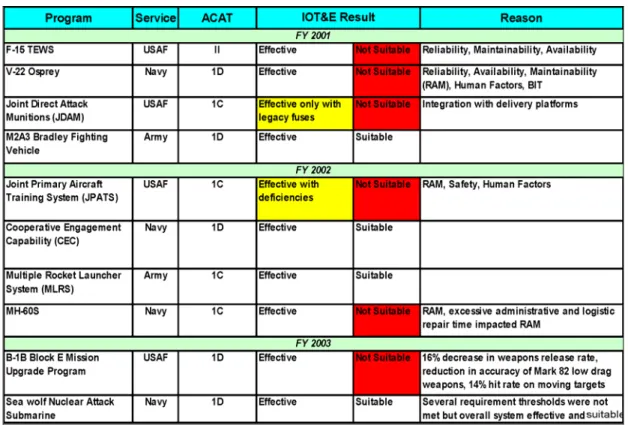
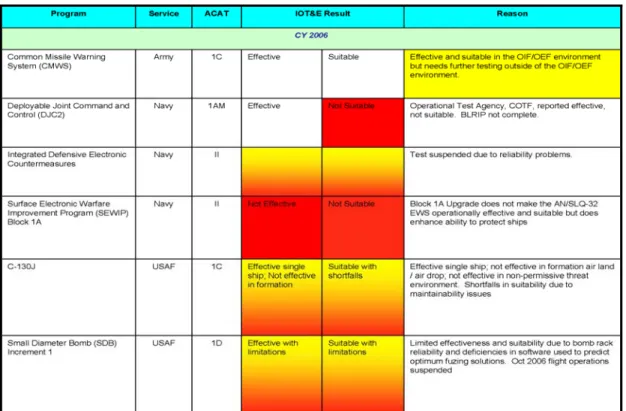
EFINITIONIn recent years, there has been a dramatic increase in the number of systems not meeting suitability requirements during IOT&E. Reliability, Availability and Maintainability (RAM) deficiencies comprise the primary shortfall areas. DoD IOT&E results from 2001 to 2006 are summarized in Figures 1 through 3. These charts graphically depict the high suitability failure rates during IOT&E resulting from RAM deficiencies. Figure 4 is a comparison of Army systems that met or did not meet reliability requirements.
EXECUTIVE SUMMARY___________________________________________________________________
Figure 1. DoD IOT&E Results FY 2001-2003.
_____________________________________________________________EXECUTIVE SUMMARY
Figure 3: DoD IOT&E Results for 2006.
Figure 4: Army Systems Failing Reliability during Operational Testing (1997-2006).
EXECUTIVE SUMMARY___________________________________________________________________
Early in the DSB study, it became obvious that the high suitability failure rates were the result of systemic changes that had been made to the acquisition process; and that changes in developmental test and evaluation could not remedy poor program formulation. Accordingly, the Task Force study was expanded to address the broader programmatic issues, as well as the above issues identified in the Terms of Reference (TOR).
A number of major changes in the last 15 years have had a significant impact on the acquisition process. First, Congressional direction in Fiscal Year (FY) 1996, 1997, 1998 and 1999 Defense Authorization Acts reduced the acquisition workforce (which includes developmental test and evaluation). Several changes resulted from the implementation of Acquisition Reform in the late 1990s. The use of existing commercial specifications and standards was encouraged, unless there was justification for the use of military specifications. Industry was encouraged to use commercial practices. Numerous military specifications and standards were eliminated in some Service acquisition organizations. The requirement for a reliability growth program during development was also deemphasized, and in most cases, eliminated. At the same time, systems became more complex, and systems-of-systems integration became more common. Finally, there was a loss of a large number of the most experienced management and technical personnel in government and industry without an adequate replacement pipeline. The loss of personnel was compounded in many cases by the lack of up-to-date standards and handbooks, which had been allowed to atrophy, or in some cases, eliminated. It should be noted that Acquisition Reform included numerous beneficial initiatives. There have been many programs involving application of poor judgment in the last 15 years that can be attributed to acquisition/test workforce inexperience and funding reductions. It is probable that these problems would have occurred independently of most Acquisition Reform initiatives.
All Service acquisition and test organizations experienced significant personnel cuts, the magnitude varying from organization to organization. Over time, in-house DoD offices of subject matter experts (who specialized in multiple areas, such as promoting the use of proven reliability development methods) were drastically reduced, and in some cases, disestablished. A summary of reductions in developmental test personnel follows. The Army essentially eliminated their military Developmental Testing (DT) component and declared the conduct of DT by the government to be discretionary in each program. The Navy reduced their DT workforce by 10% but no shift of "hands-on" government DT to industry DT occurred. The trend within the Air Force gave DT conduct and control to the contractor. Air Force test personnel have been reduced by approximately 15% and engineering personnel supporting program offices have been reduced by as much as 60% in some organizations. The reduction of DT personnel in the Services occurred during a time when programs have become increasingly complex (e.g., significant increases in software lines of code, off-board sensor data integration, and systems of systems testing). Congressional actions to cut the DOD acquisition workforce are also discussed in a recent National Research Council sponsored study.1
1
Paul Kaminski, et al, Pre-Milestone A and Early Phase Systems Engineering: A Retrospective Review and Benefits for Future Air Force Acquisition, Washington, D.C., National Research Council, 2008.
_____________________________________________________________EXECUTIVE SUMMARY
P
RINCIPAL FINDINGS AND RECOMMENDATIONSR
ELIABILITY,
A
VAILABILITY,
ANDM
AINTAINABILITY(RAM)
As a result of industry recommendations in the early 1970’s, the Services began a concerted effort to implement reliability growth testing as an integral part of the development process. This implementation consisted of a reliability growth process wherein a system is continually tested from the beginning of development, reliability problems are uncovered, and corrective actions are taken as soon as possible. The Services captured this practice in their reliability regulations, and the Department of Defense (DoD) issued a new military standard on reliability, which included reliability growth and development testing as a best practice task. The goal of this process from 1980 until the mid-1990’s was to achieve good reliability by focusing on reliability fundamentals during design and manufacturing rather than merely setting numerical requirements and testing for compliance towards the end of development.
The general practice of reliability growth was discontinued in the mid-to-late 1990’s, concurrent with the implementation of Acquisition Reform. This discontinuance may not be a direct result of Acquisition Reform, but may be related instead to the loss of key personnel and experience, as well as short-sighted attempts to save acquisition funds at the expense of increased life cycle costs. With the current DoD policy, most development contracts do not include a robust reliability growth program. The lack of failure prevention during design, and the resulting low initial Mean Time Between Failure (MTBF) and low growth potential are the most significant reasons that systems are failing to meet their operational reliability requirements.
An OSD Cost Analysis Improvement Group (CAIG) study2 shows operations and sustainment account for two-thirds or more of a system’s life-cycle cost. According to Army studies3, almost 90% of the sustainment costs are directly correlated with the reliability of the system. Given the amount of resources consumed during sustainment, investments in reliability enhancements can provide a very large return on that investment. A case study4 conducted by the Logistics Management Institute (LMI), provided data that indicated an investment in total program reliability equal to twice the average production unit cost would yield an approximate 35% reduction in support costs.
FINDINGS
• Acquisition personnel reductions combined with acquisition system changes in the last 15 years had a detrimental impact on RAM practices
– With some exceptions, the practice of reliability growth methodologies was discontinued during System Design and Development (SDD)
– Relevant military specifications, standards and other guidance were not used – Suitability criteria, including RAM, were de-emphasized
2
See Appendix I. Costs based on data reported in recent DoD Visibility and Management of Operating and Support Costs (VAMOSC) for programs, projected over the probable service lives of the systems.
3
Michael Cushing, David Mortin, and Steve Yuhas, Improving Army Materiel Reliability: A Business Case Approach, Washington, D.C., AEC and AMSAA, 2007.
4
EXECUTIVE SUMMARY___________________________________________________________________
• Improved RAM decreases life cycle costs and reduces demand on the logistics system • The Deficiency Report (DR) can be a valuable tool for early identification of
RAM-related suitability problems, when used in conjunction with an adequately resourced deficiency correction system
RECOMMENDATIONS
The single most important step necessary to correct high suitability failure rates is to ensure programs are formulated to execute a viable systems engineering strategy from the beginning, including a robust RAM program, as an integral part of design and development. No amount of testing will compensate for deficiencies in RAM program formulation. To this end, the following RAM-related actions are required as a minimum:
• Identify and define RAM requirements during the Joint Capabilities Integration Development System (JCIDS), and incorporate them in the Request for Proposal (RFP) as a mandatory contractual requirement
• During source selection, evaluate the bidders’ approaches to satisfying RAM requirements
– Ensure flow-down of RAM requirements to subcontractors
– Require development of leading indicators to ensure RAM requirements are met • Make RAM, to include a robust reliability growth program, a mandatory contractual
requirement and document progress as part of every major program review
• Ensure that a credible reliability assessment is conducted during the various stages of the technical review process and that reliability criteria are achievable in an operational environment
• Strengthen program manager accountability for RAM-related achievements
• Develop a military standard for RAM development and testing that can be readily referenced in future DoD contracts
• Ensure a adequate cadre of experienced RAM personnel are part of the Service acquisition and engineering office staffs
R
OLES ANDR
ESPONSIBILITIES OFG
OVERNMENTT
EST ANDE
VALUATIONO
RGANIZATIONSThe role of the government in the DT process has evolved over the past 50 years. Historical catalysts for change have included technological advances, acquisition policy changes, government resource availability and, in recent years, the Global War on Terrorism (GWOT). The most significant acquisition policy changes in the past several decades were made as a part of Acquisition Reform in the mid-to-late 1990’s. With some exceptions, there has been a significant decrease in government involvement in test planning, conduct and execution.
The traditional role of the government during the DT planning phase included the identification of the test resource requirements and government test facilities, the development of the test strategy and detailed test and evaluation plans, as well as the actual conduct of T&E. When a program moved from the planning phase to the test execution phase, the government traditionally participated in test conduct and analysis; performing an evaluation of the test results for the program office. With some exceptions, this is no longer the case. Until recently, it was
_____________________________________________________________EXECUTIVE SUMMARY
recognized that there should be some level of government involvement and oversight even when the contractor has the primary responsibility regarding planning and execution of the DT program.
In addition to the reduction in the number of government acquisition and test personnel, the experience level of both government and industry personnel has steadily diminished in recent years. A significant percentage of the workforce became eligible to retire since 2000, and due to prior downsizing, there has not been a steady pipeline of younger technical personnel to replace them. As an example, Appendix I is a chart depicting near-term retirement eligibility for Major Range and Test Facility Base (MRTFB) personnel. Two-thirds or more of the senior civil service personal are eligible for retirement.
FINDINGS
The changes in the last 15 years, when aggregated, have had a significant negative impact on DoD's ability to successfully execute increasingly complex acquisition programs. Major contributors include massive workforce reductions in acquisition and test personnel, a lack of up-to-date process guidance in some acquisition organizations, acquisition process changes, as well as the high retirement rate of the most experienced technical and managerial personnel in government and industry without an adequate replacement pipeline.
• Major personnel reductions have strained the pool of experienced government test personnel
• A significant amount of developmental testing is currently performed without a needed degree of government involvement or oversight and in some cases, with limited government access to contractor data
RECOMMENDATIONS
• As a minimum, government test organizations should develop and retain a cadre of experienced T&E personnel to perform the following functions:
- Participate in the translation of operational requirements into contract specifications, and in the source selection process, including RFP preparation
- Participate in DT&E planning including Test and Evaluation Master Plan (TEMP) preparation and approval
- Participate in technical review processes
- Participate in test conduct, data analysis, and evaluation and reporting; with emphasis on analysis and reporting
• Utilize red teams, where appropriate, to compensate for shortages in skilled, experienced T&E domain and process experts
• Develop programs to attract and retain government personnel in T&E career fields so that the government can properly perform its role as a contract administrator and as a “smart buyer”
I
NTEGRATEDT
EST ANDE
VALUATIONIntegrated testing is not a new concept within the Department of Defense, but its importance in recent years has been highlighted, due in part to the growth of asymmetric threats and the adoption of net-centric warfare. The December 2007 OSD Test and Evaluation Policy Revisions
EXECUTIVE SUMMARY___________________________________________________________________
memorandum reinforces the need for integrated testing.5 Implementation of integrated test concepts has been allowed to evolve on an ad-hoc basis. The time has come to pursue more consistency in integrated test planning and execution.
Collaboration between developmental and operational testers to build a robust integrated test program will increase the amount of operationally relevant data that can be used by both communities. DT and Operational Test (OT) planning is separate and this inhibits efforts by the Services to streamline test schedules, thereby increasing the acquisition timeline and program test costs.
Additionally, there is a widely held assumption by many in the OT community that only data from independent OT is acceptable for operational evaluation purposes. While not all information from DT may be useable by the Operational Test Agency (OTA) to support IOT&E, a significant amount of developmental test data can be used to partially satisfy OT requirements. More importantly, an operational perspective earlier in the developmental process has often proven to be a catalyst to early identification and correction of problems.
DoD policy should mandate integrated test planning and execution on all programs to the extent possible. To accomplish this, programs must establish a team made up of all relevant organizations (including contractors, developmental and operational test and evaluation communities) to create and manage the approach to incorporate integrated testing into the T&E Strategy and the TEMP.
FINDINGS
• Service acquisition programs are incorporating integrated testing to a limited degree through varying approaches
• Additional emphasis on integrated testing will result in greater T&E process efficiency and program cost reductions
RECOMMENDATIONS
• Implement OSD and Service policy6 mandating integrated DT&E/OT&E planning and execution throughout the program
– Require sharing and access to all appropriate system-level and selected component-level test and model data by government DT and OT organizations, as well as the prime contractor, where appropriate
– Integrate test events, where practical, to satisfy OT and DT requirements
O
PERATIONALT
ESTR
EADINESSR
EVIEW(OTRR)
Each Service has an Operational Test Readiness Review (OTRR) process. Although it varies from Service to Service, the process generally results in in-depth reviews of readiness to undergo an IOT&E event. 5 See Appendix D. 6 See Appendix D.
_____________________________________________________________EXECUTIVE SUMMARY
FINDINGS
• Department of Defense Instruction (DoDI) 5000.2 requires that “the Service Acquisition Executive (SAE) shall evaluate and determine materiel system readiness for IOT&E"
– Decision authority is frequently delegated to the appropriate Program Executive Officer (PEO)
– Materiel developer is also required to furnish DT&E report to the Under Secretary of Defense for Acquisition, Technology and Logistics (USD[AT&L]) and Director, Operational Test and Evaluation (DOT&E)
• Shortcomings in system performance, suitability, and RAM are usually identified during the OTRR
• In most cases, the operational test readiness certifying authority is well aware of the risk of not meeting OT criteria when major shortcomings exist
• Because of funding constraints, the low priority given to sustainment, as well as the urgency in recent years to get new capabilities to the Warfighter, major suitability shortcomings have rarely delayed the commencement of dedicated IOT&E
RECOMMENDATIONS
• Conduct periodic operational assessments to evaluate progress and the potential for achieving pre-determined entrance criteria for operational test events
• Conduct an independent Assessment of Operational Test Readiness (AOTR) prior to the OTRR (included in latest draft DODI 5000.2)
• Include a detailed RAM template in preparation for the OTRR
• Require the Command Acquisition Executive (CAE) to submit a report to OSD that provides the rationale for the readiness decision
OSD
T
EST ANDE
VALUATIONO
RGANIZATIONThe Task Force was asked to assess OSD roles and responsibilities for T&E oversight. T&E has been a visible part of OSD since the early 1970’s, reporting to the Research and Engineering command section when it was in charge of acquisition oversight and subsequently to the Under Secretary of Defense for Acquisition (now AT&L). The early T&E office was responsible for all T&E, ranges, resources oversight, and policy. In 1983, Congress established an independent Director, Operational Test and Evaluation (DOT&E) organization, reporting directly to the Secretary of Defense (SECDEF), responsible for operational test and evaluation policy, budget review, and assessments of operational effectiveness and suitability. The Live Fire Test (LFT) oversight function was created and added to the DT&E office responsibilities in the mid 1980’s. Later, the LFT oversight function was moved to the DOT&E organization.
In 1999, the DT&E organization was dismantled by DoD. Many functions were moved to DOT&E, including test ranges and resources, and joint T&E oversight. Some of the remaining T&E personnel billets were eliminated to comply with a congressionally mandated (AT&L) acquisition staff reduction. The residual DT&E policy and oversight functions were separated and moved lower in the AT&L organization.
EXECUTIVE SUMMARY___________________________________________________________________
A 2000 DSB Task Force Study on Test and Evaluation Capabilities recommended that DoD create a test and evaluation resource enterprise within the office of the DOT&E to provide more centralized management of T&E facilities. This recommendation ultimately led to removing the test ranges and resources oversight from DOT&E, abandoning the notion of centralized management, and the establishment of the Test Resource Management Center (TRMC) in AT&L (as directed by the National Defense Authorization Act for Fiscal Year 2003).
FINDINGS
Current policy as of December 2007 mandates that developmental and operational test activities be integrated and seamless throughout the system life cycle. There must be enough experts in OSD with the ability to understand and articulate lessons learned in early testing and the ability to execute the new T&E policy. That policy is to “take into account all available and relevant data and information from contractors and government sources” in order to “maximize the efficiency of the T&E process and effectively integrate developmental and operational T&E.”7
• Currently there is not an OSD organization with comprehensive DT oversight responsibility, authority or staff to coordinate with the operational test office
- The historic DT organization has been broken up and residual DT functions were
moved lower in organization in 1999, and lower yet in 2002
- Programmatic DT oversight is limited by staff size and often performed by
generalists vice T&E experts
- Recruitment of senior field test personnel is hampered by DT’s organizational
status
- Existing residual organizations are fragmented and lack clout to provide DT
guidance
- System performance information and DT lessons learned across DoD has been
lost
- DT is not viewed as a key element in AT&L system acquisition oversight - Documentation of DT results by OSD is minimal
• Access to models, data, and analysis results is restricted by current practice in acquisition contracting, and the lack of expertise in the DT organization
• TRMC has minimal input to program-specific questions or interaction with oversight organizations on specific programs
- Organizational separation is an impediment
RECOMMENDATIONS
• Implementation of integrated and seamless DT and OT will require, at a minimum, greater coordination and cooperation between all testing organizations
• Consolidate DT-related functions in AT&L to help reestablish a focused, integrated, and robust organization8
- Program oversight and policy, and Foreign Comparative Test (FCT)
- Have Director, DT&E directly report to Deputy Under Secretary of Defense,
Acquisition and Technology (DUSD[A&T])
7
See Appendix D.
8
_____________________________________________________________EXECUTIVE SUMMARY - Restore TEMP approval authority to Director, DT&E
• Integrate TRMC activities early into DT program planning
- Make TRMC responsible for reviewing the resources portion of the TEMP
• If such an organization is established and proves itself effective, consider as part of a future consolidation moving LFT back to its original DT location (this would require congressional action and DOT&E concurrence)
Most of the organizational changes recommended above are within the purview of AT&L. The LFT change requires the concurrence of DOT&E and a legislative change to Title 10 because of the change in reporting official. All the other recommendations made throughout the report can be implemented within current DoD authority.
O
THERI
SSUESSeveral other issues were addressed as a part of the study. A discussion of each of the following topics, along with findings and recommendations, may be found in the body of the report.
• Program Structure • Requirements Definition
• Contractual Performance Requirements
• Alignment of DoD Technology with Systems Engineering Procedures • Commercial Off-The-Shelf (COTS)
__________________________________________________________________INTRODUCTION
II.
I
NTRODUCTIONThe Defense Science Board Task Force on Developmental Test and Evaluation (DT&E) was established by the Under Secretary of Defense for Acquisition, Technology and Logistics9 to examine T&E roles, responsibilities, policy, and practices; and to recommend changes that may contribute to improved success in IOT&E as well as quicker delivery of improved capability and sustainability to the Warfighter. The Task Force study was the result of a dramatic increase in recent years in the number of programs that have been evaluated as not operationally effective and/or operationally suitable at the completion of IOT&E10. Approximately 50% of the programs completing IOT&E since 2000 have been assessed as not operationally effective and/or suitable. Problems in the suitability area predominate with reliability deficiencies serving as the major shortcoming11.
The Task Force was asked to assess:
• OSD organization, roles, and responsibilities for T&E oversight. Compare organization, roles, and responsibilities in both DT&E and OT&E. Recommend changes that may contribute to improved DT&E oversight, and facilitate integrated T&E.
• Changes required to establish statutory authority for OSD DT&E oversight. Title 10 USC has an OT&E focus and does not address OSD authority in oversight of DT&E. Recommend changes to Title 10 or other U.S. statutes that may improve OSD authority in DT&E oversight.
• Many IOT&E failures have been due to lack of operational suitability. Specific problems have been in the materiel readiness sustainment areas of reliability, maintainability, and availability. Recommend improvements in DT&E process to discover suitability problems earlier, and thus improve the likelihood of operational suitability in IOT&E.
III.
P
ROBLEMD
EFINITIONIn recent years, there has been a dramatic increase in the number of systems not meeting suitability requirements during IOT&E. RAM deficiencies comprise the primary shortfall areas. DoD IOT&E results from 2001 to 2006 are summarized in Figures 1 through 312. These charts graphically depict the high suitability failure rates during IOT&E resulting from RAM deficiencies. Figure 4 is a comparison of Army systems that met or did not meet reliability requirements..13
9
See Appendix A.
10
See Figures 1-3 (pages 2-3).
11
___________________________________________________________________BACKGROUND
IV.
B
ACKGROUNDA.
M
AJORC
HANGES IN THEL
AST15
Y
EARSStarting with the post-Cold War world of the early 1990’s, many initiatives have been undertaken to reduce the defense budget. In the aggregate, these initiatives have resulted in both beneficial and detrimental changes to the acquisition process.
Congress directed several sequential cuts to the DoD acquisition workforce in the late 1990’s. Congressionally mandated reductions started in FY1996, with additional cuts in the FY1997, 1998, and 1999 Defense Authorization Acts. The reductions mandated by Congress put the DoD acquisition workforce on a precipitous path and are highlighted in a recent National Research Council study.14 Personnel reductions, combined with implementation of new contracting approaches (e.g., performance-based contracting and Total System Performance Responsibility [TSPR]) reduced close government oversight. Over time, in-house DoD offices of subject matter experts (who specialized in multiple areas, such as promoting the use of proven reliability development methods) were drastically reduced, and in some cases, disestablished. The invoking of military specifications and standards in defense contracting was replaced by strong encouragement for industry to use what were thought to be less costly commercial practices and Commercial Off-The-Shelf (COTS) products.
Organizational efficiencies have been pursued through Base Realignment and Closure (BRAC) decisions. Also, efforts have been underway to bring a closer integration of the developmental and operational T&E organizations.
At the same time, the emergence of asymmetric threats have driven the need for the Services to collaborate closely in warfighting and the requirement for new joint Service operational capabilities and acquisition programs.
The attacks of September 11, 2001, ushered in a new era of warfighting with the Global War on Terrorism. Significant priority was given to finding more efficient ways to deliver new capabilities to the Combatant Commanders for use against quickly adapting threats. Rigorous T&E before deployment was sometimes sacrificed to meet schedule demands.
Major changes, some of which had detrimental impacts, are summarized below: • Congressionally mandated cuts to the acquisition workforce
– Decreased government management of acquisition program formulation and execution
• Acquisition Reform
– Strong encouragement to use commercial specifications and standards in lieu of military specifications
– Emphasis on commercial practices and products, including COTS equipment and components
BACKGROUND_________________________________________________________________________
– Performance-based contracting – Reduced government oversight
– Emphasis on survivability and lethality testing below end item
• Reliability growth during system development was deemphasized or eliminated • Emphasis on evolutionary acquisition and spiral development
• Increased weapon systems complexity
• Reduced government resources and workforce
• Integrated developmental and operational test emphasis • Emphasis on joint programs
• BRAC realignment
• Loss of strong Service advocates for RAM (Willoughby, Lorber, Goodell) • More emphasis on systems engineering
• Initiated Systems of Systems (SoS) acquisition approach
B.
R
ECENTA
RMYT&E
CHANGESDevelopmental testing within the U.S. Army has experienced changes in five principal areas over the last 15 years. They are:
• Organizational • Personnel
• OPTEMPO (Operational Tempo) • Legal
• Acquisition
In 1999 the Army consolidated the U.S. Army Test and Evaluation Command (TECOM), the Army’s principal developmental tester, with the Army’s U.S. Army Operational Test and Evaluation Command (OPTEC). This consolidation was driven by recommendations from the Army Science Board (ASB) which asserted that a single Army T&E command would provide more effective and efficient support to the materiel acquisition process and to the Warfighter. This organizational consolidation of testers, along with the previous consolidation of developmental and operational evaluators in 1996, resulted in the first fully-consolidated Service T&E organization within DoD; known as the U.S. Army Test and Evaluation Command (ATEC). Particularly noteworthy is the creation of a single ATEC system team chairperson to develop the early T&E concept with the ability to tailor the testing to eliminate rigid DT and OT stovepipes and minimizes the unnecessary use of resources. This required a significant cultural change but was essential to ATEC’s successful integration of DT and OT. Additional benefits have been gained by the development of a single integrated investment strategy across DT and OT organizations along with a single Information Technology (IT) Enterprise architecture. This architecture allows internal and external customers to view all T&E information on a particular acquisition system. Previous barriers, whether real or perceived, have been broken and cooperation has increased.
Personnel levels within the U.S. Army Developmental Test Command (formerly TECOM) decreased by 45% throughout the 1990’s to a level of 5,834 in 2000. During this period the military strength was reduced by 97%, virtually eliminating the Army’s Soldier, Operator, Maintainer, Test and Evaluation (SOMTE) personnel. The SOMTE soldiers, who were trained as testers and had recent field experience, influenced the planning and test conduct by providing
___________________________________________________________________BACKGROUND
material interface for early input on possible tactics, techniques, and procedures. Their involvement was more efficient than attempting to borrow troops from operational units that are already taxed by their existing missions.
Although military levels have not returned to the Army DT, there has been recognition of the value of a dedicated Army Evaluation Task Force (AETF) for the upcoming Army Future Combat Systems (FCS). A Brigade Combat Team (BCT) has been formed at Fort Bliss, Texas, to provide military test support for the FCS program.
There was a major shift from a government civilian to a contractor workforce from 1991 to 2007. Civilians were reduced by 45% while contractors were increased by 50%. Although contracting is an excellent strategy to augment the current civilian workforce, it should not replace the civilian workforce. Civilians are the stable part of the workforce. Contractors are employed and released based on workload demands. It is impossible to maintain the required testing experience and institutional knowledge necessary without maintaining a core cadre of government civilian personnel. The civilian workforce should be deemed critical in order to maintain the required institutional knowledge and skills to support current and future testing needs.
Major changes are summarized below:
• Testing functions consolidated into ATEC (1999)
• Army designated government DT as discretionary (late 1990s)
• Major shift in DT military, civilian, and contractor workforce mix (1991 to 2007) – Military strength reduced from 1836 to 61 soldiers
– Civilian manpower reduced from 5610 to 3076
– Contractor full-time equivalent increased from 3072 to 4599 • Rapid Fielding Initiatives (RFIs) reduced test times at the expense of:
– Increased workloads (up to 24 hours a day, 6 days a week)
– Decreased traditional subtests such as limited E3, cold and tropic testing, etc. – Suitability requirements
C.
R
ECENTN
AVYT&E
CHANGESThe Navy conducted 264 operational test events between FY1999 and FY2007 (May 2007). The averages over this time found programs 85.6% effective and 67.4% suitable. The figure on the next page displays the Navy's operational test success rates over the past 8 years:
BACKGROUND_________________________________________________________________________
% Effective and Suitable by FY
0.0% 20.0% 40.0% 60.0% 80.0% 100.0%
FY99 FY00 FY01 FY02 FY03 FY04 FY05 FY06 FY07 % Effective % Suitable
Figure 5: Navy Operational Test Success Rates FY 1999-2007.
Naval Aviation DT has always been “hands on.” No shift to oversight has ever occurred. The Naval Air Systems Command (NAVAIR), Naval Sea Systems Command (NAVSEA), and Space and Naval Warfare Systems Command (SPAWAR), generally support the Integrated Test Team (ITT) concept. Integrated DT&E and OT&E provides an opportunity for the Commander, Operational Test and Evaluation Force (COMOPTEVFOR) to participate in DT, provide information to the Decision Authority (DA) in advance of independent OT, enlarge the OT database, and reduce the amount of operational testing. Integrated testing is encouraged and is governed by the TEMP. Program managers have discretion to determine where integrated testing will improve overall test process effectiveness.
In June 2005, the Navy Operational Test Agency formally recognized that testing needs to be considered as a continuum of events. COMOPTEVFOR formally adopted the following goals:
• Seek integration of testing, where appropriate • Eliminate redundant events
• Recognize the distinct disciplines in developmental and operational test • Use both to better support the systems engineering process.
A truly integrated approach takes a significant investment of intellectual capital upfront. The OT community is obliged to develop a more sophisticated understanding of the system under development. The requirements community is challenged to articulate Concept of Operations (CONOPS) and to more clearly define system requirements. A more robust definition of the threat environment is needed. The development of a common database that assures the pedigree of the data is essential but may not be compatible with many of the contractual vehicles developed in the late 1990’s (e.g., some acquisition contracts awarded during that period did not contain the necessary contract data requirements clauses to obtain access to contractor test data).
___________________________________________________________________BACKGROUND
Some variations of DT approaches exist within the Navy. Aviation has a robust and organizationally identifiable DT community. The surface community treats DT as a subset of systems engineering. The Command, Control, Communications, Computers and Intelligence (C4I) community has been challenged to find realistic venues for full scale developmental and operational tests. The common approach tends to be to demonstrate new technology and capability while taking older technology as a given (e.g., new long range radar performance versus short range modes, shallow water torpedo modes tested, deep water assumed to be good). Integration with legacy systems is not always adequately tested. Even the best software test facilities seem to be challenged to accurately estimate the time and effort required. Challenges of integrating with older, poorly documented systems still exist.
Major changes are summarized below:
• Navy enterprise T&E board of directors established in 2007
– Encourages integration of priorities across Navy Warfighting Enterprises – Facilitates continuous process improvement initiatives
– Shares and leverages best practices
• Personnel levels in Navy DT reduced 10% across the board
– No shift from government “hands-on” DT to oversight has occurred • Integrated prime contractor/government DT/ OT (Integrated Test Teams) • Navy DT closely coupled with systems engineering process
D.
R
ECENTA
IRF
ORCET&E
CHANGESPolicies implemented as a result of budgetary pressures from the end of the Cold War through the early 1990’s affected resources flowing into DT&E capability development and sustainment. The divergence of policy governing requirements definition, acquisition, and test, along with Air Force acquisition’s transition to Total System Performance Responsibility (TSPR) in the later part of the decade, collectively led to a “hollowing out” of the test capability infrastructure and the perception of government “rent-a-ranges” by weapon system Original Equipment Manufacturers (OEMs). In addition, there was a major reduction in the in-house engineering workforce. Some of these trends have begun to reverse. Accordingly, Air Force policy documents were updated after 2002 to re-link requirements, acquisition and test planning, and management and execution. However, additional effort is needed to correctly define, resource, and sustain current test capability needs; plan for future test capability requirements; and realign or divest test capabilities and infrastructure that are minimally used or no longer required, in order to create an optimum balance of DT&E test capabilities.
Budgetary pressures have historically influenced both the policy and resources governing the utilization and sustainment of test capabilities retained by the Air Force. These budgetary pressures and the resulting challenges of implementing long-range test capability strategies remain today. The DT&E portion of the budget has declined, in proportion of Research, Development, Test and Evaluation (RDT&E) funding, from approximately 9.8% in 1996 to approximately 7.3% in 2005. This divergent trend has challenged the Air Force’s ability to maintain current DT&E capabilities across test centers and has limited investments in new capabilities necessary for testing advanced technologies (e.g., hypersonics and directed energy
BACKGROUND_________________________________________________________________________
A healthy DT&E capability requires a trained technical workforce that supports current test requirements, adjusts to meet tactical changes, and yet is also prepared to support testing of advanced technologies and future test requirements. The current Air Force DT&E workforce is a composite of military (officer and enlisted), government civilians, and contractors. The Air Force DT&E workforce has decreased approximately 15% since FY1992 and has shifted towards a much reduced organic (civilian, officer and enlisted) government T&E workforce. In 1994, contractors made up approximately 20% of the total workforce; while in 2003 contractors comprised approximately 50% of the workforce. During the same period, the organic government T&E workforce has generally declined. This trend, combined with policy shifts towards increasing OEM developmental test activities, suggests that a significant amount of DT&E is performed without the benefit of government insight or oversight.
Major changes are summarized below:
• Current trend is to give DT&E conduct and control to the prime contractor
– Ability to conduct government DT&E and independent analysis has significantly diminished
– Increasing perception that Air Force test activities are migrating to "rent-a- range" support for system manufacturers
• Test personnel levels have decreased approximately 15% since 1992 – Support contractor workforce increased from 20% to 50%
• Aeronautical systems engineering workforce declined 59% in last 15 years – Established Central Test Authorities (CTAs) in 2004
• Moved PEOs from the Pentagon to Product Command Centers
• DT reporting activity decreased from an average of 200 reports per year in the 1980's to approximately 50 reports per year since the mid 1990's
________________________________________________PRINCIPAL FINDINGS AND RECOMMENDATIONS
V.
P
RINCIPAL FINDINGS AND RECOMMENDATIONSA.
R
ELIABILITY,
A
VAILABILITY,
ANDM
AINTAINABILITY(RAM)
15As a result of industry recommendations in the early 1970’s, the Services began a concerted effort to implement reliability growth testing as an integral part of the development process. This implementation consisted of a reliability growth process wherein a system is continually tested from the beginning of development, reliability problems are uncovered, and corrective actions are taken as soon as possible. The Services captured this process in their reliability regulations (i.e., Army Regulation 702-3, the Air Force R&M 2000, and the Navy Willoughby Templates Best Practices, NAVSO P-6071). In 1980, DoD issued a new military standard on reliability, Mil Std 785 B Reliability Program for Systems and Equipment Development and Production, which included reliability growth and development testing as a best practice task. In 1981, DoD also issued a new military handbook on reliability growth, Mil Handbook 189,
Reliability Growth Management, which addressed the concepts and principles of reliability growth, advantages of managing reliability growth, and guidelines and procedures to be used in managing reliability growth.
The goal of the reliability process from 1980 until the mid-1990’s was to increase the reliability of the programs tested, mainly by focusing on reliability fundamentals during the design and manufacturing phases rather than merely focusing on numerical performance and test requirements during full scale DT and IOT&E. DoD data from 1980-1988 shows that programs adopting a reliability growth approach increased system MTBF by an average factor of four. In the 1990's and later, testing for reliability growth was not typically conducted. The logical conclusion, everything being equal, is that systems are being fielded with a fraction of the MTBF potential. This conclusion is consistent with the high percentage of systems not meeting requirements as well as the high support costs. On the other hand, those DoD systems that still employ reliability growth generally field systems with higher effectiveness and lower support costs than they would if they had not had a reliability growth program.
As stated above, the general practice of reliability growth was discontinued with the implementation of Acquisition Reform in the mid-to-late 1990’s. An exception is aircraft development programs in the Navy and Air Force. Reliability growth testing during development remains a standard practice for most of these programs. However, as can be seen in Figures 1 and 216, RAM failure rates during IOT&E are high in many aircraft programs. Adequate attention is not given to initial requirements. Contributing factors include the elimination of a viable reliability organization in some acquisition organizations as well as a lack of up-to-date process guidance. Additionally, problems uncovered through the DR process and other reporting mechanisms are usually not corrected. With the current DoD practices, most other development contracts since the mid-1990’s do not include a robust reliability growth program. These programs rely instead on an operational reliability test to demonstrate a numerical MTBF requirement. Experience over the past 35 years has shown that reliability demonstration tests not preceded by a strong reliability growth program during development
PRINCIPAL FINDINGS AND RECOMMENDATIONS________________________________________________
have proven to be ineffective in providing acceptable levels of RAM. In contrast, reliability growth practices have proven effective on many major fielded systems (e.g., the Army’s Black Hawk, M1 Abrams, Bradley, and Patriot, as well as many Navy and Air Force systems).
The successful achievement of system suitability is directly related to the management and engineering attention given to RAM-related failure prevention during the design phase. These management and engineering activities are primarily directed toward increasing the system’s initial operational MTBF and establishing the system’s growth potential MTBF above the minimum acceptable requirement. Reliability growth is successful if it is based on a fundamentally good design with a modest number of deficiencies.
The lack of continuous RAM improvement during design, and the resulting low initial MTBF and low Growth Potential are the most significant reasons that systems are failing to meet their operational suitability requirements. Good RAM is vital to many suitability factors, including training and logistics support. Dependable failure prevention starts with the reliability growth in the design phase. In order to attain needed and sustainable RAM in fielded systems, RAM generally needs to increase beyond the minimum acceptable requirements, toward the growth potential. This additional increase in reliability usually requires finding failure modes through continuous testing that could not otherwise be predicted and prevented in the design phase, such as due to interactions between components. Although failure modes are typically uncovered before the completion of DT, failure analysis and corrective actions generally do not occur in time for cost-effective, design-optimized solutions.
There are numerous adverse consequences that have been shown to result from suitability shortfalls. The first and most significant are under performance in the field and substantial increases in life cycle costs. These cost implications are discussed in more detail below. There are also additional near-term ramifications. Some programs are forced to extend the SDD phases and add unplanned resources for redesign, reengineer and retest. The V-22 program extended SDD by five years and spent over $1 billion additional funds to resolve its suitability issues. The Joint Air-to-Surface Standoff Missile (JASSM) was similarly delayed from proceeding to full production and deployment because of poor RAM. When poor performance in IOT&E delays the full production or fielding of a system, additional costs are incurred to operate and support the system in the near term. In some cases, the correction of RAM deficiencies are deferred until a major block upgrade or Service Life Extension Program (SLEP). The corrections, as well as remedial actions and the retrofits into already fielded systems, necessitate additional funding. The operation and maintenance of multiple configurations of fielded systems is another unplanned expense. Any system that is fielded with known RAM shortcomings increases the costs for maintenance and repair as well as for additional contractor logistics and spare parts support.
An OSD CAIG study shows that Operations and Sustainment (O&S) costs account for two-thirds or more of a system’s total life-cycle cost17. According to Army studies18, almost 90% of the in-service costs are directly correlated with the reliability of the system. Given the amount of resources consumed during sustainment, investments in reliability enhancements can provide a
17
See Appendix I.
18
________________________________________________PRINCIPAL FINDINGS AND RECOMMENDATIONS
substantial return on that investment. A case study conducted by LMI19, provides data that indicate an investment in total program reliability equal to twice the average production unit cost would yield an approximate 35% reduction in support costs. This conclusion was based on major combat systems; these systems are large enough to provide significant funding to implement a reliability program. The conclusions of the LMI case study suggest that a relatively modest investment in reliability programs would have a substantial positive impact on the lifecycle cost of the system. In addition, according to an Army study20, increasing reliability had the largest positive effect on operational availability. Reliability issues are the most common root cause of 50% of systems being judged as not suitable in IOT&E. A recent GAO study21 reinforced the need for increased attention to Weapons Systems quality issues, particularly reliability. A recent study by the Institute for Defense Analyses also suggests that investing in reliability is the most effectively accomplished during System Design and Development.22
FINDINGS
• Acquisition personnel reductions combined with acquisition system changes in the last 15 years had a detrimental impact on RAM practices
– With some exceptions, the practice of reliability growth methodologies was discontinued during SDD
– Relevant military specifications, standards and other guidance were not used – Suitability criteria, including RAM, were de-emphasized
– The technical/managerial workforce was reduced in most government program offices and test organizations
• Reliability staff was reduced from 50 to 5 in one major acquisition organization
• Improved RAM decreases life cycle costs and reduces demand on the logistics system • RAM shortfalls are frequently identified during DT, but program constraints (schedule
and funding) often preclude incorporating fixes and delaying IOT&E
• By the time reliability data are analyzed in IOT&E, it is generally too late to make significant design changes (i.e. improve the reliability within program resources)
• In some instances, programs had such serious RAM concerns that they were precluded from proceeding to production until the problems could be corrected. Improved RAM decreases life cycle costs and reduces demand on the logistics system
• The DR can be a valuable tool for early identification of RAM-related suitability problems when used in conjunction with an adequately resourced deficiency correction system
RECOMMENDATIONS
The single most important step necessary to correct high suitability failure rates is to ensure programs are formulated to execute a viable systems engineering strategy from the
19
Jim Forbes, Presentation on Empirical Relationships Between Reliability Investments and Life-Cycle Cost, 2008.
20
Michael Cushing, et al, Improving Army Materiel Reliability: A Business Case Approach, 2007.
21
United States Government Accountability Office, Best Practices: Increased Focus on Requirements and Oversight Needed to Improve DoD’s Acquisition Environment and Weapon System Quality, Washington, D.C., February 2008.
PRINCIPAL FINDINGS AND RECOMMENDATIONS________________________________________________
beginning, including a robust RAM program, as an integral part of design and development. No amount of testing will compensate for deficiencies in RAM program formulation. To this end, the following RAM-related actions are required as a minimum:
• Identify and define RAM requirements during the JCIDS process, and incorporate them in the RFP as a mandatory contractual requirement
• During source selection, evaluate the bidders’ approaches to satisfying RAM requirements
– Ensure flow-down of RAM requirements to subcontractors
– Require development of leading indicators to ensure RAM requirements are met (all Technical Performance Measurements [TPMs])
• Make RAM, to include a robust reliability growth program, a mandatory contractual requirement and document progress as part of every major program review
• Ensure that a credible reliability assessment is conducted during the various stages of the technical review process (System Readiness Review [SRR], Preliminary Design Review [PDR], Critical Design Review [CDR], etc.) and that reliability criteria are achievable in an operational environment
• Strengthen program manager accountability for RAM-related achievements
• Develop a military standard for consistent RAM development and testing that can be readily referenced in future DoD contracts
• Modify the curriculum at the Defense Acquisition University (DAU) to stress the importance of a robust reliability design and test effort as part of the systems engineering process
• Ensure an adequate cadre of experienced RAM personnel are part of the Service acquisition and engineering office staffs
• Action
– USD(AT&L) charter an OSD/Service Task Force to implement RAM recommendations
B.
R
OLES ANDR
ESPONSIBILITIES OFG
OVERNMENTT
EST ANDE
VALUATIONO
RGANIZATIONSThe role of the government in the DT process has evolved over the past 50 years. Catalysts for change have historically included technological advances (e.g., software intensive systems, fly-by-wire, SoS), acquisition policy changes, government resource availability, and in recent years, the Global War on Terrorism. Perhaps the most significant acquisition policy changes in the past several decades were made as a part of Acquisition Reform in the mid-to-late 1990’s. The cancellation of many military specifications and standards without replacing them with adequate commercial specifications and standards had a detrimental impact on system development. The promotion of performance-based contracting and TSPR contract vehicles impacted the government’s role in the DT process. Additionally, the government acquisition and test workforce was reduced as a part of the reform process as well as by Congressionally mandated
________________________________________________PRINCIPAL FINDINGS AND RECOMMENDATIONS
cuts. The Services test personnel drawdown specifics are discussed in detail in the preceding sections.23
DoD acquires a wide variety of commodities including surface ships, submarines, aircraft, missiles, ground combat vehicles, space systems, and numerous types of sensors and command & control systems. In the last two decades, systems became increasingly software intensive which, for most systems, enables and results in frequent block upgrades. This drives almost continuous test activity which may last for decades, in contrast to most programs in the 1950’s-1970’s which had discrete test program and workforce start and end points. There are some commonalities, but many differences, in the test practices among these systems. This is driven in part by the commodity, and in part by the Service acquisition and test organizational structures and culture. Some previous studies have focused on organizational change, with recommendations for more uniformity in the Service test organizational structures. However, the effectiveness of the government’s involvement in DT is driven more by its role and related processes than by organizational construct.
Commodity type has a major influence on the government’s role in the DT process. An illustrative contrasting example is aircraft versus large surface ships. In the former case, dedicated test vehicles are flown at government-operated ranges. In the latter case, there are no dedicated test vehicles. The mission systems are sometimes installed at a location separate from the shipbuilder’s facility and system alpha and beta testing are accomplished on the first operational ship by the ship’s crew, in conjunction with personnel from the responsible test activity. At the other end of the spectrum, DT on many command and control systems is accomplished in part or totally by the manufacturer at the contractor facility.
What is the appropriate test and evaluation role for the government in today’s environment?
As discussed previously, there is no single organizational model for the Services to follow. However, there are many common elements where knowledgeable government test expertise is needed. The first is participation of government DT during RFP preparation to help define test assets, define test resources, and scope the test program. Related critical issues include ensuring that the RFP gives the government rights to test data acquired by the contractor as well as access to contractor developed models and simulations. The test community should then participate in the source selection process to evaluate the test programs proposed by the offerors.
The traditional responsibilities of the government during the DT planning phase have included development of the test strategy and detailed test plans, as well as the identification of the test resource requirements and government test facilities. The degree of involvement was driven by the commodity type and the contractual approach. In the past, a limited amount of DT planning and execution was accomplished primarily or exclusively by the government. With rare exceptions, this is no longer the case. However, there should be some level of government involvement and oversight even when the contractor has the primary responsibility regarding
PRINCIPAL FINDINGS AND RECOMMENDATIONS________________________________________________
planning and execution of the DT program. A recent GAO study24 corroborates the requirement for increased government oversight. In the past, when the program moved from the planning phase to the test execution phase, the government participated in test conduct and analysis, supplying operators and engineers with DT personnel who performed an evaluation of the test results. These evaluations took many forms. Some government organizations published a report summarizing their analysis of the information. This is still accomplished by some Service DT organizations but has been discontinued by others. “Quick Look” rapid feedback briefings are sometimes used as reporting mechanisms. While these fulfill a useful purpose, they tend to be perishable and are not archived for future reference. The most powerful reporting tool for RAM issues is the DR. This report is still used during most developmental programs; however, deficiency correction, except for major problem areas, gets far less attention. One Service audit agency recently issued a report that criticized the lack of emphasis on addressing problems identified through the DR process. This de-emphasis is caused in part by the lack of a robust reliability program that includes reliability growth as an integral part of the systems engineering effort.
The implementation of some Acquisition Reform initiatives has had detrimental impacts on T&E. The current OSD guidance is to use performance specifications and commercial standards in preference to design-specific specifications and standards. There had been some poor applications of military specifications and standards in the past, in that they were not sufficiently tailored to the system to be procured. However, these standards had evolved and were updated over decades and were excellent compendiums of best practices and lessons learned. Many were used to provide guidance for system development to ensure a systematic and disciplined approach, and to ensure that problems that occurred in any new complex high technology system would be uncovered early. Since the start of Acquisition Reform, these documents have not been kept up to date in many cases. One organization estimated that 80% of their technical handbooks have atrophied in the last ten years. This information on processes and procedures will be lost over time unless the Services take aggressive action to preserve it.
The congressionally mandated cuts mentioned earlier had a major detrimental impact on the government acquisition and test community. The Services’ DT workforce reductions are discussed in more detail earlier in this report.25 Significant reductions were made by all Services to the government program management and supporting engineering workforce. In some cases, these cuts decimated the workforce in certain technical domains. For example, the reliability engineering workforce at one acquisition product center was reduced from 50 in 1997 to 5 in 2007, and further cuts are anticipated in 2008. These are the personnel who define reliability criteria for incorporation into RFPs, shape the reliability growth programs for the program office, participate in deficiency reporting and other reviews, and evaluate the status of the reliability test effort during development. It is not surprising that the RAM results from IOT&E are so dismal, given the loss of government expertise in developing initial requirements and evaluating results. A specific case from another product center involves a current major joint Service acquisition for which there were no suitability requirements specified in the initial contract. Not surprisingly,
24
United States Government Accountability Office, Best Practices: Increased Focus on Requirements and Oversight Needed to Improve DoD’s Acquisition Environment and Weapon System Quality, February 2008.
25
________________________________________________PRINCIPAL FINDINGS AND RECOMMENDATIONS
the reliability of the system was extremely poor and the system’s software crashed so often during IOT&E that testing was terminated.
The large congressionally mandated cuts, when combined with high retirement rates has a significant detrimental effect on the experience level of the government acquisition/test workforce. This trend is driven by the retirement of a high percentage of the experienced workforce and the absence of a steady pipeline of younger technical personnel to replace them. As an example, Appendix I is a chart depicting near-term retirement eligibility for MRTFB personnel. Two-thirds or more of the senior civil service personnel are eligible for retirement. The loss of government personnel will have an additional impact on industry in the future, as it is a major training source for people who transfer to industry.
A 2008 National Research Council study26 contains an in-depth discussion of the six drivers of cost development time and performance risks. It characterizes inexperienced government and industry personnel in key leadership positions as the largest risk. Other risk areas to avoid or manage include external interface complexity, system complexity, incomplete or unstable requirements in Milestone B, reliance on immature technology, and reliance on large amounts of new software.
FINDINGS
The aggregate lack of process guidance due to the elimination of specifications and standards, massive workforce reductions in acquisition and test personnel, acquisition process changes, as well as the high retirement rate of the most experienced technical and managerial personnel in government and industry has a major negative impact on DoD's ability to successfully execute increasingly complex acquisition programs.
• Major personnel reductions have strained the pool of experienced government test personnel
– Government test and evaluation capability has been severely impaired in some acquisition organizations
– A significant amount of developmental testing is currently performed without the needed degree of government involvement or oversight and in some cases, with limited government access to contractor data
• The current trend away from governmental involvement in DT makes operationally oriented testing in some areas during development even more difficult to accomplish.
RECOMMENDATIONS
• As a minimum, government test organizations should develop and retain a cadre of experienced T&E personnel to perform the following functions:
- Participate in the translation of operational requirements into contract specifications, and in the source selection process, including RFP preparation
– Scope test program and define test assets – Develop proposed test program