University of Huddersfield Repository
Power, Jess
Promoting Employability Skills Through Active Learning
Original Citation
Power, Jess (2012) Promoting Employability Skills Through Active Learning. In: The Second Employability, Enterprise, & Citizenship in Higher Education Conference, Tuesday 27th March 2012, Manchester, UK.
This version is available at http://eprints.hud.ac.uk/16613/
The University Repository is a digital collection of the research output of the University, available on Open Access. Copyright and Moral Rights for the items on this site are retained by the individual author and/or other copyright owners. Users may access full items free of charge; copies of full text items generally can be reproduced, displayed or performed and given to third parties in any format or medium for personal research or study, educational or not-for-profit purposes without prior permission or charge, provided:
• The authors, title and full bibliographic details is credited in any copy; • A hyperlink and/or URL is included for the original metadata page; and • The content is not changed in any way.
For more information, including our policy and submission procedure, please contact the Repository Team at: [email protected].
1
Promoting Employability Skills Through Active Learning
E.J.Power [email protected]
Hollings Faculty, Manchester Metropolitan University
Abstract
The Higher Education (HE) landscape in England has changed dramatically in the last two decades. There is a political drive to improve accessibility and transparency of information available to current and prospective students. This combined with the new funding structure is placing more demand on HE intuitions to ensure students receive a positive experience and value for money. Employability by its very nature can only be assessed after graduation. However, developing strategies for enhancing student employability skills is a key area in HE. Traditional methods of teaching and learning however limit the development and evaluation of employability skills. Active learning strategies in contrast offer educators the opportunity to embed skill enhancement. It is imperative that graduates have developed life skills of problem solving, teamwork, communication and an enthusiasm for their selected career in addition to discipline knowledge. This paper details the development of employability skills within an apparel product development unit at level 6. The unit employed an active learning strategy using an operational framework. It was delivered over a period of 24 weeks for two consecutive years. It was found that there was evidence to suggest that active learning encouraged the development of employability skills.
Key words: Apparel, Active learning, Employability, life skills
Introduction
Universities in UK are experiencing a period of unprecedented change. In the last two decades the Higher Education (HE) landscape in England has changed dramatically. The most recent government HE reforms are designed to tackle three challenges; financial sustainability; student experience; and social mobility (BIS, 2011). The white paper “Students at the heart of the system” (BIS, 2011), focuses on greater accountability in higher education, placing students firmly in the driving seat, in terms of choice. The cost of studying in HE is set to rise during autumn 2012 to between £6,000 – 9,000 per annum depending on the course and university (BIS, 2011), and in turn student expectations are set to change. One reason for pursuing a HE qualification that is often cited is to improve job prospects (BIS, 2009; DIUS, 2009). It has become widely recognised that individuals with HE qualifications are less likely to be out of work, have better life chances and higher earning potential (BIS, 2009, DIUS, 2008; BIS 2009a; DIUS, 2009). It has been acknowledged that the skills required for globalised knowledge based economies are built by educated, enterprising people (BIS, 2009a; BIS, 2009b). The relationship between HE and the national economy is not new, governments worldwide have considered various strategies to promote
2 graduate employability. Lord Leitch’s analysis showed that the UK economy requires 40% of the working population to have degree equivalent skills to support economic growth (DIUS, 2008). Stephen Howard (Chief Executive, Business in the Community) stated ‘in the current economic climate, graduates now more than ever need to be equipped with the right skills to succeed in the workplace’ (DIUS, 2009a).
Employability is an ambiguous term with many interpretations. Most literature associates the term (at least in part) with graduates obtaining a job (Hillage and Pollard, 1998; Pierce, 2002; Yorke, 2006); and certainly in the UK this data is published as a key performance indicator (HEFCE, 2001). Yet is this a good measure of employability, since employers can after all only assess the potential to perform a task at the interview stage, proof comes after (Hinchliffe and Jolly, 2010). Perhaps Hillage and Pollard (1998) definition of employability would serve the term better; an individual’s capability of gaining initial employment, maintaining employment, and obtaining new employment if required. Yet there are notable problems within the HE context with this definition, since employability (in this sense) can only be assessed some time after graduation and requires continuous monitoring. A more accurate measure of employability in the HE context would be the potential of a graduate to obtain employment. Yet this is subjective and almost impossible to quantify. At best HE can only facilitate the students’ development in terms of employability skills. The definition of employability provided by Yorke appears to serve HE more accurately ‘a set of achievements – skills, understandings and personal attributes – that makes graduates more likely to gain employment and be successful in their chosen occupations, which benefits themselves, the workforce, the community and the economy’ (2006, pp.8). In order for graduates to be competitive they need to be industry ready, possessing the necessary professional and technical skills to ensure success in the modern world of work. HE needs to develop strategies for enhancing and measuring the development of student employability skills within the curriculum.
Wedgewood in 2008 reported that the HE sector must redefine the business of teaching and learning if it is to achieve a step change in the delivery of HE to the workforce market that is recommended in the Leitch report. It is essential that graduates are industry ready, equipped with the necessary professional and technical skills to ensure they are competitive, a view supported by many researchers and reports (Laughlin & Kean, 1995; DeLong et al., 1997; De Gallow, 2000; Eckman & Frey, 2005; Fiore et al., 2005; Hawley, 2005; O’Neal, 2007; BIS, 2010). Yorke’s (2006) report acknowledged that employers value generic skills far higher than subject knowledge in terms of graduate recruitment. Further to this the report stated that in the main, employers have been generally happy with subject knowledge and skills, but less satisfied with graduates’ generic skill development. Many publications acknowledge that it is no longer enough for graduates to have passed assessment they must have developed life skills of problem solving, teamwork, communication and enthusiasm for their selected career (Carpenter & Fairhurst, 2005; Eckman & Frey, 2005; Fiore et al., 2005; Hawley, 2005; Kimmons & Spruiell, 2005). A view supported by Wedgewood (2008) who’s report addressed the need for common understanding to be achieved between the value of acquiring
3 knowledge as well as skills, and the value of intellectual development as well as competency in occupational skills. Previous work (Power, 2010b) identified four key statements required to enhance graduate employability in the apparel sector, The development of technical competencies (knowledge, understanding and competency); The expansion of life skills for a globalised knowledge economy (key and occupational/professional skills); The advancement of high order cognitive skills (analysis, synthesis and evaluate); and, The appreciation of metacognitive strategies (learning how to learn, appreciating skill development).
Globalisation has continued to dominate the apparel industries worldwide, accelerating at an ever changing pace (Eckman & Frey, 2005; Jacob, 2007; Walter et al eds, 2009). It has been reported by many that no sector of business is more global than the textiles and apparel (Dickerson, 1999; Jones 2002; Kunz and Garner, 2006; Soni and Kodali, 2010) thus, providing many dynamic opportunities for HE graduates that are skill and knowledge ready. In order to raise levels of graduate employability, it has been identified prior that generic skills in teamworking, problem solving and communication must be improved (Carpenter & Fairhurst, 2005; Eckman & Frey, 2005; Fiore et al, 2005; Hawley, 2005; Kimmons & Spruiell, 2005; Power, 2007; Power , 2010b). A key feature of current HE education policy is the development of industry ready graduates; the challenge for HE is the integration of employability skills into the curriculum which will not become obsolete. Yorke a (2006) aligns employability with good learning (Yorke, 2006a). When devising any curriculum creating the right learning environment must be given a high priority, engaging the student is essential to success (Piaget, 1977; Von Wright, 1992; Mayes, 1998; Cannon & Newble, 2000; Downing, 2001; Kadolph, 2005; Downing et al., 2007; Downing et al., 2009; Power, 2010b). Hawley (2005) acknowledged the shortcomings of a traditional passive teaching system and recommended that opportunities to encourage skill development needed to be embedded into the curriculum planning.
There has been a considerable amount of research and development within HE over the last three decades in respect to effective teaching and learning (Knowles & Associates, 1984; Cannon & Newble, 2000; Somekh, 2006; Greasley & Ashworth, 2007; Ha-Brookshire, 2008). Many authors (Downing et al, 2007; Greasley & Ashworth, 2007; Downing et al, 2009) have acknowledged that one factor that influences learning is the educator, Cannon & Newble (2000) summarised this as a “two-way bargain” it is the lecturer’s responsibility to create a stimulating environment to promote interaction and a learner’s responsibility to actively engage. Previous works identified that largely when learners are given the opportunity to invest in an issue they tend to take ownership (Kimmons & Spruiell, 2005; Hmelo et al, 1997; Hawley, 2005; Power, 2010b). Active learning strategies have been proven to promote; student engagement, the development of metacognition, effective progression to autonomous learning, and the enhancement of key/professional skills (Power 2007; Power, 2010a). Whilst the relationship between active learning strategies and effective learning is well established in HE, a link has not yet been established which connects apparel students perception of employability skill development and active learning. Since value for money and student experience are increasingly important, and a major driver for individuals
4 engaging with HE is related to improved job prospects and enhanced career opportunities, students perception of the development of employability skills within HE needs to be explored.
Aim of the study
The focus of this paper was to investigate (from a learners perspective) if active learning strategies encouraged the development of employability skills. Three research questions were investigated.
1) Did the learners developed specific life skills as a direct result of the teaching and learning method.
2) Did active learning strategies promote the development of employability skills? 3) Will active learning strategies benefit the student in their employment?
Further to this, the study also investigated if the method of assessment allowed the student to display the extent of their learning effectively, whether they enjoyed their learning experience, and if they were satisfied with the quality of the unit. Five methods were used to evaluate the success of the unit; a practitioner journal, learner formative feedback, learner skills audit, attendance records and assessment grade. This paper presents the findings of the learner skills audit and parts of the learner formative feedback from level 6 (National Framework for Higher Education Qualifications (FHEQ)) students taken from two consecutive cohorts.
Curriculum design
There is no doubt that student expectations are on the rise. Individuals are set to pay up to £9000 per year out of their own pockets from Sep 2012 to finance their education. Already there is a political drive regarding transparency of information, and with this there comes a higher expectation that students will receive a positive learning experience and value for money. Exactly how each student measures this varies depending on a variety of factors including the learners past experiences and perceptions of future experiences (particularly in relation to their career). More emphasis is being placed on measures such as the National Student Survey and obtaining graduate level jobs (current students use the previous year’s data as benchmark for their success). This is not surprising since improved career prospectus is a common reason for engaging with HE study. Therefore, curriculums need to be geared to producing industry ready graduates with the right skills to ensure success in their selected career. Educators need to provide opportunities to encourage skill enhancement appropriate to the cognitive development of HE students both academically and professionally. Previous studies acknowledged it is easy to blame the student for poor performance in terms of skill development, but in reality it is often the fault of a passive teaching system (Fiore et al, 2005; Hawley, 2005) that provided no opportunity for the wider development of lifelong skills. Many authors have identified that a dualistic approach (a right or wrong answer) does not encourage the development of student’s critical thinking skills, which may affect their long term contribution to the global market place (Laughlin & Kean 1995; DeLong, 1997; Fiore et
5 al, 2005; Kimmons & Spruiell, 2005). The advancement of lifelong learning skills promotes the development of metacognitive strategies which are essential for survival in our rapidly changing world (Kimmons & Spruiell, 2005; Downing et al, 2007).
Various studies have demonstrated that learners prefer active engagement enabling them to secure a concrete learning experience at the point of delivery; studies also support a general trend to higher academic achievement (Schroeder, 1993; Hawley, 2005; Power, 2007; Eskrootchi & Reza Oskrochi, 2010; Power, 2010a). Active learning strategies are effective but careful consideration must be given to how they are embedded into the curriculum. It cannot be presumed that all students will have encountered this style of learning previously or have the skills to be self directed (Fiore et al, 2005; Downing et al 2009; Power, 2010a). Power (2010b) suggested that an operational model which provides a supportive framework should be employed, since some students will be in unfamiliar territory. This model enables the students to determine at least some goals and devise action plans to realise them, but provides a safety net in terms of possible tutor intervention. Active learning strategies provides opportunities for the development of academic, profession and lifelong learning skills, especially if employed in team working scenarios combined with elements of PBL. It is linked to the development of critical thinking, analytical and self development skills. The apparel product development curriculum was designed using an active learning operation model to facilitate the students’ development in terms of employability skills in addition to developing technical competencies. The curriculum development is well documented in a prior publication (Power, 2010b) and is based around the principles of producing industry ready graduates possessing the necessary employability and technical skills.
Four cutting edge apparel technologies were embedding into an advanced product development curriculum. The technologies were not only introduced, based on a series of activities to encourage active engagement, they were integrated together enabling the students to critically evaluate the merits independently but also synthesise the impact each one had on the other. This is a new development since it is rare for an educational establishment to have all the technologies available to them and even less common for them to be integrated simultaneously into a curriculum. Each technology requires a specialist tutor and therefore a fully integrated team teaching approach is required. To replicate industry product development teams, the cohort was split into teams consisting of between 6-10 members and the product development teams were given a project and weekly activities to support them (thus employing the operational active learning model). They received weekly lectures (from a range of guest speakers), weekly tutor feedback, peer support sessions and academic support sessions. The assessment was designed in 3 stages, the first stage contained the research, critical analysis and evaluation; the second stage focussed on communication of the group range (advanced sportswear) in terms of the technology; and the final stage reflected on the product development process and the impact of the new integrated technology. The academic support sessions had a direct focus on skill development, but enhancement of employability skills was implicit through the whole project. Since the project required self management, critical engagement, group working, communication, information technology
6 and personal skills to be developed. These were mapped with the QAA subject benchmark statements for generic skill (2008) development and developed into a 14 point skill audit. Metacognative strategies were developed through putting into practise what had been learned, this involved planning, reflection, refining ideas, producing action plans, problem solving, producing minutes and engaging with peer and tutor support strategies. Finally the higher order cognitive skills were developed through the project since the students were requested to analysis, synthesis, and evaluate their own design (in terms of innovative, new and emerging technology) and then each group was required to synthesis the entire range (evaluating strengths and weaknesses). The group disseminated their findings in a conference style presentation lasting 40 minutes to an informed audience.
Method
The participants of this study totalled between 118 - 126 level 6 (NQF) students. The survey was taken over two consecutive cohorts during the period 2009-2010 and 2010-2011 from a population totalling 179 students. The sample was predominantly female with less than 3% of the total cohorts being male. Participants were all at the same level in their studies but the pre-requisites varied since some students were direct entry at level 6. The response rate for each year was; 48-49 students which equates to 60-61% of the cohort in 2009-2010, and 70-77 students which equates to 71-78% of the cohort in 2010-2011 (figures vary due to response rate differing between the survey and skills audit). The students were placed in product development teams (12 in total per cohort) each consisting of between 6-10 members.
The unit was delivered to level 6 apparel (FHEQ) students and was weighted at 20 credits (equates to 1/6 of the final year). The unit was delivered over a period of 24 weeks (two 12 week terms) and timetabled for a total of two hours per week. During the first 12 weeks the cohort was timetabled together in a fixed seat lecture theatre and the class time was split equally between guest lectures and student product development team activities (active learning). During the second term a team teaching approach was utilised, this involved four subject specialist lecturers and the cohort was split into four sub groups each totalling between 18-25 students. Each of the sub groups contained 3 product development teams, which rotated around the staff (and technology) on a two week cycle, the remainder of the weeks (4 weeks) was used for academic support sessions. The unit design is discussed extensively in a prior publication (Power, 2010b). This paper focuses on the students’ perception of skill development within the unit.
Data analysis
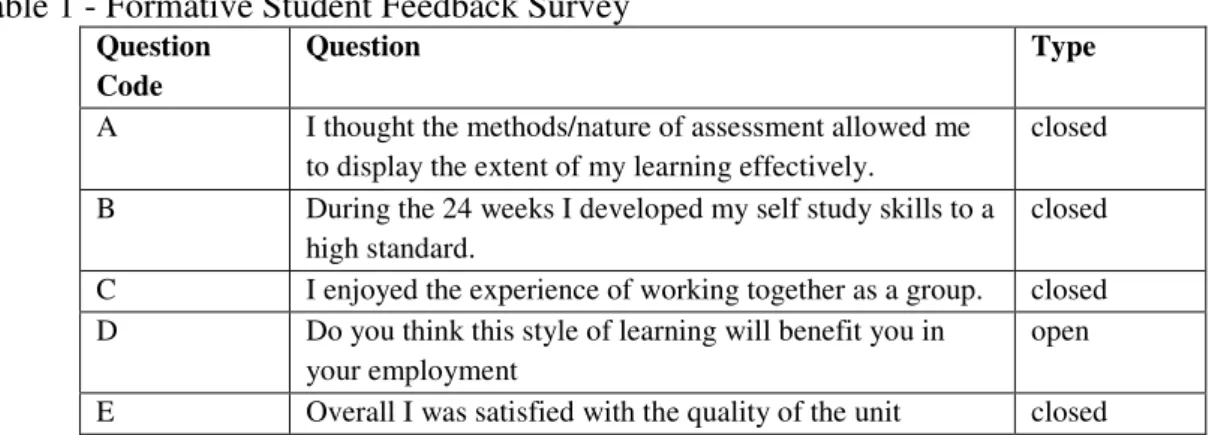
The formative student feedback survey consisted of 16 closed questions and 9 open questions which were categorised under 3 headings (learning, teaching and general comments). The closed questions used a 5 point Likert-type scale ranging from 5 (strongly agree) to 1 (strongly disagree). This paper presents the analysis of five specific questions (Table 1) related to employability, study skills, assessment method, enjoyment and general unit satisfaction (four questions were closed and 1 open ended).
7 Table 1 - Formative Student Feedback Survey
Question Code
Question Type
A I thought the methods/nature of assessment allowed me
to display the extent of my learning effectively.
closed
B During the 24 weeks I developed my self study skills to a
high standard.
closed
C I enjoyed the experience of working together as a group. closed
D Do you think this style of learning will benefit you in
your employment
open
E Overall I was satisfied with the quality of the unit closed
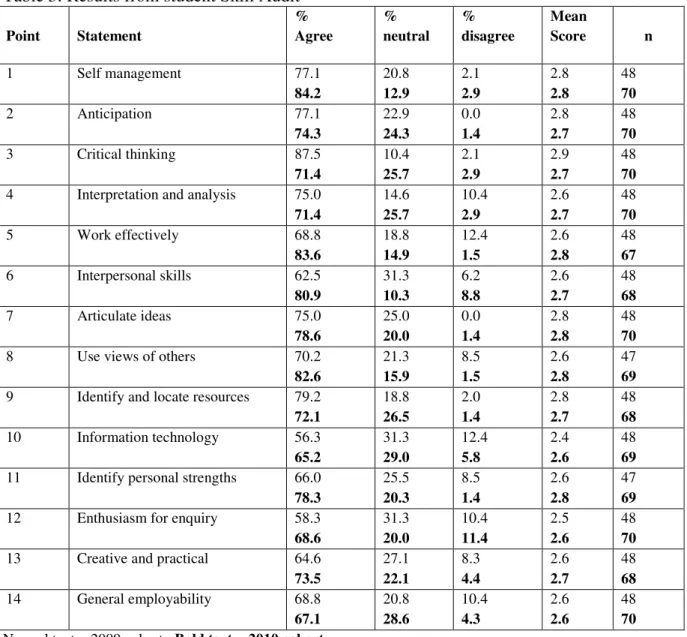
Further to this a 14 point skill audit was administered to enable student perception of employability skill development to be quantified in relation to the teaching and learning methods (Table 2). The skill statements used a 5 point Likert-type scale, ranging from strongly agree to strongly disagree to enable them to quantify their skill development. Both the survey and skill audit was administered on the last teaching session, week 24 which was before the final assessment. Statistical analyses were performed using Statistical Package for the Social Sciences (SPSS 18). For ease of comparison between the cohorts the Likert scale was modified to 3 agree, 2 neutral, 1 disagree (Tables 3 and 4 presents an overview of the data obtained from the two cohorts).
Table 2 - Student 14 Point Skill Audit Point Statement
1 The teaching and learning method used in this unit enabled me to improve myself management skills (study independently, set goals, meet deadlines)
2 The teaching and learning method used in this unit enabled me to anticipate and accommodate change and work within the context of uncertainty and unfamiliarity
3 The teaching and learning method used in this unit enabled me to improve my critical thinking skills
4 The teaching and learning method used in this unit enabled me to improve my skills of data interpretation and analysis
5 The teaching and learning method used in this unit improved my ability to work effectively in a group/team setting
6 Working in a group/team environment improved my interpersonal communication skills
7 The teaching and learning method used in this unit enabled me to articulate ideas and information comprehensibly in visual, oral and written forms
8 The teaching and learning method used in this unit enabled the group to use the views of others effectively in the development or enhancement of their work
9 The teaching and learning method used in this unit improved my ability to identify and locate appropriate resources to assist with problem solving
10 Through this project my information technology skills have improved
11 This project has enabled me to identify personal strengths and reflect on personal development 12 Through this project I developed enthusiasm for enquiry into technology research and the
motivation to sustain it.
13 This project provided the opportunity to develop both creative and practical skills 14 This unit was very valuable in the development of employability skills
8
Data analysis and results
The data from the skills audit was analysed to assess if each cohort thought the style of teaching and learning had enabled them to develop/improve a range of skill related to employability. The students were presented with 14 statements; two statements relating to each of the following categories; self management (Table 2: Points 1&2), critical engagement (Points 3&4), group working skills (Points 5&6), skills in communication (Points 7&8), information skills (Points 9&10) and personal qualities (Points 11&12), the remaining two statements (Points 13&14) allowed the student to acknowledge the development of creative/practical and employability skills.
Table 3: Results from student Skill Audit Point Statement % Agree % neutral % disagree Mean Score n 1 Self management 77.1 84.2 20.8 12.9 2.1 2.9 2.8 2.8 48 70 2 Anticipation 77.1 74.3 22.9 24.3 0.0 1.4 2.8 2.7 48 70 3 Critical thinking 87.5 71.4 10.4 25.7 2.1 2.9 2.9 2.7 48 70
4 Interpretation and analysis 75.0
71.4 14.6 25.7 10.4 2.9 2.6 2.7 48 70 5 Work effectively 68.8 83.6 18.8 14.9 12.4 1.5 2.6 2.8 48 67 6 Interpersonal skills 62.5 80.9 31.3 10.3 6.2 8.8 2.6 2.7 48 68 7 Articulate ideas 75.0 78.6 25.0 20.0 0.0 1.4 2.8 2.8 48 70 8
Use views of others 70.2 82.6 21.3 15.9 8.5 1.5 2.6 2.8 47 69 9
Identify and locate resources 79.2
72.1 18.8 26.5 2.0 1.4 2.8 2.7 48 68 10 Information technology 56.3 65.2 31.3 29.0 12.4 5.8 2.4 2.6 48 69
11 Identify personal strengths 66.0
78.3 25.5 20.3 8.5 1.4 2.6 2.8 47 69 12
Enthusiasm for enquiry 58.3 68.6 31.3 20.0 10.4 11.4 2.5 2.6 48 70 13
Creative and practical 64.6 73.5 27.1 22.1 8.3 4.4 2.6 2.7 48 68 14 General employability 68.8 67.1 20.8 28.6 10.4 4.3 2.6 2.6 48 70
9 The mean scores were all above the central tendency (1.5) of the 3 point scale, thus indicating a positive skew towards agreement with all the specific skill development statements (Table 3). More detailed analysis of the frequency distribution revealed that over 74% of both cohorts agreed that their self management skills (points 1&2) had developed as a result of the teaching and learning (T&L) method. The first cohort (2009) scored the development of critical engagement (points 3&4) slightly higher than the 2010 cohort. However, irrespective of the cohort over 70% of both cohorts agreed that their critical engagement skills had improved as a direct result of the T&L strategies utilised. In terms of group working skills (points 5&6) the second cohort indicated a significant improvement in group working (above 80%). Both cohorts agreed in the main (over 70%) with communication skills (points 7&8) improving. The next four statements related to information gathering skills (points 9&10) and personal skill development (points 11&12). Whilst the vast majority of students (over 72%) felt the unit design had improved their ability to identify and locate appropriate resources to assist with problem solving; only 56.3% of the 2009 cohort (65.2% of the 2010 cohort) thought that the project had enabled them to improve their information technology skills. Regarding the development of personal qualities, 78.3% of the 2010 cohort but only 66% of the 2009 cohort supported this statement. A similar picture was illustrated (68.6% of the 2010 cohort and 58.3% of the 2009 cohort agreed) for demonstrating enthusiasm for enquiry into technology research and the motivation to sustain it. The statement (Point 13) regarding the development of creative/practical skills show that over 73% of the 2010 (64.6% of the 2009) cohort agreed that the project provided the opportunity to develop these. The final statement related to the development of employability skills illustrated very similar levels of agreements for both cohorts (68.8% and 67.1% respectively).
Data analysis of formative questionnaire
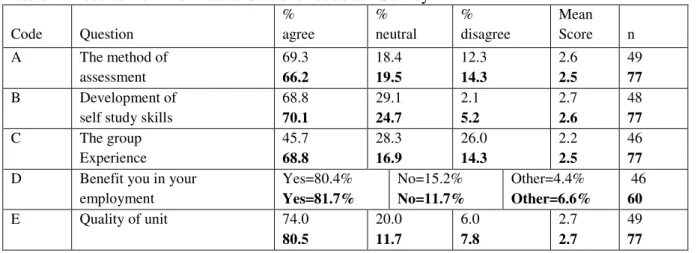
Five specific questions (Table 1) from the formative student feedback survey were analysed, the data is presented in Table 4. Questions B (closed question) and D (open question) related directly to the research aims. It was found that both cohorts agreed (68.8% in 2009 and 70.1% in 2010) that during the 24 weeks they developed their self study skills to a high standard. The open ended question related to if this style of learning will benefit you in your employment (D) was analysed initially using a yes/no/other criteria although many students expanded on this with comments such as: group work reflects the scenario in industry, it enables you to work with new people, it enables you to develop key communication skills. It was found that over 80% of both cohorts agreed that active learning would benefit them in their employment. A further 3 questions related to; the method of assessment (Question A), the group experience (Question C) and the quality of the unit (Question E) were analysed. The results for method of assessment were similar between the cohorts with over 66% agreeing that it allowed them to display their learning effectively. Similarity the quality of the unit was highly rated with over 74% of both cohorts being satisfied. The question relating to group working, specifically related to the enjoyment of the group experience. The results show that whilst the majority (mode) of the individuals from the 2009 cohort selected the agree category, the actual percentage is significantly lower than obtained in any other
10 question or skill statement. The student’s perception of their group experience improved significantly in the next cohort (2010) with 68.8% agreeing that they had enjoyed their experience.
Table 4: Results from Formative Student Feedback Survey
Code Question % agree % neutral % disagree Mean Score n A The method of assessment 69.3 66.2 18.4 19.5 12.3 14.3 2.6 2.5 49 77 B Development of self study skills
68.8 70.1 29.1 24.7 2.1 5.2 2.7 2.6 48 77 C The group Experience 45.7 68.8 28.3 16.9 26.0 14.3 2.2 2.5 46 77 D
Benefit you in your employment Yes=80.4% Yes=81.7% No=15.2% No=11.7% Other=4.4% Other=6.6% 46 60 E Quality of unit 74.0 80.5 20.0 11.7 6.0 7.8 2.7 2.7 49 77
Normal text = 2009 cohort : Bold text = 2010 cohort
Discussion
It was found from the skills audit that generally the level 6 students perceived that a variety of life skills were developed/improved as a direct result of the active teaching and learning strategy utilised in this unit. On average the mean score relating to the 14 statements for 2009 was calculated to be 2.6 and in 2010 it was 2.7 which show’s that the vast majority of students agreed that specific skills had been developed. The highest agreements were related to point 1 (agreement was above 77% for both cohorts) which was improved self management skills, this supports findings of other studies which have focused on using active learning to develop autonomous learners (Power, 2010a). When the same students answered a similar question (Question B, relating to the development of self-study skills) in the formative feedback survey the number of students that agreed was significantly lower (agreement less than 71%). Point 7 also scored highly with over 74.9% agreeing that the teaching and learning method used in this unit had enabled them to articulate ideas and information comprehensibly in visual, oral and written forms. Since the assessment was specifically designed to enable students to utilise a variety of different methods it is surprising the number of students that selected the neutral option (between 20-25%).
The two statements, in which less than 60% of the group (2009 cohort) agreed with, were related to the development of information technology skills, and enthusiasm for enquiry into technology research and the motivation to sustain it. This was interesting since the project had deliberately encouraged the development of IT skills through, a written assignment, a visual poster (incorporating CAD) and a 40 minutes presentation (supported by Powerpoint). During the project some groups in this cohort had progressed further to develop their research
11 to include primary data from sports clubs (interviews and observations), innovative material developments (swatches and technical details of materials), samples of seaming (obtained from industry), body scans of professional athletes, information on advanced technology (using resources outside the department, wind tunnel etc.) and had incorporated a self developed movie clip to provide an overview of their research. Clearly not all the learners perceived this as enthusiasm for the enquiry or the advancement of IT skills, perhaps this was due to the skills being so deeply embedded into their project work. It was observed by the tutors that the students excelled in their resourcefulness for research and invested heavily to maximize the desired outcome. This supports the work of Kimmons & Spruiell (2005) and Hmelo et al (1997) who identified when students are given opportunity to invest they take direct ownership. Further strategies need to be explored regarding students reflective practice to assess how a greater appreciation of IT skills can be embedded and why so many students are selecting the neutral option in many categories (10.3-31.3%).
The final statement in Table 3 related to the development of employability skills, the data showed very similar levels of agreements for both cohorts (68.8 and 67.1 % respectively). In the formative survey, when the question was re-worded to link directly to employment over 80% of both cohorts agreed that active learning would benefit them in their employment. This suggested that students associated the unit directly with employment prospect rather than the development of employability skills. This could be linked to graduates connecting HE qualifications to improve job prospects.
In terms of group working skills (points 5&6 in Table 3) the 2010 cohort indicated significant improvement in group working skills (above 80%), whilst support was provided to both cohorts there was a slight change in the delivery schedule during the second cohort and tutor feedback to the groups was provided both verbally and written on a weekly basis during the first term. Tutor observation found that the written feedback appeared to open each weeks peer discussion, providing the group with team guidance and points to consider, encouragement and promoted a stronger element of reflection, than that observed in the first cohort. The question in the formative student feedback survey (Question C, Table 2) relating to group working, specifically related to the enjoyment of the group experience. The results show that whilst the majority (mode) of the individuals from the 2009 cohort selected the agree category, the actual percentage is significantly lower than obtained in any other question or skill statement. The group experience improved significantly in the next cohort with 68.8% agreeing that they had enjoyed their experience. This appears to support the view above regarding change in delivery.
Further to this, the study also investigated if the method of assessment allowed the student to display the extent of their learning effectively and if they were satisfied with the quality of the unit. Generally the views of the students remained static in all these areas with most students agreeing.
12
Conclusion
The focus of the study was to investigate (from a learners perspective) if active learning developed employability skills within apparel students? It was found from the data analysed that generally the level 6 students perceived that a variety of life skills were developed/improved as a direct result of the active teaching and learning strategy utilised in this unit. However, it was acknowledged that further strategies need to be explored regarding how to improve student’s reflective practice to assess a greater appreciation of IT skills and establish the reason for why so many students had selected the neutral option. The finding from this study suggested that students associated the unit directly with employment prospect rather than the development of employability skills. But since these are interrelated it can be concluded that active learning strategies do promote the development of employability skills. This study clearly established a link between apparel student’s perception of employability skill development and active learning.
References
BIS (2009) Who’s heading for HE, Department for Business, Innovation and Skills, URN 09/1166, TSO: UK.
BIS (2009a) Higher Ambitions, Department for Business, Innovation and Skills, URN 09/1452, TSO: UK.
BIS (2009b) Skills for Growth, Department for Business, Innovation and Skills, Cm 764, TSO: UK.
BIS (2010) Annual innovation report 2009, Department for Business, Innovation and Skills, URN 11P188, TSO: UK, Available online at: http://www.bis.gov.uk/annual-innovation-report-2009 (accessed March 2010).
BIS (2011) Students at the heart of the system (whitepaper), Department for Business, Innovation and Skills, CM8122, TSO: UK.
Cannon, R. & Newble, D. (2000) A handbook for teachers in universities and colleges 4th Ed, Kogan Page: UK.
Carpenter, J. M. & Fairhurst, A. E. (2005) Delivering quality and value in the classroom: The use of problem-based learning in retail merchandising courses, Clothing and Textile Research Journal, 23(4) 257-265.
De Gallow, D. (2000) What is Problem-based Learning? University of California, Available online at: http://www.pbl.uci.edu/whatispbl.html (accessed Feb 2010).
DeLong, M., Hegland, J. & Nelson, N. (1997) Encouraging critical thinking in the classroom: an example from aesthetics, Clothing and Textiles Research Journal, 15(2) 86-95.
13 DIUS (2008) A New University Challenge: Unlocking Britain’s Talent, Department for Innovation, Universities and Skills, Crown copyright: UK.
DIUS (2009) Life after Graduation, Department for Innovation, Universities and Skills, Crown copyright: UK.
DIUS (2009a) Boosting Skills in the Work Place. Department for Innovation, Universities and Skills. Crown copyright: UK
Downing, K. (2001) Information technology, education and healthcare: constructivism in the 21st Century. Educational Studies. 27(3) 299-235.
Downing, K. et al (2007) Metacognitive development and moving away. Educational Studies. 33(1) 1-13.
Downing, K. et al (2009) Problem-based learning and the development of metacognition, Higher Education, (57) 609-621.
Eckman, M. & Frey, D. K. (2005) Using WebCT NAFS program to promote analytical thinking and global awareness competencies through a team approach, Clothing and Textiles Research Journal, 23(4) 278-289.
Eskrootchi, R., & Oskrochi, G. R. (2010). A study of the efficacy of project-based learning integrated with computer-based simulation - STELLA. Educational Technology &
Society, 13 (1), 236–245.
Fiore, A. M., Kadolph, S. J. & Ogle, J. P. (2005) Promoting critical thinking in product development: connections between textile science and consumers’ aesthetic value, Clothing and Textiles Research Journal, 23(4) 229-237.
Greasley, K. and Ashworth, P. (2007) The phenomenology of ‘approach to studying’: the university learner’s studies within the lifeworld, British Education Research Journal, 33 (6), 819–843.
Ha-Brookshire, J. (2008) Exploring learning experiences in textile and apparel management; study aboard in El Salvador, International Journal of fashion Design, Technology and Education, 1 (3), 113–123.
Hawley, J. M. (2005) Border crossing: active and deep learning in a large global consumption class, Clothing and Textiles Research Journal, 23(4) 307-321.
HEFCE (2001) Performance indicators in hger education: 1998-99, 1999-2000, Higher Education Funding Council for England.
Hmelo, C. E. et al. (1997) A Theory Driven Approach to Assessing the Cognitive Effects of PBL, Instructional Science, (25) 387-408.
14 Hillage, J. and Pollard, E. (1998) Employability: developing a framework for policy analysis, Department for Education and Employment.
Hinchliffe, G. W. & Jolly, A. (2010) Graduate identity and employability, British Educational Research Journal, iFirst Article, 1-22 (accessed June 2010).
Jacob, J. (2007) Surveying the present and an imagined future: The quest for a bright future in the textiles and apparel professions, Clothing and Textiles Research Journal, 25(4) 349-374.
Jones, R. M. (2002) The apparel industry, Blackwell Science: UK.
Kadoloph, S. J. (2005) Equipment Experts: Enhancing Student Learning in Textile Science, Clothing and Textile Research Journal, 23(4) 368-374.
Kimmons, J. V. & Spruiell, P. R. (2005) Using problem-based learning in a Multidisciplinary Setting, Clothing and Textiles Research Journal, 23(4) 385-395.
Knowles, M. S. and Associates (1984) Andragogy in action, Jossey-Bass: US. Kunz, G. I. and Garner, M. B. (2006) Going global: The textile and apparel industry, Fairchild Publications: New York.
Laughlin, J. & Kean, R. C. (1995) Assessment of textiles and clothing academic programs in the US, Clothing and Textiles Research Journal, 13(3) 184-199.
Mayes, T. (1998) Teaching, technology and talk, The Psychologist, 11(8) 375-377.
O’Neal, G. S. (2007) Continents, cultures, curriculum: some thoughts on the future of the profession, Clothing and Textiles Research Journal, 25(4) 375-379.
Piaget, J. (1977) The Development of Thought: Equilibrium of Cognitive Structures. Viking Press: New York.
Pierce, D. (2002) Employability: higher education and careers service, cited in Yorke, M. (2006) Employability in higher education: What it is – what it is not. Learning and Employability series 1, ESECT, The Higher Education Academy: UK.
Power, E. J. (2007) An examination into textile education by active research, Textile Institute 85th World Conference. Conference Proceedings: Colombo, Sri Lanka, 1st – 3rd March 2007. Power, E. J. (July 2010a) Examination of issues effecting the teaching and learning of large cohorts within practical based subjects, International Journal of Fashion Design, Technology and Education, 3 (2) 55-66.
Power, E. J. (2010b) Devising a product development curriculum to promote industry ready apparel graduates. The Textile Institute Centenary Conference. Conference Proceedings: Manchester UK, 2-4th Nov 2010.
15 QAA (2008) Subject benchmark statements (Art and Design), The Quality assurance agency for Higher Education, 2008.
Schroeder, C. (1993) New students – new learning styles, Change, 21-26. Somekh, B. (2006) Action research, Open university Press: UK.
Soni, G. and Kodali, R. (2010) International benchmarking for assessment of supply chain performance, Benchmarking: An international Journal, 17 (1) 44-76.
Von Wright, J. (1992) Reflections on Reflection, Learning and Instruction, 2 (1) 59-68. Yorke, M. (2006) Employability in higher education: What it is – what it is not. Learning and Employability series 1, ESECT, The Higher Education Academy: UK.
Yorke, M. (2006a) Embedding employability into the curriculum, Learning and Employability series 1, ESECT, The Higher Education Academy: UK.
Walter, L et al (2009) Transforming clothing production into a demand-driven, knowledge-based, high-tech Industry, Springer: UK.
Wedgewood, M. (2008) Higher Education for the Workforce: Barriers and Facilitators to Employer Engagement, Research Report 08 04, Department for Innovation, Universities and Skills, Crown copyright: UK.