PERCEPTIONS OF STAKEHOLDERS ON MANAGEMENT DEVELOPMENT PROGRAMMES FOR BEGINNING SECONDARY SCHOOL HEADS IN ZIMBABWE
BY
KUDZAYIISHE MUDZINGWA
SUBMITTED IN ACCORDANCE WITH THE REQUIREMENTS FOR THE DEGREE OF
DOCTOR OF PHILOSOPHY
IN THE SUBJECT
EDUCATION MANAGEMENT
AT THE
UNIVERSITY OF SOUTH AFRICA
PROMOTOR: PROFESSOR EJ VAN NIEKERK OCTOBER 2018
Page | i DEDICATION
This work is dedicated to the memory of my mother, Marie Mudzingwa née Matumba. I can never thank you enough for the unconditional love and support that you gave to me as I grew up. You always gave me invaluable wisdom and advice when I needed it most. You shall always remain a source of inspiration to me. I knew one day I would make you proud.
Page | ii ACKNOWLEDGEMENTS
This work could not have been completed without the wise counsel, support and encouragement of several people.
I am most thankful to Professor E. J. Van Niekerk for the guidance and support
he provided to me during the entire duration of my research work. I shall always remain indebted to his insightful advice and constructive feedback that motivated me to keep working on this project.
I am also grateful to my wife, Wadzanayi, for providing me with encouragement
and support throughout the research work.
My sincere appreciation goes to members of my family, namely my father Mr July
Kenneth Mudzingwa, brother Johnson, sister Abigail, children Ken, Kevin Tatenda and Karen Mufaro for their continued support during the research process.
I am also indebted to the support of Jairos Gonye, a colleague and friend who
sacrificed his precious time to shape my ideas.
I would like to thank the Ministry of Primary and Secondary Education for granting
me the permission to carry out research in its schools.
I also wish to express my heartfelt gratitude and appreciation to the scores of participants who sacrificed their time to participate in this research study. Thank you all.
Page | iii DECLARATION
I declare that the research report entitled PERCEPTIONS OF STAKEHOLDERS ON MANAGEMENT DEVELOPMENT PROGRAMMES FOR BEGINNING SECONDARY SCHOOL HEADS IN ZIMBABWE is my own work, and that all sources used or quoted have been indicated or acknowledged by means of complete references.
Signature
KUDZAYIISHE MUDZINGWA
Page | iv ABSTRACT
The education system in Zimbabwe has experienced a wide range of educational reforms
and technological changes since the last half of the 20th century. These changes have
resulted in a significant expansion of the duties and responsibilities that school heads are expected to perform in schools. Despite these changes, there has not been a comprehensive training programme meant to prepare newly promoted secondary school heads for the daunting task of school leadership in Zimbabwe. The study sought to examine the perceptions of stakeholders regarding management development programmes (MDPs) for beginning secondary school heads (BSSHs). The study employed the descriptive case study approach based on a qualitative research design. A total of 28 participants were initially selected for the study but only 27 took part. The participants comprised five BSSHs, five practising secondary school heads, four deputy heads and 10 senior teachers who were drawn from 10 selected secondary schools in Zaka district. Three school inspectors from the district education office in Zaka district also took part. The participants were purposively sampled using the maximum variation sampling approach to account for the differences of their professional categories. Individual semi-structured interviews were used to collect data from the BSSHs, practising secondary school heads and school inspectors, while focus group interviews were used to collect data from deputy heads and senior teachers. A review of relevant documentary sources such as vacancy announcement circulars, the Civil Service Commission (CSC) training and development policy and policy circulars from the Ministry of Primary and Secondary Education (MoPSE) was also undertaken. The findings indicated that there was a need for a management development programme that would equip newly promoted school heads with the relevant technical skills and competencies that would enable them to provide sound leadership to schools. The study established that BSSHs required knowledge and skills in financial management, instructional leadership, general administration, ICT, policy issues, human resources management, community relations, documentation and asset management.
Page | v ISIFINQO
Uhlelo lwezemfundo eZimbabwe seluhlangabenzane nezinkinga ezinkulu ezimayelana
nezinguquko kwezemfundo kanye noshintsho kwezobuchwepheshe kusukela
kuyisigamu sokugcina sekhulu leminyaka engama-20. Lezi zinguquko ziholele ekwandisweni okuphawulekayo kwemisebenzi kanye nezibopho okumele othishanhloko ezikolweni bayifeze. Ngaphandle kwalezinguquko, akukaze kwabakhona uhlelo lokuqeqesha olunzulu olulungiselela othishanhloko abasanda kuthola izikhundla ezintsha kulomsebenzi onzima wokuhola eZimbabwe. Isifundo sizohlola sibheke imibono
yamadlelandawonye mayelana neZinhlelo Zokuthuthukisa Ukuphatha
kwalabothishanhloko bezikole zamabanga aphezulu abasafufuza. Isifundo sizosebenzisa ucwaningo lwesifundo esichazayo olwakhelwe phezulu kocwaningo lokuklama
oluphathelene nesimo. Kuye kwakhethwa abantu abangamashumi amabili
nesishiyagalombili (28) kodwa babe ngamashumi amabili nesikhombisa (27) kuphela
abaye babamba iqhaza. Abantu ababambe iqhaza behlise obekuhloswe
ngalabothishanhloko abahlanu (5) bezikole zamabanga aphezulu abasafufuza, othishanhloko abahlanu (5) asebekhona kulo mkhakha emabangeni aphezulu, amaphini kathishanhloko yesikole amane (4), othisha abasezingeni lokuphatha ngokwesikhathi asebe sisebenzile abaqokwe ezikolweni zamabanga aphezulu abayishumi (10)
abakhethwe ezikolweni zamabanga aphezulu kuyisifunda sakwaZaka. Abahloli bezikole
abathathu ababuya kuyisifunda somnyango wezemfundo kuso isifunda sakwaZaka nabo babamba iqhaza. Abantu ababambe iqhaza basampulwe ngenhloso ethile lapho kusetshenziswe indlela ephezulu yokuhluka kwesampuli ukuze kuphendulwe ngokuhluka ngokwezigaba zabo zemfundo. Izinhlolokhono ezihleliwe zomuntu ngamunye ziye zasetshenziswa ukuqoqa ulwazi kothishanhloko bezikole bamabanga aphezulu
abasafufuza, othishanhloko asebekhona kulo mkhakha emabangeni aphezulu kanye
nabahloli bezikole kwase kuthi izinhlolokhono zamaqembu zasetshenziselwa ukuqoqa ulwazi kumaphini onhloko bezikole nakothisha abasezingeni lokuphatha ngokwesikhathi asebe sisebenzile abaqokwe ezikolweni zamabanga aphezulu. Kuye kwabuyekezwa imibhalo yamaphepha efanele efana namasekhula amemezela izikhala zomsebenzi,
iKhomishani Yomsebenzi Womphakathi yokuqeqeshwa nenqubomgomo
Page | vi
weMfundo yamabanga Aphansi nawaPhezulu. Kuye kwatholakala ukuthi kunesidingo
sezinhlelo zokuthuthukisa ukuphatha ezizohlomisa othishanhloko abasandukunyuselwa kulezi zikhundla ngamakhono afanele ezobuchwepheshe anamandla azobasiza ukuba babengabaholi abaqotho ezikolweni. Isifundo siye sathola ukuthi othishanhloko bezikole bamabanga aphezulu abasafufuza badinga ulwazi namakhono ngokuphathwa kwezimali,
ubuholi obuqotho bokufundisa, ukuphathwa kwamabhuku jikelele, Ulwazi
Lwezobuchwepheshe Kwezokuxhumana (ICT), okuphathelene nengqubomgomo,
ukuphathwa kwabantu, ubudlelwano nomphakathi, kanye nokuphathwa kwemibhalo nempahla.
Page | vii SETSOPOLWA
Peakanyo ya thuto go la Zimbabwe e itemogetše dimpshafatšo tša thuto le diphetogo tša theknolotši tše di fapanego go tloga nakong ya seripagare sa mafelelo sa ngwagakgolo
wa bo20. Diphetogo tše di hlotše koketšo ye kgolo ya ditshwanelo le boikarabelo tšeo
dihlogo tša dikolo di letelwago go di phethagatša dikolong. Ka ntle ga diphetogo tše, go bile le lenaneo la tlhahlo leo le feleletšego leo le diretšwego go beakanyetša dihlogo tša dikolo tše mpsha tšeo di sa tšogo godišwa go tlo lebana le modiro wo o tšhošago wa boetapele bja dikolo ka Zimbabwe. Thutelo e nyaka go hlahloba dikgopolo tša batho bao ba nago le dikgahlego malebana le mananeo a tlhabollo ya bolaodi (diMDP) a dihlogo tša dikolo tša sekontari tše di thomago (diBSSH). Thutelo e latetše mokgwatebelelo wa ditlhalošo wa nyakišišo ye e dirilwego ka ga tiragalo wo o theilwego go tlhako ya nyakišišo
ka go utolla mokgwa wa bophelo bja setšhaba se itšeng. Palomoka ya batšeakarolo ba
28 e kgethilwe pele go thutelo eupša ba 27 ba tšere karolo. Batšeakarolo e be e le diBSSH tše tlhano, dihlogo tša dikolo tša sekontari tše tlhano tšeo di lego modirong, bathušahlogo ba bane le barutišibagolo ba 10 bao ba tšerwego dikolong tša sekontari tšeo di kgethilwego seleteng sa Zaka. Bahlahlobi ba dikolo ba bararo go tšwa ofising ya selete ya thuto ka seleteng sa Zaka le bona ba tšere karolo. Batšeakarolo ba kgethilwe ka maikemišetšo bjalo ka disampolo ka go diriša mokgwatebelelo wa maksimamo wa go tšea disampolo ka go fapana go hlaloša lebaka la diphapang ka go magoro a bona a diprofešene. Ditherišano tša motho a nnoši tša dipotšišo tšeo di sa latelego lenaneo leo le itšeng di dirišitšwe go kgoboketša datha go tšwa go diBSSH, dihlogo tša dikolo tša sekontari tšeo di lego mošomong le bahlahlobi ba dikolo, mola ditherišano tša dihlopha tšeo di nepišitšwego di dirišitšwe go kgoboketša datha ye e hweditšwego go batlatšadihlogo le barutišibagolo. Tekolo ya methopo ya maleba ya kanegelo ya ditiragalo go swana le mangwalophatlalatšwa, molaotshepetšo wa tlhahlo le tlhabollo wa Khomišene ya Mešomo ya Mmušo (CSC) le mangwalophatlalatšwa a melaotshepetšo go tšwa go Kgoro ya tona ya Thuto ya Praemari le Sekontari (MoPSE) le yona e phathagaditšwe. Dikhwetšo di šupile gore go bile le tlhokego ya lenaneo la tlhabollo ya bolaodi leo le tlo fago dihlogo tše mpsha tšeo di sa tšwago go godišwa mabokgoni le botsebi tša sethekniki tša maleba tšeo di tlo ba kgontšhago go phethagatša boetapele
Page | viii bjo bo kwagalago bja dikolong. Thutelo e utollotše gore diBSSH di be di nyaka tsebo le mabokgoni tšeo di nyakegago go bolaodi bja matšeleng, boetapele go tša dithuto,
Page | ix KEY WORDS
Management development programmes; beginning secondary school heads; training needs; responsibilities of school heads; challenges of new school heads; induction training; management training; management development process
Page | x ** TABLE OF CONTENT DEDICATION ... i ACKNOWLEDGEMENTS ... ii DECLARATION ... iii ABSTRACT ... iv
LIST OF FIGURES ... xviii
LIST OF TABLES ... xviii
ABBREVIATIONS ... xix CHAPTER 1 ... 1 ORIENTATION ... 1 1.1 INTRODUCTION ... 1 1.2 RATIONALE ... 5 1.3 BACKGROUND ... 6 1.4 THEORETICAL FRAMEWORK ... 9
1.4.1 The Peter Principle ... 10
1.4.2 The constructivist theory of learning ... 11
1.5 CONCEPTUAL FRAMEWORK ... 12
1.6 STATEMENT OF THE PROBLEM ... 14
1.6.1 Research questions ... 15
1.7 AIM OF THE STUDY ... 16
1.8 RESEARCH DESIGN AND METHODS ... 16
1.8.1 Research design ... 16
1.8.2 Research approach ... 18
1.8.3 Research strategy ... 18
1.8.4 Research methods ... 19
1.8.4.1 Population and sampling ... 19
1.8.4.2 Data collection ... 22
1.8.4.2a Individual interviews ... 22
Page | xi 1.8.4.3 Document analysis ... 23 1.8.4.4 Data analysis ... 24 1.9 CLARIFICATION OF CONCEPTS ... 25 1.10 CHAPTER DIVISION ... 27 1.11 SUMMARY ... 28 CHAPTER 2 ... 29
CONTEXTUALISING BEGINNING SCHOOL HEADSHIP WITHIN RELEVANT MANAGEMENT THEORY ... 29
2.1 INTRODUCTION ... 29
2.2 THEORETICAL FRAMEWORK ... 30
2.3 THE CONCEPTUALISATION OF MANAGEMENT AND LEADERSHIP IN EDUCATION ... 31
2.4 CHANGES THAT LED TO THE EVOLVED ROLE OF THE SCHOOL HEAD ... 32
2.5 MANAGEMENT... 35
2.5.1 The scientific management theory ... 36
2.5.2 The administrative management school of thought ... 37
2.5.3 The human relations paradigm ... 38
2.5.4 The systems theory ... 39
2.6 FUNCTIONS OF MANAGEMENT ... 40
2.6.1 Planning ... 41
2.6.2 Organising ... 43
2.6.3 Leading ... 44
2.6.4 Controlling ... 46
2.7 THE NEXUS BETWEEN MANAGEMENT AND SKILLS ... 47
2.8 LEADERSHIP ... 50
2.8.1 Instructional leadership ... 54
2.8.2 Transformational leadership ... 57
2.8.3 Transactional leadership ... 60
2.9 LEADERSHIP AND SCHOOL EFFECTIVENESS ... 61
2.10 PROMOTION OF SCHOOL HEADS ... 64
2.11 ROLE OF SCHOOL HEADS ... 66
Page | xii
2.13 SUMMARY ... 72
CHAPTER 3 ... 74
THEORETICAL CONTEXTUALISATION OF MANAGEMENT DEVELOPMENT PROGRAMMES ... 74
3.1 INTRODUCTION ... 74
3.2 THEORETICAL FRAMEWORK OF MANAGEMENT DEVELOPMENT PROGRAMMES FOR BSSH . 74 3.2.1 The social learning theory ... 75
3.2.1.1 Community ... 76
3.2.1.2 Identity ... 77
3.2.1.3 Meaning ... 78
3.2.1.4 Practice ... 78
3.2.2 The social development theory ... 79
3.3 JUSTIFICATION FOR THE PROFESSIONAL DEVELOPMENT OF BSSH ... 81
3.4 FACTORS THAT INFLUENCE THE DESIGN OF A MANAGEMENT DEVELOPMENT PROGRAMME FOR SCHOOL HEADS ... 85
3.4.1 Ideological perceptions of the state ... 85
3.4.2 National competence frameworks and standards... 86
3.4.3 Training needs assessment ... 87
3.4.4 Principles of adult learning ... 90
3.5 THE CONTENT OF A MANAGEMENT DEVELOPMENT PROGRAMME FOR BSSHs... 92
3.6 TYPOLOGIES OF MANAGEMENT DEVELOPMENT APPROACHES ... 96
3.6.1 Experiential learning ... 96 3.6.2 Induction ... 97 3.6.3 In-service training ... 99 3.6.4 Contact sessions ... 101 3.6.5 Mentoring ... 102 3.6.6 Coaching ... 104
3.7 LEADERSHIP PRACTICE COMMUNITIES ... 104
3.8 A BRIEF OVERVIEW OF MANAGEMENT DEVELOPMENT PROGRAMMES IN THREE SELECTED COUNTRIES ... 105
3.8.1 South Africa ... 106
3.8.2 Kenya ... 108
Page | xiii
3.9 SUMMARY ... 112
CHAPTER 4 ... 114
RESEARCH DESIGN AND METHODS ... 114
4.1 INTRODUCTION ... 114
4.2 RATIONALE FOR EMPIRICAL RESEARCH ... 114
4.3 RESEARCH DESIGN ... 115
4.3.1 Research paradigm ... 116
4.3.2 Research approach ... 118
4.3.3 Research strategy ... 121
4.4 RESEARCH METHODS ... 123
4.4.1 Sample and sampling procedure ... 123
4.4.2 Data collection ... 127
4.4.2.1 Interviews... 127
4.4.2.2 Focus group interviews ... 129
4.4.2.3 Document analysis ... 131
4.4.2.4 Pilot study ... 133
4.4.2.5 Gaining access to conduct research ... 134
4.4.3 Data analysis ... 134
4.4.4 Measures for trustworthiness of data ... 137
4.4.5 Triangulation ... 139
4.4.6 Ethical considerations ... 140
4.4.6.1 Informed consent ... 141
4.4.6.2 Confidentiality and participants’ right to privacy ... 142
4.4.6.3 Protection from harm ... 143
4.5 SUMMARY ... 143
CHAPTER 5 ... 144
DATA PRESENTATION, ANALYSIS AND DISCUSSION ... 144
5.1 INTRODUCTION ... 144
5.2 BACKGROUND OF SCHOOLS SELECTED FOR THE RESEARCH SAMPLE ... 145
Page | xiv
5.3.1 School inspectors ... 147
5.3.2 School heads ... 148
5.3.3 Deputy heads ... 151
5.3.4 Senior teachers ... 153
5.4 DISCUSSION AND ANALYSIS OF FINDINGS FROM THE STUDY ... 155
5.4.1 Theme 1: Responsibilities of secondary school heads ... 160
5.4.1.1 Accountability ... 161
5.4.1.1a Report writing ... 162
5.4.1.2 Policy implementation ... 162
5.4.1.3 Day-to-day administration of the school ... 163
5.4.1.4 Financial management ... 165
5.4.1.5 Human resources management ... 167
5.4.1.6 Asset management ... 169
5.4.1.7 Link between the school, the ministry and other stakeholders ... 171
5.4.1.8 Marketing the school ... 173
5.4.1.9 Instructional leadership ... 174
5.4.2 Theme 2: Challenges faced by beginning secondary school heads ... 176
5.4.2.1 Lack of proper induction ... 177
5.4.2.2 Instructional leadership ... 180
5.4.2.3 Financial management ... 186
5.4.2.4 Implementation of policies ... 190
5.4.2.5 Asset Management ... 191
5.4.2.6 Information Communication Technology ... 192
5.4.2.7 Overburdened with responsibilities ... 193
5.4.2.8 Human resources management ... 194
5.4.2.9 Community relations ... 197
5.4.2.10 Documentation ... 199
5.4.3 Theme 3: Work experience at the level of senior teacher as a form of preparation for school leadership ... 201
5.4.4 Theme 4: The extent to which tertiary education institutions help to prepare aspiring incumbents for school leadership ... 206
Page | xv
5.4.4.2 University Education Degree Programmes ... 209
5.4.5 Theme 5: Current training programmes for BSSHs ... 211
5.4.6 Theme 6: Perceptions of participants regarding the need for training for BSSHs ... 215
5.4.7 Theme 7: Role of experienced/ retired school heads in the professional development of BSSHs ... 217
5.4.8 Theme 8: Components of an envisaged management development programme for BSSHs as perceived by stakeholders ... 220
5.4.9 Theme 9: Strategies for delivery of instruction to BSSHs ... 222
5.4.9.1 Partnerships between MoPSE and tertiary education institutions ... 222
5.4.9.2 Induction training ... 224
5.4.9.3 In-service training ... 227
5.4.9.4 Self-learning ... 228
5.4.9.5 Cluster-based training ... 228
5.4.9.6 Mentoring and coaching ... 230
5.4.9.7 Use of resource persons ... 231
5.5 SUMMARY ... 232
CHAPTER 6 ... 234
SUMMARY, RECOMMENDATIONS AND CONCLUSIONS ... 234
6.1 INTRODUCTION ... 234 6.2 SUMMARY OF CHAPTERS ... 234 6.2.1 Chapter 1 ... 235 6.2.2 Chapter 2 ... 235 6.2.3 Chapter 3 ... 236 6.2.4 Chapter 4 ... 237
6.3 SUMMARY OF EMPIRICAL RESEARCH FINDINGS ... 237
6.3.1 Responsibilities of secondary school heads ... 238
6.3.2 Challenges beginning secondary school heads (BSSHs) face ... 238
6.3.3 Work experience at the level of senior teacher as a form of preparation for school leadership ... 239
6.3.4 The extent to which tertiary and higher education institutions help to prepare incumbents for school leadership... 240
Page | xvi
6.3.5 Current training programmes for BSSHs ... 240
6.3.6 Perceptions of participants on the need for training for BSSHs ... 241
6.3.7 Role of experienced/ retired school heads in the development of BSSHs ... 241
6.3.8 Components of an envisaged management development programme for BSSHs as perceived by stakeholders ... 242
6.3.9 Strategies for delivery of instruction to BSSHs ... 243
6.4 CONCLUSIONS ... 243
6.4.1 Lack of a management development policy for newly promoted school heads ... 244
6.4.2 Lack of a policy on standards and norms for school heads ... 244
6.4.3 The current induction training programme ... 244
6.4.4 Over-reliance on the workshop model for instructional delivery ... 245
6.4.5 School induction ... 245
6.5 RELEVANCE OF THE PETER PRINCIPLE TO THE RESEARCH STUDY ... 246
6.6 RECOMMENDATIONS ... 247
6.6.1 Development of a management development policy for newly promoted school heads .... 247
6.6.2 Development of a policy on standards for school heads ... 247
6.6.3 Partnership between MoPSE and tertiary education institutions in the design and implementation of a management development programme for BSSH ... 248
6.6.3.1 The Government of Zimbabwe ... 248
6.6.3.2 Universities ... 249
6.6.3.3 Teachers’ Colleges... 250
6.6.4 Identification of training needs of beginning school heads ... 251
6.6.5 The management development process for BSSHs ... 251
6.6.6 Components of an envisaged management development programme for BSSHs ... 253
6.6.6.1 Content ... 253
6.6.6.2 Strategies ... 254
6.6.6.2a Orientation Workshop ... 254
6.6.6.2b School-based induction ... 255
6.6.6.2c Contact sessions ... 255
6.6.6.2d Self-learning ... 256
6.6.6.2e In-service training ... 257
Page | xvii
6.6.6.2g Mentoring ... 258
6.6.6.2h Coaching ... 258
6.6.7 Training of tutors, mentors and coaches ... 260
6.6.8 Development of self-learning modules... 260
6.6.9 Provision of a school head’s manual for reference purposes during the early years of school leadership ... 261
6.7 RECOMMENDATIONS FOR FURTHER RESEARCH ... 261
6.8 LIMITATIONS OF THE STUDY ... 262
6.9 CONCLUSION ... 262
BIBLIOGRAPHY ... 264
APPENDIX A: BIO DATA FORM FOR SCHOOL INSPECTORS ... 287
APPENDIX B: BIO DATA FORM FOR PRACTISING SCHOOL HEADS ... 288
APPENDIX C: BIO DATA FORM FOR BEGINNING SECONDARY SCHOOL HEADS ... 289
APPENDIX D: BIO DATA FORM FOR DEPUTY HEADS ... 290
APPENDIX E: BIO DATA FORM FOR SENIOR TEACHERS ... 291
APPENDIX F: SEMI-STRUCTURED INTERVIEW GUIDE FOR SCHOOL INSPECTORS ... 292
APPENDIX G: SEMI-STRUCTURED INTERVIEW GUIDE FOR PRACTISING SECONDARY SCHOOL HEADS .... 293
APPENDIX H: SEMI-STRUCTURED INTERVIEW GUIDE FOR BEGINNING SECONDARY SCHOOL HEADS .... 294
APPENDIX I: FOCUS GROUP INTERVIEW GUIDE FOR DEPUTY HEADS ... 295
APPENDIX J: FOCUS GROUP INTERVIEW GUIDE FOR SENIOR TEACHERS ... 296
APPENDIX K: DOCUMENT ANALYSIS GUIDE ... 297
APPENDIX L: LETTER REQUESTING AN ADULT TO PARTICIPATE IN AN INTERVIEW ... 298
APPENDIX M: CONSENT FORM ... 300
APPENDIX N: PARTCIPANT INFORMATION SHEET ... 301
APPENDIX O: CONSENT TO PARTICIPATE IN THIS STUDY (Return slip) ... 305
APPENDIX P: FOCUS GROUP CONSENT AND CONFIDENTIALITY AGREEMENT ... 306
APPENDIX Q: PERMISSION LETTER FROM MoPSE TO CONDUCT RESEARCH ... 307
APPENDIX R: PERMISSION LETTER FROM MoPSE, MASVINGO PROVINCE ... 308
APPENDIX S: PERMISSION LETTER FROM MoESAC, ZAKA DISTRICT ... 309
APPENDIX T: RESEARCH ETHICS CLEARANCE FORM ... 310
Page | xviii LIST OF FIGURES
Figure 1.1: Map showing the location of Zaka District in Masvingo, Zimbabwe ... 20
Figure 3.1: The four elements of Wenger’s concept of CoP ... 76
Figure 3.2: Zone of Proximal Development ... 80
Figure 3.3: Kolb’s learning cycle ... 96
Figure 4.1: Data analysis procedure... 136
Figure 6.1: A model of the management development process for BSSHs ... 252
Figure 6.2: A pathway for a management development programme for BSSHs ... 259
LIST OF TABLES Table 4.1: Number of participants according to category and research site ... 126
Table 5.1: Table showing school by responsible authority and status of school head ... 146
Table 5.2: Characteristics of Schools Inspectors ... 147
Table 5.3: Characteristics of Practising School Heads ... 149
Table 5.4: Characteristics of Beginning School Heads... 150
Table 5.5: Characteristics of deputy heads ... 151
Table 5.6: Senior Teachers in focus group 1 ... 153
Table 5.7: Senior Teachers in focus group 2 ... 154
Table 5.8: Emerging themes and categories ... 156
Page | xix ABBREVIATIONS
ACE: SML Advanced Certificate in Education: School Management and Leadership
B.Ed. Bachelor of Education
BSP Better Schools Programme
BSSHs Beginning Secondary School Heads
CoP Community of Practice
CDE Centre for Distance Education
CPD Continuing Professional Development
CSC Civil Service Commission
CIET Commission of Inquiry into Education and Training
DBE Department of Basic Education
DSI District Schools Inspector
EFA Education For All
EMSSA Educational Management sub-Saharan Africa
HEADLAMP Head teacher Leadership and Management Programme
HIP Headship Induction Programme
HOD Head of Department
IEM Institute of Educational Management
ICT Information and Communication Technology
IIEP International Institute for Educational Planning
LEA Local Education Authority
KEMACA Kenya Educational Management Capacity Assessment
KEMI Kenya Education Management Institute
KESI Kenya Education Staff Institute
LPC Leadership Practice Community
MDP Management Development Programme
MoPSE : Ministry of Primary and Secondary Education
NASH National Association of Secondary School Heads
NCSL National College for School Leadership
Page | xx
NGO Non-government Organisations
NLE National Leaders of Education
NPQH National Professional Qualification for Headship
OECD Organisation for Economic Cooperation and Development
PGDE Post Graduate Diploma in Education
PMDP Principals Management Development Programme
PTUZ Progressive Teachers’ Union of Zimbabwe
SAMDI South African Management Development Institute
SDC School Development Committee
TD Training and Development
TNA Training Needs Assessment
UNESCO United Nations Educational, Scientific and Cultural Organization
UNICEF United Nations Children’s Education Fund
ZIMTA Zimbabwe Teachers’ Association
ZOU Zimbabwe Open University
ZPD Zone of Proximal Development
Page | 1 CHAPTER 1
ORIENTATION
1.1 INTRODUCTION
This study seeks to examine the perceptions of stakeholders within the field of education regarding the professional development of beginning secondary school heads (BSSHs) as a way of initiating them into their new leadership roles. This chapter provides a background and context to the study. It outlines the rationale of the study and defines the research problem and the purpose of the study. The chapter also highlights the research design and methods that will be used in the study.
Some research evidence supports the view that effective school leadership is a key factor in the achievement of successful schools and successful students (Pont, Nusche & Moorman 2008:18; Bush 2009:375; Ashu 2014:1). The role of school heads in providing sound leadership to schools is an area that has received global recognition among political leaders and education policy makers. There is also heightened awareness that schools contribute significantly to the promotion of issues on the national agenda like economic development and the training of a human resources base for the nation (Bush 2007:391; Chiome 2011: 445) and that school heads are central to the achievement of these tasks.
The advent of globalisation has also brought about new challenges and opportunities in the management of education worldwide that compel school heads to attain certain technical competences that would enable them to cope with these new challenges and to pursue the opportunities. In addition, a wide range of education reforms introduced in schools, chief among which was the devolution of school management from a centralised system to a decentralised system that was site based, have also thrust new responsibilities upon school heads (Caldwell 2008:235; Bush 2009:376; Pont et al 2008:18). The rationale for these changes in the management of schools was anchored in the thinking that schools were likely to be administered more effectively from within the
Page | 2 institution rather than from a distance. These changes imply that there is now an increasingly growing list of responsibilities placed upon the school head. The complex challenges that school heads encounter in the process of executing their leadership responsibilities have compelled education policy makers in the western world to put more focus on the need to provide professional development programmes for school heads. Bush (2009:377) states that education authorities have a moral obligation to train school leaders and equip them with the requisite skills and knowledge that enable them to be effective in their new roles. Despite the introduction of leadership development programmes in the western world, there is still very little formal training for school heads in Africa (Ashu 2014:4; Bush 2008:27).
In Zimbabwe, as in many countries, the role of the school head has evolved significantly to include increased responsibilities. Internal vacancy announcement notices that are generated by the Civil Service Commission (CSC) inviting interested candidates to apply for posts of school heads in schools under the Ministry of Primary and Secondary Education (MoPSE) spell out the duties and responsibilities that are expected of school heads (Vacancy Announcement Notice – Internal Minute No. 32 of 2014:2). An analysis of the job description of school heads as outlined in this document clearly shows that the role of the school head has expanded significantly to encompass an array of knowledge and skills that were not part of the curriculum of initial teacher training, such as budgeting, resource management, planning, recruitment and selection of staff, performance management, staff development, project management, instructional leadership and policy implementation. In studies carried out on the role of principals in the United States of America, Darling-Hammond, LaPointe, Meyerson, Orr and Cohen (2007:2) also noted that school leaders are responsible for:
… playing a daunting array of roles, ranging from educational visionaries and change agents to instructional leaders, curriculum and assessment experts, budget analysts, facility managers, special program administrators, and community builders.
Page | 3 In addition, schools have had to deal with various stakeholders from the public and private sectors as well as non-governmental organisations (NGOs) (Volunteer Services Overseas 2006:6; Naicker 2011:431). Schools have also experienced an increase in parental involvement in school governance following the promulgation of Statutory Instruments (SI) number 87 of 1992 and number 379 of 1998, Education Regulations. These regulations set up the introduction of school development committees and associations that provided oversight of schools' governance. This development made school heads even more accountable to communities.
The array of skills required of school heads has provided the framework of performance expectations against which their competencies have been measured. Given the complexity of the role of the school head, as evidenced by the demanding range of skills needed to perform the tasks mentioned above, it can be argued that the post of headship comprises specialist tasks that are difficult to execute without specific preparation (Bush 2009:376). Many heads lack the necessary technical skills to provide sound leadership and are often overwhelmed by the task of headship (Bush & Oduro 2006: 359). A Voluntary Service Overseas (VSO 2006: 6) study also established that head teachers tend to be promoted from classroom teaching into management positions with little organised training. Locally, the Presidential Commission of Inquiry into Education and Training (CIET) (CIET1999:465) also found that leaders of schools could not stand up to the challenges of their roles in financial administration, instructional leadership, student discipline and human resource management. The Commission recommended that the MoPSE should invest more resources in leadership training to enable school heads to tackle their leadership roles effectively. This points to the fact that school heads require specific training in order for them to perform their leadership functions well.
Cases of professional lapse and ineptitude among school heads have been reported and these bear testimony to the fact that school heads assume the post of responsibility
without adequate preparation (Arikuweyo 2009:77). The Chronicle of 10 February 2000
reported a case in which the then Secretary of Education raised concern about flawed accounting systems in schools to the extent that a certain school could not account for
Page | 4 $20 000. The Secretary, in his address to auditors, attributed this to a lack of training in
management skills. In addition, the The Financial Gazette of 24 May 2012 also reported
irregularities in the administration of funds in most Zimbabwean schools and that four heads in Gutu district had been charged with fraud. However, in the same article, the
Progressive Teachers’ Union of Zimbabwe (PTUZ) and the Zimbabwe Teachers’
Association (ZIMTA) argued in defence of school heads by stating that such cases were acts of omission rather than commission because heads lacked the requisite financial management skills. The unions blamed government for the problem as it was failing to organise induction courses that would equip school heads with the requisite technical skills. It is quite apparent therefore, on the basis of these examples, that many newly promoted secondary school heads have had to face the dilemma of holding the position of leader without being adequately prepared for the daunting tasks of leadership. This is corroborated by Eacott and Asuga (2014:920) who state that in Africa there is no requirement for school heads to receive formal training. Rather, heads are simply promoted on the basis of their outstanding performance as teachers. This scenario therefore presents a strong case for a leadership development programme for beginning school heads in order to adequately prepare them for their new roles.
The major challenge of the MoPSE has largely bordered on the lack of a coherent leadership development policy for beginning school heads to the extent that they are simply expected to govern schools without adequate preparation. The situation regarding the lack of specific preparation for newly promoted incumbents into their new roles is also true of the secondary school sector in Zimbabwe. This study therefore seeks to investigate the sentiments of stakeholders regarding an envisaged training programme that can be introduced to familiarise newly promoted school heads with their leadership roles.
The current situation in the MoPSE is such that novice secondary school heads are simply thrust into their new roles and left to grapple on the basis of trial and error. This leads to the question: What kind of interventions can be made available to BSSHs to prepare them for their new leadership roles? The focus of this research study shall therefore be to
Page | 5 examine the perceptions of stakeholders regarding an envisaged management development programme (MDP) that can be introduced to initiate BSSHs into their new roles during the probationary period of the first two years after appointment.
1.2 RATIONALE
The bulk of literature that has been reviewed illuminates the critical importance of providing specific training to school heads in order to prepare them effectively for the complex challenges of leadership (Bouchamma, Basque & Marcotte 2014:580; Parshiadis & Brauckmann 2009:121). Policymakers also acknowledge that the professional development of school heads can improve their capacity in terms of leadership skills, knowledge and expertise and ultimately contribute to improved school outcomes (Ashu 2014:1; Bush, Kiggungu & Moorosi 2011:32). In Zimbabwe, however, there is a dearth of literature on the professional development of beginning school heads. Literature that has been reviewed by the researcher on professional development regarding school management in Zimbabwe relates to an administrative manual for primary school heads by Chiwore (1995) and also a thesis by Moyo (2002) that dealt with school management training for practising school heads in Zimbabwe. This implies that few research material has focused on capacity building programmes for novice school heads, hence this study will therefore prove to be invaluable in providing insights towards training programmes for BSSHs in Zimbabwe.
Literature on MDPs that has been reviewed suggests that training programmes have generally been designed and imposed upon school heads without considering their perceptions regarding their real training needs. An understanding of the training needs of organisations and individuals is critical as it informs the design and structure of an MDP (Armstrong 2012:290). These glaring gaps existing in literature and the limited research in this area in Zimbabwe have motivated this researcher to focus on the management development of BSSHs in this study. The researcher anticipates that this study will enable an in-depth investigation into the problem of MDP for BSSHs and contribute significantly to the existing body of knowledge on the subject. It will also benefit the education system
Page | 6 as it has the potential to stimulate debate among education practitioners, administrators and policy makers about the need for a training programme for novice secondary school heads. Recommendations made by the CIET (CIET 1999:465) vouching for the introduction of training programmes for school heads have also spurred the researcher to interrogate the subject under study. From this perspective, the importance of providing professional training for school heads is therefore quite evident.
The researcher’s personal experience spanning over two decades in the teaching profession as a secondary school teacher, college lecturer in Further Education and Training and Professional Studies, respectively, and as an Assistant Registrar in the Faculty of Education at Great Zimbabwe University has provided insight into the challenges that BSSHs face. This experience has also invoked an interest and desire within the researcher to contribute to the field of educational management by unravelling the training needs of newly promoted secondary school heads.
1.3 BACKGROUND
An understanding of the leadership crisis in Zimbabwean schools can best be gained within the context of the history of the education system in Zimbabwe dating back to the colonial era. The colonial education system was characterised by separate development that was based on race (Gatawa 2003:13). The responsibility for African education mainly lay with the Christian missionaries while the colonial government focused on white education. The purpose of African education was intended to create a semi-literate workforce for the colonial economy (CIET 1999:2). The training of teachers, let alone school heads, to staff the African schools was therefore not a priority for the colonial regime. Chiome (2011:447) makes reference to the findings of the CIET which stated that although the reports of the 1962 Southern Rhodesia Education Commission and the 1974 Committee of Enquiry into African Primary Education (1974) recommended the training of school heads, these recommendations were never implemented because the matter was not a policy priority. Had these recommendations been implemented, this could have
Page | 7 ushered in a new era of training of school heads. However, as it seems, the training of school heads has not been formally implemented as a government initiative to date.
Upon the attainment of independence in 1980, the education system in Zimbabwe experienced rapid expansion in line with the majority government’s pursuit of the principle of Education for All (EFA). According to the Education Secretary Report cited in CIET (1999:9), the number of secondary schools rose from 177 in 1980 to1502 in 1987. Despite these developments, policy makers continued to downplay the importance of training school heads within the new political order, yet the proliferation of secondary schools resulted in the recruitment of inexperienced teachers to positions of headship. Asuga and Eacott (2012:134) assert that the appointment of school heads to positions of leadership without adequately preparing them for the new role has devastating effects on the management of schools. This highlights the importance of professional development programmes in preparing newly promoted school heads to take on leadership roles.
From a policy front, the MoPSE has always acknowledged the need to provide training to BSSHs, but over the years the Government has failed to render budgetary support to fund a structured MDP. Rather, it has largely depended on non-governmental organisations such as the United Nations Children’s Education Fund (UNICEF) (Mandebvu & Chitekuteku 2000:1) and the Commonwealth Secretariat which coordinated the Better
Schools Programme (BSP) (Commonwealth Secretariat 2000:1) using the ‘workshop’
model of professional development. However, it turns out that the workshops were mainly meant for practising school heads rather than beginning ones and worse still, the workshops targeted primary school heads to the detriment of secondary school heads. Bush and Oduro (2006:364) have criticised the capacity of workshops to address the training needs of school heads and effectively encapsulate the required skills given their short duration. Bush et al (2011:33) corroborate this view by stating that the content of workshops tends to be generally prescriptive with little consideration given to the real context within which the participants practise school leadership. Ibrahim (2011:292) contends that workshops prepared in the setting of the western world are hardly transferrable to the African setting because of cultural and contextual differences. Eacott
Page | 8 and Asuga (2014:920) also argue that a major defect of donor sponsored workshops is that they seek to espouse western values without due consideration of the relevance of these values within the African context. This presents a strong case for a homegrown MDP programme for newly promoted secondary school heads.
Workshop programmes have significantly receded due to a lack of funding emanating from donor fatigue that was triggered by the political crisis that engulfed Zimbabwe in the first decade of the new millennium. There were efforts by the Government of Zimbabwe to launch the Bachelor of Education (Educational Administration and Policy Planning Studies) degree programme in partnership with the Centre for Distance Education (Moyo 2002:2). This programme was a school leadership preparation programme targeted at practising school heads whose thrust was mainly centred on theory without contextualised school and community case studies in the programme modules. The failure of the programme to integrate theory with practice was its major undoing as research has shown that graduates of degree awarding courses often face the challenge of transferring their theoretical knowledge into the real school situation (Darling– Hammond et al 2007:5).
In Zimbabwe, like in other countries in Africa, individuals who are appointed to the positions of headship are appointed from the ranks of senior teachers with little or no preparation for the complex tasks of school management (Arikuweyo 2009:77; Bush & Oduro 2006:262; Volunteer Services Overseas 2006:5). Wamba (2015:120) and Sang (2010:1) concur that the only requirement for promotion to the position of school head is a good teaching record, a teaching qualification and a first degree. Bush et al (2011:31), however, state that excellence in teaching does not guarantee that individuals have the knowledge and skills to run schools effectively. This is because headship requires a completely different set of skills from those attained at teacher training. More so, undergraduate degree qualifications for teachers are normally in a pedagogical area of specialisation with very little coverage of education management content. The CIET report (1999:463) concluded that the management of a school demands skill competencies that are totally different from those required in teaching. This implies that
Page | 9 the promotion policy currently in practice is warped as it does not harmonise the issue of promotion with the performance of school management tasks by the school heads so promoted. It is quite apparent that there is a need to develop interventions that would prepare BSSHs for the complex tasks of headship (Bush & Oduro 2006:259). Bush and Jackson (2002:424) elaborate on the essence of leadership development programmes by stating that:
... in dealing with a wide range of issues and managing relationships with many different groups within and outside the school, principals need to be able to call on a subsequent reservoir of expertise and experience, to identify solutions to what are often complex problems.
This implies that there is a strong need to introduce a training programme for beginning school heads lest schools may continue to be run by inexperienced leaders, a situation which constraints the efficient management of schools. The impression that one gets is that once an individual is appointed to the post of school head, the incumbent often passes through the probationary period of two years despite a poor record of performance for as long as they do not commit an act of misconduct.
It is within this context that this research study seeks to investigate the perceptions of stakeholders in the field of education regarding the components of a training programme for BSSHs during the formative years of their career in school leadership. Stakeholders that will constitute the target group of this study include practising school heads, deputy heads, school inspectors and senior teachers. An enquiry into the needs, challenges and the types of skills that BSSHs require will inform the typology of content for an MDP that could effectively enhance their leadership capacity.
1.4 THEORETICAL FRAMEWORK
Imenda (2014:189) defines a theoretical framework as a theory that provides a guideline to a researcher in their quest to find explanations for a certain phenomenon. A theoretical framework provides the structure of the study. It also guides the researcher in the
Page | 10 formulation of the research problem, the research design and the methodology. Besides, the theoretical framework helps to explain phenomena and related concepts that define social reality (Silverman 2007: 98). In this study, the theoretical framework will lead the researcher in identifying the appropriate body of literature that will help to unravel the research problem and to identify the literature gaps in management development for BSSHs. The theoretical parameters that will guide this research study will be based on the Peter Principle (Peter & Hull 1969:8) and the constructivist theory of learning, particularly Jean Lave’s situated learning theory (Lave & Wenger 1991:63) and Levi Vygotsky’s theory of social development. (Feldman 2009:420; Armstrong 2012:280).
1.4.1 The Peter Principle
The Peter Principle states that in an organisation, an individual is promoted to a leadership position on the basis of previous performance (Peter & Hull 1969:8; Lazear 2004:141). There is no guarantee, however, that the incumbent will perform to expectation in the new role since the new post requires new competences. The risk is that an employee is promoted from a level of competence to a level of incompetence. Incompetent performance at the new level may stem from the fact that the required skills are different from those of the previous level. According to the Peter Principle, it can therefore be said that leadership is viewed as a second career, which demands a completely different set of skills in order for the incumbent to achieve a desirable level of performance. In this study, the theory is situated within the context that school heads are promoted on the basis of their outstanding achievement as teachers yet previous performance in teaching does not guarantee success in the new leadership role. The Peter Principle, in this instance, accounts for the gap between the promotion of individuals to positions of headship and the performance of the newly promoted secondary school heads. This study seeks to interrogate how leadership development approaches can initiate newly promoted secondary school heads into the new career of leadership.
Page | 11 1.4.2 The constructivist theory of learning
The constructivist theory of learning posits that human beings construct knowledge as they interact with the environment (Eloff & Ebersohn 2004:24). The constructivist paradigm argues that learning occurs in a social and cultural context in which learners acquire knowledge through collaboration and active participation. Learners are responsible for their own learning as they derive meaning from experiences. The instructor simply plays the role of a facilitator by creating the appropriate environment for learning as well as providing support to the learner. This study will focus on the socio-cultural view of learning as propounded by Jean Lave and Levi Vygotsky.
According to Lave and Wenger (1991:54), the situated learning theory states that learning occurs naturally within a given context and culture. The theory’s major tenet is the notion of legitimate peripheral participation in which learners gain new knowledge through active social interaction and collaboration within a community of practice. In this case, learners commence the learning process as novices but are able to move gradually from the periphery to the centre where they can gain expertise in a particular field through the support of more experienced peers.
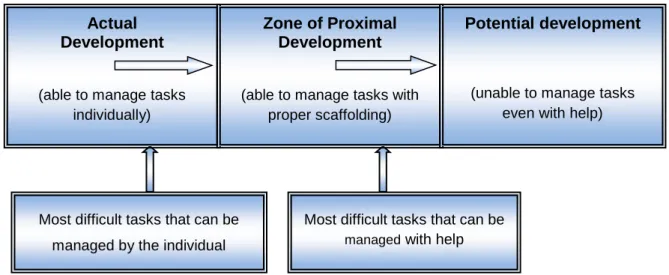
The social development theory, which was proposed by Levi Vygotsky, is another theory of learning that subscribes to the socio-cultural view of learning (Rogers & Horrocks 2010:115). Although this theory was developed to explain learning in children, its application has gained wide acclaim in the field of training management. According to this theory, learning is a social process in which learners acquire knowledge through interaction and socialisation with their peers (Tuckman & Monetti 2011:73). Of particular interest to this theory is the notion of the zone of proximal development (ZPD) which separates the level of tasks learners can perform on their own from the level of tasks learners can perform with assistance from more experienced peers. Learning therefore occurs through a process of scaffolding in which the more experienced peers provide support to the novices so that the latter are able to acquire new knowledge and skills. The social learning theory has significant implications for the design and provision of training
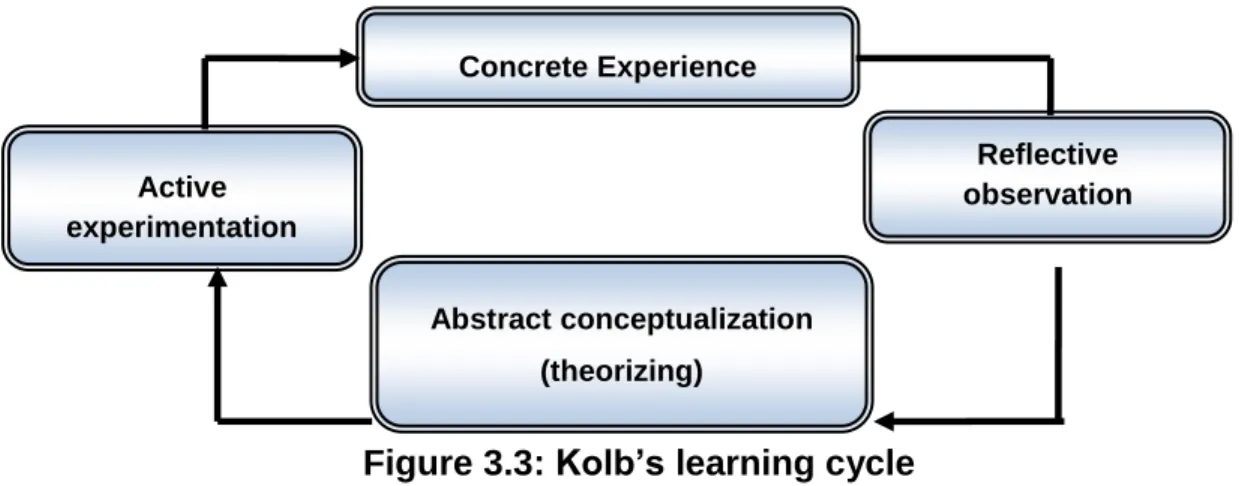
Page | 12 for school heads (Jwan & Ong’ondo 2011:402). The notion of experiential learning is therefore a cornerstone of the theory as learners generate new knowledge within a community of practice based on their interaction with their experiences and ideas. Experiential learning focuses more on the use of experience to ensure the integration of theory and practice as well as the personal development of learners through a process of self-reflection and self-awareness. In terms of this study, the social learning theory provides grounding to the existing literature views regarding the selection of training approaches that are used in MDPs for BSSHs. Armstrong (2012:280) asserts that the practice of learning and development should be based on an understanding of learning theory and the process involved in learning and development.
The constructivist theory of learning is relevantly placed to mitigate the potential problem associated with the Peter Principle. As stated earlier, the Peter Principle highlights the risk of newly promoted incumbents performing incompetently in their new positions if no training is provided to prepare them for the demands of their new leadership role. In this regard, the constructivist theory of learning is quite relevant as it provides a framework for the identification of an appropriate learning environment and instructional methodologies that enable the effective preparation of newly promoted school heads. The two frameworks are therefore interlinked because the constructivist theory of learning views social interaction as a major determinant of learning thereby prescribing the kind of experiential learning strategies that can be used to transfer knowledge and skills to novice school heads in order to deal with the problem of underperformance as stated by the Peter Principle.
1.5 CONCEPTUAL FRAMEWORK
Rudestan and Newton (1992 in Lesham and Trafford 2007: 96) define a conceptual framework as a set of ideas and principles that are used to outline the structure and direction of a research study. A conceptual framework is comprised of variables that are interrelated and which need to be interrogated in order to establish the meaning of the phenomenon under study. In this study, the conceptual framework will provide a
Page | 13 schematic map that will give direction to the entire study. This implies that the framework will situate the study within the existing literature and the methodology that will be used to explain the research problem.
Research is replete with evidence of a connection between quality leadership and successful schools (Bush 2008:1; Bush et al 2011:31). Education policy makers recognise that schools require effective leaders. Leithwood, Day, Sammonds, Harris and Hopkins (2006:5) assert the following: “There is not a single documented case of a school turning around its pupil achievement trajectory in the absence of talented leadership.” On the basis of the above, it can be stated that effective leadership contributes towards school success and education authorities tend to appreciate the importance of introducing leadership preparation programmes that nurture the appropriate leadership skills and behaviours of school heads. Forde (2011:356) highlights the importance of providing MDPs to school leaders by stating that headship is a specialist profession that requires specific training in order for incumbents to be able to cope with its demands. Leadership development is therefore a critical intervention for the professional socialisation of newly promoted school heads. An understanding and exposition of the concepts of leadership and management will form an essential part of the conceptual framework of the study in their relation to a third important concept, namely an MDP.
As has been stated before, school heads start their careers as teachers and their progression to the post of headship calls for a different set of competencies. From a moral standpoint, education authorities are obliged to provide specific training to newly promoted school heads in order to equip them with the skills that are necessary for school leadership (Bush 2008:30). The concept of professional socialisation of BSSHs interlinks with the theoretical perspective of the Peter Principle, which identifies a gap between promotion to the post of headship and the performance expected of school heads. It is this deficiency that an MDP seeks to address.
According to Forde (2011:356), there are various leadership development approaches that can be undertaken at several stages of the continuum of leadership practice.
Page | 14 Regarding the preparation of school heads, the experiential-based approach is the most appropriate approach that will enable participants to learn the necessary skills on the basis of experience and development support from other experienced peers. In terms of content, the principles of leadership and management (Lunenburg & Ornstein 2008:5; Robbins & Coulter 2009:45), need to be buttressed with a major focus on practice to form the bedrock of a leadership development programme. Leithwood, Reid, Pedwell and Connor (2011:349) also state that learners should significantly participate in the identification of training needs as well as the design of an MDP. This view is also supported by Hussain and Zamair (2011:25) who argue that training need assessment surveys are critical in determining a management development curriculum. This implies that the perceptions of stakeholders identified in this study will inform the content of an MDP for BSSHs.
A review of MDPs currently in practice in countries such as South Africa (Naicker 2011:431; Bush et al 2011:31); Kenya (Sang 2010:1; Ibrahim 2011:292; Jwan & Ong’ondo 2011:404) and England (Earley 2013:163; Bush & Jackson 2002:422) is also critical as it provides insight into the content of MDPs. The review of the literature will be done against the backdrop of the purpose of the research study and the research questions in order to form a theoretical and conceptual framework on the basis of which a foundation for the empirical research can be provided. A model of an MDP for BSSHs will finally be proposed as part of the research findings.
1.6 STATEMENT OF THE PROBLEM
The professional development of school leaders has become a critical component of the national agenda in countries across the world (Wallace 2007:2). There is an increased awareness of the critical role played by the school head towards the realisation of successful outcomes in schools (Alkarni 2014:56; Bouchamma 2012:2; Bush 2007:391; Mathibe 2007:523). In Zimbabwe, school heads are promoted from the ranks of senior teachers. Given the complexity of the role of the school head, competence as a classroom practitioner is not sufficient to guarantee optimum performance (Bush 2008:30). The
Page | 15 position of headship requires a set of skills that are different from those acquired in teacher training to the extent that the effective preparation of newly promoted school heads is necessary to ensure successful school outcomes. Countries in the developed world have institutions and programmes that are intended for the preparation and development of school heads (Ibrahim 2011:291), hence it is also a moral obligation for countries in Africa, Zimbabwe included, to provide training interventions that can initiate beginning school leaders into their new roles. The question that can be asked therefore relates to what stakeholders perceive to be the components of a structured MDP to equip BSSHs with the relevant skills to become effective leaders.
1.6.1 Research questions
The problem being investigated in this study can be summed up in the form of the following research question:
What are the perceptions of stakeholders regarding components of an MDP that could effectively prepare BSSHs for their new roles during the first two years after appointment?
Emanating from the research question are the following sub-questions:
How can management and leadership in schools be conceptualized? (Chapter 2)
How can the management development of BSSHs be conceptualized? (Chapter
3)
How do stakeholders perceive the need for an MDP for BSSHs in Zimbabwe?
(Chapter 5)
Page | 16 1.7 AIM OF THE STUDY
The main aim of the study is to examine the perceptions of stakeholders regarding the components of a management development programme that could effectively prepare BSSHs for their new roles during the first two years after initial appointment.
Emanating from the main research aim are the following objectives:
To provide a conceptual framework of management and leadership in schools
(Chapter 2).
To provide an insight into the concept of management development of BSSHs
(Chapter 3).
To examine the perceptions of stakeholders regarding the need for an MDP for
BSSHs in Zimbabwe (Chapter 5).
To propose components of an MDP for BSSHs in Zimbabwe (Chapter 6).
1.8 RESEARCH DESIGN AND METHODS
1.8.1 Research design
As indicated in section 1.6.1, the problem under investigation in this study deals with the perceptions of stakeholders regarding MDPs for BSSHs. Empirical research was extensively undertaken to gather data that would help to provide answers to the problem under study. The process of research started with a review of the relevant literature about the professional development of school heads in chapters 2 and 3. The review of literature was conducted for a number of reasons. Firstly, the literature survey sought to situate the study within the broader context of the body of knowledge of the theory and practice of school leadership development. Secondly, the review of literature also helped in setting the direction for the formulation of the theoretical framework for the study. Thirdly, the literature review set out the groundwork for the collection, analysis and presentation of empirical data that would help the researcher to gain an understanding of the views and
Page | 17 experiences of participants regarding the professional development of novice secondary school heads.
Creswell (2013:5) defines a research design as the research blueprint that outlines the entire research process from the formulation of the research problem to the collection, analysis and interpretation of data. This definition implies that the research design acts as the base and logical structure of the research inquiry, which helps the researcher to gather empirical evidence that is needed to answer the research question under study. The phenomenological research design used in this study is based on the idea that human experience is central to an in-depth understanding of social phenomena. In this regard, the phenomenological view of social reality contends that a clear understanding of a phenomenon can only be achieved by examining the views and lived experiences of participants within a given social setting.
Creswell (2013:18) states that certain factors influence the choice of the research design. Factors such as the nature of the research problem, the purpose of the research and the philosophical assumptions that researchers bring to the research study have been cited as having an influence on the manner in which the research problem is formulated and how evidence is gathered to unravel the phenomenon under study. According to Cohen, Manion and Morrison (2011:3), the three main philosophical assumptions that underpin the researcher’s beliefs are ontology (the nature of reality), epistemology (the nature and forms of knowledge) and methodology (research process). These philosophical assumptions shall be discussed in greater detail in chapter 4.
The philosophical assumptions influence the researcher’s beliefs regarding the research paradigm that could be used for a particular research study. This study was guided by the interpretivist paradigm. According to Cohen et al (2011:115), the interpretivist paradigm is premised on the idea that the perspectives and experiences of people can be understood better if they are investigated from within the contexts in which they occur. This implies that meaning can be denoted from the behaviours, attitudes, perceptions and lived experiences of participants within their own social setting. This matter is further
Page | 18 discussed in section 4.3.1. The ensuing section focuses on the research approach and the research strategy that was used in this study.
1.8.2 Research approach
This study used the qualitative research approach.
This approach was deemed to be the most appropriate approach for this study because it enabled the researcher to explore, in an in-depth manner, the behaviour, attitudes and perceptions of people within the context of their natural settings. Besides, the qualitative approach allowed the researcher to be directly ‘immersed’ in the social setting being investigated. This enabled the researcher to understand subjects’ views from within (Thomas 2009:173). It was quite apparent that a clear understanding of the perceptions of stakeholders regarding the professional development of BSSHs could only be achieved by examining the experiences and attitudes of the participants within the social context in which they occurred. It is for this reason that the qualitative research approach was found to be most suitable for this particular study. Qualitative research is associated with the inductive approach to research, which contends that researchers study social situations, make sense of the participants’ perceptions and experiences in order to generate new hypothesis regarding the topic under study (Babbie, Mouton, Voster & Prozesky 2015:270). This matter is further discussed in section 4.3.2.
1.8.3 Research strategy
The case study was used as a strategy to explore and analyse the perceptions of selected participants (school heads, deputy heads, senior teachers and school inspectors) in order to gain a better understanding of their perceptions regarding an envisaged MDP for BSSHs.
Creswell (2013:97) defines a case study as a strategy of inquiry that investigates a specific phenomenon within its real-life context. One major feature of case study research
Page | 19 is that it allows for the identification of a small group that is studied as a specific illustration of the problem under study (Yin 2011:17; Gray 2009:247). This implies that case studies are bounded in terms of time and place, which allows the researcher to undertake a comprehensive study of the phenomenon within a limited geographical area for the purpose of generalising empirical findings to a broader context. As shall be outlined in greater detail in section 4.3.3, the specific case study research design used in this study was the embedded single case design. This design was selected to cater for the different sub-categories of participants (school inspectors, school heads, deputy heads and senior teachers) who would provide evidence during the study (Cohen et al 2011:289).
The case study was quite appropriate for this study as it allowed the researcher to conduct research despite the constraints of time and adequate resources. In addition, the use of the case study as a research strategy also allowed for the use of multiple data collection instruments such as interviews, focus group discussions and document analysis. Cohen et al (2011:223) attest that the use of multiple sources of data helps in the verification of data through the process of triangulation.
1.8.4 Research methods
The methods of research that were employed in this study were associated with qualitative research. Although the matter is dealt with in greater detail in chapter 4, this section briefly discusses issues of population and sampling, data collection and data analysis.
1.8.4.1 Population and sampling
The study was undertaken in the district of Zaka which is located in Masvingo Province to the South East of Zimbabwe (see figure 1). The district has 42 secondary schools. Although the secondary schools belong to different responsible authorities ranging from central government, Christian missions and the local district authority, the promotion and
Page | 20 appointment of heads in these schools is largely the prerogative of the Ministry of Primary and Secondary Education (MoPSE).
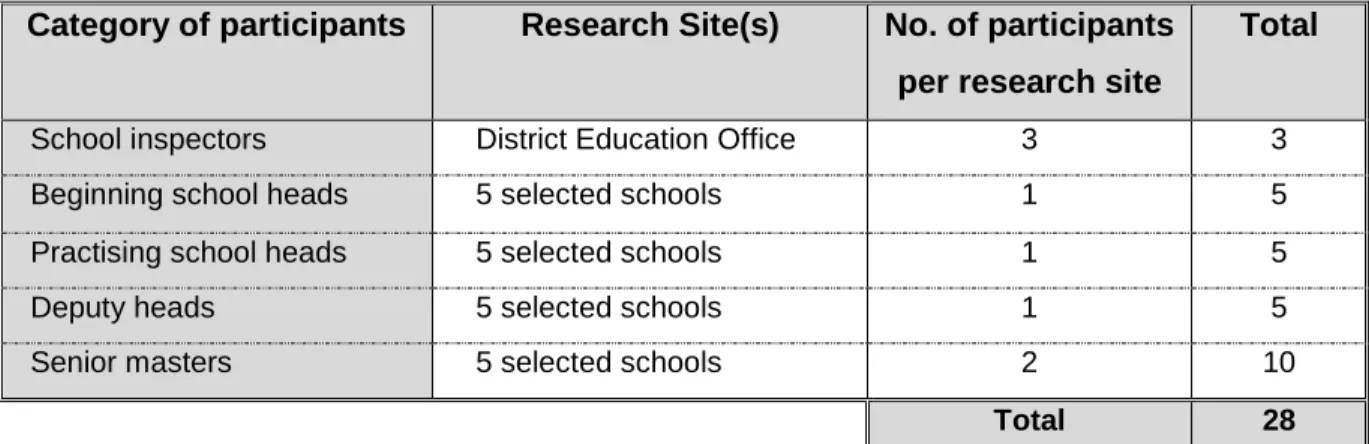
The sample for this study comprises participants that were drawn from a total of ten secondary schools and the district education office (see table 4.1). The secondary schools were selected through a process of purposive sampling. Cohen et al (2011: 157) identify purposive sampling as a form of qualitative research sampling that allows the researcher to select the subjects to be included in the research.
Figure 1.1: Map showing the location of Zaka District in Masvingo, Zimbabwe
Source: Department of Geography: Great Zimbabwe University, 2010.
The purposive sampling of participants was meant to ensure that the researcher used his own determination to denote those subjects with the relevant characteristics and the