Technical Report: Secure Cloud Computing through a
Separation of Duties
Christian Henrich†, Matthias Huber‡, Carmen Kempka†, J¨orn M¨uller-Quade†, and Ralf Reussner‡
†IKS/EISS ‡IPD Fakult¨at f¨ur Informatik Karlsruhe Institute of Technology (KIT)
This paper was submitted to the European Symposium on Research in Computer
Security (ESORICS 2010)1
Abstract. Cloud Computing offers many opportunities but also introduces new
risks. A user who outsources a database into the Cloud loses control over his data. While the data can be secured against external threats using standard tech-niques, the service providers themselves have to be trusted to ensure privacy. This work proposes a novel approach to provide security for database services without the need to trust the provider. We suggest employing aseparation of dutiesby distributing critical information and services among multiple providers in a way that the secrecy of a database can only be compromised if corrupted providers work together. We present a formal security model to evaluate distribution pro-cedures and apply it to our approach. A result of independent interest shows that our novel security property impliesk-anonymity for deterministic anonymization procedures.
1
Introduction
Due to advances in networking and virtualization technology, new paradigms of provid-ing IT infrastructure, computprovid-ing and software have emerged – among them the so-called Cloud Computing. The National Institute of Standards and Technology [20] defines Cloud Computing as “a model for enabling convenient, on-demand network access to a shared pool of computing resources (e.g., networks, servers, storage, applications, and services) that can be rapidly provisioned and released with minimal management effort or service provider interaction.”
Inherent to this model are privacy problems [21, 14]. By using services in the Cloud, clients lose control over their data. Current security mechanisms focus on protecting the data transfer to and from the service provider. But the threat of insider attacks keeps many potential customers from using Cloud Computing in critical or sensitive scenarios (e.g., scenarios comprising business secrets or customer data).
For a pure storage service, providing protection against insider attacks can be easily achieved by encrypting all data on the client side. As this prevents the server from
forming any meaningful operation on the data, more complex services require advanced techniques.
There are cryptographic methods likesecure multiparty computation[11, 6] or
pri-vate information retrieval[9] that in principle can solve all privacy problems, especially
since a fully homomorphic encryption method [10] was discovered in 2009 which al-lows calculations on encrypted data. However, due to high communication and com-putation costs, these methods are infeasible and their costs outweight all benefits of outsourcing.
Nevertheless, we need privacy and security guarantees for Cloud Computing in or-der to use it in sensitive scenarios. In this paper, we propose a new security notion that can be applied to outsourced databases as well as an architecture for services. We sug-gest partitioning a service on the basis of its duties and deploying the parts on different servers. For two examples we show that it is possible to provably provide a certain level of privacy usingSeparation of Duties, assuming the adversary has access to only one server. In contrast to secret sharing, this approach respects algorithms and data struc-tures and thus preserves the efficiency of the services.
This paper is organized as follows: In the remainder of this section, we give an overview about anonymity properties and discuss related work. In Section 2, we demon-strate a subliminal channel in anonymization processes that producek-anonymous data-bases and introduce our new security notion for anonymization procedures. We present our proposed architecture and deployment in Section 3 giving two examples and prov-ing that they fulfill our security notion. Section 4 summarizes our results and states open problems.
1.1 Anonymity Properties
In contrast to releasing data in statistical form (macrodata), the release of specific data (microdata) allows for more detailed analysis but raises privacy concerns. To protect privacy and provide some anonymity guarantees, statistical notions have been defined that released databases have to fulfill, namely k-anonymity [22, 7], l-diversity [19],
andt-closeness[18]. Since our security notion we define in Section 2.2 is based on
k-anonymity the remainder of this section is focused on this property.
The idea ofk-anonymity is that for each entry in a database that can be mapped to an individual, there are at leastk−1 other entries that can also be mapped to the same individual:
Definition 1. k-anonymity (taken from [7])
Let T(A1, ...,Am) be a table, and QI be a quasi-identifier associated with it, where
a quasi-identifier is a set of attributes included in the private table, also externally
available and therefore exploitable for linking. T is said to satisfy k-anonymitywith
respect to QI iff each sequence of values in T[QI]appears at least with k occurrences
in T[QI]. T[QI]denotes the projection, maintaining duplicate tuples, of attributes QI in
T .
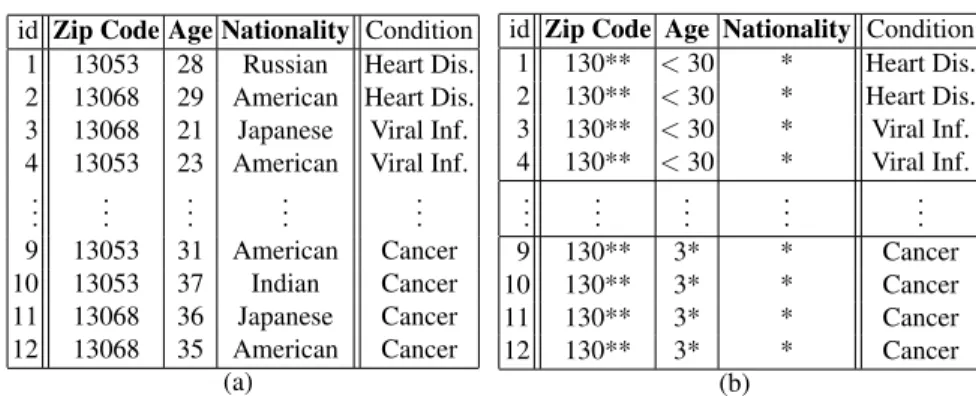
In order to achievek-anonymity one cangeneralizeattribute values. The highest gen-eralization of an attribute is calledsuppression. Consider for example the tables in Fig-ure 1(a) and FigFig-ure 1(b). The table in FigFig-ure 1(b) is a 4-anonymous version of the
table in Figure 1(a), where the rows with ids 1–4 and 9–12 each form a 4-bucket. The attributesZip Code,AgeandNationalityare quasi-identifiers, while the attribute Con-dition is sensitive information that must not be linked to an individual. While the values of the attributeAgewere generalized to achievek-anonymity, the values of the attribute
Nationalitywere suppressed.
id Zip Code Age Nationality Condition
1 13053 28 Russian Heart Dis. 2 13068 29 American Heart Dis. 3 13068 21 Japanese Viral Inf. 4 13053 23 American Viral Inf.
.. . ... ... ... ... 9 13053 31 American Cancer 10 13053 37 Indian Cancer 11 13068 36 Japanese Cancer 12 13068 35 American Cancer (a)
id Zip Code Age Nationality Condition
1 130** <30 * Heart Dis. 2 130** <30 * Heart Dis. 3 130** <30 * Viral Inf. 4 130** <30 * Viral Inf. .. . ... ... ... ... 9 130** 3* * Cancer 10 130** 3* * Cancer 11 130** 3* * Cancer 12 130** 3* * Cancer (b)
Fig. 1.(a) An example of a medical database (from [19]) with the quasi-identifiersZip Code,Age
andNationalityand the information column Condition and (b) a 4-anonymous version of this
database. The attributesZip CodeandAgewere generalized andNationalitywas suppressed. The entries with ids 1–4 and 9–12 each form a 4-bucket.
It is well known thatk-anonymity has a weakness [19, 18]. Consider for example the records with id 9,10,11 and 12 in Figure 1(b). If you know that there is someone in the database who is older than 29 and lives in a city with a zip code beginning with 130, you can infer that he/she has cancer (homogeneity attack). A similar attack can be done on the records with id 1,2,3 and 4 if you can rule out that an individual has a heart disease due to background knowledge. These attacks are possible because of a lack of diversity in the values of the sensitive attribute in ak-bucket.
Another weakness ofk-anonymity is based on the fact that this property describes the resulting database and not the anonymization process itself. We will discuss this weakness in Section 2.1
1.2 Related Work
There are cryptographic solutions for two or more parties cooperatively computing a certain function over a set of data without any party learning anything about the input of other parties except what is learned by the output. Using an interactive protocol, thesesecure multiparty computations[11, 6] can thus solve all privacy problems. The problem is that for each party, the computation cost is higher than computing the whole function on the complete input without any other party. This makes the concept of multiparty computation for outsourcing services unsuitable and in fact pointless if the client is the only one with private input.
The problem of a searchable encryption is motivated by the database community having realized the benefits of outsourcing databases early. In 2002, the concept of
Database as a Servicewas introduced by Hacig¨um¨us et al. in [13]. For data privacy, they
propose encryption and evaluate several different ways to encrypt data in a database. However, the user has to hand the encryption key to the server for query processing. This is a security risk in an untrusted server scenario. In [12], Hacig¨um¨us et al. propose a tuple level encryption scheme and coarse indices to enable the server to execute SQL on the encrypted data. The server does not need to decrypt the data for coarse grained query execution, and returns a superset of the tuples queried. The client has to decrypt the returned data and execute the exact query on it. There were other papers considering different aspects of this idea. Damiani et al. considered confidentiality in encrypted databases in [8]. They introduce exposure coefficients and examine databases where an index refers to just one attribute value. However, in contrast to our approach, they do not provide any security notions for their schemes. A more detailed view on exposure coefficients which considers coarse indices is given by Ceselli et al. in [5]. In [15] Hore et al. addressed the problem of creating an optimal bucketization scheme under efficiency aspects.
In contrast to the schemes described above, Aggarwal et al. propose in [1] to split a database according to privacy constraints and to distribute it to different providers. They propose to use encryption if a privacy constraint cannot be met and present three en-cryption schemes, namely one-time pad, deterministic enen-cryption and random addition. They also propose adding noise to enhance privacy of a distributed database. They de-fine a composition as privacy preserving if all privacy constraints are met. However, this definition depends on the privacy constraints of the actual database. It is unclear what level of privacy can be provided if the associations between deterministically encrypted attribute values are not hidden.
Kantarcioglu and Clifton showed in [16] that classical cryptographic definitions do not work for encrypted databases because generally it is infeasible to realize a database that complies with these definitions. Therefore, they come up with new definitions and propose an encrypted database with hardware support. In [2] Amanatidis et al. look at searchable encryption from a provable-security methodology point of view. They propose an encryption scheme capable of efficient exact match and range queries while providing provable security. In [4], Bellare et al. propose a new security notion called
PRIV. In contrast to our notion, a PRIV-secure database provides provable privacy only if the plaintext is drawn from a space of high min-entropy. They emphasize that the proposed schemes enable sublinear search complexity which is important for databases to enable fast query processing.
1.3 Our Contribution
Our contribution is twofold. On the one hand, we introduce a new security notion that can be applied to outsourced databases. On the other hand, we introduce our concept
ofSeparation of Dutiesthat allows us to seperate and distribute services. Distributing
services is not entirely new [1], however, to our knowledge, we are the first to give a formalized security notion for it. And, in contrast to classical secret sharing, our concept respects algorithms and data structures. This application specific distribution maintains
the efficiency of services. We apply Separation of Duties to two examples, and show that these examples fulfill our new notion. Although our CRM database example was designed with access logs in mind, we only consider static analysis, since our notion does not cover access history.
2
Security of Anonymization Functions
Thoughk-anonymity is a good first indication for anonymity, it cannot directly be used as a notion of security of services. Consider a storage service where the database is anonymized by probabilistically encrypting each entry. The resulting database clearly is notk-anonymous, as each combination of ciphertexts will probably be unique. How-ever, encrypting a database this way should be considered secure by any reasonable notion of security.
This shows that a good anonymization may not bek-anonymous. Even worse, an anonymization process may contain a subliminal channel leaking information without violating thek-anonymity of the resulting database.
2.1 Subliminal Channel ink-Anonymity
For a databasedthere are in general different anonymized versions complying withk -anonymity. LetDkdbe the set of allk-anonymous versions of a databased. A malicious database anonymizer can encode data simply by disclosing a particular databased0∈
Dkd. Of course the anonymizer cannot choose an arbitraryd0∈Dkd.
age salary 31 123 31 234 35 123 35 234 (a) age salary 3* 1** 3* 2** 3* 1** 3* 2** (b)
Fig. 2.An example salary databasedwith two attributes (a) and the 2-anonymous versiond0of
d(b), where the attributeagewas generalized once and the attributesalarytwice
Sincek-anonymity is defined with respect to quasi-identifiers, we do not consider other columns here. Our example databased(cf. Figure 2(a)) consists of two attributes. Assuming that the attributeagehas two (e.g. 31→3*→*) generalizations and the attributesalaryhas three (e.g. 123→12*→1**→*) generalizations, we can build a
generalization graphford.
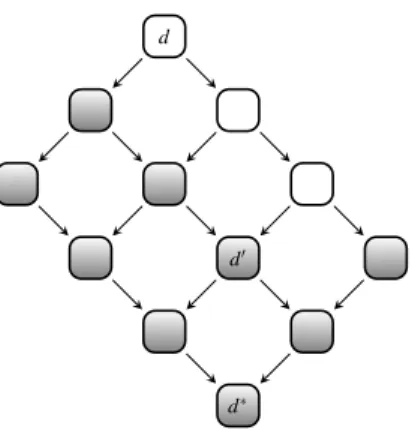
This graph is depicted in Figure 3. Let d0 (cf. Figure 2(b)) be the database the anonymizer discloses. Note that the anonymizer knows all the databases in this graph, but the adversary only learns the disclosed databased0. However, if the adversary knows the underlying anonymization procedure, what we assume according to Kerckhoffs’
d
d0
d∗
Fig. 3.Generalization graph for databased. Downleft arrows denote generalization of attribute
age while downright arrows denote generalization of attribute salary. The node d∗ denotes the completely anonymized table. Shaded boxes denote generalizations ofdcomplying with 2-anonymity.
principle, she can reconstruct the structure of the graph. Of course she neither learns if any of the databases next to or aboved0arek-anonymous nor the databases themselves. However it is still possible to introduce a subliminal channel into the anonymization procedure. One possibility is that the anonymizer scans the graph for a level of nodes containing only databases complying with thek-anonymity property, and chooses one of them. Since an adversary can reconstruct the structure of the whole graph, she also knows how many databases are on the same level as the released one. This results in a subliminal channel with capacitylog(n1), wheren1is the number of databases on that level. Another possibility is that the anonymizer ignores inner nodes of the graph and chooses one resulting path towards the completely suppressed databased∗. He releases the first database complying with thek-anonymity property he encounters. The adver-sary can also reconstruct which path the anonymizer took, resulting in a subliminal channel with capacitylog(n2), wheren2ist the number of disjoint paths in the graph. However, this only works if every path has a database complying with thek-anonymity property besides the trivial oned∗(cf. Figure 3).
While this may seem infeasible for an actual attack, these two examples for sub-liminal channels in the anonymity property k-anonymity show that we need to de-fine anonymity not for the database that results from anonymization, but for the pro-cess of anonymization itself. We will prove that for deterministic anonymization func-tions which operate on the entries of a database our new notion of security implies
k-anonymity. Given a process of anonymization which we consider to be ideal, we will derive a notion of security of services in Section 2.3.
2.2 Indistinguishability under Independent Column Permutation
Our security notion we describe in this chapter is motivated byk-anonymity. Intuitively, the aim ofk-anonymity is to hide each individual in a crowd of size at leastk. Our
no-tion shares this property while overcoming the weaknesses ofk-anonymity mentioned above. It allows for probabilistic encryption and at the same time prevents any sublimi-nal channel that leaks information about associations between database entries. In order to achieve this, instead of examining only the anonymized table, our security notion re-gards the anonymization process as a whole.
More formally, we consider an anonymization function f that takes a database of a certain format as input and computes an anonymized database. In the following, we dif-ferenciate between columns ofquasi-identifiersand columns with sensitive information which we callinformation columns.
Without loss of generality, we consider databases with exactly one information col-umn as multiple information colcol-umns can be combined. We define anonymity consider-ing the worst case where each entry in the information column is unique. In the case of non-unique or absent information items we require that our notion holds even if absent information items are added and all information items are renamed to be unique. For our purposes, we define a database as follows:
Definition 2. Adatabaseis a table containing arbitrary many quasi-identifier columns and exactly one information column. All entries in the information column are unique within this column. We call the set of all databases DB.
As argued above, this captures databases in full generality.
Definition 3. Adatabase functionis a function f:DB→DB. We callDthe set of all database functions.
Examples for database functions are projection π and selectionσ from relational al-gebra and our anonymization functions. Another special case of database functions we will use are special permutations defined as follows:
Definition 4. The set ofcolumn independent permutationsΠ⊂Dis the set of database
functions p:DB→DB such that each p∈Π permutes entries within each
quasi-identifier column of a database but leaves the information column untouched. The
per-mutations implied by eachp∈Π on the individual columns can be independent from
each other.
Please note that the identity function is a valid permutation. Therefore a permutation according to the definition above does not have to affect all quasi-identifier columns.
Intuitively, we say f is a good anonymization if an adversary is unable to distin-guish between an anonymization of the original database and an anonymization of a version of the original database where the entries in each column have been permuted independently from each other and hence relations between entries have been elimi-nated. This intuitive notion cannot always be met, and in the definition below, we will allow to restrict the permutations within the columns to affect only entries inkrows. This restriction tokrows is motivated fromk-anonymity. To define this formally, we use a technique often used in cryptography: In an experiment an adversaryA has to distinguish whether she has got the result of an anonymization of a databased or the anonymization of a permutationp(d).
Letd∈DBbe a database, f∈Da database function,p∈Π a column independent permutation,A an adversary andi∈ {0,1}. Depending oniwe define our experiment as follows:
Ind-ICPAk,p,i(d):
d0:= f(d)
d1:= f(p(d))
b:=A(di)
returnb
In the experimentInd-ICPAk,p,0A’s input is f(d), an anonymization of the original databased. In the experimentInd-ICPAk,p,1,A gets f(p(d)), an anonymization ofp(d) which is a permutation of the original database, as input.
Using this experiment we define the notionk-Indistinguishability under Independent Column Permutation withε-Advantage.
Definition 5. (k-Ind-ICP withε-Advantage)
For a database function f k-Indistinguishability under Independent Column
Permuta-tion(k-Ind-ICP)withε-Advantageholds iff for each polynomially restricted adversary
A, for each database d∈DB the following holds:
For each row riin d exists a set Miof k rows in d (called the k-bucket of row ri) such
that ri∈Miand for eachp∈Π that affects only rows in Miand leaves the entries of all
other rows unchanged the advantage of the adversaryA is
AdvIndA -ICPk,p(d):=
Pr[Ind-ICP k,p,0 A (d) =1]−Pr[Ind-ICPAk,p,1(d) =1] <ε.
Ifk-Ind-ICP holds for an anonymization function f and a reasonably smallε, a subliminal channel in f will at most leak information about individual entries in the original database. It does not contain information about relations between entries that would be eliminated by independently permuting the entries of each column. Therefore, relations between any quasi-identifiers and sensitive attributes are hidden by f.
In the rest of this paper we considerεto be reasonably small. In some cases, e.g., when encryption is involved, it makes sence to defineεdepending on a security param-eterswhich could for example be the key length of the used encryption. More precisely, for a family of anonymization functions and a security parametersone could demand thatεdecreases asymptotically ins.
Theorem 1. If k-Ind-ICP with ε-Advantage holds for a reasonably small ε for an
anonymization function f that operates deterministically on the entries within each
k-bucket Mi, then f(d)is k-anonymous for all d∈DB which have either0or at least k
rows.
Note that in particular a fully deterministic function operating on the entries satisfies the requirement of deterministic behavior on eachk-bucketMi.
Proof. The proof is by contradiction. Let f be a database function which isk-Ind-ICP
withε-Advantage and fulfills the preconditions of Theorem 1. Further letd∈DBbe a database for which f(d)is notk-anonymous. Then there exists a rowrjin the database
f(d)with a combination of identifiers which occurs less thanktimes in the database
f(d). For the row corresponding torjin the original databased there exists ak-bucket
Mjofkrows, such that the image of fis indistinguishable if the entries of each column
LetM0jdenote an arbitrary set having this property and let f(M0j)denote the rows in f(d)corresponding toM0j. There must be one rowri∈ f(M0j)for which at least one
quasi-identifier differs from the corresponding quasi-identifier in rowrj. As f operates
deterministically on the quasi-identifiers withinM0jwe have that exchanging the quasi-identifiers from the rows corresponding toriandrj will exchange the quasi-identifiers
from the rows ri andrj and hence this permutation does not yield indistinguishable
images under the mapping f. As this is true for arbitraryM0jthe function f cannot have beenk-Ind-ICP withε-advantage for any reasonably smallε.
One gets an even stronger notion if one addsl-diversity tok-Ind-ICP by requiring the images of f to bel-diverse.
Definition 6. Let f be a database function for which k-Ind-ICP withε-advantage holds.
The function f is called l-Div-k-Ind-ICP withε-advantageif for each d∈DB with at
least k rows f(d)is l-diverse.
For the sake of readability in the rest of this paper, we write “k-Ind-ICP” instead of “k-Ind-ICP withε-advantage for a reasonably smallε”.
2.3 Ideal Anonymization
Given a class of anonymization proceduresF which are assumed to be ideal, we define the security of a real anonymization process by comparison. We say a real process
g anonymizes a class DBof databases as good asF if forg there exists a function
f ∈F such that for alld∈DBintuitively the following holds: Everything that can be learned fromg(d)which was anonymized using the real process can also be learned from the ideally anonymizedf(d). More formally we say that for each polynomial time adversaryA which is giveng(d)there exists a polynomial time simulatorSwhich is given f(d)such that the outputs ofA andSare computationally indistinguishable.
With this concept giving a concrete definition of security boils down to specifying the classF which specifies the amount of anonymity that is to be reached.
A concrete classF of ideal anonymization procedures could be the class of allk -Ind-ICP mappings with ε-advantage for certainkandε. A more strict choice of the classF would be to first apply ak-Ind-ICP mapping and then encrypting each entry with an ideal cipher. However, the latter class of ideal anonymization procedures can be too strict. Sometimes facts can be derived from an anonymized database which are commonly known, but would formally violate the security definition. To cope with this the ideal anonymization functions fromF may also output some auxiliary information which will explicitly not be kept secret. Examples for this common knowledge are that the height of persons lies within the range of zero to three meters, that a certain street is in a certain city, or that the database contains citizens of a certain region.
The amount of auxiliary information given is hence made explicit in our security notion and this amount is also a good measure for comparing different anonymization processes.
From this notion of anonymization we derive a notion of security for the Separation of Duties approach. The real anonymization process g for the Separation of Duties approach is defined by the assumptions restricting the adversary. As an example let
two serversS1andS2be given and let f1and f2denote the anonymization forS1and
S2respectively. For an adversary limited to compromise only one of the two servers the Separation of Duties is at least as good as an anonymizationF if both f1 and f2 anonymize as good as an ideal anonymizationF.
3
Separation of Duties
To reduce the information a single provider can learn, we propose to combine the design patternpartitioned application[17] with theneed to know principle[23] and apply it to services. This means separating a service with respect to its algorithms and data structures and deploying each part on a different server. Each part only gets the data needed to fulfill its duty. Simple assumptions about the servers’ capabilities (like limited or no storage) result in provable security guarantees if the separation procedure follows certain rules and an adversary only has access to one server. On a sidenote, since the code of the service is partitioned and distributed as well, this also impedes software piracy.
The remainder of this section is structured as follows. In Section 3.1 we present a general description of an architecture of a separated service and in Section 3.2 we give instructive examples to explain how our approach can enhance privacy. The examples were chosen to exhibit very simple proofs showing the easy applicability of the methods presented in this work. We show that the mapping of the database to each single server in our examples are k-Ind-ICP. Hence, under the assumption that the adversary can break into at most one server, our Separation of Duties approach is at least as secure as the classFof ideal anonymizations, whereF denotes the class ofk-Ind-ICP mappings withkbeing the number of rows in the database.
3.1 Description of the Proposed Architecture
Separating a service into different parts can be done in two ways which we termserial
andparallel. When a service is separated serially into two sub-services or components,
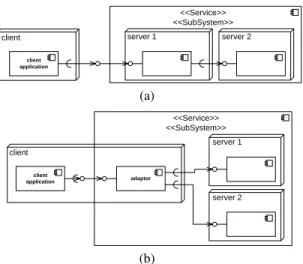
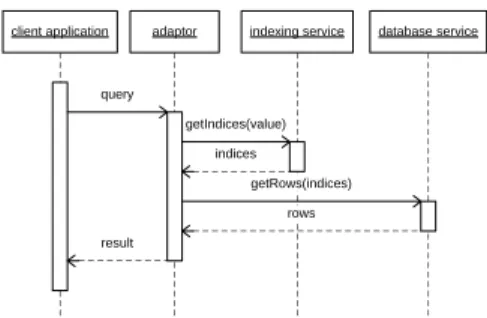
one part calls the other part (cf. Figure 4(a)). Consider for example a database storage service calling an indexing service for faster search. With serial separation, in order to be connected the components or the servers the components are deployed on have to be aware of each other. With parallel separation, this is not necessary. However, for such a separation to be transparent to the client application, an adaptor has to be deployed. Fig-ure 4(b) shows a parallel separation with an adaptor component deployed on the client’s machine. The adaptor or the client application respectively has to call both parts. For example consider the sequence diagram in Figure 5. Here a client calls the adaptor. The adaptor calls the indexing service and then queries the database using the results from the indexing service. With parallel separation one can achieve potentially more secure services than with serial separation since the components do not need to be aware of each other. This reduces the likelihood of malicious collaboration. However, parallel separation of services may be harder to achieve since it may require a new component as well as an adaption of existing components and the calling party. This may be coun-terintuitive for software engineers. A more detailed view on how to separate services and to deploy the parts on different servers is given in Section 3.2.
server 1 server 2 client client application <<Service>> <<SubSystem>> (a) server 2 client client application <<Service>> <<SubSystem>> server 1 adaptor (b)
Fig. 4.System and deployment view of a (a) serial and (b) parallel separation of a service. The
composition structure and the deployment relationship cross each other. This is not in conflict with UML and conceptionally sound, as long as the inner components are bundled by anassembly
where inner components remain visible, exactly for the reason of possibly distributed deployment. Both concepts, composed components, which would hide inner structural details, and assemblies are not well separated in the UML, but in more modern component models, such as Palladio[3].
3.2 Examples
In this section we give two instructive examples in order to explain how Separation of Duties enhances the security of services. We use our new security notion defined in Section 2.2 to make explicit statements about their security. We provide proofs that these separations provide privacy according to our notion.
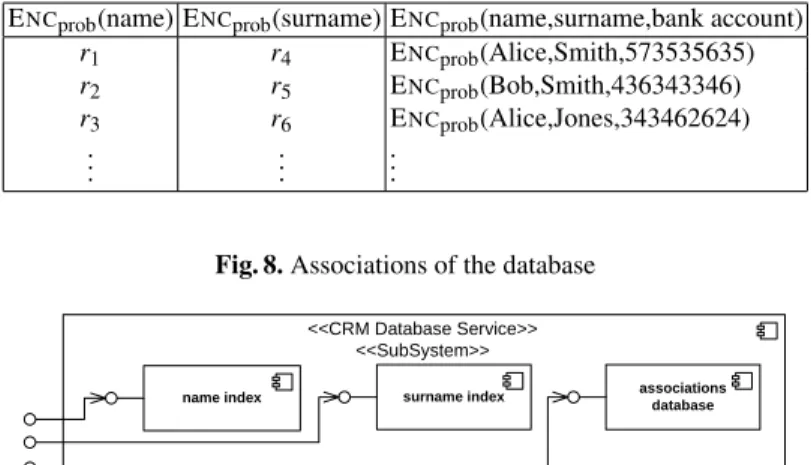
CRM Database Consider the example customer relationship database in Figure 6. We treat all attributes as quasi-identifiers and want to hide any connection between them. In this CRM database we want to search for a name and get the corresponding bank account number, but will never search for a bank account number. For this example, we propose to separate the indices from the database, and apply encryption (cf. Fig-ures 7 and 8). We use a deterministic encryption ENCdetand a probabilistic encryption ENCprob and introduce random numbersriused as pointers to connect the distributed
entries. Keywords are encrypted with ENCdetdeterministically to enable searching, the pointers and the attribute values are encrypted using ENCprob to prevent the server to gain information about correlations.
Consider the system depicted in Figure 9. In this example, the tables in Figures 7 and 8 are each on a different server. Thename index component stores the table of Figure 7(a), thesurname index componentthe table of Figure 7(b), respectively. The
associations database component stores the table of Figure 8. Because of this
client application adaptor indexing service database service query getIndices(value) indices getRows(indices) rows result
Fig. 5.Sequence diagram for a query on an example of a paralelly separated database service
name surname bank account Alice Smith 573535635
Bob Smith 436343346 Alice Jones 343462624
..
. ... ...
Fig. 6.An example of a CRM database.
query the index component(s) for pointers or create new pointers respectively. For ex-ample if the client wants to execute the query “SELECT * FROM table WHERE name = Alice AND surname = Smith;”, the client has to query the name index with sub-query1 = “SELECT * FROM table WHERE keyword = ENCdet(Alice);”, the surname with subquery2 = “SELECT * FROM table WHERE keyword = ENCdet(Smith);” and finally query the associations database server with the decrypted results.
Note that, despite the communication and encryption overhead, search time is still sublinear. Also note that this example is not secure in the strict sense of classical cryp-tography as information about the structure of the data, e.g., the number of different attribute values, may leak.
Security ProofLetdbe a database of the form displayed in Figure 6. We first consider the indexing servers and show that the function f1mappingdto indexing databases of the form displayed in Figure 7 as described above isk-Ind-ICP. The function f1
sup-keyword pointer ENCdet(Alice) ENCprob(r1,r3)
ENCdet(Bob) ENCprob(r2) ..
. ...
(a)
keyword pointer ENCdet(Smith) ENCprob(r4,r5)
ENCdet(Jones) ENCprob(r6) ..
. ...
(b)
Fig. 7.Separated indices of the database with the deterministically encrypted names and the
ENCprob(name) ENCprob(surname) ENCprob(name,surname,bank account) r1 r4 ENCprob(Alice,Smith,573535635) r2 r5 ENCprob(Bob,Smith,436343346) r3 r6 ENCprob(Alice,Jones,343462624) .. . ... ...
Fig. 8.Associations of the database
name index surname index associations database
<<CRM Database Service>> <<SubSystem>>
Fig. 9.Proposed separation for our CRM database example (client parts and deployment view
omitted)
presses all attributes except a given attributea, deletes duplicate values of that attribute and encrypts the remaining values deterministically with ENCdet.
In order to obtain the pointers for the association, f1adds a column containing a unique random number for each occurrence of the corresponding value ofain the orig-inal database. Then f1encrypts all entries in this column probabilistically with a given encryption algorithm ENCprob. The result of f1generates the indexing tables described above.
The database f1(d)contains two columns. In the first column, no two values are identical since we removed duplicates before applying the deterministic encryption. The entries in the second column are random values, so (assuming a good encryption) the table is indistinguishable from a table with mere random entries of the same size. Hence f1isk-Ind-ICP, because permutations of the entries of each column cannot be detected after an application of f1.
Second we look at the association server. Let f2be a function that replaces every attribute value of a given database with a unique random number and additionally f2 adds a column containing original attribute values of each row encrypted with a given secure encryption algorithm ENCprob. The mapping f2 generates exactly the associa-tions table described above. We will show that f2isk-Ind-ICP forkbeing the number of rows of the databased. Since f2(d)only contains unique random numbers or plain-text encrypted with ENCprob, we have that permutations of the entries of each column cannot be detected after an application of f2and f2clearly isk-Ind-ICP.
Intelligent Electric Meter Consider an intelligent decentralized power grid, where the provider keeps track of the power consumption of its clients to dynamically activate or deactivate power stations or consumers. Intelligent electric meters in the clients’ system report the consumption to a central database. Clients, however, do not want the provider to know their current consumption for privacy reasons. The requirements of both the
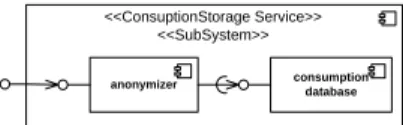
provider and the consumers can be met by separating and distributing the storage ser-vice. Consider the system depicted in Figure 10. Here, the service is serially separated into two components. If clients send their consumption encrypted with the consump-tion database’s public key the anonymizer does not learn their current consumpconsump-tion, but still can anonymize the data. Note that this example is not secure in the strict sense of classical cryptography as information about the data, e.g., names or consumption rates, may leak as only the correlation is hidden.
anonymizer consumption
database
<<ConsuptionStorage Service>> <<SubSystem>>
Fig. 10.Components of the consumption storage service
Figure 11 depicts an example database the anonymizer may hold. Clients send their consumption encrypted to the anonymizer, which adds for every tuple “client - ENC(consumption)” a unique random number. The anonymizer sends the relation “ENC(consumption) - random number” to the consumption database, which can de-crypt the values of the consumption attribute with his private key. An example for the
client ENC(consumption) random number Henry Smith xXzss43rFd 573535635
John Doe 5DFF5dbctd 436343346
Fig. 11.The association table of theanonymizer componentmapping clients to random number,
effectively anonymizing each client’s consumption information.
random number consumption 573535635 56
436343346 0
Fig. 12.The comsumption information as seen by theconsumption database component.
consumption information database is depicted in Figure 12. The provider can still run statistics or data mining techniques for forecasting, but no longer knows the consump-tion of a certain client at any given time.
Security ProofTo show that our Separation of Duties approach in this example is at least as secure as the class ofk-Ind-ICP mappings, we have to consider the anonymizer and the server containing the consumption database. The first server learns the original
user identities and the encrypted power consumption. As encrypted values of power consumptions are indistinguishable, a permutation of the entries of each column before encrypting the power consumption entries cannot be detected and the mapping of the original database to the anonymizer’s data isk-Ind-ICP. The second server learns the original power consumption entries of each row, but obtains the rows in permuted or-der with randomized user IDs. A permutation of the entries within the columns before introducing the randomized IDs and applying the permutation of the rows cannot be detected and so the second mapping isk-Ind-ICP, too.
4
Conclusion and Future Work
Cloud Computing introduces serious privacy risks to which classical cryptographic techniques cannot be applied as they undo the advantages of outsourcing services. In this work, we introduced an approach to distribute data and services to several indepen-dent servers while respecting the algorithms and data structures used in the service. Our Separation of Duties approach does not offer the same level of security as a complete encryption of a database, but allows for services to be performed efficiently on the data. The abstract definitions from classical cryptography cannot capture application spe-cific security and more fine grained notions are necessary. In order to give precise secu-rity guarantees, we introduced a novel secusecu-rity notion. This notion allows to precisely judge even weak levels of protection which cannot be expressed in the security mod-els of classical cryptography. We showed thatk-anonymity is inapplicable for judging anonymization mechanisms as it disregards subliminal channels in an anonymization procedure and is unfitting for encrypted attribute values. Our notion, inspired by k -anonymity, describes the anonymization procedure and not the results and so can detect and prevent subliminal channels. This notion hides relations within ak-bucket and is applicable to practical anonymization procedures generating databases which are not
k-anonymous but intuitively secure. We gave two practical examples and suggested an anonymization process for each. The protection mechanisms given provably meet our new security notion.
For future work, we propose to consider dynamic attacks where an adversary learns access statistics. Also, an examination of subliminal channels of anonymization func-tions enforcingl-diversity is necessary. This could lead to stronger notions of anonymity and to notions which can measure the effectiveness of introducing dummy data or dummy queries to further enhance the security of Cloud Computing.
References
1. Gagan Aggarwal, Mayank Bawa, Prasanna Ganesan, Hector Garcia-Molina, Krishnaram Kenthapadi, Rajeev Motwani, Utkarsh Srivastava, Dilys Thomas, and Ying Xu. Two can keep a secret: A distributed architecture for secure database services.CIDR 2005.
2. Georgios Amanatidis, Alexandra Boldyreva, and Adam O’Neill. Provably-secure schemes for basic query support in outsourced databases. InDBSec, pages 14–30, 2007.
3. Steffen Becker, Heiko Koziolek, and Ralf Reussner. The Palladio component model for model-driven performance prediction.Journal of Systems and Software, 82:3–22, 2009.
4. Mihir Bellare, Alexandra Boldyreva, and Adam O’Neill. Deterministic and efficiently searchable encryption. InCRYPTO, pages 535–552, 2007.
5. Alberto Ceselli, Ernesto Damiani, Sabrina De Capitani Di Vimercati, Sushil Jajodia, Ste-fano Paraboschi, and Pierangela Samarati. Modeling and assessing inference exposure in encrypted databases, 2005.
6. David Chaum, Claude Cr´epeau, and Ivan Damgard. Multiparty unconditionally secure pro-tocols. InSTOC ’88: Proceedings of the twentieth annual ACM symposium on Theory of computing, pages 11–19, New York, NY, USA, 1988. ACM.
7. Valentina Ciriani, Sabrina De Capitani di Vimercati, Sara Foresti, and Pierangela Samarati. k-anonymity. pages 323–353, 2007.
8. Ernesto Damiani, S. De Capitani Vimercati, Sushil Jajodia, Stefano Paraboschi, and Pierangela Samarati. Balancing confidentiality and efficiency in untrusted relational DBMSs, 2003.
9. William Gasarch. A survey on private information retrieval. Bulletin of the EATCS, 82:72– 107, 2004.
10. Craig Gentry. Fully homomorphic encryption using ideal lattices. InSTOC ’09: Proceedings of the 41st annual ACM symposium on Theory of computing, pages 169–178, New York, NY, USA, 2009. ACM.
11. Oded Goldreich, Silvio Micali, and Avi Wigderson. How to play any mental game. InSTOC ’87: Proceedings of the nineteenth annual ACM symposium on Theory of computing, pages 218–229, New York, NY, USA, 1987. ACM.
12. Hakan Hacig¨um¨us, Bala Iyer, Chen Li, and Sharad Mehrotra. Executing SQL over encrypted data in the database-service-provider model. In Proceedings of the 2002 ACM SIGMOD international conference on Management of data, pages 216–227. ACM, 2002.
13. Hakan Hacig¨um¨us, Bala Iyer, and Sharad Mehrotra. Providing database as a service. In
ICDE ’02: Proceedings of the 18th International Conference on Data Engineering, page 29, Washington, DC, USA, 2002. IEEE Computer Society.
14. Christian Henrich, Matthias Huber, Carmen Kempka, J¨orn M¨uller-Quade, and Mario Strefler. Towards secure cloud computing. InProceedings of the 11th International Symposium on Stabilisation, Safety, and Security of Distributed Systems (SSS 2009), 2009.
15. Bijit Hore, Sharad Mehrotra, and Gene Tsudik. A privacy-preserving index for range queries. InVLDB ’04: Proceedings of the Thirtieth international conference on Very large data bases, pages 720–731. VLDB Endowment, 2004.
16. Murat Kantarcioglu and Chris Clifton. Security issues in querying encrypted data. Technical report, 2004.
17. Darrell M. Kienzle, Matthew C. Elder, Ph. D, Ph. D, David Tyree, and James Edwards-hewitt. Security patterns repository, version 1.0, 2006.
18. Ninghui Li and Tiancheng Li. t-closeness: Privacy beyond k-anonymity and l-diversity. 2007. 19. Ashwin Machanavajjhala, Daniel Kifer, Johannes Gehrke, and Muthuramakrishnan Venki-tasubramaniam. l-diversity: Privacy beyound k-anonymity. Cornell University, page 52, March 2007.
20. NIST. Nist - cloud computing. http://csrc.nist.gov/groups/SNS/ cloud-computing/, 2009.
21. Sinai Pearson. Taking account of privacy when designing cloud computing services. HP Laboratories, 2009.
22. Pierangela Samarati and Latanya Sweeney. Generalizing data to provide anonymity when disclosing information (abstract). page 188, 1998.
23. H. Wedekind. Ubiquity and need-to-know: two principles of data distribution.SIGOPS Oper. Syst. Rev., 22(4):39–45, 1988.