TECHNOLOGY AUDIT
Testing Services (Europe)
CTG
OVUM BUTLER GROUP VIEW
ABSTRACT
CTG is a significant-sized services provider that offers many service lines, and in particular has developed a range of testing services that, in Europe, are available in Belgium and Luxembourg. These span the whole spectrum of testing management and activity, from consultancy that deals with test strategy, via test management and planning, to providing resources that undertake and complete testing on behalf of the customer organisation. There is growing realisation that testing processes are worthy of investment in order to increase maturity, with drivers such as compliance requirements and the use of the Agile development methodologies increasing the focus on testing and the value of any efficiency improvements. CTG’s STBoX tool provides customers with customisable processes, documentation, and templates out of the box, backed up by a knowledge base that captures experience value from many CTG engagements. Many parts of STBoX are available online on a ‘guest’ basis, enabling organisations to consider numerous elements of the value available from investing in greater testing-related maturity. CTG has strong credentials and its methodology could undoubtedly result in faster value realisation for many organisations. However, Ovum feels that the company’s current limited coverage of European countries is a drawback.
KEY FINDINGS
End-to-end coverage of testing-related processes, issues, and requirements.
Bases processes on a range of industry standards and best practice.
STBoX tool is a valuable source of online documentation and knowledge.
Provides automated testing tool based on
HP QuickTest Professional.
Provides resources via managed staffing or service engagements, or less formal short-term arrangements.
Current coverage of European markets is limited to Belgium and Luxembourg and a very small UK contingent.
LOOK AHEAD
FUNCTIONALITY
The role of testing in application development is being extensively reappraised as its impact on software quality and other parts of the application development lifecycle become better understood. There are a number of different types and stages of testing, and benefits are available from making improvements to ways in which testing is undertaken and managed in each of these. One of the drivers of this changing emphasis on testing is the adoption of the Agile software development approach, which brings particular focus to both developer testing and to end-user participation through user acceptance testing (UAT). With compliance issues also affecting many organisations, there are numerous reasons that so many organisations consider it worthwhile to make an assessment of their testing capabilities and the management applied to them.
Product Analysis
CTG delivers a full range of testing services that span the testing lifecycle. It can work with customers to address large-scale requirements over a lengthy period, or can address one-off or discrete requirements. The company focuses strongly on delivery of measurable business benefits and cost savings via testing services, either by increasing customers’ return on investment (ROI) from current levels, or reducing the relevant total cost of ownership (TCO). It can offer risk and reward sharing with customers by calculating the costs and benefits of each testing project and committing to the delivery of both parts of the equation: costs incurred via fixed-price projects, and benefits received such as service level metrics, gains in quality, or reduced delivery time.
The company states that it can provide all services related to software testing on any system and with any technology. The earliest phase of an actual software testing engagement would be functional testing, which could span the testing lifecycle to encompass performance testing and incorporate specialist requirements such as security testing. CTG is a specialist in establishing test automation solutions and has developed a framework based on HP QuickTest Professional. The framework is based on many years of test automation experience and is a strong foundation for a maintainable test automation implementation that ensures value delivery.
An in-depth engagement might include helping clients to organise or optimise their test organisation and approach, and could involve some level of ongoing service delivery beyond a finite project. Strategic test consultancy would be the highest-level of CTG’s services, and can be complemented by other high-level services such as testing-related support to the customer’s management team. However, the contribution of CTG resources could also involve a small number of people working on simpler aspects of a single step in the testing lifecycle.
CTG has developed its own testing methodology called STBoXTM (Software Testing Based On Experience) which can be adopted as the foundation for increasing the maturity of customers’ testing processes. All CTG consultants and test engineers are thoroughly trained in the methodology, and STBoX is available as an online resource so that its knowledge base and other resources can be readily available to use at customer sites. The methodology is designed to reduce implementation timescales and increase efficiency with the incorporation of workflow-based practices. It also incorporates many elements of leading or standard
Product Operation
STBoX is based on standards used by the Information Systems Examinations Board (ISEB) and International Software Testing Qualifications Board (ISTQB) in their certification programs, including BS 1, BS 7925-2, IEEE Std. 829-1998, and ISO 9126. STBoX adds value to the base descriptions of these standards, and complements its resources such as templates for working within the standards, by describing relevant best practice as divined from CTG’s many years of experience. Information is also incorporated describing CTG’s services as they relate to individual elements of requirements, plus some amplification of how they are undertaken, covering the following elements of establishing testing functions:
The involvement of processes in the preparation, planning, execution, and management of tests. How people’s roles should be fitted to the organisation and management of testing functions. Technology needed to support test environments, test data, and tools.
A wide-ranging knowledge base covering valuable advice on managing and undertaking testing. A number of templates and examples that enable the advice to be put into practice or illustrated.
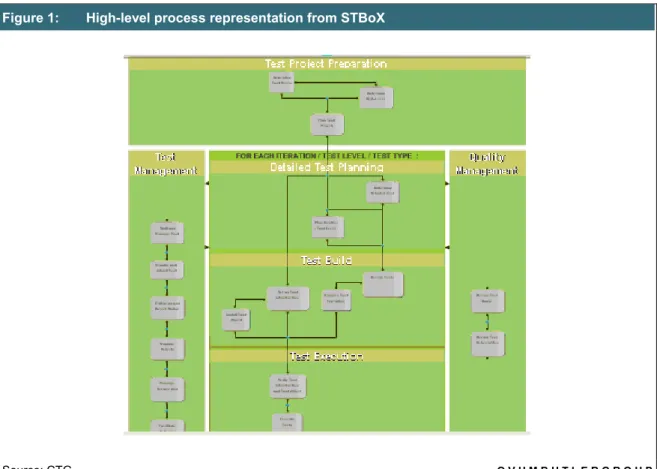
Figure 1: High-level process representation from STBoX
Figure 1 shows a graphic representation of a high-level process within STBoX. All such diagrams provide navigation to facilitate drill-down queries on any of the detailed assets that underpin each element of the chart. Any element within STBoX is customisable to meet the requirements of individual customers. Templates and processes are likely to be changed from the basis provided upon implementation, and at stages afterwards. This is especially true where the tool identifies accountability, as it does for every procedure, document, and other element via a responsibility assignment (RACI) matrix. Many customers incorporate their existing practices within the artefacts in their own version of STBoX.
STBoX offers more detail (see Figure 2) relating to testing processes than some organisations wish to absorb so CTG makes available a cut-down edition called STBoX Essentials. This can be helpful for organisations that have a considerable gap between their own maturity with regard to adoption of formalised testing processes and the highly process-driven levels of maturity that STBoX details in its full form, which is known as STBoX Prime. Also available is STBoX Agile, a specialist adaptation for defining testing within projects that are using an Agile methodology. STBoX Essentials, and some parts of STBoX Prime, are available free online. In a forthcoming release, a new tool, STBoX Governance, will extend the scope of test management, providing low-level, deliverable-focused information to help progress monitoring.
CTG offers an implementation of automated testing processes in its Test Automation Framework for HP QuickTest Professional. Much of the value of many years of test automation experience is built-in and allows customers implementing test automation to start quickly, building on the proven test automation approach supported by the HP QuickTest Professional function libraries, and gaining value from their investment in test automation more rapidly. The test automation framework ensures that processes can be set up in a maintainable and standardised way.
Figure 2: Detailed test process within STBoX
Product Emphasis
CTG’s testing services range across a broad spectrum, from consulting on testing-related strategy or processes to low-level testing and the whole set of activities in between. The company brings a significant body of resources to bear in its European countries of operation, with considerable expertise, and much in the way of value enhancement from its practical intellectual property (IP)-based tools. Of these, STBoX.constitutes a powerful means of helping customers to reach new levels of maturity in their approach to testing, and to do so on a foundation of standards and best practice. The fact that STBoX can be customised to suit each customer’s individual requirements is a significant plus. Ovum is strongly of the opinion that many organisations could make significant gains from investing in increasing the maturity of their testing processes, and believes that CTG is in an excellent position to provide valuable help in the countries where it provides testing services.
DEPLOYMENT
CTG supports four modes of delivery of its services: Flex Staffing, Managed Staffing, Managed Services, and Project Based. Flex Staffing and Project-based delivery are more flexible because they address shorter-term requirements that can be somewhat dynamic.
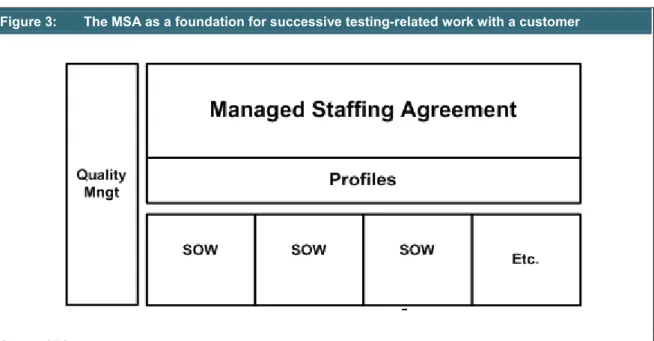
A Managed Staffing Agreement (MSA) with the customer is established as a commercial foundation for delivery of Managed Staffing services, and provides a contractual definition of numbers of people with particular expertise (matching pre-defined profiles) that CTG commits to supply for a certain period of time. The MSA also stipulates general terms and conditions for the engagement, encompassing for example the means of managing quality assurance throughout the lifecycle of the engagement across all workloads undertaken. Periodically, as defined by the customer’s overall delivery requirements, a Statement of Work (SOW) will be drawn up in which the workload for the coming period will be estimated and the necessary skills required will be planned for accordingly. Later SOW instances succeed those agreed earlier.
Figure 3: The MSA as a foundation for successive testing-related work with a customer
Source: CTG O V U M B U T L E R G R O U P
A Managed Service Agreement (MSeA) is a contractual definition in which CTG guarantees to deliver services defined by a service level agreement (SLA) for a certain period (typically two years with the duration defined by customer needs). The MSeA can detail penalties payable by CTG for failure to deliver within the terms of an SLA. CTG ensures the continuity of knowledge availability within the delivery team (whether team members are CTG resources or customer staff) to cover changes of personnel during the lifetime of the MSeA, and also in handing over to other teams after completion. Additionally, CTG ensures that all resources assigned to a customer project satisfy the minimum skills needed to fulfil the tasks required by the relevant Statement of Work (SOW). It also regularly assesses the performance of each staff member and the quality of services provided.
Customers may contract CTG to ensure that, throughout the MSA, the service provider (in association with customer representatives) assesses whether there are any opportunities for process improvements. Such an approach can ensure that increased maturity evolves over time and customers benefit from optimised processes as early as possible,
PRODUCT STRATEGY
CTG’s primary European focus for testing services is Belgium where it targets the following industry sectors: Financial services (representing 15% of total business). Clients include Fortis, ING, UBS, Securex,
and Euroclear.
Government (10% of total business). B-Holding (Belgian Railway) is a customer.
Industry (25% of total business). Clients include D’Ieteren, Wolters Kluwer, Eandis, Elia, Fabricom, and Indexis.
Companies of all sizes engage with CTG for testing services, from low-end SME’s with a few people in the IT department, up to large companies with several hundreds of people in the IT department. In general, CTG’s focus is the largest 200 companies in any country. The main opportunity for its services arises from lack of software quality and process maturity at potential customers’ sites, and also from a shortage of resources and skills among the customer’s workforce to resolve the problem.
Testing services are sold direct to customers by CTG account executives. Deal sizes can be as low as EUR 10,000 and can range up to EUR 1million. CTG recognises the growing competition in this market segment, both from general service providers such as Logica, Capgemini, IBM, and HP/EDS, as well as staffing specialists such as PS Testware and Quasus. It also acknowledges the commoditisation of lower-value testing services such as test design and execution, but it competes over a much broader range of scope, and with higher-value skills and services. CTG has supporting business partnerships with Zion Security for security testing, and with Polaris for offshore test projects. Its key supporting technology partnerships are with HP, IBM, and Microsoft. CTG is undertaking scientific study into the ROI from software testing. It also plans to add an STBoX Governance tool to extend the scope of test management to provide low-level deliverable-focused information to help progress monitoring.
Globally, additional service lines from which CTG’s business arises include a range of requirements and technologies:
IT Service Management (ITSM), responsible for approximately 20% of CTG revenues.
Application development solutions, the largest grouping, which involves over 100 people in Europe. Business intelligence (BI) solutions, a significant number of which are focused on data quality. Compliance solutions, originally a life sciences-related capability, but now focused across a number
of industries and incorporating, for example, testing against Food and Drug Administration (FDA) Regulations in the US. It is common for testing services to be required as part of customer compliance solutions.
CTG’s US business is very significantly focused on opportunities in the healthcare sector. The company’s plans include development of the business in the UK healthcare market, involving business consulting, and implementations of medical and laboratory systems. These capabilities will also be rolled out into markets elsewhere in Europe, and generalised testing services will be a strong feature in both the UK and the rest of Europe.
COMPANY PROFILE
Computer Task Group, Inc. (CTG) was founded in the US in 1966, and started doing business in Europe in 1976. Its headquarters are in Buffalo, New York and it has offices in over 20 additional locations in the US, as well as in Toronto, Canada. Its European base is in Belgium, and it also has offices in Luxembourg and the UK. Worldwide, CTG has over 3,000 employees, of whom about 500 are located in European offices. Of the European staff, 160 are dedicated to testing services, with eight of these in the UK, 15 in Luxembourg, and the rest in Belgium. Another 10% or so of the European workforce is employed to undertake R&D, sales and marketing, administration, and support roles across all of CTG’s European activities. The remaining (just under 300) employees deliver or manage non-testing services. CTG expects its European workforce to increase by over 10% during 2010.
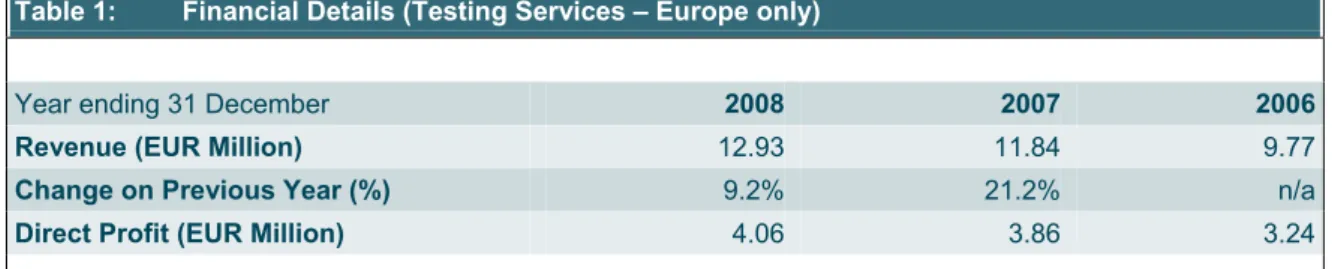
The company is listed on Nasdaq (NASDAQ: CTGX). Its financial results relating to testing services in Europe in recent financial years are detailed in Table 1. These figures do not include revenues that are segregated as arising from engagements dealing with regulatory compliance issues, although some of those do involve testing work. Revenues from testing services consistently represent roughly 25% of CTG’s total European revenues, and testing services have tended to be slightly more profitable than other services collectively.
Table 1: Financial Details (Testing Services – Europe only)
Year ending 31 December 2008 2007 2006
Revenue (EUR Million) 12.93 11.84 9.77
Change on Previous Year (%) 9.2% 21.2% n/a
Direct Profit (EUR Million) 4.06 3.86 3.24
Source: CTG O V U M B U T L E R G R O U P
Engagements vary from supporting as few as 10 users up to hundreds. CTG has undertaken (or continues to undertake) testing services for 88 customers, from the company’s total European customer base of 128 organisations. Its work with European customers includes:
Working for Agfa, specialist testing of third-party applications that digitise x-ray images, with specific responsibility for system and integration-level testing using HP and INM tools and complying with Agfa’s own test methodology.
Conducting interviews, analysis, and workshops to establish requirements for testing capability upgrade at Electrabel, followed by lead role in proof of concept, demos, and evaluation of solution selection for testing tools.
High-level test planning, test modelling, tooling, methodology establishment, and training followed by coordination and partial resourcing of two pilot projects for KBC Securities.
Implementation of a test methodology based on STBox, for Luminus, followed by resourcing of tool support, test coordination, and project-specific expertise assistance.
Implementation of a test methodology based on STBox, for Luminus, followed by resourcing of tool support, test coordination, and project-specific expertise assistance.
Implementation of a software test methodology for UBS Fund Services based on STBox, including an alignment programme to the customer requirements, and deployment of its realisation via HP Quality Center with follow-up training and project-specific services.
Implementation of a software test methodology for UBS Fund Services based on STBox, including an alignment programme to the customer requirements, and deployment of its realisation via HP Quality Center with follow-up training and project-specific services.
SUMMARY
SUMMARY
In its ability to undertake a complete range of engagement types relating to testing requirements from consulting-level and test management to test execution, CTG is a potentially valuable partner for organisations from all vertical sectors and of all sizes that have targeted the benefits that increasing maturity with respect to testing capabilities and processes can bring. The company can be engaged as a testing specialist complementing other service providers within the overall application lifecycle, or can also provide services that complement its testing specialism. Ovum feels that CTG’s European focus, in which Belgium and Luxembourg are its only areas of operation, is currently limited. However, we recognise that the company plans to extend its testing services offerings further in the UK (where CTG has a small initial presence) and to other countries.
In its ability to undertake a complete range of engagement types relating to testing requirements from consulting-level and test management to test execution, CTG is a potentially valuable partner for organisations from all vertical sectors and of all sizes that have targeted the benefits that increasing maturity with respect to testing capabilities and processes can bring. The company can be engaged as a testing specialist complementing other service providers within the overall application lifecycle, or can also provide services that complement its testing specialism. Ovum feels that CTG’s European focus, in which Belgium and Luxembourg are its only areas of operation, is currently limited. However, we recognise that the company plans to extend its testing services offerings further in the UK (where CTG has a small initial presence) and to other countries.
Table 2: Contact Details European headquarters Woluwelaan 140 A 1831 DIEGEM Belgium Tel: +32 2 720 51 70 Fax: +32 2 725 09 20 E-mail: [email protected] www.ctg.com UK office 11 Beacontree Plaza Gillette Way Reading Berkshire RG2 0BS UK Tel: +44 (0)118 975 0877 Fax: +44 (0)118 931 0249 Source: CTG O V U M B U T L E R G R O U P Headquarters Shirethorn House, 37/43 Prospect Street, Kingston upon Hull, HU2 8PX, UK
Tel: +44 (0)1482 586149 Fax: +44 (0)1482 323577
Australian Sales Office Level 46, Citigroup Building, 2 Park Street, Sydney, NSW, 2000,
Australia
Tel: + 61 (02) 8705 6960 Fax: + 61 (02) 8705 6961
End-user Sales Office (USA) 245 Fifth Avenue,
4th Floor, New York, NY 10016,
USA
Tel: +1 212 652 5302 Fax: +1 212 202 4684
Important Notice
This report contains data and information up-to-date and correct to the best of our knowledge at the time of preparation. The data and information comes from a variety of sources outside our direct control, therefore Butler Direct Limited cannot give any guarantees relating to the content of this report.