Type-Safe Feature-Oriented
Product Lines
Sven Apel
†, Christian Kästner
‡, Armin Größlinger
†, and
Christian Lengauer
††Department of Informatics and Mathematics, University of Passau {apel,groesslinger,lengauer}@uni-passau.de
‡School of Computer Science, University of Magdeburg [email protected]
Technical Report, Number MIP-0909 Department of Informatics and Mathematics
University of Passau, Germany June 2009
Type-Safe Feature-Oriented Product Lines
Sven Apel†, Christian Kästner‡, Armin Größlinger†, and Christian Lengauer††
Department of Informatics and Mathematics, University of Passau
{apel,groesslinger,lengauer}@uni-passau.de
‡
School of Computer Science, University of Magdeburg
Abstract. Afeature-oriented product lineis a family of programs that share a common set of features. Afeatureimplements a stakeholder’s requirement, rep-resents a design decision and configuration option and, when added to a program, involves the introduction of new structures, such as classes and methods, and the refinement of existing ones, such as extending methods. With feature-oriented decomposition, programs can be generated, solely on the basis of a user’s selec-tion of features, by the composiselec-tion of the corresponding feature code. A key challenge of feature-oriented product line engineering is how to guarantee the correctness of anentirefeature-oriented product line, i.e., of all of the member programs generated from different combinations of features. As the number of valid feature combinations grows progressively with the number of features, it is not feasible to check all individual programs. The only feasible approach is to have a type system check the entire code base of the feature-oriented product line. We have developed such a type system on the basis of a formal model of a feature-oriented Java-like language. We demonstrate that the type system ensures thateveryvalid program of a feature-oriented product line is well-typed and that the type system is complete.
1
Introduction
Feature-oriented programming(FOP) aims at the modularization of programs in terms of features [55,13]. Afeatureimplements a stakeholder’s requirement and is typically an increment in program functionality [55,13]. Contemporary feature-oriented pro-gramming languages and tools such as AHEAD [13], Xak [2], CaesarJ [48], Class-box/J [14], FeatureHouse [9], and FeatureC++ [10] provide a variety of mechanisms that support the specification, modularization, and composition of features. A key idea is that a feature is implemented by a distinct code unit, called afeature module. When added to a base program, it introduces new structures, such as classes and methods, and refines existing ones, such as extending methods [43,11]. A program that is decomposed into features is called henceforth afeature-oriented program.1
1
Typically, feature-oriented decomposition is orthogonal to class-based or functional decomposition [63,49,61]. A multitude of modularization and composition mecha-nisms [17,26,24,45,46,56,65] have been developed in order to allow programmers to decom-pose a program along multiple dimensions [63]. Feature-oriented languages and tools provide a significant subset of these mechanisms [11].
Beside the decomposition of programs into features, the concept of a feature is useful for distinguishing different, related programs thus forming asoftware product line[35,21]. Typically, programs of a common domain share a set of features but also differ in other features. For example, suppose an email client for mobile devices that supports the protocols IMAP and POP3 and another client that supports POP3, MIME, and SSL encryption. With a decomposition of the two programs into the features IMAP, POP3, MIME, and SSL, both programs can share the code of the feature POP3. Since mobile devices have only limited resources, unnecessary features should be removed.
With feature-oriented decomposition, programs can be generated solely on the ba-sis of a user’s selection of features by the composition of the corresponding feature modules. Of course, not all combinations of features are legal and result in correct programs [12]. Afeature model describes which features can be composed in which combinations, i.e., which programs are valid [35,21]. It consists of an (ordered) set of features and a set of constraints on feature combinations [21,12]. For example, our email client may have different rendering engines for HTML text, e.g., the Mozilla en-gine or the Safari enen-gine, but only one at a time. A set of feature modules along wit a feature model is called afeature-oriented product line[12].
An important question is how the correctness of feature-oriented programs, in par-ticular, and product lines, in general, can be guaranteed. A first problem is that con-temporary feature-oriented languages and tools usually involve a code generation step during composition in which the code is transformed into a lower-level representation. In previous work, we have addressed this problem by modeling feature-oriented mech-anisms directly in the formal syntax and semantics of a core language, calledFeature Featherweight Java (FFJ). The type system of FFJ ensures that the composition of feature modules is type-safe [8].
In this paper, we address a second problem: How can the correctness of anentire feature-oriented product line be guaranteed? A naive approach would be to type-check all valid programs of a product line using a type checker like the one of FFJ [8]. How-ever, this approach does not scale; already for 34 implemented optional features, a vari-ant can be generated for every person on the planet. Noticing this problem, Czarnecki and Pietroszek [22] and Thaker et al. [64] suggested the development of a type sys-tem that checks the entire code base of the feature-oriented product line, instead of all individual feature-oriented programs. In this scenario, a type checker must analyzeall feature modules of a product line on the basis of the feature model. We will show that, with this information, the type checker can ensure thateveryvalid program variant that can be generated is type-safe. Specifically, we make the following contributions:
– We provide a condensed version of FFJ, which is in many respects more elegant and concise than its predecessor [8].
– We develop a formal type system that uses information about features and con-straints on feature combinations in order to type-check a product line without gen-erating every program.
– We provecorrectnessby proving that every program generated from a well-formed product line is well-formed, as long as the feature selection satisfies the constraints of the product line. Furthermore, we provecompletenessby proving that the
typedness of all programs of a product line guarantees that the product line is well-typed as a whole.
– We offer an implementation of FFJ, including the proposed type system, which can be downloaded for evaluation and for experiments with further feature-oriented language and typing mechanisms.
Or work differs in many respects from previous and related work (see Section 5 for a comprehensive discussion). Most notably, Thaker et al. have implemented a type system for feature-oriented product lines and conducted several case studies [64]. We take their work further with a formalization and a correctness and completeness proof.
Furthermore, our work differs in many respects from previous work on modeling and type-checking feature-oriented and related programming mechanisms. Most no-tably, we model the feature-related mechanisms directly in FFJ’s syntax and semantics, without any transformation to a lower-level representation, and we stay very close to the syntax of contemporary feature-oriented languages and tools (see Section 5). We begin with a brief introduction to FFJ.
2
Feature-Oriented Programs in FFJ
In this section, we introduce the language FFJ. Originally, FFJ was designed for feature-oriented programs [8,7]. We extend FFJ in Section 3 to support feature-feature-oriented product lines, i.e., to support the representation of multiple alternative program variants at a time.
2.1 An Overview of FFJ
FFJ is a lightweight feature-oriented language that has been inspired byFeatherweight Java(FJ) [32]. As with FJ, we have aimed at minimality in the design of FFJ. FFJ provides basic constructs like classes, fields, methods, and inheritance and only a few new constructs capturing the core mechanisms of feature-oriented programming. But, so far, FFJ’s type system has not supported the development of feature-oriented product lines. That is, the feature modules written in FFJ are interpreted as a single program. We will change this in Section 3.
An FFJ program consists of a set of classes and refinements. Arefinementextends a class that has been introduced previously. Each class and refinement is associated with a feature. We say that a feature introducesa class or appliesa refinement to a class. Technically, the mapping between classes/refinements and the features they belong to can be established in different ways, e.g., by extending the language with modules rep-resenting features [48,14,23] or by grouping classes and refinements that belong to a feature in packages or directories [13,10].
Like in FJ, each class declares a superclass, which may be the classObject. Refine-ments are defined using the keywordrefines. The semantics of a refinement applied to a class is that the refinement’s members are added to and merged with the member of the refined class. This way, a refinement canadd new fields and methods to the class andoverrideexisting methods (declared byoverrides).
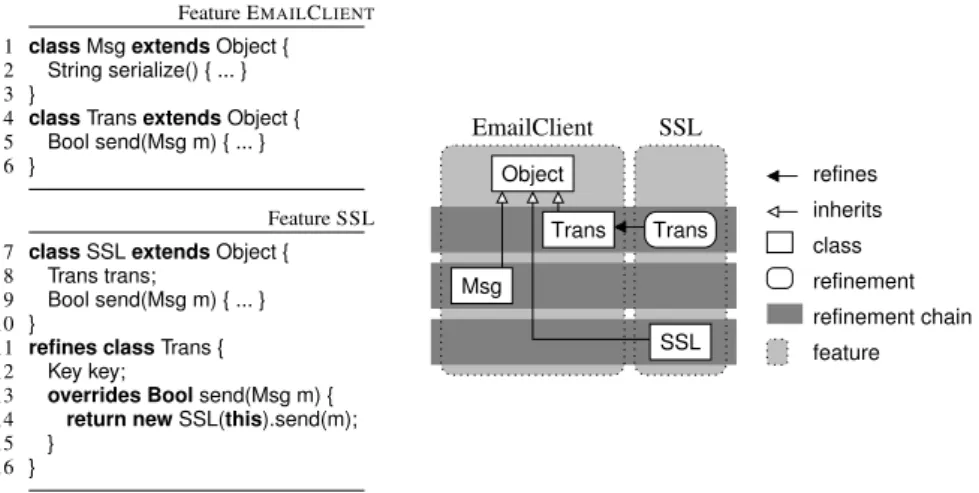
On the left side in Figure 1, we show an excerpt of the code of a basic email client, called EMAILCLIENT, (top) and a feature, called SSL, (bottom) in FFJ. The feature SSL adds the classSSL(Lines 7–10) to the email client’s code base and refines the classTrans in order to encrypt outgoing messages (Lines 11–15). To this effect, the refinement ofTransadds a new fieldkey(Line 12) and overrides the methodsendof classTrans(Lines 13-15).
Feature EMAILCLIENT 1 classMsgextendsObject { 2 String serialize() { ... } 3 }
4 classTransextendsObject { 5 Bool send(Msg m) { ... } 6 }
Feature SSL 7 classSSLextendsObject { 8 Trans trans;
9 Bool send(Msg m) { ... } 10 }
11 refines classTrans { 12 Key key;
13 overrides Boolsend(Msg m) { 14 return newSSL(this).send(m); 15 } 16 } refinement chain feature refinement class inherits refines SSL EmailClient Object Trans Msg Trans SSL
Fig. 1.A feature-oriented email client supporting SSL encryption.
Typically, a programmer applies multiple refinements to a class by composing a sequence of features. This is called a refinement chain. A refinement that is applied immediately before another refinement in the chain is called itspredecessor. The order of the refinements in a refinement chain is determined by their composition order. On the right side in Figure 1, we depict the refinement and inheritance relationships of our email example.
Fields are unique within the scope of a class and its inheritance hierarchy and re-finement chain. That is, a rere-finement or subclass is not allowed to add a field that has already been defined in a predecessor in the refinement chain or in a superclass. For example, a further refinement ofTranswould not be allowed to add a fieldkey, since
keyhas been introduced by a refinement of feature SSL already. With methods, this is different. A refinement or subclass may add new methods (overloading is prohibited) and override existing methods. In order to distinguish the two cases, FFJ expects the programmer to declare whether a method overrides an existing method (using the mod-ifier overrides). For example, the refinement ofTrans in feature SSL overrides the methodsendintroduced by feature MAIL; for subclasses, this is similar.
The distinction between method introduction and overriding allows the type system to check (1) whether an introduced method inadvertently replaces or occludes an ex-isting method with the same name and (2) whether, for every overriding method, there is a proper method to be overridden. Apart from the modifieroverrides, a method in FFJ is similar to a method in FJ. That is, a method body is an expression (prefixed with
return) and not a sequence of statements. This is due to the functional nature of FFJ and FJ. Furthermore, overloading of methods (introducing methods with equal names and different argument types) is not allowed in FFJ (and FJ).
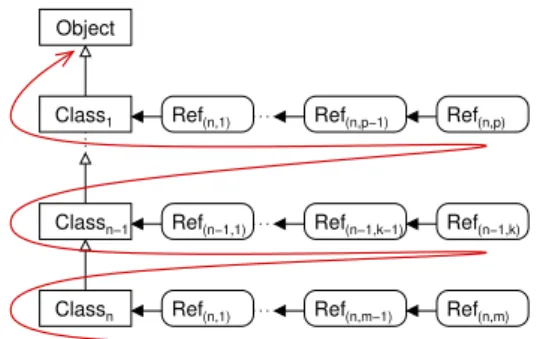
As shown in Figure 1, refinement chains grow from left to right and inheritance hierarchies from top to bottom. When looking up a method body, FFJ traverses the combined inheritance and refinement hierarchy of an object and selects the right-most and bottom-most body of a method declaration or method refinement that is compati-ble. This kind of lookup is necessary since we model featuresdirectlyin FFJ, instead of generating and evaluating FJ code [40]. First, the FFJ calculus looks for a method declaration in the refinement chain of the object’s class, starting with the last refinement back to the class declaration itself. The first body of a matching method declaration is returned. If the method is not found in the class’ refinement chain or in its own dec-laration, the methods in the superclass (and then the superclass’ superclass, etc.) are searched, each again from the most specific refinement of the class declaration itself. The field lookup works similarly, except that the entire inheritance and refinement hier-archy is searched and the fields are accumulated in a list. In Figure 2, we illustrate the processes of method body and field lookup schematically.
Ref(n−1,1) Ref(n−1,k−1) Ref(n,1) Ref(n,m) Classn Ref(n,m−1) Ref(n,1) Ref(n,p) Ref Class1 Ref(n,p−1) (n−1,k) Classn−1 Object
Fig. 2.Order of method body and field lookup in FFJ.
2.2 Syntax of FFJ
Before we go into detail, let us explain some notational conventions. We abbreviate lists in the obvious ways:
– Cis shorthand forC1,. . ., Cn – C fis shorthand forC1f1,. . ., Cn fn – C f;is shorthand forC1f1;. . .; Cnfn; – t : Cis shorthand fort1: C1,. . ., tn : Cn – C <: Dis shorthand forC1<: D1. . .Cn <: Dn – . . .
Note that, depending on the context, blanks, commas, or semicolons separate the el-ements of a list. The context will make clear which separator is meant. The symbol•
denotes the empty list and lists of field declarations, method declarations, and parameter names must not contain duplicates. We use the metavariablesA–Efor class names,f–h
for field names, andmfor method names. Feature names are denoted by Greek letters. In Figure 3, we depict the syntax of FFJ in extended Backus-Naur-Form. An FFJ program consists of a set of class and refinement declarations. A class declaration L
declares a class with the nameCthat inherits from a superclassDand consists of a list
C f;of fields and a listMof method declarations.2A refinement declarationRconsists
of a listC f;of fields and a listMof method declarations.
L::= class declarations: class C extends D { C f; M } R::= refinement declarations: refines class C { C f; M } M::= method declarations: [overrides] C m(C x) { return t; } t::= terms: x variable t.f field access t.m(t) method invocation
new C(t) object creation
(C) t cast
v::= values:
new C(v) object creation
Fig. 3.Syntax of FFJ in extended BNF.
A methodmexpects a listC xof arguments and declares a body that returns only a single expressiontof typeC. Using the modifieroverrides, a method declares that it intends to override another method with the same name and signature. Where we want to distinguish methods that override others and methods that do not override others, we call the formermethod introductionsand the lattermethod refinements
Finally, there are five forms of terms: the variable, field access, method invocation, object creation, and type cast, which are taken from FJ without change. The only values are object creations whose arguments are values as well.
2.3 FFJ’s Class Table
Declarations of classes and refinements can be looked up via a class tableCT. The com-piler fills the class table during the parser pass. In contrast to FJ, class and refinement declarations are identified not only by their names but, additionally, by the names of the enclosing features. For example, in order to retrieve the declaration of classTrans, introduced by feature MAIL, in our example of Figure 1, we writeCT(MAIL.Trans); in order to retrieve the refinement of class Transapplied by feature SSL, we write CT(SSL.Trans). We callΦ.Cthequalified typeof classCin featureΦ. In FFJ, class and refinement declarations are unique with respect to their qualified types. This prop-erty is ensured because of the following sanity conditions: a feature is not allowed
2The concept of a class constructor is unnecessary in FFJ and FJ [54]. Its omittance simplifies
– to introduce a class or refinement twice inside a single feature module and – to refine a class that the feature has just introduced.
These are common sanity conditions in feature-oriented languages and tools [13,10,9]. As for FJ, we impose further sanity conditions on the class table and the inheritance relation:
– CT(Φ.C) = class C. . . or refines class C. . . for every qualified typeΦ.C ∈
dom(CT); Feature Base plays the same role for features as Object plays for classes; it is a symbol denoting the empty feature at which lookups terminate. – Base.Object∈/ dom(CT);
– for every class nameCappearing anywhere inCT, we haveΦ.C∈dom(CT)for at least one featureΦ; and
– the inheritance relation contains no cycles (incl. self-cycles).
2.4 Refinement in FFJ
Information about the refinement chain of a class can be retrieved using the refinement tableRT. The compiler fills the refinement table during the parser pass.RT(C)yields a list of all features that either introduce or refine class C. The leftmost element of the result list is the feature that introduces the classCand, then, from left to right, the features are listed that refine classCin the order of their composition. In our example of Figure 1,RT(Trans)yields the list EMAILCLIENT,SSL. There is only a single sanity condition for the refinement table:
– RT(C) = Φfor every typeC∈ dom(CT), withΦbeing the features that
intro-duce and refine classC.
In Figure 4, we show two functions for the navigation of the refinement chain that rely onRT. Functionlastreturns, for a class nameC, a qualified typeΨn.C, in which
Ψn refers to the feature that applies the final refinement to classC; if a class is not
refined at all,Ψn refers to the feature that introduces classC. Functionpred returns,
for a qualified typeΦ.C, another qualified typeΨn.C, in whichΨnrefers to the feature
that introduces or refines class Cand that is the immediate predecessor of Φin the refinement chain; if there is no predecessor,Base.Objectis returned.
Navigating along the refinement chain
RT(C) = Ψ
last(C) = Ψn.C
RT(C) = Ψ,Φ,Ω Ψ6=• pred(Φ.C) = Ψn.C
RT(C) = Φ,Ω
pred(Φ.C) = Base.Object
2.5 Subtyping in FFJ
In Figure 5, we show the subtype relation of FFJ. The subtype relation<:is defined by one rule each for reflexivity and transitivity and one rule for relating the type of a class to the type of its immediate superclass. It is not necessary to define subtyping over qualified types because only classes (not refinements) declare superclasses and there is only a single declaration per class.
Subtyping C <: D C <: C C <: D D <: E C <: E CT(Φ.C) =class C extends D { . . . } C <: D Fig. 5.Subtyping in FFJ. 2.6 Auxiliary Definitions of FFJ
In Figure 6, we show the auxiliary definitions of FFJ. Functionfieldssearches the re-finement chain from right to left and accumulates the fields into a list (using the comma as concatenation operator). If there is no further predecessor in the refinement chain, i.e., we have reached a class declaration, then the refinement chain of the superclass is searched (see Figure 2). IfBase.Objectis reached, the empty list is returned (denoted by•).
Functionmbodylooks up the most specific and most refined body of a methodm. A body consists of the formal parametersxof a method and the actual termtrepresenting the content. The search is like in fields. First, the refinement chain is searched from right to left and, then, the superclasses’ refinement chains are searched, as illustrated in Figure 2. Note that[overrides]means that a given method declaration may (or may not) have the modifier. This way, we are able to define uniform rules for method introduction and method refinement. Functionmtypeyields the signatureB→B0of a declaration
of methodm. The lookup is like inmbody.
Predicateintroduceis used to check whether a class has been introduced by mul-tiple features and whether a field or method has been introduced mulmul-tiple times in a class. Precisely, it states, in the case of classes, whetherChas not been introduced by any feature other thanΦand whether a methodmor a fieldfhas not been introduced byΦ.Cor in any of its predecessors or superclasses. To evaluate it, we check, in the case of classes, whetherCT(Ψ.C)yields a class declaration or not, for any featureΨ
different fromΦ, in the case of methods, whethermtypeyields a signature or not and, in the case of fields, whetherfis defined in the list of fields returned byfields.
Predicaterefine states whether, for a given refinement, a proper class has been declared previously in the refinement chain. The predicate override states whether a methodm has been introduced before in some predecessor of Φ.C and whether the previous declaration ofmhas the given signature.
Field lookup fields(Φ.C) =C f
fields(Base.Object) =•
CT(Φ.C) =class C extends D { C f;M }
fields(Φ.C) =fields(last(D)),C f
CT(Φ.C) =refines class C { C f; M }
fields(Φ.C) =fields(pred(Φ.C)),C f
Method body lookup mbody(m,Φ.C) = (x,t)
[overrides] B m(B x) { return t; }∈M
CT(Φ.C) =class C extends D { C f;M }
mbody(m,Φ.C) = (x,t)
mis not defined inM
CT(Φ.C) =class C extends D { C f;M }
mbody(m,Φ.C) =mbody(m,last(D))
[overrides] B m(B x) { return t; }∈M CT(Φ.C) =refines class C { C f;M }
mbody(m,Φ.C) = (x,t)
mis not defined inM
CT(Φ.C) =refines class C { C f;M }
mbody(m,Φ.C) =mbody(m,pred(Φ.C))
Method type lookup mtype(m,Φ.C) =C→C
B0m(B x) { return t; }∈M
CT(Φ.C) =class C extends D { C f;M }
mtype(m,Φ.C) =B→B0
mis not defined inM
CT(Φ.C) =class C extends D { C f; M }
mtype(m,Φ.C) =mtype(m,last(D))
B0m(B x) { return t; }∈M CT(Φ.C) =refines class C { C f;M }
mtype(m,Φ.C) =B→B0
mis not defined inM
CT(Φ.C) =refines class C { C f; M }
mtype(m,Φ.C) =mtype(m,pred(Φ.C))
Valid class introduction introduce(Φ.C)
@Ψ : (CT(Ψ.C) =class C. . . ∧ Φ6= Ψ) introduce(Φ.C)
Valid field introduction introduce(f,Φ.C)
fields(Φ.C) =E h f∈/h
introduce(f,Φ.C)
Valid method introduction introduce(m,Φ.C)
(m,Φ.C)∈/dom(mtype)
introduce(m,Φ.C)
Valid class refinement refine(Φ.C)
RT(C) = Ψ,Φ,Ω CT(Ψ1.C) =class C. . . refine(Φ.C)
Valid method overriding override(m,Φ.C,C→C0)
mtype(m,Φ.C) =B→B0 C=B C0=B0
override(m,Φ.C,C→C0)
2.7 Evaluation of FFJ Programs
Each FFJ program consists of a class table and a term.3The term is evaluated using the
evaluation rules shown in Figure 7. The evaluation terminates when a value, i.e., a term of the formnew C(v), is reached. Note that we use adirect semanticsof class refine-ment [40]. That is, the field and method lookup mechanisms incorporate all refinerefine-ments when a class is searched for fields and methods. An alternative, which is discussed in Section 5, would be aflattening semantics, i.e., to merge a class in a preprocessing step with all of its refinements into a single declaration.
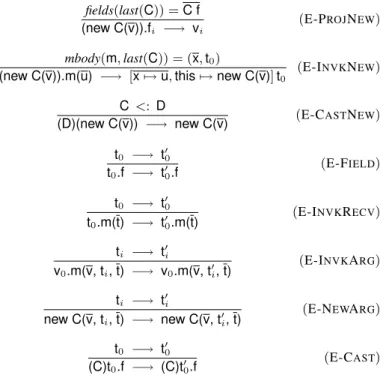
fields(last(C)) =C f
(new C(v)).fi −→ vi
(E-PROJNEW)
mbody(m,last(C)) = (x,t0)
(new C(v)).m(u) −→ [x7→u,this7→new C(v)]t0
(E-INVKNEW)
C <: D
(D)(new C(v)) −→ new C(v) (E-CASTNEW)
t0 −→ t00 t0.f −→ t00.f (E-FIELD) t0 −→ t00 t0.m(t) −→ t00.m(t) (E-INVKRECV) ti −→ t0i v0.m(v, ti, t) −→ v0.m(v, t0i, t) (E-INVKARG) ti −→ t0i new C(v, ti, t) −→ new C(v, t0i, t) (E-NEWARG) t0 −→ t00 (C)t0.f −→ (C)t00.f (E-CAST)
Fig. 7.Evaluation of FFJ programs.
Using the subtype relation<:and the auxiliary functionsfieldsandmbody, the eval-uation of FFJ is fairly simple. The first three rules are most interesting (the remaining rules are just congruence rules). Rule E-PROJNEW describes the projection of a field from an instantiated class. A projected field fi evaluates to a valuevi that has been passed as argument to the instantiation. Function fieldsis used to look up the fields of the given class. It receiveslast(C)as argument since we want to search the entire refinement chain of classCfrom right to left (cf. Figure 2).
Rule E-PROJINVKevaluates a method invocation by replacing the invocation with the method’s body. The formal parameters of the method are substituted in the body for
3
the arguments of the invocation; the value on which the method is invoked is substituted forthis. The functionmbodyis called with the last refinement of the classCin order to search the refinement chain from right to left and return the most specific method body (cf. Figure 2).
Rule E-CASTNEWevaluates an upcast by simply removing the cast. Of course, the premise must be that the cast is really an upcast and not a downcast or an incorrect cast.
2.8 Type Checking FFJ Programs
The type relation of FFJ consists of the type rules for terms and the well-formedness rules for classes, refinements, and methods, shown in Figures 8 and 9.
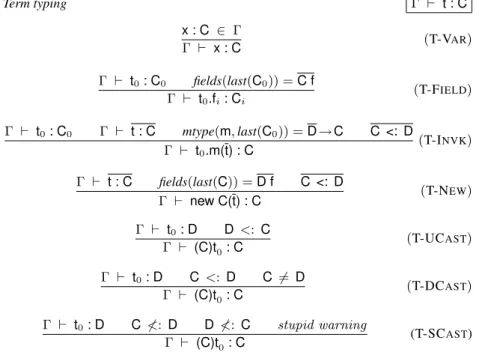
Term typing Γ ` t : C x : C ∈ Γ Γ ` x : C (T-VAR) Γ ` t0: C0 fields(last(C0)) =C f Γ ` t0.fi: Ci (T-FIELD) Γ ` t0: C0 Γ ` t : C mtype(m,last(C0)) =D→C C <: D Γ ` t0.m(t) : C (T-INVK) Γ ` t : C fields(last(C)) =D f C <: D Γ ` new C(t) : C (T-NEW) Γ ` t0: D D <: C Γ ` (C)t0: C (T-UCAST) Γ ` t0: D C<: D C 6=D Γ ` (C)t0: C (T-DCAST) Γ ` t0: D C 6<: D D 6<: C stupid warning Γ ` (C)t0: C (T-SCAST)
Fig. 8.Term typing in FFJ.
Term Typing Rules. A term typing judgment is a triple consisting of a typing context
Γ, a termt, and a typeC(see Figure 8).
Rule T-VARchecks whether a free variable is contained in the typing context. Rule T-FIELDchecks whether a field accesst0.fis well-typed. Specifically, it checks whether
fis declared in the type oft0and whether the typefequals the type of the entire term.
Rule T-INVK checks whether a method invocationt0.m(t)is well-typed. To this end,
Method typing MOKaΦ.C x : B, this : C ` t0: E0 E0 <: B0
CT(Φ.C) =class C extends D { C f; M } introduce(m,last(D))
B0m(B x) { return t0; }OKaΦ.C x : B, this : C ` t0: E0 E0 <: B0
CT(Φ.C) =class C extends D { C f; M } override(m,last(D),B→B0) overrides B0m(B x) { return t0; }OKaΦ.C
x : B, this : C ` t0: E0 E0 <: B0
CT(Φ.C) =refines class C { C f; M } introduce(m,pred(Φ.C))
B0m(B x) { return t0; }OKaΦ.C x : B, this : C ` t0: E0 E0 <: B0
CT(Φ.C) =refines class C { C f; M } override(m,pred(Φ.C),B→B0) overrides B0m(B x) { return t0; }OKaΦ.C
Class typing LOKaΦ
∀f∈f : introduce(f,last(D)) introduce(Φ.C) MOKaΦ.C
class C extends D { C f; M }OKaΦ
Refinement typing ROKaΦ
∀f∈f: introduce(f,pred(Φ.C)) refine(Φ.C) MOKaΦ.C
refines class C { C f; M }OKaΦ
formal parameters ofmand whether the return type ofmequals the type of the entire term. Rule T-NEWchecks whether an object creationnew C(t)is well-typed in that it checks whether the argumentstof the instantiation ofCare subtypes of the typesDof the fields ofCand whetherCequals the type of the entire term. The rules T-UCAST, T-DCAST, and T-SCASTcheck whether casts are well-typed. In each rule, it is checked whether the typeCthe termt0is cast to is a subtype, supertype, or unrelated type of the
type oft0and whetherCequals the type of the entire term.4
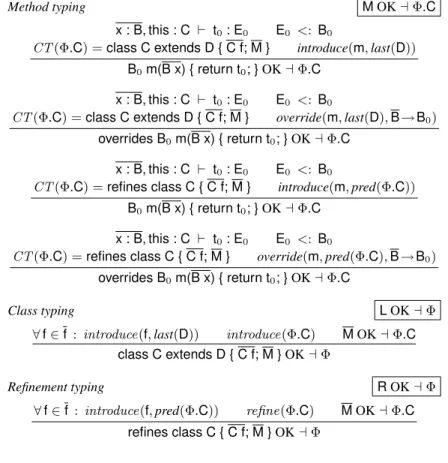
Well-Formedness Rules. In Figure 9, we show FFJ’s well-formedness rules of classes, refinements, and methods.
The typing judgments of classes and refinements are binary relations between a class or refinement declaration and a feature, writtenLOK aΦandROK a Φ. The rule of classes checks whether all methods are well-formed in the context of the class’ qualified type. Moreover, it checks whether none of the fields of the class declaration is introduced multiple times in the combined inheritance and refinement hierarchy and whether there is no feature other thanΦthat introduces a classC(usingintroduce). The well-formedness rule of refinements is analogous, except that the rule checks whether a corresponding class has been introduced before (usingrefine).
The typing judgment of methods is a binary relation between a method declaration and the qualified type that declares the method, writtenMOKa Φ.C. There are four different rules for methods (from top to bottom in Figure 9)
1. that do not override another method and that are declared by classes, 2. that override another method and that are declared by classes,
3. that do not override another method and that are declared by refinements, 4. that override another method and that are declared by refinements.
All four rules check whether the typeE0of the method body is a subtype of the declared
return typeB0of the method declaration. For methods that are being introduced, it is
checked whether no method with an identical name has been introduced in a superclass (Rule 1) or in a predecessor in the refinement chain (Rule 3). For methods that override other methods, it is checked whether a method with identical name and signature exists in the superclass (Rule 2) or in a predecessor in the refinement chain (Rule 4).
Well-Typed FFJ Programs. Finally, an FFJ program, consisting of a term, a class table, and a refinement table, is well-typed if
– the term is well-typed (checked using FFJ’s term typing rules),
– all classes and refinements stored in the class table are well-typed (checked using FFJ’s well-formedness rules), and
– the class and refinement tables are well-formed (ensured by the corresponding san-ity conditions).
4Rule T-SC
ASTis needed only for the small step semantics of FFJ (and FJ) in order to be able to formulate and prove the type preservation property. FFJ (and FJ) programs whose type derivation contains this rule (i.e., the premisestupid warningappears in the derivation) are not further considered (cf. [32]).
Type Soundness of FFJ. The type system of FFJ is sound. We can prove this using the standard theorems of preservation and progress [66]:
THEOREM2.1 (Preservation) If Γ ` t : C and t−→t0, then Γ ` t0: C0 for some
C0<: C.
THEOREM2.2 (Progress) Supposetis a well-typed term.
1. Iftincludesnew C0(t).fias a subterm, thenfields(last(C0)) =C ffor someCand
f.
2. Iftincludesnew C0(t).m(u)as a subterm, thenmbody(m,last(C0)) = (x,t0)and
|x|=|u|for somexandt0.
We provide the proofs of the two theorems in Appendix A.
3
Feature-Oriented Product Lines in FFJ
PLIn this section, our goal is to define a type system for feature-oriented product lines – a type system that checks whether all valid combinations of features yield well-typed programs. In this scenario, the features in question may be optional or mutually ex-clusive so that different combinations are possible that form different feature-oriented programs. Since there may be plenty of valid combinations, type checking all of them individually is usually not feasible.
In order to provide a type system for feature-oriented product lines, we need infor-mation about which combinations of features are valid, i.e., which features are manda-tory, optional, or mutually exclusive, and we need to adapt the subtype and type rules of FFJ to check that there are no combinations/variants that lead to ill-typed terms. The type system guarantees that every program derived from a well-typed product line is a well-typed FFJ program. FFJ together with the type system for checking feature-oriented product lines is henceforth called FFJPL.
3.1 An Overview of Feature-Oriented Product Lines
A feature-oriented product line is made up of a set of feature modules and a fea-ture model. The feafea-ture modules contains the feafea-tures’ implementation and the feafea-ture model describes how the feature modules can be combined. In contrast to the feature-oriented programs of Section 2, typically, some features are optional and some are mu-tually exclusive (Also other relations such as disjunction, negation, and implication are possible [12]; they are broken down to mandatory, optional, and mutually exclusive features, as we will explain.). Generally, in aderivation step, a user selects a valid sub-set of features from which, subsequently, a feature-oriented program is derived. In our case, derivation means assembling the corresponding feature modules for a given set of features. In Figure 10, we illustrate the process ofprogram derivation.
Typically, a wide variety of programs can be derived from a product line [21,19]. The challenge is to define a type system that guarantees, on the basis of the feature modules and the feature model, that all valid programs are well-typed. Once a program is derived from such a product line, we can be sure that it is well-typed and we can evaluate it using the standard evaluation rules of FFJ (see Section 2.7).
selection user’s feature B A E C program program program program A B D E A B E B A C E D
...
A B C D F F E B B A ... E ... ... feature model F C B A D E feature modulesfeature−oriented product line feature−oriented programs
derivation
Fig. 10.The process of deriving programs from a product line.
3.2 Managing Variability – Feature Models
The aim of developing a product line is to manage thevariabilityof a set of programs developed for a particular domain and to facilitate thereuseof feature implementations among the programs of the domain. Afeature modelcaptures the variability by (explic-itly or implic(explic-itly) defining an ordered set of all features of a product line and their legal feature combinations. A well-defined feature order is essential for field and method lookup (see Section 3.6).
Different approaches to product line engineering use different representations of feature models to define legal feature combinations. The simplest approach is to enu-merate all legal feature combinations. In practice, commonly different flavors of tree structures are used, sometimes in combination with additional propositional constraints, to define legal combinations [21,12], as illustrated in Figure 10.
For our purpose, the actual representation of legal feature combinations is not rele-vant. In FFJPL, we use the feature model only to check whether feature and/or specific program elements are present in certain circumstances. A design decision of FFJPLis to abstract from the concrete representation of the underlying feature model and rather to provide an interface to the feature model. This has to benefits: (1) we do not need to struggle with all the details of the formalization of feature models, which is well understood by researchers [12,22,64,23] and outside the scope of this paper, and (2) we are able to support different kinds of feature model representations, e.g., a tree struc-tures, grammars, or propositional formulas [12]. The interface to the feature model is simply a set of functions and predicates that we use to ask questions like “may (or may not) featureAbe present together with featureB” or “is program elementmpresent in every variant in which also featureAis present”, i.e., “is program elementm always reachablefrom featureA”.
3.3 Challenges of Type Checking
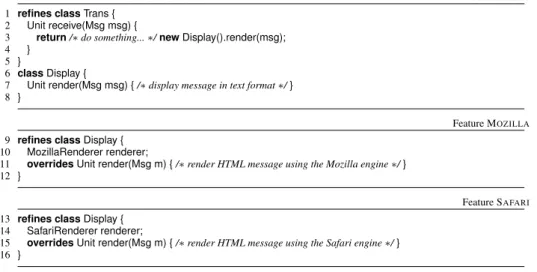
Let us explain the challenges of type checking by extending our email example, as shown in Figure 11. Suppose our basic email client is refined to process incoming text messages (feature TEXT, Lines 1–8). Optionally, it is enabled to process HTML
messages, using either Mozilla’s rendering engine (feature MOZILLA, Lines 9–12) or Safari’s rendering engine (feature SAFARI, Lines 13–16). To this end, the features MOZILLAand SAFARIoverride the methodrenderof classDisplay(Line 11 and 15) in order to invoke the respective rendering engines (fieldrenderer, Lines 10 and 14) instead of the text printing function (Line 7).
Feature TEXT 1 refines classTrans {
2 Unit receive(Msg msg) {
3 return/∗do something...∗/newDisplay().render(msg); 4 }
5 }
6 classDisplay {
7 Unit render(Msg msg) {/∗display message in text format∗/} 8 }
Feature MOZILLA 9 refines classDisplay {
10 MozillaRenderer renderer;
11 overridesUnit render(Msg m) {/∗render HTML message using the Mozilla engine∗/} 12 }
Feature SAFARI 13 refines classDisplay {
14 SafariRenderer renderer;
15 overridesUnit render(Msg m) {/∗render HTML message using the Safari engine∗/} 16 }
Fig. 11.A feature-oriented email client using Mozilla’s and Safari’s rendering engines.
The first thing to observe is that the features MOZILLAand SAFARIrely on class
Displayand its methodrenderintroduced by feature TEXT. In order to guarantee that every derived program is well-formed, the type system checks whetherDisplayand
renderarealways reachable from the features MOZILLAand SAFARI, i.e., whether, in every program variant that contains MOZILLA and SAFARI, also feature TEXT is present.
The second thing to observe is that the features MOZILLAand SAFARI both add a fieldrenderer toDisplay(Lines 10 and 14), both of which have different types. In FFJ, a program with both feature modules would not be a well-typed program because the field rendereris introduced twice. However, Figure 11 is not intended to repre-sent a single feature-oriented program but a feature-oriented product line; the features MOZILLAand SAFARIare mutually exclusive, as defined in the product line’s feature model (stated earlier), and the type system has to take this fact into account.
Let us summarize the key challenges of type checking product lines:
– A global class table contains classes and refinements of all features of a product line, even if some features are optional or mutually exclusive so that they are present only insomederived programs. That is, a single class can be introduced by multiple features as long as the features are mutually exclusive. This is also the case for multiple introductions of methods and fields, which may even have different types.
– The presence of types, fields, and methods depends on the presence of the fea-tures that introduce them. A reference from the elements of a feature to a type, a field projection, or a method invocation is valid if the referenced element is always reachable from the referring feature, i.e., in every variant that contains the referring feature.
– Like references, an extension of a program element, such as a class or method refinement, is valid only if the extended program element is always reachable from the feature that applies the refinement.
– Refinements of classes and methods do not necessarily form linear refinement chains. There may be alternative refinements of a single class or method that ex-clude one another, as explained below.
3.4 Collecting Information on Feature Modules
For type checking, the FFJPLcompiler collects various information on the feature mod-ules of the product line. Before the actual type checking is performed, the compiler fills three tables with information: the class table (CT), the introduction table (IT), and the refinement table (RT).
The class tableCT of FFJPL is like the one of FFJ and has to satisfy the same sanity conditions except that (1) there may be multiple declarations of a class (or field or method), as long as they are defined in are mutually exclusive features, and (2) there may be cycles in the inheritance hierarchy, but no cycles for each set of classes which are reachable from any given feature.
The introduction tableIT maps a type to a listΦof (mutually exclusive) features that introduce the type. The features returned byIT are listed in the order prescribed by the feature model. In our example of Figure 11, a call ofIT(Display)would return a list consisting only of the single feature TEXT. Likewise, the introduction table maps field and method names, in combination with their declaring classes, to features. For example, a call ofIT(Display.renderer)would return the list MOZILLA, SAFARI. The sanity conditions for the introduction table are straightforward:
– IT(C) = Φfor every typeC∈dom(CT), withΦbeing the features that introduce
classC.
– IT(C.f) = Φ for every fieldf contained in some classC ∈ dom(CT), withΦ
being the features that introduce fieldf.
– IT(C.m) = Φfor every methodmcontained in some classC∈dom(CT), with
Φbeing the features that introduce methodm.
Much like in FFJ, in FFJPLthere is a refinement tableRT. A call ofRT(C)yields a list of all features that either introduceorrefine classC, which is different from the introduction table that returns only the features that introduce classC. As withIT, the features returned byRT are listed in the order prescribed by the feature model. The sanity condition for FFJPL’s refinement table is identical to the one of FFJ, namely:
– RT(C) = Φfor every typeC∈ dom(CT), withΦbeing the features that
3.5 Feature Model Interface
As said before, in FFJPL, we abstract from the concrete representation of the feature model and define instead an interface consisting of proper functions and predicates. There are two kinds of questions we want to ask about the feature model, which we explain next.
First, we would like to know which features areneverpresent together, which fea-tures aresometimespresent together, and which features arealwayspresent together. To this end, we define two predicates,neverandsometimes, and a functionalways. Pred-icatenever(Ω,Φ)indicates that featureΦis never reachable in the contextΩ, i.e., there is no valid program variant in which the featuresΩand featureΦare present together. Predicate sometimes(Ω,Φ)indicates that feature Φ is sometimes present when the featuresΩare present, i.e., there are variants in which the featuresΩand featureΦare present together and there are variants in which they are not present together. Function
always(Ω,Φ)is used to evaluate whether featureΦis always present in the contextΩ
(either alone or within a group of alternative features). There are three cases: if featureΦ
is always present in the context,always returns the feature again (always(Ω,Φ) = Φ); if featureΦis not always present, but would be together with a certain group of mutu-ally exclusive featuresΨ(i.e., one of the group is always present),always returns all features of this group (always(Ω,Φ) = Φ,Ψ). If a feature is not present at all, neither alone nor together with other mutually exclusive features, always returns the empty list (always(Ω,Φ) =•). The above predicates and function provide all information we need to know about the features’ relationships. They are used especially for field and method lookup.
Second, we would like to know whether a specific program element is always present when a given set of features is present. This is necessary to ensure that ref-erences to program elements are always valid (i.e., not dangling). We need two sources of information for that. First, we need to know all features that introduce the program element in question (determined using the introduction table) and, second, we need to know which combinations of features are legal (determined using the feature model). For the fieldrendererof our example, the introduction table would yield the features MOZILLAand SAFARIand, from the feature model, it follows that MOZILLAand SA
-FARIare mutually exclusive, i.e.,never(MOZILLA, SAFARI). But it can happen that none of the two features is present, which can invalidate a reference to the field. The type system needs to know about this situation.
To this end, we introduce a predicatevalidrefthat expresses that a program element is always reachable from a set of features. For example,validref(Ω,C)holds if type
Cis always reachable from the contextΩ,validref(Ω,C.f)holds if fieldfof classC
is always reachable from the contextΩ, andvalidref(Ω,C.m)holds if methodmof classCis always reachable from the contextΩ. Applyingvalidref to a list of program elements means that the conjunction of the predicates for every list element is taken. Finally, when we writevalidref(Ω,C)aΨ, we mean that program elementCis always reachable from a contextΩin a subsetΨof features of the product line.
In our prototype, we have implemented the above functions and predicates using a SAT solver that reasons about propositional formulas representing constraints on legal
feature combinations (see Section 4), as proposed by Batory [12] and Czarnecki and Pietroszek [22].
3.6 Refinement in FFJPL
In Figure 12, we show the functionslastandpred for the navigation along the refine-ment chain. The two functions are identical to the ones of FFJ (cf. Figure 4). However, in FFJPL, there may be alternative declarations of a class and, in the refinement chain, refinement declarations may even precede class declarations, as long as the declaring features are mutually exclusive. Let us illustrate refinement in FFJPLby means of the example shown in Figure 13. ClassCis introduced in the featuresΦ1andΦ3. Feature
Φ2refines classCintroduced by featureΦ1and featureΦ4refines classCintroduced by
featureΦ3. FeatureΦ1andΦ2are never present when featureΦ3orΦ4are present and
vice versa. A call ofRT(C)would return the listΦ1, . . . ,Φ4, a call oflast(C)would
return the qualified typeΦ4.C, and a call ofpred(Φ4.C)would return the qualified type
Φ3.Cand so on.
Navigating along the refinement chain
RT(C) = Ψ
last(C) = Ψn.C
RT(C) = Ψ,Φ,Ω Ψ6=• pred(Φ.C) = Ψn.C
RT(C) = Φ,Ω
pred(Φ.C) = Base.Object
Fig. 12.Refinement in FFJPL. C C C C 2 3 4 1 Φ Φ Φ Φ mutually exclusive
Fig. 13.Multiple alternative refinements.
3.7 Subtyping in FFJPL
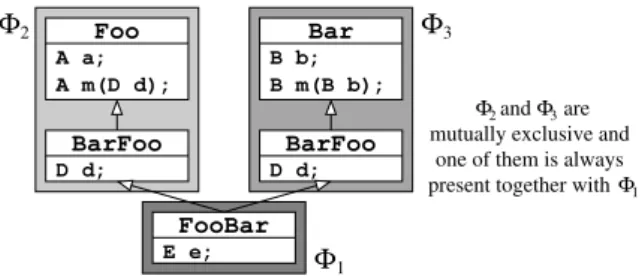
The subtype relation is more complicated in FFJPL than in FFJ. The reason is that a class may have multiple declarations in different features, each declaring possibly different superclasses, as illustrated in Figure 14. That is, when checking whether a class is a subtype of another class, we need to check whether the subtype relation holds in allalternative inheritance paths that may be reached from a given context. For example,
program variant (since always(Φ1,Φ2) = Φ2,Φ3); but FooBaris not a subtype of
FooandBarbecause, in both cases, a program variant exists in whichFooBaris not a (indirect) subclass of the class in question.
Φ1
Φ2 Φ3
Φ2 Φ3
Φ1 present together with
and are mutually exclusive and
one of them is always
E e; B b; B m(B b); A a; A m(D d); D d; FooBar Foo Bar BarFoo D d; BarFoo
Fig. 14.Multiple inheritance chains in the presence of alternative features.
In Figure 15, we show the subtype relation of FFJPL. The subtype relationC <:
EaΩis read as follows: in the contextΩ, typeCis a subtype of typeE, i.e., typeCis a subtype of typeEin every variant in which also the featuresΩare present. The first rule in Figure 15 covers reflexivity and terminates the recursion over the inheritance hierarchy. The second rule states that class Cis a subtype of class E if at least one declaration ofCis always present (tested withvalidref) and if every ofC’s declarations that may be present together withΩ(tested withsometimes) declares some typeDas its supertype andDis a subtype ofEin the contextΩ. That is,Emust be a direct or indirect supertype ofDinallvariants in which the featuresΩare present. Additionally, supertypeDmust be always reachable from the context (Ω,Ψ). When traversing the inheritance hierarchy, in each step, the context is extended by the feature that introduces the current class in question, e.g.,Ωis extended withΨ.
Interestingly, the second rule subsumes the two FFJ rules for transitivity and direct superclass declaration because some declarations ofCmay declare E directly as its superclass and some declarations may declare another superclassDthat is, in turn, a subtype ofE, and the rule must be applicable to both cases simultaneously.
Subtyping C <: EaΩ C<: CaΩ validref(Ω,C) ∀Ψ∈IT(C) : sometimes(Ω,Ψ)⇒ „ CT(Ψ.C) =class C extends D { . . . } validref((Ω,Ψ),D) D<:EaΩ,Ψ « C <: EaΩ Fig. 15.Subtyping in FFJPL.
Applied to our example of Figure 14, we haveFooBar<: FooBaraΦ1because
of the reflexivity rule. We also haveFooBar <: BarFoo a Φ1 because FooBaris
reachable from featureΦ1and every feature that introducesFooBar, namelyΦ1,
con-tains a corresponding class declaration that declaresBarFooas FooBar’s superclass, andBarFoois always reachable fromΦ1. However, we haveFooBar6<: Foo a Φ1
andFooBar 6<: Bar a Φ1 because FooBar’s immediate superclassBarFoois not
always a subtype ofFoorespectively ofBar.
3.8 Auxiliary Definitions of FFJPL
Extending FFJ toward FFJPL makes it necessary to add and modify some auxiliary functions. The most complex changes concern the field and method lookup mecha-nisms.
Field Lookup. The auxiliary functionfieldscollects the fields of a class including the fields of its superclasses and refinements. Since alternative class or refinement decla-rations may introduce alternative fields (or the same field with identical or alternative types),fieldsmay return different fields for different feature selections. Since we want to type-check all valid variants,fieldreturns multiple field lists (i.e., a list of lists) that cover all possible feature selections. Each inner list contains field declarations collected in an alternative path of the combined inheritance and refinement hierarchy.
For legibility, we separate the inner lists using the delimiter ‘◦’. For example, look-ing up the fields of classFooBarin the context of featureΦ1 (Figure 14) yields the
list A a,D d,E e ◦ B b,D d,E e because the featuresΦ2 and Φ3 are mutually
ex-clusive and one of them is present in each variant in which also Φ1 is present. For
readability, we use the metavariablesF andG when referring to inner field lists. We abbreviate a list of lists of fieldsF1◦. . .◦ FnbyF. Analogously,Fis shorthand for
F11◦. . .◦ Fn1◦. . .◦ F1m◦. . .◦ Fnm.
Functionfieldsreceives a qualified typeΦ.Cand a context of selected featuresΩ. If we want all possible field lists, the context is empty. If we want only field lists for a subset of feature selections, e.g., only the fields that can be referenced from a term in a specific feature module, we can use the context to specify one or more features of which we know that they must be selected.
The basic idea of FFJPL’s field lookup is to traverse the combined inheritance and refinement hierarchy much like in FFJ. There are four situations that are handled differ-ently:
1. The field lookup returns the empty list when it reachesBase.Object.
2. The field lookup ignores all fields that are introduced by features that are never present in a given context.
3. The field lookup collects all fields that are introduced by features that are always present in a given context. References to these fields are always valid.
4. The field lookup collects all fields that are introduced by features that may be present in a given context but that are not always present. In this case, a special
marker@is added to the fields in question because we cannot guarantee that a ref-erence to this field is safe in the given context.5It is up to the type system to decide,
based on the marker, whether this situation may provoke an error (e.g., the type sys-tem ignores the marker when looking for duplicate fields but reports an error when type checking object creations).
5. A special situation occurs when the field lookup identifies a group of alternative features. In such a group each feature is optional and excludes every other feature of the group and at least one feature of the group is always present in a given context. Once the field lookup identifies a group of alternative features, we split the result list, each list containing the fields of a feature of the group and the fields of the original list.
Field lookup fields(Ω,Φ.C) =C f
fields(Ω,Φ.Object) =• (FL-1)
never(Ω,Φ)
fields(Ω,Φ.C) =fields(Ω,pred(Φ.C)) (FL-2)
sometimes(Ω,Φ) always(Ω,Φ) = Φ
CT(Φ.C) =class C extends D { C f; M }
fields(Ω,Φ.C) =append(fields(Ω,last(D)),C f) (FL-3.1)
sometimes(Ω,Φ) always(Ω,Φ) = Φ
CT(Φ.C) =refines class C { C f; M }
fields(Ω,Φ.C) =append(fields(Ω,pred(Φ.C)),C f) (FL-3.2)
sometimes(Ω,Φ) always(Ω,Φ) =•
CT(Φ.C) =class C extends D { C f; M }
fields(Ω,Φ.C) =append(fields(Ω,last(D)),C f@) (FL-4.1)
sometimes(Ω,Φ) always(Ω,Φ) =•
CT(Φ.C) =refines class C { C f; M }
fields(Ω,Φ.C) =append(fields(Ω,pred(Φ.C)),C f@) (FL-4.2)
sometimes(Ω,Φ) always(Ω,Φ) = Ψ
fields(Ω,Φ.C) =fields((Ω,Ψ1),Φ.C)◦. . .◦fields((Ω,Ψn),Φ.C)
(FL-5)
Fig. 16.Field lookup in FFJPL.
In order to distinguish the different cases, we use the predicates and functions de-fined in Section 3.5 (especiallynever,sometimes, andalways). The definition of
func-5Note that the marker@is generated during type checking, so we do not include it in the syntax
tionfields, shown in Figure 16, follows the intuition described above: OnceBase.Object
is reached, the recursion terminates (FL-1). When a feature is never reachable in the given context,fields ignores this feature and resumes with the previous one (FL-2). When a feature is mandatory (i.e., always present in a given context), the fields in ques-tion are added to each alternative result list, which were created in Rule FL-5 (FL-3.1 and FL-3.2).6 When a feature is optional, the fields in question, annotated with the marker@, are added to each alternative result list (FL-4.1 and FL-4.2). When a feature is part of an alternative group of features, we cannot immediately decide how to pro-ceed. We split the result list in multiple lists (by means of multiple recursive invocations offields), in which we add one of the alternative features to each context passed to an invocation offields(FL-5).
Method type lookup mtype(Ω,m,Φ.C) =B→B0
mtype(Ω,m,Base.Object) =• (ML-1)
B0m(B x) { . . . }∈M sometimes(Ω,Φ)
CT(Φ.C) =class C extends D { C f; M }
mtype(Ω,m,Φ.C) =mtype(Ω,m,pred(Φ.C)),mtype(Ω,m,last(D)),B→B0
(ML-2)
B0m(B x) { . . . }∈M sometimes(Ω,Φ)
CT(Φ.C) =refines class C { C f; M } mtype(Ω,m,Φ.C) =mtype(Ω,m,pred(Φ.C)),B→B0
(ML-3)
(mis not defined inM ∨ never(Ω,Φ))
CT(Φ.C) =class C extends D { C f; M }
mtype(Ω,m,Φ.C) =mtype(Ω,m,pred(Φ.C)),mtype(Ω,m,last(D)) (ML-4) (mis not defined inM ∨ never(Ω,Φ))
CT(Φ.C) =refines class C { C f; M }
mtype(Ω,m,Φ.C) =mtype(Ω,m,pred(Φ.C)) (ML-5)
Fig. 17.Method Lookup in FFJPL.
Method Type Lookup. Like in field lookup, in method lookup, we have to take al-ternative definitions of methods into account. But the lookup mechanism is simpler than in fields because the order of signatures found in the combined inheritance and refinement hierarchy is irrelevant for type checking. Hence, function mtype yields a simple list B→B0 of signatures for a given method name m. For example, calling mtype(Φ1,m,Φ1.C)in the context of Figure 14 yields the listD→A,B→B.
6Functionappendadds to each inner list of a list of field lists a given field. Its implementation
In Figure 17, we show the definition of functionmtype. ForBase.Object, the empty list is returned (ML-1). If a class that is sometimes reachable introduces a method in question (ML-2), its signature is added to the result list and all possible predecessors in the refinement chain (usingpred) and all possible subclasses are searched (using
last). Likewise, if a refinement that is sometimes reachable introduces a method with the name searched (ML-3), its signature is added to the result list and all possible prede-cessors in the refinement chain are searched (usingpred). If a class or refinement does not declare a corresponding method (ML-4 and ML-5) or the a class is never reachable, the search proceeds with the possible superclasses or predecessors.
The current definition of functionmtypereturns possibly many duplicate signatures. A straightforward optimization would be to remove duplicates before using the result list, which we omitted for simplicity.
Valid class introduction introduce(Ω,Φ.C)
@Ψ : „ CT(Ψ.C) =class C extends D { C f;M } Ψ6= Φ sometimes(Ω,Ψ) « introduce(Ω,Φ.C)
Valid field introduction introduce(Ω,f,Φ.C)
∀E h∈fields(Ω,Φ.C) : f∈/h introduce(Ω,f,Φ.C)
Valid method introduction introduce(Ω,m,Φ.C)
mtype(Ω,m,Φ.C) =•
introduce(Ω,m,Φ.C)
Valid class refinement refine(Ω,Φ.C)
RT(C) = Ψ,Φ,Π validref(Ω,C)aΨ
refine(Ω,Φ.C)
Valid method overriding override(Ω,m,Φ.C,C→C0)
RT(C) = Ψ,Φ,Π validref(Ω,C.m)aΨ,Φ
∀B→B0∈mtype(Ω,m,Φ.C) : C=B ∧ C0=B0 override(Ω,m,Φ.C,C→C0)
Valid Introduction, Refinement, and Overriding. In Figure 18, we show predicates for checking the validity of introduction, refinement, and overriding in FFJPL. Predicate introduceindicates whether a class with the qualified typeΦ.Chas not been introduced by any other featureΨthat may be present in the contextΩ. Likewise,introduceholds if a methodmor a fieldfhas not been introduced by a qualified typeΦ.C(including possible predecessors and superclasses) that may be present in the given contextΩ. To this end, it checks either whether mtype yields the empty list or whetherf is not contained in every inner list returned byfields.
For a given refinement, predicaterefineindicates whether a proper class, which is always reachable in the given context, has been declared previously in the refinement chain. We write validref(Ω,C) a Ψ in order to state that a declaration of class C
has been introduced in the setΨof features, which is only a subset of the features of the product line, namely the features that precede the feature that introduces classC. Predicateoverride indicates whether a declaration of methodmhas been introduced (and is always reachable) in some feature introduced by before the feature that refines
m and whether every possible declaration ofmin any predecessor of a Φ.C has the same signature.
3.9 Type Relation of FFJPL
The type relation of FFJPLconsists of type rules for terms and well-formedness rules for classes, refinements, and methods, shown in Figure 19 and Figure 20.
Term Typing Rules. A term typing judgment in FFJPLis a quadruple, consisting of a typing contextΓ, a termt, a list of types C, and a feature Φthat contains the term (see Figure 19). A term can have multiple types in a product line because there may be multiple declarations of classes, fields, and methods. The listCcontains all possible types a term can have.
Rule T-VARPLis standard and does not refer to the feature model. It yields a list consisting only of the type of the variable in question.
Rule T-FIELDPL checks whether a field accesst0.fis well-typed in every
possi-ble variant in which alsoΦis present. Based on the possible types Eof the termt0
the field f is accessed from, the rule checks whether f is always reachable from Φ
(using validref). Note that this is a key mechanism of FFJPL’s type system. It en-sures that a field, being accessed, is definitely present in every valid program variant in which the field access occurs – without generating all these variants. Furthermore, all possible fields of all possible typesE are assembled in a nested listF,C f,G in whichC fdenotes a declaration of the fieldf; the call offields(Φ,last(E))is shorthand forfields(Φ,last(E1)) . . . fields(Φ,last(En)), in which the individual result lists are
concatenated. Finally, the list of all possible typesC11, . . . ,Cn1, . . . ,C1m, . . . ,Cnmof
fieldfbecomes the list of types of the overall field access. Note that the result list may contain duplicates, which could be eliminated for optimization purposes.
Rule T-INVKPLchecks whether a method invocationt0.m(t)is well-typed in every
possible variant in which alsoΦis present. Based on the possible typesEof the term
Term typing Γ ` t : CaΦ x : C∈Γ Γ ` x : CaΦ (T-VARPL) ∀E∈E :validref(Φ,E.f) Γ ` t0: EaΦ fields(Φ,last(E)) =F,C f,G Γ ` t0.f : C11, . . . ,Cn1, . . . ,C1m, . . . ,CnmaΦ (T-FIELDPL) ∀E∈E : validref(Φ,E.m) ∀C∈C,∀D∈D∈D : C<:DaΦ Γ ` t0: EaΦ Γ ` t : CaΦ mtype(Φ,m,last(E)) =D→B Γ ` t0.m(t) : B11, . . . ,Bn1, . . . ,B1m, . . . ,BnmaΦ (T-INVKPL) validref(Φ,C) ∀D g∈ F,∀C∈C : C<:DaΦ Γ ` t : CaΦ fields(Φ,last(C)) =F @∈ F/ Γ ` new C(t) : CaΦ (T-NEWPL) validref(Φ,C) Γ ` t0: EaΦ ∀E∈E : (E <: CaΦ ∨ C <: EaΦ) Γ ` (C)t0: CaΦ (T-UDCASTPL)
validref(Φ,C) stupid warning
Γ ` t0: EaΦ ∃E∈E : (C6<: EaΦ ∧ E 6<: CaΦ)
Γ ` (C)t0: CaΦ (T-SCASTPL)
Method typing MOKaΦ.C x : B, this : C`t0: EaΦ ∀E∈E : E <: B0aΦ
validref(Φ,B) introduce(Φ,m,last(D))
CT(Φ.C) =class C extends D { C f; M }
B0m(B x) { return t0; }OKaΦ.C
x : B, this : C`t0: EaΦ ∀E∈E : E <: B0aΦ validref(Φ,B) override(Φ,m,last(D),B→B0)
CT(Φ.C) =class C extends D { C f; M }
overrides B0m(B x) { return t0; }OKaΦ.C x : B, this : C`t0: EaΦ ∀E∈E : E <: B0aΦ
validref(Φ,B) introduce(Φ,m,pred(Φ.C))
CT(Φ.C) =refines class C { C f; M } B0m(B x) { return t0; }OKaΦ.C
x : B, this : C`t0: EaΦ ∀E∈E : E <: B0aΦ validref(Φ,B) override(Φ,m,pred(Φ.C),B→B0)
CT(Φ.C) =refines class C { C f; M } overrides B0m(B x) { return t0; }OKaΦ.C
Class typing LOKaΦ
validref(Φ,D) validref(Φ,C)
∀f∈f : introduce(Φ,f,last(D)) introduce(Φ,Φ.C) MOKaΦ.C
class C extends D { C f; M }OKaΦ
Refinement typing ROKaΦ
validref(Φ,C)
∀f∈f: introduce(Φ,f,pred(Φ.C)) refine(Φ,Φ.C) MOKaΦ.C
refines class C { C f; M }OKaΦ
(usingvalidref). As with field access, this check is essential. It ensures that in generated programs only methods are invoked that are also present. Furthermore, all possible signatures ofmof all possible typesEare assembled in the nested listD→Band it is checked that all possible listsCof argument types of the method invocation are subtypes of all possible listsDof parameter types of the method (this implies that the lengths of the two lists must be equal). A method invocation has multiple types assembled in a list that contains all result types of methodmdetermined bymtype. As with field access, duplicates should be eliminated for optimization purposes.
Rule T-NEWPLchecks whether an object creationnew C(t)is well-typed in every possible variant in which alsoΦis present. Specifically, it checks whether there is a declaration of classCalways reachable fromΦ. Furthermore, all possible field combi-nations ofCare assembled in the nested listF, and it is checked whether all possible combinations of argument types passed to the object creation are subtypes of the types of all possible field combinations (this implies that the number of arguments types must equal the number of field types). The fields of the result list must not be annotated with the marker@since optional fields may not be present in every variant and references may become invalid (see field lookup).7An object creation has only a single typeC.
Rules T-UDCASTPLand T-SCASTPLcheck whether casts are well-typed in every possible variant in which alsoΦis present. This is done by checking whether the type
Cthe termt0is cast to is always reachable fromΦand whether this type is a subtype,
supertype, or unrelated type of all possible typesEthe termt0can have. We have only
a single rule T-UDCASTPLfor up- and downcasts because the listEof possible types may contain super- and subtypes ofCsimultaneously. If there is a type in the list which leads to a stupid case, we flag astupid warning. A cast yields a list containing only a single typeC.
Well-Formedness Rules. In Figure 20, we show the well-formedness rules of classes, refinements, and methods.
Like in FFJ, the typing judgment of classes and refinements is a binary relation be-tween a class or refinement declaration and a feature. The rule of classes checks whether all methods are well-formed in the context of the class’ qualified type. Moreover, it checks whether the class declaration is unique in the scope of the enclosing featureΦ, i.e., whether no other feature, that may be present together with featureΦ, introduces a class with an identical name (usingintroduce). Furthermore, it checks whether the superclass and all field types are always reachable fromΦ(usingvalidref). Finally, it checks whether none of the fields of the class declaration have been introduced before (usingintroduce). The well-formedness rule of refinements is analogous, except that the rule checks that there isat least oneclass declaration reachable that is refined and that has been introduced before the refinement (usingrefine).
The typing judgment of methods is a binary relation between a method declaration and the qualified type that declares the method. Like in FFJ, there are four different rules for methods (from top to bottom in Figure 20)
1. that do not override another method and that are declared by classes,
7
2. that override another method and that are declared by classes,
3. that do not override another method and that are declared by refinements, 4. that override another method and that are declared by refinements.
All four rules check whether all possible typesEof the method body are subtypes of the declared return typeB0of the method and whether the argument typesBare always
reachable from the enclosing featureΦ(usingvalidref).
For methods that are introduced, it is checked, usingintroduce, whether no method with identical name has been introduced in any possible superclass (Rule 1) or in any possible predecessor in the refinement chain (Rule 3). For methods that override other methods, it is checked, using override, whether a method with identical name and signature exists in any possible superclass (Rule 2) or in any possible predecessor in the refinement chain (Rule 4).
Well-Typed FFJPLProduct Lines. An FFJPLproduct line, consisting of a term, a class table, an introduction table, and a refinement table, is well-typed if
– the term is well-typed (checked using FFJPL’s term typing rules),
– all classes and refinements stored in the class table are well-formed (checked using FFJPL’s well-formedness rules), and
– the class, introduction, and refinement tables are well-formed (ensured by the cor-responding sanity conditions).
3.10 Type Safety of FFJPL
Type checking in FFJPLis based on information contained in the class table, introduc-tion table, refinement table, and feature model. The first three are filled by the compiler that has parsed the code base of the product line. The feature model is supplied directly by the user (or tool). The compiler determines which class and refinement declarations belong to which features. The classes and refinements of the class table are checked us-ing their well-formedness rules which, in turn, use the well-formedness rules for meth-ods and the term typing rules for method bodies. Several rules use the introduction and refinement tables in order to map types, fields, and methods to features and the fea-ture model to navigate along refinement chains and to check the presence of program elements.
What does type safety mean in the context of a product line? The product line itself is never evaluated; rather, different programs are derived that are then evaluated. Hence, the property we are interested in is thatallprograms that can be derived from a well-typed product line are in turn well-well-typed. Furthermore, we would like to be sure that allFFJPLproduct lines, from which only well-typed FFJ programs can be derived, are well-typed. We formulate the two properties as the two theoremsCorrectness of FFJPL andCompleteness of FFJPL.
Correctness
THEOREM3.1 (Correctness of FFJPL) Given a well-typed FFJPLproduct linepl (in-cluding with a well-typed termt, well-formed class, introduction, and refinement tables
CT,IT, andRT, and a feature modelFM), every program that can be derived with a valid feature selectionfsis a well-typed FFJ program (cf. Figure 10).
pl = (t,CT,IT,RT,FM) pl is well-typed fsis valid inFM derive(pl,fs)is well-typed
Functionderive collects the feature modules from a product line according to a user’s selection fs, i.e., non-selected feature modules are removed from the derived program. After this derivation step, the class table contains only classes and refinements stemming from the selected feature modules. We define avalid feature selectionto be a list of features whose combination does not contradict the constraints implied by the feature model.
The proof idea is to show that the type derivation tree of an FFJPL product line is a superimposition of multiple so-called type derivation slices. As usual, the type derivation proceeds from the root (i.e., an initial type rule that checks the term and all classes and refinements of the class table) to the leaves (type rules that do not have a premise) of the type derivation tree. Each time a term has multiple types, e.g., a method has different alternative return types, which is caused by multiple mutually exclusive method declarations, the type derivation splits into multiple branches. Withbranchwe refer only to positions in which the type derivation tree is split into multiple subtrees in order to type check multiple mutually exclusive term definitions. Each subtree from the root of the type derivation tree along the branches toward a leaf is a type derivation slice. Each slice corresponds to the type derivation of a feature-oriented program.
Let us illustrate the concept of a type derivation slice by a simplified example. Sup-pose the application of an arbitrary type rule to a termtsomewhere in the type deriva-tion. Termthas multiple typesCdue to different alternative definitions oft’s subterms. For simplicity, we assume here thatthas only a single subtermt0, like in the case of a
field access (t=t0.f), in which the overall termthas multiple types depending ont0’s
andf’s types; the rule can be easily extended to multiple subterms by adding a predicate per subterm. The type rule ensures the well-typedness of all possible variants ofton the basis of the variants oft’s subtermt0. Furthermore, the type rule checks whether a
predicatepredicate(e.g.,C <: D) holds for each variant of the subterm with its possible typesE, writtenpredicate(t0: Ei). The possible typesCof the overall term follow in
some way from the possible typesEof its subterm. Predicatevalidref is used to check whether all referenced elements and types are present in all valid variants, including different combinations of optional features. For the general case, this can be written as follows:
predicate(t0: E1) predicate(t0: E2) . . . predicate(t0: En)
t0:E always(. . .)
Γ ` t:CaΦ (T-*PL)
The different uses ofpredicate in the premise of an FFJPL type rule correspond to the branches in the type derivation that denote alternative definitions of subterms.