UNI VE RSITY O F VAAS A FACULT Y O F TE CHNOLO GY INDUSTRIAL MANAGEME NT
Ali Kheradnejad
ISO/IAT F16949 a L ean Manufacturin g Framew ork or a Wasteful Process
Master’s Thesis in Industrial Management
I
Contents
ABSTRACT ... i
1 Introduction ... 1
1.1 What is the research about? ... 1
1.2 Why it is important? ... 1
1.3 What has been done previously ... 1
1.4 Motivations and background of the author ... 2
2 Literature Review... 4
2.1 Lean and Automotive Industry ... 4
2.2 Lean Manufacturing ... 5 2.3 Lean Principals ... 8 2.3.1 Value ... 8 2.3.2 Value stream ... 8 2.3.3 Flow ... 8 2.3.4 Pull ... 9 2.3.5 Perfection ... 9
2.4 Value Stream Mapping (VSM) ... 9
2.5 The Waste of Overproduction ... 9
2.6 The Waste of Waiting ... 10
2.7 The Waste of Movement ... 10
2.8 The Waste of Transportation ... 11
2.9 The Waste of Over-processing ... 12
2.10 The Waste of Inventory ... 12
II
2.12 The New Wastes ... 12
2.12.1 The waste of untapped human potentials ... 13
2.12.2 The waste of making the wrong product efficiently ... 13
2.12.3 Excessive information and communication ... 13
2.12.4 Waste of time ... 13
2.12.5 The waste of inappropriate systems ... 13
2.12.6 Waste of energy and water ... 14
2.12.7 Waste of natural resources ... 14
2.12.8 Waste of 'No follow through' ... 14
2.12.9 Waste of Knowledge ... 14
2.12.10 The waste of empty labour ... 15
2.12.11 Trading off wastes against each other ... 15
2.12.12 Finally: Can You Go Too Far on Waste Reduction ... 16
2.13 Continuous Improvement (Kaizen) ... 16
2.14 What is ISO? ... 16
2.14.1 Context of the organization ... 18
2.14.2 Leadership ... 19 2.14.3 Planning ... 19 2.14.4 Support ... 20 2.14.5 Operation... 20 2.14.6 Performance evaluation ... 22 2.14.7 Improvement ... 23
2.15 What is the ISO/TS16949? ... 24
2.16 IATF 16949:2016 ... 25
III
2.16.2 IATF Rules... 28
2.16.3 Customer Specific Requirements (CSR's) ... 28
3 Methodology ... 28
3.1 How the research is conducted? ... 28
3.1.1 Document Study... 29
3.1.2 Observations ... 29
3.1.3 Interviews ... 30
3.1.4 Reliability and Validity ... 30
4 Analysis... 31
4.1 Internal Audits ... 31
4.2 Internal Audits versus External Accredited Third-Party Audits ... 36
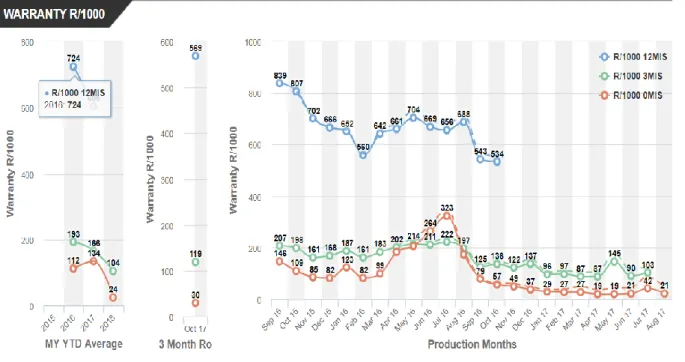
4.3 Warranty Performance ... 38
4.4 Maintenance Performance ... 43
4.4.1 Maintenance in Assembly Halls ... 44
4.4.2 Body in White (BIW) Maintenance ... 48
4.5 Problem Solving Approach ... 51
5 Conclusion ... 51
6 References ... 54
IV
Table of Figures:
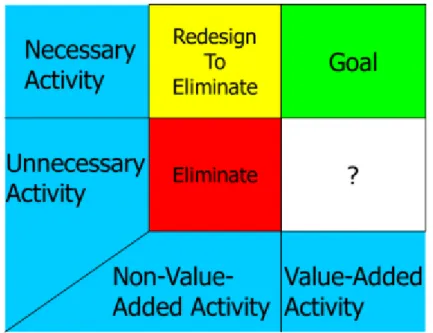
Figure 2.1 - Value-Added Activity Verses Non-Value-Added Activity ... 7
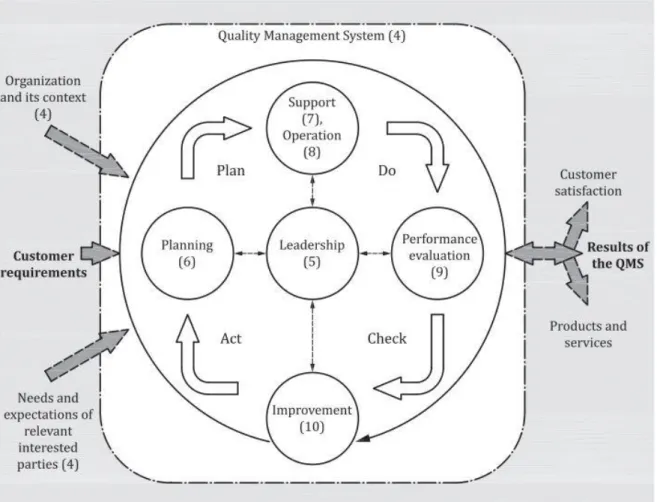
Figure 2.2 - Quality management systems and Plan-Do-Check-Act approach. ... 18
Figure 4.1 - 2017/2018 Fiscal Year to Date ... 33
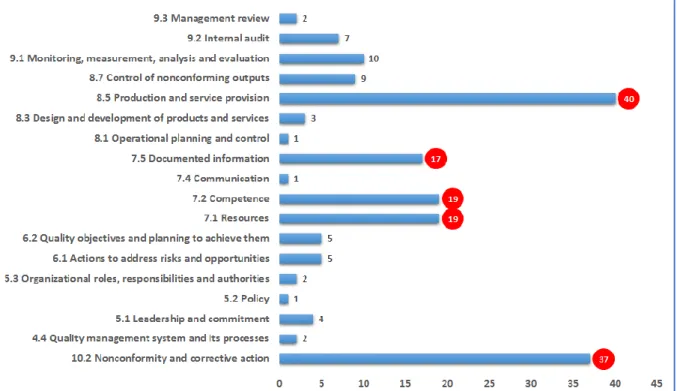
Figure 4.2 - Internal Audit NC’s - IATF16949 Process Audit Repeat Concerns (2017-Current) ... 34
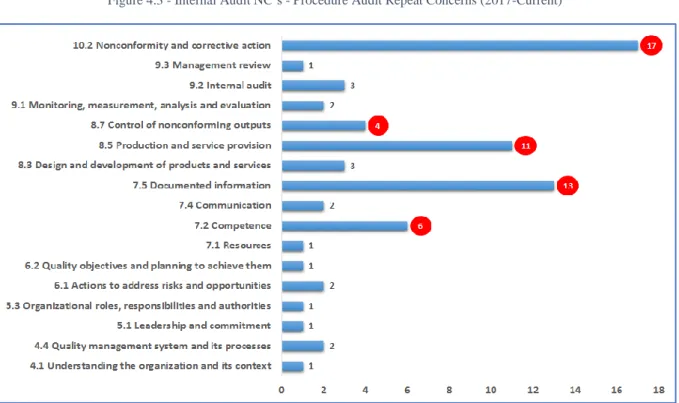
Figure 4.3 - Internal Audit NC’s - Procedure Audit Repeat Concerns (2017-Current) ... 35
Figure 4.4 - Medium Saloon MY, Warranty Performance ... 41
Figure 4.5 - Small-Medium Saloon MY, Warranty Performance ... 42
Figure 4.6 - Large Saloon MY, Warranty Performance ... 42
Figure 4.7 - Coupe Warranty Performance ... 43
Figure 4.8 - The Assembly Hall Maintenance Time Availability (TA) ... 45
Figure 4.9 - The Operating Percentage Rate in Assembly Lines ... 46
Figure 4.10 - Weekly Andon Calls ... 47
Figure 4.11 - Assembly maintenance AOR (Available on Request) ... 48
Figure 4.12 - BIW Maintenance KPI’s ... 50
Table of tables:
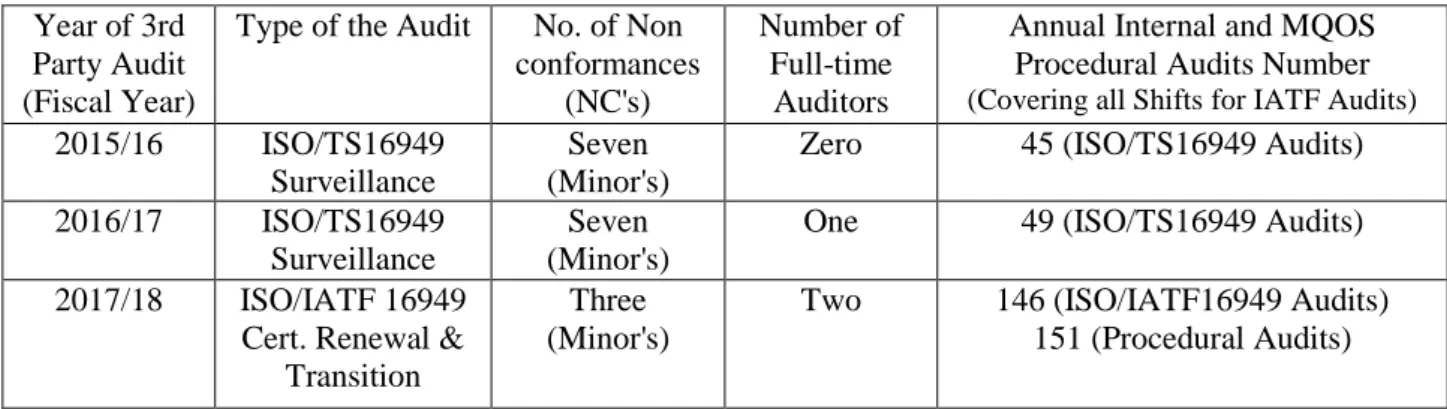
Table 1 - Internal Audit NC’s - Process Audit Repeat Concerns - Examples ... 36Table 4.2 - 3rd Party Audits Vs Internal Audit Activities ... 37
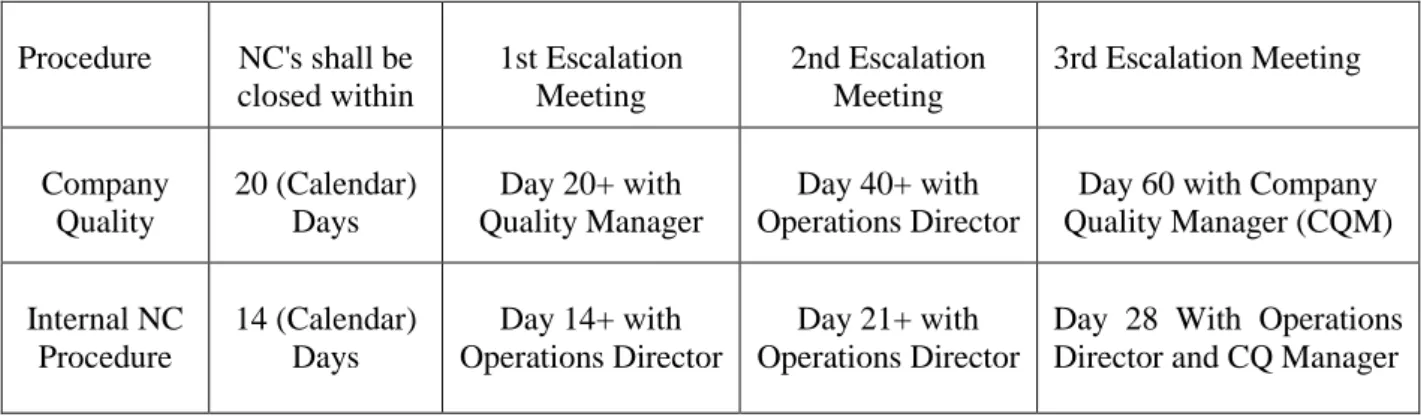
Table 4.3 - NC Management Company Quality Procedure (CQ) Versus Internal Procedure . 38 Table 4.4 - Top faults by duration ... 49
---
UNIVERSITY OF VAASA School of Management
Author: S. Ali A. Kheradnejad
Master’s Thesis: Lean Manufacturing and Quality Management System
Main title: ISO/IATF16949 a Lean Manufacturing Framework or a Wasteful Process
Degree: Master of Science in Economics and Business Administration
Major Subject: Industrial Management
Supervisor: Petri Helo
Year of Graduation: Spring 2018
Number of pages: 60
---
ABSTRACT
The Quality Management Systems in automotive industry known as ISO/TS16949 which recently has been updated into ISO/IATF16949:2016 developed by western major car manufacturers as an alternative approach for Total Quality Management (TQM). As it is not tailor-made for each of the western OEM's, however by introducing customer specific requirements to the requirements made it more suitable for OEM's to monitor and manage the quality and reliability of the products and processes throughout the supply chain. On the other hand, the lean philosophy is a key for cost reduction and in simple words 'do more with less'. As by some, the processes and the significant costs of certification and maintaining the certification is being considered as wastes, without taking into account the benefits, this study is striving to clarify this picture. The scope of the study is a OEM which I was working in last 18 months and my intention is to demonstrate whether with a serious commitment to IATF QMS the well known lean wastes in manufacturing reduces or not. The two departments including Warranty Claims (For all models) and Maintenance (Assembly and Body-In-White) performance measures reviewed and analysed as they are their performance can indicate wastes and success of lean manufacturing. The results of this study denote a significant improvement in Warranty claims and a considerable improvement in efficiency and effectiveness in Maintenance teams after improvement in QMS.
---KEYWORDS: Automotive, Lean Manufacturing, Kaizen, Continual Improvement, Continuous Improvement,, Quality Management Systems (QMS), Quality Assurance, ISO/TS 16949:2008, ISO 9001: 2015, IATF 16949:2016, Core Tools
1
1 Introduction
1.1 What is the research about?
This master thesis is about answering to this question which is promoting and strengthening Quality Management Systems (QMS) particularly in the automotive industry helping Lean manufacturing. The scope of this research is a vehicle manufacturing plant in one of Western European countries which is ISO/IATF16949 QMS certified (later certified with transition to ISO/IATF16949:2016) and lean manufacturing philosophy is the main focus to cut the cost of advance planning and production activities.
1.2 Why it is important?
The reason for this question is as some may say quality management systems or at least most of it is not a value-added activity and consider it as a costly and wasteful activity and against the lean manufacturing. This is trying to reveal if the QMS deployment and practice is really effective, in which areas, and how it is possible to optimise it in order to boost the effectiveness of the QMS to create a better support for lean manufacturing. As an internal ISO/IATF Lead auditor always I was facing this challenging question that the auditing process is a wasteful process. Although, I can understand the audit frequency and non-conformance closure policy can be very time taking process especially for those who are trained with problem solving tools and also have minimum knowledge of ISO/TS16949 (or ISO/IATF16949), but what this process actually is improving in terms of creating value or preventing waste is quite significant in my experience.
1.3 What has been done previously
There are a number of conceptual models that connect quality and learning (Dutton and Thomas 1984, Fine 1986, Levy 1965) and also the impact of learning and innovation on productivity growth (Cole et al. 1986, Gordon 1990), and a few number of empirical studies which actually tested the direct impact of quality tools on productivity improvement.
Hendricks and Singhal (1997) demonstrate the implementation of an effective total quality management (TQM) programs potentially improves the operation performance of firms. Fynes and Voss (2001) propose and test the links connects the impact of quality practices on
2 the various dimensions of the quality performance, the manufacturing performance, and the business performance. Sousa and Voss (2002) made a review of the TQM research, summarising that as the quality has been shown to be linked to operational performance, actually there is no identified link to the business performance. They suggested in order to satisfying the need for a vigilant study of Quality Management Systems and their links to the firms, they should provide several examples of similar studies. Iyer, Sarangi, and Sephardi (2013) mainly focus on quality practices associated with adoption of quality management systems (QMS) and TQM and try to empirically identify the mechanisms by which quality practices give rise to productivity change in Indian automotive parts manufacturers. They believe the implementation of both QMS and TQM are resulted in rise in productivities of the firms, however they believe TQM has got higher rate of performance. Although they did not mention QMS certification was in automotive certification (ISO/TS16949) and they merely mention QMS and ISO9001 while tier 1 automotive suppliers to OEM's are required to be certified to ISO/TS 16949 (at the time and at the moment ISO 9001:2015 /IATF 16949:2016).
C.P. Katha (2004) discusses and compares relationships between, ISO9000:2000, QS9000, ISO/TS16949:2002 and criteria of Malcolm Baldrige National Quality Award which has been established in 1987 in the U.S. by the Congress to promote quality awareness and business excellence, and believes with added requirement to the ISO9000 requirements by QS9000 and ISO/TS16949 it will make them closer to TQM. Although C.P. Kartha refers to the previous researches regarding significant performance after implementation and certification of ISO9000, but it mostly compared the requirements and emphasises and reaches to this point that Baldridge Award and quality standard certifications are getting closer to each other.
Gruszka, J., Misztal, A. (2017) have done a detailed review of structure of ISO/IATF16949 and updates and scheduling of transition from ISO/TS169494:2008 to the ISO/IATF16949:2016, but not much information about the performance improvement discussion and tangible productivity enhancement.
1.4 Motivations and background of the author
Since I joined the company in April 2015 in the engine plant, whilst I have had one-year experience of working in automotive parts manufacturer and supplier in Iran, I realised the
3 QMS certifications was a great deal for this industry. After lean training and working a few months in the operations as an assembly operator or in organisation's term 'Integrated manufacturing specialist', joining the Quality Management System team as an Internal Auditor for ISO/TS16949:2008 gave me a very steep learning curve within one and half a year, and I have been promoted to a new position in the vehicle plant (in the same company) as ISO/IATF16949:2016 Lead Auditor with one-week training of ISO/IATF16949 Lead Auditor and Core Tools (APQP, PPAP, FMEA, MSA, SPC) training. My career continued in this position for another one and half a year and received an offer from a 3rd party Certification Body (CB) to start working as an Automotive Assessor (IATF 16949 auditor) or in other words certified 3rd party auditor in accredited certification body.
As an auditor I learnt a lot from my audits as I had to learn from the process and understand objectives and activities in each department, although, working as an auditor will not make you people's favourite person. The positive side of this role is a never-ending learning job and every day is a learning day which is fascinating.
What it should be emphasised is I have had training of Lean principals by the company and also experience of working on the line as a production operative, similarly as an ISO/TS16949 internal auditor and ISO/IATF16949 internal lead auditor, during the finalising this thesis I am a ISO/IATF16949 3rd party CB automotive auditor under training. I am assuming it would be a great advantage that I worked in production line as well as QMS department to have a wider view of understanding and interpreting the observations.
As both lean philosophy and ISO/IATF16949 QMS are key factors for any automotive organisation to flourish. However, the ISO/IATF16949 quality management standards are mandatory for automotive tier 1 OEM suppliers, and as we all know, anything becomes mandatory it loses its appreciation, thus, it is beneficial to understand them both and identify the link between them, the this may help the organisations to embrace them both with more understanding of them.
With this study I would like to understand this mandatory ISO/IATF16949 certification requirement is improving lean manufacturing for their benefits or it is just an extra costs imposed by major OEM's to the suppliers.
4
2 Literature Review
2.1 Lean and Automotive Industry
Since Henry Ford, the American industrialist introduced the legendry Model T car mass production in early 20th century with the invention of moving assembly line to reduce the production costs, till Toyota comprehensive Lean manufacturing systems known as Toyota Production System (TPS) in the late 20th century which turned this company from a small/middle size company to one of the largest, most successful and pioneer in automotive industry, one factor almost played the most determining role in successful mass production manufacturing and it was and is how to reduce the manufacturing cost while increasing and maintaining the customer satisfaction.
Nevertheless, the lean manufacturing is in contrast with mass-production as primitive manufacturing started with craft production, where a craftsman made an entire single product. With development of technology in industrial production, mass manufacturing began. Lean is directly in contrast with the mass production system that emphasises on making large quantities of items in a batch-and-queue mode. For instance, the mass production way of thinking can be demonstrated by automotive painting processes. These factories would usually have large paint colour change-over times. For example, it is like painting black cars in the week one, red cars in the week after, white cars in another week, and so on. This meant the customer could obtain the specific colour of preference merely every month or two. Nowadays, some of manufacturers upgraded and right-sized (optimised) their painting facilities and equipment so that colour change-over durations are very quick, enabling rapid response to the customers need. This rapid response to the customer's need, enabling the customer to pull the product, are very good example of a lean system.
Lean production system which has been pioneered by Toyota after World War II demonstrated a better way of organising and managing customer relations, the supply chain, product development and production operation. This new way of manufacturing has been named lean production, simply because it does (or achieves) more and more with less and less.
5 Automotive industry without a doubt dwells in one of the increasingly most brutal and merciless competitive markets in the world with low profit high volume. Nowadays, the high-volume car manufacturers are absolutely aware which their existence and future of their companies are tied up with this matter that how successful they would be with robustness in implementation of the lean manufacturing. Behind all of their attractive and inspiring slogans manufacturers know crystal clear that they have to put all of their power and strength to implement lean principals robustly from head to toe in their organisations. Although Lean is imperative for a profitable and flourishing manufacturing, managing quality and reliability is vital for increasing and maintaining a high customer satisfaction which is one of the crucial element for the products demand in the market. However, quality usually considered as a massive cost for the manufacturers and sometimes mistakenly has been sacrificed for the sake of production costs. Meanwhile, many believe a robust quality management system is not only increasing the customer satisfactions that will even help the waste elimination/reduction and continual improvement in work efficiency which are also the main goal of the lean philosophy. Toyota as an example is using Total Quality Management (TQM) which is putting customer first and endeavours strategically to protect the customer and reduce the rework and warranty’s costs. But TQM require massive effort and time to create and organise a system to cover throughout the supply chain which for small or and young companies can be quite unjustifiably expensive and time taking. Hence, a standardised quality management system offers not only highlighting boundaries but also works with Lean manufacturing philosophy to protect the customer with maintaining quality and reliability criteria which consequently prevents extra costs for poor quality throughout the design, concept products, product creation, product realisation launch, manufacturing, delivery and warranty period in shorter time with comparison to the TQM.
2.2 Lean Manufacturing
Muda is a Japanese word which means "waste", any human activities which absorbs resources but creates no value. Although the original Lean Principal defined by Taiichi Ohno (1988) who was the Toyota executive and perhaps he was the most brutal enemy of waste in human history, and his philosophy delves into recognition of seven elements of wastes; but as time passed, gradually more new elements of wastes were recognised (i.e. manufacturing products and or providing services which is not required by customer, quality more than
6 customer's need or requirements can potentially be considered as waste). Also, unused or misusing talents of employees and work forces in organisation has been identified as an element of waste and added to the list by some. Perhaps there are more elements waste and would be identified in the future. For instance, in Six-Sigma methodology waste of unused skills is known as waste with regards of unutilised capacities or delegating tasks with inadequate training and skills. Unnecessary space is also recognised as a waste (Stamatis 2011).
J. Bicheno & M. Holweg (2016) believe lean is all about reaching to the destination with uninterrupted flow in the sequence of operations that deliver perfect quality and this flow is not only physical products and services, but also includes the information and the design to run the production. They put the continuous improvements by the lean into three categories; first is Reduction of wastes, second Enhancing the Value, and the third involving and engaging people and emphasised without any of these three the lean is not possible, however, as the weight may shift through the time as the condition changes. The value which plays a key role in lean philosophy must be only defined by the customer and no one else.
Womack and Jones (2003) in their book Lean Thinking explain the lean is only possible through a lean enterprise and not only lean manufacturing. This means a lean mind-set is essential for all of the departments and functions of an enterprise (or an organisation) such as accounting, IT, HR, marketing, sales, purchasing, distribution, and certainly design & development and not only manufacturing, otherwise lean manufacturing on its own will not be either possible or sustainable. They succinctly identified five principles for lean enterprise which are value, value stream, flow, pull and perfection. They explain how this philosophy stands against the incautious Ford mass production philosophy with creating a platform of clear understanding of customer's need, and analysing the activities within enterprise to deliver more customer satisfaction with less effort and resources.
The main purpose of TPS (Toyota Production System) includes minimising overburden in system (Muri) and inconsistency, and lastly elimination of waste (muda). Simply by designing a system free of inconsistency the process would be capable of delivering smoothly, but also it is extremely important the system be flexible to avoid the stress and overburden as it will create wastes.
7 7 classic elements of Wastes in Manufacturing identified by Taiichi Ohno are:
Waste of over-production
Waste of waiting
Waste of unnecessary movement
Waste of transportation
Waste of over-processing
Waste of inventory
Waste of scrap (including Rework, Repair and warranty cost)
In fact, it is not only crucially important to eliminate the wastes in the activities but also in order to prevent them, it is imperative to analyse and categorise the nature of elements of those activities to identify and separate necessary and value-added activities and also necessary but non-value-added activities from purely unnecessary and non-value-added activities. Figure 2.1 illustrated different categories of activities. The question mark is a reminder of impossible situation of ‘unnecessary activity’ to be value added. The goal is necessary activities to be add activities by first removing unnecessary and non value-add activities, and second by reducing necessary but non-value-value-add activities, and third maintain the improvements.
8
2.3 Lean Principals
Womack and Jones five lean principals are the with a renewed message in their book “The machine that changed the world” (with this warning message to automotive industry, simply 'Do or Die')
2.3.1 Value
Value is what has been specified and defined by the customer and that is the only way to strategically recognise and distinguish value added activities from non-value-added activities. Womack and Jones (2003) also explain about the target cost as the most important part of specifying value which basically by identifying all visible wastes (or muda) how much the target cost would be by squeezing out all the identified wastes. Once the final product target cost is ready and available to be broken down to bits to elements of cumulative work, then it can be the scope for every step-in value stream.
2.3.2 Value stream
The step by step sequence of activities throughout the supply chain activities from raw materials to the hand of final customer, or from concept to product launch is interpreted as value steam. The aim is to map and measure the performance of the value stream, and not functions and departments.
2.3.3 Flow
This ideology is literally opposite the traditional batch, hold and queue method by downsizing or optimising the batch sizes and also holding times as much as possible. As the batch and queue is a highly wasteful process by nature, as it has to wait until the batch is complete and then after inspection (which is not as accurate and sometimes possible comparing to small batches) release to the next process, and this is cumulative waiting waste, furthermore putting and holding more product and value on holding in inventory is in the nature of unnecessary large batches, plus more pressure on the transportations and consequently slowing it down. So, making the production flow by 'right sized' batches and using JIT by Kanban system is what Toyota production system (TPS) came up with to pioneer a smooth manufacturing.
9 2.3.4 Pull
Pull system is actually the situation which a need to be satisfied only when it is needed. An operator signals the warehouse whenever needed more parts (via Kanban system introduced by Toyota), so consequently material planning and logistics team receives the signal and delivers the right part with required number with the Just-In-Time (JIT) and MRP system.
2.3.5 Perfection
Perfection does not mean the product will be defect-less, instead it deliver what, when, the customer wants precisely at the fair price. The bench mark for this process is zero waste and not the best practices or competitors' performance, in other word 'continual improvement'.
2.4 Value Stream Mapping (VSM)
The key factor and starting point of lean analytical thinking is value and it can only be defined by the final customer. Value Stream Mapping is one of the best analytical tools to map a process and to identify value-added or non-value-added (both, necessary or unnecessary) activities. According to Mike Rother (2003) says a value stream is all the actions (both value added or non-value added) currently required to bring a product through the main flows essential to every product: (1) the production flow from raw material into the hands of customer, and (2) the design flow from concept to launch.
According to Deming (1982) any group should have as its aim (of) optimisation over time of the larger system that the group operates in. Anything less than optimisation of the whole system will bring eventual loss to every component in the system. Thus, the value stream mapping can be more meaningful in bigger picture to create an affective improvement in the system. Otherwise it can be visualised by improvement in one wing of an aeroplane will only unbalance it but also may ending up with disaster.
2.5 The Waste of Overproduction
Waste of overproduction is known as the worst or the costliest kind of waste among the seven elements of wastes. In automotive manufacturing industry there are three major problems:
1. The final product is the result of numerous activities and process and using numerous different parts and materials. Thus, the final product with no customer is costing the company highly.
10 2. There are different models and derivatives and demand in each model varies from the other one, so allocation of effort and investment in one model with lower demand will overburden on one production line and also overproduction and as they remodel after a few years then old model in inventory become obsolete.
3. The cost of inventory is considerably high as the investment is sleeping, also products may be damaged or contaminated and etc.
When they realised the cost of overproduction, Toyota introduced Just-In-Time (JIT) process. It is a customer focused and pulling system which means each operation has a customer which is next operation, and it should receive the order from that customer. This will reduce the overproduction as well as buffer lines in production processes. This will balance the demand and inventory and help in forecasting and optimises the balance on the production line and reduces surplus of unnecessary production.
2.6 The Waste of Waiting
Waiting for parts, materials on the production line can be as result of mis-scheduling, or overburdening on one operation, while other operations are waiting, before (lined up) or after (starving) that operation. This also can be seen in service industries as the activities are related to dependent on each other are not synchronised.
One of the most common situations for ‘waste if waiting’ which is when there is a shortage in some parts and line stops and everybody is waiting for parts to arrive. The ‘Kanban System’ introduced by Toyota first was very basic but highly effective to tackle this problem for Material Panning and Logistics. Kanban cards with red and green colours on each side could quickly send this message to the material planning and logistics team to act before the shortage. Nowadays this system becomes electronic and much faster but still we can see errors in these extremely modern systems which will cause trouble in smooth manufacturing. Today, there is variety of different software and tools to help industries for this problem such as 'Enterprise Recourse Planning' (ERP) and 'Systems Applications and Products' (SAP) is one of those to avoid such problem.
2.7 The Waste of Movement
Part of work study analysis is about eliminating unnecessary activities of operators which slow down the process or considerably exhausting him/her. These are recognised as
11 ‘bending’, ‘reaching’ and ‘lifting’. Work place should be designed to ease the worker’s activities. 5S is one of the tools to keep the work environment comfortable, tidy and suitable for the worker to deliver his tasks and duties with less trouble and difficulties.
2.8 The Waste of Transportation
This is one of the areas which can be potentially very costly for an organisation. External and internal transportation needs to be analysed and optimised strategically. Material planning and logistic in factory layout, also in design of the tools should be considered very carefully with taking attention in detail. Any kind of ideas which can reduce or eliminate the transportation will help to reduce the energy and cost of final product. Waste of transportation can involve raw components, sub-assemblies, empty boxes or just about anything that is required for production. It will not only be found in the production area, but also the material delivery areas, throughout the supply chain and even in offices. Transporting material is a necessary activity but it does not add value to the final product. Eliminating or reducing this type of waste within your facility (or within your supply chain) may reduce overall lead time or cycle time. Within the production, waste of transportation is when product not stored close at hand at the point of use. If space allows (based on component sizes), best practice is to keep a small inventory store near the production area. This will avoid having to bring the product back and forth to a warehouse. When using the components, they should be at the station where they are being used. Any distance further than an arm's length away is considered a waste. Look for ways to store the components in use close to the worker whenever possible. When you do get them closer to the worker, continue looking for improvements by eliminating unnecessary motions (parts stored in the proper position on the correct side of the worker). Waste of transportation will be more evident in the material delivery areas than the production areas. Moving product further than necessary, storing product in a temporary location only to move it shortly thereafter and moving with empty delivery carts are all considered a very big waste. Application of standardized material handling routes will help reduce this waste. As part of the route, the delivery person will travel only with a full cart; component delivery one-way, empty totes the other way (assuming returnable containers are used). By doing this, the person transporting the parts will never travel with an empty cart which is considered a huge waste in lean manufacturing. The basic concept is as follows; for every full box of components delivered
12 (using a Kanban system) an empty box should be available to be returned to the supplier. With every box of finished goods picked up, an empty box will be required by production.
2.9 The Waste of Over-processing
This is the area which works study and work analysis can be extremely helpful. When a processes and stream value of that process is studied and analysed, then unnecessary activities and parts of process are recognised and processed can be redesigned more robustly. This also known as part of the ‘continues improvement’ which is another key element in lean manufacturing. Practical problem solving like Fishbone of Ishikawa or 5Why’s depending on type of problem can massively help to understand the nature and source (or in other words 'root-cause) of the problem and come up with effective interim containments, corrective and preventive actions to smoothening the process.
2.10 The Waste of Inventory
Inventory (of either finished products or sub-assembly parts and materials) is basically a necessary but non-value-added activity, thus, it should be optimised and reduced to a assured level which is not going to affect the customer but also not generating extra cost cash flow for the enterprise. The other waste in Inventory is actually the risk of damage and aging the raw materials, parts and final products.
2.11 The Waste of Rework Repair and Scrap
Rework is an extra and non-value-added activity on a product to be acceptable for the customer. It can be considered as the cost of quality but in fact this is the cost of failure in the system which was not able to produce perfectly that product in first place. The concept of First-Time-Through (FTT) or Right-First-Time (RFT) are example of those tools and destinations which world class manufacturers nowadays are trying to set it as their target. The cost of scrap and salvaged products which have been through using raw materials and many expensive parts is massively damaging financially plus cost of warranty and customer loyalty which might be even more damaging the brand reputation.
2.12 The New Wastes
The new wastes may be added to the original 7 wastes identified by Ohno, suitability either in manufacturing or services is that is applicable.
13 2.12.1 The waste of untapped human potentials
Bicheno and Holweg mentioned that there is quote from Ohno which says main objective of Toyota was 'to create thinking people', thus, this waste is directly coming from Ohno.
It is also recognised as the eighth elements of waste by the training provider called Babcock International Group Plc which was providing the lean manufacturing training for the company the research has been conducted. They dubbed it waste of talent and basically what they were promoting was not to stop people from innovation and development, and not letting talents stagnate and perish in the storm of mass production noisy atmosphere.
2.12.2 The waste of making the wrong product efficiently
Although this is eighth waste recognised by Womack and Jones, but it actually is related to the over-production waste and can be categorised in the original 7 classic wastes.
2.12.3 Excessive information and communication
This is the danger of getting lost in the excessive information and Ohno himself emphasised 'excessive information must be suppressed'. Nowadays it is quite tangible to spend hours and hours on social media with massive amount of value-added, confusing, confusing or even misleading information. Of course, there are genuine information and news on the social networks, but they easily can be lost in the middle of noises.
2.12.4 Waste of time
Bicheno and Holweg say that everyone is suffering from this kind of waste. They suggest to categorising the activities, for instance, as urgent, non-urgent but important and non-urgent and with this categorisation respond to them accordingly which is quite fascinating even when review our daily activities based on this methodology, as if we respond urgently to a non-urgent issue is a waste of spending time which can be allocated to an urgent or important activity or vice versa, non-urgently responding to an urgent issue which can be disastrous or at least disruptive.
2.12.5 The waste of inappropriate systems
Inappropriate systems visualised by examples Bicheno and Holweg provided like the number of applications on our smart phones or computers which never been used and directly or indirectly we paid for them. They explain the lean way approach is to first remove the wastes
14 and then automating after, or a quote from Michael Hammer which says, "don't automate, obliterate!" The waste of inappropriate systems is not limited to automation and computers, but also things like record keeping, checking and reconciling are purely waste as well.
2.12.6 Waste of energy and water
Sources of energy or in other word the sources of power (like oil, gas, coil, etc.) are limited and perishable resources (except for the renewable energy resources like sun, wind, damn, etc), and we all are witnessing the impacts of unwise usage of non-renewable sources of energy on the globe. Although, the energy management systems significantly improved in factory, office and home, but at the end of the day, still it is human to behaviourally and culturally reduce the wastes by using the appropriate approaches.
2.12.7 Waste of natural resources
Basically, it is promoting the recycling as Howkins, Lovins and Lovins of the Rocky Mountain Institute estimated 99% of the materials used in manufacturing of products in the U.S. become waste (or garbage) within 6 weeks after sale. So, let's go paper less!
2.12.8 Waste of 'No follow through'
Waste reduction is not same as cost reduction, and further actions are necessary basically to reduce the cost and increase the sales. It is like micromanagement instead of looking at the bigger picture or in other words using helicopter (or satellite) view. You can use shortcuts or speed up with dangerous driving and save a few minutes, but if you do not use the saved time, you simply have not done any saving at all.
2.12.9 Waste of Knowledge
Bicheno and Holweg explain meaning of this waste is simply letting knowledge disappear, especially in design and innovation, but not limited to and can be applied to many fields. Basically, a knowledge, an experience or lesson-learnt that gained for example during new product designed, launched, manufactured, introduced and marketed is nor recorded to be used to avoid in the future projects and simply forgotten. Even if the knowledge or experience is recorded in the head of person there is always risk of losing it when the individual leaves the organisation or any incident or event prevent him/her to continue cooperation with the business.
15 2.12.10 The waste of empty labour
Bicheno and Holweg explained this is more about the empty labour which is a complex and apparently growing issue particularly for lean managers to deal with.
Personally, I feel uncomfortable to either agree or disagree with their point as it may sound Taylorism, however the standardised work, cycle time calculations and analysis, can give some clarity with the nature of the job to understand and justify the work. Kaizen and employment involvement is an important factor which can put the labour and manager on the same side (which traditionally they were on the opposite sides) to plan to remove and overcome the obstacles on the other side.
2.12.11 Trading off wastes against each other
After reading the explanation of Bicheno & Holweg, which basically says this is the situation when you slow down a process because there is a bottleneck on the process. For instance, if we have a cycle time of 2 minutes for chassis and under body, and on the other hand 3 minutes cycle time for upper body ultimately chassis and under body ought to wait one minute idle for each process.
Frankly I understood this is not much different from the waste of waiting and Line balancing is what managers usually do for smoothing the process, however when it comes to cross functional synchronisation it might be quite challenging. For example, when it material planning and logistics has to analyse and standardise the batches (for size, numbers and timing) for every single part which is being used in the production to prevent waiting situation by disrupting the production flow.
Designing out inconsistency (Line balancing) is when different parts of an organisation or system are not proportionate or do not work proportionately. For example, in one production line we have one operation A with 38 seconds cycle time (cycle of a repetitive job from start to the end is called cycle time) and next operation B which is working with 45 seconds cycle time it means these operations are not designed proportionately to work smoothly. In fact, operation B is slowing down the operation A for 7 seconds, and all the operations after operation B are going to be waiting for at least 45 seconds. As a result, cycle time of these two operations and all the production (assuming operation B has the longest cycle time) is 45
16 seconds per product. This will cause over burdening from operation B to the rest of production line which will lead to other extra costs and also generates waste of waiting time for operations. These numbers in mass production are really appalling.
Imagine if with redesigning these two operations and allocating activities proportionately to these two operations, taking 4 seconds of activities from operation B and putting on operation A activities then both would have 41 seconds cycle time and no waiting time and overburden for any of them. Practically, that is not always possible in reality but it is possible to move towards that zero waste goal which called ‘Destination Zero’. This process of analysing, categorising and moving work elements between operations is called Line Balancing.
2.12.12 Finally: Can You Go Too Far on Waste Reduction
Lean way is simply a never-ending journey and there is no perfection, but a perfection destination and the lean journey is to that zero waste destination. New wastes may be identified in the future and removing those wastes the lean will evolve.
2.13 Continuous Improvement (Kaizen)
The cultural attitude towards work and life which everything can be improved through the process is one of the key elements the Japanese car manufacturer has flawlessly deployed in its organisation. Involvement every member and giving this opportunity to them to share their ideas and suggestion to make the process smoother, easier and faster is always welcome. In fact this is a win-win tool for both employees and also employer, because on one hand employees can share their problems and issues at work with employers to improve it, on the other hand, the organisation benefits from recognised problems and concerns and have this opportunity to rectify them far in advance.
2.14 What is ISO?
The International Organization for Standardization (ISO) is an independent, non-governmental, non-profit (which is selling standards to finance development of standards), international organisation with a membership of 161 national standards bodies. Through its members, it brings together experts to share knowledge and develop voluntary, consensus-based, market relevant International Standards that support innovation and provide solutions to global challenges. It started in 1946 when representatives from 25 countries met in London
17 at the Institute of Civil Engineers and to create a new international organization ‘to facilitate the international coordination and unification of industrial standards’. On 23 February 1947 the new organization, ISO, officially began operations. Since then, it published over 22070 International Standards regarding almost all aspects of technology and manufacturing.
The generic nature of the ISO allows it to be applicable to all of the manufacturing and services industries. EC (The European Community) adopted ISO 9000 and made ISO 9000 registration (and certification) compulsory condition for trade and business with other nations.
Structure of ISO9001:2015 which is the fifth and latest version of ISO9001 and superseded the ISO 9001:2008 (fourth edition) version. It is including ten chapters which actually chapters from four to ten are conveying the ISO9001 requirements. According to ISO 9001 introduction 'The adoption of a quality management system is a strategic decision for an organization that can help to improve its overall performance and provide a sound basis for sustainable development initiatives.' and philosophy of it is based on the process approach and the well-known Plan-Do-Check-Act (PDCA) cycle of Dr. Deming and risk-based thinking. It is fascinating as quality management principles are including some of quite specific elements of lean! Those quality management principles which specifically mentioned in ISO 9001:2015 are: customer focus, leadership, engagement of people, process approach, improvement, evidence-based decision making (decision based on data) and relationship management.
The figure 2.2 is a virtual picture of Plan-Do-Check-Act cycle is demonstrating the quality management system as a whole and how it can be applied to all processes and functions. It illustrates how clauses ISO9001:2015 4 to 10 can be categorically grouped in relation to the PDCA cycle.
Following of this chapter those requirements would be discussed and explained how potentially can help any enterprise to improve.
18
Figure 2.2 - Quality management systems and Plan-Do-Check-Act approach.
2.14.1 Context of the organization
The chapter 4 of ISO 9001:2015 which is the first and most fundamental part of it reminds me this Chinese idiom that says "If know yourself and know your enemy, then you will be invincible" (Chinese idiom, from Sunzi's "The Art of War"). It is all about the understanding the organisation and its framework and boundaries, analysing internal and external strength and weaknesses, threats and opportunities, and strategically plan for the organisation. This simply reminds me the SWOT (Strengths, Weaknesses, Opportunities and Threats) and also PESTLE (Political, Economic, Social, Technology, Legal, and Environmental) analysis, however there is no obligation to use only these risk analysis tools and organisation can chose any risk analysis to the organisation for this matter.
19 In this chapter ISO demands the organisation to establish an appropriate and process approach quality managements system with inputs and outputs, sequence and interactions of processes, recognised criteria and methods for an effective operation and process control including monitoring, measuring and performance evaluation (KPI's), resource management, organisation, roles and responsibilities, lively act on the results of risk analysis and the results of performance evaluations to assure continual improvement, so this shall not be forgotten to make these activities documented and retain it for analysis and improvement.
2.14.2 Leadership
The general requirements for leadership (in chapter 5) which is mostly inspiring the people, promoting and improving the QMS and basically making sure QMS system is working, however there are some specific requirements which are to be customer focused which literally understanding the customer statuary and regulatory requirements, risks which can threat the organisation commitment and customer satisfactions, and appropriately addressing them.
Establishing a documented quality policy and communicating it to the organisation, giving a clear direction, which provides a framework of quality objectives including the organisation commitments to satisfy the intended requirements and also continual improvement.
2.14.3 Planning
When an organisation planning to achieve the intended results, which have been aimed in creating and inspiring the organisation, it ought to give assurance that the design quality management system is able achieve its intended result, enhance the desirable effects and prevent, or reduce, undesired effects and achieve improvement. To achieve this is all about risks and opportunities and PDCL cycle to be reviewed and corrective and/or preventive actions to be put in place to make the planning robust and reliable and this is a never-ending process. Quality policies are the relevant, measurable, monitor-able documents with all of required information to control the plan and enhance the customer satisfactions.
Planning the change is what specifically ISO decided to be considered by looking into the changes and potential consequences of them, assuring integrity of QMS during or after the change, availability of required resources and updates in roles and responsibilities if required.
20 2.14.4 Support
Generally speaking chapter seven in ISO 9001:2015 is containing a significant number of requirements. Basically, it wants to assure the internal and external availability and capability of resources including people, infrastructure (i.e. building, equipment, transportation, IT etc.), suitable environment for the operation (i.e. social, psychological, physical etc.) to achieve intended results. Assuring the suitable measuring and monitoring equipment and system is in place, calibrated and traceable.
The organisational knowledge loss, poor or ineffective training, competency and awareness, are considered as highly likely damaging threats for an organisation. Communications internally and externally play a significantly vital role in success an organisation, thus, it shall be clearly defined both internally and externally.
Document control and updates, also record retentions are the areas which many may find it tedious, however without documented record of information how is it possible to maintain knowledge, or analyse the information and make decision based on data?! Although, this is one of the requirements people in manufacturing neglect very often, but this is the only angel recording their good deeds!
2.14.5 Operation
Chapter eight constitute the most populated part of ISO 9001:2015 with the most of its clauses and requirements. It includes operational planning and control in operations and services. In fact, the planning and QMS design and all of the supporting process resulted in conforming product or services. With this thought it emphasises on communication with customer related to provided product and services, complaints, contingency plan if the in case of risks to customer requirement etc. In this, generally speaking the main aim is to assure the actual product and service to be what necessarily needed to be. For this reviewing and reminding the requirements of products and services, changes to those requirements etc, are mentioned as an ISO requirement.
Design which is one of the most critical part of success or failure of a product or service and consequently prosperity of an organisation, thus, the design related requirements are included to this chapter as well. The defined nature, durations, and complexity of the design and
21 development activity process, review and progress, verification and validation by interested parties, define authorities and responsibilities, communications and harmony between the team members who are involved in design and development stages, define requirements for the product provisionally, the level of control to adhere to those intended requirements for the customer and interested parties are emphasised in this section with the inputs, control, outputs and changes of the design and development.
Control of outsourced (externally provided) processes for products and services which is another essential and key player in any operation or service to assure the intended result can be achieved. ISO 9001:2015 call for the organisation to assure to control and monitor their suppliers and outsourced process provider to that extent which will not affect the conformity of the product and services.
Control of production and service provision is the where the core activity of a business is happening, thus, that is why it is at the main focus of the QMS. From documented information of the product and services with all of the required specification from the customer(s), how the sequence of activities is, how to measure and monitor the activities to maintain the intended result, and finally how to inspect the product to assure the quality of the product, implement actions to prevent human errors (error-proofing), and post-delivery activities.
Identification and traceability is one the critical elements of the QMS which in my experience is quite vital solution in control of manufacturing process and also control and containment of suspect and non-conforming products.
Preservation is another subject which has been considered by ISO quality management system to ensure the materials during and after the production is kept at the condition which would not breach integrity of maintaining the intended quality of the product. This can be using an expired adhesive or a raw material life time.
Post-delivery activities which seems out of cycle of manufacturing is actually quite important and necessary to assure the customer requirement are actually met and if not rectify it and use customer feedback to improve the process towards the direction which satisfies the customer.
22 Control of change or in other words, change management is the area which needs extra vigilance in planning, cross functional collaboration and communication to assure the change is not affecting the organisation's performance. Engineering change, organisational change, product change, and so on can potentially have an enormous impact on the performance of an organisation and to prevent any issue during the change advance planning and a strong project with help of a cross functional team consisting all of the stakeholders' representatives. Control of non-conforming outputs is the final area which ISO 9001:2015 is emphasising as a vital requirement to assure the customer is not at the risk of receiving non-conforming product.
Corrections, segregations, containments, return or suspension, product or services, also informing customer and obtaining customer authorisation for acceptance with customer's concession if possible, creating documented information regarding the product specifications and non-conformity are the areas which this sub-clause of operation explains and demand as a requirement.
2.14.6 Performance evaluation
Performance evaluation is the 9th chapter of the ISO 9001:2015 requirements. It is simply about monitoring, measuring, analysing and evaluating the activities throughout the organisation. Potentially this is the first step for any organisation which is committed to continual improvement as we do not measure we do not know whether we improved or worsen the process. This can be the minimum benchmark to compare analyse the performance against its own performance.
Customer satisfaction has been included in this section, although this is quite challenging for many organisations to evaluate the customer satisfactions but must not be omitted from the evaluation of the process. Because quality only will have meaning in the eye of the customer and that is where we can see actual results. Evaluation of conformity of product and services, degree of customer satisfactions, QMS performance and effectiveness, planning, risks and opportunities, outsourced processes providers performance, etc. all should be included in the analysis.
23 Internal audit is one of the critical factors which considered on evaluation and analysis of the QMS system to assure the QMS requirements are being adhered to or if there is any deviation put the corrective actions in place and bring it back to where it needs to be. Although this is one of the main subject that could be mistakenly looked as waste but this more or less reminds me the DMAIC or DMAICR in SIX SIGMA which are: Define, Measure, Analyse, Improve, Control, and Replicate. Internal audit in my view is more control, although analysis of the process for adherence and also improving it in case of nonconformity is also instituted in the process but assurance of maintaining the QMS system is the main purpose of the internal audit in QMS.
Audit scope and criteria should be defined. Auditor selection process must be along with objectivity, partiality to assure the effectiveness and integrity of the audit. Reporting to top management and immediate corrective actions to eliminate the nonconformity are other elements which required by the ISO 9001:2015.
Management review is the final elements of the performance and evaluations section. It is imperative to assure top management are aware of the effectiveness of the QMS system and also the performance of the organisation towards the strategic direction of the organisation.
2.14.7 Improvement
This is the tenth and last chapter of ISO 9001:2015. The general requirement for improvement seems more like a commanding mission for the organisation, to be determined and take any opportunity for improvement and enhance the customer satisfactions, by improving product and services, corrective and preventive actions for undesired results and effects and improving the performance.
Nonconformity and corrective actions is the next elements of this chapter which my experience as an auditor gave me this indication that it can be a chronic weakness which can create a lot of damage and loss for the business and dealing with problems by trained and experiences specialists with appropriate problem-solving methodologies potentially can be a game changer.
And final requirement of this chapter and also ISO9001:2015 again continual improvement. Organisation shall continually improve QMS for the suitability, adequacy, and effectiveness.
24 The organisation shall consider need of improvement from analysing and evaluating of management review output.
2.15 What is the ISO/TS16949?
In 1994 three American automotive manufacturers (Ford, General Motors & Chrysler) created an expanded version of ISO9001 with some mandatory automotive requirements and called it QS9000. Until that time each OEM manufacturer were imposing separate sets of requirements for their suppliers. By standardising and streamlining the big three separate requirements into one common set of standards called QS9000 virtually and theatrically eliminated the varying demands and the wastefulness of old practice and making it easier for the major OEM suppliers to satisfy the customer specific requirements dictated by automotive manufacturers. Probably the success in QS9000 was one of the most important reasons that prompt to establish IATF (International Automotive Task Force) committee in 1999 by five major car manufacturer countries (USA, Germany, France, Italy & UK) to internationally standardise and create a common set of technical specifications requirements (ISO/TS16949) to be dictated to OEM suppliers and assure adherence to them.
ISO/TS 16949 (1st edition) which is literally ISO 9001 requirements plus automotive adds-on of technical specifications necessary in this sector, which originally established in 1999 by the International Automotive Task Force (IATF) members from five major countries - International Automotive Oversight Bureau (IAOB/USA), Associazione Nazionale Filiera Industrie Automobilistiche (ANFIA/Italy), Fédération des Industries des Équipements pour Véhicules (FIEV/France), Society of Motor Manufacturers and Traders (SMMT/UK), Verband der Automobilindustrie - Qualitätsmanagement Center (VDA-QMC/Germany) - in automotive manufacturing industry with the aim of harmonising the different assessment and certification systems internationally throughout the supply chain for the automotive sector. Following revisions were created (2nd edition in 2002 and 3rd edition in 2009) as essential for automotive sector enhancements and/or ISO 9001 revisions. ISO/TS 16949 (along with supporting technical publications which are called 'core tools' developed by OEM's and the national automotive trade associations) introduced a common set of techniques and methods for common product and process development for automotive manufacturing worldwide.
25
2.16 IATF 16949:2016
In 2015 while the new version of ISO9001:2015 published, IATF decided to publish a completely separate handbook with the updated requirements a year after (in 2016) which was complementing the ISO9001:2015 by automotive quality management systems requirements and named it IATF16949:2016 and set the final date for transition to new standard to be in September 2018.
The IATF is an “ad hoc” group of automotive manufacturers and their respective trade associations, formed to provide improved quality products to automotive customers worldwide. IATF members include the following vehicle manufacturers: BMW Group, FCA US LLC, Daimler AG, FCA Italy Spa, Ford Motor Company, General Motors Company, PSA Group, Renault, Volkswagen AG and the vehicle manufacturers' respective trade associations – AIAG (U.S.), ANFIA (Italy), FIEV (France), SMMT (U.K.) and VDA QMC (Germany).
The IATF hand book claims the goal of the Automotive QMS standard is the development of a quality management system that provides for continual improvement, emphasising defect prevention and the reduction of variation and waste in the supply chain.
Structure of IATF 16949:2016 is basically in alignment with ISO9001:2015 requirements and constituting automotive quality management system with adding stricter sub-clauses requirements to ISO9001 clauses. Literally the same as ISO/TS16949:2008 with this difference now we have two separate books to refer for automotive QMS requirements. In section 3, the automotive terms and definitions has been added to clarify the acronyms and meaning of automotive terms. Almost in all sections IATF came up with tighter and stricter requirements.
2.16.1 What are the 'core tools'?
Core tools are those specific automotive frameworks which have been developed to standardise some of most complicated and confusing process throughout the design, supply chain, supplier liaison, manufacturing, problem solving, error proofing, learning lessons etc. I am going to briefly explain about five major core tools in automotive industry.
26
2.16.1.1 Advanced product quality planning (APQP)
Product quality planning process that supports development of a product or service that will satisfy customer requirements; APQP serves as a guide in the development process and also a standard way to share results between organizations and their customers; APQP covers design robustness, design testing and specification compliance, production process design, quality inspection standards, process capability, production capacity, product packaging, product testing and operator training plan, among other items aftermarket.
2.16.1.2 Production Part Approval Process (PPAP)
PPAP is a tool developed by Automotive International Action Group (AIAG) for the Part Approval process, which are basically interactions between OEM and supplier to assure all aspects of requirements for productions (e.g. design, machinery, raw materials, capacity of production, logistics, packaging, etc) are being met. In different regions the Part Approval process might be different, for instance in German automotive standard, VDA 6.3, Volume 2 Production process and product approval (PPA) is more common, so this depends on customer specific requirements from each OEM.
2.16.1.3 Failure Mode and Effective Analysis (FMEA)
FMEA is another core tools which is being used vastly in automotive industry. FMEA is an analytical methodology to consider and control potential problems and risks throughout the product and process development such as APQP. It is a documented process of cross-functional teams' collective knowledge. It is usually starts from Design problems which lead to developing DFMEA's (Design Failure Mode and Effective Analysis) and also Process (or manufacturing) problems which lead to creating and developing PFMEA's (Process Failure Mode and Effective Analysis). Although there FMEA are being used in other issues such as maintenance and equipment failure which is called EFMEA (Equipment Failure Mode and Effective Analysis), but DFMEA and PFMEA are main use of the FMEA's in automotive industry. It is normally multiplication of three-digit numbers of Severity, Probability and Detection each vary from 1 to 10 and the result usually called RPN number which normally varies from 1 to 1000. Each FMEA should ensure that full attention considering higher priority to critical and safety related parts or processes has been given to every component for
27 product and assembly. One of the most important factors in the successful FMEA is to be "before-the event" action not "after-a-fact" exercise.
2.16.1.4 Measurement System Analysis (MSA)
MSA an analytical and statically study to understand the within process and in-between processes variables to understand quality and reliability of measurements' data generated from that specific method of measurement. This can help to improve the most appropriate and effective measurement system for measuring that specific (or similar) characteristic. The main subject of discussion is based on Gauge Repeatability and Reproducibility (GRR, or Gauge RR) to identify of indication of equipment true value, bias, stability. Repeatability is variation of measurements obtained from a measuring instrument when it used several times. It is commonly called Equipment Variation (E.V.). Reproducibility is variation in the average of the measurements generated by different appraisers using the same gauge when using to measure same characteristics on one component. Commonly it is referred to Appraiser Variation (A.V.). Gauge R & R is a combined estimate of measurement system repeatability and reproducibility. The main calculation of MSA study is on variation in measuring equipment (E.V.), variation of (or degree of disagreement between) appraisers, and variation of the component's characteristics.
2.16.1.5 Statistics Process Control (SPC)
SPC is a statistical tool in automotive which main purpose of it is claimed to be 'Continual Improvement' and focus on customers need internally and externally. The need for process control includes Detection (which Tolerates Waste) and Prevention (which avoids waste). The main strategy should be waste preventive actions which it is not always possible. A process control system is working like a feedback from the system or in other words voice of the process. SPC is more analysing and concern with common cause of variation in the system instead of special causes of variation. SPC emphasises on to act on its indicator more wisely. It categorised the actions to 'Local actions' (which are usually required to remove special cause of variation, can be done by operator and is typically correcting 15% of the process problems) and 'Actions on the system' (which are required to reduce the common cause of variation, and require management decision for system's improvement, and typically solves 85% of the process problems).
28 2.16.2 IATF Rules
This is the rules that IATF have imposed to be followed by IATF certification bodies for certifying OEM suppliers. The IATF16949 Rules 5th Edition is the reference book for certification bodies to adhere to in process of certification of 3rd party lead auditors and auditors, and also in certification of automotive OEM manufacturers. Very intense training course called IATF ADP (Auditor Development Plan) to train, assess and evaluate the knowledge of automotive (Knowledge exam minimum pass 80% on all elements) including Core Tools (FMEA, MSA, SPC), IATF16949 and Rules 5th edition, and also application assessment (Application exam minimum pass 50% on all elements) of those automotive 3rd party audit such as 'process approach', 'non-conformance management', 'Core Tools', 'IATF16949', 'Customer Specific Requirements (CSR's)' and again 'Rules 5th edition'. Still that is not the end of story for auditor development plan as frequently (usually every two years) auditors should have refresher training and exams for core tools and other critical knowledge of IATF. The training and examinations are all being conducted by IATF Oversights members such as ANFIA (Italy), AIAG (USA), FIEV (France), SMMT (UK), and VDA (Germany) and the records of training are being held at the IATF ADP data base.
2.16.3 Customer Specific Requirements (CSR's)
Customer Specific Requirements are the requirements which each OEM may require in addition to the ISO/IATF16949:2016 requirements. Thus, normally the structures of these CSR's are in alignments with ISO/IATF QMS Standard 1st Edition. For instance, Ford may require FMEA as a risk analysis tool but Fiat may require FTA (Failure Tree Analysis) as a risk analysis tool, or process capability. The latest OEM CSR's can be retrieved from IATF Oversight website (http://www.iatfglobaloversight.org/oem-requirements/customer-specific-requirements/).
3 Methodology
3.1 How the research is conducted?
According to Andersen (1994), there are three ways to collect data: (1) Document studies, (2) Observations and (3) Interviews. Which method that should be used should depend on the