NBER WORKING PAPER SERIES
MANAGED CARE
Sherry Glied
Working Paper 7205
http://www.nber.org/papers/w7205
NATIONAL BUREAU OF ECONOMIC RESEARCH
1050 Massachusetts Avenue
Cambridge, MA 02138
July 1999
This paper will be a chapter in the forthcoming Handbook of Health Economics. All opinions expressed are those of the authors and not those of the National Bureau of Economic Research.
© 1999 by Sherry Glied. All rights reserved. Short sections of text, not to exceed two paragraphs, may be quoted without explicit permission provided that full credit, including © notice, is given to the source.
Managed Care
Sherry Glied
NBER Working Paper No. 7205
July 1999
JEL No. I11, L10
ABSTRACT
By 1993, over 70% of all Americans with health insurance were enrolled in some form of
managed care plan. The term managed care encompasses a diverse array of institutional
arrangements, which combine various sets of mechanisms, that, in turn, have changed over time. The
chapter reviews these mechanims, which, in addition to the methods employed by traditional
insurance plans, include the selection and organization of providers, the choice of payment methods
(including capitation and salary payment), and the monitoring of service utilization.
Managed care has a long history. For an extended period, this form of organization was
discouraged by a hostile regulatory environment. Since the early 1980s, however, managed care has
grown dramatically. Neither theoretical nor empirical research have yet provided an explanation for
this pattern of growth. The growth of managed care may be due to this organizational form’s relative
success in responding to underlying market failures in the health care system - asymmetric information
about health risks, moral hazard, limited information on quality, and limited industry competitiveness.
The chapter next explores managed care’s response to each of these problems.
The chapter then turns to empirical research on managed care. Managed care plans appear
to attract a population that is somewhat lower cost than that enrolled in conventional insurance. This
complicates analysis of the effect of managed care on utilization. Nonetheless, many studies suggest
that managed care plans reduce the rate of health care utilization somewhat. Less evidence exists on
their effect on overall health care costs and cost growth.
Sherry Glied
Columbia School of Public Health
Division of Health Policy and Management
600 West 168
thSt., 6
thFloor
New York, NY 10032
and NBER
Managed care dominates the United States health insurance marketplace. By 1993, over 70% of all Americans with health insurance were enrolled in some form of managed care plans (Quinn, 1998). The term managed care encompasses a diverse array of institutional arrangements. There is no single broadly accepted definition of the term nor do any existing definitions persuasively distinguish managed care from other types of health insurance. Many definitions of managed care focus on the nature of the contract, arguing, in effect, that managed care arrangements are more complete contingent claims contracts than traditional health insurance contracts. For example, managed care organizations may intervene in the relationship between the provider and the insured individual, limiting service use in particular circumstances, or they may selectively contract with a defined set of providers, limiting choice of provider. This broad definition of managed care includes arrangements in which insurance and service delivery are fully integrated, such as staff and group model health maintenance organizations (HMOs); arrangements in which insured people are restricted to a defined set of providers, such as independent practice associations (IPAs); and arrangements in which the choice of providers is unrestricted but insurers provide incentives to use selected providers and monitor the care provided, such as preferred provider organizations (PPOs) that conduct utilization review of costly services (UR).
Managed care is often viewed as a particularly American phenomenon associated with voluntary insurance purchase in a private market. The public sector in the United States, however, has also made increasing use of managed care. Furthermore, many systems with compulsory national insurance have always used or have begun to adopt the same mechanisms used by American managed care plans. Since 1980, several countries, including Great Britain, the Netherlands, Germany, and Israel, have formally incorporated elements of managed care into their national health systems and other countries, such as France, are contemplating such changes (Brown, 1998). In this discussion, I focus on the U.S. experience with managed care plans, but much of the analysis is equally relevant when the same mechanisms are used in other contexts.
Most of the health economics literature on managed care is an empirical literature. This literature seeks to answer the question: How do managed care arrangements perform relative to other types of insurance arrangements? Economic theory offers an equivocal answer to this question. As discussed below, managed care arrangements are one set of responses to the range of informational asymmetries and other market failures that characterize health care delivery. Other institutional arrangements address the same problems in other ways. There is no theoretical reason to expect managed care arrangements always to perform better or worse across dimensions of performance than should other arrangements (Ramsey and Pauly, 1997). This theoretical indeterminacy is consistent with both the highly varied nature of managed care in practice and the rather mixed results of the extensive empirical literature along
most (though not all) dimensions of performance of managed care plans relative to conventional insurance arrangements (discussed below).
One of the most striking features about managed care – and one that is hardly addressed in the existing economic literature -- has been its remarkably rapid growth as a share of the health care marketplace. Beginning in the mid-1980s, enrollment in managed care plans in the U.S. grew very rapidly, more than 10 % per year (AAHP, 1998). By the end of 1995, over 91 million privately insured Americans were enrolled in HMO, PPO and hybrid managed care plans and almost all conventional insurers incorporated some managed care practices into their plans (Managed Care, 1997) [See Figure 1 – Enrollment in Managed Care in the United States]. An increasing proportion of the publicly insured population is also enrolled in managed care. By 1996, 12% of Medicare beneficiaries and 39% of Medicaid beneficiaries belonged to managed care plans (Physician Payment Review Commission, 1997). The theory of managed care should provide some answers to the question of why managed care has grown so quickly. If managed care is understood as a response to particular problems of market failure, the growth of managed care should be understood as a response to exacerbations of these particular problems (see, for example, Baumgardner, 1991). In the discussion of the theoretical literature on managed care below, I assess the potential strengths of existing theory in explaining the growth of managed care.
While market failures are undoubtedly important, the development, early stagnation, and later growth of managed care, in the United States and elsewhere, are not only a product of economic efficiency but also a consequence of the regulatory and institutional environment. In the past, the regulatory and institutional environment has at times discouraged the growth of managed care (for example, through anti-selective contracting legislation) and encouraged the growth of managed care (for example, through passage of the 1973 HMO Act). Furthermore, the future of managed care will depend substantially on the regulatory environment in which it must operate. Both the theoretical and empirical literature on managed care can only be understood within this historical context. I begin this chapter by defining managed care. Section III describes the origins of managed care and the regulatory and institutional environment in which it came to exist. Section IV is a discussion of how managed care addresses imperfections in health care markets. Section V presents empirical evidence on the effects of managed care. Section VI describes some economic problems created by the rise of managed care. Section VII concludes1.
As the broad definition above suggests, the nature of managed care plans varies tremendously across plans and the degree of variation has been increasing over time (Feldman, Kralewski and Dowd, 1989). As one writer puts it: “If you’ve seen one managed care plan, you’ve seen one managed care plan.” This tremendous variation makes it difficult to assess the economics of managed care either theoretically or empirically. It makes more sense to think of managed care plans as combining various sets of mechanisms, although these mechanisms, too, have changed over time (Miller and Luft, 1991). In theory and in practice, different combinations of mechanisms may generate different outcomes and some combinations may work together better than others (Robinson, 1993).
In traditional health insurance, a contract can be defined along three dimensions: a premium, a set of covered benefits (such as inpatient hospitalization), and a set of cost-sharing provisions that apply to these benefits (possibly including an out-of-pocket payment limit and limits on annual or lifetime payments). In addition to these, the mechanisms at the disposal of managed care plans consist of the selection and organization of providers, the methods used for paying providers (in addition to the levels of payment), and the methods used for monitoring service utilization. Several authors have developed taxonomies of these plans that describe how they combine these mechanisms (Robinson, 1993; Weiner and deLissovoy, 1993; Miller and Luft, 1994). While these taxonomies are helpful, the observed combinations of these mechanisms are constantly changing. There is, as yet, no single clearly superior combination of mechanisms.
The variation in combinations of mechanisms makes it difficult to characterize managed care. It also makes it difficult to assess the effectiveness of any single mechanism. Few plans incorporate just one managed care mechanism. Furthermore, managed care mechanisms differ in their stringency and design in ways that may be hard for researchers to observe. Two plans may cover similar benefits, but limit access in different ways. They may incorporate cost-sharing, but at very different rates. They may contract with the same providers and hospitals, but one may pay discounted fee-for-service and the other may use capitation payments. They may use utilization review, but differ in how stringently they review claims.
Covered Benefits
Managed care plans contracts often cover a broader scope of benefits than do indemnity plans (in part, as a consequence of Federal regulations described below). In particular, managed care plans, especially the more integrated forms, offer more generous preventive services than do traditional health insurance plans (Weiner and deLissovoy, 1993). Prior to the passage of the Pregnancy Discrimination
Act (1979), managed care plans also offered better coverage for maternity care. This better coverage for preventive and maternity services is sometimes explained as a natural outgrowth of the fact that managed care plans take on a larger share of the financial risk of health care than do indemnity plans (Pauly, 1970). If plans prevent disease, proponents argue, overall health care costs to the plan will be reduced
(Duston, 1978). While this argument is appealing in principle, relatively few preventive health services are medical care cost saving (Russell, 1986). The investment value of preventive services from the perspective of the managed care plan is even more limited because members can, and frequently do, change plans before the payoffs would become evident (Doherty, 1979).
Others have argued that providing better coverage for preventive (and maternity) services helps plans (managed care or traditional) attract a healthier than average population (Frank, McGuire and Glazer, 1998). If the correlation between the demand for these services and total health care expenditures is negative, then the plan may benefit from expanding coverage.
In other areas, the scope of benefits formally covered by managed care plans is also more generous than under indemnity plans. For example, managed care plans are less likely to incorporate lifetime coverage limits (Jensen et al., 1997). This difference in formal definition, however, may be less meaningful than it appears. In indemnity plans, the scope of services is normally defined by service type (e.g., all inpatient hospitalization costs, a specific number of psychiatrist visits). This type of
specification describes both the upper and lower bounds of coverage when patients themselves choose services. If providers or plans decide whether or not to authorize an admission or service, formal terms of this type may define only the upper bound of services available under the contract (Glied, 1998).
Consumer Cost-Sharing
Managed care plans generally rely less on cost-sharing than do conventional indemnity plans. They use cost-sharing in two ways. First, like indemnity insurers, they use cost-sharing to control the use of services within their restricted networks of providers. Historically, group and staff model HMOs eschewed such consumer cost-sharing altogether. Empirical evidence, however, suggests that, as with conventional insurers, cost-sharing can reduce the use of services in managed care plans (see, for example, Cherkin, Gothaus and Wagner, 1989). Nominal cost-sharing requirements in managed care plans quadrupled between 1987-1993 (Gabel, 1997). Today, most plans, even group and staff model plans, have adopted small copayments for routine, non-preventive physician visits.
The second way that cost-sharing is used by managed care plans is as a financial incentive to encourage members to use services provided by the plan’s own network of providers. Preferred provider
organizations, and looser HMOs (such as point-of-service plans), offer members the choice of network services with low co-pays or out-of-network services with high co-pays.
Provider Selection and Organization
The relatively low use of cost-sharing in managed care plans means that plans (or the providers with whom they contract) bear a higher share of the financial risks of medical care use. This risk, borne across all types of medical services, gives the plans (or providers) an incentive to encourage the optimal use of a range of services and to substitute less costly for more costly services (as well as to select healthier patients). One way that the plans can do this is through the selection and organization of participating providers.
Managed care plans may require or encourage patients to use selected providers. Several of the earliest managed care plans were almost fully vertically integrated organizations, in which a limited number of hospitals and physicians were employees of organizations that took on insurance risk. These plans are often referred to as “staff model” HMOs. Closely related to these plans are those (often referred to as “group model” HMOs) in which a fixed group of physicians (and sometimes hospitals) contracts exclusively with an organization that takes on insurance risk.
Much of the early literature on HMOs illustrated the advantages of these vertically integrated delivery systems (Luft, 1981). Nonetheless, these forms have shrunk in importance, suggesting that the advantages of formal vertical integration have declined over time (or that consumer preferences for choice have increased). Staff and group model HMOs dominated the managed care marketplace through 1983, but their market share has since declined considerably (Feldman, Kralewski and Dowd, 1989). In 1995, only 25% of those enrolled in HMOs reported that they belonged to a group or staff model HMO (Managed Care, 1997). New forms of vertical integration, such as hospital- or physician-sponsored networks and plans have begun to develop, but the economic literature has not yet evaluated the efficiency of these organizations or the extent to which these forms of vertical integration behave differently from traditional staff and group model HMOs.
An alternative form of organization is through contractual arrangements with independent providers. Several early HMOs, known as “independent practice associations” operated through non-exclusive contracts with providers who also treated indemnity patients. These IPAs now dominate the HMO segment of the managed care market. Many other managed care forms also use non-exclusive contracts with providers, but do not share all the features of IPA HMOs. The largest of these forms are the preferred provider organizations (PPOs), which negotiate discounted rates with a defined panel of
providers. In addition to selecting providers, plans may also restrict access to pharmaceuticals through the use of formularies. Under formulary arrangements, insurers cover the cost of pharmaceuticals only if they are selected from among those on a predetermined (usually discounted) list.
Managed care plans can select the physicians, non-physician providers, and hospitals with whom they contract. Manipulating the composition of provider panels to reduce costs and improve quality could be a valuable tool for managed care plans, but there is very little evidence that they do so systematically. A limited body of research has examined the characteristics of these providers. Physicians participating in managed care plans are more likely to be board-certified than average (Brown, 1983). Early studies suggested that their specialty composition resembled that of the U.S. population (Luft, 1981). Some subsequent studies found that managed care plans were likely to employ fewer physicians per patient and a lower proportion of specialist physicians than the U.S. average (Weiner, 1994). More recent evidence suggests that as the populations in plans more closely resemble the US population, the physician
composition also more closely resembles U.S. averages (although the U.S. average is itself affected by the spread of managed care) (Hart et al., 1997). Group and staff model HMOs employ more non-physician providers than the U.S. average (Hart et al., 1997). Some evidence suggests that managed care plans choose providers with low-cost practice styles (Robinson, 1993). Some studies find that managed care plans contract with higher volume hospitals than do other plans (Chernew, Hayward and Scanlon, 1996); other studies find the opposite (Escarce, Shea and Chen, 1997).
Paying Providers
Managed care plans use a wide range of methods to pay physicians and a somewhat narrower range (similar to those used by traditional plans) for paying hospitals. The three basic methods of physician payment are salaries, fee-for-service, and capitation. Plans may also combine these
mechanisms, as well as bonuses, withholds, and other incentives, into tailored incentive schemes. Each mechanism generates a set of incentives and a distribution of financial risk (Gaynor, 1994). Under pure salary payment, physicians have no incentive to see more patients or to provide more services of any particular type. Under fee-for-service payment, providers collect more revenue the more services they provide and, if fees exceed costs, earn more as they provide more services (Pauly, 1970). Particularly in combination with limited consumer cost-sharing, fee-for-service payment (at fees that exceed costs) can generate excessive service utilization. Nonetheless, many managed care plans continue to pay physicians on a (discounted) fee-for-service basis (Gold et al., 1995).
Under capitation payment, providers receive a fixed periodic payment for each patient they enroll and can earn more by enrolling more patients (if the capitation fee exceeds expected costs). Capitation makes providers face the full financial cost of their patients’ service use, which gives them an incentive to reduce utilization (Pauly, 1970; Gaynor and Gertler, 1995). To the extent that they are also responsible for patients’ future service use (which depends on the expected duration of the provider-patient
relationship), capitation payment can also encourage the provision of preventive services that reduce the total costs of health care. Capitation arrangements vary according to the scope of services covered within the capitation contract. If the scope of services is very narrow, providers paid a capitation fee have incentives to refer patients to other providers whose services are not included in the capitation fee. Such contracts typically incorporate additional mechanisms to restrict such referrals. Under broad capitation arrangements, providers may also be financially responsible for the costs of services obtained through referral or hospitalization.
Capitation arrangements require providers to share in the financial risk of illness. Thus, they can be thought of as a form of supply-side cost-sharing (Ellis and McGuire, 1993). Supply-side cost-sharing has several advantages over demand-side cost sharing as a means of using financial risk to control the use of services. Providers, especially if they form groups, are better able to bear financial risk than are consumers (though risk averse providers also experience disutility from risk bearing). Furthermore, providers generally have more information about risks and benefits than do consumers and are better able to make efficient tradeoffs (Ellis and McGuire, 1993). Nonetheless, capitation, like other forms of supply-side cost sharing poses two serious problems. First, if patients are ill-informed, capitation can lead to underprovision of necessary services (Blomqvist, 1991). Capitation also gives providers strong incentives to avoid costly cases (Newhouse, 1996; Ellis and McGuire, 1993; Selden, 1990).
The choices available for paying physicians vary widely, and depend, to some extent, on the extent of vertical integration within the plans. In fully vertically integrated plans, physicians are often paid using salaries (Gold et al., 1995 report that 28% of group and staff model plans pay primary care physicians salaries without further financial incentives). Where groups of physicians contract with managed care providers, the group may be paid on a capitation basis, per member enrolled with the group. Within these groups, individual physicians may be paid using capitation or salaries. This three-tier system makes it particularly difficult to assess the incentives facing a particular provider
(Hillman, Welch and Pauly, 1992). When individual physicians contract with managed care plans, they may be paid using capitation, discounted fee-for-service, or on an incentive basis. In less integrated arrangements, such as PPOs, discounted fee-for-service is the usual (though not exclusive) payment
mechanism. These arrangements can be combined with bonuses, withholds, and other incentive arrangements (see Gold et al., 1995 for examples).
There is very little empirical evidence on the behavior of physicians paid using different payment arrangements. In a study of partnerships, Gaynor and Gertler (1995) find that systems that reward physicians for effort (such as fee-for-service payment) induce substantially more effort than salary or capitation mechanisms. Hillman, Pauly, and Kerstein (1989) find mixed evidence on the effect of financial incentives. Physicians paid capitation or salary used hospitalization less frequently than did those paid fee-for-service, but other measures were inconsistent with theory. Stearns, Wolfe, and Kindig (1992) find evidence that the same physicians, when paid on a capitation rather than a fee-for-service basis, used significantly fewer hospital admissions in treating patients.
Plans can also combine these payment mechanisms. For example, plans may pay fee-for-service rates but withhold a portion of the payment if utilization exceeds a predetermined level (Hillman, 1987). Table 1 describes the distribution of physician payment arrangements in 1995 (Remler et al., 1997). Table 1: Physician Payment Arrangements in 1995
All Physicians Generalists Medical Specialists
Surgeons Mean % of
Patients for Whom Capitation is Paid to Physician Practice
13 18 10 10
Mean % of
Patients for Whom Capitation is Paid to Physician 8 9 5 7 Physicians Paid Salary 34 43 36 22
Source: Remler et al., 1995.
Managed care plans typically rely less on complex financial incentives for hospitals than for physicians (Luft, 1981), and pay hospitals in much the same way that traditional plans do. Many plans pay hospitals on a per-diem basis based on negotiated rates. Some plans pay using prospective payment mechanisms (Zelman, 1996). Those vertically-integrated managed care plans that own their own
hospitals use internal pricing mechanisms to pay them (Newhouse, 1993). There are no existing surveys of managed care hospital payment arrangements.
Monitoring Service Utilization
In addition to altering the financial incentives affecting providers, managed care plans also directly monitor service utilization. They do this by placing limits on which providers an enrollee may see and by placing limits on what those providers can do. Plans with strong ownership and contractual ties over providers focus on the former type of restriction, while looser plans emphasize the latter. Under capitation or salary payment, physicians may have incentives to underservice patients relative to the health plan’s optimum. Plans may also monitor utilization to ensure that it meets minimum quality standards. Finally, plans use a range of management techniques, such as feedback mechanisms and continuous quality improvement programs, that provide information to physicians and assist them in improving quality and reducing costs.
More strongly integrated plans limit enrollee choice by restricting reimbursement to the services of those providers who belong to or contract with the plan. All managed care plans may further restrict choice through the use of “gatekeeper” arrangements. Gatekeeper arrangements require enrollees to obtain a referral from a specified primary care physician before consulting a specialist. In some specialized health plans, such as managed mental health plans, the referral source may be a specialized referral screener, rather than a primary care doctor. Gatekeeper arrangements permit plans to hold primary care physicians financially responsible for the magnitude of referrals, and so strengthen the power of existing financial incentives. Furthermore, to the extent that specialist treatment is more costly than generalist treatment, gatekeepers may reduce total treatment costs, even if they face no financial incentives to limit referrals.
In addition to limiting enrollee choice of provider, most managed care plans also monitor utilization directly. Utilization review is particularly common for high cost services, such as hospitalizations and surgical procedures. About 80% of insurers in 1990 required that enrollees (or their physicians) obtain pre-admission insurer authorization for hospitalization
(Sullivan and Rice, 1991). Many plans also directly limit the number of days that patients spend in hospital. More recently (and particularly for mental health services), plans have begun applying guidelines for the outpatient treatment of particular conditions. In plans with contractual relations with providers, financial incentives may be tied to compliance with these guidelines. Some plans also require patients who seek surgery to obtain a second opinion.
Early studies of utilization review suggested that it had little effect on utilization (IOM, 1976). Some more recent research suggests that utilization review can reduce hospital expenses by about 7-10%
(Wheeler and Wickizer, 1990; IOM, 1989; Wickizer, 1992; Wickizer, Wheeler and Feldstein, 1989, Khandker and Manning, 1992). Again, however, the results are not unequivocal (Ermann, 1988). One controlled trial of the use of utilization review in a fee-for-service context found that it had no effect whatsoever on utilization (Rosenberg et al., 1995). Even in studies where utilization review is shown to reduce utilization, the source of this reduction in expenses differs across studies. Some studies find that utilization review reduces admissions (Wickizer, 1992; Feldstein, Wickizer and Wheeler, 1988; Wheeler and Wickizer, 1990). Other studies find that the effects occur mainly through reductions in length of stay (Khandker and Manning, 1992).
A similar lack of concrete evidence characterizes the literature on second surgical opinion programs. The empirical effectiveness of these programs is unknown (Lindsey and Newhouse, 1990). Furthermore, as Newhouse and Lindsey (1988) point out, if those who provide second opinions are as likely to make mistakes as the initial physician, these programs may actually worsen outcomes. III. History of Managed Care
Managed care has a long history. Arrangements where individuals (often employers) contract with a number of physicians to provide services for a preset fee to a defined population have been noted since 1849 (Friedman, 1996). Large prepaid group practices, such as the Kaiser health plan, date back to the 1930s (Starr, 1981). Nonetheless, these plans did not grow quickly until quite recently.
Many physicians and physician associations disapproved of these “contract medicine” plans, and beginning in the 1920s, they pursued both informal and regulatory efforts to ban the practice of contract medicine. For example, in some states physicians who participated in prepaid plans were excluded from medical associations and were denied hospital admitting privileges (Friedman, 1996). Over half the states at some point banned consumer-controlled medical plans and 17 required free choice of physician, effectively eliminating most forms of managed care (IOM, 1993). Indeed, efforts to thwart the growth of prepaid, consumer-controlled group practice plans even led to the formation of other types of managed care plans. These “foundation plans” consisted of physicians in private, independent practice, and were the precursors of today’s highly successful independent practice associations (IOM, 1993; Starr, 1981). Together, these efforts to limit the growth of prepaid practice were largely successful, preventing the establishment of more than a handful of prepaid practices (fewer than 40) through the 1960s (Gruber, Shadle and Polich, 1988; IOM, 1993). In the 1950s and 1960s, court and legislative decisions gradually relaxed these restrictions on physician practice, and most studies find no evidence that remaining state legislation limited HMO formation subsequently (Goldberg and Greenberg, 1981; Morrissey and Ashby,
1982; but see Welch 1985 for some contrary evidence). Nonetheless, between 1930 and 1970, enrollment in these plans in the United States remained small as a proportion of the insured population. As late as 1980, just 5% of Americans were enrolled in managed care plans (Weiner and deLissovoy, 1993).
Medical reformers as early as the 1930s had pointed to prepaid practices as an ideal model of medical practice (IOM, 1993). After the passage of Medicare and Medicaid in 1965, as the Federal government became more directly affected by the rising cost of health care, political interest in this model grew. In 1973, the Federal government passed the HMO Act. The Act signaled a substantial change in the regulatory environment. Rather than discouraging (or tolerating) managed care, the Act provided start-up funds to encourage the development of HMOs, overrode State anti-managed care laws, and required large firms to offer an HMO choice to their employees (Brown, 1983). At the same time, it placed restrictions on the HMOs that were permitted to use these new funds and privileges (these were relaxed somewhat by amendments in 1976). Qualified HMOs were required to offer open enrollment, community rating of health insurance premiums, and comprehensive benefit packages (Brown, 1983). The HMO Act was somewhat successful in encouraging the growth of HMOs. Between 1970 and 1975, the number of HMOs increased from 37 to 183 and HMO membership doubled (Gruber, Shadle and Polich, 1988).
Despite these advances, HMO enrollment remained small as a fraction of the insured population. HMO custom, Federal rules, and employer practices contributed to this stagnation. In an effort to gain employer acceptance of its prepaid group practice, the Kaiser health plan had insisted that employers who offered it also offer a conventional insurance alternative (Starr, 1981). This policy was entrenched in the Federal HMO act, which required that employers who offered a Federally-qualified HMO plan also offer their employees a conventional insurance alternative (Feldman, Kralewski and Dowd, 1989). When employers did offer multiple competing plans, they typically contributed a fixed share of the premium (often 100%) to both types of plans, regardless of plan cost (Enthoven, 1980). This practice continues today, with only 28% of employers contributing an equal dollar amount to all health plans in 1997 (Center for Studying Health System Change, 1998). This structure meant that HMO plans had a limited incentive to control the cost of care relative to competing indemnity insurers. Since employees bore little of the incremental cost of more expensive health plans, they showed little inclination to switch to HMOs. Estimates of the elasticity of employee demand with respect to price were quite low (-0.2 -- -0.5; Cutler and Reber, 1997). Instead, plans competed principally by offering lower out-of-pocket costs than their indemnity competitors.
Looser selective contracting arrangements between plans and providers, such as PPOs, are a more recent phenomenon than HMOs, emerging in the early 1980s. They too faced legal restrictions. Many states restricted the ability of insurers to selectively contract with physicians and hospitals, and several required all insurers to offer individuals a free choice of qualified providers. In 1980, the regulatory structure in most states effectively prohibited such selective contracting. In 1982, California relaxed selective contracting limits and between 1981-1984, 15 other states passed laws encouraging the growth of PPOs (Gabel et al., 1986). Almost immediately, growth in PPO plans escalated rapidly. While data on PPO membership are notoriously unreliable, in 1983, physicians reported that 5% of their patients
contacts were governed by a PPO contract; just two years later, they reported that PPO patients accounted for ¼ of their contacts (Gabel et al., 1986).
The growth of PPOs also led to changes in the more traditional HMO market. The popularity of PPOs encouraged the growth of independent practice association model HMOs. IPA, group, and staff model plans began to allow “point-of-service” options, which provide partial reimbursement for services that enrollees receive from providers outside the plans.
Through 1990, managed care participation was almost exclusively confined to the private sector. Medicare permitted enrollment in HMOs from its inception, but plans had few incentives to join
(Adamache and Rossiter, 1986). Reimbursement was cost-based and retrospective and HMOs provided physician (Part B) services only (Gruber, Shadle and Polich, 1988). In 1983, only 1.5% of Medicare beneficiaries belonged to HMOs (Bonnano and Wetle, 1984). From 1982 on, changes in Medicare legislation began to authorize prospective contracts with Federally-qualified HMOs. Prospective reimbursement was set based on the age-sex adjusted average per capita cost of Medicare’s fee-for-service program in each county, a practice that generated wide variation in Medicare’s HMO
reimbursement across the country (Physician Payment Review Commission, 1997). This legislation encouraged some HMOs to join, but requirements remained relatively onerous. Only Federally-qualified plans could participate and hybrid plans, such as point-of-service plans, were generally not permitted. Furthermore, most Medicare beneficiaries held supplementary coverage that effectively eliminated Medicare cost-sharing. As long as costs of supplementary coverage remained relatively low, Medicare beneficiaries given the choice between traditional Medicare with limited cost-sharing and restricted managed care proved understandably reluctant to switch to managed care plans. As late as 1990, only 5.4% of Medicare beneficiaries belonged to HMOs (Physician Payment Review Commission, 1997). As premiums for supplementary insurance increased, however, managed care became a more attractive option for Medicare beneficiaries. By 1996, one in eight Medicare beneficiaries belonged to a managed care plan (Physician Payment Review Commission, 1997). Under the Balanced Budget Act of 1997,
forms of managed care other than traditional HMOs (such as some point-of-service plans and provider-sponsored plans) will be permitted to participate in Medicare.
Under Medicaid, a joint state-federal program, states have always been permitted to contract with managed care plans who could provide services to those who voluntarily enrolled (Brown, 1983).
Through the early 1980s, only a few states pursued such contacts (16 had contracts in 1980), and several of the early efforts were poorly managed (Brown, 1983). These voluntary plans attracted very few beneficiaries (only 1.3% of all beneficiaries in 1980) both because of difficulties in administering the plans and because Medicaid fee-for-service beneficiaries already received comprehensive services and had little cost-sharing (Brown, 1983; Luft, 1981)2. Legislation in 1981 created the possibility of waivers for mandatory HMO enrollment (Gruber, Shadle and Polich, 1988). In 1982, Arizona entered the
Medicaid program with an all-HMO plan and enrollment in managed care grew somewhat during the 1980s. By 1991, nearly 10% of Medicaid beneficiaries were enrolled in managed care plans. Since then, States have been increasingly turning to managed care. By 1996, all States except Utah and Alaska used managed care as a component of their Medicaid programs, and nearly 40% of Medicaid beneficiaries were enrolled in managed care (Physician Payment Review Commission, 1997; Holahan et al., 1998). The 1997 Balanced Budget Act eliminated the requirement that states seek a Federal waiver to begin mandatory Medicaid managed care programs. While HMOs dominate the Medicaid managed care business, other forms of managed care are also in use. For example, California implemented a system of selective contracting for its Medicaid fee-for-service program in 1982.
Efforts to manage care within traditional health insurance directly were encouraged from the 1950s on (IOM, 1993). By the early 1960s, many Blue Cross plans reviewed hospital claims (IOM, 1993). The initial Medicare legislation incorporated a requirement of hospital utilization review. These requirements have been amended several times, but continue in the form of PROs, which examine both quality and hospital costs (Ermann, 1988). Second surgical opinion programs were attempted in the mid-1950s and but were not successfully implemented until the mid-1970s. By 1984, 76% of conventional insurers had implemented second surgical opinion programs.
Today, managed care is well established in the US health care market, yet the legal requirements that limited the initial growth of these contracts have by no means disappeared. A managed care backlash has led to the passage of new requirements that may (or may not) have desirable effects on the quality of care, but are also likely to inhibit the formation or operation of these arrangements. In 1995, 27 states required state-regulated insurers to permit “any willing provider” to participate in a health plan, although often these requirements only apply to pharmacists (Zelman, 1996). Some states require managed care
plans to permit those holding coverage a free choice of provider or mandate that plans must offer a point-of-service option, sometimes at a defined premium level (Marsteller et al., 1997; Hellinger, 1996). Overall, in 1996, nearly 1/3 of the states had strong or medium-strong restrictions on the operations of state-regulated managed care plans (Marsteller et al., 1997). At this writing, the Federal government is considering similar legislation that would apply to coverage exempt from state-regulation3.
IV. Managed Care and Market Failure
Through the use of the mechanisms described above, managed care organizations can respond differently than did traditional health insurers to the underlying characteristics of the health care system. This section considers four well-known features of the health care system and describes how managed care plans respond to them: asymmetric information about health risks (leading to adverse selection), moral hazard, information about health care quality, and industry competitiveness. The growth of managed care may be due to this organizational form’s relative success in responding to these underlying features of the health care system. If so, recent changes either in underlying economic problems or in the technology available to address them, should favor managed care. In each case, I assess this possibility and discuss its implications.
Asymmetric Information about Health Risks
A fundamental problem in the health care market is that individuals have more information about their propensity to use services than do insurers (Arrow, 1963). This informational asymmetry can lead to adverse selection, and adverse selection can lead to segmentation of the health insurance market.
Managed care may be a response to these informational asymmetries and managed care plans may have an advantage over traditional insurers in segmenting the market according to risk (and utilization preferences). Managed care changes the way health care services are rationed. Since people are heterogeneous (both in their preferences and in their health-related characteristics), these changes are more desirable to some consumers than to others. Patients with long-standing ties to providers do not want to switch doctors, while those who are newly arrived in communities may prefer to choose from a pre-selected list of physicians. Patients who expect to use routine preventive care may prefer
organizations that cover such care and do not require consumer cost-sharing while those who require specialty care may prefer organizations that do not require gatekeeper authorization for such care. These differences imply that the populations enrolled in managed care organizations will differ from those enrolled in traditional health insurance plans.
By designing packages that appeal to some consumers and not others, managed care
organizations can make consumers reveal information about their expected use of health services and encourage consumers with lower expected use to choose different plans than consumers with higher expected use. Differences in cost-sharing rules under indemnity insurance can have the same effect, but the multiplicity of managed care mechanisms may lead to more market segmentation than under
indemnity insurance. Managed care plans can use both explicit prices (consumer cost-sharing rules) and implicit prices (provider selection and incentives) to set different shadow prices for different services (Frank, Glazer and McGuire, 1998 ).
Segmentation of the health care market through adverse selection means that consumers with high expected use pay high prices while consumers with low expected use pay less. The normative consequences of this risk segmentation are controversial. By generating separating equilibria, risk segmentation may preserve otherwise unstable insurance markets and increase coverage among healthy populations (Pauly, 1985). At the same time, risk segmentation limits the amount of risk spreading that goes on in health insurance markets. Since risk averse people want insurance against the possibility that they will develop an adverse health condition, segmentation of this type can lead to inefficiency
(Cochrane, 1995). In practice, risk segmentation can also generate welfare losses by leading generous plans that are preferred by some segment of the population to leave the market (Cutler and Reber, 1997).
Managed care plans may (or may not) attract lower utilizers than traditional insurance plans at a point in time (an empirical question addressed in Section V below), but can the superior ability of managed care plans to sort people according to expected utilization explain the growth of managed care? If consumers have more private information about health risks than they did previously, managed care plans’ advantage in segmenting risk may have become more valuable. In practice, it is unclear that there have been such improvements in private information, so there is little reason to expect the advantage of managed care plans in risk segmentation to have become more important over time. Furthermore, this advantage should have led managed care plans to increase overall coverage among low risk populations. To date, there is no evidence suggesting that the growth of managed care has increased total health insurance coverage rates among these populations.
To the extent that managed care plans do operate by segmenting the market and selecting good risks, they are likely to drive up the costs of their competitors. Overall health care costs will not fall as a consequence of the introduction of managed care (Luft, 1981)4. Instead, health care costs will simply be distributed differently among plans.
Moral Hazard
Under moral hazard, people with insurance may use more services than they otherwise would (Arrow, 1963). They may also use more costly services than do those without insurance. Finally, they may prefer relatively more quality-enhancing but cost-increasing technologies than would those without insurance (Goddeeris, 1984). This last effect may lead to higher rates of growth of health care costs.
Traditional health insurance responds to moral hazard through demand-side cost-sharing – co-payments and deductibles that require consumers to bear a share of the cost of their health care consumption. By contrast, managed care combines cost-sharing with a range of provider-side mechanisms and direct supply constraints to control moral hazard5.
One set of mechanisms consists of supply-side cost-sharing arrangements (Ellis and McGuire, 1990; Ellis and McGuire, 1993). Under these arrangements, which include capitation payment and financial penalties for the use of services, providers bear part of the risk of increased utilization. A second set of arrangements, which include provider guidelines and utilization review procedures, uses administrative regulations, rather than financial incentives, to control use of health care resources. These arrangements correspond closely to the theoretical concept of monitoring utilization to control moral hazard. A final set of rationing arrangements focuses on the choice of provider for a given service. These arrangements, which include gatekeepers, closed panels, and preferred provider organizations, seek to address that aspect of moral hazard associated with the use of more costly care under health insurance.
As the discussion above suggests, consumer-side cost-sharing can perform exactly the same functions as managed care in controlling moral hazard. The results of the RAND health insurance experiment, which, in part, compared a staff model health maintenance organization that used no cost-sharing with a series of indemnity plans that used different rates of cost-cost-sharing, suggest that this
particular managed care form led to utilization rates equal to those under a 95% cost-sharing plan with an out-of-pocket cap of $1,000 (in late 1970s dollars).
The optimal choice between these mechanism depends on the distribution of decision making, on risk bearing abilities, and on administrative costs (Ellis and McGuire, 1993). No single study examines the efficiency of using these three sets of managed care mechanisms together; but the theoretical literature taken as a whole points to the result that neither consumer cost-sharing, nor producer cost-sharing, nor quantity restrictions alone is likely to be optimal (Blomqvist, 1991; Newhouse, 1996; Ellis and McGuire, 1993; Ramsey and Pauly, 1997; Selden, 1990).
Mechanisms that control moral hazard at a point in time can also directly affect the choice of technologies and may change the nature and extent of technological innovation in health care. High cost-sharing provisions in indemnity insurance will encourage patients to choose less costly technologies, just as high supply-side cost sharing arrangements will encourage providers to recommend less costly technologies. Managed care arrangements that directly control the providers and technologies used by patients can also reduce the use of costly technologies (Baumgardner, 1991), a result that can also be obtained through coverage restrictions in conventional contracts (Ramsey and Pauly, 1997). Managed care responses to moral hazard, such as supply-side cost-sharing and utilization monitoring, may have become more valuable over time, helping to explain the growth in this organizational form. As health care costs rise, the disutility associated with the financial risks of a given consumer-side cost-sharing rule also increase. The RAND health insurance experiment incorporated an out-of-pocket limit of $1,000 in the late 1970s, roughly equal to mean expenditures in the free care plan and under 5% of median family income in 1980 (Newhouse, 1993; Census, 1996). Given medical care cost inflation since then, a comparable out-of-pocket limit in 1996 would exceed 9% of median family income. To the extent that providers are better able than consumers to pool these risks, we would expect the growth in medical costs to lead to a shift toward provider-side cost-sharing. Similarly, if the costs of administering a utilization monitoring system rise more slowly than consumer financial risks, we would expect to see a shift toward this approach to the management of moral hazard. Consistent with this hypothesis, the strongest effects of managed care occur in circumstances where services are very high cost (e.g., hospital care) and where the price elasticity of demand for services is very high (e.g., mental health care). In both these
circumstances, the out-of-pocket expenditures necessary to reduce moral hazard may impose greater financial risk costs on consumers than the costs of directly monitoring services.
In functioning as a control on moral hazard, managed care can reduce the cost of health insurance for its members. Indeed, if managed care leads to a proliferation of less intensive practice styles, or reduces the returns to investments in the development of new technology, it might also reduce the cost of health care provided in the non-managed care sector.
Similarly, the growth of managed care may lead conventional insurers to adjust their cost-sharing or utilization management procedures to keep costs low (Enthoven, 1978). If health care providers induce demand for their services (or raise prices), however, managed care may lead to an increase in the cost of health care in the non-managed sector. Under managed care, providers no longer have an incentive (under capitation) or no opportunity (under gatekeeping and utilization review) to induce demand from their patients. If this reduction in moral hazard also reduces provider incomes, they might respond by increasing demand inducement among their non-managed care patients (Enthoven, 1978; McGuire and
Pauly, 1991). Finally, some argue that the growth of managed care may lead to intensified competition among managed care plans (Enthoven, 1978).
Information
It is difficult for consumers to assess the quality of the health care that they purchase. Several mechanisms in the health care system serve to improve consumers’ knowledge of the quality of health care. Patients may rely on general practitioners whose quality they can judge to recommend specialty care (Pauly, 1978). Physicians may affiliate with hospitals that promise to screen doctors. Hospitals and physician groups may develop brand names that are associated with quality. Managed care plans, particularly those that use restricted provider panels, may act as effective agents, offering another set of mechanisms for assessing the quality of health care.
In order to operate, managed care plans must have the capacity to collect and transfer
administrative data within an internal market. This information collection capacity means that plans can collect information on the process and outcomes of care offered by many different providers to a defined population of enrollees (Miller and Luft, 1994; Luft, 1981). If firms disseminate this information, consumers can use it to compare performance across competing managed care plans.
The type of information generated under managed care is distinct from the type of information available under traditional health insurance. While information about the quality of services provided by specific physicians and hospitals could be generated under indemnity insurance, the use of restrictive panels and defined populations allows managed care plans to generate information both about the process of care and about the outcomes experienced by those enrollees who did and did not receive specific services (e.g., population level hospitalization rates). Plans, in turn, can use their control over provider patterns and practice guidelines to improve their performance on these quality measures, although it is not yet clear to what extent they actually do this.
The growth of managed care has coincided with renewed efforts to measure the quality of
medical services. In part, this information collection dissemination responds to direct consumer demands, including requirements of regulatory agencies. In addition to this consumer- and regulator-mandated dissemination, most managed care plans routinely collect some data related to quality, particularly data on consumer satisfaction (McGlynn, 1997). Quality report cards developed by private groups and public payers, are increasingly used to measure the output of managed care plans. In 1997, about one quarter of large employers disseminated information about plan quality to their employees (Center for Studying
Health System Change, 1998). There is less evidence that firms or their employees actually make use of this information in making health plan choices (Gabel et al., 1998).
Managed care plans can also generate information about quality through the development of brand names (Klein and Leffler, 1981). While health care delivery is inherently local, managed care plans may be able to develop national reputations based on the quality of their provider panels, the nature of their incentive systems, and the types of guidelines and utilization mechanisms they use. The
development of brand names in health care is consistent with the growing predominance of national firms in the managed care marketplace (Zelman, 1996).
One element in the rise of managed care may be cost-reducing and quality-improving changes in the technology of administration, such as the development of computer systems, which make it possible to monitor transactions and processes across a range of providers. The advantage of managed care over indemnity insurance in generating information about quality in health care markets depends on the extent to which the information generated through these measures meaningfully describes the quality of health care. This question is the focus of considerable research. The answer will help economists understand whether managed care can offer an increase in the efficiency of the health care market through
improvements in consumer information. Industry Competitiveness
Several features of health care have historically limited the extent of price competition in the industry (Arrow, 1963). First, the industry has maintained formal barriers to competition. As noted above, for many years, the growth of many forms of managed care was stymied by barriers such as prohibitions on contracting and on prepaid practice. Second, the rules of professional practice have also limited competition. In most states, advertising by professionals, particularly price advertising, was until recently prohibited and professional organizations have combined to limit price competition among their members. While these regulatory barriers to competition have been struck down, incentives for price competition were – and continue to be – muted by the provision of public subsidies (including the tax treatment of employer-sponsored health insurance and public programs), which protect consumers from the full cost of their health insurance and health service decisions. Finally, in some areas of the country, small numbers of providers still share considerable market power. Managed care may provide a means to overcome some of these formal and informal barriers to competition.
In a perfectly competitive marketplace where search is costless, price-sensitive consumers should efficiently seek out low cost producers. In practice, search is costly, especially where provider
advertising is prohibited. Furthermore, under indemnity coverage with limited copayments, individual consumers gain only a small fraction of the total benefits of search for lower prices (Newhouse, 1978). Finally, providers may collude to keep prices uniformly high, limiting the benefit of search.
Certain managed care techniques, particularly selective contracting, can allow consumers to act in combination and exert countervailing pressure against the price setting power of health care providers (Dranove, Shanley and White, 1993; although note that managed care may lead to new inefficiencies if managed care firms become monoposonist purchasers). Furthermore, managed care plans that selectively contract with providers and sell services to large numbers of consumers can reduce the cost of search and seek out low cost producers. Since they bear (almost) the full cost of services used by their enrollees, they benefit fully from search. Finally, they gain a further advantage in generating price competition because they can promise producers a large volume of service in exchange for lower prices. This last point means that managed care is most likely to be effective in obtaining discounts from prevailing health care prices when producers have substantial excess capacity (see, for example, Kralewski et al., 1992; Morrissey and Ashby, 1982).
Can the advantages of selective contracting explain the rise in managed care? There is little empirical evidence on this point. Nonetheless, the steep reductions in inpatient occupancy rates in the early 1980s may have generated this type of excess capacity, encouraging the growth of plans that were able to negotiate substantial price discounts.
Even if only a few managed care plans are able to search more effectively in the health care marketplace, they may (under restrictive assumptions) lower costs to themselves and to competing plans (Salop, 1976). If managed care plans are able to obtain discounts by offering health care providers a steady flow of business, they may lower their own costs without affecting the costs faced by their competitors. If, however, health care providers offset reduced prices paid by managed care providers by raising prices or inducing demand among those with traditional health insurance, total health care costs may be unaffected by the growth of managed care (see Mathewson and Winter, 1997 for a theoretical discussion of this point; for some evidence consistent with this hypothesis, see Feldman et al., 1986). V. Empirical Research on Managed Care
The theoretical structure above suggests that managed care might be expected to affect the utilization of health care services, the quality of health care services, the total cost of health care, and the rate of growth of health care costs. The magnitude of these effects has been the subject of a considerable body of empirical research.
Empirical research on managed care is complicated by two factors. First, as discussed above, the term managed care incorporates many different combinations of mechanisms. Even plans that apparently share common mechanisms may vary in the specifics of their provider or consumer cost-sharing
arrangements or in the stringency of their utilization review procedures. Plans often will not release detailed information about these arrangements to researchers, citing competitive concerns. Conventional insurance plans used as comparisons in these studies also vary in their cost-sharing arrangements. By the mid-1980s, many apparently conventional insurance arrangements incorporated some managed care features, particularly utilization review, so that organizational complexity can obscure both sides of the managed care-conventional insurance comparison.
In addition to their use of these specific mechanisms, plans also vary in their organization in ways that might be expected to affect their performance, although the direction of the effects may be unclear. Some plans are for-profit, others are not-for-profit. Some plans have existed for a long time, others are brand new. Some plans are insurer-based, others are provider-based. This substantial, and often
unobservable, heterogeneity means that it is very difficult to generalize from the results of managed care studies.
Second, risk segmentation through managed care substantially complicates the analysis of the effects of managed care. If managed care enrollees differ from enrollees of conventional insurance plans, differences in observed utilization at a point in time, growth in utilization over time, and outcomes may be a consequence of the underlying characteristics of the enrolled population, rather than the management of care itself. Furthermore, if managed care is correlated with overall insurance coverage, even measures of costs that combine information from the conventional insurance and managed care sectors may be misleading (Glied, Sparer and Brown, 1995). A small study in St. Louis in the early 1970s (Perkoff, Kahn and Haas, 1976) and the RAND Health Insurance Experiment (Manning, Leibowitz, Goldberg, Rogers and Newhouse, 1984) are the only studies in which people were randomly assigned to a managed care plan . A few other studies are able to exploit natural experiments that minimize the effects of self-selection (Buchanan, Leibowitz, Keesey, Mann and Damberg, 1992; Cutler and Reber, 1997). Most studies rely on multivariate controls to attempt to remove the effects of selection on the results.
Selection
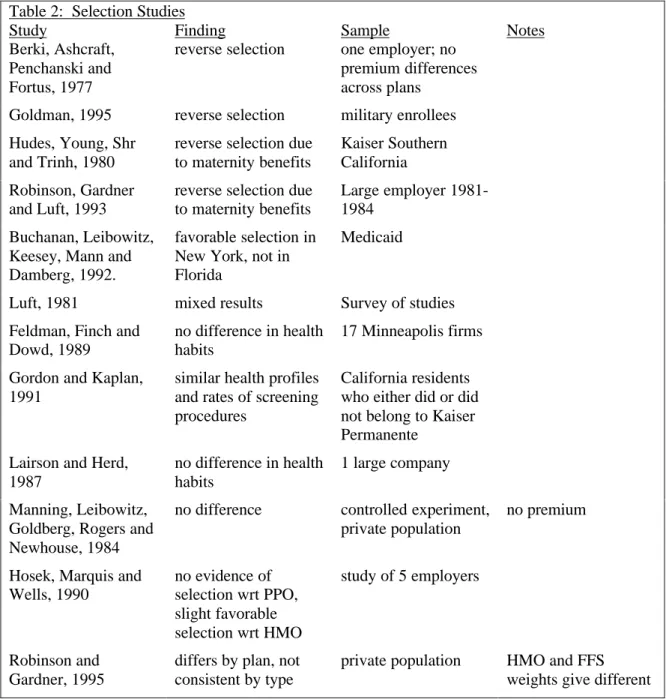
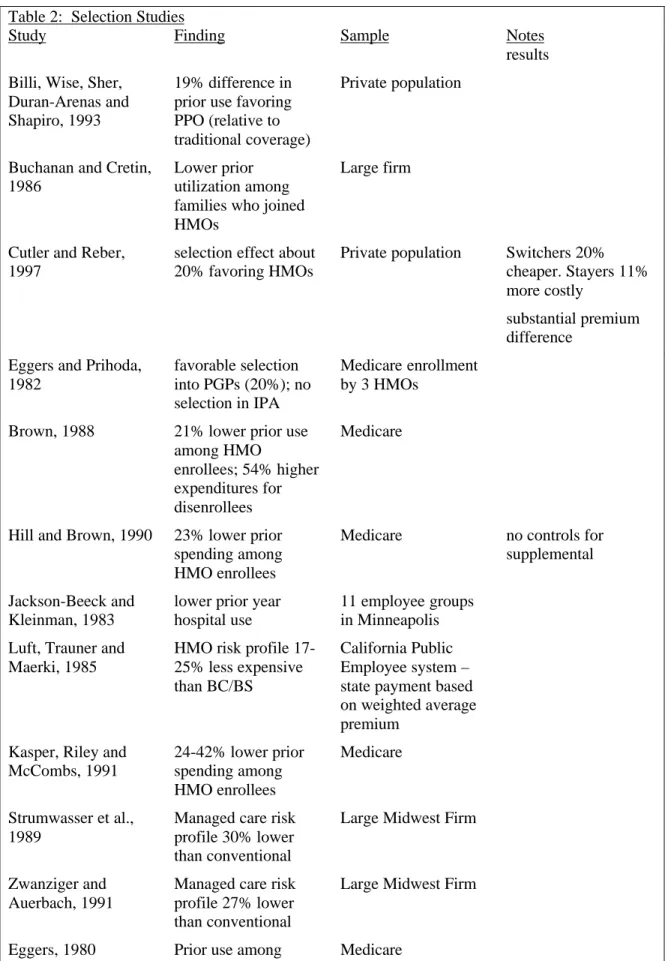
A considerable empirical literature has documented differences between managed care and conventional insurance enrollees (Hellinger, 1995; Physician Payment Review Commission, 1996). This literature is summarized in Table 2. Differences across plans are complex and vary across studies. Some
managed care plans attract more young families (Berki et al., 1977). Some plans attract fewer
chronically ill people (Hill and Brown, 1990). Managed care plans often attract new migrants and do not attract people with long-standing ties to physicians (Luft, 1981). Many studies find differences in rates of prior health service utilization. The results, however, are not uniform. Several studies find reverse selection, especially with respect to maternity care (e.g., Hudes et al., 1980; Robinson, Gardner, and Luft, 1993). Some authors have speculated that managed care plan members might differ from conventional insurance enrollees in terms of their health attitudes and behaviors, but there is little evidence to support this conjecture (Feldman, Finch and Dowd, 1989; Lairson and Herd, 1987). The RAND health insurance experiment found no statistically significant differences in the expenditures of those randomly assigned to an HMO and those who had voluntarily chosen the plan (Manning et al., 1984).
The results of selection studies depend on how selection is measured. Some studies measure selection according to particular conditions (such as maternity or chronic disease). Since patterns of care differ by system of care, it is possible for both types of plans to have unfavorable selection of this type at the same time (Frank, Glazer and McGuire, 1998). Access to hospital care is easier under conventional insurance, so those who expect to use high levels of inpatient care may select conventional coverage. Access to general practitioners is easier under managed care, so those who expect to use high levels of outpatient services may select managed care coverage. Families who expect to need maternity care may choose HMOs, while those with heart disease may choose conventional insurance. Consistent with this possibility, Robinson and Gardner (1995) find that the pattern of selection on health characteristics differs according to whether the costs of these characteristics are assessed based on HMO practice patterns or conventional insurance practice patterns.
Prior utilization measures of selection more accurately capture the effect of sets of health characteristics on costs. These measures, however, may overstate selection (especially if they focus on plan switchers). This will occur if prior utilization includes both transitory and permanent components and there is regression to the mean in overall expenditures (Welch, 1985). As discussed further below, the growing literature on risk adjustment attempts to provide better estimates of differences in expected health care utilization among populations.
Overall, the results of selection studies suggest that managed care plans in the private sector tend to enjoy a 20-30% prior utilization advantage over conventional indemnity plans while Medicare plans enjoy a similar advantage over traditional Medicare. The degree to which managed care plans attract healthier people will depend, of course, on the generosity of the conventional insurance alternative and the stringency of managed care limitations on use. Selection may be more severe (or less severe) as the
price differential faced by consumers increases. In practice, the financial implications to the consumer of choosing managed care rather than an alternative depend on employer practices. Since many employers continue to pay a fixed proportion of costs, the cost advantage to an employee of selecting a managed care plan may be relatively small. While less clear, the selection studies also suggest that differences in health outcomes between managed care and conventional insurance enrollees may also depend on the underlying characteristics of these populations. The wide range of estimates and the complicated nature of selection between managed care and non-managed care suggests caution in interpreting the results of non-randomized studies of managed care utilization and quality (Newhouse, 1996).
Table 2: Selection Studies
Study Finding Sample Notes
Berki, Ashcraft, Penchanski and Fortus, 1977
reverse selection one employer; no premium differences across plans
Goldman, 1995 reverse selection military enrollees Hudes, Young, Shr
and Trinh, 1980
reverse selection due to maternity benefits
Kaiser Southern California Robinson, Gardner
and Luft, 1993
reverse selection due to maternity benefits
Large employer 1981-1984
Buchanan, Leibowitz, Keesey, Mann and Damberg, 1992.
favorable selection in New York, not in Florida
Medicaid
Luft, 1981 mixed results Survey of studies
Feldman, Finch and Dowd, 1989
no difference in health habits
17 Minneapolis firms Gordon and Kaplan,
1991
similar health profiles and rates of screening procedures
California residents who either did or did not belong to Kaiser Permanente
Lairson and Herd, 1987
no difference in health habits
1 large company Manning, Leibowitz,
Goldberg, Rogers and Newhouse, 1984
no difference controlled experiment, private population
no premium
Hosek, Marquis and Wells, 1990 no evidence of selection wrt PPO, slight favorable selection wrt HMO study of 5 employers Robinson and Gardner, 1995
differs by plan, not consistent by type
private population HMO and FFS weights give different
Table 2: Selection Studies
Study Finding Sample Notes
results Billi, Wise, Sher,
Duran-Arenas and Shapiro, 1993
19% difference in prior use favoring PPO (relative to traditional coverage)
Private population
Buchanan and Cretin, 1986
Lower prior utilization among families who joined HMOs
Large firm
Cutler and Reber, 1997
selection effect about 20% favoring HMOs
Private population Switchers 20% cheaper. Stayers 11% more costly
substantial premium difference
Eggers and Prihoda, 1982 favorable selection into PGPs (20%); no selection in IPA Medicare enrollment by 3 HMOs
Brown, 1988 21% lower prior use among HMO
enrollees; 54% higher expenditures for disenrollees
Medicare
Hill and Brown, 1990 23% lower prior spending among HMO enrollees
Medicare no controls for
supplemental Jackson-Beeck and
Kleinman, 1983
lower prior year hospital use
11 employee groups in Minneapolis Luft, Trauner and
Maerki, 1985
HMO risk profile 17-25% less expensive than BC/BS
California Public Employee system – state payment based on weighted average premium
Kasper, Riley and McCombs, 1991 24-42% lower prior spending among HMO enrollees Medicare Strumwasser et al., 1989
Managed care risk profile 30% lower than conventional
Large Midwest Firm
Zwanziger and Auerbach, 1991
Managed care risk profile 27% lower than conventional
Large Midwest Firm
Table 2: Selection Studies
Study Finding Sample Notes
HMO enrollees 52-62% lower
Utilization
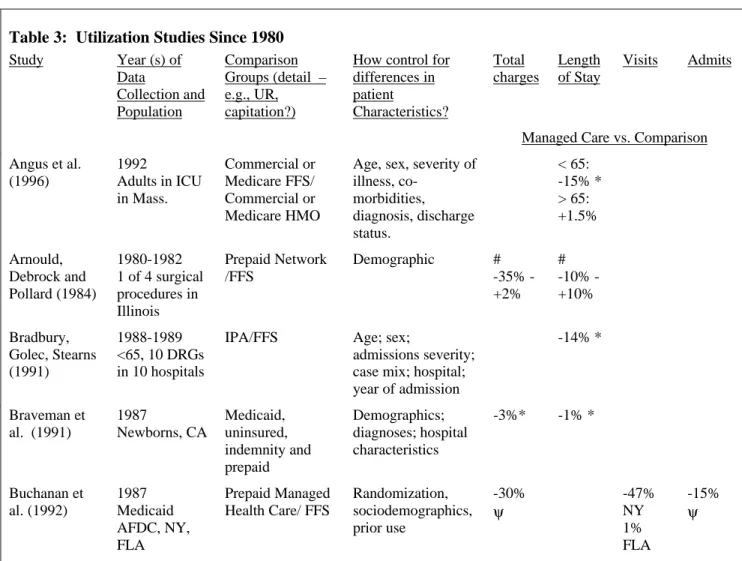
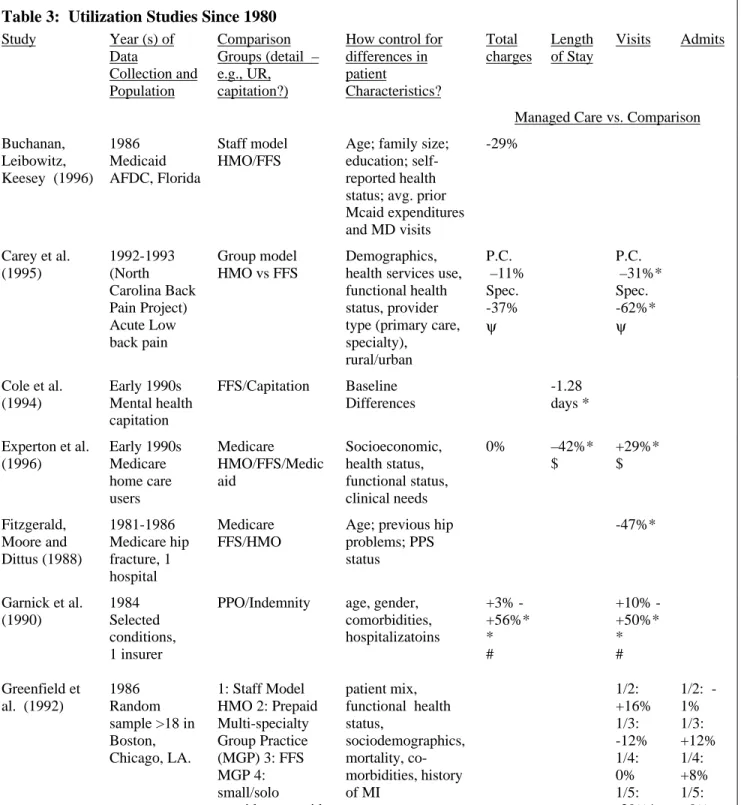
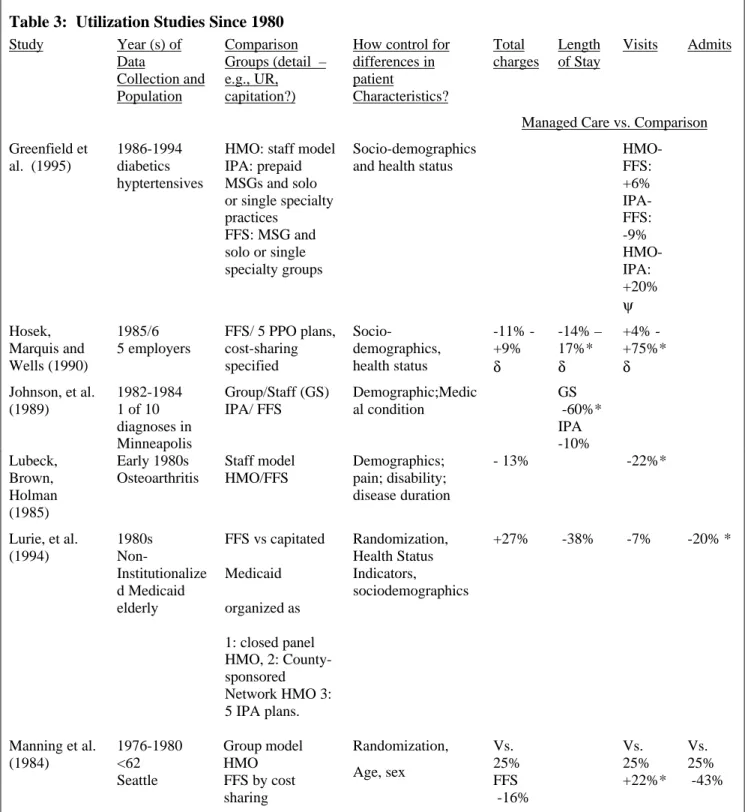
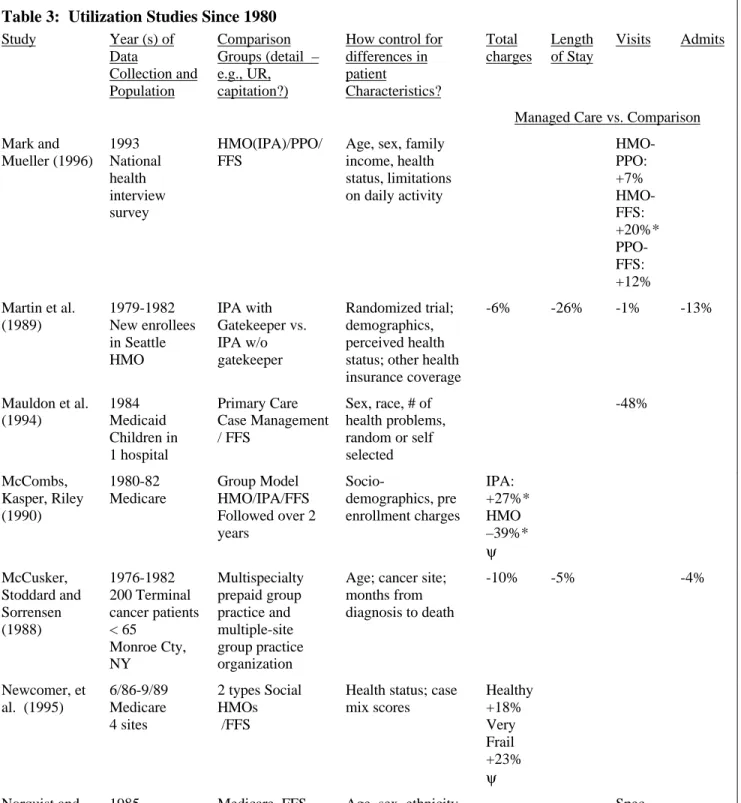
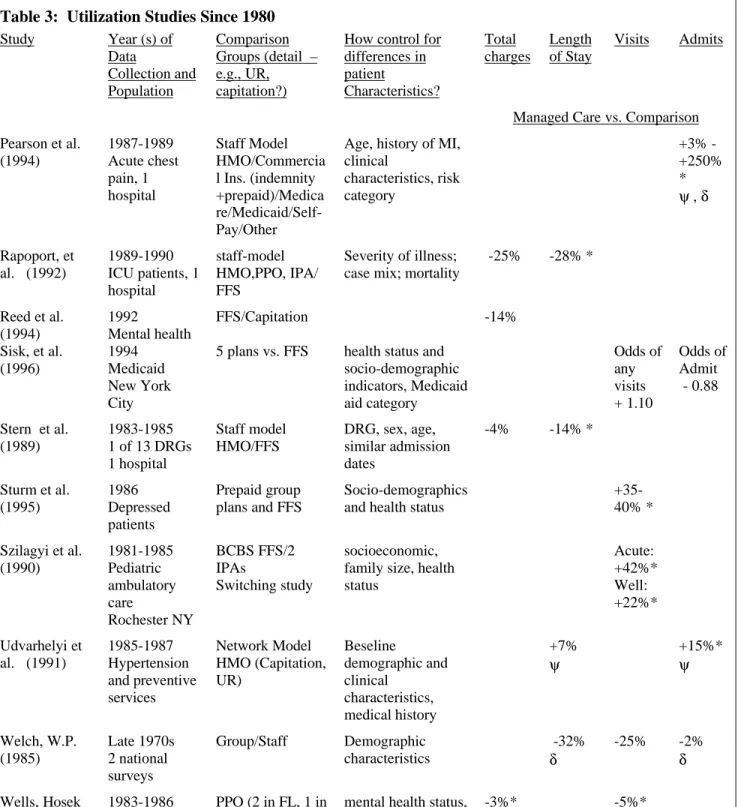
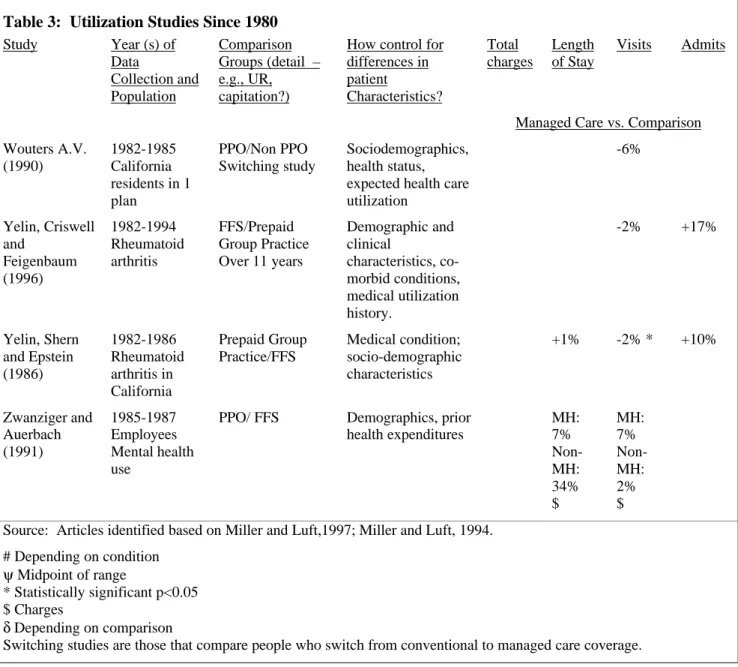
Analyses of the effects of managed care on utilization examine its effects on inpatient, outpatient and total utilization. Comprehensive review of this literature are provided in Luft, 1981; Miller and Luft, 1994; and Miller and Luft, 1997. Luft (1981) reviewed studies of managed care utilization conducted between 1959 and 1975. Most of these studies compared people in group or staff model managed care plans with those in conventional insurance arrangements. Since conventional arrangements in this period rarely incorporated utilization review, while managed care plans rarely incorporated cost-sharing, the results are somewhat easier to generalize than those from studies conducted after 1980. The managed care plans in Luft’s survey include plans that manage only outpatient care (HIP), IPA plans, and group and staff plans. The characteristics of the comparison group of conventional insurance plans are rarely specified in detail.
The study of utilization effects is further complicated by the problem of measuring costs within managed care. Managed care plans often do not collect cost information that is comparable to traditional insurance claims costs. Mechanisms such as capitation and salary payment make it especially difficult to measure costs at the level of the individual visit. Instead, many studies impute costs based on observed patterns of utilization measured at traditional insurance claim rates. To the extent that these rates do not accurately reflect costs within a managed care setting (whether because of production efficiencies or volume discounts), estimates of the cost of service use within managed care may be misleading.
In general, Luft finds that managed care plans reduced inpatient admission rates, had mixed effects on length of inpatient stays, and reduced total inpatient costs. The overall effect on inpatient days was a reduction of 5-25% for IPA plans and 35% for group and staff model plans. Results were generally more robust for group and staff plans. Managed care plans, especially IPAs, tended to have higher outpatient visit rates, especially for patient-initiated visits. Overall costs were 10-40% lower for group and staff model plans, but IPA plans did not appear to be less costly than conventional arrangements.
In 1985, the RAND health insurance experiment group published the results of its randomized study of the effects of managed care. The study assigned 1149 people to Group Health of Puget Sound, a staff-model HMO in Seattle, Washington. It also observed the behavior of 733 people who were already enrolled in the plan. In addition to randomizing enrollees, the RAND experiment was unusual in