Integrative Modeling
Method name Availability (web URL)
Brief description Citation
IMP http://salilab.org/imp IMP provides an open source C++ and Python toolbox for solving complex modeling problems, and a number of applications for tackling some common problems in a user-friendly way
(1)
Rosetta https://www.rosetta commons.org/
A suite for modeling macromolecular structures. It is a flexible, multi-purpose application that includes tools for structure prediction, design, and remodeling of proteins and nucleic acids.
(2)
Rigid-Body Fitting
Method name Availability (web URL)
Brief description Citation
3SOM http://www.russellla b.org/3SOM/
Fitting of atomic structures to low resolution electron density maps by surface overlap maximization.
(3) ADPEM http://chaconlab.org
/methods/fitting/adp em
ADPEM is an ultra fast multiresolution rigid-body fitting tool which has been specially designed to support high throughput coverage. The method uses spherical harmonics to effectively speed up the rotational part of the fitting search.
(4)
Attract-EM Attract-EM combines search strategies and techniques from the protein-protein docking program ATTRACT (5) with EM derived data encoded as additional docking penalty score. In ATTRACT-EM each subunit as well as the cryo-EM map is represented as a set of Gaussians. The scoring function includes an overlap term between the complex density map and the subunits repulsion term between subunits, as well as a symmetry energy term for symmetric complexes. The fitting is optimized using ATTRACT's energy minimizer.
(6)
BCL::EM-Fit http://meilerlab.org/i ndex.php/servers/s how?s_id=6
BCL::EM-Fit fits atomic-detail structural models into medium resolution density maps. In an initial step, a "geometric hashing" algorithm provides a short list of likely placements. In a follow up Monte Carlo/Metropolis refinement step, the initial placements are optimized by their cross correlation coefficient. The resolution of density maps for a reliable fit was determined to be 10 Å or better using tests with simulated density maps. The BCL::EM-Fit algorithm offers an alternative to the established Fourier/Real space fitting programs.
(7)
EMatch bioinfo3d.cs.tau.ac.i l/EMatch
Fold recognition and rigid fitting based on secondary structure elements (8) EMfit http://bilbo.bio.purd ue.edu/~viruswww/ Rossmann_home/s oftwares/emfit.php
Fitting criteria includes the sum of densities at atomic sites, the lack of atoms in negative or low density, the absence of atomic clashes between symmetry-related positions of the atomic structure, and the distances between identifiable features in the map and their positions on the fitted atomic structure.
EMLZerD EMLZerD combines a multiple protein docking procedure and an assessment for fitness of the protein complex structures and the EM map using the 3D Zernike descriptor (3DZD). The multiple protein docking procedure generates a couple hundred plausible protein complex structures
assembled from the component proteins (10). Then, the overall surface shape of each candidate protein complex structure is compared with the EM map using the 3DZD, a mathematical series expansion of a 3D function, which is a compact and rotationally invariant representation of a 3D object.
(11)
GMFit http://strcomp.protei
n.osaka-u.ac.jp/gmfit/
GMFit superimposes several subunit atomic models into a low resolution EM using a Gaussian Mixture Model.
(12)
IQP The subunits as well as the map are represented as sets of
points at a reduced complexity level. The fitting is
formulated as a point set matching using integer quadratic programming method. The algorithm is able to match multiple point sets simultaneously and not only based on their geometrical equivalence, but also based on the similarity of the density in the immediate point
neighborhood. The assemblies are then refined based on the Iterative Closest Point registration algorithm.
(13)
MultiFit http://modbase.com pbio.ucsf.edu/multifi t/
Simultaneously fitting atomic structures of components into their assembly EM map. The component positions and orientations are optimized with respect to a scoring function that includes the quality-of-fit of components in the map, the protrusion of
components from the map envelope, as well as the shape complementarity between pairs of components. The scoring function is optimized by an exact inference optimizer that efficiently finds the global minimum in a discrete sampling space.
(14)
Situs http://situs.biomachi na.org/
A package for the modeling of atomic resolution structures into low-resolution density map s e.g. from electron
microscopy, tomography, or small angle X-ray scattering.
(15)
UCSF Chimera
http://www.cgl.ucsf. edu/chimera/
A highly useful set of visual tools for guiding rigid fitting. (16) Flexible Fitting
Method name Availability (web URL)
Brief description Citation
BCL::EM-Fit http://meilerlab.org/i ndex.php/servers/s how?s_id=6 DireX http://www.schroder lab.org/software/dir ex/
DireX performs efficient geometry-based conformational sampling of protein structures under experimental restraints. It combines prior structural information with experimental data through the Deformable Elastic Network (DEN) approach which
drastically reduces over-fitting. EM-IMO http://wiki.c2b2.colu mbia.edu/honiglab_ public/index.php/So ftware:cryoEM_Gen eral_Description
EM-IMO (electron microscopy-iterative modular optimization) is based on the framework of IMO procedure (18), which was originally developed for local structure refinement in the context of protein structure prediction. EM-IMO can be used for building, modifying and refining local structures of protein models using cryoEM maps as a constraint. As a supervised refinement method, EM-IMO allows users to specify parameters derived from inspections so as to guide, and as a consequence, significantly speed up the refinement.
(19)
Flex-EM http://salilab.org/Fle x-EM/
Atomic positions are optimized with respect to a scoring function that includes the cross correlation coefficient between the structure and the map as well as stereochemical and
nonbonded interaction terms. A heuristic optimization that relies on a Monte Carol search, a conjugate-gradient minimization, and simulated annealing molecular dynamics is applied to a series of subdivisions of the structure into progressively smaller rigid bodies.
(20)
FRODA http://flexweb.asu.e du
Flexible fitting of high-resolution structures to cryo-EM maps using constrained geometric simulations as implemented in the FIRST/FRODA software package. These simulations have the distinct advantage that rigid units (such as secondary structure elements) are identified in the starting structure based on physical principles and maintained intact throughout the simulation. This ensures that the local geometry and
stereochemistry are valid and maintained at every point during the simulation. No nonphysical distortions of the structure take place.
(21)
iMODFIT http://chaconlab.org /methods/fitting/imo dfit
Efficient tool for flexible fitting of atomic structures into EM maps based on Normal Mode Analysis in internal Coordinates.
(22) MDFF http://www.ks.uiuc.e
du/Research/mdff/
Flexibly fit atomic structures into density maps. The method consists of adding external forces proportional to the gradient of the density map into a molecular dynamics simulation of the atomic structure. Other data can be added as additional restraints.
(23)
MDfit http://mdfit.lanl.gov/ The method uses reduced description all-atom molecular dynamics to construct atomic models consistent with cryo-EM reconstructions. The algorithm can be applied to other forms of experimental data. The method uses a molecular dynamics force field defined by an X-ray structure itself. The methods preserves this X-ray structure as much as possible while
simultaneously fitting the cryo-EM map. Because explicit solvent is not required, the methods can be run on a high end desktop computer. Tertiary contacts, dihedrals, base pairs and other contacts are naturally preserved according to the X-ray
structure. The method can also use a structural model in place of an X-ray structure.
NMFF http://mmtsb.org/sof tware/nmff.html
Flexible multi-resolution fitting of large atomically detailed structures into electron density maps from cryo-EM, tomography and related lower resolution methods. The method is based on searching along a few lowest frequency normal mode vectors, constructed from a multi-resolution elastic network representation of the atomic structure of interest, to maximize the correlation between the computed electron density for the flexible model and the experimental density.
.
(25)
NORMA http://www.igs.cnrs-mrs.fr/elnemo//NOR MA/
NORMA searches along few lowest frequency modes to minimize the URO (26) misfit parameter using a multiple-dimension simplex-minimization with optional simulated annealing. Minimization calculations are performed in reciprocal space, which reduced density segmentation bias.
(27)
ROSETTA https://www.rosetta commons.org/
Rosetta was adapted to refine comparative models and low-resolution backbone traces using density maps as a guide. A local measure of the fit to density is used to identify regions incompatible with the density that are targeted for extensive rebuilding, and the whole structure is then refined using this measure as a guide. The method generates models that fit the density, are low in energy, and can have near atomic resolution starting from 4-8 Å density maps.
(28)
S-flexfit http://biocomp.cnb.c
sic.es/Sflexfit/ Superfamily-based flexible fitting (29)
YUP.SCX http://www.harvey.g atech.edu/Yammp Web/userman/yups cx/yupscx.shtml
The program fits a molecular structure into a density map. The molecular model is represented by atoms connected in a Gaussian Network while the density map is represented by a cloud of attractive holes, each hole is fixed in space and attracts all the atoms that are within an adjustable distance. The fitting is accomplished by finding the minimum of the combined
Gaussian Network and attractive hole energy functions. These functions, data preparation utilities, simulation methods and data analysis routines are implemented in the Emmental module of the YUP package.
(30)
Feature Extraction
Method name Availability (web URL)
Brief description Citation
AIRS http://ncmi.bcm.tmc. edu/software/AIRS
The Analysis of Intermediate Resolution Structures (AIRS) toolkit is designed for structure discovery in intermediate resolution structures from EM. AIRS contains tools for filtering, segmentation, analysis and docking, in addition to a variety of other visualization tools.
Gorgon / Pathwalker
http://gorgon.wustl. edu/
Gorgon is an interactive molecular modeling system specifically geared towards cryo-EM and other low resolution structures of macromolecular complexes. Gorgon's de novo modeling procedure couples sequence-based secondary structure prediction with feature detection and geometric modeling techniques to generate initial protein backbone models. Beyond model building, Gorgon is an extensible interactive visualization platform with a variety of computational tools for annotating a wide variety of 3D volumes.
(32,33)
Voltrac http://situs.biomachi na.org/
Detection of filamentous densities (such as alpha-helices and actin filaments) in intermediate resolution maps from EM and tomography
(34,35)
Model Building
Method name Availability (web URL)
Brief description Citation
Coot www.biop.ox.ac.uk/
coot Visual macromolecular model building, model completion and validation, particularly suitable for protein modeling using high-resolution maps.
(36)
EM-fold http://www.meilerla b.org/index.php/ser vers/show?s_id=18
De novo folding of guided by topological restraints derived from intermediate-resolution EM map.
(37) Modeller http://salilab.org/mo
deller/
MODELLER is used for homology or comparative modeling of protein three-dimensional structures. The user provides an alignment of a sequence to be modeled with known related structures and MODELLER automatically calculates a model containing all non-hydrogen atoms. MODELLER implements comparative protein structure modeling by satisfaction of spatial restraints, and can perform many additional tasks, including de novo modeling of loops in protein structures, optimization of various models of protein structure with respect to a flexibly defined objective function, multiple alignment of protein
sequences and/or structures, clustering, searching of sequence databases, comparison of protein structures, etc.
(38)
Visualization
Method name Availability (web URL)
Brief description Citation
Coot www.biop.ox.ac.uk/ coot
Visual macromolecular model building, model completion and validation, particularly suitable for protein modeling using high-resolution maps.
(36)
Pymol http://www.pymol.or g
A powerful and comprehensive molecular visualization product for rendering and animating 3D molecular structures, built on an open-source foundation.
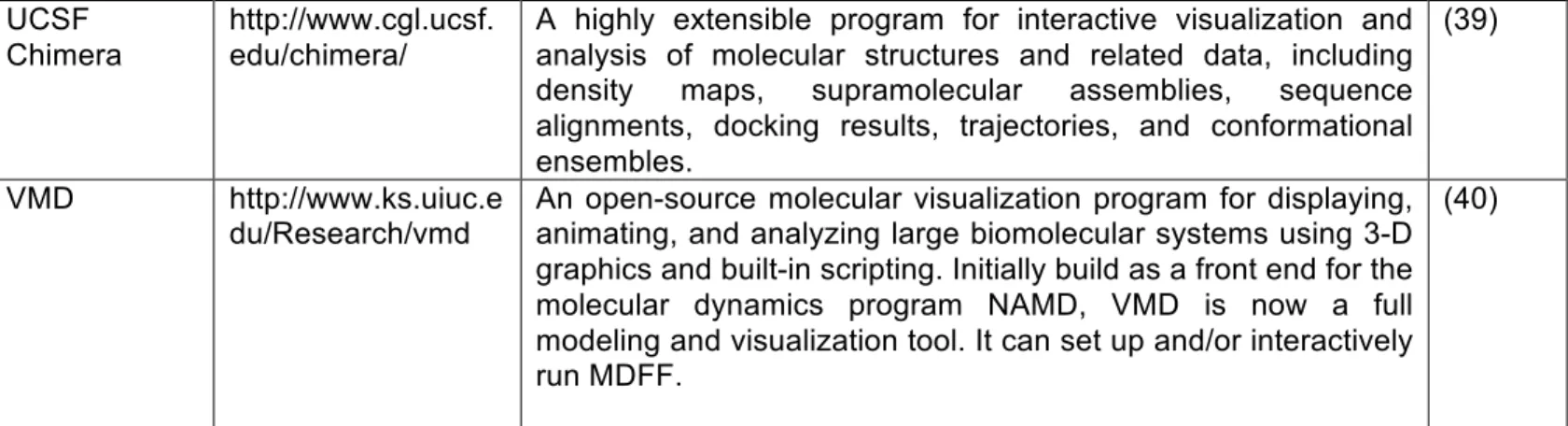
UCSF Chimera
http://www.cgl.ucsf. edu/chimera/
A highly extensible program for interactive visualization and analysis of molecular structures and related data, including density maps, supramolecular assemblies, sequence alignments, docking results, trajectories, and conformational ensembles.
(39)
VMD http://www.ks.uiuc.e du/Research/vmd
An open-source molecular visualization program for displaying, animating, and analyzing large biomolecular systems using 3-D graphics and built-in scripting. Initially build as a front end for the molecular dynamics program NAMD, VMD is now a full modeling and visualization tool. It can set up and/or interactively run MDFF.
(40)
Table S1: Summary of modeling techniques available for building structures based on EM maps. We encourage method developers as well as users to engage to update this resource. An online version of
this table can be found at http://villalab.ucsd.edu/modeling/software/. Supplementary References
1. Russel, D., Lasker, K., Webb, B., Velazquez-Muriel, J., Tjioe, E., Schneidman-Duhovny, D., Peterson, B. and Sali, A. (2012) Putting the pieces together: integrative modeling platform software for structure determination of macromolecular assemblies. PLoS Biol, 10, e1001244. 2. Leaver-Fay, A., Tyka, M., Lewis, S.M., Lange, O.F., Thompson, J., Jacak, R., Kaufman, K.,
Renfrew, P.D., Smith, C.A., Sheffler, W. et al. (2011) ROSETTA3: an object-oriented software suite for the simulation and design of macromolecules. Methods in enzymology, 487, 545-574. 3. Ceulemans H and RB, R. (2004) Fast fitting of atomic structures to low-resolution electron
density maps by surface overlap maximization. J Mol Biol, 338, 783-793.
4. Garzon, J.I., Kovacs, J., Abagyan, R. and Chacon, P. (2007) ADP_EM: fast exhaustive multi-resolution docking for high-throughput coverage. Bioinformatics, 23, 427-433.
5. Zacharias, M. (2003) Protein-protein docking with a reduced protein model accounting for side-chain flexibility. Protein Sci, 12, 1271-1282.
6. de Vries, S.J. and Zacharias, M. (2012) ATTRACT-EM: a new method for the computational assembly of large molecular machines using cryo-EM maps. PloS one, 7, e49733.
7. Woetzel, N., Lindert, S., Stewart, P.L. and Meiler, J. BCL::EM-Fit: rigid body fitting of atomic structures into density maps using geometric hashing and real space refinement. J Struct Biol, 175, 264-276.
8. Lasker, K., Dror, O., Shatsky, M., Nussinov, R. and Wolfson, H.J. (2007) EMatch: discovery of high resolution structural homologues of protein domains in intermediate resolution cryo-EM maps. IEEE/ACM transactions on computational biology and bioinformatics / IEEE, ACM, 4, 28-39.
9. Rossmann, M.G., Bernal, R. and Pletnev, S.V. (2001) Combining electron microscopic with x-ray crystallographic structures. J Struct Biol, 136, 190-200.
10. Venkatraman, V., Yang, Y.D., Sael, L. and Kihara, D. (2009) Protein-protein docking using region-based 3D Zernike descriptors. BMC bioinformatics, 10, 407.
11. Esquivel-Rodriguez, J. and Kihara, D. (2012) Fitting multimeric protein complexes into electron microscopy maps using 3D Zernike descriptors. The journal of physical chemistry. B, 116, 6854-6861.
12. Kawabata, T. (2008) Multiple subunit fitting into a low-resolution density map of a macromolecular complex using a gaussian mixture model. Biophys J, 95, 4643-4658.
13. Zhang, S., Vasishtan, D., Xu, M., Topf, M. and Alber, F. (2010) A fast mathematical programming procedure for simultaneous fitting of assembly components into cryoEM density maps. Bioinformatics, 26, i261-268.
14. Lasker, K., Topf, M., Sali, A. and Wolfson, H. (2009) Inferential optimization for simultaneous fitting of multiple components into a cryoEM map of their assembly. J Mol Biol, 388, 180-194. 15. Wriggers, W. (2010) Using Situs for the integration of multi-resolution structures. Biophys Rev,
2, 21-27.
16. Goddard, T.D., Huang, C.C. and Ferrin, T.E. (2007) Visualizing density maps with UCSF Chimera. J Struct Biol, 157, 281-287.
17. Schroder, G.F., Brunger, A.T. and Levitt, M. (2007) Combining efficient conformational sampling with a deformable elastic network model facilitates structure refinement at low resolution. Structure, 15, 1630-1641.
18. Zhu, J., Xie, L. and Honig, B. (2006) Structural refinement of protein segments containing secondary structure elements: Local sampling, knowledge-based potentials, and clustering. Proteins, 65, 463-479.
19. Zhu, J., Cheng, L., Fang, Q., Zhou, Z.H. and Honig, B. (2010) Building and refining protein models within cryo-electron microscopy density maps based on homology modeling and multiscale structure refinement. J Mol Biol, 397, 835-851.
20. Topf, M., Lasker, K., Webb, B., Wolfson, H., Chiu, W. and Sali, A. (2008) Protein structure fitting and refinement guided by cryo-EM density. Structure, 16, 295-307.
21. Jolley, C.C., Wells, S.A., Fromme, P. and Thorpe, M.F. (2008) Fitting low-resolution cryo-EM maps of proteins using constrained geometric simulations. Biophys J, 94, 1613-1621.
22. Lopez-Blanco, J.R. and Chacon, P. (2013) iMODFIT: efficient and robust flexible fitting based on vibrational analysis in internal coordinates. J Struct Biol, 184, 261-270.
23. Trabuco, L.G., Villa, E., Mitra, K., Frank, J. and Schulten, K. (2008) Flexible fitting of atomic structures into electron microscopy maps using molecular dynamics. Structure, 16, 673-683. 24. Ratje, A.H., Loerke, J., Mikolajka, A., Brunner, M., Hildebrand, P.W., Starosta, A.L., Donhofer,
A., Connell, S.R., Fucini, P., Mielke, T. et al. (2010) Head swivel on the ribosome facilitates translocation by means of intra-subunit tRNA hybrid sites. Nature, 468, 713-716.
25. Tama, F., Miyashita, O. and Brooks, C.L., 3rd. (2004) Normal mode based flexible fitting of high-resolution structure into low-high-resolution experimental data from cryo-EM. J Struct Biol, 147, 315-326.
26. Navaza, J., Lepault, J., Rey, F.A., Alvarez-Rua, C. and Borge, J. (2002) On the fitting of model electron densities into EM reconstructions: a reciprocal-space formulation. Acta Crystallogr D Biol Crystallogr, 58, 1820-1825.
27. Suhre, K., Navaza, J. and Sanejouand, Y.H. (2006) NORMA: a tool for flexible fitting of high-resolution protein structures into low-high-resolution electron-microscopy-derived density maps. Acta Crystallogr D Biol Crystallogr, 62, 1098-1100.
28. DiMaio, F., Tyka, M.D., Baker, M.L., Chiu, W. and Baker, D. (2009) Refinement of protein structures into low-resolution density maps using rosetta. J Mol Biol, 392, 181-190.
29. Velazquez-Muriel, J.A. and Carazo, J.M. (2007) Flexible fitting in 3D-EM with incomplete data on superfamily variability. J Struct Biol, 158, 165-181.
30. Tan, R.K., Devkota, B. and Harvey, S.C. (2008) YUP.SCX: coaxing atomic models into medium resolution electron density maps. J Struct Biol, 163, 163-174.
31. Baker, M.L., Zhang, J., Ludtke, S.J. and Chiu, W. (2010) Cryo-EM of macromolecular assemblies at near-atomic resolution. Nat Protoc, 5, 1697-1708.
32. Baker, M.L., Abeysinghe, S.S., Schuh, S., Coleman, R.A., Abrams, A., Marsh, M.P., Hryc, C.F., Ruths, T., Chiu, W. and Ju, T. (2011) Modeling protein structure at near atomic resolutions with Gorgon. J Struct Biol, 174, 360-373.
33. Baker, M.R., Rees, I., Ludtke, S.J., Chiu, W. and Baker, M.L. (2012) Constructing and validating initial Calpha models from subnanometer resolution density maps with pathwalking. Structure, 20, 450-463.
34. Rusu, M., Starosolski, Z., Wahle, M., Rigort, A. and Wriggers, W. (2012) Automated tracing of filaments in 3D electron tomography reconstructions using Sculptor and Situs. J Struct Biol, 178, 121-128.
35. Rusu, M. and Wriggers, W. (2012) Evolutionary bidirectional expansion for the tracing of alpha helices in cryo-electron microscopy reconstructions. J Struct Biol, 177, 410-419.
36. Emsley, P., Lohkamp, B., Scott, W.G. and Cowtan, K. (2010) Features and development of Coot. Acta Crystallogr D Biol Crystallogr, 66, 486-501.
37. Lindert, S., Alexander, N., Wotzel, N., Karakas, M., Stewart, P.L. and Meiler, J. (2012) EM-fold: de novo atomic-detail protein structure determination from medium-resolution density maps. Structure, 20, 464-478.
38. Sali, A. and Blundell, T.L. (1993) Comparative protein modelling by satisfaction of spatial restraints. J Mol Biol, 234, 779-815.
39. Pettersen, E.F., Goddard, T.D., Huang, C.C., Couch, G.S., Greenblatt, D.M., Meng, E.C. and Ferrin, T.E. (2004) UCSF Chimera--a visualization system for exploratory research and analysis. J Comput Chem, 25, 1605-1612.
40. Humphrey, W., Dalke, A. and Schulten, K. (1996) VMD: visual molecular dynamics. Journal of molecular graphics, 14, 33-38, 27-38.