Developing and Integrating Life Cycle
Management Methods in Project
Management Systems
Case: Faveo Prosjektledelse ASErika Palmer
Master in Industrial Ecology
Supervisor: John Eilif Hermansen, IØT
Department of Industrial Economics and Technology Management Submission date: May 2013
Developing and Integrating
Sustainable Life Cycle
Management Methods in
Project Management Systems
,Case: Faveo Prosjektledelse AS
Erika Palmer
Spring 2013Industrial Ecology Master Thesis
Department of Industrial Economics and Technology Management
The Norwegian University of Science and Technology
iv
Acknowledgements
This master thesis is the second half of a yearlong project that could not have been completed without the collaboration of many people both at NTNU and Faveo Prosjektledelse AS. I would first like to thank my thesis advisor, John Eilif Hermansen, whose guidance, support and input have been incredibly valuable. At NTNU, I would like to thank Cecilia Haskins and Annik Magerholm Fet for their advice and feedback especially in the initial development of this project.
This project could not have been completed without the interest and motivation of Faveo to work with corporate social responsibility and environmental management. At Faveo, I would like to thank Hedvig Hjertås Mauseth and Milda Lunde Stene for the coordination of this thesis and their interest in the material and support through the process. The Sustainable Project Life Cycle Management Guide benefitted greatly from the input and feedback from Ole Jonny Klakegg, and my thanks goes to him for his support in the past year. I would like to thank specifically Nils Morten Beitnes for making the time to be the initial tester of the guide and for his valuable feedback. I would also like to give my sincere thanks to Ingemund Jordanger for his valuable input concerning value creation and for all the interesting lunch room discussions.
v
Abstract (English)
This master thesis was written as a requirement in the completion of the international Master of Science degree in Industrial Ecology with a specialization in environmental management and politics at the Norwegian University of Science and Technology. The thesis was written with the Department of Industrial Economics and Technology Management and under the supervision of Associate Professor John Eilif Hermansen. The case company for this thesis is Faveo Prosjektledelse AS, and the thesis is a continuation of the specialization project
completed with Faveo in the fall of 2012.
The goal of this master thesis was to develop life cycle management tools and methods for use in project management. The research questions concerned the practical integration of these tools in a system dynamics perspective and the contribution this can have in creating value. First an introduction of the research area is given, followed by the methods employed, an exploration of the theoretical foundation, a theoretical analysis of how life cycle
management in project management can be used, an explanation of the tool that was
developed, an explanation of the application of the tool on a project and how it contributes to value creation, and finally a discussion is given followed by a conclusion. The Sustainable Project Life Cycle Management (SPLCM) Guide is the tangible result of this thesis, and it is an easy to use tool that project managers at Faveo (and at other companies) can use in their projects to mitigate the environmental and social impacts of their projects. Using this guide will change the Faveo system (illustrated in the specialization project) and allows the project managers to have a direct relationship with the community and the environment in the life cycle of their projects. The SPLCM Guide not only has the potential to reduce the impact the projects at Faveo have on society and the environment, but it can also create value for the project owners and for Faveo itself. Sustainable value creation meets the needs of
stakeholders while creating value for the company, and the SPLCM Guide (in conjunction with other initiatives) can realize this for Faveo.
vi
Abstrakt (Norsk)
Denne masteroppgaven var skrevet som en del av det internasjonale masterprogrammet i industriell økologi med fordypning i miljøledelse og politikk. Masteroppgaven ble skrevet hos Institutt for industriell økonomi og teknologiledelse, og førsteamanuensis John Eilif
Hermansen var veilederen. Masteroppgaven var gjennomført i samarbeid med Faveo Prosjektledelse AS, og dette var fortsettelsen til fordypningsprosjektet som ble gjennomført hos Faveo i høsten 2012.
Målet med masteroppgaven var å utvikle livsløpledelsesverktøy og metoder for å bruke i prosjektledelse, og oppgaven har forskningsspørsmål som handler om praktisk integrering av disse verktøyene i en system dynamics tilnærming og bidraget dette har for verdiskaping. Denne masteroppgaven innholder en introduksjon som forklarer forskningsområdet, metoder, teoretisk sammendrag, teoretisk analyse til bruk av livsløpsledelse i prosjektledelse,
verktøyforklaring, forklaring av hvordan verktøyet var brukt i et eksempelprosjekt og hvordan det bidrar til økt verdiskaping, og til sist er det en diskusjon og konklusjon. Sustainable Project Life Cycle Management (SPLCM) Guide er det konkrete resultatet av
masteroppgaven. Dette er enkelt for prosjektledere å bruke hos Faveo (og i andre bedrifter) for å redusere miljø- og sosialeffekten til prosjektene sine. Bruk av denne guiden skal
forandre Faveosystemet (utviklet i fordyningsprosjektet), og gjør det mulig for prosjektledere å ha en direkt innflytelse på samfunnet og miljøet i livsløpet til prosjektene sine. SPLCM Guiden har ikke bare potensialet til å redusere den negative effekten prosjektene hos Faveo har på samfunnet og miljøet, men den kan også skape verdi for prosjekteiere og for Faveo. Bærekraftig verdiskaping oppfyller hva aktørene trenger mens den skaper verdi for bedrifter, og SPLCM-Guiden (sammen med andre initiativer) kan realisere dette for Faveo.
vii
Table of Contents
1.0 Introduction ... 1
1.1 Background ... 1
1.1.1 Faveo ... 1
1.1.2 The Specialization Project ... 1
1.1.3 The Master Thesis ... 2
1.2 Motivation ... 2
1.3 Challenges ... 3
1.4 Research Questions ... 3
1.5 Thesis Chapters ... 3
2.0 Scientific Approach and Methodology ... 5
2.1 Scientific Approach ... 5 2.1.1 System Dynamics ... 5 2.2 Methodology ... 6 2.2.1 Literature Review ... 7 2.2.2 Qualitative Modeling ... 7 2.2.3 Semi-Structured Interview ... 9
2.3 Reliability and Validity ... 9
3.0 Literature Review ... 10
3.1 Sustainability ... 10
3.1.1 The Three Pillars of Sustainability: The triple bottom line ... 10
3.1.2 Sustainable development and the Green Economy ... 11
3.1.3 The Business Case for Sustainability ... 11
3.1.4 A Systemic Approach to Sustainability ... 12
3.2 Life Cycle Thinking ... 13
3.2.1 The Supply Chain ... 14
3.2.2 Advantages of a Life Cycle Approach ... 15
3.3 Life Cycle Management ... 16
3.3.1 What is Life Cycle Management ... 16
3.3.2 Life Cycle Management Tools... 20
3.3.3 Different Industries, Different Applications ... 23
4.0 The Use of Life Cycle Management in Project Management ... 25
4.1 The Need for LCM Implementation ... 25
viii
4.2.1 Current State of Life Cycle Management in Project Management ... 29
4.3 The Project and the Life Cycles... 30
4.4 Theoretical Use of Life Cycle Management in Project Management ... 34
5.0 Tools and Methods for the Application of Life Cycle Management in Project Management Systems ... 36
5.1 The Development of the Sustainable Project Life Cycle Management Guide ... 36
5.2 The Goals and an Explanation of the SPLCM Guide ... 37
5.3 How the SPLCM Guide will Develop LCM in Faveo’s Project System ... 39
6.0 SPLCM Guide Application ... 42
6.1 Description of the Project and Background of the Project Manager ... 42
6.2 Filling out the Guide ... 42
6.3 Interview Results ... 43
6.3.1 Part 1 ... 44
6.3.1 Part 2 ... 44
6.4 Interpretations and Recommendations ... 45
7.0 Sustainable Project Life Cycle Management and Value Creation ... 47
7.1 Sustainable Value ... 47
7.1.1 Creating Sustainable Value ... 48
7.2 Value Management in Projects ... 49
7.3 The Incorporation of LCM in Project Management Systems and Value Creation... 51
8.0 Discussion ... 54
8.1 Summary of results ... 54
8.2 A Discussion of the SPLCM Guide ... 55
8.3 Addressing the Research Questions ... 56
8.3.1 Research Question 1 ... 56
8.3.2 Research Question 2 ... 57
8.4 Generalization of the Results ... 58
8.5 The Validity and Reliability of the Results ... 59
9.0 Conclusion ... 61
9.1 Future research ... 61
10.0 References ... 63
Appendix 1: Specialization Project Qualitative Models ... 66
Appendix 2: The Sustainable Project Life Cycle Management Guide ... 72
ix
Appendix 4: Interview Guide and Answers ... 115
Table of Figures and Tables
Figure 1: Concept Map of Systems Engineering (Bahill et al. 2002)... 6Figure 2: Life Cycle of a Product (Haskins 2006) ... 6
Figure 3: The Three Pillars of Sustainability ... 10
Figure 4: The Triple Bottom Line (TBL) and the shear zones: 1=eco-efficiency, 2= environmental justice, 3= business ethics ... 10
Figure 5: Life Cycle Stages ... 13
Figure 6: Life Cycle Thinking and the Supply Chain ... 14
Figure 7: LCM connects and utilizes many different concepts and tools (adapted from UNEP 2007). 17 Figure 8: Elements of LCM (McLaren and McLaren 2010) ... 18
Figure 9: Contributions from different functions of an organization (UNEP 2007) ... 20
Figure 10: LCA Components (ISO 14041:1998) ... 21
Figure 11: Stakeholder Matrix ... 23
Figure 12: Faveo's Project Types ... 23
Figure 13: Faveo Project Management Model (Faveo 2012b) ... 27
Figure 14: Project life cycle phase and knowledge area map (adapted from the PMBOK guide (PMI 2004)) ... 28
Figure 15: Periodic Table of Project Management Competence Elements (IPMA 2012) ... 29
Figure 16: Project Life Cycle Stages (adapted from Labuschagne and Brent (2005)) ... 31
Figure 17: The Asset Life Cycle Stages. Above: Simplified Version, Below: More Detailed Six Stage Life Cycle (Categorized by Acquisition and Utilization of the Asset) (Adapted from Labuschagne and Brent (2005)) ... 32
Figure 18: Relationship between the Project and Asset/Process Life Cycles (adapted from Labuschagne and Brent 2005) ... 32
Figure 19: The Product Life Cycle in Relation to the Asset Life Cycle ... 33
Figure 20: Assessing sustainability in operations (Labuschagne and Brent (2005)) ... 34
Figure 21: Level Two Concept Mapping with the addition of the SPLCM Guide ... 40
Figure 22: Relationship between the eight disciplines of sustainable value creation (adapted from Laszlo 2003) ... 49
Table 1: Description of Life Cycle Stages (adapted from Labuschagne and Brent (2005)) ... 31
Table 2: Laszlo's Eight Sustainable Value Disciplines (Laszlo 2003) ... 48
Table 3: Continued gaps in the Faveo System even with the inclusion of the SPLCM Guide ... 52
Table 4: Examples of Potential for Value Creation by Addressing Stakeholder Needs ... 52
In the SPLCM Guide in Appendix 2: Table 1: Explanation of the general life cycle stages (adapted from Labuschagne and Brent (2005)) . 77 Table 2: Midpoint and Endpoint Categories (ReCiPe 2008) ... 88
1
1.0 Introduction
Project management consultancies have the ability to influence the community and environment both positively and negatively. The range of industries in which project management consultancies operate gives the potential for these companies to influence the development of a sustainable society. However, these companies also have the potential to negatively impact the community and environment in which their projects take place, as well as further up the value chain. In a social and environmental perspective, the goal is to have sustainable projects; and to reach that goal, tools and techniques need to be developed to guide and aid project managers in their decision making. Sustainability cannot be achieved without thinking about the life cycle of both the projects and the products produced from those projects, and this life cycle needs to be managed to inhibit harm to the community and environment and to foster prosperity. The goal of this master thesis is to develop life cycle management tools and methods for use in project management. This thesis has been completed in cooperation with Faveo Prosjektledelse AS.
1.1 Background
This master thesis is the second half of a year-long project. The first half was the specialization project which used system dynamics methodology to evaluate the project management systems of Faveo Prosjektledelse AS. This section describes Faveo as a company, gives a summary of the specialization project and its relationship to the master thesis and provides a description of the master thesis.
1.1.1 Faveo
Faveo Projektledelse AS is the largest project management consultancy company in the Nordic region. They offer independent project management and project competence both in the private and public sector and have the goal of practicing project management at a world class level. Their services include project development and project control, and they work with both small and large projects (Faveo 2012). Faveo’s projects are in a range of different areas including: construction, transport, property development, business development, IT and technology development, research and development and industrial projects. They have specialized competence and tools in many areas including economic, risk, time and
environmental management. Examples of their projects include the hospital in Trondheim, Norway, a wind power project in Denmark and developing project, program and portfolio management at Nordea (a Nordic bank). In 2011, Faveo was involved in 1421 projects (representing billons of kroner in value), and it is because of the amount and scale of the projects Faveo is involved with that they significantly influence communities in both Norway and Sweden (Faveo 2011).
1.1.2 The Specialization Project
The goal of the specialization project was to analyze Faveo as a system in order to find opportunities for including corporate social responsibility (CSR) and environmental
management in their project management systems and to create concrete world class project management criteria that Faveo can strive towards. Organizational learning and systems
2 thinking were the theoretical foundation for the specialization project. Using system dynamics methodology, Faveo was modeled as a system and further analyzed. This analysis showed that Faveo needs an integration of life cycle management in their project management systems that involve both CSR and environmental management for application in projects regardless of industry or project type. This problem needed to be solved in order to reach the goal of
sustainable projects. Backcasting created a pathway to reach that goal, and a systemigram was created to show how life cycle management is necessary for sustainable projects. A gap analysis was also completed to show where Faveo is now in terms of sustainable projects. Opportunities for CSR and environmental management inclusion were identified to begin the process of developing life cycle thinking at Faveo. Concrete criteria for world class project management were also developed in the areas of organizational learning and sustainability. The specialization project laid the foundation for the development of life cycle management tools and methods.
1.1.3 The Master Thesis
The master thesis project will develop methods for the practical application of the results from the specialization project, i.e. integrating life cycle management with project management systems. This integration requires methods and competence building. The development of tools for the practical application of life cycle management will be based on the system dynamics evaluation of the Faveo system. To develop these methods, life cycle management will be explored. This exploration will include such questions as: what does life cycle management include and what is the current state of research on this topic? Life cycle
management will also be evaluated in terms of its use in project management. This evaluation will research life cycle management methods which are currently utilized in order to develop their application for project management. From this evaluation and the knowledge of the Faveo system acquired from the specialization project, a tool will be developed for the practical implementation of life cycle management in project management. The added value for clients in incorporating life cycle management with project management systems will also be explored in this thesis by evaluating life cycle management’s role in value creation.
1.2 Motivation
Faveo Prosjektledelse AS is an active member in the CSR Network at NTNU and was approached by the analyst in June 2012 to cooperate in the completion of both the
specialization project and master thesis. Faveo has the vision and motivation to become an industry leader in terms of their ethical standards and the environmental performance of their projects. Their commitment to these goals has already been demonstrated by their
achievement of ISO 9001 and 14001 certifications. Faveo’s commitment to organizational learning is demonstrated through their Faveo Academy which works to build broad
competence within their professional staff. Faveo’s motivation and commitment has created an opportunity to develop tools that can be used industry wide to create sustainable project management.
Beyond Compliance
Faveo fully complies with all the environment, health and safety laws and regulations in Norway. On the national level, environmental regulations are administered by several
3 government bodies: the Ministry of the Environment, the Ministry of Petroleum and Energy (Olje- og energidepartementet), the Norwegian Climate and Pollution Agency (KLIF - Klima og Forurensnings Direktoratet) and the Climate, Industry and Technology Department: section for Climate Change and Emissions to Air (KLU), The laws in Norway concerning a company’s impact on society and the environment are directed towards gross misconduct (e.g. the Pollution Control Act (KLIF 2013)). Faveo wants to go further than this.
The World Business Council for Sustainable Development (WBCSD) is a CEO-led organization that pushes for sustainability efforts within business instead of waiting for lawmakers to require sustainable action. The cornerstone to their organization is Vision 2050 which details a pathway to a business-led sustainable future (Sandberg et al. 2010). This ambition is shared by Faveo, and this thesis is a part of their efforts in contributing to sustainable development.
However, it is not just for altruistic reasons that Faveo wants to increase its sustainability efforts. They work for their clients, the project owners, and Faveo needs to show how implementing sustainable initiatives will increase the value for the clients’ projects.
1.3 Challenges
In undertaking this thesis, several challenges were soon realized. Life cycle management has been studied in various industries, and life cycle management in project management has focused on one industry at a time. The main challenge for this thesis is to develop a tool that is specific enough to be useful in all project types regardless of industry, but one which
project managers can easily access the necessary parts for their particular project. If all project types are targeted, then project managers will have a lot of information that is irrelevant for their project. A filtering mechanism must be developed to avoid this so the project manager can use the tool with ease.
Another challenge is time. The tool will not be tested for the life cycle of a project. The application of the tool will be on a project that has already been completed, and the results of the actual application of the tool cannot be documented. This is, however, an unavoidable challenge, but one that can be remedied with future research.
1.4 Research Questions
This thesis will address the following research questions:
1) How can life cycle management be practically integrated into project management systems using the case of Faveo Prosjektledelse AS?
2) What is the added value for clients in the incorporation of life cycle management into project management systems?
1.5 Thesis Chapters
To answer these research questions, a system dynamics scientific approach is used. Chapter 2 explains this approach and the methodology. Chapter 3 gives a literature review of life cycle management. Chapter 4 gives a theoretical evaluation of the use of life cycle management in
4 project management. Chapter 5 explains the development of the life cycle management tool. This tool is then applied to one of Faveo’s projects and the project manager who uses the tool is interviewed; Chapter 6 provides an interpretation of the results of this application. Chapter 7 explains the contribution of life cycle management to the value creation of projects. Finally, Chapter 8 discusses the results of this research, including the transferability of the life cycle management tool developed in this thesis.
5
2.0 Scientific Approach and Methodology
“We can't impose our will on a system. We can listen to what the system tells us, and discover how its properties and our values can work together to bring forth something much better than could ever be produced by our will alone.”
― Donella H. Meadows, Thinking in Systems: A Primer
Environmental Scientist This research uses a system dynamics scientific approach (explained in section 2.1.1). The methodology used in this thesis includes a literature review, qualitative modeling and a semi-structured interview; sections 2.2.1, 2.2.2 and 2.2.3 respectively explain how this thesis employs these methods. Lastly, section 2.3 discusses reliability and validity.
2.1 Scientific Approach
This research uses a system dynamics approach to answer the research questions. System dynamics was the scientific approach taken in the specialization project, and it was through system dynamics methodology that the specialization project was undertaken. While this thesis uses no new system dynamics methodology, this thesis is still operating within a system dynamics scientific approach because this thesis uses the results of the analysis in the
specialization project. Section 2.1.1 explains system dynamics as a concept.
2.1.1 System Dynamics
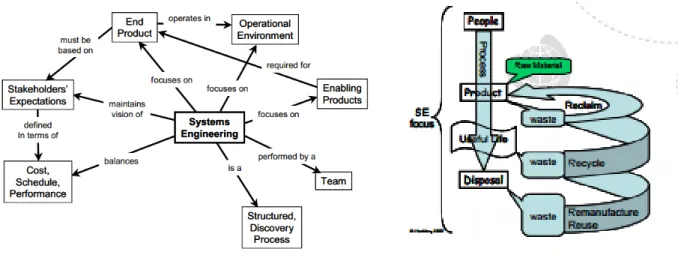
System dynamics is used to address the main research goal of analyzing project management as practiced at Faveo Prosjektledelse AS. System dynamics methodology was originally developed at MIT by a group dedicated to this pursuit founded by Jay Forrester (Meadows 2008). Systems thinking and systems engineering are used interchangeably in some contexts; however systems engineering is more the process of creating and analyzing systems, and systems thinking is the cognitive processes used in the creation of those systems. Systems engineering is an iterative, interdisciplinary process which views problems holistically. Essentially, using systems engineering involves identifying elements, subsystems, and the systems’ context, boundaries and properties, and then mapping how they are connected. Figure 1 shows an illustration of the ontology of systems engineering.
From this illustration, it is possible to see that systems engineering is used to analyze the world in a structured way, incorporating all the elements’ needs and expectations. Systems engineering embodies life cycle thinking as it takes a holistic view of the world. Figure 2 shows the model of a product system, and from this illustration, it is possible to see how systems engineering focuses on the entire life cycle: from the people who need the product to the disposal of the product while illustrating the feedback loops and interactions.
6
Figure 1: Concept Map of Systems Engineering (Bahill et al. 2002) Figure 2: Life Cycle of a Product (Haskins 2006)
Some basic terms used in system dynamics include: system element, interconnections,
function/purpose, system of interest and enabling system (Meadows 2008). A system element is one part of a system; this can be tangible or intangible. Interconnections in a system are the relationships between the elements. These relationships can be difficult to see, and the
function/purpose can be even more elusive. Function is the term usually used for a non-human system (mechanical), and purpose is used for a human system (organizational and social systems) (ibid). The system of interest is the system that is being studied, and the enabling system is a system that complements the system of interest somewhere in its life cycle but is not directly responsible for its function. Systems engineering is both systematic and systemic in that there are systematic processes that can design complex systems, but it is rooted in systemic thinking in order to recognize and solve complex problems by seeing the whole instead of only the parts (Haskins 2008).
According to ISO/IEC 15288:2002 (2002) on system life cycle processes, a system is “a combination of interacting elements organized to achieve one or more stated purposes.” This can be applied to an organization as well because the organization is exactly that: elements interacting purposefully. System dynamics is useful in analyzing companies because the corporation is a complex feedback system and using systems engineering can test social systems; yielding the same benefits it does for engineering. Organizations are systems, and by applying systems engineering methodology to Faveo Prosjektledelse AS, it is possible to gain an understanding of how the company operates and interacts with the environment and the community.
2.2 Methodology
The specialization project and this thesis both use a qualitative research design. The data collection for the development of the life cycle management tool in this thesis was completed in the specialization project in the fall of 2012, but this is supplemented by the methods in the master thesis in order to develop the life cycle management tool and to answer the thesis research questions. This analysis uses literature review, qualitative modeling and a semi-structured interview. However this thesis contains no new qualitative models; the models from the specialization project are the only ones used for further analysis. Section 2.2.1 explains how the literature review is undertaken. Section 2.2.2 describes the qualitative
7 modeling completed in the specialization project, and Appendix 1 provides all models.
Section 2.2.3 explains why and how the semi-structured interview is used in the research design.
2.2.1 Literature Review: Theoretical Resources
An academic literature review is used for several different purposes in this thesis. While the goal of this thesis is to develop life cycle management tools and methods for use in project management, life cycle management must be explored as a concept. This is not a traditional literature review; it is an exploration of the theoretical foundation for this thesis. The current state of research for life cycle management will help shape the concept for further analysis. What is meant by further analysis is how life cycle management is or could be used in project management. In this thesis, literature is reviewed for the theoretical evaluation of the use of life cycle management in project management. This theoretical evaluation helps in the
development of the life cycle management tool. Value creation is an important topic related to project management that is advantageous to explore in this thesis because of the added value life cycle management incorporation can contribute to the client’s projects, and an exploration of the literature will assist in understanding this.
The process of choosing the literature was tailored to fit each purpose stated in the previous paragraph. The exploration of life cycle management begins with an explanation of
sustainability, sustainable development and life cycle thinking. These are established concepts and many authors explain these in the literature. The literature chosen for the explanation of these concepts is from well-known sources in the field of sustainability (e.g. Elkington and UNEP), and they were chosen because of their contributions to the field itself. While there is a wealth of sources for these concepts, there are few for life cycle management as a concept. This is partly because it is called by other names (e.g. life cycle engineering) and because life cycle management is often not seen as different from environmental management. Therefore, the literature for life cycle management was chosen by “snowballing;” by finding applicable sources and then investigating the literature used in the first source. The theoretical evaluation of the use of life cycle management in project management also uses snowballing. There is very little research conducted on this topic, and there was very little choice as to which sources needed to be included in the evaluation. The value creation literature was chosen for two reasons: first, Faveo’s own researchers have published on the topic and the analyst was able to discuss the literature with the authors; second, the sustainable value creation literature is rather unique in that there are few sources on the topic, and the explanation by the author chosen (see Laszlo 2003) was the most applicable to the tool developed in Chapter 5.
2.2.2 Qualitative Modeling
The development of the life cycle management tool uses the results of the system dynamics analysis completed as part of the specialization project. The specialization project used qualitative modeling as a way to illustrate and analyze the Faveo system. The SPADE
framework developed by Haskins (2008) was used to develop and analyze this system model. SPADE stands for: Stakeholders, Problem Formulation, Analysis, Decision-Making and Evaluation. Within each of SPADE’s elements, it is possible to use various methods for analysis.
8 For the stakeholder part of the framework, a stakeholder analysis was applied to Faveo
Prosjektledelse AS. The specialization project uses the model for stakeholder analysis developed by Haigh & Griffiths (2007) which is adapted from Mitchell et al., (1997) and Driscoll and Starik (2004). Each stakeholder is evaluated based on the attributes of power, urgency, legitimacy and proximity; and in doing so, places the stakeholder into one of five categories: non-stakeholder, latent stakeholder, expectant stakeholder, definitive stakeholder and primary stakeholder. This model is used because it incorporates the natural environment into the stakeholder analysis, and the natural environment is an important focus for this project. Appendix 1.1 provides the stakeholder analysis from the specialization project. In formulating the problem, the specialization project uses concept mapping as explained by McCartor et al. (1999). Concept mapping is a way of making non-linear relationships explicit by placing every element (object or event) in a circle and then arranging these in a hierarchal manner with the most general being the outermost circles and the most specific being the innermost circles. The circles are connected with lines to illustrate the connection between the elements. By using concept mapping, the problems and challenges in the Faveo system
became apparent. Appendix 1.2 and 1.3 provide the level 1 and level 2 concept maps respectively.
To analyze the problem and to create a pathway for reaching Faveo’s goal of becoming a world class project management company, the specialization project used backcasting according to the framework described by Holmberg & Robert (2000). Backcasting is the opposite of forecasting in that it describes the end goal and explains the steps needed to achieve this. In using backcasting, the system conditions and principles must be clarified. Backcasting was used to analyze the Faveo system because it provided an explanation for how to solve the problem and tackle the challenges uncovered in the problem formulation concept mapping, and this yielded a pathway for reaching the end goal. Appendix 1.4 provides the backcasting from the specialization project.
For the decision-making part of the SPADE framework, the specialization project used systemigrams (developed by Boardman and Sauser (2008)). The systemigram illustrates systems in a way that other system diagrams cannot. Systemigrams use both prose and pictures to describe complex non-linear systems. Boardman and Sauser (2008) provide rules for creating the prose and graphics, and these were applied to the Faveo system. The
systemigram designed the system and addressed the problems and challenges identified earlier in the application of the SPADE framework; decisions were then made concerning them. Appendix 1.5 provides the systemigram from the specialization project.
Concerning evaluations, the specialization project used an evaluation matrix developed by Blanchard and Fabrycky (1998). This project used the evaluation matrix for the gap analysis of Faveo Prosjektledelse AS. This matrix lists criteria (created by the analyst) based on the earlier SPADE framework analyses and then measured whether Faveo was fulfilling these criteria. Some of the criteria were weighted by the analyst. Appendices 1.6-7 provide the evaluation matrices.
9 2.2.3 Semi-Structured Interview
For the initial testing of the tool presented in Chapter 5, the tool is applied to a completed project at Faveo. Because of time challenges, the tool is applied to a completed project. The goal of this application is not to scientifically test the tool (the goal of thesis is to develop the tool), but the test application is meant to give an initial indication of how the tool will work in an actual project. Because of the lack of time (and scientific testing being beyond the scope of this thesis), the project manager who applied the tool to a completed project is interviewed to understand the potential effects of using the tool and to understand how the tool will work in an actual project. The project manager is interviewed to understand their experience in using the tool to test the language and explanations in the tool and to understand their thoughts about how it will affect the environmental and social performance of their project. Appendix 4 provides the interview guide and gives the interviewee’s (the project manager) answers in full. The interview guide was developed based on the guidelines and information in Bryman’s (2012) Social Research Methods (4th edition). The interview guide has two parts: part 1 seeks to understand the potential effects of using the tool; part 2 questions the project manager on their experience in using the tool. The interview is semi-structured to allow for flexibility in the interview because of the interview’s exploratory nature.
2.3 Reliability and Validity
Concerning reliability, it is useful to use the term dependability when using qualitative research methods (Bryman 2012). The research in this thesis is carried out by one person, but it is in collaboration with those both at Faveo and NTNU. These collaborators then act as ‘auditors’, and this interaction increases the dependability of the methods. For example, the analyst created the interview guide but was ‘audited’ by the thesis advisers, Ole Jonny Klakegg and John Hermansen. The specialization project supervisors, Cecilia Haskins and Ole Jonny Klakegg audited the qualitative models
This thesis uses triangulated methods in pursuit of its research goal. The goal is to develop a sustainable project life cycle management tool and integrate it into the project management system of Faveo. This research uses qualitative modeling, literature review and a semi-structured interview to accomplish this. Triangulation increases the credibility (and hence internal validity) of the results; in that several different methods construct a social concept. In this thesis, it is the concept of life cycle management in project management.
External validity is a concern in this thesis because the development of the life cycle
management methods is based on the system dynamics analysis of Faveo Prosjektledelse AS. This company was chosen as a case company because of their motivation to improve their corporate social responsibility and environmental performance and their willingness to cooperate in this project. Because of the variety of project types and volume of projects (both number and worth) that Faveo is involved with, the methods developed based on their project management systems stand a good chance of being applicable in other project management consultancies. Testing is, however, crucial in understanding whether this is possible, and section 9.1 discusses the necessary future research. Section 8.4 discusses the external validity of the results of this thesis.
10
3.0 Theoretical Resources
Sustainable development is like teenage sex – everybody claims they are doing it but most people aren’t, and those that are, are doing it very badly.” — Professor Chris J Spray
Dundee University
This chapter explains life cycle management (LCM) and its theoretical foundation. It begins by introducing sustainability; this section explains important terms such as the triple bottom line (TBL), sustainable development and the green economy, as well as the business case for sustainability and how sustainability is approached systemically. This explanation leads to the discussion of how life cycle thinking is an important part of sustainability; and section 3.2 explains life cycle thinking, its advantages and drivers, and introduces supply chain management. Section 3.3 gives a thorough explanation of LCM, including methods for implementation, its role in green supply chain management and tools used in the application of LCM.
3.
1 Sustainability
Sustainability can be defined simply as balance. Balance between growth, resources, welfare and health of a system. Sustainability as a term can be applied to any kind of system, but the system referred to in this research is the earth. In order for the human race to continue inhabiting the planet, the economic activities need to switch focus to long term sustainability goals so as not to degrade the environment to the point that it makes it uninhabitable for life.
3.1.1 The Three Pillars of Sustainability: The triple bottom line
In the sustainability of the earth, there are three areas that must be in balance: the economy, society and the environment. These are called the three pillars of sustainability and are shown in Figure 3.
Figure 3: The Three Pillars of Sustainability
Figure 4: The Triple Bottom Line (TBL) and the shear zones: 1=eco-efficiency, 2= environmental justice, 3= business ethics
11 At the 2012 United Nation Conference on Sustainable Development (UNCSD), or Rio +20, the UN Major Group, Indigenous Peoples, wanted culture to be added as another pillar (IPMG 2012). They were not successful in their campaigning, but it illustrates that what has been defined as sustainability is not all encompassing and is subject to debate.
The triple bottom line refers to the interaction between the three pillars of sustainability. These interactions form economic, social and environmental accounting that must be in balance in a sustainable world. Elkington (1998) explains that these lines are constantly in flux. He describes them as tectonic plates, and when they interact with each other they form ‘shear zones.’ The shear zone between the economic and environmental agendas is eco-efficiency; between the environmental and social agendas is environmental justice (intra- and inter-generational equity); and between the social and economic agenda is business ethics. The shear zones (represented in Figure 4) express how the relationships must be managed in a sustainable world.
3.1.2 Sustainable development and the Green Economy
The difference between sustainability and sustainable development is growth. Economic growth in a manner that does not negatively affect the environment and the welfare of its inhabitants is called sustainable development. The most well-known definition of sustainable development is from the 1987 report from the World Commission on Environment and Development, “Our Common Future,” which states
: “s
ustainable development isdevelopment that meets the needs of the present without compromising the ability of future generations to meet their own needs.” (WCED 1987). This is a very vague definition of sustainable development because it does not explain “the how;” it only explains the pillars of sustainability need to be in balance if economic growth is to be sustained. This is where the green economy fits into the concept of sustainability.
There is no agreed upon definition of the green economy. Business and industry, the UN, NGOs and various governments have each developed their own definition of the green economy. The term is sometimes used synonymously with sustainable development, but the green economy is however a way of operationalizing sustainable development. The United Nations Environmental Program’s definition of the green economy is: a system of economic activities related to the production, distribution and consumption of goods and services that result in improved human well
‐
being over the long term, while not exposing futuregenerations to significant environmental risks and ecological scarcities (UNEP 2011). What makes the green economy different from sustainable development is its focus on concrete economic measures. Sustainability is the goal, sustainable development is how it is accomplished and the green economy includes the economic actions that drive the process.
3.1.3 The Business Case for Sustainability
If the inherit goal of business is to make profit, why is it in their own interest to contribute to sustainable development? Sustainable development cannot be accomplished without the contribution of business. Business, however, benefits from this contribution. This is a subject that is complex and organizations have formed to support it (e.g. World Business Council for Sustainable Development (WBCSD)). This thesis provides a brief overview of the business
12 case for sustainability. Below are three of the most common arguments for the business case for sustainability.
Competition
Competition is driving business to take sustainable development seriously (Holliday et al. 2002). It is becoming the norm for business to implement sustainability initiatives. As the competition for talent and new customers increases, business will be forced to become more sustainable.
Value Creation
Sustainability practices are developed and implemented by companies because of the potential contribution these practices could have for value creation (Chapter 7 explores this in detail.) For example, companies often begin new activities before they are known to be profitable (ibid); sustainability is in that unknown profitability category for most companies. It has also been argued by SustainAbility (a think tank for sustainable business) that sustainable
development practices are at worst neutral for shareholders and have been shown to add value (SustainAbility 2001). Shareholder value is driven by brand value and reputation, risk profile and customer attraction, and sustainability performance affects all of these.
Transparency
Increasing transparency is also driving business to take a more serious look at their social and environmental impact. Unwanted attention of the media and NGOs from highlighting the poor and social and environmental performance of companies pushes management to factor in the needs of their company’s stakeholders. Also, financial markets are more cognizant of
unsustainable business practices than ever before and will become even more aware in the future (Holliday et al. 2002).
3.1.4 A Systemic Approach to Sustainability
There are different approaches in attempting sustainable development. For example, anthropogenic and eco-centric approaches see the world from the point of view of humans and the earth respectively. To have a strong approach to sustainability, there needs to be an ethical foundation, and one approach that does this holistically is systems thinking. This was described earlier in section 2.1, and in this section systems thinking will be briefly discussed in terms of how it can be used to approach sustainability.
In using a systemic approach to sustainability, the focus is on the interaction of the elements relevant to sustainability (Espinosa Salazar and Walker 2011). Sustainability in this
perspective entails the interactions between social systems (human systems) and ecosystems. This is a whole system perspective called the socio-ecological system (Gallopin 2003), and the basic properties of this system are: (1) availability of resources, (2) adaptability and flexibility, (3) general homeostasis: stability, resilience and robustness, (4) capacity of response, (5) self-reliance and (6) empowerment (ibid).
Sustainability is not the same as constancy; in sustainable systems, there can be constant change. Sustainable system change can be seen as co-evolutionary because of the adaptability of the system to the change. Change in sustainable systems is not the same as sustainable
13 development because sustainable development implies one-directional, progressive change (Gallopin 2003).
Sustainable development does not always mean growth either; development implies increasing complexity. An important part of sustainable development is the redefinition of progress. The current socio-ecological system is unsustainable, but the question now is what is to be changed in the system to make it sustainable.
3.2 Life Cycle Thinking
Sustainable development is embedded in life cycle thinking. In traditional environmental management, the focus has been very often on production process, and cleaner production and pollution prevention are common methods for improving the environmental performance of this process (Pesonen 2008). By focusing on production, a very narrow scope of the
environmental impacts of a product is taken. If the environmental performance of production is improved, this improvement may be at the expense of another stage of the life cycle. This is called environmental problem shifting. To avoid this, it is important to use life cycle thinking which takes the focus away from production and puts it on the product. The relationship between systems thinking and life cycle thinking is explained in section 2.1.1. The focus of this section is to expand this explanation to include environmental management.
Life cycle thinking is a cradle to grave perspective (creation to disposal) of the product. The life of the product is broken down into stages, as shown below in Figure 5 where each arrow is a different stage in the life cycle. There is also a cradle to cradle perspective which adds an additional life cycle stage which accounts for any environmental impacts from materials taken from recycling after the end of life (EOL).
Figure 5: Life Cycle Stages
As mentioned, life cycle thinking avoids problem shifting because if production is made cleaner, the environmental impacts of other life cycle stages can be monitored for change. And while cleaning up production may help improve environmental performance, this improvement may mean very little when compared to impacts in other life cycle stages (UNEP 2004). An interesting example of this is the British government reporting that its carbon footprint had fallen by 19 % between 1990 and 2008 (Beament 2012). This is not actually true. The carbon emissions generated in the UK had decreased, but if the entire life cycle of the products consumed in the UK is considered, then emissions actually rose by 20 %. Production of goods in the UK has largely been outsourced to developing countries (as has happened in most first world countries), and the carbon emissions in production were no longer being accounted for.
resource
extraction Production Deployment Use
Disposal or End of Life
14 In corporate environmental management, life cycle thinking must be developed. To begin this process of development, management needs to consider the supply chain.
3.2.1 The Supply Chain
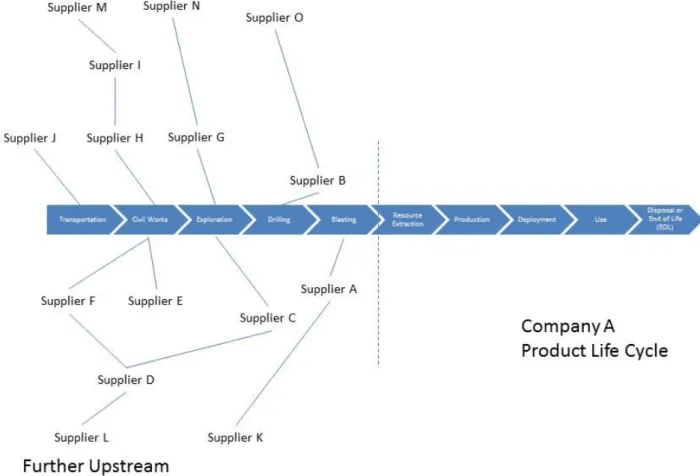
Even in life cycle thinking there are boundaries to what is incorporated into the life cycle. In Figure 6, the life cycle of a product is on the right side of the figure (same figure shown in Figure 5). On the left side, activities further up the supply chain are shown (further
“upstream”). In this figure, the activities for the minerals that need to be extracted for the production of company A’s product is shown. The different suppliers that are needed for these activities are shown, as well as the suppliers that supply the suppliers, i.e. the supply chain. There are, of course suppliers in the life cycle to the right of the dotted line that are accounted for, but this figure shows all the suppliers that are not accounted for even when taking a life cycle perspective and illustrates the complexity of supply chains. They essentially never end. When a company adopts life cycle thinking, it is important to not just think of the suppliers and relationships, but also the suppliers of the suppliers and so on. In this way, life cycle thinking can begin to take hold (UNEP 2007).
Figure 6: Life Cycle Thinking and the Supply Chain
Green supply chain management (GSCM) is an environmental management concept that takes environmental management and introduces it to the supply chain. This includes for example: design, choice of raw materials, packaging and the environmental performance of the
suppliers. GSCM begins by using life cycle thinking and understanding how a product or service indirectly impacts the environment and society through its suppliers. GSCM needs to
15 be strategically planned through life cycle management starting with green procurement and operations planning (Emmett and Sood 2010). Green procurement fosters collaboration with suppliers that builds sustainable supply networks. Once these networks are developed, GSCM continuously improves the supply chain’s impact on the environment and society by
identifying the environmental and social problems in the supply chain and working to minimize or eliminate these problems.
3.2.2 Advantages of a Life Cycle Approach
From a business perspective, there are many advantages in using life cycle thinking as an approach to environmental initiatives. These are termed ‘internal driving forces’ in adopting life cycle thinking and these are listed below (Remmen and Münster 2003).
The Responsibility of Management: An important responsibility of management is to
reduce the environmental impact of their business. Using life cycle thinking will allow for a more precise and thorough identification of the impacts.
Improved Product Quality: While the purpose of life cycle thinking is to understand
environmental (and social) impacts, using life cycle thinking may improve product quality in the process.
Reputation: If a company has a desire to improve its image, adopting life cycle thinking in its
environmental initiatives can be marketed in a way that helps the reputation management of the company.
Reduction in Costs: Improving the life cycle impacts has the potential to help both the
environment and the bottom line. Cutting waste is one example of this, as well as increasing efficiency.
Employees: Employees in a company are often interested and willing to be involved in
environmental initiatives, and life cycle thinking can improve this culture. Improved environmental performance will also help attract new talent to the company.
Technology Development: The potential for fostering technology development and
innovation is also possible when taking a closer look at the life cycle of a product. There are also ‘external driving forces’ for adopting life cycle thinking in approaching environmental initiatives which are forces connected to elements outside of the company (Remmen and Münster 2003). The following list gives examples of the main external driving forces.
Goodwill with the Authorities: Life cycle thinking will take the companies environmental
initiatives above and beyond what is required from government agencies which will foster goodwill with these entities.
Market Advantage: Cleaner products receive eco-labels, such as the EU Flower and the
Nordic Swan. A life cycle thinking approach offers more than what is required by most eco-labels, and this can give a company an advantage in the market.
16 Public Demand: The public is not only increasingly buying products that have a good
environmental performance, but they are questioning the companies that do not. By adopting life cycle thinking in environmental initiatives, this demand will be better satisfied.
Competitive Advantage: Life cycle thinking within a company will put its environmental
initiatives in the forefront of the industry. In operating in this way, it may even be possible for a company to create the benchmark for environmental management within the industry.
Network Demand: As knowledge of supply chain environmental impacts are better
understood, a life cycle approach may be required in their environmental initiatives to maintain buyer/seller relationships.
Network Collaboration: The network that a company operates in is a community that can
share information to foster environmental innovation which can work to everyone’s mutual advantage.
3.3 Life Cycle Management
It has been established in the previous section that life cycle thinking is important if sustainability goals are to be reached. This section will explain how the life cycle is
incorporated into environmental management, i.e. life cycle management (LCM). LCM will first be explained as a concept, and how it can be implemented. For this implementation, tools are needed; and the most common tools are explained in this section, including life cycle analysis (LCA), strategic life cycle management, (SLCM), environmental life cycle costing and stakeholder analysis. This section ends with examples of how LCM is applied in different industries.
3.3.1 What is Life Cycle Management?
Life cycle management seeks to manage environmental aspects over the entire life cycle of a product or service to make the environmental impact as small as possible so that sustainability goals can be achieved. This life cycle encompasses the entire value chain from the extraction of raw materials to the end of life management (McLaren and McLaren 2010). UNEP (2004) gives a concise definition of life cycle management: “life cycle management (LCM) is the application of life cycle thinking to modern business practice, with the aim to manage the total life cycle of an organization’s product and services toward more sustainable
consumption and production” (p. 10). LCM is a framework that includes many different tools, methods and procedures that incorporate the environmental, social and economic elements of the company’s products and services. LCM is a management framework that must be tailored to meet the particular industry and company it is applied to (UNEP 2004).
17
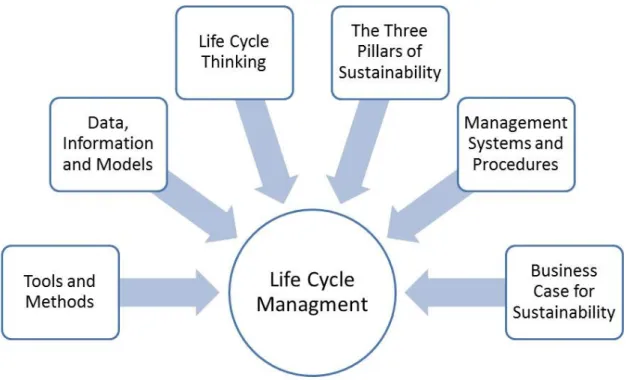
Figure 7: LCM connects and utilizes many different concepts and tools (adapted from UNEP 2007).
Figure 7 illustrates what is involved in life cycle management. Life cycle thinking,
sustainability and the business case for sustainability have already been explained. The tools and methods are explained in section 3.3.2. Examples of management systems and procedures include (UNEP 2007):
• Communication • Eco-labeling • Certification
• Sustainable Procurement
• Stakeholder Engagement/ Product
Panel
• (Product-Oriented) Environmental
Management Systems
• Design for Sustainability • Dematerialization
• Environmental Impact Assessment
This list is not exhaustive; the aim in listing this here is to show a sampling of the systems already in place in companies that can utilize elements of life cycle management.
This is also true for the data that companies have at their disposal. Companies have a lot of information and raw data that can inform life cycle management. What is important is to utilize this data when using life cycle thinking. Examples of data, information and modeling include (UNEP 2007):
• Databases
• Best Practice, e.g.
- Benchmarks, - Standards
- Weighting Schemes
• Models, e.g.
- Dose-Response - Fate and Exposure - Scenario
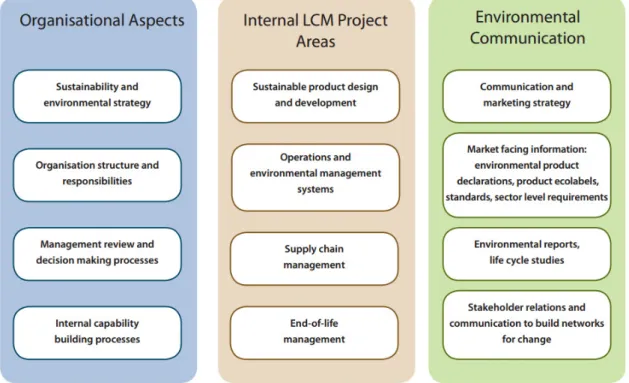
18 McLaren and McLaren (2010) discuss the elements of life cycle management. These elements are organized under three categories: organization aspects, internal LCM project areas and communication. This is illustrated in Figure 8.
Organizational Aspects: The entire organization of a company needs to be considered in life
cycle management. This includes the strategy, the structure and responsibilities, management review and decision making processes and internal capability building processes. There needs to be a clear vision for the environment and social responsibility. This vision needs to be turned into strategy, and the structures in place need to embody the responsibility and accountability to turn strategy into practice. There are technical and non-technical aspects of LCM that will be new to the employees, and this will require the company to raise its
competence level in order to practice LCM. Using some LCM tools, however, can be outsourced to consultants (e.g. LCA), and the information gained from these tools can be utilized in decision making in the company.
Figure 8: Elements of LCM (McLaren and McLaren 2010)
Internal LCM Projects: Internal LCM project areas break LCM down into targeted areas.
These include: sustainable product design and development, operations and environmental management systems, supply chain management and end of life management. If life cycle thinking is embedded in product design and development, innovation will be fostered which can only benefit the environment and society. Operations and environmental management systems include having control over the internal environmental aspects of a company,
possibly with environmental management certifications such as ISO 14001 and EMAS. Green supply chain management takes the boundaries of the life cycle further by understanding how suppliers and other companies in the supply network are practicing environmental
management and using life cycle thinking. End of life management can create opportunities for a company to strengthen customer relationships and possibly create first mover advantage.
19 Information gained in this part of the life cycle can inform other stages which will in turn improve the end of life environmental and social performance.
Communication: Communication is about transparency and brand management.
Transparency is important in environmental and social responsibility reporting, and it is important to have a stakeholder management system that includes how the stakeholders are engaged and communicated with. Communication and life cycle management work together for marketing purposes as well. This can take the form of eco-labeling and environmental product declarations, but it can also be used as strategy to engage green consumers. Implementing LCM
Implementing LCM in a company can seem like a daunting task because it requires employees to change the way they think. The Danish Environmental Protection Agency in 2003 explained a nine step process for beginning the implementation of LCM in a company. 1) Policy: The first step is to set goals and determine the ambition in terms of sustainability.
Once this is established, the policies of the company need to be changed to reflect this. The policies need to be concrete and realistic; this will avoid creating a gap in what the company says it does and what it actually does.
2) Organize: This step involves using the organizational aspects of LCM described above to
enable the policy of the company.
3) Survey: The data, information and models mentioned above are the basis for the survey the
company needs to execute in order to evaluate the present state of the environmental and social impact of the company. This step may require the involvement of experts for the evaluation.
4) Goals: Based on the survey, the company must decide where it must direct its efforts.
Decisions must be made between what is most important to fix now and what resources are available to fix them.
5) Environmental (and Social) Improvements: Once these decisions are made, the plans
then need to be enacted to make the improvements.
6) Reporting: Transparency is important. As plans are put into action, the results of these
plans need to be communicated and should be made public. The type of reporting is dependent on the ambition level of the company. Reporting can be quite simple or it could conform to the level of the Global Reporting Initiative (GRI).
7) Begin Again: The process should begin again with a review of the company policy and
ambition level. This will conform to the continuous improvement that is required in the environmental management system standard: ISO 14001.
8) Additional Investigations: Supplementary investigation of the environmental and social
impacts of a company’s products and services might be beneficial once a basic evaluation of the company has been undertaken to create a richer decision making environment.
20 Information can also be gained by cooperating with other companies in the company’s
network.
9) Revise Initiative Areas and Goals: A company, at this point, has gained experience in
applying LCM and can reevaluate what environmental and social initiative areas are most important for the company, and this may change the environmental and social sustainability goals the company has.
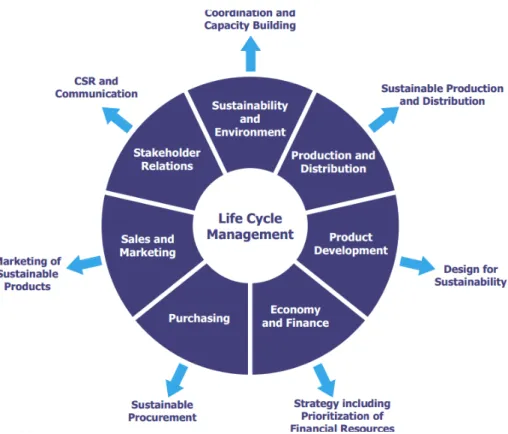
A company has many different departments and the employees have very different roles. It is important to remember that every function in a company can play some part in life cycle management. This is illustrated below in Figure 9.
Figure 9: Contributions from different functions of an organization (UNEP 2007)
3.3.2 Life Cycle Management Tools
There are many different tools and methods used in LCM. Examples of these include:
• Life Cycle Assessment (LCA) • Life Cycle Costing (LCC) • Cost Benefit Analysis (CBA) • Material and Substance Flow
Analysis (MFA/ SFA)
• Material Input Per Unit of Service
(MIPS)
• Investment strategy
• Cumulative Energy Requirements
Analysis (CEPA)
• Cleaner Production Assessment
(CPA)
• Risk Assessment (RA) • Stakeholder Analysis • Audits
• Input-Output Analysis (IOA)
This section will describe some of these tools and methods. Life cycle Analysis is explained because it is the most important tool for identifying environmental aspects in the life cycle of
21 a product or service. Strategic life cycle management (SLCM) (long term sustainability
strategy) and environmental life cycle costing are discussed because they represent the economic pillar of sustainability. Lastly, stakeholder analysis is discussed because it represents the social pillar of sustainability.
Life Cycle Analysis (LCA)
Life cycle analysis (LCA) is the tool most often thought of in LCM. Though LCA has its limitations (as do all the tools in LCM), LCA provides a thorough assessment of the
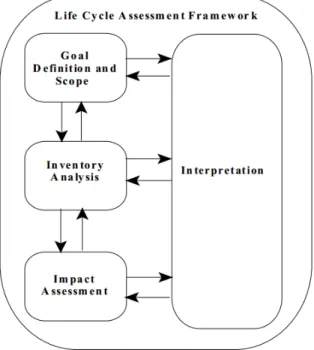
environmental impacts of the entire life cycle of a product, process or service. LCA has four components (Curran 2006), and each is described below and illustrated in Figure 10.
Goal, Definition and Scope: In this initial step in conducting an LCA, what is being
evaluated must be established and most importantly the system boundaries need to be set. The functional unit, context and the environmental effects must be defined in this step.
Inventory Analysis: Once the context and boundaries are established, energy, water, material
usage and environmental discharge need to be identified and quantified.
Impact Assessment: This component takes the inventory analysis and evaluates the potential
human and environmental impacts.
Interpretation: This is the evaluation of the impact assessment and inventory analysis to
make decisions. These decisions could include changing material types to improve the environmental impact or to select a preferred product, process or service that has a better environmental performance.
Figure 10: LCA Components (ISO 14041:1998)
LCA can help decision makers make more informed decisions (choosing between alternatives or improving design) and can avoid (or at the very least illustrate) problem shifting; however, LCA has a limited scope and can be resource and time consuming. Also, the data available for
22 the inventory analysis is not always correct or complete. Because of this, LCA must be used with other LCM tools (Curran 2006).
Environmental Life Cycle Costing
Environmental life cycle costing (LCC) builds upon traditional life cycle costing, i.e. the evaluation of costs in the life cycle of an asset. However in a traditional LCC, the
environment is considered an externality and the evaluation is concerned with purely economic costs. The life cycle of the asset in traditional LCC is split into four life cycle stages: investment, operation, maintenance and disposal (or EOL-end of life). In
environmental LCC, environmental costs are included in the evaluation over this life cycle (as well as social and economic). Environmental LCC uses environmental management tools, such as LCA, in order to ascertain the environmental impact of the asset in question.
However, the environmental impacts uncovered in LCA must be quantified in monetary terms to be included in the environmental LCC. Therefore, environmental LCC cannot be used on its own, but must be used in conjunction with other environmental management tools (Hunkeler et al. 2008).
Stakeholder Analysis
Stakeholder analysis is based on stakeholder theory developed by Edward Freeman in his 1984 book: Strategic Management: A Stakeholder Approach. There are many different ways to do a stakeholder analysis, but identifying the stakeholders is the first step. A stakeholder is any person, group of people or entity that can claim a relationship with a company (or the product or service). These can include: customers, competitors, shareholders, the
environment, NGOs, the media, local and national government and etc. By identifying who or what has a stake in the operations of a company, this company can greatly expand its
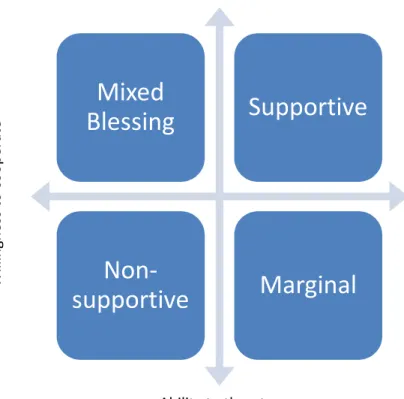
contributions to corporate social responsibility. Once the stakeholders are identified, then they must be categorized. Categorization can be done in several different ways; however, the stakeholder matrix is a very common method. Below is an example of the stakeholder matrix developed by Polonsky (1996) (Figure 11). Once the stakeholders are categorized, a
communication and engagement strategy must be developed for each stakeholder type. Categorizing stakeholder shows more clearly how the stakeholders should be managed. Mixed blessing, supportive, non-supportive and marginal stakeholders have different ways in which they should be managed and this is explained in Polonsky (1996).
Strategic Life Cycle Management (SLCM)
Strategic life cycle management (SLCM) is using LCM to identify investment pathways that enable sustainable development (Ny et al. 2006). This is a sustainability assessment of the life cycle of a product or service that uses backcasting (determining the end goal and forming a pathway to reach that goal) based on sustainability principles. If the goal of the company is to have a sustainable product, this would be the goal in the backcasting of the product. The company then needs to get an overview of what it would take for the product to be
sustainable. This would require a detailed analysis, as is done in traditional LCA but with a broader scope making it more relevant in sustainable development. In this way,
environmental, economic and social sustainability issues are covered in the SLCM. SLCM is the combination of the LCM and strategic management.
23
Figure 11: Stakeholder Matrix
3.3.3 Different Industries, Different Applications
Different industries have different environmental and social impacts in the life cycles of their products and services. Project management consultancies often offer services in more than one industry. Below, Figure 12 shows all the different project types at Faveo. This section will give a brief introduction of how LCM is applied in the construction and manufacturing industries.
Figure 12: Faveo's Project Types
In the construction industry, there are several different environmental frameworks based on life cycle thinking which are established. The most well-known are BREEAM (UK) and LEED (USA) (Oritz et al. 2009). Environmental impacts in the building sector have been well researched, and these frameworks have been developed to improve environmental
performance in construction. Although BREEAM and LEED are based on life cycle thinking, LCA is used to a very limited extent in the building sector due to its complexity and
uncertainty; however using LCA in this sector is important because of the support it lends to
Mixed
Blessing
Supportive
Non-supportive
Marginal
W il li n g n e ss t o c o o p e ra te Ability to threaten24 decision-making. The current use of LCA and LCC in the building sector is mostly used to make decisions on choice of materials (LCA) and deciding on alternate installations in buildings (LCC) (Malmqvist et al. 2010).
In the manufacturing industry, LCM is broken down into four different approaches: Design for Life Cycle, Life Cycle Evaluation, Life Time Management and Product Cycle
Management (Westkämper et al. 2000). Design for the life cycle involves the design for the environment (DfE) framework. Life cycle evaluation applies LCA and LCC to manufacturing. Life time management includes the technical support in manufacturing processes. Product life cycle management involves recycling and waste management. These different areas of life cycle management encompass different spheres of work in the manufacturing industry, and the different tools and frameworks for applying LCM are turned into life cycle programs or intelligent manufacturing systems (IMS).
In a project management company, such as Faveo, the real challenge lies in introducing a life cycle management methodology that is applicable to all the industries in which the company has projects. Each industry has different environmental and social impacts, so the methods need to be general enough to cover all the industries yet specific enough to address all environmental and social aspects in the life cycle of all projects. The following chapter will evaluate the theoretical application of LCM in project management.