Clemson University
Clemson University
TigerPrints
TigerPrints
All Dissertations
Dissertations
August 2018
Stochastic Optimization Models for Perishable Products
Stochastic Optimization Models for Perishable Products
Zahra Azadi
Clemson University, [email protected]
Follow this and additional works at: https://tigerprints.clemson.edu/all_dissertations
Recommended Citation
Recommended Citation
Azadi, Zahra, "Stochastic Optimization Models for Perishable Products" (2018). All Dissertations. 2551.
https://tigerprints.clemson.edu/all_dissertations/2551
This Dissertation is brought to you for free and open access by the Dissertations at TigerPrints. It has been accepted for inclusion in All Dissertations by an authorized administrator of TigerPrints. For more information, please contact [email protected].
Stochastic Optimization Models for Perishable Products
A Dissertation Presented to the Graduate School of
Clemson University
In Partial Fulfillment of the Requirements for the Degree
Doctor of Philosophy Industrial Engineering by Zahra Azadi August 2018 Accepted by:
Dr. Sandra Eksioglu, Committee Chair Dr. Burak Eksioglu
Dr. David Neyens Dr. Kevin Taaffe Dr. Khoa Truong
Abstract
For many years, researchers have focused on developing optimization models to design and manage supply chains. These models have helped companies in different industries to minimize costs, maximize performance while balancing their social and environmental impacts. There is an increasing interest in developing models which optimize supply chain decisions of perishable products. This is mainly because many of the products we use today are perishable, managing their inventory is challenging due to their short shelf life, and out-dated products become waste. Therefore, these supply chain decisions impact profitability and sustainability of companies and the quality of the environment. Perishable products wastage is inevitable when demand is not known beforehand. A number of models in the literature use simulation and probabilistic models to capture supply chain uncertainties. However, when demand distribution cannot be described using standard distributions, probabilistic models are not effective. In this case, using stochastic optimization methods is preferred over obtaining approximate inventory management policies through simulation.
This dissertation proposes models to help businesses and non-profit organizations make inventory replenishment, pricing and transportation decisions that improve the performance of their system. These models focus on perishable products which either deteriorate over time or have a fixed shelf life. The demand and/or supply for these products and/or, the remaining shelf life are stochastic. Stochastic optimization models, including a two-stage stochastic mixed integer linear program, a two-stage stochastic mixed integer non linear program, and a chance constraint program are proposed to capture uncertainties. The objective is to minimize the total replenishment costs which impact profits and service rate. These models are motivated by applications in the vaccine distribution supply chain, and other supply chains used to distribute perishable products.
This dissertation also focuses on developing solution algorithms to solve the proposed op-timization models. The computational complexity of these models motivated the development of
extensions to standard models used to solve stochastic optimization problems. These algorithms use sample average approximation (SAA) to represent uncertainty. The algorithms proposed are extensions of the stochastic Benders decomposition algorithm, the L-shaped method (LS). These ex-tensions use Gomory mixed integer cuts, mixed-integer rounding cuts, and piecewise linear relaxation of bilinear terms. These extensions lead to the development of linear approximations of the models developed. Computational results reveal that the solution approach presented here outperforms the standard LS method.
Finally, this dissertation develops case studies using real-life data from the Demographic Health Surveys in Niger and Bangladesh to build predictive models to meet requirements for various childhood immunization vaccines. The results of this study provide support tools for policymakers to design vaccine distribution networks.
Dedication
This dissertation is dedicated to the memory of my grandfather Ibrahim Mansouri, who loved to see this day. I also dedicate this to my parents, Morteza Azadi and Kobra Mansouri, and my siblings, Mona and Amir.
Acknowledgments
I would like to express my sincere appreciation to my advisor, Dr. Sandra D. Eksioglu, for her continuous support, guidance and patience throughout my studies. Under her supervision, I learned how to define a research problem, find a solution, and publish the results. On a personal level, she inspired me by her hardworking and passionate attitude. I am indebted to her for being such a great friend and a role model.
I would like to extend my gratitude to Drs. Burak Eksioglu, David Neyens, Kevin Taaffe, and Khoa Truong for being a part of my committee and providing invaluable comments for my dissertation. My sincere thanks go to Dr. Harsha Gangammanavar for his time and ideas on my research. I appreciate his working closely and sharing with me his experience in the stochastic opti-mization field. I am grateful to department head Dr. Cole Smith for providing me the opportunity to teach a class.
I am very thankful to my best friend Aida, for always being there and making me feel happy. I also would like to verbalize my appreciation to all of my sincere friends at the IE Department and in Clemson.
There are no words that can express my thanks to my parents, Morteza Azadi and Kobra Mansouri, for their continuous love, motivation, and encouragement. I would have never made this journey without their support and sacrifice. A heartfelt appreciation is for my sister, Mona, and her husband, Hamed during their four years stay with me at Tehran, they did give an enormous moral support for my undergraduate studies. Thanks to my brother, Amir, for his unconditional love and patience.
Last, but most importantly, I would like to express my deepest gratitude to my husband, Ershad for his endless support, continued patience, and warm love. He has always been around at times I thought that it is impossible to continue.
Table of Contents
Title Page . . . i
Abstract . . . ii
Dedication . . . iv
Acknowledgments . . . v
List of Tables . . . viii
List of Figures . . . ix
1 Introduction . . . 1
2 Developing Childhood Vaccine Administration and Inventory Replenishment Policies that Minimize Open Vial Wastage . . . 6
2.1 Introduction . . . 6
2.2 Problem Formulation . . . 12
2.3 Solution Approach: An extended L-shaped method . . . 17
2.4 Computational Experiments: A case study for Bangladesh . . . 25
2.5 Conclusion and Future Research . . . 39
3 A Two-Stage Stochastic Model for Joint Pricing Inventory Replenishment with Deteriorating Products . . . 43
3.1 Introduction . . . 43
3.2 Literature Review . . . 45
3.3 Our Contributions . . . 48
3.4 Problem Statement and Formulation . . . 49
3.5 Solution Approach . . . 53
3.6 Numerical Study . . . 59
3.7 Summary of Results . . . 68
4 Forecasting Childhood Routine Immunization Vaccine Demand: A Case Study in Niger . . . 77
4.1 Introduction . . . 77
4.2 Methods . . . 79
4.3 Results . . . 82
4.4 Discussion . . . 84
5 Stochastic Optimization Models For Childhood Vaccine Distribution Network Design: A Case Study In Niger . . . 86
5.2 Problem Statement . . . 89
5.3 Approximating The Chance Constraints . . . 94
5.4 Numerical Experiments . . . 95
5.5 Conclusion and Future Research . . . 100
6 Conclusions and Future Research . . . 103
6.1 Research Summary . . . 103
6.2 Future Research . . . 106
Appendices . . . 107
A Two-stage stochastic programming model . . . 108
B Performance evaluation of stochastic solutions . . . 110
C McCormick relaxations . . . 112
List of Tables
2.1 Cost and weight of different vaccine vial sizes of Pentavalent. . . 26
2.2 Data used to predict the daily demand distribution of Pentavalent through different regions in Bangladesh. . . 27
2.3 Paired t-test between different number of scenarios. . . 28
2.4 Comparison of solution quality. . . 29
2.5 Two-sample paired t-test for differences between the base and heuristic policies in Chittagong. . . 39
3.1 Input data . . . 60
3.2 Comparison of solution quality. . . 62
3.3 Paired t-test and relative Euclidean distance for different number of scenarios. . . 64
4.1 Parameter estimate (standard error, and R-square) for all individual simple linear regression models predicting the vaccine demand based on the monthly population size in different regions. . . 83
4.2 Parameter estimate (standard error, and R-squared) for the national level linear re-gression models predicting the vaccine demand based on the regional population size, percentage of people under poverty line, adult literacy rate in 2008. . . 84
5.1 Decision variables and parameters. . . 91
5.2 Vaccine characteristics. . . 97
5.3 Relative distance between objective function values for different number of scenarios. 98 1 Decision variables and parameters. . . 108
List of Figures
2.1 Inventory dynamics in vaccine administration and inventory replenishment model. . 13
2.2 Dose utilization forn=2 withτ=7. . . 15
2.4 Schematic representation of extended L-shaped algorithm. . . 23
2.5 Base policy: analysis of solution algorithm. . . 29
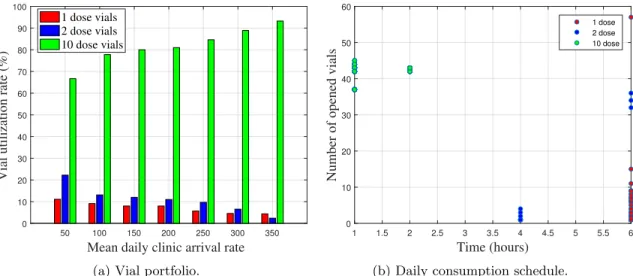
2.6 Base policy: analyzing the impact of mean daily patient arrival rate on vial portfolio and daily consumption schedule on number of opened vials. . . 30
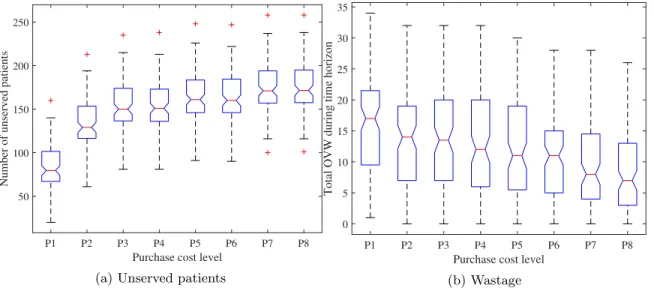
2.7 Effect of varying purchase cost on dose utilization. . . 31
2.8 Impact of session duration on OVW and number of unserved patients in Chittagong 32 2.9 Dose utilization and patients waiting forn=2 withL=2. . . 36
2.10 Comparison of heuristic policies. . . 41
2.11 SDS and WO analysis results. . . 42
3.1 Evaluating solution quality of Algorithm 2 when`=2, T =1. . . 62
3.2 Comparing the quality of solutions from Algorithm 2 to the model by [40] for`=3, T =2. 63 3.3 Evaluating the impact of markdown on retailer’s profits. . . 65
3.4 Impact of deterioration rate. . . 66
3.5 Sensitivity of the optimal solution to the penalty of shortage. . . 70
3.6 Evaluating the sensitivity of solution to markdown period. . . 71
3.7 A summary of demand patterns tested. . . 72
3.8 Evaluating the impact of demand patterns. . . 73
3.9 Sensitivity of the optimal solution to the unit inventory holding cost. . . 74
3.10 Sensitivity of the optimal solution to the ratioβn/βo. . . 75
3.11 Impact of markdown period when the supplier is unreliable. . . 75
4.1 Total administered Measles vaccine through 2007-2011 in three different regions of Niger . . . 82
5.1 Vaccine supply chain network with 3 tiers: 1 central store, 2 district stores, and 1 clinic having only refrigerators and for 2 time periods and 1 vaccine type. . . 92
5.2 Regional FIC for the current supply chain for low and high standard deviations of demand for vaccine. . . 100
5.3 Countrywide FIC for the four- and three-tier vaccine supply chains. . . 101
5.4 Countrywide FIC for ten-dose Measles vials and single-dose Measles vials. . . 102
5.5 SR for all vaccine types when either ten-dose Measles vials are used or single-dose vials.102 1 The value of stochastic solution. . . 111
Chapter 1
Introduction
Inefficient inventory management of perishable products negatively impacts companies eco-nomic prosperity. A new study reveals that about $5 billion worth of drugs are thrown away in unopened packs due to expiration date [77]. Economic Research Service (ERS) of United States Department of Agriculture (USDA) estimates that, in 2010, 45 billion pounds of available food at retail stores in the United States was wasted [25]. This amount of wastage sums to $41.9 million [138]. The Secretary of Agriculture and the Deputy Administrator of Environmental Protection Agency announced that the food waste in United States, should decrease by 2030 [4]. Poor inven-tory management of perishable products contributes to this waste. Waste negatively impacts the environmental and is one of the sources of social problems like hunger. In the United States, food waste accounts for 10% of the energy supplied, 80% of water consumed, and 50% of farm land used [56]. Disposed pharmaceutical wastage often reaches the sewage system. This practice is dangerous since pharmaceutical products contain active chemicals which impact the environment, animal and human health. The Associated Press reported that, in 2008, drinking water used by 41 million people in United States was contaminated by pharmaceutical residues [44]. Perishable product wastage is also critical in developing countries. For example, vaccine wastage negatively impacts immunization coverage by decreasing availability. Wastage occurs when a vaccine vial is physically damaged or exposed to extreme temperatures, or when doses from an open vial are discarded after their safe use time expires. The latter is referred to as open vial wastage (OVW). Clinics can use single-dose vials to reduce OVW; however, such an approach is more expensive than using multi-dose vials.
These models have helped companies in different industries to minimize costs, maximize performance while balancing their social and environmental impacts. There is an increasing interest in developing models to support supply chain-related decisions for perishable products. Perishables are products which either become obsolete within a fixed period of time, or loose value with time. The first group of products is referred to in the literature as “perishable products with fixed shelf life”, and the second group is referred to as “deteriorating products”. Some examples of perishable products with fixed shelf life include dairy, pharmaceuticals, and blood. Electronics, foods, and groceries are examples of deteriorating products. Perishable products are an essential part of our life, and their out-dating is a great threat to the profitability and sustainability of companies, and quality of the environment. The statistics about the large amounts of waste generated indicate that companies are not doing a great job in managing perishable inventories. Based on our review of literature, there is a limited number of models which companies can use to manage the inventory of perishable products. However, these models do not consider integrating inventory replenishment and markdown decisions, as well as, trade-offs between the cost of storage and transportation of perishable products when demand and/or supply is stochastic. In order to fill this gap in the literature, we propose models and solution algorithms which capture the specific characteristics of perishable inventories. The challenges associated with decision making about inventory management of perishable products, both for businesses and non-profit organizations, can be categorized as follows:
• Transportation and storage of perishable products. There are trade-offs between the cost of storage and transportation of perishable products and the remaining product shelf life. These decisions impact costs since excess supply leads to spoilage, but shortage results in lost sales. Questions such as, which supplier(s) to select, how much to order, and how frequently to replenish the inventory need to be addressed in order to optimize the system performance.
• Price markdowns. The importance of price determination for perishable products is highlighted in many studies such as [32] and [40]. The goal is to price products in such a way that the profits of an organization are maximized. This is not an easy task since price impacts demand. Markdown policies are used to stimulate demand for perishable products by decreasing their selling price. This leads to decrease in waste and increase in cost savings. Unit selling price of a product, and the timing of markdown decisions are important and need to be addressed.
beforehand. Therefore, deterministic inventory models which do not take uncertainty into account do not find robust solutions. Although there are studies that consider demand uncer-tainties, for example [36], most of these studies obtain optimal policies through approximation methods or simulation. When demand uncertainties cannot be represented using standard distributions, probabilistic models are not effective. Developing stochastic models and exact solution approaches is a challenging task which needs to be addressed.
• Uncertainties in supply. Replenishment decisions for perishable products are further com-plicated by uncertainties in the amount and quality of shipments received from suppliers. Dual-sourcing is a policy often used by retailers to mitigate the risks of supply uncertainties [84]. In this setting, usually, one of the suppliers is reliable but expensive. The other supplier is less reliable and less expensive. Supplier reliability is impacted by his limiting and varying capacity. In this regard, considering the trade-offs between supply chain costs and reliability is important and needs to be addressed.
In this dissertation, we use operations research (OR) tools to develop stochastic optimization models and solution algorithms in order to address the above mentioned challenges. These models can enable companies and organizations which manage perishable products to identify policies which allow them to fulfill customer demand at a minimum cost. The proposed models capture the impact of demand uncertainty on decision making. We propose stochastic optimization models, including a two-stage stochastic mixed integer linear program, a two-stage stochastic mixed integer non linear program, and a chance constraint program to capture uncertainties. To solve the two-stage stochastic programs and analyze the results, we develop different solution frameworks based on well-known algorithms such as stochastic Benders decomposition. We use the SAA method to solve the chance constrained program.
In Chapter 2, we study the vaccine vial replenishment problem. Vaccines are perishable products which have a fixed shelf-life. In the last century, many infectious diseases have been completely eradicated or significantly reduced because of childhood vaccinations. Ample evidence suggests that low vaccination coverage in developing countries is caused by vaccine stock out and high vaccine wastage. Wastage occurs when a vaccine vial is physically damaged or exposed to extreme temperatures, or as OVW. Clinics can use single-dose vials to reduce OVW; however, such an approach is more expensive than using multi-dose vials. The focus of this chapter is to develop
new policies that support vaccine administration and inventory replenishment. These policies are expected to reduce OVW, reduce the cost of vaccinations and improve vaccination coverage levels in developing countries. We propose a two-stage stochastic programming model that identifies an optimal mix of different-sized vaccine vials, and the corresponding decisions that clinics make about opening vials in the face of uncertain patient arrivals. This work develops a case study with data gathered from Bangladesh. Experimental results indicate that using a mix of vials of different sizes reduces OVW, compared to the current practice of using single-sized multi-dose vials. Experimental results also point to simple and economic vaccine administration policies that health care administrators can use to minimize OVW. The model is solved using an extension of the stochastic Benders decomposition algorithm, the LS method. This algorithm uses GMI and MIR cuts to address the problem’s non-convexity. Computational results reveal that the solution approach presented here outperforms the standard LS method.
In Chapter 3, we analyze the joint pricing and inventory management for deteriorating prod-ucts. This research is motivated by the opportunities we see to reduce waste and increase profitability of perishables in retailing using pricing. We propose a two-stage stochastic optimization model that selects suppliers; identifies a replenishment schedule for a periodic-review inventory system with non-stationary demand and supply; and identifies the timing and size of a price markdown in order to maximize retailer’s profits. In this model, the first-stage problem is bilinear since it captures the additive relationship between price and demand. Thus, we develop a solution approach which extends Benders decomposition algorithm via a piecewise linear approximation method to solve the first-stage problem. We develop a case study to validate the model. Numerical experiments point to the benefits of integrating inventory management and pricing decision in the supply chain.
Effective distribution of vaccines from manufacturers to clinics is challenging. One of the main challenges is the stochastic nature of demand for vaccines. In many developing countries the demand for vaccine is growing exponentially because of an increasing birth rate. This demand is met via supplies from international organizations that coordinate shipments from multiple different resources. This complicates vaccine distribution planning. An efficient distribution plan requires an accurate demand forecast. In Chapter 4 we build predictive models to meet requirements for various childhood immunization vaccines (CIV). Data from the Demographic Health Surveys in Niger and Niger Census are used in regression models to predict monthly demand for CIV per region. The population size, the percentage of population under poverty line, the adult literacy rate, and the
number of clinics were selected as independent variables. The results suggest that, vaccine type, as well as, the social and economic characteristics of a region impact the demand for vaccination, and should be considered in vaccine distribution planning. The results of this study provide support tools for policymakers to design vaccine distribution networks.
In Chapter 5, we propose a chance constraint programming model which identifies optimal vaccine supply chain designs and management strategies. This is a data-driven model built upon the regression models in Chapter 4. The proposed model considers the limited shelf life of vaccines, facility and transportation storage capacities, as well as variations in patient arrivals at health clinics. The SAA method is used to approximate the chance constraints. We use the model to analyze different supply chain network designs and vaccine administration policies for vaccine vial distribution in Niger. The existing distribution network has multiple layers. Decision makers in each layer identify inventory levels and timing of replenishment. Removing a level in the hierarchy of the network impacts on the system-wide costs and reduces the chance of vial breakage due to fewer times vaccines are touched. Moreover, when a single-dose vaccine is replaced with a multi-dose vaccine, the OVW rate increases. In this regard, we evaluate the impact of converting the current Niger’s four-tier vaccine supply chain to a three-tier one by removing the regional stores, and changing Measles’s vial size from multi-dose to single-dose on vaccine availability at clinics and immunization coverage.
Chapter 2
Developing Childhood Vaccine
Administration and Inventory
Replenishment Policies that
Minimize Open Vial Wastage
2.1
Introduction
The spread of infectious diseases has significantly receded over the last century, and these widespread immunities can largely be attributed to childhood vaccinations [117]. Childhood vac-cinations have helped eradicate diseases, like smallpox, and have severely restricted diseases, such as polio, measles, and tetanus. Immunization programs, led by World Health Organization (WHO) and United Nations Children’s Emergency Fund (UNICEF), have been instrumental in delivering global eradication efforts. However, achieving immunization targets in developing countries has been particularly challenging. As recently as 2014, 60% of the 18.7 million children worldwide who did not receive the diphtheria-tetanus-pertussis (DTP) lived in ten developing countries [3]. Vaccine stockout is one of the primary reasons for the low vaccination coverage in these places. In 2014, 26% of WHO-member countries experienced a national level vaccine shortage for at least one month
[127]. Stockout occurs, in part, because of vaccine wastage. WHO estimated that, more than half of the total vaccination supply distributed around the world is wasted [1]. Wastage occurs when a vaccine vial is physically damaged or exposed to extreme temperatures, or when doses from an open vial are discarded after their safe use time expires. The latter is referred to as OVW. The Global Alliance for Vaccines and Immunizations (GAVI) requests that countries take measures to bring down their vaccine wastage rates [1], and lowering OVW rates can be one effective approach. In many developing countries, immunizations are administered in health care centers or at outreach sessions. For example, in Bangladesh, 94% of immunizations are accomplished at outreach sessions [55]. These sessions are organized through programs, such as Expanded Programme on Immunization (EPI), and delivered by trained nurses. Health care centers are often located in remote areas that lack proper transportation and basic amenities, including refrigeration.Childhood vaccines, including bacille Calmette-Gu´erin (BCG), measles, DTP, and tentanus (TT), are typically produced in multi-dose vials. Outreach sessions conducted by EPI follow a strict open vial policy, which requires that, opened vials of multi-dose vaccines be discarded at the end of the day or six hours, whichever comes first [145]. Discarded doses contribute to OVW. While single-dose vials have zero OVW, they are more expensive than multi-dose vials because of additional costs for packaging, holding, and transportation. A 2010 study in Bangladesh estimated OVW for BCG at 85%, measles at 71%, DTP at 44.2%, and TT at 36% [55].
Organizations managing immunization programs in developing countries do make vaccine replenishment decisions for a single vial size [43, 55]. Vaccines are then distributed to clinics based on a fixed replenishment schedule [52]. Intuition tells us that, allowing clinics to use a mix of vials of different sizes should result in OVW reductions. Better inventory management should result when clinics decide their own replenishment schedules based on observed patient arrivals, and when clinics have easy-to-implement vaccine administration policies.
In this study, “inventory replenishment policy” refers to the mix of multi-dose vaccine vials, e.g., single-, two-, and ten-dose vials, that a clinic should order to reduce OVW during outreach sessions and maintain low vaccination costs. “Vaccine administration policy” refers to the conditions under which a nurse should open a new vial of a particular size during an outreach session. Such a policy accounts for session duration, the number of patients present, and/or the time of day when a multi-dose vial of a particular size should be opened. In the absence of such policies, deciding whether to open or not to open a multi-dose vial vaccine is challenging due to an uncertain number
of patient arrivals. This study develops a two-stage stochastic programming model to identify the optimal mix of multi-dose vaccine vials to order, the timing of orders and the corresponding vial opening decisions in the face of uncertain patient arrivals. The goal is to minimize OVW and achieve lower vaccination costs in developing countries. The models proposed here are tested via an extensive numerical analysis using data from Bangladesh. Numerical results inspired the development of a number of vaccine administration policies which, as demonstrated in this study, can reduce OVW.
2.1.1
Literature Review
In developing countries, EPI vaccines are purchased by governmental and non-profit agencies to satisfy annual vaccine requirements. In these countries, EPI delivers vaccines to a central store from which they are shipped to regional stores, then to district stores, and, finally, to local clinics. The number of downstream tiers, or supply chain stages, which handle vaccines varies by country. Some studies in the literature focus on national-level decisions made about how many vaccines should be purchased to ensure high vaccine coverage levels [34]. Other studies focus on the structure of the corresponding supply chain to minimize immunization costs [14, 13, 24]. A few studies focus on the decisions made about clinic-level vaccine administration that can minimize OVW [97, 96, 43]. Similarly, this work examines clinic-level inventory replenishment decisions and vaccine administration policies with the goal of minimizing OVW and inventory replenishment costs.
The literature on vaccine supply chain management has increased in recent years. Research focused on OVW management started as vaccine vial wastage increased in outreach immunization sessions held under programs such as EPI in developing countries. The work conducted by [45] was the first that discussed the general differences between single- and ten-dose vaccine vials in terms of cost, distribution, coverage, and safety. A survey of vaccine wastage in Bangladesh, provided in [55], detailed the usage and wastage rates of different-sized vaccine types in randomly selected outreach and non-outreach sessions. The aims of both studies were to estimate vaccine wastage, but neither considered the associated supply chain costs. However, these costs were considered in the analysis conducted by [115]. The scope of these studies was restricted to analyzing existing vaccine administration practices, and, hence, they do not prescribe any plan for efficient inventory management. However, they recognize that “there is an urgent need for more rigorous and systematic wastage monitoring” [115].
different-sized multi-dose vials on OVW. [78] proposes a simulation model for Thailand’s Trang Province that evaluates the cost of replacing ten-dose with single-dose vial vaccines. The results of this study show that, given a fixed patient arrival rate, the cost associated with medical waste disposal is greater than the cost savings resulting from OVW reduction. This finding, followed their earlier simulation work that models patient arrivals using a Poisson distribution [80]. The authors conclude that the suitable number of doses per vial may vary by region and patient arrival rate. However, the Pois-son arrival assumption may not necessarily capture the arrival process in outreach immunization sessions due to the particular challenges of organizing these sessions in particular communities. A similar simulation study was carried out by [147] to analyze the impact of different patient arrival rates on OVW for five- and ten-dose vaccine vials. In this case, the authors use real-life data to estimate parameters for simulation. These studies examine the current practice of using a single multi-dose vial, and they recommend using a particular vial size based on patients arrival rates. These recommendations are based on simulated cost estimates, but once again, these works do not prescribe any vaccine inventory management schemes.
In order to prescribe a vaccine management plan, optimization models are necessary. Such approaches are limited and include deterministic mixed-integer programs (MIP) and finite state probabilistic models. In [43], the total vaccination cost is minimized via optimal ordering decisions which are identified by solving a deterministic MIP integrated within a Monte Carlo simulation setup. The authors used the simulation model to generate patient arrivals and compute OVW under a fixed vaccine administration policy and for a given multi-dose vaccine vial. The estimated OVW is then used in the optimization model to determine the optimal ordering decisions. [97] proposed a Markov Decision Process (MDP) model to identify a vial-opening policy which minimizes expected OVW cost and maximizes vaccine coverage over a finite horizon. The authors used a backward induction algorithm to solve their probabilistic model. This work is further extended in [96] as the MDP model is integrated with simulation to analyze how session duration impacts the optimal policy obtained in their previous work. In both studies, the authors determine the clinic closing time or the time when patients should be rejected. However, they do not consider loss in opportunity due to unserved patients. Moreover, they assume that an infinite amount of vaccines can be replenished, which is not always the case at outreach sessions. These studies address the inventory management of a single multi-dose vaccine vial, and patient arrival is characterized either probabilistically or through simulation. The optimization models focus either on ordering decisions or vial-opening decisions.
However, these decisions are interrelated, and, therefore, a model which considers both and accounts for uncertainty in patient arrivals should be very effective in reducing OVW costs and increasing immunization rates.
Vaccines are perishable products that expire after their safe-use time. Thus, the study presented here is related to the literature on inventory replenishment models for perishable products with fixed shelf-life. Works by [101], [119], and [17] model these problems by extending the classical economic lot sizing (ELS) problem formulation. ELS and its variations are often formulated using extensions of the minimum cost network flow model [113]. While some ELS models for perishable products with fixed shelf-life consider demand to be deterministic, others have considered stochastic demand; [17] surveys this work. [135] and [103] find optimal ordering policies, when demand follows continuous and differentiable distributions, by incorporating shortage and ordering costs in the cost function. [103] also account for wastage costs due to expiry in their cost function. An extended m-period dynamic programming model is presented both in [51] and [100]. The ELS for perishable products with a fixed shelf-life is solved with well-known ordering policies, such as (s, S) and (Q, r). A Markov renewal process is used to obtain an ordering policy in [86], which uses a closed-form cost function for an (s, S) policy with back-orders. [140] shows the optimality of (s, S) policy when the demand process is compound Poisson. In these studies, the inventory replenishment model is restricted to follow a specific policy that is optimal only under certain demand distributions and cost functions. For example, in [140], the proposed inventory ordering policy is optimal only if the demand is a compound Poisson process.
Using exact methods to derive optimal policies for stochastic ELS models and their exten-sions is computationally complex which has resulted in the development of many heuristic policies. For example, [104] develop a myopic-based inventory policy using bounds on wastage costs. Fol-lowing this approximation method, [36] develop two heuristic policies for a joint inventory control and pricing model, but these policies perform well only when demand is non-stationary. Simulation-based methods have also been employed to obtain approximate policies; see [133]. A combination of dynamic programming and simulation is used to reduce the state space of the stochastic ELS model in [59]. However, optimization models that provide exact solutions to the ELS problem and its ex-tensions have been limited to deterministic models; see [47]. Stochastic demand is handled through optimal policies only when highly simplifying assumptions have been made, or through sub-optimal heuristic policies under slightly general settings [86, 104, 140, 133].
2.1.2
Our contributions
When stochastic patient arrivals cannot be described using standard distributions, proba-bilistic models are not effective. In this case, using optimization methods is preferred over obtaining approximate policies through simulation. Moreover, when vaccines are distributed via a mix of multiple-dose vials, inventory replenishment and vaccine administration decisions, estimating inven-tory states, and their interdependencies become complicated. Such realistic requirements can be captured using stochastic programming (SP) models. Furthermore, SP provides effective tools to design algorithms that can handle these comprehensive models. In this regard, the contributions of our study are as follows:
• Vaccine administration and inventory replenishment model: We propose a two-stage SP model for vaccine vial replenishment which captures (a) the order frequency for respective quantities of different-sized vials, (b) the opening schedule for these vials, and (c) the administration of available doses to patients. Experimental results indicate that, using a mix of different-sized vials compared to using vials of a single size, results in monetary savings, better service, and OVW reductions at outreach sessions.
• Vaccine administration policies: Motivated by the solutions obtained from our model, we propose simple and economic vaccine administration policies for outreach sessions. These policies depend on the population size and birth rate in the regions served. This study compares their effectiveness by replicating a simulation process.
• Scalable algorithm: We develop a new solution approach for two-stage stochastic integer programs (2-SIP) with continuous recourse. Our algorithm is motivated by the well-known stochastic Benders method; uses GMI and MIR cuts to address the non-convexity of the first-stage problem. Our approach significantly reduces the computational requirement compared to the standard method. Such computational enhancements allow our algorithm to be applied to real problems.
In the following sections, the SP model developed and tested. The model is presented in
§2.2, and the solution approach is discussed in§2.3. . Data and computational results are presented in§2.4, and ideas regarding extensions of the current model and the solution approach are presented in§2.5.
2.2
Problem Formulation
2.2.1
Problem description and assumptions
This section details a model that aids the design and management of immunization programs conducted through outreach sessions in developing countries. The structure of vaccine distribution system differs by country. Typically, clinics replenish inventories via shipments from a regional distribution center. Clinics run two types of immunization sessions: drop-in or outreach. In drop-in sessions, individuals visit the clinic to get vaccinated. In outreach sessions, health workers travel to provide vaccinations in rural communities during temporary gatherings [43]. For example, drop-in sessions account for 6%, and outreach sessions account for 94% of immunizations in Bangladesh [55]. This study focuses on short outreach sessions, usually lasting a few weeks, that target the infant population in rural areas. Assume that patient arrivals in outreach sessions are random. Due to the stochastic nature of patient arrivals and the open vial policy, identifying replenishment schedules and administration policies is critical.
The model presented below is based on the following assumptions: (i) Vaccines are dis-tributed in multi-dose vials of different sizes. (ii) Vaccine purchase cost is proportional to its size because of additional packing costs. (iii) Clinics maintain inventories of multi-dose vials of different sizes and inventories of doses from opened vials. (iv) OVW and storage cost the clinic.
Transportation lead time for vaccine replenishment is constant since deliveries are received from the same distribution center. Thus, we can easily transform this into a problem with zero lead time as follows: (a) the order for a replenishment that is to arrive in time t is submitted in time
t−t′, wheret′is the lead time; and (b) the unit procurement cost is increased by the unit inventory
cost during transit time. Thus, the remainder of this study assumes negligible lead times.
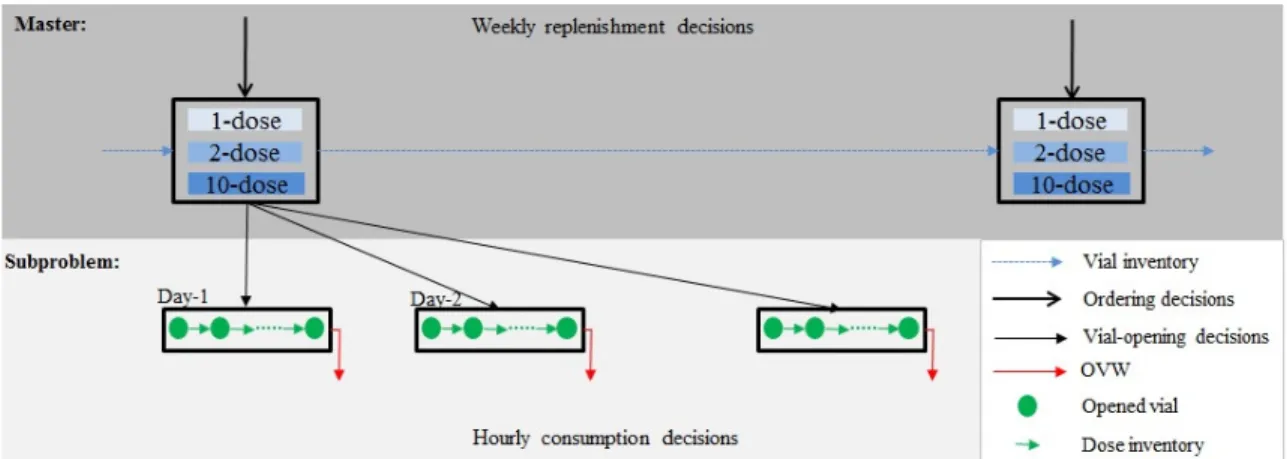
Figure 5.1 provides a schematic representation of the modeling approach used for this prob-lem. The darker shaded area represents inventory replenishment decisions for multi-dose vials during the planning horizon. These decisions are made weekly. Each box represents the type of vials in the inventory over a particular week. Boxes in successive time periods are connected to represent the inventory flow. The lighter shaded area represents vaccine administration decisions. These decisions are made daily. Each box shows when a vial is opened and how the doses are used during a given day. Boxes in successive time periods are not connected since unused doses are discarded, which contribute to OVW.
Figure 2.1: Inventory dynamics in vaccine administration and inventory replenishment model.
2.2.2
Vaccine administration and inventory replenishment model
For the model formulation presented here, note the use of lower case for vector and matrix entries and that bold font represents the entire vector or matrix.
Our model considers two major decisions: (a) inventory replenishment or ordering decisions, and (b) vial administration or opening decisions. Ordering decisions help to identify the optimal replenishment schedule, order mix and vial sizes. These decisions are made in a weekly basis. On the other hand, opening decisions are a function of the vaccine administration policy which depends on patient arrivals, and thus, these decisions are made at a much finer timescale: on an hourly basis. HereT =1, . . . , T denotes the ordering decision epochs, and each ordering period consists of
N opening decision epochs. Therefore,N =0, . . . , N T denotes all the opening decision epochs over
the planning horizon.
We first describe modeling of the inventory replenishment decisions. Let V represent the
set of multi-dose vial sizes, e.g., one-dose, five-dose and ten-dose vials, available for order. Once the vials are opened they must be used within their safe use time, and τ denotes this limit. Att∈ T,
ordering decisionsztare made at fixed costft. If an order is placed (zt=1), then the replenishment
quantity for each multi-dose vial size can be determined. These decisions are represented byrνt, and
the corresponding variable purchase cost bycνt,∀ν∈ V. At each opening decision epochn∈ N,
vial-opening decisions are made. Letuνn represent the number of vials of sizeν opened. Replenishment
quantity decisionsrνt and vial-opening decisionsuνn together determine the state of vial inventory,
evolution of inventory for each vial sizeν∈ V is captured by the following flow-balance equations:
sνN t=sν(N t−1)+rνt−uνN t ∀t∈ T, (2.1a)
sνn=sνn−1−uνn ∀n∈ N ∖ {N,2N, . . . , T N}, (2.1b)
The initial inventorysν0 is assumed to be known. Since the inventory of vials is replenished weekly,
equation (2.1a) is used to represent the corresponding inventory balance constraints. However, since dose administration decisions are made at a finer time scale, and those decisions impact the inventory of vials, equation (2.1b) is used to capture inventory balance during vaccine administration time periods. Since open vial policy does not apply to unopened vials, loss of inventories is not considered in these constraints.
∑
ν∈V
rνt≤Mtzt ∀t∈ T. (2.2)
Let Mt be an upper bound (UB) on the quantity of vials ordered in a time period. Constraints
(2.2) ensure that the inventory of vials is replenished only if an order is placed in period t. Note that, decisions about vial replenishment and inventory (z,r,u,ands) are made before the number of patient arrivals is realized.
We now describe modeling of the vial administration decisions. The vials opened in period
ncan vaccinate children in period m<n+τ, or before the end of a session, whichever occurs first.
Withynmto denote the number of doses obtained from vials opened in periodn, and used in period m, then yn(n+τ) represent the number of doses that expire after their safe use time expires, and
hence contributes to OVW. The relationship between the number of vials opened and the number of doses available is captured by the following equation:
n+τ−1 ∑ m=n ynm+yn(n+τ)= ∑ ν∈V qνuνn ∀n∈ N, (2.3)
whereqν is the number of doses in a multi-dose vial of sizeν. The right-hand side of equation (2.3)
represents the total number of doses obtained by opening vials, while the left-hand side is the sum of utilized and expired doses in periodn.
The total number of patients arriving in time periodnis denoted by ˜ωn. If the total number
Doses utilizedynm Doses expiredyn(n+τ)
Demand ˜ω OVW
Vial-opening decisionsuνn
Figure 2.2: Dose utilization forn=2 withτ=7.
* Filled circles indicate opened vials and unfilled circles indicate unopened vials.
not be served. This model assumes that patients do not wait for vaccinations. This assumption is relaxed in §2.4.4 when the wait-to-open policy is described. A penalty is associated with each unserved patient, which is denoted by`n. With these, the dose inventory must satisfy the following
flow-balance equations:
n
∑
m=n−τ+1
ymn+`n=ωn ∀n∈ N. (2.4)
Here,ωnis a realization of the random variable ˜ωn. Equation (2.4) indicates that, of the total number
of patients arriving during a session, the number of patients vaccinated depends on the total number of doses available, denoted by the first term in the left-hand side of the equation. If the number of open doses is smaller than the number of patients present during period t, then the unserved patients leave the session. Figure 2.2 provides a schematic representation of how doses obtained from opened vials in period n=2 are utilized over the next τ=6 periods. OVW is represented by
the arc in red.
We finally describe modeling of the objective function. The objective function includes the fixed (ft) and variable (cν) purchasing costs, the inventory holding costs (dν), and the expected
value of wastage (g) and penalty (p) costs. This objective function is given by:
∑ t∈T (ftzt+ ∑ ν∈V cνrνt) + ∑ ν∈V ∑ n∈N dνsνn+E{ ∑ n∈N (gyn(n+τ)+p`n)}. (2.5)
The expectation function is taken over the distribution of ˜ω and its argument captures the penalty associated with unserved patients and OVW disposal. Note that the total disposal cost depends on
patient arrivals and is bounded below by zero.
The vaccine vial replenishment problem can be written as a 2-SIP to capture the impact of the stochastic nature of patient arrivals on vaccine inventory replenishment and vaccine administra-tion decisions. The complete 2-SIP is presented in Appendix (A). To simplify the exposiadministra-tion of the algorithm, the following succinct representation of the model formulation is used in the remainder of the chapter. A single decision vectorx∈ X collectively denotes the ordering decisionzt, the
replen-ishment quantityrνt, vial-opening decisions uνn, and the state variables sνn, i.e., x= (z,r,u,s)⊺.
Note that the decision vector x consists of binary (zt), as well as pure-integer decisions1. Since
decisionxis made prior to realizations of patient arrivals, which is non-anticipative in nature [20],x
represents the first-stage decision. On the other hand, vial opening decisionsynmdepend on patient
arrivals, and therefore, these decisions are made in an adaptive manner. We collate all the adaptive decisions in a single decision vectorγ= (y, `)⊺. This allows us to write the replenishment model as:
min F(x) +E(H(x,ω˜)) (2.6)
s.t.x∈ X
where the recourse function H(x, ω)takes the first-stage decisions x and realization ω of random
variable ˜ω as input. The resulting model is:
H(x, ω) =min G(γ) (2.7)
s.t.Wγ=ρ(ω) −Tx.
In the equations above, functionsF(⋅)andG(⋅)are linear functions;Wis the recourse matrix; and
T is the technology matrix. In the SP literature, formulation (2.6) is referred to as the first-stage problem, and formulation (2.7) is the second-stage problem.
Equations (2.3) and (2.4) represent the constraints set of formulation (2.7). The first-stage decision variablexaffects the right-hand side of equation (2.3). Txin formulation (2.7) represents this relationship. The uncertainty affects the right-hand side of equation (2.4). ρ(ω)in formulation
(2.7) denotes this relationship. Consequently, the recourse matrixWrepresents the left-hand sides 1We use the notationvto denote a single column vector obtained from elements(v
1, v2, . . . , vi)⊺for one dimensional
vectors, column-wise concatenation for two-dimensional matrices(v11, . . . , vi1, v12, . . . , vi2, . . . , v1j, . . . , vij)⊺, and so
of equations (2.3), and equation (2.4) is independent of randomness. Such SPs are said to have a fixed recourse [20]. Finally, the first- and second-stage problems have discrete decision variables. However, the structure of the second-stage constraint set satisfies the following proposition:c
Proposition 1 The linear programming in second-stage problem (2.7) has at least one integer op-timal solution.
Proof: Second-stage problem (2.7) is an uncapacitated minimum cost network flow model. There-fore, the recourse matrix satisfies the total unimodularity property [11]. In other words, since the recourse matrix is integer, every basic feasible solution to the linear relaxation of second-stage prob-lem is integer for any integer vector(∑ν∈Vqνuνn, ω,∀n∈ N) which appears on the right-hand side
of (2.7). Since the number of patients and number of doses available are integer, this condition is satisfied. ∎
As a consequence of Proposition 1, the integer constraints are relaxed in the second-stage problem. Thus, this problem is solved as a linear program for a given input of (x,ω). Linearizing
second stage problem (2.7) is necessary for the implementation of the LS algorithm which relies on the duality of the second-stage problem. From this point on, our notation 2-SIP refers to an integer first-stage problem (2.6) and the linear relaxation of the second-stage problem (2.7). The solution algorithm is presented in the next section.
2.3
Solution Approach: An extended L-shaped method
2-SIPs have been used to model many applications in the fields of financial planning, ca-pacity expansion, manufacturing, resource allocation, etc. Over the past several decades, different algorithms have been proposed to tackle these problems. To achieve computational tractability, many algorithms represent uncertainty through a finite number of realizations (scenarios). If Ω= {ω1,ω2, . . . ,ωS} represents this finite set of scenarios with respective probabilitiespi, i=1, . . . , S,
then the expectation function in first-stage problem (2.6) can be written as:
E{H(x,ω˜)} =
S
∑
i=1
Discretizingω allows modeling of the corresponding deterministic equivalent formulation (DEF) of the proposed 2-SIP. In general, even ifSis relatively small, the size of DEF can increase quickly. Since the decisions variables of the first-stage problem are integers, DEF is a network flow problem with fixed charge costs, known as an NP-Hard problem [65]. Therefore, solving DEF is computationally challenging.
Decomposition-based methods, notably, the stochastic Benders decomposition [134], Dantzig-Wolfe decomposition [41], and progressive hedging [123] have effectively addressed this computa-tional challenge. These methods iteratively build approximations to the expected recourse function. Dantzig-Wolfe decomposition is an inner linearization method that iteratively solves the dual of the first-stage problem. However, this method is not applicable to the class of problems with discrete first-stage variables, which is the case here. Progressive hedging is a primal-dual method where, in each iteration, a penalty is associated with a deviation from a feasible solution. However, using this method requires selecting an appropriate proximal parameter that is both instance dependent and hard to discern [137]. Therefore, the solution approach proposed here is based on stochastic Benders decomposition which is also known as the LS method.
In order to build the DEF of a 2-SIP, whose random variable has a large number of realiza-tions, or its underlying distribution is continuous (as is the case in our application), it is recommended to use a sampling-based approach [20]. In this case, one can generateSrealizations of random vector
˜
ωusing Monte Carlo simulation. Then, the setΩ will be comprised of these simulated vectors, and each will have the same probabilitypi=1/S. Given this set of realizations, the SAA problem of the
DEF can be written as follows:
min x∈X ˆ FS(x) ∶=F(x) + 1 S S ∑ i=1 H(x,ωi). (2.9)
The second term in problem (2.9) is an unbiased estimator of the expectation function in formulation (2.8). The SAA problem is a 2-SIP with discrete distribution and therefore can be solved using the LS method with a branch-and-cut procedure to recover the integrality of the first-stage problem. Since the SAA problem is constructed using random realization obtained by sampling using Monte-Carlo or other techniques, verifying the quality of the solutions obtained from the SAA is imperative. Thus, this study uses estimates of lower bounds (LBs) and upper bounds (UBs) computed across multiple replications, as suggested by [92].
The LS method is an iterative method used to solve SP problems with continuous recourse. It is well known that, in these problems, the expected recourse function is piecewise linear and convex [20]. Therefore, the dual solutions of the second-stage problem are used to generate a LB and provide an outer approximation of this expected recourse function, in each iteration of the LS method. When second-stage problem variables are discrete valued, then additional steps are necessary to achieve convexity; see [125] for details. Due to the total unimodularity of the recourse matrix W, employing such procedures is not necessary. In order to solve problems with binary constraints in the first stage, Laporte and Louveaux proposed the integer LS method in 1993 [75]. Later on, improved optimality cuts were introduced by [64] to strengthen the method. This method was further improved by using local branching techniques developed by [122]. These methods work for problems with only first-stage binary variables and hence do not apply to the problem presented here.
In order to improve the computational time of solving large-scale mixed-integer two-stage SPs with continuous recourse, [22] add valid integer cuts within the LS method. The cuts are added to the LP relaxation of the first-stage problem. Their computational results show an improvement in the LS algorithm’s performance. The solution algorithm developed here is an extension of the LS method to solve the SAA formulation in which the first-stage problem is a mixed-integer program. This work uses GMI and MIR cuts to strengthen Benders’ cuts. In this regard, our approach resembles the work of [22] in which cuts are added to the DEF of their problem.
2.3.1
Extended LS Method:
When the classical LS method of [134] is applied to 2-SIPs with continuous recourse, op-timization is achieved by solving the first-stage problem as an MIP in every iteration. These MIP solvers often tend to be computationally expensive, prohibiting extensive numerical experimentations necessary to conducing reliable statistical analyses of the results obtained by solving an SAA-based formulation of the problem. Herein lies the motivation for the algorithm presented here.
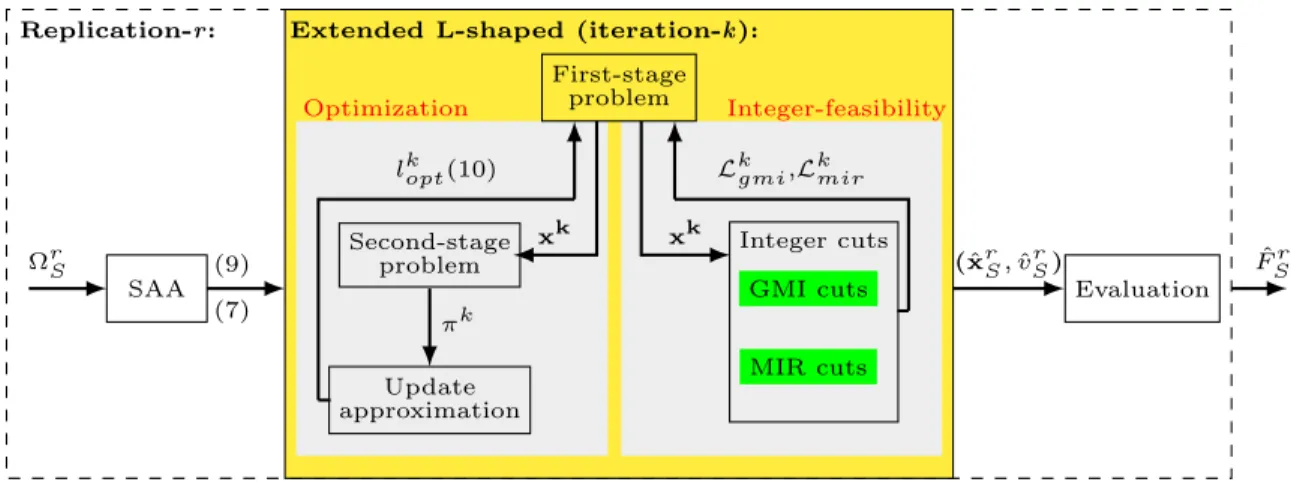
Our algorithm operates in one of two modes: (a) optimization mode and (b) integer-feasibilitymode. In the optimization mode, the goal is to develop acceptable LB approximations of the first-stage objective function. In this regard, the procedure adopted is akin to the classical LS method applied to a two-stage stochastic linear program (2-SLP). The goal of the integer-feasibility mode is to determine an integer feasible solution.
The algorithm is initialized by setting the first-stage feasible regionX
0
= X, the set of original
constraints. Over the course of the algorithm, lower-bounding affine functions are computed in the optimization mode and integer cuts are added in the integer-feasibility mode. In iteration k, the first-stage feasible region X
k−1
is characterized by the set of original constraints X, a set of lower
bounding cutsLkopt−1, and a certain set of integer cutsLkint−1. The lower bounding cuts are expressed
using an auxiliary variableη, as in the case of the classical LS method. Whilexis an integer decision variable, η is a free continuous variable. Therefore, the feasible region for iterationsX
k−1
, k>1 is
described in an extended space which includes both x and η, a mixed-integer set. The second-stage problem in formulation (2.7) satisfies the relatively complete recourse assumption; that is, the second-stage problem is feasible for all ωi ∈ Ω and x∈ X
k
, which mitigates the need to generate feasibility cuts. Feasibility is achieved because not every patient is assumed to be vaccinated, and waste is allowed and accounted for. However, the relatively complete recourse assumption can be relaxed, and a mechanism to generate feasibility cuts can be incorporated in the optimization mode. These feasibility cuts will be generated in a manner similar to the classical LS method, and therefore, they are not discussed here. First, the steps involved in the optimization mode procedure are described, followed by the approach used in the integer-feasibility mode.
2.3.1.1 Optimization Mode.
In this mode, iterationkstarts by solving the following problem that identifies a candidate solution: min {F(x) +η∣ (x,η) ∈X k−1 lp } (Mlpk) whereX k−1
lp is a linear relaxation of the first-stage feasible regionX k−1
. The optimal solution of this problem is given by (xk,ηk), with objective function valuevSk. Using the solution xk and a
realizationωi∈Ω, the second-stage problemH(xk,ωi)is solved to obtain the optimal dual solution,
πk. This procedure is enumerated for every ωi∈Ω. Using these dual solutions, a lower bounding
affine function cut is computed by:
lkopt(x,η) ∶= 1 S S ∑ i=1 (πk)⊺[ρ(ωi) −Tx] −η≤0. (2.10)
This affine function is used to obtain the updated setLkopt= Lkopt−1∪ {lkopt(x,η)}which provides a LB
approximation to the objective function. The optimal objective function valuevk
S provides a LB to (M k lp). A UB to (M k lp) is ˆFS(xk) = lk
opt(xk, ηk). Let ∆k denote the relative gap between the current UB and LB defined as ∆k(xk) =
(FˆSk(xk) −ˆvk)/Fˆk(xk). If ∆k(xk) is less than a predefined error , then switch to the
integer-feasibility mode. Otherwise, if ∆k(xk) ≥ , then set Lkint = Lkint−1, i.e., no new integer cuts are
added in iterationk. This results in an updated first-stage feasible regionX
k
, and one iteration in optimization mode is complete.
Remark: While the algorithm operates in the optimization mode, no new integer cuts are added. Therefore, when the relative gap ∆k(xk) < , the algorithm has solved a 2-SLP with a
first-stage problem characterized by a feasible region{xk ∣xk∈ Xk∩ {l(xk,ηk) ≤0}, l∈ Lκint}, where
κis the last iteration when the algorithm operated in integer-feasibility mode. This feasible region is defined by the original set of constraints and the integer cuts added up to iterationκ. Therefore, the algorithm presented here converges to the optimal solution of this problem in a finite number of iterations ifω has a finite support [20].
2.3.1.2 Integer-feasibility mode.
Let κ denote the iteration when switching to integer-feasibility mode. At this point, the current solution is assigned as an incumbent solution, i.eˆxκ
=xκ, with the corresponding objective
function value ˆvκ
=vκ. If the incumbent solution satisfies the integer requirement, then we have an
integer feasible solution within an acceptable relative gap. Therefore, the algorithm is terminated. Otherwise, a mixed-integer program is solved:
min {F(x) +η∣ (x,η) ∈X k−1 lp ∩l k opt(x,η) ≤0}. (M κ mip)
Note that the constraint set in the above problem does includes the latest optimality cut added in the optimization mode. LetˆxκS be the integer optimal solution with the objective function value ˆvSκ. Since the solution is updated, the gap estimate ∆κ
(ˆxκ)is recomputed with ˆFS(xˆκ)as the UB. This
update might result in ∆κ becoming greater than error. In this case, we conclude that the lower
bounding approximation forˆxκis not acceptable, and hence, the optimization mode is necessary to
Before returning to the optimization mode, GMI and MIR cuts are constructed at(xκ,ηκ)
and added to the feasible region [63]. As a result, the feasible region no longer contains the non-integer solution xκ. Note that integer cuts are generated based on the original constraint set, as
well as the affine lower bounding functions added so far. Particularly, GMI cuts are generated for fractional basic solutions to (Mklp). Therefore, multiple GMI cuts are generated up to iterationκusing fractional basic solutions. LetLκgmidenote the set of all GMI cuts generated in iterationκ. The MIR
cuts are generated only for constraints with mixed-integer variables. In the SAA model, the variables used in the constraint set of the first-stage problem ((2.1), (2.2)) are integers. Therefore, MIR cuts are only used for the lower bounding affine functions inLκopt, which contain the continuous variable
η. Moreover, the observation that the recourse functionH(⋅)is lower bounded by zero almost surely
plays a critical role in deriving the MIR inequalities. The set of MIR inequalities added in iteration
κis denoted byLκmir. Together, the updated set of integer cuts becomes:
Lκint= Lκint−1∪ Lκgmi∪ Lκmir. (2.11)
This formulation completes the steps involved in the integer-feasibility mode of the proposed algo-rithm, which results in an updated first-stage feasible regionX
κ
. The algorithm returns to a new iteration in optimization mode.
2.3.2
Statistical Evaluation
Notice that(ˆxS,ˆvS)is the optimal solution-value pair to the SAA problem in formulation
(2.9) when sample size is S. However, the sample size which is required to ensure that ˆx is an optimal solution to the true problem (2.6), is problem specific. Moreover, since the samples used to setup the SAA are chosen randomly through the Monte Carlo sampling method, the optimal objective function value obtained is also a random quantity. Therefore, concluding that the solution obtained from a single SAA is optimal to first-stage problem (2.6), may be erroneous. In order to overcome such premature conclusions on optimality, the experiments should be replicated with different sets of scenarios. The idea of using multiple replications for estimating the LBs and UBs, which are then used to obtain estimates on an optimality gap, was proposed by [93]. This idea has been incorporated successfully in the SP literature to provide statistical performance guarantees for 2-SLPs [85]. Here, a similar experimental setting is used for the SAA approach to develop a 2-SIP
Replication-r:
ΩrS
SAA (9) (7)
Extended L-shaped (iteration-k):
Optimization Integer-feasibility First-stage problem xk Integer cuts GMI cuts MIR cuts Lk gmi,Lkmir xk Second-stage problem πk Update approximation lkopt(10) (xˆrS,vˆrS) Evaluation ˆ FSr
Figure 2.4: Schematic representation of extended L-shaped algorithm.
with continuous recourse.
For a given selection ofS, let ΩrS denote the set of scenarios generated, and let(xˆrS,vˆSr)be
the optimal solution pair obtained using the extended LS algorithm in replication r=1, . . . , R. In
this regard, an estimator of the optimal objective function value of the true problem (2.6), is given byvRS = R1 ∑ R r=1ˆvSr. Note that ˆv r S is an LB, and thereforev R
S is a biased estimator of the objective
function value.
In each replication, the quality of solution ˆxr
S is evaluated by simulating the second-stage
problem using scenarios different from the ones in Ωr
S. This is an out-of-sample evaluation process.
The evaluation continues until a sample of size S′ is found, such that the corresponding ˆFr S′ is
contained in the(1−α)confidence interval created using ˆFsrfors=1, . . . , S′. Consider the estimator
∆r=FˆSr(xˆrS) −ˆvSr of the optimality gap. The mean and variance of this estimator are given by:
∆R= 1 R R ∑ r=1 ∆r, σ2∆= 1 R(R−1) R ∑ r=1 (∆r−∆ R )2. (2.12)
Notice that ∆R overestimates the optimality gap and therefore, can be viewed as a pessimistic gap. In our computational study, we report this gap and the distribution of ˆFSr′ over replications.
Before the conclude this section, we present the distinguishing features of our algorithmic framework, compared to prior works.
1. If the LS method is implemented to solve the SAA, then the MIP first-stage problem pre-sented in this study would be solved in every iteration of the algorithm. Instead, the algo-rithm proposed here solves a linear first-stage problem during the optimization mode, which
Algorithm 1Pseudocode for one replication of the extended L-shaped algorithm. 1: Initilize ,k←0,L0int= ∅,L0opt= ∅
2: Optimality mode 3: k←k+1
4: Solve (Mk
lp) to obtain(x k,ηk
)with the objective function value ofvk
5: foralli∈ {1, . . . , S}do
6: Solve the second-stage problemH(xk, ωi)to obtainπk.
7: end for
8: Compute`kopt(xk,ηk)using (3.11) and add toLkopt
9: FˆS(xk) =loptk (xk,ηk) 10: if ∆k(xk) = (FˆSk(xk) −vˆk)/Fˆk(xk) <then 11: Go to integer-feasibility mode 12: else 13: Lkint= Lkint−1 14: end if 15: Integer-feasibility mode 16: Setk=κ, ˆxκ=xκ, ˆvκ=vκ 17: if xˆκ ∈Z+then 18: STOP 19: else 20: Solve (Mκ
mip) to obtain ˆxκS with the objective function value ˆvκS 21: end if
22: if ∆κ(xκ) = (FˆSκ(xκ) −ˆvκ)/Fˆκ(xκ) <then
23: STOP
24: else
25: Add GMI and MIR cuts,Lkint= Lkint−1∪ Lkgmi∪ Lkmir
26: Go to optimization mode 27: end if
significantly reduces its running time. The algorithm seeks an integer solution only during the integer-feasibility mode. The computational results in Table (2.4) illustrate that the proposed algorithm leads to lower running times.
2. The effectiveness of using integer cuts within the LS method has previously been explored in [22]. The authors add GMI cuts in every iteration of the LS method. In addition to GMI cuts, the algorithm proposed here exploits the impact of adding MIR cuts as well. These cuts are only added during the integer-feasibility mode, which reduces the computational time of the algorithm. The results in Table (2.4) indicate that using both GMI and MIR cuts results in finding solutions of higher quality, compared to using GMI cuts only.
3. For the application considered in this study, limited data is available to estimate the underlying distribution of the random variable involved. When this is the case, an evaluation process of the SP algorithms is required to validate and verify the quality of the solutions obtained [93]. While evaluation procedures have been developed for a 2-SLP [85], to the best of our knowledge, the work presented here reflects the first adoption of these procedures for 2-SIPs. Figure 2.4 shows the schematic representation of the algorithmic framework developed in this study.
2.4
Computational Experiments: A case study for Bangladesh
Instances of the vaccine administration and inventory replenishment problem were created with real-life data from different regions in Bangladesh. These instances were created to highlight the impact of data, deterministic as well as stochastic, on model decisions and to draw insights about the problem as it actually exists in the real world. The optimal solution of the SAA is used as a benchmark for the simple, easy-to-implement inventory replenishment and vaccine administration policies proposed here.
This section is organized as follows: First, the input data is presented; second, the ex-perimental setup is explained; third, the results of solving the SAA are analyzed. The inventory replenishment and vaccine administration policies derived from solving the SAA are referred to as the “base policy” to distinguish them from some easy-to-implement policies proposed at the end of this section.
Table 2.1: Cost and weight of different vaccine vial sizes of Pentavalent.
Vaccine size Purchase cost per dose ($) Vaccine weight per dose (gr) Lower limit Mean Upper limit Lower limit Mean Upper limit 1 dose 3.24 3.60 3.96 1.542 1.713 1.885
2 dose 3.25 3.50 3.75 1.723 1.914 2.106
10 dose 2.00 1.80 2.20 3.169 3.522 3.874
2.4.1
Data input model
Two different data sources were used in this case study to generate problem instances for an outreach session conducted by EPI in Bangladesh. Two regions, based on varying demographic data, were selected: urban Chittagong and rural Rajshahi. Deterministic data, including purchase and inventory holding costs, was complied using the 2012 WHO vaccine volume calculator [2]. Stochastic data was compiled from the Demographic and Health Survey (DHS) of Bangladesh, a population-based survey executed by National Institute for Population Research and Training in 2011 [105] that includes individual household level DHS data. The details of deterministic and stochastic parameters are described next.
2.4.1.1 Deterministic parameters:
The EPI outreach sessions in rural areas are scheduled on a weekly basis [52]. Thus, this study terms the planning horizon to include 2 weeks with 5 working days per week and 2 to 8 working hours per day. Based on the proposed model, inventory replenishment decisions are made at the beginning of each week, and the vaccine administration decisions are made hourly. Experiments for the Pentavalent vaccine, which is distributed in one-, two-, and ten-dose vials, were conducted. However, this setup can apply to other pediatric vaccines as well. The Pentavalent vaccines has 6 hours safe use time before expiration (i.e. τ = 6). The 2012 WHO vaccine volume calculator
[2] provides data about vial purchasing costs and corresponding weights, which are summarized in Table (2.1). Inventory holding cost is estimated based on the weight of the Pentavalent vaccine. Sensitivity analyses, with respect to purchase and inventory holding cost, were conducted. The lower, mean and upper limit of the values are presented in Table (2.1). In all the other experiments conducted, the mean values of purchase and inventory holding costs are used. Order setup cost is assumed to be constant over the planning horizon and is set to$10. This value is estimated based on interviews with health care workers in a developing country. The penalty cost associated with