5
Analysis of Gender Differences in Self-Statements and Mood
Disorders
Robert DeVore: McNair Scholar
Mary Pritchard: Mentor
Psychology
Abstract
Over 25% of adult Americans suffer from a mental disorder each year, with depression and anxiety being some of the most commonly reported issues. Researchers estimate that between 10% and 50% of adult Americans will suffer from a depressive episode at some point in their life, and cognitive theorists argue that mental states, including disorders, are generated and maintained by personal, subjective beliefs, and that events can only be appropriately labeled by the individual experiencing them. Thus, cognitive theorists suggest a strong link between self-talk (ST) and behavior and note that the automatic use of ST is associated with disordered thinking. Researchers further suggest ST may differ between those suffering from anxiety and those suffering from depression. However, studies have yet to examine whether ST in men suffering from depression or anxiety differs from that of women.
Keywords: self-talk, depression, anxiety, gender difference
Introduction
An estimated 58,000,000 adult Americans, over 25% of the adult population, suffer with a mental disorder each year, with depression and anxiety being some of the most common mental health issues (Prah, 2006). Although most studies of depression have indicated that 10% to 20% of adult Americans will suffer from the disorder at some point in their lives, some studies have found rates of nearly 50% (Clemmitt, 2009). Major depression affects between three and five percent of the population, whereas bipolar disorder affects around one percent (Clemmitt, 2009), and anxiety disorders affect 17% of Americans (Prah, 2006). Combined, major depression and bipolar disorder affect 75% of people with severe mental disorders (Clemmitt, 2009).
Although many factors contribute to the development of mental health issues, studies have shown significant differences in the prevalence of mental disorders between men and women (Eaton et al., 2011). For example, women are almost twice as likely as men to suffer from depression (Clemmitt, 2009). Women are also twice as likely to have an anxiety disorder, with 3.1% of women suffering with general anxiety in the last 12 months and 5.8% over the course of their lives, compared to 1.4% in the last 12 months or 3.1% over a lifetime for men (Eaton et al., 2011). Various explanations for why these differences exist have been theorized (Eaton et al., 2011), including response bias, as depression is considered unmanly (Clemmitt, 2009), and possible biological,
demographic, and/or psychological explanations (Eaton et al., 2011).
Although the diagnostic criteria for each of these disorders differ, they do share some symptomology. For example, pervasive negative thoughts are a part of both depression and anxiety. With depression, a person is likely to believe they are incompetent or that life is hopeless; with anxiety, a person is likely to have negative thoughts about what might happen or about threats in the future (Safren et al., 2000). Despite these differences, some have argued that they are in fact the same disorder with different presenting symptoms (Safren et al., 2000). This is supported by the high comorbidity of depression and anxiety, and high concordance between parents with both depression and anxiety and children with both depression and anxiety (Lerner et al., 1999). However, in individuals diagnosed with depression alone, serotonin levels have been found to be lower than those of the general population, whereas in people diagnosed with anxiety alone, serotonin levels have been found to be higher than those of the general population (Prah, 2006).
Cognitive theorists argue that mental states, including disorders, are generated and maintained by personal, subjective beliefs (Kelly, Zurhoff, & Shapira, 2009), and that events can only be appropriately labeled by the individual experiencing them (Oliver, Markland, & Hardy, 2010). Monitoring changes in self-talk (ST) compared to symptoms is one way to measure the effectiveness of therapy (Lerner et al., 1999), as demonstrated by an analysis in which the benefits of cognitive-behavioral therapy (CBT) for anxiety patients were found to be mediated by changes
6
in ST (Oliver et al., 2010). A study by Kelly et al. (2009) used ST interventions to test whether self-soothing and attack-resistant ST would reduce symptoms of depression, noting that self-criticism is associated with higher levels of depression and with longer periods of depression.
Numerous questionnaires have been made to gauge ST as cognitive theorists suggest a strong link between ST and behavior, and the deliberate use of positive ST has been successful in improving performance (Theodorakis, Hatzigeorgiadis, & Chroni, 2008). While the deliberate use of ST has been identified as an effective means of enhancing confidence, performance, mood, and attention, its automatic use is more commonly associated with disordered thinking (Theodorakis et al., 2008). Studies have been conducted to verify the validity of questionnaires for these automatic thoughts. For example, exploratory factor analysis of the automatic thoughts questionnaire-revised (ATQ-R; Hollon & Kendall, 1980) and the anxious self-statements questionnaire (ASSQ; Kendall & Hollon, 1989; Safren et al., 2000) produced four separate classes of ST, two correlating to anxiety, one with depression, and one with positive affect. Additionally, the three negative classes of ST were grouped as part of a general negative affect class in a hierarchical analysis. Calvete and Conner-Smith (2005) similarly reported a higher order positive ST class but only when more categories of positive ST were used. Safren et al. (2000) reported that Jolly and Dykman's (1994) analysis of the cognition checklist supported a similar 3-factor model, and Lerner et al.’s (1999) analysis of the negative affect self-statement questionnaire produced a 4-factor model. These analyses all support the idea that there are significant and meaningful differences in ST between anxiety and depression (Safren et al., 2000).
There are still several questions one could ask about ST. Lerner et al. (1999) did not analyze their sample for differences based on gender, and Safren et al. (2000) used a sample composed entirely of women, making an analysis based on gender impossible. Recognizing that there are significant gender differences in the prevalence rates of these disorders (Eaton et al., 2011), one might wonder whether these gender differences are mediated by differences in ST. Do men and women rely on the same or different types of ST to express their anxiety and depression? The present study will address these questions. We hypothesize that women will use more negative ST than men, and that depression and anxiety scores will be best predicted by different types of ST depending on gender. In addition, we hypothesize that ST will mediate the relationship between gender and anxiety and depression.
Method
Participants
Three hundred nineteen students in an introductory psychology course at a public university in the Rocky Mountain region were surveyed (194 females, 125 males). The average age of those surveyed was 21.65 (SD = 5.99). The sample was 84.6% White/Caucasian, 1.9% Black/African American, 1.6% Asian, .9% Native Hawaiian/Pacific Islander, .3% American Indian/Alaskan Native, 4.1% mixed, and 6.6% other. The Institutional Review Board approved all study procedures before data collection commenced.
Measures
Self-statements.
The anxious self-statements questionnaire (ASSQ) is a measure of the frequency with which a participant uses self-statements related to anxiety (Kendall, & Hollon, 1989). It is measured on a 5-point scale (1 = never, 5 = very often), and final scores are a sum of the item scores. The ASSQ consists of 32 negative self-statements related to anxiety. Factor analysis has shown that these self-self-statements are correlated with anxiety and consistent with the content-specificity hypothesis (Safren et al., 2000; α = .97).The automatic thoughts questionnaire-revised (ATQ-R) includes 30 self-statements associated with depression and 10 positive self-statements inversely associated with depression (Hollon, & Kendall, 1980). The statements are measured on a 5-point scale (1 = never, 5 = very often), and final scores are obtained by adding the item scores for each category, positive or negative. The ATQ-R has shown moderate to high correlations with the MMPI-Depression scale (r = .45-.70) and acceptable reliability and validity (Hollon, & Kendall, 1980; α = .88).
The ASSQ and ATQ-R were combined and broken down according Safren and colleagues’ (2000) factor analysis. This created four subscales: depressive ST (27 items; α = .97), poor coping ST (i.e. ST regarding one’s inability to cope; 11 items; α = .95), uncertainty ST (i.e. ST regarding one’s uncertainty about the future; 8 items; α = .89), and positive ST (10 items; α = .90).
7
Depression.
The Beck Depression Inventory (BDI) contains 21 sets of items regarding participants' mood over the last week (Beck, Rush, Shaw, & Emery, 1979). The BDI has been used extensively over the past 30 years and has shown good validity and reliability (Kendall, Hollon, Beck, Hammen, & Ingram, 1987; Safren et al., 2000; α = .92).Anxiety.
A measure of trait anxiety, the state-trait anxiety inventory (STA-T) consists of 20 items intended to measure a person's general feelings of anxiety (Spelberger, Gorsuch, & Lushene, 1970). The trait portion of the STA-T was used to gauge typical anxiety levels of participants. The trait portion of the STA-T has shown acceptable levels of validity and reliability (Spelberger et al., 1970; α = .92).Results
t
-Tests
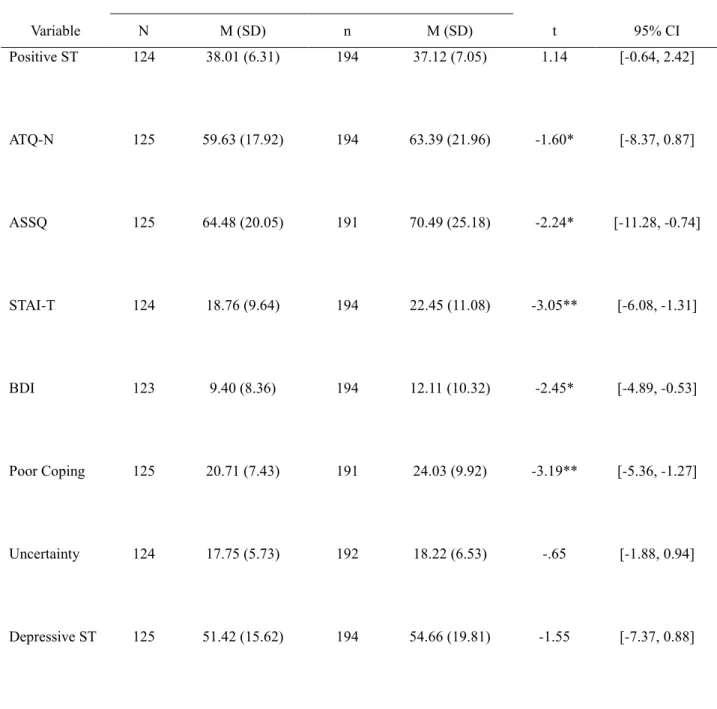
Before ascertaining whether there were gender differences in factors relating to anxiety and depression scores for men and women, we first needed to determine whether there were gender differences in anxiety and depression in our sample. To this end, we ran independent samples t-tests for all variables (see Table 1). As expected, women reported using more negative self-statements on the ATQ (Hollon & Kendall, 1980) as well as anxious self-statements (ASSQ; Kendall & Hollon, 1989) than men did. Women also reported significantly higher trait anxiety (STAI-T; Spelberger et al., 1970) and depression (BDI; Beck et al., 1979) than men did, and women utilized more self-talk (ST) regarding one’s inability to cope. Finally, as hypothesized, relationships between all variables were significant at the p < .001 level for both men and women (see Table 2).
Stepwise regression
Anxiety.
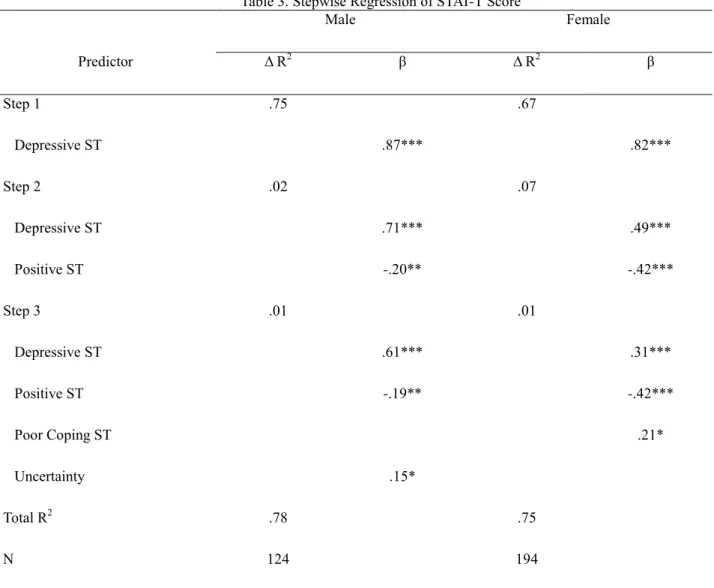
To determine which of our independent variables (IV) best related to our dependent variables (DV), we ran separate stepwise regressions for men and women for each DV. The stepwise method was chosen because we felt it was important not only to know whether different factors related to anxiety and depression in male and female college students, but also their order of importance. As shown in Table 3, in men, anxiety was best predicted by depression, F(1,120) = 360.93, p < .001, R2 = .75. After depression was controlled for, there was an inverserelationship between positive self-statements and anxiety, F(2,119) = 195.22, p < .001, R2 = .77, R2Δ = .02. Finally,
self-statements regarding uncertainty about the future contributed a small but significant effect to the variance in anxiety score, F(3,118) = 138.77, p < .001, R2 = .78, R2Δ = .01.
However, in women self-statements regarding uncertainty about the future did not contribute significantly to the variance in anxiety score. As shown in Table 3, anxiety in women was best predicted by depression, F(1,188) = 386.90, p < .001, R2 = .67. After controlling for depression, there was an inverse relationship between positive
self-statements and anxiety, F(2,187) = 268.13, p < .001, R2 =.74, R2Δ = .07. Finally, for women self-statements regarding an inability to cope contributed to the variance in anxiety scores, F(3,186) = 185.61, p < .001, R2 = .75,
R2Δ = .01.
Depression.
Stepwise regression of depression scores for men, as shown in Table 4, determined that depressive self-statements best predicted depression, F(1,188) = 370.20, p < .001, R2 =.66. There was also an inverserelationship between positive self-statements and depression score for men, F(2,187) = 208.54, p < .001, R2 = .69, R2Δ = .03. Women's depression scores were also best predicted by depressive self-statements, F(1,119) = 182.36, p <
.001, R2 =.60, and an inverse relationship with positive self-statements, F(2,118) = 107.71, p < .001, R2 = .65, R2Δ =
.05.
Mediation.
To test whether ST mediated the relation between gender and mood disorders, we followed Baron and Kenny’s (1986) model for testing mediation. In step 1, the IV (gender) was regressed on each of the mediators (positive ST, uncertainty, poor coping, and depression). The model was significant for the relation between gender and poor coping, F(1,314) = 10.20, R2 = .03, β = .18, p < .001. However, there was no relation between gender andpositive ST, F(1,316) = 1.31, uncertainty, F(1,314) < 1, or depressive ST, F(1,317) = 2.39. As a result, we only tested mediation for poor coping ST. In Step 2 of the mediation model, poor coping was regressed on anxiety, F(1,313) = 530.43, p < .001, and on depression, F(1,312) = 405.02, p < .001. In the final step, gender and poor coping were
8
regressed on anxiety, F(2,312) = 266.03, p < .001, and depression, F(2,311) = 201.94, p < .001. As displayed in Table 5, poor coping did in fact mediate the relation between gender and anxiety and depression.
Discussion
General
Previous research on the relation between ST and mood disorders has failed to examine possible gender differences in ST (Lerner et al., 1999; Safren et al., 2000). Given that there are significant gender differences in the prevalence rates of these disorders (Eaton et al., 2011), the purpose of the present test was to examine whether these gender differences are mediated by differences in ST.
Similar to previous research, we found that women reported higher levels of both depression and trait anxiety (Eaton et al., 2011). We had hypothesized that women would use more negative ST than men. We only found one significant differences between the scores of men and women for the three kinds of negative ST measured: poor coping ST. Supporting our hypothesis, women had higher scores for all three measures of negative ST.
Previous studies on ST identified differences between anxious ST and depressive ST (Lerner et al., 1999; Safren et al., 2000) which our regression analyses support. Safren et al. (2000) further identified two sub-types of anxious ST: poor coping ST and uncertainty ST. We found significant correlations between both of these types of ST and trait anxiety scores; furthermore, our regression analysis of anxiety showed that these types of ST have are related to anxiety differently between men and women.
We also hypothesized that anxiety and depression would be predicted by different kinds of ST in men and women. Men’s trait anxiety scores were related to by their use of uncertainty ST, whereas women’s anxiety scores were related to their use of poor coping ST. Additionally, both depression scores and anxiety scores were best be predicted by depressive ST and the absence of positive ST for both men and women.
We hypothesized that ST would mediate the differences between gender and depression and anxiety. We found a significant mediation effect from poor coping ST for both depression and anxiety scores for men and women. Thus, poor coping ST mediated gender differences in both depression and anxiety scores.
Limitations
The generalizability of this study is limited by its cross sectional nature. If we had surveyed students several times throughout the semester or over a period of years, our results may have been different. That our study is composed of college students is a mixed blessing. One previous study (Lerner et al., 1999) studied ST and mood disorders in children, whereas another (Safren et al., 2000) studied adult mothers. We have bridged that age gap by surveying young adults; however, since no one else analyzed for gender differences, it is impossible to tell if the differences identified are unique to a college population or not. All data was gathered via self-report surveys and thus was not viable as a diagnostic for the actual presence of any mood disorders. Finally, no analysis was capable of accounting for all of the variance in IV scores.
Conclusion
There are differences in the way each gender uses ST. Since ST, and changes in ST, has been used in therapy (Kelly et al., 2009; Lerner et al., 1999; Oliver et al., 2010), differences in the way men and women use ST may indicate that therapy should be different for men and women. Monitoring or attempting to change the most relevant kind of ST may prove more effective than monitoring the broader spectrums of ST. While men and women did rely primarily on the same types of ST for depression and anxiety, the amount of variance accounted for by each type was different for each gender. In addition, poor coping ST mediated the relation between gender and anxiety and depression. These differences may help explain the different prevalence rates for mood disorders between men and women and may be helpful to counselors treating men and women for depression.
9
References
Beck, A. T., Rush, A., Shaw, B., & Emery, G. (1979). Cognitive therapy of depression. New York: Guilford Press. Baron, R. M., & Kenny, D. A. (1986). Moderator-mediator variables distinction in social psychological research:
Conceptual, strategic, and statistical considerations. Journal of Personality and Social Psychology, 51, 1173-1182.
Clemmitt, M. (2009, June 26). Treating depression. CQ Researcher, 19, 573-596.
Calvete, E., & Conner-Smith, J. K. (2005). Automatic thoughts and psychological symptoms: A cross-cultural comparison of American and Spanish students. Cognitive Therapy & Research, 29, 201-217.
Eaton, N. R., Keyes, K. M., Krueger, R. F., Balsis, S., Skodol, A. E., Markon, K. E., Grant, B.F., & Hasin, D. S. (2011). An invariant dimensional liability model of gender differences in mental disorder prevalence: Evidence from a national sample. Journal of Abnormal Psychology.
Hollon, S. D., & Kendall, P. C. (1980). Cognitive self-statements in depression: Development of an Automatic Thoughts Questionnaire. Cognitive Therapy & Research, 4, 383-395.
Kelly, A. C., Zuroff, D.C., Shapira, L.B. (2009). Soothing oneself and resisting self-attacks: The treatment of two intrapersonal deficits in depression vulnerability. Cognitive Therapy & Research, 33, 301-313.
Kendall, P. C., & Hollon, S. D. (1989). Anxious self-talk: Development of the Anxious Self-Statements Questionnaire (ASSQ). Cognitive Therapy & Research, 13, 81-93.
Kendall, P. C., Hollon, S. D., Beck, A. T., Hammen, C. L., & Ingram, R. E. (1987). Issues and recommendations regarding use of the Beck Depression Inventory. Cognitive Therapy & Research, 11, 289-299.
Lerner, J. A., Safren, S. A., Henin, A., Warman, M., Heimberg, R. G., & Kendall, P. C. (1999). Differentiating anxious and depressive self-statements in youth: Factor structure of the negative affect self-statement questionnaire among youth referred to an anxiety disorders clinic. Journal of Clinical Child Psychology,
28, 82-93.
Oliver, E. J., Markland, D., & Hardy, J. (2010). Interpretation of self-talk and post-lecture affective states of higher education students: A self-determination theory perspective. British Journal of Educational Psychology,
80, 307-323.
Prah, P. M. (2006). Eating disorders. CQ Researcher, 16, 121-144.
Safren, S. C., Heimberg, R. G., Lerner, J. Henin, A. Warman, M., Kendall, P. C. (2000). Differentiating anxious and depressive self-statements: Combined factor structure of the anxious self-statements questionnaire and the automatic thoughts questionnaire-revised. Cognitive Therapy & Research, 24, 327.
Spielberger, C., Gorsuch, R., & Lushene, R. (1970). STAI Manual. Palo Alto, CA: Consulting Psychologists Press. Theodorakis, Y., Hatzigeorgiadis, A., & Chroni, S. (2008). Self-talk: It works, but how? Development and
preliminary validation of the functions of self-talk questionnaire. Measurement in Physical Education and Exercise Science, 12, 10-30.
10
Appendix
Table 1. T-tests for Mood Disorders and forms of Self-Talk
Male Female Variable N M (SD) n M (SD) t 95% CI Positive ST 124 38.01 (6.31) 194 37.12 (7.05) 1.14 [-0.64, 2.42] ATQ-N 125 59.63 (17.92) 194 63.39 (21.96) -1.60* [-8.37, 0.87] ASSQ 125 64.48 (20.05) 191 70.49 (25.18) -2.24* [-11.28, -0.74] STAI-T 124 18.76 (9.64) 194 22.45 (11.08) -3.05** [-6.08, -1.31] BDI 123 9.40 (8.36) 194 12.11 (10.32) -2.45* [-4.89, -0.53] Poor Coping 125 20.71 (7.43) 191 24.03 (9.92) -3.19** [-5.36, -1.27] Uncertainty 124 17.75 (5.73) 192 18.22 (6.53) -.65 [-1.88, 0.94] Depressive ST 125 51.42 (15.62) 194 54.66 (19.81) -1.55 [-7.37, 0.88]
Notes: Significance is indicated by * = p < .05, ** = p < .01. ST = self-talk, ATQ-N = Automatic Thoughts Questionnaire-negative self-statements, ASSQ = Anxious Self-Statements Questionnaire, STA-T = State Trait Anxiety Inventory-Trait portion, BDI = Beck Depression Inventory, Inability to Poor Coping = ST regarding one’s inability to cope, and Uncertainty = ST regarding one’s uncertainty about the future.
11
Table 2. Summary of Correlations
1 2 3 4 5 6 7 8 1. Positive ST - -.76 -.68 -.75 -.73 -.69 -.77 -.53 2. ATQ-N -.78 - .87 .87 .75 .88 .99 .68 3. ASSQ -.73 .92 - .83 .68 .93 .87 .89 4. STAI -.80 .82 .81 - .82 .81 .87 .67 5. BDI -.74 .81 .77 .83 - .69 .76 .49 6. Poor Coping -.71 .91 .95 .78 .77 - .88 .74 7. Depressive ST -.78 .99 .92 .82 .81 .90 - .67 8. Uncertainty -.63 .79 .92 .71 .62 .80 .79 - Notes: Scores for males are presented above the diagonal line; scores for women are presented below the diagonal line. All scores are significant at the p < .001 level. ST = self-talk, ATQ-N = Automatic Thoughts Questionnaire-negative self-statements, ASSQ = Anxious Self-Statements Questionnaire, STAI-T = State Trait Anxiety Inventory-Trait portion, BDI = Beck Depression Inventory, Coping = ST regarding one’s inability to cope, and Uncertainty = ST regarding one’s uncertainty about the future.
Table 3. Stepwise Regression of STAI-T Score
Male Female Predictor Δ R2 β Δ R2 β Step 1 .75 .67 Depressive ST .87*** .82*** Step 2 .02 .07 Depressive ST .71*** .49*** Positive ST -.20** -.42*** Step 3 .01 .01 Depressive ST .61*** .31*** Positive ST -.19** -.42*** Poor Coping ST .21* Uncertainty .15* Total R2 .78 .75 N 124 194
Notes: Significance is indicated by * = p < .05, ** = p < .01, and *** = p < .001. ST = self-talk, Poor Coping = ST regarding one’s inability to cope, and Uncertainty = ST regarding one’s uncertainty about the future.
12
Table 4. Stepwise Regression of BDI scores
Male Female Predictor Δ R2 Β Δ R2 β Step 1 .61 .66 Depressive ST .78*** .81*** Step 2 .04 .03 Depressive ST .53*** .61*** Positive ST -.32*** -.27*** Total R2 .65 .69 N 124 194
Notes: Significance is indicated by * = p < .05, ** = p < .01, and *** = p < .001. ST = self-talk.
Table 5. Testing mediation of Poor Coping on the Relation between Gender and Depression and Anxiety
Depression Anxiety Predictor R2 Β R2 β Step 2 .56 .63 Poor Coping .75*** .79*** Step 3 .56 .63 Gender .01 .04 Poor Coping .75*** .79*** N 313 314