http://researchcommons.waikato.ac.nz/
Research Commons at the University of Waikato
Copyright Statement:
The digital copy of this thesis is protected by the Copyright Act 1994 (New Zealand). The thesis may be consulted by you, provided you comply with the provisions of the Act and the following conditions of use:
Any use you make of these documents or images must be for research or private study purposes only, and you may not make them available to any other person.
Authors control the copyright of their thesis. You will recognise the author’s right to be identified as the author of the thesis, and due acknowledgement will be made to the author where appropriate.
You will obtain the author’s permission before publishing any material from the thesis.
The Rock Concert Experience:
The Self-Authentication Process and Wellbeing
A thesis
submitted in fulfilment of the requirements for the degree
of
Master of Management Studies
at
The University of Waikato
by
Daniel Hopper
ii
Abstract
The purpose of this research was to understand consumers’ experiences at rock concerts. Growth in the live concert industry over the past 20 years suggests that these experiences provide value that consumers cannot attain through other means. Music fans can stream rock music or watch concerts without cost, while concert tickets are often over $100 each. Marketers need to understand more about the value derived from the live rock concert experience.
The researcher gathered data over a period of six months in 2013, utilising three data collection methods: 1) in-depth interviews with eight participants; 2) observation of nine rock concerts; and 3) analysis of responses to concert reviews on news website Stuff.co.nz. Constructivist Grounded Theory guided the research process: theoretical sampling, grounded theory coding, constant comparison, and memo-ing.
Findings indicate that consumers derive enhanced wellbeing from attending rock concerts. Consumers want to repeat concert experiences to maintain or further enhance their wellbeing. This could explain why the live music industry is growing rapidly.
Findings also indicate authenticity is an important value-providing process to rock concert consumers. Value occurs through two main processes: the co-created experience and the self-authentication process. The band, fans, and the venue co-create the rock concert experience, enabling hedonia and short-term happiness. Fans experience a rock concert as something extraordinary. The extraordinary experience is composed of a utopian atmosphere and a state of transcendence. Fans live out their fantasies of seeing their favourite bands perform, escape from everyday life, and have cathartic experiences. Fans also experience the rock concert as community. Through playing (e.g., dancing, drinking, singing, being in the mosh pit) with like-minded others, fans feel like they belong to a community.
Secondly, via the self-authentication process, eudaimonia contributes to wellbeing through lasting meaning. By authenticating the band through its performance and the audience’s communal participation, fans authenticate the concert experience.
iii Through authenticating the experience, and through their own activities in it, fans are able to self-authenticate. Consequently, rock concert experiences are important for the long-term wellbeing of avid rock music fans because they can validate their own identities as rock music fans.
In summary, by responding to calls for research into rock concert consumption, this thesis ties together previously fragmented knowledge. The findings and resultant framework explain how hedonic happiness, eudaimonic meaning, extraordinary experiences, and a self-authentication process work together to create short-term and long-term wellbeing for avid rock music consumers. Moreover, the findings and framework suggest how authenticity appears to be a process towards the goal of enhanced wellbeing, rather than being a goal in itself as treated by most marketing scholars.
iv
Preface
In 2010, my post-graduate services marketing class was assigned a group research ‘memory-work’ assignment, in which my group chose concerts as our topic. Upon realising that the literature on concerts was especially scarce from the consumer perspective, this was the beginnings of this thesis topic. It felt like the perfect topic for me as a music fan. I went to my first major concert at the age of 16, becoming a passion I have to this day. I have been to around 50 concerts in my lifetime, and have seen many of my favourite bands perform live which are cherished memories.
I was lucky enough to receive a scholarship from the University of Waikato of which I am infinitely grateful. Without that opportunity, the cost of attending these concerts would have been too great, and the observations would not have been possible. Because of this funding, my friends thought it was all a scam in order to go to more concerts. I was almost embarrassed to talk about my topic with people, because nobody seemed to take it seriously.
However, I took it very seriously and I put thousands of hours of hard work in. This paper is the report of this long process. It seems like an eternity ago I started this thesis, and at times, it felt like a real battle. I have definitely grown an extra thick layer of skin.
There were days were I spent ten hours plus working furiously on this project, and days where I could barely fit in a couple of hours with my work commitments I had for work. I had encouraging meetings with my supervisors where I felt like I was making process, and there were other meetings where I left feeling demoralised and useless. The thesis itself cannot express the long days I spent in front of my laptop, the countless meetings with supervisors, and what seemed like endless rewrites.
However, it has been rewarding. I am very proud of this thesis. I have a book with my name on it! I hope you enjoy it reading it.
v
Acknowledgements
Firstly, a huge thank you goes to my supervisors Associate Professors Carolyn Costley and Lorraine Friend, for their guidance, encouragement, enthusiasm, criticisms, and patience and for my topic and ideas. Not wanting to let you down has driven me throughout this process to keep working, and keep pushing.
A sincere thank you goes out to the scholarship funding provided by the University of Waikato Masters Research Scholarship. This helped make the process a lot easier, and the observations would not have been a reality without this. Similarly, without the wonderful interview participants who shared their insights and experiences, this research would not have been possible. Many thanks.
Thanks to my parents for raising me the way they did. I do not know whether it was nature or nurture, but as an adult, I never give up. Thanks to my friends for just hanging out with me and keeping me sane throughout this process. Quiz and band practices allowed me to get away from my laptop and my thoughts for a few hours.
Big thanks to everybody I came across in the University environment. The people in my classes who got a better mark, you made me try harder. Thanks to my friends for their ears and ideas. Specifically, I would like to thank Will, Rishi, Tash, and Bronwyn, for the many chats we had in the computer labs.
Thanks to my son Iszaac, and my cat killer for their daily cuddles. I decided this thesis would be my girlfriend during its duration. Iszaac your love and affection I cherish, it got me through some tough days. May one day you read this and realise how much it means to me.
Finally, I would like to thank the gym for the personal utopia and catharsis you bring.
vi
Table of Contents
Abstract ... ii Preface ... iv Acknowledgements ... v Table of Contents ... vi List of Figures ... xi List of Tables... xiChapter One: Introduction... 1
Chapter Two: Research Methods ... 6
Introduction ... 6
Methodology ... 6
Induction, Emergent, & Constant comparison ... 9
Theoretical framework ... 10
Data Collection Methods... 10
In-depth Interview ... 10
Ethnography ... 13
Data Analysis ... 17
Grounded Theory Coding ... 18
Memos and the Reflective Journal ... 21
Abduction and the use of Literature ... 23
Research Ethics ... 24
Maintaining Data Security and Confidentiality ... 25
Research Trustworthiness ... 25 Credibility ... 25 Dependability ... 26 Confirmability ... 27 Transferability ... 27 Integrity ... 28
vii
Poetic Representation of the Data ... 28
Methodological Limitations ... 29
Chapter Three: Literature Review ... 31
Initial Literature Review ... 32
An Introduction to Rock Music... 32
Concerts and Performance in the Management Literature ... 33
Hedonic Consumption and Eudaimonic Meaning ... 34
Emergent Literature Review ... 41
Embodied Experiences ... 41
Authenticity ... 42
Authenticity and music: multiple constructions ... 48
Rock Music’s Authenticity and Pop Music’s Inauthenticity ... 54
Music, Identity and Consumption Communities ... 58
Consumer Culture and Identity ... 58
Chapter Four: The Rock Concert Experience ... 63
Introduction ... 63 Co-Created Experiences ... 64 The Band ... 65 Defining Rock ... 65 The Performance ... 67 Fans ... 78 Audience Demographic ... 78
Concerts as a Social Encounter ... 80
Fandom ... 82
Expectations and Anticipation ... 89
Venue ... 91
Summary ... 94
viii
Utopian Experience ... 95
Transcendent: Lost in the Moment ... 99
Fulfilling a Fantasy ... 100
Escape ... 101
Summary ... 103
Rock Concert Audiences as Community ... 104
Audience Participation ... 105
Dancing ... 105
Closer the Better ... 111
Consuming Drugs and Alcohol ... 113
Forming Community ... 114
Sense of belonging ... 116
Chapter Summary... 117
Chapter 5: Rock Concerts as Authentic Consumption Experiences ... 118
Introduction ... 118
Authenticity and Consumption ... 118
Authentic Experiences: An Evaluation ... 119
Inauthentic Experiences ... 119
Venue and Band Mismatch ... 120
Venue Service ... 123
Inauthentic Audience Members ... 125
Band Authentication (Legitimising Fandom) ... 126
Authentic Rock: Constructed Upon Performance ... 127
Genuine from Artist ... 128
Authenticating New Band Members ... 129
Shared Authentication (Band Community) ... 130
Self-Authentication ... 132
ix
Importance of Rock Concerts to Identity ... 134
Music and Identity... 134
Duty as a Fan ... 135
Concert Memories ... 135
Story Telling & Music Knowledge ... 137
Nostalgia ... 138
Wellbeing ... 140
Implications for Practitioners ... 141
Chapter Summary... 143
Chapter 6: Conclusion ... 144
Wellbeing ... 145
The Co-Created Experience ... 146
The Self-Authentication Process ... 146
Contributions ... 149
Answering Calls to Action and Questioning Knowledge ... 149
Conceptual Framework ... 150
Hedonia, Eudaimonia, and Wellbeing ... 152
Implications for Future Research ... 153
Authenticity and Rock Performance ... 153
Replication of the Study in Other Countries ... 153
YouTube Fan Communities ... 154
Conclusion ... 154
References ... 155
Appendices ... 195
Appendix A. ... 195
Appendix Tables & Figures ... 195
x A. A. 2. Methods to Address the Trustworthiness of Interpretive Research (Lincoln & Guba, 1985; Wallendorf & Belk, 1989) & the Evaluative Criteria
of Constructivist Grounded Theory (Charmaz, 2006) ... 197
A. A. 3. Coding and Poetry Example ... 200
A. A. 4. Early Mind-Mapping of Concepts Related to the Concert Experience ... 201
A. A. 5. Model Adapted from Minor et al. (2004) ... 201
Appendix B. ... 202
Participant Summaries ... 202
Appendix C. ... 205
C.1 Consent form... 206
C.2 Application for Ethical Approval ... 207
C.3. Participant Information sheet ... 216
Appendix D. ... 219
Interview guide (Charmaz, 2003). ... 219
Appendix E. ... 223
Member Check Document ... 223
Appendix F. ... 224
Flowchart of How Codes Relate to Concepts ... 225
Appendix G. ... 225
Power Quotes ... 226
Appendix J. ... 229
Appendix Images ... 229
List of appendix images ... 229
xi
List of Figures
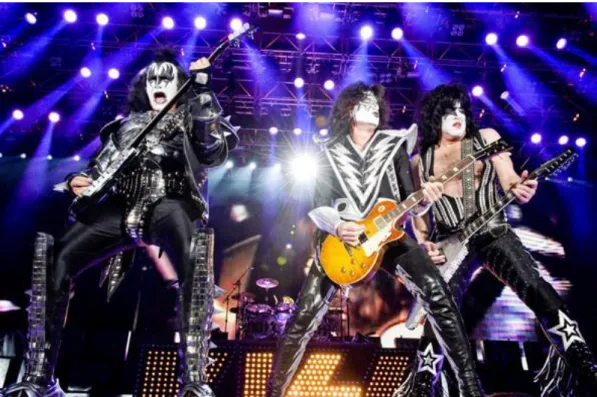
Figure 1: Kiss Performing ... 58
Figure 2: Metallica 1989 ... 58
Figure 3: Metallica 1996 ... 58
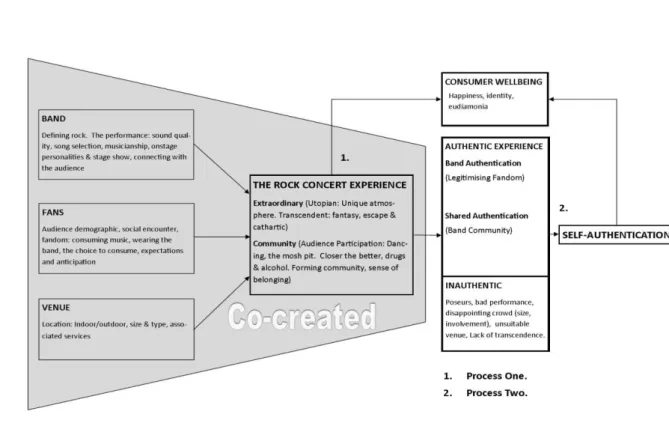
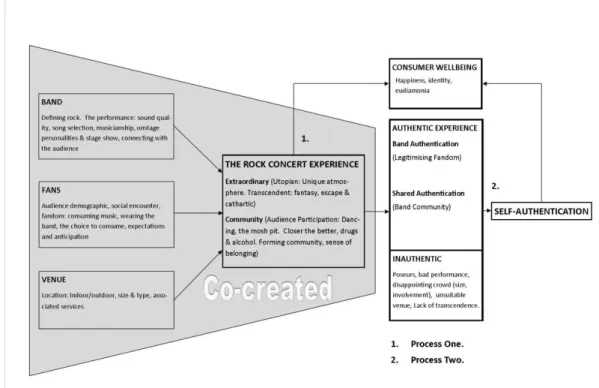
Figure 4: Rock Concert Experiences, Authentication, and Consumer Wellbeing 63 Figure 5: Alice Cooper Performing... 73
Figure 6: Slipknot Performing ... 73
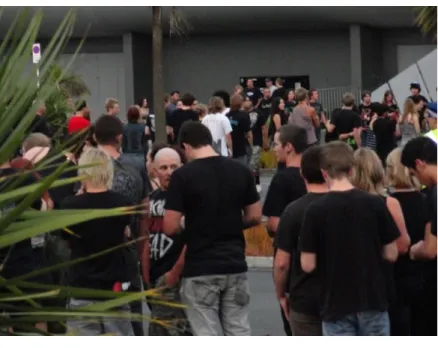
Figure 7: A Sea of Black – System of a Down Audience ... 79
Figure 8: Kat’s Band T-Shirts ... 85
Figure 9: Andrea’s Guitar Picks Wristband from Concerts ... 136
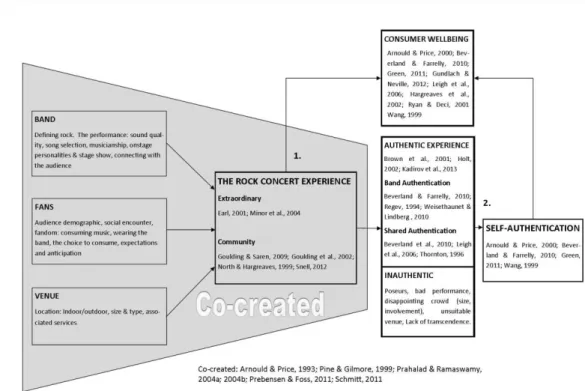
Figure 10: Rock Concert Experiences, Authentication, and Consumer Wellbeing ... 145
Figure 11: Alignment with Previous Research ... 150
List of Tables
Table 1: Grounded Theory Methodology: Dey (1999) as Defined by Creswell (2009) ... 8Table 2: Participant Summary ... 13
Table 3: Example of Observation Notes [Foo Fighters] (13/12/2011) ... 15
Table 4: Overview of Rock Concerts Observed ... 17
Table 5: Coding Example... 20
1
Chapter One: Introduction
Music itself is going to become like running water or electricity… Better be prepared for doing a lot of touring. - David Bowie, 2002
The concert industry has seen enormous growth over the past 10 to 20 years (Cluley, 2009; Connolly & Krueger, 2006; Rondán-Cataluña & Martín-Ruiz, 2010; Shankar, Elliott, & Fitchett, 2009). Between the mid-1990s and mid-2000s, concert revenues doubled in North America (Black, Fox, & Kochanowski, 2007). This trend has continued, with worldwide ticket revenue in 2011 at USD $12.1 billion (grabstats.com, 2013). Furthermore, the top three grossing tours of all time have all occurred since 2005. U2’s 360˚ tour [2009-2011] the top grossing [$736,137,344] with total attendance over seven million people. The Rolling Stones tour second [$558,255,524], and third is ACDC [$441,121,000] (“List of highest-grossing tours,” 2012), all these bands from the rock music genre.
New Zealand is not exempt from this flourishing rock concert market. An example of this is the Roger Waters [former member of influential rock band Pink Floyd] show ‘The Wall’ that is based on the album of the same name, and toured New Zealand in 2012. It sold out Auckland’s 12,000 people capacity indoor venue ‘Vector Arena’ four nights over. Tickets ranged between NZD $150 and $400, illustrating the revenue earning potential of rock concerts in New Zealand.
The upsurge in the consumption of live music has been concurrent with the dematerialisation of recorded music (Shankar et al., 2009). The emergence of digital music and the internet has seen album sales diminish over the past 20 years to the point where it is no longer the principal form of income for the music industry. As such, live concerts have become the major source of income for the music industry (Cluley, 2009; Connolly & Krueger, 2006; Warr & Goode, 2011). Approximately 60% of all music consumption is in the form of live music (Hausman, 2011). Considering ticket prices have inflated greatly over this period and prices of recorded music dropped (Brennan, 2010; Connolly & Krueger, 2006; Rondán-Cataluña & Martín-Ruiz, 2010), it is significant that a substantial market for live music still exists (Earl, 2001).
2 Management scholars have studied the economics of concerts in some depth. Researchers using statistical data and time analysis examined how inflating ticket prices drove up the revenue growth of the concert industry during the mid-1990s (cf. Black et al., 2007; Connolly & Krueger, 2006; Rosen & Rosenfield, 1997). Krueger (2005) studied the economic significance of ‘star power’, established by music icons such as The Beatles [who largely influenced rock culture, allowing bands to become superstars], and how exploiting the star power of artists allows promoters to set a price premium for concerts and maximise profit through the sale of complimentary goods such as band t-shirts.
Despite the notable disadvantages of attending live concerts compared to listening to recorded music (e.g. higher costs, poorer sound quality, viewing difficulties, and undesired supporting artists), consumers’ positive experiences must outweigh the negatives (Earl, 2001; Black et al., 2007). Experiencing live rock concerts appears to provide significant value for consumers. In spite of this, the marketing literature reflects little interest, few consumer studies have attempted to gather insight on concert consumption experiences (cf. Earl, 2001; Hausman, 2011; Minor, Wagner, Brewerton, & Hausman, 2004; Rondán-Cataluña & Martín-Ruiz, 2010; Santoro & Troilo, 2006; Yazicioğlu & Firat, 2011).
Earl (2001) used introspection of his own concert experiences to identify psychological, social, and ritualistic aspects of live music performance not offered by a recording. These included concert specific or new music, excitement of the live setting, hero-worshiping, participation in crazy behaviours, and the social and ritualistic nature of the live concerts.
Studies of fans of specific bands [e.g. Bruce Springsteen] and their attendance of concerts have similar findings to Earl (2001) (e.g. Cavicchi, 1998; Kruger & Saayman, 2012; Löbert, 2012). All studies find fans value the uniqueness of the concert experience, the enjoyment and entertainment of attending, the nostalgic feelings associated to their long held fandom, and their ability to connect first hand with the performer, and other fans as community. However, these findings differ in one main aspect. Earl (2001) concludes that if people consume concerts for reasons he discussed, musicians would have trouble generating consumer interest to attend repeat live performances as a live experience may resolve
3 people’s motivations to attend another. Yet findings from fandom studies of individual musicians/bands indicate fans attend multiple concerts (e.g. Löbert, 2012), suggesting that there must be repeated value in attending live concerts not understood by Earl (2001).
While Earl’s (2001) study is an important starting point, it has limitations by being completely introspective and not including others’ experiences. Similarly, findings of the fandom studies are also hard to generalise as they focus on a specific band instead of across music generally. Questions remain, such as, are behaviours/reactions specific to the avid fans of these bands studied? Are they common across the consumers of different types of live concerts, and specifically rock music?
Other studies (cf. Minor et al., 2004; Rondán-Cataluña & Martín-Ruiz, 2010) examine the antecedents of live concert satisfaction. Both studies find concert consumers are generally highly satisfied by their experience. The Minor et al. (2004) study found concert atmosphere, community, and fans’ emotion were the biggest factors influencing satisfaction. Similarly, feelings of community is a common finding in studies of musical subcultures (cf. Goulding & Saren, 2009; Goulding, Shankar & Elliott, 2002; Henry & Caldwell, 2007; Snell, 2012; Yazicioğlu, 2010; Yazicioğlu & Firat, 2008, 2011). Live concerts are places where fans gather to connect with like-minded others and reinforce their desired identities.
Santoro and Troilo (2006) also find emotion to be an important aspect of rock concert experiences, while Hausman (2011) highlights the importance of hedonic and sensory aspects of concerts via high involvement. Hedonic pleasure is also a root of the motivation to consume the performing arts. Consumers have a high knowledge and understanding of the experience and come prepared to have a good time (Andreasen & Belk, 1980).
Limiting the Minor et al. (2004) findings is the focus on small local performers. These findings may not be transferable to acts that tour internationally. The Rondán-Cataluña and Martín-Ruiz (2010) study is limited by the quantitative methodology providing no in-depth understanding of what satisfies concert
4 consumers. Finally, apart from the series of studies on rock culture in Turkey (cf. Yazicioğlu, 2010; Yazicioğlu & Firat, 2008, 2010, 2011), and those on heavy metal (cf. Henry & Caldwell, 2007; Snell, 2012), research has focused on concerts generally. As rock music bands dominate tour revenue figures, this becomes the focus.
Despite this recent research, there is still a lot to learn about what consumers want to get out of live concerts (Minor et al., 2004; Hausman, 2011). The purpose of this research is therefore to understand experiences of rock concert consumers, and the value provided to audience members.
The research methods used in this study are consistent with Constructivist Grounded Theory (Charmaz, 2006), a qualitative research methodology that generates rich data and a deep understanding of the ‘lived experience’ (Crotty, 1998). Grounded Theory is most applicable when the researcher is investigating new territory (Schreiber, 2001).
Findings indicate that the main value derived by the consumers of rock concerts is enhanced wellbeing. This is why consumers want to have rock concert experiences, and what keeps rock music fans coming back for more, suggesting an explanation for why the live music industry is growing rapidly. Findings also indicate authenticity is an important process that provides value to concert consumers. Wellbeing occurs through two processes, the co-created experience, and the self-authentication process.
This research contributes to the literature through responding to calls for research to help understand consuming authenticity, concert consumption, and performance authenticity. The thesis also ties together fragmented knowledge into a framework. The framework identifies and shows how co-creation at rock concerts leads to extraordinary experiences, and a strong sense of community. Findings and the framework explain how hedonic happiness, eudaimonic meaning, and a self-authentication processes work together to create short-term and long-term wellbeing for avid rock music consumers.
5 This thesis first reviews the relevant literature. Second, it details the methods. Third, the findings are presented, followed by the main discussion where rock concerts are presented as authentic consumption experiences. Finally, it summarises the contributions in the conclusions, while presenting areas for future research and managerial implication.
6
Chapter Two: Research Methods
Introduction
This chapter introduces the research methodology used for this thesis, how it has guided the data collection and analysis, and the development of theory. First, I briefly introduce the research. Following this, the background behind the chosen methodology [Constructivist Grounded Theory] is illustrated, and explained with the methodology’s fundamentals to justify the rationale for why I chose this approach. This includes the identification of data requirements, subjects and site, and the techniques for data collection and analysis. This allows the reader to understand and judge the fit of the research methods I have used in this study.
The catalyst for writing this paper was noticing a lack of a holistic understanding of the rock concert experience whilst researching concerts for a post-graduate marketing. There was limited understanding of why people consume concerts, what happens at the concerts, what the bands mean to these people, and why consumers want to repeated experiences. As somebody who regularly attends rock concerts, I also wanted an understanding of my own consumption. The purpose of this research was therefore to fill this void, and render an understanding the value received by the experiences of regularly consuming large [over 1000 people in attendance] rock concerts in New Zealand. Utilizing qualitative research methods provided the opportunity to generate rich data regarding these consumption experiences. Qualitative research explores the world of lived experience, and generates rich data to provide important insights, knowledge, and understanding (Denzin & Lincoln, 2005; Creswell, 2009).
Methodology
The nature of the research purpose suggests a Constructivist Grounded Theory methodology (cf. Charmaz, 2003; 2004; 2006). Grounded theory [GT] is the most widely cited research method in the social sciences (Bryant & Charmaz, 2007), and is useful across multiple research areas (Wells, 1995)1. GT is most applicable when the researcher is investigating new territory (Schreiber, 2001). Through following strict and systematic procedures to data collection and analysis,
7 grounded theory constructs a theory that relates to a certain situation (Charmaz, 2006; Creswell, 2009; Strauss & Corbin, 1990). It is suitable for researchers when they wish to make knowledge claims about how individuals interpret reality (Charmaz, 2006). Constructivist grounded theory focusing on identifying processes at work in order to provide a deeper understanding of the social world being explored (Charmaz, 2003). A theory help reveals the obvious, implicit, the unrecognised, and the unknown, in the construction of an explanation to the data (Morse, 1994). Within the musical consumption literature, an example of the GT method is Goulding and Saren’s (2009) study to understand the experiences of people who identify with Goth culture and listen to the associated metal music. The similar purpose of this research suggests grounded theory is a good fit.
GT is a qualitative research method introduced by Glaser and Strauss (1967) in an effort to answer the common criticism that qualitative inquiry is not rigorous, and unscientific (Bryant, 2007). Glaser and Strauss have since split into opposition camps, but both their methodologies share a positivist view that knowledge is objective, waiting for discovery by an unbiased observer, who records facts about that reality (Creswell, 2007). In contrast, constructivist GT as prescribed by Charmaz (2003, 2006) rejects these positivist assumptions that there is a universal and objective truth. Instead, constructivism views learning as a process, constructing meaning through close interactions between the researcher and respondents. Researchers are not separate from their theories. Theories constructed through the researcher’s privileges and interactions with people and places (Allen, 2010). Constructivism emphasizes the feelings, assumptions, and meaning making of participants (Charmaz, 2006; Guba & Lincoln, 1994; Schram & Thomas, 2006). Truth and knowledge produced by individuals within various social contexts, realities subjective, local, and specific (Bryant, 2007; Charmaz, 2006).
Constructivism GT follows a relativist epistemology. A philosophical assumption that reality is co-constructed and knowledge socially produced by following multiple standpoints of the research participants, and the researcher (Bryant & Charmaz, 2007). Knowledge of rock concerts therefore best understood according to symbolic interactionism (cf. Blumer, 1986), pragmatism (cf. Rorty, 1982), and Hermeneutics (cf. Bernstein, 1983).
8
Symbolic Interactionism preconfigures social constructionism theory. It places emphasis on the interplay between self and society, an understanding that you cannot develop one without the other, achieved through interaction with others (Blumer, 1986). Immersion in the everyday activities of the participants is necessary to understand the meaning of their actions, defining situations and the process that actors construct the situation through their interaction (Becker, 1984; Marshall, 1998). Pragmatism rejects the idea that scientific truth reflects an independent external reality. Instead, ‘truth’ results from acts of observation and the concurrent emergence within a community of observers as they make sense of it (Cheng & Holyoak, 1985; Suddaby, 2006). Hermeneutics is the route of philosophical reflection, premised on the assumption that by following the indication of symbolic meaning, one will arrive at a deeper understanding of human existence (Ricoeur, 1981). In the understanding of social events, the researcher interprets social events by analysing their meaning to the research participants and their culture (Willis, 2007).
The readers of this thesis therefore will be able to follow and hear the voices of both the researcher and the participants in an evolving dialogue (Charmaz, 2006).
Table 1: Grounded Theory Methodology: Dey (1999) as Defined by Creswell (2009) 2
1 The aim of grounded theory is to generate or discover a theory.
2 The researcher has to set aside theoretical ideas to allow a ‘substantive’ theory to emerge.
3 Theory focuses on how individuals interact in relation to the phenomenon under study.
4 Theory asserts a plausible relation between concepts and sets of concepts. 5 A theory is derived from data acquired through fieldwork interviews,
observations, and documents.
6 Data analysis is systematic and begins as soon as data is available.
7 Data analysis proceeds through identifying categories and connecting them. 8 Further data collection (or sampling) is based on emergent concepts.
9 These concepts developed through constant comparison with additional
9 data.
10 Data collection can stop when new conceptualisations emerge.
11 Data analysis proceeds from ‘open’ coding (identifying categories, properties and dimensions) through ‘axial’ coding (examining conditions, strategies and consequences to ‘selective’ coding around an emerging storyline.
12 The resulting theory can be reported in a narrative framework or as a set of propositions.
Induction, Emergent, & Constant comparison
Grounded theory is inductive, which means I began with the participants’ stories or specific observations of phenomena. Induction is open-ended and exploratory, especially at the beginning research stages where the researcher places emphasis on gathering as much data as possible, and following many potential paths (Trochim, 2000). Patterns and regularities then detected in the data to formulate ideas to explore, and finally end up developing some general conclusions or theories (Babbie, 2012). This is in stark contrast to deductive reasoning which in comparison is narrow in nature, designed with a specific theory in mind to validate through hypothesis testing (Trochim, 2000).
This process of induction allows the research to be emergent, a core of the GT Method (Fassinger, 2005). An emergent research design is when the data collection and the subsequent data analysis identify new areas to explore and what data to collect next from the theoretical sample (Charmaz, 2006). GT data analysis begins from the outset of the research (Charmaz, 2006). Data collection and analysis simultaneous, ensuring grounding in the participants’ words through systematic comparisons between observations, participants’ experiences and emerging categories (Bryant, 2007). This repetitive process of zigzagging between the field and analysis called the constant comparative method (Charmaz, 2006; Strauss & Glaser, 1964). The theory traced back to the data, becoming more plausible as continued research strengthens it. This helps check for similarities and differences to continually refine the concepts. The focus narrows through being sensitive to respondent-supplied concepts and relationships, eventually arriving at the grounded theory.
10
Theoretical framework
This GT provides a theoretical framework of how the New Zealand rock concert consumer receives value from their experiences.
A conceptual framework “lays out the key factors, constructs, or variables, and presumes relationships among them” (Miles & Huberman, 1994, p. 440). Moreover, Miles and Huberman (1994) recommend basing the definition of conceptual frameworks not on variable or factors, but on concepts alone. When variables or factors are used, they suggest employing the term model. The framework provides not a causal/analytical setting, but rather an interpretation aimed at providing an understanding of the social world (Jabareen, 2009). “Theoretical renderings offer an interpretive portrayal of the studied world, not an exact picture of it” (Charmaz, 2006, p.10). This positions the study in context and relevance to existing concepts, paradigms, and theories.
Data Collection Methods
The following section explains the data collection methods utilised by this study. I collected data between the period of late 2011 and mid-2012, and as per the traditions of GT, the prominent data collection method was in-depth interview (Charmaz, 2006). The GT method however transcends specific data collection methods, which allows the researcher to combine and integrate any methods of data collection (Glaser, 2002). GT studies therefore rarely have interviews as their sole form of data collection (Suddaby, 2006). Netnography and ethnography/participant observation were two further data collection methods utilised.
In-depth Interview
I interviewed eight participants, their stories a means of eliciting information their consumption experiences at rock concerts (Creswell, 2009). The interviews were unstructured, open-ended, and conversational, lasting one-to-two hours. Interviews were audio-recorded and transcribed verbatim within three days of the interview. Overall, the interviews produced over one-hundred-and-fifty pages of single spaced transcript.
11 Good interviewing technique involves sensitivity and adaptability (Wallendorf & Belk, 1989). This is the ability to let the interview be conversational, looking for potential paths for the discussion to flow. Therefore, I let participants go on tangents trying to explain how much they love a specific band, or album. I sensed this deep meaning of bands played an important role in the consumption of rock concerts and I did not want to limit the discussion solely to the concert experience itself.
Interviews began with the question, “can you tell me about your latest concert experience?” To elicit a deeper understanding, I then asked questions such as “can you elaborate on that?” “How was that different to...” and “Is there anymore you can tell me about…” I used the interview guide prepared by Charmaz (2006) [see Appendix D.], as a prompt for possible questions to probe new areas. These included questions such as, “could you describe the events that led up to ____ [or preceded _____]?” Interviews gradually structured around the emerging key themes that I wanted to explore.
Wallendorf and Belk (1989) discuss that “the best interview is one which is supplemented by and embedded in observations of behaviour in a naturalistic setting. In other words, over-reliance on interview material without supplementary contextualizing observations and participation in the culture of the informant opens the door to the impatient researcher being duped” (p. 80). Moreover, prolonged engagement in a research setting gives the researcher time to learn the nuances and language of a setting or phenomenon through participant observation (Wallendorf & Belk, 1989). In this sense, my personal involvement rock music culture for nearly 15 years, and ten years of concert consumption therefore was an advantage. I know the bands and the music, I know the rituals, and I know the lingo. Observations from concerts during the data collection phase also served as a means to elicit discussion from interview participants.
This knowledge and experiences of rock concerts allowed me to share some of my own stories to help establish rapport and credibility with the research participants (Wallendorf & Belk, 1989). When researchers are willing to talk a bit about themselves and their experiences related to the topic of the research, it can make the interview more natural and less threatening to participants (Wallendorf, 1987).
12 This technique of self-revelation helped create rapport and trust with the participants by cultivating familiarity and intimacy with them. This allowed rich meaningful data to be co-produced, limiting the chance of misinformation (Wallendorf, 1987). Illegal behaviours such as drug consumption in the context of the concert something participants had no issue discussing. Three of my participants admitted openly to consuming cannabis and ecstasy at concerts, and even sneaking it in. This suggests participant accounts were an open and honest recollection of events.
Photo elicitation was another technique used to promote/encourage conversation in the interviews. The method involves photos, videos, and other forms of visual representation used in an interview, and informants asked to comment on these (Harper, 2002). I asked the participants to bring items relevant to discuss that had some connection to rock music, or rock concerts such as photos taken at concerts, concert ticket collections, CDs and band t-shirts. All but two of the participants brought items to discuss, these included photos of concerts, a guitar pick, and a backstage pass.
Participant selection
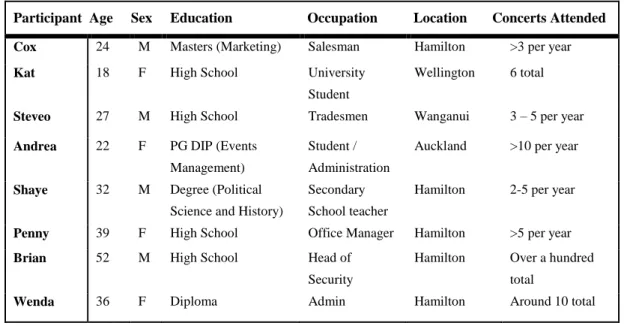
In qualitative research, information-rich participants are the basis for its sample (Patton, 1990). Purposeful sampling is a strategy to gain these information rich cases, which involves playing a pre-specified criterion upon the sample (Patton, 2002). Participants selected were all required to fulfil the criterion of attending at least ten large rock concerts, and at least one over the last six months prior to the interview. Large concerts defined as at least one thousand people in attendance. The sample was heterogeneous, varying in occupation, age, and gender [see Table 2.]. I did not want to choose just young males commonly associated to consuming rock music [bogans], as others have explored this specific consumption community (cf. Snell & Hodgetts, 2007; Snell, 2012). I wanted a broader perspective of rock concert consumers to ensure the resultant theory explained the phenomena in a holistic nature as per theoretical sampling. A theoretical sample solicits specific participants or data collection sources that will provide further information on the particular concept examined, purposefully testing the emerging theory (Glaser, 1978; Morse, 2010). Snowball sampling and word of mouth used to obtain appropriate participants (Patton, 1987).
13 Participant Age Sex Education Occupation Location Concerts Attended
Cox 24 M Masters (Marketing) Salesman Hamilton >3 per year
Kat 18 F High School University
Student
Wellington 6 total
Steveo 27 M High School Tradesmen Wanganui 3 – 5 per year
Andrea 22 F PG DIP (Events Management)
Student / Administration
Auckland >10 per year
Shaye 32 M Degree (Political Science and History)
Secondary School teacher
Hamilton 2-5 per year
Penny 39 F High School Office Manager Hamilton >5 per year
Brian 52 M High School Head of Security
Hamilton Over a hundred total
Wenda 36 F Diploma Admin Hamilton Around 10 total
Table 2: Participant Summary
Ethnography
Market-oriented ethnography is a technique focused on observing the behaviours of the people who constitute a market for a product or service (Wallendorf & Arnould, 1991). Ethnography aims to clarify the simultaneous ways cultures are constructed and formulated by people's behaviours and experiences (Arnould & Wallendorf, 1994). Scholars attempt to observe and interpret the cultural beliefs and practices of social groups by engaging them in some kind of interpersonal encounter (Grazian, 2004).
This thesis utilises two ethnographic data collection methods - participant observation, and netnography.
Participant Observation
I observed nine rock concerts of differing size and subgenres of rock music. Participant observation is a mode of being-in-the-world of the participants, a form of data collection synonymous with ethnography (Atkinson & Hammersley, 1994). It provides access to the complex behavioural details of consumption. Field notes typically recorded to document happenings as they take place, however, because of the scenario I was unable to take written field notes during observations. In a mosh pit, having a pad of paper and a pen is not a reality. It was similarly difficult to record voice notes, as the noise of rock concerts is so
14 loud. Therefore, I decided to record voice notes before and after the concerts where possible, and some were recorded later when I arrived home. Voice notes later transcribed and coded.
Pictures and videos were taken outside of the venues prior to the concert starting and inside during the concert. I took photos of the stage and the crowd, whereas the videos recorded the bands performing and the crowd participation in front of the stage. Video recording and still photography provide the researcher with "new eyes" (Wallendorf & Belk, 1989), providing a perspective on field interactions that is meaningfully different from that provided in field notes (Collier & Collier, 1986).
In the past, academic musicologists such as Cook (1999)have criticised the extent that researchers have distanced themselves from the sensual and emotional experience of participating in musical events whether as performers, listeners, or audience members (Wood, Duffy & Smith, 2007). This was not the case in my research. I acted as a participant observer, and participated fully as a ‘Complete Participant’ (cf. Atkinson & Hammersley, 1994). Sherry (1991) recommends ethnographers use their bodies as research tools to participate in and observe cultural phenomena. We cannot study the social world without being a part of it. As a passionate concert junkie, I was unable to restrain my embodied urges to participate. My immersion in the rock concert experience allowed me to embody the experiences of the social world (Hammersley & Atkinson, 1983).
My level of participation varied between concerts. For example, some concerts everybody was seated, such as ‘Roger Waters – The Wall’, so there was singing and applause after songs as opposed to dancing. On the other hand, concerts such as ‘System of a Down’, there was not much seating and the audience danced and moshed.
At the concerts, I observed things such as, what was happening around me, what the band was doing, what the audience was doing, who made up the audience, and the audience’s state of being [e.g., mood, craziness]. I also made reflections of my own feelings as a rock music fan about to see a band live. Detailed notes from the first concert I attended [the Foo Fighters] allowed me to create codes or
15 concepts to explore in early interviews. Observation and reflection notes of later concerts were not as detailed, as they were used more for the purpose of triangulating data already collected (Wallendorf & Belk, 1989). Triangulation defined as using more than one method, theoretical perspectives, or sources of data and methodologies in order to compare results. This helps check the authenticity of data as the research evolves through purposeful sampling (Denzin, 1970). This technique is to increase the trustworthiness of qualitative research (Lincoln & Guba, 1985), especially helpful in comparing interview-based perspectives on action to observation-based perspectives in action (Snow & Anderson, 1987).
Observation Initial Codes
Held at massive outdoor venue, 50,000 plus people Outdoor, large crowd
Arrived late, stuck in traffic, and didn’t know where I was going – first time to that venue. Thought I allowed plenty of time. Raining lots - then slowed down drank couple of bourbons before the concert to loosen me up. Missed pre-show
Travelled to show, traffic
management, Preconcert
routine, weather, alcohol, missed opening
A lot of the crowd around me didn’t really seem to know every song like I did. Wasn’t singing their brains out like I was. Play a range of their songs from their different albums, bit of new and old, bit in the middle, few randoms and covers – was cool.
Unfamiliarity with all bands songs, Long career, crowd not all singing, range of music from artists career
Few beach balls bouncing around at the start, lots of people recording videos on cell phones, waving them rounds, waving lighters, joints passed around, cups of alcohol, all over the crowd, plastic ponchos on the ground.
People interacting with objects, rock concert rituals, recording on cell phones, open marijuana use and sharing
Big cat walk was another cool addition, where he was down it to the sound stage in middle of field which was set up as another stage and sung a couple of acoustic songs to people at back and got people at front and back of stadium to sing diff parts to each other.
Cat walk, second stage,
acoustic songs, high
interaction with crowd, high involvement
Table 3: Example of Observation Notes [Foo Fighters] (13/12/2011)
Site selection
I based the concerts I selected to attend on whether ‘The Rock’ radio station [New Zealand rock music radio station] plays the band’s music. I attended the ten rock concerts held in New Zealand during the period of my data collection [13/12/11 -6/11/2012] to understand consumer experiences of different venues and styles of
16 rock. The first eight were attended with specific observations made, however the latter two were attended as a consumer as a fan of the bands [notes were not recorded]. The last two concerts served to triangulate the data. I attended these with a research participant who was a fan, which helped ratify behaviours discussed in the interview. It also served to way to confirm saturation of the main findings, with no new behaviours or happenings observed.
Concert [Band]
Genre [as listed by Wikipedia.com]
Date Venue City Crowd
Size
Cost [NZ$]
Foo Fighters Alternative rock, post-grunge, hard rock
13/12/2011 Western Springs (Outdoor)
Auckland 50,000 130
Big Day Out [Festival] My Chemical Romance I am Giant Kasabian Soundgarden Noel Gallagher Multiple
Alternative rock, post-hardcore, emo, pop punk
Rock, Alternative rock Indie Rock, space rock, neo-psychedelia, electronica
Alternative rock, alternative metal, grunge
Rock, alternative rock, baroque rock, psychedelic rock, Britpop 20/01/2012 Mt Smart Stadium (Outdoor) Auckland 25,000-30,000 170
Seether Post-grunge, alternative metal 12/02/2012 Logan Campbell Centre (Indoor) Auckland 4,000 60 System of A Down Alternative metal, progressive rock, hard rock, experimental 22/02/2012 Trusts Stadium (Indoor) Auckland 7,000 100 Roger Waters – The Wall live (Pink Floyd) Progressive rock, psychedelic rock, acid rock, space rock
23/02/2012 Vector Arena (Indoor)
Auckland 12,000 300
G3 live Instrumental Rock 25/03/2012 Logan Campbell Centre
(Indoor)
Auckland 4,000 130
Shihad Alternative rock, industrial rock, hard rock
05/04/2012 Altitude Bar (Indoor)
Hamilton 1,000 50
INXS Rock, alternative rock, New Wave, Australian rock, post-punk, dance rock, hard rock
21/04/2012 Seddon Park (Outdoor)
17
The Smashing Pumpkins
Alternative rock 04/08/2012 Vector Arena
(Indoor)
Auckland 10,000 90
Radiohead Alternative rock, experimental rock, electronic
06/11/2012 Vector Arena (Indoor)
Auckland 12,000 130
Table 4: Overview of Rock Concerts Observed
Netnography
Netnography was the third form of data collection. I analysed fan responses to concert reviews by New Zealand online news website Stuff.co.nz.
Netnography is an ethnographic research method where computer-mediated forms of communication between consumers are analysed, adding further value when combined with more traditional research techniques (Kozinets, 2009). Internet-based research methods offer endless opportunities for textual analysis. It is a form of ‘extant text’, where the researcher does not affect the construction of the data (Charmaz, 2006).
New Zealand news website Stuff.co.nz posts concert reviews the day after the event. People are able to post in reply to the review, often posting their own reviews and opinions of the concert. This was therefore an excellent source of unprompted consumer discussion about rock concerts in New Zealand, and a resource to help triangulate my data. I analysed seven concerts: The Foo Fighters, Evanescence, Rob Stewart, The Big Day Out, Roger Waters’ The Wall, Def Leppard, and Meatloaf. These received between thirty and two-hundred replies, and I coded these in the same method as the observations and interviews (Kozinets, 2002).
Data Analysis
The qualitative analysis of the data gave an overall picture of the consumption experiences of those who regularly attend large rock concerts in New Zealand. GT subjects the data to rigorous analysis, systematically moving between analysis, the literature, and further data collection (Charmaz, 2006). This gives the emerging themes academic grounding, as they become apparent (Creswell, 2007). Therefore, the analysis started after the first observation, instead of after all the data collection was over as common in other forms of research (Patton,
18 1990). GT analysis appropriate as grounded theories focus on identifying processes at work in order to provide an understanding of the social world being explored (Charmaz, 2003). The data coded as per recommended for GT.
Grounded Theory Coding
Codes are the anchors given to a block of text, allowing the identification and gathering of key points of the data (Braun & Clarke, 2006). It is the researcher’s interpretation of the data, serving as a shorthand device to label, separate, compile, and organise data into a constant state of potential revision and fluidity (Charmaz, 2006). It is a potential indicator of concepts constantly compared with theory to see where they best fit. Concepts are labels given to describe discrete phenomena and are the building blocks of theory (Pandit, 1996). I used a combination of the coding schema recommended by Charmaz (2006), Strauss and Corbin (1994), and Glaser (2002), all of whom use a similar method. They all discuss the stages of coding as consisting of all or some of the following, 1) open coding, 2) axial coding, 3) selective coding, and 4) categorisation.
Often, researchers write up qualitative inquiries in the first person, indicating an involved and passionate investigator (Charmaz, 2006). I utilised 'in vivo' coding (Charmaz, 2006), a technique that utilises participants’ special terms in the codes. This allowed me to stay close to the data, invoking a sense of understanding from the perspective of the informant, through the preservation the participants’ meanings and actions in the code itself (Charmaz, 2006). I utilised Microsoft Excel to create a spreadsheet to record, label, and sort the codes. As the data went from open codes into concepts and then categories, the analysis became conceptual. Concepts formed as incidents are recorded and subsequently compared to previous codes,
Grounded theorists have to be careful not to distort data by forcing categories from a pre-existing theory upon it. Forcing data is using pre-existing concepts to group pieces of data that may have no relevance to the substantive area (Glaser, 2002). Themes must emerge naturally and earn their way into the analysis (Charmaz, 2003; Schram & Thomas, 2006). The constructivist GT method keeps away from forcing the data [a criticism of Strauss and Corbin’s method], which can lead the analyst elsewhere from what is really going on. Charmaz (2006)
19 recommends focusing on getting as many possible codes out of the data as possible in its early phase of analysis. This procedure helps ensure the research stays grounded in the data. My analysis included 129 secondary codes, and thousands of open codes.
Coding Process
Open coding provides the initial interpretation of the data, examining the meaning of every line (Charmaz, 2006). The focus is on actions and processes, but everything possible coded in order to stay close to the participants’ meaning. Open codes were recorded in the right hand column of the page of the initial transcripts. After the coding of each interview was complete, I transferred the codes onto the Excel spreadsheet.
The second and third phases are focused and axial coding, used interchangeably with open coding as more data is collected.
Focused coding emphasises the most common codes, while dropping some initial codes and combining others (Charmaz, 2006). Conceptual labels then given for conceptually similar events and actions (Corbin & Strauss, 1990). As I added the new open codes to the spreadsheet, I compared and contrasted these with the existing codes and then concepts as I became more familiar with the data. I compared concepts to literature as the concepts became conceptual and less descriptive.
Axial coding is a set of procedures putting data back together in new ways after open and selective coding. This makes connections between emerging categories. Codes linked to contexts, to consequences, to patterns of interaction, and to causes. This allows the grouping of data together into concepts easily or categories that best fit the data (Charmaz, 2006).
At this stage, there were hundreds and then thousands of individual codes. I sorted the initial codes into 129 secondary codes, and then 30 concepts. Some of these I dropped, and some later become categories. Concepts moved around the spreadsheet until they grouped into logical categories. Categories are elaborated concepts regarded as representing real-world phenomena. Categories may
20 subsume several concepts, and as such, categories are more abstract than concepts (Charmaz, 2003).
Categorisation selects the core category and systematically relates it other categories, while filling in categories that need further refinement and development (Bryant, 2007). A core category is the central issue or focus around which all other categories are integrated (Charmaz, 2006). At this stage, categories arranged into a logical order, then used as a template to write up a theory of rock concert consumption. During this phase, authenticity emerged as a dominant category, even though it was not a frequent early open code.
See Appendix F. for a flowchart of how codes relate to concepts, while Table 5. below is an example of the coding process.
Participant Quote Initial Codes Secondary & Focused Code
Core Category
Concept
Like I talked about earlier, hate to use the slipknot example again, their sound let me down. A lot. But their show was good, so I think sound plays a big part in it. Some bands you hear… It’s pretty rubbish to be honest. Sound isn’t that great and it lets you down [Cox].
Let down, band’s role, sound quality, stage show, evaluations
Band performance Co-creation of
experience
Authentic Experience
Table 5: Coding Example
Data Saturation
Theoretical saturation employs the general rule of data gathering until there no new findings emerge. There is no new information emerging on the categories, categories well developed in terms of properties and dimensions, and a relationship amongst the categories is established (Strauss & Corbin, 1998; Charmaz, 2006). This becomes the ultimate criterion for the final sample size.
I utilised two means of checking theoretical saturation. First, close attention paid to the generation of new categories during the coding of the later interviews. There were no new theoretical codes generated, and very few sub-codes generated in the last interviews. Those that did appear did not add any new insight. I also
21 went to more concerts to check if any new happenings took place, not discussed or observed earlier.
Memos and the Reflective Journal
Memo writing is the pivot intermediate step between data collection and writing the drafts of papers. Memo writing constitutes a crucial method in GT, as it prompts analysis of the data and codes early in the process (Charmaz, 2006). Memos are an instrument for the outflow of ideas, memos theorized and written up about substantive codes and their relationships with other codes. Memos define properties of the concepts and themes as they emerge during all stages of the research, an important tool for constant comparison (Bryant, 2007; Charmaz, 2006; Glaser, 1998).
I first drafted memos in my reflective research journals for convenience purposes, and later typed these up to form sections of the findings chapter. Journals are reflexive documents kept by researchers in order to reflect on, tentatively interpret, and plan data collection (Wallendorf & Belk, 1989). I kept two journals.
The first journal was for the reflective purpose of drafting notes on my feelings, and recording what I was learning during the research. Reflective purposes what Werner, Schoepfle, and Ahern (1987) refer to as learning about one-self and how one may be affecting the information gathered. A ‘self-monitoring tool’ (Mruck & Mey, 2007) where the researcher becomes aware of how his or her own concepts are constructed, monitoring the use of the literature and theoretical constructions (Thornberg, 2012). By providing formal access to the researcher’s reflections, this separates qualitative from quantitative research (Janesick, 2001).
The journal also served the purpose of writing down early ideas, codes, and field notes. Holbrook (1987) recommends combining the reflective journal and field notes in one journal as a ‘log’. The log a representation of reactions to the observed filtered through the researcher’s sensibilities. The research experience as I lived it (Holbrook, 1987). Holbrook (1987) believes that the emphasis some researchers place on distinction between field notes and journal entries may be misdirected. Often, the field notes amount to little more than a (partial) transcript
22 of what is already on tape, whereas the journals sound like ‘Dear Diary’ material that has no real support in concrete events (Holbrook, 1987). Therefore, by combining the two together this can alleviate these issues.
My log combined aspects of field notes and reflections by describing my own experiences of rock concerts and the interviews. I tried to keep this with me as often as possible, even while relaxing and watching television on the couch. If my mind happened to skip to a recent to a recent concert or an idea popped up, I was ready to write it down. I kept this with me during interviews, where I jotted down notes from the interviews as I progressed. It also allowed me to use it as a prompt for possible themes to explore I may have forgotten or had not been discussed yet.
A large sketchbook was the second form of journal kept. The sketchbook where I brainstormed and mind mapped the emerging themes to frame the research.
Introspection
Many later grounded theorists view the act of introspection as highly important (cf. Charmaz, 2006; 2008; Dey, 2007). Introspection is another term for the researcher’s reflexivity, and is an important part of the hermeneutic process (Charmaz, 2003). Introspection is characterised by self-analysis as a source of hypotheses, and testing of whether an explanation seems to ‘play’ in the experience of the researcher (Wallendorf & Belk, 1989).
The researcher is a main instrument in constructing knowledge (Brooks, 1999). A ‘responsible’ researcher therefore has to admit his or her theoretical understandings from the outset of the study (Bruce, 2007). This includes the researcher's awareness of their multiple influences on research processes, his or her relationship to the field of study, and how research processes affect them (Wallendorf, & Belk, 1989). “What is needed is for the researcher to recognize her or his own assumptions and beliefs, make them explicit, and use GT techniques to work beyond them throughout the analysis” (Schreiber, 2001, p. 60). By acknowledging his or her prior knowledge and theoretical understanding instead of pretending to be without preconceptions and theoretical influences, the researcher also acknowledges the need for constant reflexivity (Thornberg, 2012).
23 My assumptions and suggestive paradigms at the proposal stage of the research is a section of Appendix A. This was my early conceptual framing of the study, based on findings from my own prior research. Included is a model of concert satisfaction I adapted from Minor et al. (2004) for an assignment for a post-graduate level Services Marketing paper class.
Abduction and the use of Literature
Abductive reasoning is an essential component of GT methodology (Bryant, 2007; Bryant & Charmaz, 2007; Dey, 2007; Locke, 2001). The general idea of abduction is to select hypothesis that explains a particular segment or set of data better than any other candidate hypotheses (Douven, 2011). The adoption of this hypothesis is not to be verified or confirmed, but as warranting further investigation (Douven, 2011).
Abduction is the basis for Thornberg’s (2012) discussion of an informed GT approach. Informed GT similar to the constructivist approach, but with an added emphasis on the researcher taking advantage of pre-existing theories and research findings in the substantive field in a sensitive, creative, and flexible way. Informed grounded theorists do not use literature for forcing applications or deduction. Analysis includes critical adoption of paradigms, judged in terms of their relevance, fit, and utility (Thornberg, 2012). Thornberg (2012) discusses that if researchers reject a naive empiricism, then they do not dismiss extant literature. Instead literature is used as “a possible source of inspiration, ideas, ‘aha!’ experiences, creative associations, critical reflections, and multiple lenses, very much in line with the logic of abduction” (p.249).
An early and on-going literature review reveals how previous studies investigated the phenomenon (Dunne, 2011), thus raising awareness for potential conceptual and methodological pitfalls, while stimulating theoretical sensitivity (Bryant, 2009; Glaser & Strauss, 1967, 1964; Thornberg, 2012). Thornberg (2012) also contends that many institutes require a positioning of the study during the proposal phase of the research, which is a further requirement for an early literature review. This was also the case for this thesis.
24 I used the online scholarly database Google Scholar to source articles for the literature review. Hundreds of articles were read, some not of use and uncited in this research. The Bibliography consists of 40 pages of references, indicating a substantive literature review. My search of the literature was broad, and although this is a marketing study, I did not want to limit my readings to mainly consumer research. Many of the readings came from the social sciences and music literatures.
Research Ethics
Researchers must undertake research in an ethical manner. Universities offer guidelines or the production of research, the following taken from the University of Waikato website:
Any member of the University community who participates in research and specified related activities is required to conduct the research and/or related activities in a manner that conforms with ethical standards set down by the University, by relevant national and international professional bodies, and by the law of the country in which the research is undertaken (The University of Waikato, 2011, para 1).
The University of Waikato's regulations and guidelines on Human Research Ethics Regulations 2008 provided the ethical guidelines for the research. By following these guidelines, I produced the research in an ethical manner. Data collection commenced upon gaining ethical approval from the University. The documents associated to ethical approval viewable in Appendix C.
I provided interviewees with an information sheet a couple of days prior to the interview. This included their right that can opt out of the research, their ability to not answer questions if they did not feel comfortable, how information would be used, reassured them identities would remain confidential. Explicitly and repeatedly assuring the anonymity of an informant's identity removes one potential reason why informants may misrepresent or distort information reported to a researcher, helping to ensure integrity (Wallendorf & Belk, 1989). Consent gained through both written and verbal means prior to the interview.
25
Maintaining Data Security and Confidentiality
I maintained all the data in my possession. I am the only one who knows the identities of the participants, and their full names and other private details such as address not recorded. Electronic files are stored online in a private password protected storage website, and on my password-protected computer. Communication was also limited to email as to ensure none of the respondents had access to contact information for any of the other participants. The data accessed by netnography supplied by participants upon agreeing to the terms and conditions of Stuff.co.nz, and the only personal information supplied was their pseudonym required to post. Observation data collection was in a public place, attendants agreeing to the terms and conditions of the concert promotion company.
Research Trustworthiness
Any research approach, regardless of its philosophy, requires a way to address the trustworthiness of the research (Wallendorf & Belk, 1989). Qualitative inquiry differs significantly from the conventional quantitative measures that attempt to show validity, soundness, and significance. The aim of trustworthiness in a qualitative inquiry is to provide persuasive support for the argument that the inquiry’s findings are “worth paying attention to” (Lincoln & Guba, 1985, p.290). To adequately judge the quality of this research, I have followed Lincoln and Guba’s (1985) criteria for interpretivist research as discussed by Wallendorf and Belk (1989) [Credibility, Dependability, Confirmability, Transferability, and Integrity].
How aspects of the study relate to the factors of trustworthiness are summarised in a table in Appendix A, along with Charmaz’s (2006) principles for Constructivist GT [Integrity, Originality, Resonance, Usefulness].
Credibility
Credibility is the extent to which the results appear to be acceptable representations of the data (Wallendorf & Belk, 1989). Credibility achieved through different measures. Firstly, the triangulation of data through multiple forms of data collection adds credibility to the study. This shows that the main