A Semantically Aware
Transactional Concurrency
Control for GPGPU Computing
Qi Shen
School of Computing Science
University of Newcastle
A thesis submitted for the degree of
Doctor of Philosophy
Acknowledgements
I would like to thank my supervisor, Dr Graham Morgan for his in-valuable guidance and support throughout all my time at Newcastle. This research and thesis would not be possible without his kind en-couragement and motivation that Graham provided.
I also would like to thank my colleagues and friends in Newcastle University, who have helped me in various ways during my PhD life. Especially Dr. Craig Sharp, who helped me a lot at the beginning of my study and gave me a lot of advices.
Certainly, I would like to thank my family, my father and mother. I would not have a chance to carry on the research without their unconditional and continuous support. Finally, I would like to express my utmost thanks to my loving wife, for her support and patience during my research.
Abstract
The increased parallel nature of the GPU affords an opportunity for the exploration of multi-thread computing. With the availability of GPU has recently expanded into the area of general purpose program-ming, a concurrency control is required to exploit parallelism as well as maintaining the correctness of program. Transactional memory, which is a generalised solution for concurrent conflict, meanwhile allow application programmers to develop concurrent code in a more intu-itive manner, is superior to pessimistic concurrency control for general use. The most important component in any transactional memory technique is the policy to solve conflicts on shared data, namely the contention management policy.
The work presented in this thesis aims to develop a software trans-actional memory model which can solve both concurrent conflict and semantic conflict at the same time for the GPU. The technique differs from existing CPU approaches on account of the different essential ex-ecution paths and hardware basis, plus much more parallel resources are available on the GPU. We demonstrate that both concurrent con-flicts and semantic concon-flicts can be resolved in a particular contention management policy for the GPU, with a different application of locks and priorities from the CPU.
The basic problem and a software transactional memory solution idea is proposed first. An implementation is then presented based on the execution mode of this model. After that, we extend this system to re-solve semantic conflict at the same time. Results are provided finally, which compare the performance of our solution with an established GPU software transactional memory and a famous CPU transactional memory, at varying levels of concurrent and semantic conflicts.
Contents
Contents iii 1 Introduction 1 1.1 Parallel Computing . . . 1 1.1.1 Benefit of Parallelism . . . 1 1.1.2 Classifications of Parallelism . . . 2 1.2 Multi-Threading . . . 31.2.1 Concurrent Conflict and Concurrency Control . . . 3
1.2.2 Mutual Exclusion . . . 5
1.2.3 Transactional Memory . . . 5
1.2.4 Semantic Conflict . . . 6
1.3 GPGPU Computing . . . 7
1.3.1 The demand of Transactional Memory on the GPU . . . . 7
1.3.2 GPU Architecture and Memory Hierarchy . . . 8
1.4 Thesis Contributions . . . 8
1.5 List of Publications . . . 10
1.6 Thesis Outline . . . 10
2 Background and Related Work 11 2.1 Concurrency Control . . . 11
2.1.1 Correctness Criteria . . . 11
2.1.2 Categories of Concurrency Control . . . 12
2.1.3 Basic Methods for Concurrency Control . . . 13
2.1.4 Transactions . . . 18
CONTENTS
2.1.6 Semantic resolving Contention Manager . . . 25
2.1.7 Summary . . . 26
2.2 Parallel Architectures . . . 26
2.2.1 Hardware . . . 27
2.2.2 Execution . . . 29
2.2.3 Concurrency Control Operations . . . 32
2.2.4 Summary . . . 34
2.3 Related Work . . . 34
2.3.1 Transactions on CPU . . . 35
2.3.2 Transactions on GPU . . . 41
2.4 Summary and Thesis Contribution . . . 46
3 PR-STM : A Priority Based Software Transactional Memory for the GPU 48 3.1 Introduction . . . 48
3.2 System Design and Implementation . . . 50
3.2.1 Overview . . . 50
3.2.2 Metadata . . . 52
3.2.3 STM Operations . . . 53
3.2.4 Contention Management Policy . . . 55
3.3 Summary . . . 57
4 Resolving Semantic Conflict in a Parallelised Contention Man-agement Policy on the GPU 59 4.1 Introduction . . . 59
4.2 Design and Implementation . . . 61
4.2.1 Overview . . . 61
4.2.2 Metadata . . . 63
4.2.3 Semantic Contention Management Policy . . . 64
4.2.4 PR-STM2 Handlers . . . 65
4.3 Summary . . . 66
5 Evaluation 68 5.1 Overview . . . 68
CONTENTS
5.2 Evaluation of the first version . . . 68
5.2.1 Transaction Throughput . . . 70
5.2.2 STM Scalability . . . 72
5.3 Evaluation of the latest version . . . 73
5.4 Implementation of Bank Benchmark . . . 74
5.4.1 Performance with Bank Benchmark . . . 75
5.4.2 Throughput of Semantic Transactions . . . 83
5.5 Implementation of Vacation Benchmark . . . 87
5.5.1 Performance in Vacation Benchmark . . . 91
5.6 Implementation of SkipList Benchmark . . . 99
5.6.1 Performance of SkipList Benchmark . . . 99
5.7 Summary . . . 106 6 Conclusion 107 6.1 Thesis Summary . . . 107 6.2 Main Contributions . . . 108 6.3 Limitations . . . 109 6.4 Future Work . . . 109 References 112
Chapter 1
Introduction
1.1
Parallel Computing
As sequential programs can be executed more efficiently when processor frequency increases, processing frequency scaling can provide an easier option to enhance sequential programming for more difficult tasks. However, from the beginning of the 21st century, parallel computing has become more important as it is the only way to achieve the best performance from multi-processor platforms when limita-tions have been placed on frequency scaling. Until the time of writing, computing platforms with increasing numbers of processor cores are the mainstream on the market and in design.
1.1.1
Benefit of Parallelism
In recent decades, the study of parallel computing has become ever more impor-tant. The main reason for this is parallel computing offers numerous advantages over sequential computing in the following ways:
1. Efficiency: As many processors are available for modern computers, in the-ory, using multiple processing elements for a task can shorten the time taken to compute a solution compared to a single processor. Parallel computing is the only way to utilise all computation resources for solving problems, because otherwise additional processors would be suspended and would give no advantage.
2. Performance: Many problems can be distributed and solved with multiple processing elements in ways faster than with sequential computing. Fur-thermore, some large projects are too complex to be solved on a single computation unit, as memory is limited. Plus, some problems are parallel in nature and would too much time to be solved using a sequential algo-rithm. Both types of problem can be more easily solved and performance improved using parallel computing.
3. Tolerance: As opposed to sequential computing, which is halted when an er-ror occurs since there is only one processor operating, parallel computation can be designed to operate in fault-tolerant systems, especially by using lockstep systems which operate the same instructions in parallel. Repli-cation methods are also applied in hard real-time systems using parallel computing.
1.1.2
Classifications of Parallelism
In identifying the different patterns of sequential characteristics and parallelism which exist in computing science. Flynn’s taxonomy [13] classifies any system ac-cording to two independent dimensions: the instruction stream and data stream. Each dimension can be divided into a single or multiple case. Therefore, the four possible categories are as follows:
1. SISD: a single instruction stream and single data stream is commonly used in serial computing. Only one each instruction and data stream is being used during one clock cycle.
2. SIMD: single instruction stream and multiple data stream systems are used in parallel computing. This is the most suitable solution for problems char-acterized by a high degree of regularity, such as graphics processing.
3. MISD: multiple instruction stream and single data stream systems are also used in parallel computing. This type of parallel computing is rarely used in practise.
4. MIMD:multiple instruction stream and multiple data stream systems are again used in parallel computing. Most current multi-core computing falls into in this category. Execution can be deterministic or non-deterministic in this pattern.
1.2
Multi-Threading
Multi-threading is an execution model in which programmers can create multiple independent processes within a single operating system process. At the time of writing, multi-threading with shared memory is arguably the most popular model of concurrent programming.
Multi-threading is not only a model of execution, but also has a tremendous impact on program design [36]. When multi-threading is introduced, as threads can access shared data in different permutations from one to another, determin-ism is lost. This loss of determindetermin-ism complicates the prediction of the results of concurrent programs. Moreover, non-deterministic execution also introduce inconsistencies for shared data, and leads to greater complexity in program de-bugging.
Compared to multi-thread programming, sequential programming can benefit from determinism, which means that multiple executions of the same program will obtain the same result. This mechanism is lost in concurrent programming, and concurrency control is demanded to reintroduce determinism for multi-thread programming.
1.2.1
Concurrent Conflict and Concurrency Control
Race conditions are a well-known type of concurrency error that may result in inconsistent data in multi-threaded programs. Figure 1.1 provides an example with two threads (T1 and T2) which read the same location (x) in shared memory and increase the value of that shared memory by 1. The possibility of a race condition means that there could be two different final values for memory location x. In the top scenario, the memory value holds the value 2 when there is no interference between T1 and T2. However, in the bottom scenario, interleaved
thread execution produces a final memory value of 1.
Figure 1.1: A race condition
In this example the possibility of a race condition has removed the element of determinism from the program; it is no longer possible to say what the value of memory x will hold. Concurrency control aims to implement mechanisms which prevent this loss of determinism. The two most prominent approaches to imple-menting concurrency control are pessimistic and optimistic concurrency control. Pessimistic concurrency control (PCC) protocols aim to prevent non-determinism conflict occurring in advance, normally by using blocking synchronization such as locks or semaphores. Optimistic concurrency control (OCC) detects conflicts after they have occurred and then implements steps to correct such conflicts [35], for example using abortable transactions.
Blocking synchronisation by mutual exclusion is a common approach to pes-simistic concurrency control and transactional memory is a popular optimistic method for concurrency control. As there exist many kinds of applications in which concurrency control is needed, no single approach is likely to be the best solution for all scenarios. However, whether a method is pessimistic or optimistic, the main aims of concurrency control mechanism are:
1. Correctness: This means that the concurrency control technique should prevent the logical inaccuracy of any program it is applied to.
impose a large burden on the execution platform. Resources for concurrency control should be used efficiently.
1.2.2
Mutual Exclusion
Mutual exclusion is a foundational and frequently used technique in pessimistic concurrency control [10]. Mutual exclusion is normally used when memory ac-cess is restricted, but becomes extremely difficult to implement when software becomes large and the data interacts a lot. The ultimate principle of mutual exclusion is that only one thread at a time can write-access data in a critical sec-tion. The determinism can be reintroduced, as only a single thread can access a critical region at one time. Programming with mutexes also provides user-defined conditions that can deal with the more complex coordination of threads. There are some disadvantages to this approach as well, such as starvation in which sit-uation some threads repeatedly locking critical sections, blocking access to them for others. Besides this, the programmer must be aware of the risk of deadlock, when two or more threads wait for each others’ resources indefinitely. In addition, livelock can be introduced if threads continually respond to each other’s action instead of progressing their own execution.
1.2.3
Transactional Memory
Transactional memory is a modern and well-known example of optimistic concur-rency control. In the transactional memory paradigm, threads can access shared data within the execution of a transaction. However, modifications to shared data are not made permanent until the transaction has completed successfully. These changes are made into shared data only if no concurrency conflict is detected, or otherwise the potential changes must be aborted and the transaction will restart. The main benefit of transactional memory compared to mutual exclusion is that dead lock can be avoided [22]. This is because all threads can operate without in-terference from other threads. Transactional memory implementations, however, typically require an overhead in excess of that required by a more simple blocking approach, which may lead to the degradation of performance when contention is high.
To achieve data consistency, transactions must be
1. Atomic: this means that all operations within a transaction must be treated in their entirety. All the operations can be committed or none at all.
2. Consistent: this means that all data have to meet the validation rules declared by applications.
3. Isolated: this means that each thread has its own mirror during a transac-tion and all changes to shared data cannot be observed by other threads until the transaction is committed.
However, theDurability is removed from ACID rules for databases because it can-not be maintained in physical violate event such as power loss. In Transactional Memory for concurrency, all transactions can only have their effects remain after commits if the task could be done without any physical damage.
1.2.4
Semantic Conflict
Semantic conflict is another circumstance that prevents a transaction from exe-cuting but which is not caused by data interference. It occurs due to the presence of certain application conditions. When transactions were originally introduced for distributed database applications, the order of transactions was an inconse-quential matter since operations tended to be independently. However, when im-plementing software transactional memory for multi-thread programming, trans-actions turn into tightly coupled and coordination becomes a significant issue. For example, a transaction may process a withdrawal from a bank account with insuf-ficient funds, while another transaction tries to deposit money into the same bank account. In these circumstances, the deposit transaction must precede the with-drawal transaction in order for progression to occur. In these kinds of conditions, resolving semantic conflicts without overloading a huge amount of programming work (for example, programmers need to schedule all transactions by themselves.) is necessary.
1.3
GPGPU Computing
1.3.1
The demand of Transactional Memory on the GPU
Graphics processing units (hereafter GPU) were first designed for rendering graph-ics in the early 1980s. At that time, GPU could only be used for accelerating the creation of images in a frame buffer and then output to a display. When dealing with computer graphics and image processing, as they are highly parallel struc-tures in nature, the GPU processes blocks of visual data in parallel and never encounters data interference. So there is no demand for concurrency control.
However, the availability ofGPU has recently expanded into the area of
gen-eral purpose programming, giving rise to a new genre of applications known as General Purpose GPU (hereafter GPGPU). The principle benefit of using the
GPU is the relatively high degree of parallel computation available compared to the CPU. Furthermore, programming APIs such as CUDA have grown in sophistication with every new advancement in GPU design. As such, GPGPU programmers now have at their disposal tools to enable them to write complex and expressive applications which can leverage the power of modern GPUs [55]. As with multi-threaded applications on the CPU, GPGPU applications require synchronization techniques to prevent the corruption of shared data. As has long been experienced in the domain of CPU computing, correctly synchronizing mul-tiple threads is a difficult task to implement without introducing errors such as deadlock and livelock. To compound matters, the high number of threads avail-able on modern GPUs means that contention for shared data is an issue of greater potential significance than on the CPU where the number of threads is typically much lower. To have a tool which can free the application programmer from implementing complex concurrency control, a transactional memory is a notable technique to use. Although transactional memory may have a overhead than customized concurrency control solution, achieving a generalized transactional approach to the GPU is yet important.
1.3.2
GPU Architecture and Memory Hierarchy
A GPU has more transistors devoted to processing to data caching and flow con-trol. With this architecture, the GPU is optimized for data parallel computations (single instruction multiple data). In addition to the high degree of threads avail-able, groups of GPU threads execute as part of a ‘warp’. Threads belonging to the same warp share the same instruction counter and thus execute the same instruction in a ‘lock-step’ fashion [42]. In addition to the risk of high contention given the high number of threads, deadlock and livelock are possible because threads of the same warp cannot coordinate their accesses to locks as they can on the CPU.
To use the GPU properly, a general idea about memory hierarchy of the GPU is necessary. There are three access levels in the hierarchy of memory, as follows:
1. Global Memory: Global memory is off-chip memory, which means that access speed is slow, but all threads in a GPU kernel can access it.
2. Shared Memory: Every block has a piece of shared memory which is on-chip, and threads within one block are able to access it.
3. Thread Local Memory: Two kinds of thread local memory are involved in the GPU: registers and local memory. Registers are its fastest memory in the GPU with a restricted capacity, which can only be accessed by one thread. Local memory is an abstract memory which is allocated to global memory but one thread can only access its own local memory.
Sometimes using global memory for thread interaction between blocks is de-manded. The most efficient way to use global memory is to obtain data from global memory and replicate it to local memory.
1.4
Thesis Contributions
This thesis addresses the scientific and engineering problems related to concur-rency control in general purpose computational systems. A particular focus is to derive software solutions for GPU hardware architectures. The work presented
in the thesis is suitable for current commercial GPU hardware and future GPU hardware where core numbers may increase significantly.
The main contributions the Thesis provides are:
• A transactional memory implementation on the GPU that can take, as its batch input, arbitrarily ordered transactions and successfully execute them all without deadlock occurring, using a priority system for determining the contention resolution of locks. With the inherent priorities to sort threads order when manage conflicts during transaction time is optimal on GPU compare to previous work. Theoretically, this order of execution is a scalable and lock-free solution for real-time concurrent problems.
• A contention management system for the GPU that can handle semantic conflict at the application layer. The ordering of transactions can increase throughput and semantic correctness. For example, if the two operations of deposit and withdrawal on a shared empty bank account are ordered as withdraw first, then a semantic failure would occur. However, if the deposit was ordered before withdraw then this would be a correct semantic. Besides this, as GPU threads are executing in a lock-step fashion, it may introduce the possibility of live-lock. A re-ordering of a semantically aborted trans-action can evade this. The proposed search is general purpose in nature, as the re-order is independent of execution or data structure.
• A comprehensive evaluative benchmarking of the above two contributions demonstrates the improvements they provide in terms of throughput and efficiency compared to similar works in this area. Experiments were devised to show the effectiveness and generalizability of the proposed approach.
In order to obtain a practical realisation of the mechanisms described, theory was implemented in a programmer-defined manner popular within transactional systems (begin/commit/abort). As the proposed approach is the first to use contention management in software transactional memory (STM) coupled with rescheduling semantically aborted transactions on the GPU, the proposed solution is compared with other STMs (without handling semantic conflict) on both CPUs and GPUs, which are the closest approaches to ours.
1.5
List of Publications
Portions of the work within this thesis have been documented in the following publications:
1. Q. Shen, C. Sharp, W. Blewitt, G. Ushaw, and G. Morgan PR-STM: Pri-ority Rule Based Software Transactions for the GPU In: 21th International Conference on Parallel and Distributed Computing (Euro-Par), 2015
2. Q. Shen, Y. Gu, C. Sharp, G. Ushaw, G. MorganA Parallelised Contention Management Policy for the GPU In: ACM Transactions on Parallel Pro-cessing, Under Review
1.6
Thesis Outline
The rest of this thesis is organised as follows.
Chapter 2 describes the background knowledge about the work carried out, and highlights the main contributions of the research.
Chapter 3 describes a model of the proposed system and discusses its advan-tages and disadvanadvan-tages. Then the algorithm of the contention manager is presented.
Chapter 4 addresses semantic conflict in this system and an extra contention manager for it is introduced. After that, an implementation is described.
Chapter 5 provides a description of experiments which conducted to evaluate the performance of both systems. The PR-STM is compares to previous work and the PR-STM2 shows a unique ability for general purpose tasks.
Chapter 6 summarises and concludes the thesis and suggests some possibilities for further work.
Chapter 2
Background and Related Work
This chapter introduces concurrency control, and a number of frequently-used contemporary concurrency control models which are relevant to the research re-ported in this thesis. The problem of concurrency control and some basic solutions are introduced at the beginning of this chapter. After that, a summary is pre-sented the different features of frequently used parallel computation platforms. At the end, some related work are presented such as research on software trans-actional memories on the CPU and recent concurrency control solutions on the GPU.
2.1
Concurrency Control
As discussed in Chapter 1, the race condition is one of the most important types of error which has to be resolved in parallel computing. For the sake of getting the correct results for concurrent programming, and dealing with the race condition as quickly as possible, concurrency control is introduced. This section discusses some basic concepts of concurrency control and then some general solutions to it are presented.
2.1.1
Correctness Criteria
To describe concurrency control, a definition of concurrent objects is first required. A concurrent object is any data structure or entity which provides some equivalent
behaviours to a sequential object. When discussing concurrent object, two factors which need to be considered are correctness and progress.
Correctness or memory consistency means that any interaction by threads parallel to the concurrent object should not introduce any inconsistency with the object. There are two levels of consistency which are important to address:
Linearizability – Linearizability means that all operations on a single concur-rent object are atomic, provide a real-time guarantee and are composable [30]. So linearizability is about a single operation, a single object and operating in real-time.
Serializability – serializability means that the execution of a set of transactions over multiple data should be able to reorder in such a way that is equivalent to some sequential execution of the transactions [18]. So this concerns multiple operations, multiple objects and not operating in real-time.
Then when the property of progress is being discussed, it means that level of liveliness about the interactions on a concurrent object. Three frequently used levels are:
Obstruction-Free – this is the weakest natural non-blocking progress guaran-tee. It requires that any thread executes in isolation from obstructing threads, and it should complete its operations within a finite number of steps [29].
Lock-Free – this means that no thread is blocked indefinitely from an execution of another thread so that deadlock is avoided in this model.
Wait-Free – this is a technique where any operation by a thread should finish in a limited number of steps, and all algorithms could be implemented as wait-free [28]. It provides a stronger guarantee than lock-free progress but is more complicated to implement.
Although wait-free progress seems to be superior to lock-free solutions, the later is more efficient in many situations as extra problems need to be solved in the wait-free mechanism.
2.1.2
Categories of Concurrency Control
Pessimistic
can be classified as pessimistic concurrency control, where when a contention for shared data access arises, one thread may impede activities from other threads. It is called pessimistic because the approach assumes that the worst case will always occur with concurrency conflicts over shared data. So a pessimistic concurrency control technique would take whatever steps are necessary to prevent data access interference from taking place [12, 19].
Optimistic
Due to the major problem with pessimistic concurrency control which are reductions in performance and the danger of deadlock, another solution allows threads do modify data first, and then detect any concurrent interference which arises to interrupt consistency afterwards [6]. And as so this is on the opposite to a pessimistic approach, and it is called optimistic approach. In an optimistic approach, if no interference takes pace, then a modification made by the thread will carry on and be revealed to other threads [35]. However, if such interference occurs, it must be detected and all modifications should be rolled back. After aborting the modifications, the thread may attempt to repeat these modifications. Deadlock is impossible here as no blocking is used.
2.1.3
Basic Methods for Concurrency Control
Locking
Locking constructs were proposed by the early concurrent programmers. It was designed to prevent race conditions and still remains widely used. Basically, locking data means that only one thread would be allowed to access a piece of shared data at a time. Access to shared data may be sacrificed at times, but it can be guaranteed that locked data can be accessed or modified in a deterministic manner. The essential trade-off is that the reliability of data offsets the reduced parallel speed, as threads need longer average time to access shared data.
There are lots of approaches used to implement a lock strategy, however, when a thread confronts locked data, two primary approaches exist:
1. Spinning: a thread can repeatedly check the lock until it becomes available if the lock is expected to be held for only a short duration of time. This is also referred to spinlock orbusy waiting;
2. Blocking: the waiting thread can also be suspended and the operating sys-tem can use a context switch to allow another thread to access the scheduler if the lock is expected to be held for a long duration of time. However, con-text switching is very expensive, and the decision should be made very carefully.
Most operating systems have specified operations to help in building locks (for example, non-interruptible critical sections) and locking has often been used for many years in diverse programming domains such as operating system pro-gramming [50]. As a result, lots of locking constructs have been implemented and are widely available for programmers to use, and they are supported by full documentations.
However, programmers using locks may encounter difficulties when dealing with sophisticated multi-threaded programs for which locks cannot be composed. For example, although the occurrence of race conditions on a single data structure can be prevented by mutual exclusion, threads may introduce deadlock when they require multiple locks. Developing an algorithm to avoid deadlock tends to be only suitable for particular software and cannot be transferred to other applications. Furthermore, proving that complex locking applications do not introduce deadlock into programs may take a lot of time.
In addition to the difficulty of implementing and proving sophisticated lock-ing protocols, locklock-ing also encounters the problem of efficiency. Because of the pessimistic nature of the lock in blocking thread execution, programs with lock-ing are often suffocate even when concurrent access to shared data would not cause inconsistency. As the fundamental principle of pessimistic approaches is the assumption that inconsistency will always arise if threads access the same shared data, locking applications can result in execution bottlenecks, especially when the number of threads increases.
Read-Write Locks
Different types of locks can be used when dealing with different levels of access rights to shared data. In this way, the potential bottlenecks can be reduced and the level of concurrency can be increased. Locks can be simply distinguished between read locks and write locks. A typical lock only allows single access to
a single shared piece of data, making the application inefficient if there are a lot of threads which only read from the shared data and they are all prevented, as read-only threads guarantee that there will not be any modification and there is no need to prohibit access [38].
Read-write locks allow the programmer to specify whether a thread intends to access a shared resource for reading or writing. As in its literal meaning, a thread can acquire a write lock which behaves like a typical lock when it wishes to write or modify the shared data, and it can grant exclusive access to the owner. A thread can also acquire a read lock which allows more threads to gain access to the shared data in parallel when it is only wished to read the shared data. This may improve the level of concurrency available to threads. However, as locks have an error-prone nature, this simple mechanism also introduces some possible errors:
1. As a write thread can only lock shared data when there is no read thread, it is possible that the write thread could be ’starved’ when read threads are abundant. The write thread cannot gain access to the shared resource due to everlasting read requirements for the resource.
2. Using a queue for access to a shared resource or prioritizing a queue of write threads can solve the problem of starvation, but it may reduce the level of parallelism that the read-write lock was supposed to offer. The reason for this is that now all read or write threads have to perform coordinated queuing operations to assign priorities to the write threads.
Two-Phase Locking
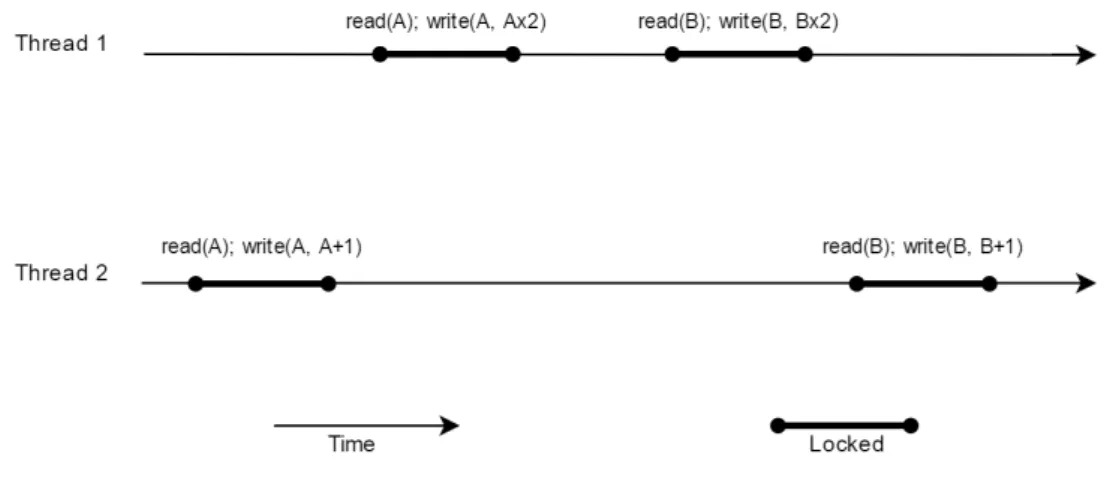
In an execution schedule, when there are multiple locks used by multiple threads, non-serializable schedules are not guaranteed to be prevented. A seri-alizable schedule means that when two or more threads contain read or write instructions, they can be reordered into an new schedule which is equivalent to a serial schedule [44](for example, where one thread’s instructions all precede the others’). However, some instructions are in a causal order and cannot be re-ordered without infringing the results of previous instructions if one thread reads or writes to shared data which another thread has written to. Figure 2.1 shows an execution schedule which is not serializable. In this figure:
1. Thread 1 cannot precede Thread 2 as item A is written to by Thread 2 and then read by Thread 1.
2. Thread 2 cannot precede Thread 1 as item B is written to by Thread 1 and then read by Thread 2.
Figure 2.1: An Example of a Non-Serializable Schedule.
Reordering these instructions in a new order so that either thread executes strictly in serial is impossible. It is assumed that there is a constraint that shared data A and B must always hold the same values and there would be no solution for these threads to execute without violating the constraint because of the non-serializable schedule.
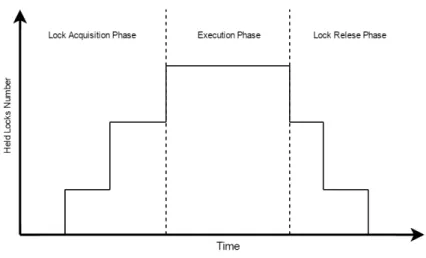
However, two-phase locking (hereafter 2PL) can resolve this problem without resorting to locking shared data unnecessarily, although it reduces the potential concurrency [16]. To utilize a 2PL, threads have to process an acquisition phase and a release phase (Figure 2.2 shows). A thread has to acquires all the locks it needs to guarantee exclusive access in the acquisition phase. If one thread has locked all necessary locks, then it can be able to access and modify shared data and subsequently release all acquired locks in the release phase. In such a way, the constraint on shared data A and B will not be violated, because Threads 1 and 2 have to initially lock both shared data and then process access and modification operations.
Figure 2.2: Two Phase Locking : This graph shows a single processor gradually acquiring locks, executing after obtain all lock and then releasing locks gradually.
Besides locking, the timestamp is another method used to enforce concurrency control, especially in some database applications [51]. A timestamp is basically a value conferred on every thread whenever there is concurrent access to shared data, following these rules:
1. Each participated thread should have a unique timestamp;
2. The orderings of multiple concurrent actions must be able to be identified by timestamps;
The timestamps should also deal with out-of-order accesses. For example, there is a database of multiple shared data, and a timestamp would be generated whenever read or write by a thread happens to indicate the order of those reads and writes to keep a sequential order. But as thread communication is asyn-chronous in nature, some accesses can be received out of timestamps order, and this kind of accesses should be detected and aborted.
Obviously this kind of aborting can reduce the performance of parallel ex-ecution, especially when there are hug numbers of requests should be aborted. However, buffer is proposed to improve the reduced performance by this. Not like always requiring the server to deal with requests whenever they arrive, all re-quests can join a buffer for a specified duration instead. And after some extended
behaviour of the application, an order of buffered access requests can be selected to reduce the aborted accesses number. The difficulty in applying this technique into application is the duration of requests buffered time and the amount of stored requests.
There are three frequently implemented methods of timestamp [1]:
1. System clocks. Timestamps can be generated from the system clock on the host platform;
2. logical clocks. Timestamps can also be generated from simply increasing integer values, which is called a logical clock;
3. Some others methods use a combination of system clock and logical clock. For example, when applying timestamps to distributed systems, as each site has a unique ID, a logical lock can be appended to the ID to form a timestamp which is unique to a specific thread on a specific site.
Timestamps are better for hosts over geographically distributed systems than locking because of the high latency of inter-host communication. However, the following issues should be processed appropriately when implementing concur-rency control with timstamps:
Resolution. When using clocks as timestamps, the granularity of timing must be sufficiently accurate to make sure that timestamps are unique values even when generated very close in time.
Locking. Irrespective of whether system clocks or logical clocks are used, some concurrency control mechanism is also required to ensure the uniqueness of timestamps for each thread, for example, and atomic increase to a counter.
Bounds. As memory is not infinite in any site, a maximum number of values that can be represented needs to be clear. And further care should be taken when the value of a timestamp is going to exceed the capacity of memory, in order to ensure that no error will occur.
2.1.4
Transactions
The term transactions used for concurrency control on general purpose multi-processor platforms has involves similar principles to those applied in database
applications. In a database system, many concurrent clients apply changes to the database in the form of transactions which contains all of the modifications a client wishes to commit. And modifications in a transaction can be either all successfully committed or all failed [24]. A database manager with some programmer defined rules will resolve conflicts between requested transactions so that the client can be liberated from the complexity of concurrent programming. Figure 2.3 shows an example of a time-line with three threads trying to commit transactions. As there is a contention (updates to the same memory location) between the transactions committed by thread 1 and thread 2, thread 2 must abort its transaction and retry it. However, although thread 1 and thread 3 try to commit transactions at the same time, as there is no interference between them, they can both commit their transactions.
Figure 2.3: An Example of Transaction Contention.
The principles of how database systems manage concurrency are based on the ’ACID’ regulations [22]:
1. Atomicity: all actions made by a transaction must take place entirely or not at all;
2. Consistency: the behaviours of transactions must be validated to meet all rules set by the database;
3. Isolation: all behaviours of a transaction must be isolated from other threads until it has been committed successfully;
4. Durability: all transactions should have their effects remain after commit, even in an event such as power loss.
If all transaction managers observe these ACID rules then a generalised trans-actional system can be provided, which is lacking in pessimistic approaches. Fur-thermore, atomicity and isolation are especially useful for multi-processor plat-form applications as they treat multiple operations on shared data within a single atomic section. In this way operations on shared data can be composed optionally to reduce the difficulties of concurrent programming with intricate interactions.
However, there are still two major problems that transactional memory needs to solve, namely:
1. High Contention. As threads must abort and retry all executions that encounter interference, a lot of the work accomplished by thread may be wasted, especially when the contention rate for shared data is high.
2. Starving. Another main drawback is that some transactions may always be in the position of being aborted and rolled-back [52]. For instance, if there is a long transaction and many short transactions continuously come in, if the long transaction always conflicts with the short transactions, then it might never be able to commit.
To solve these problems, a contention management policy(CMP) is required, which is discussed in Section 2.3.4.
In parallel programming practice, transactional memory fall into two main areas:
1. Hardware Transactional Memory (HTM): this is a solution for modifying cache protocols and architectural design to provide some functionality to transactional memory semantics. The execution speed usually exceeds the software transactional memory.
2. Software Transactional Memory (STM): this is a generalised programme implementation of transactions that apply ACI rules for threads accessing shared data. The flexibility and dispensability of modifying hardware are the main advantages compared to hardware transactional memory;
Hardware Transactional Memory
It is not only restricted to software applications when implementing transac-tional memory, but hardware transactransac-tional memory (HTM) is also an area where transactional memory can be implemented. The main idea is to modify the hard-ware architecture to provide some features for supporting transactions in HTM, specifically:
1. a mechanism to provide isolation when threads execute instructions;
2. a mechanism to detect conflicts in the consistency of data;
3. a mechanism to undo or roll-back committed results.
The techniques used by HTM have been extended from those used to deal with the consistency of data held within processor and memory caches such as cache coherence protocols, speculative execution techniques and memory consis-tency models [5]. Cache coherence protocols can detect inconsistent data held in multiple versions by different caches. In this way, threads are allowed to effec-tively execute many instructions in isolation from other threads as a significant aspect of the transactional memory. And speculative execution techniques enable processors to execute instructions in a different order from the program’s order and then roll-back to a previous state if any inconsistencies occur. With its help, threads are able to try different of instructions orders and roll-back to a consis-tent state if necessary. Finally, memory consistency models allow processors to detect and forbid errors introduced by executing instructions out of the program’s order. This can support a thread in executing atomic instructions and detecting conflicts.
Software Transactional Memory
There are a lot of techniques which aim to provide transactions implemented in software. With the ACI rules, concurrency control can be achieved in an application level. As it is more flexible and easier to experiment compared to the use of hardware transactional memory, STMs can be easily integrated with programming language and provide a light prototype solution. However, the performance and bottleneck of improvement tends to be worse than with HTM, and numerous studies have been carried on to reduce those defects.
Many STM techniques have been devised at the time of writing, and they can often be categorised in three types of methods: the granularity of shared data, overheads of updating shared data, and the synchronization mechanism in accessing shared data.
STMs can fall into two approaches if the granularity is differentiated:
1. Object based STMs – here data is represented as objects in this kind of solution. An object is a composed concurrent data structure. As it is similar to Object Orientated language in nature, it can easily be integrated into that kind of programming languages(e.g. DSTM2 [26]).
2. Word based STMs – the granularity of shared data is memory words in this kind of solution, so it involves a lower-level of concurrency than object based STMs(e.g. TinySTM [45]).
Also, when considering the overheads associated with accessing shared data, two modes are available:
1. Deferred update – the updating of shared data is not really accomplished during the transaction, but is enacted a cope-in thread local cache. After the whole transaction finishes, all updating then takes place from private caches to the shared data;
2. Direct update – the updating of shared data is directly made on the original version, which can reduce the overheads of creating local thread copies. The consistency of shared data can be achieved by restricting shared data to one thread at a time. And when a conflict over shared data acquisition occurs, a contention management scheme should be consulted to decide which one must abort.
Besides this, STM approaches can be divided into two kinds with regard to the technique of synchronization employed of accessing data:
1. Obstruction-free – In an obstruction-free STM model, if a thread executes in isolation at any point, it will make progress with its transaction(whether commit or abort). For instance, a numerical marker can be set for shared
data, and when threads read the shared data, they read the marker as well. Threads will compare the previous read marker and the current marker when they try to update and if they match, then committal can be accom-plished and consistency is guaranteed; otherwise, they need to abort.
2. Lock-based – In a lock-based STM model, the short critical sections guarded by locks allow ownership of shared data. A deadlock needs to be settled cautiously by methods such as maximum attempt limitation or prioritising.
Every different approach to shared data access has its own benefits and over-heads. Most STMs combine several approaches for different purposes. Addition-ally, a significant feature of all STMs is the contention management policy(CMP). This is consulted to decide which thread can progress when threads confront con-flicts in trying to access shared data. When the number of threads and the conflict rate are low, the CMP seems to be less important. However, if the concurrent resource is numerous and the conflict rate is high, it becomes a non-negligible task to ensure that all threads can execute as expected.
2.1.5
Contention Manager
As mentioned above, the two main issues in Transactional Memory are high con-tention and starving. As more transactions execute concurrently, there are more likely to be contentions for access to shared data, which may lead to a greater frequency of aborting or rolling-back transactions and the overall performance of the programme could be reduced. To mitigate the time wasted caused by this, contention management is required for STMs to reduce the frequency of occur-rence of aborted transactions. A variety of studies of contention management have been carried out and various of approaches have been implemented which can be divide into the following categories:
1. Exception-based. The way to deal with aborting transactions is to leave it to the programmers to decide. Exception handling only provides a mecha-nism in programming languages to support throw and catch semantics for exceptions;
2. Wait-based. This kind of contention management typically solves interfer-ence between threads by just allowing one thread to proceed while aborting other threads and forcing them to wait for a period of time before retrying.
3. Serializing. Rescheduling the execution of aborted transactions is the main method for resolving conflicts between threads. This is different from wait-based approaches, in the serializing solutions often need to allocate transac-tions to threads so that aborted transactransac-tions can be executed by one single thread(sequentially) in order to avoid further conflict.
With the exception-based approach, the programmer can benefit from cus-tomized solutions to contention which are more flexible and can be more suitable for a single application. However, the main burden of conflict-solving still falls on application programmers.
Plenty of approaches to solve contention exist in wait-based CMPs. For in-stance, Polite, Karma and Polka [21,46] are well-known approaches which are rel-atively straightforward to implement, offering versatility and good performance. The CMP in Polite will abort one transaction if two transactions conflict, and will then increase the back-off time before retrying to avoid another conflict before the winning one finishes. Karma uses priorities for each transaction, and aborts the one with lower priority when conflict occurs. The main idea is to abort the trans-action with the least cost associated with rolling it back. Polka is a combination of Polite and Karma, and uses an exponential back-off time period for aborted transactions. An inefficiency of wait-based approaches has been identified [25], however, as the dynamic nature of the execution of STM leads to difficulty in finding an adequate back-off period.
Serializing CMPs typically reschedule or serialize aborted transactions. An example has been described [3] whereby transactions are distributed among the threads of the application, with transactions that are likely to conflict being assigned to the same thread, thus assuring serialization. In Ansari’s study a Stealon-Abort approach is described in which various techniques are considered for rescheduling transactions amongst threads, with additional work-queues cre-ated when the number of transactions passes a threshold [2]. A collision avoid-ance and resolution approach to schedule-based CMP was also been described [11]
which also reassigns conflicting transactions to the same work thread.
2.1.6
Semantic resolving Contention Manager
Several approaches to implementations of STM have been developed to solve semantic conflict by employing a universal construction (UC) [31]. This con-cept enables multiple threads to access a shared data structure in a wait-free manner. The UC technique was subsequently applied to transactions to handle particular failure conditions [8, 53]. The approach was further extended to re-move the abort semantics of STM [9]. Thread level speculation is introduced to transactional memory [4]. In this approach, platform parallelism is exploited to explore different permutations of transactional elements. This is achieved by reordering the internal execution elements of a particular transaction to better reflect concurrent schedules of execution. This technique reorders execution at a lower level than that presented the present study which seeks to reschedule whole transactions to better accommodate the semantics of execution.
More recently, a CMP described has used a UC technique to resolve conflicts (labelled Hugh2) [47, 48]. The threads which are considered are those which contain transactions that have been aborted due to semantic conflicts within the context of a session. The technique was first presented for object-based STM [48] and then extended to resolve semantic conflicts in word-based software transac-tional memory [47]. Universal Construction allows any sequential data structure to be transformed into a linearisable representation that can be accessed and updated by a number of threads [31]. The UC consists of three phases. Firstly, a thread proposes an input to be added to the UC. Secondly, each thread which has proposed an input reaches a consensus to decide which input will be added. Finally, the winning thread updates a log of inputs to reflect the decision. Hugh2 accepts as input a permutation of one or more sequentially executed transactions and decides which permutation will be added to the log. This approach to CMP for STM was the first to use additional threads to provide multiple serialized executions of aborted transactions in parallel. This was achieved without the overhead of a thread-pool.
2.1.7
Summary
This section has explained the demand for concurrency control in parallel com-puting, and some basic methods. Most focus is currently on concurrency control as transactional memory as this is a general solution that can avoid the need for programmer of data correctness and preventing deadlock. However, differ-ent ideas of dealing with contdiffer-ention can lead to huge differences in performance, which makes a contention manager one of the most important parts of trans-actional memory. The next section discusses different parallel architectures and how these can provide concurrency control mechanisms for programmers.
2.2
Parallel Architectures
Traditionally, a computer is built in a single core architecture, and most com-puter software is written for serial computation. Moore predicted that chip per-formance would double every 18 months so that sequential programming can be easily enhanced by hardware [39]. However, from the beginning of the 21st cen-tury, multi-core processor platforms have appeared in CPU architecture and have become the main trend since integrating more cores is cheaper than improving frequency for a single core to provide the same speed-up for the CPU. Since then, the CPU has turned into a commonly used platform for parallel computing.
Developments in modern graphics processing units have attracted significant interest partly due to the fact that they can now accelerate applications not only in traditional computer graphics domains, but also in general purpose domains. General-Purpose GPU (GPGPU) applications provide a different architecture from Central Processing Units (CPUs). For example, a modern CPU architecture is typically optimized for low-latency access to cached data, and offers sophisti-cated control logic for out-of-order and speculative executions. For this purpose, the CPU has a larger cache and stronger control units than a GPU. The GPU, conversely, has more parallel processing elements than a CPU. As such, a GPU application can access and exploit a far greater number of threads.
2.2.1
Hardware
There are two different types of main memory in a parallel computer, which are known as shared memory and distributed memory. In a shared memory parallel computer, memory is shared between all processing elements in a single address space, and in a distributed memory parallel computer, each processing element has its own logical address space (normally in physical as well). If all elements of main memory can be accessed in the same bandwidth, it is called a uniform memory access (UMA) system, otherwise it is known as a non-uniform memory access (NUMA) system [37].
Depending on the different levels of hardware, parallel computers can be clas-sified as multi-core computing, symmetrical multiprocessing, distributed comput-ing, cluster computcomput-ing, massively parallel computcomput-ing, and grid computing. Multi-core computing has multiple processing units (know as Multi-cores) integrated in the same chip, whereas symmetrical multiprocessing means multiple identical proces-sors that share memory and connect via a bus. Meanwhile, distributed computing is obviously a distributed memory computer system in which all processors are connected via a network, and cluster computing is a close group of loosely cou-pled computers. Massively parallel computing indicates a single computer but with many network processors, and finally grid computing means computers com-municating via the internet to solve a given problem. As this thesis focuses on single chip computers, the next sections introduce the single multi-core processor for the CPU and the single graphic card for the GPU, both of which are UMA systems.
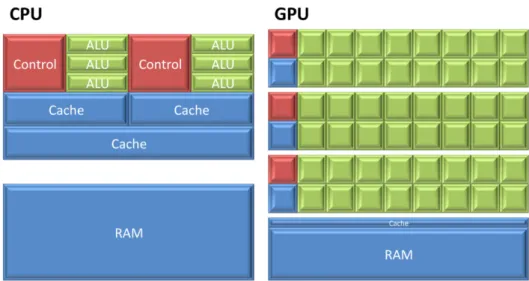
Although both architectures are suitable for recent parallel computing, there are still significant differences in their nature. As Figure 2.4 shows, the CPU usually has several Arithmetic Logical Units which can be treated as processors since they provide most of the computational power. However, as the CPU is designed to be more suitable for an operating system, it has to employ most of its transistors on features for that purpose. For example, a large on-chip cache is applied in the CPU together with further control units (such as instruction reorder buffers and reservation stations). In these ways it can optimize the execution speed of a single thread and is more suitable for most operating systems. As a
Figure 2.4: Differences between CPU and GPU Architectures.
result, the CPU can perform better for complex operations on a single or a few streams of data, but it is not that good for handling many streams simultaneously. On the other hand, as the GPU is designed to execute parallel streams of instructions as quickly as possible, as Figure 2.4 shows, a GPU employs more transistors in processor arrays, multi-threading hardware, and multiple memory controllers which do not focus on a particular thread but support tens of thou-sands of threads to run concurrently with a high memory bandwidth. In such a way, the GPU excels over the CPU in areas which require more parallelism such as video processing and physics simulations which execute simple operations on large amounts of data [42]. However, GPU memory is very limited compared to the CPU as the latter can use virtual memory while the GPU cannot, and GPU execution units do not support hardware interrupts in the same way CPUs do.
As a result of different design patterns, the CPU can only support one or two threads per core, while a CUDA capable GPU can support up to 1024 threads per streaming multiprocessor. CPU takes hundreds of cycles to switch threads but the GPU has little cost in switching threads. To reduce the latency of memory access, the CPU can use its large caches and branch prediction hardware while the GPU switches to another thread when one thread needs to wait for a memory reading.
2.2.2
Execution
To design a proper algorithm for GPU computing, it is necessary to take into ac-count the differences in execution between the CPU and the GPU. The execution for a multi-core CPU is quite similar to that of a single thread, except that more threads can work together on the same task. Tasks are allocated to the CPU all the time and the results are calculated continuously.
In this thesis, the NVIDIA introduced CUDA (Compute Undified Device Ar-chitecture) is used as the GPGPU computing API for the graphics card hardware, and this section explains how CUDA executes.
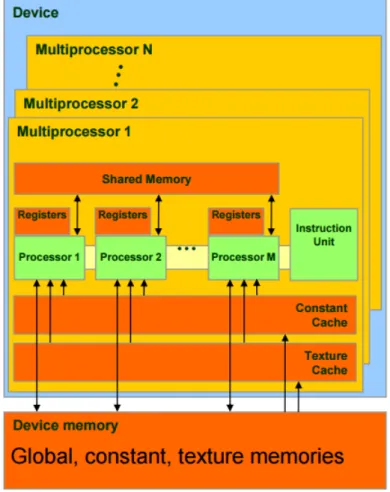
Figure 2.5 shows an abstract architecture of a CDUA device. CUDA ap-plications can run on any card which supports this architecture, but as each GPU device has different specifications, they may have slightly different sets of supported features and different numbers of available computational resources. However, any CUDA supported device should have some Streaming Multipro-cessors (SMs), and each of which consists of some processor cores (ALUs), one multi-thread instruction unit, a shared memory and a set of registers [43].
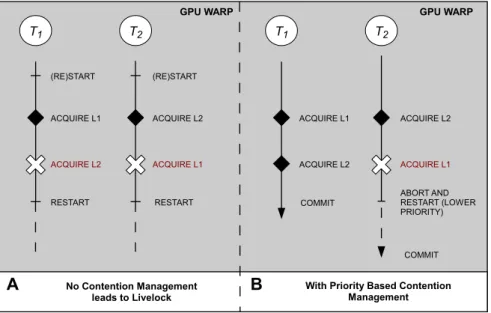
Whenever a CUDA application is launched, and if it needs to use GPU re-sources for computation, a ‘kernel’ has to be invoked to match the work-flow from the CPU to the GPU, and a specified number of primitive threads will simulta-neously execute that work-flow. Batches of these primitive threads are organized into ‘thread blocks’. The amount of primitive threads within a thread block is specified by the programmer, but is also limited by the amount of available shared memory as well as the desired memory access latency hiding characteristics. At the same time, a total of 512 threads for one ‘thread block’ is the upper limit set by the architecture. One or more ’thread blocks’ are assigned to an SM during the execution of a kernel, and CUDA run time handles their dynamic scheduling to a group of SMs. The scheduler will only assign a thread block to a SM when it has enough resources to support that thread block. Then after a thread block is assigned to a SM, it will be further divided into ‘warps’ which each contain 32 threads and share the same instruction counter. If flow-control statements (e.g if-then-else) are introduced to the program, a possibility of thread divergence is also introduced. Thread divergence occurs when some threads in the same warp
Figure 2.5: CUDA Device Architecture.
follow a different execution path from others. In this circumstance, threads fol-lowing one path execute first, while other threads folfol-lowing different paths are suspended, then after this path is completed, other threads will execute while the current executing threads are suspended. This is called a ‘lock-step’ process and is one of the aspects most different from CPU parallel computing. After all threads in a kernel have finish their assigned tasks, the results data would be stored in GPU global memory and the programmer can copy them from there to the CPU memory for further use.
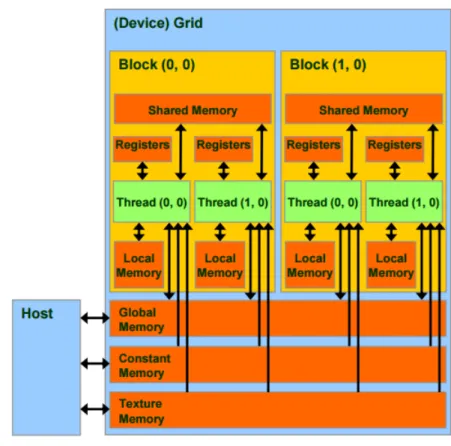
There are several levels of memory in a GPU device as Figure 2.6 shows, and each of them has its own read and write characteristics. Every primitive thread has access to private ‘local’ memory and registers. This ‘local’ memory merely means that the memory is private to the thread, but does not mean that it is
Figure 2.6: CUDA Memory Architecture.
stored locally on the thread registers. Instead, it is actually an off-chip memory in the global GDDR memory available on the graphics card. A unified ‘shared memory’ is located in an SM, which is shared among all threads of the same thread block. Finally, all threads have read and write access to ‘global memory’, which is located off-chip on the main GDDR memory, and is not cached. Therefore, it has the largest capacity but also costs the most to access. There also exists read-only ‘constant’ and ‘texture’ memory, which are in the same location as global memory but can be accessed more quickly as sometimes they may be cached. Those three types of memories located in the main GDDR memory and can be accessed by the CPU. While global memory can be read from and written to by both the CPU and GPU, read-only memories can only be initialized by the CPU.
2.2.3
Concurrency Control Operations
To produce a general purpose parallel programme, concurrency control has to carefully be implemented. And both the CPU and GPU provides basic operations to achieve this.
CPU
As the CPU has more control units on its chip, and it has been upgraded many times for control function, it has much more flexible basic concurrency control op-erations than the GPU. Normally, atomic opop-erations, and thread synchronization and communication are all available for the CPU.
Atomic operations are operations guaranteed to be isolated from concurrent processes, and for all processes processing the same atomic operation at the same time, only one can succeed while others should receive a fail use notice. Atomic operations usually affect performance, but are the basic element in implementing a lock [33]. Normally atomic operations consist of atomic read-write, atomic test-and-set, atomic fetch-and-add and atomic compare-and-swap.
Thread synchronization is also named process synchronization, and it means that two or more threads will be guaranteed to not execute simultaneously in some parts of the program (called a critical section) [17]. It can be implemented by using spin-locks, barriers or semaphores.
Thread communication can be divided into broadcasting and all-to-all com-munication. Broadcasting means that one thread can send transmit messages to all receiver threads while all-to-all communication means that threads can send transmit messages to each other. Both types are important when modifications have to be made to shared data which has been copy held by more than one thread.
With all these concurrency control primitives, the CPU can use various con-currency control methods. Transactional memory is the most advanced kind as it can peel off the most difficult tasks such as deadlock and race conditions from parallel programming, with only cost being some overhead of performance.
GPU
Although GPU applications offer more parallelism than a typical CPU appli-cation, restrictions on data access mean that the semantics of GPU applications
tend to differ significantly from those of their CPU counterparts. Applications on the GPU tend to feature large numbers of threads which are wholly independent of one another with regard to their accessing of shared data (such applications are termed embarrassingly parallel). The coordination of thread activity is mini-mal in such applications, whereas this is rarely the case in the domain of parallel programming on the CPU.
To make GPU applications more generalized, concurrency control is needed. It is also achievable on the GPU because it has basic operations which are required by concurrency control such as atomic functions and thread synchronization.
However, approaches to concurrency control on the GPU are different from those with the CPU because the former has different features, as discussed in previous subsections. For example, as mentioned before, group of GPU threads execute as a ‘warp’ and all threads in the same warp share a same instruction counter [42]. This makes the GPU threads in the same ‘warp’ can only execute the same instruction at the same time, so that strategies to operate different threads with different instructions as is suitable for CPU applications is not achievable on the GPU. For example, a frequently used method of dealing with concurrent conflict is to make conflict threads back off and to ask them to wait for a different periods of time before retrying. In such a way, conflicting threads can restart at different time points to avoid the conflict happening again. However, all GPU threads in the same ‘warp’ share the same instruction counter and always execute the same instructions [55]. If this method was applied to the GPU, threads encountering conflict would always retry the aborted instruction at the same time and conflict again. Therefore, all technologies based on this principle which work well on the CPU cannot be applied for the GPU.
Another common technology used on the CPU is broadcasting. A lot of con-currency control methods on the CPU need to broadcast modifications to shared data from one thread to all other threads attempting to read or write the same shared data. But on the GPU, threads cannot communicate with each other directly, because inter-threads communication occurs only via global memory. However, seting a monitor to a global memory address is expensive since many threads have to access that address frequently, and even in this way the amount content which can be communicated is very limited. Hence none of the
technolo-gies based on broadcasting are suitable for GPU concurrency control.
As a result, some new principles for concurrency control on the GPU need to be explored. Current researches into concurrency control, and especially on transactional memory on the GPU, is being carried out by different groups around the world.
2.2.4
Summary
This section has compared the different features of CPU and GPU in both hard-ware and softhard-ware layers. We can see that the CPU is better for conducting parallel computation that involves complicated thread execution, but provides fewer threads. Meanwhile, the GPU is excellent with simple multiple work on large amount of data. And although their execution modes are different, both require concurrency control and this can be approached in different ways. At the moment, concurrency control on the CPU is very advanced and has resulted in many transactional memory approaches developed to remove concerns about deadlock from the programmer. The GPU can also get considerable benefits from transactional memory as it is easy to use, but performance is slightly worse. The next section introduces some famous types of transactional memory on the CPU and some which have been recently developed for the GPU.
2.3
Related Work
As mentioned before, in blocking synchronization algorithms, mutual exclusive access to critical section is used which is usually guaranteed by locks. When a process tries to acquire a lock that has already been obtained by another process, it needs to stay in a waiting state until that lock is released. And this waiting state can cause various problems such as deadlock. However, the use of a non-blocking synchronization algorithm manes that no waiting state is needed and so many problems can be avoided. Some new problems such as live-lock can be introduced by non-blocking synchronization, but they can be effectively solved by contention management. As non-blocking synchronization has many benefits compared to blocking synchronization, and since transactional memory is a
typi-cal non-blocking synchronization construct that has been researched for decades, the present study also uses software transactional memory to resolve concurrency control. The following sections we will introduce some previous research con-ducted in this area.
2.3.1
Transactions on CPU
The First Software Transactional Memory
The idea of transactional memory was firstly proposed by Herlihy and Moss in [32], who described an architecture that extended multiprocessor cache coher-ence protocols. In this protocol, instructions would be stored in an instruction set provided by the system for access to shared memory positions. After this proposal, a more delicate system called Software Transactional Memory was im-plemented by Shavit and Toutitou [49]. Here, a system-wide declaration would be made if a transaction tried to update a shared memory location. This decla-ration is actually the owner of a particular concurrent object and referenced to that specific shared memory location. As a result, all other transactions can know that an update is being made to this location. After the update has succeeded, the ownership of this concurrent object should then be released. Both acquiring and releasing ownership of a concurrent object should be done atomically using the atomic compare and swap operation. To guarantee the correctness of the result, ownership must be exclusive, which means that at any given time each concurrent object can only have at most one owner.
In Shavit and Touiton’s design, a concurrent object is a shared memory word, and each global declaration is another word called an ownership record. Con-current objects and ownership records are associated one of each. The value of the ownership record can either be a null, which means no owner at all, or a ref-erence to its owner transaction. Obviously, one ownership record can only have one owner transaction at any time. A transaction would try to own all ownership records it needs one by one, and it will release all of its acquired ownership records if it fails to acquire any ownership (when a concurrent object is already owned by another transaction). After it has acquired all of the ownership records it desires, it would commit the updates and then release all acquired ownership records. As