Flash-aware Database Management Systems
Hardock, Sergej (2020)
DOI (TUprints): https://doi.org/10.25534/tuprints-00014476 License:
CC-BY-SA 4.0 International - Creative Commons, Attribution Share-alike Publication type: Ph.D. Thesis
Division: 20 Department of Computer Science
Computer Science Department
Technical University of Darmstadt
Data Management Lab
Flash-aware Database
Management Systems
Zur Erlangung des akademischen Grades Doktor-Ingenieur (Dr.-Ing.) Genehmigte Dissertation von Sergej Hardock aus Kiew, Ukraine Tag der Einreichung: 30.7.2020, Tag der Prüfung: 4.11.2020 1. Gutachten: Prof. Dr. Carsten Binnig2. Gutachten: Prof. Dr.-Ing. Ilia Petrov 3. Gutachten: Alejandro Buchmann, Ph.D. Darmstadt
Flash-aware Database Management Systems Accepted doctoral thesis by Sergej Hardock 1. Review: Prof. Dr. Carsten Binnig
2. Review: Prof. Dr.-Ing. Ilia Petrov 3. Review: Alejandro Buchmann, Ph.D. Date of submission: 30.7.2020
Date of thesis defense: 4.11.2020 Darmstadt
Bitte zitieren Sie dieses Dokument als: URN: urn:nbn:de:tuda-tuprints-144769
URL: http://tuprints.ulb.tu-darmstadt.de/id/eprint/14476 Dieses Dokument wird bereitgestellt von tuprints,
E-Publishing-Service der TU Darmstadt http://tuprints.ulb.tu-darmstadt.de [email protected]
Die Veröffentlichung steht unter folgender Creative Commons Lizenz: Namensnennung - Weitergabe unter gleichen Bedingungen 4.0 International https://creativecommons.org/licenses/by-sa/4.0
This dissertation is dedicated to my parents who encouraged me to
follow my dreams.
Erklärungen laut Promotionsordnung
§8 Abs. 1 lit. c PromO
Ich versichere hiermit, dass die elektronische Version meiner Dissertation mit der schriftli-chen Version übereinstimmt.
§8 Abs. 1 lit. d PromO
Ich versichere hiermit, dass zu einem vorherigen Zeitpunkt noch keine Promotion versucht wurde. In diesem Fall sind nähere Angaben über Zeitpunkt, Hochschule, Dissertationsthe-ma und Ergebnis dieses Versuchs mitzuteilen.
§9 Abs. 1 PromO
Ich versichere hiermit, dass die vorliegende Dissertation selbstständig und nur unter Verwendung der angegebenen Quellen verfasst wurde.
§9 Abs. 2 PromO
Die Arbeit hat bisher noch nicht zu Prüfungszwecken gedient.
Darmstadt, 30.7.2020
Acknowledgments
First, I would like to thank my supervisors Ilia Petrov and Alejandro Buchmann. My interest in database management systems, which continuously evolved over the years, began back in year 2010 with your exciting lectures. After different projects and Master thesis done under your supervision, it was a great pleasure to get an offer to work as PhD student in your team. Without your support, help and guidance I would not be able to finish this dissertation.
I wish to thank all other members of defense committee Carsten Binnig, Andreas Koch, Christian Bischof and Max Mühlhäuser for meaningful and fruitful discussions, comments and suggestions.
Many thanks to my former colleagues Robert Gottstein, Daniel Bausch, Dejan Petkov, Alexander Frömmgen and Robert Rehner. Your support has helped me a lot during the research. I really appreciate the work and spare time we spent together at university and on conferences. I like to express my gratitude to Maria Tiedemann for the help in lots of organisational topics.
I had great pleasure of working with undergraduate students Sruthi Parvathy Subra-manian, Mohan Kanth Dayanandan and Elena-Madalina Cososchi. Thank you for your contribution to this project.
Special thanks to my family, especially to my dear parents. Your support and belief in me helped me in various difficult moments over these 6 years. You did not let me give up at the final, most difficult steps.
Abstract
Flash SSDs are becoming the primary storage technology for single servers and large data centers. In contrast to conventional magnetic disks, which were dominating the storage market for more than 40 years, Flash offers significantly more performance, consumes less energy and has lower cost per IOPS (I/O Operations Per Second). Besides these advantages, an important role in establishment and quick proliferation of Flash storage was played by the black-box design of SSDs, which guaranteed their backwards compatibility with the traditional hard disk drives. This makes the replacement of HDDs seamless as the software stack, including the application, does not require any adjustment. However, such design of SSDs has multiple disadvantages, which become especially critical for database management systems.
The backwards compatibility of SSDs is encapsulated in the so-called Flash translation layer (FTL). FTL is a set of Flash management tasks that typically run on device and mask the native behavior of Flash memory. In other words, FTL creates a black-box over Flash memory and emulates the behavior of HDDs. The fact that the database system has no knowledge about FTL, and has no control over the physical data placement on Flash, results in high I/O overhead, which is caused by suboptimal realization of Flash management tasks and functional redundancy along the critical I/O path. Thus, write-amplification of conventional SSDs used in traditional ’cooked’ storage architecture (i.e., with file system indirection) can be as high as 15x, i.e., a single 4KB write request submitted by the DBMS can turn into 60KB being physically written on Flash storage. As a result, the effective I/O throughput and longevity expectations of SSDs are significantly lower than those of Flash memory encapsulated in these SSDs.
In this work we describe our approach - the NoFTL storage architecture - that aims to solve the aforementioned disadvantages of modern Flash SSDs. The basic idea behind the NoFTL is to give the full control over the underlying Flash storage to the database management system, which in turn assumes elimination of all intermediate abstraction layers (file system, block device layer and FTL) between the DBMS and physical storage. NoFTL consists of three main elements - (i) native Flash interface; (ii) integration of Flash management into subsystems of the DBMS; and (iii) the concept of configurable Flash storage. The interplay of them allows us to realize the whole performance potential of
Flash memory. Native Flash interface allows the DBMS to control physical data placement on Flash storage, and to utilize the computational power of the SSD to perform near-data processing. Integration of typical Flash management tasks (address translation, garbage collection and wear leveling) into different subsystems of the DBMS leads to an optimization of these tasks and of native DBMS algorithms. The concept of configurable Flash storage is a unique approach to organize and manage data on Flash SSDs. With the help of novel storage abstractions, the database system can perform intelligent data placement by clustering objects into different regions. Moreover, for each such region the DBMS can apply a separate set of Flash management algorithms, which would be optimal for data assigned to that region.
All this reduces the write-amplification of SSDs to a minimum (up to 15x reduction for OLTP workloads), improves the overall system performance, and significantly increases the lifetime of Flash SSDs (up to 30x improvement). We have realized the NoFTL prototype on an open-source database engine and evaluated it under various scenarios and on different testbeds.
Zusammenfassung
Flash-SSDs werden zur primären Speichertechnologie für einzelne Server und große Rechenzentren. Im Gegensatz zu herkömmlichen Festplatten, die mehr als 40 Jahre lang den Speichermarkt dominierten, bietet Flash deutlich mehr Leistung, verbraucht weniger Energie und hat geringere Kosten pro IOPS (I/O-Operationen pro Sekunde). Eine wichtige Rolle bei der Etablierung und schnellen Verbreitung von Flash-Speichern spielte neben diesen Vorteilen auch das Black-Box-Design von SSDs, wodurch deren Abwärtskompatibi-lität mit den herkömmlichen Festplatten garantiert wurde. Dies macht den Austausch von Festplatten nahtlos, da der Software-Stack einschließlich der Anwendung keine Anpassung erfordert. Ein solches Design von SSDs weist jedoch mehrere Nachteile auf, die für die Datenbankverwaltungssysteme besonders kritisch werden.
Die Abwärtskompatibilität von SSDs ist in der sogenannten Flash Translation Layer (FTL) eingekapselt. FTL ist eine Reihe von Flash-Verwaltungsaufgaben, die normalerweise auf dem Gerät ausgeführt werden und das native Verhalten des Flash-Speichers mas-kieren. Mit anderen Worten, FTL erstellt eine Blackbox über dem Flash-Speicher und emuliert das Verhalten von Festplatten. Die Tatsache, dass das Datenbanksystem keine Kenntnisse über FTL und auch keine Kontrolle über die physische Datenplatzierung auf dem Flash hat, führt zu einem hohen I/O-Overhead, der durch die suboptimale Realisie-rung von Flash-Verwaltungsaufgaben und funktionale Redundanz entlang des kritischen I/O-Pfades verursacht wird. Somit kann der Schreibfaktor (write amplification) herkömm-licher SSDs, die in der üblichen "cookedSSpeicherarchitektur verwendet werden (d.h. mit Dateisystem-Indirektion), bis zu 15x sein. So kann eine einzelne 4KB Schreibanforderung, die vom DBMS gesendet wird, bis zu 60KB werden, die physisch auf dem Flash-Speicher geschrieben sind. Infolgedessen sind der effektive I/O-Durchsatz und die Langlebigkeits-erwartungen von SSDs erheblich niedriger als die von in diesen SSDs eingekapselten Flash-Speichern.
In dieser Arbeit beschreiben wir unseren Ansatz - die NoFTL-Speicherarchitektur, der darauf abzielt, die oben genannten Nachteile moderner Flash-SSDs zu lösen. Die Grun-didee hinter der NoFTL besteht darin, dem Datenbankverwaltungssystem die vollstän-dige Kontrolle über den zugrunde liegenden Flash-Speicher zu geben, was wiederum die Eliminierung aller zwischengeschalteten Abstraktionsschichten (Dateisystem,
Block-Geräteschnittstelle und FTL) zwischen dem DBMS und dem physischen Speicher vor-aussetzt. NoFTL besteht aus drei Hauptelementen: (i) native Flash-Schnittstelle; (ii) Integration des Flash-Managements in Subsysteme des DBMS; und (iii) das Konzept des konfigurierbaren Flash-Speichers. Das Zusammenspiel ermöglicht es uns, das gesamte Leistungspotential des Flash-Speichers auszuschöpfen. Mit der nativen Flash-Schnittstelle kann das DBMS die Platzierung physischer Daten auf dem Flash-Speicher steuern und die Rechenleistung der SSD für die datennahe Verarbeitung nutzen. Die Integration typischer Flash-Verwaltungsaufgaben (Adressumsetzung, Garbage Collection und Wear-Leveling) in verschiedene Subsysteme des DBMS führt zu einer Optimierung dieser Aufgaben und als auch Optimierung nativer DBMS-Algorithmen. Das Konzept des konfigurierbaren Flash-Speichers ist ein einzigartiger Ansatz zum Organisieren und Verwalten von Daten auf Flash-SSDs. Mithilfe neuartiger Speicherabstraktionen kann das Datenbanksystem eine intelligente Datenplatzierung durchführen, indem Objekte in verschiedenen Regionen gruppiert werden. Darüber hinaus kann das DBMS für jede dieser Regionen einen separa-ten Satz von Flash-Verwaltungsalgorithmen anwenden, die für Dasepara-ten, die dieser Region zugewiesen sind, optimal wären.
All dies reduziert den Schreibfaktor von SSDs auf ein Minimum (bis zu 15-fache Redu-zierung für OLTP-Workloads), verbessert die Gesamtsystemleistung und verlängert die Lebensdauer von Flash-SSDs erheblich (bis zu 30-fache Verbesserung). Wir haben den NoFTL-Prototyp auf einer Open-Source-Datenbank-Engine realisiert und unter verschiede-nen Szenarien und auf verschiedeverschiede-nen Testumgebungen evaluiert.
Contents
Glossary xvii
List of Figures xix
List of Tables xxii
1. Introduction 1
1.1. Scope . . . 1
1.2. Problem Statement . . . 2
1.3. Proposed Approach . . . 8
1.4. Contributions . . . 10
1.5. Structure of the Thesis . . . 12
2. Background 13 2.1. DBMS . . . 13
2.1.1. Evolution . . . 13
2.1.2. Architecture of Relational DBMS . . . 15
2.2. DBMS Storage Alternatives and I/O Stack . . . 19
2.2.1. Cooked Storage . . . 20
2.2.2. Raw Storage . . . 24
2.2.3. Block-Device Layer . . . 26
2.3. Flash . . . 27
2.3.1. NAND Flash Memory . . . 28
2.3.2. Flash SSD . . . 37
3. NoFTL Approach 55 4. Native Flash Interface 71 4.1. Command Set . . . 71
4.2. User-Defined Commands . . . 72
5. DBMS Integration 75
5.1. Address Translation . . . 76
5.2. Atomicity of Writes . . . 77
5.3. Garbage Collection and Wear-Leveling . . . 78
5.4. Parallelism . . . 79
5.5. Recovery . . . 80
5.6. Evaluation Results . . . 81
6. Configurable Flash storage 87 6.1. NoFTL Regions . . . 90
6.1.1. Data Placement with Regions . . . 90
6.1.2. Region-Specific Flash Management . . . 93
6.2. NoFTL Groups . . . 98
6.3. Evaluation Results . . . 101
7. In-Place Appends 111 7.1. Revisiting Erase-Before-Overwrite Principle . . . 113
7.2. Design and Implementation Details of IPA . . . 116
7.2.1. Page Layout for IPA . . . 117
7.2.2. Page Operations under IPA . . . 119
7.2.3. WRITE_DELTA Command . . . 121
7.2.4. Error Detection and Correction . . . 123
7.3. Variations of IPA . . . 124
7.3.1. IPA for Indeces . . . 124
7.3.2. IPA on Different Flash Types . . . 127
7.4. Evaluation . . . 134
7.4.1. Basic IPA . . . 135
7.4.2. IPA for Indexes . . . 142
8. Auto-Tuning 147 8.1. Selection of Multi-Region Configuration . . . 147
8.2. Change of Multi-Region Configuration . . . 148
8.3. Wear-Leveling in Multi-Region Configuration . . . 156
9. Related Work 159 9.1. FTL-based SSDs . . . 159
9.2. Native Flash Storage . . . 163
9.3. IPA Approach . . . 166
9.4. In-Storage Processing . . . 167
10. Conclusions 169
11. Future Work 173
A. Appendix 187
Glossary
BBM bad-block management
BCH Bose–Chaudhuri–Hocquenghem codes
BLM block-level address mapping DBMS database management system
DDL data definition language
ECC error-correction codes FS file system
FTL Flash translation layer
GC garbage collection
HDD hard disk drive I/O input/output operation
ISP in-storage processing
ISPP incremental step-pulse programming
LDPC low-density parity-check code
MLC multi-level cell
NFI native Flash interface
NVM non-volatile memory
OS operating system
PLM page-level address mapping
QLC quad-level cell
SLC single-level cell
SQL structured query language
SSD solid-state drive
TLC triple-level cell
WL wear-leveling
List of Figures
1.1. Pillars of NoFTL approach. . . 9
1.2. Performance comparison of DBMS on different storage alternatives under TPC-C benchmark. . . 11
2.1. Module-based architecture of the relational DBMS (based on [80]). . . 15
2.2. DBMS storage alternatives. . . 20
2.3. Floating-gate transistor making a single Flash memory cell. . . 29
2.4. Cell-array architecture of the NAND Flash memory. . . 30
2.5. Latencies of basic operations for different NAND types. Source: AnandTech [98] . . . 32
2.6. Four different types of NAND Flash memory. . . 35
2.7. Simplified architecture of SSD. . . 38
2.8. Main tasks of FTL. . . 41
2.9. I/O bandwidth fluctuations of an enterprise SSD. Source: Petrov et al. [77]. 44 2.10.Example of data placement in page-level FTL. . . 45
2.11.Example of read operation in block-level FTL. . . 47
2.12.Example of write operation in block-level FTL. . . 48
2.13.Address trnaslation in hybrid FTL. . . 49
2.14.Example of merge operation in hybrid FTL. . . 50
3.1. NoFTL as a storage alternative for DBMS. Source: Hardock et al. [34]. . . 56
3.2. Integration of Flash management into the modules of the DBMS. . . 59
3.3. Example of a region configuration. . . 62
3.4. Cumulative distribution of update-sizes in TPC-B benchmark under default eager-eviction strategy with different sizes of DBMS buffer. Source: Hardock et al. [31] . . . 66
3.5. Performance comparison of DBMS on different storage alternatives under TPC-C benchmark. Figure is also presented in Chapter 1. . . 68
3.6. Comparison of write amplification and intensity of erase operations for different storage alternatives under TPC-C benchmark. . . 69
5.1. NoFTL architecture and integration of Flash management in the DBMS.
Source: Hardock et al. [34]. . . 76
5.2. NoFTL with traditional and Flash-aware strategies for background writes under TPC-C benchmark. . . 85
5.3. NoFTL with traditional and Flash-aware strategies for background writes under TPC-B benchmark. . . 85
6.1. Example of reclaiming a victim block by garbage colelction. . . 88
6.2. Hot/cold data separation using NoFTL regions. . . 91
6.3. Control of SSD parallelism using NoFTL regions. . . 92
6.4. Selective Flash management with NoFTL Regions . . . 98
6.5. Hot/cold data separation using NoFTL groups . . . 99
6.6. Comparison of write amplification and intensity of erase operations for different storage alternatives under TPC-B benchmark. . . 109
7.1. Write-amplification under OLTP workloads. Source: Hardock et al. [31]. . 112
7.2. Database page layout for IPA on Flash. Source: Hardock et al. [31] . . . . 117
7.3. Example of database page with two delta records. Source: Hardock et al. [31] . . . 119
7.4. Implementation of write_delta command on OpenSSD Jasmine board. (1) up-to-date version of a page in database buffer pool; (2) "remembered" changes since last fetch from SSD encoded as delta record in delta-record area; (3) storage manager issues write_delta command only for delta record, i.e., only delta record is transmitted to the SSD; (4) controller copies delta record into the original position in an empty page (initialized with "1"s) in DRAM buffer of SSD (write cache); (5) original Flash page on Flash with empty delta-record area; (6) through overwriting the original (PPN=7) page only the delta-record area becomes updated, while the body of the page remains unchanged. . . 122
7.5. Modification of an entry in B-Tree. Traditional approach. . . 125
7.6. Page layout and format of delta record in IPA-IDX. Source: Hardock et al. [33] . . . 127
7.7. Modification of an entry in B-Tree using IPA-IDX. . . 128
7.8. Memory organization of MLC Flash. . . 130
7.9. Program interference in MLC Flash during PROGRAM operation. CellM is being programmed; cells G, H, I, Q, R, S can experience program interference errors. . . 132
7.10.Cumulative distribution of update sizes in TPC-C under eager eviction strategy. . . 136 7.11.Cumulative distribution of update sizes in TPC-C under non-eager buffer
eviction strategy. . . 141 7.12.CDF of update sizes for index on NewOrder table in TPC-C benchmark. . . 143 8.1. Excerpt from an example ofsummaryoutput of NoFTL advisor. . . 149 8.2. Example of a migration to target NoFTL configuration. . . 151 A.1. OpenSSD Jasmine board. . . 187
List of Tables
2.1. Comparison of NAND and NOR Flash memory types. . . 28 2.2. Variety of SSDs on the storage market (Part 1). . . 39 2.3. Variety of SSDs on the storage market (Part 2). . . 40 5.1. TPC-C benchmark under different storage alternatives on OpenSSD Jasmine
board. . . 82 5.2. TPC-B benchmark under different storage alternatives on OpenSSD Jasmine
board. . . 83 5.3. DFTL-based SSD versus NoFTL under TPC-C/B benchmarks. . . 84 6.1. TPC-C benchmark under three different NoFTL configurations on OpenSSD
Jasmine board. . . 102 6.2. TPC-B benchmark under three different NoFTL configurations on OpenSSD
Jasmine board. . . 103 6.3. Comparison of NoFTL with and without regions under TPC-C on Flash
emulator. . . 104 6.4. Data placement configuration for TPC-C. . . 105 6.5. Data placement configuration with selective, region-specific Flash
manage-ment for TPC-C benchmark. . . 106 6.6. Comparison of NoFTL approach with a single- and multi-FMS under TPC-C
benchmark. . . 107 7.1. TPC-C benchmark on OpenSSD: traditional approach vs. IPA in pSLC and
odd-MLC modes. Source: Hardock et al. [31] . . . 138 7.2. TPC-C: traditional (no IPA[0×0]) vs. [2×48]schemes with large buffer
pools (eager eviction). Source: Hardock et al. [31] . . . 139 7.3. TPC-C: traditional (no IPA) vs. [2×M] schemes with large buffer pools
(non-eager eviction). Source: Hardock et al. [31] . . . 142 7.4. Evaluation results of IPA-IDX on TPC-C benchmark. Source: Hardock et al.
7.5. Evaluation results of IPA-IDX on TPC-B benchmark. Source: Hardock et al. [33] . . . 146
1. Introduction
1.1. Scope
Data volume and speed and quality of data processing have become crucial for many domains, such as, communication, security, entertainment, sales, mobility and health care. For more than forty years the hard disk drive was the only feasible solution for the secondary storage of large volumes of data with reasonable access speed. However, portable devices, such as, MP3 players, game consoles, digital cameras, smartphones, and a huge number of small embedded devices required a compact, shock-resistant and energy efficient memory. The solution was Flash memory. It took more than a quarter of a century for Flash memory to evolve from a small capacity storage for portable devices to the mass storage media for data intensive applications and data centers. Questions about moving from HDDs to Flash-based storage, durability, cost, and where Flash memory should be used in the storage architecture have shifted to a debate about what kind of Flash storage is best and how its properties can best be exploited by today’s data processing software. The major reason behind the limites use of Flash in the early 2010s was its price. The price per GB of Flash storage was in average 10-20x higher than the price per GB of HDD. Today this difference is about 5x, which is, however, still a lot. Nevertheless, Flash has won the competition on the storage market by another, more important metric – price/performance ($/GB/s). In other words, it is not simply about the amount of stored data, but rather about the ability to process this data fast. Besides its better performance, Flash storage consumes significantly less energy (~3x), has typically much smaller form factor per GB, produces less heat and noise, and due to the absence of moving parts is much more robust and shock-resistant than HDDs. This makes it a perfect match for both large data centers, and small portable or embedded devices. Thus, Flash nowadays is the primary technology for non-volatile storage for all kinds of data management systems. The newest developments in Flash technology, as well as Non-Volatile-Memory, lead to the conclusion that in the next five years the market share of Flash will continuously increase from its current level of about 50%, and the dominance of Flash as a mass storage will remain for at least 10 more years.
multiple issues that have kept Flash memory from realizing its full potential in data intensive applications. In this work, we focus on those issues, and propose a novel design along with multiple optimizations based on it, which significantly increase performance and longevity of Flash storage, simultaneously decreasing its overall cost.
1.2. Problem Statement
Although both software and hardware evolve continuously, they rarely evolve at the same rate. Software was usually leading, and thus was often hungering for more powerful hardware. However, during the last decade there has been a clear trend towards a role reversal. The power of computational units with high degree of parallelism and the performance of storage in modern systems are typically orders of magnitude higher in their hardware specifications than their real performance in running systems. The reason for this lies typically in legacy software, which is unable to utilize the full potential of hardware.
The common characteristic of most database systems until about the mid-2000s was the limited amount of main memory, which was making them IO-bound1. This created the situation where the gap between CPU and HDD became the major performance bottleneck for DBMSs. Not surprisingly, the design of those systems was strongly influenced by the IO infrastructure. In all DBMS subsystems, data structures and processing algorithms it is easy to find design decisions, which are based on the assumption of having HDD as the secondary storage, and are ment to reduce the IO costs. The buffer manager, query optimizer, storage and free space managers, recovery, access paths, page layout and the whole IO stack were strongly influenced by the characteristics of spinning storage media. These “deep roots” of the HDDs inside the DBMS, as well their clear monopoly on the storage market made the deployment of Flash storage for the database systems challenging.
Flash memory differs from magnetic disk significantly. Different physical principles of work and properties of media result also in the behavioral differences of Flash as compared to HDDs. The major of those are the following:
• Data access on Flash memory ismuch fasterthan on the HDD. Thus, reading a 4KB data block from Flash memory requires typically less than 50µs, while the high-end enterprise HDD would need at least 2ms, resulting therefore in more than 40x access time difference for reading.
1
An IO-bound system is one in which the total time spent for accessing the data is significantly larger than the one for processing it.
• Flash memory isasymmetric. Reading a page is usually 10x faster than writing a page, while erasing a block takes usually as much as 10 page writes. The latencies of read and write operations on the HDD are equal.
• There are no seek times on Flash, i.e. the access time to an arbitrary location on Flash does not depend on the location itself and is constant in time2. On the HDD, in contrast, positioning of the moving head for a particular data access causes location dependent seek time, making performance of the drive strongly dependant on the workload’s access pattern (random vs. sequential). Thus, the access “sequen-tialization” became the major instrument for DBMS designers to increase the I/O performance on magnetic storage.
• Flash memory follows a so-callederase-before-overwriteprinciple. Once the data is written to a certain location on Flash, it cannot be updated in place without a preceding erase operation. Furthermore, while the minimal unit of reading and writing on Flash is a Flash page (typically 4-16KB), the erase operation is performed on Flash blocks, which are composed of hundreds of pages. This makes a simple update operation on Flash even more challenging. This is quite different from the overwrite behavior of the HDD, where updated data is simple written “on top” of the old one, and the erase operation as such is not defined at all.
• Flash blockswearwith increasing number of erase cycles performed on them. After a certain number of erases, which might vary from 3 to 100 thousands depending on the Flash type, the block with all its pages cannot store data reliably anymore, and thus they become invalid for further read/write operations. The magnetic surface of the HDD plates is not affected equally by its use3.
• Flash storage typically provideshigh level of IO parallelism, supporting dozens to hundreds different IO operations in parallel. The “built-in” parallelism of Flash is made possible by the multi-level memory hierarchy (see Chapter 2.3.2). The parallelism of the HDD is very limited. Multiple heads and plates of HDDs are still connected to the common axes, allowing therefore parallelism only through splitting large requests into chunks, which are then processed in parallel.
These physical properties of Flash memory influence the access strategy, and require managing functionality for the efficient and reliable usage of Flash storage. The combina-2Although the sequential access to the Flash storage is still faster than the random, it is caused by optimized
caching and other Flash management algorithms described in more detail in Chapter 2.3.2. 3
However, the moving parts of spinning disks make this media more susceptible to failures as compared to Flash memory with its wear-outing nature.
tion of these three factors: (1) behavioral specifics of Flash memory, which would require significant architectural changes in the HDD-defined design of the DBMS and IO-stack; (2) the “immature” technological level of Flash development in the earlier 2000s; as well
as (3) high price difference between Flash and HDD back then - created together a firewall for Flash on the way to become a mass storage for data intensive applications.
To overcome these obstacles and start the competition with HDDs, Flash storage was made to be backwards compatible to spinning drives. Flash Solid-State-Drives (hereafter SSDs) provided the same physical interface and transmission protocols as HDDs, and thus did not require any additional driver, and were recognized by the operating system and application as traditional HDDs. This made the replacement of the HDDs with SSDs seamless, and stimulated establishment and proliferation of Flash on the storage market.
To achieve this compatibility with the traditional hard disk drives, SSDs were designed as black boxes over Flash memory inside them. Through the use of an additional level of indirection, which is encapsulated in the storage device, all native specifics of Flash memory become hidden from the upper I/O layers. This indirection is realized as a software called Flash Translation Layer (FTL) running on the SSD’s internal controller. FTL executes all management functionality for Flash memory transparently to the host system, and thus it provides outward the illusion of operating on typical (although 2-5x faster) HDD, i.e., no erases, no out-of-place updates, no wear-out of Flash, no highly parallel internal architecture (see more about FTL functionality in Chapter 2.3.2).
A black-box design of SSDs is a standard nowadays. While the current storage market provides SSDs in a variety of form factors, with different physical interfaces and transmis-sion protocols, with different “place of residence” of the FTL (device vs. OS), the common feature of probably 99.9%4 of all Flash storage is still the FTL. Looking back, we can certainly say that this backward compatible design of SSDs did its job well –Flash SSD is the storage of today, and this storage is FTL-based.
However, for all its advantages, the backwards compatibility in general and FTL in particular are something of a double-edged sword. Masking the native behavior of Flash behind the additional abstraction layer, and emulating thereby legacy storage, results in two main disadvantages: overhead and underutilization. Those are themselves manifold. The overhead is of computational and IO nature, and it is rooted in many layers along the IO path (DBMS, file system, OS and FTL). The underutilization relates primary to memory and computational resources of Flash SSDs. The most important of those are briefly described below.
4
We speculate on this number, since due to the clear dominance of the FTL-based SSDs on the market, the statistics regarding the popularity of alternative SSD designs is (to the best of our knowledge) not available. The very few FTL-less alternatives are mostly research projects and are covered later in Chapter 9.
• Typically, SSDs are featured with quitelimited amount of volatile DRAM memory5, varying from a few hundred megabytes (e.g., 64-256MB) in consumer SSDs to a maximum of 2GB in the expensive enterprise devices. The lion share of this memory is used by the controller for queuing and caching of incoming write requests (e.g., write-cache), which allows to smooth the negative effects of GC during the relatively low IO loads. The minor part of the on-device DRAM is used for caching FTL metadata. Among others this includes the mapping information required for the logical-to-physical address translation. However, since the remaining DRAM size does not allow to cache the complete mapping table with the desired fine granularity, FTL designers are forced to implement the alternative mapping schemes (e.g., hybrid mapping). As a result, the write-amplification and the insensitivity of erases produced by GC increases manifold (2-3x), which negatively impacts the foreground performance of the SSD and its longevity (see more in Chapters 2.3.2 and 5.6). To overcome those disadvantages, several SSD manufactures offer enterprise SSDs in which FTL is moved from device to host system (implemented as a device driver in the OS). This solves the problem of limited on-device DRAM resources, since now FTL uses main memory of the host.
• Another typical source of the overhead is the functional redundancy along the IO path. In the traditional “cooked” storage alternative for the DBMS (see Figure 2.2), functions like buffering/caching, address mapping, free space management and recovery are performed separately by DBMS, file system and FTL. This results in the computational overhead and significant write-amplification on the SSD. For instance, we have experienced more than 3x write-amplification from the ext4 file system for the OLTP workloads (see Tables 5.1 and 5.2 in Chapter 5.6). Similar and even more dramatic results (up to 11x write-amplification) are presented in [59]. To eliminate the overhead from the file system some popular DBMSs (e.g., Oracle, IBM DB2) offer the so-called “raw” storage alternative. It eliminates the file system as an intermediate layer and gives the DBMS direct control over the storage. However, if the storage is based on Flash SSD, the terms “raw storage” and “direct control” are not valid anymore because of the indirection introduced by FTL. While the above overheads could be eliminated by using SSDs with the OS-resident FTL and eliminating the file system, the major disadvantage of the FTL is present in all modern Flash SSDs regardless of their design or the configuration of the IO stack. By creating a 5In modern SSDs the on-device DRAM memory is backed by the large capacitors (big CAPs), which supply the device with enough power to write the data from volatile DRAM to durable Flash memory in case of power outage.
black-box abstraction over the Flash memory FTL builds a wall between the DBMS and SSD. This wall is opaque from both sides. On one side, the DBMS has almost no knowledge about the underlying storage, as well as no control over it. The SSD is in the eyes of the DBMS just a storage with a continuous address space, supporting reads and writes on immutable addresses. On the other side of the wall, the Flash management algorithms of the SSD’s FTL have no access to rich DBMS knowledge about the data being stored on the Flash. Thislack of information and controlon both sides creates the lose-lose situation. • The GC is a major influencer of the overall SSD performance. The GC overhead itself is characterized by the amount of performed page migrations (i.e. write-amplification of the SSD) and erases required to reclaim the space occupied by invalidated versions of data. Mapping scheme, as already mentioned, is one of the factors determining the GC overhead. Another, more significant factor, is the proper data placement strategy. The ability to place the data with similar update frequency (data temperature) together is the major knob we can use to reduce the number of page migrations performed by the GC. This is often called hot-cold data separation strategy. Under the FTL-based design of the modern SSDs, however,efficient data placement is almost impossible. The DBMS, which has the comprehensive metadata required for the proper hot-cold data separation, has no control over the physical data placement on Flash. Writing a data to a certain logical address (LBA) the DBMS is completely unaware about the resulting physical location of data on Flash. On the other side, the FTL algorithms responsible for placing the data have no access to the metadata of the DBMS. Thus, the only way for the SSD to provide hot-cold data separation is to collect and analyze the device internal statistics about the update frequencies of individual pages. However, the limited on-device DRAM resources prevent this approach to be realized efficiently. As a result, on average, SSDs experience the write-amplification of about 3.5x, i.e., every single incoming write request results in 3.5 physical writes on the Flash. This increases IO response times and shortens the lifetime of the SSD.
• Further, the address indirection provided by the FTL makes thetypical data place-ment strategies of the DBMS and file system useless. Extents, tablespaces, files and partitions are becoming, in the case of SSD-based storage, solely logical data structures and have no impact on the physical placement of data on Flash memory. In other words, data supposed to be placed continuously (or separately from each other) by an application, in reality might be distributed randomly over the whole Flash memory. Therefore, a large part of the effort of the DBMS or file system for placing the data continuously (crucial for the HDD) is senseless for SSDs.
• The lack of information about the SSD’s internals and the inability to control physical data placement by the DBMS has also a negative impact on the efficientutilization of the available Flash parallelism. To utilize the IO parallelism of underlying Flash memory the typical approach of the FTL is to distribute the data evenly (based on its logical address - LBA) over the independent units of the Flash (data channels, Flash chips/dies, planes). Although this strategy typically results in the perfect load balancing and simplifies wear-leveling algorithms, it is usually losing to smart data placement by delivering in the general case 2-3x lower performance of the SSD. Smart data placement uses data semantics and access statistics to distribute the data on Flash in a way that allows minimizing write-amplification (GC overhead) and maximizing the gain from available IO parallelism by managing it in a demand-based manner (e.g. while hot data requires often high level of IO parallelism, cold data does not). Solely the DBMS (not the FS nor the OS) has all the required information to perform smart data placement. However, the FTL-based, black-box design of SSDs provides no means to realize such strategies.
• The efficiency of separate FTL algorithms (address translation, GC, WL, ECC) was a hot topic for both database and storage communities in recent years. Although many research approaches were proposed, neither of them could be marked as universally optimal, since their efficiency is strongly workload dependent. On the other side, every SSD nowadays utilizes only one (which one is the manufacturer’s top secret) predetermined variation of those algorithms. This makes each particular FTL – a “one size fits all” solution. This is another consequence of the SSD’s black-box design. As a result, the complete performance of the storage becomesworkload dependent. Not surprisingly, it is common to experience an order of magnitude difference between the numbers in a device’s specification and those measured under various real workloads. Beside the workload dependency the SSD’sperformance is often unpredictablefor the system, due to the complete unawareness of the host about the internal FTL processes on the SSD.
• Another disadvantage of the FTL and backwards compatibility of SSDs with HDDs is theunderutilization of the computational power of SSDs. Modern SSDs are equipped with various powerful processing units (multi-core controllers, FPGAs, GPUs). Currently those are utilized solely for execution of FTL tasks. However, they might be used efficiently for data processing on behalf of the DBMS. This would significantly minimize data transfer, as well as the “pollution” of the host’s DRAM and CPU cache. The realization of such near data processing is, however, impossible under the black-box design of SSDs and the use of the traditional block-device
interface.
This list of drawbacks and disadvantages of modern FTL-based SSDs is not exhaustive. A deeper look into the DBMS subsystems shows many places that might be significantly optimized by having a direct control over Flash memory. Query optimizer, buffer manager, transaction manager and recovery algorithms would be the first candidates for such optimizations.
1.3. Proposed Approach
If the disadvantages and unrealized optimizations for Flash storage are caused by the FTL and the compatibility mode supported by modern SSDs, then the solution to those problems lies in eliminating the FTL.In this work we present a concept called NoFTL, which gives the DBMS full and direct control over the underlying Flash storage by removing typical abstraction layers on top of it, such as file system, block device abstraction and FTL.The efficient realization of this concept is based upon three basic principles: native Flash interface, integration of Flash management into the DBMS subsystems, and configurable Flash storage (Figure 1.1).
Once the traditional block device abstraction is removed the DBMS is confronted with the first question: how to “speak” to Flash storage without FTL. To answer this question we introduce the concept of native Flash interface. The interface is open and flexible, and thus might be developed further depending on the needs and system resources. Its major purpose is to enable the DBMS to control the physical data placement on Flash, and utilize the on-device computational resources to perform near-data processing tasks.
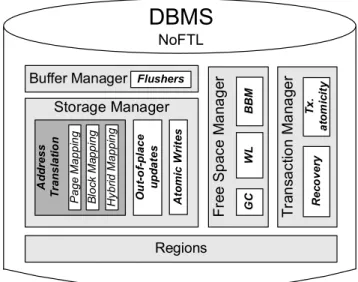
Since the removal of the FTL does not eliminate the necessity of the Flash management tasks, this raises the second question: who takes the responsibility of them? Under the NoFTL design the main high-level tasks of the Flash management are integrated into the subsystems of the DBMS. This integration creates a win-win situation for both the DBMS and the Flash management. On one side, Flash management algorithms and data structures can be significantly optimized by utilizing comprehensive metadata and statistics of the DBMS, as well as rich memory and (typically underutilized) computational resources of the host system. On the other side, the ability to perform direct physical data placement on Flash and control Flash management tasks leads to optimizations and simplifications in many places inside the DBMS. For instance, the control over the out-of-place update strategy and garbage collection on Flash allows for significant reduction in the overhead required for the support of IO and transactional atomicity by the DBMS. It is worth to note, that the implementation of Flash management inside the DBMS does not
Integration of Flash management into DBMS
(Section 5)
Configurable Flash storage
(Section 6) FTL-less Flash storage Native Flash interface (Section 4)
Figure 1.1.: Pillars of NoFTL approach.
add much complexity to the latter. Every DBMS has its own address translation, free space management, and garbage collection; the corresponding functions and data structures of Flash management can be smoothly integrated into them. This results in the reduction of functional redundancy along the IO path. It is important to observe that only the high-level Flash management functionality is integrated into the DBMS, the low-level Flash management remains the responsibility of the on-device controller.
The open native Flash interface can be seen as a toolbox containing different tools allowing the DBMS to operate on the FTL-less Flash storage. The integration of Flash management into the DBMS subsystems is then a set of techniques and methods to work with those tools on Flash. The third guiding principle of this dissertation answers the question: how to apply these techniques efficiently, and what technique is best suited for a particular system and workload. Those questions are answered by the concept of configurable Flash storage. In contrast to the “one size fits all” design of modern SSDs, NoFTL optimizes the usage and management of Flash storage by clustering the data with similar properties physically on Flash, and by applying the most appropriate set of Flash management algorithms for the particular cluster. In order to realize this concept
we introduce two novel data structures – region and group. These structures allow us to manage the physical address space of Flash and selectively apply Flash management algorithms. Regions and groups are efficiently coupled with the traditional DBMS concepts of tablespaces, files and extents, thereby returning to the DBMS the power over the physical data placement. Depending on the properties of data assigned to a particular region, the latter is managed by the most appropriate set of Flash management techniques, i.e. variants of address translation, GC and WL. Those local optimizations significantly reduce the overall overhead of Flash management. Moreover, using regions the DBMS can control the utilization of available Flash parallelism, with the purpose to maximize its benefit. Thus, the configurable Flash storage gives the DBMS flexibility in how data is placed on Flash and how the storage is managed.
The native Flash interface, the integration of Flash management functionality into the DBMS subsystems, and configurable Flash storage are the three pillars of the NoFTL concept, which enables the DBMS to obtain maximum performance from Flash storage, avoiding the disadvantages of the FTL-based, black-box SSD design.
To simplify the configuration of Flash storage for the database administrator two solutions called Advisor and Migrator are provided. The NoFTL Advisor monitors the IO statistics of the DBMS, as well as the statistics of Flash management, and based on this information assists the database administrator in selecting the appropriate configuration. The transformation of the storage from one configuration to another is carried out by the Migrator module. The migration process is performed in the background and can be configured by the DBA over tuning knobs.
1.4. Contributions
We see the main contribution of this research in describing the novel storage alternative for the DBMS – NoFTL, which assumes operation on FTL-less Flash storage. NoFTL eliminates all significant disadvantages resulting from the black-box design of modern SSDs, and enables the DBMS to utilize the whole performance potential of Flash SSDs. To prove this concept we have implemented the NoFTL prototype in an open-source DBMS and evaluated it under various scenarios on real Flash storage, as well as on a configurable and precise Flash emulator. NoFTL should not be seen as a finished solution. We believe that NoFTL opens the door for many even more significant DBMS optimizations on modern Flash storage. We further believe, that the main idea of NoFTL – DBMS on native storage – is going to prove itself for the next generation of storage based on non-volatile memory technologies. This assessment is based not only on our own results, but is also confirmed by developments in industry and academia.
The various optimization approaches we designed, implemented and evaluated in this research under the general NoFTL concept are rooted in different subsystems of the DBMS, mainly buffer, storage, transaction, and recovery managers. Performance gains achieved via those optimizations are primary due to the reduction of IO and computa-tional overheads, as well as better utilization of available Flash parallelism and on-device
computational resources. TPC-C
Cooked
SSD RawSSD NoFTL basic NoFTLregions groups NoFTL regions groups IPA 0 100 200 300 400 500 600 700 800 110 251 422 675 756 T pm -C ( T x. p er m in )
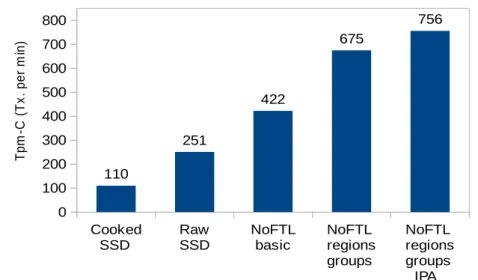
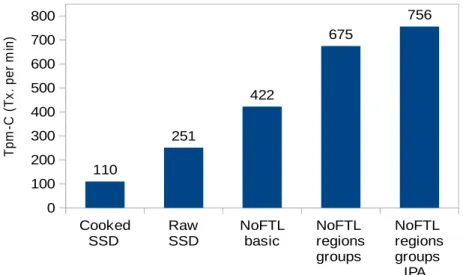
Figure 1.2.: Performance comparison of DBMS on different storage alternatives under TPC-C benchmark.
For instance, by applying smart data placement and Flash management we could reduce the write-amplification of Flash SSD for OLTP workloads by 2-15x depending on the system configuration. Another example is the reduction of performed erase operations for a particular workload by up to 80% thanks to one of the most significant approaches we provide – in-place appends (IPA). These reductions of GC overhead have two main implications. First, the reduction of IO response times and consequently theincrease of the overall performance of the storage. The extent to which the improved IO performance positively impacts the system performance depends on the IO-boundedness of the latter. Thus, we experienced the improvement of the system’s throughput by up to 7x for IO-bound configurations (see Figure 3.5). The second important implication is theprolongation of the SSD’s lifetime. The NoFTL approach can improve the longevity of SSD by twice and even more under the OLTP-like workloads.
Continuing the already mentioned statement that FTL-based Flash SSD is the storage of
today, we strongly believe that the principles underpinning the proposed NoFTL approach will characterize the Flash storage for data-intensive applications of the future. We dare to forecast that FTL-less Flash SSDs will hold the dominance on the storage market for the next decade.
1.5. Structure of the Thesis
On the whole, the flow of the thesis corresponds the chronological evolution of the research underlying it. As the construction of a building follows a certain order, so the research and realization of the NoFTL concept was following its plan. To start our construction project we first must discover the area, its past and current developments. We do this in the next Chapter by providing necessary background information regarding the DBMS, IO stack and Flash. We continue then in Chapter 3 with general overview of the proposed NoFTL concept – the architectural plan for our building. As already mentioned, the NoFTL is founded on three main pillars – the native Flash interface, the DBMS integration of Flash management, and the concept of configurable Flash storage. Their design, implementation and evaluation details are provided in Chapters 4, 5 and 6 respectively. The sustainable base of the NoFTL concept allows the realization of various optimizations for the Flash management algorithms and in different subsystems of the DBMS. While multiple of those optimizations are described during the building of corresponding pillars, in Chapter 7 we present the approach called IPA. This approach was designed and developed in the final phase of this research and is especially interesting because it shows the whole NoFTL concept with its three pillars “in action”. Chapter 8 describes the idea and example solutions that help to find the proper configuration of the Flash storage under NoFTL. The analysis of the related work is provided in Chapter 9. We conclude and discuss future work in Chapter 10.
2. Background
The following chapter is dedicated to the necessary background knowledge on database management systems and Flash storage. It consists of short surveys for the relevant topics, which allow us to provide quick, in-place references to other chapters. Please note, that related research work is described separately in Chapter 9, which is placed at the end of the thesis to enable better comparison with the proposed approach.
2.1. DBMS
2.1.1. Evolution
For more than thirty years since the 1980s the term DBMS was primarily associated with relational database management systems (RDBMSs), having their begin with the pioneering System R and Inges projects based on Codd’s seminal paper on the theoretical aspects of relational systems.
RDBMSs were designed for the management of structured data. The data here is organized according to the schema in tabular format and is queried via a query language, Structured Query Language (SQL) being the de facto standard. Through extensions the RDBMSs could successfully cover almost all possible data domains and satisfy the needs of the corresponding data-intensive applications. The database market grew soon to the billion range and is estimated to reach $50 billion this year. The three major vendors of RDBMS software holding together more than 85% of the total database market’s revenue are Oracle (Oracle DBMS), IBM (DB2) and Microsoft (Microsoft SQL Server). There are also multiple open-source alternatives, which are successfully competing with the proprietary software and continuously increase their market share. The most popular examples of open-source RDBMSs are MySQL, PostgreSQL and SQLite.
However, about a decade ago the monopoly of the relational databases finished with the establishment of so-called NoSQL database management systems. The major reason stimulating the (rush) development of those systems was the tremendous increase of the amount and importance of unstructured and semi-structured data. Petabytes of video and audio files, documents in dozens of possible formats, event logs, crawling data and
web indexing are the main examples thereof. Regardless of the physical location, variety of formats and purpose the Internet is by far the major place of residence for this data. For YouTube, Facebook, Google, Amazon and many other Internet companies the ability to store and process it is crucial for the business model. The use of RDBMSs for the management of this data is, however, typically impractical. First, the relational model is less suitable for semi-structured data, and almost useless for unstructured data. Second, the amount of the data is typically far beyond the capacities of a single server and often even beyond a single data center. Thus, highly distributed data management systems are required. Although the RDBMSs can scale well by increasing the resources of a single machine (scale-up), they are typically weak in the distributed environments. By horizontal scaling (scale-out) the provision of basic RDBMS guarantees becomes challenging. Espe-cially the transactional model, which provides the atomicity and consistency properties (A and C from basic ACID properties of transactions) is hard to realize efficiently in the environment with hundreds and thousands of machines distributed all over the world. The strict consistency of changes over high (dynamic) number of replicas or shards would cause high locking overhead and increase response times drastically, which in turn will slow down the system performance and throughput.
In contrast to RDBMSs, NoSQL data management systems are specifically designed to manage mixed data (unstructured and structured), they provide lower guarantees regarding data consistency (and sometimes durability), while increasing the availability and processing performance via ease of horizontal scaling (ACID vs. BASE). There are four main types of NoSQL systems: key-value pair systems, document management systems, (wide-)column stores, and graph databases. NoSQL database systems, their comparison
and popular examples are well described in [19] and [25].
However, most of the enterprise data is still structured and is also transactional, which means that only the RDBMSs with their strong consistency guarantees, powerful query language and schema-based data model will be the data management systems of choice in the foreseeable future. The revenue numbers prove this statement: while taking into account that the market for commercial DBMSs (primary choice of enterprises) is continuously increasing, the NoSQL market share is estimated to be less than 5% nowadays for all NoSQL products together. The non-revenue market share for NoSQL is, however, significantly larger than that, since currently the majority of NoSQL products are open-source. Saying that, it is important to understand that it is not about “Who wins?”, because SQL and NoSQL data management systems are not really competitors, but rather complementary systems. Both products are good in a certain data domain (structured vs. unstructured) and for certain requirements (consistency vs. scalability). Therefore, both will co-exist in the future. Already today the major vendors of traditional RDBMSs start offering also NoSQL products coupled to their relational systems.
The problem of sub-optimal use of modern storage hardware considered in this work is the general problem for both SQL and NoSQL systems. Although, the same is valid also for the basic concept of the proposed solution, the implementation details might differ significantly. In this work we concentrate primary on the traditional relational database management system (referring to them simply as DBMS).
2.1.2. Architecture of Relational DBMS
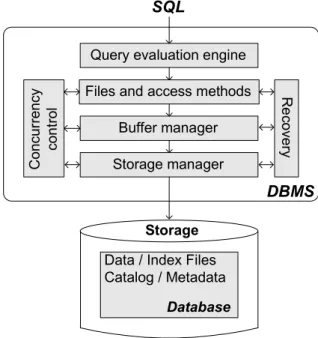
Figure 2.1 presents the module-based architecture of the classical relational DBMS. Despite the variety of today’s database systems, their design and implementation differences, the basic functional components are present in all of them. Each of those is complex and consists of multiple sub-modules. Although the detailed description of the DBMS architecture and the interplay of its modules are well described and can be easily found in classical database textbooks ([80], [22], [38]), we decided to provide here a brief recap for the purpose of completeness.
Storage
Data / Index Files Catalog / Metadata R e c o v e ry DBMS Query evaluation engine
Files and access methods
Buffer manager Storage manager C o n c u rr e n c y c o n tr o l SQL Database
Figure 2.1.: Module-based architecture of the relational DBMS (based on [80]).
Processing of incoming SQL queries begins with the Query Processor. The key compe-tence of this module is an establishment of the query plans and control of their execution.
In order to find an optimal execution strategy the DBMS utilizes various metadata, such as catalog information, access statistics, histograms, runtime data, etc. The query plan decisions are made not only regarding the kind of the operators, but also about their execution order. The emerging computational and storage hardware with high level of supported parallelism force the DBMS designers to revisit traditional operators and data structures in order to increase intra-query and intra-operator parallelism. Thus, the efficient query optimizer must be able to recognize possible ways of parallelizing the query execution based on the available hardware resources. Flash storage is the perfect example of hardware development which offers the possibility to significantly speedup the execution of major query operators. Read/write asymmetry and I/O parallelism are the main properties of Flash SSDs allowing these improvements. Further, the rich on-device computational resources of modern SSDs allow for execution of query operators on the storage device itself, increasing thereby the computational parallelism, and saving data transmission costs, as well as reducing CPU cache and buffer pool pollution of the host system. Those optimizations require, however, a re-design of large parts of the logic of DBMS’s modules, as well as an additional support from the storage device.
Once the query plan is defined and the query processor starts with the execution of operators (e.g., selection, projection, joins, modification, aggregation, etc.) the second layer of the DBMS comes into the play - Files and Access Methods. This layer is responsible for the organization of data in logical database structures such as files and indexes, as well as internal organization of data records within those structures. It provides, therefore, interfaces for the query operators to locate, access and modify the data. The standard data organization layouts supported by the majority of DBMSs today are heap, sorted and hashed files, as well as B-Tree indexes. Bitmap, UB-Tree or R-Tree indexes are further alternatives supported by some database systems.
The key challenge of introducing a novel data structure or access method is the efficient support of concurrency and recovery. In recent years the database community actively looked into the data access layer in order to better address the properties of Flash SSDs. Prioritization of reads for writes, parallel access and the out-of-place update strategies are common ideas underlying the proposed novel or modified data structures. In this work we touch this layer multiple times while implementing the NoFTL architecture. Especially the approach of In-Place Appends (IPA) (see Chapter 7) required modifications in page layout for table and index data.
The next essential module of the DBMS is the Buffer Manager. Once the data requested by the operators is being located using appropriate access routines, the Buffer Manager is asked to provide access to the corresponding database page. If the look-up in the internal hash table was successful, the reference to the buffer frame containing this page is returned. Otherwise (i.e., cache miss), the Buffer Manager issues an I/O request to
the underlying Storage Manager to read the page from the storage and place it into the reserved free buffer frame. In the meanwhile, the replacement policy is responsible for the decisions regarding when and what data should be removed from the buffer pool. Thereby, unmodified data is simply evicted from the cache, while modified pages are written back (flushed) to the storage. The flushing API of the Buffer Manager is also used by other database modules, such as Recovery and Transaction Managers, for guaranteeing atomicity and durability properties of the DBMS.
The influence of the buffer’s replacement strategy on the database performance corre-lates with system’s dependency on the I/O stack. In systems where the working set cannot be cached completely in the buffer, the improper replacement strategy can easily become a significant bottleneck. Especially, if the workload mixes large table scans with small OLTP-like accesses, an intelligent Buffer Manager is vitally important. The efficient replacement strategy must take into account not only the simple statistics about frequency (e.g., LFU) or recency (e.g., LRU) of page accesses, but also the information about the workload, the query plan and the current operator causing those accesses, as well as the type of database pages (e.g., index or table pages). Also, the type and characteristics of storage have an influence on the Buffer Manager. The clear latency asymmetry of read and write requests of the Flash storage (e.g., 10x and more) encourage to revisit the replacement strategy. The recent approaches addressing those issues are covered in Chapter 9. In this work we have looked at the Buffer Manager considering yet another important property of Flash SSDs - parallelism. We do not change the way the replacement strategy decides about what and when to write out back to storage, but rather how the selected pages are being flushed. We show that (i) by utilizing information about the internal architecture of the Flash storage, and (ii) having a control of the physical data placement on Flash - both of which have first become available in the NoFTL architecture - the DBMS can speed-up the flushing process by about 50%. This is achieved by better utilization of a device’s parallelism and reducing the contention for physical resources between DBMS flusher threads (page cleaners). We did further modifications to the Buffer Manager module in connection with the IPA approach. The detailed description of those approaches and the required modifications are presented in Chapters 5.4 and 7, respectively.
The nearest to the physical storage is the Storage Manager module of the DBMS. It is responsible for the space management on the storage, which includes among others storage access routines, allocation and deallocation of space for database structures, and mapping of those structures to physical storage addresses (or files and their offsets in case of using a file system). This module was getting the lowest attention from the DBMS research community and is, therefore, the least modified one over the last couple of decades. The reason for this is an assumption of operating on storage devices which support the block device interface. Having only a hard disk drive as a reasonable storage
for more than three decades made this assumption an indisputable rule. Flash as a viable storage option was made possible mainly due to the support of a block device interface, i.e., SSDs were made backwards compatible with the traditional HDDs. In contrast to this, the NoFTL architecture removes the backwards compatibility of Flash storage, gives the DBMS full and direct control over the Flash by means of the novel native Flash interface. As a consequence, the Storage Manager of the DBMS has been rewritten to support FTL-less Flash SSD. More information about the changes in this module are provided in Chapters 4 and 5.
The next important module in the simplified DBMS architecture is the Transaction Manager. Its main task is to provide concurrency control. The efficient support for parallel execution of transactions is the most critical and important functionality of modern DBMSs. Not surprising is, therefore, the attention to this module from industry and academia over the last decade, motivated by the continuously growing gap between hardware parallelism and concurrency level of the DBMS. In fact, the majority of today’s database systems utilize traditional concurrency models, which often are going back to the pioneer systems in the late 80s. The typical mechanisms to support different levels of transaction’s isolation are locking, multi-versioning and tracking of transactional access history (e.g., in an optimistic concurrency control model). Although, compared to other modules, this module is only weakly coupled to the characteristics of physical storage, careful consideration of Flash specifics allows us to optimize traditional approaches. For instance, the implementation of multi-version concurrency control can be significantly improved by considering the out-of-place update principle of Flash SSD. More details about recent research in this area are provided in Chapter 9.
The last module in our simplified architecture of the DBMS is the Recovery Manager, which is, however, definitely not less important than others. Although, its core compe-tence is to guarantee the durability of data after failures or system crashes ("D" in ACID properties of RDBMS transactions), it typically assists also the Transaction Manager to realize atomicity and isolation properties of a transaction’s execution ("A" and "I" in ACID). The common principle for all systems to provide the recovery functionality is based on maintaining a certain level of data redundancy. Database systems realize this via logging. Logs are small records describing a single modification of data item(s), which can be used to recover the corresponding data in case of losses or data corruption. The majority of today’s relational database systems are implementing a kind of ARIES-like recovery. Its main principle is based on persisting the log records before writing the corresponding modified data items to the stable storage, the so-called Write-Ahead Logging (WAL). Flash storage with its "native" support of data redundancy caused by the out-of-place update strategy allows for significant simplification of these traditional recovery mechanisms. In other words, on writing a modified database page out of the buffer pool to the Flash
SSD, there is always a previous unmodified version of the page present on the storage. This "backup" page can be used for recovery purposes. However, modern FTL-based SSDs hide completely the out-of-place update behavior from the host system, making thereby this "free" recovery support of Flash being unaccessible for the DBMS. In contrast, under the NoFTL architecture the DBMS performs direct physical data placement, and thus has full control over the out-of-place update strategy, which allows us to use it for recovery optimizations. We discuss similar approaches proposed in recent years, as well as our ideas in Chapter 9. Our modifications to the Recovery Manager required for the basic realization of NoFTL are provided in Chapter 5.5.
Apart from the mentioned six modules, database systems must implement also other important functionalities, which might be realized as separate modules or be a part of the above. Those include authorization, metadata management, memory management, administration, etc. Those modules are typically completely independent of the underlying storage infrastructure and are, therefore, out of the scope of this work. In our NoFTL prototype implemented on top of an open-source storage engine they are left unchanged.
2.2. DBMS Storage Alternatives and I/O Stack
In this chapter we continue to follow the path of user requests submitted to the database, but move our attention now outside the DBMS. As we saw, the last stop of requests within the database system is the Storage Manager, where I/O requests are formed and sent down in the direction of the storage device. However, the way to the destination is typically quite long and full of further stops. Because this way is the major cause of disadvantages and limitations of modern Flash SSDs, we describe it in more detail.
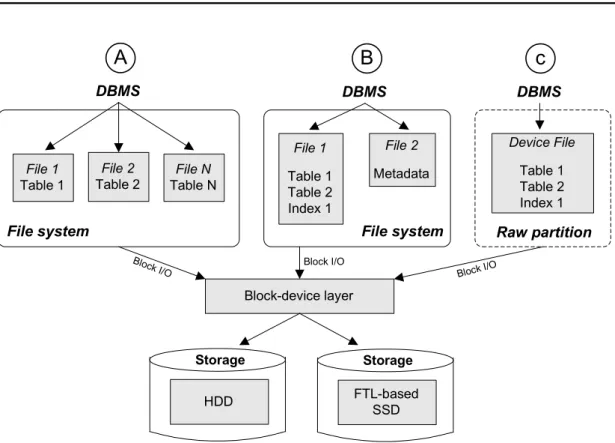
There are two traditional ways for the DBMS to operate on physical storage - with and without a file system on top of a block device. The storage alternative with the file system - also known as "cooked" storage (Figure 2.2-A,B) - was, and continues to be, the most widely used, and thus it is supported by all of today’s database systems. The alternative without a file system is typically referenced as "raw storage" (Figure 2.2-C), and is also available as an option by the main DBMSs on the market. Common for both alternatives is, however, the utilization of the block device interface and block I/O infrastructure (encapsulated in the so-calledblock-device layer).
The backwards compatibility of modern Flash SSDs allows (or better saidforces) them to utilize the very same I/O stack as used by traditional HDDs. That means, that block device interface is common for both SSDs and HDDs, and consequently two mentioned storage alternatives (cooked and raw) are applicable for both types of storage devices as well. In the following we describe major characteristics of these alternatives and of
Storage File system File 1 Table 1 DBMS File 2 Table 2 File N Table N File system File 1 Table 1 Table 2 Index 1 DBMS File 2 Metadata Device File Table 1 Table 2 Index 1 DBMS Raw partition HDD Block-device layer Storage FTL-based SSD
A
B
c
Block I/O Block I/O Block I/OFigure 2.2.: DBMS storage alternatives.
the block device layer from the perspective of the HDDs. In the subsequent chapter we concentrate on the properties of Flash memory and Flash SSDs, and thereafter we come back again to the I/O stack and revisit it now from the perspective of Flash SSDs.
2.2.1. Cooked Storage
The use of a file system allows the DBMS to organize whole data as a set of files and directories. The main advantage of this approach is the simplification of the data adminis-tration on the DBMS side, achieved by delegating the responsibility for space management (at least the most part of it) to the file system. Further, the file system simplifies the management of data access permissions; makes the DBMS support of portability across multiple OSs easier; and allows the use of external tools to access database data (e.g., external data backup).
However, using a file system has also its down side for the DBMS. The negative influence
![Figure 2.9.: I/O bandwidth fluctuations of an enterprise SSD. Source: Petrov et al. [77].](https://thumb-us.123doks.com/thumbv2/123dok_us/10224062.2926263/69.892.191.788.171.443/figure-i-bandwidth-fluctuations-enterprise-ssd-source-petrov.webp)
![Figure 3.1.: NoFTL as a storage alternative for DBMS. Source: Hardock et al. [34].](https://thumb-us.123doks.com/thumbv2/123dok_us/10224062.2926263/81.892.188.788.267.619/figure-noftl-storage-alternative-dbms-source-hardock-et.webp)