A v a i l a b l e o n l i n e a t w w w . s c i e n c e d i r e c t . c o m
j o u r n a l h o m e p a g e : w w w . e l s e v i e r . c o m / l o c a t e / j v a l
Decision-Oriented Health Technology Assessment: One Step
Forward in Supporting the Decision-Making Process in
Hospitals
Matteo Ritrovato, MScEng, PhD1,*, Francesco C. Faggiano, MSBE1, Giorgia Tedesco, MSE1,
Pietro Derrico, MScEng, MBA2
1Health Technology Assessment and Safety Research Unit, Bambino Gesù Children’s Hospital, Rome, Italy;2Clinical Technologies’ Innovations Research Area, Bambino Gesù Children’s Hospital, Rome, Italy
A B S T R A C T
Objectives:This article outlines the Decision-Oriented Health Tech-nology Assessment: a new implementation of the European net-work for Health Technology Assessment Core Model, integrating the multicriteria decision-making analysis by using the analytic hierarchy process to introduce a standardized methodological approach as a valued and shared tool to support health care decision making within a hospital. Methods:Following the Core Model as guidance (European network for Health Technology Assessment. HTA core model for medical and surgical interventions. Available from: http://www.eunethta.eu/outputs/hta-core-model-medical-and-surgi cal-interventions-10r. [Accessed May 27, 2014]), it is possible to apply the analytic hierarchy process to break down a problem into its constituent parts and identify priorities (i.e., assigning a weight to each part) in a hierarchical structure. Thus, it quantitatively compares the importance of multiple criteria in assessing health technologies and how the alternative technologies perform in satisfying these criteria. The verbal ratings are translated into a quantitative form by using the Saaty scale (Saaty TL. Decision making with the analy-tic hierarchy process. Int J Serv Sci 2008;1:83–98). An eigenvectors
analysis is used for deriving the weights’systems (i.e., local and global weights’ system) that reflect the importance assigned to the cri-teria and the priorities related to the performance of the altern-ative technologies. Results: Compared with the Core Model, this methodological approach supplies a more timely as well as contex-tualized evidence for a specific technology, making it possible to obtain data that are more relevant and easier to interpret, and therefore more useful for decision makers to make investment choices with greater awareness.Conclusions: We reached the con-clusion that although there may be scope for improvement, this implementation is a step forward toward the goal of building a“solid bridge”between the scientific evidence and thefinal decision maker’s choice.
Key words:analytic hierarchy process, decision tree, Decision-Oriented Health Technology Assessment, doHTA, health technology assessment, hospital-based HTA, multicriteria decision analysis system.
Copyright&2015, International Society for Pharmacoeconomics and Outcomes Research (ISPOR). Published by Elsevier Inc.
Introduction
Health technology assessment (HTA) arises in answer to the unchecked spread of expensive health technologies (HTs). HTA is a multidisciplinary assessment process aimed at supporting decisions pertaining to the allocation of resources [1]. This is especially in view of the fact that the health system has limited resources, which cannot satisfy all the health demands of a population with a trend toward increasing health needs owing to progressive aging and an enhanced awareness of the availability and potential of new HTs. As a matter of fact, HTA is not a mere research tool, but rather a systematic, rigorous, reproducible assessment process that can be considered a “bridge between the world of research and the world of decision making, partic-ularly policy making” [1]. In view of this, HTA becomes a governance approach aimed at linking decisions to available
scientific evidence. This metaphor, often referred to over the years, might well become rhetorical if we cannot define more accurately what connects each end of the“bridge”: the start (e.g., available scientific evidence) andfinish points (i.e., decision by health care managers and policymakers) are clearly defined, but the pathway connecting who produces the evidence and thefinal decision makers (that is to say, the standardized methodology of gathering and reporting evidence on the basis of which the decision makers make their choices) is still inaccurate and elusive. One of the main reasons for the gap between the available scientific evidence and the evidence needed by decision makers is the failure to provide decision makers with more efficient and suitable (in other words, appropriate) tools (because they permit a decision in an effective and timely way and take into account all the relevant aspects), enabling them to make a more knowledgeable decision between the different alternatives.
1098-3015$36.00 –see front matter Copyright&2015, International Society for Pharmacoeconomics and Outcomes Research (ISPOR). Published by Elsevier Inc.
http://dx.doi.org/10.1016/j.jval.2015.02.002 E-mail:[email protected].
Admittedly, available evidence cannot always provide useful answers to the questions raised by decision makers. This is even more often the case at the“meso”level—that is to say, when it is necessary to establish whether a technology should be imple-mented within a hospital, while at the same time trying to forecast the possible impact on its organizational frame. In fact, especially in the case of particularly innovative technologies, while the scientific literature focuses on aspects such as safety and clinical efficacy, hospital managers need to also take into account organizational and economical aspects as well as tech-nical or legal implications.
The application of HTA methodology at the meso level[2], and in particular its implementation at the hospital level (defined as hospital-based HTA)[3], is essential when considering the adop-tion or rejecadop-tion of HTs in a hospital because it is aimed at contextualizing both evidences and decisions. The hospital-based HTA is a hospital assessment process for using the available evidence in decision-making processes about the introduction of new or existing technology. Differences in how HTA is perceived, understood, or used in the national or regional health care setting may have an important impact on the way HTA methodology is organized and used within a hospital.
Hospitals should not each implement their own detailed methodology usable only within their organization and suitable only for a limited set of technologies; rather, a standardized methodology that can be applied to all the available technologies and, if possible, be shared among all HTA specialists (hence overcoming barriers in the collaboration of HTA assessment among hospitals) must be structured. Decision makers do not have the time and resources needed for developing an exhaustive HTA program, and, therefore, they require suitable tools for facilitating the adaptation of HTA output from external reports, making theirfinal choice easier[4]. Moreover, because decision makers often take into consideration what is being done in other systems or in other countries, it is desirable to reach stand-ardized outputs to assess the HT impact at its different levels by means of a shareable and adaptable method to each health context (national, regional, local) or health care organization.
In 2004, the European network for Health Technology Assess-ment (EUnetHTA) was established by the European Commission and Council of Ministers to create an effective and sustainable network for HTA across Europe and help to develop reliable, timely, transparent, and transferable information to contribute to HTAs in European countries. As part of its mission, the EUnetHTA developed the Core Model, a methodological framework for shared production and sharing of HTA information. Although the Core Model is confirmed as an accurate and important guide for the assessment of an emerging technology, it has some limits. These limits are found especially when it is applied within a hospital context (the meso level[3]): specifically, its implementa-tion would lead to results that would be difficult to understand and could not be easily or immediately applied. In fact, the literature results, which are the outcome of analyses carried out by colleagues who have previously tested the applicability of the Core Model[5–7], consist mainly of lists of answers (i.e.,“issues”). Despite being important and indicative of the technology under consideration, these do not provide a tangible understanding of how the decision maker will then decide whether to adopt a given technology. Moreover, although the EUnetHTA Core Model becomes more specific and detailed when it comes to operation-alizing the questions pertaining to a given technology, the purpose of such questions is often not applicable to the decision makers’needs and unlikely to point out the data of the evalua-tion context.
Furthermore, asking a health organization (HTA multidiscipli-nary team as well as every unit that conducts HTA) to answer about 200 questions (such as those posed in the EUnetHTA Core
Model) would require a great amount of resources (in terms of both cost and time). This is, however, necessary to comply with the accuracy and time constraints of the Hospital Management/ Board of Directors or of the HTA project’s sponsor. An HTA report previously elaborated by other institutions (though compliant with the Core Model) could not be shared among different levels (national, regional, local) or organizations because it is usually not reported in a defined, standardized, and structured output. Actually, between the presentation of results based on the Core Model guidelines and thefinal decision, there is a gap that could be bridged by carrying out further analyses and using models that
would allow the assessment to be concluded by defining a
classification of the assessed alternatives.
In view of this, the HTA Research Unit of the Bambino Gesù Children’s Hospital in Rome, Italy, devised the Decision-Oriented Health Technology Assessment (doHTA) method to guide and support the introduction of innovative HTs in hospitals. The doHTA is a new implementation of the EUnetHTA Core Model that integrates multicriteria decision analysis (MCDA) by using the analytic hierarchy process (AHP). Although key parts of the Core Model remained substantially unaltered, the new approach considers the repositioning of“domains,” “topics,”and“issues,” redefining them in a new goal-oriented framework[8]. It has been developed to introduce a standardized methodological approach as a valued and shared tool to support health care decision making within a hospital. The aims of this article were 1) to illustrate a detailed new implementation of the EUnetHTA Core Model by also describing the main features of the AHP approach in a hospital context and 2) to explain how the results of the doHTA application can closely support health care decisions. No previous analysis has shown the results of the integration between AHP methodology and the Core Model application as a part of the HTA process within a hospital setting.
Methods
The EUnetHTA Core Model
The EUnetHTA Core Model has been devised mainly to promote the standardization of HTA results, usable in all member states of the European Union, to spread and share evidences and results obtained. The EUnetHTA Core Model is built to focus on assess-ment eleassess-ments that describe the technology or the consequences of its use in order to supply the information needed to decide on the use or nonuse of any selected technology [9]. The model combines several methods of analysis developed within each discipline involved: epidemiology, cost-effective analyses, safety and technical assessment, social science, ethics, and so forth. The model aims to accurately organize the collected evidence about the technology considered in different “assessment ele-ments”made up of domains (i.e., health problem and current use of technology, technical characteristics of the technology, safety, clinical effectiveness, costs and economic evaluation, ethical analysis, organizational aspects, social aspects, legal aspects), topics, and issues [5,10]. Each assessment element “defines a piece of information that describes the technology or the con-sequences or implications of its use”[9].
Given the substantial differences between the domains listed above, the nature of assessment elements can therefore differ considerably because of the methods of investigation and anal-ysis adopted to study each of them. Each domain is composed of different topics, and each topic can concern more than one domain. The topics represent more specific aspects within the domain and can, in turn, be described by one or more issues. An issue underlies a specific factor within a topic. This combination accurately organizes the collected evidence about the technology
considered. The different aspects assessed are eventually syn-thesized in a document (i.e., HTA full-report), with its form (e.g., structure and size) depending on the information goal and the health system level at which the decision is to be made.
The availability of such a tool leads to an increase in the use of HTA and its application as a support to decision-making proc-esses[9,11]. The standardization of information in an HTA report increases the clarity of information, enhances the quality and thoroughness of information, fosters the extraction of items of information from HTA reports as well as information sharing, and reduces work duplication[9]. After the“prioritisation and/or commissioning process”[12](needed to establish which technol-ogy investments should be made and, subsequently, which technologies are to be assessed), the Core Model could be used as an applicable tool for assessing HTs, as already frequently happens in the European context. In fact, across Europe, it represents an important standard tool for technology assessment by which reliable, transparent, and transferable data about selected technologies can be outlined and taken up into decision-making processes.
Several studies have been carried out to test the Core Model at performing HTA about a specific technology, such as multislice computed tomography in coronary angiography or drug-eluting stents[6,7]. The HTA on multislice computed tomography reveals some weaknesses in the content of the assessment elements (e.g., description and technical characteristics of technology, accuracy). Indeed, some issues remain unanswered and some answers are incomplete [7]. Despite this, the results of these studies confirm that the EUnetHTA Core Model is an appropriate tool to produce HTA reports to support decision making and to promote collaboration and sharing in HTA regarding the distri-bution of results and the exploitation of the information pool used in the assessment of the selected technologies.
The AHP
The AHP is an MCDA technique developed at the Wharton School of Business by the mathematician Thomas Saaty in the 1970s [13]. It is a method, already generally validated for MCDA, deriving from operations research and is a valuable tool to help decision makers in assessing HTs according to afinite number of criteria. It is commonly used to break down a decision problem into its constituent parts, which are then structured into a hierarchy[14], combining a goal at the topmost level, criteria at the consecutive level, and subcriteria at successive sublevels, while the lowest level contains the alternatives. The AHP includes a structured hierarchy, pairwise comparisons, verbal ratings, experts’judgments, an eigenvector method for deriving weights, and a method to verify the“consistency”of judgments. Indeed, the pairwise comparisons expressed in verbal form using the Saaty scale[14] (e.g.,“safety”is more important than“the legal aspects”for the technology in question) are converted in a consistent way into a set of numbers representing the relative priority of each criterion. As a result, the AHP delivers a ranking of alternatives that facilitates the selection of a policy option. This technique for MCDA is increasingly being used and provides valuable support in complex health care decisions[15].
The DoHTA Method
The doHTA method aims at integrating into a single consistent tool the two above-mentioned methodologies and essentially consists of the following main steps.
Step 1: Problem Definition
Using the EUnetHTA Core Model as guidance, determine the kind of knowledge sought. This means identifying which specific
“assessment element”may bring a piece of knowledge that can potentially (if compliant with the above-mentioned eligibility criteria) be translated into an indicator of the decisional structure.
Step 2: Literature Review
Scientific evidence should be obtained using major databases and search engines, Web sites of national and international HTA agencies, technical reports, clinical guidelines, primary studies, systematic reviews, gray literature, documentation by technology vendors/manufacturers, and information by clinicians, nurses, and patients. The search strategy should include specific key words and explicit MESH terms. The search should be focused on studies that supply evidence of feasibility, safety, efficacy, costs, and organizational and technical characteristics of this technol-ogy and on studies that compare this given technoltechnol-ogy with its alternatives.
Step 3: Hierarchy Construction
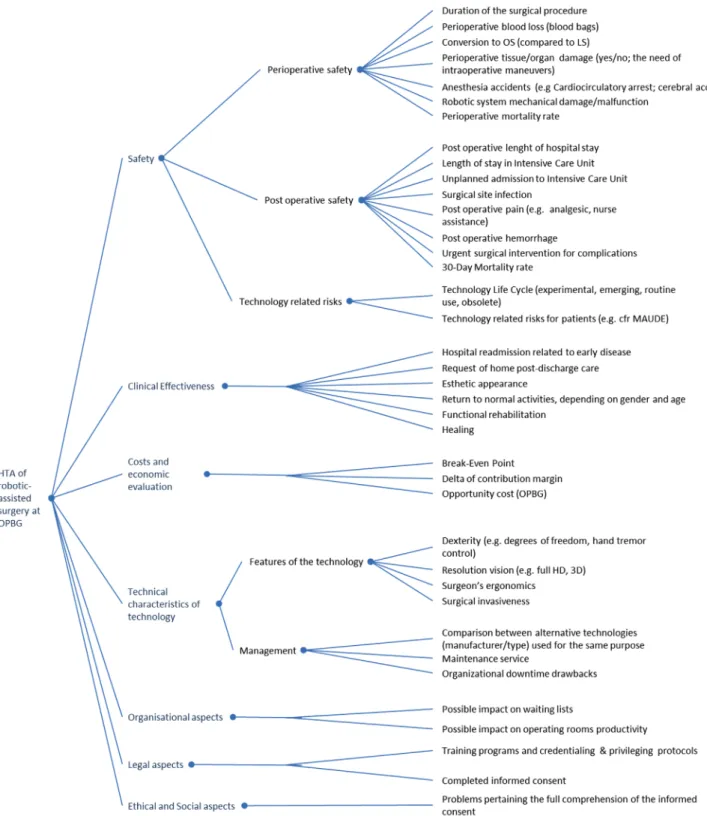
The main goal of the literature review, among other objectives such as acquiring a deeper knowledge of the question under examination and gathering scientific evidence on HTs’ imple-mentation outcomes, is to identify all the components of the decisional hierarchy structure (i.e., the different key performance indicators [KPIs]) and, in agreement with the AHP method, their topological arrangement within it.Figure 1presents an example of the application of the doHTA method in the assessment of a surgical robot: it highlights the decision tree structure, its nodes and leaves, as well as the complete list of KPIs. Therefore, the goal of the decision (which could be“the choice to adopt or not adopt a high-cost innovative technology”) is broken down into its constituent parts from the topmost level (the overall goal itself), then the objectives from a broad perspective, and through the intermediate levels representing ever more specific objectives. Following the overall goal, thefirst level is made of the criteria on which subsequent elements depend[14]. In our model, thefirst level is made of the different domains singled out in the Core Model; that is, each criterion is exactly identified by the“domain” singled out in the Core Model. The sublevels are built by following specific guidelines from the Core Model (i.e., questions depicted as a topic or an issue and pertaining to a specific domain) yet consisting of a list of detailed indicators (Level 1 KPIs and Level 2 KPIs). Level 1 KPIs and Level 2 KPIs represent well-defined, specific characteristics of the considered HT, resulting from the synthesis of scientific evidence, the results of the specific context analysis, and the application of the following eligibility criteria:
1. KPIs must be“a priori”assessable.
2. KPIs are pertinent to all the alternative technologies under consideration.
3. KPIs should preferably be objectively measurable.
Step 4: Priority Analysis
Lists of pairwise comparisons of indicators grouped under the same nodes must be drawn and subsequently submitted to each profes-sional participating in the assessment, who has to answer on the basis of his or her own experience and knowledge. That is, for each pair of elements in the pairwise comparison, each professional is required to give a“verbal rating” to the elements compared by responding to a question such as“How important is the element A (e.g.,‘safety’) relative to the element B (e.g.,‘legal aspects’)?”
Each element in an upper level is used to compare the elements in the level immediately below with respect to it[14]. Verbal ratings are translated into a quantitative form by using the Saaty scale[14]. Given that the comparisons are accomplished through personal or subjective judgments based on personal
knowledge (yet usually based on literature evidence) and experi-ence, some degree of inconsistency may be observed[16]. There-fore, at the end of each interview, it is desirable to check the degree of consistency among the pairwise comparisons, and to repeat the pairwise comparisons while trying to improve the coherence of the judgments if it is found that the consistency ratio exceeds the limit [17]. A consistency check is then per-formed, as well as the computation of both local weights
(i.e., the weights characterizing indicators with respect to the connected upper node) and global weights (i.e., with respect to the overall assessment goal), as stated in the AHP theory, by means of eigenvectors analysis[14]. After pairwise comparisons performed by all involved professionals are positively checked for consistency, the derived weights’ systems are then averaged using the geometric mean to yield a unified weights’ system (Fig. 2).
Fig. 1–Decisional tree. EUnetHTA domains and KPIs arranged into a hierarchical decision tree. EUnetHTA, European network for Health Technology Assessment; KPI, key performance indicators.
Step 5: Alternative Technologies evaluation
With step 4 completed, a weighted decision tree is available for evaluating the considered alternative technologies. This is per-formed for a single technology by attributing to each lowest indicator (i.e., the end nodes of the decision tree) a value representing the performance of the technology with respect to the indicator itself. Values to be attributed to each indicator vary correspondingly according to its nature: some indicators can be metrically estimated (e.g., spatial resolution, image uniformity, power, and turnaround time), some by means of an estimate of coverage of needs (e.g., percentage of laboratory tests performed by a chemical analyser out of the hospital tests’demand), some by a true/false statement (e.g., the presence, or lack thereof, of a specific characteristic of the technology, such as a failsafe valve in an anesthesia machine), and some only by a qualitative judgment scale of performance (i.e., attributing a“value”ranging, e.g., from“very poor” to“excellent”to the performance of the technology with respect to the indicator). The latter case, how-ever, can be better accomplished by again following the AHP theory, thus using alternative technologies to set up another pairwise comparison list in which each technology is compared against its alternative with respect to every lowest indicator. Whatever the nature of the indicators, it isfinally possible to compute (by means of a weighted sum) a numerical value that represents the performance of each technology with respect to the overall decision goal. Moreover, exploiting the very character-istics of the AHP method, it is also possible to compare alter-native technologies’performances with respect to lower levels nodes (i.e., domains as well as sublevels indicators).
Step 6: Results Presentation
The results from the aggregation of values can then be repre-sented either in graphical form (e.g., histogram and ring plot; Fig. 3) or by numerical report, which are supposedly useful to summarize the evidence that emerged from the evaluation
process. Finally, each technological alternative is evaluated against the lowest indicators (i.e., the end nodes in the hierarch-ical tree) to derive an overall rating.
Results
The doHTA method, already used and tested on a large number of HTs since 2009 to reduce the above-mentioned gap, takes a step forward by introducing a new implementation of the EUnetHTA Core Model using the AHP. This allows for the out-lining of the“general problem”into a number of subgoals and, for each of these, makes it possible to compare and classify the different solutions (i.e., alternative HTs) taken into account. Then, the outcomes of each comparison can be combined back-ward to the solution of the general problem. This is due, indeed, to the various relevant features and points of view that typically characterize such kinds of decisional problems, making it intrinsically impossible to synthesize it into a single consis-tent goal.
The domains making up the Core Model are all substantially important and are therefore analyzed when a new technology is assessed. What differentiates our new implementation of the model from the original one is the possibility of streamlining the assessment not only by selecting some topics and the related issues but also by choosing the most characteristic features of the technology to be assessed or through unifying some of these, and hence gathering the meaning of topics and issues in a concise
final element. To integrate the AHP method, the assessment elements are translated in the form of criteria or subcriteria[17], which we called KPIs. This means that selected topics and issues arefinally translated into a list of specific and narrow elements. This new implementation confers a key role infinding evidence Fig. 2–Weights’system. Example of the unified weights’
system (as relating to thefirst layer of decisional tree).
Fig. 3–Comparison of three alternative technologies. The histogram chart highlights the contribution of each domain tofinal comparison between alternative technologies.
available in the literature both to identify the KPIs and to attribute a value for them that represents the performance of the alternative technologies being considered (especially for those KPIs that are already supported by strong literature evi-dence, hardly leaving room for interpretation).
For instance, as regards the assessment of the robotic surgical system within our hospital, several assessment elements were identified, translated into KPIs, weighted, and arranged in a decision tree (seeFig. 1). It was then possible, in the subsequent comparison phase (see step no. 5), to attribute them a value representing the performance of robotic surgery compared with its conventional alternatives (laparoscopic surgery and open surgery). If we look at one of the KPIs for the surgical robot assessment regarding the analysis of safety aspects,“ perioper-ative blood loss”is one of several KPIs identified (because the scientific literature places great relevance on this element). The scientific literature has, in this specific case (for other evaluation aspects, such as those related to organizational issues, internal data have been the most relevant source), also been the primary source considered while attributing a performance value (thus attributing less perioperative bleeding to robotic and laparoscopic surgeries, i.e., better performance values). If no strong evidence is available, one should try to quantify KPIs through data from hospital management systems, team expertise, feedback from the stakeholders involved, face-to-face interviews, question-naires, and so forth.
An example of the results achievable with this method is presented inFigures 1,2, and 3, all pertaining to the assessment of a robotic surgical system. Thefirst one represents the decisional tree that we have derived, in which EUnetHTA domains (corresponding to thefirst hierarchy level) and KPIs are arranged: 1) the apex is“the assessment of a robotic surgery program within the pediatric hospital”; thefirst level is made of the different domains, such as safety, clinical effectiveness, costs and economic evaluation, techni-cal characteristics of the technology, ethitechni-cal and social aspects, legal aspects, and organizational aspects; the sublevels are built identify-ing the Level 1 KPIs with respect to every previous criterion (e.g., safety: perioperative safety, postoperative safety, and technology-related risks; technical characteristics of technology: technological features, technical management). The later indicators (Level 2 KPIs) are, for instance, “time of operation,” “perioperative blood loss,” “postoperative length of hospital stay,” “surgical site infection,” “ 30-day mortality rate,” “request of home postdischarge care,” “ technol-ogy-related risks for patients,” “surgeon’s ergonomics,” “ mainte-nance service,” “organizational downtime drawbacks,” “possible impact on waiting lists,” “delta of contribution margin,” “breakeven point,” “training programs and credentialing & privileging protocols,” and“problems pertaining to the full comprehension of the informed consent.” In this case, any hospital manager could use such a decisional hierarchy structure to make choices about robotic surgery investment, possibly by modifying a part of it (e.g., it could be necessary to readjust some KPIs with respect to the individual context).
The second figure specifies the unified weights’ system as related to the domains layer of the decisional tree, as derived from pairwise comparisons and mathematical calculations in accordance with the AHP method; in our study, about two thirds of the whole evaluation is represented by safety and clinical effectiveness. The doHTA method can provide similar charts for each sublevel of the decisional tree. The histogram chart, illus-trated inFigure 3, specifies the computed performance (global and per domain) of the available alternatives inFigures 1,2, and 3 (robotic surgery, laparoscopic surgery, and open surgery, respec-tively). Specifically, the computed performance (expressed in terms of percentages as required by the AHP method) of alter-native 1 is calculated as 28.14% for safety and 20.06% for clinical effectiveness, with the others combined accounting for a very
small percentage (i.e., 0.86%, cost and economic evaluation; 5.93%, technical characteristics of technology; 1.91%, organiza-tional aspects; 2.01%, legal aspects; and 1.80%, ethical and social aspects). As for the comparison between alternatives 1 and 2 (i.e., robotic surgery and laparoscopic surgery), the percentages for safety and clinical effectiveness seem to be comparable, but the “organizational aspects”are exclusively positive for laparoscopic surgery. With regard to the“economic aspects,”as evidenced also from the literature review, the results confirmed the disadvan-tages of robotic surgery, mainly due to the high initial cost and the maintenance cost of the system.
Conclusions
This article identified several key points of the doHTA method, derived from the new implementation of the EUnetHTA Core Model along with the AHP application, arising from its successful implementation as a tool for effective and efficient decision making. Since 2009, many HTs have been analyzed by adopting this new methodological approach within the Bambino Gesù Children’s Hospital (e.g., blood gas analyzers [18], pulse oxi-meters, the design/organizational structure of the clinical chem-istry laboratory, and robotic pediatric surgery). In fact, we have been able to supply a more precise and more structured output as well as a contextualized evidence of specific technology, making it possible to obtain data that are more relevant and easier to interpret, and therefore more useful for the decision makers to make investment choices with greater awareness.
The EUnetHTA Core Model has been an essential and profi t-able guide for the implementation of our methodology for supporting decision making by describing a framework for identifying the different types of questions suitable to give appropriate answers about the technology considered. It can also guide HTA teams in selecting which aspect of a technology or its use they could (or should) study. Yet, compared with the EUnetHTA Core Model, the doHTA application provides a more detailed and precise evidence to support the decision-making process, summarizing each result in a standardized and struc-tured output that can be shared and then used systematically by other health care organizations. In fact, our method allows for the identification (in a very explicit fashion) of all the compo-nents of the decisional hierarchy structure (i.e., KPIs) as well as their topological arrangement and their weights within it. More-over, the performance of each assessed HT is also appraised in a straightforward and clear way. Thus, the result can then be used (or readapted) by decision makers or HTA specialists from other hospitals to assess the same or similar technologies by
1. adopting the same hierarchy structure, as well as adding or eliminating some KPIs (thus deriving a decision tree that includes all the elements that are important in their context); 2. adopting the same weights systems, as well as deriving (by means of pairwise comparisons and AHP equations) their own weights’system (i.e., one that reflects more consistently their opinion of which elements are of importance in their context); and
3. comparing different alternative technologies by attributing performance value (relating to the single KPI) that is“ meas-ured”against context-specific requirements or characteristics. Such a method, however, presents a potential operative criticality. In fact, because the interviewees have different com-petences and roles (i.e., belonging to different professional and expertise areas), a simplistic application of the geometric mean as per the computation of the global weights’system can lead to a biased evaluation because of the possible imbalance of experts
involved. A possible solution is represented by clustering each professional with respect to his or her professional area, comput-ing a weights’ system for each professional area, and then computing the global weights’system as a geometric mean of the weights’system of different professional areas.
We have tested the doHTA method on various HTs (from hospitalwide services to multipurpose tools to much specialized devices) to check its feasibility, adaptability, and scalability. Our method allows a structured and more precise output, giving decision makers the possibility to choose more knowingly between the different considered alternatives, often in a very short time (as they have been provided with a clear and instantaneous depiction of the whole evaluation, making theirfinal choice easier and faster).
Thus, we have reached the conclusion that although there may be scope for improvement, this implementation is a step forward toward the goal of building a“solid bridge”between the available scientific evidence and thefinal decision maker’s choice.
R E F E R E N C E S
[1]Battista RN, Hodge MJ. The evolving paradigm of health technology assessment: reflections for the millennium. CMAJ 1999;18:1464–7. [2]Catananti C, Cicchetti A, Marchetti M. Hospital based HTA: evidences from
Policlinico“A. Gemelli”University Hospital. Ital J Pub Health 2005;2:23–9. [3]Gagnon MP. Hospital-based health technology assessment:
developments to date. Pharmacoeconomics 2014;32:819–24. [4]Martelli N, Lelong AS, Prognon P, Pineau J. Hospital-based health
technology assessment for innovative medical devices in university hospitals and the role of hospital pharmacists: learning from international experience. Int J Technol Assess Health Care 2013;29:185–91.
[5]Pasternack I, Anttila H, Mäkelä M, et al. Testing the HTA core model: experiences from two pilot projects. Int J Technol Assess Health Care 2009;25(Suppl.):21–7.
[6] European network for Health Technology Assessment. Core HTA on drug eluting stents. Available from:http://www.eunethta.eu/outputs/ core-hta-drug-eluting-stents. [Accessed May 27, 2014].
[7] European network for Health Technology Assessment. Core HTA on MSCT coronary angiography. Available from:http://www.eunethta.eu/ outputs/core-hta-msct-angiography. [Accessed May 27, 2014]. [8]Radaelli G, Lettieri E, Masella C, et al. Implementation of EUnetHTA
Core Model in Lombardia: the VTS framework. Int J Technol Assess Health Care 2014;30:105–12.
[9] European network for Health Technology Assessment. HTA core model for medical and surgical interventions. Available from:http://www. eunethta.eu/outputs/hta-core-model-medical-and-surgical-intervent ions-10r. [Accessed May 27, 2014].
[10]Lampe K, Mäkelä M, Garrido MV, et al. The HTA core model: a novel method for producing and reporting health technology assessments. Int J Technol Assess Health Care 2009;25(Suppl.):9–20.
[11]Kristensen FB, Mäkelä M, Neikter SA, et al. European network for Health Technology Assessment, EUnetHTA: planning, development, and implementation of a sustainable European network for health technology assessment. Int J Technol Assess Health Care 2009;25 (Suppl.):107–16.
[12]Velasco M, Perleth M, Drummond M, et al. Best practice in undertaking and reporting health technology assessments. Working group 4 report. Int J Technol Assess Health Care 2002;18:361–422.
[13]Forman E, Selly MA. Decision by Objectives: How to Convince Others That You Are Right. Singapore: World Scientific, 2001.
[14]Saaty TL. Decision making with the analytic hierarchy process. Int J Serv Sci 2008;1:83–98.
[15]Ho W. Integrated analytic hierarchy process and its applications: a literature review. Eur J Oper Res 2008;186:211–28.
[16]Hummel JM, Ijzerman M. A systematic review of the analytic hierarchy process in health care decision making. Value Health 2009;12:227. [17]Saaty TL. The Analytic Hierarchy Process. New York: McGraw-Hill,
1980.
[18]Franchin T, Faggiano F, Plebani M, et al. Adopting European network for Health Technology Assessments (EUnetHTA) core model for diagnostic technologies for improving the accuracy and appropriateness of blood gas analyzers’assessment. Clin Chem Lab Med 2014;52:1569–77.