HAL Id: hal-01349569
https://hal.archives-ouvertes.fr/hal-01349569
Submitted on 20 Sep 2016
HAL
is a multi-disciplinary open access
archive for the deposit and dissemination of
sci-entific research documents, whether they are
pub-lished or not. The documents may come from
teaching and research institutions in France or
abroad, or from public or private research centers.
L’archive ouverte pluridisciplinaire
HAL
, est
destinée au dépôt et à la diffusion de documents
scientifiques de niveau recherche, publiés ou non,
émanant des établissements d’enseignement et de
recherche français ou étrangers, des laboratoires
publics ou privés.
SCALP: Superpixels with Contour Adherence using
Linear Path
Rémi Giraud, Vinh-Thong Ta, Nicolas Papadakis
To cite this version:
Rémi Giraud, Vinh-Thong Ta, Nicolas Papadakis. SCALP: Superpixels with Contour Adherence using
Linear Path. 23rd International Conference on Pattern Recognition (ICPR 2016), Dec 2016, Cancun,
Mexico. �hal-01349569�
SCALP: Superpixels with Contour Adherence
using Linear Path
R´emi Giraud
1,2,3, Vinh-Thong Ta
1,2and Nicolas Papadakis
31Univ. Bordeaux, CNRS, LaBRI, UMR 5800, PICTURA, F-33400, Talence, France 2
Bordeaux INP, LaBRI, UMR 5800, F-33400, Talence, France
3
Univ. Bordeaux, CNRS, IMB, UMR 5251, F-33400, Talence, France Email: (remi.giraud, vinh-thong.ta)@labri.fr, [email protected]
Abstract—Superpixel decomposition methods are generally
used as a pre-processing step to speed up image processing tasks. They group the pixels of an image into homogeneous regions while trying to respect existing contours. For all state-of-the-art superpixel decomposition methods, a trade-off is made between 1) computational time, 2) adherence to image contours and 3) regularity and compactness of the decomposition. In this paper, we propose a fast method to compute Superpixels with Contour Adherence using Linear Path (SCALP) in an iterative clustering framework. The distance computed when trying to associate a pixel to a superpixel during the clustering is enhanced by considering the linear path to the superpixel barycenter. The pro-posed framework produces regular and compact superpixels that adhere to the image contours. We provide a detailed evaluation of SCALP on the standard Berkeley Segmentation Dataset. The obtained results outperform state-of-the-art methods in terms of standard superpixel and contour detection metrics.
I. INTRODUCTION
Image segmentation is an essential tool to analyze the image content. The aim is to split the image into similar regions with respect to some priors (e.g., object, color or texture). To decrease the computational time and to improve the accuracy of unsupervised segmentation, superpixel decom-position methods have been proposed. These methods group the pixels into homogeneous regions while trying to respect image contours. Superpixels drastically decrease the image content dimension while preserving geometrical information, contrary to multi-resolution approaches. For instance, small objects that disappear at small resolution levels, can still be contained into single superpixels. Hence, superpixels have naturally become key building blocks of many computer vision works such as: contour detection [1], face labeling [2], object localization [3], or multi-class object segmentation [4], [5].
Superpixel methods can be divided in two categories that provide either irregular or regular decompositions. With irreg-ular methods, superpixels can be stretched, with very different sizes, and may overlap with several objects contained in the image. Moreover, very small superpixels can be extracted, and without enough pixels, significant descriptors are difficult to estimate. On the contrary, regular methods provide superpixels with approximately the same size, and enable to compute more robust descriptors.
There is no general rule for the definition of an optimal superpixel method since the desired properties depend on the tackled application. A compromise must be made between:
computational time, adherence to image boundaries, and size and shape regularity of the superpixel decomposition.
On the one hand, accurate contour adherence is for instance reached with irregular methods (e.g., [6]) that allow very stretched superpixel decompositions based on color similarity. On the other hand, it appears crucial for superpixel-based object recognition methods to use regular decompositions [4], [5]. Moreover, when facing video tracking of superpixels [7], fast and regular approaches are suitable to consider the time consistency of the decomposition. Regularity is thus crucial to accurately analyze object trajectories in a scene. In Figure 1, we show an example of a reconstructed image from the irregular method SEEDS [6] and from our regular method SCALP. The image is computed by the average color on each superpixel. SCALP provides a much more visually satisfying result due to regularity and accuracy of superpixel boundaries.
Initial image SEEDS [6] SCALP
Fig. 1. Reconstruction from average colors with 200 superpixels on an
example image from the Berkeley Segmentation Dataset [8]
Irregular Superpixel Methods. Classical methods, such as the watershed approach [9], compute decompositions of highly irregular size and shape. In this context, starting from an initial clustering, Mean shift [10] or Quick shift [11] approaches use histogram-based segmentation but require high computational time. By considering pixels as nodes of a graph, faster agglomerative clustering can be obtained [12]. In addition to the lack of control over the superpixels shape, all these methods present another main drawback. They do not allow to directly control the number of superpixels, which is a major issue when using superpixels as low-level representation to reduce the computational time for a dedicated task.
More recently, the SEEDS method [6] has been proposed to produce a decomposition in a reduced computational time. This approach is initialized with a regular grid and updates superpixel boundaries with block and pixel transfers. Despite its initial regular grid, this method provides superpixels with irregular shapes. Finally, the authors report significantly de-graded results when trying to regularize the superpixel shape with compactness constraint [6].
Regular Superpixel Methods. When considering more general applications than contour adherence, state-of-the-art superpixel-based methods consider regular decompositions (e.g., [7], [5]). Classical methods are based on region growing, such as Turbopixels [13] using geometric flows, or graph-based energy models [14], [15]. In [16], the watershed method is adapted to produce regular decompositions using a spatially regularized gradient.
Recently, the Simple Linear Iterative Clustering (SLIC) su-perpixel method was proposed in [17], and its extensions,e.g., [18], [19]. This method performs an accurate color clustering, providing regular superpixels, while being order of magnitude faster than graph approaches [14] or [15], and achieves state-of-the-art results on superpixel metrics. However, since a compactness parameter is set to enforce the superpixel shape regularity, SLIC can fail to adhere to image contours, as for other regular methods [13], [14].
Several works have attempted to enhance the performance of regular methods in terms of contour adherence by using a contour prior information. Although methods to compute regions from contours have been proposed (e.g., [20]), they do not allow to control the size, shape and number of regions, and therefore cannot be considered as superpixel decomposition methods. In [21], contour priors are used to compute a pre-segmentation using the normalized cuts algorithm [22]. This segmentation is considered as a hard constraint to provide a finer regular decomposition. However, the decompositions based on normalized cuts are highly tuned and computationally expensive, while they are far from state-of-the-art results in terms of contour adherence. In [23], the decomposition is constrained to fit to a grid, named superpixel lattice. This decomposition uses a contour map as input to determine this lattice, and iteratively refines it using optimal cuts. The method finally produces superpixels of regular sizes but irregular shapes, that are visually unsatisfactory [23]. Moreover, the method appears very dependent on the contour prior. In more recent works, such as [19], superpixels are locally forced to adhere to contours by considering a pre-computed gradient used as constraint to compute the boundaries of superpixels.
Contributions. In this paper, we propose a fast method to directly include a contour prior in a superpixel clustering framework, and not as hard prior from a pre-segmentation step. To that end, the distance computed when trying to associate a pixel to a superpixel is enhanced by considering image feature and contour intensity on a linear path to the superpixel barycenter. The decomposition provides superpixels of regular sizes and shapes that respect color homogeneity, and their boundaries are computed according to the contour prior.
We provide a detailed evaluation of our method on the standard Berkeley Segmentation Dataset [8], compared to state-of-the-art methods on superpixel and contour detection metrics. We demonstrate the regularity of our decomposition, that obtains the best results on most of the compared metrics.
II. SCALP FRAMEWORK
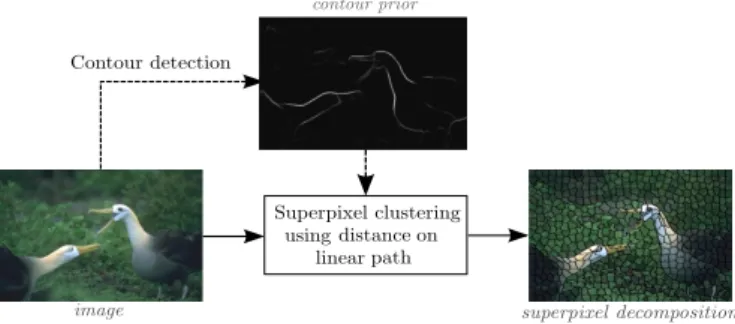
The SCALP framework generalizes the iterative clustering algorithm of [17]. Thanks to the introduction of the linear path within the clustering, a more regular decomposition can be obtained. Moreover, prior information such as contour maps can be naturally included within the path to softly constrain the decomposition, as illustrated in Figure 2.
In this section, we first present the iterative clustering framework. Then, we define the linear path to the superpixel barycenter. Next, we propose to use this path to include relevant information for superpixel clustering, by proposing a new color distance term. We finally propose a fast method to integrate a contour prior into our framework.
Fig. 2. The SCALP framework. When trying to associate a pixel to a
superpixel, SCALP considers the linear path to the superpixel barycenter with a color distance. A prior can be used (dotted arrows) to ensure that no image contour is crossed, leading to an accurate and homogeneous decomposition
A. Simple Linear Iterative Clustering
As previously stated, SLIC [17] is one of the most efficient and simplest superpixel frameworks. In its default settings, it only takes the number of superpixels as parameter. The decomposition is initialized with a regular grid, with blocks of size r, and an iterative clustering, spatially constrained into a window of fixed size2r+ 1, is performed for all superpixels. The size r is defined by the ratio between N the number of pixels andkthe number of superpixels, such thatr=pN/k. With this constraint, roughly equally sized superpixels are provided, ensuring the decomposition regularity.
Each superpixel Sk of SLIC is described by a cluster Ck
containing the average feature information and spatial barycen-ter of all pixels p∈Sk. In [17], the clustering is performed
in the CIELab color space. Therefore, each superpixelSk at a
given iteration is described by its cluster Ck=[lk, ak, bk, Xk],
containing the average CIELab color feature on pixelsp∈Sk
and Xk=[xk, yk], the barycenter of Sk. At each iteration,
and for each clusterCk, all pixelsp=[lp, ap, bp, Xp], within a
square window of size2r+1×2r+1centered on the barycenter
distance ds(p, Ck) = (xp−xk)2+ (yp−yk)2, and a color
distance dc(p, Ck) = (lp−lk)2+ (ap−ak)2+ (bp−bk)2.
The pixelp is assigned to the cluster Ck that minimizes the
sum of these two distances. Despite its basic framework, SLIC achieves results that are comparable to state-of-the-art methods and even outperforms irregular approaches such as [6], in the contour detection evaluation framework of [24].
The framework in [17] provides regular superpixels that can adhere to image contours. However, this adherence can still be enhanced by considering accurate contour information as prior. By introducing the notion of linear path, SCALP computes a generalized color distance term that improves the homogeneity of the color clustering and the regularity of the superpixels shape. We also propose to integrate the contour prior information as a soft constraint in this new color distance to enforce the adherence to image contours.
B. Linear Path to the Cluster Center
To enforce the color homogeneity within a superpixel and contour adherence, we consider the color and contour intensi-ties on the linear path between pixels and their corresponding superpixel barycenter.
We thus define the path Pk
p of pixels between a pixel p
and a superpixel barycenter Xk. By considering information
along this path, SCALP is able to enhance the relevance of the color distance. Note that the more pixels are considered in
Pk
p, the higher the computational cost is. Hence, we propose
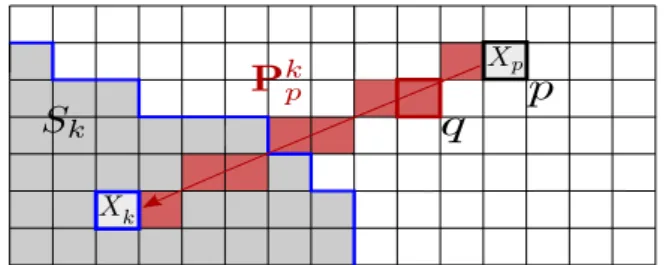
to use [25] to only get the positions of pixels on the direct path between the pixelpand the barycenter of superpixelSk,
as illustrated in Figure 3. The considered pixels q (in red) are those that intersect with the segment (red arrow) between
Xp, the position of pixelp(in black), andXk, the barycenter
of superpixel Sk (in blue). By considering this simple linear
path instead of a more sophisticated geodesic one [26], we limit the computational cost and enforce the decomposition compactness.
Fig. 3. Illustration of linear path to cluster center (see text for more details)
C. Improved Color Distance to Cluster
As in [17], the spatial distancedsbetween a processed pixel
pand a cluster Ck is only computed between positions of p
and its barycenterXk. However, the CIELab color distancedc
may now be computed on Pk
p, the set of pixels on the path
to the superpixel barycenter. The new color distance is thus defined as: dc(p, Ck,Pkp) =λdc(p, Ck)+(1−λ) 1 |Pk p| X q∈Pk p dc(q, Ck), (1)
where λ ∈ [0,1] weights the influence of the color distance along the path betweenXp andXk. Since color on the linear
path to the barycenter should be close to the average color of the superpixel, SCALP naturally enforces the decomposition compactness and favors uniform color distribution.
D. Adherence to Contour Prior
When associating a pixel to a superpixel cluster, we want to favor the color homogeneity, the proximity to the cluster barycenter and the adherence to image contours. We assume that a soft contour prior map C is available. Such map typically sets C(p) → 1 if a contour is detected, otherwise
C(p) → 0, at pixel p. A fast and efficient way to integrate this prior information is to weight the color distance (1) by
dC(p, Ck,Pkp), the sum of contour intensity onPkp defined as:
dC(p, Ck,Pkp) = 1 + γ |Pk p| X q∈Pk p 1−exp(−C(q)2/σ2) , (2)
whereγ ≥0 andσ >0are parameters that weight the influ-ence of the contour prior along the linear path. When a contour intersects the path between a pixelpand a cluster barycenter, such term tends to prevent this pixel to be associated to the cluster Ck. The proposed distance D to minimize during the
clustering is finally defined as:
D(p, Ck) =dc(p, Ck,Pkp)dC(p, Ck,Pkp) +ds(p, Ck)
m2
r2, (3)
wheremis the compactness parameter,i.e., setting the trade-off between color distance dc and spatial distance ds. The
higher mis, the more regular,i.e., compact, is the superpixel shape. On the other hand, small values of m allow a better adherence to image color boundaries, producing superpixels of more variable sizes and shapes. By setting λ= 1 in (1) and
γ= 0in (2), the proposed distance (3) reduces to the standard distance used in [17]. The SCALP algorithm is summarized in Algorithm 1.
Remark: Note that although the algorithm starts from an initial regular grid, the spatial barycenter of a superpixel may, in very rare cases, fall outside the superpixel after a few iterations. Having a cluster center outside the superpixel impacts the computation of the linear path. Hence, if the barycenter Xk is not contained into the superpixel Sk, we
consider the projected positionXk∗ to compute the linear path to the center Pk
p, which is computed as:
Xk∗= argmin
Xp,p∈Sk
kXp−Xkk2. (4)
E. Contour Prior
SCALP can directly consider a contour prior into the clustering framework. Therefore, our decomposition is not constrained by a pre-segmentation step. This contour prior can either be soft or hard, i.e., having values between 0 and 1 or being binary, and can be computed by any contour detection method (see for instance [1] and references therein). In Section III-B, we report results obtained using different contour detection methods [27], [28], [29].
Algorithm 1: SCALP method
inputs :Number of superpixelsk, Contour priorC
output:Superpixel decompositionS
Initialization of clustersCk←[lk, ak, bk, Xk]from a regular grid
Initialization of superpixel labelsS ←0
foreach iterationdo
Distanced← ∞
foreachCkdo
foreachpin a2r+ 1×2r+ 1window centered onXkdo
ComputeD(p, Ck)usingCandPkp(3)
ifD(p, Ck)< d(p)then
d(p)←D(p, Ck)andS(p)←k
Update[lk, ak, bk, Xk]for all clustersCk
Compute if necessary the projectionXk∗of centersXkintoSk(4)
III. RESULTS
A. Validation Framework
1) Dataset: We evaluate our method on the standard Berke-ley Segmentation Dataset (BSD) [8]. The BSD contains 500 images of 321×481 pixels divided into three sets: 200 for training, 100 for validation and 200 for testing. For each image, at least 5 ground truth decompositions from manual segmentations are also provided to compute evaluation met-rics. We report results of SCALP and other compared methods on the 200 images of the test set.
2) Metrics: To evaluate the performances of our framework and compare to the state-of-the-art methods, we use the standard superpixel evaluation metrics: boundary recall (BR), undersegmentation error (UE) and achievable segmentation accuracy (ASA). To compare the regularity of superpixel shape of different decompositions, we report the compact-ness measure introduced in [30]. In the following, for an image I, a human ground truth segmentation is denoted
G={Gi}i∈{1,...,nG}, whereGi is a segmented region of the
scene,nGis the number of regions within the decomposition,
and|.| denotes the cardinality. Reported values are averaged results on all ground truths. To quantify the results of contour detection performance, we report the precision (P) recall (R) curves [24].
Boundary Recall. This measure evaluates the percentage of ground truth contours B(G) that overlap, within an -pixel distance, with the boundaries of the computed superpixel decompositionB(S). The BR metric is defined as follows:
BR(S,G) =
P
p∈B(G)δ[minq∈B(S)kp−qk< ]
|B(G)| , (5) withδ[a]=1whenais true and0otherwise, and=2as in [6].
Achievable Segmentation Accuracy. The ASA is an upper bound measure that computes the maximum object segmen-tation accuracy by taking superpixels as units. For each superpixelSk, the largest possible overlap with a ground truth
segmentGi is computed and averaged as follows:
ASA(S,G) = P kmaxi|Sk∩Gi| P i|Gi| . (6)
Undersegmentation Error. This measure evaluates the per-centage of pixels that cross ground truth boundaries. With an accurate superpixel decomposition with respect to a given ground truth, superpixels should overlap with only one object. The undersegmentation error (UE) is computed as:
U E(S,G) = P i P k:Sk∩Gi6=∅|Sk−Gi| P i|Gi| . (7)
Compactness measure. The compactness (CO) measure for a superpixel decomposition S is defined as in [30]:
CO(S) = 1 |I| X Sk∈S 4π|Sk|2 |P(Sk)|2 , (8)
whereP(Sk)defines the perimeter of the superpixelSk. High
values indicates more compact superpixels.
Precision-Recall. The PR framework [24] evaluates the con-tour detection accuracy. It can be used to measure the concon-tour detection performances of segmentation or superpixel algo-rithms. The PR curves are computed from a set of input maps, which values represent the confidence in being on an image boundary. When evaluating superpixel methods, these maps can be computed by averaging superpixel boundaries obtained from decompositions at multiple scales. As in [6], we considered 12 scales, ranging from 6 to 600 superpixels, to compute the boundary maps. We rank the methods according to their maximum F-measure defined as (2.P.R)/(P +R), where P (precision) is the percentage of accurate detection among the computed contours, andR(recall) is the percentage of detected ground truth contours.
3) Parameter Settings: SCALP was implemented with MATLAB using C-MEX code, on a standard Linux computer. The number of clustering iterations is set to5. We setλto0.5
in the proposed color distance (1), σto0.25in (2), andγ to
2r, to adjust to the superpixel size. The compactness parameter
mis set to10in (3) as in [17]. These parameters offer a good trade-off between adherence to contour prior and compactness. In the following, if not mentioned, we use a prior from the contour detection method of [29].
B. Influence of Parameters
We first measure the influence of parameters within the proposed framework. In Figure 4(a), we provide PR curves for different distance settings. Contributions of the new the color distance (1) and the additional contour intensity (2) computed on the linear path to the superpixel barycenter both increase the accuracy of the decomposition with respect to ground truth segmentations. The complete SCALP algorithm, i.e., using color distance and contour intensity, provides the best results and outperforms the standard method proposed in [17].
We also investigate the influence of the contour prior. In Figure 4(b), we provide PR curves obtained by using the glob-alized probability of boundaryalgorithm [27], a method using learned sparse codes of patch gradients [28], and a structured forests approach [29] for contour detection. Results are also improved with respect to the contour detection accuracy. In the following, results are computed using [29].
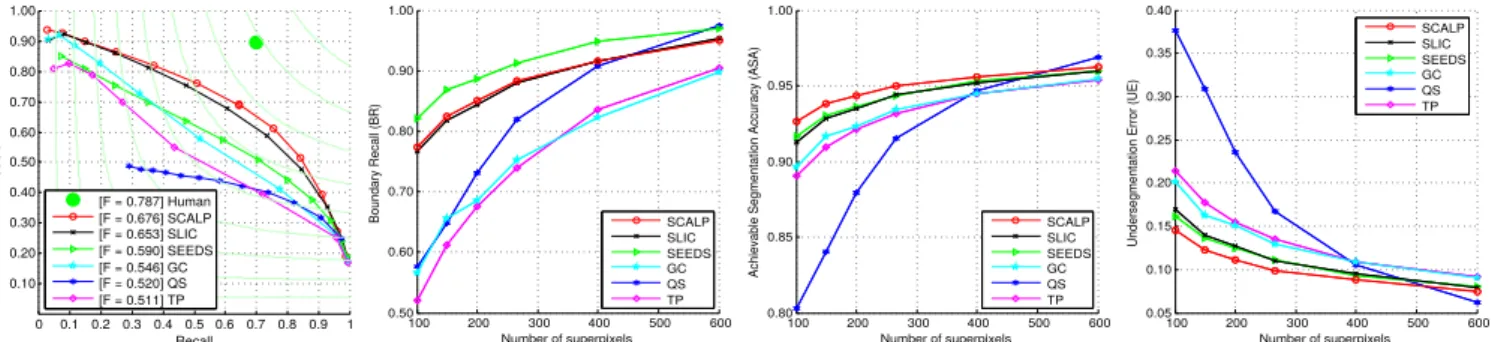
0 0.1 0.2 0.3 0.4 0.5 0.6 0.7 0.8 0.9 1 0.10 0.20 0.30 0.40 0.50 0.60 0.70 0.80 0.90 1.00 Recall Precision [F = 0.787] Human [F = 0.676] SCALP [F = 0.653] SLIC [F = 0.590] SEEDS [F = 0.546] GC [F = 0.520] QS [F = 0.511] TP 100 200 300 400 500 600 0.50 0.60 0.70 0.80 0.90 1.00 Boundary Recall (BR) Number of superpixels SCALP SLIC SEEDS GC QS TP 100 200 300 400 500 600 0.80 0.85 0.90 0.95 1.00
Achievable Segmentation Accuracy (ASA)
Number of superpixels SCALP SLIC SEEDS GC QS TP 100 200 300 400 500 600 0.05 0.10 0.15 0.20 0.25 0.30 0.35 0.40
Undersegmentation Error (UE)
Number of superpixels SCALP SLIC SEEDS GC QS TP
Fig. 5. Comparison between the proposed SCALP framework and state-of-the-art methods on contour detection and superpixel metrics on the BSD test set
0.0 0.1 0.2 0.3 0.4 0.5 0.6 0.7 0.8 0.9 1.0 0.0 0.1 0.2 0.3 0.4 0.5 0.6 0.7 0.8 0.9 1.0 Recall Precision [F = 0.787] Human [F = 0.676] λ=0.5, γ=2r [F = 0.671] λ=1, γ=2r [F = 0.660] λ=0.5, γ=0 [F = 0.653] λ=1, γ=0 0.0 0.1 0.2 0.3 0.4 0.5 0.6 0.7 0.8 0.9 1.0 0.0 0.1 0.2 0.3 0.4 0.5 0.6 0.7 0.8 0.9 1.0 Recall Precision [F = 0.787] Human [F = 0.653] SLIC [F = 0.676] SCALP using [29] [F = 0.670] SCALP using [28] [F = 0.661] SCALP using [27] (a) (b)
Fig. 4. PR curves for different SCALP distance parameters (a), and contour detection methods (b)
C. Comparison with State-of-the-Art Methods
We compare the proposed approach to the following state-of-the-art methods: Quick shift (QS) [11], Turbopixels (TP) [13], a graph cut approach (GC) [14], SLIC [17] and SEEDS [6]. Note that TP and GC enforce regularity and thus provide very consistent decompositions at the expense of lower contour adherence. All provided results are computed with the same validation framework, described in Section III-A, with codes provided by the authors and used with their default settings.
In Figure 5, we provide PR curves with their maximumF -measure, and report the standard BR (5), ASA (6) and UE (7) metrics. SCALP is ranked1st on PR, providing the higher F-measure (0.676). On superpixel metrics, it is ranked1st on
ASA and UE, and 2nd on BR.
Although high BR results indicate that ground truth bound-aries are well detected by the superpixels, this measure does not consider the false detection. Therefore, irregular methods such as [6], that produces very stretched superpixels with much more boundary pixels can obtain higher BR results. Better PR performances indicate that SCALP very accurately detects object contours with a lower false detection rate. The UE metric is penalized when superpixels overlap with multiple objects. Hence, SCALP superpixels overlap with a lower number of ground truth segments. The ASA evaluates the consistency of a decomposition with respect to the objects within an image, thus enhancing the largest possible overlap. Higher ASA results for SCALP also indicate that the produced superpixels are better contained in the image objects.
The regularity of the proposed SCALP framework is con-firmed with Table I, which reports the compactness measure (8) for the best compared methods. The provided results are averages obtained on all image decompositions, on the same scales as the ones used to compute the PR curves. SCALP obtains the most regular superpixels, even improving the results of SLIC [17].
TABLE I
COMPARISON OF SUPERPIXEL REGULARITY, CO (8)
SEEDS [6] QS [11] SLIC [17] SCALP
0.201 0.205 0.269 0.278
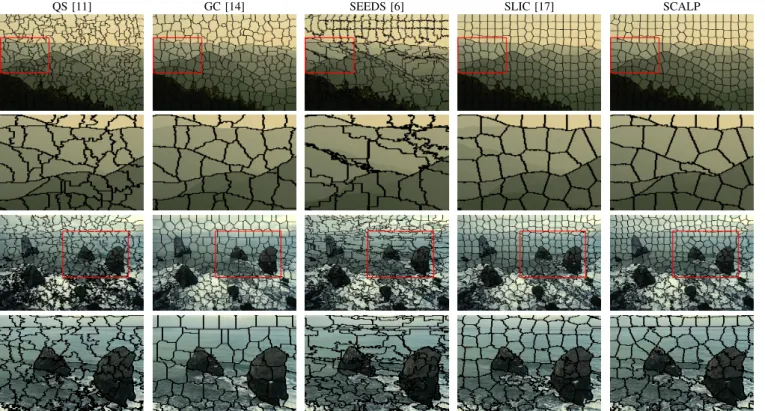
Finally, Figure 6 illustrates the decomposition results ob-tained with SCALP and the compared approaches on example images. SCALP appears to provide more regular superpixels while tightly following the image contours.
SCALP achieves the best state-of-the-art segmentation and contour detection performance, while providing a regular superpixel decomposition, in a limited computational time,i.e., less than 0.4s per image of the BSD.
IV. CONCLUSION
In this work, we propose a generalization of the superpixel clustering framework of [17], by considering image feature and contour intensity on the linear path from the pixel to the superpixel barycenter. The contour prior information enhances the adherence to the object boundaries.
The proposed SCALP method provides superpixels of more regular shape, according to the compactness measure. SCALP also obtains state-of-the-art results, outperforming [17] on superpixel metrics, and obtains the higher F-measure among the compared methods. Finally, our fast integration of the contour prior within the framework enables to obtain the decomposition in a limited computational time.
Future works will focus on SCALP adaptation to supervoxel decomposition, for video and 3D image processing.
ACKNOWLEDGMENT
This study has been carried out with financial support from the French State, managed by the French National Research Agency (ANR) in the frame of the Investments for the future Program IdEx Bordeaux (ANR-10-IDEX-03-02), Cluster of excellence CPU and TRAIL (HR-DTI ANR-10-LABX-57).
QS [11] GC [14] SEEDS [6] SLIC [17] SCALP
Fig. 6. Comparison of decomposition results between SCALP and state-of-the-art superpixel methods on example images of the BSD
REFERENCES
[1] P. Arbelaez, M. Maire, C. Fowlkes, and J. Malik, “Contour detection and
hierarchical image segmentation,”PAMI, vol. 33, no. 5, pp. 898–916,
2011.
[2] A. Kae, K. Sohn, H. Lee, and E. Learned-Miller, “Augmenting CRFs
with Boltzmann machine shape priors for image labeling,” in CVPR,
2013, pp. 2019–2026.
[3] B. Fulkerson, A. Vedaldi, and S. Soatto, “Class segmentation and object
localization with superpixel neighborhoods,” inICCV, 2009, pp. 670–
677.
[4] S. Gould, J. Rodgers, D. Cohen, G. Elidan, and D. Koller, “Multi-class segmentation with relative location prior,”IJCV, vol. 80, no. 3, pp. 300– 316, 2008.
[5] S. Gould, J. Zhao, X. He, and Y. Zhang, “Superpixel graph label transfer
with learned distance metric,” inECCV, 2014, pp. 632–647.
[6] M. Van den Bergh, X. Boix, G. Roig, B. de Capitani, and L. Van Gool,
“SEEDS: Superpixels extracted via energy-driven sampling,” inECCV,
2012, pp. 13–26.
[7] S. Wang, H. Lu, F. Yang, and M. H. Yang, “Superpixel tracking,” in
ICCV, 2011, pp. 1323–1330.
[8] D. Martin, C. Fowlkes, D. Tal, and J. Malik, “A database of human segmented natural images and its application to evaluating segmentation algorithms and measuring ecological statistics,” inICCV, vol. 2, 2001, pp. 416–423.
[9] L. Vincent and P. Soille, “Watersheds in digital spaces: an efficient
algorithm based on immersion simulations,”PAMI, vol. 13, no. 6, pp.
583–598, 1991.
[10] D. Comaniciu and P. Meer, “Mean shift: a robust approach toward feature space analysis,”PAMI, vol. 24, no. 5, pp. 603–619, 2002. [11] A. Vedaldi and S. Soatto, “Quick shift and kernel methods for mode
seeking,” inECCV, 2008, pp. 705–718.
[12] P. F. Felzenszwalb and D. P. Huttenlocher, “Efficient graph-based image segmentation,”IJCV, vol. 59, no. 2, pp. 167–181, 2004.
[13] A. Levinshtein, A. Stere, K. N. Kutulakos, D. J. Fleet, S. J. Dickinson, and K. Siddiqi, “Turbopixels: Fast superpixels using geometric flows,”
PAMI, vol. 31, no. 12, pp. 2290–2297, 2009.
[14] O. Veksler, Y. Boykov, and P. Mehrani, “Superpixels and supervoxels in
an energy optimization framework,” inECCV, 2010, pp. 211–224.
[15] M. Y. Liu, O. Tuzel, S. Ramalingam, and R. Chellappa, “Entropy rate
superpixel segmentation,” inCVPR, 2011, pp. 2097–2104.
[16] V. Machairas, M. Faessel, D. C´ardenas-Pe˜na, T. Chabardes, T. Walter, and E. Decenci`ere, “Waterpixels,”TIP, vol. 24, no. 11, pp. 3707–3716, 2015.
[17] R. Achanta, A. Shaji, K. Smith, A. Lucchi, P. Fua, and S. S¨usstrunk, “SLIC superpixels compared to state-of-the-art superpixel methods,”
PAMI, vol. 34, no. 11, pp. 2274–2282, 2012.
[18] Z. Li and J. Chen, “Superpixel segmentation using linear spectral
clustering,” inCVPR, 2015, pp. 1356–1363.
[19] Y. Zhang, X. Li, X. Gao, and C. Zhang, “A simple algorithm of
superpixel segmentation with boundary constraint,” TCSVT, no. 99,
2016.
[20] P. Arbelaez, M. Maire, C. Fowlkes, and J. Malik, “From contours to
regions: An empirical evaluation,” inCVPR, 2009, pp. 2294–2301.
[21] G. Mori, X. Ren, A. A. Efros, and J. Malik, “Recovering human body
configurations: combining segmentation and recognition,” in CVPR,
vol. 2, 2004, pp. 326–333.
[22] J. Shi and J. Malik, “Normalized cuts and image segmentation,”PAMI,
vol. 22, no. 8, pp. 888–905, 2000.
[23] A. P. Moore, S. J. D. Prince, J. Warrell, U. Mohammed, and G. Jones, “Superpixel lattices,” inCVPR, 2008, pp. 1–8.
[24] D. R. Martin, C. C. Fowlkes, and J. Malik, “Learning to detect natural image boundaries using local brightness, color, and texture cues,”PAMI, vol. 26, no. 5, pp. 530–549, 2004.
[25] J. E. Bresenham, “Algorithm for computer control of a digital plotter,”
IBM Syst. J., vol. 4, no. 1, pp. 25–30, 1965.
[26] G. Zeng, P. Wang, J. Wang, R. Gan, and H. Zha, “Structure-sensitive
superpixels via geodesic distance,” inICCV, 2011, pp. 447–454.
[27] M. Maire, P. Arbelaez, C. Fowlkes, and J. Malik, “Using contours to
detect and localize junctions in natural images,” inCVPR, 2008, pp.
1–8.
[28] R. Xiaofeng and L. Bo, “Discriminatively trained sparse code gradients for contour detection,” inNIPS, 2012, pp. 584–592.
[29] P. Doll´ar and C. L. Zitnick, “Structured forests for fast edge detection,”
inICCV, 2013, pp. 1841–1848.
[30] A. Schick, M. Fischer, and R. Stiefelhagen, “Measuring and evaluating
![Fig. 1. Reconstruction from average colors with 200 superpixels on an example image from the Berkeley Segmentation Dataset [8]](https://thumb-us.123doks.com/thumbv2/123dok_us/9218923.2806092/2.892.458.828.618.808/reconstruction-average-colors-superpixels-example-berkeley-segmentation-dataset.webp)