Computer Science ETDs Engineering ETDs
12-1-2012
Methods for speculatively bootstrapping better
intrusion detection system performance
Sunny Fugate
Follow this and additional works at:https://digitalrepository.unm.edu/cs_etds
This Dissertation is brought to you for free and open access by the Engineering ETDs at UNM Digital Repository. It has been accepted for inclusion in Computer Science ETDs by an authorized administrator of UNM Digital Repository. For more information, please [email protected].
Recommended Citation
Fugate, Sunny. "Methods for speculatively bootstrapping better intrusion detection system performance." (2012). https://digitalrepository.unm.edu/cs_etds/20
Computer Science
Department
This dissertation is approved, and it is acceptable in quality and form for publication:
Approved by the Dissertation Committee:
, Chairperson George F. Luger Jedidiah R. Crandall Thomas P. Caudell Thomas P. Hayes LorRaine T. Duffy
Intrusion Detection System Performance
by
Sunny James Fugate
B.S., Electrical Engineering, University of Nevada, 2002
M.S., Computer Science, University of New Mexico, 2011
DISSERTATION
Submitted in Partial Fulfillment of the Requirements for the Degree of
Doctor of Philosophy
Computer Science
The University of New Mexico Albuquerque, New Mexico
To my brilliant wife Truc-Ha, my sons Minh and Maxwell, and my friends and colleagues who have supported and encouraged me.
I would foremost like to thank my adviser, Professor George Luger, for supporting my research even though it often drifted from his own interests. My time at the University of New Mexico would not have been nearly as pleasurable without your insights, patience, and candor (and occasional infusions of India Pale Ale at the local brew pub).
As a recipient of the Naval Postgraduate School’s Science, Mathematics, & Research for Transformation (SMART) Scholarship, I am eternally grateful for the financial means to obtain an advanced degree while maintaining my pursuit of Navy-directed research as a government civilian. The financial freedom afforded by the SMART program has enabled me to start a family and learn about human cognition and development as both a scientist and a parent.
I would also like to thank the Defense Threat Reduction Agency for supporting my application to the SMART program, the, Systems Center (SPAWAR) for their continued employment throughout my degree studies, and the Office of Naval Research (ONR) for funding my research projects throughout my studies. Many aspects of this dissertation were partially funded through ONR.
Dr. LorRaine Duffy has been my mentor, adviser, and friend during my first decade of government service. She has been my unequivocal advocate throughout both my academic studies and research efforts. Under her guidance, I have had the most fun, worked with the best teams, met the most fascinating people, and worked on the most clever ideas of my early career. Thank you for believing in me, trusting me, and being my vocal advocate in a forest of falling trees. Someday, the rest of the guys and I will make you famous, just you wait.
Finally, I would like to thank Christine Lisman. Without her advocacy of my early efforts in security-related visualization (and my having subsequently followed her out to Washington, DC to work at the Joint Task Force for Global Network Operations) I may have never gotten my feet wet with Network Intrusion Detection in the first place.
Intrusion Detection System Performance
by
Sunny James Fugate
B.S., Electrical Engineering, University of Nevada, 2002
M.S., Computer Science, University of New Mexico, 2011
Ph.D., Computer Science, University of New Mexico, 2012
Abstract
During the last three decades, the designers of computer Intrusion Detection System (IDS) have been continuously challenged with performance bottlenecks and scalability issues. The number of threats is enormous. The performance of IDS systems depends primarily on the quantity of input data and complexity of detected patterns. During noisy attacks, system load tends to increase proportional to increasing data rates, making IDS systems vulnerable to flooding and denial-of-service attacks. Unfortunately, the number, type, and sophistication of threats is quickly increasing, outpacing our ability to detect them. The more we try to detect, the more computing and economic resources must be reserved solely for the task of detection, whittling away at what remains for performing useful computations.
This dissertation describes methods for assessing the current scaling performance of signature-based IDS and presents models for speculatively bootstrapping better IDS performance. Using measurements of the coverage and scaling performance of a modern signature-based IDS in the context of an anticipatory model arguments are presented that
how mechanisms of anticipatory bias can be used to achieve performance improvements. To support the theoretical models, two principal approaches have been implemented. The first uses a combination of anticipation and feedback in an attempt to decrease per-signature costs by (counter-intuitively) increasing system coverage. The approach uses learned sequence statistics to make predictions of future events. Each prediction above a chosen threshold is used to decrease per-stream detection cost by shunting traffic to smaller detectors (at the risk of increased error rates). The new approach promises decreasing per-signature costs as new detection signatures are added. The design and performance of a prototype anticipatory IDS, “Packet Wrangler”, demonstrates the feasibility of the basic approach.
The second approach applies primarily to improving the performance of IDS when under stress. When overburdened, an IDS will drop input data (often arbitrarily). Aprobabilistic signature activationapproach is described which improves error rates by decreasing the total amount of input data lost by probabilistically dropping signature activations based on learned event statistics and system load. A theoretical analysis is presented which shows that a policy which drops signatures instead of packets can outperform the default policy of dropping packets in terms of total error rates. A rudimentary prototype based on the Snort IDS, “Probabilistic Flowbits”, is described. Experimental results are then given which show substantially decreased error rates while simultaneously decreasing system overhead.
In conclusion, a case is made for expanding IDS coverage and implementation fast-feedback and anticipatory optimizations. It can be argued that these extensions are both necessary and sufficient for long-term scalability, but oddly absent from existing systems.
Abstract . . . vi Figures . . . xii Tables . . . xiv Listings . . . xvi 1 Introduction 1 1.1 Summary of Results . . . 5 2 Background 10 2.1 Why Study Anticipatory Intrusion Detection? . . . 10
2.1.1 Inspiration . . . 10
2.1.2 Software Complexity, Vulnerability, and Detection . . . 13
2.1.3 The Problem of Performance . . . 15
2.1.4 Goals . . . 17
2.2 Intrusion Detection Systems . . . 21
2.2.1 Host versus Network Detection . . . 22
2.2.2 Misuse and Anomaly Detection . . . 24
2.2.3 Signature-Based Detection . . . 26
2.3 Characteristics of Signature-Based Detection . . . 29
2.3.1 Decision Procedure . . . 29
2.3.2 Signature Information . . . 32
2.3.3 Alert & Signature Semantics . . . 33
2.4 Per-Signature Cost Optimization . . . 37
2.4.1 Flow Tracking . . . 38
2.4.2 Signature Chaining . . . 38
2.4.3 Event Filtering & Suppression . . . 39
2.5 Related Work . . . 40
2.5.1 Attacker Modeling . . . 42
2.5.2 Prediction & Performance Adaptation . . . 44
2.5.3 Historical Surveys . . . 49
3 Theory 54 3.1 An Anticipatory IDS Model . . . 55
3.1.1 Wasted Information . . . 58
3.1.2 Threat Coverage . . . 63
3.1.3 Packet Coverage . . . 64
3.1.4 Signature Equivalence Classes . . . 66
3.1.5 An IDS Cost Function . . . 68
3.2 Probabilistic Signature Activation . . . 70
3.2.1 Signature Activation Policies . . . 71
3.2.2 Probabilistic Flowbits and False Negatives . . . 75
3.3 Predictor Errors . . . 83
3.3.1 Signature Chaining & Flow Tracking . . . 83
3.3.2 Systematic Errors . . . 84
3.3.3 Error Detection . . . 85
3.4 The Detection Game . . . 86
4 IDS Performance Characteristics 90 4.1 Generating Large Signature-Sets . . . 91
4.2 Snort IDS Performance Scaling . . . 93
4.2.2 Packet Coverage . . . 94
4.2.3 CPU-time scaling . . . 96
4.2.4 Packet Loss Scaling Performance . . . 97
4.2.5 Anticipatory Gain Potential of the Snort IDS . . . 101
5 Prototypes 105 5.1 Packet Wrangler . . . 105 5.1.1 Startup . . . 106 5.1.2 Program Logic . . . 108 5.1.3 Predictors . . . 109 5.1.4 Discussion . . . 111 5.2 Probabilistic Flowbits . . . 113 6 Experiments 117 6.1 Methods . . . 117 6.2 Packet Wrangler . . . 119
6.2.1 Naive Bayes Predictor . . . 120
6.2.2 Rule-Based . . . 125
6.2.3 Traffic Split . . . 129
6.2.4 Discussion . . . 131
6.3 Probabilistic Flowbits . . . 133
6.3.1 Results . . . 134
6.3.2 Analysis & Criticisms . . . 141
7 Impact, Conclusions, & Future Work 144 7.1 A “Household Survey” Analogy . . . 146
7.2 Biological Metaphors & Future Work . . . 148
A Hardware & Software Configurations 156 A.1 Test System Configuration . . . 156
A.2 Training and Test Data . . . 158
B Snort Configurations & Analysis 164
B.1 Basic Snort Configuration File . . . 164 B.2 Snort Signature Profiling & Tuning . . . 165 B.3 Custom Snort Signatures . . . 170
C Issues & Confounding Factors 172
C.1 Event Suppression . . . 172 C.2 Packet Loss . . . 173
D Scripts & Algorithms 176
D.1 Packet Wrangler . . . 176 D.2 Gain Curve Calculations . . . 177
2.1 Software growth over a decade of Linux operating system development . . 13
2.2 Cataloged vulnerabilities per calendar year . . . 14
2.3 Signature-set processing times for the Snort IDS release 2.9.1.2 . . . 16
2.4 Temporal logic relations over IDS events . . . 36
2.5 Temporal logic using Next(alert) semantics . . . 36
3.1 Predictive IDS architecture denoting conventional techniques . . . 56
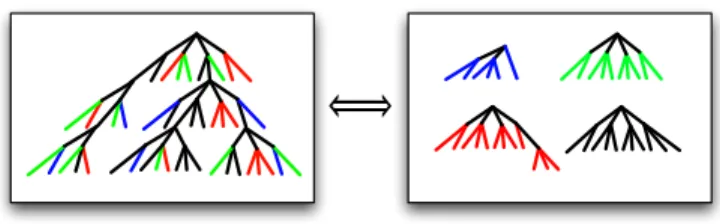
3.2 Dual decision tree representations with color-labeled equivalence classes . 57 3.3 Anticipatory IDS architecture . . . 58
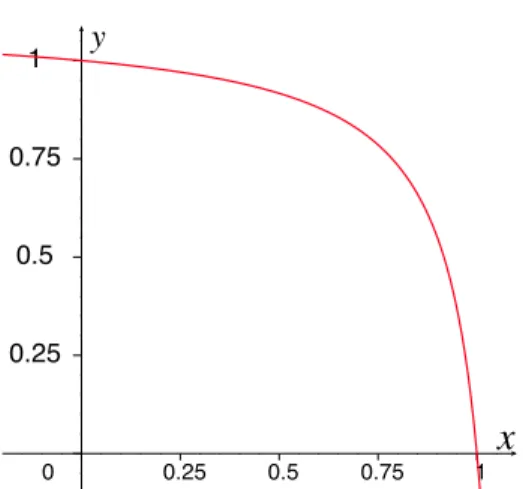
3.4 Probabilistic signature activation function . . . 74
3.5 Simple state transitions for Flowbit-based signature activation . . . 75
3.6 The Detection Game payoff matrix for a zero-sum game . . . 87
4.1 Random feature replacement algorithm . . . 92
4.2 Polynomial fit for the startup time of the Snort IDS . . . 94
4.3 Linear scaling of total CPU-time with signature-set size of the Snort IDS . 96 4.4 Test 18-2: Packets dropped by Snort for signature-set sizes 1K-40K . . . 98
4.5 Test 18-1: Snort scaling for signature-set sizes from 1K-40K . . . 99
4.6 Over-estimating fit for packet processing rate . . . 100
4.7 Packet processing rate estimate curves . . . 100
4.8 Curves of constant gain for signature-set size ofn = 4320. . . 102
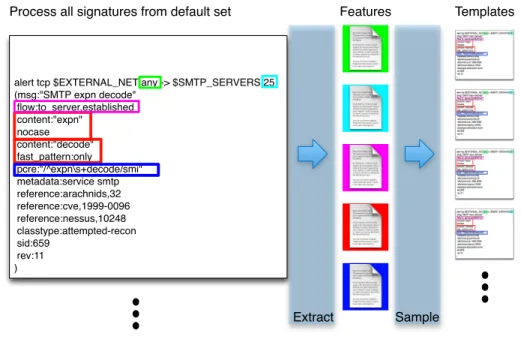
5.1 Predictive IDS architecture showing data flow . . . 106 5.2 Flow diagram for the Packet Wrangler program . . . 108 6.1 Test 5: Packet Wrangler forwarding using theTop 50event sequences . . 121 6.2 Test 15: Packet Wrangler Top 50 Configuration . . . 124 6.3 Test 36: Process Times showing experimental overhead costs . . . 131 6.4 Test 36: Process Times with event filter . . . 132 6.5 Test 38-1b: Total CPU-time for all processes (0min-10min window) . . . 135 6.6 Test 38-2b: Total CPU-time for all processes (10min-20min window) . . . 136 A.1 Stochastic matrix set showing Snort’s built-in preprocessors . . . 161 A.2 Example stochastic matrix using the entire set of available signatures . . . 162 B.1 A Snort signature-set profile of top 10 signatures (Avg/Check) . . . 166
2.1 Linear temporal logic relations . . . 35
2.2 Intrusion Detection Systems . . . 50
3.1 Equivalence class size and problem size . . . 68
6.1 Test 29a,b: HTTP traffic split [s1 flow tracking, s1 HTTP-detection] . . . 127
6.2 Test 29c: HTTP traffic split [nos1flow tracking, 3-tuple] . . . 128
6.3 Tests 30-32: [small secondary signature-sets] . . . 129
6.4 Test 35h: Dropping all detected TCP packets for a high-load scenario . . . 130
6.5 Test 36: Measuring cost of I/O for traffic detection signatures . . . 131
6.6 Test 38-1b: packets processed and error rates (0min-10min) . . . 135
6.7 Tests 38-1b & 2b: Cost-relevance policy relative to signature 4677 . . . . 136
6.8 Test 38-2b: Packet processing and error rates (10min-20min window) . . 137
6.9 Test 38-2j: Cost-relevance policy with re-scaled probabilities . . . 138
6.10 Test 38-2j: Packet processing and error rates after signature removal . . . 138
6.11 Calculated gains for various signature activation policies . . . 139
6.12 Test 38-2k: Cost policy probability table . . . 140
6.13 Test 38-2k: Packet processing and error rates using a Cost policy . . . 141
A.1 System Hardware Configuration . . . 157
A.2 System Software Configuration . . . 157
A.3 High Occurrence Alert Sequences for the 1998 Dataset . . . 160
B.2 Top 10 signatures in terms of total CPU-time using a Cost policy . . . 169 B.3 Cost policy performance differences in total CPU-time and checks . . . . 169
2.1 Example of a Snort Signature . . . 34
2.2 Predicate logic representation of a Snort Signature . . . 34
A.3 Snort configuration options used for compilation . . . 156
A.4 Snort command using the PF RING data acquisition module . . . 157
A.5 Snort command for experiments . . . 158
A.6 TCPReplay command . . . 158
B.7 High-cost signature 4677 reproduced from a Snort IDS signature-set . . . 166
B.8 Simple HTTP activity detection signatures . . . 170
B.9 TCP Detection Signatures . . . 171
D.10 Packet Wrangler: predictEquivalenceClasses(Alert SetAi,ConnectionCi) 176 D.11 Packet Wrangler: updateAllFilters . . . 176
D.12 Packet Wrangler: updateFilter(ConnectionCi,Equivalence classesEi) . . 176
D.13 Setup for gain curve computation in Mathematica . . . 178
Introduction
Each and every day, our bodies wander through a morass of other organisms, proteins, and matter. They assault us via the front lines of skin, lungs, and gut. The total exposed surface area of around400m2is truly extraordinary1. Via evolution, our bodies have learned
to process a great diversity of substances (air, water, foods, toxins, casual contacts), all while efficiently identifying and filtering pathogenic material. The cost of not detecting a threat is disease, possibly death. The cost of overreacting is allergy, asthma, and possibly anaphylactic shock. Each day the body strives for the happy median in between – all without conscious involvement.
During the last few decades we have created a rich ecology of sophisticated computing machines. Each day these devices are more and more extensions of our bodies and our minds. We gain great advantage through their use, but we have exposed ourselves in ways unimaginable by any process of natural evolution. We have expanded our total surface area by inextricably tying ourselves into the realm of information and networks. Somehow, however, we never realized the extent of our newfound vulnerabilities. We protect our digital surface areas using a bubble-boy approach to preventing disease. Our protection
mechanisms are complex barriers, detection, and filtering mechanisms. We attempt to limit our exposure, but any exposure is enough to destroy us. Just as for the premature child in an intensive-care unit, regimented isolation is not a permanent solution. The costs are debilitating. The risks do not dissipate the longer we wait.
In this thesis, we examine a particular type of defense mechanism used for detecting computational pathogens, the Intrusion Detection System or IDS.
During the last 25 years, IDS designers have been continuously challenged with perfor-mance bottlenecks and scalability issues. The number of threats is enormous. But the more we try to detect, the more of our computing resources are being used solely for protection, whittling away at what remains for performing useful computations. The performance of many IDS systems depends primarily on the quantity of input data and complexity of detected patterns. During noisy attacks, system load tends to increase proportional to increasing data rates, making IDS systems vulnerable to flooding and denial-of-service attacks. Unfortunately, the number, type, and sophistication of threats is quickly increasing, outpacing our ability to detect them. Anyone who has run a background anti-virus program on their computer can attest to the impact such systems have on our productivity.
The research community has met these challenges with a sophisticated arsenal of clever algorithms for achieving low-cost pattern-matching, decreasing per-packet (and per-signature) detection costs. However, there has been little work in assessing whether traditional signature-based IDS approaches can achieve long-term scalability in the face of increasingly multifarious threats.
Our desire is tocheaply detectall of the relevant threats for our computer networks. The current problem is that these systems scale poorly. Detecting more things requires more hardware, so much so that nobody (except maybe the US Department of Defense) attempts to detect everything. Parallelization, often touted as the solution to all scalability problems, is really just more hardware in a smaller space. It is part of the solution, but it does not
make our algorithms smarter nor does it significantly change the scaling performance of our existing detection systems. These systems all scale proportional to the size of the detection task. The larger the detection task, the larger the computing and storage costs. This is unacceptable.
However, precise detection does not have to cost us so much. Instead of simply being a thorn in our side, precise detection should be a means to an end in respect to scalability. But systems must be designed to take advantage of it. The principle thesis of this dissertation is that detection systems can achieve better scaling performance by using increased coverage to anticipate future events.
Currently, detection system performance proportionally degrades as coverage is in-creased, but if the added coverage allows some events to be easily predicted, increasing detection system coverage can make overall detection less expensive. The compromise is that each bit of information gain must be achieved with minimum cost, more information must be retained over time, wasted information must be eliminated whenever possible, and the detection system must be made more sophisticated through the use of closed-loop feedback for online detector optimization.
Signature-basedintrusion detection systems utilize large collections of fixed patterns to detect malicious events on computers and computer networks. These systems are sometimes associated with single computing system, as in a Host Intrusion Detection System (HIDS). They may also sit at a router or firewall and examine traffic from a network of computing systems, as in a Network Intrusion Detection System (NIDS).
In brief, a “signature” is a collection of features which can be used to uniquely identify a specific malicious event (see Sect. 2.2.3 on page 26). The number of potential signatures necessary to precisely identify all current threats is daunting. As of May 2012, MITRE Corporation’s Common Vulnerabilities and Exposures (CVE) database has cataloged ap-proximately 55,000disclosedvulnerabilities dating from 1999. This only accounts for a
fraction of the exploits available to a well-funded adversary. Indeed the number of mali-cious programs which might be gainfully identified using signature-based approaches while in-transit over a network number in the millions. Clearly, modern IDS achieve only partial coverage of known vulnerabilities, exploits, and other threat-related activities.
To improve coverage we might simply abandon signature-based approaches and use something wildly different. Statistical anomaly detection approaches provide much better coverage of both current and potential threats. Unfortunately, these types of system do not provide much in terms of precision. They tell us that something bad is happening, but not whatit is orwhywe should do something about it. We have chosen to focus on signature-based approaches because of their ability to precisely identify specific threats. Anomaly detection systems are important, but nobody wants a system that only ever tells them “something bad is happening, but I do not know what it is and I do not know why I feel this way.” We are over-simplifying in order to make a point. We do need to be able to detect statistical anomalies so that we can learn about new threats that we cannot yet identify. But we need precision in order to act and respond quickly and appropriately.
Within modern IDS, most of the information whichcouldbe learned (and later used) in the process of detecting threats is generally wasted, discarded due to the high cost of processing and storage. IDS tend to be vulnerability focused and are designed to “forget” anything that is not directly identified as a threat. Unfortunately, these forgotten features are exactly what we need to improve the performance of future detection tasks. By throwing away so much information for purposes of efficiency, we preclude an important class of performance optimizations: anticipation. We end up with detection systems which lack sufficient coverage of input features to perform gainful anticipation of future events. This lack of broad-spectrum coverage (and subsequent lack of anticipatory mechanisms) is partially to blame for our current performance bottlenecks and scalability issues.
While the algorithms and approaches of modern IDS are undeniably sophisticated, few have made use of the efficiency tricks and shortcuts commonplace within biological
cognitive and neural systems. Numerous behavioral psychology concepts seem relevant: priming, anticipation, habituation, sensitization, desensitization, associative learning, im-printing. There are also cellular and multicellular dynamics processes that seem particularly fitting, namely: neuronal action potential dynamics such as signal transduction, frequency summation, afterhyperpolarization, and refractory periods; cardiac pacemaker potentials; lateral inhibition between retina horizontal cells; and neurotransmitter-mediated signaling and neuronal dynamics.
We do not need to be experts to be fascinated by these concepts. In particular, we can readily note their apparent applicability (and presence) within an incredibly wide range of phenomenon. We can use these concepts as inspiration for various optimization approaches for intrusion detection systems. While implementations fall short of their biological equivalents, the reader should be inspired to approach detection systems from new perspectives. Nature cheats, takes shortcuts, and takes chances to achieve its sophistication and efficiency. So should we in the design and construction of detection systems.
In summary, we have taken a single, widely used IDS system and applied some of these concepts, namely habituation, desensitization, and priming. Throughout this dissertation we explore the design and performance of IDS (Chapt. 2 and Chapt. 4), craft theoretical models of anticipation and inhibition within detection systems (Chapt. 3), create several prototypes (Chapt. 5), run many experiments, and generate some results (Chapt. 6). While these explorations have not always resulted in the dramatic new insights, they do suggest new perspectives on how detection systemsshouldwork.
1.1 Summary of Results
The long-term goal of this research is to improve the performance and coverage of signature-based IDS in general. It is hoped that with the right architecture and mechanisms
per-signature cost can be decreased as new per-signatures are added to such a system. The resulting system would havestrong sub-linear scaling. While the prototype systems implemented thus far fall short of this goal, it is clear that the direction for future systems is to more intelligently leverage information gained in performing detection.
Two fundamentally different prototypes have been constructed. The first,Packet Wran-gler, uses a predictor and traffic management mechanism which is wholly separate from the IDS. This prototype was inspired by biological anticipation mechanisms such as prim-ing. The goal is to guess future events and use only the relevant portion of the detection engine. The Packet Wrangler prototype predicts future events and forwards portions of traffic to IDS instances configured with smaller collections of signatures. The prototype is described in Chapt. 5.1. Several experiments and results are shown in Sect. 6.2. In brief, any performance gains were generally small due to high costs of Input/output (I/O) overhead for signature-sets with sufficient coverage. In other words, signatures need to produce information for large portions of the input data. However, the performance gains achievable are appear to be proportional to the increase in I/O overhead, generally resulting in a net loss. An analysis of the failure of this prototype to achieve acceptable gains is given in Sect. 6.2.4.
The second prototype,Probabilistic Flowbits, performs anticipation in a simpler sense, operates internal to the IDS, operates on individual traffic flows, and thus resolves a number of issues with the Packet Wrangler prototype. In order to achieve appreciable gains it was necessary to eliminate the I/O and processing overhead of the Packet Wrangler approach. The overall approach is inspired by inhibitory feedback mechanisms in biological systems. The prototype is a modification of the internal flow-tracking mechanism of the Snort IDS2
to set and check “flowbits” according to a table of pre-configured probabilities. In this way the anticipatory mechanism is simply a per-flow biased sampling of high-cost or high-occurrence signatures with an optimal threshold which depends on system load.3
2http://snort.org-Snort Home Page(Webpage - Retrieved Aug 2012)
In brief, we have had partial success in achieving performance gains. Using standard signature sets the Packet Wrangler prototype generally increases system overhead between 4% and 30%. The lack of performance gains is due to a combination of factors: low gains between signature-sets of similar sizes; significant I/O overhead for high-coverage signature-sets; and difficulty in manually crafting high-coverage signatures. The Proba-bilistic Flowbits prototype addresses many of the issues in the Packet Wrangler approach and produces substantial gains between 20% and 40%. Section 6.3 describes the result of experiments using this system. Sections 6.3.2 presents an analysis of the results and presents potential extensions.
In summary this research has produced the following contributions:
• Presented a method and supporting theory to improve the practical coverage and performance of signature-based IDS.
• Demonstrated improvements to the practical coverage and precision of signature-based IDS.
• Demonstrated improvement of the scaling performance of signature-based IDS. • Achieved lower per-packet computing cost using anticipatory mechanisms.
Secondarily, we have also explored the following:
• Demonstrated a method for generating large sets of random signatures. • Explored the scaling performance of Snort IDS for large signature-sets.
• Provided sound justification and means for ignoring sets of signatures for using anticipation and bias.
• Explored the resulting trade-offs between anticipation, expanded coverage, improved performance, and error rates.
• Explored how this approach can be extended and utilized in more widespread appli-cations.
A primary theoretical result is an analytical determination of the efficiency and quality of a signature-based detection system with and without prediction under optimal conditions. An exploration of the theory of anticipation for intrusion detection is important for several reasons. There is currently a wide array of solutions provided by industry, but there are no known systems (or published methods) which take the signature-based system to the logical extreme of a single signature for each exploit and vulnerability. This dissertation attempts to directly address the need for progressively larger signature-sets that has arisen as the software ecosystem has evolved. Engineering solutions abound, but do not address the extreme case where the number of signatures is essentially unbounded. The approach described also calls for further research and application to new systems, such as bio-detection and chemical sensing where the number of entities which should be detected precisely far outnumber the currently tractable detection mechanisms.
In addition to analytic results, this thesis has been supported using experimental re-sults demonstrating the performance of a system which uses anticipation mechanisms. Although some of the results have been limited in scope, the proposed methods promise to enable functioning IDS even in the face of incalculably large decision procedures[60] or (equivalently) severely limited computing power.
To summarize, methods and analysis have be demonstrated which show better scaling performance than perceptually “naked” systems. The extent of this improvement is a princi-pal question of this research. Although we explore both experimental and analytical results on potential performance gains, future research should be capable of greatly extending these findings. Finally, very different types of IDS should be able to benefit using an anticipatory approach. Where Snort is essentially a stateful string-based pattern matcher, the Bro IDS4
utilizes a number of anomaly detection methods and incorporates a stateful analysis of
event sequences as specified using a scripting language [72, 78]. Both of these systems, and others should be amenable to augmentation using anticipatory mechanisms, but this is left to future research.
Background
2.1 Why Study Anticipatory Intrusion Detection?
2.1.1 Inspiration
A primary inspiration of this research is the observation that human beings and other organisms are able to perceive and process a huge number of different stimuli without relying on brute-force search or rote pattern matching. The mechanisms employed by almost any known organism dwarfs that of our most sophisticated computing systems. It is a premise of this research that such organisms must reason abductively about almost everything that is perceived, that without leaping to conclusions first and checking logical supports later, perception is nigh impossible.
Even the simplest organism utilizes multiple knowledge representations and myriad predictive mechanisms tied to the fact-checking apparatus of logic. All organisms are zealots of prediction and inductive bias. Without such bias, no organism (whether a single-celled protozoan or the most intelligent of human beings) would be capable of perceiving much at all. As far as we know,guessingis necessary for practical perception.
The detection of threats is one of every living organisms highest perceptual priorities. This prioritization is an emergent phenomena of our evolution within an often hostile environment. However, if we were to examine the perceptual apparatus of any organism we would most likely find that the detection of threats is balanced carefully and cleverly with the perception of other necessities, such as the location of food, friends, and shelter. Indeed, at least in humans, perception of threats appears to prioritize attention, not to capture it[69]. We might also find that the organism spent an inordinate amount of time perceiving things within its environment that were not directly helpful at all. What a waste.
It might not be obvious, but organisms perceive objects in the world because they can, not because they should. Another way of stating this is that organisms perceive objects
because they are convenient and not because they are necessary. We are opportunistic and lazy, although an organism well adapted to its environment will perceive what it needs to perceive often enough to survive. The point being made is that most oftenwhat is perceived is what is expected and what is convenient. This is not necessarily what is needed, even when it is in right front of us.
When our expectations (not our perception!) indicate a threat or are violated, we are able to respond immediately, without delay to reciprocate proactively to an anticipated threat, and reactively to our violated expectations. Our proactive response is a prediction of future precepts, whether it be the taste of a spoon full of strawberry ice-cream or the deadly grasp of a predator. What we currently perceive immediately informs us of what we might perceive next. This is the key to efficient, or even remotely tractable perception. We generally do not need to search for claw wielding predators when eating ice cream, and we certainly do not look for ice cream when escaping a predator. Our environment and prior precepts informs our current means of perception.
Without these perceptual predictions, there are simply too many possible precepts at any given instant. If somehow we could isolate individual objects pre-perceptually, there are often so many in our immediate environment that we it would be difficult to even count
them. Nonetheless, when our predictions fail we use logic to determine the cause of our failure and an adequate logical resolution. For complex organisms and sufficient time, when our expectations do not match our perception, we perform some form of cognitive reconciliation or behavioral adaptation. Only then do we take the time to manually refine our perceptual predictors using any type of brute-force approach.
Our software detection mechanisms are constructed to be as efficient as possible given our knowledge of algorithms and efficient search. We’ve been fortunate so far in that enumeration of such things in a brute force manner is not always intractable. But even now there are simply too many things to be perceived in each instant of computing time. This leaves us to produce a predetermined static prioritization of precepts, perhaps optimal in the case when we lack prior knowledge, but rarely optimal in context. Similar to organism cognition, our software defensive mechanisms should first detect what is either the most relevant (based on priors) or the most easily perceived, using this to bias future expectations and the search for explanations. The methods employed must be opportunistic in the same way that our human perceptual mechanisms are opportunistic.
Counter-intuitively, there are generally too many threats to search only for threats. Rather, perceive the immediate, and let this inform more costly and precise mechanisms of threat detection. It is not enough that we might compute ourselves out of the problem. There is not enough time in the microseconds between events on a computer network. The answer of what to perceive at each instance must already be known. Of course, preoccupation by strawberry ice-cream does not predict being eaten by a claw wielding predator, nor should it. But gladly, just as in physical environments, these bizzare juxtapositions rarely occur and should be easy to detect using computationally inexpensive statistical anomaly detection techniques when they do.
2.1.2 Software Complexity, Vulnerability, and Detection
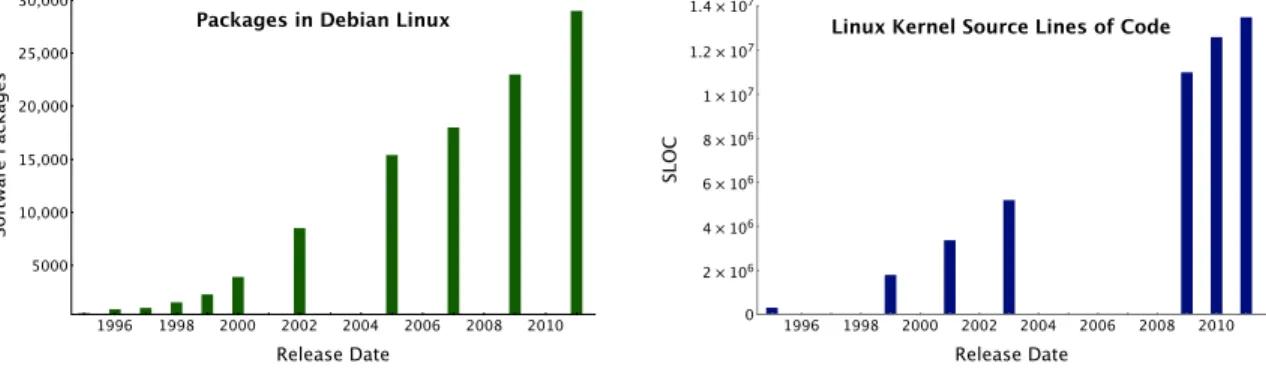
The complexity and diversity of software systems continues to evolve at a frenetic pace. Within just the last decade we have seen a hundred-fold increase in the number of software applications distributed with modern operating systems and similarly rapid growth of even formerly nascent computer operating systems such as Linux. Figure 2.1 shows the number of packages in the Debian Linux operating system release and the lines of code within the Linux Kernel from its inception. From its origins in the mid-90’s, the Linux operating system kernel has grown from a pet project to representing 10’s of millions of source lines of code. Similar growth has been seen in other software applications and development efforts. Measures as simple as the number of source lines of code have long been known to correlate with software defects [52, 83]. Defects occasionally lead to vulnerabilities and vulnerabilities are often exploited.
1996 1998 2000 2002 2004 2006 2008 2010 5000 10,000 15,000 20,000 25,000 30,000 Release Date So ftw ar e Pa ck ag es
Packages in Debian Linux
1996 1998 2000 2002 2004 2006 2008 2010 1.4 × 10⁷ 0 2 × 10⁶ 4 × 10⁶ 6 × 10⁶ 8 × 10⁶ 1 × 10⁷ 1.2 × 10⁷ Release Date SL OC
Linux Kernel Source Lines of Code
Figure 2.1:Software growth over a decade of Linux operating system development
Source: Wikipedia articles: “Lines Of Code” & “Debian Linux”, Feb 5, 2011
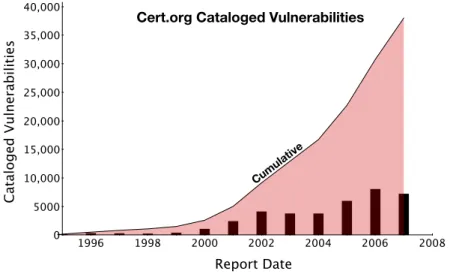
The growth in software size, complexity, and the resulting number of vulnerable defects appears to be growing at an exponential rate. Within the last decade, clever engineering approaches to computer defense have allowed existing technologies and approaches to scale even in the face of an increasing number and complexity of threats. However, the threats covered by those approaches, just as those cataloged by organizations such as Carnegie Mellon’s Computer Emergency Response Team (CERT) (within the Common
Vulnerabil-ities and Exposures database) represent a fraction of known software vulnerabilVulnerabil-ities and just a small sample of all of the vulnerabilities within the wild (Figures 2.2). As a result of the enormous growth of software ecologies and latent threats, current approaches to threat detection and response will become increasingly difficult as we extrapolate even a few years. 2008 1996 1998 2000 2002 2004 2006 0 5000 10,000 15,000 20,000 25,000 30,000 35,000 40,000 Report Date C ata lo g ed V u ln er ab ili ti es
Cert.org Cataloged Vulnerabilities
Cumulative
Figure 2.2:Cataloged vulnerabilities per calendar year
Source: Carnegie Mellon - CERT Statistics (Historical): http://www.cert.org/stats, Feb 5, 2011
Catalogues of known and disclosed vulnerabilities, however, are not a measure of threat. Common vulnerabilities are generally the target of numerous exploits. Blackmarket exploit packages are likely to contain a large number of current and sophisticated attack tools, many of which we have no way of identifying using IDS. Signature-based detection only works when we have carefully characterized the threat. For network-based IDS we first require enough representative network traffic to generate compact, high-confidence signatures. Internet Protocol (IP) packets cannot be pre-labelled as “bad” or “good” even though we often wish this were the case.1Often, the traffic used to create and test new IDS signatures
must be manually crafted and may represent difficult to obtain exploits.
As a researcher, the number of readily available exploits represents only a small fraction of the exploits which are written and deployed by adversaries. The well-known “Metas-ploit” framework includes approximately 800 of such exploits for common vulnerabilities2.
Penetration testing using such tools is extremely time consuming and generally reserved for high-criticality systems and environments. This is one reason that detection is so desireable. When we cannot prove a particular attack is possible (by attempting it ourselves and taking steps to prevent the attack vector) detection becomes top priority. In many instances and for many organizations, detection may be the only option.
It is clear that computing systems and networks suffer from an ever increasing demand for comprehensive, robust, and efficient detection mechanisms. As the number of software products, capabilities, and resulting vulnerabilities have increased, so has the number and sophistication of attacks. Computing improvements such as faster processors, faster net-works, parallelization, increased storage, and faster storage will increase the number and sophistication of attacks just as they improve our ability to detect and respond. Smarter algorithms are needed. Modern approaches represent a comprehensive arsenal of sophis-ticated defensive tools and techniques, but we are still falling short. Some of these are discussed in Sect. 2.2 on page 21.
2.1.3 The Problem of Performance
Whether or not existing approaches adequately address current threats is a matter of debate. A thorough review of existing literature and familiarity with the commercial capabilities suggests that existing network-based IDS approaches generally lack adequatecoverageand have linearcostscaling (in terms of packets or signatures). Signature-based IDS generally lack coverage of particular exploits and polymorphic variants being generally vulnerability-based rather than exploit-vulnerability-based as a matter of tractability. A more detailed discussion of
some of the issues associated with signature-based IDS are presented in Sect. 2.2.3 on page 26.
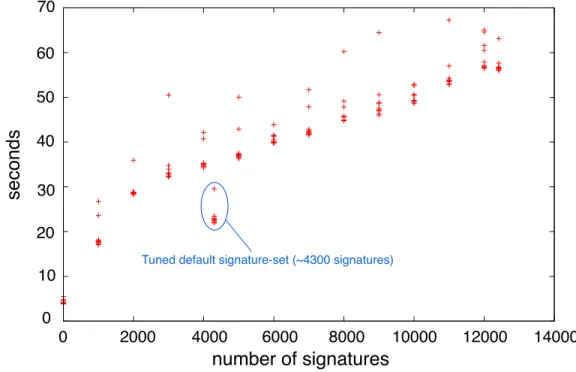
A straightforward measurement of the Snort IDS suggests linear scaling even for relatively small numbers of signatures. Figure 2.3 shows the total clock time required to process an identical dataset for various sized signature-set sizes (selected randomly from the pool of signatures distributed in release 2.9.1.2 of the widely available Snort IDS). The outlier at approximately 4300 signatures represent the default signature-set released by the Sourcefire team (which is highly tuned for performance). The official signature release was used for this test vice experimental signature-sets which are readily available online.
Tuned default ruleset (~4300 rules)
0 2000 4000 6000 8000 10000 12000 14000 0 10 20 30 40 50 60 70 number of signatures Tuned default signature-set (~4300 signatures)
se
co
n
d
s
Figure 2.3:Signature-set processing times for the Snort IDS release 2.9.1.2
Ignoring differences in the cost of various signatures (as they are not the focus of this research), at the limit, current techniques requireO(p n)comparisons of packetspwith
signaturesn. This is true even when clever algorithms are used to construct optimal decision trees over the signature-set (see section 2.3 on page 29).
Certainly, this is linear scaling and not immediately alarming. However, the number of relevant threats is increasing rapidly. The number of necessary signatures is growing as some function of the number of deployed software instances, hardware instances, protocol instances, versions, and vulnerabilities (Fig. 2.2). It seems clear that these systems are not sufficientlyscalable.
The computing cost of most NIDS is within a constant factor ofO(p n). This forces IDS designers to use small sets of broad signatures which focus on vulnerability rather than exploit identification (resulting in poor coverage of exploits, and essentially no coverage of other characteristics). As an example, the Snort IDS (version 2.9.1.2) ships with approxi-mately 6 thousand signatures which are enabled by default. Another 12 thousand signatures are readily available for use, but not enabled due to the significantly increased burden on the system and the potential obsolescence of older signatures. For these reasons and others, significant improvements in the ability to cheaply prioritize signature computations are needed.
2.1.4 Goals
Ascalablesystem grows in computing cost (measured in bit-operations) at a rate propor-tional to the size of its input and task complexity such that the system can continue to function within its original design parameters (e.g. linear or sublinear scaling) without fundamental changes to its design. This research effort has focused on signature-based detection based on our need for better performance and better coverage. An interesting perspective on this problem is that instead of trading performance for coverage we may be able to intelligently leverage improved coverage to directly improve IDS performance. Rather than proportionally degrading (in the best cases), performace of an IDS might be
made to improve through the addition of appropriate signatures and the use of anticipation and other forms of predictive bias.
More precisely, we can define the relevant aspects of a signature-based IDS as follows: • Asignature,s, is a fixed or dynamic pattern (such as a string or regular expression) which can be used by a detector to identify threats and generate output alerts from input data.
• Asignature-set,S, is a set of signatures which are used in combination within by a detection system.
• Analert set,A, is a union of the sets of vulnerabilitiesAvuln, exploitsAexploit, victim
characteristics Avictim, and attacker characteristics Aattacker which are accurately
identified by an IDS (i.e. A=Avuln[Aexploit[Avictim[Aattacker).
• The Threat Coverage (TC) measures the portion of possible attacks which can be properly characterized using an alert set.
• Performanceis defined using the conventional measures of precision, recall, accuracy, and specificity.
The key claims being explored in this research are that signature-based IDS are not currently scalable because they are:
• Imprecise with respect to exploits and tertiary characteristics (such as victim and attacker characteristics), and therefore lack coverage of features sufficient for useful prediction.
• Lack mechanisms which dynamically improve detection system performance based on prior information.
Given more precise information of an ongoing attack, in many cases we should be able to predict future attacker actions or attack characteristics and to use this information to prioritize future detection computations. The idea is conceptually simple:
By using the prior knowledge of previous detections, resource utilization can be optimized for each network conversation by prioritizing matches of new packets against subsets of the detection tasks, these subsets being based upon a set of anticipated behaviors, attacks, or characteristics.
Traditional IDS techniques perform detection blindly in respect to prior knowledge, with the obvious exception of protocol state-machine tracking (such as Transmission Control Protocol (TCP) state tracking). In the worst-case, a signature-set would be applied se-quentially, giving linear Central Processing Unit (CPU)-time performance in the length of packets, signatures, and outputs. In many existing systems optimal decision trees[53] or clever discrete finite-state machines[33] are used in combination with fast string matching algorithms[68, 90]. Many significant internal performance improvements are possible, but most allow for only short-term gains in the face of dramatically expanding threats.
Ignoring differences in the costs of individual feature comparisons, existing detection systems perform an equivalent amount of work for every packet. Using a hypothetical predictive mechanism, signature matching might be more efficiently accomplished by traversing (or selectively ignoring) subsets of the original decision procedure. Such an approach is able to take advantage of recent advances in string matching and regular expres-sion evaluation because it occurs separate from the IDS pattern matching facility. Prediction and anticipatory techniques might be used at many levels within an IDS architecture.
If performed external to the IDS, at an event level, this represents the same semantic level as the attacker’s actions. As such, it should be possible to use additional IDS coverage to directly improve performance. If particularly specific signatures are used, in some cases it might be possible to directly choose subsequent signatures without performing decision tree
traversal. This would dramatically decrease the overall computational cost for individual connections when sufficiently accurate predictions are available.
If performed internal to the IDS, at the granularity of individual packets or signatures, this represents a semantic level of the internal IDS logic and algorithms. A significant amount of work has been done on implementing and improving internal detection mecha-nisms, some improvements incorporating prediction[90]. Nonetheless, some performance gaps still exist (primarily due to safety and performance assumptions). Probabilistic ap-proaches (generally absent from signature-based detection systems) will likely play a central role in future systems.
Unfortunately, the linchpin of an anticipatory aproach appears to be increasing coverage in a way that improves the predictive power of events while limiting increasing I/O and overhead costs. Most NIDS effectively only cover vulnerabilitiesAvuln, with little or no
coverage of exploits or attacker and victim characteristics. Including these in the coverage set could easily expand the number of signatures into hundreds of thousands. However, expanding either the number of signatures or the amount of output has an associated cost. Most IDS are not designed to retain tertiary characteristics. The resulting I/O and memory costs can be substantial. In order for an anticipatory approach to work performance gains must be substantially larger than the increased costs associated with increased coverage.
It should be the case that detection can be performed ever more efficiently as new knowledge is added to a detection system. These types of systems should have strong sublinear scaling in respect to signature-set size. While this research effort has been able to demonstrate limited performance gains for particular configurations with existing signature-sets, the overall research goal is not simply to improve the runtime performance of current IDS approaches. The goal is to increase the practical coverage of these types of systems. In this light we have attempted many techniques for building more efficient detection systems, some which directly address issues of expanded IDS coverage.
2.2 Intrusion Detection Systems
As initially described by Denning in her seminal paper “An Intrusion-Detection Model”[31] and summarized by Bishop[19], IDS can be loosely categorized intomisuse detectionand
anomaly detection. The difference between these two approaches is essentially one of either characterizing known bad patterns and detecting instances which match the patterns (misuse detection) versus characterizing known good behaviors and detecting deviations (anomaly detection). Denning originally described the pattern matching strategy of signature-based IDS as utilizing both formal and informal specifications and knowledge models such as expert systems. Patterns examined by such systems were also conceived as extending beyond the individual entities being examined (e.g. IP packets, process execution traces, memory accesses) and describe complex patterns of interdependent activity.
One of the most widely used IDS is the signature-based Snort IDS[78]. Others include the event-based BroIDS[72]),statistical anomaly (behavioral) detectionsystems (such as the Time-based Inductive Machine (TIM) system[87]), andhybridsystems which combine both approaches. Of particular relevance to this research are Denning’s initial Markov detection model[31] as well as systems which use temporal predictors as embodied by systems such as TIM[87]. In some respects, most existing systems combine many of the aspects of misuse and anomaly detection. Rather than delve into a discussion of the ways in which these different approaches can be implemented, we treat systems as belonging primarily to one or another of either misuse or anomaly detection. The particulars of individual systems not studied in this research effort is left for the reader to explore (see Sect. 2.5 on page 40).
The primary distinction made in this dissertation (relating to to misuse-detection in particular) is a fundamental difference in the use of a predictor for online performance optimization rather than as the detector itself. Our principal inquiry iswhether we can bootstrap a predictor and system performance gains by increasingthe coverage of the
IDS. In most systems any expansion of the signature-set being applied necessarily degrades system performance.
One way of understanding why the state-of-the art systems appear to have missed this important approach is related to the way in which misuse/signature-detection systems (and decision procedures in generally) are naturally generalized. It is easy to understand that “exploit polymorphism” and the high cost of monitoring an expanding set of threats immediately suggests the application of a statistical predictive approach. Signature-based systems quickly become unwieldy to maintain and costly to compute. As a result systems tend to either be bottom-up signature-based approaches (with low rates of false positives) or top-down anomaly detectors (with low rates of false-negatives) [56]. Our contribution is to show that in some cases detector performance can be incrementally improved using statistical predictors, building the IDS “toward the middle”. The basic idea seems sound. It also represents a natural progression towards more sophisticated and (hopefully) better detectors. If we are lucky, we might even end up with more robust and resilient detection. A stronger statement concerning the purpose of statistical methods might also be made. Clearly, statistical approaches are poor at identifying the nature of particular events precisely. It might be claimed that the fundamental purpose of statistical anomaly detection should not be for the detection of anomalies but in the prioritization of decision procedures which are good at precise prediction (at the expense of performance and coverage).
2.2.1 Host versus Network Detection
The particular detection model representation is not particularly important to our thesis. Numerous representations have been used, as described in the literature (e.g. rules, scripts, decision trees, neural networks, statistical models, Petri nets, etc.)[92]. As noted by Yu and Tsai[92], a signature-based system is often easier to modify dynamically due to the relative
independence of individual signatures, although it is clear that performance specifics are dependent upon the underlying implementation.
Regardless of the detection model, IDS can be loosely grouped into host and network-based systems. Host-network-based systems can easily rely on limiting detection to those attacks that might possibly affect the software which is actually resident on the host. Network-based detections however, can only take such an approach if given access to data structures containing the status of host configurations and software. Limits will always exist in knowing the precise state of host machines unless a host-based sensor is used. However, based sensors are not always possible or even desired due to the possibility of host-compromises, the latency of centralized storage, and the potential for data corruption. Host-based and combined systems are not tolerant to corruption of host state. Such approaches also require significant resources to maintain shared state between host and network-based sensors. Although combined systems are deployed within many operational environments, engineering compromises and overall cost are often prohibitive, or result in unacceptable compromises.
Network-based detections are required to detect many classes of attack (e.g. distributed denial-of-service, some types of scans, spoofing techniques, etc.) Network-based detection is also required in order to guarantee that hosts which may be compromised still have a detection and reporting mechanism in place. Nonetheless, knowledge of machine state is desired and even necessary for making IDSs both tractable and accurate. Knowledge of the state of a potentially vulnerable host can elucidate the set of signatures that are relevant. Knowledge of the state of an attacker’s machine can provide insight into the goals, exploits, and knowledge of the attacker. This knowledge can significantly affect the confidence in our knowledge of the state of an attack and guide both our detection strategies and our responses. Unfortunately, although host-based sensors have been widely used in the context of signature-based IDS, comprehensive victim and attacker modeling has not.
2.2.2 Misuse and Anomaly Detection
Anomaly detection system (often called “behavior-based”) utilize learned statistical distribu-tions of normal network and user behavior in order to detect significant deviadistribu-tions. Systems can be trained to perform both the detection and classification of anomalies, but do not provide an obvious semantics to elucidate the meaning of an alert. This limits their direct use for understanding the meaning of detected events. Such systems rely on information provided by other threat and attack modeling techniques which is an area of particular rele-vance in extending existing IDS capabilities using predictive techniques[31]. Nonetheless, such systems offer generality that misuse detection does not, detecting malicious activities which a misuse detector has no patterns for.
Anomaly detection systems are by definition predictive. By using representational statistics to gauge the likelihood of an event, they are used to predict whether activities are benign or may represent a threat. In the simplest instances, a detected event which is determined to have a low likelihood in a simple Markov model and a fixed or dynamic threshold determines whether the event is anomalous. For example, one of the first of such systems, Time-based Inductive Machine (TIM), used a set of inductively learned temporal event sequences which were used to detect deviations from established activities and unrecognized event sequences as anomalies[87]. Systems such as TIM are absolutely essential to enable the detection of new threats, but do not directly address the issues of scalability for precise event detection.
This dissertation considers equivalent predictive models to those commonly employed in anomaly detection, but expressly for the purposes of increasing coverage and improving performance. For example, in the case of a Markov predictor, predicted future states in a learned transition matrix are not used to determine anomalies, but to prioritize the detector’s decision procedure. In essence, those events that aremoreanomalous are presented with a larger decision procedure, whereas events which areexpectedare presented with a smaller
decision procedure representative of the expected outcome. Other anomaly detectors generally apply these predictions directly for the purposes of detecting anomalies, not for the improvement of the detection mechanism itself.
Signature-based IDS are precise and due to their simplicity have been employed within many large-scale, commercially available systems. In such systems each input (e.g. header, packet, TCP session, event, event sequence, derived feature set, etc.) is compared against sets of thousands of signatures in a more-or-less brute-force manner. The patterns used and the algorithms employed for pattern matching are very efficient. Significant gains have been made in the last two decades in the area of pattern matching. Of particular relevance with respect to performance are a predictive matching algorithm developed by Vespa, et al. and the substantial previous work with content-addressable memory for pattern matching[90]. These classes of predictive approach are at a very fine granularity with respect to the semantics of network events. These techniques generally improve the performance of every pattern assessed by a system, leading to substantial performance improvements.
Commonly, signatures are written to be very precise with respect to vulnerabilities, exploits, and other “known bad” sequences. False negatives are common and false positives are often manually “tuned” out of signature-sets over time[35]. Such systems have the benefit of precision, but are generally poor at detecting new exploits and are very labor intensive to maintain in the face of large numbers of vulnerabilities and exploits. The signature-tuning process often consumes a significant portion of the time spent managing a signature-based system’s signature-set. A number of adaptive systems and automated signature generation system have been proposed and constructed to alleviate some of these issues[23, 24, 92]. In many instances adaptation occurs only in direct response to operator feedback in identifying false positives or operator information overload.
These systems are also often limited by particular nuances of the signature language used and the specific preprocessors which are employed. Further, there are classes of
attack, which due to dynamics in the patterns produced, are simply not detectable using conventional signature-based approaches[16].
2.2.3 Signature-Based Detection
The most common and well-understood misuse-detection approach within modern IDS is to utilize one or more pattern matching signatures for each identifiable attack or compromise. This is commonly termed “signature-based detection” and is often desireable because of its precision and simplicity.
A “signature” in IDS parlance is a set of patterns (or in some cases preconditions) which identifies a known threat (as uniquely as is possible or practical) [23, 82]. Signatures in many detection systems are often very precise and consequently expensive to compute. These systems have a resultingly low false positive rate, but generally require at least a single signature for each vulnerability, exploit, or attack vector (each signature representing a series of potentially costly computations.) These signatures must often be kept as simplistic and as compact as possible for purposes of performance and this results in brittleness. Nonetheless, signature-based detection is often desirable due to its simplicity. There is a direct and easily understood mechanism which relates the features of network traffic to identification of malicious events.
Each signature is composed of explicit patterns, bytes, strings, field values, expressions, and preconditions. Signatures are most often pre-filtered by matching against protocol attributes first (both IP packet and TCP session headers and payloads) and expensive string matches and regular expressions second. Signature-based approaches can be performed very efficiently using pre-compiled expressions, careful management of feature ordering, and automated binning and pre-filtering of incoming traffic such that signatures only “see” traffic that is relevant (e.g. by static fixed signature fields of protocol, port, address, etc.).
Unfortunatley, signature-based intrusion detection system approaches seem to have been recently neglected by the research community. Few significant gains in the tractability of IDS have been made in the last few years while many of the scalability issues have been hidden by modern achievements in computing performance and parallelization. Many previously identified issues have simply been swept away by engineering slight-of-hand, current systems making gross compromises in the name of engineering feasibility and often requiring a highly trained staff to manage even a single deployed IDS[59].
Within existing threat detection and threat response systems, design and configuration compromises abound. In particular,
• Computationally short-circuiting the detector to only alert on the first (or a limited number) of detected events can allow attackers to “game” intrusion detection systems by flooding these systems with irrelevant information.
• Denial-of-service (DOS) and flooding attacks often cripple IDS and prevent detection of more important attacks masked by the DOS.
• Tuning an IDS to achieve better performance (by removing apparently irrelevant, old, or noisy signatures) decreases the IDS coverage of existing threats. The resulting poor coverage of a “tuned” IDS can also allow obscure and “obsolete” attacks to older systems to go completely unnoticed.
• Removing signatures based on the need to eliminate spuriously large numbers of false positives allows attackers to circumvent detection by making it appear that an alert is a false positive. It is generally trivial to generate traffic to match a detection signature. Using crafted packet traffic, an attacker can generate false positives in obnoxious numbers, resulting in the alert’s subsequent removal (tuning) by administrators. • Lack of adaptive mechanisms within IDS can allow new attacks to proceed unhindered
• Lack of industry-wide standards, incentives, and protocols for sharing information (intellectual property in the form of IDS signatures/patterns) results in poor coverage for all.
The sizes of signature-sets is often kept as small as possible to allow detection systems to perform under peak network loads. Consequently, these system suffer poor recall due to lack of sufficient coverage of exploits and variants. These limited signature-sets often even preclude comprehensive coverage of expected vulnerabilities and exploits. The Snort IDS, one of the most widely deployed, currently includes approximatley 18,000 signatures. This limited signature-set covers only a small fraction of the known threats.
For similar reasons, signatures are written to cover vulnerabilities rather than exploits, resulting in a lack of insight into the active attackers methodology and toolset. Without these insights, defensive postures and response actions are generally performed blindly. It is as if we can recognize that the shooter is using some form of projectile weapon through an office window, but we have no idea whether he is using a rock, a .22, or a bazooka.
Even with severely limited signature-sets, the flood of resulting alerts is often too much for a human analyst to reason about, requiring complex aggregation systems to cluster, correlate, and corroborate a fire-hose of (mostly) irrelevant information. From an analyst’s perspective the deluge of data produced by an IDS has the outward appearance of high-coverage, scalable detection. The essential approach to the dealing with the fire-hose is to filter, aggregate, and annotate known attacks and unknown anomalies[92]. In theory and practice this helps, but does not address (and actually serves to hide) the underlying problem of the poor coverage and poor performance of the detector. As a result, signature-based systems tend to be eithertoo brittle ortoo expensive. And in a complementary manner, anomaly-based systems tend to be eitherto noisy but robust oracceptably quiet but useless. The daunting scale and scope of future requirements is likely to make brute-force IDS intractable without a huge economic cost in hardware and manpower. Arguably, such
systems currently achieve only marginal utility, representing simultaneously (and non-intuitively) both the best precision and the poorest coverage of the actual attack vectors and related network activity.
2.3 Characteristics of Signature-Based Detection
2.3.1 Decision Procedure
There is no single model which adequately describes the wealth of approaches found within existing IDS products and research efforts. Nonetheless, for the purposes of discussion, we can treat most signature-based IDS as if they were simply some type of optimal decision tree. Indeed, the more complex nuances are often treated as special cases after a fast decision procedure has first been applied.
Decision tree techniques have a long history as key components of detection systems[8, 53, 60, 61, 73]. In order for host or network-based IDS to be tractable the detection scheme must be significantly more efficient than an exhaustive comparison of signatures to packets and packet-derived features. Decision trees provide one possible mechanism for improving IDS performance. Even systems with sophisticated filtering and pre-processing mechanisms spend a significant amount of energy pre-processing data-irrelevant signatures. Decision-tree approaches can improve performance both in achieving log-scaling in respect to signature-set size and by organizing the structure of trees using Shannon-entropy and other information theoretic methods as pioneered and elucidated by Quinlan et al.[53, 75, 76, 77].
Although a clear improvement over any type of brute-force signature-based system, there are a number of outstanding issues with decision-tree approaches. The construction of such trees is both expensive and somewhat opaque. In many cases the entire decision
tree must be recalculated for each signature addition. Although this needs to be done only once per addition to a signature-set, it does not allow fast incremental and modular signature-set additions. Algorithms such as ID3 have a sub-exponential complexity, but is still proportional toO(n|v| |r|), wherenis the number of examples,|v|is the number of features, and|r|is the number of internal nodes in the decision tree [77]. Since a substantial benefit of modern signature-based IDS is the ability to “turn off” subsets of the signature-set and to dynamically generate new signatures based on the output of anomaly detection, rebuilding the decision tree for each signature addition appears highly undesirable. The more dynamic the IDS (or the larger the IDS), the less appealing such a decision tree construction method becomes.
Nonetheless, these approaches have significant performance gains over naive IDS signature matching approaches. Naive IDS signature matching approaches do not allow for any significant parallelism and the most common approaches often suffer from signatures duplicating a significant amount of work when (as is often the case) many signatures share the same or similar preconditions[53]. In ad-hoc approaches to improving parallelism, a set of well-known common constraints are used at the top-level to partition the signatures (e.g. ports, protocols, and IP addressing). Because a naive ad-hoc approach does not consider Shannon-information, these approaches are generally much poorer in performance than information theoretic approaches[53]. The naive approach hand-picks constraints such as port and protocol to partition the signature-set. Information-theoretic approaches pick the most discriminating features and performs parallel evaluation of every relevant feature[53]. For the purposes of later discussion, the iterative information theoretic approaches to constructing decision tree can be considered to be “greedy” tree construction strategies.
Another consideration is that while greedy approaches do construct an optimal decision tree given the entire signature-set, such a tree is demonstrably suboptimal for some signature subsets[42, 53, 77]. There are both online and offline solutions to this problem. If the signature-set were first clustered and partitioned to group sets of semantically related