Office of Operations Review and Audit
Program Review
UW Mental Health Counseling Services
Table of Contents
Page
Executive Summary i
Scope 1
Background 1
Discussion and Recommendations 3
Mental Health Services Offered 3
Arrays of Services 4
Student Access to Counseling Services 7
Service Utilization 9
Program Administration and Staffing 14
Organizational Structures 14
Professional Counseling Staff 15
Service Quality 16
Financial Support and Options 19
Expenditures and Sources of Support 19
Current and Future Challenges 21
Funding Alternatives and Options 23
Conclusion 28
EXECUTIVE SUMMARY
Colleges and universities in the United States have been offering mental health counseling services since the early 1900s, rapidly expanding their services after World War II. Various analyses and studies in recent years indicate that a significant number of college students have mental health problems, and these problems may be growing on campuses. The University of Wisconsin (UW) System Office of Operations Review and Audit reviewed UW mental health counseling services. The review examined: services offered; student utilization of counseling services; and issues, challenges, and potential enhancements related to the administration of mental health counseling services. The review also examined reports issued by the UW System President’s Commission on University Security and the Governor’s Task Force on Campus Safety, as well as information on counseling practices at other institutions of higher education. Mental Health Services Offered
The UW Board of Regents recognized the importance of mental health counseling in Regents Policy Document (RPD) 23-1. Created in 1978 and revised in 2005, RPD 23-1 does not specify counseling services that UW institution should offer, but states that UW institutions “should provide counseling services sufficient to address the developmental needs of students as well as respond to unexpected crises.” All 13 four-year UW institutions and three UW Colleges offer an array of mental health counseling services for their students. The remaining ten UW Colleges do not currently offer services, but staff members do help to facilitate students’ access to counseling services in the community and will begin to offer services in the 2008-09 academic year.
Mental health counseling services commonly offered by UW institutions include individual counseling, group counseling, crisis intervention, psychiatric services, outreach and education, mental health screening, and referrals. These services are consistent with those offered by other public colleges and universities in states surrounding Wisconsin.
UW counseling services are offered at accessible locations and at varying hours. UW institutions also maintain open eligibility for counseling services. In fiscal year 2006-07, 11 four-year UW institutions for which data were available reported serving more than 9,500 individual students.
Program Administration and Staffing
Mental health counseling services at all four-year UW institutions and the three UW Colleges that offer the services are broadly organized as integrated health and counseling services (at six institutions), stand-alone units (at seven institutions), or outsourced services (at three
institutions). In comparison, approximately two-thirds of counseling centers participating in a 2006 national survey of counseling center directors were stand-alone units.
UW professional counseling staffs are composed of psychologists, counselors, psychiatrists, and clinical social workers. Fifty-six percent of the UW professional counseling staff have doctoral degrees, and 44 percent have master degrees. The average number of years of experience in the counseling field ranged from nine to 26 years.
In 2006-07, the number of professional counseling staff at the four-year UW institutions ranged from 1.3 to 27.5 full-time equivalent (FTE) staff. Compared with 2002-03, the number of FTE professional counseling staff at nine UW campuses stayed unchanged. The ratio of FTE professional counseling staff persons to students ranged from one to 1,492 to one to 4,289. Five UW institutions received accreditation from three different accrediting agencies: the International Association of Counseling Services, Accreditation Association for Ambulatory Health Care, and the American Psychological Association. Two additional UW institutions are pursuing accreditation.
Financial Support and Options
Salaries and fringe benefits account for most of the expenditures for counseling services. In 2006-07, the 13 four-year UW institutions reported spending more than $6 million for salaries and fringe benefits for professional counseling staff.
UW System Financial and Administrative Policy G15, “Student Services Funding,” specifies General Purpose Revenue as the primary funding for counseling services. G15 also allows segregated fees as a funding source. The sources of support for UW counseling services range from 100 percent GPR to 100 percent segregated fees. In recent years, some UW institutions have shifted from GPR to segregated fees. This shift is consistent with the national trend. In addition to GPR and segregated fees, some UW institutions support their counseling services with grants and revenues from differential tuition initiatives.
UW institutions do not report having waiting lists, but they do require students without an urgent need to schedule an appointment. The reported wait time for mental health counseling
appointments ranged from a few days to four weeks. The reported wait time at most UW
institutions is at least one week. In addition to the wait time, UW counseling center directors and counselors reported increases in workload among professional counseling staffs. The wait time for appointments and staff workload will likely be further increased by a number of new
developments, including increased total student enrollment and enrollment of veterans and their dependents, increased severity of mental health problems, concerns for campus safety, and the potential discontinuation of grant funding.
Funding for mental health counseling services has been a continuing dilemma for colleges and universities. The challenge for the UW Board of Regents, System Administration, and campus administrations is maintaining funding levels and finding a funding mix that can sustain an appropriate level of services. While there are no easy solutions, the report offers three possible courses of action for the Board of Regents, System Administration, and campus administrations to consider:
• Delineating the extent of the UW System’s role in counseling services: Although some UW institutions have set session limits for individual therapy, they have not strictly enforced the limits for various reasons. While psychiatric evaluation and consultation is an important component of counseling services, psychiatric services are also very expensive. The report identifies a need for a policy guideline as to the extent of services a student can receive and
the extent of the UW System’s role in providing psychiatric services to students without a separate charge.
• Exploring additional sources of financial support for counseling services: GPR and
segregated or student fees are the two principal sources of support for counseling services in the UW System and at many other colleges and universities. However, other colleges and universities have also used other sources of support that have not been tapped in the UW System to replace or supplement funding for their counseling services. The report identifies student counseling fees, user fees, financial support from other university departments, and third-party billing and payments as possible additional sources of support for counseling services.
• Maximizing the use of existing counseling resources: Since the bulk of UW counseling budgets go toward supporting professional counseling positions, it would be difficult to find savings from counseling operations. The report describes some ways that UW counseling centers can serve more students with the professional counseling staff they have, such as managing missed appointments, increasing the use of group therapy, seeking inter-campus collaboration, outsourcing certain aspects of counseling, and using counselor interns. Also, in light of the tragedy at Virginia Tech, Northern Illinois, and other universities, and to enhance UW counseling services, the report recommends that UW institutions develop a process of following through the transfer of care of students identified as being high-risk when these students are referred to off-campus providers.
SCOPE
The University of Wisconsin (UW) System Office of Operations Review and Audit reviewed UW mental health counseling services. The review focused only on counseling services for students. The goals of the review were to identify what counseling services are offered; to examine student utilization of these services; and to identify issues, challenges, and potential enhancements related to the administration of counseling services.
To conduct this review we: (1) visited UW-Eau Claire, Green Bay, Madison, Milwaukee, Oshkosh, Parkside, Platteville, River Falls, Stout, and Whitewater; (2) conducted telephone interviews with staff at UW institutions not visited, including UW Colleges campuses that offer counseling services; (3) reviewed reports issued by the UW System President’s Commission on University Security and the Governor’s Task Force on Campus Safety; (4) reviewed studies and articles about college and university counseling services; and (5) examined counseling practices at other colleges and universities. UW staff we interviewed and surveyed include counseling directors, counselors, chief student affairs officers, deans of students, registrars, campus police chiefs, and student government presidents. During the visits, we also toured counseling services facilities.
BACKGROUND
Various analyses and studies indicate that a significant number of college students have mental health problems, and that mental health problems on campuses may be growing. For instance:
• The American College Health Association has conducted surveys of college students in the fall and spring each year since 2000. More than 71,800 students from 107 colleges and universities participated in the spring 2007 survey. Results from that survey revealed that 63.3 percent of the respondents reported they felt hopeless at times; 45 percent reported they were depressed to the point of having trouble functioning; 9.8 percent reported they had seriously considered attempting suicide; and 1.6 percent reported they had attempted suicide at least once during the past school year.1 When results from the 2007 survey are compared with those from spring 2000, the proportion of students who reported they were depressed, felt hopeless, and seriously considered attempting suicide had increased slightly.
• The University of Pittsburgh conducts annual surveys of university counseling center directors. Three hundred sixty-seven college and university counseling center directors, including directors from some UW institutions, participated in the 2006 survey. Ninety-two percent of the center directors indicated that the number of students with severe
psychological problems had increased in recent years.2 1
The American College Health Association. “American College Health Association National College Health Assessment Spring 2007 Reference Group Data Report (Abridged).” Journal of American College Health, 2008, Volume 56, Number 5.
2
Gallagher, Robert P. “National Survey of Counseling Center Directors, 2006.” 6 September 2007
<http://www.iacsinc.org/National%20Survey%20for%20Counseling%20Center%20Directors%20Results%20-%20Final.pdf>.
• An analysis of the case files of more than 13,000 students who sought personal counseling at Kansas State University Counseling Center between 1989 and 2001 showed increases in the percentages of students having problems with stress/anxiety, depression, chronic mental disorder, and suicidal ideation. During this period, the number of students with depression doubled, and the number of students who had thoughts of committing suicide tripled.3 College Counseling Program Guidelines
Colleges and universities in the United States have been offering counseling services since the early 1900s, and they rapidly expanded their services after World War II to assist the returning veterans.4 Over time, a number of standards were established to guide college counseling programs. The most recognized standards include:
• The International Association of Counseling Services (IACS): Currently, IACS is the only accrediting agency for college and university counseling centers. IACS standards cover five major areas, including counseling services roles and functions, ethical principles, and
counseling services personnel. Colleges and universities are not required to obtain IACS accreditation to offer counseling services. However, college and university counseling centers have generally accepted IACS standards as minimum standards for their counseling services.
• Accreditation Association for Ambulatory Health Care (AAAHC): AAAHC certifies college and university health centers. Because the health centers on some college and university campuses are also responsible for mental health, mental health care is addressed during the AAAHC accreditation process.
• Council for the Advancement of Standards in Higher Education (CAS): CAS is not an accrediting agency. However, CAS has a long-term involvement in developing and
promoting standards in student affairs, student services, and student development programs. The CAS standards for counseling services include a self-assessment guide covering topics such as mission, organization and management, ethics, financial resources, and program evaluation.
• American Psychological Association (APA): The APA accredits education and training in professional psychology.
In addition to these national standards, counseling centers and the conduct of counselors are also regulated by various federal and state laws and professional organizations. Federal laws, such as the Americans with Disabilities Act (ADA), the Family Educational Rights and Privacy Act (FERPA), and the Health Insurance Portability and Accountability Act (HIPAA), and Wisconsin 3
Benton, Sherry A., John M. Robertson, Wen-Chih Tseng, Fred B. Newton, and Stephen L. Benton. “Changes in Counseling Center Client Problems Across 13 Years.” Professional Psychology: Research and Practice, 2003, Volume 34.
4
laws, such as Chapter 51, Wis. Stats., grant certain rights to students seeking and receiving counseling services and require counseling centers and counselors to safeguard student records. Professional licensing organizations for the counseling staff also hold them accountable to ethical standards.
Developments in the UW System
The UW Board of Regents acknowledged that mental health is a critical factor in student success and recognized the importance of counseling services in Regent Policy Document (RPD) 23-1, “Basic Health Module,” created in 1978 and revised in 2005. The policy states that UW
institutions “should provide counseling services sufficient to address the developmental needs of students as well as respond to unexpected crises.”
In the wake of the Virginia Polytechnic Institute and State University (Virginia Tech) tragedy, the UW System President established the Commission on University Security in April 2007. The Commission was charged to “develop recommendations for how UW institutions can prevent, intervene, respond, heal, and resume operations when confronted with the threat, or actual incidence, of major violence” similar to the type experienced at Virginia Tech. A subcommittee on counseling services was established as part of the Commission to review the UW System’s counseling resources and to develop recommendations specifically on counseling services as they relate to violent behaviors. The subcommittee issued its report to the Board of Regents in August 2007.
DISCUSSION AND RECOMMENDATIONS
This review examined: (1) mental health counseling services offered to and used by UW students; (2) staffing and administration of counseling services; and (3) methods for funding counseling services. Literature we reviewed while planning for this review indicated that the most pressing challenge facing college and university counseling centers is to respond to the increased demand for counseling services when there is not a corresponding increase in resources. Thus, we analyzed the current methods of providing and funding UW counseling services and identified alternative and additional sources of funding for UW counseling services.
MENTAL HEALTH SERVICES OFFERED
RPD 23-1 does not specify counseling services that UW institutions should offer to students, but urges UW institutions to: (1) include an educational component in the services offered; (2) make psychiatric and medication management available and accessible to students; and (3) maintain referral sources for students who require long-term care. We examined the array of counseling services offered by UW institutions, student access to counseling services, and student utilization of counseling services.
Array of Services
In reviewing the array of counseling services offered by UW institutions, we found that all 13 four-year campuses and three UW Colleges – UW-Baraboo/Sauk County, UW-Marathon County, and UW-Richland – offer counseling services for their students. All 13 four-year UW institutions provide most or all of their services in house and on campus. The three UW Colleges contract with community mental health service providers to provide counseling services for their students, and these services are offered off campus.
The remaining ten UW Colleges do not offer counseling services. However, staff members indicated that they help to facilitate students’ access to counseling services in the community. For example, UW-Barron County faculty and staff direct students needing mental health counseling services to Barron County Department of Health and Human Services. The remaining ten UW Colleges, including UW-Barron County, plan to also offer counseling services in the 2008-09 academic year. In June 2008, the Board of Regents approved UW Colleges’ request to increase segregated fees in fiscal year 2009 for mental health services. We researched mental health counseling services offered by other colleges and universities in states surrounding Wisconsin. The array of counseling services offered by UW institutions are consistent with services offered by colleges and universities in our research. Even though each UW institution offers a unique array of services, UW institutions do offer some common services. These services include individual counseling, group counseling, crisis intervention, psychiatric services, outreach and education, and screening and referrals. Currently, these services are offered to UW students without a separate charge.
Individual Counseling
According to UW counseling center directors and counseling staff, individual counseling or psychotherapy is the core of counseling services offered by UW institutions. Full-time UW counselors spend between 20 and 25 hours each week in direct counseling services, most of them in individual counseling. Typical individual counseling sessions at UW institutions last between 45 minutes and one hour.
RPD 23-1 states that counseling services should reflect a brief psychotherapy model, but does not define “brief.” In keeping with this model, some UW institutions establish session limits or guidelines for individual psychotherapy. The guideline is 10 sessions per academic year at UW-Madison and UW-Milwaukee; 12 sessions per year at UW-Green Bay, La Crosse, and Oshkosh; and 14 sessions per year at UW-Eau Claire and UW-Whitewater. UW-Richland offers up to two sessions per year. These session limits are not rigidly enforced, however, and some UW
counseling directors indicated that a lack of local resources for referral can make enforcing the limits more difficult. Also, they indicated that a counselor cannot ethically stop serving a student who needs continued assistance, even when a session limit has been reached, without a clear referral link.
UW-Parkside, Platteville, River Falls, Stevens Point, and Stout have not established session limits. However, UW-Platteville and UW-Stout conduct a meeting of counseling staff to discuss the need to continue seeing the student after the sixth and tenth counseling session, respectively. Group Counseling
Counseling center directors indicate that group counseling can be a valuable and cost-effective alternative to individual counseling. At the time of our visits, UW-Eau Claire, Madison,
Milwaukee, Oshkosh, Stout, and Whitewater offered multiple group counseling options. Group counseling is also offered by providers under contract by Baraboo/Sauk County and UW-Richland. Other UW institutions, such as UW-Green Bay, Parkside, Platteville, River Falls, and Stevens Point, offered limited group counseling options or stopped offering group counseling. Some counseling center directors we interviewed indicated that their institutions lack suitable space for confidential group sessions, UW staff and some students have concerns about anonymity, and the existing professional counseling staff do not have the time to organize groups.
Crisis Intervention
The goals of crisis intervention are to provide immediate or emergency psychological care in order to avert a state of crisis and to respond quickly to mental health emergencies. UW institutions intend to achieve these goals by ensuring that students with urgent needs are seen immediately and by establishing procedures to respond to mental health emergencies.
During office hours, the four-year UW institutions factor into their staff scheduling some time each day for students who might have urgent needs. Counseling staff members are on call and available during this time. Students indicating urgent needs are scheduled for a crisis
intervention session with the on-call counseling staff member.
The four-year UW institutions provide crisis intervention coverage for after hours and weekends through various arrangements. UW-Madison maintains a crisis phone line. UW-La Crosse, Oshkosh, Stout, and Whitewater arrange with community service providers to provide crisis intervention. At the remaining four-year UW campuses, university or local police are to be
contacted in case of crisis; the counseling center directors and staff are available for consultation. UW Colleges do not provide crisis intervention directly, but the service is available through their respective community mental health and law enforcement services providers.
Outreach and Education
All four-year UW campuses offer outreach and education to students. A variety of information is provided, including information about counseling services, signs and symptoms of severe depression, stress management, anxieties, eating disorders, coping skills, sexual assault,
relationship violence, academic problems, conflict resolution, and suicide prevention. Outreach and education are provided through websites, printed brochures, posters/bulletins, mass e-mails,
faculty/staff orientation, parent and student orientation, classroom presentations, and residence hall gatherings.
The extent of the outreach and education varies, based on staff and financial resources. Only UW-Stout and UW-Whitewater reported having staff designated for outreach. At all UW campuses, mental health outreach and education are done as part of the professional counseling staff members’ regular responsibilities. Grant funding also enables some UW institutions, such as UW-River Falls and UW-Oshkosh, to develop and assemble educational materials for
students.
Psychiatric Services
Nine UW institutions – UW-Green Bay, La Crosse, Madison, Milwaukee, Oshkosh, Parkside, Platteville, River Falls, and Whitewater – offer psychiatric services on campus with university psychiatrists, psychiatric nurses, or consulting psychiatrists. At most of these campuses, psychiatric service hours are limited: four hours per month at UW-Green Bay; eight hours per month at La Crosse, Oshkosh, and River Falls; eight to ten hours per month at
UW-Parkside; and 16 hours per month at UW-Platteville and UW-Whitewater. Psychiatric services encompass evaluation, diagnosis, consultation, therapy, and medication.
UW-Eau Claire does not offer psychiatric services on campus, but does refer students to community psychiatrists and covers some of the costs for uninsured students. The remaining three four-year UW institutions – Stevens Point, Stout, and Superior – do not offer any
psychiatric services. At these UW institutions, counseling staff members consult with university health physicians and nursing staff on psychotropic medication management and suggest
students use mental health services offered by community providers or through their insurance plans, if they have them.
Screening and Referral
Eight UW institutions offer mental health screening online or “mental health screening days.” These screenings are not meant to replace formal psychological evaluations. However, the screening serves as a tool to educate students about signs and symptoms of mental health issues. The screening also provides information to students about whether or not to seek a professional mental health evaluation.
Students who, after an evaluation, are determined to need care beyond what UW counseling services offer or who would benefit most from services in the community are referred to off- campus providers. All 13 four-year UW institutions that offer counseling services on campus refer students to off-campus mental health service providers. Anecdotal information indicates there are challenges with referring students to community resources, such as a lack of resources in the community, lack of transportation, inability of students to pay for services, and student resistance to the challenges of obtaining services off-campus.
UW mental health counseling services could be enhanced by tracking and monitoring student referrals to off-campus mental health providers. Tracking referrals was also an issue raised by
investigators of the Virginia Tech tragedy. Currently, when making a referral, UW counselors enter the information in the case notes and have students sign a release of information, if a release is needed. Some counselors we interviewed indicated that they also follow up with the providers or with the students after the referrals in some cases, but the follow up is not done consistently, and students do not always respond. UW counseling centers do not have any means of mandating student compliance with the referrals.
Although mandating compliance is not possible, following through with students who are referred to off-campus providers would help to ensure that at least students the Counseling Center identifies as “high risk” are successful in connecting with the off-campus providers. According to a study, 42 percent of clients referred by college and university counseling centers were unsuccessful in connecting with the off-campus providers.5 In order to facilitate care for students who are referred to off-campus providers, we recommend that UW institutions develop a process of following through the transfer of care of students identified as being high risk. Towson University counseling center (Maryland) tracks referrals by appointing a point staff person for all off-campus referrals. In addition to developing a referral network, this staff person meets with each student to be referred. During the meeting, a consent form is signed allowing the staff to discuss treatment needs with insurance companies and providers, and the providers to call back or return a note card indicating that the student has begun treatment. UW institutions could adopt a similar process, to the extent that workload permits.
Asking off-campus providers to disclose information about a student will require student consent, and UW counseling centers must abide by all federal and state privacy laws. UW counseling centers can ask for this consent when discussing the referral with the students. UW-River Falls, for example, uses a student consent form to release information to off-campus providers and, in some cases, to request certain information from the providers.
Student Access to Counseling Services
Accessible counseling services are essential if students are going to receive care. In reviewing student access to counseling services, we found that UW institutions that offer counseling services have implemented a number of actions to provide easy access to students. These included varying counseling center hours, locating facilities and services in easy access areas, having open eligibility, and implementing triage to ensure students with urgent needs are seen immediately.
Varying Service Hours
During the fall and spring semesters, counseling centers at the 13 four-year UW institutions are open between 8:30 a.m. and 4 p.m., Monday through Friday, with most opening at 8 a.m. and closing at 4:30 p.m. or later. The center hours vary during summers and semester breaks. The bulk of counseling services are provided during normal office hours. However, offering certain services after office hours and on weekends is common. For example, UW-Eau Claire 5
Owen, Jesse, Lavanya Devdas, and Emil Rodolfa. “University Counseling Center Off-Campus Referrals: An Exploratory Investigation.” Journal of College Student Psychotherapy, 2007, Volume 22, Number 2.
keeps the counseling center open until 7 p.m. every Wednesday, and La Crosse and UW-Platteville also offer individual counseling appointments in the evening to accommodate students who cannot make daytime appointments. Richland County Health and Human Services, the provider under contract with UW-Richland to provide counseling services, opens its office in the evening two nights a week. UW institutions that offer group counseling also schedule group sessions in the evenings and on weekends. Outreach and education services are provided when requested, and may include evenings and weekends. As previously noted, crisis intervention is also generally available 24 hours a day, 7 days a week.
Accessible Locations
UW institutions we visited locate their counseling services within walking distance of the residence halls, academic buildings, and other student facilities. UW-Madison offers students free bus passes on Madison Metro, which serves Madison and nearby cities, and arranges with Madison Metro to offer free campus bus routes. UW-Parkside operates a free shuttle bus that takes students to various campus locations, including the counseling facility. UW-Superior offers free transportation between residence halls and the counseling facility. The providers under contract with UW-Marathon County and UW-Richland are located within walking distance of these campuses. The provider under contract with UW-Baraboo/Sauk County is located approximately two miles from UW-Baraboo/Sauk County campus.
UW institutions have also facilitated student access to counseling services by locating counseling services with other student services. At UW-Green Bay, Milwaukee, Parkside, Platteville, River Falls, Stevens Point, and Whitewater, counseling services are located in the same buildings that house student health services. At UW-Eau Claire and Stout, counseling services are located with other student services, such as Dean of Students, financial aid, services for students with
disabilities, and student organizations.
Counseling services brochures and web sites indicate where counseling services are located. Signs for counseling services are also visible inside and, in some instances, outside of the buildings.
Open Eligibility
UW institutions maintain open eligibility for counseling services. At all UW institutions, all students are eligible for counseling services without a separate charge. Students are eligible as long as they are enrolled, regardless of the number of the credits they carry. Students who are not enrolled during the summer semester are eligible for counseling services during the summer if they were enrolled in the preceding spring semester and intend to return in the upcoming fall semester.
Triage
According to the literature, having students wait to see counselors is a common practice at college and university counseling centers because demand tends to outweigh available staff resources. UW institutions do not have waiting lists, but they do require that students without
urgent needs schedule appointments. To ensure a quick response to students with urgent needs, most of the 13 four-year UW institutions have implemented a triage process to rapidly sort students by the severity of their conditions when counseling services are being sought.
Service Utilization
Various studies indicate college and university counseling centers have experienced increased demand for mental health counseling services. We examined data on counseling service
utilization to gauge the demand for counseling services at UW institutions. As we collected the data, we also reviewed methods UW institutions use to track counseling services data and what data are tracked.
Tracking Methods
We found that UW institutions use a variety of methods to track counseling service utilization. UW-La Crosse, Oshkosh, and Stout use Titanium Schedule, a management software package designed specifically for college and university counseling centers. Milwaukee and UW-Whitewater use PyraMED, a scheduling and management system designed for college health and counseling services. UW-Madison uses Point and Click, an electronic scheduling and records system. The remaining UW institutions used either homegrown or commercially-available spreadsheets and database products, such as Microsoft Excel, Microsoft Access, and Foxpro, or they maintained service utilization data manually. The three UW College campuses that offer counseling services do not maintain their own records of students referred for counseling services, and rely on reports from the providers under contract.
Most UW institutions maintain basic information, including age, race, sex, class rank, and the number of appointments or sessions. The types of problems presented are also commonly tracked, but coding of the presenting problems varies. Some UW institutions also maintain information on the student referral sources and termination reasons.
Due to the different systems used, information on service utilization is maintained differently across the UW System. For example, UW-Parkside maintains service utilization by
appointments or sessions, rather than by individual students. UW-River Falls tracks service utilization manually, keeping count of students and faculty and staff served under the campus Employee Assistance Program separately, and combining all other information.
Students Receiving Services
Information on the number of individual students receiving counseling services was available from 11 of the 13 four-year UW institutions and from two of the three UW Colleges campuses that offer counseling services. As Table 1 shows, the 11 four-year UW campuses reported serving more than 9,500 individual students in individual, couples, or group therapy in fiscal year 2006-07. The proportion of students receiving counseling services compared to the total student population ranges from 3.2 percent at UW-Milwaukee to 9.1 at UW-Madison. According to the 2007 survey of counseling center directors, the 272 counseling centers participating in the survey saw, on average, 8.5 percent of the enrolled students in 2006.
Table 1: UW Students Receiving Counseling Services (2006-07) UW INSTITUTION ENROLLMENT HEAD COUNT (FALL 2006-07) NUMBER OF STUDENTS RECEIVING SERVICES (UNDUPLICATED COUNT) PERCENT OF ALL STUDENTS RECEIVING SERVICES Eau Claire 10,766 720 6.7% Green Bay 5,690 303 5.3% La Crosse 9,849 813 8.3% Madison 41,028 3,727 9.1% Milwaukee 28,309 916 3.2% Oshkosh 12,530 794 6.3% Parkside 5,007 * * Platteville 6,813 379 5.6% River Falls 6,229 298 4.8% Stevens Point 9,048 427 4.7% Stout 8,372 521 6.2% Superior 2,924 ** ** Whitewater 10,502 606 5.8% UW Colleges 12,639 * *
Sources: UW institutions (for number of students served)
UW System Office of Policy Analysis and Research (for enrollment head count)
* UW-Parkside tracks service utilization by appointments and not by individual students. UW-Baraboo/Sauk County’s contracted provider reported 19 student callers. UW-Richland’s contracted provider reported providing nine assessment sessions. UW-Marathon County reported having referred approximately 100 students to the contracted provider, but did not require the provider to provide information on how many students were actually seen.
** UW-Superior was in the process of reorganizing its counseling services at the time of the review and data were not available.
We reviewed the gender and classification of students receiving mental health services. On average, about two-thirds (65 percent) of the students seeking counseling services at UW institutions in academic year 2006-07 were female. More than half (55 percent) of the overall student population was also female (Appendix 1). On average, seniors constituted the largest percentage of the students receiving counseling services (Appendix 2).
Information on the number of individual students receiving counseling services in 2006-07 and in 2002-03 was available from ten UW institutions. Compared to 2002-03, all but one UW institution reported an increase in the number of students receiving counseling services, with increases ranging from less than one percent at UW-La Crosse to 52 percent at UW-River Falls (Appendix 3). The average increase was 22 percent. The average increase in enrollment headcount at these same UW institutions was 3.6 percent during the same four-year period. Data on the sources of referrals show that the majority of students were self-referred. These data, as well as anecdotal information, indicated UW institutions have seen increases in the number of student referrals by other students, faculty, and staff.
Presenting Problems
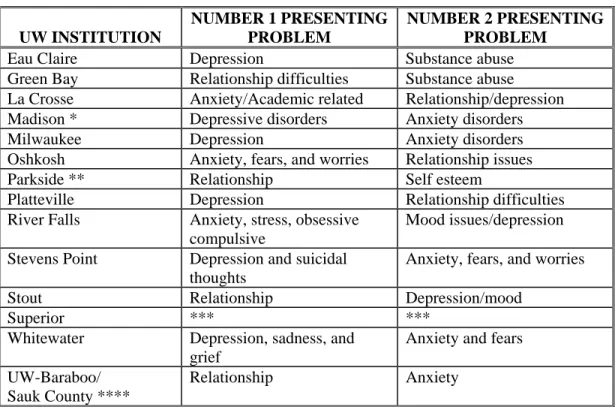
All UW institutions track information on the presenting problems for which students seek counseling. However, the presenting problems are coded differently across UW institutions. Table 2 shows the top two presenting problems reported by UW institutions.
Table 2: Top Two Presenting Problems of Students Seeking Counseling Services
(2006-07) UW INSTITUTION NUMBER 1 PRESENTING PROBLEM NUMBER 2 PRESENTING PROBLEM
Eau Claire Depression Substance abuse
Green Bay Relationship difficulties Substance abuse
La Crosse Anxiety/Academic related Relationship/depression
Madison * Depressive disorders Anxiety disorders
Milwaukee Depression Anxiety disorders
Oshkosh Anxiety, fears, and worries Relationship issues
Parkside ** Relationship Self esteem
Platteville Depression Relationship difficulties
River Falls Anxiety, stress, obsessive
compulsive
Mood issues/depression
Stevens Point Depression and suicidal
thoughts
Anxiety, fears, and worries
Stout Relationship Depression/mood
Superior *** ***
Whitewater Depression, sadness, and
grief
Anxiety and fears UW-Baraboo/
Sauk County ****
Relationship Anxiety
Sources: UW institutions
* Based on a sample of 300 students.
** Based on appointments rather than individual students.
*** UW-Superior was in the process of reorganizing its counseling services at the time of the review, and data were not available.
**** Information is not available for UW-Richland and UW-Marathon County.
UW institutions reported changes in the presenting problems over time. For example:
• Several UW institutions reported an increase in the number of students seeking counseling services for depression and bi-polar disorders.
• UW-Milwaukee reported sharp increases in the number of students with eating disorders and attention-deficit disorder between 2005-06 and 2006-07.
• UW-Stout reported an increase in the number of immediate or same-day appointments. The number of immediate or same-day appointments for 2004-05, 2005-06, and 2006-07 were 5, 34, and 39, respectively. These appointments are reserved for students who need urgent care or crisis intervention.
• UW-Whitewater reported a 44 percent increase in the number of students seeking services for suicidal thoughts between 2005-06 and 2006-07 alone (from 36 to 52 students).
UW counseling center directors and staff we interviewed indicated that the presenting problems of UW students and the increased severity of problems are consistent with the national trend. Counseling Sessions Provided
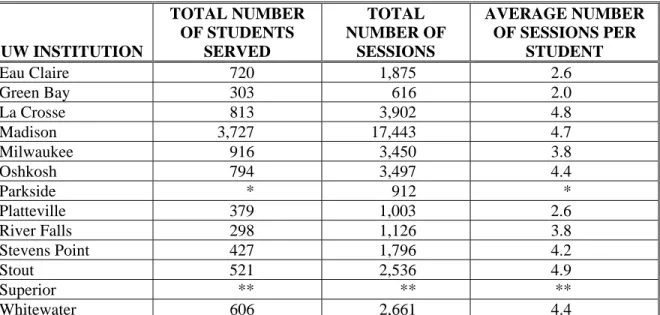
Information on both the number of individual students receiving services and number of counseling sessions provided was obtained from eleven UW institutions. These institutions provided 39,905 counseling sessions to 9,504 students in 2006-07. The average number of counseling sessions per student ranged from 2 at UW-Green Bay to 4.9 at UW-Stout, as shown in Table 3.
Table 3: Counseling Sessions Provided to Students (2006-07) UW INSTITUTION TOTAL NUMBER OF STUDENTS SERVED TOTAL NUMBER OF SESSIONS AVERAGE NUMBER OF SESSIONS PER STUDENT Eau Claire 720 1,875 2.6 Green Bay 303 616 2.0 La Crosse 813 3,902 4.8 Madison 3,727 17,443 4.7 Milwaukee 916 3,450 3.8 Oshkosh 794 3,497 4.4 Parkside * 912 * Platteville 379 1,003 2.6 River Falls 298 1,126 3.8 Stevens Point 427 1,796 4.2 Stout 521 2,536 4.9 Superior ** ** ** Whitewater 606 2,661 4.4 Sources: UW institutions
* UW-Parkside tracks service utilization by appointments and not by individual students. UW-Parkside provided 778 full counseling sessions in 2006-07.
** UW-Superior was in the process of reorganizing its counseling services at the time of the review and data were not available.
To determine the change in the number of counseling sessions, we compared the number of counseling sessions in 2006-07 to that in 2002-03. We received data for these two years for ten UW institutions. Eight of the ten UW institutions reported an increase in the number of
counseling sessions. The increases ranged from 5.6 percent at UW-Milwaukee to 102 percent at UW-River Falls. UW-Eau Claire and UW-La Crosse reported a decrease in the number of sessions provided, due to counseling staff reductions and referral of students with long-term needs to off-campus providers.
Even though most UW institutions have seen more students and provided more counseling sessions, the average number of sessions per student has not increased in the same proportion during the same period. The average number of sessions per student actually decreased at six UW institutions. Four UW institutions reported an increase, with only River Falls and UW-Stevens Point reporting increases of 10 percent or more. The smaller increases in the average number of sessions per student may have been incidental rather than intentional, as UW
institutions have not strictly enforced the session limits, and the average number of sessions is far below the established limits.
Overall, our review indicates that counseling services of some type are available to students and that students are utilizing these services. We also noted numerous actions by UW institutions to reach students, to keep counseling services brief, and to accommodate students with long-term mental health needs. These actions include:
• Management of high-risk students: All UW institutions have established a multidisciplinary review team to coordinate intervention for and response to students who are in distress on campus. Team members typically consist of staff from student affairs, residence life,
university police, and counseling services. The teams developed a protocol for faculty, staff, and students to refer students of concern for intervention; and counseling is an essential component of the intervention. Another benefit of this effort is getting students into
counseling and getting them in early before the problems exacerbate to the level of needing crisis intervention or long-term care.
• Education: UW counseling center directors and staff reported that they have increased education for students, parents, faculty, and staff about counseling services, health and wellness, and signs and symptoms of mental health problems. The education helps to increase coping skills and to get students with mental health issues to seek counseling early, before the problems become more severe.
• Solution-focused counseling: In keeping with a brief therapy model, UW counseling staff members utilize available resources and the students’ strengths to help the students make effective changes in response to problem situations, rather than focusing on the sources of the problems.
• Case reviews and referrals: A number of UW institutions hold reviews of student cases after a certain number of sessions to discuss whether counseling should be extended, what
counseling approach to explore, and whether students would be better served elsewhere.
• Withdrawal for medical reasons: All UW institutions that offer counseling services allow students to withdraw from school for medical reasons and receive full or partial credit for tuition paid. The policies allow students who need intensive and long-term mental health treatment to withdraw from school. UW institutions generally require that students returning after having withdrawn for medical reasons provide evidence from a medical professional that the students have received treatment for the problems.
PROGRAM ADMINISTRATION AND STAFFING
Neither the various standards that guide college and university counseling services, nor RPD 23-1, specify how counseling services should be organized. We reviewed the organization of UW counseling services, staffing for counseling services, and the metrics of quality of counseling services. We expected to find variations among UW institutions, and this was the case.
Organizational Structures
Mental health counseling services at the 13 four-year UW institutions and the three UW College campuses are broadly organized in one of three ways: integrated health and counseling services, stand-alone units, or outsourced services.
• Integrated health and counseling services: At UW-Madison, Milwaukee, Parkside, River Falls, Superior, and Whitewater, counseling services and student health services are merged. At these institutions, student health services and counseling services are in the same unit and under one single director. With the exception of UW-Madison and UW-Superior, counseling and student health services are also housed in the same building. Counseling and student health services at UW-Madison are scheduled to be moved to the same building sometime in December 2008. All health services at UW-Superior are provided off-campus, while
counseling services are on campus.
• Stand-alone units: At UW-Eau Claire, Green Bay, La Crosse, Oshkosh, Platteville, Stevens Point, and Stout, counseling services are in a stand-alone unit headed by a director.
However, counseling services are not necessarily the only services that these units provide. Other common services include assault and violence prevention and administration of various national standardized tests. Except at UW-Stout, the counseling services directors and the directors of student health services at these UW institutions report to the same
manager or administrator. Counseling services and health services may also be housed in the same building.
• Outsourcing: At UW-Baraboo/Sauk County, Marathon, and Richland, counseling services are provided by local mental health service providers through contracts.
In times of limited resources, colleges and universities may experience increased pressure to find cost savings by merging health and counseling services. According to literature we reviewed, few studies have examined the costs and benefits of merging counseling services with health services. However, counseling directors who have gone through such a merger cited a number of advantages and disadvantages to a merged administrative structure. The advantages include improved communication between health and mental health providers; health and counseling services most likely offered in a single location; creation of a multidisciplinary treatment team; reduced confusion for students, parents, staff, and administrators; salary savings; improved treatment planning; and singular leadership. The disadvantages include increased tension between the staff, as student health services and counseling services compete for resources;
decreased confidentiality; and loss of experienced professional staff.6 Some UW counseling directors also indicated that merging health and counseling services records could violate IACS standards on record privacy. IACS-accredited counseling centers are to limit access to
counseling records to counseling center personnel; a signed release of information must be obtained from the student before records can be shared with other individuals.
According to the 2006 survey of counseling center directors, 65 percent of the directors participating in the survey indicated that their counseling services were not administratively integrated with health services. The Association for University and College Counseling Center Directors (AUCCCD) also believes that no single administrative structure is the most effective in serving students.
Our analysis of the administrative structure of counseling centers at public colleges and universities in states surrounding Wisconsin indicates that counseling centers at most of these colleges and universities are stand-alone units. Counseling staff at UW institutions indicated they collaborate extensively with student health services staff, even though the counseling services are separate.
Professional Counseling Staff
UW professional counseling staffs are composed of psychologists, counselors, psychiatrists, and clinical social workers or nurses. In 2006-07, the number of professional counseling staff at four-year institutions ranged from 1.3 full-time equivalent (FTE) staff at UW-Parkside to 27.5 at UW-Madison. The ratio of FTE professional counseling staff persons to students ranges from one to 1,492 at UW-Madison to one to 4,289 at UW-Milwaukee, as shown in Table 4.
The number of FTE professional counseling staff at nine UW institutions in 2006-07, compared with 2002-03, stayed unchanged. UW-Milwaukee and UW-River Falls reported staff increases, while UW-Eau Claire reported a staff decrease. However, UW-River Falls and UW-Eau Claire reported significant staff reductions in comparison to 10 to 15 years ago. According to the director of health and counseling services, the number of full-time counselors at UW-River Falls was reduced from five in 1994-95 to one in 2005-06. UW-River Falls had since added two additional professional counseling positions. The UW-Eau Claire counseling director reported having lost three FTEs since 1994, due to reduced General Purpose Revenue (GPR) funding. The International Association of Counseling Services (IACS) accreditation standards state that efforts should be made to maintain a minimum staffing ratio of one professional FTE to every 1,000 to 1,500 students. Only UW-Madison meets the recommended IACS staffing ratio. The Subcommittee on Counseling Services of the UW System President’s Commission on University Security identified staff shortages as an issue. To be at the IACS staffing ratio standard, the subcommittee estimated 30 staff FTE and $3 million would be needed. The subcommittee recommended that UW institutions work toward meeting 75 percent of IACS staffing standards in the short term.
6
Brown, Steve D., Ruperto M. Perez, and B. Lynne Reeder. “The Costs and Benefits of Merging Counseling Centers with Student Health Services: Perceptions of the Experienced.” Journal of College Student Psychotherapy, October 2007, Volume 22, Number 1.
Table 4: Professional Counseling Staff (FY 2006-07) UW INSTITUTION FULL-TIME EQUIVALENT STAFF * STUDENT COUNT (FALL 2006) STAFF-TO-STUDENT RATIO Eau Claire 4.3 10,766 1:2,504 Green Bay 2.6 5,690 1:2,188 La Crosse 4.8 9,849 1:2,052 Madison 27.5 41,028 1:1,492 Milwaukee 6.6 28,309 1:4,289 Oshkosh 7.2 12,530 1:1,740 Parkside 1.3 5,007 1:3,852 Platteville 2.5 6,813 1:2,725 River Falls 2.8 6,229 1:2,224 Stevens Point 4.0 9,048 1:2,262 Stout ** 4.1 8,372 1:2,042 Superior *** 1.5 2,753 1:1,835 Whitewater 4.1 10,502 1:2,561 SYSTEM TOTAL 73.3 157,067 1:2,143 Source: UW institutions.
* Includes the counseling center director position if the director also carries a counseling caseload. ** Includes 0.5 FTE from one-time funding from the Chancellor for alcohol prevention programming. *** UW-Superior reorganized its counseling services in 2006-07. Staffing and enrollment are for 2007-08.
When IACS accreditation is sought, ICAS does not automatically exclude counseling centers that do not meet the staffing ratio from attaining accreditation. IACS’ accreditation process takes into account various factors, such as the existence of other campus mental health services, budget constraints, and impacts on services. In Wisconsin, two UW counseling centers, UW-Eau Claire and UW-La Crosse, are IACS accredited.
Although IACS standards have generally been accepted as minimum standards for college and university counseling services, IACS accreditation is not required, and is not commonly sought by colleges and university counseling centers. As of May 2008, a total of 163 counseling centers in the United States were IACS accredited. In contrast, 464 counseling centers’ directors were members of the Association for University and College Counseling Center Directors (AUCCCD) in January 2008. Eight UW directors are members of AUCCCD.
Service Quality
We examined some indicators of the quality of mental health counseling services. The extent to which successful outcomes are achieved is probably the best measure of service quality. Some UW counseling centers administer pre- and post-questionnaires. However, data on service outcomes are not consistently tabulated. In the absence of complete data on outcomes, we found a number of service elements that offer alternative indications about the quality of UW
counseling services. Overall, we found that counseling services at the four-year UW institutions are provided by trained, highly educated, and experienced staff.
Counselors’ Education and Experience
Wisconsin Statutes require individuals practicing psychotherapy in Wisconsin to have the proper certificates and licenses. One qualification for a certificate or license is an advanced degree. For instance, clinical social workers and professional counselors must have master’s degrees, and psychologists must hold doctoral degrees. IACS and CAS standards state that the counseling center directors should have doctoral degrees and counseling staff members have master’s degrees. The APA also requires that doctoral student interns be supervised by doctoral-level psychologists.
As Table 5 illustrates, all UW professional counseling staff members hold a master’s degree or higher. Only UW-Green Bay, Parkside, Platteville, and River Falls do not have staff with doctoral degrees. At UW-Eau Claire, Madison, Milwaukee, Oshkosh, and Stevens Point, the majority of the counseling staff members have doctoral degrees. UW-Madison, Milwaukee, and Whitewater also have medical doctors (psychiatrists) on staff.
Table 5: Highest Degrees Held by Professional Counseling Services Staff Members (as of October 2007) UW INSTITUTION TOTAL STAFF HEAD COUNT
DOCTORAL MASTER’S BACHELOR’S NUMBER % OF TOTAL NUMBER % OF TOTAL NUMBER % OF TOTAL Eau Claire 4 3 75.0% 1 25.0% 0 0.0% Green Bay 3 0 0.0% 3 100% 0 0.0% La Crosse 8 3 37.5% 5 62.5% 0 0.0% Madison 30 20 66.7% 10 33.3% 0 0.0% Milwaukee 8 7 87.5% 1 12.5% 0 0.0% Oshkosh 9 6 66.7% 3 33.3% 0 0.0% Parkside 2 0 0.0% 2 100% 0 0.0% Platteville 3 0 0.0% 3 100% 0 0.0% River Falls 4 0 0.0% 4 100% 0 0.0% Stevens Point 5 4 80.0% 1 20.0% 0 0.0% Stout * 5 3 60.0% 2 40.0% 0 0.0% Superior 2 1 50.0% 1 50.0% 0 0.0% Whitewater 6 3 50.0% 3 50.0% 0 0.0% TOTAL 89 50 56.2% 39 43.8% 0 0.0% Sources: UW institutions.
* Includes 0.50 FTE from one-time funding from the Chancellor for alcohol prevention programming.
Having staff with advanced degrees appears to be the norm for college and university counseling services. A 1999 survey of 114 college and university counseling centers in 38 states by the University of Iowa found that 94 percent of these campuses had counselors with doctoral degrees on staff, and 28 percent had psychiatrists on staff. Compared with 17 public universities in states surrounding Wisconsin, the UW System is in the lower one-third for the number of counseling staff members with doctoral degrees (Appendix 4).
UW counseling staff members also hold a variety of licenses and certificates. Licenses and certifications held by UW counseling staff members include Academy of Certified Social Workers, Licensed Psychologist, Licensed Clinical Social Worker, Licensed Professional
Counselor, National Certified Counselor, Licensed Independent Clinical Social Worker, Alcohol and Other Drug Abuse Counselor, Board Certified Psychiatrists, and Licensed Registered Nurse. UW professional counseling staff members have many years of counseling experience in the counseling field and in the UW System. The average number of years of experience in the counseling field ranges from nine at UW-Oshkosh to 26 at UW-Eau Claire. The average number of years of counseling experience in the UW System ranges from 5 at UW-Oshkosh to 20 at UW-Stevens Point (Appendix 5).
Biographical information on counseling staff members indicated that UW counseling staff members have diverse areas of specialty, including relationship issues, adjustment disorders, grief, trauma, sexual and cultural identity, assault and abuse, anxiety, eating disorders, substance abuse, anger management, depression, and career counseling. The diverse areas of specialty enable UW institutions to work with the range of problems students have.
UW counseling staff members we interviewed reported that peer consultation occurs freely within their centers and as frequently as needed on clinical matters. Peer consultation is a method used to provide and obtain critical and supportive feedback from peers on specific cases or situations. In addition to one-on-one peer consultation, UW institutions also schedule and conduct periodic internal case reviews by the clinical teams. During these case reviews, treatment plans and approaches for how student needs can be best met are discussed. Staff Development
Staff development is important because it enables staff members to enhance their knowledge and skills. A requirement for professional license renewal is evidence of continuing education. The common practice at UW institutions is to budget a certain amount of money per staff member for staff development. UW counselors we interviewed indicated that getting approval to attend training and conferences has not been a problem.
Student Feedback
Both IACS and CAS standards require regular assessment and evaluation of counseling services. One measure used by UW institutions we visited to evaluate their counseling services is to obtain feedback from students who receive the services. The feedback is obtained by asking questions after the counseling sessions or conducting student satisfaction surveys at the end of each semester or the year. We obtained summaries of student feedback from five UW institutions. Students responding to the surveys at these institutions are generally very satisfied with the counseling services they received, and indicated that they would feel comfortable returning to the counseling centers for services.
Accreditation and Other Standards
Accreditation typically conveys a high level of care. Five UW institutions received accreditation from three different accreditation agencies, and additional UW institutions are pursuing
accreditation.
As noted above, UW-Eau Claire and UW-La Crosse are IACS accredited. UW-River Falls and UW-Whitewater were also once IACS accredited, but decided not to renew accreditation because of the cost and perceived value of accreditation. The current IACS annual accreditation fee is $850. All IACS accredited counseling centers must be re-evaluated once every four years. The re-evaluation application fee is $150, and the accreditation team field visit fee may range from $500 to $1,000.
Three of the six UW institutions that have integrated health and counseling services – UW-Madison, Milwaukee, and Whitewater – receive AAAHC accreditation for their behavioral health and psychiatry specialties. UW-Parkside staff indicated they will be pursuing AAAHC accreditation. UW-Madison’s counseling services also receives APA accreditation as an internship site, while UW-Whitewater’s counseling center is pursuing APA accreditation. Accreditation, along with qualified staff and other characteristics, suggest that UW counseling centers strive to provide quality mental health counseling services.
FINANCIAL SUPPORT AND OPTIONS
An area of concern to many college and university counseling centers is that while the demand for counseling services has increased, resources have not kept up with the demand. We
examined UW institutions’ expenditures for counseling services and sources of financial support for counseling services.
Expenditures and Sources of Support
UW System Financial and Administrative Policy (FAP) G15, “Student Services Funding,” specifies GPR as the primary funding source for some counseling services, such as personal counseling, crisis intervention, alcohol and other drug abuse, outreach/prevention programming, and consultation with faculty/staff on student problems. Segregated fees are allowed as a funding source. Fee for service is also allowed, except for crisis intervention and consultation with faculty/staff on student problems.
Determining exactly how much UW institutions spend each year specifically on counseling services for students is difficult. Some counseling centers offer services other than mental health counseling services, such as testing and career counseling. Also, budgets and expenditures for counseling services are not always reported separately when health and counseling services are integrated. As an alternative, we focused on expenditures for salaries and fringe benefits of professional counseling staff, since these account for most of the expenditures for counseling services.
Table 6 shows UW institutions’ expenditures on salaries and fringe benefits for professional counseling staff, and the sources of revenues. The 13 four-year UW institutions spent a total of $6.2 million for salaries and fringe benefits for professional counseling staff in 2006-07. UW-Madison alone reported spending more than $2 million.
As table 6 shows, the sources of support for counseling services in the UW System vary widely among UW institutions. However, funding for UW counseling services is consistent with FAP G15. The source of support ranges from 100 percent GPR to 100 percent segregated fees. GPR accounted for the major source of support for professional counseling staff positions at seven UW institutions. On the other hand, UW-Milwaukee relied completely on segregated fees to support professional counseling staff positions. The other sources of support for UW counseling services include grants, differential tuition, and residence hall operations.
Table 6: UW Institutions’ Expenditures on Salaries and Fringe Benefits for Professional Counseling Staff, and Revenue Sources
(FY 2006-07) UW INSTITUTION TOTAL GENERAL PURPOSE REVENUE SEGREGATED FEES OTHER * AMOUNT % OF TOTAL AMOUNT % OF TOTAL AMOUNT % OF TOTAL Eau Claire $ 340,437 $ 340,437 100.0% $ 0 0.0% $ 0 0.0% Green Bay $ 176,114 $ 176,114 100.0% $ 0 0.0% $ 0 0.0% La Crosse $ 389,579 $ 171,998 44.1% $ 217,581 55.9% $ 0 0.0% Madison ** $2,428,184 $1,125,541 46.4% $ 1,302,643 53.6% $ 0 0.0% Milwaukee $ 688,243 $ 0 0.0% $ 688,243 100.0% $ 0 0.0% Oshkosh $ 527,454 $ 458,224 86.9% $ 0 0.0% $ 69,230 13.1% Parkside ** $ 97,344 $ 66,700 68.5% $ 30,644 31.5% $ 0 0.0% Platteville $ 157,183 $ 65,282 41.5% $ 74,055 47.1% $ 17,847 11.4% River Falls $ 187,158 $ 86,252 46.1% $ 100,906 53.9% $ 0 0.0% Stevens Point $ 367,900 $ 367,900 100.0% $ 0 0.0% $ 0 0.0% Stout ** $ 334,968 $ 334,968 100.0% $ 0 0.0% $ 0 0.0% Superior $ 113,633 $ 72,894 64.1% $ 40,739 35.9% $ 0 0.0% Whitewater $ 348.412 $ 332,480 95.4% $ 15,932 4.6% $ 0 0.0% UW Colleges *** *** *** *** *** *** *** TOTAL $6,156,609 $3,598,790 58.5% $ 2,470,742 40.1% $ 87,077 1.4%
Sources: UW Data Mart for PeopleSoft Financials
* Other revenue sources include differential tuition and grants (UW-Oshkosh), residence hall operations (UW-Platteville), and grants (UW-Stout). UW-Platteville will also be funding a professional counseling staff position with differential tuition in FY 2008-09.
** When fringe benefit amounts were not available, a rate of 38.30% was used.
*** UW-Baraboo/Sauk County’s contract pays the provider a lump sum of $5,000 per year for counseling services with segregated fees. UW-Marathon paid the contract provider $75 an hour and allocates $2,000 per year in segregated fees and other funding for counseling services. UW-Richland pays the contract provider $3,000 a year, using a combination of segregated fees and foundation funds.
While UW-Milwaukee has used segregated fees to fund professional counseling staff positions for several years, this has not always been the case. Prior to 1986-87, UW-Milwaukee used both GPR and segregated fees to fund professional counseling positions. Like UW-Milwaukee, a number of other UW institutions have also shifted from GPR to segregated fees in recent years. For instance:
• Professional counseling staff positions at UW-Platteville were supported mainly by GPR prior to 2003-04. In 2003-04, one full-time counseling position and 50 percent of the counseling director’s position were moved to segregated fees. In 2008-09, UW-Platteville will fund a new counseling staff position using differential tuition.
• After having gone through major counseling staff reductions due to cuts in GPR, UW-River Falls began to use segregated fees to fund new counseling staff positions in 2004.
• Prior to merging with student health services in 1993-94, UW-Madison professional counseling staff positions were funded entirely with GPR. Since 1994-95, counseling staff positions were funded by both GPR and segregated fees.
The gradual shift to segregated fees by UW institutions is consistent with the national trend. In 1995, only 28 percent of the university counseling centers that participated in the AUCCCD national survey of counseling directors were supported fully or partially by student fees. The percentage of centers supported by student fees increased to 41.7 percent in 2006. We spoke to some counseling directors from other universities that have switched to student fees. These directors indicated that while they have had to convince a student constituency that is constantly changing about the value of counseling services, student fees have been a more stable source of support compared to GPR.
Current and Future Challenges
Funding mental health counseling services has been a continuing dilemma for colleges and universities.7,8,9,10 Literature reviewed indicates that demands for mental health services have increased without a corresponding increase in resources. UW institutions have demonstrated resourcefulness in addressing the increased demands for mental health services. For example, most professional counseling staff members have a nine-month appointment rather than the typical 12-month appointment. This practice allows counseling centers to have maximum staff coverage during the regular academic semesters. UW institutions have also implemented triage, established session limits, and identified other funding sources, as described above. Nonetheless,
7
Hodges, Shannon. “University Counseling Centers at the Twenty-First Century: Looking Forward, Looking Back.” Journal of College Counseling, 2001, Volume 4.
8
Stone, Gerald. L. and Jacqueline McMichael. “Thinking about mental health policy in university and college counseling centers.” Journal of College Student Psychotherapy, 1996, Volume 10.
9
Deborah C. Davis and Karen M. Humphrey. (See reference #4.)
10
Bishop, John. “Emerging Administrative Strategies for College and University Counseling Centers.” Journal of Counseling and Development, 1995, Volume 74.