Profile of Parkland College
Parkland College is a comprehensive two-year public institution of higher learning that offers associate degrees, certificates, continuing education opportunities, and specialized training to the residents of Illinois Community College District 505, which encompasses 2,908 square miles, 55 communities, approximately 244,000 inhabitants, and 25 high school districts in 12 counties. Parkland has served more than 200,000 students in its 35-year history. The college’s special qualities and distinctive programs include offering more online learning opportunities than any other Illinois two- or four-year college or university; serving as the primary source of transfer students for the University of Illinois; providing an agricultural technology applications center to satisfy the high-technology needs of farmers and agribusinesses; receiving national recognition for its center for excellence in teaching and learning, where Parkland faculty members share their expertise to improve student learning; and establishing partnerships with global businesses, such as Microsoft, Cisco Systems, Kraft, Ford Motor Company, Case-IH/Birkey’s Farm Stores, and others.
Profile of District 505 and Champaign County
East central Illinois is one of the most productive corn and soybean agricultural areas in the region, and District 505 comprises many sparsely populated farming communities. Piper City, at the district’s northern end, has a population of approximately 781; Arcola, at the southern end, has approximately 2,652. The district includes 27 public and private high schools; 28.8% of their graduates (759 students) attended Parkland in fall 2001, representing 8% of the college’s total credit enrollment of 9,531.
Although the number of district farms has been decreasing, production levels of corn and soybeans have remained relatively stable. The current selling price of an acre of farmland is $2,850. Champaign-Urbana, in Champaign County, is one of the largest urban areas in downstate Illinois, with a sound economic base that includes retailing, light manufacturing, high-technology research and development, health care, agriculture, and the University of Illinois.
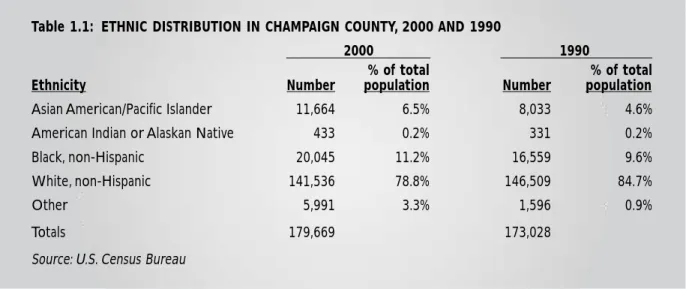
Champaign County, with 1,000 square miles of District 505, has a total population of 179,669. Table 1.1 shows the county’s ethnic distribution in 1990 and 2000; Table 1.2 shows the county’s 15 largest employers in 2000, their products or services, and number of employees.
Table 1.1: ETHNIC DISTRIBUTION IN CHAMPAIGN COUNTY, 2000 AND 1990
2000 1990
% of total % of total
Ethnicity Number population Number population
Asian American/Pacific Islander 11,664 6.5% 8,033 4.6%
American Indian or Alaskan Native 433 0.2% 331 0.2%
Black, non-Hispanic 20,045 11.2% 16,559 9.6%
White, non-Hispanic 141,536 78.8% 146,509 84.7%
Other 5,991 3.3% 1,596 0.9%
Totals 179,669 173,028
Source: U.S. Census Bureau
Introduction
1
Table 1.2: CHAMPAIGN COUNTY’S LARGEST EMPLOYERS, THEIR PRODUCTS OR SERVICES, AND NUMBER OF EMPLOYEES IN 2000
Employer Product/Service Number of Employees
University of Illinois education 20,766
Carle Clinic Association health care 2,426
Carle Foundation Hospital health care 2,027
Kraft Foods, Inc. food 1,650
Provena Covenant health care 1,450
Rantoul Products automotive interior parts 1,100
Caradco windows 1,090
Champaign School District education 1,000
Parkland College education 882
Super Valu food distribution 880
Christie Clinic health care 725
Hobbico hobby product distribution 700
Meijer supermarket/discount store 700
Solo Cup paper/plastic cups 700
Urbana School District education 672
Source: The Greater Champaign-Urbana Economic Partnership’s Top Employer Directory
The 2000 median Champaign County family income was $38,245. Persons below the poverty level in 2000 numbered 21,736, or 12.1%. The unemployment rate for Champaign County in November 2001 was 2.3%, down from 3.1% in 1996; the unemployment rate for Illinois was 5.4% in 2001, up from 5.3% in 1996; the national unemployment rate was 4.8% in 2001, down from 5.4% in 1996.
Table 1.3 gives a profile of Parkland students in fall 2001 and fall 2000.
Table 1.3: FALL 2001 AND FALL 2000 PARKLAND STUDENT PROFILE
Fall 2001 Fall 2000 Part-time/Full-time 60%/40% 59%/41% Men/Women 45%/55% 45%/55% Asian American/ Pacific Islander 5% 5% American Indian/ Alaskan Native 0.4% 0.4% Black, non-Hispanic 13% 13% Hispanic 4% 3% White, non-Hispanic 74% 75% Non-resident Alien 5% 4%
Average age of all students 27.5 27.9
Median age 22.4 22.6
Age range: Under 17 2% 1%
17-20 37% 37% 21-24 22% 21% 25-30 13% 14% 31-39 11% 12% 40-55 12% 12% Over 55 3% 3% Fall 2001 Fall 2000 Freshmen 75% 73% Sophomores 25% 27% District 505 76% 77% District 505 temporary 11% 10% Out of district 8% 8% Out of state 1% 1% International visa 3% 2% Chargeback 1% 2% Transfer programs 36% 35% Continuing education/ course enrollee 36% 35% AAS/occupational programs 20% 21% AGS/associate in general studies 5% 5% Certificates 3% 4% Source: OIRE
The spring 2000 student satisfaction survey indicated that of the 582 respondents, 75.9% (442 persons) had jobs while enrolled at Parkland, working an average of 24.1 hours a week; 19.9% (116 persons) had dependent children, 18.7% (109 persons) were married, 52.1% (303 persons) were receiving financial aid, and 43.1% (251 persons) were first-generation college students, with neither parent having a degree.
Parkland’s Accreditation History
In November of 1967, Parkland received correspondent status from the North Central Association of Colleges and Schools; in 1970 the college was granted recognized candidate for accreditation status and in 1972 earned NCA accreditation. In 1981 and in 1993 Parkland earned ten years of continued accreditation, with no interim reports or visits. A brief history of Parkland appears on pages 17 and 18 of the 2002-2003 catalog.
Self-Study Report Purposes and Audiences
One purpose of our self-study report is, of course, to seek continued accreditation. Preparing for a comprehensive evaluation affords us the incentive and the opportunity to step back and examine every aspect of our college to see how we can make an excellent institution even better. The goals our NCA steering committee identified for the self-study process serve as additional purposes for the report:
• to highlight our strengths and identify areas for improvement;
• to encourage discussion across the college and across the disciplines, strengthening our college community as self-study participants learn about and evaluate components of the college other than their own;
• to make sure that we don’t concentrate so much on what we have done that we lose sight of where we want to go;
• to educate and involve full-time and part-time faculty and staff as stakeholders in the processes necessary to provide quality education continuously;
• to help all faculty, staff, and administrators, especially those new to Parkland, in learning about the college—what we do and why it is vital to the citizens of District 505;
• to work together to encourage awareness and appreciation of the professional contributions of all Parkland employees, both full- and part-time.
Our report is intended for many audiences: the Higher Learning Commission’s team of consultant-evaluators who will visit Parkland in November 2002, the college’s current and future administrators, faculty, staff, and trustees, institutions with whom we enjoy partnerships, and interested district residents. Our report will identify what we find effective in achieving our goals and fulfilling our mission and purposes. It will also keep us mindful of needed improvements that will enhance our performance and value to our communities and students.
Organization of the Report
The self-study report is organized around the Higher Learning Commission’s five criteria for accreditation: Chapters 4 and 5 address Criterion One; Chapters 6 through 11 offer evidence that we are meeting Criterion Two. We have discussed academic resources, support services, and equipment as well as student services under Criterion Two because the institutional effectiveness process is used to assess their effectiveness. Chapters 12 through 15 are devoted to Criterion Three; we chose to discuss our educational programs under Criterion Three because the academic assessment process is used to assess their effectiveness. Chapters 16 and 17 address Criterion Four, and Chapters 18, 19, and 20 address Criterion Five.
Chapter 2 of the self-study report comprises the General Institutional Requirements; the college’s responses to the 1993 team’s concerns are found in Chapter 3. Chapter 21 discusses federal compliance, federal programs, and the opportunities Parkland provided for third-party comment. The report concludes with Chapter 22, which summarizes the major strengths and challenges identified by the self-study process, includes strategies for addressing the major challenges, and requests continued accreditation. Volume II of
the self-study report, Academic Assessment and Institutional Effectiveness Examples, offers a representative sample of our processes for assessing student academic achievement and the effectiveness of the college’s support units. All academic assessment documents and all institutional effectiveness annual reports can be found on the Parkland College Web site: (http://www.Parkland.edu), and all academic assessment and institutional effectiveness documents are in the resource room.
Although mindful of the need for conciseness in the self-study report, we have, in some cases, included information that can also be found in other college publications, such as the catalog. The self-study report will be used often in subsequent years, and we want it to be as self-contained as possible to be of maximal value to the college.
Parkland’s Self-Study Process
Parkland’s self-study process officially began in October of 1998 when Dale Ewen, then the vice presi-dent for academic and stupresi-dent services, invited Larry Thurow, then associate professor of agriculture, and Sally Wallace, professor of English, to serve as self-study coordinators. The three agreed that the ideal process would have two distinct benefits: it would educate members of the college community about aspects of Parkland outside their own areas of activity and expertise, and it would encourage participation by both veteran and relatively new members of the faculty and staff, thus assuring varied perspectives and some continuity for future self-studies. Dr. Harris, Dale Ewen, and the coordinators also discussed the ideal size and composition of the steering committee, and Dr. Harris sent letters of invitation to campus leaders representing a cross-section of the entire institution. The steering committee met for the first time on May 12, 1999.
The coordinators decided upon a pyramidal organizational structure. They chose a chair for each of the five criteria for accreditation, with co-chairs for Criterion Two; the criteria chairs then met with Dale Ewen and the coordinators to discuss the self-study report’s ideal content and format. After essential chapters had been decided upon, the criteria chairs chose chapter chairs. For maximal educational value and objectivity, the chapter chairs, who also represent a mixture of veterans and relative newcomers, were assigned to investigate and appraise areas of the college other than their own. The chapter chairs then chose members for their committees. In fall 2000 and spring 2001, chapter committees gathered information, analyzed data, and worked on rough drafts to be submitted to the relevant criterion chair and to the self-study coordinators in May of 2001. The steering committee had agreed that the ideal self-study report would include just enough description to provide context for out-of-state community college colleagues and that each chapter would address these questions: What are we doing? Why are we doing it? Is it working? How do we know whether it’s working? What are its strengths? What isn’t working as well as it could? What needs to be improved? Why? Is there work in progress to improve? Appropriate chapters would also articulate their relationship to Parkland’s mission, purposes, and core values. Although our baseline, snapshot academic year was fall of 2000 and spring of 2001, we decided to use as much current information as was available, including changes in administrative titles and department names, so confusion would be minimized for the visiting team.
The criteria chairs and the self-study coordinators examined the drafts for patterns of evidence that the college meets each criterion, made suggestions for revision, and returned the drafts to the chapter chairs for revision. The criteria chairs also worked on the General Institutional Requirements each had been assigned. In October of 2001 the second draft of each chapter, incorporating an analysis of data gleaned from the spring 2001 semester, was submitted to the editing committee, which evaluated each draft for completeness, conciseness, accuracy, and clarity; the editing committee, when appropriate, requested additional information. As each chapter emerged from the editing process, it was posted on Parkland’s Web site, with highlighted questions that needed to be addressed by April 15, 2002, which was also the deadline for corrections of errors of fact from the college community at large. The editing committee held an open hearing on April 18, 2002, for all those with questions about any aspect of the self-study process or the penultimate drafts. On April 25, members of the administration, faculty, and staff gathered outside near the planetarium for a historic panoramic photograph to serve as the cover for the self-study volumes and to commemorate Parkland’s thirty-fifth anniversary. Revised penultimate drafts were posted on the Web early in May; after final editing, the complete report went into final production in the middle of July.
Significant Developments Since 1993
The college has devoted much of the past decade to the concept and practice of institutional and educational excellence — how to define it, how to achieve it, and how to maintain it. We have focused on the assessment of student academic achievement and institutional effectiveness. We have revised our statement of mission and purposes, identified and articulated our institutional values, and revised our general education objectives to make them more measurable. We have implemented a uniform faculty evaluation process and schedule. We have expanded our academic offerings by providing online courses, and we have been granted Higher Learning Commission permission to offer degrees through Internet/ modem connection. We have nurtured our center for excellence in teaching and learning, which has become one of the jewels in Parkland’s crown, to provide meaningful, lasting faculty development.
Significant events in our quest for excellence throughout the past decade include:
1993
• Alpha Psi Eta, Parkland’s chapter of Phi Theta Kappa, the international honor society of the two-year college, was chartered.
• Academic and student services were combined into one organizational unit. • The center for excellence in teaching and learning was established.
• Academic assessment became a specific action plan strategy in the college’s operational plan. • Parkland hosted the state’s first multicultural education conference for over 400 educators.
1994
• Parkland’s first leadership development seminar, “Leadership: A Commitment to Involvement in the Decision-Making Process at Parkland College” was held May 25-27 at Allerton Park.
• Dr. Harris appointed a special task force to develop a plan for establishing Parkland as a key regional community college.
• The comprehensive assessment program (CAP) became fully operational.
1995
• Telephone registration became fully operational. • E-mail became available college-wide.
• Parkland’s agriculture program hosted a forum at which farmers, former students, and agri-business leaders suggested ways the college could better meet their training/education needs. This forum was the forerunner of the focused futures conferences, which inform the college’s career offerings. • The child development center opened.
1996
• A college-wide enrollment management team was created.
• Parkland’s first college-wide futures conference was held in February, and input was included in the college’s strategic plan.
• Free diversity education was provided for every full-time Parkland employee.
• As part of the college’s effort to recruit new faculty into departments/disciplines with underrepresented groups, four Diversity 2000 faculty interns were hired.
• The Parkland board chairman, John Albin, was the first community college representative appointed to the Illinois Student Assistance Commission.
• Parkland President Zelema Harris was appointed chair of the Illinois Community College Board (ICCB) committee on access and opportunity.
• The agriculture training institute was created to offer short-term workshops and classes to the agricultural community.
1997
• The Parkland board of trustees passed a resolution reaffirming its commitment to diversity and charged the administration with developing and implementing a plan to hire a more diverse faculty. • The college’s first Internet-based courses were offered.
• A master technology plan was developed to provide a blueprint for Parkland’s future use of technology, including creating a Distance and Virtual Learning department.
• An apprenticeship program began in the new manufacturing technology A.A.S. degree program. Twenty-two area manufacturing companies became sponsors of apprentices.
• Two Illinois universities, Olivet Nazarene University and Eastern Illinois University, offered the second two years of bachelor’s degrees in nursing and in business on Parkland’s campus.
1998
• The workforce preparation center, a collaboration among Parkland, JTPA (Job Training Partnership Act), public aid, and other agencies, opened in downtown Champaign to serve unemployed and underemployed adults.
• Parkland partnered with Cisco Systems to become a regional training academy.
• The college developed the first district-wide formal agreement to offer dual credit courses to District 505 high schools.
• The PROF (Professors of the Future) scholar program was established to identify promising minority students at Parkland and assist them in becoming community college faculty.
• An integrated learning community was piloted in the spring.
• An off-site location was secured for the business training center, which was renamed the Parkland Business Development Center.
• International student enrollment reached an all-time high of 400.
1999
• Focused futures conferences were held in agriculture, health, information technology, and industrial technologies.
• The computer technology center was established to offer computer training courses on an open-entry, open-exit basis in the on-campus center as well as online.
• Parkland joined four other community colleges to form IPIC (Illinois Prairie Internet Consortium) to jointly develop and offer courses via the Internet.
• The adult degree completion center was started.
• The state legislature approved seed money of $350,000 to build an agricultural technology applications center at Parkland.
2000
• The Parkland Foundation embarked on its first major gifts campaign.
• Parkland made a significant commitment to techCommUnity, a collaborative effort with the University of Illinois, chambers of commerce, and local businesses to attract and develop more high-tech businesses in the area.
2001
• Parkland celebrated its thirty-fifth anniversary.
• Classes began in the new Tony Noel Agricultural Applications Technology Center. • The new D wing was completed in late fall.
• Parkland received Higher Learning Commission approval to offer degrees through Internet/modem connection.
Many grants have contributed to Parkland’s excellence and commitment to its mission; they include: • The office of women’s programs and services received a Ford Foundation grant to train Illinois
community college faculty how to integrate multiculturalism into their classrooms.
• Parkland was named administrator for the Higher Education Cooperative Agreements (HECA) Minority Articulation Grant, with seven other colleges and universities; the college received three grants to train Romanian child welfare workers.
• The Ms. Foundation funded the “Get with the Program” series offered through continuing education for outreach into the African-American community.
• The college received a Student Support Services (TRIO) grant, funded by the United States Department of Education, to provide one-on-one support for low-income, first-generation students attending college.
• A Talent Search grant, also funded by the United States Department of Education, provides support and encouragement for low-income, first-generation college students.
• The Minority Transfer Center grant, funded by the Illinois Board of Higher Education (IBHE) as part of the HECA, yields approximately $60,000 per year to support student services in assisting with the transfer process for minority students.
• Parkland administers approximately $1,000,000 from the Illinois State Board of Education (ISBE) annually to facilitate the continuation of a comprehensive statewide plan for the improvement of agriculture education at all levels.
• Parkland administers approximately $500,000 for each of three years from the Illinois Century Network to provide the telecommunications background linking colleges and universities, K-12, public libraries, museums, and other non-profit organizations.
• The IBHE granted Parkland $75,000 to create Classmate Online Peer Tutoring, a Web-based tutoring system designed to assist online students by providing academic assistance from their peers and faculty.
• Ameritech granted the college $35,000 to operate a training center to provide workshops on assistive technology software for young people with disabilities.
• The IBHE and the ICCB have awarded Parkland $105,000 for each of two years to share state-wide the Prairie Consortium model for faculty/staff development in multicultural education: Creating Inclusive Communities.
• HECA grants fund IPIC, of which Parkland is a member, to share expertise and resources in developing and expanding online degree programs.
The past four annual Parkland College year-end grant reports are in the resource room.
Significant awards in the past ten years have acknowledged the college’s excellence; a list of institutional and individual national, regional, and state honors and awards appears in Appendix B. We have supported our commitment to excellence by seeking the guidance and expertise of consultants; a list appears in Appendix C.