EPS-001 7/13
W
hether eggs come from a common chicken or an exotic bird, you must store and incu-bate them carefully for a successful hatch. Envi-ronmental conditions, handling, sanitation, and record keeping are all important factors when it comes to incubating and hatching eggs.Fertile egg quality
A fertile egg is alive; each egg contains living cells that can become a viable embryo and then a chick. Eggs are fragile and a successful hatch begins with undamaged eggs that are fresh, clean, and fertile. You can produce fertile eggs yourself or obtain them elsewhere. While commercial hatcheries produce quality eggs that are highly fertile, many do not ship small quantities. If you mail order eggs, be sure to pick them up promptly from your receiving area. Hatchability will decrease if eggs are handled poorly or get too hot or too cold in transit.
If you produce the eggs on site, you must care for the breeding stock properly to ensure maximum fertility. Egg quality and embryo survival are influenced by hen and sire’s:
◆ age ◆ health ◆ nutrition
Factors that affect hatchability
Breeder Hatchery
Breeder nutrition Disease
Mating activity Egg damage
Correct male and female body weight Egg sanitation Egg storage Sanitation Egg storage Egg damage Incubation—Management of setters and hatchers Chick handling
Collecting and storing fertile eggs
Fertile eggs must be collected carefully and stored properly until they are incubated. Keeping the eggs at proper storage temperatures keeps the embryo from starting and stopping development, which increases embryo mortality. Collecting eggs frequently and storing them properly delays embryo development until you are ready to incu-bate them.
Egg storage reminders
• Store less than 10 days• Maintain temperature between 55 to 65°F • Keep relative humidity at 75 percent • Turn eggs stored more than a week • Handle eggs with care!
Cleaning and culling
Do not incubate eggs that are cracked, misshapen, soiled, or unusually small or large. These rarely hatch andcan potentially contaminate the good
Incubating and Hatching Eggs
Gregory S. Archer and A. Lee Cartwright** Assistant Professor and Extension Poultry Specialist, Associate Professor and Extension Poultry Specialist, The Texas A&M University System
◆ ratio ◆ genetics ◆ stress
eggs. Do not wash or wipe eggs with a damp cloth. Doing so can remove the egg’s protective layer and allow disease and bacteria to enter. It can also spread bacteria from one dirty egg to others. You can gently buff soiled eggs with fine sand paper but this can also damage the egg’s protective coating. It is best to avoid incubating soiled eggs.
General care
Once you have eggs to incubate, avoid damaging or contaminating them. Wash your hands fre-quently to remove bacteria from your hands.
Storage time
Eggs should be set as soon after you collect them as possible. Storing eggs for at least three days helps prepare them for incubation; however, fresh and stored eggs should not be set together.
It is best to incubate eggs within 7 to 10 days of their being laid. Hatchability decreases rapidly when eggs are stored for more than 10 days. After 7 days, hatchability decreases 0.5 to 1.5 percent per day. Each day in storage adds one hour to the incubation time.
Temperature and humidity during storage
Fertile eggs should be stored between 55 and 65°F. If fertile eggs reach temperatures above 72°F, embryos will begin to develop abnormally, weaken, and die. Embryos stored below 46°F also have high embryo mortality. Room temperature is generally too warm and the refrigerator is too cold for storing fertile eggs. If you plan to store eggs in a refrigerator, adjust it to an appropriate tempera-ture.
Fertile eggs should be stored at 70 to 80 percent relative humidity. High humidity can cause con-densation to form on the eggshell. This can clog the pores on the eggshell and cause contamination the same way washing does. Clogging the pores can also suffocate the embryo.
Low humidity during storage can make the egg lose internal moisture and kill the embryo. To
increase the humidity, place a pan of water in the storage room. It is the surface area of the water influences humidity, not the depth of the water. Avoid drafts; these can dry the eggs out even when humidity is within the appropriate range.
Positioning and turning eggs during storage
If you plan to store eggs for less than ten days before incubating, place them on flats with the large end up. You do not need to turn the eggs if they will be incubated within a week of being laid. You should cover the eggs with a loose material to keep them clean.
If you plan to store eggs for more than 10 days, tilt them from side to side over a 90-degree angle once or twice daily. You can do this by placing a six-inch block under one end of the flat, switching the end of the flat each day until incubation.
Incubation
An incubator is basically a box that holds eggs while maintaining an appropriate temperature, humidity, and oxygen level. Incubators have vary-ing capacities and adapters for eggs from different species.
Popular incubator models often include automatic turners, humidifiers, and temperature controllers. Egg turners can usually be purchased separately for incubators that do not include them. Humidi-fiers can be the type that disperses water vapor as needed or many smaller incubators use a simple water reservoir. Temperature is controlled by older wafer systems or the newer digital thermostats. Incubators come in forced air or still air versions. The temperature and humidity in a forced air incubator is more consistent. They also return to desired temperature and humidity more quickly after being opened.
Still air incubators can give inaccurate humidity and temperature readings and the temperature in them can vary considerably. Whenever possible, use a forced air incubator. Regardless of incuba-tor type, for a successful hatch you must turn the
eggs and monitor the temperature, humidity, and ventilation.
The incubator should be in a room that has no drafts or direct sunlight; the temperature and humidity should be controlled and stable. The incubator and hatcher should also be isolated from the growing facilities. Newly hatched chicks can be contaminated by older birds and the dust created by growing birds. Take biosecurity mea-sures to insure the incubator area is not contami-nated by older birds.
Chicks may be hatched in the incubator depend-ing on what type it is; however, hatchdepend-ing creates large amounts of dust and down. Hatching in a separate unit will keep dust and down from contaminating the incubator. Temperature and humidity can also be controlled more easily if you use separate units for incubating and hatching. Regardless of method, you must properly clean and disinfect the incubator and hatcher between batches.
Two to three days before incubation
Sanitize the incubator and run it for several days before setting the eggs. This will ensure that the incubator is maintaining the proper temperature and relative humidity before the eggs are set. Adjusting the temperature and humidity after the eggs are set can decrease hatchability. If you are using an automatic turner, test it completely before setting the eggs. The temperature and humidity of the incubation room should be correct and stable when you set the eggs. Do not set the eggs until the temperature and humidity in the incubators and the room are correct and stable.
Cleaning and fumigation
Microbes in an incubator can significantly reduce hatchability. Cleaning and disinfecting equipment must be standard operating procedures. Disinfect, incubators, hatchers and their racks with quater-nary ammonia or a commercial disinfectant after each hatch.
The day eggs are set
Let stored eggs warm to room temperature for 4 hours to 8 hours before setting them in the incubator. If you place cold eggs in a warm, humid incubator, condensation will form on them and lead to possible contamination or suffocation. Once the eggs are in the incubator, do not adjust the temperature or humidity for a few hours, unless the temperature exceeds 102°F. After 4 hours, make proper adjustments. The final tem-perature should vary only .5 degree above or below 99.5°F. The temperature of incubators with-out circulating fans fluctuates more than incuba-tors with circulating fans. If the temperature does not exceed 102°F, the hatch should not be harmed. Set the small end of the egg lower than the large end in the incubator. A developing embryo orients so that the head develops toward the air cell, which is in the large end of the egg. If the small end is higher than the large end during incuba-tion, a chick’s head can orient away from the air cell of the egg and not hatch.
Set stage
The set stage refers to incubation period up until 2 or 3 days before a hatch. Different species have different incubation periods (Table 1). Incubating different species together in the same incubator is not recommended, especially if the incubator is also used as hatcher.
Turning the eggs during incubation prevents embryo death and unhealthy hatches. Eggs must be turned at least five times every 24 hours. Turning more frequently is better and once per hour is best. Keep accurate records to ensure the eggs are turned three to five times each 24-hour period. Failure to turn eggs appropriately results in embryo death.
Turning must continue even through weekends. An automatic turner simplifies this task and decreases human error during the incubation process.
Table 1. Incubation period to hatch time and when to transfer to hatcher. Temperature and humidity levels for common birds.
Common name
Incubation conditions Hatcher conditions
Days Temperature
°F Humidity %RH Transfer day Temperature °F Humidity
canary 13–14 100.5 56–58 11 99 66–74 chicken 21 99.5 58 18 98.5 66–75 cockatiel 18–20 99.5 58–62 15–18 99 66–74 cockatoo 22–30 99.5 58–62 20–27 99 66–74 conure (sun) 28 99.5 58–62 25 99 66–74 conure (various) 21–30 99.5 58–62 18–27 99 66–74 dove 14 99.5 58 12 98.5 66–75 duck 28 99.5 58–62 25 98.5 66–75 muscovy duck 35–37 99.5 58–62 31–33 98.5 66–75 finch 14 99.5 58–62 12 99 66–74 Domestic goose 30 99.5 62 27 98.5 66–75 geese (various) 22–30 99.5 62 20–27 98.5 66–75 grouse 24–25 99.5 54–58 22 99 66–74 guinea 28 99.5 54–58 22 99 66–74 lovebird 22–25 99.5 58–62 20–22 99 66–74 macaw 26–28 99.5 58–62 23–25 99 66–74 mynah 14 100.5 56–58 12 99 66–74 parakeet 18–26 99.5 58–62 15–23 99 66–74 budgerigar 18 99.5 58–62 15 99 66–74 parrot (various) 18–28 99.5 58–62 15–25 99 66–74
parrot (african grey) 28 99.5 58–62 25 99 66–74
chukar partridge 23–24 99.5 62 20 99 66–74 peafowl 28–29 99.5 58–62 25–26 98.5 66–75 ptarmigan 21–23 99.5 58–62 18–20 99 66–74 raven 20–21 99.5 58–62 17–18 99 66–74 ring-neck pheasant 24–24 99.5 58–62 21 99 66–74 pheasant 22–28 99.5 58–62 20–25 99 66–74 pigeon 17–19 100.5 58 14 99 66–74 bobwhite quail 23 99.5 54–58 21 99 66–74 japanese quail 17–18 99.5 58–62 15 99 66–74 swan 33–37 99.5 58–62 30–33 99 66–74 turkey 28 99.5 54–58 25 98.5 66–75 emu 49–50 97.5 32–40 47 97.5 69 ostrich 42 97.5 32–40 39 97.5 69 rhea 36–42 97.5 50 34–37 97.5 69
Temperature, humidity,
and ventilation of incubator
During the set stage, temperature in the incubator should be 99.5°F to 100°F for chickens. Other spe-cies have different requirements (Table 1). If the temperature deviates more than 1/2 degree from 100°F, a poor hatch is likely. Check the tempera-ture at least twice a day.
Relative humidity should be set at 55 to 60 per-cent. If the incubator uses a passive humidity control system, add water to the pan or trough daily to maintain correct humidity levels. If the humidity in the incubator is too low or too high, the hatch will fail.
Insufficient humidity causes:
◆ The air cell to be too large at the time of hatch ◆ The contents of the egg be too viscous for the
chick to turn
◆ The membranes to be too tough to break ◆ The navel to not close properly
Excess humidity will cause:
◆ Too little water to evaporate from the egg ◆ The air cell to be too small for the chick to
reach during the hatching process
◆ The chick to drown or be too swollen with water to turn in the egg
◆ The yolk sac to be too large for the navel to close completely
The air cell of the egg should become larger as incubation progresses because of the balance between temperature and humidity during incubation. Chicken eggs lose 12 percent to 14 percent of their total weight to evaporation during incubation. You can weigh racks of eggs during incubation to detect problems with humidity and evaporative loss before a hatch is destroyed. The chick embryo uses oxygen and produces carbon dioxide. This gas exchange is insignificant during early incubation or when a small number of eggs are incubated; however, follow the manufac-turer’s recommendations to assure that developing
chicks have adequate oxygen available. Near the end of the incubation period, the shell nearly filled with the embryo and a full incubator requires large amounts of oxygen. Ensure adequate venti-lation and monitor wet and dry bulb temperatures very carefully during the last third of incubation.
Incubation Reminders
• Place the incubator in a room with a constanttemperature, no drafts or direct sunlight. • Sanitize the incubator.
• Wash hands before touching eggs. Keep germs, dirt and oil away from incubating eggs.
• Only incubate eggs together from species with similar incubation periods.
• Keep the small end of the egg lower than the large end.
• Record of incubator data daily.
• Ensure that the humidifier is working or that the water pan is filled.
• Verify humidity levels are between 55 to 60 percent. • Check temperature daily and keep it at 99.5°F to 100°F. • Turn eggs at least 5 times a day until 3 days before
hatch.
• Increase ventilation during the last third of incubation. • Do not turn for the final 3 days. Provide a cloth or
rough paper for the chicks to walk on.
• Increase humidity to 65 to 70 percent at hatch stage.
Record keeping
Record the incubator environment daily (Appen-dix A). The sample record on page 11 is designed for use with eggs that hatch after 21 days of incubation. You can use records of your hatches to detect malfunctions before a hatch is ruined. Records of fertility and embryo deaths can also alert hatchery managers about problems with production, storage, or incubators.
Candling
Shining a light through the egg to observe embryo development is called candling. White or pale eggs are easier to candle than dark or speck-led eggs. Many people candle eggs with a small flashlight that can be focused. You can also buy commercial candlers at reasonable cost.
In a dark room, hold the egg to the light of the candler to observe the contents of the egg. Cool-ing that occurs for less than 10 minutes durCool-ing candling does not harm the embryo. However, even a brief period at 104°F kills embryos—expose the egg to the hot light sources only briefly. Embryos can be confirmed easily after 8 to 12 days of incubation. The living embryo will appear as a dark spot in the large end of the egg sur-rounded by a faint outline of blood vessels. The blood vessels will appear firm and distinct. The embryo appears as dark spot that becomes larger as incubation progresses. Eventually you will see only a dark mass and the air cell.
In comparison, an infertile or unincubated egg transmits light brightly. Dead embryos will some-times appear as a ring or a smear of blood in the egg or a dark spot dried to the inside of the shell. Once it dies, the embryo no longer grows and the blood system fades.
You should expect some mortality; however, unusual mortality or certain characteristics of the mortality can be indicators that you need to correct certain practices to improve hatchability.
Keep records of egg infertility or embryo death for reference.
Ten percent or more of incubated eggs are infertile. Identifying and removing eggs that are infertile or dead eliminates possible sources of contamination from the incubator. If you have doubts about can-dling, seek expert advice.
Hatch stage
This stage refers to final 2 to 3 days of incubation when chicks hatch out of the shell. Transfer eggs to a dedicated hatcher for the last 3 days to 4 days of incubation and do not turn them. If a hatcher is not available, remove the eggs from the turner and lay them in the hatching basket or place them on cloth or rough paper (not newspaper) in the incubator. Make sure the cloth or paper do not cover vent holes, or touch the water or the heating element. During this stage, decrease the temperature 1°F and increase the relative humidity to 65 to 70 percent. You can increase the humidity by adding a wet sponge or wet paper towels to the incubator. The chicks should start to pip within a day of the incubation period listed for the species in Table 1.
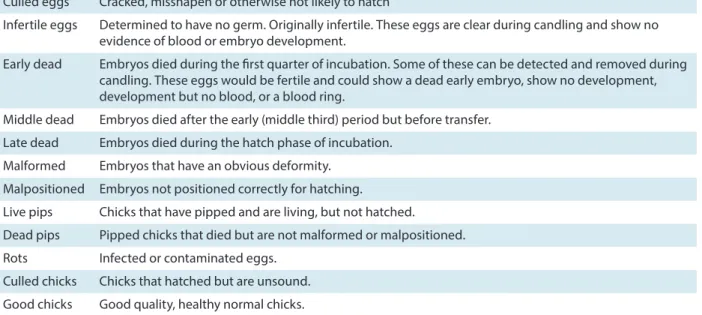
Table 2. Incubating and hatching egg and chick classification
Culled eggs Cracked, misshapen or otherwise not likely to hatch
Infertile eggs Determined to have no germ. Originally infertile. These eggs are clear during candling and show no
evidence of blood or embryo development.
Early dead Embryos died during the first quarter of incubation. Some of these can be detected and removed during
candling. These eggs would be fertile and could show a dead early embryo, show no development, development but no blood, or a blood ring.
Middle dead Embryos died after the early (middle third) period but before transfer.
Late dead Embryos died during the hatch phase of incubation.
Malformed Embryos that have an obvious deformity.
Malpositioned Embryos not positioned correctly for hatching.
Live pips Chicks that have pipped and are living, but not hatched.
Dead pips Pipped chicks that died but are not malformed or malpositioned.
Rots Infected or contaminated eggs.
Culled chicks Chicks that hatched but are unsound.
When chicks hatch
Hatching requires great effort; the chick is very active then takes long rests. The entire process takes 10 hours to 20 hours. Do not worry about how long a chick takes to hatch unless it takes more than 20 hours.
Eggs that are not hatched 1 day after the predicted incubation period should be discarded. Do not help a chick free itself from the shell; chicks that
cannot hatch on their own usually die. If you help them and they live, they usually will not thrive. Dispose of weaker deformed chicks humanely. These chicks should never be used for breeding because these traits could be transmitted to their young.
Once chicks successfully leave the shell, increase the ventilation in the incubator and leave them in it about 24 hours or until their feathers are dry.
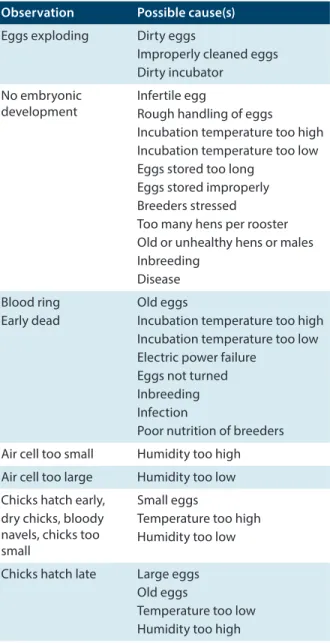
Table 3. Possible causes of hatching problems
Observation Possible cause(s)
Eggs exploding Dirty eggs
Improperly cleaned eggs Dirty incubator
No embryonic
development Infertile eggRough handling of eggs
Incubation temperature too high Incubation temperature too low Eggs stored too long
Eggs stored improperly Breeders stressed
Too many hens per rooster Old or unhealthy hens or males Inbreeding
Disease Blood ring
Early dead
Old eggs
Incubation temperature too high Incubation temperature too low Electric power failure
Eggs not turned Inbreeding Infection
Poor nutrition of breeders
Air cell too small Humidity too high
Air cell too large Humidity too low
Chicks hatch early, dry chicks, bloody navels, chicks too small
Small eggs
Temperature too high Humidity too low
Chicks hatch late Large eggs
Old eggs
Temperature too low Humidity too high
Observation Possible cause(s)
Chicks dead after
pipping Eggs not turned first 2 weeksThin-shelled eggs
Temperature too low during incubation
Temperature too high during incubation
Humidity too low during incu-bation
Humidity too high during incu-bation
Infection, disease Unhealed navel
Mushy chicks
Temperature too low during incubation
Wide temperature variation in incubator
Humidity too high during incu-bation
Poor ventilation Malformed legs and
toes
Improper temperature during incubation
Improper humidity during incubation
Legs also may be harmed by hatching or holding chicks
Weak chicks Temperature too high or low
Old eggs Poor ventilation
Gasping chicks Disease: Bronchitis or Newcastle
disease
Malpositions Temperature too high or low
Turning inadequate
Large end of egg not up when set
Old or poorly handled eggs Poor breeder nutrition
When more than 90 percent of the chicks are dry, remove them from the hatcher. Move the chicks to a warm brooder and give them water and feed. Leaving chicks in the incubator too long can dehydrate them.
Embryo death
Eggs fail to hatch because they are infertile or because the embryo dies. You can candle eggs during incubation or examine them after the hatch to determine what caused them to fail. Humidity control can sometimes contribute to these problems.
Embryos usually die during the first 3 days of incu-bation or the 3 days immediately before a hatch. Early embryo death happens when embryonic organs are forming. However, eggs that are fertile one third of the way through incubation have an 88 to 90 percent chance of continuing to develop. Death at the end of the incubation process can occur because the chick:
◆ Has difficulty positioning for pipping ◆ Cannot absorbing the yolk sac ◆ Cannot transition to breathing air
Record when embryos die to identify changes you need to make in the incubation process. A sample record form for hatch and fertility failures is in Appendix A.
Examine the eggs that fail to hatch by remov-ing the top of the egg at the large end. A chick that has developed appropriately in the egg will normally have its head under the right wing. The air cell will be large enough to allow the chick to position correctly for hatching. The shell mem-branes should not dry to the chick during hatch. Note any dryness. Note the condition of the beak, wings, and legs for proper form.
Carefully classify infertile or dead embryos using the designations listed in Table 2. All abnormal-ities should be recorded and analyzed to deter-mine if hatch failure was caused by fertility or environmental problems that can be corrected.
Use the Hatchability and Mortality Record (Appendix B) to calculate the percentage fertility, percentage hatchability, and percentage of total eggs hatched. These numbers will help in evaluat-ing hatch efficiency. Any changes in the mortality records data are early warnings to correct small problems before they become serious.
Nutrition can be a factor in fertility and hatch-ability problems, as recognized by the National Research Council (Appendix C).
Resources
Professional advice and support
The office of the Texas AgriLife Extension Service in your county listed in the telephone directory under the county name.
Gregory S. Archer MS 2472 TAMU
College Station, TX 77843-2472 Telephone: (979) 845-4319
E-mail: [email protected]
PowerPoint presentation: An accompanying slide-show is available at your local Extension office or the Texas A&M Department of Poultry Science.
Sources of fertile eggs
There are many sources for fertile eggs. Some sources are convenient and the eggs affordable, but egg quality and fertility can be a problem. One source of fertile eggs is Texas A&M Uni-versity, which will ship as few as 2 dozen fertile eggs. Prices and other information are subject to change.
To order fertile eggs from Texas A&M, please complete and submit the form at http://posc.tamu. edu/fertile-egg-orders
Or contact Dale Hyatt at (979) 845-4367 No credit cards are accepted. Eggs are sold in dozen and half dozen quantities only, with a min-imum 2 dozen order. Eggs are $7 per dozen plus a $3 handling fee per order, plus shipping.
Shipping within Texas: Eggs are shipped via Greyhound Bus Lines to the nearest bus terminal. Please check with Greyhound for shipping times between Bryan, Texas and your destination. Ship-ping charges vary according to the number of eggs ordered and the distance from shipping point. When ordering, request fertile chicken eggs for a school project. You will be billed at the end of the month.
Sources of fertile eggs, incubators,
and equipment
Cackle Hatchery PO Box 529 Lebanon, MO 65536 (417) 532-4581 cacklehatchery.comCarolina Biological Supply Company P.O. Box 6010 Burlington, NC 27216 (800) 334-5551 www.carolina.com GQF Manufacturing Co. 2343 Louisville Rd. Savannah, GA 31415-1619 (912) 236-0651 www.gqfmfg.com Hoffman Hatchery Inc. P.O. Box 129 Gratz, PA 17030 (717) 365-3694 www.hoffmanhatchery.com Ideal Poultry PO Box 591 Cameron, TX 76520 (254) 679-6677 www.ideal-poultry.com Kemp’s Incubators 3560 West 18th Ave. Eugene, OR 97402 (888) 901-2743 www.poultrysupply.com
Lyon Technologies, Inc. 1690 Brandywine Avenue Chula Vista, CA 91911 (888) 5966-872 www.lyonusa.com McMurray Hatchery P.O. Box 458 191 Closz Drive
Webster City, Iowa 50595 (800) 454-3280 www.mcmurrayhatchery.com Meyer Hatchery 626 State Route 89 Polk, OH 44866 (888) 568-9755 www.meyerhatchery.com Randall Burkey Co., Inc. 117 Industrial Dr.
Boerne, TX 78006 (800) 531-1097
www.randallburkey.com
Stromberg’s Chicks and Game Birds P.O. Box 400
Pine River, MN 56474 (800) 720-1134
www.strombergschickens.com Ridgway Hatcheries, Inc. 615 North High St. Box 306 Larue, OH 43332 (740) 499-2163 ridgwayhatchery.com Welp Hatchery P.O. BOX 77 Bancroft, Iowa 50517 (800) 458-4473 www.welphatchery.com
Helpful books
Bird, Egg, Feather, Nest, by Maryjol Koch. Smith-mark Publishing, 1999.
Chicken and Egg, by Christine Back, and Olesen Jens. A&C Black Publishers Ltd, 1992.
Chicks & Chickens, by Gail Gibbons. Holiday House, 2005.
Eggs and Chicks, by Fiona Patchett. Usborne Books, 2007.
Eyewitness Books: Bird, by David Burnie. DK Children., 2008.
From Egg to Chicken, by Anita Ganeri. Heine-man-Raintree, 2006.
From Egg to Chicken, by Gerald Legg. Children’s Press, 1998.
From Egg to Chicken, by Robin Nelson. Lerner Publications, 2003.
See How They Grow: Chick, by Jane Burton. DK Preschool, 2007.
The Chicken or the Egg?, by Allan Fowler. Chil-dren’s Press, 1993.
Where Do Chicks Come From?, by Amy Sklansky. Collins, 2005.
Websites
http://www.enchantedlearning.com/subjects/ birds/info/chicken/egg.shtml http://chickscope.beckman.uiuc.edu/resources/ egg_to_chick/development.html www.4-h.org/Resource-Library/.../Emb-Help-Guide-Beginner.dwn www.4-h.org/Resource-Library/.../Emb-Help-Guide-Advanced.dwnWall charts
Chicken Development, Chart by Carolina http://www.carolina.com/
Chicken Development, Poster by Ward’s Natural Science
http://wardsci.com/
Chicken Embryo, by American Educational Prod-ucts, LLC
http://www.amep.com/
Chicken Embryology, Poster Set” by eNasco http://www.enasco.com/
Technical references
A Guide to Better Hatching, by Janet Stromberg. Stromberg Publishing Company, 1975.
Hatching Manual, Lyon Electric Company, Inc. 1988.
Practical Incubation, by Rob Harvey. Hancock House Publishers, 1993.
http://www.cobb-vantress.com/products/guide- library/general/hatchery-management-guide
Appendix A: Incubator Data Chart
Day# Date Turner Works1 Temperature
Wet
Bulb CheckedWater Candling Remarks
1 2 3 Room Incubator 1 2 3 4 5 6 7 8 9 10 11 12 13 14 15 16 17 18 19 xxx xxx xxx 20 xxx xxx xxx 21 xxx xxx xxx
This record is important. Keeping data will help prevent problems from developing during incubation.
A pp en di x B : H at chab ilit y an d m or ta lit y r ec or d ID # Set date Ca nd lin g da te Eg gs D ea d Ma lfo rme d/ M al po si tio n Pips Li ve /D ea d Ro ts Ch ic ks Per cen ta ge Cu lle d Inf er til e Ear ly M idd le La te Cu ll G ood Fe rt ili ty 1 H atc h 2 To ta l 3 / / / / / / / / / / / / / / / / / / / / / / / / Th is r ec or d i s i m po rt an t. K ee pi ng d at a w ill h el p i de nt ify p ro bl em s w ith b ird h us ba nd ry a nd i nc ub at io n. 1Fe rt ili ty ( % ) = ( Fe rt ile E gg s/ Eg gs S et ) x 1 00 % 2H at ch ab ili ty ( % ) = ( G oo d C hi ck s H at ch ed /F er til e E gg s) x 1 00 % 3To ta l E gg s H at ch ed ( % ) = ( G oo d C hi ck s H at ch ed /E gg s S et ) x 1 00 %
Appendix C: Signs of deficiency in the embryo
Nutrient Deficiency signs
Vitamin A Death at about 48 hours of incubation from failure to develop the circulatory system; abnormalities of
kidneys, eyes and skeleton.
Vitamin D Death at about 18 or 19 days of incubation, with malpositions, soft bones, and with a defective upper
mandible prominent.
Vitamin E Early death at about 84 to 96 hours of incubation, with hemorrhaging and circulatory failure
(impli-cated with selenium).
Vitamin K No physical deformities from a simple deficiency, nor can they be provoked by antivitamins, but
mor-tality occurs between 18 days and hatching, with variable hemorrhaging.
Thiamin High embryonic mortality during emergence but no obvious symptoms other than polyneuritis in
those that survive. Riboflavin
(Vitamin B2)
Mortality peaks at 60 hours, 14 days, and 20 days of incubation, with peaks prominent early as defi-ciency becomes severe. Altered limb and mandible development, dwarfism and clubbing of down are defects expressed by embryo.
Niacin Embryo readily synthesizes sufficient niacin from tryptophan. Various bone and beak malformations
occur when certain antagonists are administered during incubation.
Biotin High death rate at 19 days to 21 days of incubation, parrot beak, chondrodystrophy, several skeletal
deformities and webbing between the toes. Perosis.
Pantothenic acid Deaths appear around 14 days of incubation, although marginal levels may delay problems until
emer-gence. Variable subcutaneous hemorrhaging and edema; wirey down in poults.
Pyridoxine Early embryonic mortality based on antivitamin use.
Folic acid Mortality at about 20 days of incubation. The dead generally appear normal, but may have bent
tibi-otarsus, syndactyly and mandible malformations. In poults, mortality at 26 days to 28 days of incuba-tion with abnormalities of extremities and circulatory system.
Vitamin B12 Mortality at about 20 days of incubation, with atrophy of legs, edema, hemorrhaging, fatty organs,
and head between thighs malposition.
Manganese Deaths peak prior to emergence. Chondrodystrophy, dwarfism, long bone shortening, head
malfor-mations, edema, and abnormal feathering are prominent. Perosis.
Zinc Deaths prior to emergence, and the appearance of rumplessness, depletion of vertebral column, eyes
underdeveloped and limbs missing.
Copper Deaths at early blood stage with no malformations.
Iodine Prolongation of hatching time, reduced thyroid size, and incomplete abdominal closure.
Iron Low hematocrit; low blood hemoglobin; poor extra-embryonic circulation in candled eggs.
Selenium High incidence of dead embryos early in incubation.
Texas A&M AgriLife Extension Service AgriLifeExtension.tamu.edu
More Extension publications can be found at AgriLifeBookstore.org
Educational programs of the Texas A&M AgriLife Extension Service are open to all people without regard to race, color, sex, religion, national origin, age, disability, genetic information, or veteran status.