Analele UniversităŃii din Bucureşti – Chimie, Anul XIV (serie nouă), vol. I-II, pg. 241-246 Copyright © 2005 Analele UniversităŃii din Bucureşti
ANALYSIS (TGA) AND OF THE DIFFERENTIAL THERMAL
ANALYSIS (DTA) FOR RAPID THERMAL ENDURANCE TESTING
OF ELECTRICAL INSULATING MATERIALS
P. Budrugeac, E. Segal*
abstract: The thermogravimetric analysis (TGA) and the differential thermal analysis (DTA) were applied to investigations of aging processes in some electroinsulating polymeric materials (glass reinforced epoxy resin, NBR ( two sorts), styrenated unsatured polyester resin, hydrogenated NBR (T80), polychloroprene rubber , EPR) and to the measurement of aging reaction rates. It is shown that thermal analysis curves (TG and DTA) can be used for planning thermally accelerated aging experiments which are used for the thermal lifetime evaluation by the method given in IEC 216. Some results concerning isothermal and non-isothermal aging of the above mentioned materials are presented and discussed. The obtained results show that, except EPR, for each investigated material, the value of activation energy corresponding to isothermal degradation of a mechanical property is close to the value of activation energy rapid evaluated from TGA or DTA data. The rapid method for thermal lifetime evaluation which consists in the rapid determination of the activation energy from thermal analysis data and the plotting of only one isotherm of accelerated aging, corresponding to the maximum admitted temperature for accelerated aging, was checked. The results presented in this work show that the TGA and DTA methods should be included among the analytical methods used for thermal endurance testing of insulating materials.
Introduction
The practical use of the polymeric electroinsulating materials requires the knowledge of their thermal lifetime corresponding to a certain end-point criterion and the operating temperature. According to the method recommended by IEC 216 [1], in order to predict the thermal lifetime, the polymeric material is submitted to accelerated aging (at temperatures higher than the temperature of use) by following the changes in time of a property of interest (mechanical property, electrical property, weight loss). Through extrapolation of the so obtained results at the temperature of use, the thermal lifetime of the polymeric material can be estimated. In order to apply this method, one has to choose the temperatures of thermal accelerated aging. In this paper it will be shown how the thermal analysis methods, like TG, DTG and DTA, can be used in order to estimate these temperatures.
*
Department of Physical Chemistry, Faculty of Chemistry, University of Bucharest, Bd. Elisabeta, Nr 4-12, Bucharest, Romania
According to IEC 216 Standard [1], the thermal endurance characterization of an insulating material requires about 1 year. As is suggested in IEC 1026 Standard [2], the time of experiments necessary for thermal lifetime prediction can be shortened by using some analytical techniques (gas chromatography, mass spectrometry, isothermal differential calorimetry). This Standard does not recommend the use of the rapid non-isothermal techniques (such as thermogravimetric analysis (TG) and differential thermoanalysis (DTA)) since these methods lead to extrapolation of test results over a large temperature span, which may lead to erroneous conclusions. However, the results reported by some investigators [3 – 8] show that a careful kinetic analysis of the non-isothermal data lead to the value of the activation energy which can be used in order to rapid prediction of the thermal lifetime. In this paper, the results obtained in the study of the isothermal and non-isothermal thermal degradation of some polymeric materials will be presented. In addition, the possibility of using of the thermal analysis methods in order to rapid thermal endurance characterization of these materials will be discussed.
The use of thermal analysis (TG, DTA) in the selection of the temperatures of accelerated thermal aging
According to IEC 216 Standard [1], for thermal degradation, the acceleration factor has to be chosen so that the mechanism of accelerated degradation of the polymeric material should be identical with that of the degradation under practical conditions of use. The minimal and maximal temperatures of accelerated aging should belong to the so-called range of chemical stability of the material; i.e. the temperature range in which for the relatively short time of several hours, no chemical changes are detected in the material [7]. It is obvious that one has to account for the phase changes (softening, glass transition). The range of chemical stability, as well as the temperatures corresponding to the phase transitions can be determined by thermal analysis methods (TG, DTG, DTA, DSC). Below, some examples concerning the use of thermal analysis methods in order to select the temperatures of accelerated aging will be given.
The thermograms (TG, DTG and DTA curves) were recorded using a Q-1500 D – MOM – Budapest – type Paulik-Paulik-Erdey derivatograph, in static air atmosphere, in the temperature range 20 – 5000C.
Thermal degradation of low density polyethylene (LDPE)
In a recent paper [9], the results concerning the changes in mechanical properties (elongation at break, traction resistance) and thermal behaviour of LDPE in response to accelerated thermal aging were presented. The thermal analysis (TG, DTG, DTA) of LDPE shows that, at the progressive heating of this material, the following processes take place: 1. a first order phase change (melting or softening) at ≈ 1050C; 2. an exothermic change, accompanied by a slight increase in mass; 3. a thermo-oxidative degradation with the generation of volatile products. The corresponding range of chemical stability is 20 – 1700C. According to these results, the temperatures of accelerated aging were: 700C , 800C , 900C and 1000C.
Thermal degradation of polycarbonate
The thermal analysis of polycarbonate shows that this material exhibits a glass transition around 1350C and a range of chemical stability of 20 – 2350C. The values of the
mechanical properties of the thermal aged material at 1000C , 1200C and 1300C exhibit a significant statistical scattering. This result can be explained by the inadequate selection of the temperatures of accelerated aging which are close to the glass transition temperature.
Thermal degradation of polychloroprene rubber
For this material, accelerated thermal aging was studied by measuring the residual deformation under constant deflection in air [10,11]. The thermogram shows that up to 3250C a single exothermal degradation process takes place, which is accompanied by a release of volatile products (mainly hydrogen chloride). The temperatures of accelerated aging which were selected, 700C , 800C ,900C and 1000C, are substantially lower than the maximum temperature of the range of chemical stability. In the choice of these temperatures we have into account the recommendation of IEC 216 [1] according to which an aging temperature that yields predictive information in less than 100 h is too high.
Thermal analysis and the rapid thermal endurance characterization of polymeric materials
Considering that at thermal degradation a polymeric material undergoes a single main chemical reaction, and the change of the property of material is dependent on the degree of conversion (quasichemical approximation), Dakin [12, 13] derived the following kinetic equation:
( )
−
=
−
RT
E
Af
dt
d
exp
ε
ε
(1) whereε
is the property of interest (mechanical property, electrical property, weight loss) ,( )
ε
f
is the differential function of degradation, A is the pre-exponential factor, E is the activation energy, R is the gas constant and T is the absolute temperature.If the activation parameters do not depend on
ε
, the integration of eqn. (1) leads to:( )
−
=
RT
E
At
F
ε
exp
(2) where:( )
( )
∫
−
=
ε εε
ε
ε
0f
d
F
;ε
0 is the initial value ofε
. The logarithmic form of eqn. (2) is:T
b
a
t
=
+
ln
(3) where:( )
A
F
a
=
ln
ε
−
ln
(4)R
E
b
=
(5)A polymeric material can be used until the value of the relative property decreases at a certain value,
0
ε
ε
L= end-point criterion, when
t
=
L
=
themal
lifetime
. Thus, according to eqn. (3):T
b
a
L
=
L+
ln
(6)Equation (6) is the thermal lifetime equation, and the corresponding straight line
L
ln
vs. (1/T), for a certain end-point criterion, is the thermal endurance line [1]. Through extrapolation of this straight line at the temperature of use , TU , the thermal lifetime isevaluated. In some cases [1], the thermal endurance of a polymeric material is expressed in a abbreviated form through the temperature index, TI, which is the temperature, in 0C, at which the end-point criterion is reached in 20000 h. From relationship (6), one obtains the following formula in order to calculate TI :
273
20000
ln
−
+
−
=
La
b
TI
(7)For a certain end-point criterion, it is also possible to use the following formula in order to calculate the lifetime of the polymeric material:
−
+
≡
−
+
=
a u a a u a uT
T
R
E
L
T
T
b
L
L
ln
1
1
ln
1
1
ln
(8)where the subscripts u and a correspond to aging at the temperature of use and at temperature of accelerated aging, respectively. Thus, in order to determine the thermal lifetime, La and E should be known.
The main assumption made in the analytical test methods for thermal lifetime evaluation is that the activation energy of the degradation process can be derived in a short time by analytical techniques. The thermal endurance line location is provided by an experimental point, which is derived by a conventional life test, corresponding to the maximum admitted temperature for accelerated aging (≈ 300 h of thermal aging).
In the following we will show that in many cases, the correct evaluation of the parameters from thermal analysis data leads to the value of activation energy which is close to that obtained from thermal endurance line.
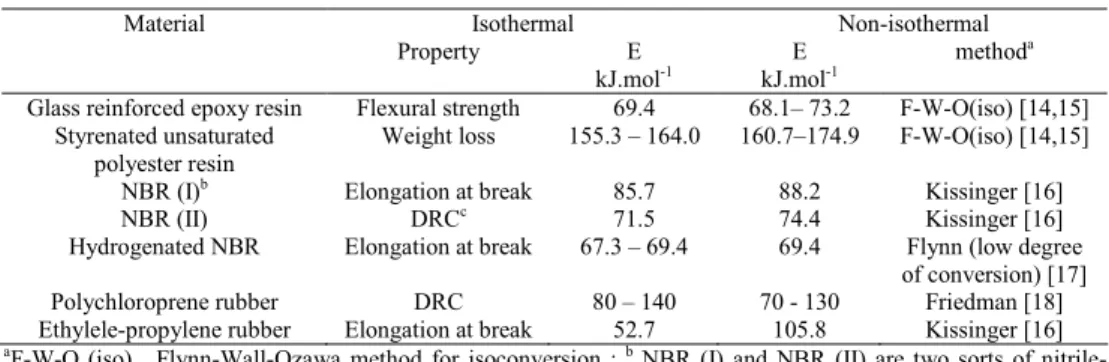
Table 1.Comparison between the isothermal and non-isothermal values of activation energy
Material Isothermal Non-isothermal Property E
kJ.mol-1
E kJ.mol-1
methoda
Glass reinforced epoxy resin Flexural strength 69.4 68.1– 73.2 F-W-O(iso) [14,15] Styrenated unsaturated
polyester resin
Weight loss 155.3 – 164.0 160.7–174.9 F-W-O(iso) [14,15]
NBR (I)b Elongation at break 85.7 88.2 Kissinger [16]
NBR (II) DRCc 71.5 74.4 Kissinger [16]
Hydrogenated NBR Elongation at break 67.3 – 69.4 69.4 Flynn (low degree of conversion) [17] Polychloroprene rubber DRC 80 – 140 70 - 130 Friedman [18] Ethylele-propylene rubber Elongation at break 52.7 105.8 Kissinger [16]
aF-W-O (iso) , Flynn-Wall-Ozawa method for isoconversion ; b NBR (I) and NBR (II) are two sorts of
nitrile-butadiene rubber; cDRC, residual deformation under constant deflection; d
E varies with the degree of degradation
The results listed in Table 1 shows that, except ethylene-propylene rubber, the two values of the activation energy (isothermal and non-isothermal ones) are in satisfactory agreement. The polychloroprene rubber exhibits the change of the activation energy with the degree of degradation. According to the previous theoretical considerations [19], in this case, in both isothermal and non-isothermal conditions the dependence of the activation energy on the degree of degradation was evaluated by differential isoconversional methods. The isothermal and non-isothermal values of the activation energy are practically in the same range and increase with the degree of degradation [11].
For the ethylene-propylene rubber, there is a discrepancy between the two values of the activation energy. This can be accounted for by taking into account that the isothermal degradation is limited by diffusion of oxygen in the polymeric material.
Tables 2 and 3 contain the values of TI for hydrogenated NBR and styrenated unsaturated polyester resin, estimated by conventional aging method (CA) (eqn. (7)) and by using the values of activation energy evaluated from thermal analysis data (TA).
Table 2. Comparison between TI values estimated by CA and TA, for different end-point criteria of
hydrogenated NBR ( property is elongation at break )
End-point aL b K TI (0C (CA) TI 0C (TA) 0.80 -14.9133 8187 57 58 0.75 -14.2909 8054 60 62 0.70 -14.1534 8119 65 66 0.65 -14.4454 8358 70 70
Table 3. Comparison between TI value, estimated by CA and TA, for different weight losses
values of styrenated unsaturated polyester resin
Weight loss % AL b K TI 0C (CA) TIa 0C (TA) TIb 0C (TA) TIc 0C (TA) 17.5 -36.8418 19087 135 137 139 139 20 -35.7003 18705 137 140 142 142 25 -36.3093 18944 144 145 148 146
a, b, cTI was evaluated using
8 . 167
=
E kJ.mol-1 (obtained from non-isothermal data) and the isotherm of thermal
One can notice a satisfactory agreement between the values of TI evaluated by CA and TA. From Table 3, it results that the TI values provided by TA are relevant to only one value of thermal endurance line slope, and change with the selection of the CA test for thermal endurance line location. However, the differences among the TI values provided by TA, obtained for the three values of Ta, are in the limits of the experimental errors.
These results support the use of the thermal analysis methods for short-time thermal endurance characterization of polymeric materials.
Conclusions
1. It was shown that thermal analysis curves (TG, DTG, DTA) can be used for planning thermally accelerated aging experiments on polymeric materials.
2. Some results concerning isothermal and non-isothermal degradation of some polymeric materials have been presented and discussed.
3. It has been shown that, in some cases, thermal analysis methods can be used for rapid thermal endurance characterization of polymeric materials.
REFERENCES
1. IEC 216 Standard, Fourth issue (1990 – 1994). 2. IEC 1026 Standard, First issue (1991).
3. D. J. Toop, IEEE Trans. El. Insul., EI – 6 (1971) 2. 4. D. J. Toop, IEEE Trans. El. Insul., EI – 7 (1972) 25.
5. J. H. Flynn, Proc. 2nd Eur. Symp. Thermal Anal., Heyden, London, 1981, p.223.
6. Standard of the First Ministry of Machine Building of China, JB 1544-76: Method of Rapid Evaluation of Thermal Endurance Properties for Electrical Insulating Impregnated Varnishes and Coated Fabrics – Thermogravimetric Point slope Method (TPS).
7. P. Budrugeac and E. Segal, Thermochim. Acta, 211 (1992) 131.
8. G. C. Montanari and Zhang Yingsuo, IEEE Trans. Dielectr. El. Insul., 1 (1994) 1026. 9. P. Budrugeac and E. Segal, J. Thermal Anal., 53 (1998) 801.
10. P. Budrugeac and S. Ciutacu, Polym. Degrd. Stabil. , 33 (1991) 377. 11. P. Budrugeac and E. Segal, J. Thermal Anal., 53 (1998) 441. 12. T. W. Dakin, AIEE Trans., 67 (1948) 113.
13. T. W. Dakin, Electrotechnology , 66 (1960) 124. 14. T. Ozawa, Bull. Chem. Soc. Japan, 38 (1965) 1881. 15. J. H. Flynn and L. A. Wall, Polym. Lett., 4 (1966) 191. 16. H. A. Kissinger, Analyt. Chem. , 29 (1959) 1702.
17. J. H. Flynn and L. A. Wall, J. Res. Natl. Bur. Stand., A70 (1966) 487. 18. H. L. Friedman, J. Polym. Sci., 6C (1965) 183.