“Risks of the Implementation Costs
Increase for the Infrastructure
Projects Co-financed by the European
Union Funds and Their Impact on the
Project Implementation”
Executive Summary
(Contract No FM2006/KF-32)
“Konsorts”, Ltd.
Address: Olīvu street 9, Riga, LV-1004
Phone: 67216793
Fax: 67216771
E-mail: [email protected]
WWW: www.konsorts.lv
“Geo Consultants”, Ltd.
Address: Olīvu street 9, Riga, LV-1004 Phone: 67627504
Fax: 67623512
E-mail: [email protected]
Contractor:
Contracting authority:
LR Ministry of Finance
Address: Smilšu street 1, Riga, LV-1919 Phone: 67095405
Fax: 67095503 E-mail: [email protected]
European Union Funds and Their Impact on the Project Implementation”
The technical assistance project for the lead institution of the Cohesion Fund in Latvia allows lessening of economic and social differences among the citizens of the European Union.
Contents
INTRODUCTION ... 3
1. THE GOALS AND TASKS OF THE STUDY ... 5
2. THE METHODOLOGY OF THE STUDY ... 5
3. ANALYTICAL SURVEY OF MACROECONOMIC AND SECTOR DEVELOPMENT ... 6
4. DEVELOPMENT TENDENCIES OF THE CONSTRUCTION SECTOR ... 7
5. CONSTRUCTION COSTS AND INDEXATION OF COSTS (EU EXPERIENCE) ... 7
6. CONSTRUCTION OF TRANSPORT AND ENVIRONMENTAL INFRASTRUCTURE: ANALYTIC SURVEY ... 8
6.1. GENERAL CHARACTERISTICS ... 8
6.2. ANALYSIS OF THE COSTS OF THE INFRASTRUCTURE PROJECTS FINANCED BY THE COHESION FUND AND ERDF ... 9
7. CONSTRUCTION OF TRANSPORT AND ENVIRONMENTAL INFRASTRUCTURE: COST FORECAST ... 11
7.1. THE FORECAST PRICE DYNAMICS FOR THE MAIN COMPONENTS OF THE RESOURCES ... 11
Labour force ... 11
Construction materials... 12
Construction machinery and mechanisms ... 12
7.2. EVALUATION OF CONSTRUCTION COSTS ... 12
8. PROPOSALS AND RECOMMENDATIONS ... 14
8.1. PROPOSALS FOR THE RISK INCREASE CONTROL ... 14
European Union Funds and Their Impact on the Project Implementation”
Introduction
The first stage of the acquisition of the European Union funds (2000-2006) revealed a range of problems that arise when implementing infrastructure projects.
The initial cause of the problems is the significant increase of construction work costs during the project implementation process.
During the stage of the pre-feasibility study the evaluation of the necessary investments is made. Depending on the investment volume funds are earmarked from the Cohesion Fund and ERDF and financing was planned from the state budget, local governments and credit resources.
During the next project implementation stages the technical parameters of the project were specified, costs were updated according to the current prices. As a result the amount of the necessary investment increases, while the EU grant remains at the previous level.
It resulted to an additional financial burden to the local financing. The lack of the available financial resources decreases the volume of the work, i.e., the project is commissioned according to its short version. On its turn due to non-fulfilment of physical indicators the amount of the allocated resources from the EU funds decreases even more.
To avoid similar problems in future, the Republic of Latvia Ministry of Finance, as well as the institutions that are responsible for the appropriate use of the European Union funds assigned to prepare “The Study on the Risks of the Implementation Costs Increase for the Infrastructure Projects Co-financed by the European Union Funds and Their Impact on the Project Implementation”.
The document merges the results of the made research and it contains four sections:
methodological, analytical, forecasting and recommendations.
In the first section the study goals, tasks and the methodology are formulated, as well as the stages of the task are specified.
The analytical section summarizes the results of the made retrospective analysis in the three main directions:
– macroeconomic situation;
– development of construction sector;
– implementation of particular infrastructure projects co-financed from the European Union funds.
The analytical macroeconomic and sector development survey refers to Latvia and to the closest neighbouring countries – countries of the Baltic Sea region, as well as to overall tendencies in the European Union countries.
The list of the analysed projects in each of the examined construction segments (transport, waste management, water supply) is agreed with the Ministry of Finance and encompasses 30 projects.
European Union Funds and Their Impact on the Project Implementation”
– justification of the preconditions of the forecasting-analytical calculations; – modelling of the price policy by the main components of the resources;
– evaluation of the possible cost increase during the implementation of the investment projects.
The final section summarizes the main conclusions of the study and it includes the recommendations to reduce the cost increase risks in the construction of infrastructure objects.
The present executive summary contains a short account of the study results in compliance with the structure of the full version of the document.
The document is prepared by the experts of “Konsorts”, Ltd. in cooperation with “Geo Consultants”, Ltd. based on the contract No FM 2006/KF-32 (13 March 2007).
European Union Funds and Their Impact on the Project Implementation”
1. The goals and tasks of the study
The main goal of the study is to provide analysis of the circumstances under which the infrastructure projects co-financed by the European Union are implemented and to identify the factors influencing them.
The specific goal is to evaluate the influence of the cost increase as well as other economic factors to the implementation of infrastructure projects and elaborate recommendations to decrease (prevent) the risks related to it.
Work tasks:
to identify and evaluate the costs items that influence the implementation of construction projects in the following construction segments: motor road construction, water supply and wastewater treatment, waste management;
to evaluate cost increase for ten infrastructure projects in each of the construction segments;
to develop proposals to decrease or prevent project implementation risks that are related to the cost increase and impact of other economic factors to the implementation of projects.
2. The methodology of the study
The research process embraces three mutually linked stages:
I. Analytical stage that includes the following parts with various degrees of detailed elaboration:
i) macroeconomic development of Latvia and the countries of the neighbouring regions;
ii) tendencies of construction sector in Latvia and other countries of the Baltic region;
iii) the implementation conditions of particular infrastructure projects in the singled out construction segments.
II. Forecasting of the main macroeconomic and sector indicators in perspective and developing the adjustment mechanisms of the corresponding construction parameters depending on their implementation terms.
III. Preparation of proposals for decrease of risks related to the cost increase in various implementation stages of infrastructure projects.
European Union Funds and Their Impact on the Project Implementation”
Figure 2-1. Principal scheme of study accomplishing
Macroeconomic Analysis
Analysis of Construction Costs Transport Water Waste
I. Cohesion projects (15)
• Transport – 5 projects
• Waste – 5 projects
• Water management - 5 projects
II. ERDF projects (15)
Forecast of Construction Costs
I. Situation Analysis II.Situation forecast III. Conclusions,
proposals
National Economy in Total Construction Sector
Foreign Indicators
Proposals for decrease of risks related to the cost increase at various implementation
stages of infrastructure
projects GDP, CPI, PPI, wages, etc.
1. Cost classification 2. Main cost items
3. Review of local construction market: demand, supply, raw materials, workforce, equipment, energy resources etc.
4. Review of foreign construction market
Project analysis
Transport Water Waste
Forecast of basic components of costs
• Cost of materials
• Wages
• Cost of equipment
Construction Price Index Forecast
Possible cost correction of unfinished projects
I. Cohesion projects II. ERDF projects
Evaluation of project costs Conjuncture and competition
of construction market Macroeconomic forecast
The following is analysed during the project research process:
cost dynamics depending on the implementation terms and stages of investment projects;
cost structure to single out the main components and the basic interconnections in each of the examined construction segments;
specific weigh of the most sensitive basic components of the cost structure in relation to the impact of external factors (price of energy resources, value of the used equipment and materials, salary of the employees, etc.).
3. Analytical survey of macroeconomic and sector development
Based on the analysis of the structure and dynamics of GDP, development rate of the sectors of the national economy, situation in the labour market, salary level, unemployment among the able-bodied population the following conclusions on the state and tendencies in the macroeconomics of Latvia are drawn:
After Latvia joined the European Union in 2004 unfavourable tendency emerge d in the dynamics of a range of macroeconomic indicators that clearly appeared in 2006 and 2007.
On the average increase of GDP for 7% per year the consumer price index reached in September 2007 10% (for 12 months). In 2006 the current account deficit constituted 21% of GDP that is for 8.5 credit points more than in 2005. The population income increases more rapidly that work productivity.
During last years almost 80% of GDP is ensured by the growth of the service sectors and the largest is the contribution of trade and commercial services. Also construction develops very rapidly; the growth of industry is more moderate.
The specific weigh of processing industry in the national economy of Latvia is markedly low (12.7%), that lags the EU average level (17.2%). The productivity level in Latvia is one of the lowest in EU.
European Union Funds and Their Impact on the Project Implementation”
Industry growth is closely linked with the opportunities of goods export growth that should be evaluated in the directions of three markets – EU, Russia and other CIS countries, as well as separately to the closest neighbouring countries – Lithuania and Estonia.
The economic development of Latvia during the next 3-4 years will depend on the operativeness and scale of the measures taken by the government to stabilize the economy.
4. Development tendencies of the construction sector
In 2006 the share of construction in the gross domestic product constituted 6.8%. For comparison, in EU-25 the average share of construction in the value added is about 6%, the highest specific weight of construction is in Spain – 11.6%.
During the last years (2001-2006) the average annual growth rate in construction was 12.1% that exceeds the average indicator in the national economy by 2.3 per cent points. In 2006 the number of the employed in construction was 9.5% of all the employed in the country.
The current construction tendencies – increase of construction volumes can be observed due to construction of infrastructure objects (roads, piping, electric lines) – national financing and foreign investment, due to repairs and reconstructions, as well as the new objects – servicing infrastructure. The proportion of repair and reconstruction works in the overall structure of construction is high – about 2/3 and only 1/3 is the construction of new objects. Engineering structure constitute 60% of all the construction works.
As of 2004 growth of average construction costs has started. In 2004 they increased by 6.4%, in 2005 – by 11.4%, but in 2006 – by 20.9%. Initially oil (bituminous concrete and transportation costs) and steel (bridge construction, transportation costs) costs were the prevailing cost increase factor. As of 2005 labour and raw materials (sand, gravel, dolomite, broken stone) costs growth had an important role. Labour costs increased most rapidly – by 44.2%.
Surplus on the side of demand has had an important part in the resources market during the last years, i.e., prices of resources have increased significantly because the offer of resources grows slower than demand and the supply-demand balance changes. Thus, the conclusion can be drawn that competition decreases both in the resources market and in the construction sector in total.
5. Construction costs and indexation of costs (EU experience)
According to the made analysis the price level in the countries of the European Union differs several times and the majority of the countries have faced the construction cost indexation problem for some or other degree.
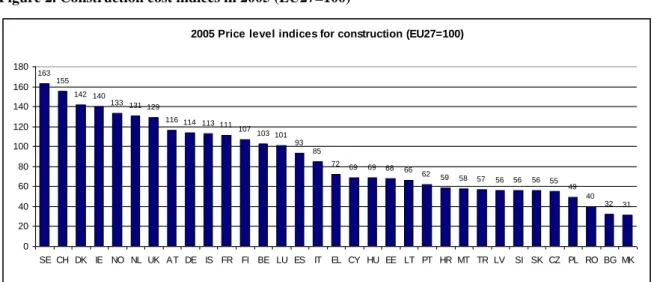
According to the data of 2005 the average price level index (PLI) for construction in 27 member countries is 80. For Latvia PLI was 56 that is lower than in Estonia (68), in Lithuania (66) and the EU average (see Figure 2).
European Union Funds and Their Impact on the Project Implementation”
Figure 2. Construction cost indices in 2005 (EU27=100)
2005 Price level indices for construction (EU27=100)
163 155 142 140 133 131 129 114 113 111 107 103 101 93 85 72 69 69 68 66 62 59 58 57 56 56 56 55 49 40 32 31 116 0 20 40 60 80 100 120 140 160 180 SE CH DK IE NO NL UK AT DE IS FR FI BE LU ES IT EL CY HU EE LT PT HR MT TR LV SI SK CZ PL RO BG MK
Source: Statistics in Focus, Eurostat, 03.09.2007.
Since in Latvia during the last years rapid construction price increase can be observed, it follows from the above that the construction prices approach the European level.
The cost indexation is used as the main mechanism of price update during the implementation process of the long term projects.
As the analysis of foreign experience testifies, regular and many-sided monitoring of construction costs would allow identifying the possible problems in time. The official cost indexation and the forecast of the respective costs decrease unjustified (too high) evaluation of investments. The preconditions for timely regulating of demand and supply in the construction market, i.e., the “overheating” or “slowdown” of the branch is not allowed.
6. Construction of Transport and Environmental infrastructure: analytic survey
6.1. General characteristics
During the research process standard objects in each of the examined construction segments were classified, the main types of construction works were identified and the cost structure by the main components (labour force, materials, equipment) was determined, the most frequently used materials were singled out and the dynamics of the respective prices was analysed.
The following were examined as standard projects: road construction, bridge construction, construction of landfills, remediation of dumpsites, projects of water supply and wastewater system.
The following are analysed by the costs of resource components: prices of oil products, steel, gravel, sand, dolomite; wages.
The prices of oil products and metal constructions are most influenced by the external factors. In Latvia during the last five years diesel prices have increased five times, prices of hardware have doubled.
European Union Funds and Their Impact on the Project Implementation”
Intense price increase of local raw materials (gravel, sand, dolomite) has been observed starting from 2005 and as at the beginning o 2007 this indicator exceeded 25%. Price increase on the local market is predetermined by:
demand exceeding supply that was caused by active growth of construction (14-16% per year),
inertia of mining industry – preparation of new sand-pits or gravel-pits in terms of time may take starting from half a year (sand) even up to 2-3 years (dolomite), higher prices of the imported raw materials.
Costs of the derived materials (bituminous concrete, cement) depend directly on the price of raw materials.
Annual average growth of labour costs in construction in the countries of the European Union is estimated 2.5-3.5%. According to the data as at the beginning of 2007 this indicator reached 39.3% in Latvia, 33% - in Lithuania, 26.3% - in Estonia.
The following should be singled out among the factors stimulating the growth of wages in construction branch in Latvia after 2005:
the demand for qualified construction experts increases rapidly, but it is not fully met;
the level of wages in Latvia is significantly lower than the European average; the mobility of workforce that is facilitated by the opening of the labour market of the “old” EU countries to the citizens of the “new” EU countries;
the process of legalization of wages (“envelope wages” were replaced by the official payment form on which taxes are imposed).
Regarding the situation in the construction market the following can be stated:
The market of the suppliers of raw materials and work performers has not been ready to react with the changes in the capacities or efficiency improvement when financing for the construction of infrastructure become available.
Unavailability of national investment programmes and/or long-term plans still deters the contractors and the manufacturers of raw materials to make larger investments in fixed assets and human resources to increase the overall capacity. The primary important reaction to the changes in demand has been increase of the price level of supply.
The slow reaction of the contractors and suppliers to the changes in demand has caused distortions in the field of competition to which the research of the Competition Council indicates. The overall level of competition during the last years has decreased relevantly.
6.2. Analysis of the costs of the infrastructure projects financed by the Cohesion Fund and ERDF
During the analysis process of actual data of 30 particular projects the following regularities were observed:
European Union Funds and Their Impact on the Project Implementation”
The project costs – the forecast (feasibility studies), planned (tender documentation and technical projects), the ones offered by the contractors (the tender result) and actual (the ones offered by the contractors + changes) differ greatly especially if more than one year has passed between the various stages of the preparation of documentation.
By planning the projects the existing or even slightly outdated prices (unit costs) are used and the historical data that actually might not serve as the only indicator are used for the cost increase. The fact that the opinion of the developers of the feasibility studies and the designers is limited by the cost increase indicators determined at the national level that should be taken into account when planning the projects, i.e., the Consultant considers the wish of the country to joint the Euro zone and meeting the Maastricht criteria related to it.
There are mistakes of physical indicators in the projects arising in the project planning process (not all the circumstances are considered or all the necessary components envisaged). The mistakes of physical indicators closely correlates with the project preparation time – the shorter the project preparation period, the biggest mistakes are committed. Comparing the projects financed by ERDF and the Cohesion Fund, it should be mentioned that the mistakes in ERDF projects are more significant since the project documentation in the previous planning period did not require the technical project of at least feasibility study in the project documentation.
It is observed that the changes of costs within the frame of the large projects financed by the Cohesion Fund that is related to the longer project implementation period that is related with larger risks to the contractors, as well as with possible less competition in the projects related to high qualifications and requirements of technical supply.
The cost items outside the contractor’s impact – fuel, bitumen, steel, as well as the contractor’s requirements are poorly forecast and they make also significant multiplier effects in the related sectors, in case of changes influencing significantly the cost levels of extractive, processing and service sectors that raise the overall project costs.
The project implementation periods are protected and there exist significant risks of cost changes. Allowing for these risks the contractors include large project risk premiums that significantly raise the overall project costs.
Lack of cost classification in the project estimates by the main components (labour resources, materials, equipment, overheads) encumbers (eliminates) the possibility to control actually the costs that would be very important in order to evaluate not only the adequacy of offer price to the planned amount, but also determine its adequacy in each particular case.
The high degree of co-operation among the contractors is stressed by forming the relations of the contractor and sub-contractor before the tenders.
To prevent the reasons of the revealed negative phenomena it is necessary to follow the following rules (principles):
To prepare the cost estimates of construction works (ask the responsible state institutions their preparation) in compliance with Republic of Latvia Cabinet of Ministers Regulation No 1014 “Regulation of the requirements of the Latvian construction norms LBN 501-06 “The Procedure by which the construction norms are set”. It would allow ensuring the “transparency” of the project costs.
European Union Funds and Their Impact on the Project Implementation”
By preparing the projects the time difference between the project implementation stages should be considered. Planning of the costs that are older than half a year should not be admitted when organizing the tenders since the planned costs would always be less than the ones offered by the builders. So, the price (cost) updating is necessary and accordingly the decrease of the work amount or planning the additional funds.
To perform regular (at least once a month) cost indexation on the particular construction sectors where the EU co-financing is used. The obtained date should be used to determine the general tendencies for the period not longer than 5 years. The cost raise forecasts should be used for the preparation of the long term (longer than one year) projects. On their turn the actually set cost raise rate should be applied for re-considering the project costs in compliance with the cost estimate items.
The size of the lots (parts) by organizing the tenders should be economically justified. The dividing or joining the tender projects influences the purchase prices offered by the construction companies. The subdividing or joining into lots by inviting the experts should be done to ensure the balance of the work volume and potentialities (capacities) avoiding the artificial cost raise.
7. Construction of transport and environmental infrastructure: cost forecast
To evaluate the possible risks by implementing the infrastructure projects the following works were performed:
sustainable growth scenario of the economy towards which the government policy is orientated is adapted to the current situation and is used like a reference-point to forecast the main macroeconomic indicators in the medium and long term perspective;
the development tendencies of the regional construction market are determined;
for each of the examined construction segments – transport, waste management, water management – standard projects are singled out by their cost structure;
work classification within the frame of the standard projects is done by singling out separately the costs of basic components (costs of materials, wages, equipment maintenance costs), as well as indirect costs;
the finance model for the evaluation of the specific weight of construction costs depending on the changes of the main factors is elaborated;
sensitivity analysis of the main factors of construction cost index;
forecast of cost index for each of the examined construction segments for the period up to 2015 as well as integral cost raise indicator for forecast of cost index for each of the examined construction segments for the period up to 2015 as well as integral cost raise indicator for overall infrastructure projects.
European Union Funds and Their Impact on the Project Implementation”
labour force partly will be compensated on the account of immigration that would promote general levelling of wage raise rate in various sectors of economy.
Construction materials
Steel The situation in the world metal markets is characterized by the rapidly growing demand for metallurgical products, modernization of production, merging of manufacturing companies that allow forecasting further price growth for steel and rolling products. Considering the existing tendencies and experts’ opinion the average steel price growth is accepted 7-10 per cent per year.
Sand, gravel, dolomite Sand, gravel and dolomite mainly are supplied by the local manufacturers (quarries of Latvia and neighbouring countries). Prime cost and the situation in market determine the purchase prices. By demand increase, the limited material manufacturing capacities caused sharp price rise of these products. Extending of supply (acquisition of new quarries, emerging of new suppliers) on the one hand and decrease of demand in housing construction segment (determined by the restrictions of mortgage loans) on the other hand gradually bring to the balanced market. In the perspective calculations the average price increase for this type of product is assumed at the level of 8-10 per cent. Higher rate is at the beginning of the forecast period when the implementation of the large infrastructure projects co-financed by the European funds is envisaged.
Cement It is expected that the sharp rise of cement prices that could be observed in 2005-2006 (more than 62%) will continue also in this year. According to the preliminary calculations the increase would constitute 25-27 percent and would refer both to the imported production and the local production. In the coming years the decrease of the growth rate is expected from 15 percent in 2008 to 5 percent in 2015.
Derv Considering the impact of the world tendencies on the oil markets, the development of alternative types of fuel (bioethanol), as well as the increase of the excise tax on derv the growth rate of derv and bitumen is forecast at the level of 5-8%.
Construction machinery and mechanisms
The costs of machinery are mainly formed by the fuel costs and machinery maintenance and purchase prices. In the offered cost classification fuel is singled out in a separate cost item. That is why by forecasting the dynamics of the costs of equipment maintenance and purchase is based on the producer price index in the European Union and CIS countries from where the construction machinery and trucks are imported.
7.2. Evaluation of construction costs
The forecasting of the construction costs of infrastructure objects is based on the indexation methodology accepted in the European Union. In compliance with this methodology the main cost components are taken into account: material, technical and labour resources as well as their proportion in the construction works.
Such approach is applied to separate construction works and in the more aggregate level when the object costs are evaluated in total.
The identification of standard infrastructure projects and classification in each of the reviewed construction segments allowed evaluating cost indices for the construction of motor roads, bridges and overpasses, municipal waste landfills, water supply and waste water systems separately for small and large projects.
European Union Funds and Their Impact on the Project Implementation”
Table 1. Transport and environmental infrastructure construction cost indices (2006-100%)
2007 2008 2009 2010 2011 2012 2013 2014 2015 Motor roads 114% 124% 133% 142% 150% 158% 165% 173% 182% Bridges 114% 127% 139% 152% 165% 179% 193% 208% 224% Waste landfills 120% 135% 149% 162% 174% 187% 199% 212% 225% Remediation of dumpsites 115% 126% 136% 146% 156% 166% 175% 185% 196% Small projects of water management 120% 134% 147% 160% 172% 184% 196% 209% 222% Large projects of water management 121% 136% 151% 164% 177% 190% 203% 216% 230% “Konsorts”, Ltd.
The made forecasting-analytical calculations allow making the following conclusions:
The cost indexation in the construction of water supply systems and waste landfills may be done according to the overall indicator since the differences in the dynamics are insignificant and may be related to inaccuracies that have arisen by evaluating factors and analysing the cost structure;
It is reasonable to perform the indexation of the remediation of dumpsites and the construction of motor roads by separate indices since the dynamics of their changes (the other preconditions being the same) is significantly lower;
Since the effectiveness indicators are sensitive regarding a range of factors, it is necessary to update their forecast regularly based on the actual available data and make the respective changes for the calculation of particular cost indices in future.
Figure 3.Construction cost indices for transport and environmental infrastructure, 2007-2015
100% 120% 140% 160% 180% 200% 220% 240% 2006 2007 2008 2009 2010 2011 2012 2013 2014 2015 Motor roads Bridges Waste landfills Remediation of dumpsites
Small projects of water managmenent Large projects of water managmenent
European Union Funds and Their Impact on the Project Implementation”
8. Proposals and recommendations
8.1. Proposals for the risk increase control
1) Planning of national and municipal resources
– Due to use of the EU structural funds and the Cohesion Fund as well as construction of large national objects (the Southern bridge in Riga etc.) the state and municipal procurements in the construction branch raise rapidly increasing pressure to the construction capacities and costs. To decrease pressure to the construction costs the planned large national and municipal projects should be included in the medium term budget and the priority succession should be determined considering the fiscal restriction of the budget and construction capacity restrictions.
– It is necessary to elaborate a national investment programme and/or long term plan in each sector of the infrastructure projects by outlining the main types of the works to be performed, the construction indicators to be achieved and the planned technologies to be used. The unavailability of such a programme still deters the contractors and manufacturers o raw materials to make larger investments in fixed assets and human resources to increase the overall capacity.
2) Factors promoting competition in the construction sector
– To increase significantly the capacity of the institutions supervising the local competition that would promote more careful evaluation of merging and adoption processes at horizontal and vertical level.
– To monitor carefully the market capacity and perform procurement procedures in compliance with it as much as possible avoiding the “overheating” or “slowdown” of the sector.
– To reduce the qualification requirements in the small objects, including waiving the contract implementation provision rights, thus promoting emerging of new local construction companies.
– For the long term perspective it is suggested to resign from indication of specific materials in the procurement procedures, determining only what the final result with specific parameters should be achieved.
– To invest in supporting such measures that are related to the implementation of innovations, including promotion of improvement of the level of education, co-operation of scientific institutes with the contractors etc.
3) Forecasting of macroeconomic and construction indicators
Until now the cash flows forecasts of the projects of ERDF and the Cohesion Fund were based on the macroeconomic indicator forecasts (GDP, consumer prices, employment, monthly average wages, household income) developed by the Ministry of Finance once a year.
As the practice and the analysis made by the Consultant show, these indicators are not sufficient to forecast objectively the volume of investment increase particularly in the construction sector. Thus, the Consultant proposes to make regular maintaining and update of the macroeconomic and construction sector indicator forecasts once a quarter. These
European Union Funds and Their Impact on the Project Implementation”
forecasts would serve as the basis for the timely re-calculation and planning of the project construction costs.
4) To ensure transparency and comparability of cost estimates by clearly singling out the items of basic costs:
– prices and costs of materials; – labour costs;
– equipment costs; – overheads; – profit.
Only by ensuring the drawing up of the costs estimates in compliance with the real situation and clearly dividing them by the cost items, it is possible to evaluate adequately the validity of cost increase as well as avoid the profit indexation.
5) Procurement dividing or joining in lots
The project analysis made by the Consultant testifies that the project dividing or joining into lots may have a significant impact on the procurement price offered by the construction companies. Thus, dividing or joining into lots by inviting experts should be done to ensure balance of work volume and the capacity of the construction company to avoid artificial cost raise.
The general recommendations are:
– Not to divide into lots uniform or very similar works (e.g., recovery of landfills) since it causes relevant cost increase;
– To divide into lots the works the content of which differs (e.g., construction of waste water treatment equipment and sewer network) since to perform specific tasks the large companies attract sub-contractors that know the particular field. In practice in this case the costs of work decrease if the “former” subcontractor is hired for implementation of the particular work.
6) Based on the developed methodology to perform the cost update and forecast from planning to construction in each stage of the project implementation:
– Pre-feasibility study (if such is envisaged); – Feasibility study;
– EU application;
– Elaboration of technical project (if such is envisaged); – Announcing of pre-construction /delivery tenders.
It is important to stress here that it would be necessary for the ministries (Ministry of Environment, Ministry of Transport and the Latvian State Roads, Ministry of Finance) to accumulate regularly the latest information on unit costs in order it would be possible in each stage of project preparation to examine how precisely the costs are determined. Here it would be important to determine that every project financed by EU (refers more to ERDF) needs feasibility study with detailed cost estimate (in the previous budget period it was possible to do without feasibility study in the road sector which resulted to the fact that cost estimates were calculated very roughly and which afterwards caused frequentative cost raise.
European Union Funds and Their Impact on the Project Implementation”
technical projects (also in the field of environment) by the municipal and state institutions are known.
Under the circumstances of high inflation, as it is seen in practice, it is not sufficient with one inflation calculation in the initial stage of the project that might be corrected prior the approval of the project budget because as a rule at least 1 year passes between the approval of the project budget and signing of the agreement. This approach might be implemented under the circumstances of stable economy when the inflation level is low and the price indexation plays insignificant part, but not under Latvia’s circumstances when the current inflation exceeds 10% per year. Therefore the Consultant considers that for the projects with the implementation time for all the stages prior the implementation of construction works longer than one year (or 0.5 year) should be reconsidered or “tables of the adjusted data” that respectively should be introduced and legalized in all the contracts.
The planned costs even if they are approved a year or even a longer period ago must be reconsidered prior announcing the construction tender or prior signing the contract if the tender procedure is longer than 0.5 year. In every case if there is a shortage of funds for the project implementation in full, the priorities should be set – what is more topical, that is financed (“not reducing the volume”), that is less topical – it is postponed.
7) To include the methodology for the indexation of the construction costs during the construction process in the construction contracts that are longer than 1 year
In compliance with the experience summarized by the Consultant there can be a range of methods how to solve these issues. It is possible to index particular cost items by particular weights (specific weight) once a year, reconsidering the value of the works that are not implemented at the moment of the cost re-considering, i.e., it is possible to apply a methodology that is similar to the one set by FIDIC. The problems of this approach are cost estimates and their objectivity – they should be precise in order to determine the specific weight of each cost in the item. Besides there will be a range of items that would not have precise enough (sufficiently representative) reporting indicators against which to measure the cost increase. It is possible to define precisely only changes of such costs that are published by the Central Statistical Bureau, i.e., fuel, pipelines, and construction costs in total. Theoretically quotations from the commodity exchange may be applied for steel and fuel.
Other method is to apply the coefficients of growth of general construction costs, inflation coefficients, labour cost coefficients or by combining them in certain proportions agreeing on it in the contract between the contracting authority and contractor.
It is important to stress here that any opportunity for cost re-considering and methodology should always appear in the tender regulation by the draft contract.
Likewise it is important to stress that it is possible to achieve theoretically that the profit is not indexed (here we are not talking about the hidden profit that is included in materials, mechanisms and labour force). Only a part of project costs may be indexed (e.g., 80-90% of the costs estimate). On its turn if the amount of profit is indicated precisely in the cost estimate, then indexation may be not applied to this volume.
The procedure of the implementation of the projects financed by the European Union funds does not allow including in the procurement contracts the item of re-considering the base price during the contract implementation, but does not forbid price indexation. If the contract is signed in compliance with FIDIC, providing for “tables of the adjusted data”, where the current prices as at the moment of the contract signing are given then in case of actual (proven) cost raise “free financial resources” should be sought for that should be accumulated timely at the level of national or municipal budget.
European Union Funds and Their Impact on the Project Implementation”
8) Not to apply FIDIC for ERAF contracts
The builders have an opinion that it is possible to decrease costs estimate even for 10% if it is known that the number of the documentation to be approved is reduced and quick payments for the performed works are ensured. That would improve flexibility of the builders in the implementation of works. Likewise regarding FIDIC the 52 days deferred payment. It is considered that it facilitates the raise of the project costs since the credit interest payments or factoring payment is “shifted to the Contracting authority” and the Contracting authority covers these Contractor’s costs.
8.2. Proposals for improvement of the legislative environment
1) To improve the criteria for determination of the tenderer’s qualification To determine the volume of the previous experience that can be compared to the subject of the tender or is even less to promote competition.
By evaluating the projects to take into consideration tax payments per one employee since according to research there are builders that distort competition by paying official minimal wages, but a part of the wages - as “envelope wages”. Theoretically this does not refer to inflation, but at any case it is a step towards arranging the business environment.
2) Stronger requirements for construction supervision
Not only the duties of the construction supervisors, but also their rights should be formalized more strictly. Currently especially in the environmental projects, the construction supervisor controls the actual work implementation, but do not take any decisions regarding disputable cases that are related to the implementation of the requirements of FIDIC regulation. Currently usually it is an compromise between the Contracting authority and the Builder, there is nothing for the construction supervisor, but to accept it.
The second important aspect is – most often the construction supervisor is not involved in the evaluation of the technical part of the builders’ proposal. If the Contracting authority trusts the Construction supervisor (signs an agreement), then it would be quite logically if the opinion of the Construction supervisor on the offered technical solutions, etc. is followed. This section should be formalized b adding, for example, “Regulation on Construction Supervision” or “Law on Public Procurement” in the section on the activities of the Procurement Commission (most logically – in both).
3) Time for tender announcing
It is important to consider an option that the tenders in the sector of infrastructure construction basically should be organized in winter (preferable December – February) that would allow the builders planning the necessary purchases of raw materials and mechanisms on time. As at the moment of developing this document the practice to purchase raw materials for the so called “spot” prices that usually are higher that they would be if the builders have duly signed a contract with the supplier of raw materials.
European Union Funds and Their Impact on the Project Implementation”
Timely developing plans of the sector also would be necessary that would allow planning timely and announcing tenders for the designing works. Likewise it is necessary to set rational due dates, since developing of technical projects and solutions in the most direct way determines the content and structure of construction volumes. Also in the work task of the technical project providing for the opportunity of the designer to index the construction costs estimate for the period (i.e., to prepare costs estimate at current and forecast prices) by the planned tender announcing date of the construction of the construction project. Likewise it is necessary to envisage adequate time for designing in order not to design in a hurry that would decrease the possibility of mistakes in the technical solutions of the projects.
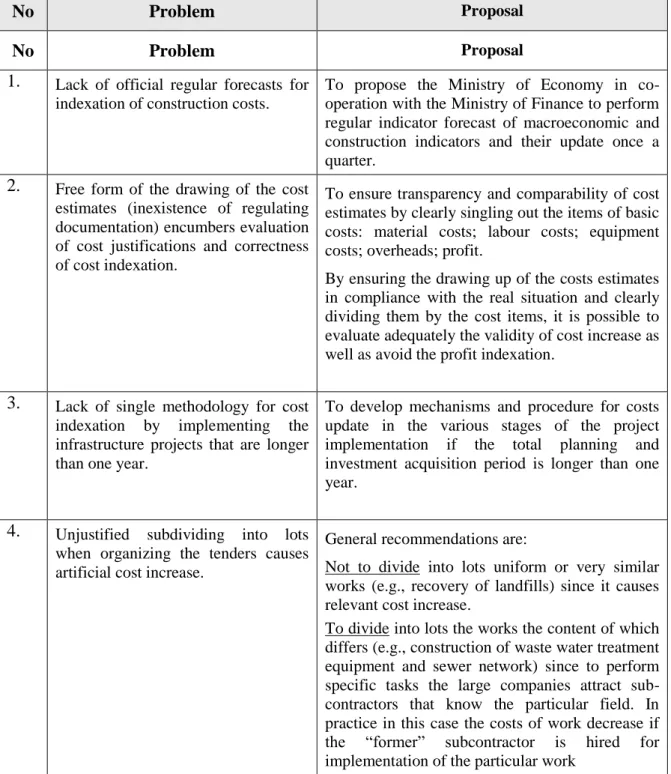
The most topical problems that appeared during the development of the study as well as the proposals of the Consultant for their solutions are summarized in the table below. Table 2. Matrix of problems and the offered solutions
No Problem Proposal
No Problem Proposal
1. Lack of official regular forecasts for
indexation of construction costs.
To propose the Ministry of Economy in co-operation with the Ministry of Finance to perform regular indicator forecast of macroeconomic and construction indicators and their update once a quarter.
2. Free form of the drawing of the cost
estimates (inexistence of regulating documentation) encumbers evaluation of cost justifications and correctness of cost indexation.
To ensure transparency and comparability of cost estimates by clearly singling out the items of basic costs: material costs; labour costs; equipment costs; overheads; profit.
By ensuring the drawing up of the costs estimates in compliance with the real situation and clearly dividing them by the cost items, it is possible to evaluate adequately the validity of cost increase as well as avoid the profit indexation.
3. Lack of single methodology for cost
indexation by implementing the infrastructure projects that are longer than one year.
To develop mechanisms and procedure for costs update in the various stages of the project implementation if the total planning and investment acquisition period is longer than one year.
4. Unjustified subdividing into lots
when organizing the tenders causes artificial cost increase.
General recommendations are:
Not to divide into lots uniform or very similar works (e.g., recovery of landfills) since it causes relevant cost increase.
To divide into lots the works the content of which differs (e.g., construction of waste water treatment equipment and sewer network) since to perform specific tasks the large companies attract sub-contractors that know the particular field. In practice in this case the costs of work decrease if the “former” subcontractor is hired for implementation of the particular work
European Union Funds and Their Impact on the Project Implementation”
5. Organizing of procurement tender
disregarding the seasonality of construction works has a negative impact on the planning of deliveries, organizing of construction works and in the result also service costs.
It would be reasonable to systemize the organizing of the construction procurement tenders, regarding winter period as a priority. Tender announcing the winter period would allow the contracting authorities more precisely planning the necessary budgets, thus including less premiums related to risk management in the proposals.
6. Non-compliance of the selection
criteria for construction companies set forth in the work task the amount of the potential tenderers thus causing the cost raise.
To improve the criteria for determining the qualification criteria of the tenderers, mainly to determine the volume of the previous experience that should be compares to the work volume of the procurement subject or even lower in order to promote competition.
8. Inadequate development rates for the
extractive and processing companies (lagging).
To determine the extractive and construction sectors as prior and consider an option to finance them and/or stimulate within the frame of the state support programme.