VEHICLE-BASED INTERSECTION MANAGEMENT WITH INTELLIGENT AGENTS
Xi Zou and David Levinson
Department of Civil Engineering, University of Minnesota 500 Pillsbury Drive SE, Minneapolis MN 55455 USA [email protected], [email protected]
ABSTRACT
Signal-based intersection management will change when vehicles with intelligent capability are available in the future. Intelligent agents embedded in vehicle software will be responsible for vehicle control and route guidance. Intersection management can be achieved through the collaboration of these agents, without a centralized control infrastructure. This research focuses on the use of distributed multi-agent systems to provide microscopic adaptive control which might reduce traffic delay and chances of collisions at intersections. A hypothesized Mobile Ad-hoc Network provides communication links to connect the agents.
KEYWORDS: Intelligent Agents, Adaptive Intersection Control
1. INTRODUCTION
Traffic signals were first installed in Cleveland in 1914, and there are more than 300,000 traffic signals now operating in North America, which control two-thirds of
roadway travel each year (FHWA 1995). While great progress has been made in terms of passenger safety and road efficiency by this technique, there are still some limitations. Improperly operated traffic signals cause excessive delays that sacrifice productivity, waste fuel, and pollute the air. While side collisions are reduced, rear-end collisions are increased at signalized intersections. Dissatisfaction with intersection operation has become a serious problem faced by traffic operators. Because the effectiveness of traffic signals depends on the ability of signal operators to obtain real-time traffic patterns, the conventional fixed-phase signal control is obviously limited. Efforts have been taken to deploy adaptive traffic control systems (e.g. UTOPIA-spot, SCOOT), which try to optimize traffic flow by recognizing the traffic demand in real-time. However, these schemes still cannot be optimal because of the rapidity with which traffic changes. These schemes are only sensitive and then responsive to local traffic changes. A global network traffic optimization cannot be achieved by simply aggregating these local controllers.
A mechanism that addresses both coordination and collaboration of traffic at both the network level and intersection level is expected to solve the problems mentioned above. Roozemond and Rogier (2000) proposed agent-based traffic control at the network level. In their framework, autonomous agents of Urban Traffic Control cooperate in pro-active traffic control with online optimization. Our research is concentrated on the intersection level of traffic control in which the behaviors of every vehicle will be adjusted according to their temporal and spatial relation and potential conflicts. We are designing a multi-layer agent model. Both the vehicles and the management will be represented by respective agents. The adjustments of vehicle behaviors will depend on the results of negotiations among the vehicle agents in question
and the collaboration of vehicle and intersection management agents. Furthermore, the intersection agents, which coordinate the vehicles at intersections, will be coordinated by a network agent that is responsible for network effectiveness. The hypothesis to be studied is that the compromise of local (intersection) and global (network) optimum can be obtained in this hierarchical agent community.
The first step of this research is concentrated on competition and collaboration of agents at the intersection level. Vehicle dynamics and route choice at an intersection are the objects of control in this level. Vehicle agents that represent the drivers’ motives and choices will be included in a transaction process. Crossing priority and travel time are the goods to be exchanged in these transactions. The modeling of agent collaboration will be illustrated below.
2. MICROSCOPIC ADAPTIVE INTERSECTION CONTROL
In intersection management, the number of accidents and total delay can be reduced if drivers/vehicles are aware of the states of other vehicles near the intersection. Current technologies enable vehicles to be aware of their own real-time states such as position, speed, and acceleration, and to communicate with other entities (vehicles or management). Furthermore, vehicles near an intersection can acquaint themselves with the overall and detailed information about other vehicles. They might evade each other efficiently, avoiding potential collisions. Unlike conventional signal control, we propose microscopic control in which the behavior of each vehicle is adjusted individually.
An intelligent agent, a concept borrowed from artificial intelligence, is a software entity in a dynamic environment. Normally, an intelligent agent should be an
autonomous, interactive and reactive entity that accomplishes its missions by competing and collaborating with other agents. In our research, we suggest an intelligent agent to represent the motivation of each driver/vehicle at an intersection. We call it a vehicle agent. The detailed modeling of vehicle agent will be discussed below. Before that, the functions of the vehicle agent must be specified.
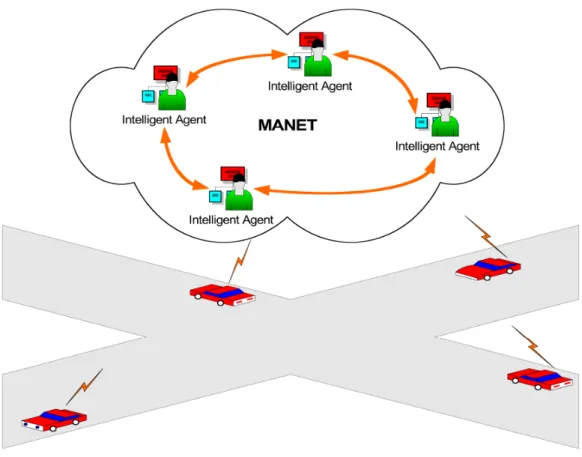
Figure 1. Framework of Multi-Agent Based Intersection Management
By integrating intelligent agents and Mobile Ad-hoc Networks (MANETs), the management of low-volume intersections can be devolved to vehicles, without requiring conventional traffic signals, or forcing extended stops at red lights. Advanced techniques such as digital maps, GPS, in-vehicle computers, and mobile wideband communications provide cornerstones of this new framework. Intelligent agents implanted in the vehicle
represent the aims of drivers and management, as shown in Figure 1. The intelligent agents embedded in vehicles know the vehicle’s destination, and adjust the vehicle’s speed up or down by using techniques like adaptive cruise control. These agents continuously announce their identity, position, speed, and acceleration to inform other equipped vehicles over a Mobile Ad-Hoc Network. (While radar and GPS can be used by one vehicle to determine another vehicle’s position and speed when it is in line-of-sight, it is insufficiently accurate to determine acceleration, or other attributes when the vehicle is obscured). Based on the position/speed/acceleration of other vehicles, a vehicle proceeds through the intersection at its current speed, slows down, or speeds up to avoid a collision. A consistent protocol used by all vehicles (based on each vehicle’s position, speed, and acceleration) determines which vehicle passes through the intersection conflict point first, both avoiding collisions and ensuring safety. Thus intersection management becomes a decentralized operation of a community of intelligent agents.
There is an argument between infrastructure-based and vehicle-based schemes. It can also be seen as the competition between centralized and decentralized control. In the infrastructure-based scheme, an intersection control system is in charge of collecting information, decision-making and signal control. Sensors such as loop detectors, sonar and microwave radar are used to collect traffic information. Volume, density and length of queue can be measured with a given accuracy. However, other information such as speed or acceleration of vehicles cannot be obtained as accurately because of the limitation of sensors and the dynamic nature of vehicle movement. In this respect, infrastructure-based scheme is a macroscopic control method where traffic flow is the
variable in the feedback control. The behaviors of vehicles that greatly affect the efficiency and safety of intersection are not fully controlled.
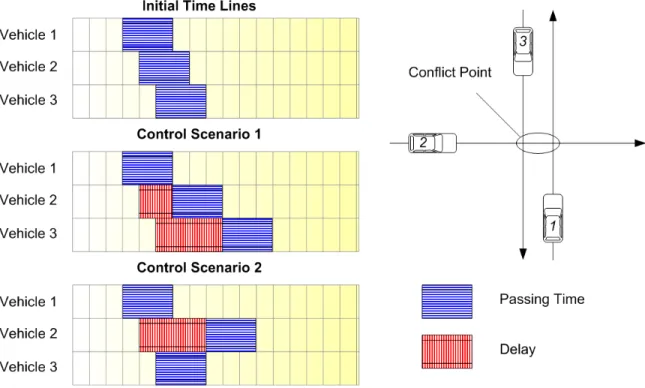
In contrast, the vehicle-based scheme is a microscopic control in which the control objective is achieved by adjusting the behavior of each vehicle individually. The information used in the vehicle-based scheme is much more than that in the infrastructure-based scheme. The control output is more detailed and complicated. For instance, instead of using stop-or-go control, more flexible passing maneuvers can be used to increase the capacity in every approach and reduce average travel delay through the collaboration among vehicle agents, as shown in Figure 2.
An advantage of the vehicle-based scheme is that it doesn’t need the installation of detectors in every intersection, no matter the location (urban, rural), type (T, Y or X), and geographic formation (flat or hilly). The saving in equipment cost is just a minor factor. The current traffic detectors can only detect limited specified information. None of them can provide a complete perspective of traffic and most of them are seriously affected by inclement weather. In contrast, the vehicle-based system grasps the entire traffic condition by collecting the real-time position, speed and expected turning of each vehicle.
In-vehicle electronics are more reliable and suffer less wear compared with conventional traffic detectors which are installed in open areas. Weather and equipment malfunction will be less serious factors that affect the robustness of the management system. Without traffic signals that suffer from improper settings, delayed maintenance, and malfunctions, the proposed framework takes advantage of the distributed sensing and
computing resources in vehicles, which makes the system more robust, flexible and economical.
Figure 2. A Simple Example of Multi-agent Collaboration
(In scenario 1, vehicles evade collisions by decelerating one by one; in scenario 2, vehicle agents find a better passing strategy that reduces total delay.)
Another argument that supports a vehicle-based scheme is that the expectation in the future is every vehicle/driver will be capable of communicating with any other vehicle/drivers nearby and forming an ad-hoc network. The proposed advanced traffic management will become a software function that is implanted into the vehicle information system. Since the communication could be a “default” device, there is no additional expense for the dedicated communication equipment of traffic management. Or the expense could be similar to the proportion of adding a Bluetooth module to a potable computer. Every vehicle itself becomes a natural traffic sensor that just costs a
small amount in electronics. The traffic information will hold a relatively small part of the total bandwidth. So the traffic management related expense will be a marginal cost of total communication cost. In other words, a part of traffic management will become a software function that is implanted into the vehicle information system. The entity of this function is the vehicle agent that forms the vehicle community around a specific intersection.
3. MODELING INTELLIGENT AGENTS
We define three types of agents that work in the different level of this hierarchical system:
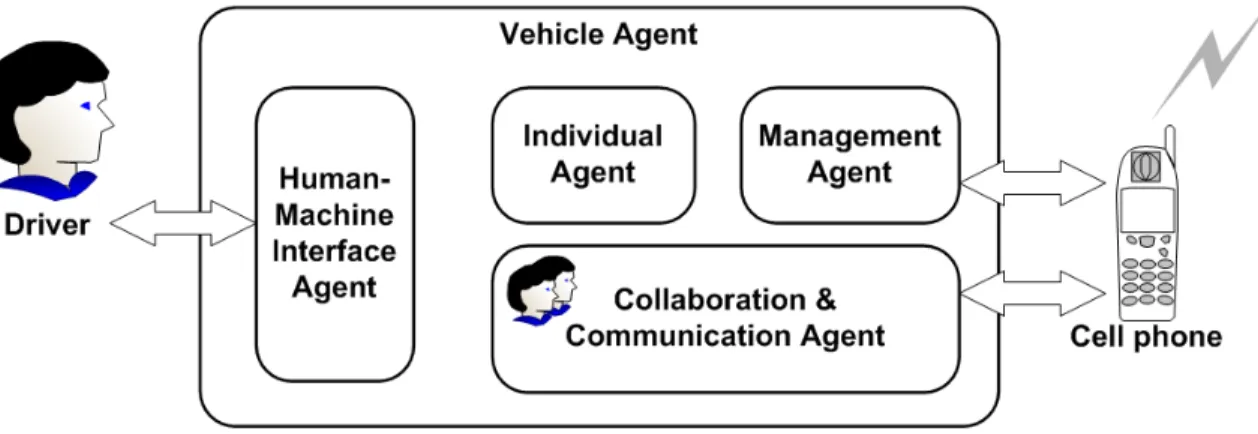
(1) Network agents (NAs) represent the motivation of network manager; (2) Intersection agents (IAs) represent the motivation of intersection control; (3) Vehicle agents (VAs) represent the drivers’ motivation and vehicle dynamics. As mentioned before, modeling of vehicle agent should be done in the first step. The functions of VA will include: (1) interacting with driver to obtain the driver’s motivation; (2) interacting with other VAs in collaboration; (3) interacting with IA; (4) providing communication service. These functions are summarized in Figure 3.
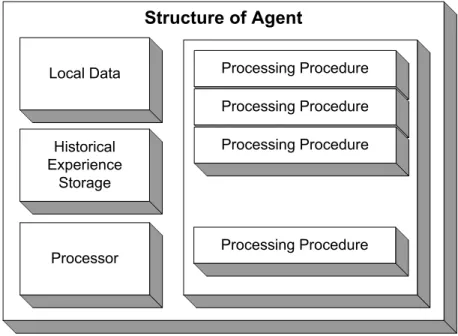
The application of agent needs a formal semantic description of its structure. This includes several data sets. The private data set will include the driver’s motivation and vehicle dynamics which are used to determine potential conflicts. Historical Experience Knowledge-base is a set of prior decisions and historical data which helps to enhance the adaptability of agent. Process procedures are the core of agents. They define the behavior set of an agent and are the only interface interacting with other agents. The processor provides the computational capability which, though being emphasized in other distributing computation system, is not a critical problem in this physically separated system. Figure 4 describes the structure of an agent.
Structure of Agent Historical Experience Storage Local Data Processor Processing Procedure Processing Procedure Processing Procedure Processing Procedure
Figure 4. Structure of Agent
4. MODELING AGENT COLLABORATION
The collaboration of agents in an intersection includes group cooperation and group competition. Vehicles from the same approach form a group naturally. Vehicle groups from different approaches compete with each other to obtain higher throughput.
At the same time, the first vehicles in each approach face a direct conflict. This is lower level of competition but its result will affect the output of group competition and cooperation. This is a very complex dynamic system. To probe the solution that optimize the total throughput and minimizes total delay, we first decompose the problem to some small group competition problems.
Single collision avoidance could be a simple maneuver of vehicles near the intersection. For instance, in the case that two vehicles are approaching a conflict point and one of them will arrive half second early, if the other vehicle is aware of the position and speed of the former one, it will decelerate automatically to avoid collisions.
This function can also be accomplished by an adaptive signal. Conventionally, traffic signal control can give notice to one vehicle of the approach of the other by changing the signal to red. The disadvantage is that the vehicle that must slow down doesn’t know the amplitude of deceleration that is needed to avoid collisions. So it will prepare to stop outside the conflict area. Travel time is unnecessarily wasted in the stop-and-go process. On the other hand, if there is communication between the traffic signal and vehicles, vehicles can be aware of the necessary deceleration so that travel time can be saved. A disadvantage is that the reactions of vehicles are always passive – responding to other vehicles presence just by deceleration.
Single collision avoidance cannot take advantage of the correlation among traffic streams because the only information a single vehicle can use is about another vehicle that will arrive at the conflict point immediately before this vehicle does. A collaboration scheme can solve this problem. Figure 2 shows a simple situation in which the collaboration scheme works better. Vehicle 1, 2 and 3 from south, west and north bound
will pass an intersection with overlapped time. According to simple collision avoidance scheme, vehicle 2 and 3 will decelerate sequentially so that vehicle 2 will be the second and vehicle 3 the third passing the conflict point. In the collaboration scheme, vehicles can find another way of adjusting priorities. For instance, vehicles without conflict, i.e. vehicle 1 and 3, can pass the point at the same time, as shown in Figure 5, reducing total delay. Vehicle 1 Vehicle 2 Vehicle 3 Conflict Area Vehicle 4 Vehicle 1 Vehicle 2 Vehicle 3 Vehicle 4 Vehicle 1 Vehicle 2 Vehicle 3 Vehicle 4
EB-WB Passing Time
Delay SB-NB Passing Time 3 2 1 4 Uncontrolled Situation Control 1 Control 2
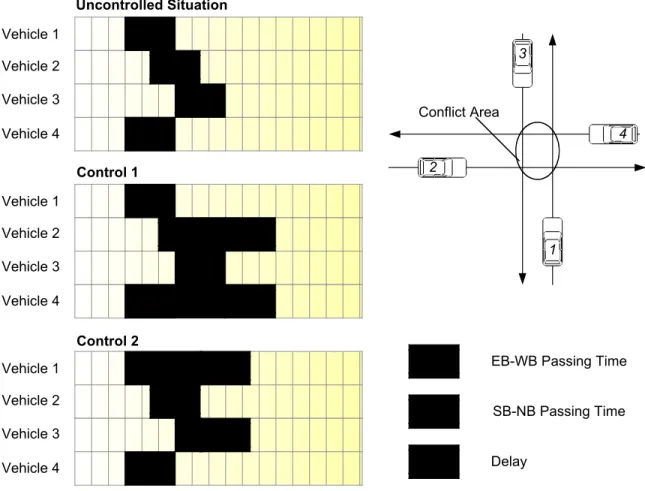
Figure 5. Simple Situation of Two-Phase Traffic Needing Collaboration (II)
In Figure 5, another example is shown in which four vehicles are from four approaches respectively. The leading vehicles from two approaches, north bound and west bound will arrive at the same time. Two possible controls are shown. In the first
one, southbound and northbound vehicles obtain priority. In the second one, eastbound and westbound vehicles obtain priority. It is obvious that the second control generates less total delay.
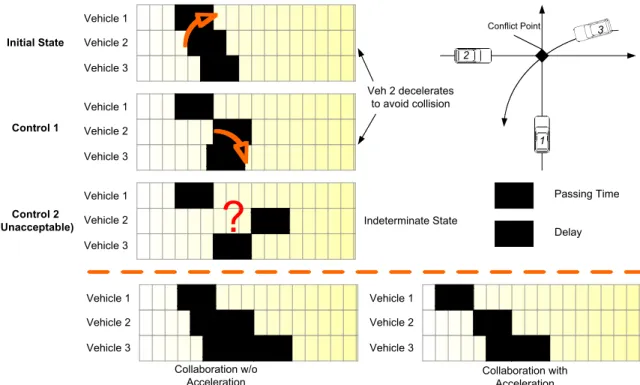
The upper part of Figure 6 shows another case in which collaboration helps to obtain robust control output. In this case, three vehicles will conflict in a point. Vehicle 2 and 3 should decelerate accordingly. But in reality, the difference in vehicle dynamics will affect the result. For instance, if vehicle 2 decelerates faster than vehicle 3, it may cause a situation in which vehicle 3 arrives at the point earlier. Vehicle 2 could accept this “priority” by adjusting further its speed. At the same time, the vehicle prior to vehicle 3 becomes vehicle 1. This priority exchange happened in the dynamic procedure to cause an indeterminate control output that is unacceptable in management. In the collaboration scheme, this problem can be easily solved by assigning constant adjustments to members in a cooperation group. Initial State Control 1 Control 2 (Unacceptable) Vehicle 1 Vehicle 2 Vehicle 3 Vehicle 1 Vehicle 2 Vehicle 3 Vehicle 1 Vehicle 2 Vehicle 3 Conflict Point 1 2 3
?
Vehicle 1 Vehicle 2 Vehicle 3 Vehicle 1 Vehicle 2 Vehicle 3 Passing Time Delay Veh 2 decelerates to avoid collision Indeterminate State Collaboration w/oAcceleration Collaboration withAcceleration
If vehicles are equipped with ACC, the capability of automated acceleration is an important advantage that further supports the collaboration scheme. Consider a situation in which three vehicles will arrive at a conflict point at the same time. Obviously a better solution is that one vehicle accelerates, one decelerates and the other one keep constant speed, comparing to the case that two vehicles decelerate. Acceleration is an active
behavior that cannot be controlled by traffic signal. The lower part of Figure 6 compares the scenarios with and without vehicle acceleration. It is obvious that the one with acceleration can greatly reduce the total delay.
5. IMPLICATIONS OF THE AGENT-BASED INTERSECTION MANAGEMENT
Safety
Significant improvement in safety can be expected in a scenario where drivers are aware of the presence of others. In places where visibility is adversely affected by environmental factors (geographical profile or weather) or where management infrastructure is not available or in malfunction, an infrastructure-independent system is preferable. Depending on the communication among vehicles in the same approach, rear-end collision, which are prevailed in current signalized intersection, can be greatly reduced, if not eliminated. Extra improvement can be obtained when pedestrians and cyclists are equipped with communication units, e.g. cellular phone or portable computers. Though in need of legislative and civil right authority, agent-based system is
capable of limiting illegal, irrational or dangerous behaviors of drivers and providing further protections to pedestrians and cyclists.
Capacity
The improvement in capacity is expected but the conclusion cannot be easily drawn. Congestion will still exist. Vehicles adjust their speeds and affect others behind them. Collaboration among the vehicles that are closest to the intersection is not necessarily the optimal solution of traffic control. Besides, the relation between a sequence of least delay control and the optimal traffic control which generates least total delays is waiting to be illustrated. To reduce the average travel delay of all vehicles passing the intersection, vehicles further behind the leading vehicles on each approach should also be considered.
Furthermore, besides the average travel time, equity among drivers in different approaches should also be considered in the collaboration scheme. This could be a very complex problem that has not ever been probed. The framework to analyze this problem is still under developed in which the competition of priority and travel time is converted to a transaction process. In this special discrete event dynamic system, the conventional queuing theory cannot be directly applied. The probability that a user (vehicle) obtains service (passing) will be determined through the coordination among all users. The methodology in coordination is the key of this system which eventually determines its effectiveness. We can quantify the improvement in capacity only when the framework is well developed.
Emissions
Vehicles generate more emissions in stop-and-go driving. Federal Highway Administration estimated that “idling and stop-and-go traffic costs motorists 753 million gallons of gasoline a year, or $1,194 per driver in wasted fuel and time” (National safety Concil 2003) Congestion may still exist even after advanced techniques are applied. But as we illustrated above, the agent-based intersection control system has the capability of reducing the number of stop-and-go conditions. Vehicles don’t have to change their speeds aimlessly and may obtain more chance to keep their speeds in the optimal range in emission.
Economy
In a first-come-first-serve system, vehicles with the least time before approaching the intersection should have priority. But this speculation will be criticized when we consider (1) commercial vehicles with longer passing time; (2) pedestrians and cyclists who need much more passing time and are vulnerable in accidents; (3) transit which represents the aggregated utility of all riders; (4) emergency vehicles which have priority over all other vehicles. The first-come-first-go ethic that we currently use to determine priorities exclusively will not be applicable. The criteria to determine priorities are many. Priority of a single entity can be changed or even exchanged. A businessman who wants to get to the airport for a million dollar business trip probably is willing to pay $50 for passing priorities on congested local road. People who encounter this businessman in intersections probably would let him go first if compensated, if they themselves are not in a hurry. Other users in the traffic system who are further affected by this event should
also be compensated. By considering all these factors in detail, we can create an economy of priorities and travel time on the road that benefits travelers and obtains a chance to realize equity while keeping or even improving system efficiency. Further research in this direction by considering other externalities should be interesting.
6. CONCLUSIONS AND FUTURE WORK
A microscopic-level adaptive intersection control that can adjust the maneuvers of vehicles is capable of increasing vehicle throughput, reducing travel time delay and minimizing collisions. Intelligent agents representing drivers, intersection controllers and network managers can collaborate at different levels to achieve compromises that enhance the efficiency and equity of the traffic system. The proposed framework transforms traffic management and vehicle control from a hardware-concentrated system to a software-concentrated one. Traffic signals become adjunct components. Eventually it will become a part of the intelligent traffic management system.
We need to develop a detailed semantic description of agents for the application of traffic management and vehicle control. The economic relationship among competitive agents should be modeled properly so that both the equity among drivers and the efficiency of traffic system do not deteriorate. Experimentation with the proposed system will be done first in simulation.
Though this scenario may not be exist in the near future, it is a worthwhile study. The telecommunication, intelligent agent, mobile ad-hoc network and distributed computing techniques are enjoying rapid development and provide higher possibilities to realize automated transport system than any other time in history. We have seen the
demonstration of automated highway systems (AHS). The problem emerges soon about how drivers adapt to the congested local road after they exit from AHS. The eventual answer will be that an intelligent transport system should be ubiquitous. This research is an initial step to sketch the prospective non-freeway ITS.
REFERENCES
Chatziioanou, A., Lecture notes, Chap. 8 Intersection Control, http://ceenve.ceng.calpoly.edu/chatziioanou/ce421/, accessed by Xi Zou in May 20, 2002.
FHWA (1995), Improving Traffic Signal Operations: A Primer, U.S. Department of Transportation, Federal Highway Administration (FHWA), Publication No. FHWA-SA-D6-007.
FHWA (2003) Transportation Air Quality - Selected Facts and Figures, http://www.fhwa.dot.gov/environment/aqfactbk/factbk13.htm, accessed by Xi Zou in Jan. 2003.
He, Yan-xiang and Chen, Xin-meng, (2001) Design and Application of Agent and Multi-agent system, Wuhan University Press, June.
Khisty, C.J. and Lall, B. K. (1998). Transportation Engineering, Chapter 8: Intersection Control and Design, Prentice Hall Inc.
National safety concil (2003) http://www.nsc.org/ehc/mobile/mse_fs.htm, accessed by Xi Zou in Jan. 2003.
Newman, A.J., Frazier. T.M., (2000). Intelligent vehicle and roadway system (IVRS), Alphatech, Inc. TASK Kickoff Meeting, October 3-5, http://www.task-program.org/REF_IVRbrief.ppt, access by Xi Zou in May 22, 2002.
Roozemond, D.A. and Rogier J. (2000) Agent Controlled Traffic Lights, ESIT 2000, Germany, 14-15 September.
Russell, S. and Norvig, P. (1995) Artificial Intelligence: a Modern Approach, Prentice Hall.
Sukthankar, R., Baluja, S. J., Hancock, (1998). Multiple Adaptive Agents for Tactical Driving. International Journal of AI, 9(1).
Sastry S.S. (1998). Overview of ONR UCAV Project, ONR Project Review, Electronics Research Laboratory, University of Berkeley, July, 21, http://robotics.eecs.berkeley.edu/~sastry/ppt.files/ONR/prog-rep.ppt, access by Xi Zou in May 22, 2002.
Today in Science History (2002). Today in Science History webpage:
http://www.todayinsci.com/cgi-bin/indexpage.pl?http://www.todayinsci.com/8/8_05.htm, access by Xi Zou in June 10.
Wooldridge, M. and Rao, A. (1999) Foundations of Rational Agents, Kluwer Academic Publishers.