1
By NASA [Public domain], via Wikimedia Commons
E-learning Appraisal Report
University of Ghana
College of Health Sciences
Ghana
2
Acknowledgements
First and foremost the authors wish to thank Rita Quist-Therson for her great hospitality and
coordination of the site visit to the College of Health Sciences (CHS) at University of Ghana (UG) from 21 to 22 February, 2013. Our thanks go to The Provost at CHS, Professor Aaron Lawson, for welcoming us. Also, thanks to Professor Richard Adanu for the closing meeting during the site visit. The vast number of dedicated UG faculty, employees and students who participated in interviews and who brought
insightful information for the appraisal (in random order): Dr. Richmond Aryeetey, Dr. Philip Adongo, Webmaster Patrick Kuti, Multimedia Specialist Chris Andrew, College Registrar Margaret Lartey, Adziri Sackey, Dr. Bamenla Goka, Dr. Cathrine Segbefia, Dr. C. Oduro-Boatey, Dr. Samuel Antwi Oppong, Professor Samuel A. Obed, Dr. Nii Armah Adu-Aryee, Dr. Sandra Hewlett, Tom A. Ndanu, Barfi-Adomako Owusu, Samuel Bentil Aggrey, Francis Awuye-Kpobi, Emefa Modey, Deda Ogum Alangea and Baaba da-Costa Vroom. Finally we wish to address a special thank you to Kathleen Ludewig Omollo from the University of Michigan who has previously worked with CHS-UG on a project that relates to this appraisal and who generously passed on her input and suggestions.
Authors
Søren Larsen E-learning Consultant
IT Learning Center, Faculty of Science, University of Copenhagen E-mail: [email protected]
Michael Rytkønen
Project Manager/Consultant
IT Learning Center, Faculty of Science, University of Copenhagen E-mail: [email protected]
Contributors
Rita Quist-Therson
BSU Programme Coordinator E-mail: [email protected] Peter Furu
Senior Adviser
Department of International Health, Immunology and Microbiology, University of Copenhagen E-mail: [email protected]
Henrik Bregnhøj E-learning Consultant
Department of International Health, Immunology and Microbiology, University of Copenhagen E-mail: [email protected]
3
Table of contents
Acknowledgements ... 2 Authors ... 2 Contributors ... 2 Table of contents ... 3 Executive summary ... 4 Introduction ... 6 Objective ... 6 Background ... 7 About e-learning ... 7 Implementing e-learning ... 7Approach to e-learning implementation ... 8
Culture and barriers to change ... 9
Organisational structures ... 9
Quality assurance ... 10
Financial management ... 11
Planning for change ... 11
Methodological approach for appraisal analysis ... 14
Activities ... 14
Appraisal analysis findings ... 15
Preliminary literature review ... 15
ICT infrastructure analysis ... 15
E-learning feasibility study ... 15
Developing an E-learning strategy for public universities in Ghana... 16
Findings from appraisal site visit ... 18
Management support, policies and strategy ... 18
PhD students’ attitude towards e-learning ... 19
E-learning experiences to build upon ... 20
ICT infrastructure and LMS ... 23
Summary of findings ... 28
Recommendations ... 29
Create a supportive organisational environment ... 30
Establish a e-learning committee ... 30
Make a vision and strategy for e-learning at CHS-UG ... 30
Establish governing structures ... 31
Plan the implementation process ... 32
Build an e-learning support team ... 33
Conduct pilot courses to identify a good, specific and sustainable practice for implementing e-learning ... 34
Encapsulate and communicate a clear goal for implementing e-learning ... 35
Think pedagogy before technology ... 35
Plan online learning activities that integrate with the face-to-face teaching ... 36
Ensure the requirements related to ICT infrastructure and LMS ... 37
Appendix A: List of respondents in interviews ... 38
Appendix B: Interview guide - PhD students at CHS-UG ... 39
Appendix C: Interview guide - key member of management at CHS-UG ... 41
Appendix D: Interview guide - participants from The Open Educational Resources project ... 42
Appendix E: Interview guide - UG teacher(s) ... 44
Appendix F: Interview guide – Key IT, web and technical experts ... 45
4
Executive summary
The appraisal was conducted to assess the existing e-learning environment within College of Health Sciences at University of Ghana (CHS-UG) and to determine the feasibility and ways of implementing e-learning methods in PhD training in the future. The appraisal was part of the BSU phase one and the budget was DKK 32.113,00 (south) and DKK 46.800,00 (north).
The report contains a background chapter presenting the authors´ assumptions of key elements when conducting and implementing quality e-learning; a chapter presenting the findings from the appraisal site visit; as well as a chapter with recommendations. The findings chapter covers: a preliminary
literature review, findings related to management support, policies and strategy; information about PhD students’ attitude towards e-learning; identified e-learning experiences to build future activities upon, and ICT infrastructural data. Based on these findings, the report gives recommendations for creating a solid foundation for a wider integration of learning technologies in the teaching at CHS-UG and primarily activities that can be implemented within short-term.
The status at CHS-UG is as follows:
UG has been working with e-learning since the millennium and a policy paper on technology-mediated courses and programmes is about to be ratified. UG has expanded the ICT services, and improved the lectures’ and students’ access to the internet. The technical infrastructure is sufficient to support e-learning even though power cuts occur frequently, the bandwidth is rather limited and the availability of Learning Management System (LMS1), could be improved. Especially the internet connection at the Korle Bu campus is unreliable. Nevertheless, it is recommendable to provide offline access to the e-learning material by making material and e-learning elements downloadable and accessible through the local intranet at local servers.
UG has a competent team of IT staff that has the skills to install, expand and maintain the LMS, and the Open Educational Resource (OER) Office has valuable experiences and competences in production and structuring of e-learning material, which advantageously can be used as a base in future e-learning initiatives. The CHS is currently implementing their own LMS called ULTRA, while UG is about to replace the university-wide LMS, KEWL, with a new Sakai LMS. Sakai is superior to ULTRA in terms of features. Consequently the authors recommend that the Sakai LMS is the platform for any future e-learning pilot courses at UG-CHS.
The students at CHS-UG have no experiences with e-learning as an integrated and coherent part of the curriculum, but have a positive attitude, and they are interested in, and motivated to explore new
1 The LMS is the online platform for the administration, documentation, tracking, reporting and delivery of e-learning based education.
5
teaching forms such as e-learning. The flexibility that the media provides is seen as a great asset by students, teachers and managers.
Although ICT policies are in place they are not backed by solid and financed plans for implementation. Lack of time and formal incentive structures are mentioned as major reasons for teachers not
implementing more e-learning in the teaching. The fact that many of the challenges identified back in 20062 are still highly relevant indicates conflicting interest when it comes to implementation of e-learning at UG. The suggested steps for implementation of e-e-learning, identified in 2006, are still valid and in line with the recommendations in the literature and the assumptions of this appraisal report. Three recommendations are identified with an eye for BSUs limited mandate and budget. The focus is on creating a solid foundation for a wider integration of learning technologies in the teaching at CHS-UG and primarily on activities that can be implemented within short-term. The results of the suggested activities should go into the design of any long-term initiatives. The recommendations are thought as parallel activities:
1. Create a supportive organisational environment a. Establish a e-learning committee
b. Make a vision and strategy for e-learning at CHS-UG c. Establish governing structures
d. Plan the implementation process 2. Build an e-learning support team
3. Conduct pilot courses to identify a good, specific and sustainable practices for implementing e-learning
a. Encapsulate and communicate a clear goal for implementing e-learning b. Think pedagogy before technology
c. Plan online learning activities that integrate with the face-to-face teaching d. Ensure the requirements related to ICT infrastructure and LMS
2 Isaiah T. Awidi (2008): Developing an E-learning Strategy for Public Universities in Ghana. Educause Quaterly 2008 (2)
6
Introduction
The Building Stronger Universities (BSU) initiative focuses on strengthening research capacities, educational capacities and dissemination of research results3.
The overall development objective for the College of Health Sciences, University of Ghana (CHS-UG), as a partner in this first phase of the BSU collaboration is to “Enhance capacity to promote health through research education, research and knowledge management as a vehicle for economic and social development”, with the specific objective to “Strengthen the research education programme, the research environment, and the management and administrative capacity”4.
CHS-UG comprises of six schools and one research institute, and offers five PhD programmes in Public Health, Medical Biochemistry, Microbiology, Pathology and Pharmacology. PhD programmes at CHS-UG have one year compulsory course work and is furthermore mainly based on research. The CHS have been the first college at UG to develop generic PhD courses and currently there is five BSU funded PhD courses in the pipeline. In this context, e-learning is seen as an efficient tool to boost the quality of the teaching and provide flexible access to the learning material for teachers and students. In addition learning make it easier to invite online guest teachers to participate in the courses. Exactly how e-learning can be used to support the PhD education at CHS-UG have not been discussed in detail, but one idea is to compress the courses into an intensive one week course, with use of online material for individual preparation outside the scheduled face-to-face teaching hours. Hopefully this report will inform the future e-learning endeavours at CHS-UG.
Objective
The objective of this assignment is to assess the existing e-learning environment at CHS-UG and to determine feasible ways of implementing e-learning in PhD training.
3
Building Stronger Universities in Developing Countries – Partnerships for Change,:
http://www.dkuni.dk/~/media/Files/Publikationer/Building%20stronger%20universities.ashx
4 BSU Inception Report,: http://www.dkuni.dk/Internationalt/~/media/Files/Internationalt/BSU/Inception report
7
Background
This chapter gives an underlying definition and understanding of e-learning and accounts for the authors’ assumptions of key elements when conducting and implementing quality e-learning.
About e-learning
The term learning is ambiguous and has different meanings to different people. Tony Bates defines e-learning broadly as “all computer and Internet-based activities that support teaching and learning – both on-campus and at a distance”5. With this wide definition we focus on the full array of potentials that e-learning has to offer. In this context e-e-learning is understood as a continuum extending from classroom aids to fully online distance education as illustrated in figure 1.
Figure 1: The continuum of e-learning. From Bates and Poole (2003)6
Classroom aids refer to teachers using computers during class, and students using online content to supplement face teaching. In mixed mode (or blended mode as it is often referred to) face-to-face time is replaced with online learning activities but not entirely abolished. E.g. students might use online learning activities to prepare for more intensive courses. In distance education mode the course is delivered fully online with no face-to-face activities, following a specific pedagogical model.
Implementing e-learning
This section presents key elements for implementing and managing e-learning in higher education, based on the literature mentioned in the footnotes below78910.
5
Bates (2008). What is e-learning? Retrieved March 11, 2013: http://www.tonybates.ca/2008/07/07/what-is-e-learning/
6 Bates, A. W., & Poole, G. (2003). Effective Teaching with Technology in Higher Education: Foundations for Success. Jossey-Bass, San Francisco.
8
Approach to e-learning implementation
E-learning has the potential to increase universities competiveness by providing a flexible and effective learning experience, with an efficient use of the organisational resources. Therefore, e-learning has a great potential to support universities in meeting the challenges they face in a globalised world with rapid changing demographics, economies, technologies and societies.
A successful integration of e-learning builds on a balanced approach and should in addition to the academic content focus equally on the three elements: pedagogics, organisation and technology. Equal attention should be given to how we use technology to increase the quality of the student learning, how e-learning activities are funded, governed and supported, as well as the sustainability of the
technological choices we make.
There is no single best way to implement e-learning. E-learning consists of many interrelated aspects, and universities are complex organisations. This calls for a holistic approach, adjusted to the specific context, consisting of top-down strategies, such as visions, reward and incentive structures, as well as strategic plans that work together with bottom-up initiatives, such as pilot projects, workshops, networks and learning communities, training, and involvement of students, staff, and teachers in the decision making process as much as possible.
Innovation does normally occur as bottom-up processes, as emergent strategies to provide specific solutions. This is also the case in higher education, where innovative use of technology in teaching often takes place as specific solutions, developed by enthusiastic teachers. It has also shown that innovation in higher education does not diffuse as innovation normally does in organisations; as an S-shaped growth curve towards saturation and full deployment11. At universities, it takes much longer time for innovation in teaching to diffuse. Key reasons are overburdened teachers and lack of incentives to focus on
education development in general. This dynamic is a strong argument for applying a combination of top-down and bottom-up strategies, to create a supportive environment that drives and pushes the process from the top, and stimulate individual emergent innovation at the ground in the same time.
7
A.W. (Tony) Bates and A. Sangrà (2011). Managing Technology in Higher Education: Strategies for Transforming Teaching and Learning. Jossey-Bass, San Francisco
8 Philip M. Uys, Paul Nleya and G.B. Molelu (2004). Technological Innovation and Management Strategies for Higher Education in Africa: Harmonizing Reality and Idealism. Education Media International, 41:1 – ICTs in Education in Eastern Europe.
9
Kotter, J.P. (1996): Leading Change, Harvard Business School Press 10
A comprehensive list of other relevant resources on the area can be retrieved on this page:
http://www.batesandsangra.ca/resources/
9
Culture and barriers to change
The main reason for slow integration of e-learning in the Higher Education sector is the existing culture and systemic barriers to change. Universities are conservative institutions and inherently reluctant to changes. Most academic staff has strong feelings for traditional teaching practice and methods, the university career system favours research over teaching, and strong hierarchies hinder new teaching practice and methods to be accepted and diffuse freely in the organisation.
Training and information is the most efficient way to deal with barriers to change. With the introduction of new technology, methods and pedagogics, the teachers’ role is changing. This pushes obviously some teachers out of their comfort zone, and training and information that enable the teachers to use the new technology are needed. Systematic training is the most efficient way to transform the teaching practice at a wider scale.
But not only teachers need training. Senior and middle administrators and managers play an important role in controlling financial resources and IT systems and the decision making process. This group should therefore have a solid understanding of relevant factors for successful implementation of e-learning, and especially how to establish coherence between policy goals and practical realisation. Basically, they should be able to ask the right questions before making decisions. Orientation workshops, conferences, and committees for discussing e-learning issues, are ways to deal with training of managers and
administrators.
Strict top-down reforms of the teaching practice have shown to fail due to lack of ownership among the teachers. It is therefore suggested to build educational reforms and implementation of e-learning on solid educational goals, rather than administrative or technical goals. To ensure this focus, the implementation process should emanate from the academic plan, where specific goals such as
“increasing the quality in teaching”, “increasing innovation in teaching”, “reducing the cost per student”, “increasing the number of students”, “increasing the access for disadvantages learners” etc. should drive and guide how e-learning is implemented in the most feasible way, adjusted to the specific context and desired goals at programme and course level. In this way e-learning becomes a lever for a higher educational goal, and not a detached goal in itself. Strategies, action plans, outcomes, and performance indicators should be developed for the defined academic goals, and should be supported by specific and realistic budgets.
Organisational structures
Successful implementation of e-learning requires a clear governance structure. Administrative and educational technology is often implemented ad-hoc and the governance structure is therefore blurry with parallel committees and units, governing and managing the technology. As the university´s cores systems and services are influenced by interlinked technology, decisions made in one area can have unintended consequences on others. This setup makes it impossible to move the institution in a desired direction, as the management may not have the necessary foundation to take correct decisions. Strong
10
leadership is therefore not enough for a successful implementation of e-learning, but requires positive engagement from all key stakeholders. It is suggested that a technology committee is established, represented by; Provost of academic affairs (chair), Provost of research, Head of administration, Head of IT, Director(s) of teaching, learning, technology unit(s), and academic representatives. This committee should have the mandate to prepare policies and strategic goals, to approve projects and allocate funding, and to coordinate the overall governance of the technological services, including learning technologies. The committee should be permanent and assisted by temporary subcommittees, working groups, and task forces, taking care of ad-hoc projects and specific tasks. The committee should develop a rolling three year plan for e-learning, adjusted yearly. The plan should be integrated with the
universities’ overall strategic and academic plans and drive and guide the budget allocation. Together with the faculties and departments, the committee should develop and adjust the academic and programme plans, and take the necessary decisions and fund projects that enable the implementation of e-learning at programme and course level.
Permanent operational units, such as an IT department, are needed to support integration of technology in teaching and to provide a stable and coherent IT infrastructure. Moreover, a fully professional e-learning unit, providing pedagogical support in the use of e-learning technologies and training of teachers and staff, is needed. Whether to rely on a large central unit or smaller distributed support structures at each faculty or department is not to be predetermined, but requires a thorough local examination of feasibility and affordability. An e-learning unit should consist of staff with both technical and
pedagogical expertise.
Learning technologies are basically tools to strengthen the general principles for effective university teaching. Training programmes in e-learning do in some cases focus exclusively on learning
technologies, assuming that the teachers have a prior knowledge of the underlying principles for effective university teaching. In other cases, training programmes introduce e-learning as one focus area among other relevant aspects for effective university teaching, as part of a larger capacity building intervention. The latter will sometimes involve collaboration between the e-learning unit and other teaching and learning units and experts.
Quality assurance
E-learning as a teaching form is still shrouded with scepticism and quality insurance is therefore important to maintain support among management and teachers. The best way to guarantee quality e-learning is by having:
• Skilled subject experts, trained in e-learning
• A professional e-learning support unit
• Adequate resources, including teacher/student ratio
• Appropriate model for course and material development in place
11
The most important factor for quality e-learning is the method used for designing, developing, and conducting the courses. In a university context the following five approaches are the most common; the lone ranger/individual approach, boutique approach, collegial material development approach, project management approach, and open content approach.
The most common is the lone ranger approach, where individual and enthusiastic teachers with a special interest in learning technologies develop own courses. The main problem with this approach is the time spent and quality. It is time consuming to develop everything individually, and the quality might be questionable, as teachers are not necessarily experts in e-learning. The boutique approach is
teachers having access to a professional e-learning support that they consult on a voluntary basis. This approach is good when only few teachers need support, but has limitations when scaling up. The collegial material development approach is when colleagues collaborate on developing e-learning material together. This approach is good for sharing knowledge and ideas, providing feedback, and reducing the time spent. At some point, professional e-learning support might be needed to increase and secure quality. The project management approach is when development teams use project management tools to control quality and resources. E-learning development needs skills and expertise to combine good pedagogical practice with an understanding of the strengths and weaknesses of different media, subject expertise, and knowledge about project planning. By working in development teams, guided by timelines, budgets and clear deliverables, the quality is likely to be higher, and the development cost controlled. This approach is the recommended approach for a sustainable e-learning development. The open content approach comprises use of free content, in combination with one of the other approaches for course development.
Financial management
Management wants to know the impact of the money invested in educational technology. The cost and benefits in terms of educational quality, but also financial measures, such as the teachers’ time spent, should therefore be tracked, as this information will provide valuable data for analysing, understanding and prioritising further investments. Technology can enable teachers to use their time more effectively, but only adding technology to existing teaching practice, will probably increase the cost. This is a financial argument for implementing e-learning as a lever to transform the teaching, and not introduce technology as an add-on. To ensure commitment among management and teachers, benefits of transforming the teaching practice should exceed the costs in the long run. It is therefore suggested to base any programme or course development on clear business plans, analysing costs, risks, and benefits of different scenarios for course design and development.
Planning for change
Implementation of e-learning at a wider scale is a reformation and change of the existing teaching practice and culture. Besides planning the actual goals for implementing e-learning, the change process
12
should be carefully planned. John Kotter’s eight step change model12 is often used as checklist and overall framework for designing and preparing action plans for larger organisational change projects, see table 1 hereunder.
Phase Steps Elaboration
Mobilisation and preparation
1: Create awareness of the need for change and a sense of urgency
People change if they see a need to do so following a threat by not changing, or due to potentials in changing.
2: Gather a group of influential people, to serve as the governing coalition
For people to change, they need to be convinced. Visible support from management and key employees with a high credibility is convincing. The coalition should have sufficient power to drive the change process.
3: Create a vision, and a strategy to achieve this vision
A clear vision and strategy has three purposes, 1) It clarifies the general direction of the planned change, which is important, because there may be some disagreement on the need for change, 2) It motivates employees to take the right direction, although it may force people out of their comfort zone, 3) It coordinates actions in a swift and effective manner.
4: Communicate the vision
Keep the pot boiling, and make sure that everybody knows and understand the vision. Let management be the role model for the change.
5: Enable employees to work with the vision
Remove obstacles for change with access to support, information and training, convincing “evidence", and possibly changes in the organisational setup.
6: Create short-term wins - and celebrate them
Short-term wins boost the motivation and keeps the process on track. Pick low hanging fruits and use a pilot project approach for identifying good practices
Consolidation 7: Consolidate the changes
Analyse the results and build on identified "good practices” 8: Anchor the changes in
organisational culture
Integration of changes in working practices, within the organisation, and in people's minds through education, information, management support, and harmonisation of strategies
Table 1: From John Kotter’s Eight Step Change Model
All steps are important, but step 1 and 5 are crucial for securing positive commitment and ownership to the desired changes. When preparing larger organisational changes, most decisions are taken in the beginning of the process, at a time where management and the rest of the organisation do not necessarily have the overview and knowledge to take the right decisions. It is therefore recommended to “front-load” and allocate sufficient resources in the beginning of the change process, to ensure an informed planning process, ownership and willingness to change, and to build up capacities among the teachers to work with the vision.
13
Pilot projects are often a good way to start up larger organisational changes, as this will provide the people in the implementing coalition, insights in existing barriers and possibilities before designing any long term strategy and action plans. Success is a strong stimulus for motivation to change, and selecting and conducting pilot projects with a good chance for success is therefore recommended. Selecting teachers with a personal drive and own ideas as pioneers and the ones to conduct the first pilot
projects, will increase the chances for success, hence a successful implementation. Preparing a business case and/or conducting a SWOT analysis after the pilot project, are ways to analyse the potentials of the intended vision. Market analysis, test of concepts and models, orientation workshops for management, and training of teachers and staff in e-learning are other relevant activities, which ensure a good start on the change process. An effective preparation and mobilisation programme will pay off in the long run as it will reduce resistance, the number of wrong decisions, and the time it takes to implement the
14
Methodological approach for appraisal analysis
For an institution to take the right steps for progress, the institution needs to be aware of its strengths, weaknesses and possibilities. In context of this report, this is sought by conducting an appraisal analysis, investigating how CHS-UG addresses relevant aspects of e-learning and in line with the objectives: to assess the existing e-learning environment at CHS-UG and to determine feasible ways of implementing e-learning in PhD training.
Activities
The following methodological activities were conducted to meet the objectives:
• Preliminary literature review and context analysis: Relevant stakeholders were identified and the basis for the appraisal analysis was formed.
• An appraisal site visit to CHS-UG was conducted to map experiences with e-learning and collect information for the e-learning appraisal analysis. The actual selection of respondents at UG was purposefully identified in the literature review and by consulting Nadia Tagoe and George Koffuor, as well as Kathleen Ludewig Omollo from the University of Michigan, who has previously conducted an analysis at UG similar to this appraisal13. The preparation of the meetings and the questions for the attendees were based on the preliminary context analysis and the authors understanding of quality e-learning, described in the background chapter. The interview guides follow Steinar Kvales principals for semi-structured interviews14 (See Appendix A for a list of respondents in interviews and appendix B-G for interview guides).
• Learning Management System (LMS15) uptime monitoring: The up time on the LMS servers was monitored as an indicator of the stability of the systems.
• The LMS was tested on-site in accordance to predefined criteria.
The sum of all these activities were analysed in order to prepare recommendations for the future implementation of e-learning at CHS-UG.
13 Omollo, Kathleen Ludewig (2011): ICT infrastructure analysis of KNUST and UG. University of Michigan Medical School, Office of Enabling Technologies
14
Kvale, S., & Brinkmann, S. (2008). Interviews: Learning the craft of qualitative research interviewing. Sage Publications.
15 The LMS is the online platform for the administration, documentation, tracking, reporting and delivery of e-learning based education.
15
Appraisal analysis findings
The findings are presented in two main sections. The first part is a review of relevant literature, current reports and documentation about e-learning in context of CHS-UG. The discoveries from the review constitute a preliminary understanding of the CHS-UG setting. The second part is a summary of the information collected during the site visit to CHS-UG from 21 to 22 February, 2013.
Preliminary literature review
The following literature review was conducted as a desk study in order to understand and gather the currently available textual information related to e-learning at CHS-UG.
ICT infrastructure analysis
A comprehensive analysis of the ICT infrastructure at CHS-UG and CHS at Kwame Nkrumah University of Science and Technology (KNUST) in Kumasi, Ghana, was finalised in July 201116. The analysis showed that both universities recently updated their ICT policies, expanded ICT services, improved the network backbone, and increased bandwidth. But the analysis did also show that several obstacles limit the growth of ICT at both universities, including:
• Lack of awareness of existing ICT services
• Lack of coordination across campuses and departments
• Lack of instructor incentives to integrate technology with teaching and research, and
• Frequent power outages and fluctuations
The report suggests that in order to advance ICT support for health science education at UG, there should be:
• Installed more surge protectors and backup power supplies
• The publicity about existing ICT services should be increased
• Information literacy topics should be integrated more into ICT training
• Bulk educational discounts should be established when making ICT procurements
• An expansion of the cross-departmental collaboration for multimedia and tech support for instruction
E-learning feasibility study
A study at CHS-KNUST and CHS-UG aimed at determining the feasibility of e-learning in medical studies, by investigating whether a group of medical students at CHS-UG and CHS-KNUST was able to easily use electronic learning material and whether they perceive this method of learning as acceptable. The study showed that all students who viewed the learning material at both institutions indicated that the e-learning programmes were more effective in comparison to other methods of e-learning17.
16
Omollo, Kathleen Ludewig (2011): ICT infrastructure analysis of KNUST and UG. University of Michigan Medical School, Office of Enabling Technologies
16
The conclusion was that “Computer ownership or availability at both medical schools is sufficient to permit the distribution and viewing of e-learning materials by students and the medical students considered both programmes to be very helpful”18.
Developing an E-learning strategy for public universities in Ghana
In 2006, stakeholders from UG, KNUST and University of Cape Coast, organised a workshop to discuss the challenges related to implementation of e-learning at Ghanaian public universities.
The conclusion of the workshop was that “with an appropriate strategic plan and policies in place, careful consideration of the stakeholder’s needs and concerns, and adequate funding, the public
universities in Ghana will have set the stage for successful adaptation of e-learning instructional methods and implementation of appropriate supporting technologies. This groundwork can facilitate the national goal of offering higher education for everyone in Ghana who wants it.”19
The major identified challenges were:
• Lack of e-learning policies, strategies and plans for implementation
• Insufficient and unreliable ICT infrastructure
• Lack of skills and competences among teachers to produce and conduct e-learning
• Inabilities to retain trained and motivated technical support staff
• Resistance towards change of teaching practice among some teachers and managers
• Conflicting policies that make it impossible to conduct e-learning, as students have to be physically present to complete their courses
• Lack of time among teachers to obtain the needed training and skills
Following recommendations for a successful implementation of e-learning were identified:
• If widely adopted the LMS must be university-wide. Campus-wide LMS are only suitable for pilot projects.
• Partnering universities can advantageously pool resources
• Having the right leadership is vital. Leaders with visions are needed to mobilise the right
resources, and to take the implementation to a higher level than buying computers and running ICT literacy training
• Training is crucial to overcoming resistance and to create motivation and especially training in pedagogical use of the new technological opportunities. In this regard, it is important to have the necessary support and capacities available at the university
18
Adanu, R. M. K., Adu-Sarkodie, Y., Opare-Sem, O., Nkyekyer, K., Donkor, P., Lawson, A., & Engleberg, N. C. (2011). Electronic learning and open educational resources in the health sciences in Ghana. Ghana Medical Journal, 44(4). 19Isaiah T. Awidi (2008): Developing an E-learning Strategy for Public Universities in Ghana. Educause Quaterly 2008 (2)
17
• Focus on postgraduate programmes with fewer students as pilot projects
• Initially, focus on blended learning, as teachers and students like to meet physically, and to accommodate limited ICT literacy and eventual discomfort with e-learning as teaching form
• Partner with private internet service providers to support off campus students
• Secure a stable power supply and resilience against power cuts
• Address bandwidth management
• Ensure management support
• Build a strategy for change (change management)
The suggested steps in the process of implementing e-learning are:
• Apply a “system approach”20 to implementation of e-learning by involving all stakeholders in the planning process
• Establish an implementation and e-learning strategic committee, represented by all stakeholders
• Build a clear university-wide strategic plan and implementation strategy
• Build an institutional plan for e-learning implementation that supports and fits into the university-wide plans. Important issues that the plan should ensure and address are:
o Funding for support of staff, training of staff, content development, and change management
o Workload issues o Property right
o Students’ and teachers’ needs and concerns
o Emerging issues and how to gather information from e-learning pioneers o Fit with university pedagogics
• Establish a solid support structure with clear roles and responsibilities in relation to the implementation and development of e-learning
Key lessons learned
• Even though the ICT infrastructure recently has been upgraded, CHS-UG still experiences frequent power cuts and struggles with limited bandwidth. However, the ICT infrastructure is sufficient to support e-learning.
• Students’ access to computers and the internet is sufficient to support e-learning
• Even though the ICT policies recently have been updated, teachers at CHS-UG still lack incentives to integrate e-learning in their teaching
20 Definition of System Approach/System Thinking:
18
• The challenges identified in 2006 for implementation of e-learning at Ghanaian public universities are still highly relevant, indicating conflicting interests and inertia among the decision makers when it comes to the actual implementation of e-learning.
The suggested steps for implementation of e-learning at Ghanaian public universities, identified at the workshop in 2006, are still valid and in line with theory (see background chapter).
Findings from appraisal site visit
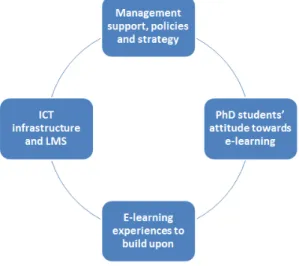
The following chapter documents the findings from the authors’ site visit to CHS-UG. The discoveries are divided into four focal points in order to get a comprehensive picture of the status of e-learning:
Figure 2: The four focal points of the interviews conducted during the UG site visit Management support, policies and strategy
UG has been working with e-learning since the beginning of the 21st century where the Knowledge Environment for Web-based Learning (KEWL) LMS was introduced. In 2005, a policy document on ICT stated a clear vision where ICT should be “(a) integrated into teaching, learning, research and drive most of the university’s administration services, such that teachers/researchers use ICT as a basic tool to teach, communicate and collaborate with students, peers, and researchers within and outside; (b) students (on-campus and off-campus) use ICT for learning and accessing learning resources over various multimedia platforms; and (c) lecture rooms and classrooms are ICT-enabled to promote e-learning”.21 Nonetheless, the policy was, and is not backed by specific strategies, action plans or incentive structures
21 Tagoe. M. A. (2012): Students’ Perceptions on Incorporating E-Learning into Teaching and Learning at the University of Ghana. International Journal of Education and Development using ICT
19
to promote implementation of e-learning, and very little e-learning have been incorporated into teaching and learning at UG 20 and 22.
In august 2011, a policy paper on technology-mediated courses and programmes was drafted by the UG e-learning committee, accepted by the university council, and according to the administrative
responsible for e-learning at UG, Francis Awuye-Kpobi, the policy is expected to be ratified this year. The policy paper builds on the recommendation gained from the aforementioned workshop in 2006, and describes steps and policies that will enable a wide deployment of e-learning at UG. See the part “Developing an E-learning strategy for public universities in Ghana” above.
When talking to management at CHS-UG, they perceives e-learning as having great potentials, but also that e-learning as teaching form, still is in its infancy at CHS-UG. Very few teachers at CHS-UG have embraced e-learning, even if CHS-UG has been involved in various e-learning projects over the years. According to management, the major challenges are that:
• teachers lacks time to participate in training and for developing e-learning
• teachers do not have sufficient access to didactical and technical training and support
• the cost of producing e-learning-, and in specific video-material are high
• the bandwidth are low and unstable
• the sharing of experiences on e-learning across CHS is insufficient
• some teachers are worried about copyright issues
• some teachers are difficult to convince of the potentials in e-learning, and
• some teachers at “practical” disciplines are reluctant with going online as they are afraid that students will stay away from the contact hours and therefore not learn the needed practical skills.
Some teachers and managers at UG, claims that there is a need for specific incentive structures to encourage teachers to start exploring e-learning further, such as promotion credits and/or extra salary payments when developing e-learning.
Key lessons learned
• UG is currently ratifying a policy paper on technology-mediated courses and programmes
• In general, teachers at CHS-UG do not prioritize developing their teaching using e-learning due to lacking incentives
PhD students’ attitude towards e-learning
The PhD students interviewed for this report have no experience with e-learning from their education at CHS-UG, but saw a potential in using e-learning more, especially as a way to attend compulsory teaching
20
activities while on fieldwork. It was perceived, that the majority of the PhD students have access to the internet from home by mobile broadband, but mainly use internet services such as browsing and email when on campus and very seldom at home, unless expected. They perceive their access to internet at campus as satisfying, but their access to IT support as difficult. Even though the students had limited experiences with e-learning, they had a few recommendations for an ideal design of a PhD e-learning course in context of the BSU initiative:
• The course should be easy to navigate and use.
• It should be accessible from outside the campus (on the internet).
• It should be reliable and stable.
• The learning material should be downloadable when off-line and for periods with power blackouts.
• The course should use elements as voice, pictures and video to make the learning material interesting and inspiring.
• A certificate should be given after completing the course to motivate the students to participate.
• When blending online and face-to-face activities, online activities should count in the overall assessment to ensure student participation.
• In case the course are designed as self-paced learning, the learning material and entry point should be accessible at different levels to ensure that all students are challenged appropriately. An entry level screening of the students could be a part of this exercise.
• Students are often overloaded which should be considered in the course design.
• There should be a clear description of the output of the course and need of taking the course, especially if the course is thought as supplementary.
• The online activities should be scheduled ahead so the students can plan their participation and ensure access to the internet from where they want to work.
Key lessons learned
• The PhD students at CHS-UG have limited experiences with e-learning.
• E-learning activities should be included in assessment and fully integrated with the course.
• The PhD students at CHS-UG have access to the internet, and are confident with use of IT and web technologies. Course material should be downloadable for off-line viewing.
• The PhD students at CHS-UG are used to various teaching forms and keen on trying new ways of teaching.
E-learning experiences to build upon
The current e-learning experiences at CHS-UG are primarily based on The Open Educational Resources project and The Raft Project. This chapter examines the gained experiences.
21
The Open Educational Resources project
Open Educational Resources (OER) is defined by UNESCO as “(…) any type of educational materials that are in the public domain or introduced with an open license. The nature of these open materials means that anyone can legally and freely copy, use, adapt and re-share them. OER range from textbooks to curricula, syllabi, lecture notes, assignments, tests, projects, audio, video and animation.”23. In the context of UG, the OER Project was a partnership between the University of Michigan and the CHS at both UG and KNUST while also University of Cape Town, University of the Western Cape and OER Africa participated. The project emerged in 2008 and managed to get a two-year grant in late 2009 sponsored by The William and Flora Hewlett Foundation and aimed “to advance health education across the continent by using OER developed by and targeted towards Africans in order to share knowledge, address curriculum gaps and support communities around health education”24. Through the project, faculty at CHS UG produced an impressive series of OER comprising of videos, texts, tests, cases and assignments. The OER were produced in collaboration between teachers and The OER Office based at CHS UG. The OER Office is a group of support staff members who assisted in the planning, technical production and web publishing of the material. Basically the OER Office is the back office of the OER Project. All OER are freely available through the website www.oerafrica.org/healthoer. Even though The OER Project has ended The OER Office still operates and comprises of three staff members:
OER Media Specialist, Chris Yebuah
Two staff members with expertise in 3D animation, databases, web and video.
Teachers report both challenges and advantages with using the OER in teaching. The primary method of using the OER is to ask students to access the resources as additional material, but only few students access the OER voluntarily. Generally the OER being produced in the project are of high quality and they were designed with a focus on Intended Learning Outcomes (Objectives), which corresponds with good practice when developing learning resources for university teaching25.
It is evident that the production of OER needs to address a specific target, e.g. growing number of students or availability of patients at the university hospital. The OER Project has come to a point where new targets have to be articulated in order to move it further.
One clear lesson learned from the OER Project is that regular workshops for staff members do not move the process forward. Instead the respondents in the interviews mention that a more targeted
23 UNESCO definition of OER:
linkhttp://www.unesco.org/new/en/communication-and-information/access-to-knowledge/open-educational-resources/what-are-open-educational-resources-oers/
24
Omollo, K. L., Rahman, A. & Yebuah, C. A (2012).: Producing OER from Scratch: The Case of Health Sciences at the University of Ghana and the Kwame Nkrumah University of Science and Technology. In Open Educational
Resources and Change in Higher Education: Reflections from Practice. Commonwealth of Learning, Vancouver.
25 Biggs, J., & Tang, C. (2011). Teaching for quality learning at university (Fourth edition.). Berkshire, UK: Open University Press.
22
based approach focusing on smaller teams of teachers who are co-teaching a course is more useful. Through this approach teachers can start doing a small e-learning intervention and then build more advanced experiences on that.
Distribution of OER to students at the Korle Bu campus rely on a purely offline method, i.e. circulation of CDs due to challenges with internet access.
Some teachers are reluctant to produce OER as they do not have correct citations on parts of their teaching material, and some are unconfident with making their teaching material available to all on the internet. By allowing teachers to share content with students in a closed format on a LMS with password protection might be an easier step for them to take compared with publishing under the OER licence.
Key lessons learned from the OER project
On an overall basis these are the overall lessons learned from the project:
• Supplementary and considerable use of faculty time. Faculty reported a heavy time investment in the production of OER material. In addition to the time used by the teachers, The OER Office use time on video and web production.
• Offline access and intranet access to resources. Challenges with internet connectivity advocates for offline access through downloadable modules and access through local intranet at
institutional server in addition to distribution through e.g. CD media.
• Limited integration of the OER as learning activities in courses. Student perceive the OER as isolated from the regular coursework and only very little efforts was made to integrate the resources into the actual teaching practice.
• Target e-learning development on a course-based approach. Instead of offering workshops for larger groups of staff a more targeted course-based approach is needed in which smaller teams of teachers who are co-teaching a course is being helped in their collaborative efforts to develop e-learning.
By considering The OER Project as an extensive stepping stone into the future of e-learning the most prevalent finding is that UG has vast competences and experiences with rich media production that can serve as a building block in future e-learning initiatives.
The RAFT Project
Dr Richmond Aryeetey is a Lecturer at the School of Public Health, who is involved in a network for eHealth in Africa called RAFT (Réseau en Afrique Francophone pour la Télémédecine) together with the WHO and European partners, e.g. the University of Geneva. Currently RAFT is working on an e-learning platform or LMS to share medical knowledge based on a platform that is named Dudal. The platform is accessible at http://raft.unige.ch/.
23
Key lessons learned from the RAFT project
The major lesson learned from the RAFT project is that it a difficult to switch from face-to-face to an online teaching format and that special attentions should be put on realising that online learning is a context very different from the face-to-face one.
ICT infrastructure and LMS
UG have recently restructured the ICT organisation into what is now called the University of Ghana Computing Systems (UGCS). The restructuring was done in order to streamline and harmonise all ICT units focusing on IT services, procurement of hardware and training for all students and staff. Academic Computing is a sub unit under the UGCS, which deals with e-learning as well as research and library systems.
Bandwidth
The UG main campus is located at Legon where you will also find one of the CHS schools namely the School of Public Health. The remaining five schools of CHS are located on the satellite campus of Korle Bu, which hosts the university hospital. There are currently plans of relocating all of the CHS schools to the Legon main campus. There is a fibre network connection from Legon to the Korle Bu campus hosted by Vodafone. Internally the Legon campus has a solid and very fast connection to access on campus servers which also include the LMS.
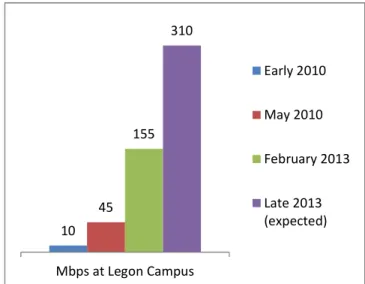
As of February 2013 the bandwidth was 155
Mbps (Megabyte per second) in both uplink and downlink at Legon and UG expect to double it to 310 Mbps at the end of the year. The bandwidth at the Korle Bu campus is 10 Mbps and only the main administrative building including the Computer Assisted Learning Centre (CALC) is linked to UG Legon cable supported by Vodafone. Consequently all schools and departments at Korle Bu are connected to the internet through separate internet service providers and there is no access through the internal network to the university hosted LMS. The connection at Korle Bu is considered very unreliable and most staff relies on the personal USB mobile internet connection.
The uplink is used for off campus access to UG webservers and sending e-mails whereas the downlink is for all access to external websites, receiving e-mails, etc. Currently, the uplink is not being used fully, which means that there is sufficient bandwidth to enable access to the LMS by PhD students and teachers who are located off campus.
10 45 155 310 Mbps at Legon Campus Early 2010 May 2010 February 2013 Late 2013 (expected)
24
Even though that UG have experienced a steep increase in bandwidth during the last 3 year as shown in figure 3, students and faculty members still ask for more bandwidth – the demand is unlimited.
Increasing the bandwidth is always followed by an increase in heavy file download. Also at the Korle Bu campus the bandwidth has increased during the last 3 three years from 1 Mbps downlink and 0,3 Mbps uplink in 2010 to 10 Mbps up- and downlink today.
Recently a heavy investment has been done in the ICT infrastructure at UG. The ICT Based Distance Education Project is funded with a $37,500,000 Chinese Government Loan procured by the Government of Ghana and will be implemented over a two year period starting from April 2012. The phase 1 of the project has now ended with a heavy investment in the fibre cable infrastructure at Legon as well as acquisition of PC desktops, projectors, etc. The next phase 2 of the project will extent the fibre cable connection to 12 regional centres of the Institute of Continuing and Distance Education and quip computer labs at all the regional centres with 600 computers and a web conferencing facility and enhance administrative support services at UGCS.
Power stability
UG experiences power outages on a common basis. The web and mail servers are supported by emergency power through a Uninterruptible Power Supply (UPS) that provides immediate protection from power interruptions, while fuel driven backup generators are in place for longer power outages. In addition, power fluctuations are a part of the daily challenges that UG experiences.
The LMS landscape
UG and CHS have a diverse landscape of LMSs comprising of currently two,KEWL and ULTRA. A new university-wide LMS, Sakai, is now in the planning phase.
KEWL - Knowledge Environment for Web-based Learning
KEWL is a centrally hosted e-learning LMS at UG that was introduced by a chemistry professor from the Faculty of Science in 2002. KEWL is open source based and developed by the University of the Western Cape, South Africa. KEWL has been continuously updated until 2007. No widespread adoption of the LMS has ever occurred and KEWL was never integrated with the university staff, student and course databases. All users and courses were created manually. Only a few lecturers at he Faculty of Science have used KEWL. The low adoption rate of KEWL was caused by bad timing due to very low bandwidth and computer availability at the time of implementation in 2002. Also the fact that it was championed by one professor seems to have limited the adoption to people outside of the Faculty of Science. A broader anchoring of any future LMS is consequently needed.
ULTRA - University of Ghana College of Health Sciences Learning & Teaching Resource Application
The online platform behind this short acronym of an otherwise very long name is based on the open source code of the Tufts University Sciences Knowledgebase, TUSK. ULTRA is being implemented
25
specifically at CHS as a part of a USAID-funded project on building capacity around HIV/AIDS medical education and professional training together with Tufts, Brown and Yale Universities in the US. One component of the project involves distance education. Consequently a dedicated server that hosts ULTRA has been installed at CHS and training of staff through workshops has been initiated.
The future is Sakai
The Chinese financed ICT Based Distance Education Project also includes a component that seeks to implement a new LMS besides the heavy infrastructural investments as already mentioned. The introduction of a new LMS developed by a Chinese company has nevertheless suffered from major challenges leading to a closure of the service. The LMS suffered from frequent and random failures and did simply not work in the phase 1 of the project. In the phase 2 of the project that is about to
commence UG wishes to implement an LMS that has a proven track record of operation and that is built on open source code. After testing an array of different LMSs the UG E-learning Implementation
Committee have decided on the Sakai open source LMS that is currently being used at an estimate of 300 institutions around the world and which is developed and organised around the Sakai community and foundation comprising of mainly university and college members. Sakai is supposed to replace KEWL as the UG LMS with full integration to staff, student and course databases for automatic access to course content.
LMS inspection
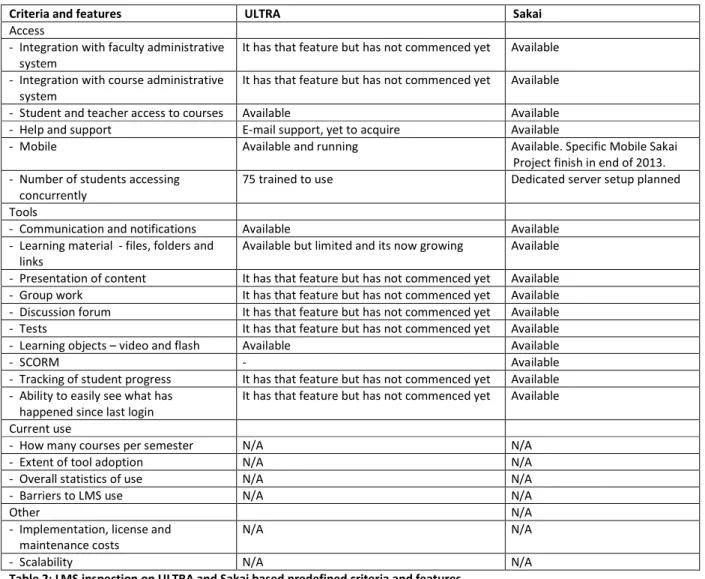
In order to evaluate the LMSs an inspection based on a set of criteria and features was conducted, see table 2. Given the fact that KEWL is currently being phased out and replaced with Sakai, no inspection was done on KEWL, which leave space to focus on ULTRA and Sakai.
26
Criteria and features ULTRA Sakai
Access
- Integration with faculty administrative system
It has that feature but has not commenced yet Available
- Integration with course administrative system
It has that feature but has not commenced yet Available
- Student and teacher access to courses Available Available - Help and support E-mail support, yet to acquire Available
- Mobile Available and running Available. Specific Mobile Sakai Project finish in end of 2013. - Number of students accessing
concurrently
75 trained to use Dedicated server setup planned
Tools
- Communication and notifications Available Available - Learning material - files, folders and
links
Available but limited and its now growing Available
- Presentation of content It has that feature but has not commenced yet Available - Group work It has that feature but has not commenced yet Available - Discussion forum It has that feature but has not commenced yet Available - Tests It has that feature but has not commenced yet Available - Learning objects – video and flash Available Available
- SCORM - Available
- Tracking of student progress It has that feature but has not commenced yet Available - Ability to easily see what has
happened since last login
It has that feature but has not commenced yet Available
Current use
- How many courses per semester N/A N/A
- Extent of tool adoption N/A N/A
- Overall statistics of use N/A N/A
- Barriers to LMS use N/A N/A
Other N/A
- Implementation, license and maintenance costs
N/A N/A
- Scalability N/A N/A
Table 2: LMS inspection on ULTRA and Sakai based predefined criteria and features
From the LMS inspection it is evident that Sakai has a slight edge when matching features and the criteria set in table 2 when compared to ULTRA.
LMS uptime monitoring
The ULTRA LMS has only just recently been launched while Sakai is currently only available at UG for testing purposes. Consequently the uptime of KEWL was monitored in order to give an image of the availability of a given LMS within the UG context:
Uptime Downtime Number of downtimes Downtimes per day Average downtime duration
92.86% 4d 22h 14m 490 6,9 14m
The overall average response time was 4,694 ms
After inspecting the data more en detail the following picture appeared: LMS typically down 1-2 minutes 0-7 times a day.
27
Looking at a graphical representation of the period the following picture arises:
Figure 4: Graph of uptime during the monitoring period. Percentage indicate availability of the LMS on a given day.
On most days the uptime was close 99% but a few long duration downtimes diluted the overall uptime record i.e.:
• 9 December 2012 11:20:30AM, 1d 22h 21m
• 8 February 2013, 07:39:30PM, 23h 46m
• 9 February 2013 08:06:30PM, 18h 20m
The recorded downtimes were due to power outages. The power backup generator can run for 24 hours. Consequently outages lasting more than or close to 24 hours lead to server downtime.
Access to online learning resources from Denmark
Given a situation where Danish and Ghanaian teachers are co-teaching a PhD course it is possible to access online learning resources on servers based in Denmark from the UG campus. A test was carried out in which a rich media element i.e. an online lecture consisting of a PowerPoint presentation with audio was accessed through a PC at the UG Legon campus. The total load time was counted to 3 minutes, which is considered tolerable.
Key lessons learned
• The demand from faculty and students on downlink bandwidth is high, even though UG have experienced a heavy increase in bandwidth over the last years.
• The internet connection to the Korle Bu campus is unreliable.
• Power outages are a common problem. Outages lasting longer than 24 hours results in insufficient fuel for the generator running the web and LMS servers.
28
• Sakai is the new planned university-wide LMS. ULTRA is currently being implemented at CHS. In terms of a LMS inspection Sakai has a slight edge.
• When monitoring the uptime of the KEWL LMS it is evident that power outages and can cause long term server down time and is major challenge.
• Load time to rich media on servers in Denmark is tolerable for sharing of content.
• UGCS are fully competent and have experiences with installation and maintenance of a LMS.
Summary of findings
UG has been working with e-learning since the early 2000 and a policy paper on technology-mediated courses and programmes is expected to be ratified in 2013. In general the management at CHS perceives that teachers do not prioritize developing their teaching using e-learning due to lacking incentives, low bandwidth and little available e-learning support and training.
The PhD students at CHS-UG have limited experiences with learning but are positive about using e-learning in PhD courses. The students are used to various teaching forms and keen on trying new ways of teaching as long as the e-learning activities are fully integrated in the teaching and included in the assessment.
From the OER Project is has become evident that a more targeted e-learning development on a course-based approach is needed. Instead of offering workshops for larger groups of staff a more targeted course-based approach is needed in which smaller teams of teachers who are co-teaching a course is being helped in their collaborative efforts to develop e-learning. Together with the experience of the PhD students the OER Project has shown that e-learning material should be made available for off-line viewing.
On the more technical side of e-learning matters CHS-UG is experiencing unreliable internet access at the Korle Bu campus. Also, power outages in general are a common problem sometimes leading to long term downtime of the LMS. The currently planned university-wide Sakai LMS is the best in terms of features compared with the ULTRA platform. UG has a fully competent team of staff members at the UGCS who have experiences with installation and maintenance of a LMS. The OER Office has valuable experiences and competences in production and structuring of e-learning material which
advantageously can be used as base in future e-learning initiatives.
The fact that many of the challenges identified back in 200626 are still highly relevant indicates conflicting interest when it comes to implementation of e-learning at UG. The suggested steps for implementation of e-learning, identified in 2006, are still valid and in line with the recommendations in the literature and the authors´ assumptions.
26 Isaiah T. Awidi (2008): Developing an E-learning Strategy for Public Universities in Ghana. Educause Quaterly 2008 (2)
29
Recommendations
The recommendations build upon the report findings, as well as the theory presented in the background chapter.
A successful integration of learning technology will have the potential to provide more flexible access to learning material, improved learning outcome for the students, and increase the quality of teaching and administrative services, without changing the mission of universities or reducing the academic freedom and autonomy.
Three recommendations are identified with an eye for BSUs limited mandate and budget. The focus is on creating a solid foundation for a wider integration of learning technologies in the teaching at CHS-UG and primarily on activities that can be implemented within short-term. The results of the suggested activities should go into the design of any long-term initiatives. The recommendations are thought as parallel activities:
1. Create a supportive organisational environment a. Establish a e-learning committee
b. Make a vision and strategy for e-learning at CHS-UG c. Establish governing structures
d. Plan the implementation process 2. Build an e-learning support team
3. Conduct pilot courses to identify a good, specific and sustainable practices for implementing e-learning
a. Encapsulate and communicate a clear goal for implementing e-learning b. Think pedagogy before technology
c. Plan online learning activities that integrate with the face-to-face teaching d. Ensure the requirements related to ICT infrastructure and LMS
Based on a two day site visit, the authors’ knowledge of CHS-UG is obviously not complete, and the recommendations should be seen as guidelines that need adjustment and detailed planning before implementation.
30
Create a supportive organisational environment
Successful implementation of e-learning at a wider scale requires a supportive organisational environment with clear governance structures, a clear vision and strategy and a process plan for the implementation. Strong leadership is important, but not enough, and a successful implementation of e-learning requires positive engagement from all key stakeholders, and support and ownership among the teachers.
Establish a e-learning committee
As a first step, it is suggested to establish an e-learning committee at CHS-UG, represented by; Provost of academic affairs (chair), Head of administration, Head of IT, Director of the e-learning unit, and academic and student representatives. The mandate of this committee should in first place be to identify and participate in the preparation the pilot courses, prepare a vision and a strategy for e-learning at CHS-UG, and to plan the process of implementing the strategy in full scale.
Make a vision and strategy for e-learning at CHS-UG
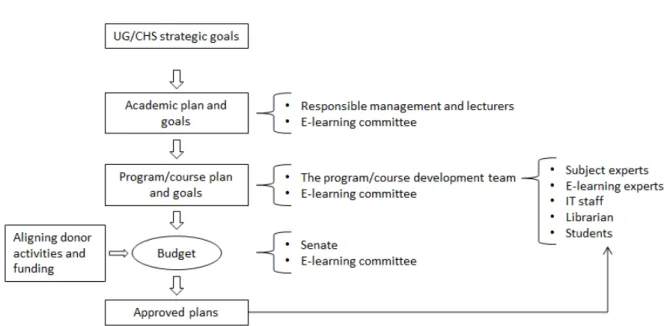
Regarding vision and strategy for e-learning, it is important that e-learning is not becoming a detached goal in itself, but a lever to reach higher educational purposes and strategic goals. Therefore, the vision and strategy for e-learning should be aligned with UGs and CHSs overall strategic goals for education. The academic goals for PhD education (and other educational levels for that sake), should prioritise how e-learning should be implemented. In this sense, the strategy for e-learning should secure that goals and strategies at all levels use learning technology as a lever, when feasible. See table 4 for one example27. Other goals could be “improve flexibility in education”, “reduce the cost/student”, etc. In all examples, learning technology should be seen as a lever to reach the academic goal.
Academic plan for PhD education
Goal A Strategy Outcome Success criteria
Innovate education Redesign the teaching for large classes (by use of learning technology)
More face-to-face interaction among teacher and students (e.g. by use of flipped teaching28) Improved student learning outcome
X% large classes redesigned
Student and teacher satisfaction increased by X%
Student performance increased by X% The cost of running the course are lower or the same as before
Table 4: Example of a goal in an academic (development) plan
27
Based on table 9.1 in A.W. (Tony) Bates and A. Sangrà (2011, p. 223). Managing Technology in Higher Education: Strategies for Transforming Teaching and Learning. Jossey-Bass, San Francisco