Supporting Information
Functionalization of Benzotriazole based Conjugated Polymers for Solar Cells: Heteroatom
vs. Substituents
Jeromy James Rech, Liang Yan, Zhen Wang, Qianqian Zhang, Spencer Bradshaw, Harald Ade, and Wei You*
J. J. Rech, L. Yan, Q. Zhang, S. Bradshaw, and Prof. W. You
Department of Chemistry, University of North Carolina at Chapel Hill, Chapel Hill, NC 27599, United States
*Email: [email protected]
Z. Wang and Prof. H. Ade
Department of Physics and Organic and Carbon Electronics Laboratories (ORaCEL), North Carolina State University, Raleigh, NC 27695, United States
Synthetic Details:
All chemicals were purchased from commercial source (Sigma-Aldrich, Fisher, Acros, etc.) and were used as received except when specified. Anhydrous THF was prepared via distillation over sodium and benzophenone before use. For reactions under argon, the reaction flask was evacuated and refilled with argon for three times.
Scheme S1 – Synthesis of PyTAZ core
3,4-diaminopyridine (1a) was purchased from Matrix Scientific (No 011183, 98%) and used without further purification.
2,5-dibromopyridine-3,4-diamine (2a) was synthesized as follows: In a 250 mL round bottom flask, 1a (10.9 g, 1 eq, 100 mmol) was dispersed in 48% hydrobromic acid (HBr, 100 mL). The reaction flask was cooled to 0 ˚C with an ice/water bath. Liquid bromine (Br2, 43.0 g, 13.8 mL,
2.7 eq, 270 mmol) was slowly added dropwise. The solution was heated to 110 ˚C and refluxed for five hours. The reaction flask was then cooled to 0 ˚C with an ice/water bath. The solid was collected via vacuum filtration and slowly washed with saturated bicarbonate solution (NaHCO3,
500 mL) – warning, there is a large amount of acid which needs to be neutralized and caution should be taken. The remaining solid is dissolved in ethyl acetate (EtOAc, 500 mL) and washed with brine (saturated NaCl solution) twice. The organic phase was dried with magnesium sulfate (MgSO4), filtered, and concentrated via rotary evaporation. Yield: Light brown solid, 10.68 g, 40%. 1H NMR (400 MHz, d6-DMSO) δ 7.53 (s, 1H), 5.99 (s, 2H), 5.05 (s, 2H).
4,7-dibromo-2H-[1,2,3]triazolo[4,5-c]pyridine (3a) was synthesized as follows: In a 250 mL round bottom flask, 2a (4.9 g, 1 eq, 18.4 mmol) was mixed with glacial acetic acid (CH3COOH,
50 mL). In a separate scintillation vial, sodium nitrite (NaNO2, 1.33 g, 1.05 eq, 19.3 mmol) was
dissolved in water (H2O, 20 mL). The sodium nitrite solution is added dropwise to the first mixture,
and the reaction mixture is allowed to stir (open air) for four hours. The reaction flask was then cooled to 0 ˚C with an ice/water bath. The solid was collected via vacuum filtration and dried in the oven overnight. By NMR, there was a small amount (2.6%) of acetic acid still stuck in the crystal. Yield: yellow-brown solid, 4.42 g, 86%
1H NMR (400 MHz, d6-DMSO) δ 8.50 (s, 1H).
4,7-dibromo-2-(2-butyloctyl)-2H-[1,2,3]triazolo[4,5-c]pyridine (4a) was synthesized as follows: In a dry, 2 neck, 100 mL round bottom flask with an attached condensing column, 3a (4.22 g, 1 eq, 15.2 mmol) and potassium carbonate (K2CO3, 4.19 g, 2.0 eq, 30.4 mmol) were added. The
reaction flask was seal, evacuated and refilled with argon three times. Anhydrous dimethylformamide (DMF, 60 mL) was added and the reaction mixture was heated to 70 ˚C. After 30 minutes, 5-(bromomethyl)undecane (4.16 g, 1.1 eq, 16.7 mmol) was added and the reaction continued to stir at 70 ˚C overnight. The reaction mixture was quenched with saturated ammonium chloride (NH4Cl, 100 mL); the product was extracted with dichloromethane (DCM) and washed
with H2O three times. After drying the organic phase with MgSO4 and filtering the mixture, the
mixture was concentrated via rotary evaporation. The product was purified through silica gel column chromatography – first, a byproduct was removed with a 10:1 hexanes:DCM solvent system. Afterwards, the solvent system was gradually changed to a 2:1 hexanes:DCM mixture which was used to collect the product. Yield: pale yellow oil, 2.81 g, 42%
1H NMR (400 MHz, CDCl
3) δ 8.36 (s, 1H), 4.71 (d, J = 7.1 Hz, 2H), 2.34 (m, 1H), 1.39 – 1.19
(m, 16H), 0.87 (m, 6H).
Scheme S2 – Synthesis of CNTAZ core
3,4-diaminobenzonitrile (1b) was purchased from Alfa Aesar (No H6695414, 97%) and used without further purification.
3,4-diamino-2,5-dibromobenzonitrile (2b) was synthesized as follows: A solution of 1b (2.66 g, 1 eq, 20.0 mmol) and potassium bromide (KBr, 31.65 g, 13.3 eq, 266 mmol) in 300 mL methanol was purged with argon for 20 min. To that solution, 62% hydrogen bromide solution (3.54 mL) was added at 0 °C slowly. 70% tert-butylhydroperoxide solution (t-BuOOH, 1.74 mL) was added and stirred at room temperature for 6 hr. Then a second portion of 70% tert-butylhydroperoxide solution (1.74 mL) was added and stirred for 6 hours before the third portion of 70% tert-butylhydroperoxide solution (1.74 mL) was added and stirred overnight. The reaction mixture
4,7-dibromo-2H-benzo[d][1,2,3]triazole-5-carbonitrile (3b) was synthesized as follows: To the solution of 2b (2.33 g, 1 eq, 8.0 mmol) in 18 mL acetic acid, sodium nitrite (0.91 g, 1.6 eq, 13.2 mmol) in 14 mL water was added at 0 °C. The reaction was stirred at room temperature for 90 minutes before being poured into water. The product was extracted with ethyl acetate and washed with water for two times and brine once. The organic solution was then dried over magnesium sulfate, filtered, and the solvent was removed with rotary evaporation. Yield: dark red solid, 2.1 g, 87%.
1H NMR (600 MHz, MeOD) δ 7.98 (s, 1H).
4,7-dibromo-2-(2-butyloctyl)-2H-benzo[d][1,2,3]triazole-5-carbonitrile (4b) was synthesized as follows: 3b (2.1 g, 1 eq, 7.0 mmol) and triphenylphosphine (2.73 g, 1.5 eq, 10.5 mmol) where added to a 250 mL round bottom flask which was then evacuated and refilled with argon three times. Anhydrous THF (125 mL) was added to make a solution of the starting materials. 2-butyl-1-octanol (1.94 g, 1.5 eq, 10.5 mmol) was added at 0 °C, and then diisopropyl azodicarboxylate (DIAD) (2.67 g, 1.9 eq, 13.2 mmol) was added at 0 °C. The reaction was slowly warmed to room temperature and stirred overnight. Then the reaction mixture was poured into water, and the product was extracted with ethyl acetate. The organic solution was washed with water for two times and brine for one time. The organic solution was dried over magnesium sulfate and filtered. The solvent was removed with rotary evaporation, and the crude product was purified through silica gel column chromatography with hexanes:ethyl acetate = 15:1 as eluent. Yield: colorless oil, 1.11 g, 34%.
1H NMR (600 MHz, CDCl
3) δ 7.72 (s, 1H), 4.72 (d, J = 7.1 Hz, 2H), 2.33 (m, 1H), 1.40 – 1.15
(m, 16H), 0.87 (m, 6H).
Scheme S3 – Synthesis of 4FT linker
2,5-dibromothiophene (5a) was purchased from Acros Organics (No 148681000, 95%) and used without further purification.
(5-bromothiophen-2-yl)trimethylsilane (6) was synthesized as follows: 5a (24.2 g, 1 eq, 100 mmol) was added to a 500 mL multineck round bottom flask which was subsequently evacuated and refilled three times with argon. Anhydrous tetrahydrofuran (THF, 200 mL) was added and the reaction flask was cooled to -78 ˚C with a dry ice/acetone bath. n-butyl lithium (n-BuLi, 2.5 M, 20 mL, 0.5 eq, 50 mmol) was added slowly and the reaction remained stirring in the dry ice/acetone bath. 30 minutes later, chlorotrimethylsilane (TMSCl, 6.3 mL, 0.5 eq, 50 mmol) was added. The reaction continued to stir at -78 ˚C for an additional 90 minutes. An additional amount of n-BuLi (22 mL, 0.55 eq, 55 mmol) was added. After an hour, a final amount of TMSCl (7.6 mL, 0.6 eq, 60 mmol) was added. The reaction was allowed to slowly warm to room temperature overnight. Afterwards, the reaction was quenched with 20 mL of H2O and poured into 200 mL of saturated
NH4Cl. The product was extracted with DCM and washed with water three times. The organic
evaporation. The crude product was purified through silica gel column chromatography with hexanes as eluent. Note, there is an impurity (yellow band) which can make this column trickier. Yield: 21.05 g, 90%.
1H NMR (400 MHz, CDCl
3) δ 7.08 (d, J = 3.45 Hz, 1H), 6.98 (d, J = 3.45 Hz, 1H), 0.31 (s, 9H)
(4-bromo-5-(triisopropylsilyl)thiophen-2-yl)trimethylsilane (7) was synthesized as follows: 6 (20.72 g, 1 eq, 88 mmol) was added to a 500mL multineck round bottom flask which was subsequently evacuated and refilled three times with argon. Anhydrous tetrahydrofuran (THF, 300 mL) was added and the reaction flask was cooled to -78 ˚C with a dry ice/acetone bath. Lithium diisopropylamine (LDA, 2M in THF/heptanesethylbenzene, 52.9 mL, 1.2 eq, 106 mmol) was added dropwise slowly in four portions over the course of one hour. After the final portion of LDA was added, the reaction mixture was stirred at -78 ˚C for 30 minutes. Chlorotriisopropylsilane (TIPSCl, 22.08 g, 24.5 mL, 1.3 eq, 114.5 mmol) was added in one portion and the reaction was allowed to stir for 30 minutes. The reaction was warmed to room temperature and then poured into H2O (200 mL, 30 minutes after removal from bath). The product was extracted with hexanes and
washed with water three times. The organic layer was dried with magnesium sulfate, filtered, and concentrated via rotary evaporation. Yield: 33.03 g, 96%.
1H NMR (400 MHz, CDCl
3) δ 7.19 (s, 1H), 1.59 (hept, J = 7.42 Hz, 3H), 1.13 (d, J = 7.49 Hz,
18H), 0.31 (s, 9H).
(4-fluoro-5-(triisopropylsilyl)thiophen-2-yl)trimethylsilane (8) was synthesized as follows: First, 7 (32.42 g, 1 eq, 83 mmol) and N-fluorobenzenesulfonimide (NFSI, 31.33 g, 1.2 eq, 99.3 mmol) were added to a multineck round bottom flask which was evacuated and refilled with argon three times. The starting material and NFSI where then dissolved in dry tetrahydrofuran (from still) and cooled to -78 °C in a dry ice/acetone bath. Then n-BuLi (2.5 M in hexane) and NFSI were added at -78 °C in the following portions:
i) n-BuLi (16.56 mL, 0.5 eq, 41.4 mmol), stir for 1 h, ii) n-BuLi (16.56 mL, 0.5 eq, 41.4 mmol), stir for 1 h, iii) n-BuLi (16.56 mL, 0.5 eq, 41.4 mmol), stir for 1 h,
iv) NFSI (20.88 g, 0.8 eq, 66.2 mmol) dissolved in dry THF, stir for 30 min, v) n-BuLi (26.5 mL, 0.8 eq, 66.2 mmol), stir for 1 h,
The dry ice/acetone bath was then removed and the mixture was stirred at room temperature overnight. The mixture was quenched with water, and the workup began with extracting the organic layer with ethyl acetate. After being washed with brine (x2) and water (x2), and dried over magnesium sulfate, the organic phase was filtered and the resulting solution was concentrated under reduced pressure and run through a silica gel plug using hexane as eluent. After removing the hexane via rotary evaporation, vacuum distillation yielded the product. Yield: 11.14 g, 41%.
1H NMR (400 MHz, CDCl
3) δ 6.97 (d, J = 1.8 Hz, 1H), 1.38 (hept, J = 7.45 Hz, 3H), 1.10 (d, J =
7.52 Hz, 18H), 0.30 (s, 9H).
(5-bromo-3-fluorothiophen-2-yl)triisopropylsilane (9) was synthesized as follows: A mixture of 8 (10.86 g, 32.8 mmol, 1 eq.) and liquid bromine (Br2, 5.75 g, 36.1 mmol, 1.1 eq.) in
resulting organic layer was washed with water twice, then dried with magnesium sulfate. After filtration, the filtrate was concentrated via rotary evaporation. The resulting residue was purified through silica gel column (hexanes eluent), to yield the product. Yield: 9.87 g, 89%.
1H NMR (400 MHz, CDCl
3) δ 6.89 (d, J = 1.7 Hz, 1H), 1.34 (m, 3H), 1.09 (d, J = 7.52 Hz, 18H).
(3-fluoro-5-(trimethylstannyl)thiophen-2-yl)triisopropylsilane (10a) was synthesized as follows: 9 (9.02 g, 26.7 mmol, 1 eq.) was added to a flask which was then evacuated and refilled with argon three times. The oil was solubilized in dry THF (30 mL) from the still, and the mixture was cooled with a dry ice/acetone bath. Next, 2.5 M n-BuLi in hexanes (11.2 mL, 28.1 mmol, 1.05 eq.) was added to the flask, still at -78 °C and under argon. The mixture was stirred at -78 °C for 30 minutes. A 1 M solution of trimeythltin chloride (Me3SnCl in hexanes, 29.4 mL, 29.4 mmol, 1.1 eq.) was
added dropwise, and the resulting solution was stirred at -78 °C for 1 hour. The reaction mixture was allowed to warm to room temperature for 45 minutes and was then quenched with water. After extraction with hexanes, the organic layer was washed with brine (x3), dried with magnesium sulfate, filtered, and concentrated under reduced pressure/rotovap to give the product as a faint yellow oil. Yield: 9.64 g, 86%.
1H NMR (400 MHz, CDCl
3) δ 6.85 (d, J = 1.8 Hz, 1H), 1.44 (m, 3H), 0.98 (d, J = 7.5 Hz, 18H),
0.27 (s, 9H).
Scheme S4 – Synthesis of empty thiophene linker
Thiophene (5b) was purchased from TCI America (No T0223500ML, 98%) and used without further purification.
Trimethyl(thiophen-2-yl)stannane (10b) was synthesized as follows: To a dry 250 mL multineck flask which was evacuated and refilled with argon three times, anhydrous THF (100 mL) and 5b (4.21 g, 1 eq, 50 mmol) where added. The reaction flask was cooled to -78 °C in a dry ice/acetone bath. n-BuLi (2.5 M, 21 mL, 1.05 eq, 52.5 mmol) was added dropwise and the reaction stirred in the dry ice/acetone bath for 1 hour. Afterwards, trimethyltin chloride (SnMe3Cl, 1M, 55 mL, 1.1 eq, 55 mmol) was added dropwise. The reaction was allowed to slowly warm to room temperature and stir overnight. The reaction mixture was quenched with 20 mL saturated NH4Cl. The organic phase was extracted with ether and washed with brine twice. After drying with magnesium sulfate and filtering, the organic phase was concentrated with rotary evaporation. The product was vacuum distilled to purify. Yield: colorless oil, 11.24 g, 91%.
1H NMR (400 MHz, CDCl
Scheme S5 – Synthesis of PyTAZ monomer
2-(2-butyloctyl)-4,7-di(thiophen-2-yl)-2H-[1,2,3]triazolo[4,5-c]pyridine (11a) was synthesized as follows: Both 4a (1.26 g, 1 eq, 2.82 mmol) and 10b (1.74 g, 2.5 eq, 7.06 mmol) where added to a multineck round bottom flask with condensing column, which was subsequently evacuated and refilled with argon three times. A solution was made by dissolving the starting materials in anhydrous toluene. Afterwards, Pd(PPh3)2Cl2 (59 mg, 0.03 eq, 0.0846 mmol) was added under
argon stream, and the solution was purged with argon for 20 min. The reaction was heated to reflux for 48 hours. After cooling, the solvent was removed via rotary evaporation. And the product was purified via silica column chromatography with hexanes:dichloromethane at 9:1 as the eluent. By NMR, a few minor impurities remain, a gradient column might remove these. Yield: yellow oil, 0.98 g, 77%.
4,7-bis(5-bromothiophen-2-yl)-2-(2-butyloctyl)-2H-[1,2,3]triazolo[4,5-c]pyridine (12a) was synthesized as follows: In a dry round bottom flask, 11a (1.36 g, 1 eq, 3 mmol) and N-Bromosuccinimide (NBS, 1.11 g, 2.1 eq, 6.2 mmol) was dissolved in anhydrous THF (35 mL). The flask was wrapped in aluminum foil and stirred in darkness overnight. The reaction mixture was poured into saturated bicarbonate solution (100 mL) and the product was extracted with dicholomethane. The organic phase was washed with a saturated bicarbonate solution twice. Afterwards, the organic phase was dried with magnesium sulfate, filtered, and concentrated via rotary evaporation. The product was purified through silica gel column chromatography with a 9:1 mixture of hexanes:dichloromethane as the eluent. Afterwards, the monomer was recrystallized from isopropyl alcohol twice. Yield: yellow solid, 1.65 g, 82%.
1H NMR (400 MHz, CDCl
3) δ 8.54 (s, 1H), 8.20 (d, J = 4.0 Hz, 1H), 7.76 (d, J = 3.9 Hz, 1H),
7.18 (d, J = 3.9 Hz, 1H), 7.14 (d, J = 3.9 Hz, 1H), 4.77 (d, J = 6.7 Hz, 2H), 2.31 (hept, J = 6.5 Hz, 1H), 1.47 – 1.21 (m, 16H), 0.90 (t, J = 7.2 Hz, 3H), 0.86 (t, J = 7.0 Hz, 3H).
Figure S1 – PyTAZ monomer 1H NMR
Scheme S6 – Synthesis of 4FT-PyTAZ monomer
2-(2-butyloctyl)-4,7-bis(4-fluoro-5-(triisopropylsilyl)thiophen-2-yl)-2H-[1,2,3]triazolo[4,5-c]pyridine (11b) was synthesized as follows: Both 4a (1.00 g, 1 eq, 2.24 mmol) and 10b (2.36 g, 2.5 eq, 5.60 mmol) where added to a multineck round bottom flask with condensing column, which was subsequently evacuated and refilled with argon three times. A solution was made by dissolving the starting materials in anhydrous toluene. Afterwards, Pd(PPh3)2Cl2 (47 mg, 0.03 eq, 0.067 mmol)
was added under argon stream, and the solution was purged with argon for 20 min. The reaction was heated to reflux for 48 hours. After cooling, the solvent was removed via rotary evaporation. And the product was purified via silica column chromatography with hexanes:dichloromethane at 12:1 as the eluent. By NMR, a few minor impurities remain, a gradient column might remove these. Yield: yellow oil, 0.78 g, 43%.
4,7-bis(5-bromo-4-fluorothiophen-2-yl)-2-(2-butyloctyl)-2H-[1,2,3]triazolo[4,5-c]pyridine (12b) was synthesized as follows: 11b (0.5 g, 1 eq, 0.79 mmol) is added to a dry multineck round bottom flask which is subsequently evacuated and refilled three times with argon. Anhydrous THF (~100 mL) is added to the flask and the reaction stirred for ten minutes. Afterwards, tetrabutylammonium fluoride (TBAF, 1 M in THF, 2.4 mL, 3 eq, 2.4 mmol) was added via syringe and the reaction mixture stirred for six hours at room temperature. The reaction mixture was concentrated via rotary evaporation to produce a brown sludge. Ethanol (100 mL) was added and the solution was stirred. A yellow precipitate formed and was filtered and washed with ethanol. Further purifications are required to isolate the pure product, but we opted to proceed with the next reaction. In a round bottom flask, the yellow solid and NBS (0.35 g, 2.5 eq, 2.0 mmol) was dissolved in DCM (18 mL) and acetic acid (8 mL) mixture. The flask was wrapped in aluminum foil and stirred in darkness overnight. More acetic acid (3 mL) was added and the reaction was stirred in the darkness for another 36 hours. The reaction mixture was poured into saturated bicarbonate solution (50 mL) and the product was extracted with dicholomethane. The organic phase was washed with a saturated bicarbonate solution twice. Afterwards, the organic phase was dried with magnesium sulfate, filtered, and concentrated via rotary evaporation. The product was purified through silica gel column chromatography with a 6:1 mixture of hexanes:dichloromethane which was slowly increased to 4:1 as the eluent. Afterwards, the monomer was recrystallized from ethanol twice. Yield: yellow solid, 384 mg, 75%.
1H NMR (400 MHz, CDCl 3) δ 8.52 (s, 1H), 8.11 (s, 1H), 7.70 (s, 1H), 4.78 (d, J = 6.7 Hz, 2H), 2.31 (hept, J = 6.4 Hz, 1H), 1.47 – 1.21 (m, 16H), 0.90 (t, J = 7.1 Hz, 3H), 0.86 (t, J = 6.7 Hz, 3H). Mass Spectroscopy: [M+H]+ C 25H29N4S2Br2F2 ; m/z = 645.01630 ; mass error = 0.1 ppm
Figure S3 – 4FT-PyTAZ monomer 1H NMR
Scheme S7 – Synthesis of CNTAZ monomer
2-(2-butyloctyl)-4,7-di(thiophen-2-yl)-2H-benzo[d][1,2,3]triazole-5-carbonitrile (11c) was synthesized as follows: Both 4b (1.30 g, 1 eq, 2.76 mmol) and 10b (1.70 g, 2.5 eq, 6.91 mmol) where added to a multineck round bottom flask with condensing column, which was subsequently evacuated and refilled with argon three times. A solution was made by dissolving the starting materials in anhydrous toluene. Afterwards, Pd(PPh3)2Cl2 (58 mg, 0.03 eq, 0.083 mmol) was added
under argon stream, and the solution was purged with argon for 20 min. The reaction was heated to reflux for 48 hours. After cooling, the solvent was removed via rotary evaporation. And the product was purified via silica column chromatography with hexanes:dichloromethane at 9:1 as the eluent. By NMR, a few minor impurities remain, a gradient column might remove these. Yield: yellow oil, 0.93 g, 71%.
4,7-bis(5-bromothiophen-2-yl)-2-(2-butyloctyl)-2H-benzo[d][1,2,3]triazole-5-carbonitrile (12c) was synthesized as follows: 11c (0.92 g, 1 eq, 1.93 mmol) was dissolved in 50 mL dichloromethane and 18 mL acetic acid in a multineck round bottom flask which was wrapped in aluminum foil. NBS (0.72 g, 2.1 eq, 4.05 mmol) was added in dark. The reaction was stirred in dark at room temperature for 40 hr. The second portion of NBS (0.12 g, 0.35 eq, 0.68 mmol) was added and stirred in dark at room temperature for 50 hr. The third portion of NBS (0.21 g, 0.60 eq, 1.16 mmol) was added and stirred overnight. Then the fourth portion of NBS (0.16 g, 0.40 eq, 0.79 mmol) was added and stirred overnight. The fifth portion of NBS (0.18 g, 0.52 eq, 1.0 mmol) was added and stirred overnight. The sixth portion of NBS (0.05 g, 0.15 eq, 0.28 mmol) was added and stirred overnight. The reaction was tracked with 1H NMR until the dibromination was complete. The reaction was then poured into water, and the product was extracted with dichloromethane for three times. The combined organic solution was washed with water for two times and brine for one time. The organic solution was dried over magnesium sulfate and filtered. The solvent was removed via rotary evaporation. And the product was purified with silica column chromatography with hexanes:dichloromethane = 4:1 as eluent and was then recrystallized in ethanol. Yield: yellow-orange solid, 0.96 g, 78%. 1H NMR (600 MHz, CDCl 3) δ 8.01 (d, J = 4.1 Hz, 1H), 7.79 (d, J = 4.0 Hz, 1H), 7.71 (s, 1H), 7.21 (d, J = 4.1 Hz, 1H), 7.16 (d, J = 4.0 Hz, 1H), 4.77 (d, J = 6.5 Hz, 2H), 2.28 (hept, J = 6.3 Hz, 1H), 1.47 – 1.21 (m, 16H), 0.89 (m, 6H). Mass Spectroscopy: [M+H]+ C 27H31N4S2Br2 ; m/z = 633.03540 ; mass error = 0.4 ppm
Figure S5 – CNTAZ monomer 1H NMR
Scheme S8 – Synthesis of 4FT-CNTAZ monomer
2-(2-butyloctyl)-4,7-bis(4-fluoro-5-(triisopropylsilyl)thiophen-2-yl)-2H-benzo[d][1,2,3]triazole-5-carbonitrile (11d) was synthesized as follows: Both 4a (0.96 g, 1 eq, 2.0 mmol) and 10b (2.0 g, 2.5 eq, 5.0 mmol) where added to a multineck round bottom flask with condensing column, which was subsequently evacuated and refilled with argon three times. A solution was made by dissolving the starting materials in anhydrous toluene. Afterwards, Pd(PPh3)2Cl2 (0.042 g, 0.03 eq, 0.06 mmol)
was added under argon stream, and the solution was purged with argon for 20 min. The reaction was heated to reflux for 48 hours. After cooling, the solvent was removed via rotary evaporation. And the product was purified via silica column chromatography with hexanes:dichloromethane at 30:1 as the eluent. By NMR, a few minor impurities remain, a gradient column might remove these. Yield: yellow oil, 0.79 g, 50%.
4,7-bis(5-bromo-4-fluorothiophen-2-yl)-2-(2-butyloctyl)-2H-benzo[d][1,2,3]triazole-5-carbonitrile (12d) was synthesized as follows: 11d (0.65 g, 1 eq, 0.79 mmol) is added to a dry multineck round bottom flask which is subsequently evacuated and refilled three times with argon. Anhydrous THF (~100 mL) is added to the flask and the reaction stirred for ten minutes. Afterwards, tetrabutylammonium fluoride (TBAF, 1 M in THF, 2.4 mL, 3 eq, 2.4 mmol) was added via syringe and the reaction mixture stirred for six hours at room temperature. The reaction mixture was concentrated via rotary evaporation to produce a brown sludge. Ethanol (100 mL) was added and the solution was stirred. A yellow-orange precipitate formed and was filtered and washed with ethanol. Further purifications are required to isolate the pure product, but we opted to proceed with the next reaction. In a round bottom flask, the yellow-orange solid and NBS (0.27 g, 2.1 eq, 1.51 mmol) was dissolved in DCM (17 mL) and acetic acid (12 mL) mixture. Note, reaction was done in inert atmosphere. The flask was wrapped in aluminum foil and stirred in darkness for 48 hours. More acetic acid (3 mL) was added and the reaction was stirred in the darkness for another 48 hours. The reaction mixture was poured into saturated bicarbonate solution (50 mL) and the product was extracted with dicholomethane. The organic phase was washed with a saturated bicarbonate solution twice. Afterwards, the organic phase was dried with magnesium sulfate, filtered, and concentrated via rotary evaporation. The product was purified through silica gel column chromatography with a 8:1 mixture of hexanes:dichloromethane as the eluent. Afterwards, the monomer was recrystallized from ethanol twice. Yield: orange solid, 359 mg, 68%.
1H NMR (400 MHz, CDCl 3) δ 7.98 (s, 1H), 7.75 (s, 1H), 7.69 (s, 1H), 4.78 (d, J = 6.5 Hz, 2H), 2.27 (hept, J = 6.3 Hz, 1H), 1.45 – 1.25 (m, 16H), 0.91 (t, J = 7.2 Hz, 3H), 0.86 (t, J = 6.7 Hz, 3H). Mass Spectroscopy: [M+H]+ C 27H29N4S2Br2F2 ; m/z = 669.01637 ; mass error = 0.1 ppm
Figure S7 – 4FT-CNTAZ monomer 1H NMR
Scheme S9 – Polymerization of various TAZ-based polymers
(4,8-bis(3-butylnonyl)benzo[1,2-b:4,5-b']dithiophene-2,6-diyl)bis(trimethylstannane) (13) was synthesized according to previous literature reports. (https://doi.org/10.1021/ja1112595)
Poly[7-(5-(4,8-bis(3-butylnonyl)benzo[1,2-b:4,5-b']dithiophen-2-yl)thiophen-2-yl)-2-(2-butyloctyl)-4-(thiophen-2-yl)-2H-[1,2,3]triazolo[4,5-c]pyridine] (14a – PyTAZ) was polymerized as follows: 13 (89.1 mg, 1.01 eq, 0.101 mmol), 12a (61.1 mg, 1 eq, 0.100 mmol), (Pd2(dba)3∙CHCl3, 2.0 mg, 0.02 eq, 0.002 mmol), and (P(o-tol)3, 5.0 mg, 0.16 eq, 0.016 mmol)
were charged into a 10 mL vial designed for microwave reactor. The mixture was evacuated and refilled with argon for three cycles before addition of anhydrous o-xylene (0.7 mL) under argon stream. The reaction was heated up to 200 °C and held in a CEM microwave reactor for 10 min. After the polymerization, the crude polymer was dissolved in hot chlorobenzene (<10 mL) and precipitated into stirring methanol (200 mL). The collected polymer was extracted via a Soxhlet extractor with ethyl acetate, hexanes, and chloroform. The polymer solution in chloroform was concentrated and precipitated into methanol. The polymer was then collected via filtration and dried under vacuum. Yield: golden colored film, 102.4 mg, 100%.
Poly[7-(5-(4,8-bis(3-butylnonyl)benzo[1,2-b:4,5-b']dithiophen-2-yl)-4-fluorothiophen-2-yl)-2-(2-butyloctyl)-4-(4-fluorothiophen-2-yl)-2H-[1,2,3]triazolo[4,5-c]pyridine] (14b – 4FT-PyTAZ)
was polymerized as follows: 13 (89.0 mg, 1.01 eq, 0.101 mmol), 12b (64.4 mg, 1 eq, 0.100 mmol), Pd2(dba)3∙CHCl3 (2.0 mg, 0.02 eq, 0.002 mmol), and P(o-tol)3 (4.8 mg, 0.16 eq, 0.016 mmol) were
charged into a 10 mL vial designed for microwave reactor. The mixture was evacuated and refilled with argon for three cycles before addition of anhydrous o-xylene (0.7 mL) under argon stream. The reaction was heated up to 200 °C and held in a CEM microwave reactor for 30 min. After the polymerization, the crude polymer was dissolved in hot chlorobenzene (<10 mL) and precipitated into stirring methanol (200 mL). The collected polymer was extracted via a Soxhlet extractor with ethyl acetate, hexanes, and chloroform. The polymer solution in chloroform was concentrated and precipitated into methanol. The polymer was then collected via filtration and dried under vacuum. Yield: golden colored film, 82.7 mg, 79%.
Poly[4-(5-(4,8-bis(3-butylnonyl)benzo[1,2-b:4,5-b']dithiophen-2-yl)thiophen-2-yl)-2-(2-butyloctyl)-7-(thiophen-2-yl)-2H-benzo[d][1,2,3]triazole-5-carbonitrile] (14c - CNTAZ) was polymerized as follows: 13 (89.0 mg, 1.01 eq, 0.101 mmol), 12c (63.4 mg, 1 eq, 0.100 mmol),
The reaction was heated up to 200 °C and held in a CEM microwave reactor for 10 min. After the polymerization, the crude polymer was dissolved in hot chlorobenzene (<10 mL) and precipitated into stirring methanol (200 mL). The collected polymer was extracted via a Soxhlet extractor with ethyl acetate, hexanes, and chloroform. The polymer solution in chloroform was concentrated and precipitated into methanol. The polymer was then collected via filtration and dried under vacuum. Yield: golden colored film, 94.8 mg, 91%.
Poly[4-(5-(4,8-bis(3-butylnonyl)benzo[1,2-b:4,5-b']dithiophen-2-yl)-4-fluorothiophen-2-yl)-2-(2-butyloctyl)-7-(4-fluorothiophen-2-yl)-2H-benzo[d][1,2,3]triazole-5-carbonitrile] (14d –
4FT-CNTAZ) was polymerized as follows: 13 (88.9 mg, 1.01 eq, 0.101 mmol), 12d (67.0 mg, 1 eq, 0.100 mmol), Pd2(dba)3∙CHCl3 (2.2 mg, 0.02 eq, 0.002 mmol), and P(o-tol)3 (4.7 mg, 0.16 eq,
0.016 mmol) were charged into a 10 mL vial designed for microwave reactor. The mixture was evacuated and refilled with argon for three cycles before addition of anhydrous o-xylene (0.7 mL) under argon stream. The reaction was heated up to 200 °C and held in a CEM microwave reactor for 30 min. After the polymerization, the crude polymer was dissolved in hot chlorobenzene (<10 mL) and precipitated into stirring methanol (200 mL). The collected polymer was extracted via a Soxhlet extractor with ethyl acetate, hexanes, and chloroform. The polymer solution in chloroform was concentrated and precipitated into methanol. The polymer was then collected via filtration and dried under vacuum. Yield: golden colored film, 87.1 mg, 81%.
Characterization Methods:
Mass Spectroscopy samples were analyzed with a Q Exactive HF-X (ThermoFisher, Bremen, Germany) mass spectrometer. Samples were introduced via an atmospheric pressure chemical ionization (APCI) source at a flow rate of 20 µL/min. One hundred time domain transients were averaged in the mass spectrum. APCI source conditions were set as: nebulizer temperature 350 °C, sheath gas (nitrogen) 20 arb, auxillary gas (nitrogen) 5 arb, sweep gas (nitrogen) 0 arb, capillary temperature 225 °C, RF voltage 35 V, spray voltage 5.0 KV. The mass range was set to 150-2000 m/z. All measurements were recorded at a resolution setting of 120,000. Solutions were analyzed at 0.1 mg/mL or less based on responsiveness to the APCI mechanism. Xcalibur (ThermoFisher, Breman, Germany) was used to analyze the data. Molecular formula assignments were determined with Molecular Formula Calculator (v 1.2.3). All observed species were singly charged, as verified by unit m/z separation between mass spectral peaks corresponding to the 12C and 13C12Cc-1 isotope
for each elemental composition.
High temperature gel permeation chromatography (HT-GPC) measurements were performed on a Agilent 1260 HT-GPC instrument with TCB (1,2,4-trichlorobenzene) as the eluent at 150 °C. The obtained molar mass is relative to the polystyrene standard. 1H and 13C nuclear magnetic resonance
(NMR) measurements were recorded with Bruker DRX spectrometers (400 MHz or 600 MHz). UV-visible absorption spectra were obtained with a Shimadzu UV-2600 spectrophotometer. The film thicknesses were recorded by a profilometer (Alpha-Step 200, Tencor Instruments). CV measurements were carried out on thin films using a Bioanalytical Systems (BAS) Epsilon potentiostat with a standard three-electrode configuration. A three electrode cell of a glassy carbon working electrode, Ag/Ag+ reference electrode, and Pt counter electrode were used. Films of the FREAs were drop-cast onto the glassy carbon electrode from hot chloroform solution (2 mg/mL, with tetrabutylammonium hexafluorophosphate added at 100 wt%) and dried using a heat gun. 0.1
M solution of tetrabutylammonium hexafluorophosphate in anhydrous acetonitrile was used as a supporting electrolyte. Scans were carried out under argon atmosphere at a scan rate of 100 mV/s. The reference electrode was calibrated using a ferrocene/ferrocenium redox couple. Solar cell devices were tested under AM 1.5G irradiation calibrated with an NREL certified standard silicon solar cell. Current density-voltage curves were measured via a Keithley 2400 digital source meter.
SCLC mobility was acquired through the hole-only devices with a configuration of ITO/PEDOT:PSS/active layer/MoO3/Al. The experimental dark current densities J were measured by Keithley 2400. The applied voltage V was corrected from the voltage drop Vrs dur to the series resistance and contact resistance, which were found from a reference device without the active layer, and the build-in potential, which are estimated from the VOC of corresponding hole-only devices under 1 sun condition. From the plots of J 0.5 vs V, hole mobilities of polymers were deduced from the Mott-Gurneys law:
𝐽 =9
8𝜀𝑟𝜀0𝜇ℎ 𝑉2
𝐿3
where ε0 is the permittivity of free space, εr is the dielectric constant of the polymer which is
assumed to be around 3, μh is the hole mobility, V is the voltage drop across the device, and L is
the film thickness of the active layer.
GIWAXS measurements were performed at beamline 7.3.3 (DOI: 10.1088/1742-6596/247/1/012007) at the ALS. The 10 KeV X-ray beam was incident at a grazing angle of 0.13 degree. The scattered X-rays were detected using a 2D area detector (Pilatus 1M). All measurements were conducted under He atmosphere to reduce air scattering.
Device Fabrication:
Glass substrates coated with patterned indium doped tin oxide (ITO) were purchased from Thin Film Devices, Inc. About 150 nm sputtered ITO pattern had a resistivity of 20 Ω/sq. Prior to use, the substrates were ultrasonicated in deionized water, acetone, and then 2-proponal for 15 min each. The substrates were dried under a stream of nitrogen gas and subjected to the treatment of UV−ozone for 15 min. The CuSCN was dissolved in diethylsulfide with the concentration 22.7 mg/mL under stirring for 1 hour. Then the CuSCN solution was filtered by 0.2 μm poly(tetrafluoroethylene) (PTFE) filter and spun-cast on the cleaned ITO substrates at 7000 rpm for 60 s and then baked at 100 °C for 15 min in air to give a thin film with a thickness of about 40 nm. Then blends of polymer:PC61BM (1:2 w/w) were dissolved in chlorobenzene (with 0.5%
diphenyl ether for 4FT-CNTAZ blends) with heating at 130 °C for 6 hours. All the solutions were filtered through a 5.0 μm PTFE filter and spun-cast at an optimized rpm for 60 s onto the CuSCN layer for conventional structure. The substrates were transferred into vacuum chamber immediately after spin-coating and then dried at 30 mmHg below atmosphere for 30 min. The devices were finished for measurement after thermal deposition of a 30 nm film of calcium and a 70 nm aluminum film as the cathode for a conventional structure at a base pressure of 2 x 10⁻⁶ mbar. There are 8 devices per substrate, with an active area of 13 mm2 per device.
Table S1 – Photovoltaic properties of the various polymer:PCBM solar cells with thinner device thickness of ~140 nm Polymer JSC (mA/cm2) VOC (V) FF (%) PCE (%) PyTAZ 9.97 ± 0.20 0.806 ± 0.002 68.3 ± 1.3 5.49 ± 0.17 4FT-PyTAZ 11.15 ± 0.76 0.896 ± 0.001 63.6 ± 2.2 6.35 ± 0.29 CNTAZ 11.79 ± 0.52 0.937 ± 0.001 71.7 ± 1.3 7.92 ± 0.44 4FT-CNTAZ 9.97 ± 0.40 0.965 ± 0.001 63.4 ± 1.2 6.11 ± 0.25
Figure S9 – Chemical structures of various TAZ-based acceptor moieties. Each was polymerized with the same BnDT donor moiety. The average PCE for polymer:PCBM blend is
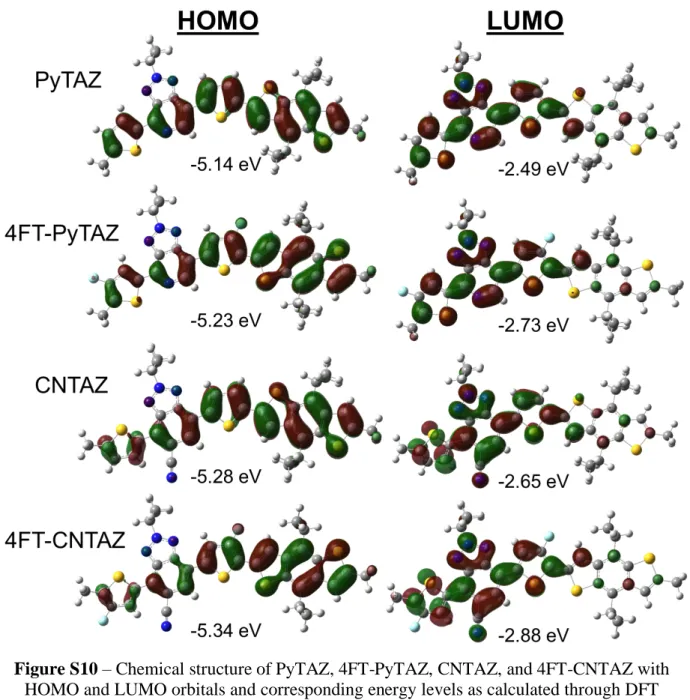
Figure S10 – Chemical structure of PyTAZ, 4FT-PyTAZ, CNTAZ, and 4FT-CNTAZ with HOMO and LUMO orbitals and corresponding energy levels as calculated through DFT
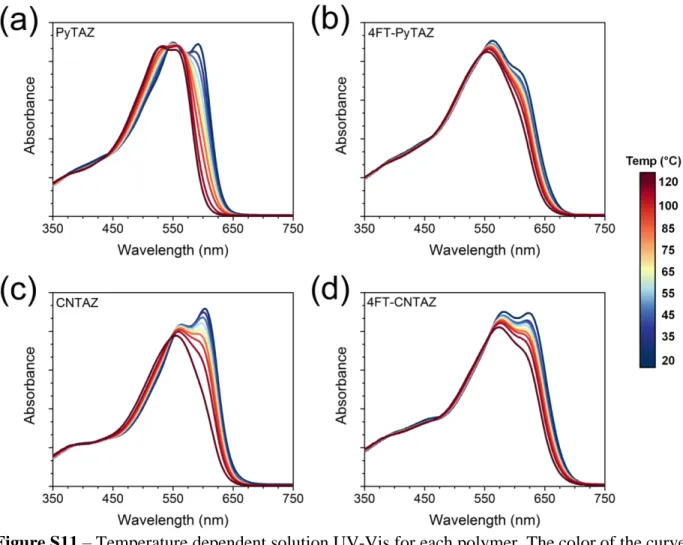
Figure S11 – Temperature dependent solution UV-Vis for each polymer. The color of the curve corresponds to the heat bar legend. (a) PyTAZ, (b) PyTAZ, (c) CNTAZ, and (d)
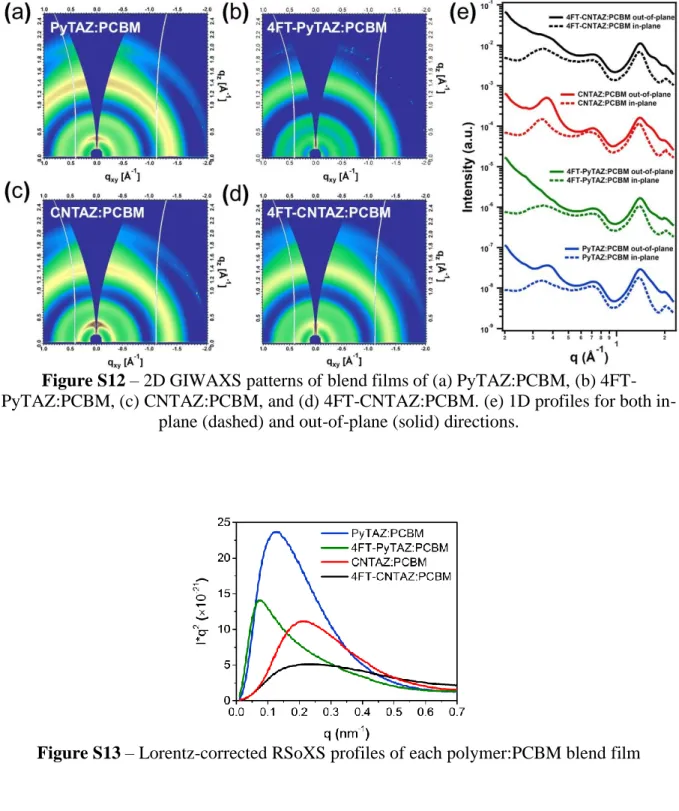
Figure S12 – 2D GIWAXS patterns of blend films of (a) PyTAZ:PCBM, (b) 4FT-PyTAZ:PCBM, (c) CNTAZ:PCBM, and (d) 4FT-CNTAZ:PCBM. (e) 1D profiles for both
in-plane (dashed) and out-of-in-plane (solid) directions.
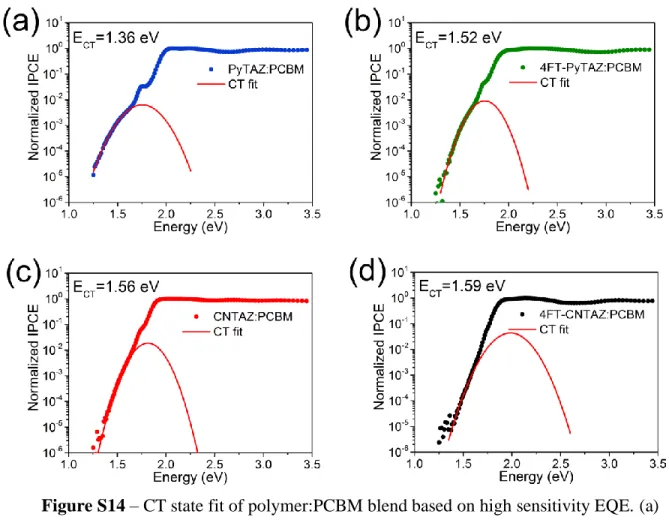
Figure S14 – CT state fit of polymer:PCBM blend based on high sensitivity EQE. (a) PyTAZ:PCBM, (b) 4FT-PyTAZ:PCBM, (c) CNTAZ:PCBM, and (d) 4FT-CNTAZ:PCBM