A customer orientation
checklist: a model
Ana Reyes Pacios Lozano
To become user or customer oriented is a fundamental principle that has renewed and dominates some of the current management trends, such as marketing or total quality. It is based on an organisation's commitment to design and develop products and services that meet its customer needs. The customer is at the centre of the organisation, is the reason for its existence. The relation between the above techniques is so close that marketing is considered an essential component of the methodology that seeks service quality (Solimine, 1995, p. 40).
To work with these techniques, an information unit must be receptive, that is, alert to the changing points of view of the users. Therefore, identifying users,
segmenting them, prioritising them, knowing their main expectations and needs and understanding, prioritising and turning them into service characteristics are all key marketing activities. Thus, the purpose is to adapt at all times the library or information centre to its demands and, consequently, to try and fulfil them.
Although in the last paragraph we have mentioned a number of activities that anyone would relate to a marketing process, the latter may encompass many others. Even more so if we take into account that this is a constantly evolving concept that seeks to reach a better explaining capacity and extend its area of application. After the initial idea that exchange was its main purpose and field of application, in the 1990s more emphasis was placed on the setting of lasting relationships between the company and its customers.
The library, as a non-profit making entity, can and must apply marketing as a
philosophy, and marketing techniques and tools as a function, both in its strategic approach and its day-to-day operation. As it incorporates marketing in its activity, its work will become more satisfactory and efficient, and so will be its relations with all groups involved: customers (both those using and those who may use the library), librarians, suppliers and parent institution.
Some libraries, even if they do not have an established marketing plan, still carry out actions, sometimes unintentionally, leading to the implementation of logical services. The same as companies, they see no point in implementing a service if no one is going to The author
Ana Reyes Pacios Lozanois Profesora Titular del Departamento de BiblioteconomõÂa y DocumentacioÂn, Universidad Carlos III ± Facultad de Humanidades, ComunicacioÂn y DocumentacioÂn, Getafe, Spain.
Keywords
Information services, Customer orientation, Libraries, Library services, Marketing
Abstract
A brief review of the concept connotations in the area of information services is carried out, trying to stress the implications of being ``customer oriented'' as the most important component of marketing. A model to measure the level of the library's orientation toward its market ± as perceived by its managers ± is presented. It was designed taking into account the models that major specialists prepared in order to evaluate marketing activity in companies. It should allow librarians to establish to what extent the library is properly user oriented and, at the same time, what specific marketing-related aspects it is failing in or should improve at.
Electronic access
The current issue and full text archive of this journal is available at
http://www.emerald-library.com
Library Review
Volume 49 . Number 4 . 2000 . pp. 173±178
use it or need it. In this respect, it is
appropriate to quote here a simple definition: ``marketing is 90 per cent common sense'' (Coote, 1994, p. 6). Any activity addressed to detect the needs of the users or any action addressed to fulfil those needs is an aspect of marketing, as are any means implemented to attract new users or to prevent loss of the existing ones. However, some Spanish professionals believe it is necessary to systematically apply some management techniques such as marketing, and this is shown by their experiences (Sanz de Ormazabal, 1992; Salaberri, 1993; PeÂrez Espinosa, 1993; MunÄoz ChoclaÂn, 1996).
Therefore, marketing involves many aspects, the implementation or non-implementation of which may help in measuring to what extent the library is oriented to its users or customers. Actions taken will differ depending on what concept of marketing is used to begin with, and since the 1950s, when this management technique was developed and applied, it has been the subject of many definitions and concepts. New contributions in the 1990s keep the debate about its concept and contents still alive (Llonch Andreu, 1996). It is customary to begin any paper on marketing by
mentioning the definitions and connotations of the concept that have been formulated to date. Here, although we briefly review the concept connotations in the area of information services, we try to stress the implications of being customer oriented as the most important component of marketing. For that purpose, a model has been created whose starting point is the connotations and components identified by specialists in that field and the models they designed to measure to what extent the marketing concept is adopted by companies. Our intention is to use the model to measure to what extent the library is oriented to its market.
Marketing connotations in the area of information services
If we review the literature on marketing applied to information services, we can see that some of its components are present in most works. We list below the most common connotations, whose meanings are so close to each other that sometimes they overlap as different authors have used them as
philosophy, function, management technique, or strategy:
. Customer oriented or focused. Already
explained above. From the initial to current works, the primary interest of marketing is focused on customer needs, finding them out and fulfilling them (Escolar, 1970, p. 24; Valls i Passoiaet al., 1995).
. Library image, or what people think about
it, both outside and inside (Zabala Alonso, 1995). It depends on such things as its staff, its internal organisation, the equipment, and the users, as they tell others about their experiences. For SalauÈn (1992, p. 103), this aspect is the positioning barometer. It is also associated with a pictorial image that identifies the library, a logo.
. Organisational culture, organisational
philosophy, marketing mentality,
understood as a basic attitude before the public and work (Klaassen, 1991, p. 55). Any member of the organisation, regardless of his or her level, must be aware of the importance of the user for its existence, progress and profitability (Shapiro, 1980). This aspect would be linked to the former one, the library image conveyed by its staff.
. Competition. Any organisation providing
products or services similar to those offered by the library might be its competitor. Therefore, the library must know and analyse its competition. The latter is seen from two standpoints: as well as an external reality that may create difficulties to the existence of libraries, it is also seen as a source of inspiration for their own benefit (Coote, 1994, p. 6). Although some authors do take it into account, competition is one of the weakest connotations in library marketing. A recent study shows that today there are some options that are considered as serious competitors of libraries. They are, for example, the large establishments or ``book palaces'' such as FNAC ± attractive and with added values ± or the ``library-cafeÂs'', so much in fashion. To compete with them, libraries need to be more attractive, modern, computerised, encompassing all communication media, with different, comfortable areas, also to interrelate and talk, with culture-related activities
(concerts, theatre, etc.), and with a bar (Artal, 1999).
. Long-term viewor strategic planning. For
any management technique, planning is an essential aspect that facilitates the development of the working processes. All libraries must set themselves a deadline to reach their ideals (Sanz de Ormazabal, 1994, p. 620).
. Evaluation.A tool including the usual
tasks, from the systematic collection of data all the way to the examination and reflection that allows for an objective analysis to be carried out and to establish feasible future targets for the library (Espinas, 1999, p. 32).
. Quality. This is possibly the most recent
connotation. Marketing and quality are so closely linked that the former is considered an essential component of the latter: ``Marketing cannot be separated from quality'' (GarcõÂa-Morales, 1997, p. 36).
Some of the above connotations, which different specialists have linked to marketing, are directly related to the key activities of a marketing process that were already referred to from the very first works (Cronin, 1981; Zachert and Willians, 1986; Wood, 1988): . Market research and segmentation:
identification of actual and potential markets and non-markets within companies.
. Market positioning: prioritising clients, groups and information services. . Customer analysis: determination of
needs and preferences.
. Marketing programme: determination of optimum mix of product, price, delivery mode (place), promotion.
. Marketing audit: evaluation of plan and implementation.
There is a series of repeatedly found connotations that are related ± perhaps too much so ± to one of the most visible aspects of marketing: promotion (Weingaud, 1995, p. 310). This is one of the most obvious and most frequently quoted connotations in marketing, as it coincides with one of the four Ps or policies. It becomes apparent in other activities:
. Communication, to the environment and
within the organisation itself. The role of communication as a component of marketing is illustrated by the following
quotation, which defines it as ``. . .
planned communication: well prepared, appropriate for the audience and focused to project an adequate image'' (Lewis, 1993, p. 65).
. Public relations. They influence
perception, attitude and opinion about the information conveyed. It is associated with marketing as a vehicle for
communication or promotion (ManÄana, 1994, p. 598).
. Publicity. The most important promotion
activity or communication instrument used by marketing (Ramos, 1995, p. 150) and to which it has been excessively linked.
. Dissemination. An aspect that
encompasses the three concepts above, all of them related to the techniques or actions used by marketing.
. Awakening. Specially related to marketing
in public libraries and to activities addressed to very specific sectors, such as literacy campaigns (DõÂez, 1993, p. 20). All these marketing-related aspects stress the activities involved in the implementation of a marketing process and its implications.
Measuring user orientation from a manager's standpoint: a model
Research work carried out by Joan Llonch (1996) shows the need for a company to adopt some method to evaluate its degree of market orientation, so that it may become aware of the importance of increasing it. Its regular, systematic control will lead to the organisation adopting deliberate behaviours to improve it.
The starting point for the development of the model that we are presenting was the models that the major specialists formulated in order to evaluate the marketing activity in companies (Ames, 1970; Kloter, 1977; Lawton and Parasuraman,1980;
Parasuramanet al., 1983; Shapiro, 1988; Narver and Slater, 1990). The questions have been selected and adapted to a library's environment. According to these models, being market oriented essentially means being customer and competitor oriented and having all functions integrated and co-ordinated. This, in libraries, requires an additional effort, as it entails integrating all its resources ± both
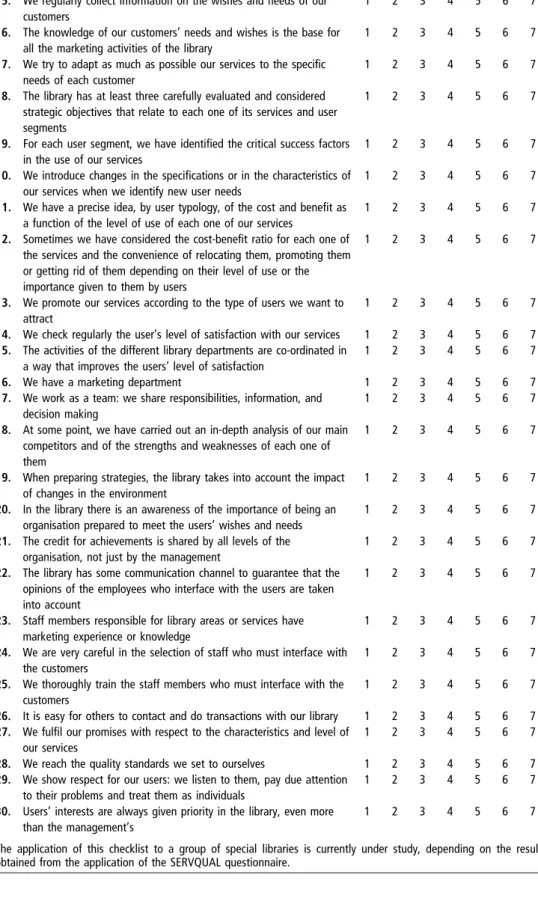
Table IQuestionnaire
1. We apply market segmentation 1 2 3 4 5 6 7
2. We often use market surveys 1 2 3 4 5 6 7
3. We prepare and implement a marketing plan 1 2 3 4 5 6 7
4. We have differentiated offers and different plans for the various user
segments 1 2 3 4 5 6 7
5. We regularly collect information on the wishes and needs of our
customers 1 2 3 4 5 6 7
6. The knowledge of our customers' needs and wishes is the base for
all the marketing activities of the library 1 2 3 4 5 6 7
7. We try to adapt as much as possible our services to the specific
needs of each customer 1 2 3 4 5 6 7
8. The library has at least three carefully evaluated and considered strategic objectives that relate to each one of its services and user segments
1 2 3 4 5 6 7
9. For each user segment, we have identified the critical success factors
in the use of our services 1 2 3 4 5 6 7
10. We introduce changes in the specifications or in the characteristics of
our services when we identify new user needs 1 2 3 4 5 6 7
11. We have a precise idea, by user typology, of the cost and benefit as
a function of the level of use of each one of our services 1 2 3 4 5 6 7 12. Sometimes we have considered the cost-benefit ratio for each one of
the services and the convenience of relocating them, promoting them or getting rid of them depending on their level of use or the importance given to them by users
1 2 3 4 5 6 7
13. We promote our services according to the type of users we want to
attract 1 2 3 4 5 6 7
14. We check regularly the user's level of satisfaction with our services 1 2 3 4 5 6 7 15. The activities of the different library departments are co-ordinated in
a way that improves the users' level of satisfaction 1 2 3 4 5 6 7
16. We have a marketing department 1 2 3 4 5 6 7
17. We work as a team: we share responsibilities, information, and
decision making 1 2 3 4 5 6 7
18. At some point, we have carried out an in-depth analysis of our main competitors and of the strengths and weaknesses of each one of them
1 2 3 4 5 6 7
19. When preparing strategies, the library takes into account the impact
of changes in the environment 1 2 3 4 5 6 7
20. In the library there is an awareness of the importance of being an
organisation prepared to meet the users' wishes and needs 1 2 3 4 5 6 7 21. The credit for achievements is shared by all levels of the
organisation, not just by the management 1 2 3 4 5 6 7
22. The library has some communication channel to guarantee that the opinions of the employees who interface with the users are taken into account
1 2 3 4 5 6 7
23. Staff members responsible for library areas or services have
marketing experience or knowledge 1 2 3 4 5 6 7
24. We are very careful in the selection of staff who must interface with
the customers 1 2 3 4 5 6 7
25. We thoroughly train the staff members who must interface with the
customers 1 2 3 4 5 6 7
26. It is easy for others to contact and do transactions with our library 1 2 3 4 5 6 7 27. We fulfil our promises with respect to the characteristics and level of
our services 1 2 3 4 5 6 7
28. We reach the quality standards we set to ourselves 1 2 3 4 5 6 7 29. We show respect for our users: we listen to them, pay due attention
to their problems and treat them as individuals 1 2 3 4 5 6 7 30. Users' interests are always given priority in the library, even more
than the management's 1 2 3 4 5 6 7
The application of this checklist to a group of special libraries is currently under study, depending on the results obtained from the application of the SERVQUAL questionnaire.
human and material ± and co-ordinating their overall operation, with the purpose of providing more value to customers in a sustained way. Therefore, the model we propose seeks to cover all those aspects and to measure factors such as the degree of customer-market-orientation, the
organisational culture, function integration and co-ordination, long-term view, marketing training, competitor orientation or
information available about the market, and some quality-related aspects. Business-specific questions, such as those addressed to find out the level of profit orientation, which is typical of profit-making organisations, have been disregarded. Others, such the one asking whether a marketing department ± seldom found in libraries ± exists, have not been avoided, and it should be worthwhile evaluating, if appropriate, whether there is a department or section of the library that actually performs those functions, even if amongst others.
These questions would be addressed to the managers or the staff responsible for the various services or departments in the library, so that they may establish to what extent the library ± and its different services in particular ± is properly user oriented and, at the same time, what specific marketing-related aspects it is failing in or should improve. The library's measure of user orientation will be a subjective one if it does not take into account the opinion of its users by means of
established methods (Hart, 1999, p. 92), and therefore the model should be complemented by those opinions. It would be ideal to compare ± for the same period of time ± the results yielded by the questionnaire with the opinions expressed by the users.
Table I is made up of items to which an answer has to be provided by means of a Likert-type scale from 1 to 7, where l means that the person answering the questionnaire does not agree at all with the question or statement, whilst 7 indicates full agreement with it. This provides for an overall mark
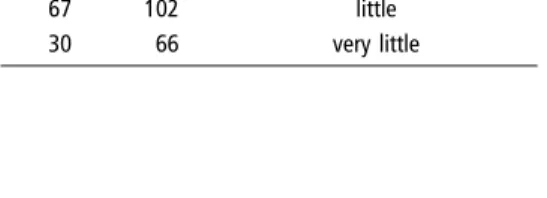
ranging from a minimum of 30 and a maximum of 210. This grand total, after all items have been evaluated, will provide an indication of the marketing efficiency according to the scale shown in Table II.
References
Ames, Ch.B. (1970), ``Trappings vs substance in industrial marketing'',Harvard Business Review, Vol. 48, pp. 93-102.
Artal, C. (1999),La Biblioteca PuÂblica vista por los ciudadanos: Informe del Estudio Realizado en tres Ciudades, 1998/99, FundacioÂn Berstelsmann, Barcelona.
Coote, H. (1994),How to Market your Library Service Effectively: and Enjoy it in the Process, Aslib, London
Cronin, B. (Ed.) (1981),The Marketing of Library and Information Services, Aslib, London.
DõÂez Hoyo, C. (1993), ``AplicacioÂn del marketing a servicios de informacioÂn'', inPonencias de las Jornadas de DocumentacioÂn, tecnologõÂa y cultura, DiputacioÂn, Valencia, pp. 15-34.
Escolar, H. (1970),Marquetin para bibliotecarios, ANABA, Madrid.
Espinas, E. (1999), ``Datos e indicadores herramientas del marketing'',EducacioÂn y Biblioteca, Vol. 100, pp. 31-33.
GarcõÂa-Morales Huidobro, E. (1997), ``Marketing en bibliotecas'',EducacioÂn y biblioteca, Vol. 78, pp. 33-7.
Hart, K. (1999),Putting Marketing Ideas into Action, Library Association Publishing, London. Klaassen, U. (1991), ``Marketing de biblioteca'', inLa
Biblioteca PuÂblica Como Centro de GestioÂn Cultural, Fundacio Biblioteca d'ÂAlcuÂdia, Alcudia, Mallorca, pp. 55-64.
Kloter, P. (1977), ``From sales obsession to marketing effectiveness''.Harvard Business Review, Vol. 55 No. 6, pp. 67-75.
Lawton, L. and Parasuraman, A. (1980), ``The impact of the marketing concept on new product planning'', Journal of Marketing, Vol. 44, pp. 19-25. Lewis, M. (1993), ``Marketing i publicitat per a arxivers'',
Lligall, Vol. 7, pp. 65-76.
Llonch A.J. (1996), ``¿CoÂmo medir el grado de orientacioÂn de la empresa al mercado?'', ESIC-MARKET, julio-septiembre, pp. 459-79.
ManÄana Vazquez, E. (1994), ``Las teÂcnicas de la comunicacioÂn: el megamarketing'', inIV Jornadas espanÄolas de documentacioÂn automatizada. Universidad de Oviedo, Asturias, pp. 595-600. MunÄoz ChoclaÂn, J. (1996), ``AplicacioÂn de los principios de
marketing en las bibliotecas puÂblicas'', inIX Jornadas bibliotecarias de AndalucõÂa, AsociacioÂn Andaluza de Bibliotecarios, Granada, pp. 74-9. Narver, J.C. and Slater, S.F. (1990), ``The effect of a
market orientation on business profitability'', Journal of Marketing, pp. 20-35.
Parasuraman, A., Berry, L.L. and Zeithaml, V.A. (1983), ``Service firms need marketing skills'',Business Horizons, Vol. 26 No. 6, pp. 28-31.
Table IIResults scale
From To Agreement level
175 210 very much
139 174 quite
103 138 medium
67 102 little
PeÂrez Espinosa, J.C. (1993), ``AplicacioÂn de la filosofõÂa de marketing a los centros de documentacioÂn''. DocumentacioÂn de las Ciencias de la InformacioÂn, Vol. 16, pp. 241-6.
Ramos SimoÂn, L.F. (1995),DireccioÂn, AdministracioÂn y marketing de empresas e instituciones documentales, Sintesis, Madrid.
Salaberri, I. (1993), ``GestioÂn estrateÂgica y marketing'', in V Jornadas Bibliotecas PuÂblicas, AsociacioÂn de Bibliotecarios y Documentalistas de Gipuzcoa, San SebastiaÂn, pp. 103-15.
SalauÈn, J.M. (1992),Marketing des bibliotheÂques et des centres de documentation, editions du Cercle de la Librarie, Paris.
Sanz de Ormazabal, I. (1992),Marketing bibliotecario. Estudio de mercado Biblioteca Municipal de RenterõÂa, Ayuntamiento de RenterõÂa, San SebastiaÂn. Sanz de Ormazabal, I. (1994), ``Marketing de servicios de
informacioÂn'', inIV Jornadas espanÄolas de documentacioÂn automatizada, Universidad de Oviedo, Asturias, pp. 617-24.
Shapiro, B.P. (1988), ``What the hell is market oriented?'', Harvard Business Review, Vol. 66 No. 6, p. 119-25.
Shapiro, S.J. (1980), ``Marketing and the information professional. Odd couple or meaningful relationship?''Special Libraries, Vol. 71 Vol. 11, pp. 469-74.
Solimine, G. (1995), ``A partire dal cliente'',Biblioteche oggi, XII, Vol. 2, pp. 40-4.
Valls i Passoia, A.et al. (1995), ``LÂorientacio dels serveis vers els usuaris a les biblioteques universitaÁries'', in 5es. Jornades Catalanes de DocumentacioÂ, Barcelona, pp. 279-80.
Weingaud, D.E. (1995), ``Preparing for the new millenium: the case for using marketing strategies'',Library Trends, Vol. 43 No. 3, pp. 295-317.
Wood, E.J. (1988),Strategic Marketing for Libraries: A Handbook, Greenwood Press, New York, NY. Zabala Alonso, J. (1995), ``La imagen del servicio
bibliotecario. Aportaciones del marketing a la identidad de la biblioteca'',AABADOM, Vol. 1, pp. 5-12.
Zachert, M.J. and Willians, R.V. (1986), ``Marketing measures for information services'',Special Libraries, Vol. 77 No. 1, pp. 61-70.