october . ISSUe 2013:17ep a
European Policy Analysis
* Kristine Kern is Professor at the Department of Economic and Social Sciences, University of Potsdam and Leibniz Institute for Regional Development and Structural Planning (IRS); and Associate Professor in Public Administration at the Department of Political Science, Åbo Akademi University.
Stefan Gänzle is Associate Professor at the Department of Political Science and Management, University of Agder.
1 Whereas the EUSBSR targets eight EU member and two non-member states, the EUSDR brings together
nine EU member states and five accession, candidate and partner countries (and subnational authorities thereof) of the European Neighbourhood Policy (ENP): Germany (i.e. Baden-Wuerttemberg and Bava-ria), Austria, Hungary, the Czech Republic, the Slovak Republic, Slovenia, Bulgaria, Romania, Croatia, Serbia, Bosnia-Herzegovina, Montenegro, as well as Moldova and the south-western part of Ukraine. The macro-regional strategies for the Ionic-Adriatic addresses Albania, Bosnia-Herzegovina, Croatia, Greece, Italy, Montenegro, Serbia and Slovenia; the Alpine Strategy targets France, Italy, Germany, Switzerland, Lichtenstein, Austria and Slovenia.
Kristine Kern and Stefan Gänzle*
Towards Cruising Speed?
Assessing the EU Strategy for the Baltic Sea Region
Abstract
In 2009, the European Union launched its first macro-regional strategy, the EU Strategy for the
Baltic Sea Region (EUSBSR). By providing a reference framework for functional cooperation in
areas such as the environment, economic development and transport infrastructure, macro-regional
strategies seek to support both the treaty-based principle of territorial cohesion and the
implemen-tation of EUROPE 2020 at a macro-regional scale. In contrast to other EU programmes of
terri-torial cooperation, macro-regional strategies pursue three objectives: first, to create an integrated
framework across policy sectors at all levels of EU governance; second, to involve supranational,
national and subnational actors – public and private alike; third, to develop a common platform for
EU member states and non-EU partner countries. In light of the upcoming new Multiannual
Finan-cial Framework of the European Union (2014–2020), this paper provides a thorough assessment of
the Strategy’s main achievements and shortcomings. Although the EUSBSR has made significant
progress since its inception, some important issues – particularly those related to governance
archi-tecture, political leadership and the added value of the Strategy – still remain to be tackled.
1 Introduction
The EU Strategy for the Baltic Sea Region (EUSBSR) of 2009 is – in the words of the EU Commissioner for Regional Policy, Johannes Hahn – the first macro-regional strategy designed to serve as a “new model for co-operation” and “to inspire other regions” (Hahn, 2010) in Europe. From this perspective, the EUSBSR has certainly provided some “inspirational successes”,
almost triggering a veritable “macro-regional fever” (Dühr, 2011, 3) amongst EU members and partner countries, and pushing the number of countries soon-to-be participating in macro-regional strategies to twenty-nine.1 It was in June 2011, under the Hungarian
Council Presidency, that the European Council endorsed the EU Strategy for the Danube Region (EUSDR), and eventually, on December 14, 2012,
the European Council called upon the Commission to elaborate “subject to the evaluation of the concept of macro-regional strategies […] a new EU Strategy for the Adriatic and Ionian region before the end of 2014” (European Council, 2012, 11). Finally, in May 2013, the European Parliament adopted a resolution in support of an Alpine macro-regional strategy (European Parliament, 2013). Deliberations among concerned countries, regions and stakeholders are currently underway, and the European Council meeting in December this year is expected to generate a mandate for the Commission to prepare such a strategy.
“Macro-regions”: According to a definition put forth by the then EU Commissioner for Regional Policy Pawel Samecki, macro-regions cover “an area including territory from a number of different countries or regions associated with one or more common features or challenges” (European Commission, 2009). The EU Strategy for the Baltic Sea Region, which targets eight EU member states (Sweden, Denmark, Estonia, Finland, Germany – i.e. Hamburg, Schleswig-Holstein and Mecklenburg-Vorpommern – Latvia, Lithuania and Poland), as well as two “partner countries” (the Russian Federation and Norway) of north-east Europe, can almost be conceived as an EU internal strategy. Conversely, the EU Strategy for the Danube Region is far more diverse, exhibits a strong external focus and covers fourteen countries altogether – from the source of the river to its estuary.
“Macro-regional strategies”: These can henceforth be conceived “as a tool of European integration and increased territorial cohesion and […] a way to promote the territorial dimension of EU policies and cooperation” (Dubois et al., 2009, 10) as they seek to draw functional cooperation and territorial cohesion closer together. In a nutshell, macro-regional strategies, which seem to be “built around a multi-level governance approach, since there are an immense number of stakeholders in the game” (Reinholde, 2010, 51), primarily aim to improve coordination amongst stakeholders and policies at the “macro-regional level” in order to increase vertical and horizontal coherence of policies across a specified number of sectors as well as coordination with other actors and organisations. Moreover, especially in light of the ongoing economic and financial crisis in the European Union, macro-regional strategies can also be perceived as potential tools for forging economic growth and development,
and thus constitute a supporting instrument for the implementation of EUROPE 2020 objectives at a macro-regional level. Furthermore, the increasing heterogeneity of the EU after several rounds of enlargements as well as the new objective of territorial cohesion, enshrined in Art. 174 TEU, have contributed to the emergence of macro-regional strategies. The establishment of macro-regions themselves is driven by intrinsic characteristics, such as their biophysical features, increasing economic interdependencies among the territories within the region, and a common historical and cultural heritage.
In its recent assessment of the added value of macro-regional strategies, the European Commission has stated that a macro-regional strategy: “(1) is an integrated framework relating to member states and third countries in the same geographical area; (2) addresses common challenges; (3) benefits from strengthened cooperation for economic, social and territorial cohesion” (European Commission, 2013a, 3). The concept is based on the principles of:
• integration of existing policy frameworks, programmes and financial instruments;
• coordination between sectorial policies, actors or different tiers of government;
• cooperation between countries and sectors;
• multi-level governance involving policy-makers at different levels of governance;
• partnership[s] between EU member states and non-member countries (see European Commission, 2013a, 3).
In other words: “Macro-regional strategies provide regional building blocks for EU-wide policy, marshalling national approaches into more coherent EU-level implementation” (European Commission, 2013a, 5).
Almost four years after the endorsement of the Strategy in October 2009, implementation of the “macro-regional project” is most advanced in the Baltic Sea Region (BSR). Furthermore, the prospects of advancing the macro-regional project in the region are quite advantageous: Lithuania has declared the EUSBSR to be one of the main objectives of its Presidency of the EU Council in the second half of 2013. In addition, the imminent prospect of Latvia’s EU Council Presidency in 2015 provides even more potential for sustaining a good momentum for a “Europe of macro-regions”
(Lithuanian EU Council Presidency, 2013, 9) in general, and the EUSBSR in particular. With the results of the Commission’s evaluation of macro-regional strategies in mind (European Commission, 2013a), and in the midst of the negotiations of the new Multiannual Financial Framework perspective of the EU, it is now about time to evaluate the macro-regional idea and, in particular, its application and implementation in the BSR. Our paper pursues five core goals: (1) to analyse the evolvement of the EUSBSR’s governance architecture in light of the so-called “three No’s” (in short, no new institutions, legislation or funding to be made available for the implementation of macro-regional strategies) declared in 2009; (2) to grasp its impact on existing and well-established organisations of regional cooperation, e.g. HELCOM; (3) to discuss the role of subnational authorities and civil society in the EUSBSR; (4) to assess the external impact of the Strategy; and (5) to examine the implications for macro-regional strategies vis-à-vis the new financial perspective for the period 2014 to 2020. Finally, the concluding section discusses the major achievements and shortcomings of the EUSBSR thus far. Although the EUSBSR has not led to new institutions, new legislation or new funding, the analysis demonstrates that it has generated a governance architecture sui
generis that has started to affect existing institutions
at the macro-regional level, EU legislation and BSR funding schemes.
2 The development of the EU Strategy for the Baltic Sea Region and its governance architecture
Collaboration in the BSR is deeply entrenched in a long historical trajectory of regional – or, for that matter, macro-regional – cooperation dating back to the Hanseatic era and, more recently, the formation of international regimes and organisations, such as the Helsinki Commission, developed to combat ecological degradation of the Baltic Sea, even during the East-West conflict. Obviously, EU cross-border, transnational and interregional cooperation programmes are a rather new phenomenon, as most of the Baltic Sea riparian countries have only been members of the EU since 2004 (with the sole, but important exception of the Russian Federation). Yet, it was already at the beginning of the 1990s that the European Commission issued its “Europe 2000” report on the future of the then European Community’s territory, endorsing the idea of “regional groupings”; as one example thereof, the Baltic Sea Region was singled out (European
Commission, 1991, 55ff.). Toward the end of the 1990s, collaboration amongst riparian countries in the BSR was eventually captured under the label of Europe’s “new sub-regionalism” (Cottey, 1999; Antola, 2009, 21ff.). Since then, the established track record in cooperative efforts across various levels of governance has been complemented by EU approaches toward the region, ranging from the “Union Approach towards the Baltic Sea Region” of October 1994 until, most recently, the EUSBSR (see Herolf, 2010, 6ff.).
The Strategy for the Baltic Sea Region started life in the European Parliament. A Euro-Baltic Intergroup consisting of MEPs from member states in the BSR presented the Strategy to European Commission President José Manuel Barroso in 2005. The core idea of the initiative was to maximise the potential of the reunited BSR (see Beazley, 2007), and to lobby for a consolidated EU pillar of Baltic Sea states within the Northern Dimension (ND). Following a mandate by the European Council (2007), the European Commission subsequently took up the initiative and quite considerably deemphasised the external dimension of the Parliament’s original proposal.
A public consultation process among different stakeholders in the region took place between August 2008 and February 2009 (see Bengtsson, 2009, 3; Rostoks, 2010, 15ff.). Schymik and Krumrey conclude that “the European Commission has by and large been able to draft an Action Plan that captures the essence of public opinion in the region” (2009, 15). This particular instrument of stakeholder participation was perpetuated by a so-called annual forum for the EUSBSR, the first of which was held in Tallinn in 2010; annual fora in Gdansk (2011), Copenhagen (2012) and Vilnius (2013) followed suit. By bringing both policymakers and stakeholders together, these meetings provided a platform for networking, discussions and exchange of views about the Strategy and its implementation. Eventually the EU Strategy for the Baltic Sea Region, presented by the European Commission in June 2009, was adopted by the European Council in October that year. The Strategy was based on the assumption that macro-regional strategies would: (1) not create new institutions, but would be supported by a multilevel, multi-actor and multi-sector governance approach; (2) not generate new legislation for developing and implementing macro-regional strategies, but would be driven by action plans and their regular updates; and
(3) not lead to new funding schemes, but would be based on the need to utilise and combine the already existing schemes (European Commission, 2013b, 10). The EUSBSR was accompanied by an Action Plan which proposed the establishment of four pillars. The Strategy aimed to: (1) improve the environmental state of the Baltic Sea; (2) promote more balanced economic development in the region; (3) make the region more accessible and attractive; and (4) make it a safer and more secure place. These areas have been broken down into fifteen different so-called Priority Areas (PAs), and have been assigned a set of highly relevant projects (also known as flagship projects), which served as a showcase for the EUSBSR. The Action Plan was conceived as a rolling plan, which implied that it was designed in order to quickly absorb “lessons learnt”; as such, it was revised in 2010 and 2013 (European Commission, 2013c). As a result, the original four overall pillars of the Strategy have been reduced to three objectives. As the number of priority areas rose from 15 to 17 at the same time, it is “doubtful whether the Strategy will in practice become more focused and more effective” (Etzold, 2013, 11). However, the horizontal actions (cross-cutting themes) have been reduced quite significantly from 13 to 5.
Following an interim implementation report in 2010, the first major report was drawn up in June 2011. The Commission found that the EUSBSR’s overall impact had been successful; in particular, it “has led to concrete action, with a more streamlined use of resources. New working methods and networks have been established, and many initiatives developed” (European Commission, 2011, 3). Clearly, as the EUSBSR was launched in the midst of the 2007–13 funding period, a great deal of financial resources had already been earmarked for other projects. Still, a number of new projects were launched, such as the “Baltic Deal” whereby members would work “with farmers across the Region to reduce nutrient run-off, and therefore eutrophication” (European Commission, 2011, 2). This project is often referred to as a model case for enhancing awareness across different policy sectors and communities.
Finally, the European Commission carried out an evaluation exercise in 2013 which taped on an extensive survey of over 100 key stakeholders, as well as independent assessments by external experts. The evaluation concludes that macro-regional strategies have triggered clear results “evident in terms of projects and more integrated policy making, although further improvements are essential in implementation and planning” (European Commission, 2013a, 11). At the same time, the document also identifies a set of problems, in particular the lack of leadership in some corners of the macro-region. While a lack of administrative capacities and national resources may account for political disinterest in some countries, the complexities of the EUSBSR’s governance architecture have not helped to make either EU members or partner countries wholeheartedly hail the new initiative.
3 Assessing the EU Strategy for the Baltic Sea Region
3.1 Evolvement of the EUSBSR governance architecture
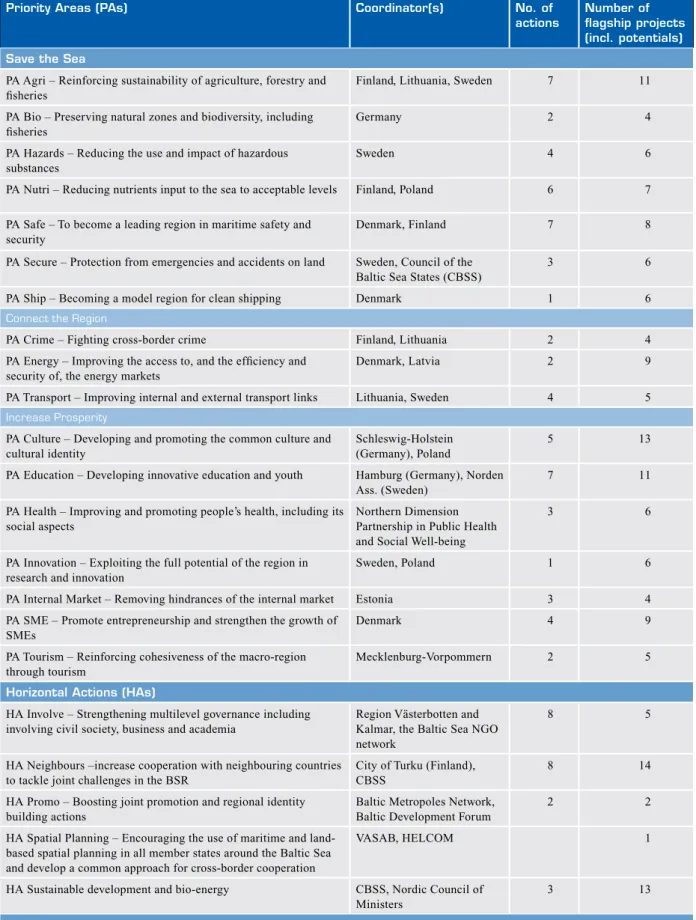
Following the revisions introduced in the Action Plan of February 2013, the EU Strategy for the Baltic Sea Region subscribes to three core objectives, which focus on environmental protection (“Save the Sea”), economic development (“Increase Prosperity”) and improvement of the infrastructure (“Connect the Region”). The three overall objectives are now linked to seventeen priority areas (PAs) – for instance, biodiversity (PA “Bio”) or innovation (PA “Innovation”) – and complemented by five horizontal actions (e.g. HA “Neighbours” or HA “Spatial Planning”) that cut across various policy areas. Different member states or organisations are responsible for the PAs and the HAs. Several organisations operating at the macro-regional level – for instance, the Council of the Baltic Sea States (CBSS), the Helsinki Commission (HELCOM) and Vision and Strategies around the Baltic Sea (VASAB) – actively take part in the implementation of the Strategy as either Priority Area Coordinators (PACs), such as CBSS for PA “Secure”, or Horizontal Action Leaders (HALs), such as VASAB and HELCOM for HA “Spatial Planning” (see Table 1).
Table 1: Priority Areas (PAs) and Horizontal Actions (HAs) of the EU Strategy for the Baltic Sea Region
Priority Areas (PAs) Coordinator(s) No. of
actions Number of flagship projects (incl. potentials) Save the Sea
PA Agri – Reinforcing sustainability of agriculture, forestry and fisheries
Finland, Lithuania, Sweden 7 11 PA Bio – Preserving natural zones and biodiversity, including
fisheries
Germany 2 4
PA Hazards – Reducing the use and impact of hazardous substances
Sweden 4 6
PA Nutri – Reducing nutrients input to the sea to acceptable levels Finland, Poland 6 7 PA Safe – To become a leading region in maritime safety and
security
Denmark, Finland 7 8
PA Secure – Protection from emergencies and accidents on land Sweden, Council of the Baltic Sea States (CBSS)
3 6
PA Ship – Becoming a model region for clean shipping Denmark 1 6 Connect the Region
PA Crime – Fighting cross-border crime Finland, Lithuania 2 4 PA Energy – Improving the access to, and the efficiency and
security of, the energy markets
Denmark, Latvia 2 9
PA Transport – Improving internal and external transport links Lithuania, Sweden 4 5 Increase Prosperity
PA Culture – Developing and promoting the common culture and cultural identity
Schleswig-Holstein (Germany), Poland
5 13
PA Education – Developing innovative education and youth Hamburg (Germany), Norden Ass. (Sweden)
7 11
PA Health – Improving and promoting people’s health, including its social aspects
Northern Dimension Partnership in Public Health and Social Well-being
3 6
PA Innovation – Exploiting the full potential of the region in research and innovation
Sweden, Poland 1 6
PA Internal Market – Removing hindrances of the internal market Estonia 3 4 PA SME – Promote entrepreneurship and strengthen the growth of
SMEs
Denmark 4 9
PA Tourism – Reinforcing cohesiveness of the macro-region through tourism
Mecklenburg-Vorpommern 2 5
Horizontal Actions (HAs)
HA Involve – Strengthening multilevel governance including involving civil society, business and academia
Region Västerbotten and Kalmar, the Baltic Sea NGO network
8 5
HA Neighbours –increase cooperation with neighbouring countries to tackle joint challenges in the BSR
City of Turku (Finland), CBSS
8 14
HA Promo – Boosting joint promotion and regional identity building actions
Baltic Metropoles Network, Baltic Development Forum
2 2
HA Spatial Planning – Encouraging the use of maritime and land-based spatial planning in all member states around the Baltic Sea and develop a common approach for cross-border cooperation
VASAB, HELCOM 1
HA Sustainable development and bio-energy CBSS, Nordic Council of Ministers
3 13
Each priority area is coordinated by administrative managers from different member states and organisations participating in the Strategy – the so-called PACs. PACs assume a managerial role in the implementation of the Strategy; they create ideas and support the implementation of the EU structural policy in the macro-region alongside HALs.
Whilst steering groups have been established in the EU Strategy for the Danube Region from the beginning, bringing together various interested stakeholders, these committees are still in the process of being put together in the BSR. Hence, the delivery of the strategies very much depends on the willingness and capacities of participating states. EU member states also operate the network of National Contact Points (NCPs), which assist and coordinate the implementation of the strategies at the national level. By and large, the commitment and willingness of member states to (re-) allocate national resources for the aims of the strategies are decisive. In addition, participating countries’ public management traditions vary considerably, and thus influence the effective implementation of the strategies; an institutional basis is therefore required at the national level so as to generate a certain degree of convergence among countries.
Apart from the increasing visibility of the member states in this process, the Commission has maintained an important role. It is, together with the EU member states in the BSR, the driving force behind the policy process leading toward the successful implementation of the strategies. It assumes an important role in preparing strategy reviews, monitoring its implementation and leading the overall coordination of the rolling Action Plan.
Participating states are linked to policy formulation by the so-called High Level Group (HLG), which also brings together all other member states at the EU level. EU member states that are not part of a given macro-region, however, do not actively participate in the HLG meetings (Interview with HAL, June 30, 2013). Perhaps this will change when an increasing number of EU member states are engaged in macro-regional strategies.
3.2 Impact on international organisations and conventions at the macro-regional level Although the establishment of new institutions within the framework of EU macro-regional strategies is not
intended, the strategies do affect the existing institutions and stimulate new forms of institutional interplay; in other words, macro-regional strategies need to be embedded in already existing institutions operating at the macro-regional level. The institutional interplay with such organisations and conventions appears to be very important for the implementation of the Strategy itself, e.g. for the establishment and implementation of priority areas and flagship projects. Ultimately, these forms of coordination and institutional interplay across several layers of EU governance are very much in line with the “White Paper on Multilevel Governance” (2009) developed by the Committee of the Regions: “The coordinated action of the various levels of government, on the one hand, and the coordination of policies and instruments, on the other hand, are vital to improve European governance and the implementation of Community strategies” (Committee of the Regions, 2009, 21).
Amongst the most important institutions at a macro-regional level in the BSR are CBSS and HELCOM. Although the European Union joined the Helsinki Convention as early as 1992, its influence on marine governance in the BSR has remained rather limited thus far. In turn, the Commission’s influence was also rather marginal in the Council of Baltic Sea States, which was established in 1992 (Etzold, 2010) with the aim of building trust and security, and coping with the region’s challenges after the end of the Cold War. Now, however, the EUSBSR provides the European Commission with a central, if not policy entrepreneurial, role in its own decision-making, and with EU member and partner countries much more relegated to matters of implementation. It is also evident that the Commission enjoys the role of a watchdog with regards to policy coherence.
The CBSS deals with concrete joint regional challenges, problems, opportunities and interests, but places no more emphasis on the high political side than is necessary. Such pragmatic functional regional cooperation could have a positive impact at high political levels, where the cooperation between EU member states and Russia is more difficult. The CBSS has outstanding expertise in issue areas such as civil security (for example, children at risk, trafficking in human beings, and radiation and nuclear safety), maritime economy and sustainable development. By involving Russia and the EU (European Commission / European External Action Service) as equal members,
and being involved in the Northern Dimension and the EUSBSR, the CBSS is in a favourable position to provide a platform for cooperation at the intersection of EU internal and external policies. The CBSS plays a unique role in integrating Russia in regional cooperation, and provides a relevant link between Russia and the EU. In this respect, the South Eastern Baltic Area (SEBA) modernisation partnership and the Northwest Strategy of Russia (in which the CBSS is closely involved) also have an important function. The environmental objectives of the EUSBSR in general, and the priority areas of this area in particular, overlap with the core tasks of HELCOM, the executive body of the Helsinki Convention, which was set up in 1974 to foster international environmental cooperation in the region. HELCOM’s main goal is to protect the marine environment of the Baltic Sea from all sources of pollution, and to restore and safeguard its ecological balance. After the convention was updated and broadened in scope, it was signed in 1992 and entered into force in 2000. The HELCOM Baltic Sea Action Plan (BSAP) (HELCOM, 2007) was adopted in 2007 and has since established the framework for action (Kern, 2011).
Consequently, the EUSBSR provides regional organisations with the opportunity to embed their activities in a wider strategic design and broader institutional framework; meanwhile, the EU might be able to benefit from the regional experience and expertise that these bodies have accumulated over time. Hence, the Council of the EU encouraged member states to further investigate:
“[the] synergy effects between the EUSBSR and multilateral cooperation structures and networks within the Baltic Sea Region [...] through better co-ordination and effective use of communication channels and for a related to EUSBSR and Baltic Sea Region to provide increased efficiency of intervention within macro region” (Council of the European Union, 2011, 5)
The institutional interplay and the resulting synergies between HELCOM’s Baltic Sea Action Plan (BSAP) and the EUSBSR are evident in the EU Strategy’s recommendation for the implementation of the BSAP (European Union, 2010, 144ff.); it can be argued therefore that the EUSBSR supports the implementation
of a cross-sectorial approach to environmental issues laid down in the BSAP. This has improved HELCOM’s position, as well as the implementation of BSAP, which had been hampered by the influence of sectorial interests because they were seen as negatively affecting the implementation of an integrative ecosystem approach (European Commission, 2013a, 5). The development of individual priority areas shows that there is now a direct link between the EUSBSR and existing international organisations such as HELCOM. For the implementation of Priority Area 2 (natural zones and biodiversity), for example, HELCOM provides the technical and scientific framework (indicators and targets) for the implementation of EU Directives (EUSBSR News, May 2012, 5).
Macro-regional strategies are rather more law-shaping than law-making (Schymik, 2011, 17). However, the analysis of existing environmental legislation, such as the Water Framework Directive (WFD, 2000/60/EC) and the Marine Strategy Framework Directive (MSFD, 2008/56/EC) on the one hand, and the EUSBSR on the other, shows the interplay between the Strategy and EU legislation. Although the EUSBSR has not created new legislation, it aims to improve the implementation of existing EU legislation (European Union, 2010). The synergies resulting from the institutional interplay between the EU and HELCOM are striking. While HELCOM is in a position to influence decision-making in Brussels, the EU can similarly utilise HELCOM as a regional environmental protection agency of sorts. Thus, it can be argued that the EU has started to co-op existing institutions so as to implement EU legislation. Furthermore, the European Commission maintains the important role of controlling the EU legislation that is implemented in the macro-regions. The case of the MSFD shows the impact of macro-regional strategies on the institutional interplay between international institutions such as HELCOM and EU institutions. The MSFD has been built on the experience of HELCOM’s BSAP, and the Commission uses the macro-regional approach to systematically improve the implementation of HELCOM guidelines that have thus far been only politically binding. While HELCOM recommendations require a consensus among the cooperating countries and lack formal enforcement powers, most EU directives are decided on the basis of a qualified majority, are binding after transposition into national law and are also subject to the infringement procedure for EU member states (Wenzel, 2011; van Leeuwen/Kern, 2013).
2 Concerning the question if the impact of the EUSBSR has improved coordination with local authorities,
six PACs/HALs remained neutral, nine (strongly) disagreed and four did not make any comments (see Gänzle/Wulf, 2013).
3.3 Involvement of subnational authorities and civil society
Macro-regional strategies provide new political opportunities for subnational authorities and civil society. If subnational authorities establish transnational networks, for example, they can develop into constitutive elements of macro-regions. In the BSR, institutional capacities are well established, as demonstrated by the 100-member-strong Union of the Baltic Cities (UBC) and the Baltic Metropoles Network, both of which play an active role in the implementation of EUSBSR. They have a long history of cooperation and are relatively well-equipped. The main goals of such transnational networks are: (1) representation and lobbying in the macro-region, but also in Brussels; (2) the funding of joint projects of member organisations by membership fees or EU funding; and (3) the exchange of experiences, transfer of best/good practice and learning among their members (Kern, 2013). In the BSR, cooperation between Hanseatic cities, and in particular the twinning relationships between these cities, even survived the Cold War period. The UBC was soon complemented by a network of sub-regional authorities: the Baltic Sea States Sub-sub-regional Cooperation (BSSSC). It can be expected that networks, which are often based on sister-city agreements (Kern, 2001), have a positive impact on the implementation of macro-regional strategies.
In a few priority areas, subnational governments serve as coordinators. In the case of the EUSBSR, for example, Mecklenburg-Vorpommern (Germany) is in charge of the PAC focussing on tourism. Interestingly, Brandenburg – which was not yet part of the established group set of Germany’s Baltic länder (i.e. Hamburg,
Schleswig-Holstein and Mecklenburg-Vorpommern) – has declared its interest to join the EUSBSR (Interview with German official, June 12, 2013). Moreover, city initiatives have become essential for the implementation of the EUSBSR, in particular the so-called Turku Process. This collaborative process was initiated by the City of Turku and the Regional Council of Southwest Finland in 2010, based on the continued cooperation between Turku and St. Petersburg, and stimulated by the start of the EUSBSR and HELCOM initiatives. It adds the expertise and knowledge of local authorities to the EUSBR process. Today, the process is coordinated
by three partners: the City of St. Petersburg, the City of Hamburg and the City of Turku-Region (together with the Region of South-West Finland) (EUSBSR News, March 2013, 5).
Despite these positive trends, such as the above-mentioned Turku process, shortcomings persist in the implementation of the EUSBSR when it comes to the integration of local and regional authorities. This is deplorable, since these actors could assume an essential role in the implementation of macro-regional initiatives. Regions, cities and their associations could serve as PACs, who help to implement specific projects that require the cooperation of actors from different levels, and which need alignment of EU and macro-regional approaches on the one hand with national and subnational policies on the other (European Commission, 2013b, 15). A recent online survey conducted amongst PACs and HALs of the BSR found that only very few representatives from municipalities had become members of steering groups thus far (Gänzle/Wulf, 2013). In the same survey, only one (out of 20 participating) PAC/HALs conceded that coordination with local authorities is efficient and effective in the context of the Strategy.2
Moreover, the EUSBSR paves the ground for a trend toward transnationalisation of the region’s civil society. The BSR, for example, has developed into a highly dynamic area of cross-border cooperation and transnational networking (Kern, 2001; Kern/ Löffelsend, 2008; Kern, 2011) that includes not only cities and subnational regions, but also non-governmental organisations covering the whole macro-region. As macro-regional governance is not restricted to the nation-states, this requires the institutionalisation of new forms of cooperation and collaboration at the macro-regional scale.
Transnational institutions are a constitutive element of macro-regions, and include hybrid arrangements of governmental and non-governmental actors (Joas et al., 2007). There are three types of transnationalisation: (1) the emergence of transnational networks and institutions such as the Coalition Clean Baltic; (2) the transnationalisation of existing international and intergovernmental organisations that provide access to
decision-making for non-governmental and subnational actors; and (3) the establishment of new transnational institutions that are based on a multi-stakeholder approach and promote the participation of civil society from the outset (Kern/Löffelsend, 2008). The combination of these three forms provides options for the direct involvement of stakeholders and the public at the macro-regional level. This development opens new opportunities, but it also leads to new challenges, because stakeholder participation in macro-regions faces the same legitimacy and accountability problems as stakeholder participation at the global level. Due to a lack of capacities, stakeholder participation – for example, in the annual forums on the macro-regional strategies – seems to be limited to a small number of organisations who have sufficient capacities to participate in such events (Kodric, 2011). However, the Horizontal Action INVOLVE (Strengthening multilevel governance including involving civil society, business and academia) aims at pan-Baltic organisations and include experts from NGOs, in particular the Baltic NGO Network, in the preparation and implementation of the EUSBSR. This requires capacity building, which will enable members of this network to cooperate transnationally (European Commission, 2013c, 152). 3.4 External relations: the case of Russia Since the EUSBSR is based on activities of mutual interest to EU member states and neighbouring countries, close cooperation with non-member countries, in particular Russia, is required in many areas of the Strategy, such as its goals of more efficient and compatible maritime surveillance (European Commission, 2012, 8). As the EUSBSR is an EU initiative and does not commit non-member states, constructive cooperation with the region’s external partners is urgently needed for the successful implementation of the Strategy (European Commission, 2013b, 31). This means that existing institutions, in particular HELCOM, CBSS and VASAB, provide the best basis for cooperation between EU member states and non-EU countries.
Although the EUSBSR is more inward-looking compared to the EU Strategy for the Danube Region, it seeks to draw Russia and Norway closer whenever appropriate, and is related to programmes such as the Northern Dimension (Archer/Etzold, 2008). This programme is a common policy of the EU, Russia, Norway and Iceland, and was set up to create a framework for cooperation, in particular with the Russian Federation. This framework is important
because it provides the basis for the external dimension of the EUSBSR (European Commission, 2013b, 31). Hence, the Director General of the CBSS maintains:
“The Strategy has improved transparency in regional cooperation, and the CBSS is together with e.g. HELCOM and the Northern Dimension one of several platforms on which EUSBSR cooperation can occur, with participation also by non-EU BSR countries” (Lundin, 2013, 15) Since the launch of the EUSBSR, the EU has developed into a point of reference for many actors under the umbrella of the CBSS. Today, many actions and projects – for example, under the “Save the Sea” objective – are implemented under the framework of the Northern Dimension Environmental Partnership (NDEP) through HELCOM, the Council of Baltic Sea States (CBSS), new initiatives like the Turku process and SEBA (European Commission 2013c, 24–25). Indeed, as a reference point for cooperation in the BSR, the EUSBSR seems to be acceptable for non-EU-members who cannot become fully involved in the Strategy, but who should naturally be included in any major framework of macro-regional cooperation (Etzold/Gänzle, 2012, 8).
The inclusion of (some or parts of) non-member states is a common feature of all macro-regional strategies that have been developed or proposed so far. This applies in particular to Russia’s Northwest Region and the subnational authorities in this part of the country. Although Russia perceives of the EUSBSR as an EU internal strategy, it has meanwhile launched a North-West Strategy which de facto provides for several interfaces with the EU Strategy (Russian Federation, 2012a, 2012b). Thus, we find parallel actions and initiatives to cooperate within common priorities. This is most obvious when comparing the EUSBSR and the Strategy of Social and Economic Development of the North-West Federal District of Russia (EUSBSR News, March 2013).
With respect to the non-member states, it can be argued that macro-regional cooperation – particularly the establishment and consolidation of macro-regional institutions – may be conducive to processes of socialisation in the macro-region, including non-members like the Russian Federation. This may explain why Russia pursues rather different strategies in the BSR than, for instance, in the Black Sea area. Russia
is cooperating, at least to a certain degree, in the BSR due to the fact that the country has already signed and ratified the Helsinki Convention (1974) and is also part of other intergovernmental institutions in the region (e.g. the Council of the Baltic Sea States or VASAB). In sharp contrast, the situation in the Black Sea is characterised by rivalry between Russia and Turkey as the most important geopolitical powers in the region, while the EU does not have much influence in the region (Knudsen, 2013).
In the BSR, cooperation with Russia has not only a long history, it has also become subnationalised. Under the revised EUSBSR Action Plan, the CBSS Secretariat and the Turku Process have become leaders of the HA “Neighbours”, which addresses cooperation with EU neighbouring countries (EUSBSR News, March 2013). The Turku Process aims primarily for practical cooperation with Russian partners at the subnational level, and is based on longstanding twin city partnerships. It includes a variety of actors, ranging from cities and regional authorities to businesses and their representative bodies, as well as civil society and research organisations. In addition, the CBSS launched a programme of modernisation of SEBA with special focus on the Kaliningrad region (European Commission, 2013c, 157). Despite these developments, there are still shortcomings when it comes to the involvement of the Russian Federation in the implementation of the Strategy, either through specific projects or existing regional frameworks and organisations (European Commission, 2013b, 31). With regard to the latter, one fundamental issue is still the choice of the institutional platform for cooperation. Whereas Finland and Sweden have always favoured the Northern Dimension Framework – increasingly supported by the three Baltic States – in dealings with (North-West) Russia, Germany and Poland have advocated the Council of the Baltic Sea States. It remains to be seen whether the EUSBSR will help establish clearer links for interaction.
4 The implications of the new financial perspective 2014–2020
The development of macro-regional strategies is driven by the Treaty of Lisbon objective to achieve territorial cohesion alongside social and economic cohesion (Art. 174 TEU), which requires the mainstreaming of the territorial dimension in future EU policymaking and implementation. Thus, one of the main objectives of the EU Cohesion Policy for the funding period 2014–
2020 is the European Territorial Cooperation, which is based on a Common Strategic Framework, Partnership Agreements and Operational Programmes (national, regional).
These new regulations will improve the EUSBSR’s funding provisions, as it is not currently supported by a self-funding scheme, but is instead funded by existing European, national and regional budgets and programmes. The main sources of funding are the Baltic Sea Region Programme, South Baltic Programme, Central Baltic Programme, TEN-T schemes and the Nordic Council of Ministers (European Commission, 2013b, 13). The European Parliament has been successful in providing some financial means in terms of technical assistance. During the Multiannual Financial Framework of 2007–2013, €50 billion was allocated to the region through the EU’s regional funds, with the Common Fisheries Policy (CFP) contributing another €1.25 billion. Moreover, the Commission has announced its plans “to work with the managing authorities to help them ensure that allocations are aligned with the Strategy” (European Commission, 2009, 5).
The success of the EUSBSR ultimately depends on the regulations in the new funding period 2014–2020. The debate whether macro-regions could become an important tool for programming and delivering EU funding is still in process, but may become a key issue in the broader debate on the cohesion policy for 2014–2020.The Strategy is likely to be linked to available resources, including the European Regional Development Fund, the European Fisheries Fund, the Connecting Europe Facility (CEF), the LIFE programme and funding programmes for research and innovation (e.g. Horizon 2020, the EU’s framework program for research and innovation). This requires the simplification and alignment of the administrative processes and the harmonisation of European Territorial Cooperation.
Furthermore, a stronger transnational dimension to national and regional programmes is needed because territorial cooperation programmes alone are not sufficient. In addition, an Implementation Facility Framework could increase the leverage of the available resources because this would include international financial institutions and private funders (European Commission, 2012, 4). As non-EU countries need to be integrated in the EUSBSR, smart forms of combining
grants and loans also need to be introduced (European Commission, 2013a, 7).
The development of the Structural Funds in the new programming period of 2014–2020 is based on several strategic documents, in particular the EUROPE 2020 Strategy, the Territorial Agenda 2010 and the Cohesion Report. The coordination of all funds in a Common Strategic Framework (CSF) would help to reinforce cooperation (EUSBSR News, March 2013). Therefore, legislative proposals submitted by the European Commission require that member states describe their approach to the macro-regional strategies, their priorities, and how these will be included in the Partnership Agreements and Operational Programmes (European Commission, 2013c, 21). Joint priorities based on the EUSBSR have to be incorporated in the national strategic planning and also in the operational programmes.
It will be a major challenge of the EUSBSR to align funding with the EU Multiannual Financial Framework, and embed the EUSBSR into the national and regional programmes of the Structural and Investment Funds. The suggested Common Provisions Regulation (CPR) for the new funding period of 2014–2020 contains certain provisions that support an aligning of macro-regional strategies with future funding programmes, in particular provisions on the Partnership Agreements and Operational Programmes (at national and regional levels). If these documents refer to the objectives of the EUSBSR and define particular projects (flagship projects of the EUSBSR), the macro-regional approach will change the EU Structural Funds, as identifying joint cooperation areas, alignment of policies and the coordination of funding could eventually lead to joint programming initiatives (EUSBSR News, March 2013, 4). The new funding schemes should support cooperation, either within the member states or transnationally across member states and non-EU countries. Based on macro-regional strategies, the strategic framework for future funding needs to be aligned with national objectives and targets, partnership agreements, operational programmes (national, regional) and local strategies (EUSBSR News, March 2013).
For the period 2014–2020, the Commission has proposed new integrating tools that can be used to implement territorial strategies on the ground. Integrated Territorial Investments (ITIs):
“allow member states to implement Operational Programmes in a cross-cutting way and to draw on funding from several priority axes of one or more Operational Programmes to ensure the implementation of an integrated strategy for a specific territory” (European Commission, 2013d, 2)
ITIs are a new instrument designed for a place-based approach that can assist in unlocking the underutilised potential at local and regional levels. The new programing period of 2014–2020 may thus empower macro-regional actors at a subnational level by ensuring their involvement in programme preparation and implementation.
For the short-term, seed money has now been made available for the implementation of the EUSBSR. The total budget of the “EUSBSR Seed Money Facility” will be around €1.1 million. It will be funded primarily through the ERDF (90% of the budget), while member states will not co-finance the facility (EUSBSR News, November 2012, 6). This new financial instrument enables networking activities, and supports the development of project ideas, small cooperation projects and strategic partnerships in the BSR to the point of applying for grants and loans; it will thus help to ensure an adequate implementation of the objectives of the Strategy. Fourteen projects already receive funding from the Seed Money Facility, including the projects Baltic Sea Youth Forum (BSYF); SPORTOUR, a programme of development of sport and outdoor event tourism in the BSR; Preparatory Actions Towards the Knowledge Network in Green Housing Technologies in the Baltic Cities (PreKNIGHT); and Baltic Sea Region Urban Forum for Smart Cities (BUF). The next decision round on seed money applications, assessed by PACs/ HALs, will take place in October/November 2013.
5 Conclusion: achievements and shortcomings
Four years after its inception, the EU Strategy is still a moving target. The Strategy itself and its rolling Action Plan have been revised and updated several times already. Today, the EUSBSR is firmly anchored as a tool of European territorial cooperation within the broader set of objectives of the EUROPE 2020 framework that primarily aims for smart, sustainable and inclusive growth by, for example, promoting innovation clusters, removing obstacles to trade and facilitating green and
blue growth (see EUSBSR News, November 2012, 3-4).
With respect to the success of the Strategy, we find both achievements and remaining challenges. In the medium- to long-term, the EUSBSR certainly has the potential to improve coordination and cooperation within the Baltic macro-region, and thereby generate a transnational policy space. The Strategy offers a new governance framework for solving problems which transcend the member state and/or EU level, and which need to be addressed in a way that integrates relevant sector policies (European Commission, 2013b, 9). For the time being, the Strategy seems to be more successful in some areas, while improvements are still needed in others.
The EUSBSR has improved the coordination of existing organisations, networks, projects and financing tools (European Commission, 2013b, 74) and the cooperation between actors in the macro-region, including the private sector; it has initiated new projects, which aim to reduce eutrophication of the Baltic Sea and improve the existing transport infrastructure, among others. Nevertheless, effective integration of non-governmental actors and stakeholders still remains an important challenge.
After a rather bumpy start concerning Russia’s involvement, the Strategy has led to greater involvement of Russian partners, in particular subnational actors in North-West Russia, in areas like environmental protection, water quality and innovation. However, given the overall nature of the relationship, there is certainly room to scale up cooperation with Russia. One important question is to decide whether to use the Northern Dimension or the CBSS as the main platform for interaction.
The success of the Strategy is most obvious with respect to the more than 100 flagship projects – such as the project “CleanShip”, which aims for a reduction of pollution from vessels, or BALTFISH, which aims for a better collaboration of fisheries management – and in those areas were the BSR has always benefited from an established track record of cooperation that predates the EUSBSR, e.g. in the environment. There is also some evidence that spin-off projects have been set up and project ideas have been taken up by other actors, such as national governments (European Commission, 2013a). It is important to note, however,
that the overall success of the Strategy during the years to come is largely dependent on the regulations of the new Multiannual Financial Framework in the period 2014-2020. In general, better linking and streamlining of resources remains a problem with regard to the financing of the Strategy activities.
Governance architecture: The EUSBSR’s governance architecture has been continuously refined and improved over the past four years. It now provides a common basis for cooperation and implementation of the Strategy through the institutionalisation of new forms of multi-sector, multi-actor and multilevel coordination and cooperation. This framework links the EU, member states and partner countries, international organisations, subnational authorities and private actors through the High Level Group, National Contact Points, Priority Area Focal Points, Priority Area Coordinators, Horizontal Action Leaders, Flagship Project Leaders and bodies in charge of implementing programmes/financial instruments. Capitalising on sectoral interdependence and transgovernmental ties, the system of PACs – a “key to future success” (Interview with Swedish official, July 2, 2013) – provides important transgovernmental networks across all levels of EU governance, including partner organisations and countries. The system of co-PACs in some of the Priority Areas – e.g. in PA “Energy” led by Latvia and Denmark – has triggered closer forms of consultations and cooperation (Interview with PAC, June 3, 2013). However, it remains an important task to ensure that PACs and HALs are supported by determined and committed steering committees that would extend the reach of the Strategy well beyond the inner circles of a prime minister’s or foreign minister’s office dealing with EUSBSR matters.
Monitoring: The EUSBSR has been complemented by a monitoring and assessment system that contains realistic and feasible targets and indicators for the three overall objectives (including its twelve sub-objectives): “Saving the Sea”, “Connecting the Region” and “Increasing Prosperity”. The member states were invited to suggest indicators and targets for individual Priority Areas, including intermediate targets and benchmarks to reach the three objectives (European Commission 2013a, 8–9). For example, “Clear water in the sea” – which is one out of four sub-goals for the “Saving the Sea” objective – is being measured by the environmental status of the Baltic Sea, in line with indicators being developed by
HELCOM and under the MSFD. The respective target is to reach a good environmental status (GES) by 2021. Another example is the sub-objective “Improved global competiveness of the Baltic Sea Region” (under the objective “Increasing prosperity”), for which various indicators (GDP growth; GDP in PPS, etc.) and targets have been set (higher average GDP growth by 2020; diminishing the difference between the average GDP in the member states with the highest-lowest GDP by 2020, etc.). However, the new monitoring system, i.e. the indicators and targets laid down in the EUSBSR Action Plan, still needs to be incorporated in national and subnational programmes.
Impact on existing institutions and partners: The EUSBSR affects existing institutions and international conventions such as HELCOM and its BSAP. It can be argued that the existence of strong macro-regional bodies such as HELCOM may lead to synergies because HELCOM guidelines influence EU decision-making in Brussels, and make EU legislation based on these guidelines binding for all member states. Furthermore, the Strategy improves the implementation of existing EU legislation because projects under the Strategy are linked to EU regulations such as REACH (1907/2006/ EC), European Transport Networks (TEN-T), the Water Framework Directive and the Marine Strategy Framework Directive (see European Commission, 2013b, 15).
Political leadership: The European Commission argues that it will continue to play a key role in the Baltic Sea macro-region, but that its support must be complemented by leadership within the regions and member countries. Thus, the “key to the future will be stronger leadership, reinforcing ownership in the regions concerned, delivering clear decision-making and greater visibility” (European Commission, 2013a, 9). Or, in other words, the participating countries – EU member states and non-EU members alike – need to develop a stronger commitment and sense
of ownership. Macro-regional strategies can thus “function as building blocks in reaching European objectives” (European Commission, 2013a, 20).
To sum up, the EUSBSR can, first, develop a new transnational and flexible governance architecture that provides the capacities to solve common problems in a multi-actor, multi-sector and multilevel setting, and which facilitates learning and adaptation to a dynamic environment. Second, the Strategy can contribute to better implementation of EU legislation in the member states and partner countries by systematically integrating EU legislation with the EUSBSR and its Action Plans. Third, the Strategy may eventually become a solid platform for solving challenges at the macro-regional level, leading to synergies that could not be utilised by the individual member states and the EU; for example, by fostering institutional interplay between the EU institutions, the member states and international organisations. Fourth, although there are still shortcomings with respect to the participation of subnational authorities (regions, cities), civil society and business, developments such as the Turku Process show considerable improvements. In the future, the Strategy will need to focus even more on existing transnational networks in the macro-region, which could contribute to the implementation of the Strategy. Fifth, the new financial perspective for 2014–2020 includes important improvements for the financial basis of the Strategy. Sixth, as the BSR is set to remain the model for other macro-regions in Europe, the success of the EUSBSR is of paramount importance to the overall success of the macro-regional idea (Gänzle/ Schneider, 2013, 78ff.).
Although an overall assessment is not possible at this stage, it can be concluded that the EUSBSR has made significant progress since its inception in 2009. However, some important issues need to be addressed to ensure that it will cruise at full speed in the not so distant future.
References
Antola, E. (2009) EU Strategy for the Baltic Sea
Region, Report for the
Adenauer-Stiftung London Office, London: Konrad-Adenauer-Stiftung.
Archer, C. and Etzold, T. (2008) ‘The EU’s Northern Dimension: Blurring Frontiers between Russia and the EU North?’, Nordeuropa-Forum 1, pp. 7-28.
Beazley, C. (2007) ‘A EU-Strategy for the Baltic Sea Region: Making a Success of the 2004 Enlargement’, Baltic Rim Economies.
Bi-monthly Review 6, p. 14.
Bengtsson, R. (2009) ‘An EU Strategy for the Baltic Sea Region: Good Intentions Meet Complex Challenges’, European Policy Analysis 9, Stockholm: Swedish Institute for European Policy Studies.
Committee of the Regions (2009) White Paper on
Multilevel Governance, Brussels.
Cottey, A. (ed.) (1999) Subregional Cooperation in the
New Europe: Building Security, Prosperity and Solidarity from the Barents to the Black Sea,
Houndmills/London: Macmillan.
Council of the European Union (2011) Council Conclusions on the Review of the European Union Strategy for the Baltic Sea Region, 3125th
General Affairs Council meeting Brussels, November 15, http://ec.europa.eu/regional_ policy/cooperate/baltic/documents_en.cfm#1 (accessed on September 13, 2013).
Delmaide, D. (1994) The New Superregions of Europe, New York: Dutton.
Dubois, A., S. Hedin, P. Schmitt, P. and J. Sterling (2009) ‘EU Macro-regions and Macro-regional Strategies – A Scoping Study’, Nordregio
Electronic Working Paper 4, Stockholm.
Dühr, S. (2011) Baltic Sea, Danube and
Macro-Regional Strategies – A Model for Transnational Cooperation in the EU?, Paris: Notre Europe
Study Research 86.
Etzold, T. (2010) Live and Let Die. Adaptability
and Endurance of Regional Organisations in Northern Europe, unpublished Ph.D.
thesis, Manchester: Department of Politics and Philosophy, Manchester Metropolitan University.
Etzold, T. (2013) ‘The EU Strategy for the Baltic Sea Region: Linking the Regional with the EU Level’, Government Gazette (Baltic Sea Special), March 2013, p. 11.
Etzold, T. and S. Gänzle (2012) ‘Creating a Coherent Framework for Baltic Sea Cooperation’, in: Henningsen, B. and T. Etzold. (eds.) Political
State of the Region Report 2012: Dilemmas and Coherence in the Baltic Sea Region, Baltic Development Forum, Copenhagen, pp. 54-63.
European Commission (1991) Europe 2000. Outlook for
the Development of the Community’s Territory, COM (91) 452 final, 7 November 1991.
European Commission (2009) European Union
Strategy for the Baltic Sea Region, COM(2009)
248 final, Brussels, 10.6.2009.
European Commission, Directorate-General for Regional Policy (2010) ‘Europe 2020: Competitiveness, Cooperation and Cohesion for All Regions’, Panorama Inforegio, Special Edition (October), Brussels.
European Commission (2011) Report from the
Commission to the European Parliament, the Council, the European Economic and Social Committee and the Committee of the Regions on the Implementation of the EU Strategy for the Baltic Sea Region (EUSBSR), COM(2011) 381
final, Brussels, 22.6.2011.
European Commission (2013a) Report from the
Commission to the European Parliament, the Council, the European Economic and Social Committee and the Committee of the Regions Concerning the Added Value of Macro-regional Strategies, COM(2013) 468 final, Brussels,
European Commission (2013b) Commission Staff
Working Document Accompanying the Document Report from the Commission to the European Parliament, the Council, the European Economic and Social Committee and the Committee of the Regions Concerning the Added Value of Macro-regions, SWD(2013) 233
final, Brussels, 27.6.2013.
European Commission (2013c) Commission Staff
Working Document Accompanying the Communication from the Commission to the European Parliament, the Council, the European Economic and Social Committee and the Committee of the Regions Concerning the European Union Strategy for the Baltic Sea Region. Action Plan, February 2013 Version,
SEC(2009), 712/2 Brussels, 27.6.2013.
European Commission (2013d) Integrated Territorial
Investment. Cohesion Policy 2014–2020,
Brussels, http://ec.europa.eu/regional_policy/ sources/docgener/informat/2014/iti_en.pdf (accessed on October 5, 2013)
European Council (2012) Presidency Conclusions, December 14, Brussels.
European Parliament (2013) Motion for a Resolution
for a Macro-regional Strategy for the Alps,
B7-0196, May 15.
European Union (2010) The European Union Strategy
for the Baltic Sea Region. Background and Analysis, Brussels.
Gänzle, S. and K. Kern (2011) ‘EUROPE 2020 and Macro-Regional Europe Coping with the Prospect of Differentiation in the EU’, A. Ágh (ed.) The European Union at the Crossroads: The
European Perspectives after the Global Crisis,
Budapest: Budapest College of Communication, pp. 263-288.
Gänzle, S. and G. Schneider (2013) ‘Baltic Sea Co-operation as a Model for Macro-regional Strategies in Europe? Comparing the EUSBR and EUSDR’, Baltic Development Forum (ed.)
Political State of the Region Report 2013,
Copenhagen: Nordic Council of Ministers, pp. 78-81.
Gänzle, S. and J.-J. Wulf (2013) Exploring the
Governance Architecture of the EU Strategies for the Baltic Sea Region and the Danube Region. Questionnaire for Members of Steering Groups, Priority Area Coordinators and Horizontal Action Leaders in the Baltic Sea and Danube Regions, Limesurvey.
Hahn, J. (2010) ‘A Look at the Baltic Sea Strategy’,
Baltic Rim Economies. Bi-monthly Review 5, p.
2 (mimeo).
Helsinki Commission (2007) Baltic Sea Action Plan:
A New Environmental Strategy for the Baltic Sea Region, November 15, Krakow: HELCOM
Ministerial Meeting.
Herolf, G. (2010) ‘Cooperation in the North – Multilateralism or Mess?’, MERCURY E-paper 7, Stockholm.
Joas, M., S. Sanberg, and K. Kern (2007) ‘Actors and Arenas in Hybrid Networks Implications for Environmental Policy-making in the Baltic Sea Region’, Ambio 35(3), pp. 237-242.
Keating, M. (2009) ‘Rescaling Europe’, Perspectives
on European Politics and Society 10(1), pp.
34-50.
Kern, K. (2001) ‘Transnationale Städtenetzwerke in Europa’, E. Schröter (ed.) Empirische Policy-
und Verwaltungsforschung. Lokale, nationale und internationale Perspektiven, Opladen:
Leske + Budrich, pp. 95-116.
Kern, K. (2011) ‘Governance for Sustainable Development in the Baltic Sea Region’, Journal
of Baltic Studies 42(1), pp. 67-81.
Kern, K. (2013) ‘Climate Governance in the EU Multi-level System: The Role of Cities’, J. Meadowcroft and I. Weibust (eds.) Multilevel
Environmental Governance Managing Water and Climate Change in Europe and North America, Edward Elgar (forthcoming).
Kern, K. and T. Löffelsend (2008) ‘Governance Beyond the Nation State. Transnationalization and Europeanization of the Baltic Sea Region’, M. Joas, D. Jahn and K. Kern (eds.) Governing a
Common Sea Environmental Policies in the Baltic Sea Region, London: Earthscan, pp. 115-141.
Knudsen, S. (2013) ‘Marine Governance in the Black Sea’, K. Kern and M. Gilek (eds.), Governing
Europe’s Marine Environment Europeanization of Regional Seas or Regionalization of EU Policies? Corbett Centre for Maritime Policy
Studies Series: Ashgate (forthcoming 2013). Kodric, M. (2011) The EU Strategy for the Danube
Region What Potential Contribution to Regional Stability and Co-operation?, Bruges Regional
Integration & Global Governance Papers 4,
Bruges.
Van Leeuwen, J. and K. Kern (2013) ‘The External Dimension of EU Marine Governance: Institutional Interplay between the European Union and the International Maritime
Organisation’, Global Environmental
Governance 13(1), pp. 69-87.
Lundin, J. (2013) ‘The Council of the Baltic Sea States in the Era of Regional Strategies, Networks and Projects’, Baltic Rim Economies. Bi-monthly
Review 1, p. 15.
Ozoliņa, Ž., I. Reinholde and T. Rostoks (eds.) The EU
Strategy for the Baltic Sea Region: A Year After and Beyond, Riga: Zinatne.
Reinholde, I. (2010) ‘How to Govern the Strategy? Whether to Govern at all …’, Ž. Ozoliņa, I. Reinholde and T. Rostoks (eds.) The EU
Strategy for the Baltic Sea Region: A Year After and Beyond, Riga: Ministry of Foreign Affairs
of the Republic of Latvia, pp. 41-58.
Rostoks, T. (2010) ‘In Place of an Introduction: Why the Baltic Sea Strategy?’, in , Ž. Ozoliņa, I. Rein holde and T. Rostoks (eds.) The EU
Strategy for the Baltic Sea Region: A Year After and Beyond, Riga: Ministry of Foreign Affairs
of the Republic of Latvia, pp. 9-40.
Russian Federation (2012) Action Plan on the Strategy
of Social and Economic Development of the North-West Federal District until 2020, No.
1939-p, October 16.
Schymik, C. (2011) Modellversuch Makroregion.
Die EU-Strategien für den Ostsee- und den Donauraum, Berlin: Stiftung Wissenschaft und
Politik.
Schymik C. and P. Krumrey (2009) EU Strategy for the Baltic Sea Region. Core Europe in the Northern Periphery? SWP Working Paper, April, Berlin: Stiftung Wissenschaft und Politik.
Wenzel, B. (2011) Environmental Governance and
Institutional Interaction in the Baltic Sea Region: Effective Governance or Institutional Entanglement? Master thesis, Philipps University Marburg.
List of abbreviations
BSAP Baltic Sea Action Plan BSC Baltic Sea Cooperation BSR Baltic Sea Region
CBSS Council of the Baltic Sea States CEF Connecting Europe Facility CFP Common Fisheries Policy CPR Common Provisions Regulation CSF Common Strategic Framework ENP European Neighbourhood Policy ERDF European Regional Development Fund EUSBSR EU Strategy for the Baltic Sea Region EUSDR EU Strategy for the Danube Region GDP Gross Domestic Product
GES Good Environmental Status
HA Horizontal Action
HAL Horizontal Action Leader HELCOM Helsinki Commission
HLG High Level Group
ITIs Integrated Territorial Investments
LIFE EU Funding Instrument for the Environment (L’Instrument Financier pour l’Environnement) MSFD Marine Strategy Framework Directive
NCP National Contact Points
NDEP Northern Dimension Environmental Partnership
PA Priority Area
PAC Priority Area Coordinator PPS Purchasing Power Standards
SEBA South Eastern Baltic Area (through regional cooperation) programme
TEU Treaty of the European Union
UBC Union of Baltic Cities
VASAB Vision and Strategies around the Baltic Sea WFD Water Framework Directive
2013
2013:16epa
The European Council – the new centre of EU politics
Author: Uwe Puetter 2013:15epa
Why the 2014 European Elections Matter:
Ten Key Votes in the 2009–2013 European Parliament
Author: Simon Hix 2013:14epa
Germany at the polls – what Europe can expect
Author: Julian Rappold 2013:13epa
The First Leadership Test: What to Expect from the Lithuanian Presidency of the EU
Author: Margarita Šešelgyte 2013:11epa
Enlarging the European Union and deepening its fundamental rights protection
Author: Christophe Hillion 2013:7epa
Strategic Use of Public Procurement – Limits and Opportunities
Author: Jörgen Hettne 2013:6epa
Aternative Dispute Resolution for Consumers in the Financial Services Sector: A Comparative Perspective
Author: Iris Benöhr 2013:3epa
The EU Neighbourhood Competence under Article 8 TEU
Author: Christophe Hillion 2013:2epa
The creation of an internal market for mortgage loans: A never-ending story?
Author: Christian König
European Policy Analysis available in English
2013:1epa
What to Expect from Ireland´s Presidency of the Council of the European Union
Author: Linda Barry
2012
2012:15epa
Evaluating the Prospects for Enhanced Solidarity in the Common European Asylum System
Authors: Eiko Thielemann and Carolyn Armstrong
2012:14epa
Consumers´ Interest and the EU: A Framework for Analysis, with Evidence from the Italian Case
Author: Paolo R. Graziano
2012:13epa
New Paradigms for Banking Regulation
Author: Xavier Freixas 2012:12epa
Response to Crisis
Author: Axel Leijonhufvud 2012:11epa
Stuck in the Exit: the Dynamics of British-EU
Relations
Author: Roderick Parkes 2012:10epa
The EU and Nuclear Safety: Challenges Old and New
Author: Anna Södersten 2012:8epa
The Commission´s Posting Package
Authors: Jonas Malmberg and Caroline Johansson 2012:7epa
The Greek Elections of 2012 and Greece´s Future in the Eurozone
Author: Dionyssis G. Dimitrakopoulos 2012:6epa
Common Fisheries Policy Reform and Sustainability