DISCLAIMER:
This document does not meet
the
current format guidelines
of
the
Graduate School at
The University of Texas at Austin.
It has been published for
1 Copyright
by
Kelly Eiko Asao 2017
2
The Dissertation Committee for Kelly Eiko Asao Certifies that this is the approved version of the following dissertation:
Sexual Morality:
Factor Structure, Individual Differences, and Cross-cultural Variation
Committee:
David Buss, Supervisor Jacqueline Woolley Cindy Meston Lisa Neff
3
Sexual Morality:
Factor Structure, Individual Differences, and Cross-cultural Variation
by
Kelly Eiko Asao, B.A.
Dissertation
Presented to the Faculty of the Graduate School of The University of Texas at Austin
in Partial Fulfillment of the Requirements
for the Degree of
Doctor of Philosophy
The University of Texas at Austin
May, 2017
4
Dedication
This dissertation is dedicated to the greatest inspiration, the most loyal friend, and the best mother a person could ask for: Jo Ann Asao. Without her guidance, I would not be the person I am today.
5
Acknowledgements
This research was supported by The University of Texas at Austin’s Psychology Bridge Grant [grant numbers 19-7965-7223].
I would like to thank David Buss, Kate Blackburn, Daniel Conroy-Beam, Joy Wyckoff, and Anna Sedlacek for their insightful feedback on earlier versions of this document.
6
Sexual Morality:
Factor Structure, Individual Differences, and Cross-cultural Variation
Kelly Eiko Asao, Ph.D.
The University of Texas at Austin, 2017
Supervisor: David Buss
Abstract: Across every society there exist moral rules governing the sexual domain. Nonetheless, extant theories have largely ignored the domain of human conduct most heavily and universally moralized—sexual conduct. Across numerous studies, I investigate people’s intuitions about sexual morality, including individual and cross-cultural variation. The goals of the research program were threefold. First, this research created a comprehensive taxonomy of sexual moral behavior—the Sexual Morality Inventory. Factor analysis revealed distinct factors that we named the Seven Pillars of Sexual Morality. A second goal was to determine if variation in sexual morality could be predicted based on other key individual difference variables. Across two studies, I found that gender, religiosity, mating strategy, and personality predict individual differences in people’s moral codes of sexual conduct. Finally, in collaboration with researchers in 37 countries, I discovered which sexual acts are universally moralized (e.g., sexual coercion) and which vary from culture to culture (e.g., short-term sex). Collectively, this program of research is the first to comprehensively study sexual morality and contributes
7 Table of Contents
List of Tables ... 8
Chapter 1: Introduction ... 9
Chapter 2: Previous Research on Morality ... 13
Gap in Morality Research ... 14
Why have prior theories of morality ignored the sexual sphere? ... 15
Chapter 3: Rationale behind The Current Studies ... 16
Chapter 4: Structure of Sexual Morality ... 18
Preliminary Study: Nominating Moralized Sexual Actions ... 18
Study 1: Identifying the Core Pillars of Sexual Morality ... 20
Study 2: Does the Seven-Factor Structure of Sexual Morality Replicate? .. 25
Chapter 5: Individual Differences in Sexual Morality ... 33
Study 1: Can We Predict Variation in Sexual Morality? ... 33
Study 2: Are the Links to Individual Difference Variables Replicable? ... 59
Chapter 6: Cross-Cultural Variation in Sexual Morality ... 79
Chapter 7: Conclusions ... 103
Appendix A: 26-item Sexual Morality Questionnaire ... 111
Appendix B: 70-item Sexual Morality Questionnaire ... 113
Appendix C: Sexual Morality Inventory ... 116
Appendix D: Cross Cultural Daily Life Questionnaire ... 117
8
List of Tables
Table 1: Items, Means (Standard Deviations), Alpha Reliability, Eigen value, and
Proportion of variance by Factor ... 23
Table 2: Factor Loadings, Orthogonal PCA and Nonorthogonal EFA ... 24
Table 3: Means, Reliability, Eigen value, and Prop. of variance by Factor ... 27
Table 4: Factor Loadings Orthogonal PCA ... 28
Table 5: Items from Worst (Most Negative) to Best (Most Positive) ... 30
Table 6: Sex differences for male and female actors ... 49
Table 7: Sex differences for male and female participants ... 50
Table 8: Regression of Moral Foundations on the Seven Pillars ... 52
Table 9: Regression of Individual Difference Variables on the Seven Pillars .. 56
Table 10: Regression of Personality on the Seven Pillars ... 58
Table 11: Sex differences for male and female actors ... 63
Table 12: Sex differences for male and female participants ... 64
Table 13: Regression of Moral Foundations on the Seven Pillars ... 66
Table 14: Regression of Individual Difference Variables on the Seven Pillars 69 Table 15: Regression of Personality on the Seven Pillars ... 71
Table 16: Regression of Past Sexual Experiences on the Seven Pillars ... 74
Table 17: Predictions by Strategic pluralism theory and Life history theory .... 86
Table 18: Country, Sample Size, Participant Age, and Majority Religion ... 89
Table 19: Mean and (SD) of Moral Judgments across Geographic Region ... 90
Table 20: Mean and (SD) of Moral Judgments across Major Religions ... 91
Table 21: Regression of Cross-cultural Variables on Seven Pillars ... 95 Table 22: Regression of Indices of Environmental Hardship on Seven Pillars . 99
Chapter 1: Introduction
Morality—judgments about what is right and wrong—once the primary province of philosophy, has attracted increasing theoretical and research attention from psychologists. Sexual morality represents a subset of the moral domain, but an extremely important subset. It involves the moralization of behaviors that involve the sexual domain. Sexual morality involves two essential human traits, a fascination with sex and a concern for the moral behavior of ourselves and others. This chapter provides a brief introduction to these concepts. People are fascinated by the sexual behavior of others. Our obsession with sex is predictable from an evolutionary perspective, given that in our species sexual reproduction is necessary for reproductive success and differential reproductive success is a primary ingredient in evolution by natural selection (Symons, 1979). Because humans evolved in small group settings with limited access to potential mates, other people’s sexual conduct would have had a profound impact on their reproductive success. Ancestral humans needed to attend to, remember, and care about the sexual decisions of others. Although people are fascinated by the sex lives of others, some denigrate this fascination as being a sign of modern or Western lasciviousness. Yet scientifically, we have to ask why are people so interested in the sexual behavior of others and whether this is limited to the modern or local environment. An evolutionary perspective offers some insight into how people think and feel about third party sexual behavior.
People are motivated to gather information about other people’s sexual behavior. In order to successfully pursue their mating interests, people must pay attention to the sexual relationships of both potential mates and sexual rivals. People need to be able to identify who is available and who is taken so as to not waste valuable time, energy, and other reproductive resources on a lost cause. Furthermore, reproductive success is linked to people’s ability to successfully influence potential mates to choose them over sexual rivals. The derogation of
sexual competitors has been shown to be an effective strategy in human mate competition (Bendixen & Kennair, 2014; Buss & Dedden, 1990; Schmitt & Buss, 1996). For example, women damage the reputation of their sexual rivals by spreading information about their promiscuous sexuality. This is an example of individuals using social information about sexual behavior for strategic intrasexual competition. Research suggests that both men and women are willing to spread information about the promiscuity of their sexual rivals when competing for a long-term mate (Campbell, 2004).
People universally moralize the behaviors of themselves and others, with no known cultures that lack standards of morality (Brown, 1991). Gossip about morality dominates much of people’s everyday conversations (Dunbar, 2004). Humans frequently judge the moral decisions of others, even when those decisions do not personally involve them (DeScioli & Kurzban, 2009). Morality is ubiquitous because morality likely evolved to serve two main functions: offering protection against exploitation by others within the group and facilitating group living in our highly social species.
First, socially imposed standards of morality constrain the behavior of others and thus provide protection against exploitation by others within one’s social group (Krasnow, Cosmides, Pedersen, & Tooby, 2012; Petersen, 2013; Petersen, Sell, Tooby & Cosmides, 2012). People reward (or do not punish) others who adhere to principles of proper conduct, and punish or ostracize those who violate them (Algoe & Haidt, 2009; Balliet, Mulder, & Van Lange, 2011; Tooby, Cosmides, & Price, 2006). Building upon this previous research, we hypothesized the Fundamental Meta-theoretical Principle: people will moralize as bad conduct by others that inflicts fitness costs on them, their kin, their mates, their dyadic allies, and their coalition partners. Conversely, people will moralize as good conduct by others that confers fitness benefits on them, their kin, their mates, allies, and coalition. Although
culture (Henrich, 2016). For example, although food taboos are common, the specific foods that are off limits vary across cultures (Fessler & Navarrete, 2003)
Second, internalized moral standards provide a guide to a person’s conduct, influencing individuals to act in ways that accord with the culturally agreed-upon principles and to avoid acting in ways that violate those principles (Mazar, Amir, & Ariely, 2008; Sperber & Baumard, 2012; Tomasello & Vaish, 2013). Once a society has established moral rules, this creates a new selection pressure: ostracism, condemnation and punishment by others in one’s social group for violating social norms (Baumard, André, & Sperber, 2013). The increased likelihood of reputation damage, punishment, and ostracism from the group changes the costs of engaging in moralized behavior (Fehr & Fischbacher, 2004). People are motivated to learn and internalize these moral norms, such that they avoid receiving direct or indirect punishment from others (Buckholtz & Marois, 2012). One hypothesized function of moral conscience is to motivate people to forego immediate fitness gains in favor of delayed gains associated with cultivating a positive reputation and avoiding punishment in the group (Asao & Buss, 2015). Thus, conscience follows condemnation, and condemnation is determined by the culture-gene coevolution of moral norms. If people believe that it is immoral to cheat on their romantic partner, for example, this value might dissuade cheating even when there is the temptation to do so.
The goal of this dissertation is to employ an evolutionary perspective to uncover the nature of sexual morality and test predictions about sexual morality derived from evolutionary theory. We expect that some aspects of sexual morality, such as moralization of incest, will be grounded in principles of evolutionary biology and largely consistent across individuals and cultures. Other aspects of sexual morality, such as moralization of sex with outgroup members, will depend upon both cultural and individual inputs and will show large variation. Furthermore, we should be able to predict which individual-level and cultural-level
variables will covary with specific moral rules. For example, people who are high in psychopathy and tend to employ exploitative strategies may not moralize coercive sexual behavior as harshly as others. And cultures in which there is a high disease prevalence may moralize short-term, casual sex more harshly than less disease-prone cultures.
Because of its universality and importance for individual and social conduct, there has been tremendous scholarly attention to the topic of morality. The next chapter reviews the current literature on morality and sexual morality in particular.
Chapter 2: Previous Research on Morality
Scientific theories of morality have become increasingly complex over time. Early theorists and even some recent theorists are properly described as ‘monist’ in that they reduce morality to a single principle such as ‘justice’ (Kohlberg & Hersh, 1977) or ‘fairness’ (Baumard et al., 2013). For example, some moral theorists have viewed morality as a unitary phenomenon, treating distinct components of moral reasoning and behavior as singular in nature, and hence amenable to a unitary explanatory framework. Perhaps most frequently, scientists treat morality as more or less synonymous with altruism or cooperation (Boyd & Richardson, 2009; Gintis, Bowles, Boyd & Fehr, 2003; Wilson, 2012). Studies demonstrating helping behavior in nonhuman primates provide the foundation for the argument that cooperation is the evolutionary root of morality (Tomasello & Vaish, 2013). Similarly, research has revealed that nonhuman animals and young children are primarily concerned with fairness (Bloom, 2013; Brosnan & de Waal, 2003; Range, Horn, Viranyi, & Huber, 2009). However, this does not necessarily indicate that altruism, fairness, or cooperation is the evolutionary root of morality.
In contrast, other researchers have taken the opposite approach, viewing morality as a multitude of distinct categories of cognitive mechanisms connected only loosely or terminologically (Graham, Haidt, & Koleva, 2013; Haidt & Joseph, 2004; Kohlberg & Hersh, 1977; Shweder, Much, Mahapartra, & Park, 1997; Stich, 2006). Others propose dual moral codes of morality, such as one for women’s morality that prioritizes care and protecting interpersonal relationships and another for men’s morality that is more individualistic and prioritizes individual rights and social justice (Gilligan, 1982). Yet others propose pluralistic theories that include five or six ‘foundations’ of morality, notably sanctity/degradation, care/harm, fairness/cheating, loyalty/betrayal, and authority/subversion (Graham et al., 2013; Haidt, 2012). For example, compassion and kindness evolved as a specific response to the
suffering of one’s offspring. In the modern environment, compassion is extended to many other contexts including strangers and baby seals.
Research on morality has also highlighted apparent inconsistencies in moral judgments about moral dilemmas that show logically identical formal structures (e.g., being willing to flip a switch to kill one person in order to save five, but not being willing to push a heavy man to his death to produce the same effect) (Crockett, 2013). These developments have produced more complex, nuanced, and situationally contingent theories of morality.
GAP IN MORALITY RESEARCH
Despite salutary developments, there is one domain of morality that has been largely ignored—sexual morality (Asao & Buss, 2016). This relative neglect is especially surprising since sexual morality is a good candidate for the domain of human conduct that is arguably more heavily moralized than any other conduct domain. Across every society there exist moral rules governing the sexual domain (Brown, 1991). Wherever there are written laws, they contain regulations about who can and cannot have sex with whom and who can and cannot marry whom.
From an evolutionary perspective, sexual behavior is so heavily moralized because nothing is closer to the vehicle of evolution by natural selection—differential reproductive success—than sexual behavior (Symons, 1979). There have been two notable exceptions to the neglect of sexual morality—moral prohibitions surrounding incest (Fessler & Navarrete, 2003; Lieberman, Fessler & Smith, 2011; Lieberman & Smith, 2012; Lieberman, Tooby, & Cosmides, 2003) and individual differences in morality surrounding homosexuality (Haidt & Hersh, 2001; Pinsof & Haselton, 2016; van Leeuwen, Miton, Firat, & Boyer, 2016). The goal of this series of studies is to provide a more comprehensive examination of morality
any comprehensive theory of morality should be able to explain sexual morality in all of its dimensions, not merely incest and homosexuality.
WHY HAVE PRIOR THEORIES OF MORALITY IGNORED THE SEXUAL SPHERE?
One reason for the lack of research on sexual morality may be historical accident— concern with morality has historically been the province of ethical philosophy, and in that tradition, the goal has been to identify abstract principles that apply across different domains of human conduct (e.g., Baumard, André, & Sperber, 2013; DeScioli, Asao, & Kurzban, 2012; Tomasello & Vaish, 2013; Trivers, 1971). This process of abstraction necessarily produces content-free moral principles, such as the omission effect. This domain-general approach may be reasonable as a starting point, but it can only take us so far. Morality is intrinsically tied to the content of human conduct, and in no domain is that more true than the sexual sphere. A more domain-specific approach to morality is necessary.
Chapter 3: Rationale behind The Current Studies
This dissertation is designed to fill the gap in the scientific understanding of morality by answering several key questions: (1) What is the structure of sexual morality; that is, is sexual morality best captured by a single psychological dimension, or does it contain multiple psychological dimensions? (2) How does sexual morality differ across individuals? (3) Can individual differences in sexual morality be predicted from other psychological variables, such as more abstract moral principles, religiosity, political orientation, preferred mating strategy, and personality? (4) How does sexual morality vary cross-culturally, and is cultural variability predictable?
What is the structure of sexual morality?
The moralization of sexual behavior is likely universal in human groups. I suggest that the centrality of sexual morality is not accidental—nothing is closer to the engine of evolution by selection, differential reproductive success, than sexual behavior. Astonishingly, extant theories of morality have largely ignored this domain of human conduct most heavily and universally moralized. My research fills this large gap in the scientific literature by creating a taxonomy of sexual morality in an effort to discover the underlying structure of sexual morality.
How does morality differ across individuals?
One key research goal is to investigate individual differences in sexual morality. Though historically focused on human universals, the field of evolutionary psychology has increasingly attempted to tackle important individual differences. My research aims to discover the key individual differences variables that predict variation in moralization of sexual behaviors. Through this research, I have found evidence that sexual morality differs importantly across gender, religion, political orientations, personality characteristics, and
narcissism, Machiavellianism, and psychopathy) rate coercive sexual acts, such as sexual assault, as less morally wrong than those low in those traits.
How does morality vary across cultures?
This research program is designed to discover both the similarities and the differences in sexual morality across cultures. Recently, the oversampling of Western, educated, industrialized, rich, and democratic (W.E.I.R.D.) populations has been called into question (Henrich, Heine, & Norenzayan, 2010). My research examines sexual morality in a large, culturally diverse sample. In collaboration with researchers in 36 countries, I am currently analyzing data to discover which aspects of sexual morality are universal and which vary as a function of culture. By sampling from a wide range of populations, we seek to gain deeper insight into the diversity of human sexual mores. From an evolutionary perspective, we predict that some aspects of sexual morality, such as strong negative judgments about incest, will be universal. Other aspects of sexual morality are expected to vary predictably across cultures. For example, we predict that cultures with a high prevalence of parasites will more strongly condemn casual sex compared to cultures with a low parasite load.
Summary
Collectively, this program of research is the first to systematically study sexual morality based on cogent evolutionary principles and designed to answer simultaneously questions of universality, within-cultural individual differences, and cross-cultural variability. This research is designed to contribute greatly to our understanding of human morality, sexuality, and diversity. Through this program of research, we can begin to understand the bases for moral decision-making, including endogenous and environmental inputs, cognitive decision rules, and behavioral outputs.
Chapter 4: Structure of Sexual Morality
In order to identify the core foundations of sexual morality, we began assembling a short (26-item) list of sexual deeds from multiple sources—laws, religious scriptures, and informal interviews (see Appendix A). We then asked participants (N= 161) to nominate sexual acts they believed were moralized as good or bad. Combining these two lists, we then assessed people’s personal standards of morality (N = 923). Principle components factor analysis yielded seven clear dimensions, which we label the Seven Pillars of Sexual Morality. Study 2 replicated the findings of Study 1.
The first goal of this suite of studies was to discover the factor structure of sexual morality. The second goal was to develop a research instrument, the Sexual Morality Inventory (SMI), which could be used to stimulate future research on sexual morality. Our final goal was to replicate the SMI.
PRELIMINARY STUDY:NOMINATING MORALIZED SEXUAL ACTIONS
The goal of the preliminary study was to create the initial list of behaviors in the sexual domain that are moralized for men and for women. We used a nomination procedure that has been used in the past to capture domains of personality dispositions (Buss & Craik, 1983), evolution-based constructs such as acts of mate retention (Buss, 1988), and the many reasons people cite for why they have sex (Meston & Buss, 2007).
Method
Participants
161 participants (85 men, 76 women) were recruited from Amazon’s Mechanical Turk online worker recruitment system. Mean age was 34.64 (SD = 11.58). Participants were compensated $0.15 for the 10-minute survey.
Each participant was asked to provide their age and sex, then was asked to nominate acts across four conditions: 1) list at least 5 acts that men might perform within the sexual realm that you consider to be morally bad, 2) list at least 5 acts that men might perform within the sexual realm that you consider to be morally good, 3) list at least 5 acts that women might perform within the sexual realm that you consider to be morally bad, 4) list at least 5 acts that women might perform within the sexual realm that you consider to be morally good.
Participants read the following instructions for each condition:
“For this question, we are interested in the behaviors or acts within the sexual or mating domain that are morally bad or wrong (morally good or right). Please think of acts that men (women) might perform that you consider to be sexually immoral—that is, morally bad (moral—that is, morally good). List at least five acts that a man (woman) might perform that you consider sexually immoral (moral). Please be as specific as possible.”
They were provided 10 lines for their nominations for each condition.
Results and Discussion
The goal of the preliminary study was to create a list of behaviors that men and women could perform within the sexual domain that are viewed as either morally good or morally bad. Two researchers then independently went through the list of all items generated and compiled the items that were not conceptually redundant with the list of 26 items. All unique nominated acts were added to a list of 26 items that were generated from evolutionary theory for a total of 70 acts (see Appendix B). Studies 1 and 2 used this list of acts to create the Sexual Morality Inventory.
Studies 1 and 2: Identifying the Core Pillars of Sexual Morality and Replication of the Structure of Sexual Morality
The goals of studies 1 and 2 were twofold: 1) to discover the underlying structure of sexual morality and 2) to develop the Sexual Morality Inventory by reducing the number of items for each factor. To do so, we asked participants to rate the morality of 70 sexual acts identified in the preliminary study. Because this research was exploratory in nature, we did not make any specific predictions about the number or content of the pillars of sexual morality, other than that we expected on evolutionary grounds that incest prohibitions would likely form one of these pillars. We employed exploratory factor analysis to organize the acts generated from the preliminary study into distinct factors to uncover the factor structure of sexual moral norms within U.S. culture.
STUDY 1:IDENTIFYING THE CORE PILLARS OF SEXUAL MORALITY
The key goal of Study 1 was to obtain a large sample of participants to evaluate each of the individual acts that we previously identified as potentially sexually moralized on their personal judgments.
Method
Participants
923 participants (356 men, 565 women) were recruited from Amazon’s Mechanical Turk online worker recruitment system. Mean age was 40.78 (SD = 13.31). Participants were compensated $0.25 for their participation in the 15-minute survey. Recruitment text asked participants to “Give us your judgments of events and behaviors. Please do NOT take this survey if you are under 18 years old or if you've taken the SMI before.”
Materials
Recruitment and compensation were hosted through Amazon’s Mechanical Turk online worker recruitment system. The survey was hosted through Qualtrics. Items were
Procedure
After electronically signing the informed consent, participants were asked to provide their personal moral judgments of 70 behaviors.
The instructions stated, “In this study, we are interested in your judgments of events and behaviors. Please evaluate if you believe the following to be morally right or good in your opinion OR morally wrong or bad in your opinion. There are no right or wrong answers. For some events and behaviors, your moral judgment may be the same for men and women; for others, your moral judgments may be different for men and women. Please use the scale below (ranging from -3 to +3) to provide your moral judgment of the acts.
Use this scale: +3 = extremely morally good +2 = moderately morally good +1 = slightly morally good
0 = neither morally good nor morally bad -1 = slightly morally bad
-2 = moderately morally bad -3 = extremely morally bad”
For each behavior, participants made two judgments: one for a man and one for a woman. For example, participants would read the statement, “Having sex before marriage” and provide their moral judgments for a man having sex before marriage and for a woman having sex before marriage. Participants also completed two checks to ensure that they were reading the instructions and paying attention. Check 1: “For this question, please choose "+3 Extremely morally good" for both man and woman. This is to ensure that you are reading the instructions.” Check 2: “For this question, please choose "-1 Slightly morally bad" for man
and "+1 Slightly morally good" for woman. This is to ensure that you are reading the instructions.”
After completing the judgments, participants filled out a brief demographics questionnaire, providing their age, sex, and sexual orientation. All participants read a debriefing statement, were thanked for their participation, and were provided with a randomized code in order to receive payment.
Results
Exploratory Factor Analysis
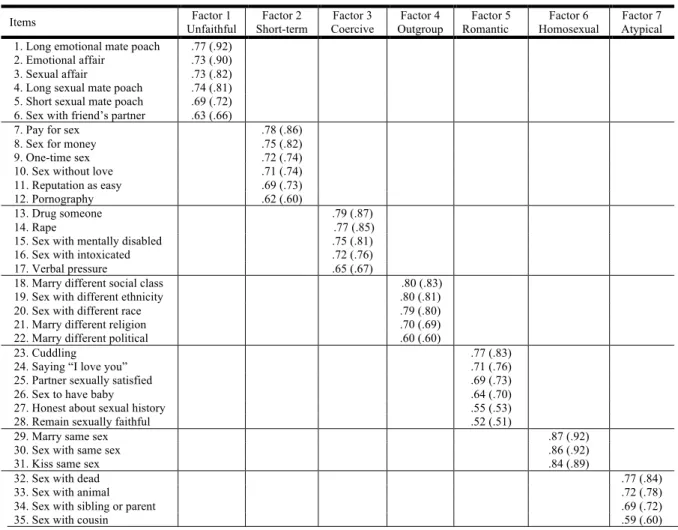
We performed an exploratory factor analysis (EFA) on the 70 items that were generated through the preliminary act nomination study using principle components analysis (PCA). Since we had no theoretical basis for predicting the factor structure a priori (e.g., the number or content of the factors), we used PCA with the varimax rotation instead of confirmatory factor analysis. PCA is preferred over principle axis factoring when the goal is to reduce the total number of items. As this was exploratory in nature, both orthogonal principle components analysis using the varimax rotation and non-orthogonal exploratory factor analysis using the promax rotation were conducted. Additionally, since sex of both participant and actor revealed no qualitative differences, the sexes were combined prior to running the PCA.
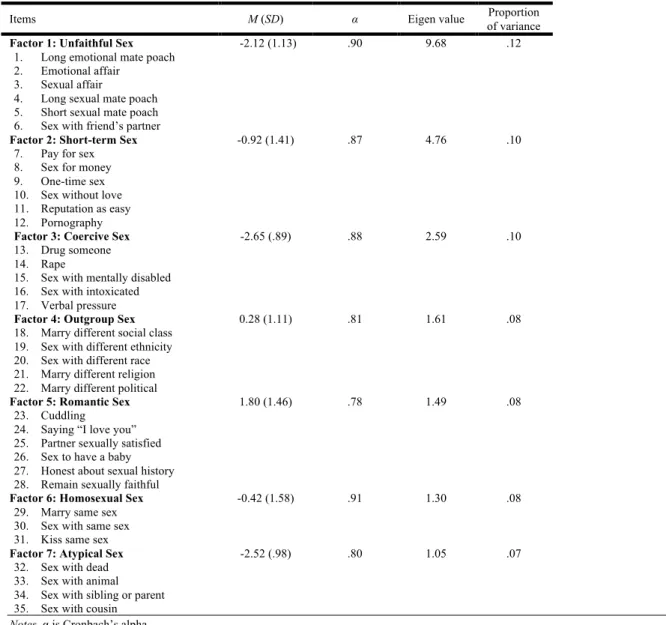
Analyses revealed that there were 10 components whose eigenvalues were greater than the mean and the scree plot indicated that the optimal number of components was 7. Both orthogonal principle components analysis using the varimax rotation and non-orthogonal exploratory factor analysis using the promax rotation showed no qualitative differences (see Table 2). The seven factors of sexual morality were named: Short-term sex, Homosexual sex, Outgroup sex, Unfaithful sex, Romantic sex, Atypical sex, and Coercive
performed two statistical checks: Kaiser-Meyer-Olkin (KMO) test and Bartlett’s test of sphericity. Both tests indicated sufficient collinearity to run the factor analysis, KMO = .96, x2 = 76892.20, p < .001.
Several items were eliminated based on a .50/.40 criterion; that is, any item (rounded) below a .50 factor loading within the category was eliminated and any item that loaded at .40 or higher on two categories was eliminated. We retained the highest loading and most theoretically representative items within each of the seven factors. There were 35 items that passed the quantitative and theory-driven criteria for inclusion.
Items M (SD) α Eigen value of variance Proportion
Factor 1: Unfaithful Sex -2.12 (1.13) .90 9.68 .12 1. Long emotional mate poach
2. Emotional affair 3. Sexual affair
4. Long sexual mate poach 5. Short sexual mate poach 6. Sex with friend’s partner
Factor 2: Short-term Sex -0.92 (1.41) .87 4.76 .10 7. Pay for sex
8. Sex for money 9. One-time sex 10. Sex without love 11. Reputation as easy 12. Pornography
Factor 3: Coercive Sex -2.65 (.89) .88 2.59 .10 13. Drug someone
14. Rape
15. Sex with mentally disabled 16. Sex with intoxicated 17. Verbal pressure
Factor 4: Outgroup Sex 0.28 (1.11) .81 1.61 .08 18. Marry different social class
19. Sex with different ethnicity 20. Sex with different race 21. Marry different religion 22. Marry different political
Factor 5: Romantic Sex 1.80 (1.46) .78 1.49 .08 23. Cuddling
24. Saying “I love you” 25. Partner sexually satisfied 26. Sex to have a baby 27. Honest about sexual history 28. Remain sexually faithful
Factor 6: Homosexual Sex -0.42 (1.58) .91 1.30 .08 29. Marry same sex
30. Sex with same sex 31. Kiss same sex
Factor 7: Atypical Sex -2.52 (.98) .80 1.05 .07 32. Sex with dead
33. Sex with animal 34. Sex with sibling or parent 35. Sex with cousin
Notes. α is Cronbach’s alpha.
Table 1: Items, Means (Standard Deviations), Alpha Reliability, Eigen value, and Proportion of variance by Factor
Items Unfaithful Factor 1 Short-term Factor 2 Coercive Factor 3 Outgroup Factor 4 Romantic Factor 5 Homosexual Factor 6 Atypical Factor 7 1. Long emotional mate poach .77 (.92)
2. Emotional affair .73 (.90) 3. Sexual affair .73 (.82) 4. Long sexual mate poach .74 (.81) 5. Short sexual mate poach .69 (.72) 6. Sex with friend’s partner .63 (.66)
7. Pay for sex .78 (.86) 8. Sex for money .75 (.82) 9. One-time sex .72 (.74) 10. Sex without love .71 (.74)
11. Reputation as easy .69 (.73) 12. Pornography .62 (.60) 13. Drug someone .79 (.87)
14. Rape .77 (.85)
15. Sex with mentally disabled .75 (.81) 16. Sex with intoxicated .72 (.76) 17. Verbal pressure .65 (.67) 18. Marry different social class .80 (.83)
19. Sex with different ethnicity .80 (.81) 20. Sex with different race .79 (.80) 21. Marry different religion .70 (.69)
22. Marry different political .60 (.60)
23. Cuddling .77 (.83)
24. Saying “I love you” .71 (.76)
25. Partner sexually satisfied .69 (.73)
26. Sex to have baby .64 (.70)
27. Honest about sexual history .55 (.53)
28. Remain sexually faithful .52 (.51)
29. Marry same sex .87 (.92)
30. Sex with same sex .86 (.92)
31. Kiss same sex .84 (.89)
32. Sex with dead .77 (.84)
33. Sex with animal .72 (.78)
34. Sex with sibling or parent .69 (.72)
35. Sex with cousin .59 (.60)
Notes. Loadings outside the parentheses were obtained using principal components analysis with varimax rotation and loadings inside the parentheses represent maximum likelihood analysis with promax rotation.
Table 2: Factor Loadings, Orthogonal PCA and Nonorthogonal EFA
Seven Pillars of Sexual Morality
Short-term Sex. 6 items loaded onto the Short-term pillar. This factor involves engaging in sexual activity without a deep romantic attachment. Example item: “Having a one-time sexual encounter without commitment.”
Homosexual Sex. 3 items loaded onto the Homosexual pillar. This factor involves engaging in same sex sexual encounters. Example item: “Having sex with someone of the same sex.”
engaging in sexual activity with someone of a different social group (e.g., race, ethnicity, religion). Example item: “Having sex with someone of a different race.”
Unfaithful Sex. 6 items loaded onto the Unfaithful pillar. This factor involves emotional infidelity, sexual infidelity, and mate poaching (i.e., stealing someone else’s romantic partner). Example item: “While involved in a steady relationship, having a sexual affair with someone else.”
Romantic Sex. 6 items loaded onto the Romantic pillar. This factor involves sex within romantic relationships and emphasizes the procreative or intimacy-building functions of sex. Example item: “Cuddling with one’s romantic partner after sex.”
Atypical Sex. 4 items loaded onto the Atypical pillar. This factor involves sex that is considered abnormal or disgusting according to most cultural norms, such as paraphilias. Example item: “Having sex with one’s parent.”
Coercive Sex. 5 items loaded onto the Coercive Sex pillar. This factor involves coercive or non-consensual sexual activity. Example item: “Physically forcing someone to have sex against their will.”
In sum, principle components analysis yielded seven core factors of sexual morality. It is noteworthy that this seven-factor solution of morality in the sexual domain is more pluralistic (larger number of dimensions) and content-saturated (as opposed to content-free abstract principles) than any of the existing theories that purport to span the entire domain of morality.
STUDY 2:DOES THE SEVEN-FACTOR STRUCTURE OF SEXUAL MORALITY REPLICATE?
The primary goal of study 2 was to determine the replicability of the factor structure uncovered in Study 1. A secondary goal was to finalize the Sexual Morality Inventory by adding theory-generated items to factors that had fewer than 5 items.
Participants
543 participants (199 men, 344 women) were recruited from Amazon’s Mechanical Turk online worker recruitment system. Mean age was 41.74 (SD = 13.75). Participants were compensated $0.50 for their participation in the 30-minute survey. Recruitment text asked participants to “Give us your judgments of events and behaviors. Please do NOT take this survey if you are under 18 years old or if you've taken the SMI before.”
Materials and Procedure
The materials and procedure were the same as in study 1, except that the participants provided moral judgments on the 35 items retained in Study 1 and an additional 3 items that were generated from theory for a total of 38 items. Two items were added to the Homosexual pillar: 1) “Having sexual relations with both men and women (e.g. bisexuality)” and 2) “Having sexual relations exclusively with someone of the same sex.” One item within the Atypical pillar (“Having sex with one’s sibling or one’s parent”) was split into two items: 1) “Having sex with one’s sibling” and 2) “Having sex with one’s parent.”
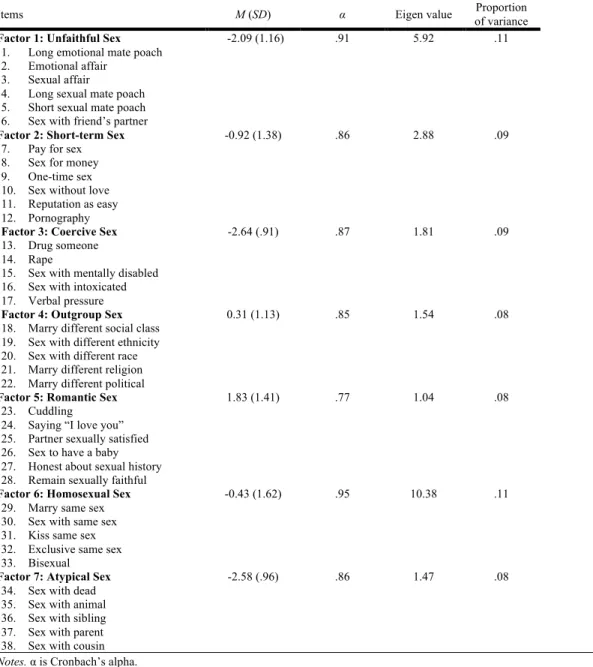
Items M (SD) α Eigen value of variance Proportion
Factor 1: Unfaithful Sex -2.09 (1.16) .91 5.92 .11 1. Long emotional mate poach
2. Emotional affair 3. Sexual affair
4. Long sexual mate poach 5. Short sexual mate poach 6. Sex with friend’s partner
Factor 2: Short-term Sex -0.92 (1.38) .86 2.88 .09 7. Pay for sex
8. Sex for money 9. One-time sex 10. Sex without love 11. Reputation as easy 12. Pornography
Factor 3: Coercive Sex -2.64 (.91) .87 1.81 .09 13. Drug someone
14. Rape
15. Sex with mentally disabled 16. Sex with intoxicated 17. Verbal pressure
Factor 4: Outgroup Sex 0.31 (1.13) .85 1.54 .08 18. Marry different social class
19. Sex with different ethnicity 20. Sex with different race 21. Marry different religion 22. Marry different political
Factor 5: Romantic Sex 1.83 (1.41) .77 1.04 .08 23. Cuddling
24. Saying “I love you” 25. Partner sexually satisfied 26. Sex to have a baby 27. Honest about sexual history 28. Remain sexually faithful
Factor 6: Homosexual Sex -0.43 (1.62) .95 10.38 .11 29. Marry same sex
30. Sex with same sex 31. Kiss same sex 32. Exclusive same sex 33. Bisexual
Factor 7: Atypical Sex -2.58 (.96) .86 1.47 .08 34. Sex with dead
35. Sex with animal 36. Sex with sibling 37. Sex with parent 38. Sex with cousin
Notes. α is Cronbach’s alpha.
Table 3: Items, Means (Standard Deviations), Alpha Reliability, Eigen value, and Proportion of variance by Factor
Items Unfaithful Factor 1 Short-term Factor 2 Coercive Factor 3 Outgroup Factor 4 Romantic Factor 5 Homosexual Factor 6 Atypical Factor 7 1. Long emotional mate poach .76 (.89)
2. Emotional affair .73 (.86) 3. Sexual affair .74 (.81) 4. Long sexual mate poach .77 (.86) 5. Short sexual mate poach .68 (.69) 6. Sex with friend’s partner .71 (.77)
7. Pay for sex .72 (.78) 8. Sex for money .70 (.77) 9. One-time sex .66 (.71) 10. Sex without love .69 (.77)
11. Reputation as easy .61 (.71) 12. Pornography .65 (.65) 13. Drug someone .78 (.91)
14. Rape .74 (.83)
15. Sex with mentally disabled .69 (.74) 16. Sex with intoxicated .65 (.73) 17. Verbal pressure .62 (.67) 18. Marry different social class .81 (.85)
19. Sex with different ethnicity .78 (.80) 20. Sex with different race .77 (.79) 21. Marry different religion .77 (.79)
22. Marry different political .65 (.69)
23. Cuddling .72 (.77)
24. Saying “I love you” .75 (.82)
25. Partner sexually satisfied .76 (.81)
26. Sex to have baby .58 (.63)
27. Honest about sexual history .49 (.48)
28. Remain sexually faithful .49 (.44)
29. Marry same sex .90 (.92)
30. Sex with same sex .89 (.89)
31. Kiss same sex .89 (.91)
32. Exclusive same sex .86 (.88)
33. Bisexual .83 (.79)
34. Sex with dead .82 (.89)
35. Sex with animal .72 (.75)
36. Sex with sibling .80 (.84)
37. Sex with parent .66 (.63)
38. Sex with cousin .56 (.53)
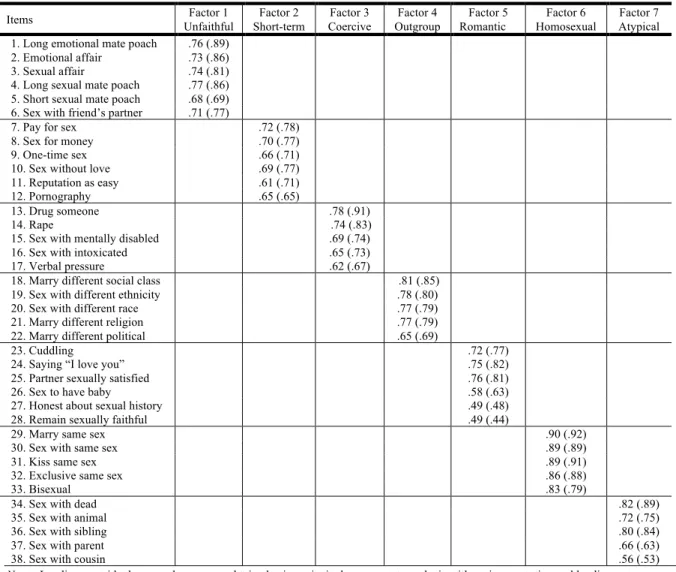
Notes. Loadings outside the parentheses were obtained using principal components analysis with varimax rotation and loadings inside the parentheses represent maximum likelihood analysis with promax rotation.
Table 4: Factor Loadings Orthogonal PCA
Are the Seven Sexual Morality Pillars Replicable?
Running both orthogonal principle components analysis using the varimax rotation and non-orthogonal exploratory factor analysis using the promax rotation on the 38 items, the same 7 factors emerge with a qualitatively and quantitatively similar factor structure. Analyses revealed that there were 7 components whose eigenvalues were greater than the mean and the scree plot indicated that the optimal number of components was 7. Table 3 gives the items, means, standard deviations and reliabilities of the 7 factors. Two items within the Romantic Sex pillar loaded onto the factor at .49 using the varimax rotation and thus
components analysis using the varimax rotation and non-orthogonal exploratory factor analysis using the promax rotation were similar (see Table 4). Again, the statistical checks were passed, Kaiser-Meyer-Olkin (KMO) test, KMO = .92 and Bartlett’s test of sphericity, x2 = 26675.59, p < .001.
Which Individual Sexual Acts Are Most Heavily Moralized?
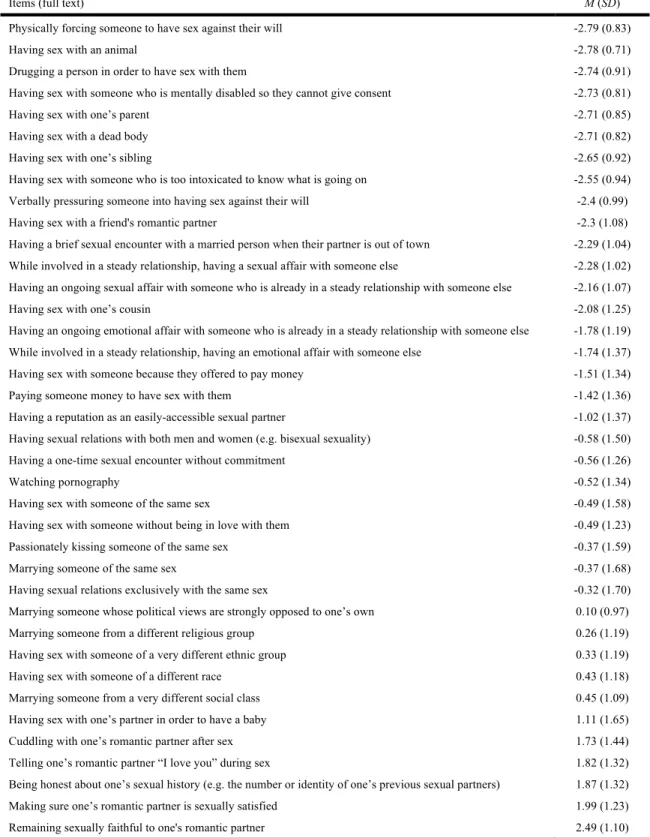
Table 5 lists the items from worst (most negative) to best (most positive) and provides the full wording of each item. As expected from the cultural universality of the incest taboo and as predicted by some evolutionary theories (e.g., Lieberman et al., 2003), having sex with a parent and having sex with a sibling were among the most morally condemned sexual acts. Acts of sexual coercion were also among the most morally condemned, including forcing someone to have sex against their will (the top-rated act), drugging someone to have sex with them, and having sex with a mentally disabled or intoxicated individuals who are incapable of giving sexual consent. Mate poaching and sexual betrayal also emerged toward the top of the most morally condemned sexual actions (e.g., having sex with a friend’s romantic partner or with someone who is married while their spouse is out of town).
At the other end of the spectrum, sexual acts seen as morally good included: Remaining sexually faithful to one’s romantic partner and making sure one’s romantic partner is sexually satisfied—acts all loading on the Romantic Sex factor.
Items (full text) M (SD) Physically forcing someone to have sex against their will -2.79 (0.83)
Having sex with an animal -2.78 (0.71)
Drugging a person in order to have sex with them -2.74 (0.91) Having sex with someone who is mentally disabled so they cannot give consent -2.73 (0.81)
Having sex with one’s parent -2.71 (0.85)
Having sex with a dead body -2.71 (0.82)
Having sex with one’s sibling -2.65 (0.92)
Having sex with someone who is too intoxicated to know what is going on -2.55 (0.94) Verbally pressuring someone into having sex against their will -2.4 (0.99) Having sex with a friend's romantic partner -2.3 (1.08) Having a brief sexual encounter with a married person when their partner is out of town -2.29 (1.04) While involved in a steady relationship, having a sexual affair with someone else -2.28 (1.02) Having an ongoing sexual affair with someone who is already in a steady relationship with someone else -2.16 (1.07)
Having sex with one’s cousin -2.08 (1.25)
Having an ongoing emotional affair with someone who is already in a steady relationship with someone else -1.78 (1.19) While involved in a steady relationship, having an emotional affair with someone else -1.74 (1.37) Having sex with someone because they offered to pay money -1.51 (1.34) Paying someone money to have sex with them -1.42 (1.36) Having a reputation as an easily-accessible sexual partner -1.02 (1.37) Having sexual relations with both men and women (e.g. bisexual sexuality) -0.58 (1.50) Having a one-time sexual encounter without commitment -0.56 (1.26)
Watching pornography -0.52 (1.34)
Having sex with someone of the same sex -0.49 (1.58) Having sex with someone without being in love with them -0.49 (1.23) Passionately kissing someone of the same sex -0.37 (1.59) Marrying someone of the same sex -0.37 (1.68) Having sexual relations exclusively with the same sex -0.32 (1.70) Marrying someone whose political views are strongly opposed to one’s own 0.10 (0.97) Marrying someone from a different religious group 0.26 (1.19) Having sex with someone of a very different ethnic group 0.33 (1.19) Having sex with someone of a different race 0.43 (1.18) Marrying someone from a very different social class 0.45 (1.09) Having sex with one’s partner in order to have a baby 1.11 (1.65) Cuddling with one’s romantic partner after sex 1.73 (1.44) Telling one’s romantic partner “I love you” during sex 1.82 (1.32) Being honest about one’s sexual history (e.g. the number or identity of one’s previous sexual partners) 1.87 (1.32) Making sure one’s romantic partner is sexually satisfied 1.99 (1.23) Remaining sexually faithful to one's romantic partner 2.49 (1.10)
Table 5: Items from Worst (Most Negative) to Best (Most Positive), Means and SDs
Which Sexual Morality Pillars Show the Largest Individual Differences?
individual differences are best revealed by the magnitude of the standard deviation for each item—the larger the standard deviation, the greater the individual differences in moral judgments. The acts showing the largest standard deviations all involve homosexual sex— having sex with someone of the same sex (SD = 1.58), passionately kissing someone of the same sex (1.59), and marrying someone of the same sex (1.68). The second cluster showing large individual differences involve sexual economics or exchanges of sex for money— Paying someone to have sex (1.36) and having sex because someone offered money to do so (1.34). The third cluster showing large individual differences involve short-term sex, such as having a one-time sexual encounter without commitment (1.26) and having sex without being in love with the person (1.23). Other notable individual items showing large standard deviations involve outgroup sex, such as having sex with someone of a different ethnic group (1.19), different religious group (1.19), or different race (1.18). The act of having sex with a cousin also showed fairly large individual differences (1.25).
These studies are limited in several respects. First, we do not currently know why some factors, such as Homosexual Sex, Short-Term Sex, and Outgroup Sex show such large individual differences. Which individual difference measures influence people’s moral norms? Religiosity, political orientation, and personality variables may predict individual differences in sexual morality.
Second, the studies were conducted within one culture, and likely most individuals within our samples would be classified as WEIRD (Western, Educated, Industrialized, Rich, and Democratic). Cross-cultural tests are needed to evaluate whether the seven factors of sexual morality are universal or culture-specific, as well as whether the consensually moralized factors in our samples (good and bad) are equally sexually moralized in other cultures.
Summary
Most extant theories of morality have ignored the sexual domain. The current research was designed to fill this gap. A preliminary study (N = 161) used a nomination procedure that identified 70 distinct acts or instances in the sexual morality domain. Study 1 (N = 923) identified seven core factors of sexual morality—Unfaithful Sex, Short-Term Sex, Romantic Sex, Homosexual Sex, Outgroup Sex, Coercive Sex, and Atypical Sex. Study 2 (N = 543) replicated this seven-factor solution. We use the highest loading items on each factor to develop the Sexual Morality Inventory, which shows excellent factor replicability and internal consistency reliability across both studies.
Chapter 5: Individual Differences in Sexual Morality
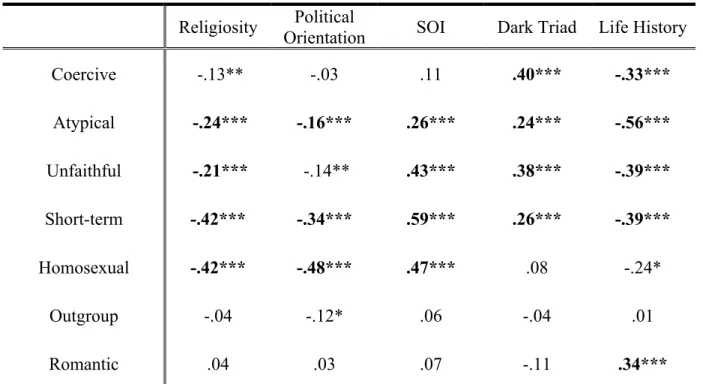
From the first suite of studies, it became clear that, at least in America, there existed large individual differences in people’s sexual morality. Certain categories of behavior, namely Homosexual Sex and Short-term Sex, showed large standard deviations in moral judgments across participants. To our knowledge, there are very few studies examining the factors that can predict intra-individual variation in morality—especially sexual morality. Why, within a given culture, would the moral norms vary so greatly? Previous research has investigated the roles that religiosity and political orientation play in people’s attitudes toward homosexuality and promiscuous sex. Do differences in religiosity and political orientation account for variation in the other pillars of sexual morality? Can we predict a priori which individual difference variables will co-vary systematically with moral judgments of each pillar based on principles of evolutionary psychology?
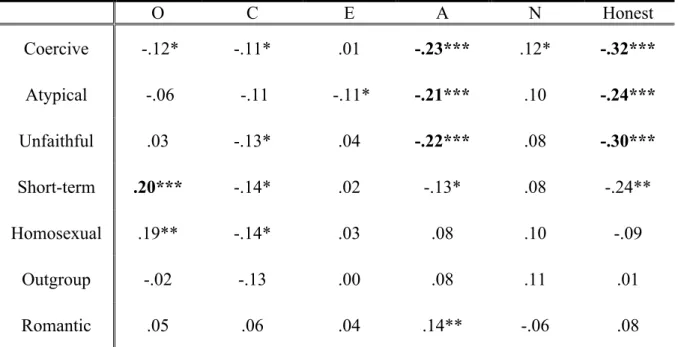
Using the Fundamental Meta-theoretical Principle mentioned earlier (i.e. that people will moralize as bad conduct by others that decreases their inclusive fitness and will moralize as good conduct by others that increases their inclusive fitness), we created a series of predictions to investigate whether intra-individual variation in sexual morality can be predicted by theoretically relevant individual differences variables. Study 1 tested these predictions using all 70 sexual behaviors discovered in the act nomination study. In Study 2, we used our newly developed Sexual Morality Inventory to replicate the findings of Study 1. The primary goal of these studies was to investigate whether and how religiosity, political orientation, sociosexual orientation, dark triad traits, Life history theory, personality, and Moral Foundations Theory can be used to explain differences in people’s sexual morality.
STUDY 1:CAN WE PREDICT VARIATION IN SEXUAL MORALITY BASED ON OTHER KEY
INDIVIDUAL DIFFERENCE VARIABLES?
Moral Foundations Theory
Moral Foundations Theory (MFT) posits that variation in morality can be explained by differences in the importance that people place upon five evolved moral foundations: Harm, Fairness, Loyalty, Authority, and Purity. Based upon MFT, we generated 14 predictions about how reliance upon the Moral Foundations would covary with individual moralization of the Seven Pillars of Sexual Morality.
Short-term Sex
People who are concerned with the moral foundations of Loyalty, Authority, and Purity are more likely to be both religious and conservative (Graham, Haidt, & Nosek, 2009; Haidt & Hersh, 2001). Religiosity is associated with a restricted sociosexual orientation, meaning that religious people tend to have believes, attitudes, and desires that promote a long-term mating strategy (Weeden & Kurzban, 2013). Other people’s short-term sexual behaviors could strategically interfere with the goals of long-term maters in several ways: (1) for long-term maters who are not in a relationship, short-term maters limit their ability to find and keep a long-term mate; (2) once a long-term mater is in an established relationship, there is the fear that short-term maters are more likely to engage in mate poaching, which would threaten existing relationships; and (3) short-term sex is a disease vector that can infect potential mates.
People with a concern for the moral foundation of Authority will rely heavily on the culturally established moral norms when judging the behavior of others. According to many religions, short-term sex is prohibited. This culturally endorsed mandate could be designed to restrict the mating behaviors of the ingroup toward long-term mateships (Kurzban, 2010). People with a concern for the moral foundation of Purity believe that some things are wrong because they are impure or degrading, such as promiscuous sexual behavior.
Short-term Sex and Loyalty: As concern for Loyalty increases, Short-term Sex will be judged more morally wrong.
Short-term Sex and Authority: As concern for Authority increases, Short-term Sex will be judged more morally wrong.
Short-term Sex and Purity: As concern for purity increases, Short-term Sex will be judged more morally wrong.
Homosexual Sex
People who show strong ingroup favoritism tend to show outgroup prejudice, such as homophobia. Same-sex sexual activity by oneself, one’s partner, or one’s kin negatively impacts reproductive success. Many long-standing cultural institutions endorse behaviors that happen to increase inclusive fitness (e.g., marriage and having children) and prohibit behaviors that decrease inclusive fitness (e.g., homosexuality).
A concern for moral foundations that focus on the group (i.e., Loyalty, Authority, and Purity) over foundations that focus on the individual (i.e., Harm and Fairness) predicts negative attitudes toward gay men (Rosik, Dinges, & Saavedra, 2013). Within small male-only coalitions, homosexual sex might undermine the unity and cohesion of the coalition because sexual activity distracts from superordinate goals and sexual rivalry within the coalition can disrupt coordinated action. People who respect authority figures are more likely to moralize homosexual sexual behavior on the basis of religious mandates, even when no harm is done. Furthermore, those who value purity may judge homosexual sex as more morally wrong because they view it as “unnatural” and therefore impure.
Homosexual Sex and Loyalty: As concern for Loyalty increases, Homosexual Sex will bejudged more morally wrong.
Homosexual Sex and Authority: As concern for Authority increases, Homosexual Sex will bejudged more morally wrong.
Homosexual Sex and Purity: As concern for purity increases, Homosexual Sex will be judged more morally wrong.
Unfaithful Sex
People pursuing unfaithful sex present strategic interference with one’s own long-term mateships and the mateships of one’s kin and allies. Sexual infidelity could lead to a variety of costs to one’s reproductive fitness, from termination of the existing relationship and all economic, social, and sexual benefits therein to sexually transmitted disease (Buss, 2000). Unfaithful sex, including mate poachers, undermines unity and cohesion of one’s coalition by creating sexual rivalries within coalition. Moralization of infidelity and mate poaching allows one to enlist mateguards, such as one’s friends and family, to defend against relationship interlopers. If everyone in the culture holds these moral norms, then people no longer need to be physically present to engage in mate guarding. We predict that people who are very concerned with group-oriented foundations of loyalty, authority, and purity will negatively moralize infidelity. People concerned with the harm caused to others will view unfaithful sex as costly and exploitative and, therefore, morally wrong. People who prioritize fairness are expected to see infidelity as a violation of the social contract.
Unfaithful Sex and Loyalty: As concern for Loyalty increases, Unfaithful Sex will be judged more morally wrong.
Unfaithful Sex and Authority: As concern for Authority increases, Unfaithful Sex will bejudged more morally wrong.
Unfaithful Sex and Purity: As concern for Purity increases, Unfaithful Sex will be judged more morally wrong.
Unfaithful Sex and Harm: As concern for Harm increases, Unfaithful Sex will be judged more morally wrong.
Unfaithful Sex and Fairness: As concern for Fairness increases, Unfaithful Sex will bejudged more morally wrong.
Atypical Sex
Incest by kin, coalition members, and allies corrupts fitness qualities of resultant offspring. Incest by one’s children or other genetic relatives directly impairs inclusive fitness. Having sex with animals or dead bodies acts as a disease vector and will be considered morally wrong by those who have a concern for Purity since atypical sexual acts will be seen as degrading or unnatural. Additionally, anyone willing to commit these forms of low base-rate deviant acts would be statistically more likely to commit other deviant acts, and corrupt their value as a kin member, mate, or ally.
Atypical Sex and Purity: As concern for purity increases, Short-term Sex will be judged more morally wrong.
Coercive Sex
Sexual coercion by anyone in one’s social group inflicts fitness costs on all kin and allies. Sexual coercion bypasses free mate-choice from the victim, interfering with a core evolved mating strategy. Sexual coercion is also linked with damage to the victim’s self-esteem, self-perceived attractiveness, self-perceived mating desirability, social reputation, and sexual functioning (Perilloux, Duntley, & Buss, 2012). Due to the heavy costs associated with sexual assault, coordinated moralization of coercive sex would help to lower the likelihood of being a victim by increasing the costs of sexual coercion and damaging the reputations of assaulters. We hypothesized that those who emphasize the importance of harm when making moral decisions would negatively moralize coercive sex due to the physical, emotional, social, and psychological damage that is inflicted upon the victims. Because individually determined mate-choice is bypassed by sexual coercion, we hypothesized that people who care about fairness will judge predatory sexual behaviors more harshly.
Coercive Sex and Harm: As concern for Harm increases, Coercive Sex will bejudged more morally wrong.
Coercive Sex and Fairness: As concern for Fairness increases, Coercive Sex will be judged more morally wrong.
Religiosity
In our American sample, the dominant religion is Christianity with 70.6% identifying as Christian (Pew Research Center, 2014). Many religions, including Christianity, endorse restrictive sexual practices and prohibit profligate sexual behaviors. Intrinsic religiosity is associated with decreased sociosexuality and a desire for fewer lifetime sex partners (Rowatt & Schmitt, 2003). Christianity traditionally proscribes the same sex sexual behaviors that characterize Homosexual Sex, although acceptance is growing among almost all Christian groups (Pew Research Center, 2014). Christians are prohibited from marrying non-Christians, which is a component of Outgroup Sex. Additionally, it forbids sexual affairs and mate poaching (e.g., coveting thy neighbor’s wife) found in Unfaithful Sex. Since religious individuals care about sanctity, impure or degrading sexual activities (e.g. sex with animals) will be viewed harshly. Finally, religiosity is positively correlated with more restrictive (long-term) sexual views (Weeden & Kurzban, 2013).
Short-term Sex: People who are more religious will judge Short-term Sex more morally wrong than those who are less religious.
Homosexual Sex: People who are more religious will judge Homosexual Sex more morally wrong than those who are less religious.
Unfaithful Sex: People who are more religious will judge Unfaithful Sex more morally wrong than those who are less religious.
Atypical Sex: People who are more religious will judge Atypical Sex more morally wrong than those who are less religious.
Coercive Sex: We do not expect that religiosity will be correlated with judgments of Coercive Sex.
Romantic Sex: People who are more religious will judge Romantic Sex more morally good than those who are less religious.
Political Orientation
Political conservatives tend to be more religious than political liberals. Therefore, many predictions are similar to those for religiosity. Conservatives also care more strongly about the Moral Foundation of Purity, which encompasses the belief that issues of purity/sanctity are important when making moral decisions (Haidt & Hersh, 2001). We expect that conservatism will be correlated with negative views about restricted sexuality, including short-term sex and unfaithful sex. American conservatives tend to be less accepting of homosexuality than liberals, which can be partially explained by underlying differences in mating strategies of conservatives and liberals (Pinsof & Haselton, 2016). Furthermore, conservatives are more disgust-sensitive than liberals (Inbar, Pizarro, & Bloom, 2009) and disgust-sensitivity is linked to implicit disapproval of homosexuality (Inbar, Pizarro, Knobe, & Bloom, 2009). Since atypical sexual acts, such as incest, evoke disgust, we expect that conservatives will view atypical acts more harshly.
Short-term Sex: People who are politically conservative will judge Short-term Sex more morallywrong than those who are liberal.
Homosexual Sex: People who are politically conservative will judge Homosexual Sex more morallywrong than those who are liberal.
Unfaithful Sex: People who are politically conservative will judge Unfaithful Sex more morallywrong than those who are liberal.
Outgroup Sex: People who are politically conservative will judge Outgroup Sex more morallywrong than those who are liberal.
Atypical Sex: People who are politically conservative will judge Atypical Sex more morallywrong than those who are liberal.
Coercive Sex: We do not expect that political orientation will be correlated with judgments of Coercive Sex.
Romantic Sex: We do not expect that political orientation will be correlated with judgments of Romantic Sex.
Sociosexual Orientation
A person’s sociosexual orientation is an index of their propensity to engage in unrestricted sexual activity (Simpson & Gangestad, 1991). High SOI is correlated with having a short-term mating strategy. People who pursue a short-term mating strategy potentially interfere with the interests of those pursuing a long-term mating strategy (low SOI). For people with low SOI who are not in a relationship, short-term maters limit their ability to find and keep long-term mates. In studies of derogation of competitors, women (who tend to be long-term oriented) denigrate other women for promiscuous sexual activity. Additionally, once someone with low SOI is in an established relationship, there is the fear of mate poachers, which would threaten existing relationships. Unrestricted sociosexual orientation is associated with increased likelihood of infidelity (Mattingly, Clark, Weidler, Bullock, Hackathorn, & Blankmeyer, 2011). People also implicitly associate homosexuality with an unrestricted sociosexual orientation (Pinsof & Haselton, 2016).
Short-term Sex: As SOI increases, Short-term Sex will be judged lessmorally wrong. Homosexual Sex: As SOI increases, Homosexual Sex will be judged less morally wrong.
Outgroup Sex: We do not expect that SOI will be correlated with judgments of Outgroup Sex.
Atypical Sex: As SOI increases, Atypical Sex will be judged lessmorally wrong. Coercive Sex: We do not expect that SOI will be correlated with judgments of Coercive Sex.
Romantic Sex: We do not expect that SOI will be correlated with judgments of Romantic Sex.
Dark Triad
The traits of narcissism (i.e. self-centeredness), Machiavellianism (i.e. strategically manipulative), and psychopathy (i.e. impulsive anti-sociality) make up the Dark Triad. Dark Triad traits have been hypothesized to predict both short-term and exploitative sexual behavior, such as coercion (Jonason, Girgis, & Milne-Home, 2017). Those scoring high in narcissism are expected to prioritize their own sexual desires over the needs and feelings of others. Narcissism may show a strong relationship with moral judgments of unfaithful sex. Machiavellianism has been linked to manipulative sexual strategies, such as infidelity and using deception to gain sexual access (Brewer & Abell, 2015; Jonason, Lyons, Baughman & Vernon, 2014) and may be strongly associated with favoring a short term mating strategy (Jonason, Li, Webster, Schmitt, 2009). Psychopathy is associated with self-reported coercion to obtain sex, such as blackmail and physical violence (Figueredo, Gladden, Sisco, Patch, Jones, 2015; Jones & Olderbak, 2014). Psychopathy is also associated with all types of sexual fantasies, even deviant ones (Baughman, Jonason, Veselka, & Vernon, 2014). Narcissism, Machiavellianism, and psychopathy were positively correlated with rape myth acceptance and empathy for rapists (Jonason, Girgis, & Milne-Home, 2017)
Short-term Sex: As narcissism, Machiavellianism, and psychopathy increase, Short-term Sex will be judged less morally wrong
Homosexual Sex: We do not expect that narcissism, Machiavellianism, or psychopathy will be correlated with judgments of Homosexual Sex.
Unfaithful Sex: As narcissism, Machiavellianism, and psychopathy increase, Unfaithful Sex will be judged less morally wrong
Outgroup Sex: We do not expect that narcissism, Machiavellianism, or psychopathy will be correlated with judgments of Outgroup Sex.
Atypical Sex: As narcissism, Machiavellianism, and psychopathy increase, Atypical Sex will be judged less morally wrong
Coercive Sex: As narcissism, Machiavellianism, and psychopathy increase, Coercive Sex will be judged less morally wrong
Romantic Sex: We do not expect that narcissism, Machiavellianism, or psychopathy will be correlated with judgments of Romantic Sex.
Life history theory
Life history theory (LHT) describes the fundamental trade-off in allocating reproductively relevant resources to either immediate or delayed reproduction. Organisms that expect a short lifespan would increase their lifetime reproductive success by pursuing frequent and immediate mating opportunities, while those that expect a long lifespan should delay reproduction to accrue resources to allocate toward future mating opportunities and parental investment (Figueredo et al., 2006, Griskevicius, Delton, Robertson, & Tybur, 2011). LHT predicts that unpredictability and environmental harshness at a young age can calibrate whether people devote their resources to either a fast or slow life history strategy. Fast life history strategies are correlated with increased short-term mating orientation (Jonason, Koenig, & Tost, 2010), and willingness to engage in sexual coercion (Dunkel & Mathes, 2011).