Utilizing Human Patient Simulators (HPS)
To Meet Learning Objectives Across
Concurrent Core Nursing Courses:
A Pilot Study
Charman L. Miller, MSN, Ohio University School of Nursing, USA Camille Leadingham, Ohio University School of Nursing, USA
Ronald Vance, Ohio University School of Nursing, USA
ABSTRACT
Associate Degree Nursing (ADN) faculty are challenged by the monumental responsibility of preparing students to function as safe, professional nurses in a two year course of study. Advances in computer technology and emphasis on integrating technology and active learning strategies into existing course structures have prompted many nurse educators to explore the use of Human Patient Simulation (HPS) utilizing high-fidelity human patient simulators. This pilot study was designed to assist ADN faculty to determine students’ perceptions regarding the use of HPS scenarios as a teaching strategy to meet course objectives across multiple core ADN nursing courses in a single quarter.
Keywords: Human Patient Simulators, simulation, technology INTRODUCTION
ssociate Degree Nursing (ADN) faculty are challenged by the monumental responsibility of preparing students to function as safe, professional nurses in a two year course of study. Advances in computer technology and emphasis on integrating technology and active learning strategies into existing course structures have prompted many nurse educators to explore the use of Human Patient Simulation (HPS) utilizing high-fidelity human patient simulators. High fidelity human patient simulators are mannequins that are life-sized, and are equipped with computer software that makes them capable of simulating a variety of human patient responses including voice, variable heart rate, blood pressure, lung and bowel sounds, and peripheral pulses. According to Jeffries (2005), simulation can increase students’ critical thinking, decision-making, and problem solving skills. Simulation also provides opportunity for ADN students to gain exposure to clinical situations that they may otherwise have limited opportunity to experience during their time-constrained clinical rotation. Simulation incorporates a variety of learning styles (visual, auditory, tactile, and kinesthetic) into a single, highly active, technology-rich learning activity (Jeffries, 2007). This pilot study was designed to assist ADN faculty to determine students’ perceptions regarding HPS teaching strategies to meet course objectives across multiple core nursing courses in a single quarter.
BACKGROUND
The concept of simulation in nursing education is not particularly new. Low fidelity human patient simulators have been used in nursing education since the late 1950’s (Herrmann, 1981). Human patient simulators continued to progress and eventually became computerized with the introduction of Sim One, used mainly in medical education and graduate nursing anesthesia programs to help students learn endotracheal intubation (Gaba & De Andra, 1988). The high-fidelity HPS models like that used in this study represent the most contemporary, state-of-the discipline technology to assist educators to instruct health care providers at all levels (Bremner et. al 2006).
A
Nurses are responsible for making accurate and appropriate clinical decisions in everyday practice. Lowenstein & Bradshaw (2001) describe clinical decision making as judgment that includes critical and reflective thinking and action and scientific and practical knowledge. Nursing students’ ability to think critically grows as they gain new knowledge in nursing practice. Human patient simulators offer students a realistic representation of an actual event (Billings & Halstead, 2005, Aronson, Rosa, & Light, 1997, Cioffi, 2001, Bruce, Bridges, &Holcomb, 2003). The obvious advantage that HPS learning provides over traditional clinical activity is that HPS learning eliminates risk to patients. Students have the opportunity to exercise clinical decision making, even make mistakes, and then benefit from immediate feedback from faculty in a safe environment. In the actual clinical setting students cannot be permitted this much autonomy as human life is at stake. Despite clear advantages that HPS offer, their use is not without some disadvantages. The high cost of the high –fidelity HPS and software as well as the challenges of finding time to develop scenarios and ensure that they are congruent with course and program objectives can be daunting in ADN programs already challenged by faculty shortages and saturated curricula(Jeffries, 2005).
SIMULATION DEVELOPMENT
Recognizing the potential of integrating HPS learning into existing courses, faculty from across courses within the same quarter collaborated to develop a plan for integration and research utilizing Jeffries (2005) framework for designing, implementing and evaluating simulations in nursing. Faculty determined that the primary goal of the HPS scenario was to determine students’ perceptions of the use of HPS activities as a teaching strategy to meet select course objectives. A review of the literature with an emphasis on best practices and use of HPS with ADN students was completed. The limited number of peer-reviewed articles addressing the use of this technology specifically with ADN students highlighted the need for research in this area.
Jeffries (2205) suggests that “teachers are essential” (p. 98) to the use of simulation as a teaching strategy. Jeffries (2205 also suggests that faculty can gain empathy for the student experience of simulation by attending a simulation workshop themselves. The faculty designing this study each attended a three day workshop on use of the high fidelity mannequin approximately three months prior to implementation of the pilot.
The three faculty collaborated to develop an unfolding HPS scenario encompassing critical elements from three core nursing courses taught concurrently in the curriculum: Adult Health Alterations I (introductory medical-surgical nursing concepts), Alteration in Mental Health (psychiatric mental health concepts), and Pharmacology III(IV therapy). The HPS scenario developed was upper gastrointestinal (UGI) bleed with unfolding laboratory, diagnostic and nursing assessment and critical nursing intervention needs to challenge student’s clinical decision making. Jeffries (2005) suggests attention to five specific areas is crucial when designing a simulation experiences: objectives, realism, complexity, cues, and debriefing.
OBJECTIVES
Learning objectives for the study were based on course objectives from the three nursing courses. This ensured that the objectives were relevant and at an appropriate level for the knowledge base of the learners. Shearer and Davidhizar (2003) also stressed the need for dissemination of information to students prior to the activity. A focused simulation preparation guide for students was developed by faculty utilizing the nursing process and pertaining to the elements to be addressed in the simulation experience. Realism
Intuitively it makes sense that simulations should mimic reality as closely as possible. The literature is replete with references to the fact that this element is crucial (Aronson, Rosa, & Light, 1997, Cioffi, 2001, Hotchkiss, Biddle, & Fallacaro, 2002). The simulation location for this study was the campus nursing simulation lab. The area was outfitted with supplies and fixtures simulating a patient hospital room. Additionally, to mimic reality, the structure of the simulation information included very basic background information on the “patient” were provided initially, the student was encouraged to investigate the scenario freely by questioning without a pre-determined sequence of queries, and the information was provided over time during the simulation (Barrow & Feltovich, 1987).
COMPLEXITY
Simulation may range from the very simple to the complex. The aim of this study was to design a simulation at a moderate level of complexity to be congruent with our learners’ knowledge base and expected skill level. Jeffries (2005) identifies complexity to be present if the patient has 1) multiple problems, 2) patient problems are in relationship to one another, and 3) clinical information is available but may be irrelevant. Our simulation was designed to include a patient with multiple medical problems (Hypertension, History of Alcohol Abuse, and Chronic Obstructive Lung Disease), the acute problem is gastrointestinal bleeding but the patient’s care is complicated by fluid overload related to the hypertension, and there is comprehensive medical history and laboratory data provided which is not all directly relevant to the patient’s acute problem. The faculty felt that limiting the related factors and irrelevant data available made this simulation of moderate complexity.
CUES
Jeffries (2005) suggests that faculty may help students progress through the simulation by cuing, providing information about the step the student is on or is approaching. The faculty in this study utilized a facilitating context and students were employing a process-based method as active participants (Jeffries, 2005). This design translated into faculty being present during the simulation and cuing students at the initiation of the scenario to gather the pertinent data required to do an initial assessment on the simulation patient and then periodically throughout the simulation when students were stalled or taking greater that the allotted time for the simulation.
DEBRIEFING
A debriefing activity is conducted at the conclusion of a simulation. The debriefing is the period in which the students and faculty actively discuss the experience and reflect on the students’ performance. According to Stafford (2005), debriefing provides a method for instructors to reinforce good practices, ensure guidelines concerning how to avoid poor outcomes and perhaps most critically, allow an outlet for students to “discharge some of the emotion from the session” (p. 1083). Although the simulation provides a safe environment for students to practice nursing judgment and skills, the student enters into the role of a nurse during simulation and thereby forms a relationship with the simulator (Stafford, 2005). Students may react emotionally to poor outcomes or close calls during the simulation and require support and reassurance in the debriefing period. Bruce, Bridges, and Holcomb (2003) ascertain that debriefing supports the development of critical thinking. This study was designed to provide for a debriefing of students and faculty immediately following the simulation experience.
METHOD
A descriptive study design was chosen. A 21-item survey developed by Kuznar (2007) and based on a previous survey by Feingold et al. (2004) was used with permission. The survey was a 5-point Likert scale (from 1= very dissatisfied to 5 = very satisfied). Faculty developed a post HPS student survey (Figure 1) utilizing a 5-point Likert scale to assess student’s reflective HPS experiences. Demographic data were also collected (age, gender, previous educational experience, previous healthcare experience). Students were randomly assigned into groups of 4-5 and were randomly assigned simulation roles. The possible roles included: primary nurse, assisting nurse, recorder, family member.
SAMPLE
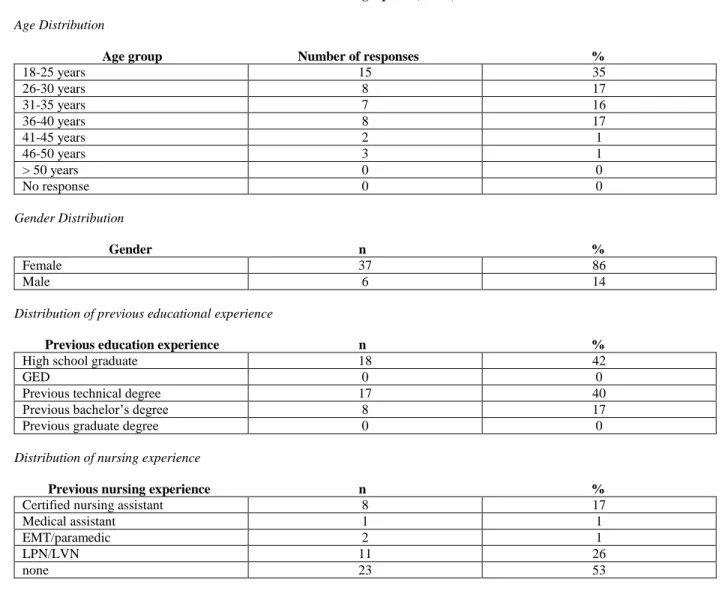
Students participating in the study (n= 43) were a convenience sample of all ADN students in the last week of the third quarter of a six quarter program at a regional campus of a Midwestern university. All students had experience utilizing the HPS for physical assessment prior to the study and were provided the focused simulation preparation guide the day prior to simulation. See Table 1 for demographic data.
Table 1: Demographics (n= 43) Age Distribution
Age group Number of responses %
18-25 years 15 35 26-30 years 8 17 31-35 years 7 16 36-40 years 8 17 41-45 years 2 1 46-50 years 3 1 > 50 years 0 0 No response 0 0 Gender Distribution Gender n % Female 37 86 Male 6 14
Distribution of previous educational experience
Previous education experience n %
High school graduate 18 42
GED 0 0
Previous technical degree 17 40
Previous bachelor’s degree 8 17
Previous graduate degree 0 0
Distribution of nursing experience
Previous nursing experience n %
Certified nursing assistant 8 17
Medical assistant 1 1
EMT/paramedic 2 1
LPN/LVN 11 26
none 23 53
SIMULATION IMPLEMENTATION
Students completed the HPS scenario in their randomly assigned groups in a maximum allotted time of 35 minutes for each group. The simulation area was fully equipped with both routine and emergency supplies including bedside monitor, crash cart, medication cart, and intravenous pump. As administering blood products was a component of the scenario, a simulated blood bank area was also identified and supplied adjacent to the simulation area. A student from each group was assigned as a recorder and was responsible for documenting all pertinent client data and nursing actions delivered during the simulation. This documentation in addition to the faculty observations was utilized to provide a comprehensive debriefing following the simulation experience. The debriefing provided an opportunity for students to self-evaluate and compare that assessment with the group and faculty observations.
STUDENT SURVEY RESULTS
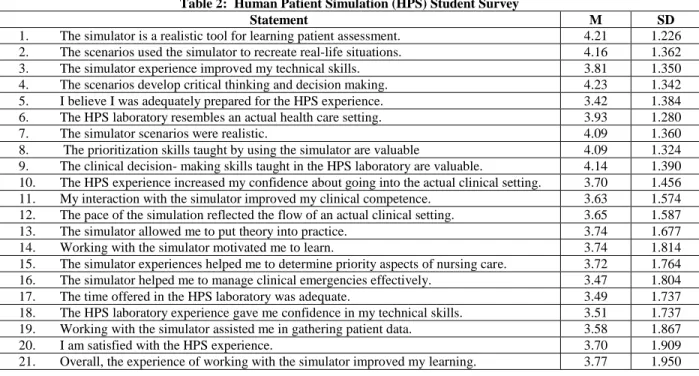
Demographic data are summarized in Table 1 and results for the survey are summarized in Table 2. A variety of comments were derived from the student’s comments section on the surveys. Overwhelmingly comments indicated satisfaction with simulation, desire to increase the use of simulation in the curriculum, and feeling that the experience was valuable. Additional suggestions included having more open accessibility to the HPS for practice, and having more frequent structured simulations to correlate with course content.
There were 11 LPN to RN students (licensed practical nurses completing the second half of the ADN program to be eligible for registered nurse board exams). There was no statistical significance between the LPN to RN students and the generic ADN students on any of the simulation survey items when subjected to ANOVA for peer similarity means.
The study indicates that the students using simulation in the third quarter of the ADN program were satisfied with using HPS. Most of the aspects assessed by the survey were highly rated. The range of means was 3.42 to 4.23 on a 5-point Likert scale. The item rated lowest in this study, “I believe I was adequately prepared for this simulation experience”, had a mean of 3.42. Of note is the fact that the preparation guide was provided only the day before the simulation. The two highest rated items on the survey, “The scenarios develop critical thinking and decision making”, and “The simulator is a realistic tool for learning patient assessment”, had means of 4.23 and 4.21 respectively. These items suggest that students perceive that HPS is a realistic and valuable tool for enhancing critical thinking which is an essential component of safe nursing practice.
LIMITATIONS
Limitations of the study include the convenience sample, relatively small sample size, the sample included only ADN students, and the sample had too limited of a representation of demographic variables to make any generalizations based on the demographics from this study.
Table 2: Human Patient Simulation (HPS) Student Survey
Statement M SD
1. The simulator is a realistic tool for learning patient assessment. 4.21 1.226 2. The scenarios used the simulator to recreate real-life situations. 4.16 1.362 3. The simulator experience improved my technical skills. 3.81 1.350 4. The scenarios develop critical thinking and decision making. 4.23 1.342 5. I believe I was adequately prepared for the HPS experience. 3.42 1.384 6. The HPS laboratory resembles an actual health care setting. 3.93 1.280
7. The simulator scenarios were realistic. 4.09 1.360
8. The prioritization skills taught by using the simulator are valuable 4.09 1.324 9. The clinical decision- making skills taught in the HPS laboratory are valuable. 4.14 1.390 10. The HPS experience increased my confidence about going into the actual clinical setting. 3.70 1.456 11. My interaction with the simulator improved my clinical competence. 3.63 1.574 12. The pace of the simulation reflected the flow of an actual clinical setting. 3.65 1.587 13. The simulator allowed me to put theory into practice. 3.74 1.677 14. Working with the simulator motivated me to learn. 3.74 1.814 15. The simulator experiences helped me to determine priority aspects of nursing care. 3.72 1.764 16. The simulator helped me to manage clinical emergencies effectively. 3.47 1.804 17. The time offered in the HPS laboratory was adequate. 3.49 1.737 18. The HPS laboratory experience gave me confidence in my technical skills. 3.51 1.737 19. Working with the simulator assisted me in gathering patient data. 3.58 1.867
20. I am satisfied with the HPS experience. 3.70 1.909
21. Overall, the experience of working with the simulator improved my learning. 3.77 1.950
RECOMMENDATIONS
The findings of this study reveal the need for replication with a larger sample size, expansion to include students from different levels of nursing education, and a larger LPN to RN group to provide more convincing evidence that there is no difference between this group and generic ADN students. HPS could be utilized across the nursing curriculum to enhance student comfort with the technology and research into the impact of this practice on student critical thinking and clinical judgment is most certainly warranted. Additional research is needed in areas of best practices in the use of simulation in ADN education and evaluating learning outcomes utilizing this teaching strategy.
CONCLUSION
In conclusion, the researchers believe that the study results provide support for the value of utilizing HPS in ADN curricula. HPS appears to be a highly acceptable and valued method of learning to students. HPS can be particularly valuable in today’s nursing education climate of limited clinical spaces and scarce nursing faculty. The study also illustrates how faculty can collaborate to integrate concepts from multiple courses into a single simulation scenario. This alleviates some of the concerns of finding time to develop scenarios and simulation projects independently and models how theory from multiple courses is integrated into safe patient care as a professional nurse.
AUTHOR INFORMATION
Professor Miller is a full time, tenure-track faculty member at Ohio University School of Nursing as well as a board-certified nurse practitioner. She teaches across the curriculum in the associate degree nursing and RN to BSN completion programs. Her research interests include: innovative teaching strategies and gerontological nursing innovations.
Professor Leadingham is a tenured faculty member at Ohio University School of Nursing as well as a board-certified nurse practitioner. She teaches across the curriculum of the associate degree nursing and Rn to BSN completion programs. Her research interests include: innovative teaching strategies and communication in clinical teaching.
Professor Vance is a full time tenure-track faculty member at Ohio University School of Nursing. He teaches across the curriculum of the associate degree nursing and RN to BSN completion programs. His research interests include: male sexual health, health disparities in Appalachia, and innovative teaching strategies.
REFERENCES
1. Aronson, B., Rosa, J., & Light, N. (1997). A simulated clinical problem-solving experience. Nurse Educator, 22, (6), 17-19.
2. Barrow, H., &Feltovich, P. (1987). The clinical reasinign process. Medical Education, 21(2), 86-91. 3. Billings, D., & Halstead, J. (2005). (2nd ed.). Teaching in nursing: A guide for faculty. St.Louis: Elsevier. 4. Bremner, M., Aduddell, K., Bennett, D. & Vangeest, J. (2006). The use of human patient simulators: Best
practices with novice nursing students. Nurse Educator, 31(4), 170-174.
5. Bruce, S., Bridges, E., & Holcomb, J. (2003). Preparing to respond: Joint trauma training center and USAF Nursing Warskills Simulation Laboratory. Critical Care Clinics of North America, 15, 149-152,
6. Cioffi, J. (2001). Clinical simulations: Development and validation. Nurse Education Today, 21, 477-486. 7. Feingold, C., Calaluce, M., & Kallen, M. (2004). Computerized patient model and simulated clinical
experiences: Evaluation with baccalaureate nursing students. Journal of Nursing Education, 43, 156-163. 8. Herrmann, E. K. (1981). Mrs. Chase: A noble and enduring figure. American Journal of Nursing, 81(10),
16.
9. Hotchkiss, M. Biddle, C., & Fallacaro, M. (2002). Assessing the authenticity of the human simulation experience in anesthesiology. ANNA Journal, 70, 470-473.
10. Gaba, D.M., & DeAndra, A. (1988). A comprehensive anesthesia simulation environment: Recreating the operating room for research and training. Anesthesiology, 69(3), 387-394.
11. Jeffries, P. (2005). A framework for designing, implementing and evaluating simulations used as teaching strategies in nursing. Nursing Education Perspectives, 26(2), 96-103.
12. Jeffries, P., Rew, S. , &Cramer, J. (2002). A comparison of student-centered versus traditional methods of teaching basic nursing skills in a learning laboratory. Nursing Education Perspectives, 23(1), 14-19. 13. Kuznar, K. (2007). Associate degree nursing students’ perceptions of learning using a high-fidelity human
patient simulator. Teaching and Learning in Nursing, 2, 46-52.
14. Lowenstein, A., & Bradshaw, M. (2001). Fuszard’s innovative teaching strategies in nursing. Gaithersburg, Maryland: Aspen Systems.
15. Shearer, R., & Davidhizar, R.(20030. Using role play to develop cultural competence. Journal of Nursing Education, 42, 273-276.
16. Stafford, F. (2005). The significance of de-roling and debriefing in training medical students using simulation to train medical students. Medical Education, 39, 1083- 1085.