Marshall University
Program Review
Program: Master of Science in Nursing 11/12/04
resubmitted 1/28/05
College: College of Health Professions
Date of last Review: 12/8/99
I. PROGRAM DESCRIPTION
The College of Health Professions currently offers the Master of Science in Nursing (MSN) degree with the areas of emphasis in: Family Nurse Practitioner (FNP), Family Nurse Practitioner with School Nurse Practitioner Specialization, Nursing Administration (NA), or Nursing Education (NE). The college also offers Post Masters Certificates in Family Nurse Practitioner, Nursing Administration, and Nursing Education.
The purpose of the MSN program is to prepare graduates for advanced practice nursing in a variety of practice settings, particularly in rural and/or underserved communities. The program also prepares nurses for leadership roles in the administration of clinical services in a variety of community based or acute care provider agencies and for academic nursing education roles.
The 2003-2004 goals of the Nursing program, approved by the faculty on 9/22/03 and specific to the BSN program are as follows:
• Maintain program accreditation.
• Strive for a state board passage rate of 90% of the national average or better.
• Continue student rotations to rural and underserved areas
• Continue community based experiences.
• Continue BSN outreach learning program for RNs and generic students.
• Provide opportunities for faculty development at least yearly.
• Encourage and facilitate faculty scholarship.
• Enhance learning resource center(s) and library resources and capability.
• Continue fund raising efforts.
• Support faculty teaching with new technology.
• Encourage and facilitate faculty and staff leadership roles in professional organizations.
• Pursue multidisciplinary and other projects and grants.
• Continue to recruit doctoral prepared faculty, and encourage faculty to obtain doctoral preparation.
• Provide re-entry education for those entering nursing as a second career.
II. ACCREDITATION INFORMATION
A. Name and Description of Accreditation Organization:
National League for Nursing (NLNAC) is officially recognized as the national
accrediting agency for nursing education. This accreditation process is voluntary and involves peer evaluation and a systematic self-study by the education program. As the designated accrediting agency for all types of nursing education programs, the NLN subscribes to uniform policies and procedures among councils and to the organizational mechanism for approval of council variations. Each council is the sole and final authority for its accreditation criteria. The graduate program is reviewed by the Council of Baccalaureate and Higher Degree Programs of the NLN.
A. Most Recent Year Program Accredited
The Master of Science in Nursing Program completed its last self study and peer review site visit for the NLNAC on September 25, 26, & 27 2002 and received written confirmation of continuing accreditation for 8 years and scheduled the next evaluation visit for Fall 2010. B. Accreditation Status
The Accreditation Status for the NLNAC is 8 years. This represents regular accreditation for the maximum allowed time.
C. Copy of the Accreditation Organization’s report
Copies of the letters granting continuing accreditation and approval are included in the NLN self-study copy submitted with the BSN Program Review.
D. Deficiencies Noted
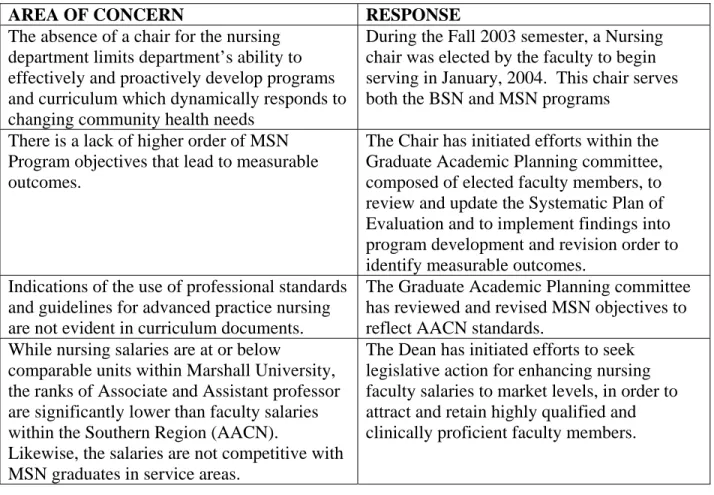
No deficiencies were noted by the NLNAC. However, areas of concern were identified for consideration. In March, 2003, the NLNAC provided a Program Evaluator Report which reflected findings of an on-site visit on September 25-27, 2002. Specific information is offered in Table 1.
E. Copies of the most recent self-study reports
A copy of most recent NLN Self Study and comments has been submitted with the BSN Program Review report.
Table 1: NLN AREAS OF CONCERN AND RESPONSES
AREA OF CONCERN RESPONSE
The absence of a chair for the nursing department limits department’s ability to effectively and proactively develop programs and curriculum which dynamically responds to changing community health needs
During the Fall 2003 semester, a Nursing chair was elected by the faculty to begin serving in January, 2004. This chair serves both the BSN and MSN programs
There is a lack of higher order of MSN Program objectives that lead to measurable outcomes.
The Chair has initiated efforts within the Graduate Academic Planning committee, composed of elected faculty members, to review and update the Systematic Plan of Evaluation and to implement findings into program development and revision order to identify measurable outcomes.
Indications of the use of professional standards and guidelines for advanced practice nursing are not evident in curriculum documents.
The Graduate Academic Planning committee has reviewed and revised MSN objectives to reflect AACN standards.
While nursing salaries are at or below
comparable units within Marshall University, the ranks of Associate and Assistant professor are significantly lower than faculty salaries within the Southern Region (AACN).
Likewise, the salaries are not competitive with MSN graduates in service areas.
The Dean has initiated efforts to seek legislative action for enhancing nursing faculty salaries to market levels, in order to attract and retain highly qualified and clinically proficient faculty members.
III PROGRAM STATEMENT A. Adequacy
CURRICULUM
Coursework in the MSN program incorporates the classroom, laboratory, and clinical modes of instruction. All nursing students have experiences with rural and/or underserved populations as part of the state initiatives for primary health care. The MSN program requires the completion of a minimum of 42 credit hours for the FNP area of emphasis, and 36 credit hours for the NA and NE areas of emphasis. Upon successful completion of the MSN-FNP and/or Post Masters Certificate programs, graduates are eligible to take the American Academy of Nurse Practitioners (AANP) Certification Examination for Adult and Family Nurse
Practitioners and/or the American Nurses Credentialing Center (ANCC) Certification for Family Nurse Practitioners and/or School Nurse Practitioners. Graduates of the MSN-NA program are eligible to take the ANCC Certification Examination for Nursing Administration or Nursing Administration Advanced, depending on their experience and stage of professional development.
The area of emphasis component (18-24 credits) allows the student to specialize in a particular area. The FNP area of emphasis (24 credits) provides students with the opportunity to develop theoretical and clinical competency. Students in this area of emphasis may also opt to specialize as school nurse practitioners. The NA area of emphasis (18 credits) provides students with the opportunity to acquire knowledge and skills necessary to administer or manage primary care agencies, home health care, and other health care agencies or units. The NE area of
emphasis (18 credits) gives the student the opportunity to gain the knowledge and skills necessary to be an academic nurse educator.
The elective component (6 credits) allows students to choose one of four options: 1) thesis, 2) role development courses in teaching, 3) school nurse practitioner courses, or 4) elective courses related to the students area of interest.
The MSN-FNP program can be completed in two academic years of full-time study or over a period not to exceed 7 calendar years from date of first class enrollment. The NA
program can be completed in one calendar year of full-time study or over a period not to exceed 7 calendar years. The NE program can be completed in 4 semesters of study. Graduate nursing courses are open only to those students admitted to the nursing program.
FACULTY
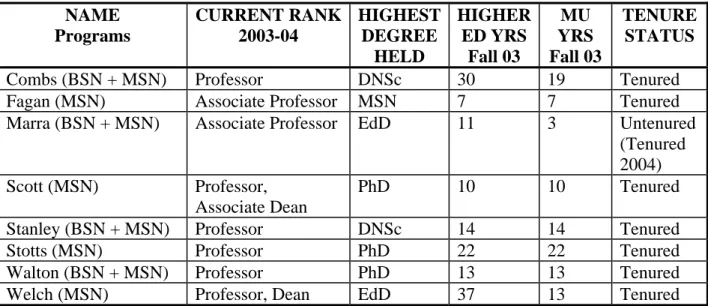
Table 2: MSN FACULTY CHARACTERISTICS—2003-04 NAME Programs CURRENT RANK 2003-04 HIGHEST DEGREE HELD HIGHER ED YRS Fall 03 MU YRS Fall 03 TENURE STATUS
Combs (BSN + MSN) Professor DNSc 30 19 Tenured
Fagan (MSN) Associate Professor MSN 7 7 Tenured
Marra (BSN + MSN) Associate Professor EdD 11 3 Untenured (Tenured 2004) Scott (MSN) Professor,
Associate Dean
PhD 10 10 Tenured
Stanley (BSN + MSN) Professor DNSc 14 14 Tenured
Stotts (MSN) Professor PhD 22 22 Tenured
Walton (BSN + MSN) Professor PhD 13 13 Tenured
Welch (MSN) Professor, Dean EdD 37 13 Tenured
For the academic year 2003-04, a total of 2 faculty members were engaged in full-time teaching in the MSN program. In addition, the Dean and Associate Dean taught courses in the MSN program and 4 full-time faculty members teach on both the BSN and MSN levels of the nursing school. In this group of 8 full-time faculty members, 7 (87.5%) were tenured, 8 (87.5%) had terminal degrees in nursing or related fields, 1 (12.5%) was enrolled in a terminal degree program of study. Part time faculty members were utilized at the Huntington site to cover
clinical and didactic teaching assignments in Pharmacology and FNP areas. All faculty members met the minimum requirements as set by the West Virginia Board of Examiners for Registered Professional Nurses (MSN + unencumbered WV licensure) and the National League for Nursing.
All faculty members were required to maintain current continuing education in order to qualify for relicensure in WV and were encouraged to attend courses and workshops which apply to their clinical specialty and to teaching/learning strategies. Support of publications,
presentations and participation in these professional meetings is provided in the individual faculty data sheets.
STUDENTS
Entrance Standards:
All applicants must meet the admission requirements of the Marshall University Graduate College. The nursing program is available to a limited number of qualified applicants. Admission is determined on a competitive basis. To be eligible for regular admission to the program, applicants must meet the following admission requirements:
• Baccalaureate degree with a major in nursing (BSN) from an NLNAC or AACN accredited program
• Undergraduate course credit for 3 semester hours of basic statistics and 3 semester hours of basic research
• Scholastic achievement as evidenced by an overall undergraduate/graduate Grade Point Average and scores on the Graduate Record Examination as follows:
1. GPA 2.5 (4.0=A) and GRE 800 (total of 2 subtests) and Analytical Writing score of 3 or greater
2. The GRE requirements is waived for applicants with an undergraduate GPA of 3.25 or higher
• Evidence of a current unencumbered license as a registered nurse in a US jurisdiction
• Highly recommended—two years of full-time nursing practice prior to application to the program. Those who do not meet this criterion are considered on an individual basis
An applicant who has a BSN and a Masters degree in any field is eligible for regular admission. Registered nurse applicants with a MSN from an NLNAC/AACN accredited program are eligible for regular admission to the Post-Masters Certificate programs, provided space is available. Applicants also submit an evaluation of their clinical nursing skills from their immediate supervisor, a complete physical examination on forms supplied by the college, and documentation of current CPR certification, Hepatitis B immunization or a signed waiver and current TB test results.
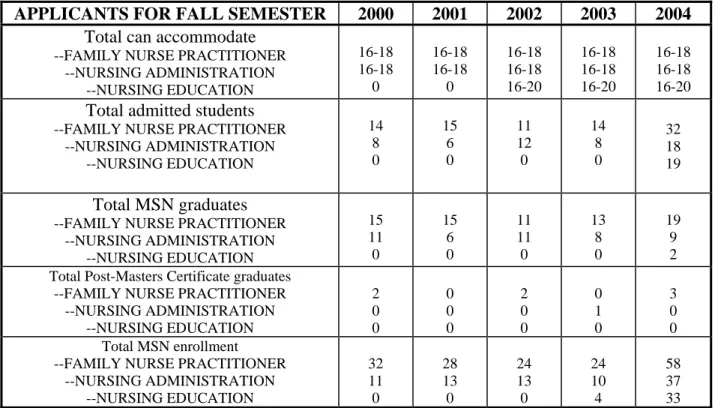
Table 3: APPLICANT/STUDENT DATA FOR MSN PROGRAM
APPLICANTS FOR FALL SEMESTER 2000 2001 2002 2003 2004 Total can accommodate
--FAMILY NURSE PRACTITIONER --NURSING ADMINISTRATION --NURSING EDUCATION 16-18 16-18 0 16-18 16-18 0 16-18 16-18 16-20 16-18 16-18 16-20 16-18 16-18 16-20 Total admitted students
--FAMILY NURSE PRACTITIONER --NURSING ADMINISTRATION --NURSING EDUCATION 14 8 0 15 6 0 11 12 0 14 8 0 32 18 19 Total MSN graduates
--FAMILY NURSE PRACTITIONER --NURSING ADMINISTRATION --NURSING EDUCATION 15 11 0 15 6 0 11 11 0 13 8 0 19 9 2 Total Post-Masters Certificate graduates
--FAMILY NURSE PRACTITIONER --NURSING ADMINISTRATION --NURSING EDUCATION 2 0 0 0 0 0 2 0 0 0 1 0 3 0 0 Total MSN enrollment
--FAMILY NURSE PRACTITIONER --NURSING ADMINISTRATION --NURSING EDUCATION 32 11 0 28 13 0 24 13 0 24 10 4 58 37 33 Entrance Abilities
Table 4: GRE AND GPA REPORT —ENTERING MSN STUDENTS Semester Number Incoming Students Average Verbal GRE Average Quant GRE Average Analytic GRE Average GPA Fall 99 37 409.73 455.14 480.81 3.41 Fall 00 51 433.40 466.38 540.64 3.41 Fall 01 34 424.24 446.97 515.15 3.35 Fall 02 29 434.44 468.15 547.04 3.39 Fall 03 38 435.67 465.33 500.00 3.46 Overall Nursing 189 427.18 460.40 518.00 3.40 Overall all Majors 4195 433.74 484.98 525.19 3.16
Exit Abilities
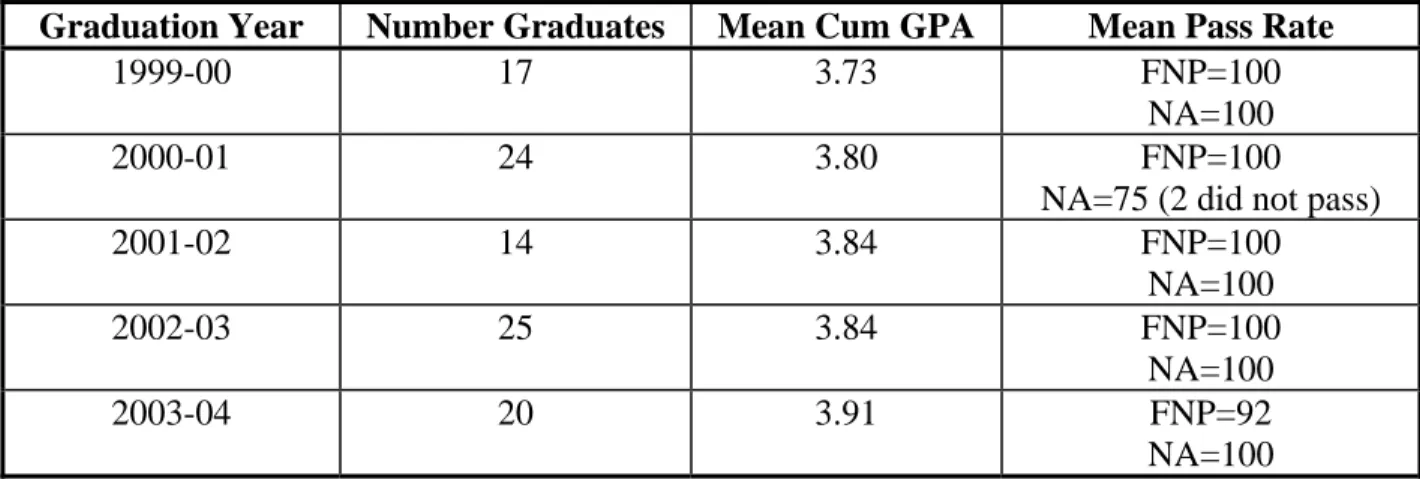
Table 5: MSN GRADUATING STUDENT CUMULATIVE GPAs AND CERTIFYING EXAM PASS RATE
Graduation Year Number Graduates Mean Cum GPA Mean Pass Rate
1999-00 17 3.73 FNP=100 NA=100
2000-01 24 3.80 FNP=100 NA=75 (2 did not pass)
2001-02 14 3.84 FNP=100 NA=100 2002-03 25 3.84 FNP=100 NA=100 2003-04 20 3.91 FNP=92 NA=100 RESOURCES Financial
The fiscal resources are adequate to support the BSN program. The University has provided support for the nursing program and has assisted in the attainment of additional funding to initiate and maintain the program. The West Virginia legislature and Vice President for Academic Affairs have assured nursing administration that this money would continue to be allocated to Nursing. Currently, Nursing has budgeted positions for 18 full-time faculty
positions on 9 month appointments, and a Dean and Associate Dean on 12 month appointments. At present, two full-time 9 month positions are open.
Two full-time positions, as well as the Dean and Associate Dean have been totally
involved in teaching in the MSN program. In addition, four full-time faculty have been involved in teaching in both the BSN and MSN programs. Seven full-time staff positions support the needs of the Dean, Associate Dean, Faculty members and Students.
The Dean is responsible for preparation and administration of the budget and is in the process of establishing a budget line for the combined nursing program (BSN and MSN) which is separate from the Dean’s budget line. Within that School of Nursing budget, the BSN and MSN programs are not differentiated. Faculty provides input for needed equipment and media.
The nursing operating expense budget is based upon student fee revenue. Thus, as the number of students increases so does the base operating budget.
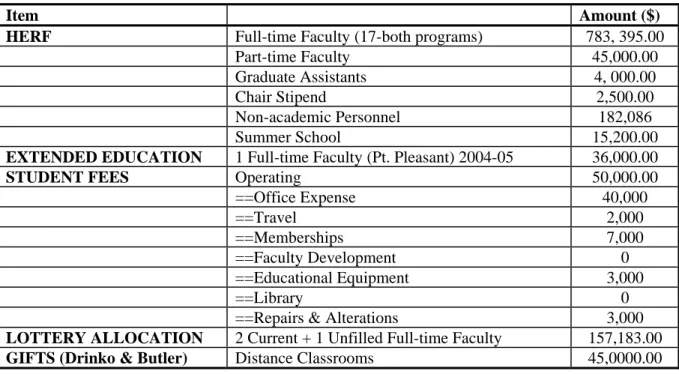
Table 7 represents the newly identified allocations separated out for the School of Nursing budget (both programs).
Table 6: FY 2003-04 BUDGET ALLOCATIONS
Item Amount ($)
HERF Full-time Faculty (17-both programs) 783, 395.00
Part-time Faculty 45,000.00
Graduate Assistants 4, 000.00
Chair Stipend 2,500.00
Non-academic Personnel 182,086
Summer School 15,200.00
EXTENDED EDUCATION 1 Full-time Faculty (Pt. Pleasant) 2004-05 36,000.00
STUDENT FEES Operating 50,000.00
==Office Expense 40,000 ==Travel 2,000 ==Memberships 7,000 ==Faculty Development 0 ==Educational Equipment 3,000 ==Library 0
==Repairs & Alterations 3,000
LOTTERY ALLOCATION 2 Current + 1 Unfilled Full-time Faculty 157,183.00
GIFTS (Drinko & Butler) Distance Classrooms 45,0000.00
Facilities==Huntington Campus
The physical facilities for nursing are adequate at this time. Nursing is located on the third and fourth floors of Prichard Hall. Each full-time, primarily campus-based faculty member has a large private office with a desk, file cabinets, bookcase, and personal computer. All
computers are linked with the MU mainframe. The telephone lines are to individual faculty offices and utilize the AUDIX voice mail system.
There are three large classrooms located in Prichard Hall (324, 401, 425) which are utilized almost exclusively by nursing. In addition, the Learning Resources Center (Skill Lab) is located in PH 301. All have recently been renovated into electronic classrooms. This state-of-the-art equipment enables each classroom to be a “send and/or receive” site. These rooms are carpeted with anti-static carpet, wired for computer availability, and are fitted with room darkening shades. An LCD, VCRs, television monitors, and ELMO overhead projectors are connected to the computer at the faculty workstation. Also located on the third floor (317), is a small conference room for seminars, meetings and small classes. If needed, other classrooms on campus may also be reserved. Classroom and conference space are adequate at this time. However, courses which include the entire sophomore, junior or senior student group must now meet in two classrooms, with the instructor present in only one. Graduate Assistants have been utilized to provide facilitation of the second classroom for attendance, collection of paperwork, and exam monitoring purposes. During a typical fall or spring semester, the large classrooms are utilized 9:00AM to 8:00PM 4-5 days/week.
The Nursing Learning Resource Center (Skill Lab) is located on the third floor of Prichard Hall (301). This area is designed for students to observe and practice nursing skills, to practice physical examination skills, review audiovisual material, and study. Six hospital beds and three examination tables are available. The Director of the Learning Resource Center is available to provide resource material to students and faculty.
The Computer Laboratory for nursing students is located adjacent to the Learning
Laboratory (308). Ten Dell OptiPlex BX110, 256K computers, all linked to the MU mainframe, are available for nursing student use. In addition, an HP LaserJet 4050TN printer is available for student use with a swipe card for printing. Students utilize the computer lab for course
assignments, email access, and use of programs loaded for NCLEX review. All faculty, students and staff also have access to equipment in Drinko Library and four other specialty Libraries.
Offices for secretarial and support staff are adequate. Each staff person has a computer linked to the MU mainframe. A scanner, large central copier, and three small copiers and fax machine are available for faculty and secretarial use. A kitchen is located on the fourth floor and includes a sink, refrigerator, microwave, and table and chairs. These facilities are open to faculty and staff. Faculty mailboxes and bulletin boards are also in this room.
ASSESSMENT INFORMATION
Principle Assessment Elements
The Master of Science in Nursing Program’s component area goals are designed to be congruent with the National League for Nursing Accrediting Commission’s criteria for accreditation. These component area goals are evaluated according to the School of Nursing Systematic Evaluation Plan which can be found at the end of this report. The component area goals are as follows.
1. Mission - The mission and goals of the College of Nursing and Health Professions are consistent with the mission and goals of Marshall University. 2. Critical Thinking – As defined by the faculty, a multidimensional, self-directed
cognitive process that uses knowledge as context is criteria based, creative and purposeful in making judgments and decisions. As a program outcome, it has been measured by the Watson-Glaser Critical Thinking Appraisal, the research project, clinical evaluations, comprehensive examinations, and graduate and alumni surveys.
3. Communication – As defined by the faculty, utilization of the communication process through a variety of methods. As program outcome, it has been measured by the senior research project, clinical evaluations, comprehensive examinations, and graduate and alumni surveys.
4. Therapeutic Nursing Interventions – As defined by the faculty, theory-based, cognitive, psychomotor and affective skills used in the implementation of nursing care. Therapeutic Nursing Intervention skills, as a program outcome, are
measured by clinical evaluations in NUR 695.
5. Performance on Certification Examination – As defined by the faculty, a high proficiency in an area of specialization has been achieved. This has been
measured by first-time passage rates on certification examinations.
6. Employment Rate – As defined by the faculty, employment patterns document employment settings, roles, population groups and overall employment rate of graduates. This has been tracked through graduate and alumni surveys.
7. Graduate Satisfaction – As defined by the faculty, the degree to which the nursing program and its component elements are perceived by its recipients to meet their requirements or criteria. This has been measured by graduate and alumni survey results.
8. Graduation rates – As defined by the faculty, the number of students entering and the number of students graduated from a given class. The School of Nursing has maintained a computerized data base.
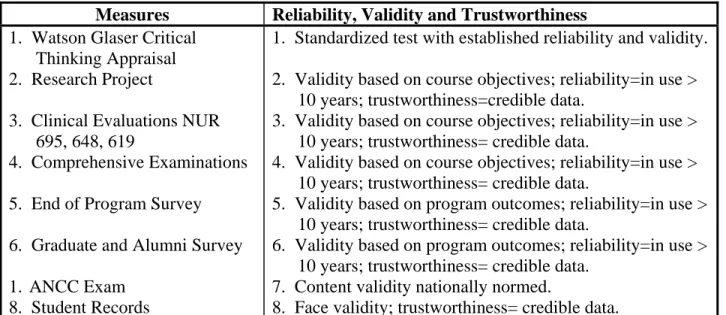
Table 7: OVERVIEW OF MEASURES
Measures Reliability, Validity and Trustworthiness 1. Watson Glaser Critical
Thinking Appraisal 2. Research Project
3. Clinical Evaluations NUR 695, 648, 619
4. Comprehensive Examinations 5. End of Program Survey 6. Graduate and Alumni Survey 1. ANCC Exam
8. Student Records
1. Standardized test with established reliability and validity. 2. Validity based on course objectives; reliability=in use >
10 years; trustworthiness=credible data.
3. Validity based on course objectives; reliability=in use > 10 years; trustworthiness= credible data.
4. Validity based on course objectives; reliability=in use > 10 years; trustworthiness= credible data.
5. Validity based on program outcomes; reliability=in use > 10 years; trustworthiness= credible data.
6. Validity based on program outcomes; reliability=in use > 10 years; trustworthiness= credible data.
7. Content validity nationally normed.
8. Face validity; trustworthiness= credible data.
Summary Information
Chart I containing student outcomes, assessment tool approach, standards/benchmark, results/analysis, and action taken information is available at the end of this report.
Use of Assessment Data to Improve Program Quality
Most areas met or exceeded critical outcomes but two required attention. The first area that required attention was the standardized testing method for critical thinking. The Watson-Glaser Critical Thinking Appraisal was re-evaluated by the Graduate Academic Standards and Planning Committee and was deemed not to adequately reflect the critical thinking abilities of the graduate level students, since it was administered only upon graduation. Beginning in the academic year 2003-2004, critical thinking will be measured by the senior research project, clinical evaluations, and graduate and alumni surveys.
The second area that was that of the comprehensive examination. The Graduate Academic Planning and Standards Committee elected to eliminate requirement of the comprehensive examination in favor of a more focused senior research project. The new research project concentrates heavily on evidence-based outcomes of clinical practice situations and includes formal poster presentation of results.
A third area of concern is the complicated nature of the evaluation plan. The Graduate Academic Progress (GAP) Committee is currently reviewing measurements used in collection of data, attempting to eliminate duplication, and selecting the most credible data for retrieval. In
addition, incorporation of a realistic and current professional nursing theoretical framework and NLN national standards is anticipated. These goals were noted in the 2000 and 2001 reports, and are now being implemented by the GAP committee.
Previous Reviews
From the July 12, 2004 review, the following comments were made:
“The program has achieved an overall score of 9 which places it in Level 3 of the NCA/HLC’s levels of implementation. Congratulations. The MSN program has continually been able to achieve this level in its assessment efforts. With strict guidelines from the NLN and the State of WV, program objectives have to be consistently met. The program has been able to accomplish this goal.
Recommendations: The only recommendations UAC might have is that the explanation for discontinuing the use of the Watson-Glaser Critical Thinking test was not well documented. General Comments: It is imperative that programs keep a record of their assessment activities and have this information available for the NCA/HLC site committee if requested.”
The Watson-Glaser tool was discontinued because it was administered only once at the end of the program, and therefore, could not be viewed as data which validated any change in levels of critical thinking as a result of the MSN program. In addition, the cost of the tool, and repeated reductions in the program budget contributed to this decision.
As the GAPS committee develops a revised current evaluation plan, responsibilities for collection of the data will be shared by committee members. Records of ongoing assessment results will be maintained in the office of the School of Nursing chair.
Strengths/Weaknesses:
SIGNIFICANT STRENGTHS OF THE MSN PROGRAM
• Excellent faculty, committed to maintaining a nursing education program of quality.
• Well qualified students, with ample applications for available spots.
• State-of-the-art technology, enabling distance outreach to the MOVC and MUGC campuses, use of WEBCT to facilitate several courses, and use of email list serves to enhance communication among faculty and student groups.
• Administrative support by the Dean and Associate Dean of the College of Health Professions.
• Strong outreach program, including participation in Rural Health rotations and clinical experiences in several area health care agencies.
• Full NLNAC continuing accreditation for 8 years.
• Extension of availability of the MSN program to distance campuses at West Liberty, Bluefield State, Fairmont State and Point Pleasant. This is especially in response to an anticipated shortage of future qualified nursing educators in the state.
WEAKNESSES OF THE PROGRAM
• Increased enrollment in response to market demands and Board of Governors directives, despite a decrease in faculty FTEs and in operating budget.
• Limited participation of faculty in research in response to workload requirements of faculty and to number of faculty members involved in community clinical practice in order to maintain FNP Certification.
• Challenges in recruiting qualified full-time faculty members in response to discrepancies in academic and clinical salary levels.
PLANS FOR REMOVING WEAKNESSES
• Continue to maintain high quality of program, which may necessitate limiting enrollment in response to faculty numbers and budget issues.
• Continue to support participation of faculty members in “completion” of their academic education. Encourage collaborative and multidisciplinary research by faculty members.
• Petition appropriate parties for consideration of adjustment of nursing faculty salaries to reflect market values.
VIABILITY Articulation Agreements
The College of Health Professions follows all articulation agreements set forth by Marshall University and the Higher Education Policy Commission.
Off-Campus/Distance Delivery Classes
Classes are offered off-campus to facilitate the learning needs of students. In addition to South Charleston, distance sites have been established at Bluefield State, West Liberty, Fairmont State, and Point Pleasant (MOVC) which offers the entire MSN program. Special emphasis has been placed on offering the Nursing Education tract to these distance sites, since this is the only MSN NE program in the state. Specific information is offered in Appendix III.
Service Courses
Because nursing is a highly specialized field, the School of Nursing does not offer services courses for other majors.
Program Course Enrollment
Course enrollment in required and elective nursing courses remains stable. A complete listing of courses and enrollments for the past five years can be found in Appendix V.
Program Enrollment
Admission to the MSN program of the School of Nursing is open to all qualified
candidates. In response to the addition of distance sites, enrollment limits have been applied for core and specialty courses. The admission must be limited due to the number of qualified faculty available, the number of faculty positions awarded, and limited ability to attract qualified faculty from clinical positions for which salaries are much higher. See Appendix VI for specific data.
Enrollment Projections
Enrollment Projections are expected to increase slightly over the next five years with the continuation of the distance sites.
NECESSITY Advisory Committee
The School of Nursing does not currently have an Advisory Committee. The administrative team does meet yearly with individual nursing CEOs and with coordinators of distance sites.
Graduates
Graduates of the Marshall University MSN program are usually employed part or full time as professional nurses while completing the program. Many receive commitments for advanced practice in education, administration, or clinical roles from employers prior to graduation. Indeed, many area hospitals request an opportunity to meet with MSN students for recruitment purposes. Students are actively recruited from area hospitals, especially King’s Daughters, Cabell Huntington, and St Mary’s Hospitals. Data for patterns of employment demonstrate that graduates are employed in a variety of settings. Although it is not unusual for new graduates to be employed in a hospital, current trends in health care are placing more emphasis on the community setting. The curriculum has a strong community-based focus and every student has some clinical experience in a rural or under-served setting. Survey of alumni and employers demonstrate that all graduates are employed in nursing who wish to be employed in nursing.
CONSISTENCY WITH MISSION
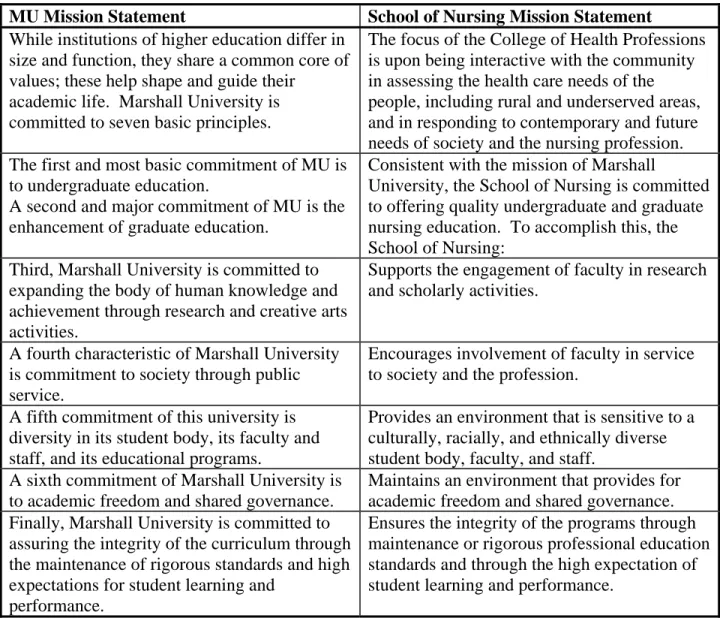
The Mission statements of MU and the School of Nursing emphasize support for quality education, the expansion of knowledge through research and creative activities, the provision of service to society, to diversity, and finally, to academic freedom. Key phrases from the MU and School of Nursing Mission Statements are abstracted from the original documents and appear in the following table to demonstrate the consistency in philosophy. Specific information is provided in Table 9.
Table 8: COMPARISON OF MU AND SCHOOL OF NURSING MISSION MU Mission Statement School of Nursing Mission Statement While institutions of higher education differ in
size and function, they share a common core of values; these help shape and guide their
academic life. Marshall University is committed to seven basic principles.
The focus of the College of Health Professions is upon being interactive with the community in assessing the health care needs of the people, including rural and underserved areas, and in responding to contemporary and future needs of society and the nursing profession. The first and most basic commitment of MU is
to undergraduate education.
A second and major commitment of MU is the enhancement of graduate education.
Consistent with the mission of Marshall
University, the School of Nursing is committed to offering quality undergraduate and graduate nursing education. To accomplish this, the School of Nursing:
Third, Marshall University is committed to expanding the body of human knowledge and achievement through research and creative arts activities.
Supports the engagement of faculty in research and scholarly activities.
A fourth characteristic of Marshall University is commitment to society through public service.
Encourages involvement of faculty in service to society and the profession.
A fifth commitment of this university is diversity in its student body, its faculty and staff, and its educational programs.
Provides an environment that is sensitive to a culturally, racially, and ethnically diverse student body, faculty, and staff.
A sixth commitment of Marshall University is to academic freedom and shared governance.
Maintains an environment that provides for academic freedom and shared governance. Finally, Marshall University is committed to
assuring the integrity of the curriculum through the maintenance of rigorous standards and high expectations for student learning and
performance.
Ensures the integrity of the programs through maintenance or rigorous professional education standards and through the high expectation of student learning and performance.
Appendix I
Required/Elective Course Work in the Program Degree Program: MASTER OF SCIENCE IN NURSING
Person responsible for the report: _SANDRA E. MARRA, EdD, NCC, RN FAMILY NURSE PRACTITIONER PLAN OF STUDY
Courses Required in Major ( Course Number and Title)
Required Hours
Elective Credit Required by the Major
6 credits from list below
Elective Hours Related Fields Courses Required Related Hours NONE Core Courses (12)
NUR 602: Theoretical Foundations in Nursing NUR 604: Leadership in Nursing
NUR 606: Advanced Nursing Research NUR 608: Issues in Health Care
Area of Emphasis Courses (24)
NUR 622: Advanced Family Nursing I NUR 624: Advanced Family Nursing II NUR 626: Advanced Family Nursing III
NUR 662: Pharmacology for Nurses in Advanced Practice NUR 695: Internship: Advanced Family Nursing
3 3 3 3 5 5 5 3 6
NUR 616: Curriculum Development in Nursing
NUR 618: Teaching in Nursing
NUR 632: School Nurse Practitioner Role in School Health I
NUR 634: School Nurse Practitioner Role in School Health II
NUR 642: Organizational Dynamics in Nursing
NUR 644: Financial Strategies in Nursing Administration NUR 681: Thesis 3 3 3 3 3 3 6
Total Required Hours 36 Total Elective Hours 6 Total Related
Hours
Appendix I continued
Required/Elective Course Work in the Program Degree Program: MASTER OF SCIENCE IN NURSING
Person responsible for the report: _SANDRA E. MARRA, EdD, NCC, RN NURSING ADMINISTRATION PLAN OF STUDY
Courses Required in Major ( Course Number and Title)
Required Hours
Elective Credit Required by the Major
6 credits from list below
Elective Hours Related Fields Courses Required Related Hours NONE Core Courses (12)
NUR 602: Theoretical Foundations in Nursing NUR 604: Leadership in Nursing
NUR 606: Advanced Nursing Research NUR 608: Issues in Health Care
Area of Emphasis Courses (18)
NUR 642: Organizational Dynamics in Nursing NUR 644: Financial Strategies in Nursing Administration
NUR 646: Nursing Management in Health Care Settings I
NUR 648: Nursing Management in Health Care Settings II 3 3 3 3 3 3 6 6
NUR 616: Curriculum Development in Nursing
NUR 618: Teaching in Nursing
NUR 632: School Nurse Practitioner Role in School Health I
NUR 634: School Nurse Practitioner Role in School Health II
NUR 662: Pharmacology for Nurses in Advanced Practice NUR 681: Thesis 3 3 3 3 3 6
Total Required Hours 30 Total Elective Hours 6 Total Related
Hours
Appendix I continued
Required/Elective Course Work in the Program Degree Program: MASTER OF SCIENCE IN NURSING
Person responsible for the report: _SANDRA E. MARRA, EdD, NCC, RN NURSING EDUCATION PLAN OF STUDY
Courses Required in Major ( Course Number and Title)
Required Hours
Elective Credit Required by the Major
6 credits from list below
Elective Hours Related Fields Courses Required Related Hours NONE Core Courses (12)
NUR 602: Theoretical Foundations in Nursing NUR 604: Leadership in Nursing
NUR 606: Advanced Nursing Research NUR 608: Issues in Health Care
Area of Emphasis Courses (18)
NUR 616: Curriculum Development in Nursing NUR 618: Teaching in Nursing
NUR 619: Practicum: Teaching in Nursing EDF 535: Tests and Measurements
CIEC 600: Computing and Instructional Design EDF 619: Educational Psychology
3 3 3 3 3 3 3 3 3 3
NUR 632: School Nurse Practitioner Role in School Health I
NUR 634: School Nurse Practitioner Role in School Health II
NUR 642: Organizational Dynamics in Nursing
NUR 644: Financial Strategies in Nursing Administration
NUR 662: Pharmacology for Nurses in Advanced Practice NUR 681: Thesis 3 3 3 3 3 6
Total Required Hours 30 Total Elective Hours 6 Total Related
Hours
Total of 36 Credits required for graduation. Professional societies that have influenced the program offering and/or requirements:
• West Virginia Board of Examiners for Professional Registered Nurses • National League for Nursing
Date Created: March 6, 2002 (1:35PM); Date Revised February 17, 2006 (9:37AM)
35 Appendix III
Off-Campus Classes
Year Location Courses Offered Enrollment
Fall 2002 Logan NUR 616 4
Spring, 2003 West Liberty State College NUR 616 3
Fall, 2003 West Liberty State College NUR 602 NUR 608 NUR 618
5 3 2
Spring, 2004 Bluefield State College NUR 602 8 West Liberty State College NUR 608
NUR 616 NUR 619
2 2 4
Summer, 2004 West Liberty State College NUR 618 1
Fairmont State College NUR 618 2
Bluefield State College NUR 618 3
Distance Delivery Classes List E courses. NONE
Appendix IV
Service Courses--NONE
Course Number Course Name Year 11999-2000 Year 2 2000-2001 Year 3 2001-2002 Year 4 2002-2003 Year 5 2003-2004 Su Fa Sp Su Fa Sp Su Fa Sp Su Fa Sp Su Fa Sp e.g. 101
Date Created: March 6, 2002 (1:35PM); Date Revised February 17, 2006 (9:37AM)
37
Appendix V
Program Course Enrollment
CourseNumber
Course Name Required/ Elective Year 1 1999-2000 Year 2 2000-2001 Year 3 2001-2002 Year 4 2002-2003 Year 5 2003-23004 ====== ================ ====== Su Fa Sp Su Fa Sp Su Fa Sp Su Fa Sp Su Fa Sp
NUR 602 Theoretical Foundations in Nursing
REQ == 10 13 == 15 13 == 10 11 == 5 9 == 16 22
NUR 604 Leadership in Nursing REQ == 16 9 == 14 20 == 13 10 == 9 7 1 10 30
NUR 606 Advanced Nursing Research REQ == 13 9 == 10 17 == 11 12 == 6 9 == 5 12
NUR 608 Issues in Health Care REQ == 10 14 == 14 15 == 6 14 == 8 8 == 17 15
NUR 616 Curriculum Development in Nursing
REQ NE
== == 7 == == 6 == == 2 == 4 5 10 == 7 NUR 618 Teaching in Nursing REQ
NE
== 4 == == 8 == == 7 == 10 == == == 6 ==
NUR 619 Practicum: Teaching in Nursing REQ NE
== == == == == == == == == == == == == == 4 NUR 622 Advanced Family Nursing I REQ
FNP
== 16 == == 14 == == 13 == == 11 == == 15 == NUR 624 Advanced Family Nursing II REQ
FNP
== == 16 == == 11 == == 12 == == 10 == == 15 NUR 626 Advanced Family Nursing III REQ
FNP
== 17 == == 15 == == 12 == == 13 == == 11 == NUR 632 School Nurse Practitioner Role in
School Health I
EL == == == == == == 11 == == == == == 4 == ==
NUR 634 School Nurse Practitioner Role in School Health II
EL == == == == == == 11 == == == == == 4 == ==
NUR 642 Organizational Dynamics in Nursing
REQ NA
== 11 == == 13 == == 13 == == 11 == == 7 ==
NUR 644 Financial Strategies in Nursing Administration
REQ NA
== 11 == == 8 == == 15 == == 13 == == 7 ==
NUR 646 Nursing Management in Health Care Settings I
REQ NA
Course Number
Course Name Required/ Elective
99 99 00 00 00 01 01 01 02 02 02 03 03 03 04
====== ================ ====== Su Fa Sp Su Fa Sp Su Fa Sp Su Fa Sp Su Fa Sp
NUR 648 Nursing Management in Health Care Settings II
REQ NA
== == == 10 == == 6 == == 11 == == 13 == == NUR 662 Pharmacology for Nurses in
Advanced Practice
REQ FNP
== 14 == == 12 == == 12 == == 17 == == 8 ==
NUR 681 Thesis EL == == == == == 3 2 == == 3 == 8 5 2 5
NUR 695 Internship: Advanced Family Nursing
REQ FNP
== 1 16 2 == 15 == == == 3 == 13 == 11
(Note: If you listed courses in Appendix IV, do not list them again in this appendix.)
* Indicate all courses other than the service courses here. Please include all special topics courses offered as well as independent studies. When listing Independent studies, please list the
Date Created: March 6, 2002 (1:35PM); Date Revised February 17, 2006 (9:37AM) 39
Appendix VI
Program Enrollment
Students Year 1 1999-2000 Year 2 2000-2001 Year 3 2001-2002 Year 4 2002-2003 Year 5 2003-2004 New Students Admitted:MSN Nursing
11 19 9 8 18
Principal Majors Enrolled Area of Emphasis: 9081 MSN Nursing 21 3 3 Area of Emphasis: GN10—MSN Nursing 38 60 62 57 55 Certificate: Family Nurse Practitioner 2
GN90—Family Nurse Practitioner, Post-Masters Program
2 7 4 2 2
Other Areas of Emphasis (i.e., education specialization majors)
Minors**
Grand Total of Students Enrolled in the Program
63 67 69 62 57
Chart I Assessment Summary Marshall University
Assessment of Student Outcomes: Component/Course/Program Level
5 year summary
Component Area/Program/Discipline:___MASTER OF SCIENCE IN NURSING
Component / Course / Program Level Student Outcome Person
Responsible Assessment Tool or Approach Standards/ Benchmark MEAN Results/ Analysis Action Taken
Critical Thinking Faculty Watson-Glaser
Critical Thinking Appraisal Exam
32 29.46 In 2003, Graduate Academic Planning % Standards Committee voted to eliminate
exam and change criteria for research project to better reflect critical thinking. Faculty Research
Project-capstone course
85% 99.75 Incorporating Evidence-Based Clinical Research Project Faculty Clinical evaluations 3 3.97 None needed Faculty Comprehensive Examinations
Pass 100% In 2003, Graduate Academic Planning & Standards Committee voted to eliminate
comprehensive exams in favor of evidence-based practice research projects. Graduates Graduate Survey 4 3.55 Monitor for trend
Alumni Alumni Survey 4 3.5 Monitor for trend
Communication Faculty Research Project 85% 99.75% Incorporating Evidence-Based Clinical
Research Project Faculty Clinical
Evaluations
Date Created: March 6, 2002 (1:35PM); Date Revised February 17, 2006 (9:37AM)
41
Student Outcome Person Responsible Assessment Tool or Approach Standards/ Benchmark MEAN Results/ Analysis Action Taken Faculty Comprehensive Exam
Pass 100% In 2003, Graduate Academic Planning & Standards Committee voted to eliminate
comprehensive exams in favor of evidence-based practice research projects. Graduates Graduate Survey 4 3.8 Monitor for trend
Alumni Alumni Survey 4 3.76 Monitor for trend Therapeutic Nursing Interventions Faculty Clinical Evaluations 3 3.97 None needed Performance on Certification Exams Graduates AACN Examination 80% 99.5% None needed
Employment Rates Graduates Graduate Surveys Dependent on Job Market
100% None Needed Alumni Alumni Surveys Dependent on
Job Market
100% None Needed Program Satisfaction Graduates Graduate Surveys 3 3.58 None needed
Alumni Alumni Surveys 3 4 None needed
Graduation Rate Graduates Student Records 70% 96.42 None needed
Systematic Evaluation Plan Master of Science in Nursing Program p. 1
Components to be Evaluated
Questions (Criteria) Methods and/or Processes Timeframe Participants Evaluation of Outcomes Examples
I. Structure and Governance
A. Mission Is the mission of Nursing consistent with the mission of the University?
Are the goals of the nursing unit administrative objectives meeting the mission of Nursing?
Review mission of Nursing for consistency with University’s mission. Program review. Evaluate Nursing administrative objectives. Every 5 years as University mission is reviewed, or as faculty determine mission should change based on changing health care needs.
Every 5 years.
End of spring semester.
Graduate Academic Planning and Standards Committee; Nursing faculty.
Graduate Academic Planning and Standards Committee; Nursing faculty; MU Graduate Council; HEPC. Dean with input from faculty.
The Nursing Mission statement was last reviewed for consistency with the University Mission statement and approved on 8/17/98. The graduate program was reviewed and approved for continuation during the 1999 - 2000 academic year.
The goals of the nursing unit are meeting the mission of Nursing. B. Organizational
Structure
Do the bylaws provide for efficient and effective governance?
Review of bylaws. End of spring semester. Graduate Academic Planning and Standards Committee; Nursing faculty.
The bylaws were reviewed, revised, and approved by an ad hoc committee and the faculty during the 2002 to 2003 academic year to provide for efficient and effective governance.
Date Created: March 6, 2002 (1:35PM); Date Revised February 17, 2006 (9:37AM)
43
Systematic Evaluation Plan Master of Science in Nursing Program p. 2
Components to be Evaluated
Questions (Criteria) Methods and/or Processes Timeframe Participants Evaluation of Outcomes Examples
C. Administration 1. Dean
2. Associate Dean, Nursing
Does the Dean adequately fulfill the responsibilities of the position?
Does the Associate Dean adequately fulfill the responsibilities of the position?
Evaluation of Dean.
Evaluation of Associate Dean.
End of spring semester.
End of spring semester.
Nursing faculty; VP for Health Sciences.
Nursing faculty; Dean.
The Dean adequately fulfills the responsibilities of the position as
evidenced by participation in university governance and committees, and interaction with health care statewide.
The Dean teaches graduate courses.
The Associate Dean adequately fulfills the responsibilities of the position as evidenced by program administration. D. Policies and Procedures Are policies and
procedures current, adequate for smooth functioning of unit in Nursing?
Policies and/or procedures are reviewed and/or recommended by appropriate persons or committees.
Ongoing.
End of spring semester.
Faculty; Dean; Associate Deans; Nursing
Committees. MU Graduate Council. Higher Ed Report Card.
Policies and procedures of the nursing unit are consistent with those of the university, are current and adequate for smooth functioning. Differences between MU and Nursing policies are justified by the nursing unit goals.
Systematic Evaluation Plan Master of Science in Nursing Program p. 3
II. Resources
A. Classrooms Are classrooms adequate for learning activity?
Are classrooms equipped to facilitate a variety of teaching learning strategies ex., seminar, small group?
Request from Associate Dean for specific rooms to meet learning activity needs is sent to administrative assistant who handles room assignments.
Reviewed by faculty and Associate Dean.
End of each semester.
End of spring semester.
Faculty; Associate Dean.
Faculty; Associate Dean.
both campuses (Marshall and MUGC) have classrooms that are adequate for learning activities and are equipped to facilitate a variety of teaching strategies.
B. Offices Is office space adequate for faculty?
Is office equipment sufficient?
Are computer services adequate?
All office space is assigned through Dean’s office. Reviewed by staff. Reviewed by Dean, faculty, staff. Ongoing. Ongoing. Ongoing.
Faculty; Associate Dean; Dean.
Office staff.
Staff; faculty; Associate Dean; Dean.
both campuses have office space that is adequate for faculty in terms of space, equipment and computer services.
C. Secretarial Services Are secretarial services adequate to support the graduate nursing program?
A staff performance appraisal form is completed by the Associate Dean and is submitted to Dean. Faculty may provide input through Graduate
Academic Planning and Standards Committee.
End of spring semester. Associate Dean; Dean. Secretarial services are adequate to support the graduate program.
Date Created: March 6, 2002 (1:35PM); Date Revised February 17, 2006 (9:37AM)
45
Systematic Evaluation Plan Master of Science in Nursing Program p. 4
D. Clinical Facilities Are clinical facilities adequate to meet course objectives?
Agreements are
established with agencies. At the end of each course, clinical site and preceptors are evaluated by students, faculty, and course coordinator. Agencies and preceptors are asked for input regarding placement of students in clinical agency.
End of each semester and as needed.
End of each semester. End of each semester.
Students; faculty; preceptors; course coordinator; Associate Dean; Dean.
Clinical facilities are adequate to meet course objectives for the graduate program. Comments are obtained and encouraged from students and faculty regarding their perception and experience with the clinical facilities.
E. Library and Learning Resources
Are the library holdings adequate to meet the needs of the graduate nursing students?
Is the Learning Resources Center adequate to meet the needs of graduate nursing students? a. space
b. supplies, equipment
Requests from faculty for purchase of books and periodicals.
Evaluation of number and type of books and periodicals requested by faculty.
Discussion held with Director of Learning Resources Center, Dean.
Requests for supplies and equipment by faculty and students each semester via course coordinator, Associate Dean, and Dean.
End of each semester.
Ongoing.
Ongoing.
End of each semester.
Library and Learning Resources Committee with input from faculty and Associate Dean. Library and Learning Resources Committee.
Director of Learning Resources Center with input from Associate Dean, Dean, faculty, and students.
Library and Learning Resources Committee with input from Graduate Academic Planning and Standards Committee, faculty, course coordinator, Associate Dean, and Dean.
The on campus Library needs are adequate to meet the needs of the graduate students. A concerted effort has been made to update all books used by graduate students on an annual basis. The Learning Resources Center is adequate to meet the needs of the students in terms of media and software. The Drinko Library and Health Science Library are adequate to meet student’s needs. The MUGC campus library facility is adequate to meet the needs of the graduate students. The Robert C. Byrd Academic Center has a library facility equipped with Internet and some health care holdings. If a nursing graduate student wants to obtain a reference from the Marshall campus, use of the courier services allows for books to be obtained. Journal and periodical articles can be purchased for .10 per page and this is the cost for students at both campuses.
Systematic Evaluation Plan Master of Science in Nursing Program p. 5
Components to be Evaluated
Questions (Criteria)
Methods and/or Processes Timeframe Participants Evaluation of Outcomes Examples
c. media
d. computer laboratory
Requests for needed media via Associate Dean, Dean.
Requests for needed software.
Ongoing.
Ongoing.
Library and Learning Resources Committee with faculty, students, Associate Dean, and Dean’s input. Library and Learning Resources Committee with input from Graduate Academic Planning and Standards Committee, faculty, students, Associate Dean, and Dean.
III. Students A. Policies regarding: 1. Admission 2. Transfer 3. Dismissal 4. Readmission 5. Progression
Are current policies appropriate?
Analysis of admission, progression, and graduation data. FNP certification success. Review of policies and procedures.
End of spring semester or as need arises.
Graduate Academic Planning and Standards Committee; Associate Dean; faculty; Dean; and consultant.
Current policies are appropriate and
recommended changes are made if the need arises. The admission policy for provisional admission was revised 4/19/99.
LOA policy revised 3/11/02.
GRE requirement removed if GPA is 3.25 or higher. Revised 4/28/03
Date Created: March 6, 2002 (1:35PM); Date Revised February 17, 2006 (9:37AM)
47
Systematic Evaluation Plan Master of Science in Nursing Program p. 6
Components to be Evaluated
Questions (Criteria) Methods and/or Processes Timeframe Participants Evaluation of Outcomes Examples
6. Student Concerns Are students concerned about specific aspects of program?
Meetings with students, faculty, Associate Dean, or Dean, committees.
Each semester, or as needed.
Students; Graduate Academic Planning and Standards Committee; other committees; Associate Dean; Dean; consultant.
Students concerns are addressed through open communication with students through meetings, correspondence or
announcements.
Dean communicates with students through meetings, correspondence or
announcements. B. Demographics Are characteristics of
students maintained?
University reports; NLN reports; AACN reports; ADDNE reports; grant reports.
Ongoing, when reports are due.
Dean; Associate Dean; Graduate School.
Characteristics of students are maintained. Reports are kept in the Record Officer’s office. C. Performance Are students meeting the
objectives of the courses?
Student performance is evaluated by faculty designed theory and performance evaluation tools. Things evaluated include exams, case studies, case presentations, video tapes, written and actual history and physicals, other written papers, Evidence Based Project, performance in campus lab, clinical agency and thesis, if applicable.
Ongoing. Each semester. Grade received at end of each course.
Faculty; preceptors; Associate Dean.
Students are meeting the objectives of the courses as evidenced by passing the course.
Systematic Evaluation Plan Master of Science in Nursing Program p. 7
Components to be Evaluated
Questions (Criteria) Methods and/or Processes Timeframe Participants Evaluation of Outcomes Examples
D. Graduates Are graduates satisfied with preparation received in MSN-FNP, MSN-NUR ADM program?
Discussion with graduates upon completion of program. Analysis of Graduate Survey.
Immediately after graduation for graduates. Surveys to be done at 1 year for graduates.
Associate Dean and/or Dean; graduates.
Faculty; Associate Dean; Dean; graduates.
Graduates and employers are satisfied with preparation received in MSN-FNP/MSN-NUR ADM as reported in surveys. Survey forms have been redesigned as the need arises.
IV. Faculty
A. Recruitment/Selection Are faculty recruited and selected who meet the needs of the graduate nursing program?
Identification of need. Active recruitment; review
applications; screen applicants; make
recommendations to Dean.
Ongoing. Faculty Search Committee; Associate Dean; Dean.
Faculty meets the needs of the graduate nursing program. 50% of full time and 75% of part-time faculty hold doctorates. All clinical nursing faculty are certified.
B. Reappointment, Promotion/Tenure
Are faculty meeting expectation of teaching assignment?
Are salaries adequate to recruit and maintain qualified faculty?
Are salaries at market value?
Student evaluation of classroom teaching, and/or clinical instruction. Comparison made with SREB, AACN. Comparison made with SREB, AACN.
End of each semester.
Annually in spring.
Annually in spring.
Students.
Dean; Associate Dean.
Dean; Associate Dean.
Faculty are evaluated annually by Dean and Associate Deans. Students are satisfied with classroom and clinical teaching. MU making effort to increase faculty salaries. New comparison universities to be used.
MU making effort to increase salaries to market value using comparable institutions.
Date Created: March 6, 2002 (1:35PM); Date Revised February 17, 2006 (9:37AM)
49
Systematic Evaluation Plan Master of Science in Nursing Program p. 8
Components to be Evaluated
Questions (Criteria) Methods and/or Processes Timeframe Participants Evaluation of Outcomes Examples
Are faculty members meeting Nursing, graduate nursing program, and University expectations according to their rank?
All faculty are evaluated yearly using designated Nursing and University policies and procedures. Faculty set goals for teaching research/ publication and service. These are discussed with Dean.
Annually in fall.
Annually.
Dean with input from Associate Deans; peers; students.
Faculty; Dean.
All faculty are meeting expectations according to their rank.
C. Graduate Faculty Membership
Do faculty have graduate faculty membership?
Faculty must apply for Associate or full graduate faculty membership. Request is submitted to Dean of Graduate College via Associate Dean for Graduate Program, CONHP Dean, and MU Graduate Council.
Every 2 years for
Associate membership and every 6 years for full graduate membership.
Faculty, Associate Dean for Graduate Studies, CONHP Dean, MU Graduate Council, Dean of Graduate College.
All faculty teaching in the Graduate Nursing Program have graduate faculty membership.
D. Preceptors Are clinical preceptors adequately prepared to teach graduate nursing students?
Clinical preceptors resume’; evaluation by faculty; Associate Dean; and students.
Each semester. Clinical preceptors; students; faculty; Associate Dean; Faculty Affairs Committee; Dean.
All clinical preceptors are qualified to teach
according to nursing and university guidelines.
Systematic Evaluation Plan Master of Science in Nursing Program p. 9
Components to be Evaluated
Questions (Criteria) Methods and/or Processes Timeframe Participants Evaluation of Outcomes Samples
V. Curriculum
A. Curriculum Is the curriculum
consistent with the mission of the program?
Do the learning experiences foster attainment of course objectives?
Did the curriculum prepare graduates for successful employment?
Review of Nursing mission and Graduate Program Objectives.
Course evaluations. Analysis and discussion of course and clinical evaluations, examinations, and assignments.
Surveys to graduates and alumni.
ANCC-FNP Certification Examination. ANCC-NUR ADM Certification Examination. ANCC-SNP Certification Examination.
End of spring semester.
At end of each semester. Ongoing. At completion of each core course. In summer, for area of emphasis courses.
End of spring semester and 1 year after graduation for FNP and NE. End of summer semester and 6 months after graduation for NUR ADM.
At completion of program.
Graduate faculty; Academic Planning and Standards Committee.
Students and faculty. Students; faculty.
Alumni.
Graduates.
Curriculum is consistent with the mission of the program.
Faculty have determined that learning experiences foster attainment of course objectives.
Results of surveys indicate graduates were prepared for employment.
Passage rate: ANCC-FNP – 97% ANCC-SNP- 100% ANCC-NUR ADM- 97%
Date Created: March 6, 2002 (1:35PM); Date Revised February 17, 2006 (9:37AM)
51
Systematic Evaluation Plan Master of Science in Nursing Program p. 10
Components to be Evaluated
Questions (Criteria) Methods and/or Processes
Timeframe Participants Evaluation of Outcomes
Examples Does the curriculum show
evidence of quality?
What evidence is there that graduates are prepared for assuming advanced positions in nursing based on their program of study?
NLNAC Self-Study; NLNAC site visitor.
Use of consultations. Faculty Development. HEPC Program Evaluations. Alumni survey. Employer survey. Five years.
Within 2 year period. Every year.
Five years.
At graduation, and 1 year after graduation for FNP and NE, and 6 months after graduation for NA. One year after graduation.
Dean; Associate Dean; faculty; program evaluators and CBHDP Board of Review. Faculty. Graduate Academic Planning and Standards Committee. Marshall University Graduate Council; Vice President for Academic Affairs Office; HEPC Office. Alumni.
Employer.
The MSN program received continuing NLNAC
accreditation until Fall 2010. Faculty have attended numerous workshops. 50% of the CON FNP alumni responded. Of those
responding 100% are working in rural/underserved areas and 75% are practicing in primary care. 30% of CON NA Alumni responded. Of the 30%, 10% were working as an administrator and 10% as a nurse educator. ANCC-FNP 97% passage. ANCC-SNP 100% passage. ANCC-NA 97% passage.
What evidence is there that graduates are prepared for advanced study in nursing?
Results of ANCC Certification
Examination for family nurse practitioners. Alumni survey.
At end of program.
At graduation, and 1 year after graduation.
Alumni.
Alumni; employers.
One graduate has completed all doctoral studies, and three are currently enrolled. Several graduates have indicated that they are making application to a doctoral program.
Systematic Evaluation Plan Master of Science in Nursing Program p. 11 Components to be
Evaluated
Questions (Criteria) Methods and/or Processes Timeframe Participants Evaluation of Outcomes Examples
VI. Evaluation
A. HEPC Program Review Is the program meeting HEPC guidelines?
Review program in light of HEPC guidelines.
Every 5 years. Associate Dean, Graduate Academic Planning and Standards Committee, Nursing Faculty, MU Graduate Council.
Last HEPC approval 1996. We are meeting guidelines.
B. MU Annual Report of CONHP-MSN Assessment Plan
Is the CONHP-MSN program meeting the goals as outlined in MSN Assessment Plan?
Review program in light of CONHP-MSN Assessment Plan.
Every year. Due October 1.
Associate Dean, Graduate Academic Planning and Standards Committee.
MU assessment plan initiated in 2001, was accepted.
C. MSN Systematic Evaluation Plan
Is the MSN Systematic Evaluation Plan adequate for eliciting appropriate information?
Review Evaluation Plan in light of NLNAC Criteria 13.
Every year at end of spring semester.
Graduate Academic Planning and Standards Committee. Nursing Faculty Organization.
More than adequate. Provides appropriate feedback for taking action.
D. Health Sciences Report Card
Is the program meeting expectations of Health Sciences Report Card?
Review program in light of Health Sciences Report Card requirements.
Every year. Associate Dean. Dean.
Graduate nursing program is meeting expectations of placing students in rural areas for clinical practice.
E. Required Outcomes 1. Critical Thinking
Is definition adequate for program outcome? Are the criteria current? Are the methods of measurement (indicators) appropriate, adequate?
Review definition.
Review criteria. Review methods.
End of spring semester.
End of spring semester. End of spring semester
Graduate Academic Planning and Standards Committee. Graduate Academic Planning and Standards Committee. Graduate Academic Planning and Standards Committee.
Reviewed and retained: Adequate.
Reviewed criteria and retained.
All methods of measurements were reviewed
Date Created: March 6, 2002 (1:35PM); Date Revised February 17, 2006 (9:37AM)
53
Systematic Evaluation Plan Master of Science in Nursing Program p. 12
Components to be Evaluated
Questions (Criteria) Methods and/or Processes Timeframe Participants Evaluation of Outcomes Examples
2. Communication Abilities
Is definition adequate for program outcome? Is the criterion current? Are the methods of measurement (indicators) appropriate, adequate? Review definition. Review objectives. Review methods.
End of spring semester.
End of spring semester. End of spring semester.
Graduate Academic Planning and Standards Committee.
Graduate Academic Planning and Standards Committee.
Graduate Academic Planning and Standards Committee.
Reviewed and retained. Adequate.
Reviewed and retained.
Clinical evaluation tools were reviewed and revised.
3. Therapeutic Nursing Interventions
Is definition adequate for program outcome? Are the criteria current?
Are the methods of measurement (indicators) appropriate, adequate? Review definition. Review objectives. Review methods.
End of spring semester.
End of spring semester.
End of spring semester.
Graduate Academic Planning and Standards Committee.
Graduate Academic Planning and Standards Committee.
Graduate Academic Planning and Standards Committee.
Reviewed and retained. Adequate.
Reviewed and retained.
4. Graduation Rates Is definition adequate for program outcome?
Are the methods of measurement
(indicators) appropriate, adequate?
Review definition.
Review methods.
End of spring semester.
End of spring semester.
Graduate Academic Planning and Standards Committee.
Graduate Academic Planning and Standards Committee.
Reviewed and retained. Adequate.
Systematic Evaluation Plan Master of Science in Nursing Program p. 13
Components to be Evaluated
Questions (Criteria) Methods and/or Processes
Timeframe Participants Evaluation of Outcomes
Examples 5. Employment Patterns Is the definition adequate
for program outcome? Are the methods of measurement (indicators) appropriate/adequate?
Review definition.
Review methods.
End of spring semester.
End of spring semester.
Graduate Academic Planning and Standards Committee.
Graduate Academic Planning and Standards Committee.
Reviewed and retained. Adequate.
Reviewed and retained.
F. Selected Outcomes 1. Program Satisfaction
Is the definition adequate for program outcome? Are the criterion appropriate? Are the methods of measurement (indicators) appropriate, adequate?
Review definition.
Review objectives.
Review methods.
End of spring semester.
End of spring semester.
End of spring semester.
Graduate Academic Planning and Standards Committee.
Graduate Academic Planning and Standards Committee.
Graduate Academic Planning and Standards Committee.
Reviewed and retained. Adequate.
Reviewed and retained.
Reviewed and retained
2. Attainment of Credentials
Is the definition adequate for program outcome?
Is the criterion appropriate?
Are the methods of measurement (indicators) appropriate, adequate?
Review definition.
Review objectives.
Review methods.
End of spring semester.
End of spring semester.
End of spring semester.
Graduate Academic Planning and Standards Committee.
Graduate Academic Planning and Standards Committee.
Graduate Academic Planning and Standards Committee.
Reviewed and retained. Adequate.
Reviewed and retained.
Reviewed and retained