INTERCULTURAL COMMUNICATION
COMPETENCE OF CHINESE ENGLISH MAJORS:
A STUDY OF ITS COMPONENTS AND
INFLUENCING FACTORS IN TEACHING
ENGLISH AS A FOREIGN LANGUAGE
LIU HAN
UNIVERSITI SAINS MALAYSIA
2014
INTERCULTURAL COMMUNICATION COMPETENCE
OF CHINESE ENGLISH MAJORS: A STUDY OF ITS
COMPONENTS AND INFLUENCING FACTORS IN
TEACHING ENGLISH AS A FOREIGN LANGUAGE
By
LIU HAN
Thesis submitted in fulfillment of the requirements
for the degree of
Doctor of Philosophy
ACKNOWLEDGEMENTS
These acknowledgements are written to express my deepest thanks to all the people who have ever helped me when I was working on this doctoral thesis. Without their unselfish help, this dissertation could not have been completed.
First, I would like to express my deepest appreciation to my supervisor, Associate Professor, Dr. Salasiah Che Lah. She has been with me in my whole process of PhD research, giving me help in life and guidance in study. She is always ready to help me whenever I am in trouble with my research, and at the same time, encourages me to think independently. “The accomplishment of your PhD thesis is only the beginning of your academic research”—my ears ring with her words. More importantly, she sets me a good example on how to be a man as well as a scholar—modest and gentle, rigorous and precise.
Second, my thanks go to the committee chairperson and examiners in my proposal defense. Their suggestions for the improvement of the proposal prove to be invaluable and without their help, the accomplishment of the thesis is impossible. A special ‘thank you’ also goes to Professor Guo-Ming Chen, working in the Harrington School of Communication and Media, in the University of Rhode Island, the USA. His patient and timely explanations about the scales that he and his fellow scholars developed and are employed in this research are of great help in increasing
my understandings about these instruments and their application.
Third, I owe a great debt of gratitude to my friends, colleagues, and the research participants. Xing Huibin and Han Hongmei are my friends as well as my colleagues in Hebei University (HBU). They helped me a lot with either their professional comments and suggestions on my thesis or with their encouragement when I felt despondent with my research. Besides, the student and teacher respondents who participate in this research really helped me a lot with their time, energy, and patience. Without their cooperation, this research could not be finished.
Last, but not least in importance, I am truly grateful to my family. My father and mother, advanced in age and poor in health, take all the household duties when I am far away in Malaysia working on the PhD thesis. My wife, very busy with her own career, bears the burden all by herself to educate our son and to show filial respect to our parents. Without the help of my family, I would have been a fish out of water, or a tree without roots.
TABLE OF CONTENTS
Acknowledgements……….…ii Table of Contents………iv List of Tables.……….……….….……….x List of Figures.………..……….……….xii List of Abbreviations……….xiii Abstrak………xiv Abstract………..……….xvii CHAPTER 1 – INTRODUCTION 1.1Background of the Study………..………...……….11.1.1 IC and ICC………...1
1.1.2 TEFL and ICC………..………3
1.1.3 ICC Studies and TEFL in China……..………5
1.2 Problem Statement……….………10
1.3 Research Objectives………..………12
1.4 Research Questions………..……….13
1.5 Scope of the Study………..………..14
1.6 Significance of the Study………..………16
1.7 Definition of Key Terms………...………19
CHAPTER 2 – LITERATURE REVIEW
2.1 Introduction………...……….…….25
2.2 Conceptualization and Theoretical Models of ICC………..….28
2.2.1 Conceptualization of ICC………..………28
2.2.2 Theoretical Models of ICC……….………31
2.2.3 G. Chen’s Conceptualization of ICC and ICC model….……….…47
2.2.4 Summary…….………..………..……….……..50
2.3 Key Studies of TEFL in Developing ICC………...……….……….53
2.3.1 Teaching Materials, Methods and Models………..………..53
2.3.2 Teachers Prepared for Culture and Language Education………62
2.3.3 Internet in Developing ICC……….68
2.3.4 Teaching-and-learning Language-and-culture..……….…………73
2.4 Assessment of ICC……….78
2.4.1 Indirect Assessment Tools………..……….…..79
2.4.2 G. Chen and his Fellow Scholars’ ICC Assessment Tools……….…81
2.4.3 Direct and Blended Assessment Tools………85
2.4.4 Assessing ICC in Education………..87
2.5 Review of Key Studies in China………..………..92
2.5.1 Theoretical Inquiry in ICC………..93
2.5.2 Culture Learning and Language Learning in Practice……….100
2.7 Summary……….……….117
CHAPTER 3 – METHODOLOGY 3.1 Mixed Methods for this Research………….………..………..120
3.2 Methods for the Questionnaires………….………..……….124
3.2.1 Sample……….……….………..124
3.2.2 Procedure………..………..126
3.2.3 Measurement………128
3.2.4 Data analysis...………..………..……….131
3.3 Methods for the Interviews……….………..………...…….134
3.3.1 Sample……….134 3.3.2 Procedure………..….……….136 3.3.3 Measurement………...138 3.3.4 Data analysis………...139 3.4 Pilot Study………..………...…142 3.4.1 Pilot Questionnaires………..………..142 3.4.2 Pilot Interviews………...151
3.5 Ethical Issues in this Research……….……….…153
CHAPTER 4 – RESULTS AND FINDINGS 4.1 Results from the Questionnaires………...155
4.1.2 Main Analyses of the Questionnaires……….………168
4.2 Results from the Interviews………182
4.2.1 The Interpretation of Theme One—Setting….…….………183
4.2.2 The Interpretation of Theme Two—Learner………187
4.2.3 The Interpretation of Theme Three—Teacher……….………190
4.2.4 The Interpretation of Theme Four—Curriculum………193
4.2.5 The Interpretation of Theme Five—Assessment….………196
4.3 Triangulation of the Quantitative and Qualitative Results.………....…….……200
4.4 Summary of the Findings………205
4.4.1 Findings about the First Research Question………205
4.4.2 Findings about the Second Research Question………205
4.4.3 Findings about the Third Research Question…..………207
4.4.4 Findings about the Fourth Research Question………207
CHAPTER 5 – DISCUSSION AND CONCLUSION 5.1 Discussion of the Findings………..……209
5.1.1 Discussion of the Findings Related to Research Question One……..…210
5.1.2 Discussion of the Findings Related to Research Question Two…..……213
5.1.3 Discussion of the Findings Related to Research Question Three...……216
5.1.4 Discussion of the Findings Related to Research Question Four….……219
5.2 Implications of the Study……..……….………224
5.2.2 Empirical Implications of the Study…….………..225
5.2.3 Methodological Implications of the Study..………227
5.3 Limitations of the Study……….…………229
5.4 Suggestions for Future Research………233
5.5 Conclusion…..………235
References….……….………237
Appendices Appendix A: Intercultural Awareness Instrument………262
Appendix B: Intercultural Sensitivity Scale……….………264
Appendix C: Intercultural Effectiveness Scale………267
Appendix D: Scale of Influencing Factors of ICC in TEFL………270
Appendix E: Intercultural Awareness Instrument (revised version) ………274
Appendix F: Intercultural Sensitivity Scale (revised version) ………276
Appendix G: Intercultural Effectiveness Scale (revised version)………279
Appendix H: Scale of Influencing Factors of ICC in TEFL (revised version).…282 Appendix I: Information Sheet for the Survey………285
Appendix J: Information Sheet for the Interview………287
Appendix K: Interview Guide………..………289
Appendix L: A Letter of Consent for the Interview………..293
Appendix N: The Pilot Version of Interview Questions………303 Appendix O: The Factor Scree Plot of the ISS………305 Appendix P: The Factor Scree Plot of the IES………306 Appendix Q: The Scatterplots for the Relationships between the IAI, ISS,
and IES……….………...307 Appendix R: The Factor Scree Plot of the SIFIT…………..………309
Appendix S: List of Publications………..………310
LIST OF TABLES
Pa g e
Table 2.1 Alternative Terms for ICC 29
Table 2.2 Items best Acknowledged by Scholars as ICC Components 30
Table 2.3 Byram’s Theoretical Model of ICC 34
Table 2.4 Teacher’s Conceptions of the Intercultural Dimensions in TEFL 67
Table 2.5 The Most Prominent Indirect Assessment Tools of ICC 80
Table 2.6 An Overview of the Direct and Blended Assessment Tools 86
Table 3.1 The Summary of the Reliability Analysis of the IAI 146
Table 3.2 The Summary of the Reliability Analysis of the ISS 147
Table 3.3 The Summary of the Reliability Analysis of the IES 148
Table 3.4 The Summary of the Reliability Analysis of the SIFIT 148
Table 3.5 The Model Fit Summary of the Confirmatory Factor Analysis of the ISS 149
Table 3.6 The Model Fit Summary of the Confirmatory Factor Analysis of the IES 150
Table 4.1 The Summary of the Reliabilities of the IAI, ISS, IES, and SIFIT 157
Table 4.2 The KMO and Bartlett’s Test Results of the ISS and IES 159
Table 4.3 The Factor Eigenvalue, Variance, and Cumulative Variance of the ISS 160
Table 4.4 The Factor Items, Loadings, and Communalities of the ISS 161 Table 4.5 The Factor Eigenvalue, Variance, and Cumulative Variance
of the IES 163
Table 4.6 The Factor Items, Loadings, and Communalities of the IES 163
Table 4.7 Descriptive Statistics of the IAI, ISS, and IES 165
Table 4.8 Descriptive Statistics of the Factors in the ISS 166
Table 4.9 Descriptive Statistics of the Factors in the IES 167
Table 4.10 Pearson Correlations between the three Dimensions of ICC 170
Table 4.11 The Correlations between the Factors in the ISS 172
Table 4.12 The Correlations between the Factors in the IES 173
Table 4.13 The KMO and Bartlett’s Test Results of the SIFIT 175
Table 4.14 The Factor Eigenvalue, Variance, and Cumulative Variance of the SIFIT 176
Table 4.15 The Factor Items, Loadings, and Communalities of the SIFIT 176
Table 4.16 Descriptive Statistics of the SIFIT and its Factors 179
Table 4.17 Descriptive Statistics of the Items in the Second Factor of the SIFIT 179
Table 4.18 The Correlations between the Factors in the SIFIT and ICC 180
Table 4.19 A Summary of the Results Answering the Fourth Research Question 201
LIST OF FIGURES
Pa g e
Figure 1.1 Concentric Circles of English 7
Figure 2.1 The Developmental Model of Intercultural Sensitivity 33
Figure 2.2 Fantini’s ICC Model 38
Figure 2.3 Pyramid Model of Intercultural Competence 41
Figure 2.4 Process Model of Intercultural Competence 42
Figure 2.5 Lussier’s ICC Model 44
Figure 2.6 G. Chen’s ICC Model 49
Figure 2.7 ICC Assessment Methods Used by Higher Education Institutions 89
Figure 2.8 The Tight Coupling Model of Language Teaching and Culture Teaching 111
Figure 2.9 ICC Framework in Foreign Language Teaching 114
Figure 2.10 A Conceptual Framework of Developing ICC in TEFL 115
LIST OF ABBREVIATIONS
CCWEP: Cross-cultural Writing Exchange Program CJFD: Chinese Journal Full-text Database
CNKI: China National Knowledge Infrastructure CSSCI: Chinese Social Science Citation Index
DMIS: Developmental Model of Intercultural Sensitivity HBU: Hebei University
IAI: Intercultural Awareness Instrument IC: Intercultural Communication
ICC: Intercultural Communicative Competence / Intercultural Communication Competence / Intercultural Competence
IDI: Intercultural Development Inventory IES: Intercultural Effectiveness Scale ISS: Intercultural Sensitivity Scale
SIFIT: Scale of Influencing Factors of ICC in TEFL TEFL: Teaching English as a Foreign Language TESL: Teaching English as a Second Language
TESOL: Teaching English to Speakers of Other Languages USM: Universiti Sains Malaysia
KOMPETENS KOMUNIKASI ANTARABUDAYA
PELAJAR CHINA BERPENGKHUSUSAN BAHASA
INGGERIS: SATU KAJIAN TENTANG KOMPONEN
DAN FAKTOR-FAKTOR YANG MEMPENGARUHINYA
DALAM PENGAJARAN BAHASA INGGERIS SEBAGAI
BAHASA ASING
ABSTRAK
Perkembangan pengantarabangsaan dan globalisasi yang pesat menjadikan jarak seantero dunia semakin kecil dan hal inilah yang telah mendesak kewujudan keperluan komunikasi merentasi budaya. Kajian ini bertujuan untuk menyelidik kompetens komunikasi antarabudaya (ICC) pelajar Cina yang berpengkhususan bahasa Inggeris dengan berbekalkan dua set soalan kajian: Salah satunya mempersoalkan tentang perkaitan hubungan antara tiga dimensi ICC pelajar Cina yang berpengkhususan bahasa Inggeris dengan antara faktor dalam dimensi sikap dan tingkah laku yang memperihalkan kompetens komunikasi antarabudaya pelajar Cina yang berpengkhususan bahasa Inggeris. Set soalan kedua pula mengenai faktor yang mempengaruhi perkembangan kompetens komunikasi antarabudaya pelajar Cina yang berpengkhususan bahasa Inggeris dalam pengajaran bahasa Inggeris sebagai bahasa asing (TEFL) dan tahap pengaruh faktor ini terhadap perkembangan kompetens komunikasi antarabudaya mereka. Bagi merungkai persoalan kajian ini,
kaedah penyelidikan kuantitatif dan kualitatif dijalankan berdasarkan model kompetens komunikasi antarabudaya Professor G. Chen. Berdasarkan model kompetens komunikasi antarabudaya tiga skala yang dikembangkan oleh Profesor G. Chen dan rakan sarjana yang lain, prestasi pelajar akan dinilai dalam konteks tiga dimensi ICC. Skala yang dikembangkan oleh para penyelidik berdasarkan pemboleh ubah kontekstual dalam pembelajaran budaya yang juga diutarakan oleh Profesor Paige dan sarjana yang lain digunakan untuk mengkaji faktor dalam TEFL yang mungkin mempengaruhi prestasi kompetens komunikasi antarabudaya pelajar. Terdapat 195 pelajar yang berpengkhususan bahasa Inggeris di Universiti Hebei (HBU) mengambil bahagian dalam kajian ini dengan menjawab empat soal selidik yang dinyatakan di atas. Selain daripada soal selidik tersebut, lapan pelajar berpengkhususan bahasa Inggeris dan dua pensyarah bahasa Inggeris di HBU juga ditemubual secara menyeluruh dalam untuk mengkaji tentang faktor dalam TEFL yang mungkin mempengaruhi perkembangan ICC pelajar Cina yang berpengkhususan bahasa Inggeris. Kajian ini menghasilkan penemuan yang baru, ada yang telah disahkan oleh para pengkaji sebelumnya manakala terdapat juga penemuan yang tidak konsisten dengan dapatan literatur sebelumnya. Sebagai contoh, dimensi kognitif ICC mungkin mempunyai kaitan dan juga mungkin tidak mempunyai kaitan langsung dengan dua lagi dimensi ICC iaitu dimensi sikap dan tingkah laku walaupun dimensi sikap dan tingkah laku berkait rapat antara satu sama lain. Penemuan lain pula menunjukkan kebanyakan responden menganggap persekitaran mereka tidak menggalakkan pembelajaran budaya. Walau
bagaimanapun, terdapat penilaian berbeza oleh responden mengenai fungsi faktor multimedia dan internet sebagai langkah pembelajaran budaya. Salah satu penemuan yang menarik memperihalkan tentang hubungan antara faktor dalam TEFL dan prestasi kompetens komunikasi antarabudaya pelajar. Hasil dapatan menunjukkan bahawa kedua-dua pemboleh ubah ini tidak berkait rapat antara satu sama lain yang juga membawa maksud bahawa terdapat faktor lain yang lebih mempengaruhi pelajar Cina yang berpengkhususan dalam bahasa Inggeris berbanding faktor dalam TEFL. Walaupun kajian ini membuahkan hasil dan memberikan impak yang sepatutnya, namun kajian ini terhad disebabkan faktor seperti penilaian, populasi kajian dan kaedah penyelidikan. Oleh itu, lebih banyak kajian sepatutnya dilakukan pada masa hadapan agar domain ini dapat dikaji dengan lebih mendalam dan teliti.
INTERCULTURAL COMMUNICATION COMPETENCE
OF CHINESE ENGLISH MAJORS: A STUDY OF ITS
COMPONENTS AND INFLUENCING FACTORS IN
TEACHING ENGLISH AS A FOREIGN LANGUAGE
ABSTRACT
With the rapid development of internationalization and globalization, this world is becoming smaller and smaller, and the necessity to communicate with people from other cultures successfully is becoming increasingly urgent. This research is designed to investigate Chinese English majors’ intercultural communication competence (ICC), and this target is split into following two sets of research questions: first, what are the relationships between the three dimensions of Chinese English majors’ ICC and those between factors in the attitudinal and behavioral dimensions of Chinese English majors’ ICC? Second, what are the factors in teaching English as a foreign language (TEFL) that may influence Chinese English majors’ ICC development and to what extent do these factors influence their ICC development? To answer these research questions, both quantitative and qualitative research methods are employed. Three scales that are developed by Professor G. Chen and his fellow scholars on the basis of G. Chen’s ICC model are used to assess students’ performance in the three dimensions of ICC. One scale that is developed by this researcher on the basis of the contextual variables in culture learning that are suggested by Professor Paige and his
fellow scholars is used to investigate the factors in TEFL that may influence students’ ICC performance. There are altogether 195 English majors in Hebei University (HBU) that participate in this research by answering these four questionnaires. Besides the questionnaires, semi-structured and in-depth interviews are also conducted to investigate the factors in TEFL that may influence Chinese English majors’ ICC development; and a total number of eight English majors and two English teachers in HBU participate in these interviews as respondents. This research yields fruitful findings—some of them are new, some of them are confirmed by previous researches, and some of them are inconsistent with previous literature. For example, the cognitive dimension of ICC is either loosely or not at all correlated with the other two dimensions of ICC, namely, attitudinal and behavioral dimensions; while these two attitudinal and behavioral dimensions are closely correlated with each other. Another finding shows that most of the respondents think the environment for their culture learning is unfavorable; but as for the functions of the factor of multimedia and internet measures in culture learning, there are differentiated evaluations coming from the respondents. One more interesting finding is about the relationships between the factors in TEFL and students’ ICC performance. The result shows that these two variables are not strongly correlated with each other, which means that there must be some other factors that bring more influence upon Chinese English majors’ ICC performance than the factors in TEFL do. Fruitful and implicative the research is, it is limited by factors like measurement, research population, and research methods; and it is suggested that in the future,
CHAPTER 1 INTRODUCTION
1.1 Background of the Study
It is necessary to introduce the most important background information about this research at the very beginning of the thesis. In this section, following topics are covered: first, what are intercultural communication (IC) and intercultural communication competence (ICC)? Second, what is the relationship between the teaching English as a foreign language (TEFL) and ICC? Third, what is the current situation of ICC studies and TEFL in China?
1.1.1 IC and ICC
As the development of internationalization and globalization, people of different cultural backgrounds are now living in this world of global village, and one of the most frequently asked questions is “how could people communicate successfully when they do not share the same or similar cultural origins?”
IC “occurs when a member of one culture produces a message for consumption by a member of another culture. … (it) is communication between people whose cultural perceptions and symbol systems are distinct enough to alter the communication
event” (Samovar & Porter, 2000, p. 48). Following subjects are the most often examined ones in IC studies: conceptualization of culture, communication, and intercultural communication; perception (cultural values, world views, social organizations); communicative competence (verbal and nonverbal processes); and intercultural application (intercultural adaptation, intercultural training, and ICC) (Fantini, 1997; Samovar & Porter, 2003).
ICC refers to “the ability to communicate effectively and appropriately in intercultural situations based on one’s intercultural knowledge, skills, and attitudes” (Deardorff, 2004, p. 194). It is one of the important research fields in IC studies. ICC studies are highly interdisciplinary in nature—linguistics, education, communication, cultural anthropology, psychology and sociology, all contribute to its development. Existing literature shows that ICC is basically composed of three major components: knowledge, attitudes, and skills—representing the cognitive, attitudinal/affective, and behavioral dimensions of ICC, respectively (Byram, 1997; G. Chen & Starosta, 1998; Fantini, 2000a; Lussier, 2009b).
Various theoretical models have been developed to define and describe ICC in the past years. G. Chen’s model (G. Chen, 2009a) is one of the most influential and well-accepted ones, in which there are three major dimensions of ICC—intercultural awareness, intercultural sensitivity, and intercultural effectiveness. And from each of these dimensions (except for intercultural awareness), a few factors are extracted
based on their theoretical conceptualization of the ICC components and the scales composed accordingly (G. Chen & Starosta, 2000; Portalla & Chen, 2009). In this study, the relationships between the ICC dimensions and those between the factors in the attitudinal and behavioral dimensions of ICC are examined on the basis of G. Chen’s theoretical model.
1.1.2 TEFL and ICC
To be a ‘fluent fool’, as Bennett (1997) puts it, is more dangerous than to be the ones who could not speak English fluently while better understand the social and cultural indicators of IC, because the more fluent he/she is in speaking a certain foreign language the more likely he himself as well as others will overestimate his ability to handle an intercultural situation, while in fact, he/she could be rather ignorant of the values, beliefs and customs of the person who speaks this language, and thus brings failure or even disaster to the actual communication.
So language and culture are interrelated. Language acquisition and culture learning are interrelated. TEFL and the development of ICC are interrelated. In order to make it clear the relationship between TEFL and ICC, first, let us take a brief look at the developmental history of the aim of TEFL.
(Chomsky, 1965), stressing the correct mastery of a foreign language. Then it is communicative competence (Hymes, 1972), stressing some sociolinguistic skills and the appropriate expression in communication. TEFL, under the guidance of communicative competence theory, takes the native speaker as the model (Byram, 1997; Cook, 1999). Now, however, as the development of internationalization and globalization, English is becoming a lingua franca and different Englishes are being used all around the world. As a result, English has become a bridge between different cultures—a bridge between native speakers and native speakers, native speakers and non-native speakers, non-native speakers and non-native speakers. Therefore, an English language learner is now expected to become a mediator or ‘intercultural speaker’ between different cultures. An ‘intercultural speaker’ is someone who “mediates between two or more cultural identifications. S/he is someone who crosses frontiers and to some extent is a specialist in the transit of cultural property and symbolic values” (Byram & Zarate, 1997, p. 11). As a result, the ultimate purpose of TEFL has changed from communicative competence to ICC, since ‘accommodation, reflection and mediation skills’ are objectives both in English as international language status and in theoretical models of ICC (Byram, 1997; Byram & Fleming, 1998; Byram, Nichols, & Stevens, 2001; G. Chen & Starosta, 1998; Mete, 2009; H. Zhang, 2007).
There are three components of knowledge, attitudes and in skills ICC, as has been mentioned above, and this is also a well-established classification in light of the
classical taxonomy of educational objectives developed by Bloom and his colleagues (Bloom, 1956; Krathwohl, Bloom, & Masia, 1964). So it is crucial for us to investigate the factors in TEFL that may bring significant influence upon students’ ICC, if we want to develop students’ ICC in English language learning programs.
1.1.3 ICC Studies and TEFL in China
ICC could be compared to the fruit in the tree of IC. It is one of the most important and popular research fields in IC as well as teaching English to speakers of other languages (TESOL). But in China, ICC studies, as well as IC studies, have been in a marginalized position and ICC researchers are predominantly foreign language teachers in colleges and universities, even though ICC is so interdisciplinary a field of research. According to Peng (2010), IC has not become a mainstream academic research field in China. Only 13.5% of all the published papers concerning IC during 2000 and 2010 are included in Chinese Social Science Citation Index (CSSCI), with the rest of the papers published in those unknown or non-academic journals. Another problem with IC studies in China is that empirical study is very rare. According to W. Hu (2006a), of all the IC research papers included in Chinese Journal Full-text Database (CJFD), only 5.6‰ could be identified as papers of empirical study. As for ICC studies, this researcher has not even found any review articles discussing its situation in China.
Next, let us take a look at the overall situation of TEFL in China. English is taught as a foreign language in China—the so called TEFL. English is neither native language (as in the United Kingdom and the United States of America) nor second language (as in Malaysia and India). It is taught for the purposes of traveling in foreign countries, doing business with foreigners, translating literary, science and technology works into Chinese or vice versa and conducting all kinds of international and diplomatic activities. It is not a working language employed in workplaces except in Sino-foreign joint ventures or wholly foreign-owned companies. In daily life, one could live comfortably without being able to read, write or speak English. On the whole, one could survive without English in China. While in countries where English is taught as a second language (the so-called TESL—teaching English as a second language), as in India and Malaysia, the situation is quite different. Besides the aforementioned purposes for TEFL countries, people in these TESL countries learn English mostly for the convenience, even the survival in their daily lives. In these countries, English is widely used in government, in business, in media as well as in schools of different stages.
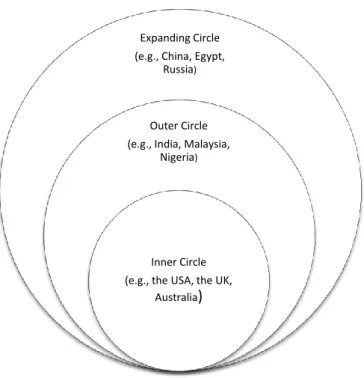
Kachru’s (1992) concentric circles of English could best illustrate China’s status in English-speaking communities comparing with other countries (see Figure 1.1). There are three concentric circles—the inner circle, the outer circle, and the expanding circle. These circles of English are drawn for us to better understand the use of the language in different countries. In the inner circle countries, such as the
USA, the UK, and Australia, English is spoken as their native tongue; in the outer circle countries, such as India, Malaysia, and Nigeria, English is spoken as either their second language or official language due to historical reasons; and in the expanding circle countries, such as China, Egypt, and Russia, English is treated as a foreign language.
Figure 1.1 Concentric Circles of English (Source: Kachru, 1992)
In English language learning classrooms of China, TEFL is still dominantly teacher-centered, textbook-based and exam-oriented. In primary schools, where English teaching begins from Grade 3 and lasts for four years, there are not enough qualified English teachers at all—only a small number of them graduate from colleges or
Expanding Circle (e.g., China, Egypt,
Russia)
Outer Circle (e.g., India, Malaysia,
Nigeria)
Inner Circle (e.g., the USA, the UK,
both junior and senior middle schools, teachers are busy with basic language proficiency teaching and assessment—their main focus of English teaching is grammar and vocabulary with the main purpose of pushing the students pass the exams of various kinds and levels.
However, the situation in colleges is a little bit different from that in primary and middle schools. First, most of the teachers are postgraduates majoring in English with either Master’s or Doctor’s degree. Therefore, they are supposed to be qualified English teachers both linguistically and interculturally. Second, students are no longer pressured so much by exams as they are in primary and middle schools, even though exams still remain. In fact, they feel much freer to do what they are interested in and what seems to be important to them in language learning. This is even more the case for English majors in colleges and universities, and this situation partially accounts for the choosing of English majors as the participants in this research.
China has made great progress in the past thirty years in her English language education as the consequence of her open-door policy towards the outside world and the economic development. But as for ICC, neither English instructors nor education administrators at different levels pay enough attention to it. As this researcher has argued, ICC should be the ultimate purpose of TEFL, but what makes the scene gloomy and blurry is that ICC has not gained its due attention and English majors in China are graduating without sufficient ICC. Very few empirical studies have ever
been done in China to investigate the ICC components and the factors in TEFL that may influence students’ ICC development. So in this research, this researcher chooses this to be the title of his doctoral dissertation: Intercultural Communication Competence of Chinese English Majors: A Study of Its Components and Influencing Factors in Teaching English as a Foreign Language.
1.2 Problem Statement
For years, ICC theoretical models have been developed in large number. But the number of instruments measuring ICC based upon these models is quite small, and still less is the number of empirical studies done to examine the relationships between the components of ICC and those between the factors that are extracted from these components. Existing literature has been describing the relationships between the components of ICC in a very general and ambiguous manner—they are ‘interrelated’, ‘interdependent’, etc. (Bennett, 1986, 1993; Byram, 1997; G. Chen & Starosta, 1998; G. Chen & Starosta, 2000; Deardorff, 2006; Fantini, 2000a; Lussier, 2009b).
G. Chen (2009a) has put forward his own theoretical model of ICC. Moreover, he himself, or together with his fellow scholars, have developed three instruments measuring the components in his ICC model, and two of the instruments have been validated by using American respondents (G. Chen, 1995; G. Chen & Starosta, 2000; Portalla & Chen, 2009). But in China, very few empirical studies have ever been done to investigate the components of ICC (Guan, 2005; W. Hu, 2005, 2006a; Peng, 2005a, 2010) and no research has been done on the relationships between the ICC components and those between factors in the attitudinal and behavioral dimensions of ICC based upon G. Chen’s model by using Chinese English majors as respondents.
As we all know, TEFL and the development of students’ ICC are supposed to be closely related. And most of the literature just takes it for granted that TEFL could and should improve students’ ICC performance. For example, Alptekin (2002) casts doubt upon the validity of the pedagogic model that is based upon native-speaker notion of communicative competence, and he believes that ICC should become the aim of TEFL. His research is very illuminating in that we are informed that communicative competence is no longer the ultimate purpose of learning a foreign language, but the problem with such researches as this one is that they fail to provide us sufficient evidence to show what are the factors in TEFL that may influence students’ ICC performance and the extent to which these factors could possibly undermine students’ culture learning on the first place. Therefore, empirical studies done to achieve these two goals are in great need.
Based upon the aforementioned rationale, this researcher identifies two problems in this research: one is that the relationships between the components of ICC and those between the factors in attitudinal and behavioral dimensions of ICC are still unclear against Chinese cultural background; the other is that the factors in TEFL influencing Chinese English majors’ ICC development and the degree to which these factors may influence Chinese English majors’ ICC development are still unknown.
1.3 Research Objectives
Based upon the problems identified, the objectives of this research are:
1. To investigate the relationships between the cognitive, attitudinal and behavioral dimensions of Chinese English majors’ ICC.
2. To examine the relationships between the factors in the attitudinal and behavioral dimensions of Chinese English majors’ ICC.
3. To identify the factors in TEFL that may influence Chinese English majors’ ICC development.
4. To investigate the degree to which the factors in TEFL influence Chinese English majors’ ICC development.
1.4 Research Questions.
According to the research objectives suggested in the previous section, following research questions are asked:
Question 1: What are the relationships between the cognitive, attitudinal, and behavioral dimensions of Chinese English majors’ICC?
Question 2: What are the relationships between factors in the attitudinal and behavioral dimensions of Chinese English majors’ ICC?
Question 3: What are the factors in TEFL that may influence Chinese English majors’ ICC development?
Question 4: To what extent do the factors in TEFL influence Chinese English majors’ ICC development?
1.5 Scope of the Study
This study lasted for about three years from July 2010 to July 2013, and was conducted in two countries—Malaysia and China. During the first year, this researcher stayed in USM, Malaysia to do library research and finished the research proposal. In the second year, this researcher stayed in China and did field work—to collect both quantitative and qualitative data in Hebei University (HBU), China. In the third year, this researcher returned to USM, Malaysia, analyzing the data collected, and finishing writing the thesis.
Relevant literature in this study is collected both in Malaysia and China. In Malaysia, the literature collected is written in English and is found either in the library of USM or online databases; in China, the literature is predominantly Chinese books and journal articles found in the library of HBU or the online database of CJFD and CSSCI. This research mainly covers the literature and publications over the recent ten years with some other earlier works that are either classical or influential.
Participants in this study are the English majors and teachers of the English Department in the College of Foreign Languages of HBU in China. The total number of the students who take part in the main study is 195, and within this sampling frame, eight students are sampled to take part in the semi-structured interviews. Moreover, two teachers in the English Department are also chosen to be interviewed.
This student population is highly homogeneous and highly representative— representing the English majors in China.
As is shown in the research questions, there are two major areas that this researcher wants to explore in this study: one is the investigation of the relationships between the three dimensions of ICC and those between the factors in the attitudinal and behavioral dimensions of ICC; the other is the examination of the factors in TEFL that may exert influence upon Chinese English majors’ ICC development.
1.6 Significance of the Study
This study is significant both theoretically and practically.
First, it is theoretically significant.
As this researcher has mentioned, the theoretical investigation in the field of ICC is far from enough and satisfactory in China. According to one research done by Peng (2005a), of the 1109 articles concerning intercultural studies, published in academic journals during Jan. 1994 and Dec. 2003, only four articles directly address intercultural theories—that is 0.36%. Peng (ibid) says that the studies built upon sound theories are very rare, and most of theoretical studies are merely introduction, evaluation and translation of western theories. Peng (2006b, 2007a, 2007b) himself investigated certain dimensions of ICC and the relationships between factors in these dimensions, but unfortunately, the questionnaires used in his studies were not piloted and it was still unknown whether they were feasible against Chinese cultural background or not. Therefore, in this research, the theoretical investigation of the relationships between the components of ICC and those between factors of attitudinal and behavioral dimensions of ICC by using Chinese English majors as respondents is extremely significant, theoretically speaking.
twenty years. But the endeavor to do empirical studies by using those theories is still far from enough. Sercu (2004b) points out that the empirical research done on the acquisition of intercultural competence (basically identical with the concept of ‘ICC’ in this research) is much less than the one done on second language acquisition. And in fact, when she is doing a survey and discussing the acquisition of intercultural competence, she has to refer to the works focusing on and discussing the variables in second language acquisition. In China, empirical studies are even less. W. Hu (2005) says that, of the 1066 articles concerning IC studies that he finds out in China National Knowledge Infrastructure (CNKI), only six articles are based on scientific data analysis. So in this study, the investigation of the factors in TEFL that exert influence upon students’ ICC development by using empirical research strategies is of great significance.
Second, this research is practically significant.
Firstly, this research is important for all Chinese English teachers, especially college teachers teaching English majors. It introduces and discusses the theoretical frameworks of ICC, which have long been neglected and misunderstood in China by college English teachers. Then it makes it clear the relationships between the ICC dimensions and those between factors in them, which will definitely help the English teachers clarify their conceptualization of ICC and subsequently, improve their performance in developing the students’ ICC. Secondly, English majors will also
benefit from this research, for both teachers and students are equally involved in the process of teaching and learning English with the same purpose of developing ICC. They would become more interculturally conscious so long as they get to know the importance of developing ICC in their English language learning. Thirdly, education administrators of different levels, including curriculum and syllabus designers, will benefit from this research. They would be kept vigilant to review and reevaluate the educational objectives of English language teaching and learning in schools of different levels, and to realize the existing problems in TEFL that may block students’ ICC performance, and start to make policies to improve the present situation.
1.7 Definition of Key Terms
Culture
In this thesis, the definition of culture provided by the United Nations Educational, Scientific and Cultural Organization is employed. It describes culture as “the set of distinctive spiritual, material, intellectual and emotional features of society or a social group, and that it encompasses, in addition to art and literature, lifestyles, ways of living together, value systems, traditions and beliefs” (UNESCO, 2002).
Culture Learning
Culture learning is “the process of acquiring the culture-specific and culture-general knowledge, skills, and attitudes required for effective communication and interaction with individuals from other cultures. It is a dynamic, developmental, and ongoing process which engages the learner cognitively, behaviorally, and affectively” (Paige, Jorstad, Siaya, Klein, & Colby, 2003, p. 4).
Communication
At its most basic level, communication involves the sending and receiving of information. In communication theory this process is stated in the form of a simple model: A (message source) to N (noise or interference) to B (receiver). …For human communicators the process of communication is viewed as a complex set of interactions, transacted (negotiated) across a wide spectrum of cultural and
situational contexts (Findlay, 1998, p. 33).
Competence
Competence, in this research, could be understood as a general term for the capabilities of a person. It encapsulates a range of attributes such as knowledge, skills and attitudes which are considered to be essential for effective and appropriate interpersonal and intercultural performance. It is knowledge in use. (Adapted from Eraut, 1998; Hymes, 1972; Usher, Bryant, & Johnston, 1997)
Intercultural Communication
In its most general sense, intercultural communication occurs when a member of one culture produces a message for consumption by a member of another culture. More precisely, intercultural communication is communication between people whose cultural perceptions and symbol systems are distinct enough to alter the communication event (Samovar & Porter, 2000, p. 48).
Intercultural Communication Competence (also Intercultural Communicative Competence or Intercultural Competence for short)
Intercultural communicative competence is “the ability to communicate effectively and appropriately in intercultural situations based on one’s intercultural knowledge, skills, and attitudes” (Deardorff, 2004, p. 194).
Intercultural Awareness
Intercultural awareness is the cognitive aspect of intercultural communication competence that refers to the understanding of cultural conventions that affect thinking and behavior (G. Chen & Starosta, 2003, p. 344).
Intercultural Sensitivity
Intercultural sensitivity can be conceptualized as “an individual’s ability to develop a positive emotion towards understanding and appreciating cultural differences that promotes an appropriate and effective behavior in intercultural communication” (G. Chen & Starosta, 1997, p. 5).
Intercultural Effectiveness
Intercultural effectiveness dictates the behavioral aspect of ICC, which refers to the ability to get the job done and attain communication goals in intercultural interactions…In other words, intercultural effectiveness corresponds to communication skills, including both verbal and nonverbal behaviors, which enable individuals to attain their communication goals in intercultural interaction through an appropriate and effective performance (G. Chen & Starosta, 1996; Portalla & Chen, 2009, pp. 3,4).
1.8 Organization of the Chapters
There are altogether five chapters in this thesis. Following is a summary of what are included and discussed in these chapters.
Chapter One is an introductory chapter. In this chapter, following topics are discussed: background of the study; problem statement; research objectives; research questions; scope of the study; significance of the study; and definition of the key terms. All these sections are closely interrelated focusing on illustrating the rationale of the research questions raised in this study.
Chapter Two is literature review. In this chapter, following topics are addressed: conceptualization and theoretical models of ICC; key studies of TEFL in developing ICC; assessment of ICC; review of key studies in China; and a conceptual framework for this Research. The topics are arranged according to two sequences: space sequence and logic sequence. According to space sequence, literature of both China and foreign countries are reviewed; according to logic sequence, the literature which is most relevant to this research is reviewed. Based upon the literature reviewed, a conceptual framework for this research is also put forward.
Chapter Three introduces the methodology for this research. Following topics are included: mixed methods research design, methods for the questionnaires, methods
for the interviews, pilot study, and ethical issues in this research. In the two sections of methods for the questionnaires and methods for the interviews, following sub-topics are discussed: sample, procedure, measurement, and data analysis. In the ‘pilot study’ section, the pilot methods and results from both of the questionnaires and interviews are introduced and reported in detail.
There are four sections in Chapter Four: the results from the questionnaires, the results from the interviews, the triangulation of the quantitative and qualitative results, and the summary of the findings. The contents in the first section are arranged according the different types of analyses of the questionnaires—the preliminary and the main analyses. The preliminary analyses provide readers some descriptive statistics of the questionnaires and the results that are going to be used in the main study, even though these results themselves do not answer the research questions. In the main analyses, detailed results are reported to answer the research questions directly. Section three in this chapter mainly focuses on the triangulation of the results from both the quantitative and qualitative research. The results from this analysis provide us more complete answers to the last research question.
As the last chapter of this thesis, Chapter Five is the discussion of the findings and the conclusion of this research. Five sections are included in this chapter: discussion of the findings, implications of the study, limitations of the study, suggestions for future research, and the conclusion. The major findings that are able to answer the
research questions are discussed and evaluated in the first section of this chapter. And the main contributions of this research to the existing knowledge in the field of ICC are demonstrated in the ‘Conclusion’ and ‘Implications of the Study’ sections.