Representing and Learning Opaque Maps
with Strictly Local Functions
Jane Chandlee
Jeffrey Heinz
Adam Jardine
CNRS, Paris, France April 18, 2015
Representing and Learning Opaque Maps
1. Chandlee 2014 defines and studies input strictly local functions which are a class of string-to-string maps (see also Chandlee and Heinz, in revision).
2. Here we show that many opaque phonological patterns can be represented and modeled with these functions without any additional modifications.
3. This matters because input strictly local functions are
efficiently learnable from positive evidence (Chandlee 2014, Chandlee et al. 2014, and Jardine et al. 2014).
Part I
Transformations in Generative Phonology
• Theories of generative phonology concern transformations, or
maps from abstract underlying representations to surface phonetic representations.
• A truism about maps:
Different grammars may generate the same map. Such grammars are extensionally equivalent.
• Grammars are finite, intensional descriptions and maps are their (possibly infinite) extensions
• Maps may have properties largely independent of their grammars. . .
Input Strict Locality: Main Idea
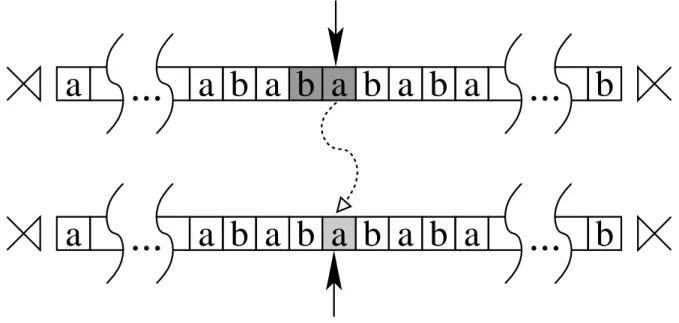
These maps are Markovian in nature.
x
0x
1. . . x
n↓
u
0u
1. . . u
nwhere
1. Each xi is a single symbol (xi ∈ Σ1)
2. Each ui is a string (ui ∈ Σ∗
2)
3. There exists a k ∈ N such that for all input symbols xi its
output string ui depends only on xi and the k − 1 elements immediately preceding xi.
Input Strict Locality: Main Idea in a Picture
u
b a b
a
b a b
a
a
a
...
...
b
x
b a b
a
b a b
a
a
a
...
...
b
Figure 1: For every Input Strictly 2-Local function, the output string
Example: Nasal Place Assimilation is ISL with
k
= 2
/inpÄfEkt / 7→ [impÄfEkt]
input: ⋊ I n p Ä f E k t ⋉
Example: Nasal Place Assimilation is ISL with
k
= 2
/inpÄfEkt / 7→ [impÄfEkt]
input: ⋊ I n p Ä f E k t ⋉
Example: Nasal Place Assimilation is ISL with
k
= 2
/inpÄfEkt / 7→ [impÄfEkt]
input: ⋊ I n p Ä f E k t ⋉
Example: Nasal Place Assimilation is ISL with
k
= 2
/inpÄfEkt / 7→ [impÄfEkt]
input: ⋊ I n p Ä f E k t ⋉
What can be modeled with ISL functions?
1. A significant range of individual phonological processes such as local substitution, deletion, epenthesis, and synchronic
metathesis
2. Approximately 95% of the individual processes in P-Base (v.1.95, Mielke (2008))
3. Opaque maps! (This talk, in a moment)
What cannot be modeled with ISL functions
1. progressive and regressive spreading
2. long-distance (unbounded) consonant and vowel harmony
What about spreading and long-distance
phonology?
• ISL functions naturally generalize Strictly Local (SL) stringsets in Formal Language Theory.
• SL stringsets model local phonotactics and ISL functions model phonological maps with local triggers.
• Output SL functions are another generalization of SL stringsets which precisely models spreading (Chandlee et al. under
review).
• Stringly-Piecewise (SP) and Tier-based Strictly Local (TSL) stringsets model long-distance phonotactics (Heinz 2010, Heinz et al. 2011).
• We expect functional characterizations of SP and TSL
Automata characterization of
k
-ISL functions
Theorem Every k-ISL function can be modeled by a k-ISL transducer and every k-ISL transducer represents a k-ISL function.
The state space and transitions of these transducers are organized such that two input strings with the same k − 1 suffix always lead to the same state.
Example: Fragment of
k
-ISL transducer for NPA
λ V:λ n:n p:λ g:λ p:p g:g V:V n:λ n:λ n:λ p:mp g:Ng V:V V:V p:p g:g /inpa/ 7→ [impa]Not all transitions and states are shown, and vowel states and transitions are collapsed. The nodes are labeled
Part II
Defining Opaque maps
• Opaque maps are defined as the extensions of particular rule-based grammars (Kiparsky 1971, McCarthy 2007).
• Bakovi´c (2007) provides a typology of opaque maps.
– Counterbleeding – Counterfeeding on environment – Counterfeeding on focus – Self-destructive feeding – Non-gratuitous feeding – Cross-derivational feeding
Counterbleeding in Yokuts
‘might fan’ /Pili:+l/
[+long] → [-high] Pile:l V → [-long] / C # Pilel
Fragment of a 3-ISL transducer for Yokuts
l ¯ı l ⋉
Counterfeeding-on-environment in Bedouin
Arabic
Bedouin Arabic ‘Bedouin’ /badw/ a → i / σ — G → V / C # badu [badu]The other examples
• Counterfeeding on focus in Bedouin Arabic (3-ISL)
• Self-destructive feeding in Turkish (5-ISL)
• Non-gratuitous feeding in Classical Arabic (5-ISL)
What is k?
• If a function described by a rewrite rule A −→ B / C D is ISL then k will be the length of the longest string in the
structural description CAD.
• For opaque maps describable as the composition of two rewrite rules, it is approximately the length of the longest string in the structural description of either rule (it may be a little longer).
• A k-value of 5 appears sufficient for the examples in Bakovi´c’s paper.
Part III
ISLFLA: Input Strictly Local Function Learning
Algorithm
• The input to the algorithm is k and a finite set of (u, s) pairs.
• ISLFLA builds a input prefix tree transducer and merges states that share the same k − 1 prefix.
• Provided the sample data is of sufficient quality, ISLFLA
provably learns any function k-ISL function in quadratic time.
• Sufficient data samples are quadratic in the size of the target function.
SOSFIA: Structured Onward Subsequential
Function Inference Algorithm
SOSFIA takes advantage of the fact that every k-ISL function can be represented by an onward transducer with the same structure (states and transitions).
• Thus the input to the algorithm is k-ISL transducer with empty output transitions, and a finite set of (u, s) pairs.
• SOSFIA calculates the outputs of each transition by examining the longest common prefixes of the outputs of prefixes of the input strings in the sample (onwardness).
• Provided the sample data is of sufficient quality, SOSFIA provably learns any function k-ISL function in linear time.
• Sufficient data samples are linear in the size of the target function.
Part IV
Some reasons why Classic OT has been influential
• Offers a theory of typology.• Comes with learnability results.
What have we shown?
1. Many attested phonological maps, including many opaque ones, are k-ISL for a small k.
2. k-ISL functions make strong typological predictions. (a) No non-regular map is k-ISL.
(b) Many regular maps are not k-ISL.
⇒ So they are subregular.
How does this relate to traditional phonological
grammatical concepts?
1. Like OT, k-ISL functions do not make use of intermediate representations.
2. Like OT, k-ISL functions separate marked structures from their repairs (Chandlee et al. to appear, AMP 2014).
• k-ISL functions are sensitive to all and only those markedness constraints which could be expressed as *x1x2 . . . xk, (xi ∈ Σ).
• In this way, k-ISL functions model the “homogeneity of target, heterogeneity of process” (McCarthy 2002)
Where is the Optimality?
• Paul Smolensky asked this question to Jane Chandlee at the 2013 AMP at UMass where ISL functions were first introduced.
• The answer is “Over there.”
• Perhaps the question ought to be “How does Optimality
Theory account for the typological generalization that so many phonological maps are ISL?”
Undergeneration in Classic OT
• It is well-known that classic OT cannot generate opaque maps (Idsardi 1998, 2000, McCarthy 2007, Buccola 2013)
(though Bakovi´c 2007, 2011 argues for a more nuanced view).
• Many, many adjustments to classic OT have been proposed.
– constraint conjunction (Smolensky), sympathy theory (McCarthy),
turbidity theory (Goldrick), output-to-output representations (Benua), stratal OT (Kiparsky, Bermudez-Otero), candidate chains (McCarthy), harmonic serialism (McCarthy), targeted constraints (Wilson),
contrast preservation ( Lubowicz) comparative markedness (McCarthy) serial markedness reduction (Jarosz), . . .
See McCarthy 2007, Hidden Generalizations for review,
Adjustments to Classic OT
- constraint conjunction (Smolensky), sympathy theory (McCarthy), turbidity theory (Goldrick), output-to-output representations (Benua), stratal OT (Kiparsky, Bermudez-Otero), candidate chains (McCarthy), harmonic serialism (McCarthy), targeted constraints (Wilson), contrast preservation ( Lubowicz) comparative markedness (McCarthy) serial markedness reduction (Jarosz), . . .
These approaches invoke different representational schemes, constraint types and/or architectural changes to classic OT.
• The typological and learnability ramifications of these changes is not yet well-understood in many cases.
Overgeneration in Classic OT
• It is not controversial that classic OT generates non-regular maps with simple constraints (Frank and Satta 1998, Riggle 2004, Gerdemann and Hulden 2012, Heinz and Lai 2013)
OT’s greatest strength is its greatest weakness.
• The signature success of a successful OT analysis is whencomplex phenomena are understood as the interaction of simple constraints.
• But the overgeneration problem is precisely this problem: complex—but weird—phenomena resulting from the
interaction of simple constraints (e.g. Hansson 2007 on ABC).
• As for the undergeneration problem, opaque candidates are not optimal in classic OT.
In a picture
Logically Possible Maps
Regular Maps
(≈ rule-based theories)
Conclusion
• Despite some limitations, k-ISL functions characterize well the nature of phonological maps.
– Many phonological maps, including opaque ones, can be expressed with them.
– k-ISL functions provide both a more expressive and
restrictive theory of typology than classic OT, which we argue better matches the attested typlogy.
• Like classic OT, there are no intermediate representations, and
k-ISL functions can express the “homogeneity of target,
heterogeneity of process” which helps address the conspiracy and duplication problems.
Conclusion in a picture
Logically Possible Maps
Regular Maps
(≈ rule-based theories)
Phonology OT
Questions
1. What is k? Can k be learned? 2. What about phonetics?
3. How do you learn underlying representations?
Acknowledgments
Thank You.
*Special thanks to R´emi Eyraud, Bill Idsardi, and Jim Rogers for valuable discussion. We also thank Iman Albadr, Hyun Jin
Appendix
Formal Language Theory
• ISL functions naturally extend SL stringsets in Formal Language Theory.
• For SL stringsets, well-formedness is determined by examining windows of size k.
x
b a b
a
b a b
a
a
a
...
...
b
Figure 2: A stringset is Strictly 2-Local if the well-formedness of each word can be determined by checking whether each symbol x in
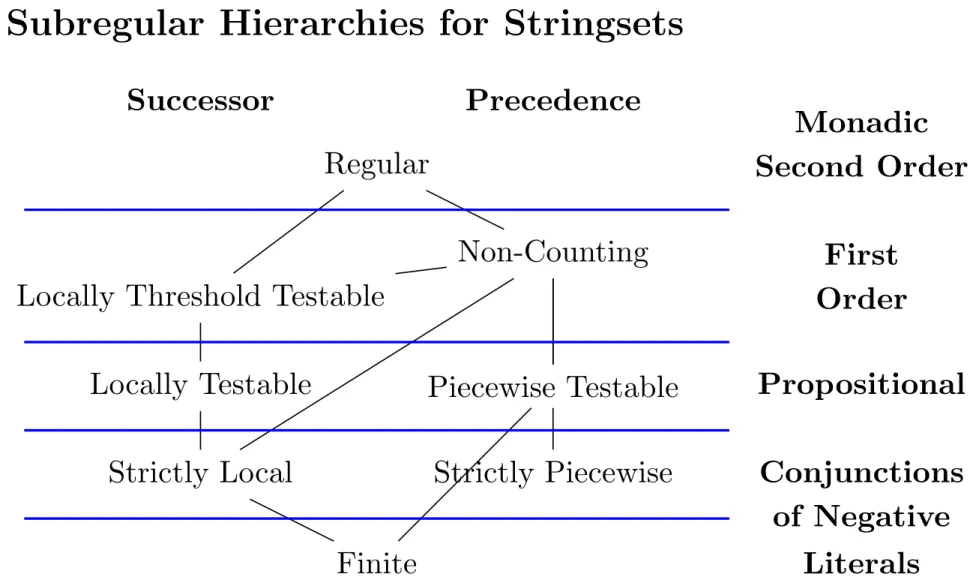
Subregular Hierarchies for Stringsets
Regular
Non-Counting Locally Threshold Testable
Locally Testable Piecewise Testable Strictly Local Strictly Piecewise
Finite Successor Precedence Monadic Second Order First Order Propositional Conjunctions of Negative Literals
Subregular Hierarchies for Maps
MSO-definable Regular
Left Subsequential Right Subsequential Input Strictly Local Left Output Strictly Local Right Output Strictly Local Finite
Formal Definition of ISL
Definition (Residual Function) Given a function f and input string x, the residual function of f w.r.t. x is
rf(x) def= n(y, v) | (∃u)f(xy) = uv ∧ u = lcp(f(xΣ∗))
o
where lcp(S) is the longest common prefix of all strings in S.
Definition (k-ISL Function) A function (map) f is Input Strictly k-Local if for all input strings w, v:
if Suffk−1(w) = Suffk−1(v) then r
f(w) = rf(v).
Counterfeeding-on-focus
Bedouin Arabic ‘he wrote’ /katab/ i → ∅ / σ katab a → i / σ kitab [kitab] This is 3-ISL.Self-destructive feeding
Turkish ‘your baby’ /bebek+n/ ∅ → i / C C # bebekin k → ∅ /V +V bebein [bebein] This is 5-ISL.Non-gratuitous feeding
Classical Arabic ‘write.MS’ /ktub/ ∅ → Vi / # CCVi uktub ∅ → P / # V Puktub [Puktub] This is 5-ISL.Cross-derivational feeding
Lithuanian
‘to strew all over’ /ap-berti/
∅ → i / C C apiberti
where Cs are homorganic stops
[−voice] → [+voice] / D apiberti [apiberti] This is 4-ISL.
Simple constraints in OT generate non-regular
maps
Ident, Dep >> *ab >> Max
anbm 7→ an, if m < n anbm 7→ bm, if n < m