1
Annual Report 2016
Simone Branchini, Viviana Brambilla, Claudia Covi, Greta Zampa,
Laura Locci, Michele Trittoni, Marco Davoli,
Corrado Piccinetti, Francesco Zaccanti, Stefano Goffredo
www.steproject.org
Department of Biological, Geological and Environmental Sciences - Section of Biology
University of Bologna www.bigea.unibo.it
Marine Science Group Citizen Science Lab
3
Economic support and sponsorship
This research has been economically supported by the Ministry of Tourism of the Arab
Republic of Egypt - Egyptian Tourist Authority, Settemari Tour Operator. The Ministry of
the Environment, Land and Sea Protection of the Italian Republic have the patronage this
research.
Ministry of Tourism of the Arab Republic of
Egypt ETA
Egyptian Tourism Authority www.egypt.travel
Ministry of the Environment and Land and Sea protection
of Italian Repubblic
5
STE TOURIST AWARDS 2016
Sponsors that reward clubs and diving centers which completed more questionnaires in
2015 (see Appendix A).
www.edenviaggi.it
www.nicolaus.it
7 INTRODUCTION
Although coral reefs only spatially represent 0.2% of the marine environment, they are the most biodiverse ecosystems of the ocean and are estimated to harbour around one third of all described marine species. Moreover, coral reefs have a key role for human activities. Coral reefs provide critically important goods and services to over 500 million people worldwide, such as: recreational opportunities, thus supporting the industry of tourism which is the main economic source for many third-world countries; coastal protection and habitat/nursery functions for commercial and recreational fisheries; and welfare associated with the diverse natural ecosystems. Despite the provision of multiple valuable services, coral reefs are facing a number of direct anthropogenic threats. Environmental change is threatening the survivorship of coral reefs on a global scale. The consequences of coral reef degradation would not be related solely to the loss of the goods and services they provide, but would also result in the extinction of a major component of the Earth’s total biodiversity. Broad conservation efforts and large-scale monitoring are needed for effective management to prevent biodiversity loss and the impacts of climate change, yet governmental agencies are often under-funded. In some cases, citizen science can overcome economic constraints on data collection, by using the skills of non-specialist volunteer researchers, collecting reliable data and, in addition, increasing the environmental awareness and public education.
The last two decades have seen a rapid increase in recreational diving activity that prompted researchers to involve recreational divers as volunteers, making use of their interest in marine diversity. Many works use formal methods of data collection, requiring intensive training and asking volunteers to perform surveys on specific sites according to strict protocols may ensure uniform data collection. This method can reduce project appeal, thus reducing the number of volunteers, and also it can affect the data accuracy. The project ‘‘SCUBA Tourism for the Environment’’ (STE) uses a survey protocol based on casual diver observations. This method allows divers to carry out normal recreational activities during their reef visits and ensure the reliability of collected data through standardized data collection.
RESEARCH OBJECTIVE
"STE - Scuba Tourism for the Environment" aims primarily to the obtainment of information on the Egyptian Red Sea marine biodiversity, by collaborating with volunteer dive tourists. In this way the research can provide to the local institutions with tools to implement conservation and preservation measures. At the same time it contributes to the development of ecotourism in the area, providing tourists with a discerning, active and useful way to increase their naturalistic awareness and the recreational value of their holidays.
This study is based on the cooperation between professional researchers and volunteer citizens. It represents the prosecution of researches originated by the excellent results and international credits obtained by “1999-2001: Mediterranean Hippocampus Mission" (S. Goffredo, C. Piccinetti, F. Zaccanti, Conservation Biology 18: 1492-1503, 2004) and successively developed with "2002-2005: Divers for the environment - Mediterranean Underwater Biodiversity Project" (S. Goffredo, F. Pensa, P. Neri, A. Orlandi, M. Scola Gagliardi, A. Velardi, C. Piccinetti, F. Zaccanti. Ecological Applications, 20: 2170-2187, 2010). Both
8 monitoring programs have been developed by the Marine Science Group (www.marinesciencegroup.org) in the Mediterranean Sea, and their results have been published in important international scientific journals.
MATERIALS AND METHODS
A special survey questionnaire has been designed. The questionnaire is the reference tool of the research. It contains three sections: the first part is about environmental education, the second is for the identification of surveyed organisms, the third is used for data recording. Surveyed organisms were selected according to the following main characteristics:
- ease of recognition by non-professionals;
- expected frequency: common in the whole Red Sea.
These characteristics should ensure that the investigation method is suited to the actual capabilities of the volunteers involved and that the state of the surveyed biodiversity is correlated to local stress factors. The presence of dead, bleached, broken, sediment covered corals and the presence of litter are recorded as negative environmental conditions. The number of divers present on the dive site and the number of contacts with the reef are recorded as diver behaviour features.
“STE – Scuba Tourism for the Environment ” is supported by the Egyptian Ministry of Tourism - ETA (Egyptian Tourism Authority), Settemari Tour Operator. The project is under the aegis of the Ministry of the Environment, Land and Sea Protection of Italian Republic.
The role of tour operators and diving agencies is fundamental for involving SCUBA tourists. Through a “pyramid system”, trained operators (tour leaders, divemasters and instructors) sensitize thousands of dive tourists with briefings and by assisting them with completing the questionnaires. Some students, who spend their thesis internship in the Marine Science Group, are present in loco. They support the resorts and diving centers’ staff in the activities of project diffusion. Tourists are also encouraged to participate during public events, where questionnaires and informative material are distributed.
Volunteer dive tourists are asked to complete the survey questionnaire soon after the end of their dive. Data are aggregated according to habitat type and “survey station” (diving site where at least ten questionnaires have been correctly completed, during the year) and are elaborated by the researchers of the Marine Science Group of the University of Bologna to obtain a marine biodiversity index. An agreement is also made with Neos Air to distribute the questionnaires inside inflight magazines. To sensitize and involve the highest number of tourist divers in the research, local, Italian, and international mass-media are contacted for public dissemination of project goals and methods (Table 1). Real-time updates on research progress and relevant initiatives are published on the project website (www.STEproject.org) and sent to volunteer tourists by email.
9 RESULTS AND DISCUSSION
During nine years of data collection (2007-2015) 34,871 survey questionnaires were completed, corresponding to 29,166 diving hours (Table 2). The most common depth range was between 0 and 20 m (93.7% of the survey stations had a mean survey depth within this range). The highest survey effort was in summer-autumn (78,8% of the survey stations had a mean survey date between June and November) and late morning (the mean survey time in 70,7% of the stations is between 10.00 and 14.00). This sampling distribution reflects the typical pattern of the usual touristic diving activity in Egypt. The first recreational diving licence allows a maximum depth of 18-20 metres. Divers prefer summer, when water temperature is higher, and the daytime, since night-dives requires particular devices and advanced training. An uneven distribution of the type of explored environment was also found (91,5% of the questionnaires concern the coral reef environment; Table 2). This unevenness is certainly due to the divers' preference for coral reefs, which are nicer to visit since they have more species compared with sandy beds and are accessible also to less experienced divers compared to other dive sites/environment, such as wrecks or blue-dives. The spatial comparison of the marine biodiversity index was made only for the coral reef environment, because sandy beds and the other environments have not reached a sufficient number of survey stations to allow a significant statistical elaboration. For the reef environment, a total of 125 survey stations were identified. The marine biodiversity index calculated in the survey stations was homogeneous among the nine years and seemed to show some pattern on the spatial scale (Fig. 3-5). Fifty stations (40%) had a “mediocre” marine biodiversity. Twenty-two stations (17,6%) differed positively from the mean value showing a "good" marine biodiversity. The fifty-three stations (42,4%) that differed negatively showed a "low" biodiversity (Figs. 3-4-5). Comparing the different zones of the Sharm el-Sheikh area, Tiran Island and Ras Mohammed reefs result better preserved than the coasts of the residential center (“Local Dives”). There were a greater number of scored “good” biodiversity stations near the Ras Mohammed National Park. The presence of the marine protected area has certainly a role in the detected patterns. The protection measures and the controls on recreational and commercial activities implemented by the Egyptian Government appear efficient. Examples of these measures are regulations on new buildings (to prevent sedimentation on coral reefs), and the installation of access points to the sea by piers (to prevent divers walking on the reef).
The conditions of the Local reefs are relatively good compared to Hurgada area, where the survey stations on coral reefs are damaging because of the anthropogenic use. A possible explanation could be that Local reefs are located between Ras Mohammed and Tiran Island, which may act as biodiversity reservoirs, providing a larval flow on local reefs. In Marsa Alam several resorts were built close to the coast but the environmental conditions are good. This situation could be explained by the fact that tourist activities in the area began only few years ago.
CONCLUSION
This recreational monitoring method assure a significant amount of data with an acceptable level of reliability because: (1) volunteers are trained and assisted during data collection in the field by dive guides and instructors who had previously been trained by professional researchers; (2) the method is suitable for amateurs, i.e., user-friendly questionnaire and taxa that are easily recognizable by recreational divers; (3)
10 the tasks selected for volunteers during project planning are appropriate, since volunteer skills and abilities vary, and we only want volunteers to collect data for which they could be trained quickly and reliably. This project confirms that ‘‘recreational’’ and ‘‘easy and fun’’ citizen science is an efficient and effective method to recruit a large number of volunteers and can be reliable if well designed.
“STE – Scuba Tourism for the Environment” project describe the status of biodiversity of the Egyptian coral reefs and its spatial variations, providing important indications to the local authorities on the current health status of the Egyptian coastlines and on the effectiveness of the environmental management. Each year the project results are presented to the Egyptian Tourism Minister and his staff, with the aim of integrating the projects finding in future environmental management actions and contribute to the development of wide conservation plans. For instance, the encouraging findings for the Sharm el-Sheikh area are an example of effective management in that area, which may serve as a model to establish new marine protected areas in other Egyptian regions.
This project presents a successful case study of collaboration among researchers, local authorities and the public, showing that with appropriate recruitment and training, volunteer-collected data are qualitatively equivalent to those collected by professional researchers and useful for resource management. This work fortifies the effectiveness of citizen science projects as fundamental tools to provide robust, objective and repeatable data for large-scale and long term monitoring, which can be used to inform marine management. This method could be applied in different countries by local governments and marine managers to achieve large-scale and long-term conservation and management actions, required in a fast-changing world where climate change and anthropogenic uses of natural resources are determining fast environmental changes worldwide.
ACKNOWLEDGEMENTS
Special thanks to the facilities that have hosted and given their logistical support to students of the University of Bologna for their Bachelor and Master Thesis about STE project:
Villaggio Settemari Club Resort (Marsa Alam – Egypt; www.settemari.it)
Holiday Service Diving Center (Sharm el-Sheikh – Egypt; www.holidaydiving.org)
►TIP: Are you a diving center/resort interested in hosting students at your resort in for STE project? Write to [email protected]
11 Table 1. Public dissemination. Number of contacts (readers, audience) produced by the Public Relations Office of the Marine Science Group (www.marinesciencegroup.org).
Total
Total readers 74.485.7902006-2015
Total audience 24.647.550TOTAL CONTACTS 99.133.340
PRESS & WEB
2015
Date Name Readers
27 November
lswn.it
10 June
TURISMOITALIANEWS.it
Total 2015
2014
Date Name Readers
December ATMOSPHERE 400.000
22 May Turismo italia news \
2 April Corriere.it 1.035.081
4 February ANSA.IT 689.519
23 January Turismo italia news \
2 Janury Il Resto del Carlino - BOLOGNA 441.000
Total 2014 2.565.600
2013
Date Name Readers
9 July Il Resto del Carlino - BOLOGNA 418.000
21 June Corriere della Sera.it 1.020.190
Total 2013 1.438.190
2012
Date Name Readers
21 October Il Corriere di Bologna 94.000
5 June Il Resto del Carlino 1.314.000
Total 2012 1.408.000
2011
Date Name Readers
17 July Il Resto del Carlino 1.296.000
17 July Corriere Adriatico 318.000
17 July La Gazzetta del Mezzogiorno 745.000
9 July Milano Finanza 308.000
July Atmosphere 588.500
13 May Il Venerdì di Repubblica 2.291.000
8 March Il Sole 24 Ore 1.015.000
12 February L'Unione Sarda 461.000
4 February La Repubblica 3.250.000
January Natura 25.000
13 Table 1 continued
2010
Date Name Readers
7 December Il Resto del Carlino \
9 September Sette - Corriere della Sera 3.056.000
9 August Il Corriere dell'Umbria 380.000
10 June Metro 1.776.000 10 June City 1.698.000 10 June Leggo 1.780.000 18 May City 2.036.000 17 May La Stampa 1.693.000 17 May Il Giornale 767.000
17 May Il Resto del Carlino \
17 May Libertà 164.000
16 May L'Unità 359.000
May Natura 25.000
19 March Trend 24.000
24 January Il Resto del Carlino 1.330.000
24 January La Nazione 865.000
Total 2010 15.953.000
2009
Date Name Readers
22 December La Repubblica 3.069.000
Settembre Corriere della Sera 2.871.000
September Mete 105.000
September Dove 388.000
8 August Il Sole 24 Ore 1.122.000
31 July Il Venerdì di Repubblica 2.252.000
6 June Il Bologna 90.000
6 June Mondo Sommerso \
June Subaqva 60.000
June Ambiente Europa 90.000
1 May Trend 24.000
May Mondo Sommerso 144.000
14 April Leggo 81.000
Total 2009 10.296.000
2008
Date Name Readers
September Tuttoturismo \
August Mondo Sommerso \
July Ambiente Europa 90.000
20 July Corriere della Sera 2.615.000
17 July Panorama 2.829.000
09 July Oggi 3.209.000
15 Table 1 continued
19 June Il Resto del Carlino 1.197.000
18 June La Repubblica \
10 June MF/Milano Finanza 383.000
7 June Gioia 545.000
30 May Italia Oggi 188.000
15 May Neos In-Flight Magazine 400.000
2 May Trend 24.000 23 April L'Espresso 2.287.000 23 April La Repubblica 2.944.000 23 April La Stampa 1.378.000 23 April AGI 250.000 March Tuttoturismo \
March Mondo Sommerso 144.000
January Tuttoturismo 236.000
Total 2008 18.809.000
2007
Date Name Readers
September SubAqva 60.000
August Tuttoturismo \
June Parchi e Riserve 36.000
22 June Il Resto del Carlino 1.180.000
19 June Il Resto del Carlino 1.168.000
May Neos in-flight magazine 400.000
22 February Il Giornale del Turismo 31.500
February Tuttoturismo 233.000
12 January MF/Milano Finanza 456.000
January Speciale Qui Touring \
January Qui Touring 626.000
January Mondo Sommerso 144.000
Total 2007 4.334.500
2006
Date Name Readers
29 December Il Resto del Carlino - La Nazione - Il Giorno \
December Sub \
November Studenti Magazine 90.000
11 October L'Agenzia di Viaggi 30.000
September Mythos 90.000
September Mix 27.000
September Il Subacqueo 111.000
September Sub \
9 August Il Resto del Carlino - La Nazione - Il Giorno 2.379.000
5 August La Repubblica - Bologna 390.000
4 August Leggo 150.000
17 Table 1 continued
July Tempo Libero 30.000
29 July Il Venerdì di Repubblica 2.713.000
June Sub 75.000
May Quark 695.000
April TuttoTurismo 219.000
April Quark 800.000
2 March Il Resto del Carlino 1.579.000
Total 2006 9.384.000
RADIO & TELEVISION
2015
Date Name Audience
9 October
RAI 3 - Buongiorno Regione Emilia Romagna
722.0001 August
Radio 24
1.962.00030 July
RAI 3 - TGR Emilia Romagna
1.110.00019 Aprile Radio Itaila 4.527.000
Total 2015 8.321.000
2012
Date Name Audience
6 August InsidER
Total 2012
2010
Date Name Audience
21 August Radio 24 - Moebius, con Federico Pedrocchi 2.371.000
h 20.00
28 July Radio Studio Più - La Carovana On the road h 20.00 222.000
23 July RadioStudioPiù
14 July RTL 102.5 - Protagonisti, con Francesca Cheyenne e Roberto Uggeri 5.533.000
h 19.00
13 April Radio Televisione Svizzera in lingua Italiana - Lo sciamano ìn bicicletta - Rete
Uno h 09.30 300.000
28 January Rai tre - Tg3 h 14.00 1.227.775
26 January Rai tre - TGR Leonardo h 14.50 1.227.775
Total 2010 10.881.550
2009
Date Name Audience
16 July Radio Montecarlo - Anteprima News, condotto da Maurizio di Maggio h 20.26 1.653.000
Total 2009 1.653.000
2008
Date Name Audience
22 July Radio Televisione Svizzera in lingua Italiana - Lo sciamano ìn bicicletta - Rete
Uno h 15.55 300.000
23 April Radio Capital h 15.55 1.671.000
19 Table 1 continued
2007
Date Name Audience
18 February RadioRai - Radio2 Strada facendo h 18.20 1.032.000
Total 2007 1.032.000
2006
Date Name Audience
8 January Rete 4 - Pianeta Mare h 11.00 (replica) 789.000
21 Table 2. Distribution of the survey effort performed by the volunteer dive tourists in the nine
years of research.
Geographical distribution of recorded questionnaires
Figure 1. Geographical distribution of the surveys recorded over the research period (2007 – 2014). Sharm el-Sheikh area was divided into 5 zones: Gubal, Ras Mohammed, Local, Tiran and Nabq.
Year Total recorded questionnaires Coral reef questionnaires Sandy bottom questionnaires Other environment questionnaires 2007 3249 2976 129 144 2008 4870 4656 109 105 2009 4120 3031 928 161 2010 5671 5137 358 176 2011 5539 5279 146 114 2012 3746 3343 299 104 2013 2381 2308 40 33 2014 2659 2585 15 59 2015 2636 2530 12 36 Total 34871 31903 2036 932
23
Marine Biodiversity
25
Marine Biodiversity: Sharm el-Sheikh
Figure 3. Marine Biodiversity Index in survey stations on coral reefs of Sharm el-Sheikh area over the period 2007-2015.
27
Marine Biodiversity: Hurgada
Figure 4. Marine Biodiversity Index in survey stations on coral reefs of Hurgada area over the period 2007-2015.
29
Marine Biodiversity: Marsa Alam
Figure 5. Marine Biodiversity Index in survey stations on coral reefs of Marsa Alam area over the period 2007-2015.
31
Appendix A: 2015 ranking
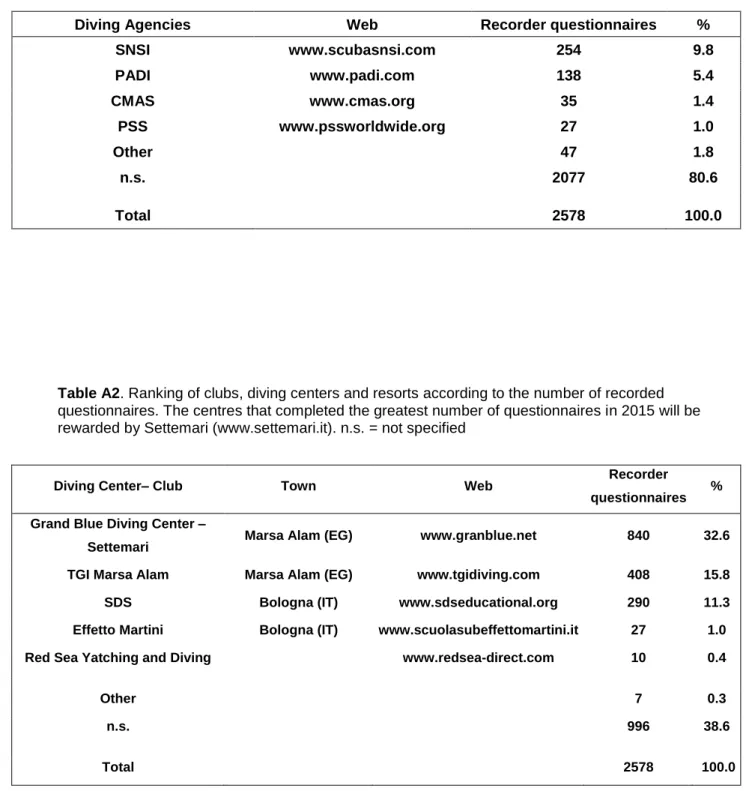
Table A1. Ranking of the diving agencies based on the number of recorded questionnaires. n.s. = not specified
Diving Agencies Web Recorder questionnaires %
SNSI www.scubasnsi.com 254 9.8 PADI www.padi.com 138 5.4 CMAS www.cmas.org 35 1.4 PSS www.pssworldwide.org 27 1.0 Other 47 1.8 n.s. 2077 80.6 Total 2578 100.0
Table A2. Ranking of clubs, diving centers and resorts according to the number of recorded questionnaires. The centres that completed the greatest number of questionnaires in 2015 will be rewarded by Settemari (www.settemari.it). n.s. = not specified
Diving Center– Club Town Web Recorder
questionnaires % Grand Blue Diving Center –
Settemari Marsa Alam (EG) www.granblue.net 840 32.6
TGI Marsa Alam Marsa Alam (EG) www.tgidiving.com 408 15.8
SDS Bologna (IT) www.sdseducational.org 290 11.3
Effetto Martini Bologna (IT) www.scuolasubeffettomartini.it 27 1.0
Red Sea Yatching and Diving www.redsea-direct.com 10 0.4
Other 7 0.3
n.s. 996 38.6
33
Appendix B: total ranking (over all years 2007-2015)
Table B1. Ranking of the diving agencies based on the number of recorded questionnaires according to the number of recorded questionnaires over the period 2007 - 2014.
n.s. = not specified
Diving Agencies Web Recorder
questionnaires %
SNSI www.scubasnsi.com 5953 17.1
PADI www.padi.com 4729 13.5
SSI www.cmas.org 2259 6.5
CMAS www.cmas.org 1635 4.7
FIPSAS-CMAS (FIPSAS) www.portale.fipsas.it 743 2.1
PSS www.pssworldwide.org 520 1.5
Other 1070 3.1
n.s. 17962 51.5
Total 34871 100.0
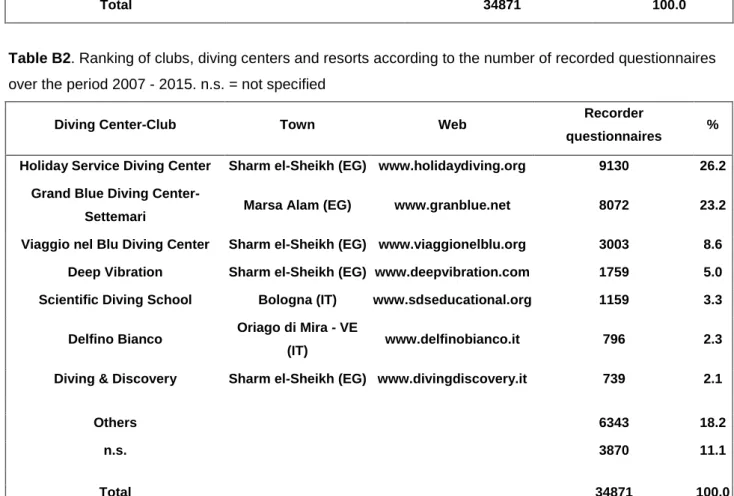
Table B2. Ranking of clubs, diving centers and resorts according to the number of recorded questionnaires over the period 2007 - 2015. n.s. = not specified
Diving Center-Club Town Web Recorder
questionnaires %
Holiday Service Diving Center Sharm el-Sheikh (EG) www.holidaydiving.org 9130 26.2
Grand Blue Diving
Center-Settemari Marsa Alam (EG) www.granblue.net 8072 23.2
Viaggio nel Blu Diving Center Sharm el-Sheikh (EG) www.viaggionelblu.org 3003 8.6
Deep Vibration Sharm el-Sheikh (EG) www.deepvibration.com 1759 5.0
Scientific Diving School Bologna (IT) www.sdseducational.org 1159 3.3
Delfino Bianco Oriago di Mira - VE
(IT) www.delfinobianco.it 796 2.3
Diving & Discovery Sharm el-Sheikh (EG) www.divingdiscovery.it 739 2.1
Others 6343 18.2
n.s. 3870 11.1