Affordable
access:
The first step to mass internet use
in
emerging
markets
Contents
3 Executive Summary: A wider internet is emerging 4 The lure of the internet
4 Access – part of the affordability challenge 5 Voice to data, urban to rural
6 Access to data, from shared to personal
7 Solving the affordability versus profitability conundrum 9 The affordability challenge in rural regions
9 Deploying and running mobile infrastructure 10 Tower – reducing the number of sites required 10 Power – efficiency is the key
10 Backhaul – the importance of technology selection 12 The emergence of network sharing
13 Adopting innovative business models 15 Innovation in marketing to rural customers 15 The dual-market urban strategy
16 Mobile internet access provides ultimate affordability 17 Shaping the individual communications experience 18 Conclusion:
The internet without restrictions 19 References
Executive Summary:
A wider internet is emerging
In mature markets, using the internethas become as much a part of everyday life as watching television or listening to the radio. While there may be dark sides to the internet, its advantages for individuals and for national economic development are overwhelming.
The internet holds untold benefits for billions of potential users in emerging markets. Affordable internet access can change the lives of people in these countries as much as, and probably more deeply, than the rapid spread of mobile voice communications is doing today. A recent World Bank Group report says that for every 10 percentage-point increase in high speed Internet connections, there is an increase in economic growth of 1.3 percentage points.1)
Yet first must come affordable access. Consumers must be able to reach the internet at a price level and with a tariff structure that matches their spending power before they can see the benefits for themselves and invest time and money in developing their online skills. There is huge future business potential for communications service providers (CSP) that invest in deploying affordable access to the mass populations of emerging markets. Success will take innovation – new technologies, novel business models, flexible regulation and fresh marketing concepts.
Shared access is already a well-proven and popular business with internet cafés catering for millions of users. By leveraging mobile technologies to provide personal access to the internet, we will see simply huge growth. The sheer volume of users will be profitable for CSPs despite the lesser revenues that lower income users in rural and urban areas will generate.
On the technology side, the latest low power, flexible base station site and backhaul solutions are helping CSPs to build mobile network coverage with significantly lower capital and operational costs than has been possible before. Costs can be cut further with new practices such as network infrastructure sharing and by the advent of flexible regulation that allows the use of frequency bands that can provide highly cost effective coverage.
On the business side, involving local communities and enthusiastic entrepreneurs in the running of rural mobile networks can bring down costs even further through better site security and by the outsourcing of key aspects of network operations. Innovative funding schemes also hold potential for helping CSPs to benefit from capital-intensive renewable energy developments.
Ultimately, the success of any strategy for providing widespread internet access in emerging markets will depend on matching the services that are provided with the needs of consumers, both in terms of cost and in terms of providing the right information that people can use to improve their lives.
All the right conditions are in place today and we already see the early signs of how CSPs can win substantial new business and how consumers can enter the internet age.
The lure of
the internet
In mature markets, internet accesshas spread widely, touching the lives of almost everyone. Using the internet has become as familiar to many people as watching TV or listening to the radio.
In many emerging markets, though, internet access remains the preserve of the few, predominantly businesses and higher income consumers in urban areas. Yet providing the right conditions are in place, there is no reason to believe that accessing the internet on a daily basis will not become as common in these markets as it is elsewhere.
There are one and a half billion internet users globally, but more than 4 billion mobile users. There is clearly a vast untapped resource of people who are already familiar with basic communications technology but who are starved of internet access. There are already signs of the potential growth in emerging markets. Mobile internet connections in Chile jumped by 315 percent in 2008.2)
Meanwhile, in early April 2009 it was reported3) that China Telecom had
gained more than 10,000 registered users in just one week during a free trial launch of 3G mobile services in Jiangsu province.
An April 2009 report4) predicts that
mobile broadband adoption in Africa and the Middle East will grow faster than the global average over the next five years, with the subscriber total increasing at a CAGR of 33 percent to reach 32.2 million by 2014.
Access – part of the
affordability challenge
Of course, people must first be able to reach the internet. The infrastructure must be in place and accessible to enable first-time internet users to experience the possibilities of online services. The right consumer devices must also be made available. With the vast bulk of users accessing
communications via mobile phones and with a lack of fixed infrastructure across large swathes of emerging markets, it is likely that most users will access the internet from their mobile devices or via shared devices.
Even a simple browsing capability will bring benefits. A growing market will stimulate the development of local content and services and the entire internet ecosystem will start to blossom in that market. In turn, this will create greater demand for access and a growing source of revenue for communications service providers (CSP), supplementing their existing voice and SMS business. As markets mature, experience shows that CSPs become more focused on hunting out new revenue sources to offset declining voice ARPU (Average Revenue per User) and to control churn.
“3G mobile internet services will constitute the majority of African broadband growth in the coming years. Mobile broadband will account for more than half of the continent’s broadband subscriber base by 2012.” Source: ITNewsAfrica5)
In this white paper we explore how internet access can be brought to the mass population in emerging markets. Access is one part of the jigsaw. Affordability, motivation and
competence are the other key issues as shown in figure 1. Together these elements make up the key challenges to consider when offering internet services once the access barrier has been addressed. Another Nokia Siemens Networks paper6) discusses
the four key elements that need to be considered when launching sustainable services in emerging markets, while a third7) looks in detail
at competence and motivation.
Voice to data, urban to rural
In most emerging markets, recent years have seen phenomenal growth in the mass adoption of communications. China alone added nearly 94 million subscribers in 20088). Even this rate of
growth is outstripped by India which added 15.41 million mobile users in January 2009 – the nation’s biggest monthly growth9).
With basic affordable voice connectivity being established, these high growth rate markets are the most likely candidates to see accelerating consumer demand for data services and internet access.
Competence
Affordability
Access
Motivation
Figure 1. The four key challenges to widespread internet use in facing emerging markets are affordability, access, competence and motivation. Source: Marja-Liisa Viherä 1999 (adapted).
Getting in ahead of competitors by providing affordable internet access is vital for CSPs, enabling them to learn from consumer behavior and translate this knowledge into new and profitable service offerings that will grow market share and revenue. Being early also helps to build brand reputation, strengthening presence in the business segment and opening up opportunities to provide managed services and other innovations to enterprises.
Indeed, it is these business users, as well as higher income consumers, that traditionally spearhead the roll out of internet access and broadband connectivity. To make the most of the opportunity, CSPs may adopt a dual market strategy. This entails providing high-speed, high-value access in urban areas for higher income users, while at the same time deploying more affordable access in both urban and rural areas to permeate access to lower income users, thus capturing the high volume market.
Access to data, from shared
to personal
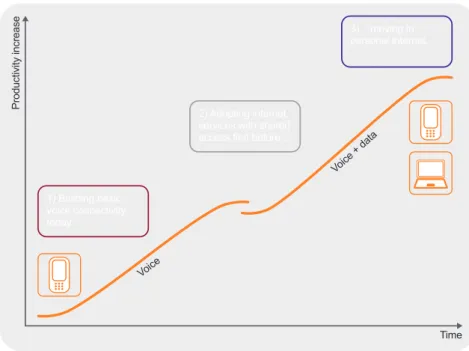
Most emerging markets follow a familiar pattern of growth with the first voice services being used by several consumers sharing a fixed or mobile device. As the affordability of services comes within their buying reach, individual consumers opt for their own device and subscription. This switch from shared to personal access is the phase of strongest growth and the one that we are currently experiencing with mobile voice in many markets. The same pattern of adoption is likely with internet access. The first data experiences are happening on shared access, such as internet kiosks and internet cafés. When consumers become sure of the value of internet access, feel comfortable using the technology and find them to be priced to suit their available spending power, they will then commit to personal subscription as illustrated in figure 2. This intermediate step of shared access will therefore be necessary to move the market from personal voice services to personal internet access, and it is in this phase of moving from shared to personal internet access that the highest rates of growth will be experienced.
Colombia evolves personal internet
access
The internet subscriber base in Colombia grew by 13.63 percent in the first quarter of 2009, reaching 2.47 million users. The government estimates the total internet user base at over 18.23 million from Colombia’s overall population of 44.97 million inhabitants. Source: Colombian Telecommunications Regulatory Commission10)
By the end of 2008, South Africa had 1.35 million internet subscribers. 794,000 of these were wireless internet subscribers and 588,000 were ADSL subscribers…. there are more mobile internet subscribers than fixed. Source: Balancing Act11)
Figure 2. Rapid growth will be achieved when users switch from shared to personal internet access.
Voice Voice + da ta Productivity increase Time 1) Building basic voice connectivity today. 2) Adopting internet services with shared access first before...
3) ...moving to personal internet.
Providing internet access at affordable rates for the mass populations of emerging markets is the key challenge for CSPs. Tariffs must be driven down to within the buying capabilities of lower income consumers who survive on just a few US dollars per day and who can afford less than ten percent of this income for communications. Yet the CSP must ensure that these lower prices are still profitable. Innovation will provide the answer. Not just deploying the latest technology, but creating innovative business models, marketing and business operations. In this respect, emerging market CSPs are not burdened by cumbersome legacy systems and processes, which can put them in a better position to adopt new ideas than some of their mature market counterparts.
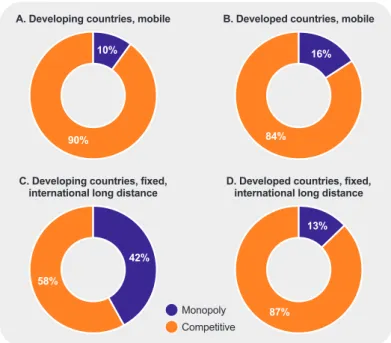
The ultra-rapid spread of voice services across emerging markets is almost completely due to the adoption by CSPs of mobile technologies, as well as mobile markets that are much more open to competition than fixed-line markets, as shown in figure 3. In rural areas, deploying fixed infrastructure across wide geographic regions is prohibitively expensive. It is unlikely that this will change and we do not foresee any significant investment in fixed access for rural areas in emerging markets.
Solving the affordability
versus
profitability
conundrum
Figure 3. Percentage of markets open to competition, mobile and fixed, worldwide, 2008. Source: ITU, World Telecommunication Regulatory Database; based on World Bank classification of economies.
A. Developing countries, mobile
C. Developing countries, fixed, international long distance
B. Developed countries, mobile
D. Developed countries, fixed, international long distance 10% 90% 42% 58% 16% 84% 13% Monopoly Competitive 87%
In urban areas too, although many fixed lines are in place, it is the ease and cost-effectiveness of mobile coverage brings that makes it attractive to CSPs looking to offer services to more people. Existing fixed infrastructure can be developed to provide more advanced data services to corporate customers and high end consumers.
Consequently, there exists a fast growing base of users who are familiar with mobile devices. CSPs that have bought into mobile infrastructure over the years are best placed to re-use much of their investment by adopting 3G technologies as the means of offering internet access to their customers.
Currently, about 100 million 3G subscribers (21 percent of global 3G subscriptions) come from emerging markets. In 2013 Nokia Siemens Networks expects this to rise tenfold to about 1 billion emerging market 3G subscribers (48 percent of the global number). However, in the context of population levels, with emerging markets having 70 to 80 percent of the world population, 3G penetration of emerging markets will remain far lower than in mature markets. (Figure 4)
“Deploying 3G services using UMTS900 may create 70 percent CAPEX and OPEX savings for mobile operators, says a recent case study on the experience of Elisa Corporation of Finland, released by the Global Mobile Suppliers Association. Widely used by GSM systems throughout Asia Pacific, the Middle East, Africa and Europe, the use of the 900 MHz band lowers the number of cell sites needed to cover rural and suburban areas.”
Source: LIRNEasia13)
Figure 4. WCDMA subscriptions are predicted to show the fastest growth rates in emerging markets.12)
Figure 5. Significant cost savings can be achieved by using the 900 MHz band compared to using the 2100 MHz band. Emerging markets Mature markets World 2500 0 500 1000 1500 2000 Subscribers in millions 2001 2002 2003 2004 2005 2006 2007 2008 2009 2010 2011 2012 2013
Cost of rural/suburban coverage (CAPEX & OPEX)
UMTS2100 UMTS900
50% – 70% reduction
Other 6.5% Support functions 12.7% Marketing & sales 16.5% Cost of goods sold 4.8% Dealer commissions 16.9% Customer service 7.5% Bad debt 0.5% IT 3.0% Networks 31.6%
In India, the government is keen to remove the digital divide (rural India has almost 75 percent of the country’s total population), and to achieve this end, it is giving high priority consideration to broadband penetration in the rural areas to extend services such as Tele-education, Tele-medicine, and e-governance.
Deploying and running
mobile infrastructure
Nokia Siemens Networks operational efficiency benchmarking studies show that in emerging markets over 30 percent of a CSP’s OPEX is accounted for by the network, with close to 40 percent coming from marketing and sales, including the cost of goods sold (Figure 6). On the other hand, the main capital costs for a CSP are in tower, power and backhaul. Clearly, these three costs – tower, power, backhaul – are key to achieving more affordable access for end users. Lowering these costs will take innovation at the network level, at the site level and at the equipment level.
The affordability challenge
in rural regions
Achieving viable affordability in rural areas takes a combination of low-cost infrastructure deployment, new business models, and innovative marketing strategies.
The move into rural areas by CSPs is being encouraged by governments and regulators. In Brazil, for example, the telecoms regulator’s licensing tender for voice telephony and broadband internet services will favor CSPs that pledge to deliver broadband internet services in rural areas. Meanwhile the Indonesian government is aiming to encourage more of the private sector to become involved in the development of ICT in the country. In addition, licensing obligations for mobile CSPs in Brazil look at reducing the cost of new frequency licensing, but require 2G coverage in all municipalities and 3G coverage in 60 percent of them within three years. In another example, an OECD Rural Policy Review reports that Chinese public expenditure for rural areas has been increasing in line with a stronger focus on territorial imbalances. Expenditure on rural areas almost doubled in nominal terms between 2004 and 2007.
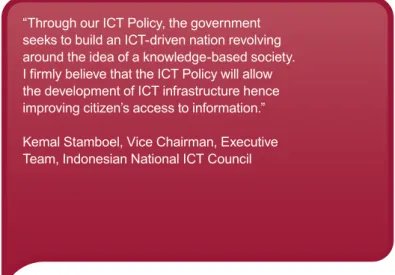
“Through our ICT Policy, the government seeks to build an ICT-driven nation revolving around the idea of a knowledge-based society. I firmly believe that the ICT Policy will allow the development of ICT infrastructure hence improving citizen’s access to information.” Kemal Stamboel, Vice Chairman, Executive Team, Indonesian National ICT Council
Figure 6. Overview of operational costs for emerging market CSPs14)
Figure 7. Breakdown of site capital costs in mature markets. Source: Powerwave Civil works 43% Base station 34% Antenna equipment 9% Coaxial cable 8% Power supply 6%
Tower – reducing the number of sites required
In rural areas, base stations need to cover huge areas and often there is no existing site development that can be built on. The difficulties of acquiring suitable sites can be eased by accurate network planning and the latest base station technology that together can reduce the number of required sites by 25–30 percent. This can cut the CSP’s capital and
operational costs (CAPEX and OPEX) significantly.
Equipment also needs to be robust to withstand often harsh environmental conditions to avoid unnecessary maintenance costs, particularly important when a maintenance engineer needs to travel for days in difficult terrain just to reach a site.
Power – efficiency is the key
With many sites built off-grid, beyond the reach of the national electricity grid, it is vital that base station equipment is as energy efficient as possible. The GSM Association estimates that 75,000 new off-grid sites will be deployed yearly from 2009 to 2012 as CSPs move increasingly into rural areas. Sub-Saharan Africa alone is expected to see year-on-year growth of 17 percent in base stations, with 70 percent being off-grid. Innovative equipment designs can reduce base station site energy consumption by as much as 70 percent. We estimate that 86 percent of a CSP’s overall energy bill is accounted for by the network, with 65 percent being consumed by base station sites. Extreme energy efficiency at the site level, coupled with fewer overall sites, can therefore reduce the CSP’s direct energy costs enormously. Furthermore, because many sites are powered by diesel generator sets, less frequent refueling can reduce site support costs dramatically.
Backhaul – the importance of technology selection
Backhaul is the third significant cost. Rural areas will not have copper transmission lines available and rely on microwave radios for the backhaul. Creating an effective mobile backhaul requires a deep understanding of both the radio and transport layers and how they interact, particularly with regard to optimizing the use of IP and Ethernet technologies across the backhaul layers. Multilayer optimization enables services to be transported in the most efficient layer, helping to reduce network complexity and cutting capital and operational costs. Such optimization requires cross-functional skills and experience spanning all technologies, which realistically can only be achieved by vendors that offer a full portfolio of access and
aggregation technologies, including microwave radio, fiber and copper in the access network; as well as Carrier Ethernet and IP/MPLS in the
aggregation and core networks.
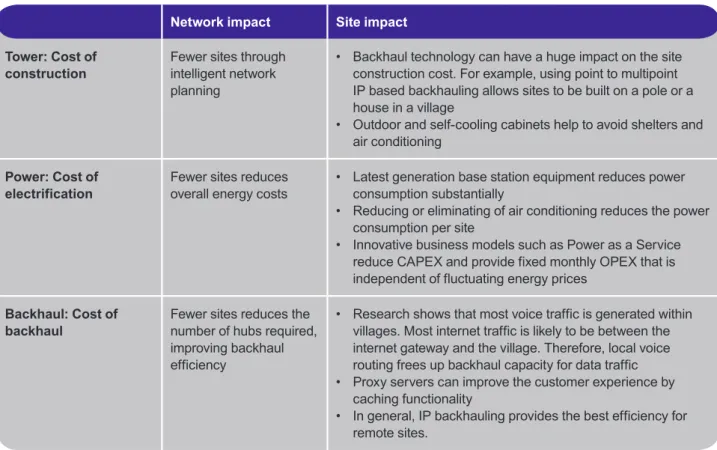
Table 1. Tower, power, backhaul – how innovation reduces the total cost of ownership for CSPs. Source: Nokia Siemens Networks, 2009.
Network impact Site impact
Tower: Cost of construction
Fewer sites through intelligent network planning
Backhaul technology can have a huge impact on the site •
construction cost. For example, using point to multipoint IP based backhauling allows sites to be built on a pole or a house in a village
Outdoor and self-cooling cabinets help to avoid shelters and •
air conditioning
Power: Cost of electrification
Fewer sites reduces overall energy costs
Latest generation base station equipment reduces power •
consumption substantially
Reducing or eliminating of air conditioning reduces the power •
consumption per site
Innovative business models such as Power as a Service •
reduce CAPEX and provide fixed monthly OPEX that is independent of fluctuating energy prices
Backhaul: Cost of backhaul
Fewer sites reduces the number of hubs required, improving backhaul efficiency
Research shows that most voice traffic is generated within •
villages. Most internet traffic is likely to be between the internet gateway and the village. Therefore, local voice routing frees up backhaul capacity for data traffic Proxy servers can improve the customer experience by •
caching functionality
In general, IP backhauling provides the best efficiency for •
Innovating at the base station site
Providing affordable access demands base station sites with low CAPEX and OPEX. Nokia Siemens Networks Smart Site solution brings innovation to all aspects of the site, including site planning and design, active base station and transmission equipment, passive equipment and the power system.
Flexible and cost-effective site design
Outdoor site design eliminates CAPEX items such as shelters •
and air conditioning and reduces site running costs Tower top sites for maximum RF coverage saving up to 30 •
percent in network roll-out costs
Optimized passive elements
Three legged tubular tower is up to 45 percent lighter for the •
same height than traditional four legged angular tower
30 percent fewer carbon emissions because less steel, concrete •
and transportation are needed
Wide coverage with Flexi Base Station
Nokia Siemens Networks Flexi Base Station supports multiple •
installation options in outdoor and indoor environment Lowest power consumption on the market
•
Suits a broad range of climatic conditions •
Integrated transmission and transmission efficiency enhancement •
Effective power systems
The latest technology helps to maintain constant optimal •
temperature to extend battery life considerably in hot or cold climates
Significantly lower power consumption can be achieved compared •
to air conditioned outdoor power cabinets Minimal power consumption reduces CO
• 2 footprint
Renewable Energy Solutions Autonomous Sites
A range of renewable energy options with one or more power •
The emergence of network sharing
Network sharing, in which CSPs come to a commercial agreement to share physical network resources, is becoming an increasingly important way of reducing costs. Sharing can be passive, in which only the site is shared, or active, in which base station and backhaul equipment are also shared.
Both passive and active sharing are seen by regulators as a fruitful way of fostering investment and growth in the ICT sector by offering incentives, including financial subsidies, for service providers who share infrastructure. The potential cost savings are enormous. There are estimates that CSPs in the Middle East & Africa region could save USD 8 billion over the next five years, by sharing their towers.15)
Infrastructure sharing is a concept that is being encouraged by several authorities around the world. In 2008, the Indian authorities relaxed their restrictions on infrastructure sharing, allowing the sharing of active and passive infrastructure except spectrum. “The guidelines are aimed to reducing the input costs on telecom access providers… (and to aid) reduced tariff and increased tele-density in rural areas,” the telecoms ministry said in a statement.16)
In China, the Ministry of Industry and Information Technology (MIIT) and the State-Owned Assets Supervision and Administration Commission issued a joint policy statement on infrastructure sharing, which became effective on 1st October 2008. The regulations mainly apply to 3G network
construction rather than 2G network sharing. According to one report,
“Sharing is key to promoting ICT access at affordable prices in rural areas. Operators will automatically receive subsidies for the
deployment and management of towers … as long as operators share the towers with three other operators or service providers.” Nirpendra Misra, Chairman of the Telecommunication Regulatory Authority (TRAI), India
“the move could lead to a reduction of about 15 percent in the 3G CAPEX of China’s three operators: China Mobile, China Unicom and China Telecom.”17)
Consequently, sharing deals in emerging markets are appearing. For example, in April 2009 Zain Kenya and Essar Telecom Kenya agreed to share 300 base stations over 15 years in Kenya.18)
In Ghana, CSPs are working jointly to enable more than one network to share cell sites. “Co-location is very close to our hearts and we are getting on very well with the other operators in reaching co-location deals to enable us to provide better services to our teaming customers,” said Brett Goshen, CEO of MTN, Ghana.19)
Adopting innovative business
models
Innovation needs to extend to business operations. The challenges specific to emerging markets are sometimes best answered by adopting business models that are unlikely to be deployed in mature markets. Take the example of theft from rural base station sites, a problem that many CSPs in emerging markets face. This can be a significant operational cost for the CSP, with repeated maintenance visits to repair base station equipment or to replenish stolen fuel supplies.
By involving local subscribers and their social structures, responsibility for a base station’s security can be taken on by the local community. For example, positioning the base station in the mayor’s or tribal eldest’s house, helps to increase the population’s
appreciation of the value of the service and provides local protection.
Building relationships with local entrepreneurs also brings down the CSP’s total costs by effectively outsourcing the management of elements of the business to local communities. Two prominent initiatives in recent years that demonstrate the possibilities are The Grameen Foundation’s Village Phone project20)
and the Nokia Siemens Networks Village Connection solution. A further option lies in innovative funding options, which create a new category of payment model,
overhauling conventional CAPEX and OPEX structures. Nokia Siemens Networks, for example, has been exploring a leasing concept for renewable energy solutions. The aim is to help CSPs adopt renewable energy solutions despite their high upfront cost.
The concept of ‘Power as a Service’ entails a vendor financing and installing a renewable energy solution at sites and then offering power for a fixed monthly fee from the CSP. The CSP can enjoy a CAPEX-free installation and monthly fees (OPEX) that are lower than the monthly cost of diesel consumption. The model also means that the renewable energy assets do not appear in the CSP’s financial records, enabling it to retain its financial flexibility to invest in its core business, which is connectivity.
Internet-style services without
the internet
A key challenge for CSPs in addressing rural users lies in building their
competence and motivation to use data services. An innovative and rapidly-deployable way of delivering data services into these markets using SMS technologies has been developed by Nokia.
Nokia Life Tools is a range of agriculture and education services aimed at rural consumers. The services use an icon-based, graphically-rich user interface that is supplied with information via SMS that can be accessed using standard mobile phones.
Using SMS makes information services available and affordable, while meeting the two other areas crucial for emerging market success – motivation and competence.
Different approaches to
innovating operations
In recent years novel business models have emerged to bring connectivity to remote villages.
Village Phone –
building the sharing model
Village Phone was pioneered in Bangladesh by Grameen Telecom and it has now also been replicated in Africa.
In rural villages, mobile phones with a coupled external antenna are provided to low-income women to operate a business by renting the use of the mobile phone and selling prepaid airtime to other villagers, thus providing vital
communications access. Equipped with an external antenna, the phone is able to receive GSM signal far outside the CSP’s normal coverage area. This enables “Village Phone ladies” to work in areas where commercial GSM phones with integrated antennas will not work20).
By leapfrogging fixed infrastructure and
leveraging existing wireless infrastructure, Village Phone offers a viable strategy for increasing communications access and technology business opportunities in emerging markets. Village Phone CSPs often use the additional income to improve their health, food and children’s education. Many Village Phone CSPs have used their new resources to develop other services, such as healthcare and emergency calls, transport and charging services that benefit the wider community.
Vandalism cut by local involvement in Nigeria
Engaging with the local population is an important aspect of serving rural communities and in May 2008 Zain Nigeria launched its innovative Rural Acquisition Initiative (RAI) to help boost entrepreneurship. The scheme franchises out the basic maintenance and security of rural BTS sites to local ‘trade partners’.
“Revenue-sharing with these local entrepreneurs is based on the call records from each site, so maintaining BTS availability is in their interests. With RAI, we have seen utilization rise by 200 percent on 25 sites, largely through better security to reduce vandalism. Community relations are a big part of our activities. We want to put something back into the local community.”
John Earley, Chief Technical Officer, Zain Nigeria.
Village Connection –
encouraging local entrepreneurs
The Nokia Siemens Networks Village Connection solution involves enterprising villagers in the management and selling of local voice and data access.
Village Connection combines a network architecture based on standard off-the-shelf GSM infrastructure with an innovative franchised business model in which call management and service is controlled by a village entrepreneur. No site construction is needed and a village-based GSM access point can be installed within hours to handle local switching. Access points are connected to regional Access Centers via a native IP link, using transmission media such as microwave radios, WiMAX or satellite
connectivity. This eliminates traditional network hierarchies, allowing a rural network to be built at a much lower CAPEX, as well as eliminating considerable operational expenses.
A local entrepreneur runs the village network, either employed by the CSP or as part of a franchise. Such an arrangement not only creates income, but also helps to build villagers’
Innovation in marketing to
rural customers
The logistics of rural areas, many lacking basic transport infrastructure, can be a further barrier to rolling out access to consumers. Furthermore, CSPs face unique challenges in the marketing of services to lower income rural communities.
Such difficulties are best overcome by a mix of technology and operational innovations.
The cost of access must be matched to the available spending power of lower income prepaid consumers who may never have a significant amount of cash to hand to buy conventional top ups of around 5 US dollars. Electronic prepaid recharging
solutions based on SMS replace paper vouchers with text messages and reduce the cost of the prepaid process by up to 70 percent, enabling CSPs to offer small denomination prepaid recharges profitably.
Conventional marketing techniques based on mass media advertising are not always appropriate for the rural sector. Instead, adopting very local marketing and distribution strategies, underpinned by detailed research on socio-cultural knowledge systems has proved to be more effective. Such local strategies are also considerably less expensive than nationwide mass media campaigns which also fail to reach the whole population.
The deployment of a rural distribution network comprising town-based distributors supplying village shops or local distributors will also help to overcome physical distribution challenges. A recent Nokia Siemens Networks pilot scheme in China rolled out eCommerce to local entrepreneurs, enabling them to expand their businesses, which are often limited due to their shop size and storage opportunities. The pilot scheme showed that during a five-month period business owners generated online transactions equal to the revenue they have raised from traditional business.21)
The dual-market urban strategy
More and more people are living in cities. It’s a trend that accelerated during the 20th century and will continue to transform the demographics of most countries. According to the United Nations, 49 percent of the world’s population lived in cities in
In emerging markets, providing data access to this huge urban population will take a different approach than that for rural regions.
A dual market strategy is needed, with investment in higher speed and higher quality access to cater for the demand for advanced services from enterprises and high-end consumers, accompanied by providing affordable access for the lower income urban population.
Shared access is already a well-proven and popular business with widespread internet cafés catering for the needs of millions of users. These establishments succeed because they sell access in affordable chunks of time. The move towards personal access to the internet via the mobile phone will be underpinned by this same charging model.
Instant provisioning solutions will enable users to buy flat rate internet access on their phones for short, affordable
The appeal of flat-rate pricing
The runaway success of flat-rate tariffs for mobile internet access in mature markets provides invaluable experience for installing instant provisioning solutions that provide access on-the-fly for lower income segments. Flat-rate pricing is proven to appeal to subscribers.
Users can be sure that costs will not go up even when •
growing from initial low levels of use to higher usage. Simple pricing increases people’s willingness to pay; •
they do not want to be bothered with complex pricing. Flat rates increase usage. Broadband CSPs have seen •
use increase by 50 to 200 percent when users change their pricing plan from a metered to a flat rate model. Source: Nokia Siemens Networks 200922)
Mobile internet access
provides ultimate affordability
It has become clear that the sheer cost and logistical difficulties of providing widespread data access with fixed technologies is simply not viable. In many countries the number of mobile internet subscribers outstrips the number of fixed access users. According to analysts Informa and Yankee group, 2009 will see the number of mobile broadband customers overtake fixed-line broadband users globally.
The markets showing high growth for voice services are clear candidates for transformation to the internet and multimedia world.
In these emerging markets the shift from shared internet access to personal internet access will be enabled by a lower total cost of ownership for the consumer, underpinned by affordable access. In Peru, for example, with a GDP per head of less than USD 4000 a year, in 2007 12.9 percent of the population had access to a PC, but only 2.5 percent had internet access – the cost structure of mobile technologies can rapidly unlock this potential.23)
The cost effectiveness of building and maintaining mobile networks for CSPs is another key factor, and in terms of the economies of scale it brings, the front runner in mobile is undoubtedly 3G. One prediction points to more than 2.5 billion 3G subscribers worldwide by 2013, with over one billion in Asia alone.24) The success of
3G is largely down to its sheer scale, making affordable access a reality for lower income segments.
There are many examples of emerging market CSPs launching 3G services and achieving rapid take up. When TEF, Chile’s most successful 3G CSP deployed 3G technology, traffic soared from 450 GB to 4 TB a day in just 60 days, with the majority of this new data traffic coming from outside urban areas.
“There has been an explosion in the use of mobile internet access [in Mexico]. Mobility plus data is what customers want and we are seeing very good results with 3G. The internet is a necessity in the 21st century, not a luxury.”
Marco Quatorze,
Director of Value Added Services for América Móvil
“The mobile handset is becoming the most important means of accessing the internet in Egypt.” Abdul Razzak,
Chief Technology Officer, Etisalat, Egypt
Shaping the individual
communications experience
The selection of technology will depend on an analysis of many factors, from frequency availability, to license and regulatory conditions, and the CSP’s existing installed base. An understanding of customer needs is equally important as the consumer market evolves from voice to data, from urban to rural, and from shared to personal access.
However, consumers are not concerned with the technology that their CSPs deploy. They want a communications experience that satisfies their individual needs. The quality of service, their costs, reliability of access and the relevance of services all influence consumer adoption. Nokia Siemens Networks focuses on helping CSPs to understand the context in which their customers find themselves – and then deliver the services that excite their imaginations and enrich their lives. The ultimate vision is to enable a segment of ‘one’ whereby the service experience is defined for each individual. Such an ‘individual communications
experience’ is the highest value that any CSP can deliver to its customers, whether people or businesses. The route to this vision lies in providing the lowest total cost of ownership for networks and their operation and
The importance of excellent customer
experience
A strong focus on customer experience is characterizing the transformation of CSPs in mature markets and already we are seeing evidence of the impact network quality and service in emerging markets. A Nokia Siemens Networks study25) has found that in Indonesia,
19% percent of all subscribers who have churned have decided to change CSP due to bad voice quality. The study also shows that when markets mature, the likelihood of mobile subscribers changing CSP increases vastly. Some 87 percent and 79 percent of mobile subscribers in Indonesia and Pakistan respectively have never changed CSP, while the corresponding figure is 55 percent and 48 percent for Germany and the UK. In times of hyper-growth, emerging market CSPs are concerned mainly with acquiring market share rapidly. The race for market share can be to the detriment of network quality, but need not be.
One Indonesian CSP has confirmed to Nokia Siemens Networks that network quality is a key acquisition driver for its customers.
Conclusion:
The internet without restrictions
This must change and it is. Internetservices can help people to build better lives and to support nations as they create greater economic prosperity. The key that will unlock these huge opportunities is affordable access. Unless people can reach the internet, the internet cannot help people.
Innovation in technology, in business and in policy-making can make affordable access a reality for ever more people, further and further down the income pyramid.
The communications industry is being charged with the responsibility to make the internet a possibility for all. The joint effort of all players in the industry is needed to provide the vital innovation. However, it is certain that the investments required will be repaid many times over through the revenue that will be generated by billions of new internet users.
Ultimately, nobody, whatever their income, need be deprived of the benefits of the internet, of the ability to use information to improve their lives. All the pieces of the affordable access puzzle are available, we just need to put them together correctly.
A minority of the world’s population uses the internet today. Yet the potential for good that the internet offers is greatest for the billions of people who do not yet use this wonder of the information era.
References
(1) http://web.worldbank.org/WBSITE/EXTERNAL/NEWS/0,,contentMDK: 22231347~pagePK:34370~piPK:34424~theSitePK:4607,00.html, July 3, 2009 (2) Chilean Mobile Telephony association (Atelmo 2008)
(3) South China Morning Post, April 2009 (4) Pyramid Research, April 2009
(5) ITNewsAfrica, October 27th, 2008. http://www.itnewsafrica.com (6) How the internet can enhance the lives of the next billion consumers,
Nokia Siemens Networks, 2008
(7) Information changes lives – making the internet relevant in emerging markets, Nokia Siemens Networks, 2009
(8) China’s Ministry of Industry and Information Technology (MIIT), 2008 (9) Telecom Regulatory Authority of India, January 2009
(10) Colombian Telecommunications Regulatory Commission (CRT), 2009 (11) Balancing Act, May 2009, www.balancingact-africa.com
(12) Nokia Siemens Networks 2009, based on multiple analyst resources (13) “Reports: 2G frequencies can make big savings on 3G deployment”,
LIRNEasia, Sept 25, 2008
(14) Nokia Siemens Networks’ operational efficiency reference benchmark 2009, 1st update, i.e. not based on published reports
(15) Tower Sharing in the Middle East and Africa: Collaborating in competition, Delta Partners, April 2009
(16) LIRNEasia, April 2008
(17) Informa Intelligence Centre, 16/10/2008
(18) Telecoms.com, http://www.telecoms.com “Zain-essar-network-sharing-deal-is-a-paradigm-shift-for-emerging-market-players”, April 16, 2009
(19) Balancing Act Africa, issue 447, March 2009
(20) Grameenphone, http://www.grameenphone.com/index.php?id=79 (21) Nokia Siemens Networks Corporate Responsibility Report 2008
(22) Opening Doors to the Next Billion People – the Markets and Economics of Connectivity White Paper, Nokia Siemens Networks 2009
(23) 3G for all. How 3G is set to transform communications across emerging markets, Nokia Siemens Networks, 2009
(24) Parks Associates, http://newsroom.parksassociates.com/article_display. cfm?article_id=5128, January 20, 2009
Nokia Siemens Networks Corporation P.O. Box 1
FI-02022 NOKIA SIEMENS NETWORKS Finland
Visiting address:
Karaportti 3, ESPOO, Finland Switchboard +358 71 400 4000
Product code B301-00437-WP-200907-1-EN Indivisual/Libris
Copyright © 2009 Nokia Siemens Networks. All rights reserved.
A license is hereby granted to download and print a copy of this document for personal use only. No other license to any other intellectual property rights is granted herein. Unless expressly permitted herein, reproduction, transfer, distribution or storage of part or all of the contents in any form without the prior written permission of Nokia Siemens Networks is prohibited.
The content of this document is provided “AS IS”, without warranties of any kind with regards its accuracy or reliability, and specifically excluding all implied warranties, for example of
merchantability, fitness for purpose, title and non-infringement. In no event shall Nokia Siemens Networks be liable for any special, indirect or consequential damages, or any damages whatsoever resulting form loss of use, data or profits, arising out of or in connection with the use of the document. Nokia Siemens Networks reserves the right to revise the document or withdraw it at any time without prior notice.
Nokia is a registered trademark of Nokia Corporation, Siemens is a registered trademark of Siemens AG.
The wave logo is a trademark of Nokia Siemens Networks Oy.
Other company and product names mentioned in this document may be trademarks of their respective owners, and they are mentioned for identification purposes only.
Every effort is made to ensure that our communications materials have as little impact on the environment as possible
Communicating is a basic human need. By making it easier to be connected to the world around us, we are making a significant difference in people’s lives. Get in touch with a world of ideas and trends in the communications industry. Read articles, watch videos, listen to podcasts or even join our community. We are interested in your comments at http://unite.nokiasiemensnetworks.com
http://expandinghorizons.nokia.com www.roundtheworldconnected.com