Practical guide
Strengthening health systems
For the PDF version of this publication and other Tools Series • Practical guides for health information systems professionals
The Knowledge Hubs for Health are a strategic partnership initiative funded by the Australian Agency for International Development
Documenting medical
records
A handbook for doctors
ADMISSION FORM Hospital Ward Number MR Number Date of Admission Attending Physician Time of Admission Patient Name in Full
Patient Address Telephone Number Age Sex Date of Discharge Civil Condition Time of Discharge Next of Kin Name
and Address
Next of Kin Telephone Number Final Diagnosis/ Main Condition ICD Code Date Clinical Notes
© University of Queensland 2013 ISBN: 9781742720753
Published by the Health Information Systems Knowledge Hub School of Population Health, The University of Queensland Room 417 Public Health Building, Herston Rd
Herston Qld 4006, Australia
Please contact us for additional copies of this publication, or send us feedback: Email: [email protected]
Tel: +61 7 3365 5405 Fax: +61 7 3365 5442
www.uq.edu.au/hishub
Editing: Econnect Communication, Brisbane, Australia Design by Biotext, Canberra, Australia
ADMISSION FORM Hospital Ward Number MR Number Date of Admission Attending Physician Time of Admission Patient Name in Full
Patient Address Telephone Number Age Sex Date of Discharge Civil Condition Time of Discharge Next of Kin Name
and Address
Next of Kin Telephone Number Final Diagnosis/ Main Condition ICD Code Date Clinical Notes
Documenting medical records
A handbook for doctors
Health Information Systems
Knowledge Hub
Acknowledgments
The author, Dr Nandalal Wijesekera, would like to thank the Health Information Systems Knowledge Hub team for their support in preparing this handbook. Expert guidance was provided by Dr Nalika Gunawardena, Dr Rasika Rampatige, Professor Ian Riley, Dr Saman Gamage, Sue Walker and Dr Lene Mikkelsen.
About this tool
This capacity-building tool has been produced by the Health Information Systems Knowledge Hub of the School of Population Health at the University of Queensland.
Health Information Systems Knowledge Hub publications are the principal means to disseminate the knowledge products developed by the hub in a user-friendly format and as easily accessible resources. Capacity-building tools are designed to increase practical knowledge and skills for a
particular health information systems issue. Formats are user-friendly and are supported by research knowledge.
The opinions or conclusions expressed are those of the authors and do not necessarily reflect the views of institutions or governments.
The Health Information Systems Knowledge Hub welcomes your feedback and any questions you may for its research staff
For further information on this paper, as well as a list of all our work, please visit www.uq.edu.au/hishub.
Contents
Preface ...2
Importance of proper documentation of Medical Records ...3
A country’s health statistics ...3
What is a Medical Record? ...5
Why do we keep medical records? ...5
Who is responsible for making entries in the medical record? ...5
What makes a good quality medical record? ...6
Quality documentation – the four attributes ...6
Availability ...6
Legibility ...6
Adequacy ...7
Accountability ...7
Admitting doctors – what entries need to be recorded in a medical record 7 Ward doctors – what entries need to be recorded in a medical record ...9
How to record an entry in a medical record ...10
General entries ...10
Clinical entries ...13
Final Diagnosis / main condition ...14
The discharge summary ...17
Correcting errors in a medical record ...18
Scenarios ...19
References ...30
Preface
Several studies have highlighted the poor quality of medical record documentation by doctors. Poor documentation can be attributed to poor knowledge, poor attitudes and commitment, and lack of training.
This handbook has been developed to provide doctors and medical students with guidelines on documenting medical records to the required level of quality, as defined by the Royal College of Physicians (2009) and the World Health Organization (2006).
Organised for easy reference, the handbook explains: • what a medical record is and what it is used for • the attributes of a quality medical record
• how doctors should complete entries in a medical record • how doctors should correct errors in a medical record.
The handbook is aimed primarily at junior doctors whose first language is not English, especially those in Sri Lanka and the Asia Pacific region.
Importance of proper documentation of
Medical Records
Medical records are important tools for communicating the progress of a patient. They also provide valuable information related to disease epidemiology, which is crucial for the health system of a country and, thereby, the health of a nation.
A country’s health statistics
Health statistics are public goods needed not only by health institutions but by governments, businesses, the media, researchers, civil society, donors and international organisations. All countries need accurate and quality health statistics to fully develop socially and economically. Policymakers need accurate and quality health statistics to make the right health-related decisions.
The quality of health statistics depends primarily on the quality of medical records as documented by doctors.
The history and progress of the patient
A patient’s medical record communicates information about their progress to the physicians and other health professionals who are providing care to the patient. It is a communication link among the patient’s care-givers. For those health professionals who provide care on subsequent occasions, the medical record provides critical information, such as the history of illnesses and the treatment provided.
Legal documents
Medical records provide evidence that may assist in protecting the legal interests of the patient, the physician and/or the healthcare institution.
Public health programs and hospital plans
Public health professionals use the information in medical records for planning preventive and control programs, evaluating and re-planning existing programs, and developing screening and surveillance programs. Health administrators and hospital managers derive data from medical records for planning, for allocating resources and for management purposes.
Trends and patterns of diseases
For epidemiologists, researchers and healthcare managers who monitor trends and patterns of diseases, information compiled from medical records is vital. In many countries, medical records are the only source of information on the magnitude of disease groups such as NCDs (non-communicable diseases).
Morbidity statistics
Medical records are the main source of morbidity statistics which are used in public health planning for NCDs such as diabetes, hypertension and cancers. Without accurate records, reducing the burden of NCDs is hampered.
Case studies
Medical records provide real case studies which can be used for educating health professionals.
What is a Medical Record?
A medical record is a compilation of pertinent facts about a patient’s life and health history, including past and present illnesses and treatments. It is written by the health professionals contributing to the patient’s care.
Why do we keep medical records?
We keep medical records for a number of reasons, including: • for communication purposes while caring for the patient • for continuity of patient care over the course of the patient’s life • for evaluating patient care
• for medico-legal purposes
• for use as a source of health statistics
• for research, education and planning purposes.
Who is responsible for making
entries in the medical record?
A medical record is generated at the point at which a patient gets admitted to a ward in a healthcare institution. Depending on the country and the institution, a new medical record may be created each time the patient is admitted, or the medical record may move from ward to ward or institution to institution.
The first page of the medical record is called the Admission Form. Although several people may contribute to it, the admitting doctor of the health institution is the person mainly responsible for documenting the first page. The patient is admitted to the relevant ward with this partially completed medical record. Thereafter, the ward doctors (Intern Medical Officers, Senior House Officers, Registrars, Senior Registrars and Consultants) and nurses attached to this ward are responsible for documenting pertinent information about the patient until the separation of the patient from the ward either by discharge or death.
What makes a good quality medical record?
• It identifies clearly the person about whom it is written. • It is legible and able to be understood by anyone likely to use it. • It identifies the people who have contributed to the record.Quality documentation – the four
attributes
As defined by the World Health Organization (2003, 2006), the Royal College of Physicians (2009), Lowe (2009) and Huffman (1994), the quality of the entries documented in a medical record is judged by the following attributes: • Availability • Legibility • Adequacy • Accountability
Availability
If an entry is present in the space provided in the medical record, or in an appropriate place in the medical record (for some entries there is no specific space allocated or the space that is provided is not sufficient), and the entry is relevant, the entry is considered to be available.
Legibility
If an entry in the medical record can easily be read at a glance, with an adequate light source, by any person other than the person who documented it, the entry is considered to be legible.
Legible entries – Zero confusion – Improved health statistics
Adequacy
Generally, all entries in the medical record should include full details and, as much as possible, be written without using abbreviations. The ‘adequacy’ varies for specific entries. More detailed explanations, with examples (scenarios), are provided later in this handbook.
Accountability
Identification details of the doctor recording the information—their name, signature (or initials) and professional designation—should be included on the medical record following successful documentation of entries. By doing so, the doctor who completed the documentation becomes accountable for the entries that were made.
Admitting doctors – what entries need to
be recorded in a medical record
Entries documented by the admitting doctor can be broadly divided into administrative/statistical and clinical information.
Administrative/statistical information
Accurate and precise administrative and statistical information is vital for the hospital administration and also for generating accurate health statistics.
The admitting doctor should record the following information: • Ward number
• Date of admission • Time of admission • Name of the patient in full • Age of the patient
• Sex of the patient
• Civil condition of the patient • Name of the admitting doctor • Designation of the admitting doctor • Signature of the admitting doctor.
Clinical information
The admitting doctor should record the following information: • Presenting complaint
• Previous history • Examination findings • Provisional diagnosis
• Basic investigations that need to be done
• Initial treatment/management that needs to be provided
• Notification instructions (if the condition is a notifiable disease or suspected of being one).
Ward doctors – what entries need to be
recorded in a medical record
Entries documented by ward doctors can be broadly divided into administrative/statistical and clinical information.
Administrative/statistical information
The ward doctor should record the following information: • Date of examination
• Time of examination • Provisional diagnosis • Date of discharge/death
• Name of attending ward medical officer • Designation of attending ward medical officer • Signature of attending ward medical officer
• Final diagnosis / main condition (the disease or injury) • Other diagnoses / other conditions.
Clinical information
The ward doctor should record the following information: • Presenting complaint
• History of presenting complaint • Past history
• Family history • Occupational history
• Drug history
• Examination findings • Provisional diagnosis • Investigations ordered
• Final diagnosis / main condition (the disease or injury) • Other diagnoses / other conditions
• Treatment/management ordered • Discharge summary
• Condition of patient on discharge
• Name(s), dosage and frequency of drug(s) to be continued at home
• Follow-up instructions given.
How to record an entry in a medical
record
General entries
Ward number
Write the ward number using numbers or letters.
For example, an admission to ward seven could be written as ‘7’ or ‘seven’.
Date of admission/examination/discharge/death
Write the full date (day, month and year).
Adequate Inadequate 14.2.12 14.2. 14 / 2/ 12 14/2 14-2-12 14-2 14.2.2012 14th February 14 / 02/ 2012 Fourteenth February 14-2-2012 14 14th February 2012 14th Fourteenth February 2012
Time of admission/examination/discharge/death
Write the hour (and minute, when applicable) and whether it is AM or PM.
Adequate Inadequate 6.30 PM 6.30 18.30 hours 18.30 4.36 AM 4.36 4.36 hours
Name of the patient in full:
Write the patient’s name in full e.g. Mark Steven Smith. Writing ‘Mark Steven Smith’ as ‘Mark’ or ‘Steven’ or ‘Smith’ is inadequate as there could be several Marks, Stevens or Smiths in the ward at the same time. This would lead to confusion and the entering of incorrect information in the medical record, with the result that patients could be given the wrong treatment.
Age of the patient
If the patient’s age is:
• more than one day and less than or equal to one week, record it in days
• more than one week and less than or equal to one month, record it in weeks
• more than one month and less than or equal to one year, record it in months
• more than one year, record it in years.
Age Record
age in Adequate Inadequate
≤ 1 day hours 12 hours Half a day or ½ day
> 1 day and ≤ 1 week days 6 days or 6/365 1 week or 1/52 > 1 week and ≤ 1 month weeks 2 weeks or 2/52 ½ month > 1 month and ≤ 1 year months 6 months or 6/12 ½ year
> 1 year years 5 years or 5 yrs 5 or five
Sex of the patient
Sex Write as
Female Female, F or ♀
Male Male, M or ♂
Civil condition of the patient
Civil condition Write as
Unmarried Unmarried or U/M, Single or S
Married Married or M
Divorced Divorced or D
Widowed Widowed or W
Name of admitting doctor / ward doctor
If you are the attending doctor, you must record your name in the medical record at the end of the entry.
Designation of admitting doctor / ward doctor:
If you are the attending doctor, you must record your designation.
Designation Write as
Medical Officer, Admission MO (Admission)
Intern Medical Officer IMO
House Officer HO
Senior House Officer SHO
Medical Officer MO
Registrar Registrar or Reg.
Senior Registrar Senior Registrar or SR
Consultant Consultant
Abbreviations (as indicated above) can be used.
Signature of admitting doctor / ward doctor
If you are the attending doctor, you must sign or initial the medical record at the end of the entry. The entry is not complete until you do so.
Clinical entries
Clinical entries vary from patient to patient. However, all entries must include relevant information about history, examination findings, investigations and treatment/management. Like all entries, the quality of a clinical entry depends on its availability, legibility, adequacy and accountability.
Documenting the final diagnosis accurately is critical to ensure that compiled health statistics reflect the true picture of the trends and patterns of diseases and injuries in a region or country.
Final Diagnosis / main condition
Final Diagnosis is the condition for which the patient is primarily investigated and treated. If there is more than one such condition, the condition that required the highest amount of resources should be selected. If NO diagnosis has been made, the main symptom, sign
or abnormal test result should be given as the final diagnosis (World Health Organization, 1993)
According to the World Health Organization (2004), a diagnostic statement is considered inaccurate if it falls into one or more of the following
categories:
• Not written in block letters
A diagnostic statement that is not written in block letters is considered as inaccurate.
WRITE THE FINAL DIAGNOSIS IN BLOCK LETTERS
• Illegible diagnosis
If a person other than the person who documented the diagnostic statement is unable to read the entry at a glance with an adequate light source, the diagnostic statement is considered as illegible.
• Incomplete diagnostic statement
If a diagnostic statement had been written without specifying the site, side, limb, organ, system, stage, and the other manifestations of the disease (when appropriate), the diagnostic statement is considered as incomplete.
Example 1: ‘FRACTURED FEMUR’ is recorded instead of ‘FRACTURE LOWER ONE THIRD OF THE RIGHT FEMUR’.
Example 2: ‘DIABETES MELLITUS’ is recorded instead of ‘DIABETES MELLITUS WITH RETINOPATHY’.
• Diagnosis recorded using abbreviations
Example: Diagnosis is written as ‘BPH’ instead of ‘BENIGN PROSTATIC HYPERTROPHY’.
• Surgical procedures given as diagnosis
Example: Diagnosis is recorded as ‘APPENDICECTOMY’ instead of ‘ACUTE APPENDICITIS’.
• Diagnostic procedures given as diagnosis
Example: Diagnosis is recorded as ‘LAPAROSCOPY’.
• Symptom, sign or an abnormal laboratory finding given as diagnosis
A symptom, sign, abnormal laboratory finding or problem may be
recorded as the final diagnosis, but only if no diagnosis has been made by the time of discharge. If it is evident from the entries in the medical record that a final diagnosis had been made by the time of discharge of the patient, and a symptom, sign or an abnormal laboratory finding has been recorded as the diagnosis, the diagnosis is considered as inaccurate. Example 1: ‘CHEST PAIN’ is written as final diagnosis when a clear
diagnosis of ‘ACUTE ANTEROLATERAL MYOCARDIAL INFARCTION’ has been made and could be identified from the notes on the medical record. Example 2: ‘HEPATOMEGALY’ is written as final diagnosis when a clear diagnosis of ‘ALCOHOLIC HEPATITIS’ has been made and could be identified from the notes on the medical record.
Example 3: ‘LUNG MASS IN CHEST X-RAY’ is written as final diagnosis when a clear diagnosis of ‘CARCINOMA OF LOWER LOBE OF LEFT LUNG’ has been made and could be identified from the notes of the medical record.
• Diagnosis recorded in general or ill-defined terms
Example: ‘CONGENITAL HEART DISEASE’ is written as final diagnosis instead of ‘VENTRICULAR SEPTAL DEFECT’.
• Incompatible diagnosis
If the final diagnosis written on the front sheet of the medical record is found to be incompatible with what is documented therein, the diagnosis is considered as ‘incompatible’.
Example 1: ‘VIRAL FEVER’ is written as the final diagnosis, but the clinical history and the laboratory reports confirm ‘PLASMODIUM VIVAX MALARIA’.
Example 2: ‘FRACTURE LOWER ONE THIRD OF THE RIGHT FEMUR’ is written as the final diagnosis but the diagnosis is documented in the clinical notes of the medical record as ‘FRACTURE LOWER ONE THIRD OF RIGHT HUMERUS’.
• Unrelated statement(s) written as diagnosis
If the final diagnosis written on the front sheet of the medical record is neither a diagnosis nor a symptom, sign, laboratory finding, surgical or a diagnostic procedure, the diagnosis is considered as ‘unrelated’.
Examples: Statements such as ‘LEFT AGAINST MEDICAL ADVICE (LAMA)’, ‘REMOVED AGAINST MEDICAL ADVICE (RAMA)’ or ‘PATIENT MISSING’ given as diagnosis.
Other diagnoses / other conditions
The World Health Organization (WHO) has defined the terms ‘other diagnoses / other conditions’ as follows:
Those conditions that coexist or develop during the episode of health care and affect the management of the patient. Conditions
related to an earlier episode that have no bearing on the current episode should not be recorded
(World Health Organization, 1993)
The WHO guidelines governing the recording of final diagnosis / main condition also apply to the recording of other diagnoses / other conditions.
The discharge summary
When a patient is discharged from the ward, the attending medical officer must write a discharge summary. The discharge summary must include the following details:
Condition of the patient on discharge
• Name(s), dosage and frequency of drug(s) to be continued at home • Follow-up instructions given
• Final diagnosis • Other diagnoses
• Surgical procedure(s) performed • Diagnostic procedure(s) performed.
Correcting errors in a medical record
Errors made in a medical record must never be obliterated.
If you see an error in the medical record, you must observe the following procedure:
• Draw a single line through the error and sign your name beside the line. The person who signs must be the person who drew the line. • Make sure that the original entry is still legible after the correction. • Never use an eraser or correction fluid.
Scenarios
Scenario 1 – A well documented medical record
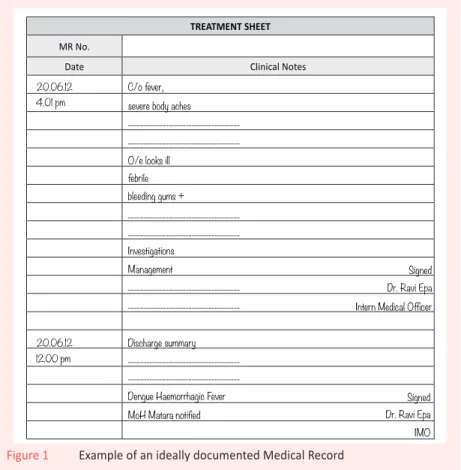
A 38-year-old married male named Mark Fernando is admitted to General Hospital, Matara, Sri Lanka, with a history of fever, severe body aches and bleeding gums. He is admitted to Ward 3 on 20 June 2012 at 3.54 in the afternoon. On examination by the admitting doctor (Dr S Silva, Medical Officer), a provisional diagnosis of dengue fever is made. Following several investigations in the ward, a final diagnosis of dengue haemorrhagic fever is made. The patient is seen by Intern Medical Officer Dr Ravi Epa and, later, by the consultant in charge of the ward. He recovers after a couple of days and is discharged on 26 June 2012 at 12 noon.
ADMISSION FORM
Hospital Ward Number
MR Number Date of Admission
Attending Physician Time of Admission Patient Name in Full
Patient Address Telephone Number
Age Sex Date of Discharge
Civil Condition Time of Discharge Next of Kin Name
and Address Next of Kin Telephone Number Final Diagnosis/
Main Condition ICD Code
Date Clinical Notes
GH Matara Dr S Walker
DENGUE HAEMORRHAGIC FEVER
C/o fever
Signed Dr. S. Silva, Medical Officer (Admission) Dengue fever
Notify relevant MoH severe body aches O/e looks ill febrile bleeding gums + 56463
38 yrs Male
1101, Kalidasa Rd Matara, Sri Lanka
Gayani Fernando 101, Kalidasa Rd Matara, Sri Lanka Mark Fernando 03 A91 20.06.2012 3.54 pm 0777 802 098 26.06.12 12.00 pm 0777 802 098 Married ... ... ...
In this scenario, the admitting doctor filled in all the relevant fields on the admission form (i.e. availability) very clearly (i.e. legibility) and recorded all relevant details in the required manner (i.e. adequacy). The admitting doctor suspected a case of dengue fever (provisional diagnosis) and prompted the ward medical officer to notify the relevant Medical Officer of Health (MOH). He then signed and wrote his name and designation on the admission form, making him accountable for his entries. The ward medical officer (an Intern Medical Officer on this occasion) agreed that it could be dengue fever (provisional diagnosis) and notified the relevant area MOH. Later, after further investigations, a final diagnosis of dengue haemorrhagic fever was made and the relevant MOH was again notified.
TREATMENT SHEET
MR No.
Date Clinical Notes
20.06.12
20.06.12 Discharge summary
C/o fever, severe body aches ...
...
... ...
... Dengue Haemorrhagic Fever MoH Matara notified
Signed Signed Dr. Ravi Epa Intern Medical Officer
Dr. Ravi Epa IMO ...
...
... O/e looks ill
febrile bleeding gums + Investigations Management 4.01 pm 12.00 pm
On discharge, the ward medical officer (again, the IMO on this occasion) recorded the discharge summary, including final diagnosis, legibly and adequately in block letters. Note that the final diagnosis was written without using abbreviations.
In this scenario, all doctors followed the WHO guidelines on correctly recording the final diagnosis, namely; ‘written in block letters, in a legible manner, with complete diagnostic statement, without using abbreviations’. The IMO wrote the discharge summary correctly before signing and writing his name and designation below the documented entries (i.e. accountability).
Scenario 2 – Surgical procedure
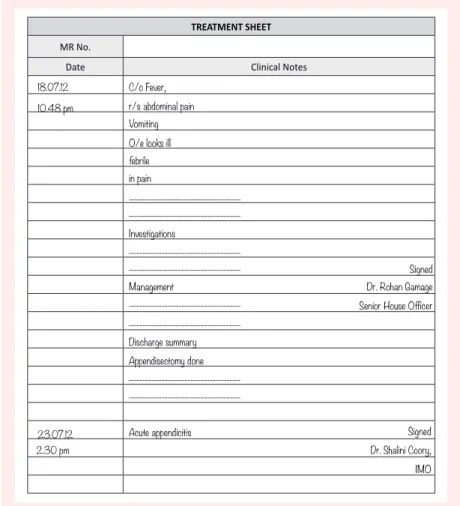
A 19-year-old unmarried female named Rani Gomes is admitted to National Hospital, Sri Lanka, with a history of fever, right-sided abdominal pain and vomiting. She is admitted to Ward 45 on 18 July 2012 at 10.32 in the morning. On examination by the admitting doctor (Dr G Perera, Medical Officer), a provisional diagnosis of ‘twisted ovarian cyst / acute appendicitis’ is made. She is seen by the Senior House Officer, Dr Rohan Gamage, and later by the consultant in charge of the ward. She undergoes surgery and an appendicectomy is performed on her. She is discharged on 23 July 2012 at 2.30 in the afternoon by Dr Shalini Coory, IMO.
ADMISSION FORM
Hospital Ward Number
MR Number Date of Admission
Attending Physician Time of Admission Patient Name in Full
Patient Address Telephone Number
Age Sex Date of Discharge
Civil Condition Time of Discharge Next of Kin Name
and Address Next of Kin Telephone Number Final Diagnosis/
Main Condition ICD Code
Date Clinical Notes
NHSL Dr. Peter Smith ACUTE APPENDICITIS C/o Fever Signed Dr. G Perera MO (Admission) ... r/s abdominal pain Vomiting 106420 19 yrs F
183, Galle Road, Mt Lavinia
Mark Gomes
183, Galle Road, Mt Lavinia Rani Gomes 45 K35.8 18/07/2012 10.32 am 071 498 075 23.07.12 2.30 PM 071 498 075 U/M
O/e looks ill febrile in pain
... ? R/Twisted Ovarian cyst ? Acute Appendicitis
In this scenario, the IMO correctly entered the final diagnosis as ‘ACUTE APPENDICITIS’ in block letters in a legible manner and without using abbreviations. More importantly, the IMO avoided a common error of entering a surgical procedure (appendicectomy in this case) as the final diagnosis.
TREATMENT SHEET
MR No.
Date Clinical Notes
18.07.12 10.48 pm 23.07.12 Discharge summary C/o Fever, r/s abdominal pain Vomiting ... ... ... ... ... Appendisectomy done
Acute appendicitis Signed
Signed Dr. Rohan Gamage Senior House Officer
Dr. Shalini Coory, IMO ...
... O/e looks ill
... febrile in pain Investigations Management 2.30 pm
Scenario 3 – Patient missing
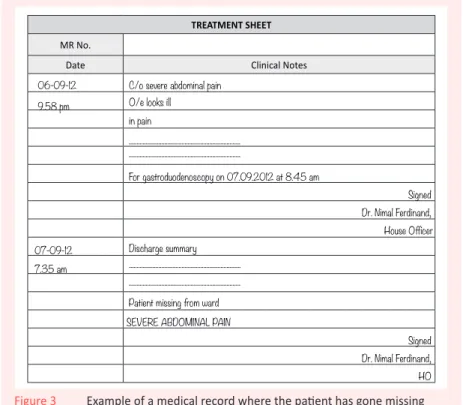
A 22-year-old unmarried male named Ranil Jasingha is admitted to Colombo South Teaching Hospital (CSTH) with a history of severe abdominal pain. He is admitted to Ward 15 on 6 September 2012 at 9.43 in the evening. On examination by the admitting doctor (Dr N Jayamuni, Medical Officer), a provisional diagnosis of gastritis is made. He is seen by the House Officer, Dr Nimal Ferdinand, at 10.03 PM. He is to undergo a gastroduodenoscopy the next morning but goes missing from the ward.
ADMISSION FORM
Hospital Ward Number
MR Number Date of Admission
Attending Physician Time of Admission Patient Name in Full
Patient Address Telephone Number
Age Sex Date of Discharge
Civil Condition Time of Discharge Next of Kin Name
and Address Next of Kin Telephone Number Final Diagnosis/
Main Condition ICD Code
Date Clinical Notes
CNTH Dr.B Vandort
SEVERE ABDOMINAL PAIN
C/o Severe abdominal pain
Signed Dr. N Jayamuni Medical Officer, (Admission) ? Gastritis
O/e looks ill 72934 22 yrs ♂ 34, Hudson Road Colombo 7 Gihan Jasingha 34, Hudson Road, Colombo 7 Ranil Jasingha 15 R10.0 06.09.12 9.43 PM 040 980 375 06-09-12 7.35 am 040 980 375 U/M in pain ...
TREATMENT SHEET
MR No.
Date Clinical Notes
06-09-12 9.58 pm
07-09-12 7.35 am
SEVERE ABDOMINAL PAIN C/o severe abdominal pain O/e looks ill in pain ... Discharge summary ... Signed Signed Dr. Nimal Ferdinand, House Officer Dr. Nimal Ferdinand, HO ...
Patient missing from ward ...
For gastroduodenoscopy on 07.09.2012 at 8.45 am
In this scenario, because the patient went missing from the ward, medical staff were unable to confirm the provisional diagnosis of gastritis. Without a diagnosis, the ward doctor, an Intern Medical Officer, could only enter the symptom presented (severe abdominal pain) as the diagnosis. He correctly wrote the final diagnosis as ‘SEVERE ABDOMINAL PAIN’ and not as ‘? Gastritis’ or ‘Patient Missing from Ward’.
When no diagnosis has been made by the time of discharge, you may record a symptom, sign, abnormal laboratory finding or problem as the final diagnosis.
This doctor has also avoided another error by not including any unrelated statements in the final diagnosis.
Scenario 4 – Patient leaves against medical advice
A 40-year-old married male named S. Jayasuriya is admitted to the
Teaching Hospital, Kandy, Sri Lanka, with a history of difficulty in breathing and coughing up blood since morning. He is admitted to Ward 2 on 7 May 2012 at 5.25 in the afternoon. On examination by the admitting doctor (Dr Paul Johan, Medical Officer), a provisional diagnosis of ‘pulmonary tuberculosis’ is made. He is seen by the Senior Medical Officer of the ward, Dr Mahela Jayasekera, and later by the consultant in charge of the ward. Following immediate management and basic investigations, a provisional diagnosis of ‘Malignant neoplasm of left lung’ is made and it is decided to perform a bronchoscopy and a bronchial biopsy to confirm the diagnosis. The bronchoscopy and the pathology report confirm the diagnosis as a malignant neoplasm of the lower lobe of the left lung. Later, the patient refuses to take further treatment and leaves, against medical advice, on 14 May 2012 at 10.30 am.
ADMISSION FORM
Hospital Ward Number
MR Number Date of Admission
Attending Physician Time of Admission Patient Name in Full
Patient Address Telephone Number
Age Sex Date of Discharge
Civil Condition Time of Discharge Next of Kin Name
and Address Next of Kin Telephone Number Final Diagnosis/
Main Condition ICD Code
Date Clinical Notes
TH Kandy Dr. S Wilkins
MALIGNANT NEOPLASM OF LOWER LOBE OF LEFT LUNG
C/o dificulty in breathing
Signed Dr. Paul Johan, MO, (Admission) ? Pulmonary tuberculosis
coughing out blood 53712
40 years M
234 Boundary Street Spring Hill, Kandy
Samantha Jayasuriya 234 Boundary Street Spring Hill, Kandy S. Jayasuriya 02 C34.3 7th May 2012 5.25 PM 040 346 902 14-05-12 10.30 am 040 346 902 M ... ...
TREATMENT SHEET
MR No.
Date Clinical Notes
07-05-12 5.58 pm
14-05-12 10.30 am
Malignant neoplasm of lower lobe of left lung C/o difficulty in breathing
coughing out blood ... Discharge summary ... Signed Signed Dr. Mahela Jayasekera, Senior House Officer
Dr. Mahela Jayasekera, SHO ...
Patient left against medical advice ... ... Malignant neoplasm of left lung
In this scenario, although the patient left against medical advice, the diagnosis was confirmed before he left. The SHO correctly wrote the final diagnosis as ‘MALIGNANT NEOPLASM OF LOWER LOBE OF LEFT LUNG’. Correctly, he did not record the diagnostic procedure (bronchoscopy) or an unrelated statement such as ‘LEFT AGAINST MEDICAL ADVICE’ as the final diagnosis.
Figure 4 Example of a medical record where the patient leaves, against medical advice
Scenario 5 – Final diagnosis differs from provisional
diagnosis
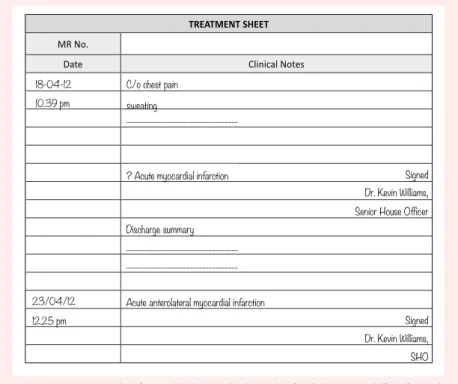
A 62-year-old married male named Jayantha Jayalath is admitted to Colombo North Teaching Hospital (CNTH) with a history of chest pain. He is admitted to Ward 12 on 18 April 2012 at 10.25 in the evening. On examination by the admitting doctor (Dr W. Thomas, Admitting Medical Officer), a provisional diagnosis of acute myocardial infarction is made. The patient is seen by the Senior House Officer of the ward, Dr Kevin Williams, at 10.39 the same night. The ECG and other investigations reveal an acute anterolateral myocardial infarction. The patient is given the necessary treatment. He recovers well and is discharged from the ward on 23 April at 12.25pm
ADMISSION FORM
Hospital Ward Number
MR Number Date of Admission
Attending Physician Time of Admission Patient Name in Full
Patient Address Telephone Number
Age Sex Date of Discharge
Civil Condition Time of Discharge Next of Kin Name
and Address Next of Kin Telephone Number Final Diagnosis/
Main Condition ICD Code
Date Clinical Notes
CNTH Dr. Michael Clarke
ACUTE ANTEROLATERAL MYOCARDIAL INFARCTION
C/o Chest pain
Signed Dr. W Thomas Medical Officer, (Admission) ? Acute myocardial infarction
Sweating 43752
42 years M
16, Anne Street, Nawala, Sri Lanka
16 Ann Street, Nawala Sri Lanka Jayantha Jayalath 12 121.0 18th April 2012 10.25 PM 0073 467 900 23/04/12 12.25 pm 0073 467 900 M ... ...
TREATMENT SHEET
MR No.
Date Clinical Notes
18-04-12 10.39 pm
23/04/12 12.25 pm
C/o chest pain sweating ... Discharge summary ... Signed Signed Dr. Kevin Williams, Senior House Officer
Dr. Kevin Williams, SHO ...
Acute anterolateral myocardial infarction
...
? Acute myocardial infarction
In this scenario, the ward doctor entered the correct final diagnosis in full as ‘ACUTE ANTEROLATERAL MYOCARDIAL INFARCTION’, avoiding the error of entering an incomplete diagnostic statement (in this case, acute myocardial infarction or myocardial infarction) as the final diagnosis.
Figure 5 Example of a medical record where the final diagnosis differs from the provisional diagnosis
References
Huffman, Edna K 1994, Health information management, 10th edn, Physicians’ Record Company, Berwyn, Illinois.
Lowe, N 2009, ‘Medical record keeping and documentation standards’, in Managed Health Services provider manual, Managed Health Services, Milwaukee, Wisconsin.
Royal College of Physicians 2009, Improving clinical records and clinical coding together, Audit Commission, 1st Floor, Millbank Tower, Millbank, London.
WHO—see World Health Organization.
World Health Organization 2006, ‘Components of a medical record’, in Medical records manual: A guide for developing countries, World Health Organization, Geneva.
—2004, International statistical classification of diseases and related health problems, 10th revision, vol 2, 2nd edn, World Health Organization, Geneva.
—2003, Improving data quality: A guide for developing countries, World Health Organization, Regional Office for the Western Pacific, Manila
The Knowledge Hubs for Health are a strategic partnership initiative funded by the Australian Agency for International Development