Persistent link:
http://hdl.handle.net/2345/bc-ir:104188
This work is posted on
eScholarship@BC
,
Boston College University Libraries.
Boston College Electronic Thesis or Dissertation, 2015
Copyright is held by the author, with all rights reserved, unless otherwise noted.
ISIS: Past, Present and Future?:
Pro-ISIS Media and State Formation
Boston College
ISIS: PAST, PRESENT AND FUTURE?
Pro-ISIS Media and State Formation
A Senior Honors Thesis
Submitted to
The College of Arts and Sciences
Islamic Civilization & Societies Program
By
Dana Hadra
“ISIS: Past, Present and Future?” Dana Hadra
Thesis Advisor: Professor David DiPasquale
This paper examines the role that media plays in the state building strategy of the Islamic State of Iraq and al-Sham (ISIS). It analyzes the ways in which ISIS spreads its message and determines the significance of that message as it relates to state formation. Research findings suggest that ISIS is a sophisticated organization driven by powerful religious and political ideas. This paper is thus a means of uncovering ISIS's own arguments and state building aspirations. Examination and analysis of ISIS publications, public statements, and social media posts (such as those found on Twitter, Youtube, and web forums) constitute the main methods of research for this report.
Analysis of social media indicates that ISIS uses conventional social media platforms (such as Twitter and Youtube) as a primary means of media dissemination, making the distribution of its media decentralized. ISIS appears to be sacrificing strict control over the delivery of its message in exchange for widespread circulation and distribution. Pro-ISIS social media accounts are arranged into hierarchical virtual networks that allow users to communicate and coordinate posts. ISIS's media campaign is thus well organized and relatively controlled.
The content found in ISIS propaganda is particularly significant in understanding ISIS's current success and long-term goals. Media allows ISIS to demonstrate to its
sympathizers that it not only has a post-war vision, but also a means of making that vision a reality. ISIS portrays itself as possessing many of the necessary features of modern statehood, including governance and legal structures, a viable economy, and the ability to provide basic and complex public services. ISIS also invests heavily in religious rhetoric, adding another layer to the group's appeal and overall legitimacy. Pro-ISIS media indicates that ISIS is not driven primarily by grand sectarian war or anti-western sentiment, but by a desire to restore the Islamic Caliphate. Global media, by helping ISIS to bolster its own political and religious legitimacy, contributes heavily to the
Table of Contents
List of Figures iii
List of Acronyms iv
Acknowledgements v
Chapter 1. Introduction 1
Content and Organization 4
Methodology 8
Conclusion 11
Chapter 2. Literature Review 12
State Formation 12
Conquest Theory 16
Voluntary Theory 20
Warfare Theory 25
Culture Theory 31 Global Media and the State 35 Conclusion 41 Chapter 3. The Evolution and Emergence of ISIS 43
1999-2006: Abu Musab al-Zarqawi 43 2006-2010: Abu Omar al-Baghdadi 45 2010-2013: Abu Bakr al-Baghdadi 48
2013-2014: The Establishment of ISIS 54
Chapter 4. The Islamic Caliphate: An Appeal to History 60
The Caliphate and its Caliphs 61
Contemporary Debates and Perceptions 69
Chapter 5. From Forums to Twitter 74
Chapter 6. Obtaining Religious Legitimacy: Theological Themes in Dabiq 89
Chapter 7. The Use of Violence 107
“Lend Me Your Ears” 111 Public Services 115 Security Services 121 Education 124 ISIS Women 129 Legal Structures 132 ISIS Economy 136 Chapter 9. Conclusion 141
Methods of Media Dissemination 142
Religious Appeals 143
Worldly Governance 147
Implications and Policy Recommendations 149
Appendix I: Map of Iraq and Syria 155
Appendix II: Map of ISIS Presence in Syria 156
Appendix III: ISIS Sanctuary Zones in Iraq and Syria 157
List of Figures
1. Screenshot of Baghdadi delivering a sermon in Mosul, Iraq 2
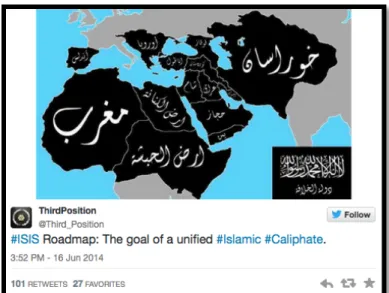
2. Twitter pose showing ISIS “roadmap” 67
3. Twitter post by user “Abu Dajana” on November 25, 2014 80 4. Sample network graph showing interactions between pro-ISIS Twitter users 82 5. Twitter post containing a link to an ISIS radio segment 86 6. Photographs of pages contained in the first issue of Dabiq 91
7. Cover of the fourth issue of Dabiq 93
8. Cover of the second issue of Dabiq 97
9. Cover of the third issue of Dabiq 101
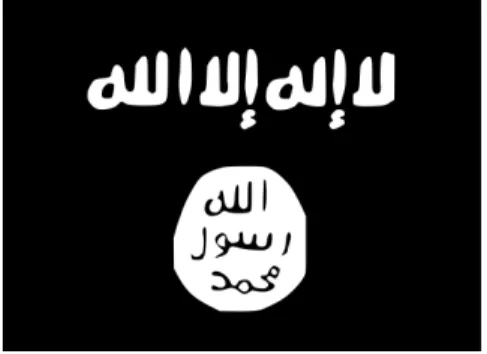
10. The ISIS flag 105
11. John Cantlie hosting an episode of “Lend Me Your Ears” 114 12. Page from the fourth issue of Dabiq describing ISIS services 116 13. Video clip showing ISIS employees digging for sewage pipes 118 14. Twitter post showing ISIS militants setting fire to American-produced chicken 122
15. Photograph of one part of the ISIS curriculum 126
16. Photograph of an ISIS fighter distributing da’wah advertisements 129 17. Image contained in the fifth issue of Dabiq depicting ISIS currency 139
List of Acronyms
AAS Ansar al-Sharia AQ Al-Qaeda AQI Al-Qaeda in Iraq JN Jabhat al-Nusra JTWJJama'at al-Tawhid wa al-Jihad ISI
The Islamic State of Iraq ISIS
Acknowledgments
I would like to acknowledge a number of people who supported me throughout the course of this research project. First, I owe my deepest thanks to Professor DiPasquale, my thesis advisor, and Professor Bailey, my seminar instructor, for guiding me through many months of research. You have been incredible mentors and have pushed me to grow intellectually. I cannot thank you enough. I would also like to thank Tim McCranor and Professor DeLong-Bas for sharing their valuable expertise and cherished advice. Finally, I want to thank my grandfather for taking such an interest in my research and for sharing his comments on early drafts of this paper. Your input was invaluable.
Thank you to everyone who gave me the confidence and motivation to tackle such difficult subject material. This research project was challenging at times, but the support and encouragement I received from the Boston College community kept me going. I am extremely grateful.
Thank you, Dana Hadra
1. Introduction
He was born in 1971 in Samarra, Iraq, to a conservative Sunni family of Islamic preachers and classical Arabic teachers. He is highly educated, having received a PhD in Islamic studies from the University of Baghdad, and has been described as shy and deeply religious. Much of his past remains a mystery, but in less than a year, he has managed to become the world’s most powerful Islamist leader. This is Abu Bakr al-Baghdadi, the self-proclaimed caliph of the Islamic State of Iraq and al-Sham (ISIS), otherwise known simply as the Islamic State.1
Not much is known about Baghdadi, earning him the title, “the invisible sheikh.”2 Only a few authenticated photographs exist of him, and, according to media sources, even his own followers do not interact with him directly.3 Baghdadi thus captured the world’s attention when, on July 4, 2014, he arrived at the Grand Mosque in Mosul, Iraq to deliver his first public sermon as leader of the newly restored Islamic Caliphate. Within hours, Baghdadi’s sermon was posted on the Internet, and images of Baghdadi slowly climbing the stairs of the pulpit dressed in a black robe and turban circulated global media.
1 Abu Bakr al-Baghdadi, the leader of the Islamic State of Iraq and al-Sham, announced the formation of a
unified Islamic Caliphate on June 29, 2014, thereby changing the group’s name from “the Islamic State of Iraq and al-Sham” to simply “the Islamic State.” For the purpose of this paper, I will continue to use the acronym “ISIS.”
2 Benjamin Russel, "Who is Abu Bakr Al-Baghdadi? The 'invisible sheikh' waging brutal war in Iraq,"
Express, June 12, 2014, accessed October 9, 2014, http://www.express.co.uk/news/world/481968/Who-is-Abu-Bakr-Al-Baghdadi-The-invisible-sheikh-waging-brutal-war-in-Iraq.
Baghdadi spoke calmly in classical Arabic before several dozen men and boys, who stood beneath the black ISIS flag draped on the wall next to them. In his sermon, Baghdadi defended his intention to establish an Islamic State, explaining, “this is a duty upon the Muslims-a duty that has been lost for centuries…the Muslims sin by losing it, and they must always seek to establish it, and they have done so, and all praise is due to Allah.”4 In only a few short months, ISIS has become the most powerful and sophisticated insurgent organization in the world.
Figure 1. Screenshot of Baghdadi delivering a sermon at the Grand Mosque in Mosul, Iraq on July 4, 2014.5
Since June of 2014, ISIS has seized control of large swaths of territory between Raqqa, ISIS’s “capital” in northern Syria, Mosul in northern Iraq, and Fallujah, west of
4 Thomas Joscelyn, "Analysis: Islamic State's 'caliph' leader prayers in Mosul," The Long War Journal, July
5, 2014, accessed September 10, 2014,
http://www.longwarjournal.org/archives/2014/07/analysis_islamic_sta.php.
5 “English subtitles of full sermon posted by ISIS’s Abu Bakr Al Baghdadi, Caliph of the ‘Islamic State,’”
Youtube video, posted by “D Brett,” July 12, 2014, accessed August 8, 2014,
Baghdad. While estimates vary, most sources report that ISIS controls nearly a third of both Syria and Iraq.6 Relentless violence and human rights atrocities have come to characterize ISIS’s method of operation. However, while the world maintains a state of horror, buttressed by images of beheadings and stonings, ISIS has managed to establish governance structures, schools, health centers, and a viable economy. One of ISIS’s media centers, al-Hayat, has launched a global propaganda campaign so alluring that thousands of fighters from all over the world have flocked to Syria and Iraq in defense of a romantic vision of the Islamic Caliphate. ISIS’s intellectual might and ability to posture itself as a legitimate state is what will make ISIS successful in the long run.
The immediate military threat that ISIS poses is only the surface of the challenge. ISIS is not merely a group of terrorists; it is an organization driven by ideas and by what many of its members believe to be the command of God. Combating a group like ISIS, therefore, requires intellectual diplomacy. The goal of this paper is not merely to react to ISIS’s actions, but also to analyze ISIS’s own arguments and state building aspirations. Careful analysis of ISIS’s media campaign serves as the means through which I will accomplish this goal. I will both examine how ISIS spreads its message and analyze the significance of that message as it relates to state formation. This will allow me to gain a deeper understanding of ISIS’s post-war aims. In this way, I will add a new perspective to the current debate about the nature of the group, examining how, on the one hand, ISIS is a new kind of security threat, different from what we in the West have encountered in the past, and on the other hand, represents a body of beliefs as old as the seventh century.
This paper is not intended to bolster sympathy for ISIS or justify the group’s actions. Rather, it is a means of taking ISIS seriously, not just militarily, but
intellectually. I plan to take ISIS under the microscope and examine the group from new and perhaps controversial angles in order to truly understand the driving forces behind ISIS. Through its media campaign, ISIS claims a degree of political and religious legitimacy to which other insurgent groups can hardly compare. It is thus vital that we understand how ISIS uses media as a weapon of statecraft.
CONTENT AND ORGANIZATION
What role do media play in ISIS’s state building strategy? What do pro-ISIS media tell us about ISIS’s long-term goals? These central questions will guide my research and lead me to develop a more comprehensive understanding of the nature of ISIS. This paper will address Iraqi and Syrian politics only as they relate to the
emergence of ISIS. This paper will also not discuss in detail ISIS’s military strategy or foreign policies concerning ISIS, but will focus instead on characterizing ISIS’s political and ideological visions. First, I will provide an overview of the literature concerning state formation. In order to understand how and why ISIS functions, it is important to gain familiarity with some of the existing theories on the origins and development of early and modern states. This literature review will cover five theories concerning state formation: conquest theory, voluntary theory, war theory, and media theory.
The next section of this paper will examine the evolution and emergence of ISIS by describing the historical and political environment in which ISIS developed. These
chapters will focus primarily on the emergence of ISIS within the contexts of the Syrian Civil War and political instability in Iraq. I will begin by describing the activities of al-Qaeda in Iraq (AQI) in 2004 under the leadership of Abu Masab al-Zarqawi. I will then trace the evolution of AQI to the emergence of the Islamic State of Iraq, which would later become, under the leadership of Abu Bakr al-Baghdadi, the Islamic State of Iraq and al-Sham. I will also discuss the emergence of al-Qaeda in Syria and the point at which ISIS broke away from al-Qaeda and became an independent organization. Until February of 2014, ISIS existed under the banner of al-Qaeda, which first began operating in Syria in 2012 under the name Jabhat al-Nusra (JN). The split between JN and ISIS in 2014, however, marked the beginning of a violent rivalry between the two groups. I will thus analyze how and why the split occurred so that I might begin to characterize ISIS better and understand what makes ISIS distinct.
In the next section of this paper, I will attempt to characterize the philosophy behind ISIS and the Islamic Caliphate more generally. How, for example, does Baghdadi justify the Caliphate and what is the historical and theological significance of the Islamic Caliphate? Answering this question will require an examination of the first Islamic Caliphate. I will also provide an overview of the contemporary debates regarding the restoration of the Caliphate.The first Islamic Caliphate was established in 632 AD and rose and fell until its final demise in 1924. The leader of a caliphate, the caliph, was and still is meant to be the shadow of the Prophet Muhammad, capable of implementing the same system of governance that existed during the Prophet's time. Baghdadi's 2014 declaration of the Islamic Caliphate thus represents a desire to emulate a system that
ruled the Muslim world nearly 15 centuries ago. In order to understand Baghdadi's role as Caliph, I will trace this role back to Abu Bakr, who was given the first title of caliph following the death of the Prophet Muhammad. Abu Bakr was one of four caliphs known as the "Rashidun," or "Rightly Guided Caliphs." The Rightly Guided Caliphs are known to have shared a close, personal relationship with the Prophet Muhammad, and are therefore looked upon as models of perfect and righteous Islamic state leadership.
What then, according to the example of the Rashidun, does it mean to be caliph? While Baghdadi was the first to officially declare the establishment of the Caliphate since 1924, many radical Islamist leaders have informally declared themselves caliphs. Al-Qaeda, for example, has publicly advocated the re-establishment of the Caliphate in rhetoric throughout its history. Despite such rhetoric, the idea of the Caliphate has not driven the group's agenda. ISIS is therefore unique in its ability and desire to turn its vision of a re-established Islamic Caliphate into a political reality. This section will thus end with a brief overview of some of the contemporary debates regarding the restoration of the Caliphate.
Following an in-depth examination of the Caliphate, I will analyze ISIS’s media strategy. I begin by looking at how ISIS disseminates its media. ISIS is known for its adept use of social media platforms and modern technology as a means of
communicating with its sympathizers abroad. Platforms such as Twitter and Youtube have proven powerful instruments of ISIS statecraft and play an incredibly significant role in ISIS’s larger political strategy. This chapter provides a glimpse at the inner workings of ISIS’s media strategy and analyzes ISIS’s overall approach to the Internet.
The next chapter will examine some of the theological themes present in ISIS’s official publications. Recognizing these themes is a necessary step towards understanding ISIS’s claim to religious authority. Religious authority, in turn, bolsters ISIS’s image as a legitimate caliphate. This section thus looks at how ISIS’s theological vision, as
presented in its media campaign, factors into ISIS’s overall method of state building. I also provide a brief chapter on how public displays of violence fit into ISIS’s overall strategy. ISIS is perhaps more widely known for its merciless brutality. While ISIS’s use of violence is not the main focus of this paper, I nevertheless demonstrate that all of ISIS’s decisions, even those that require the use of violence, are highly calculated and motivated by ISIS’s long-term goals.
In the next chapter, I will analyze how ISIS presents itself as a functioning state through its media campaign. How does ISIS claim to be governing the territories under its control? I will analyze ISIS’s use of aesthetics, symbols, and rhetoric to determine what ISIS is hoping to project or accomplish. This chapter is organized according to the various state-like functions and features ISIS claims to possess. Through ISIS self-reporting, I examine ISIS’s ability to provide public services and security forces, establish educational institutions, promote the role of women, build complex legal structures, and provide economic stability. The aim of this chapter is to assess the degree to which these various functions contribute to ISIS’s overall legitimacy.
METHODOLOGY Secondary Research
Secondary desk research, stemming from both print and online sources, will contribute heavily to the research methodology of this paper. A number of book titles by distinguished authors will provide useful background information concerning the nature of the original Islamic state and the intended role of the Caliph, for example. I will also use a number of publications and journals that cover relevant topics, many of which I found through various databases, scholarly magazines, and prominent think tanks.
Primary and Original Research
The bulk of my research on ISIS itself will stem from original and primary sources. Given that the emergence of ISIS in international politics is so recent, most of my information concerning ISIS developments will stem not from books, but from print, online, and audio media.
- English and Arabic Newspaper Articles
Like social media, English and Arabic newspaper articles will be vital to tracking developments concerning ISIS. Arabic newspapers in particular will allow me to analyze how Arab countries perceive these developments.
- Social Media
One of the best ways to track rebel movements and statements made by Islamist leaders is through social media. Rebel and Islamist groups in Syria, particularly ISIS, are notorious for communicating with each other, and the broader jihadist community, through social media sites such as Facebook, Twitter, Youtube, blogs, and jihadi web forums. Through jihadi blogs and web forums in particular I will have access to some of the conversations currently taking place within the jihadi community regarding ISIS. Activists working on the ground in Syria and Iraq also report through social media. Thus, in order to closely track current events, I will follow various Facebook and Twitter accounts, bearing in mind that social media sites are often used as a political tool or a way of disseminating propaganda. Much of the social media coming out of Syria and Iraq is biased, but this in itself can offer insight on the mindset of these Islamist groups and their members. Due to the potential dangers associated with visiting jihadi web forums and pro-ISIS social media accounts, I will use a proxy server provided by Top Browser, which acts as an intermediary between my personal computer and the Internet. This, in turn, will allow me to browse the Internet with a relative degree of anonymity.
- ISIS Publications and Propaganda
ISIS has become well known for its outstanding media campaign, coordinated and disseminated through ISIS's many formal media centers. Through its media centers, ISIS has been able to publish and disperse a number of publications that document ISIS achievements and advertise its broad military and political strategy. I will carefully examine these publications, including Dabiq, ISIS's English-language magazine, and the
frequently published "Islamic State Report," as a means of analyzing ISIS's political and religious vision. ISIS has also circulated a number of self-made videos, flyers, and short publications that advertise the Islamic Caliphate to the Muslim community elsewhere in the world, including in the West. ISIS has become well known for its propaganda, which has drawn hundreds of foreign fighters from all over the world into Syria to fight
alongside ISIS. Careful analysis of the aesthetics and rhetoric used in ISIS media will be crucial to my research.
- Public Statements
I will keep a consistent record of public statements and speeches made by ISIS leaders and members, paying close attention to the rhetoric used and how such rhetoric relates to the group's objectives and ideology. Abu Bakr al-Baghdadi's public sermon delivered in Mosul on July 4, 2014 is among the many audio and print statements I will carefully analyze. Such statements are frequently circulated on the Internet, either formally through ISIS media centers, or informally through social media sites.
Websites: Monitoring and Analysis
A number of online blogs and websites dedicated to monitoring Islamist activity will prove vital to my research. I will conduct a lot of my research with the help of sites such as SITE Intelligence Group (specifically the group's "INSITE Blog on Terrorism" and "SITE Monitoring Service: Jihadist Threat"), TRAC, Jihadica, and Jihadology. These monitoring services track, compile, analyze, and occasionally translate information
coming from jihadist websites and blogs, videos, and social media. They will prove crucial in my endeavor to closely track pro-ISIS media.
CONCLUSION
While we have seen calls for the restoration of the Islamic Caliphate throughout the twentieth century, an Islamist group has not threatened modern nation-state borders in the way that ISIS has. Unlike other militant Islamist organizations, ISIS expects to
establish a sustainable, fully functioning state. This paper will serve as a means of moving beyond daily media coverage pertaining to ISIS, which appears focused on ISIS’s use of extreme violence and brutality. I plan to look beyond the headlines and beneath the surface of ISIS, where one will likely find a smart and sophisticated organization driven by historically and religiously inspired ideas. Only by confronting these ideas head on and examining how these ideas manifest themselves in the form of a state can we truly begin to understand and combat groups like ISIS.
2. Literature Review
STATE FORMATION
Since the Second World War, the number of states in the world has quadrupled, making the nature and origin of the state a subject of increasing interest in political science, sociology, and anthropology.1 Over time, scholars have developed a wide range
of theories explaining the formation of the state. Such theories have developed
significance in the way that they impact the legitimacy of existing states and the basis on which existing governments claim authority.2 The variation in state formation theories stems from disagreement over what it is that constitutes a state in the first place, whether it is a system of formal institutions, a mechanism of dominance and authority, or merely an association of peoples. At the most basic level, and for the purposes of this paper, the state can be defined as having the following components: a permanent population, a defined territory, and a centralized government.3 Given this definition, we can begin to examine various theories concerning the formation of the state, that is, the development of state structures in an area where no effective state previously existed.
Generally speaking, state formation theories can be divided into two areas of study: early state formation and modern state formation. Early state formation concerns
1 Christian Krohn-Hansen and Nunstad G. Knut, "Introduction," in State Formation: Anthropological
Perspectives (London: Pluto Press, 2005), 3.
2 Martin Sicker, The Genesis of the State (New York: Praeger, 1991), 19.
3 H. J. M. Clasessen and Peter Skalnik, "The Early State: Theories and Hypotheses," in The Early State
the study of primitive forms of social organization. According to Fukuyama, most human civilizations began as tribal societies defined in terms of kinship.4 The evolution of primitive tribal societies into organized polities is the subject of early state formation. Theories concerning early state formation typically stem from the anthropological study of Africa, Mesopotamia, South and East Asia, and Peru.5 Prominent scholars such as Oppenheimer, Carneiro, and Wittfogel are vital to the development of early state formation theories.
Theories on modern state formation begin with the study of medieval Europe and continue through the periods of colonization and decolonization. Modern statehood is often associated with the Westphalian model of sovereignty, which requires that a state has sovereign authority over a given territory and is not controlled by any external actors.6 Fukuyama asserts that changes in ideology also marked the shift from early statehood to modern statehood. He explains:
The passage from band- and tribal-level societies to state-level ones represented, in some sense, a huge setback for human freedom. States were wealthier and more powerful than their kin-based predecessors, but that wealth and power led to a huge amount of stratification that left some masters and many others slaves.7
4 Francis Fukuyama, The Origins of Political Order (London: Profile Books, 2011), 53.
5 Ronald Cohen, "State Origins: A Reappraisal," in H. J. M. Claessen and Peter Skalnik, The Early State
(The Hague: Mouton, 1978), 39.
6 Stephen D. Krasner, "Rulers and Ruled: Minority Rights," in Sovereignty: Organized Hypocrisy
(Princeton, N.J.: Princeton University Press, 1999), 73.
The rise of modernism, however, meant the rise of "equality and recognition" at the level of the state.8 Theorists such as Tilly, Weber, and Tyler contribute heavily to the
scholarship on modern state formation.
Most theories concerning the origins of the state, early and modern, revolve around human agency in state formation. During the Hellenistic period, however, the state was widely considered a divine, rather than human, creation. As Sicker explains, ancient Greek thinkers viewed the state and its institutions as an extension of human nature, and therefore a concern of the gods. The Greeks' conception of the nature of the state "led them to consider the state more as an end in itself than as a means for furthering human purposes. As a consequence, the state took on a significance that dwarfed that of its citizens who, for the most part, submitted docilely to its virtually unlimited
authority."9 The theocratic conception of the state is thus associated with some of the earliest societies in which political authority was derived from God(s) alone. Political power was legitimized by the common belief that certain individuals were agents of the divine. In his analysis of early state formation, Service discusses the divine origin of the state as proposed by Greek and Roman philosophers such as Plato, Aristotle, the Stoics, and the Epicureans. Service explains:
During the Revival of Learning in Europe from the thirteenth to fifteenth century, Aristotle's idea of natural law to be fulfilled in terms of an ideal universal state, or cosmopolis, was united with Stoic philosophical thought to become finally theistic, particularly on the basis of "natural" (i.e. God-given) desirability of the state.10
8 Ibid.
9 Sicker, The Genesis of the State, 20.
Modern sociologists and political scientists, however, view the divine theory of state formation as deeply flawed and largely irrelevant in explaining most instances of state formation. Service, for example, discounts the divine theory as "antirevolutionary, antideterministic, and antiscientific."11 Sicker notes:
By stipulating that all power derives from God, the theory allows anyone who aspires to political power to assert that his inclinations are also of divine origin and of equal standing with that of the established political authorities, entitling him to the same legitimacy irrespective of prevailing law or custom in a particular political society.12
This idea stems from Ibn Khaldun, who argues, "human society can exist without such a Divine Law, merely in virtue of the authority which compels the others to follow and obey him."13 Most agree, then, that divine agency alone is not sufficient to explain how and why states formed throughout history. This following literature review explains more widely credited theories, some of which relate, directly and indirectly, to the divine theory of state formation. The theories discussed concern both early state formation (including conquest theory and voluntary theory) and modern state formation (including warfare theory, culture theory, and media theory.)
11 Ibid. 12 Sicker, 41.
13 Charles Philip Issawi, An Arab Philosophy of History (Princeton, NJ, USA: Darwin Press, 1987), 101,
CONQUEST THEORY
Scholars have taken a number of approaches to explaining the conquest theory, sometimes referred to as the “force theory,” but some of the earliest theories take a socioeconomic approach. At the most basic level, the conquest or force theory of state formation holds that states form as a result of the dominance of one particular group over another. While the conquest theory has its roots in the work of Ibn Khaldun, Ludwig Gumplowicz is widely considered to be one of the first sociologists to develop the
conquest theory using anthropological evidence. According to Gumplowicz, the origin of the state rests in the social stratification of society. Gumplowicz observed that early societies were divided into two broad social classes, namely, the conquerors and the conquered masses. The conquering class was motivated primarily by material gains achieved by exploiting the subjugated class. So as to maintain its dominance, the ruling class built institutions around this divided society, forming what we now know to be the state.
Following closely in Gumplowicz’s footsteps was Franz Oppenheimer, one of the leading sociologists of the modern era to explain and analyze state formation according to the conquest theory. Oppenheimer argues that all primitive states arose following the use of force. According to Oppenheimer:
The State…is a social institution, forced by a victorious group of men on a defeated group, with the sole purpose of regulating the dominion of the victorious group over the vanquished, and securing itself against the revolt from within and attack from abroad.14
Thomas Holland similarly characterizes the state in terms of force and domination, defining the state as:
A numerous assemblage of human beings generally occupying a certain territory amongst whom the will of the majority, or of an ascertainable class of persons is, by the strength of such a majority or class, made to prevail against any of their number who oppose it."15
Thus, the purpose of the state according to these scholars is to secure the dominance of the ruling class over the subjugated masses. The state was, in its origin, an instrument of oppression.
In The Origin of the Family, Private Property, and the State, Frederick Engels similarly views conquest as the primary method of state formation, but examines why and under what circumstances conquest happens in the first place. Engels' thesis rests on the idea that force is a consequence of economic development and stratification. Engels' argument begins with primitive societies. As economies began to develop, Engels argues, people established new modes of production and traditional social structures began to change. Distinct social classes and sects formed, distinguished primarily by the
possession of land and modes of production. By establishing control over the economy, the possessing class is then able to rule over the non-possessing class, and, as Krader notes, "the means by which this control is achieved is political force, including physical power. The highest (that is, most centralized), tightest, and most monopolistic control of
15 Thomas Erskine Holland, The Elements of Jurisprudence (6th ed. Oxford: Clarendon Press, 1893), 40,
the political power resides in the state, which is the organ of the ruling class."16 Like Gumplowicz, Oppenheimer, and Holland, Engels views the state as a mechanism for preserving a certain social order. In his review of Engels' thesis, Sicker assesses that "the primary purpose of the state…is to consolidate the existing class divisions of the society and thereby to ensure the security of the property of the dominant class."17 Engels’ emphasizes internal socioeconomic division as the precursor to state formation by force. This implies that the state arose out of force or conquest from within society rather than from some external force.
In his analysis of Chinese dynasties, Fukuyama asserts that economic or material interests alone cannot explain the use of force in state formation. He argues that
throughout human history, the use of force "has often been perpetuated by people seeking not material wealth but recognition." Recognition, Fukuyama states, is "the
acknowledgement of another human being's dignity or worth, or what is otherwise understood as status." Fukuyama goes on to explain that recognition is not just sought after by conquerors, but also by what he calls "humble peasant rebels," such as Arab tribes which were able to "settle their differences and conquer much of North Africa and the Middle East because they sought recognition for their religion, Islam, much as European warriors conquered the New World under the banner of Christianity."18 According to Fukuyama, then, the formation of the state by force stems not just from economic interests, but from ideological interests as well. Following from a similar
16 Lawrence Krader, Formation of the State (Englewood Cliffs, N.J.: Prentice-Hall, 1968), 44-45. 17 Sicker, Origins of the State and Civilization, 72.
argument, Benedetto Croce broadens the definition of conquest to include not just physical force or military might, but also the power of persuasion and the exertion of intellectual pressure. In his assessment of Croce’s thesis, Sicker explains, "Whoever possess the power to persuade must be considered as a force in society."19
William Lilly argues that successful state formation requires a combination of physical force and a widely accepted ideology. In First Principles in Politics, Lilly argues, "Every polity, however rude, requires the ideas of right, and of law for the
maintenance of right. Might, without these ideas, would not give rise to a commonwealth, but to a gang of robbers; to anarchy plus the sword."20 In other words, while conquest may be a contributing factor to state formation, force alone is not sufficient to
establishing a sustainable state. Force and might must be backed by ideas concerning right and wrong, and a system capable of implementing those ideas.
Carneiro argues that the force theory of state formation only applies under certain conditions, noting that many instances of warfare throughout history did not lead to the creation of a state.21 Carneiro presents what he calls “environmental” and “social circumscription” theories. Both theories of circumscription describe the isolation of a society. Environmental circumscription refers to a situation in which a population is geographically isolated within a confined area, surrounded by natural boundaries such as mountains, bodies of water, or deserts.
19 Sicker, Origins of the State and Civilization, 75.
20 Samuel William Lilly, Lilly, First Principles in Politics (New York: G.P. Putnam's Sons, 1899), 19. 21 R. L. Carneiro, "A Theory of the Origin of the State," Science 169, no. 3947 (1970): 734, accessed
Social circumscription describes a society isolated not because of natural boundaries, but because of human barriers. Carneiro explains that a society might find itself surrounded by rival or warring populations or tribes, preventing the isolated society from growing geographically. Following population growth, however, the isolated society likely faces extreme pressure to expand, forcing the society into conflict with surrounding tribes. Conquest thus becomes inevitable, according to Carneiro, and the conquered, if they seek survival, are forced to submit to the rule of their conquerors. Under conditions of social circumscription, Carneiro argues, the conquest theory of state formation may apply.
VOLUNTARY THEORY
Most voluntary theories of state formation extend from the social contract model first proposed by Enlightenment philosophers such as Jean-Jacques Rousseau, Thomas Hobbes, and Immanuel Kant. The social contract model of political legitimacy suggests that individuals have willingly given up their autonomy to some higher authority in exchange for protection. Carneiro’s explanation of the voluntary theory closely reflects the social contract model. Carneiro defines all voluntary theories as being similar in that "they demonstrated inability of autonomous political units to relinquish their sovereignty in the absence of overriding external constraints."22 Carneiro thus suggests that given certain external constraints, “autonomous political units” willingly and voluntarily give up their sovereignty to the authority of the state. According to Carneiro, the voluntary
theory of state formation holds that "at some point in their history, certain peoples spontaneously, rationally, and voluntarily gave up their individual sovereignties and united with other communities to form a larger political unit deserving to be called a state."23
Though Carneiro supports the conquest theory of state formation under conditions of social circumscription, other conditions, specifically conditions of environmental circumscription, better support the voluntary theory of state formation. In “A Theory of the Origin of the State,” Carneiro begins by describing one theory of voluntary state formation, or what he calls the “automatic theory,” first introduced by British archeologist V. Gordon Childe. According to the automatic theory, as agriculture
developed in primitive societies and food was produced in surplus, people no longer had to produce their own food. People came to specialize in other forms of production, and the division of labor was established. Due to the division of labor, society became more economically and politically integrated, demanding certain institutions and organizational structures. Such structures are what we now know to be the state.
Carneiro argues, however, that the automatic theory alone is not sufficient in describing the formation of the state, noting that states have, throughout history, formed even in cases where agriculture did not create a food surplus. Carneiro thus introduces the voluntary theory of state formation under conditions of environmental circumscription. As previously explained, environmental circumscription occurs when a society becomes geographically isolated by natural boundaries. As population increases, resources become
constrained. Eventually, people begin searching for a means of cooperation and
organized distribution of limited resources. The desperate need for resources, Carneiro suggests, leads people to voluntarily submit to some organized structure or means of cooperation, which we might consider the beginnings of early statehood.24
One of the most notable theories concerning early state formation is the
“hydraulic hypothesis,” developed largely by Karl Wittfogel. Wittfogel, like Carneiro, asserts that early populations voluntarily submitted to the authority of the state in exchange for the preservation and distribution of a particular resource. In Oriental Despotism, Wittfogel begins by examining ancient civilizations. He observes that most ancient civilizations relied heavily on irrigation and large-scale water supplies, and that the effective management of irrigation required an organized system of cooperation. This is where the state began to take shape. According to Wittfogel, state formation occurs when:
A number of farmers eager to conquer arid lowlands and plains are forced to invoke the organizational devices which- on the basis of premachine technology- offer the one chance of success: they must work in
cooperation with their fellows and subordinate themselves to a directing authority.25
Wittfogel thus asserts that the state formed around society’s stock of water, a resource of common interest. Wittfogel also observes that while the hydraulic theory implies state formation occurred according to the will of the people, states often produced despotic
24 Ibid, 734.
25 Karl Wittfogel, Oriental Despotism: A comparative study of total power (New Haven: Yale University
governments, with one person or a small group of people claiming a monopoly on the control of irrigation and governance. However, despotism in such states, Wittfogel argues, was both legitimized by claims to religious authority, and considered necessary to the effective maintenance of water systems. Water supply thus became completely
dependent on the state. Wittfogel notes, however, that while the hydraulic theory applies to early state formation, not all states throughout history formed around systems of irrigation.26 Wittfogel thus applies his analysis to modern state formation by
characterizing the state as an entity or system meant to manage any particular resource of common interest.
Elman Service’s theory on state formation requires a nuanced understanding of the voluntary theory. According to Service, states do not emerge out of common material interests, but out of association, or out of a common interest in a particular social order. In Origins of the State and Civilization, Service describes what he calls “chiefdoms,” or primitive societies characterized by primitive and theocratic rule. Service explains:
Chiefdoms have centralized direction, hereditary hierarchical stratus arrangements with an aristocratic ethos, but no formal, legal apparatus of repression. The organization seems universally to be theocratic, and the form of submission to authority that of a religious congregation to a priest-chief.27
Though power is highly concentrated with the chiefdom’s leader, Service argues, “The leader’s position is strengthened by his doing the job well and fairly.”28 Institutions and
26 Ibid.
27 Service, Origins of the State and Civilization, 16. 28 Ibid, 293.
sanctions “backed by the use of force, or the threat of it,”29 form around this type of leadership, and this, according to Service, is where the state begins to form. Service explains that those living under the leader voluntarily submit to the state after the leader "engineers the consent of the governed by the adroit use of supernatural powers.”30 It is thus believed that "the benefit of being part of the society (which) obviously outweighed the alternatives."31 According to Service's theory, then, the state forms when people voluntarily submit to a leader that they believe to be not only beneficial, but an agent of the divine.
Unlike Service, Herbert Spencer sees the state as stemming not from belief in or commitment to a particular leader, but from formal and informal welfare systems. In his analysis of state formation, Spencer distinguishes between two types of societies: militant societies and industrial societies. The industrial society, Spencer explains, is more
progressive and complex than the militant society. The industrial society is defined by the rise of traders, merchants, and new modes of production, giving society’s members “freedom to experiment and enrich themselves.”32 States stemming from industrial societies, according to Spencer, form around voluntary alliances and social obligations. While Spencer sees state formation primarily as a consequence of warfare, he also views the state as a system "which directly seeks and subserves the welfare of the individual."33 Therefore, in the industrial society Spencer describes, individuals view statehood as a
29 Claessen and Skalnik, “The Early State: Theories and Hypotheses,” 16. 30 Service, Origins of the State and Civilization, 294.
31 Ibid, 301.
32 John Offer, Herbert Spencer: Critical Assessments, Volume 4 (London: Routledge, 2000), 163. 33 Service, Origins of the State and Civilization, 39.
mechanism for preserving their personal interests, and consequently choose to submit to the state system.
WARFARE THEORY
In the militant society, however, Spencer attributes political evolution and the development of the state primarily to warfare. A militant society is one that "imposes authority upon its members" and is "designed for war with other societies.”34 It is also a society in which "the individual is subordinated to the collectivity."35 Unlike conquest theory, warfare theory rests on external conflict between societies rather than between internal social classes or individuals. Warfare, Spencer explains, requires cooperation, and efficient cooperation requires the subjugation of society to the command of a
governing authority. In early modern states, this structure influenced the establishment of similar forms of cooperation in all areas of civil and political life.
Spencer develops the theory of “social Darwinism,” whereby warfare favors stronger and more efficient societies over weaker, less organized societies, which are often overrun by the stronger societies.36 Societies would not be militarily strong and efficient, however, if it were not for the prevalence of war more generally. As Service explains, “it is the prevalence of successful warfare in a state that leads to the prevalence of military institutions, which carry their influence over to peacetime.”37 If war, or the
34 Offer, Herbert Spencer: Critical Assessments, Volume 4, 163. 35 Service, Origins of the State and Civilization, 39.
36 Ibid, 38. 37 Ibid.
threat of war, is continuous, society becomes increasingly dependent on the state, and the state, as governor of the military, becomes stronger and more centralized.
The origins of the warfare theory of state formation can be traced to Charles Tilly. In Coercion, Capital, and European States, Tilly examines the European experience in state formation. He notes that military development and innovation in pre-modern Europe made fighting wars very expensive, and that only the wealthiest states with the most capital could afford to pay for their own security. Powerful, centralized states thus developed so as to concentrate resources in the event of war. According to Tilly,
"relations among states, especially through war and preparation for war, strongly affected the entire process of state formation."38 The conditions and resources needed to fight wars, however, often required the restructuring of society. Thus, the subsequent state formation “was often the product of bargaining, cooptation, legitimation, and sheer coercion between state-makers and societal forces…"39 The strength of the state depended on the extent to which it was able to extract resources from its own people in order to wage war, resulting in “distinct organizations that control the chief concentrated means of coercion within well-defined territories, and exercise priority in some respects over all other organization operating within those territories."40
Tilly explains, however, that state-makers, the wielders of coercion, in order to most effectively concentrate their means of making war, found themselves obliged to
38 Charles Tilly, Coercion, Capital, and European States, AD 990-1990 (Cambridge, MA: B. Blackwell,
1990), 14.
39 Karen Barkey and Sunita Parikh, "Comparative Perspectives on the State," in Annual Reviews of
Sociology 17 (1991): 527-528.
manage those they were deriving their resources from. Such states thus became involved in “extraction of resources, distribution of goods, services, and income, and adjudication of disputes."41 States also needed certain formal structures capable of extracting the means of war. Tilly describes the buildup of infrastructure for taxation as being vital to war preparation, as all state leaders had to find a way to finance wars. Tilly also
acknowledges, however, that state structures vary, which Tilly attributes to variation in the relationship between capital and coercion. For example, states with a limited concentration of capital, marked by a weak urban market economy, faced a more
imminent threat of invasion from surrounding powers. This led to "the formation of states founded on the elaboration of a strong, internal state power" and followed a more
"'coercion-intensive' path of development."42 Ultimately, however, Tilly argues,
"Extraction and struggle over the means of war created the central organization structures of the state."43
According to Roberts, however, military revolutions, rather than state-makers, contributed to the formation of the state. Roberts looks to sixteenth and seventeenth century Europe to demonstrate his hypothesis, arguing that the nature of war in Europe changed drastically during this time period. He first highlights changes in military tactics and developments in military technology, pointing specifically to the emergence of portable firearms. As military technology advanced, there grew a need for more skilled and well-trained troops. The size and professionalism of armies thus expanded. As
41 Ibid, 20.
42 Barkey and Parikh, 338.
militaries became larger and more sophisticated, military strategies became increasingly complex. Certain administrative functions thus became necessary in order to keep militaries organized and well financed in the face of the newly complex and war-ridden surrounding environment. Government institutions, Roberts argues, took on this
administrative role. The state, therefore, by building up military and disciplinary structures, was the only unity capable of enduring the general chaos and violence of European warfare.
As Rasler and Thompson emphasize, the warfare theory of state formation rests largely on foreign policy concerns. States had to organize and build up their militaries in order to protect themselves from threats posed by surrounding states. “Tough
neighborhoods,” Rasler and Thompson argue, “mean that everyone had to play the same realpolitik game, lest they be overrun by a local conqueror."44 Ironically, as Rasler and Thompson point out, “the more successful a state's resource mobilization for warfare, the more tempting the ambitious foreign policy schemes became."45 From here, Rasler and Thompson make a number of proposals. First, they argue, “The greater the perceived external threat, the more likely a state is to develop and maintain a high level of domestic power inequality."46 This stems from the idea that in order to ward off a potential threat, the state must have the ability to extract resources from the people, which in turn requires the concentration of state power. Therefore, “the greater the level of domestic power
44 Karen Rasler and William R. Thompson, "The Democratic Peace and a Sequential, Reciprocal, Casual
Arrow Hypothesis," in Comparative Political Studies 37, no. 879 (2004), 882.
45 Ibid. 46 Ibid, 885.
inequality, the less likely a state is to democratize.”47 Following from this argument then, the greater a state's level of democratization, the more constrained a state is in dealing with foreign conflicts.
Schmitt expands the warfare theory further by tracing state formation and development to human diversity. Diverse identities and subgroups, Schmitt argues, give rise to conflict and hostility, eventually leading to war. Political entities, or states, form as a means of managing hostility between diverse societies. Schmitt writes specifically about the modern era, in which irregular combatants and non-state actors, rather than states themselves, are engaged in warfare. The concentration of power with the state, according to Schmitt, has thus become necessary in order to re-establish a level of order and control over the way wars are fought.
Like Schmitt, Anslo argues that the state formed as a means of fighting chaos and imposing order. Ironically, Anslo argues, the very root of chaos lies with societies’ intention to impose order. According to Anslo, "The historically and socially constructed struggle against chaos (or terrorism, or barbarism, or impurity) makes it not only possible but also indeed necessary to view the deployment of force and violence as a legitimate part of the fight."48 Anslo analyzes eighteenth and nineteenth century Mexico and concludes that the line between a society characterized by anarchy and disarray, and one characterized by order and civility, is maintained by violence and war. Further, “the forms of modern state violence may vary considerably from one society to another, in
47 Ibid.
part as a product of how governments and state institutions seek to divert, fight, and control what they view as threats and dangers."49
Anderson explains the formation of the state by offering a nuanced understanding of the warfare theory. After the Second World War, Anderson argues, territorial
competition between states diminished as modern states became economically and politically dependent on one another. “States,” according to Anderson, “particularly the highly industrialized states, have become so locked to one another that territorial competition between them has become impractical and irrelevant."50 Warfare theory, then, as it applies to the modern era, relies not on physical conflict, but on ideological competition in which states fight to gain political, economic, or ideological influence. Anderson looks specifically to the interaction between the United States and the Soviet Union during the Cold War to support his hypothesis. "The competition between the superpowers of the United States and the Soviet Union,” Anderson explains, “from the closing stages of the Second World War to the mid-1980s, was not so much to gain sovereign control of territory, but a struggle for territorial spheres of influence."51 Anderson thus attributes ideological warfare to the formation and development of the modern state.
49 Ibid
50 Malcom Anderson, Frontiers: Territory and State Formation in the Modern World (Cambridge, UK:
Polity Press, 1996), 31.
CULTURE THEORY
Anderson also supports the culture theory of state formation by arguing that identity and feelings of unity are central to state development. Durkheim, however, is often regarded as one of the first theorists to take a sociological approach to
understanding state formation. For Durkheim, material interests cannot be the sole determinants of the progress of the state. Durkheim introduces what he calls the
"conscious collective" as a factor in state formation. The conscious collective, Durkheim explains, is a type of social unity or solidarity defined by common beliefs or interests. Primitive societies, according to Durkheim, can be described as systems of segmented entities connected by the conscious collective, or “mechanical solidarity.” From the beginning, according to Durkheim, religion was central to social solidarity and the subsequent nature of the state. He argues, for example, "It is from religion that have emerged, through successive transformations, all the other manifestations of collective activity - law, morality, art, science, political forms, etc. In the beginning, everything was religious."52
Culture and tradition at the level of society, then, greatly influence how the state develops. For Anderson, the relationship between the state and society is critical to state formation.Anderson examines the development of state frontiers, or the physical
boundaries of the state. According to Anderson, culture and collective identity are the primary determinants of state frontiers. Though identity is a broad and often ambiguous term, Anderson clarifies, "Locality, social class, language, ethnicity, and religion have
also been the basis of deeply rooted identities."53 State frontiers, according to Anderson, are markers of a collective identity and are “part of political beliefs and myths about the unity of the people, and sometimes myths about the 'natural' unity of a territory."54 State borders are thus often tied to a historical narrative concerning social unity.
Anderson acknowledges that in the modern era, disputes about state frontiers are often considered "a relic from the past."55 However, "territorial ideologies," or ideas that demand the establishment or re-establishment of state frontiers, occasionally re-surface, particularly in times of war and political upheaval. Under such circumstances, Anderson points out, "Territorial ideologies…are more likely to be espoused by populations in a weak and vulnerable position," due largely to the fact that territorial ideologies appeal to historical identity, real or constructed, and focus on "their function of social
protection…"56 The state thus seeks to "construct the widest territorial entity which can be effectively integrated into an area of political stability and economic prosperity in a dangerous world."57 The state, according to this view, functions as the protector of a historic sense of identity within the context of instability and marginalization.
Like Anderson, Barkey argues that to understand fully the formation and development of the state, we must examine the nature of state-society relationships. According to Barkey, “The state gained power over the population through coercion but was then able to gain their consent as well by making them citizens entitled to certain
53 Anderson, Frontiers: Territory and State Formation in the Modern World, 5. 54 Ibid, 2.
55 Ibid, 34. 56 Ibid, 35. 57 Ibid, 35.
rights from the state."58 The strength of the state stems from its cultural symbolism and from the "allegiance and the identification of the community as a national community."59 Barkey uses the example Negara in nineteenth century Bali to support his thesis. The state, Barkey explains, performed administrative and political functions, but also "constituted the normative order in which society is embedded." The legitimacy of the state came from “its symbolized center, which focused on acting out cultural unity."60
Scholars that support the culture theory of state formation also argue that the state forms as a means of maintaining social integration. Barkey argues that the state can more easily form and gain legitimate authority where there is weak social integration or where pre-existing state structures are very weak. In Sierra Leone, for example, where "the British pursued a strategy of fragmenting social control at the societal level, a weak post-colonial state ensued." Conversely, in Israel, "where the British encouraged the
consolidation of various societal groups under the aegis of Jewish agency, the end result was a strong state."61 The state thus gains strength and legitimacy by appealing to a sense of societal unity or identity.
The extent to which society determines culture and identity, however, is a point of debate amongst scholars. Corrigan and Sayer, for example, argue:
The power of the state 'rests not so much on the consent of its subjects but with the state's regulative and coercive forms and agencies, which define
58 Barkey, “Comparative Perspective on the State,” 530. 59 Ibid.
60 Ibid. 61 Ibid, 532.
and create certain kinds of subjects and identities while denying' others thorough everyday routines and rituals of ruling.62
Culture theory, according to this view, rests not on physical coercion like warfare and conquest theory do, but on emotional and ideological coercion.
As an advocate of culture theory, Anslo acknowledges the power of group feeling and shared identity, but aims to examine how “feelings” are “embodied in material practice and lived experience.”63 "The spatial matrix in the operation of the state system,” Anslo argues, “shapes the imagining of personhood as well as place."64 That is, the state exists not only as physical territory, but also as a determinant of personal identity. Brown, meanwhile, writes specifically about the role of kinship in shaping communities, arguing that kinship can "draw upon the past not simply to posit a common origin but also to claim substantial identity in the present."65 Anslo notes that feelings of kinship can also "sacralize" the state, or the relationship between the state and society. For example, "the father-son-mother relations in Mexican nationalist discourse recall the relations among God, Jesus, and Mary; or priests, the Church, and the religious community…"66 When the state becomes “sacralized,” the protection of the state not only becomes desirable, but obligatory, which helps to explain why so many throughout history have been willing to die in defense of the state.
62 Corrigan and Sayer, quoted in Ana Anslo, "The Politics of Space, Time and Substance: State Formation,
Nationalism and Ethnicity," Annual Review of Anthropology 23 (1994): 381.
63 Ibid, 382. 64 Ibid, 384.
65 Brown, quoted in Anslo, “The Politics of Space, Time, and Substance,” 384. 66 Ibid, 385.