The Virtual Astronomical Observatory: Re-engineering Access to Astronomical Data
Hanisch, R. J.a,1, Berriman, G. B.b, Lazio, T. J. W.c, Emery Bunn, S.d, Evans, J.e, McGlynn, T. A.f, Plante, R.g
aVirtual Astronomical Observatory, 160014thStreet NW, Suite 730, Washington, DC 20036 USA and
Space Telescope Science Institute, 3700 San Martin Drive, Baltimore, MD 21218 USA bInfrared Processing and Analysis Center, California Institute of Technology, Pasadena, CA 91125 USA
cJet Propulsion Laboratory, California Institute of Technology, Pasadena, CA 91109 USA dCenter for Advanced Computing Research, California Institute of Technology, Pasadena, CA 91125
eSmithsonian Astrophysical Observatory, 60 Garden Street, Cambridge, MA 02138 USA
fHigh Energy Astrophysics Science Archive Research Center, NASA Goddard Space Flight Center, Greenbelt, MD 20771 USA gNational Center for Supercomputing Applications, University of Illinois, Urbana, IL 61801 USA
Abstract
The U.S. Virtual Astronomical Observatory was a software infrastructure and development project designed both to begin the establishment of an operational Virtual Observatory (VO) and to provide the U.S. coordination with the international VO effort. The concept of the VO is to provide the means by which an astronomer is able to discover, access, and process data seamlessly, regardless of its physical location. This paper describes the origins of the VAO, including the predecessor efforts within the U.S. National Virtual Observatory, and summarizes its main accomplishments. These accomplishments include the development of both scripting toolkits that allow scientists to incorporate VO data directly into their reduction and analysis environments and high-level science applications for data discovery, integration, analysis, and catalog cross-comparison. Working with the international community, and based on the experience from the software development, the VAO was a major contributor to international standards within the International Virtual Observatory Alliance. The VAO also demonstrated how an operational virtual observatory could be deployed, providing a robust operational environment in which VO services worldwide were routinely checked for aliveness and compliance with international standards. Finally, the VAO engaged in community outreach, developing a comprehensive web site with on-line tutorials, announcements, links to both U.S. and internationally developed tools and services, and exhibits and hands-on training at annual meetings of the American Astronomical Society and through summer schools and community days. All digital products of the VAO Project, including software, documentation, and tutorials, are stored in a repository for community access. The enduring legacy of the VAO is an increasing expectation that new telescopes and facilities incorporate VO capabilities during the design of their data management systems.
Keywords: Catalogs, Surveys, Virtual Observatory Tools, Data Discovery, Data Access, Applications
1. Introduction
1.1. Beginnings
The formal Virtual Observatory (VO) program in the United States began with the 2000 Decadal Survey of the National Academy of Science, in which a National Virtual Observatory (NVO) was identified as the top priority small initiative (McKee et al., 2001).
The NVO is the committee’s top-priority small initia-tive. NVO involves the integration of all major astro-nomical data archives into a digital database stored
Email addresses:[email protected](Hanisch, R. J.),
[email protected](Berriman, G. B.),
[email protected](Lazio, T. J. W.),
[email protected](Emery Bunn, S.),[email protected]
(Evans, J.),[email protected](McGlynn, T. A.),
[email protected](Plante, R.)
1Current address: Office of Data & Informatics, Material Measurement Laboratory, National Institute of Standards & Technology, Gaithersburg, MD 20899 USA
on a network of computers, the provision of advanced data exploration services for the astronomical com-munity, and the development of data standards and tools for data mining. The committee recommends coordinated support from both NASA and the NSF, since NVO will serve both the space- and ground-based science communities.
The NVO project and parallel projects in Europe and the U.K. were formulated through a series of meetings, begin-ning with “Virtual Observatories of the Future” (Brunner et al., 2001), held at the California Institute of Technology in 2000 June.
At the 2002 conference, “Toward an International Virtual Observatory” (Quinn and G´orski, 2004), held in Garching, Ger-many, the International Virtual Observatory Alliance2(IVOA)
was formed with the NVO, the Astrophysical Virtual Observa-tory (AVO, ESO), and AstroGrid (U.K.) as founding partners.
2http://www.ivoa.net/
R. Hanisch, the then-NVO Project Manager, was the first chair of the IVOA Executive Committee. In the subsequent decade, the IVOA has grown to have 21 member national projects.
The IVOA patterned itself on the World-Wide Web Consor-tium3 (W3C) and adopted its process for the development of
standards (Working Drafts→ Proposed Recommendations→
Recommendations) with the actual standards documents devel-oped by a set of working groups. (See§3.1 for more details.) A Virtual Observatory Working Group was established under Commission 5 of the International Astronomical Union (IAU) in order to give IVOA Recommendations official status within the IAU, but this process has not been used in practice since there was already global acceptance of IVOA standards.
The NVO project focused on standards and infrastructure de-velopment, working closely in the context of the IVOA, and implemented a number of prototype science applications to demonstrate the utility of the underlying VO standards. NVO also ran an active program of engagement with the astronomical community through annual summer schools of one-week dura-tion, exhibits at American Astronomical Society meetings, and the production of a major reference book,The National Virtual Observatory: Tools and Techniques for Astronomical Research
(Graham et al., 2007). In a demonstration of this book’s value, it was translated into Mandarin by members of the VO-China project.
The NVO project was funded by the National Science Foun-dation’s Information Technology Research program, starting in 2001, and included organizations in astronomy and com-puter science. Its funding came to a planned close in 2008, after demonstrating the technology framework for supporting a VO.
1.2. Program
In 2010, the successor to the NVO, the Virtual Astronomi-cal Observatory (VAO), was begun to sustain and evolve those technologies successfully demonstrated by the NVO as part of an operating virtual observatory. While there were numer-ous management and logistical barriers to the establishment of the VAO, the National Science Foundation (NSF) and National Aeronautics & Space Administration (NASA) agreed to fund the project jointly, with NSF support directed through the VAO, Limited Liability Company, and NASA support provided di-rectly to the participating NASA data centers.
The VAO, LLC, was created as a 50-50 collaboration be-tween the Association of Universities for Research in Astron-omy (AURA) and the Associated Universities, Inc. (AUI), with an independent Board of Directors. This management structure was chosen deliberately so that the VAO would be perceived as belonging to the research community and have dedicated over-sight. Executive authority within the VAO was provided by the Director, who worked with a Program Manager, Project Scien-tist, and Project Technologist. In order to provide advice on priorities for research tools, a Science Council was established.
3http://www.w3.org/
Within the VAO, a Program Council consisting of senior man-agement representatives from each VAO member organization was also established. The Program Council worked with the VAO management to map Science Council priorities onto avail-able resources and expertise, and thus to develop the annual program plan. Work packages for all organizations, whether funded by NSF or NASA, were agreed with the Director and Program Manager. The program plan covered all work at all organizations regardless of the source of funding.
Table 1 shows the VAO program history and funding. As a result of two major reviews, NSF and NASA redefined pro-gram priorities and reduced the overall budget from an original plan of $27.5M ($20M NSF+$7.5M NASA) to $16.5M ($11M NSF+$5.5M NASA). In addition to simple reductions in fund-ing, these reviews were often accompanied by recommended changes in the direction of the project, and, ultimately, the project duration was reduced by seven months. Consequently, some activities that were started or intended to be started were reduced in scope or stopped early to respond to the combina-tion of lower funding and recommended changes in direccombina-tion. A specific example of this change in direction and cessation of activities was the Time Series Search Tool (§2.4), which was unable to be brought to the desired level of maturity.
1.3. Major Accomplishments
The accomplishments of the NVO and VAO are extensive and will be described in further detail in the following sections of this paper. At a summary level, however, we note the following accomplishments:
• Major contributor to IVOA standards. Appendix B con-tains a list of IVOA standards to which NVO/VAO staff contributed. The list includes standards recommended by the IVOA Executive Committee and those submitted to the Executive Committee for recommendation.
• Leadership within the IVOA, within the executive, Work-ing Groups, and Interest Groups.
• High-level science applications for data discovery, integra-tion, analysis, and catalog cross-comparison.
• Scripting toolkits that allow scientists to incorporate VO data directly into their reduction and analysis environ-ments.
• A robust operational environment in which VO services worldwide are routinely checked for aliveness and com-pliance with IVOA standards.
• Community engagement through AAS meetings, summer schools (NVO), and community days (VAO).
• Comprehensive web site with on-line tutorials, announce-ments, links to both U.S. and internationally developed tools and services.
• Take up of VO standards and infrastructure within essen-tially every major data center and survey project in the
Table 1: VAO Funding and Review History
2010 Apr NSF Cooperative Agreement issued $2M NSF+$1.5M NASA (FY10) $4M NSF+$1.5M NASA (FY11)
2010 Aug PEP v1.0
2010 Oct PEP v1.1
2011 Apr PEP and review $2M NSF+$1M NASA (FY12)
2012 Feb PEP v2.0
2012 Mar PEP v2.1, v2.2
2012 May PEP v2.3
2012 Jul PEP and review
2012 Sep decision to terminate VAO, $2M NSF+$1M NASA (FY13)
effective 2014 September $1M NSF+$0.5M NASA (FY14)
Total Funding $11M NSF+$5.5M NASA
PEP refers to the Project Execution Plan, an annual deliverable to the funding agencies. NSF’s funding vehicle was a Cooperative Agreement (CA) with the VAO, LLC.
United States, with approximately 1M VO-based data re-quests per month and some 2000 unique users.
• Prudent fiscal management, with overall management ex-penses kept below 15% and the project completed with an unspent balance of funds of less than 1% (for an $11M [lifetime] budget over 4 years).
2. Science Applications
The VAO developed three science applications (Data Discov-ery Tool, Iris Interoperable SED Access and Analysis tool, and the Catalog Cross Comparison Service) and one prototype ap-plication (Time Series Search tool), all described in more de-tail below. There were also various community-led efforts, that while not formal VAO projects, built upon VO standards and often involved VAO personnel in other capacities. These are also summarized below.
The motivations for developing these science applications were two-fold. First, before a standard is adopted as an IVOA Recommendation, it is expected that the Working Draft have
tworeference implementations. The objective is to ensure that the intentions of standards actually can be met in practice. In developing these science applications, the VAO provided feed-back to the larger IVOA community on various aspects of IVOA standards. Second, these science applications were developed in concert with the research community, providing additional or new capabilities for addressing a variety of astronomical re-search questions. In the spirit that the VO is intended to en-able data discovery and access for all astronomers, the appli-cations do not serve any one observatory, wavelength, or type of user, but were intended for use by astronomers with multi-wavelength data from possibly a variety of telescopes that span the electromagnetic spectrum.
As part of a larger goal of developing an environment or “ecosystem” in which astronomical software can interact seam-lessly and other tools can be contributed by the community, the development path for these science applications often included making them interoperable with other VO tools. In so doing, the VAO also provided feedback to the IVOA on the approaches
toward interoperability. As a consequence of developing these applications, a number of libraries or services were developed that enable other developers to add functionality to the appli-cations. Two examples are the SEDLIB (SED I/O library) and NED/SED service developed for Iris. Finally, by way of en-couraging contributions, several collaborations (e.g., ASI Sci-ence Data Center (ASDC) archive plug-in for Iris) were fos-tered during VAO science applications development.
2.1. Data Discovery Tool
The Data Discovery Tool (DDT) is a web application for dis-covering all resources about an astrophysical object or a region of the sky (§3.1). Using protocols defined by the IVOA, the DDT searches those widely distributed resources that are found in the VO Registry and presents the results in a single unified Web page. In the spirit of the VAO being a working astrophys-ical observatory, the DDT was designed to serve as the initial steps toward a “portal,” a means of discovering and accessing multi-wavelength data.
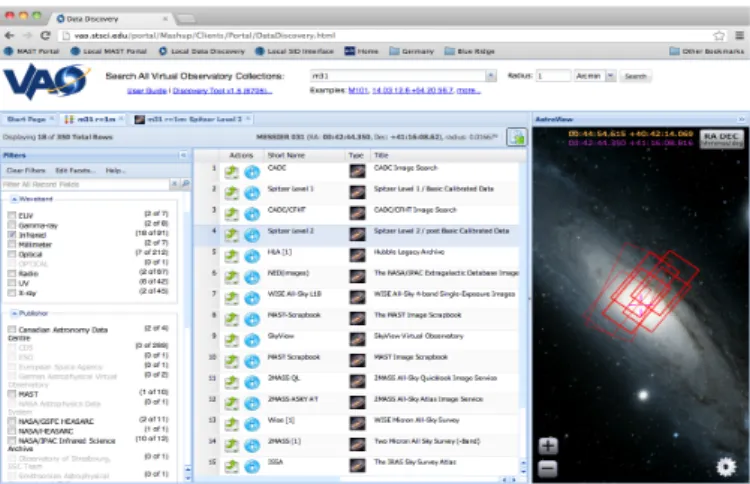
Many of the most popular U.S. archives and catalog hold-ings are available for searches in the DDT, including the Hub-ble Space Telescope,ChandraX-ray Observatory, the Mikulski Archive for Space Telescopes (MAST), the High Energy Astro-physics Science Archive Research Center (HEASARC), Sloan Digital Sky Survey (SDSS),SpitzerSpace Telescope, and the Two Micron All Sky Survey (2MASS), to name a few. A pow-erful filtering mechanism allows the user to quickly narrow the initial results to a short list of likely applicable data. Guidance on choosing appropriate data sets is provided by a variety of in-tegrated displays, including an interactive data table, basic his-togram and scatter plots, and an all-sky browser/visualizer with observation and catalog overlays (Figure 1).
The DDT was developed incrementally with the first release of the application in 2011 June. Development continued over the next two years with five incremental releases that added fea-tures and addressed any deficiencies. Web-based user docu-mentation and training videos were developed and updated for each release.
The DDT project utilized DataScope (GSFC/NVO, McG-lynn, 2007) and Astroview (STScI) and shared synergy with
Figure 1: Appearance of the Data Discovery Tool (DDT) after a search for M31 with a radius of 10showing the filters (left panel) that can be applied to the search results (center panel), and the AstroView component with field-of-view overlays representing the available data sets.
the MAST archive development project at STScI. IVOA stan-dards feedback was substantial. Experience from the DDT project was used to advocate for enhanced registry metadata, table access protocol improvements, and enhanced data access protocols to ensure support for bulk queries. Staffinvolved in DDT development also helped to write the IVOA standard on HEALPix Multi-Order Coverage maps (Boch et al., 2014) for describing sky coverage.
2.2. Interoperable SED Access and Analysis Tool, Iris
Iris is a downloadable Graphical User Interface application that enables astronomers to build and analyze wide-band spec-tral energy distributions (SEDs, Doe et al., 2012; Laurino et al., 2014a,b). SED data may be loaded into Iris from a file on the user’s local disk, from a remote URL, or directly from the NASA Extragalactic Database (NED) for analysis via the NED/SED Service. A plug-in component enables users to ex-tend the functions of Iris. Iris utilized Sherpa (Freeman et al., 2001; Doe et al., 2006) and Specview (Busko, 2002) as the components that performed fitting and visualization in the ap-plication. Communication between Specview and Sherpa is managed by a Simple Application Messaging Protocol (SAMP) connection (Taylor et al., 2012a,b). Data can also be read into Iris and can be written out via the SAMP interface (Laurino et al., 2012). A separable library for SED data input/output (SEDLib) is also included and available independently from Iris (Figure 2).
Iris was first released in 2011 October. Three incremental releases and one bug fix release followed. Iris is supported on several versions of the Mac OS X and Linux. Web-based doc-umentation and user training videos are also provided. Iris was featured on the Astrobetter blog in 2013 September.4
There were two by-products of the Iris project—the NED/SED service and the SEDLib. There were
collabora-4
http://www.astrobetter.com/ release-iris-2-0-sed-analysis-tool/
Figure 2: VAO SED access and analysis tool Iris in operation. The Iris desktop holds the interactive windows for SED data review and analysis. Shown is a panel displaying the SED of 3C 273 with a model fit (red curve) and two panels from which the user can describe the model to fit an SED and control the fitting.
tions with several groups including the ASI Science Data Cen-ter (ASDC) and CDS (Strasbourg). The collaborations led to Iris desktop plug-in services to access the respective SED data holdings (Laurino et al., 2013). The project provided feedback to the IVOA on the SAMP protocol, allowing for inclusion of a full SED into a single file extension, to TOPCAT (Taylor, 2005, 2011) for better support for SED plots, and inspired work to-ward a Virtual Observatory Data Model Language (VODML) by lead Iris developer O. Laurino.
2.3. Scalable Cross-Comparison Service
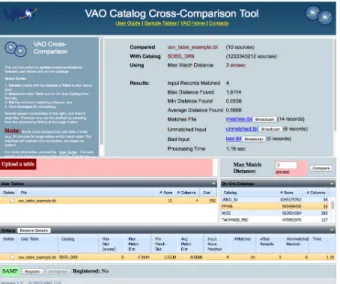
The Scalable Cross Comparison (SCC) Service performs fast positional cross-matches between an input table of up to 1 mil-lion sources and common astronomical source catalogs for a user-specified match radius. The service returns a list of cross-identifications to the user. The output is a composite table con-sisting of records from the first table, joined to all the matching records in the second table, and the angular distance and posi-tion angles of the matches (Figure 3).
The first release of the Scalable Cross Comparison Service was in 2012 January and was supported with three upgrades over the next 1.5 years. The indexing schemes that support large catalog cross-matching were provided by the Infrared Process-ing and Analysis Center (IPAC) and later adapted to the Wide-field Infrared Survey Explorer (WISE) andSpitzerprojects.
2.4. Time Series Search Tool
The Time Series Search Tool finds and retrieves time se-ries data from three major archives and analyzes them with the NASA Exoplanet Archive periodogram application. The appli-cation was a prototype developed to demonstrate that the IVOA standards of the time-series protocol and data model met the needs of such a tool. The development of the Time Series tool ended after the first VAO re-plan.
2.5. Lessons Learned
The VAO science applications group was distributed across multiple institutions, and Evans et al. (2012) described the man-agement strategy this group. A key element of developing suc-cessful applications amongst a distributed group is managing
Figure 3: The Scalable Cross Comparison Service. Shown are results for a user-uploaded table cross-matched with the Sloan Digital Sky Survey Data Release 9 catalog.
unknowns. As the VAO science application lead might be un-aware of the entire set of tasks assigned to an individual outside of the VAO efforts, coordinating task assignments and making organizational material and schedules easily available was im-portant.
The VAO implemented a relatively lightweight process, tracked in a Wiki-based environment, in order to focus the dis-tributed team on the requirements, design, and implementation of the applications. In addition to the developers themselves, a science stakeholder was assigned to each application and was key to bringing the view of the user to the development process. The stakeholder provided requirements, developed science use cases, handled technical questions, advised on development pri-orities, and performed unit tests. The use cases drove develop-ment and provided an opportunity to assess priorities and make course corrections. Internal product deliveries provided a test and assessment loop, and incremental releases (rather than one big software release) ensured that development was progress-ing as expected. A team lead managed priorities, schedule, and communication within the group.
Frequent communication was essential to ensuring that is-sues were resolved quickly and the team was working toward a common vision. The distance gap of distributed teams needs to be managed diligently. The VAO Wiki provided easy-to-access project information so that a team member could resume work quickly if he or she were sidetracked due to external project responsibilities. This process enabled the group of develop-ers working on a project, at a distributed set of institutions and working on a part-time basis, to perform their tasks and collab-orate efficiently (Evans et al., 2012).
2.6. Community Developments
During the course of the VAO, there were diverse, community-led efforts to develop VO software. (In some cases, these efforts started during the NVO era, but continued into the VAO project.) Often these involved VAO personnel, either in
the role of “consultants” or who were engaged through their work on other projects.
Examples of such community-led software efforts include VOEvent, a protocol for notifications or “alerts” from and be-tween observatories (White et al., 2006); Montage, a user-controlled tool for generating science-quality image mosaics (Berriman et al., 2003); and seleste,5a tool designed to provide
uniform access to distributed VO databases.
3. Standards and Infrastructure
The core of the VAO program was the development of soft-ware to support the IVOA standards for discovery and access to distributed data. Key components of the VAO infrastruc-ture include the resource registry (the collection of metadata describing on-line data collections and services), the data ac-cess layer protocols (images, spectra, tables, databases) and their validation tools, a distributed authentication service (“sin-gle sign-on”), and applications programming interfaces either built-in to existing software packages or available stand-alone that allow researchers to develop their own VO-enabled scripts. Much of the VAO infrastructure is now incorporated into the data services of major data centers using VAO-provided soft-ware libraries.
3.1. The VAO Infrastructure in Context
Figure 4 shows the VO architecture (Arviset et al., 2010). In this diagram, the VO infrastructure serves as a bridge be-tween data providers and users, and that bridge is supported by standards. On the provider side, data is connected into the in-frastructure through standard services that present that data in terms of standard data models. On the other side, users are con-nected to the infrastructure via generic tools that understand the VO standards. Tools are no longer tied to a single archive, but rather can talk to any and all archives that speak the common VO language.
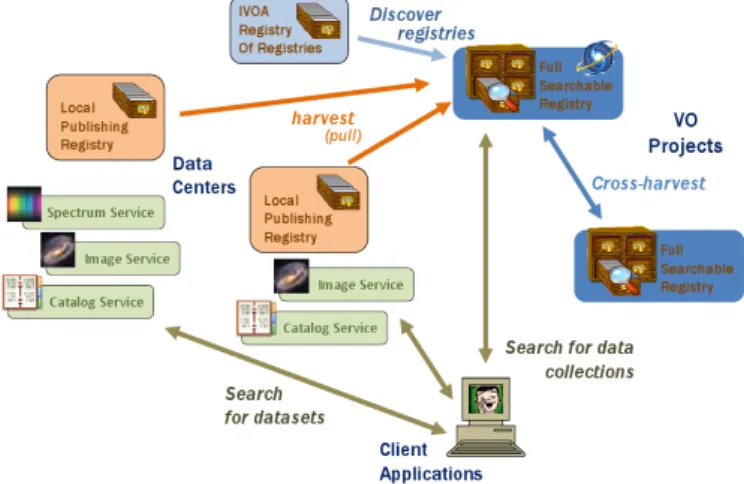
Providing the ability to discover and access data of interest is a significant motivation for the structure of the VO architec-ture. Figure 5 illustrates the discovery framework. Registries represent the first step for data discovery in this framework. A registry is a database containing descriptions of data collections and services available in the VO (Demleitner et al., 2014). Con-ceptually a VO registry is similar to a “name server” for domain name service (DNS) on the Internet (Mockapetris, 1987).
There is no single master or central registry; however, there are registries called full searchable registries that aim to have descriptions of all the data collections, archives, and service providers known to the VO from around the world. This type of registry can populate itself through a process known as harvest-ing; it starts by contacting a special “boot-strapping” registry (run by the VAO) called the Registry of Registries that will re-turn to it all of the other known registries in the VO ecosystem. In order for a new registry to enter the VO, it must be registered with the Registry of Registries.
Figure 4: Virtual Observatory architecture (Arviset et al., 2010). Users ap-pear at the top of the figure and data providers and computational resources are at the bottom, connected by the VO bridge. The VO bridge itself comprises the registry of data providers and data services, the data access protocols for discovering and retrieving data, and the core infrastructure of query languages, data models, data formats, and semantic definitions.
Figure 5: Data discovery in the Virtual Observatory.
Most of the registries within the VO are publishing registries. A registry of this type is typically run by a data center that uses it to advertise the data collections and services that it offers to the VO. The full searchable registry contacts each of the pub-lishing registries and pulls descriptions of all the data collec-tions and services provided by the data center. At this point the full searchable registry is populated with descriptions of all of the resources known to the VO. Periodically it will re-query the other registries to obtain any new resources or other changes since the last harvest.
With an up-to-date full searchable registry available to it, a client application (e.g.,§2) can discover any data known to the VO. It starts by asking the registry for a list of collections and services from each of the data centers that might have data rele-vant to the user’s science question. Most of the services will be standard data access services for finding and downloading im-ages, spectra, or catalog information from a particular archive
or collection. The application can then send a query to all of the matching services to get back lists of available data sets. By browsing the returned metadata for these data sets, the user can choose which data sets to download.
3.2. VAO and the IVOA
Much of the work the VAO conducted in advancing stan-dards was through engagement with the IVOA. The role of the IVOA is two-fold: first, to coordinate the efforts of all of the VO projects around the world, and second, to serve as a standards body for establishing VO interoperability.
From the IVOA’s beginnings, the NVO and VAO were lead-ers in shaping the VO’s global architecture and the standards that enable it, reflecting the significant data holdings of U.S. institutions. NVO/VAO staffmembers served as chairs or vice-chairs of key IVOA working groups (Appendix C). The im-pact of this leadership is also seen in the standard documents; most of the IVOA recommendations across all of the areas of the VO have featured NVO/VAO team members either as first authors, secondary lead authors, editors, or major contributors (Appendix B).
The VAO produced many of the key reference
implementations—software that demonstrates a standard in action and proves its viability. During the NVO era, there was a vigorous international debate regarding the character of the VO Registry and whether it should be relatively “coarse-grained” or “fine-grained,” in terms of the amount of detail stored in the VO Registry. (See below.) The NVO created the first implementations of registries with several different architectures. The VAO was instrumental in demonstrating data access services through software packages like DALServer (§3.4.1) and TAPServer (§3.4.2).
The NVO/VAO led the IVOA in the development of service validators. A validator is an application that checks whether another service is compliant with VO standards. A validator performs this check by sending a series of queries to a VO ser-vice and examining the response to assess whether it follows all of the rules and recommendations described in the standard. The NVO developed the first validators in the IVOA to assist data providers, allowing them to check their data access ser-vices and fix any problems before publishing them to the VO. These NVO validators quickly became critical pieces of VO in-frastructure and were continued by the VAO (§3.4.3); and other projects joined in to contribute validators for other service stan-dards.
In other areas, though, the VAO benefited from international developments. Not only did the VAO benefit from technical comments, there were multiple occasions in which the VAO could produce a library or tool, thereby ultimately more rapidly because some of the initial development had been done by in-ternational partners (e.g., the development of the single sign-on capability, initially developed by Astrogrid).
3.3. The Registry
As described above, a VO registry is a database containing descriptions of data collections, archives, services, and other
resources, and it represents the first step in data discovery. The NVO/VAO established itself as an early leader in the area of registries. In addition to creating some of the first registries, the VAO operated the Registry of Registries (RofR) on behalf of the IVOA. The RofR allows searchable registries to bootstrap their collection of resource descriptions.
The NVO and its IVOA partners developed several diff er-ent types of registries with several different implementations. There was considerable debate over the registry design, and whether it should be “grained” or “coarse-grained”. A fine-grained registry contains detailed metadata about the datasets available at a VO resource (for example, it might contain the right ascension and declination of all observed positions in an archive). A coarse-grained registry would only contain infor-mation about the general sky coverage of an archive. The ad-vantage of a fine-grained registry is that one need not query distributed resources explicitly to determine if they have data of interest, whereas with a coarse-grain registry data discovery is a two-step process. The problem with a fine-grained registry, however, is that many data collections are dynamic, so that any metadata cache has to be updated continuously. Also, the struc-ture of a fine-grained registry will necessarily be much more complicated, and harvesting of metadata between fine-grained registries could easily become inefficient. Despite the effi -ciencies for search and discovery offered by fine-grained reg-istries, the VO currently operates with coarse-grained registries. The VAO consolidated support around the coarse-grained, full searchable registry service at the Space Telescope Science In-stitute. There are ongoing efforts to build a fine-grained registry for mostly static data collections.
3.3.1. VAO Directory Service
As part of the VAO’s production registry, a Web-browser-based front end called the Directory Service6 was provided. This tool is particularly useful for discovering collections and services related to a topic. By entering keywords into the search input box, the tool will return a list of resources whose descrip-tion contains those keywords (Figure 6).
3.3.2. Registry Upgrades
Over the last two years of the VAO project, an updating program was conducted to overhaul the underlying registry database and update it to support the latest IVOA registry meta-data standards. This overhaul was also necessary to support a new standard for searching registries. This new standard lever-ages an existing IVOA standard for querying complex databases called the Table Access Protocol (TAP), for which client soft-ware already exists. (The TAP standard did not exist when the first registry search interfaces were standardized.) Completing this upgrade was critical to maintaining the registry in the even-tual post-VAO era.
A final effort conducted in the VAO project was to complete registry curation activities aimed at improving the descriptive content of the registry. In particular, a specific approach was
6http://vao.stsci.edu/directory
Figure 6: Results from a search query submitted through the VAO Directory Service. The directory service results allow one to browse the descriptions, filter results, download matching descriptions in VOTable format, and when the resource is a standard data access service, even send it a sky position-based query.
implemented to registering resources intended to make reg-istry searches more effective and their results less confusing. This approach has recently been accepted as a best practice by the IVOA Registry Working Group. The VAO curation work started with an inventory of existing resources by publisher, fol-lowed by developing a set of recommendations for improving the resource descriptions that brings them into line with the best practice. The new registry resource publishing tool (described below) will be instrumental in communicating these recommen-dations to the publisher.
3.3.3. Publishing Registries and the Resource Publishing Tool
A publishing registry is the vehicle for making a resource available to the VO. In particular, it can create new descriptions of resources and share them with the rest of the VO through the harvesting process. A data center, which may curate a number of data collections and offer a variety of services to access them, may operate their own publishing registry. Because such a reg-istry does not need to serve end users directly, operating one is much simpler than running a searchable registry. During the NVO project, the VORegistry-in-a-Box product was developed that provides a simple but compliant publishing registry imple-mentation through which a data center can maintain its own re-source descriptions in-house. This product is still in production use within the VO (including by the Registry of Registries), and the VAO continued its support.
A searchable registry can also support the publishing func-tion, which the VAO Registry at STScI does. In particular, it maintains resources descriptions on behalf of data providers who only have a few resources to share, relieving them from having to run their own publishing registry. In order to enable this feature, the VAO created the Resource Publishing Tool, a browser-based application that allows a data provider to create and share resource descriptions through the VAO Registry. It features a guided interface that steps a data provider through the process of describing a resource, prompting for metadata along the way. The tool also can check for the validity of val-ues as they are entered, alerting the user of any problems. Draft descriptions can be saved for updating and publishing later,
and already-published resource entries can be updated with this tool. Various techniques are used to minimize the amount of typing required to create a useful resource description. While the VAO Registry will share records created through this tool, the descriptions are considered “owned” by the user. Thus, to control access, the publishing tool uses the VAO Single Sign-On Services (described below).
3.4. Data Access
Standard services that allow users to find and access to data from an archive are part of the VO architecture known as the data access layer (DAL; Figure 4). In the VO architecture, there is a standard service for each type of dataset; e.g., the Simple Image Access protocol (SIAP, Tody and Plante, 2009) enables discovery and downloading of images from an archive, and the Simple Spectral Access (SSAP, Tody et al., 2012) protocol en-ables access to spectra. In this section, we describe the four different “toolkits” or new protocols that the VOA developed for improved data access within the VO.
3.4.1. DALServer
In order to help data providers share their data collections through standard VO services, the VAO created the DALServer Toolkit, a Java-based software package. When first developed as part of the NVO project, it served as a platform for devel-oping reference implementations of standard VO services (like SIA and SSA) that demonstrated features of the standards. At about the same time, both Astrogrid and ESO were developing data access toolkits, and some of this development fed into the VAO concept.
During the VAO’s final year, specific efforts were made to enhance the toolkit for use directly by data providers; this ef-fort was considered “productization,” as it focused on making the toolkit easier to use. The focus was on a simple class of use cases in which a small data provider had a simple catalog or a simple collection of images or spectra that they wished to share. By just editing configuration files and running a few scripts, the provider could deploy fully compliant VO services with no programming required. For more complicated situa-tions, such as for a data center that might already operate cus-tom data access services through their own data management system, they could use the underlying DALServer Library ap-plication programming interface (API) to adapt the VO services to their local infrastructure.
The first production release of the DALServer provided sup-port for the four “simple” standards for data access recom-mended by the IVOA: namely, Simple Cone Search (SCS, for simple position-based querying of object and observation cat-alogs, Williams et al., 2008), Simple Image Access Protocol (SIAP, for finding images), Simple Spectral Access Protocol (SSAP, for finding spectra), and Simple Line Access Proto-col (SLAP, for finding rest frequencies for spectral line emis-sions, Salgado et al., 2010). Toward the end of the VAO project, DALServer was extended to operate on multidimensional data sets (§3.4.4).
3.4.2. TAPServer
The Table Access Protocol (TAP) is an IVOA standard for querying complex catalogs that may be made up of several ta-bles (e.g., the 2MASS catalog). When a TAP service is con-nected to a catalog, users can create complex, SQL-like queries that can join metadata from several tables. Such queries are critical for mining very large catalogs. Not surprisingly given its power and flexibility, a TAP service is one of the more com-plex IVOA standards to implement. To make deploying a TAP service easier, the VAO created the TAPServer toolkit.
Like DALServer, TAPServer is configuration file driven. That is, with no programming required one can wrap the toolkit around a collection of tables in a database and deploy it as a service accessible to the VO. Because of the VAO close-out schedule, only a limited amount of development could be com-pleted, and there was no effort toward the “productization” of TAPServer. However, the code is included in the VAO Reposi-tory and available for community use. Some post-VAO targeted deployments are planned. For example, it will be deployed at the National Center for Supercomputing Applications (NCSA) to expose the Dark Energy Survey Source Catalog. In turn, DES scientists will be able to analyze the catalog using the seleste7 TAP client, a tool that allows users to form complex queries with little or no knowledge of SQL.
3.4.3. Service Validators
During the VAO project, service validators originally devel-oped during the NVO project were continued and expanded. These validators have a web browser interface that allows a data center to enter a service access URL and test the services com-pliance with the appropriate standards; the result is a listing of errors, warnings, and recommendations for improving the service. These validators share a common Java-based toolkit platform called DALValidate. They also support a program-matic interface that allowed VAO Operations to autoprogram-matically test VO services. (The VAO Operations team also engages other validators developed outside of the VAO.) Supported validators include those for Simple Cone Search, Simple Image Access, Publishing Registries, and VOResource records. The DALVali-date software is available through the VAO Repository.
3.4.4. Image Cube Access
An emerging suite of telescopes is or soon will be generating multidimensional data (often termed “image cubes”). The most general data set, produced by an instrument measuring photons, would be [I(α, δ, ν,t),Q(α, δ, ν,t),U(α, δ, ν,t),V(α, δ, ν,t)], where we have described the polarization properties by the Stokes parameters (I,Q,U,V) and each polarization can be a function of position on the sky (α, δ), frequency ν (or equivalently wavelength λ or energy E), and time t. Radio interferometers have naturally produced such multidimensional data sets for some time, and the commissioning of the Jansky Very Large Array (JVLA) and the Atacama Large Millime-ter/submillimeter Array (ALMA) is making such data sets
much more common. X-ray telescopes have, for some time, been generating data that can be considered to be extremely sparse image cubes. The introduction of integral field units (IFUs) both for ground-based telescopes and eventually for the James Webb Space Telescope is making these data more common at visible and infrared wavelengths.
Providing discovery of and access to multidimensional data was taken up as a key project upon endorsement of the VAO Board. The VAO also helped stimulate interest in multidimen-sional data within the IVOA. In the IVOA, it was recognized that although SIAP could support image cubes in a limited way, it lacked some of the metadata support and data access mecha-nisms needed to support the cubes being produced or soon to be produced. From the VAO perspective, not only would discovery and access to multidimensional data advance a new capability in the VO, it might also to engage the radio astronomy commu-nity more in VO activities.
The VAO produced an early prototype service that demon-strated a number of the key capabilities needed in a new stan-dard for image cube discovery and access. This demonstra-tion was instrumental for mapping out the strategy for an SIAP Version 2 (Dowler et al., 2014). In particular, the necessary standardization was broken down into three independent com-ponents: (1) the Image Data Model defines the semantic labels used to describe image cubes; (2) these labels are used by the SIAPV2 standard to annotate image search results; and (3) the Access Data standard defines how one can request cutouts or other transformations of image cubes.
While active in the development of the standards within the IVOA, the VAO continued prototyping access to image cube data. To ensure that the standards served the needs of real providers of image cubes, we established a collaboration with the National Radio Astronomy Observatory (NRAO). Our joint goals were first to create a real functional image cube access service based on the emerging SIAV2 draft serving real data from NRAO instruments, and second, to provide a useful archi-tectural design along with software to support active archive operations. In this collaboration, NRAO provided the VAO project with requirements and use cases. NRAO desired an image service that could simultaneously provide data to both internal and external clients. One key client is the Common As-tronomy Software Applications (CASA, Jaeger, 2008; CASA Consortium, 2011) Viewer that needs to request small visualiz-able parts of a larger cube. In return, the VAO project provided NRAO with general purpose software to both deliver data over the network to clients. The DALServer product (§3.4.1) was ex-tended to provide server-side support for SIAV2, and VOClient (described below) was extended to support the client. In the spring of 2014, NRAO, using VAO-provided software, success-fully demonstrated a service that provides access to image cube data, including image cutouts. This service allows their archive and CASA Viewer developers to test against a functional ser-vice.
3.5. Data Sharing
A common interest among astronomers is making their data available to their colleagues. Data sharing can be essential part
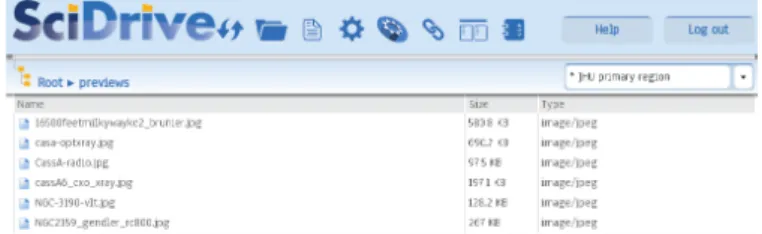
Figure 7: The SciDrive file browser, viewed via a web browser.
of a project in which team members are in different institutions, or it can be for legacy reasons to enable data re-purposing (us-ing the data for studies not originally envisioned when the data were acquired) or for ensuring replication. While there are in-stitutional data centers, both in the U.S. and internationally, there are also so-called “long-tail” data, the many small col-lections of data products that are typically associated with pub-lished papers. Such data products tend to be highly processed by individual astronomers and are not typically available from traditional observatory or project archives.
The second key project conducted during the close-out plan was more exploratory in its full scope (though it supported an important end-user application). The VAO sought to understand how these products could be published to the VO in a low-effort way; in order to enable such access, the focus was on integrat-ing data sharintegrat-ing and publishintegrat-ing into the overall scholarly pub-lishing process which starts even before the first draft of a paper. Two products were developed.
3.5.1. SciDrive
SciDrive is a Dropbox-like cloud storage application in-tended for use in scientific research (Mishin et al., 2014). It was inspired by the SDSS MyDB (O’Mullane et al., 2004) and As-troGrid MySpace (Davenhall et al., 2004) developments, and it is based primarily on the OpenStack8software (in particular the OpenStack Swift component for object storage). It can be ac-cessed from a web browser in which the user is presented with a view of a personal hierarchical directory space where one may save files by dragging-and-dropping file icons into the web page interface (Figure 7). Also available is a desktop client that can (like Dropbox) monitor a local directory and automatically up-load files that are moved into it. As many researchers already do with Dropbox, SciDrive can be a simple platform for shar-ing data within a research group; it provides a secure means to share read-write access to a collection within a restricted group or to send one-offpermissions (read or read/write) to in-dividuals. One difference from commercial storage providers is SciDrive’s ability to scale to larger collections than with the typical free versions of storage.
SciDrive supports the VOSpace 2.0 interface, the IVOA stan-dard for managing third party data transfers (Graham et al., 2014). This capability allows a user to seamlessly move files between different SciDrive instances (or other VO-compatible storage systems) located around the network. This feature is
important for new VO capabilities in which web-based tools al-low users to save application outputs to their personal space in the cloud. These outputs could be reloaded later into the tool for further analysis (e.g., as a “favorite” starting point) or loaded by other tools for synthesis with other data and analysis. A current example of this is the use of SciDrive with the Sloan Digital Sky Survey (SDSS) CasJobs: a SciDrive user can configure a directory to automatically detect uploaded table files and load them into the SkyServer database so that it can be correlated with the SDSS catalog.
The CasJobs connection highlights another unique feature of SciDrive: it supports plugins that enable special handling of certain types of data. This application is therefore a pos-sible platform for publishing data by individual scientists and research groups. There has been experimentation with plugins that automatically extract the metadata from files that is needed to expose data to the VO. With such a feature, a research group could use SciDrive to organize a collection of data for publica-tion. When the collection is ready for release a simple press of a button would expose the data publicly; the metadata would be automatically loaded into a database and the collection would be made available through standard IVOA services (e.g., using DALServer).
Completing this vision to a working implementation was be-yond the scope of the VAO Project; nevertheless, operations and development at Johns Hopkins University (JHU) of the SciDrive platform continues (with NSF support from the Data Intensive Building Blocks program). Furthermore, VAO part-ners JHU and the National Center for Supercomputing Appli-cations (NCSA) are collaborating on the emerging, community-driven initiative called the National Data Services (NDS) Con-sortium, which aims to address data publishing across all re-search fields. As the publishing scenario described above is much like one being discussed in the NDS community, we ex-pect the development of SciDrive as a publishing platform to continue beyond the VAO project.
3.5.2. Single Sign-On Services
In order to restrict access to the user’s personal space, SciDrive uses the VAO Login Services for authentication (Plante et al., 2012). These services were created so that VO users could have a single login to connect any VO-compatible service or portal even when they are managed by different orga-nizations. More than the simple convenience of a single login, a federated login system allows a user to access their proprietary data from one data center using analysis tools from another data center. A participating organization can choose to support VAO logins either as its primary identity or as an augmentation of its local authentication system.
Inspired by initial developments by Astrogrid for the single sign-on capability in an astronomical context, the VAO feder-ated login is built on the OpenID standard9that is in broad use
across the Internet. Associated with it are all the usual services that help users manage a login: the ability to reset forgotten
9http://openid.net/
passwords, edit the user profile, etc. The VAO Login service also leverages an OpenID feature for sharing user information with a portal in a privacy-conscious way; this can make regis-tering users with a portal faster and simpler. One less common feature that is important for VO applications is the ability for transparently delivering X.509 certificates to the portal. This al-lows a portal to access private data at another site on the user’s behalf. While the service requires the user’s permission to do this, it is worth noting that the user never handles the certificates directly.
The development of the VAO Login service resulted in two release software products. First, VAOSSO provides the user identity server that powers the VAO services. This software can be configured either to run as a mirror of the VAO service (for high availability) or as a completely independent service. Second, VAOLogin is a toolkit that helps portal developers add support for VAO Logins.
Current applications using the VAO Login Services include SciDrive, the VAO Registry’s Resource Publishing Tool, and the VAO Notification Service. The National Optical Astronomy Observatory (NOAO) Data Archive, which currently supports the predecessor NVO Login Service, is migrating to use of the VAO Login Services to augment their own local authentication system.
3.6. Virtual Astronomy on the Desktop
A key initiative of the VAO Standards and Infrastructure pro-gram was to make VO capabilities more available from a user’s local machine. Not only was the goal to make VO capabilities integrated into both new and existing desktop applications, the VAO Project sought to deliver that power directly to scientists through custom scripts that they can create to conduct their re-search.
Because of its growing popularity as a scripting language for scientific research, Python10was a major focus of our scripting
support, following upon the example set by AstroGrid’s python package. Further, we enabled all VO-enhanced applications and scripts running on the desktop to work together using the Simple Application Messaging Protocol (SAMP, Taylor et al., 2012a), the IVOA standard that allows desktop and Web appli-cations to exchange data.
3.6.1. VO-Enhanced Image Reduction and Analysis Facility (IRAF)
The first VAO product supporting VO on the desktop was a VO-enhanced version of IRAF (Tody, 1986, 1993; National Optical Astronomy Observatories, 1999) developed by M. Fitz-patrick (NOAO). This included some general IRAF infrastruc-ture enhancements including the ability to load data from arbi-trary URLs as well as support for loading data in VOTable for-mat. With these two capabilities, a suite of tasks was added to take advantage of VO services; these included an object name resolver, the ability to search the registry to find archives and services, the ability to search individual archives or catalogs,
and the ability to download discovered data products. SAMP support was also added so that IRAF could send data to other non-IRAF tools running on the desktop; for example, images could be sent to Aladin (Bonnarel et al., 2000) and catalogs to TOPCAT for visualization.
3.6.2. VOClient
This downloadable product provides direct access to VO ser-vices outside of a Web browser. The first VOClient release fea-tured a suite of command-line tools that enables interactive use from UNIX/Linux shell; they can also be used to create cus-tomized shell scripts. The capabilities provided by these tools include discovering archives and catalogs via the VAO registry, searching individual archives for images and spectra, down-loading discovered data across multiple archives, searching cat-alogs by position, resolving object names to sky positions, and sending data to other desktop tools (via SAMP).
The second release of the VOClient package focused more on the underlying set of core C libraries. These libraries can be used directly to add VO capabilities to C and C++applications (as was done for the NRAO CASA Viewer). These libraries are intended to be the basis for bindings to other languages, such as Python and Perl.11 The Python bindings in particular were a
focus of the second release (which featured a common API with PyVO, described below). Finally, the second release featured a task framework that enables easy integration of legacy software, making it callable from Python.
3.6.3. PyVO
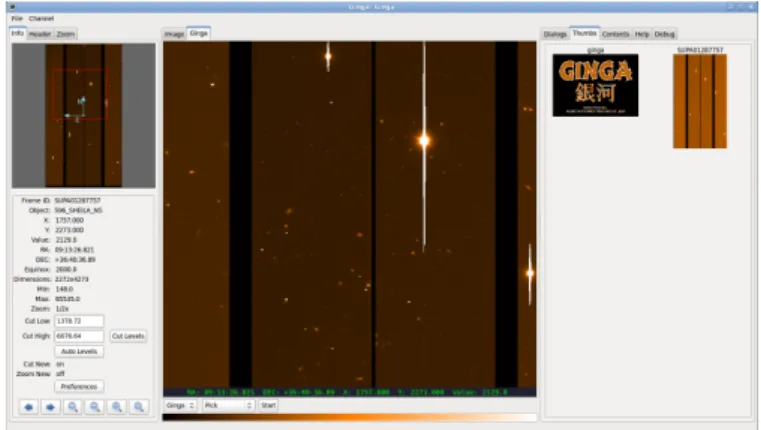
This downloadable product represented a parallel effort to support Python with a slightly different focus. Through our community engagement, we found that many Python users pre-fer to use a pure Python implementation of a VO library, which PyVO provides, as opposed to a mixture of Python and Unix system commands. As for VOClient the audience is two-fold, the first being developers who want to integrate VO capabili-ties into their own Python applications. As an example, Fig-ure 8 shows the Ginga image browser, developed for the Sub-aru Telescope, to preview observatory images (Jeschke et al., 2013). Downloading of images and catalogs was an additional functionality added to the Ginga image browser using the PyVO python module.
PyVO was also aimed at the growing community of research astronomers using Python to create custom scripts to carry out their research and analysis. In fact, PyVO is built on top of the widely used Astropy package (Astropy Collaboration et al., 2013), an integrated set of astronomically-oriented modules. This allows users to discover and download data and process and analyze it with the robust capabilities of Astropy. This combination is an important key to doing VO science at a large scale, as it becomes very easy to apply common processing to a vast array of data either from a single survey or from distributed collection. It also becomes possible to continuously monitor
11https://www.perl.org/
Figure 8: Ginga Image Browser from the Subaru Telescope showing a VO plugin powered by PyVO. The rightmost panel represents a plugin that allows users to download images and catalogs from the VO for display and overlay in the viewer.
the evolving holdings of an archive or the VO in general as new data sets are added.
The first evaluation version of PyVO was released 2013. As this release date was close to the end of the VAO Project, we wanted to ensure further use and development of PyVO beyond the Project’s end. Accordingly, we explicitly employed a strat-egy to build a community around the PyVO package. First, GitHub12was used to provide a web-based code repository for future community contributions. This approach has enabled im-portant contributions from users outside of the VAO Project; as of this writing, there are 22 issue submissions from seven exter-nal users and seven code submissions from four exterexter-nal users. The other part of the strategy was to establish a strong tie to the Astropy community, which is quite large and active. (In fact, this tie is responsible for much of the external participation via GitHub.) To this end, we applied for and were given status as an Astropy “affiliate package.” This connection also allows PyVO to become a proving ground for migrating addition VO capabil-ities into Astropy.
4. Operations
The VAO operations effort addressed two primary goals. The first was to enable science use of the VO, in the sense of be-ing an “operational observatory,” with a focus on the VAO-developed interfaces but not exclusively. Tools must work, should work consistently, and when problems arise they must be swiftly resolved. The second goal was to enable the services needed internally for the activities of the VAO itself. VAO per-sonnel needed reliable access to the tools needed for software design and access, user support, testing, configuration manage-ment, bug tracking, and so forth.
The VAO provided a number of science services and tools directly to the scientific community (§§2 and 3): its home web site, a data portal and cross-corrlation tool, the Iris SED tool, downloadable VO libraries for use by clients and servers, and
cloud storage and secure access protocols. Internal services in-cluded the VAO infrastructure: the JIRA ticket system, a Jenk-ins testing service, SVN code repository, a YouTube channel, a blog, and mailing lists. The VAO also supported the IVOA Web site and document repository; these were transferred to interna-tional partners in Italy and India. The VAO software reposi-tory13 was established to ensure that VAO-developed resources
are available indefinitely.
VAO services are supported by member institutions of the VAO with significant resources hosted at each of our sites: the Smithsonian Astrophysical Observatory, JHU, MAST, HEASARC, NRAO, NOAO, Caltech, and IPAC (IRSA and NED). Most recently the software repository has used free Google cloud-based services. Elements are distributed across the country and the Internet.
Supporting such a distributed system posed (and will pose) special operational concerns. Especially for its science users, the VAO worked to ensure that elements were seen as a coher-ent whole: science tools need to be available at a common lo-cation, forms should have consistent look-and-feel, and every-thing should be clearly visible through a consistent web pres-ence even when the web sites are on various servers.
All elements were continuously monitored and a responsi-ble party identified for each so that issues could be rapidly and decisively addressed. The operations staff met frequently (in weekly telecons) and operational issues were rapidly escalated using an internal issue tracking software to whatever level was needed to ensure that they received the needed visibility.
4.1. Service Monitoring
All VAO services were monitored hourly and a database of all tests was continuously updated. Each service was tested to ensure not only that the service was operational, but also that it responded sensibly to some simple request. When services failed a test, they were retested 15 minutes later. If the second test also failed, a message was automatically sent to the respon-sible parties and to the VAO operations monitor.
A web site was available giving the current status of all oper-ational services, and the VAO home site reflected the operations status of VAO science services so that users were immediately informed if there was an issue. Statistics were collected in and reported in biweekly periods.
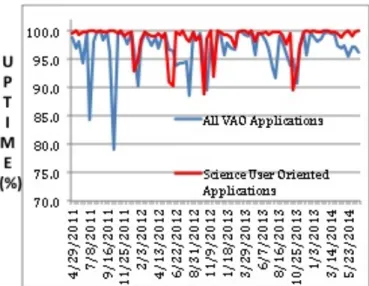
Figure 9 shows the operational status for all VAO services from spring 2011 through early summer 2014 in each bi-weekly period. The blue line shows that some of the internal VAO services—not seen directly by our science users—have had sig-nificant downtime recently. This mostly reflects in our testing and validation tools. More critically, the red line indicates only one significant lapse, in 2013 October, for the science-oriented services since early 2013. This was directly due to the shut-down of US federal services that affected NASA sites.
4.2. Monitoring and Validation of VO Data Providers
Since the effective operation of the VAO from the perspec-tive of science users required that VAO data providers’ services
13https://sites.google.com/site/usvirtualobservatory/
Figure 9: Operational status for all VAO services since from spring 2011 through early summer 2014 in each biweekly period.
were available, in addition to testing the aliveness of VAO ser-vices, the VAO also monitored whether data services external to the VAO were working. Every site that published data through the VO was tested each hour. Not all published services were tested; rather a representative service from each of class of ser-vices at a site was tested. All tests were recorded and the current status of all VO sites could be seen at the VO monitoring web site. When a problem was detected, the VAO operations mon-itor contacted the responsible party and noted the problem. In many cases the VAO assisted such sites in rapidly bringing their services back on-line.
Occasionally a VO data-providing site is abandoned. When sites were not responsive after two months, the VAO monitoring service deprecated them in the VAO registry so that users would no longer see them in typical queries.
Each week approximately 5–10 service interruption issues were handled. In addition to testing whether services were available, the VAO also validated every published VO service using the catalog/table, image, spectral, or registry service val-idators. Each day approximately 300 services were validated and all validation issues were recorded in a database. This means that all published services were validated roughly once per month. Periodically, a summary report describing the VAO validation issues was prepared for each site, in order to provide concrete recommendations for resolution of validation issues.
A service that does not pass full validation can still provide valuable information, but obtaining more complete agreement with the IVOA standard ensures that tools work more robustly.
Figure 10 shows the fraction of VO services that completely passed validation. The blue line shows all VO data providers, while the red line shows the services associated with institutions that were part of the VAO. In both cases there was a steady rise in compliance over the past several years. Two major drops in the overall compliance reflect bugs introduced at one of the ma-jor VO data providers outside the VAO. Seeing these declines our operations monitor worked with the provider, identifying
Figure 10: Variation with time of the fraction of VO services that completely passed validation.
specific services that were affected after initial bug fixes did not completely rectify the problem, and helped in their recovery.
4.3. Post-VAO Operations
The disposition of VAO-developed services and resources is discussed in detail in other sections of this paper. Most science-oriented services will continue to be maintained by the existing institutions. The state of the internal VO services, mailing lists, documentation, blogs, and such will be maintained in the soft-ware repository. Critical infrastructure services, the web site, registry, and monitoring tools will be maintained as part of a coordinated NASA follow-on effort. This will also include at least some coordination of NASA VO operations efforts, but the level of this has yet to be determined. Our experience has shown that the VO, a broadly distributed system, greatly bene-fits from clear and comprehensive mechanisms to identify and resolve operational issues. While the NASA follow-on effort may provide some minimal capabilities, it requires a broader national and international visibility. This is not currently some-thing that is handled by the IVOA.
5. Community Engagement and User Support
During the course of the VAO, effort was undertaken to en-sure that products and services delivered were robust and us-able by research scientists and to reach out to the broader astro-nomical community. The outreach efforts aimed to expose VO products and services to potential users, to assist in the take-up of those products and services, and to gather feedback in or-der to assure the maximum utility of the VO for astronomical research. This section describes the full scope of the efforts.
5.1. Web Site
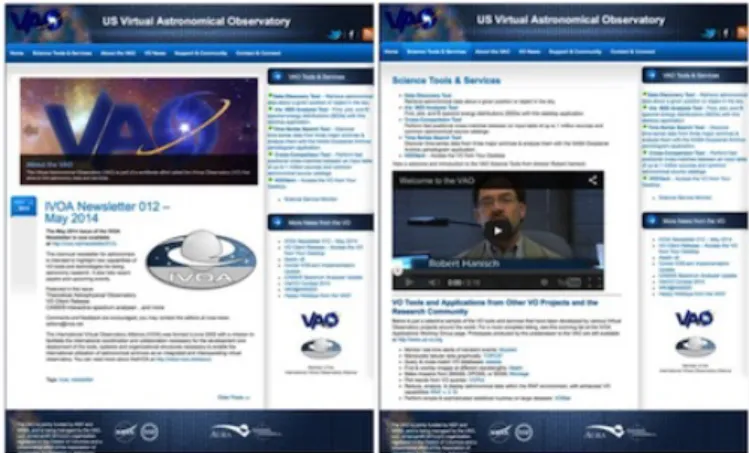
Figure 11 shows the VAO web site, with an intended audi-ence of professional astronomers and software developers. The web site was designed both to serve as an entry portal to the VAO and to provide a means for astronomers to find infor-mation about the VO—of the more than 3 million results of a search for “virtual observatory” with Google, the VAO web site is one of the top hits.
Figure 11: (Left) VAO web site home page. (Right) Science Tools & Services area within the VAO web site. Tools and services developed by the VAO appear at the top of the document, VO tools and services provided by the community appear as well.
Figure 12: (Left) VAO Forum at astrobabel.com, where users could post ques-tions and interact with other users. (Right) VAO Help Desk.
From the perspective of the end user, the web site had two key areas. The first was “Science Tools & Services.” This web document provided access to the web services or software de-veloped by the VAO. Further, as the project began to mature, community provided tools or services began to be developed, and links to those tool or services were added.
The second area of interest for end users was “Support & Community.” Analogous to the “knowledge base” that might be provided by a commercial software provider, this area was designed to help users find answers to their questions, contact other users, or submit bug reports (Figure 12).
5.2. Product Testing
At the beginning of the VAO, quality control and testing ac-tivities were under the purview of User Support. The motivation for this structure was that User Support could serve as a proxy for the end user and ensure that the products and services could be used in a research setting. For most testing activities, the User Support role was to act as the coordinator of the activities and as reviewers. In addition, User Support took the lead for performing User Acceptance Testing (UAT), which was used, along with other tests and quality control reports, to prepare software release readiness reviews.
5.3. Documentation
User Support staffwrote or completed user documentation in order to help research scientists have a better understanding
of VAO services and applications and how to use them. Doc-umentation packages included deployment instructions, gen-eral descriptions, tutorials, cookbooks, and similar documents. The User Support staff and product developers also collabo-rated to produce video tutorials, which were then made avail-able through a YouTube channel. All software documentation produced is available in the VAO Repository and the video tu-torials remain available through YouTube.14
5.4. Scientific Collaborations
During the course of the project, the VAO supported the sci-entific or technical work of multiple individuals or collabora-tions. The objectives of explicitly supporting such scientific collaborations was two-fold. First, we aimed to provide exam-ples of the VO infrastructure and capabilities being used for astronomical research. Second, the interactions with the teams were anticipated to provide feedback to the development teams for improvements to the VO infrastructure and tools. The re-quests for support resulted both fromad hocproposals to the VAO and from a formal call for proposals that the VAO issued in 2012. The following is a summary of the projects and work supported.
• “Real-Time Analysis of Radio Continuum Images and Time Series for ASKAP” (PI: T. Murphy). This proposal requested assistance in describing multi-dimensional radio wavelength data and publishing it to the VO. Interaction with this team was used as a key use case in developing the VAO Standards & Infrastructure effort toward multi-dimensional data and in interactions with the IVOA.
• “Integration of AAVSO Data Archives into the Virtual As-tronomical Observatory” (PI: M. Templeton). This pro-posal requested assistance in publishing data from the American Association of Variable Star Observers into the VO. The VAO provided assistance to the AAVSO, and the data are now available.
• “Cosmic Assembly/Near-infrared Deep Extragalactic Legacy Survey (CANDELS)” (PIs: S. Faber and H. Fergu-son). The VAO supported the CANDELS program by dis-tributing supernovae detections with the VOEvent network and providing access to CANDELS images through stan-dard VO image access protocols. CANDELS supported the VAO program by providing guidance on requirements for SED building and analysis tools.
• “Brown Dwarf Candidate Identification Through Cross-Matching” (PI: S. Metchev). The VAO supported a project that continued a search for extremely red L- and T-type brown dwarfs that had begun during the NVO. It involved cross-comparing the 2MASS and SDSS catalogs to iden-tify candidates that were followed-up with spectroscopy at the Infrared Telescope Facility, Mauna Kea. The project identified the two reddest known L dwarfs, nine probable
14http://www.youtube.com/user/usvaoTV
Figure 13: Collage of images from the VAO Booth at the 221stAmerican As-tronomical Society Meeting, Long Beach, CA (2013 January). Also shown is one of the VAO-related posters (Kinne et al., 2013).
binaries, six of which were new and eight of which likely harbor T dwarf secondary stars, and derived an estimate of the space density of T dwarfs (Geißler et al., 2011). In addition to these scientific collaborations, a scientifically motivated sub-award was issued to produce a cross-matched multi-wavelength catalog of more than 1M objects within a 10◦ radius of the SMC was produced (“A Catalog of Spectral En-ergy Distributions of Stars in the Small Magellanic Cloud,” PI: B. Madore). The catalog is in the VAO Repository, and it has been incorporated into NED with value-added content.
5.5. Booths and Exhibits at American Astronomical Society Meetings
American Astronomical Society (AAS) meetings, princi-pally those occurring during the winter, are one of the focal points for the U.S. (and international) astronomical community. During the course of the project, the VAO had exhibit booths at AAS meetings (Figure 13). The use of an exhibit booth built on experience gained from NASA Archives and National ob-servatories, for which it was found that substantial fractions of the community could be engaged at low cost. As an illustration of the value of an AAS meeting, people stopping at the exhibit were offered the opportunity to sign up for the VAO mailing list. At each AAS meeting, the size of the VAO mailing list increased by approximately 20%.
5.6. VAO Community Days
VAO Community Days were a series of presentations and hands-on activities designed to take the VAO to the community, demonstrate capabilities, develop and encourage new users, and obtain feedback on VO tools and services (Figure 14). Commu-nity Days were typically structured with a morning session led by VAO team members, with the option of an afternoon session for attendees to ask more detailed questions to VAO team mem-bers or to bring in their research questions to assess how VO