Limits to the Performance of Software Shared Memory: A Layered Approach
Angelos Bilas
1, Dongming Jiang
2, Yuanyuan Zhou
2, and Jaswinder Pal Singh
21
Department of Electrical and Computer Engineering
2Department of Computer Science
10 King's College Road
35 Olden Street
University of Toronto
Princeton University
Toronto, ON M5S 3G4, Canada
Princeton, NJ 08544, USA
[email protected]
fdj, yzhou, jps
g@cs.princeton.edu
Abstract
Much research has been done in fast communication on clus-ters and in protocols for supporting software shared mem-ory across them. However, the end performance of appli-cations that were written for the more proven hardware{ coherent shared memory is still not very good on these sys-tems. Three major layers of software (and hardware) stand between the end user and parallel performance, each with its own functionality and performance characteristics. They include the communication layer, the software protocol layer that supports the programming model, and the application layer. These layers provide a useful framework to identify the key remaining limitations and bottlenecks in software shared memory systems, as well as the areas where opti-mization eorts might yield the greatest performance im-provements. This paper performs such an integrated study, using this layered framework, for two types of software dis-tributed shared memory systems: page-based shared virtual
memory (SVM) and ne-grained software systems (FG).
For the two system layers (communication and protocol), we focus on the performance costs of basic operations in the layers rather than on their functionalities. This is possible because their functionalities are now fairly mature. The less mature applications layer is treated through application restructuring. We examine the layers individually and in combination, understanding their implications for the two types of protocols and exposing the synergies among layers. 1 Introduction
As clusters of workstations, PCs or symmetric multiproces-sors (SMPs) become important platforms for parallel com-puting, there is increasing interest in supporting the attrac-tive, shared address space (SAS) programming model across them in software. The traditional reason is that it may provide successful low{cost alternatives to tightly{coupled, hardware{coherent distributed shared memory (DSM) ma-chines. A more important reason, however, is that clusters and hardware DSMs are emerging as the two major types of platforms available to users of multiprocessing. Users would like to write parallel programs once and run them eciently on both types of platforms, and programming models that do not allow this may be at a disadvantage. Thus, despite (and in fact, because of) the success of hardware{coherent DSM, software shared memory on clusters remains an im-portant topic of research.
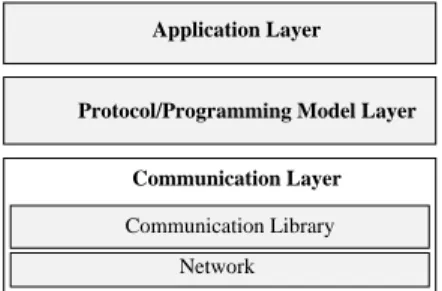
Supporting a programming model gives rise to a layered
communication architecture that is shown in Figure 1. The
lowest layer is the communication layer, which consists of
the communication hardware and the low level communi-cation library that provide basic messaging facilities. Next
is theprotocollayer that provides the programming model
to the parallel application programmer. We assume all{ software DSM protocols in this paper, and focus on two well-studied approaches: page{based shared virtual
mem-ory (SVM) and ne{grained DSM (FG). Finally, above the
programming model or protocol layer runs the application
itself.
Application Layer
Protocol/Programming Model Layer
Communication Layer
Communication Library Network
Figure 1: The layers that aectthe end applicationperformance
in software shared memory.
The last decade has seen a lot of excellent research in the individual layers, especially the lower two system lay-ers [4, 3, 5, 14, 12, 13, 21, 7, 18]. Still, software shared mem-ory systems currently yield performance that is, for several classes of applications, far behind that of hardware{coherent systems even at quite small scale.
This paper uses a layered framework to examine where the major gains (or losses) in the parallel performance of applications can or cannot come from in the future, both in the individual layers and through combinations of them, and to help cluster software and hardware designers determine where best to spend their energy for the goal of supporting software shared memory.
In the application layer, the main variable is how an ap-plication is structured or orchestrated for parallelism. The two system layers (communication and protocol) however, have both functionality and performance characteristics, all of which contribute to end application performance. It is this space that we need to navigate. This paper treats the functionality of the system layers as xed (since it is now quite mature), and varies only their basic performance costs. Results obtained by varying costs can suggest modications in functionality that can reduce or avoid the critical costs. The less mature, application layer is treated by examining the impact of application restructuring, as performed for
SVMin [11], starting from programs that are optimized for moderate-scale hardware coherent systems. We examine the impact of the layers individually and in combination, and also isolate the impact of dierent costs in each layer. Solv-ing problems or reducSolv-ing costs at each layer has its own ad-vantages, disadad-vantages, and potential for being realizable, and is under the control of dierent forces. Knowledge of ac-tual trends in the layers (application or system) can be used to draw implications for the future of dierent approaches.
While some individual aspects of this work have been studied in the past (see Section 4), the contributions of this paper are: (i) the layered approach in which it investigates performance issues, which we believe is generally useful, (ii)
studying the eects of each layer for both FG and SVM,
(iii) studying the synergies among layers, and (iv) providing detailed results and analysis for a wide range of applications. Our highest level conclusions are: (i) With currently
achievable system parameters theFGandSVMapproaches
are competitive in performance, at least at the scale we ex-amine, with the tradeos depending on particular
applica-tion characteristics. (ii) ForFG, other than access control
costs the most important layer to improve is the communica-tion layer (especially overhead and occupancy), and the im-pact of access control costs are relatively independent. (iii)
SVMexhibits a much richer story: All three layers are
im-portant and exhibit a lot of synergy, and no one or even two of them will suce for a wide range of applications; in gen-eral, the order of importance is application, communication, protocol. While the set of demands is broader, this may be an advantage since there is less dependence on particular as-pects of one layer that may be very dicult to control. (iv) Overall, if only one system layer can be improved, it should be the communication layer, though dierent aspects of it matter for dierent protocols.
Section 2 describes the protocols and the methodology we use. Section 3 presents our main results for each layer in-dividually as well as for the synergy among them. Section 4 briey discusses some closely related work, and Section 5 provides a discussion and concludes the paper.
2 Methodology
Although realSVMsystems are available, a study that varies
(and especially reduces) costs in the manner done here can only be done through simulation. We therefore use a de-tailed execution{driven simulator which we validate care-fully against real systems as discussed later. While compu-tational clusters are moving toward using SMP rather than uniprocessor nodes, we perform this study assuming unipro-cessor nodes, primarily because protocols for SMP nodes are not so mature and there are many more interactions in the nodes that can aect performance in subtle ways.
Protocols: Since we use well known, state-of-the-art pro-tocols, we describe them only briey. Page{based coherence protocols use the virtual memory mechanism of microproces-sors for access control at page granularity [14]. Fine{grained access control can be provided by either hardware support or by code instrumentation in software [7]. In both cases, we assume the coherence protocol runs in software handlers rather than in hardware, and on the main processor rather than on co{processors.
For SVM, we use the Home{based Lazy Release
Con-sistency (HLRC) protocol [21], which implements the lazy
release consistency (LRC) model [12] to reduce the impact of false sharing. Both HLRC and older LRC protocols use soft-waretwinninganddingto solve the multiple{writer prob-lem, but with dierent schemes for propagating and merging dis (updated data). Traditional LRC schemes maintain distributed dis at the writers, from where they must be fetched on a page fault [12]. In HLRC, the writer sends the dis eagerly to a designated home node for the page, and the dis are applied there to the home copy which is always kept up to date according to the consistency model. On a page fault, instead of fetching dis from previous writers, the whole page is fetched from the home.
Fine{grained protocols are able to reduce the occurrence of false sharing by virtue of their ne granularity of coher-ence, so they do not rely heavily on relaxed consistency mod-els. However, they require support for ne{grained access
control. Our ne{grained implementation (FG) uses
sequen-tial consistency, is based on the Stache protocol [16], and is similar in protocol structure to many directory{based
hard-ware implementations 1. Access control is assumed to be
provided at any xed power of two granularity for a given application. The fact that we use the best{performing
gran-ularity for each application in theFGcase requires some
pro-grammer intervention. The granularities used are 64 bytes in all other cases than the regular applications: FFT (4 KBytes), LU (4 KBytes) and Ocean (1 KByte).
Simulation environment: Our simulation environment is
built on top of augmint[19], an execution driven
simula-tor using thex86instruction set, and runs onx86systems.
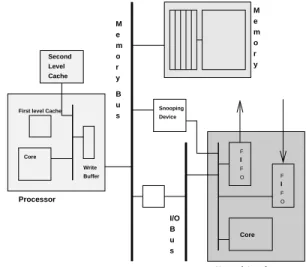
It models a cluster of 16 uniprocessor nodes connected with a commodity Myrinet-like interconnect [4] (Figure 2). Con-tention is modeled in great detail at all levels, including the network end{points, except in the network links and switches themselves. Thus, when we change protocol or communication layer costs, the impact on contention is in-cluded as well. The processor has a P6{like instruction set, and is assumed to be a 1 IPC processor. Details about the simulator can be found in [1].
e o r y B u s m M Processor
First level Cache
Core Buffer Write Second Level Cache F F O F F O I I Core I/O B u s Snooping Device Network Interface M e m o r y
Figure 2: Simulated node architecture.
The ne-grained access control needed for FG can be
provided via either code instrumentation [7, 18] or
hard-1Protocols using more complex, delayed consistency or
single-writer eager release consistency were found to perform only a little better in [22].
ware support [17]. Code instrumentation is also used for polling to handle asynchronous incoming messages, which would otherwise cause expensive and frequent interrupts
(in-terrupts are much less frequent in the coarser-grainedSVM,
so the tradeos between interrupts and polling are less clear there). Since we do not have access to high-performance in-strumentation for the x86 instruction set, and since it is un-clear what cost to ascribe to hardware access control which can be implemented in various ways, we assume access
con-trol and polling are free in theFGprotocol (access control is
already built in to the processor forSVM). In fact, due to our
lack of instrumentation, the simulator uses an interrupt-like mechanism for asynchronous message handling, but charges costs based on those of invoking a handler in polling. Actual instrumentation costs can likely be simply added to execu-tion time to rst order, since they are just addiexecu-tional com-pute instructions. We quote some instrumentation overhead data from the Shasta system, which are probably optimistic for x86 machines and hence are provided only to give a very rough idea. Directly, the results we obtain can only be used
to compareSVMwith softwareFGassuming very ecient
hardware access control. The cost of each protocol handler is computed according to the protocol task it performs.
The simulator has been validated against real system
im-plementations for bothFG (by setting parameters close to
those of the Typhoon{zero system [17] and comparing with
it) and SVMfor our real cluster [1]. The results, omitted
for space reasons, are surprisingly accurate.
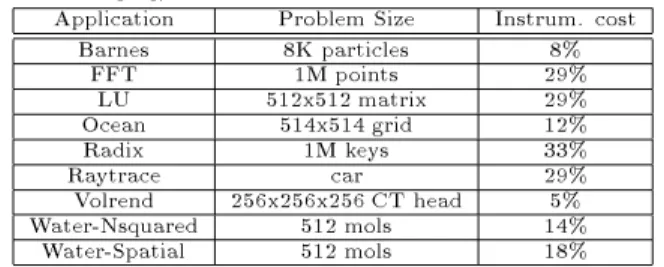
Applications: Table 1 shows the applications and the prob-lem sizes we use in this work. These applications are written for hardware DSM and they are known to deliver excellent parallel speedups for hardware cache coherent systems at the 16{processor scale we assume in this paper. They are taken from the SPLASH{2 suite (and from the restructured versions in [11]), and will not be described further here.
Application Problem Size Instrum. cost Barnes 8K particles 8% FFT 1M points 29% LU 512x512 matrix 29% Ocean 514x514 grid 12% Radix 1M keys 33% Raytrace car 29% Volrend 256x256x256 CT head 5% Water-Nsquared 512 mols 14% Water-Spatial 512 mols 18%
Table 1: Applications, problem sizes and instrumentationcosts.
The last column is the instrumentation cost in the aggressive, Alpha-based Shasta system, which we quote from [18] .
Protocol layer parameters: The protocol costs we vary and their achievable values that are assumed for the base system are shown in Table 2. The page protection cost is the cost of mprotect. A single mprotectcall may be made to the
kernel for a range of contiguous pages; it incurs a startup processing overhead, that is simulated, plus this per{page cost. This cost is aggressive for current operating systems but achievable with existing technology ( we veried that using a somewhat larger cost does not change the results much). The eects of twinning and ding on the cache (and the misses incurred) are simulated. Protocol handlers themselves cost a variable number of cycles. The basic
han-dler cost parameter is set to 100 cycles for bothSVMand
FG; additional costs for ding or traversing lists (e.g. write
notice lists) are added to this cost. The cost for travers-ing lists depends on processor speed and is set to 20 cycles per list element. The cost for ding is varied to allow for
studying the importance of ding in SVM. All these costs
closely approximate those of our real implementation. The set of values we consider for the protocol layer costs are: the
achievableset, thebest(idealized) set, where all costs are set
to zero, and thehalfwayset, where all costs are halfway
be-tween achievable and best. We do not examine a worse set of costs than the achievable set since these costs are quite closely linked to processor speed.
Parameter Achievable Best Halfway Units Page Protection 50 0 25 cycles/page
Di creation 10,10 0,0 5,5 cycles/word Di Application 10 0 5 cycles/word Twin Creation 10000 0 5000 cycles/word
Handler Cost 100+x 0+x 50+x cycles
Table 2: Protocol layer parameter values. The di creation cost
incurs a cost per word that is compared (rst number) and an additional cost per word that is put in the di (second number). The handler cost is composed of a basic cost and any additional cost for operations that may be executed by the handler.
Communication layer parameters: The parameters of the communication layer that are of most interest are the
fol-lowing Host overheadis the time the host processor itself
is busy sending a message, i.e. placing it in a buer for
the NI (we assume asynchronous send operations). NI
occu-pancyis the time spent in the NI processor or state machine to prepare each packet of the message and place it in an output queue for transmission. Packets are of variable size, depending on how much of the message data is available to
the NI at the time, and are up to 4 KBytes long. I/O bus
bandwidthis the main determinant of the host to network bandwidth, since network links and memory buses tend to
be much faster. Finally, message handling costmodels the
time from the moment a message reaches the head of the NI incoming queue to the moment the handler for the message starts to execute on the main processor; time and contention before reaching the head is simulated in detail and is not in-cluded in this parameterized cost. Incoming data messages (as opposed to requests) do not invoke a handler, and are de-posited directly in host memory by the NI without causing an interrupt or requiring a receive operation on the proces-sor [3, 5]. Hardware link latency is kept xed at 20 procesproces-sor cycles since it is usually small compared to the other costs. All costs we discuss for the communication architecture and the protocol are normalized to processor cycles. Table 3 shows the parameter values we use in the base system. The sets of values we consider for the communication layer are: The achievableset, which is modeled after a cluster of In-tel PentiumPro nodes connected by a Myrinet interconnect. Occupancy per packet is high because the processor in the Myrinet and most other commercial network interfaces is slow. However, since packets can be as large as 4 KBytes, occupancy can often be amortized. Recall that all con-tention in the system is modeled in detail, so when costs are changed the eects on contention are simulated as well.
Thebestset, where all protocol costs are set to zero. The
halfway set, where all values are halfway between the rst
two sets (more realistic than the best set). Theworst set,
where all values are doubled compared to the achievable set (i.e. worse, relative to processor speed).
Parameter Achievable Best Worse Real Host Overhead 600 0 1200 600{800 I/O Bus Bandwidth 0.5 2 0.25 0.45
NI Occupancy 1000 0 2000 1000 Message Handling Cost 200 0 400 N/A
Table 3: Communication parameter values. The rst three
columnsdescribethe valueswe use in our study as the Achievable, Best and Worse sets of values. Units are in cycles(and bytes/cycle for bandwidth). If we assume a 1 IPC, 200 MHz processor the achievable values are from top to bottom 3s, 100 MBytes/s, 5s and 1s. The fth column contains the values measured using a real communication library (VMMC [5] on a network of Intel Pentium nodes connected with Myrinet). The message handling cost is obtained from the polling{based Blizzard{S and Shasta systems (Personal communications.).
Presentation of results: We use the following nomencla-ture to refer to the parameter congurations in the two
sys-tem layers. CandPrefer to the communication and
proto-col layers, respectively. The set of values used for each layer is denoted as a subscript. The achievable set is denoted with the digit 0, the best set with the symbol +, the halfway set
between achievable and best with 1
2
; and the \worse" set
with ;: Thus the conguration corresponding to what is
achievable today is C0P0, and the zero{cost conguration
for both the communication and protocol parameters
dis-cussed earlier isC+P+.
Figure 3 presents all the main speedup results in this paper. Breakdowns of execution time are presented in Fig-ure 4. As we go through the next few sections, we shall focus on portions of the data in these gures.
For every application, there is a graph in Figure 3 with bars depicting speedups for dierent combinations of set-tings for the three layers. Each application graph has two
major sets of bars, on the left for the SVMprotocol and
on the right for theFG protocol. When an application has
two versions, there are two sets of bars for each protocol, separated by a space: original and restructured. For ease of comparison, speedups are always measured with respect to the same best sequential version, and the order of arrange-ment of the bars for the restructured version is a mirror image of the order for the original version.
The color of the bars in the speedup graphs encodes some information as well. The bars with the same color represent congurations with the same communication parameter val-ues, with only the protocol layer parameters being modied across them. Thus, black bars represent varying protocol layer parameter sets while keeping communication parame-ters xed at the achievable set, uniformly shaded bars with communication layer parameters xed at the worse set, and striped bars with those parameters xed at the best set. Unshaded bars show \ideal", 16-fold speedup as a reference point, which is close to the algorithmic (PRAM) speedup for these applications.
The breakdown graphs (Figure 4) divide the time into components, such as busy time, local cache stall time, data wait time or time spent waiting for communicated data, lock wait time, barrier wait time, and protocol overhead. Break-downs are shown averaged over all processors for a given ex-ecution, to save space. However, in analyzing the results we refer to per{processor breakdowns and more detailed per{ processor statistics gathered in the simulator to understand imbalances as well. The averaging may sometimes lead to discrepancies between the heights of the breakdown bars and the speedup bars; however, the alternative of showing the worst or last{to{nish processor instead is often
unrepresen-tative in terms of the breakdowns. 3 Results
Let us rst look at the results on only the base or achievable
systemC
0 P
0, to make some basic comparisons and place the
results in context with previous work. This includes
compar-ingSVMwithFGwith our system assumptions, and
validat-ing the application restructurvalidat-ing results forSVMfrom [11].
Then, we will examine new application restructuring results
for FG, the impact of the system layers, and the synergy
between layers.
3.1 Results for Base Architecture
Consider only the baseC0P0 bars (the black bars to which
the arrows point in Figure 3). For both the original and the
restructured applications, we see that FG either equals or
outperforms SVM. FG is especially better in applications
that use locks frequently, like Barnes-Original and to a lesser extent Water-Spatial and Volrend, and those like Radix or Ocean-Contiguous in which coarse granularity causes a lot of false sharing or fragmentation (false sharing is also a prob-lem with the image and task queues in Volrend due to
inter-vening synchronization). The only case in whichSVMdoes
better is the restructured version of Barnes (Barnes-Spatial). Note, however, that this comparison does not account for
access control costs in FG. Even with Shasta's aggressive
software instrumentation costs (see Table 1 with all caveats of Section 2), performance would be much closer, with each protocol outperforming the other in dierent applications. Applications with more complex pointer references may
in-cur higher instrumentation overheads. These results forFG
versus SVM would also be similar to the results obtained
on the Typhoon{zero platform, which provides commodity-oriented hardware support [22]. (The communication
pa-rameters here are dierent than on Typhoon{zero: theC0P0
platform has somewhat more bandwidth relative to
proces-sor speed, helpingSVM, but much more ecient access
con-trol, helping FG.) If we disallow application-specic
granu-larities, using 128 bytes or 256 bytes (the best overall gran-ularity found in [22]) in all cases, we nd (not shown) that
several of regular applications perform better under SVM.
Qualitatively, it appears that the protocols are similar at this scale with realistic access control, diering based on application. For both protocols however, the speedups on
C0P0 are clearly far from ideal, so there is a lot that can be
gained from optimizing the layers. 3.2 Impact of the Application Layer
The original versions of the applications we use (Table 1) are described in [20]. If evolutionary communication trends hold relative to processor speed, and hardware support to reduce protocol costs is not forthcoming, application restructuring
may be the only way to improve performance. ForSVM, the
result of comparing the two blackC
0 P
0bars for each
appli-cation agrees with that of [11]. The sources of the often large and sometimes dramatic improvements, described in [11] in-clude: (i) making actual access granularities to remote data larger in the application (e.g. writing to a local buer rst in Radix or using rowwise instead of square partitioning in Ocean), (ii) reducing locking and ne{grained synchroniza-tion at perhaps some cost in load balance (e.g. in the tree building phase of Barnes), and (iii) in some cases improv-ing the initial assignments of tasks so there is less need for task stealing (which is now very expensive due to synchro-nization and protocol activity, e.g. in Volrend; note that
in Volrend restructuring also greatly improves false sharing and fragmentation in the image at page granularity, and hence data wait time). Many characteristics of the
applica-tions relevant toSVM, including sharing patterns, message
frequencies and message sizes, are described in [10, 22, 2].
ForFG, not examined in [11], restructuring helps
signi-cantly in cases where application access granularity is made larger (e.g. Ocean), since it allows a larger granularity to be
PRAM SVM FG 0 5 10 15 Speedup FFT C P+ + -2 1 C P+ C P+ 0 C P0 + 0 C P0 C P- + C P- 0 C P+ 0 0 C P0 C P- 0 PRAM SVM FG 0 5 10 15 LU-Contiguous C P+ +-2 1 C P+ C P+ 0 C P0 + 0 C P0 C P- + C P- 0 C P+ 0 0 C P0 C P- 0 PRAM SVM FG 0 5 10 15 Raytrace C P+ + -2 1 C P+ C P+ 0 C P0 + 0 C P0 C P- + C P- 0 C P+ 0 0 C P0 C P- 0 PRAM SVM FG 0 5 10 15 Speedup Water-Spatial C P+ + -2 1 C P+ C P+ 0 C P0 + 0 C P0 C P- + C P- 0 C P+ 0 0 C P0 C P- 0 PRAM SVM FG 0 5 10 15 Water-Nsquared C P+ + -2 1 C P+ C P+ 0 C P0 + 0 C P0 C P- + C P- 0 C P+ 0 0 C P0 C P- 0 Base case PRAM PRAM
SVM-orig SVM-rest FG-orig FG-rest
0 5 10 15 Speedup Radix C P+ + -2 1 C P+ C P+ 0 C P0 + 0 C P0 C P- + C P- 0 C P- 0 C P- + 0 C P0 C P0 + C P+ 0 -2 1 C P+ C P+ + C P+ 0 0 C P0 C P- 0 C P- 0 0 C P0 C P+ 0 PRAM PRAM
SVM-orig SVM-rest FG-orig FG-rest
0 5 10 15 20 Ocean C P+ + -2 1 C P+ C P+ 0 C P0 + 0 C P0 C P- + C P- 0 C P- 0 C P- + 0 C P0 C P0 + C P+ 0 -2 1 C P+ C P+ + C P+ 0 0 C P0 C P- 0 C P- 0 0 C P0 C P+ 0 PRAM PRAM
SVM-orig SVM-rest FG-orig FG-rest
0 5 10 15 Speedup Barnes C P+ + -2 1 C P+ C P+ 0 C P0 + 0 C P0 C P- + C P- 0 C P- 0 C P- + 0 C P0 C P0 + C P+ 0 -2 1 C P+ C P+ + C P+ 0 0 C P0 C P- 0 C P- 0 0 C P0 C P+ 0 PRAM PRAM
SVM-orig SVM-rest FG-orig FG-rest
0 5 10 15 20 Volrend C P+ + -2 1 C P+ C P+ 0 C P0 + 0 C P0 C P- + C P- 0 C P- 0 C P- + 0 C P0 C P0 + C P+ 0 -2 1 C P+ C P+ + C P+ 0 0 C P0 C P- 0 C P- 0 0 C P0 C P+ 0 Figure 3: Application sp eedups. Please see text in \Presen tation of results" in Section 2for ho wt oi nterpret the bars and focus atten tion on some of them.
used successfully in the system, and when the need for task stealing is reduced (Volrend). However, restructuring that
helpsSVMcan sometimes hurtFG, such as in cases where
load balance is compromised to reduce lock wait time (e.g.
Barnes). Locks are not so problematic inFGas inSVM
pro-tocols: protocol activity is not postponed till synchroniza-tion points, and satisfying ner{grained block faults within critical sections is less costly than satisfying page faults, so there is less serialization.
Instead, load imbalance matters more. Overall,
restruc-turing is not benecial in as many situations as in SVM
because theFG protocol and granularities look a lot more
like the hardware{coherent protocols for which the original applications are optimized.
3.3 Impact of the Protocol Layer
Even with restructuring, performance of software DSM is still far from hardware DSM for many classes of applications and improvements in the lower layers are clearly needed. This section rst examines the impact of idealizing protocol
costs (Table 2), i.e. moving fromC0P0 to C0P+.
Proto-col costs may be improved by selectively adding hardware support or by altering the protocol.
Impact for FG: Focusing only on the blackC0P0 bar and
theC
0 P
+ bar just next to it for only the original versions
of the applications forFGin Figures 3, we see that
improv-ing protocol costs does not have a signicant impact onFG.
FGdoes not have dis or complicated protocol operations at
synchronization points. There are only two protocol{related
costs forFG: access control and protocol handlers. A rough
idea of the impact of instrumentation costs for software ac-cess control (which we do not simulate, as discussed earlier) can be gleaned from Table 1. Since protocol handlers are
very simple inFG, the cost of running the handlers is very
small compared to the communication layer costs associated with handling the messages and invoking the handlers.
In-strumentation of the original runs forFGshows that
chang-ing the cost of handlers (within a reasonable range) will not really aect performance, so we do not simulate dierent
costs forFGprotocol handlers.
Impact for SVM: InSVM, protocol costs have greater
im-pact. However, even the complete elimination of protocol costs usually does not lead to dramatic improvements in performance if the underlying communication architecture is kept the same (with the exception of Raytrace). For coarse{grained{access, single{writer applications like FFT and LU, there is very little expensive protocol activity to begin with. Several of the other applications that use a lot of locks (especially) or have irregular access and invali-dation patterns benet to varying extents: Barnes-original, Water-Spatial and Volrend-original about 10%, and Radix 20%. Greater improvements are seen in Ocean-Contiguous, Water-Nsquared and especially Raytrace.
Table 4 shows the percentage of the protocol time spent in di computation and application. The rest of the pro-tocol time is mostly spent in executing propro-tocol handlers. The other protocol cost components are very small. Regu-lar, single{writer applications spent very little time in han-dlers and there is almost no ding at all. Water-Nsquared is a regular application but not single-writer; it computes many dis for a lot of migratory data when it is updating
forces. For many irregular applications, di{related com-putation at synchronization points, such as frequent locks, usually dominates. Raytrace does not have much synchro-nization (and hence di activity) but has a very large num-ber of ne{grained messages due to irregular access, so pro-tocol handler cost is a large fraction of data wait time and processors spend a lot of time in the handlers themselves. Ocean-contiguous behaves similarly, although it is a regular application, due to ne-grained (one-element) remote ac-cesses at column-oriented partition boundaries in the near-neighbor calculations. When di cost is a problem, hard-ware support for automatic write propagation [3] can elim-inate dis [13, 9, 10], at the potential cost of contention and/or code instrumentation; we might expect it to help substantially in Water-nsquared and Radix. Finally,
im-proving protocol costs halfway (C
0 P
1=2, not shown in the
gures) usually provides about half or less of the benet of eliminating them (more on this in Section 3.5).
Application Protocol (%) Di Compute (%) Barnes-Original 7.2 68 FFT 0.5 0 LU-Contiguous 0.6 20 Ocean-Contiguous 3.0 10 Radix-Original 7.0 85 Raytrace 58 31 Volrend-Original 13.2 85 Water-Nsquared 10.7 80 Water-Spatial 3.2 94
Table 4: Percentage of total execution time spent by processors
in protocol activity, and percentage of this protocol activity time that is spent in di computation and application.
We see from the restructured applications (black bars in Figures 3), that even idealizing protocol costs together with application restructuring is insucient to approach the desired levels of performance that these applications can achieve on hardware-coherent machines. The large page granularity usually does not compensate for a less aggres-sive communication architecture even if protocol costs are magically made zero.
3.4 Impact of the Communication Layer
In recent times, overheads and bandwidths have scaled just a little bit slower than eective processor speed (about 50% per year versus about 70%) and NI occupancy can be as-sumed to scale with processor speed. It is useful to examine both what might be gained if thresholds or breakthroughs occur in communication performance and what might be lost in parallel speedups if it degrades relative to increasing processor speeds. Let us now return to the original protocol and examine the impact of improving the communication ar-chitecture only. In the best set of parameters, only the I/O bus bandwidth is nite or non-zero, being set to the same value as the memory bus bandwidth. Note that contention is still modeled in all parts of the system.
Impact for FG: Figure 3 shows that the best
communica-tion layer makes a dramatic dierence to speedups (C+P0
versusC0P0), bringing them quite close to the ideal for the
original applications. Except for the (small) protocol
han-dler cost, the FG system becomes like hardware cache
co-herence with a very fast communication architecture. Of course, adding in instrumentation costs for software access control would make the speedup worse, but the impact of the
speedups are substantially less than ideal (Barnes cases) are due to load imbalance and the still signicant synchroniza-tion cost.
Impact for SVM: ForSVM, the eects of the best
commu-nication architecture alone are substantial but less dramatic
than for FG. Applications that have little protocol
activ-ity, coarse{grained remote access and few or no locks, like FFT and LU, are constrained only by communication layer costs, so they now achieve close to ideal performance just
as withFG. The irregular applications are helped
substan-tially, but speedups with C+P0 are still as low as 5{7 on
16 processors for some of them. The breakdowns (Figure 4) show that the data wait time is mostly eliminated, but time waiting at locks is often still high. Imbalances in this time cause time waiting at barriers to be high too. Overall,
start-ing fromC0P0, communication costs generally seem to have
greater impact than protocol costs even forSVM(with
ex-ceptions like Water-spatial, Raytrace, and some restructured versions); but as we shall see in Section 3.5, once communi-cation costs are improved even to halfway (or restructuring is performed), protocol costs begin to gain in importance. Eects of Individual Parameters: Figure 5 shows the im-pact of varying only one communication parameter at a time
for some applications. These data forSVMwere discussed
in detail in [2], but the data for FG and the comparison
is new. FG clearly depends mostly on overhead and
occu-pancy, whereasSVMdepends mostly on bandwidth
(over-head and occupancy do not matter much, and interrupts which dominated in [2] are not used). These data also show the points where crossovers in protocol performance might happen (ignoring access control). Together with access con-trol costs and technology trends (e.g. bandwidth is increas-ing more rapidly than overhead is droppincreas-ing), they can help draw conclusions about choices among the protocols for spe-cic architectures or in the future.
Overall, we conclude that dramatic improvements in communication relative to processor performance will
dra-matically improve data wait time and FG performance;
forSVM, performance improves substantially (usually more
than for just improving protocol costs, at least starting from
C0P0) but is not enough since part of the problem in
irreg-ular applications is due to ne{grain lock synchronization.
Since I/O bandwidth remained nite in C+P0, we
experi-mented with doubling the I/O bandwidth compared to the
C+P0conguration. Applications that exhibit contention in
the network interface (e.g. FFT) benet substantially and
the performance improves to halfway betweenC
+ P
0and the
PRAM speedup for the application. 3.5 Synergy between Layers
Finally, let us examine both how improvements in the sys-tem layers aect the benets of application restructuring and are aected by them, as well as the synergy between pairs of layers.
Synergy in FG: Application restructuring forFGhelps
pri-marily due to the ability to use coarser granularity. Directly improving the communication architecture therefore reduces the impact of restructuring. When instrumentation is used for access control, its cost may also improve with restructur-ing (due to coarser access granularity and spatial locality), but this eect is much smaller.
For example, in Barnes, where the restructured version hurts rather than helps due to increased load imbalance, per{process execution{time breakdowns reveal that the key
load imbalance is that among data wait times. A faster com-munication architecture reduces this imbalance, leading to less damage from restructuring. Improving instrumentation costs does not interact much with communication layer
per-formance since the two are quite orthogonal. Thus, in FG
there is not much to be gained from the synergy between layers, especially if the communication layer is aggressive.
Synergy in SVM: InSVMwe nd a lot of interesting
inter-actions and a lot more synergy among layers. First, how ap-plication restructuring aects, and is aected by the two sys-tem layers depends on the application. In Barnes-original, restructuring reduces the amount of locking and serializa-tion, and while its importance diminishes as system layers
improve, it remains important all the way toC+P+and even
beyond. This is because some costs within the node (that are kept xed) remain, and bandwidth on the I/O bus is still not innite. Although protocol processing at synchroniza-tion points is free, some cost for communicasynchroniza-tion (whether all needed or due to fragmentation) remains and hence so does some serialization at locks. This is especially true for Barnes-Original because every critical section incurs more than one page miss and a lot of fragmentation within it. The
C ++
P
+(Table 5) case does much better. Because reducing
communication costs had a dramatic impact on lock serial-ization in Barnes-original, the communication layer aects the impact of restructuring more than the protocol layer. As for protocol costs, they take on greater relative signicance after restructuring than before it because a major other bot-tleneck has been removed; however, even in the restructured version communication costs are more important than pro-tocol costs. In Ocean, on the other hand, propro-tocol costs im-pact the benets of restructuring more than communication costs; also, the relative importance of the two system layers is reversed in the restructured version compared to the origi-nal. This is because the restructured version greatly reduces the number of messages but not the amount of useful data transferred, so the impact of message handling (protocol) cost is reduced relative to that of communication. Volrend and Radix behave similarly to Barnes in this respect (only less so): restructuring remains important as lower layers improve, and the impact of restructuring is reduced more by communication costs than by protocol costs (increasing the importance of protocol costs in the restructured
ver-sion). In Volrend, C
+ P
+ nally allows the critical sections
used for task stealing to be ecient enough for stealing to be successful at load balancing. While Radix continues to have low performance due to high communication and con-tention, restructuring makes a substantial dierence (66%)
even atC+P+. It takes C++P+ to deliver good speedups,
as in Barnes-Original but for a dierent reason.
InSVM, the two system layers themselves show
substan-tial synergy as well. While protocol costs are limited in the
improvement they can provide in the original C
0 case in
many applications, once communication costs are dramati-cally reduced (even halfway) the impact of reducing protocol costs becomes much greater (Figure 3), and vice versa when protocol costs matter (e.g. Ocean-Contiguous, Volrend).
Overall, in SVM no two layers are enough to improve
performance to rival hardware coherence for all applications, and all three layers are important to improve. The appli-cation layer and either of the lower layers combine to give a much greater improvement than any system layer does individually. In most cases, the order of impact is applica-tion followed by communicaapplica-tion followed by protocol. For
more important to making the programmer's job easier (i.e., making application restructuring less important). Restruc-turing changes the balance between the relative importance of protocol and communication costs, usually making the
SVM 0 5 10 15 1M Cycles FFT C P + + 1-2 C P + C P+ 0 C P0+ 0 C P0 C P + -C P -0 SVM 0 2 4 6 LU-Contiguous C P + + 1-2 C P + C P + 0 C P 0+ 0 C P 0 C P + -C P -0 SVM 0 20 40 60 80 100 Raytrace C P + + 1-2 C P + C P + 0 C P 0+ 0 C P 0 C P + -C P -0 SVM 0 5 10 Water-Spatail C P + + 1-2 C P + C P + 0 C P0+ 0 C P0 C P + -C P -0 SVM 0 5 10 1M Cycles Water-Nsquared C P + + 1-2 C P + C P + 0 C P0+ 0 C P0 C P + -C P -0 SVM-orig SVM-rest 0 50 100 150 Radix C P + + 1-2 C P + C P+ 0 C P0+ 0 C P0 C P + -C P -0 C P -0 C P + -0 C P 0 C P 0+ C P + 0 1-2 C P + C P+ + Base case
Handler Compute Time Thread Barrier Wait Time Thread Lock Wait Time Thread Data Wait Time Total CPU-Cache Stall Time Thread Compute Time
SVM-orig SVM-rest 0 20 40 60 1M Cycles Ocean C P + + 1-2 C P + C P + 0 C P0+ 0 C P0 C P + -C P -0 C P -0 C P + -0 C P0 C P0+ C P+ 0 1-2 C P + C P + + SVM-orig SVM-rest 0 20 40 60 Barnes C P + + 1-2 C P + C P + 0 C P0+ 0 C P0 C P + -C P -0 C P -0 C P + -0 C P 0 C P 0+ C P + 0 1-2 C P + C P + + SVM-orig SVM-rest 0 5 10 15 20 25 Volrend C P + + 1-2 C P + C P + 0 C P0+ 0 C P 0 C P + - C P -0 C P -0 C P + -0 C P 0 C P 0+ C P + 0 1-2 C P + C P + +
Figure 4: Application execution time breakdowns.
50 100 150 200 Bandwidth (MB/s) 0 4 8 12 16 20 Speedup 500 1000 1500 2000 NI Occupancy (cycles) 0 4 8 12 16 20 250 600 950 1300 1650 2000
Host Overhead (cycles)
0 4 8 12 16 20 Barnes-Original (FG) Barnes-Original (SVM) Barnes-Spatial (FG) Barnes-Spatial (SVM) Water-Nsquared (FG) Water-Nsquared (SVM) Water-Spatial (FG) Water-Spatial (SVM)
Figure 5: Speedups with communication architecture parameters. Each gure is a dierent parameter for various applications. Only
four applications are shown; for some of the more regular onesFGuses a coarse granularity too and the behavior of the two protocols is very similar. The curves with dashed lines are forFG, and with solid lines are forSVM.
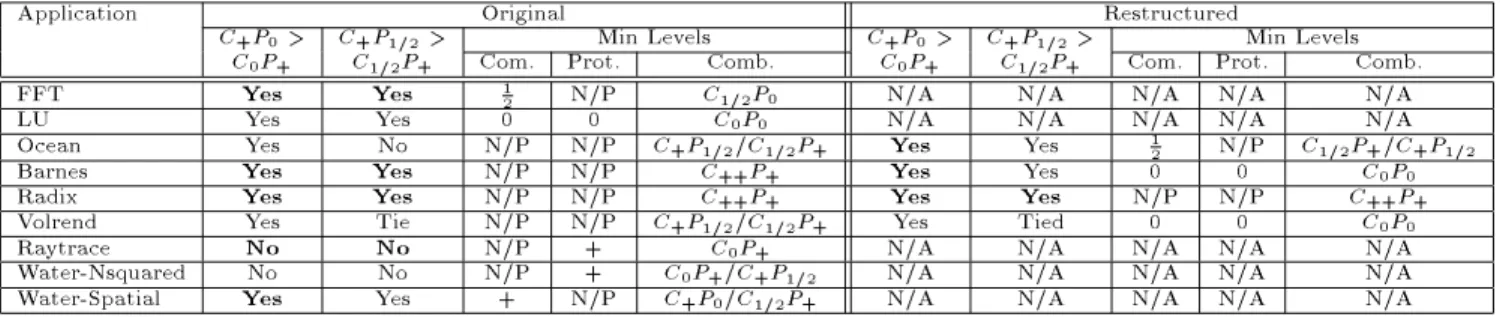
protocol costs more important than they were before. Proto-col costs also become more important once communication costs are improved (to say halfway), and vice versa. Table 5
summarizes forSVM, for each application, whether
commu-nication cost or protocol cost is initially more important,
whether C
1=2
P+ is better than C+P
1=2, and what
combi-nations of parameter values does it take to achieve about 10{fold speedup on 16 processors, which tells us both what is more important and what is needed. The need for im-provement in all layers, whether through basic performance characteristics as examined here or through altered function-ality to avoid some of these costs [1] is apparent from the last category. More detailed trends can be obtained from the graphs.
4 Related Work
The impact of individual communication architecture
pa-rameters on performance has been studied for SVM [2],
hardware coherence [8], and a non{coherent SAS [15].
How-ever, it has not been studied forFG, or by varying
param-eters simultaneously, or by examining the protocol layer as well. Various hardware supports to accelerate protocols have
been examined for SVM in [9] and [13], and forFGin the
Typhoon{zero prototype [17].
A previous study [6] compared the performance of several
non-home-based SVMprotocols; it examined two network
bandwidths and varied a unied software overhead cost. The study included only three small kernels and one application.
BothFGandSVMwere compared on a particular hardware
platform with a xed set of cost parameters in [22], with a focus on the impact of consistency models and coherence granularity. Its results are qualitatively similar to the ones
we observe here forFGversusSVM. This is the rst study
we know of that examines the impact of all these protocol and communication cost issues in an integrated framework for a wide range of applications (as well as including the impact of the application layer too).
5 Discussion and Conclusions
We have presented a framework for studying the limita-tions on the performance of software shared memory sys-tems, in terms of the layers of software and hardware that can be improved and how they impact the end performance of a wide range of applications. We have studied the lim-itations and performance eects through detailed simula-tion, treating the system layers (protocol and communica-tion layer) through only their cost parameters. The main limitations of the present work include the fact that it does not simulate true instrumentation{based ne{grained soft-ware shared memory, but rather a system with very ecient hardware access control but software protocols. Our main conclusions can be summarized as follows.
First, for currently achievable architectural values the
variable{grained FG and page{grained SVMprotocols
ap-pear to be quite comparable overall, especially if we fac-tor in aggressive but realistic access control costs. This
as-sumes that FG is allowed to choose the best granularity
of communication and coherence for each application; for
cases like FFT whereFG benets from coarse granularity,
we have found using a ner granularity to perform
substan-tially worse. In general,FGwill be worse when access
con-trol (e.g. instrumentation) costs are high or when it causes
too many small messages to be transferred; SVMis worse
when applications have a lot of ne-grained synchronization or a lot of fragmentation in page-grained communication (or especially both, as in Barnes-Original).
Second, forFGthe communication layer is key; protocol
layer costs are not very signicant, except for instrumenta-tion cost when software access control is used. Applicainstrumenta-tion restructuring is also not so widely important, at least when starting from applications that are well tuned for hardware{ coherent DSMs. Exceptions are when restructuring enables a coarser granularity of communication to be used eectively (as in Ocean), and when it reduces the frequency of task stealing (Volrend). As might be expected, the communi-cation parameters that matter most are overhead and NI occupancy, while bandwidth matters only when a coarser granularity is used.
Third, forSVM, contrary to our results forFG, we nd a
much richer set of interactions. (i) Improvements in all three layers are often necessary to achieve performance compara-ble to ecient hardware{coherent systems. No one layer or even pair of layers is enough across the range of applica-tions. (ii) There is synergy among the layers in that im-proving one system layer (even halfway) allows the other to have greater impact, so that realistic improvements to both system layers relative to processor speed may go a good way, and improving the applications often does not substantially diminish the further impact of system layers. (iii) Applica-tion restructuring is used both to make access patterns to communicated data more coarse grained and to reduce the frequency of synchronization; when applicable, it usually outperforms the gains from idealizing any one other layer. Thus, if useful guidelines can be developed for programming
SVMsystems, they can be extremely helpful. (iv) If only one
system layer is targeted for improvement, it should be the communication layer; among these parameters, the greatest dependence of performance is on bandwidth, and it is quite insensitive to improvements in the other parameters (when interrupts are used instead of polling, interrupt cost is a key bottleneck [2]). (v) Among protocol costs, the sensitivity is usually greatest to the costs associated with dis, primarily di creation. Handler cost can matter substantially in ap-plications that are more constrained by data message count than by synchronization. Table 5 summarizes the key
re-sults forSVMin terms of relative importance and what is
needed for good performance.
At a higher level, many interesting tradeos remain
be-tweenFGandSVM. ForSVM, the fact that it needs
syner-gistic improvements in multiple layers rather than just the communication layer may appear intimidating, and restruc-turing applications in fact is dicult (although recent re-sults show that similar restructurings are often needed for hardware-coherence at larger scale). But it is in some ways a promising sign, especially since the communication layer may be dicult to improve relative to processor speed, and
is not so much under the control of theSVMarchitect. Also,
the communication parameter it relies on most, bandwidth,
is the most likely to improve. FGrequires overhead and
oc-cupancy to improve further, which may be more challenging
under current memory and network speed trends. ForSVM,
while the heretofore major challenge of false sharing appears relatively easy to overcome in applications with today's pro-tocols, the large page granularity of communication seems to get in the way of applications that suer fragmentation in communication or ne-grained locking (often associated with true sharing as well).
Application Original Restructured C + P 0 > C + P 1=2 > Min Levels C + P 0 > C + P 1=2 > Min Levels C0P+ C 1=2
P+ Com. Prot. Comb. C0P+ C 1=2
P+ Com. Prot. Comb.
FFT Yes Yes
1
2 N/P
C 1=2
P0 N/A N/A N/A N/A N/A
LU Yes Yes 0 0 C
0 P
0 N/A N/A N/A N/A N/A
Ocean Yes No N/P N/P C + P 1=2/ C 1=2 P + Yes Yes 1 2 N/P C 1=2 P +/ C + P 1=2
Barnes Yes Yes N/P N/P C ++ P + Yes Yes 0 0 C 0 P 0
Radix Yes Yes N/P N/P C++P+ Yes Yes N/P N/P C++P+
Volrend Yes Tie N/P N/P C + P 1=2/ C 1=2 P + Yes Tied 0 0 C 0 P 0 Raytrace No No N/P + C 0 P
+ N/A N/A N/A N/A N/A
Water-Nsquared No No N/P + C0P+/C+P
1=2 N/A N/A N/A N/A N/A
Water-Spatial Yes Yes + N/P C+P0/C 1=2
P+ N/A N/A N/A N/A N/A
Table 5: Summary of system layer impact forSVM.C
++ P
+means that the communication architecture is even more aggressive than inC+P+ by further doubling the I/O bandwidth. N/P stands fornot possible,andN/A fornot applicable. Bold font is used when the dierence is large. The columns for each version of each application are: (i) IsC
+ P 0 better than C 0 P +, i.e. is communication more important than protocol. (ii) IsC+P
1=2better than C
1=2
P+. (iii) What minimum set of parameter values for each system layer is necessary, with the base level of the other layer, to get about 10{fold or greater speedup on 16 processors? What combination of levels does it take to achieve the same performance? For example, an 1
2 under the entry called \Com." says that the halfway or better communication costs, together with any protocol costs starting from the original, is enough to obtain 10{fold speedup. (C++P+ is excluded since it is too unrealistic).
Acknowledgments: We thank the members of the PRISM group at Princeton for useful discussions, and Rudrajit Samanta additionally for help with graphs. We gratefully acknowledge the support of NSF and DARPA.
References
[1] A. Bilas. Improving the Performance of Shared Virtual
Memory on System Area Networks. PhD thesis, Dept.
of Computer Science, Princeton University, August 1998. Available as technical report, Princeton University TR-586-98.
[2] A. Bilas and J. P. Singh. The eects of communication parameters on end performance of shared virtual memory clusters. InProceedings of Supercomputing 97, San Jose, CA, November 1997.
[3] M. Blumrich, K. Li, R. Alpert, C. Dubnicki, E. Felten, and J. Sandberg. A virtual memory mapped network interface for the shrimp multicomputer. InProceedings of the 21st
In-ternational Symposium on Computer Architecture (ISCA),
pages 142{153, Apr. 1994.
[4] N. J. Boden, D. Cohen, R. E. Felderman, A. E. Ku-lawik, C. L. Seitz, J. N. Seizovic, and W.-K. Su. Myrinet: A gigabit-per-second local area network. IEEE Micro, 15(1):29{36, Feb. 1995.
[5] C. Dubnicki, A. Bilas, K. Li, and J. Philbin. Design and im-plementation of Virtual Memory-Mapped Communication on Myrinet. InProceedings of the 1997 International
Par-allel Processing Symposium, pages 388{396, April 1997.
[6] S. Dwarkadas, P. Keleher, A. Cox, and W. Zwaenepoel. An evaluation of software distributed shared memory for next-generation processors and networks. InProceedings of the 20th Annual International Symposium on Computer
Archi-tecture, May 1993. To Get.
[7] I. S. et al. Fine-grain access control for distributed shared memory. InSixth International Conference on Architec-tural Support for Programming Languages and Operating
Systems, pages 297{307, Oct 1994.
[8] C. Holt, M. Heinrich, J. P. Singh, , and J. L. Hennessy. The eects of latency and occupancy on the performance of dsm multiprocessors. Technical Report CSL-TR-95-xxx, Stanford University, 1995.
[9] L. Iftode, C. Dubnicki, E. W. Felten, and K. Li. Improving release-consistent shared virtual memory using automatic update. InThe 2nd IEEE Symposium on High-Performance
Computer Architecture, Feb. 1996.
[10] L. Iftode, J. P. Singh, and K. Li. Understanding applica-tion performance on shared virtual memory. InProceedings of the 23rd Annual International Symposium on Computer
Architecture, May 1996.
[11] D. Jiang, H. Shan, and J. P. Singh. Application restructur-ing and performance portability across shared virtual mem-ory and hardware-coherent multiprocessors. InProceedings of the 6th ACM Symposium on Principles and Practice of
Parallel Programming, June 1997.
[12] P. Keleher, A. Cox, S. Dwarkadas, and W. Zwaenepoel. Treadmarks: Distributed shared memory on standard work-stationsand operatingsystems. InProceedings of the Winter
USENIX Conference, pages 115{132, Jan. 1994.
[13] L. I. Kontothanassis and M. L. Scott. Using memory-mapped network interfaces to improve t he performance of distributed shared memory. InThe 2nd IEEE Symposium
on High-Performance Computer Architecture, Feb. 1996.
[14] K. Li and P. Hudak. Memory coherence in shared virtual memorysystems.ACM Trans. Comput. Syst., 7(4):321{359, Nov. 1989.
[15] R. P. Martin, A. M. Vahdat, D. E. Culler, and T. E. Ander-son. Eect of communication latency, overhead, and band-width on a cluster architecture. Technical Report CSD-96-925, Berkeley, Nov. 1996.
[16] S. Reinhardt, J. Larus, and D. Wood. Tempest and typhoon: User-level shared memory. In Proceedings of the 21st
In-ternational Symposium on Computer Architecture (ISCA),
pages 325{336, Apr. 1994.
[17] S. K. Reinhardt, R. W. Ple, and D. A. Wood. Decou-pled hardware support for distributed shared memory. In
Proceedings of the 23rd Annual International Symposium
on Computer Architecure, pages 34{43, New York, May22{
24 1006. ACM Press.
[18] D. Scales, K. Gharachorloo, and C. Thekkath. Shasta: A low overhead, software-only approach for supporting ne-grain shared memory. InThe 7th International Conference on Architectural Support for Programming Languages and
Operating Systems, Oct. 1996.
[19] A. Sharma, A. T. Nguyen, J. Torellas, M. Michael, and J. Carbajal. Augmint: a multiprocessor simulation envi-ronment for Intel x86 architectures. Technical report, Uni-versity of Illinois at Urbana-Champaign, March 1996. [20] S. Woo, M. Ohara, E. Torrie, J. P. Singh, and A. Gupta.
Methodological considerations and characterization of the SPLASH-2 parallel application suite. InProceedings of the 23rd International Symposium on Computer Architecture
(ISCA), May 1995.
[21] Y. Zhou, L. Iftode, and K. Li. Performance evaluation of two home-basedlazy release consistencyprotocolsfor shared virtual memory systems. In Proceedings of the Operating
Systems Design and Implementation Symposium, Oct. 1996.
[22] Y. Zhou, L. Iftode, J. P. Singh, K. Li, B. Toonen, I. Schoinas, M. Hill, and D. Wood. Relaxed consistency and coherence granularity in DSM systems: A performance evaluation. In
Proceedings of the 6th ACM Symposium on Principles and