human behaviour
Niklas Palaghias
Submitted for the Degree of Doctor of Philosophy
from the University of Surrey
Institute for Communication Systems Faculty of Engineering and Physical Sciences
University of Surrey
Guildford, Surrey GU2 7XH, U.K.
November 2016
c
Understanding human behaviour in an automatic but also non-intrusive manner, consti-tutes an important and emerging area for various fields. This requires collaboration of information technology with humanitarian sciences in order to transfer existing knowl-edge of human behaviour into self-acting tools to eliminate the human error. This work strives to shed some light in the area of Mobile Social Signal Processing by trying to understand if today’s mobile devices, given their advanced sensing and computational capabilities, are able to extract various aspects of human behaviour. Although one of the core aspects of human behaviour are social interactions, current tools do not pro-vide an accurate, reliable and real-time solution for social interaction detection, which constitutes a significant barrier in automatic human behaviour understanding.
Towards filling the aforementioned gap in order to enable human behaviour under-standing through mobile devices, particular contributions were made. Firstly, an in-terpersonal distance estimation technique is developed based upon a non-intrusive op-portunistic mechanism that solely relies on sensors and communication capabilities of off-the-shelf smartphones. Secondly, based on user’s interpersonal distance and relative orientation, a pervasive and opportunistic approach based on off-the-shelf smartphones for social interaction detection system is presented. Leveraging information provided by psychology, analytical and error models are proposed to estimate the probability of people having social interactions. Then, to showcase the ability of mobile devices to infer human behaviour, a trust relationship quantification mechanism is developed based on users’ behavioural traits and psychological models. Finally, a prediction and compensation mechanism for the device displacement error that leverages human loco-motion patterns to refine the device orientation is introduced.
The above contributions were evaluated through experimentation and hard data col-lected from real-world environments to prove their accuracy and reliability as well as showing the applicability of the proposed approaches in daily situations. This work showed that mobile devices are able to accurately detect social interactions and further social and trust relationships among people, despite the noise induced in real-world situations. Close collaboration between informatics and social sciences is imperative, to overcome the significant barrier in the development of human behaviour understand-ing. This work could constitute a fundamental building block, as the computational power and battery autonomy of mobile devices increases, for the development of novel techniques towards understanding human behaviour, by including multiple behavioural traits and enabling the creation of socially-aware information systems.
Key words: Social Signal Processing, Human Behaviour, Social Interactions, Machine Learning, Mobile Phones.
1 Introduction 1
1.1 Motivation . . . 1
1.2 Objectives . . . 3
1.2.1 Interpersonal distance estimation with smartphones . . . 3
1.2.2 Modelling social interaction detection with smartphones in real-world . . . 4
1.2.3 Quantifying trust relationships from social interactions . . . 5
1.2.4 A prediction and compensation mechanism for device displacement 6 1.3 Contributions . . . 7
1.4 Outline . . . 8
Nomenclature 1 2 A Survey on Mobile Social Signal Processing 9 2.1 Introduction . . . 9
2.1.1 A mobile and opportunistic point of view . . . 11
2.2 An overview of Mobile Social Signal Processing . . . 13
2.3 Sensing frameworks . . . 16
2.3.1 Data collection . . . 17
2.3.2 Inference engines . . . 19
2.3.3 Framework comparison . . . 21
2.4 Social interaction detection . . . 21
2.4.1 Single modality . . . 22
2.4.2 Multi-modality . . . 25
2.4.3 Apposition of social interaction detection approaches . . . 26
2.5 Behavioural cues extraction . . . 27
2.5.1 Auditory . . . 28
2.5.2 Physical activity . . . 34
2.5.3 Gesture and posture . . . 38
2.5.4 Facial cues . . . 44
2.5.5 Environment and space . . . 48
2.5.6 Device usage . . . 55
2.5.7 Physiological . . . 56
2.6 From social signals to social behaviour inference . . . 57
2.6.1 Stress . . . 57
2.6.2 Emotion . . . 59
2.6.3 Mood . . . 62
2.6.4 Personality traits . . . 63
2.6.5 Dominance . . . 65
2.6.6 Other social behaviours . . . 66
2.7 Applications . . . 67 2.7.1 Health-care . . . 68 2.7.2 Organisational engineering . . . 69 2.7.3 Marketing . . . 70 2.8 Discussion . . . 70 2.9 Challenges . . . 74 2.9.1 Context recognition . . . 74 2.9.2 Multi-modal fusion . . . 75 2.9.3 Interdisciplinary area . . . 75 2.9.4 Ground truth . . . 76 2.9.5 Privacy . . . 76 2.9.6 Energy efficiency . . . 77
3 Interpersonal Distance Estimation with Smartphones 81
3.1 Introduction . . . 81
3.2 Background . . . 83
3.2.1 Coarse-grained distance estimation . . . 84
3.2.2 Fine-grained distance estimation . . . 84
3.2.3 Proposed approach . . . 86
3.3 Methodology . . . 87
3.3.1 Overview . . . 88
3.3.2 Training the models . . . 89
3.4 Experimental setup . . . 94
3.5 Results . . . 96
3.6 Conclusion . . . 100
4 Modelling Social Interaction Detection with Smartphones in Real-world 103 4.1 Introduction . . . 104
4.2 Related work . . . 106
4.2.1 Proximity detection . . . 107
4.2.2 Multi-modal detection . . . 108
4.2.3 The DARSIS approach . . . 109
4.3 DARSIS system . . . 110 4.3.1 Interpersonal distance . . . 111 4.3.2 Relative orientation . . . 112 4.3.3 Collaborative sensing . . . 114 4.4 System model . . . 115 4.4.1 Assumptions . . . 115 4.4.2 Prediction models . . . 116 4.4.3 Error Models . . . 118 4.5 Performance evaluation . . . 122
4.5.1 Relative orientation evaluation . . . 122
4.5.2 Error model evaluation . . . 126
4.5.3 Real-world social interactions . . . 129
4.5.4 Power consumption . . . 132
4.5.5 Data communication burden . . . 133
5 Quantifying Real-world Trust Relationships through Social
Interac-tions 137
5.1 Introduction . . . 138
5.2 Background . . . 139
5.2.1 On-line social networks . . . 139
5.2.2 Real-world social graphs . . . 141
5.2.3 Proposed approach . . . 142
5.3 Methodology . . . 143
5.3.1 Background . . . 143
5.3.2 Real-world social graph . . . 143
5.3.3 Deriving trust relationships . . . 146
5.4 Experimental setup . . . 150
5.5 Results . . . 151
5.5.1 Real-world social graph . . . 151
5.5.2 Trust relationships . . . 152
5.6 Potential applications . . . 154
5.7 Conclusion . . . 156
6 A Prediction and Compensation Mechanism for Device Displacement159 6.1 Introduction . . . 159 6.2 Background . . . 162 6.3 Methodology . . . 164 6.3.1 Assumptions . . . 164 6.3.2 Approach . . . 166 6.3.3 Kinematics . . . 166 6.4 System Design . . . 170 6.4.1 Mechanism . . . 170
6.4.2 Activity detection model . . . 171
6.4.3 On-body position detection model . . . 172
6.4.4 Prediction . . . 172
6.4.5 Error models . . . 175
6.4.7 Correction . . . 179 6.5 Experimental setup . . . 179 6.5.1 Dataset . . . 179 6.5.2 Performance metrics . . . 180 6.6 Results . . . 181 6.6.1 Performance Evaluation . . . 181 6.6.2 Error Evaluation . . . 190 6.6.3 Discussion . . . 195 6.7 Conclusion . . . 197 7 Conclusion 199 7.1 Future work . . . 203 Appendix A Tables 207 A.1 Summary of Mobile SSP Literature . . . 207
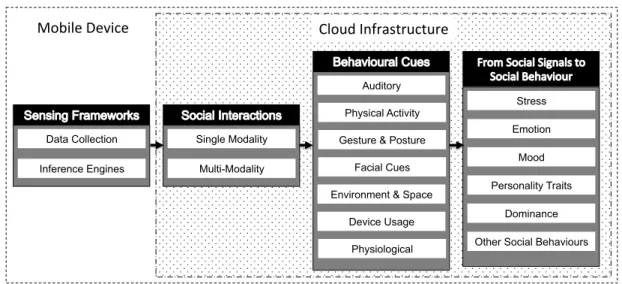
2.1 Application architecture on Mobile Social Signal Processing. . . 13
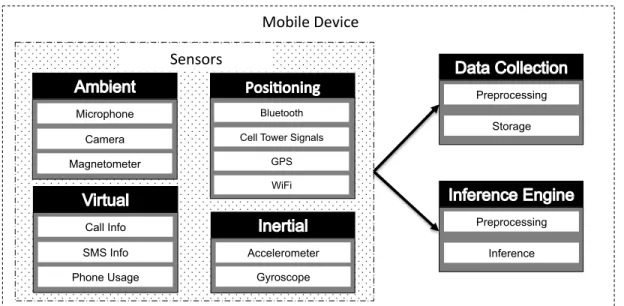
2.2 Application architecture of existing Sensing Frameworks. . . 16
2.3 State-of-the-art social interaction detection approaches. . . 22
2.4 Behavioural cues emitted during a social interaction. . . 27
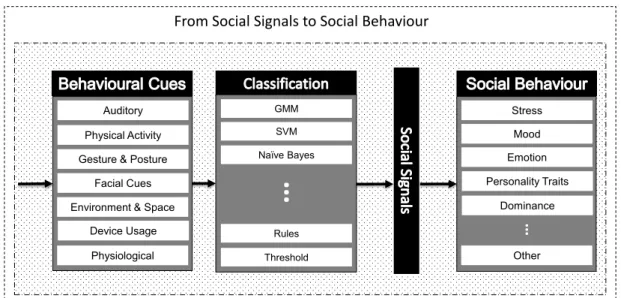
2.5 Process of understanding social behaviour through social signals. . . 58
3.1 Effect of window size in distance estimation. . . 83
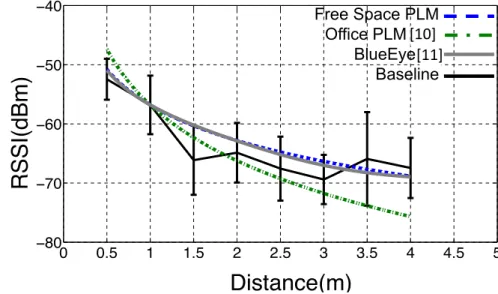
3.2 Spatial arrangement of people including the concept of interaction zones. 85 3.3 Performance of various propagation models based on Bluetooth RSSI. . 87
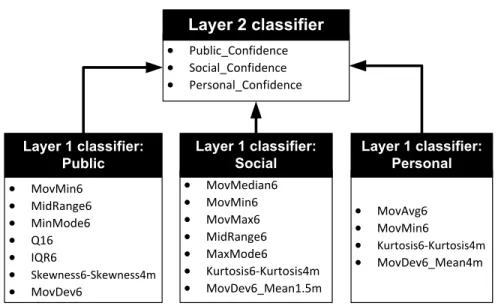
3.4 Features for 2-Layer DHC. . . 90
3.5 ROC Diagrams for DARSIS and state-of-the-art approaches. . . 98
4.1 Spatial arrangement of people in a social situation . . . 108
4.2 The DARSIS system architecture. . . 111
4.3 Relative spatial arrangement in a social situation. . . 120
4.4 Error distribution of DARSIS and error model. . . 128
4.5 Real-world experiment environment. . . 130
4.6 DARSIS energy consumption. . . 132
5.1 From social interactions to trust relationships . . . 144
5.2 Information flow in the MobTrust. . . 146
5.3 Real-world social graph from MobTrust. . . 151
5.4 Trust relationship colour maps from MobTrust. . . 153
6.1 Device displacement on real-world data. . . 161
6.2 Displacement on uDirect. . . 165
6.3 Device displacement compensation system. . . 166
6.4 Movement projection planes. . . 167
6.5 Device displacement detection points based on kinematics. . . 169
6.6 Complementary Kalman filter. . . 170
6.7 Displacement compensation in trousers front pocket. . . 182
6.8 Displacement compensation in trousers back pocket. . . 183
6.9 Displacement compensation when hand held. . . 184
6.10 Displacement compensation when hand held and using. . . 186
6.11 Displacement compensation in backpack. . . 187
6.12 Displacement compensation in handbag. . . 188
6.13 Displacement compensation in shirt pocket. . . 189
6.14 Error distribution based on on-body positions. . . 191
6.15 Error distribution based on orientation tracking methods. . . 192
Introduction
1.1
Motivation
In the recent years the popularity and computational power of mobile devices such as smartphones, tablets and wearable devices has led to a new era where they are substi-tuting computers and means of communication. Moreover, in order to facilitate user experience, mobile device production companies have integrated various sensors such as accelerometer, gyroscope, GPS, digital compass, microphone and camera. Further-more, the release of application stores has given the opportunity to third party devel-opers to implement their own applications. The combination of the embedded sensors and the application stores may introduce radical changes in fields such as healthcare, environment monitoring and human behaviour recognition.
The main challenge of this area is how to mine information about human behaviour derived from the device without endangering the user experience. The applications are categorised into participatory, where the user has active involvement in context recognition and into opportunistic where user does not affect the process [1]. Research in opportunistic sensing has focused mainly on extracting knowledge on backend servers. On the other hand, there is a need for development of new techniques for executing the above mentioned processes on mobile devices. By leveraging information derived from mobile devices, the following questions arise:
• What human behaviours are mobile devices capable of accurately recognising despite their limitations and constraints? Or more specifically to what extent can mobile devices contribute to a machine understanding of the social context of users?
• Is a mobile device capable of dealing with the demanding amount of energy, computational burden and memory constraints?
• What improvements must be applied to current techniques in order to accomplish knowledge extraction about human behaviour on mobile devices?
The execution of human behaviour recognition on mobile devices presents some major advantages [2]:
• It eliminates WiFi and Cellular communication with backend servers in order to infer user context, thus minimising the communication load and improving a mobile device’s battery life.
• Minimises financial cost due to cellular communication.
• Protection of user private information as behaviours are recognised locally and information leaving the phone can be better controlled.
• Allows user to be involved in the generation of labels concerning recognised context, allowing semi-supervised learning techniques to be leveraged through a crowd sourcing approach.
Based on the above advantages, it is hypothesised that mobile devices constitute the most qualified devices to infer social contexts of their users. The social interaction detection process is a very critical part of the context inference process. It constitutes the ground base for retrieving information regarding user’s social behaviour. Thus, a generic social interaction detection method for mobile devices will plausibly widen the current range of user context recognition applications, acting as a foundation of the area but also as a quantification mean of various aspects of user’s social daily life such as sociability [3], social role [4] and trust relationships among people.
The key research problem that this study is striving to answer is to what extent could mobile devices contribute in understanding different aspects of social behaviour such as the trust relationships among people by detecting and combining several be-havioural cues and social interaction information in an accurate, non-intrusive and privacy-preserving way.
1.2
Objectives
While mobile devices continue to provide more computation, memory, storage, sensing and communication bandwidth combined with their pervasive and ubiquitous character, they become the most qualified device for sensing and inference of social context [5] [6]. The aim of the present study is to develop techniques to extract knowledge about human behaviour on mobile devices. These advanced techniques will be essentially based on machine learning in order to recognise user social context and increase the inference accuracy which has been neglected due to device limitations. In the following subsections the main objectives of this study are outlined.
1.2.1 Interpersonal distance estimation with smartphones
Proxemics i.e. interpersonal distance among people has initially preoccupied research psychology, sociology etc. and later on the field of informatics. Initial works in psychol-ogy understood the importance of interpersonal distance among people by observing in the beginning the spatial arrangement of animals when they were in vicinity and later on followed similar approach for people. Hall [7] after conducting real-world experi-ment to understand the effect of interpersonal distance, concluded on creating different interaction zones based on the distance and mapping these zones into human social relations. This was the starting point towards understanding and measuring the inter-personal distance among people. Informatics strived to develop self-acting tools that would measure the interpersonal distance among people. Current approaches leverage obtrusive technologies in order to understand the interpersonal distance among people, to achieve high accuracy in the estimation. Also, in many cases they require from the
user to modify the firmware in order to deploy a particular configuration. Empirical and experimental evaluation (See Chapter 3) showed that state-of-the-art techniques have limited accuracy in estimating interpersonal distance as they are not able to cope with the signal fluctuation observed in real-world environment. Another major drawback of existing techniques for interpersonal distance estimation is the requirement for a large number of samples in order to perform inference. This induces a considerable amount of delay in the sensing and inference process and also may provide faulty estimations due to the usage of outdated samples.
In order to tackle the above drawbacks to infer accurately and in real-time the interper-sonal distance estimation there is a need to develop a novel machine-learning technique that will consider a small number of signal-samples. Leveraging the Bluetooth received signal to estimate interpersonal does not induce any requirement about firmware mod-ification and also provides the native capability for ad-hoc discovery among the de-vices. In order to tackle the fluctuation of the Bluetooth received signal, a hierarchical approach of machine-learning models combined with informative features and robust classifier could provide an accurate and reliable approach for estimating interpersonal distance. To select the most informative features there is a need to create a bank of features including a large number of samples that consider the human body absorption and then apply feature reduction and classifier wrapping techniques. To understand the applicability of the proposed interpersonal distance estimation technique, it will be evaluated against the state-of-the-art techniques in indoor environment.
1.2.2 Modelling social interaction detection with smartphones in real-world
A prerequisite for extracting social signals and in general human social behaviour, is the detection of social interaction among people with the above mentioned benefits of mobile devices. A first step towards mining information leading to possible social interactions is the identification of users’ spatial arrangement indicating that they are potentially interacting. Following in the rest of this report, the terms of social relation or social interaction will refer to information about the relative spatial arrangement
of the users during a social interaction. The detection of social interactions consists initially of two main parameters: a) relative orientation and b) interpersonal distance. The relative orientation of users requires modelling the knowledge of the direction of each of the participants. This cognition could be acquired by leveraging the capabili-ties of uDirect algorithm [5], which uses the walking locomotion of the user and only through two sequential steps is able to estimate his facing direction. Subsequently, proximity distance was leveraged in order to estimate if users’ interpersonal distance allows them to perform social interactions. For interpersonal distance estimation, the state-of-the-art techniques were assessed and concluded in developing two novel prob-abilistic models based on Bluetooth RSSI that detect: a) Interaction zone and b) Proximity. Interaction zone model provides a fine-grain estimation of the interpersonal distance of users. Proximity model, given the Bluetooth RSSI, infers if the users are in proximity to perform a social interaction. The developed system for detecting so-cial interactions operates in a fully distributed manner, both the sensing and inference part. This is achieved by exchanging the user direction from uDirect algorithm and the Bluetooth RSSI logged. Thus, each device has retrieved the required information to carry out its independent inference. Further details about the system and the results of its evaluation are provided in Chapter 4.
1.2.3 Quantifying trust relationships from social interactions
Deriving trust relationships from real-world social interactions may contribute signif-icant information towards social behaviour understanding. The level of trust among people constitutes a parameter for describing the social context but also an important measure for security and privacy in pervasive systems. Current works for deriving trust relationships either consider only on-line social networks to create trust networks or fo-cus on users’ on-line social interactions. An opportunistic sensing system may allow the derivation and quantification trust relationships among people through smartphones based on the detected real-world social interactions. A real-world social graph may be derived from users’ daily social interactions by also considering snapshots of their social relation. A hybrid model is developed to quantify users’ trust relationships based on the extracted real-world social graph, the estimated social relations and the
contex-tual information provided by the detected social interactions. As a proof of concept, a real-world evaluation of the system is performed.
Trust has received many definitions depending on the context in which it is defined [8]. Among the most predominant definitions is the ”generalised expectancy held by an individual that the word, promise, oral or written statement of another individual or group can be relied on” [9]. Quantifying such a complex notion constitutes a great chal-lenge and requires particular care in the process followed [10]. In order to quantify this multidimensional notion there is a need to combine multiple modalities and behavioural cues to derive a coherent measurement of trust. This work will strive to provide an initial measurement of trust by leveraging information from social situations, given the importance of trust in social interactions [11]. In particular behavioural cues will be extracted from social interactions and social situations, which will be combined in a simplistic manner to try to derive an initial measurement of trust.
1.2.4 A prediction and compensation mechanism for device displace-ment
The pervasive computing paradigm has led to the current situation where a user’s environment is full of mobile and wearable computing and communication devices. Equipped with dozens of sensors, these devices allow to gather many different types of data produced by the user, and to infer contextual information and knowledge. Based on this various new services can be provided to the user. Such contextual knowledge has already been utilised in various types of applications including fitness, eHealth, behavioural, localisation etc. However, the devices are used in peoples’ daily routine, this means they usually operate in unconstrained and real-world situations. This leads to arbitrary movements that constitute a permanent source for errors for applications which work on the assumption that the device is following user’s body movement [5] [12] as it is considered attached to or implanted in user’s body. Common examples of these situations are, displacement of the mobile phone in users’ trousers’ pocket while they are walking, or users with sensor device implanted. This type of displacement can lead to arbitrary movements and erroneous conclusions based on the sensor data collected.
There is a body of work that aimed to cope with the device displacement through filtering techniques or through analysis of the effect of device displacement in activity recognition [13] [14]. Further, occurrence of device displacement is detectable when user is standing, as there are no linear or angular accelerations applied on the device, excluding gravitational. However, there is no mechanism that tries to detect and com-pensate device displacement while the user is walking. The proposed approach here identifies particular reference points in the walking cycle and in an efficient manner it allows the estimation and compensation of device displacement.
1.3
Contributions
Due to the benefits of detecting human behaviour, the necessity of mining social signals in an automatic, consistent and non-intrusive manner, has been raised. This study in-tends to provide a set of tools that allow continuous monitoring, detection and inference of social behaviour of people through mobile devices.
The main contributions focus on:
• Development and evaluation of a novel technique for inferring interpersonal dis-tance among people to detect when they are in physical proximity and in which interaction zone, by utilising machine learning methods.
• Modelling, development and evaluation of an opportunistic and collaborative sys-tem for real-world environments that leverages the proposed interpersonal dis-tance estimation and the improvement of a state-of-the-art technique for estimat-ing user’s direction to understand social interactions among people.
• Research on understanding and modelling of trust relationship among people based on social interactions and additional contextual information in real-world environments.
• Design, development and evaluation of a novel mechanism for mobile devices that detects and compensates the device displacement error induced due to arbitrary movements in users daily life.
1.4
Outline
The remainder of this report is structured as follows. Chapter 2 surveys the existing literature in Mobile Social Signal Processing including the state-of-the-art solutions for detecting social interactions among people. Chapter 3 presents the initiative approach of solving the challenge of estimating interpersonal distance among people through smartphones. The overall social interaction detection system is described in Chapter 4. Leveraging the social interaction detection system, a novel quantification mechanism for trust relationships is proposed in Chapter 5. Chapter 6 proposes a novel mechanism for predicting and compensating device displacement for mobile devices. Chapter 7 provides a conclusion and future work regarding this research.
A Survey on Mobile Social Signal
Processing
This chapter provides an overview of the area of Mobile Social Signal Processing (SSP) while striving to shed some light on the fundamental process of inferring social be-haviour on mobile devices. It initially clarifies the core controversial terms of the field, continues by introducing the stages of mobile inference of human behaviour. Finally, it argues about potential applications in three main areas healthcare, corporations and marketing while describing the current shortcomings in literature regarding context recognition, multi-modal fusion, interdisciplinary character of the area and energy effi-ciency, which will be tackled in this research.
2.1
Introduction
Human behaviour understanding has received a great deal of interest since the beginning of the previous century. People initially conducted research on the way animals behave when they are surrounded by creatures of the same species. Acquiring basic underlying knowledge of animal relations led to extending this information to humans in order to understand social behaviour, social relations etc. Initial experiments were conducted by empirically observing people and retrieving feedback from them. These methods gave rise to well-established psychological approaches for understanding human behaviour,
such as surveys, questionnaires, camera recordings and human observers. Neverthe-less, these methods introduce several limitations including various sources of error. Completing surveys and questionnaires induces partiality, unconcern etc. [15], human error [16], and additional restrictions in scalability of the experiments. Accumulating these research problems leads to a common challenge, the lack of automation in an unobtrusive manner.
An area that has focused on detecting social behaviour automatically and has received a great amount of attention is Social Signal Processing (SSP). The main target of the field is to model, analyse and synthesise human behaviour with limited user interven-tion. To achieve these targets, researchers presented three key terms which constitute different levels of abstraction in the process of educing social behaviour [17] [18] [19]. Behavioural cues include various characteristics of human behaviour that are extracted from a modality such as prosody of the voice and interlocutors spatial arrangement. The combination of these behavioural characteristics indicate a person’s current sen-timent, understanding, attention, interest etc. which are social signals. Pentland [20] described social signals as non-verbal communication signals emitted when people are socially interacting. Merging these social signals in a longer temporal term leads to a person’s social behaviour. In recent literature the terms have been used in other areas such as social networks [21] to indicate every social related Internet activity of a user. However, this aspect is not considered in behaviour inference. Social networks may function as an enhancement of SSP to provide additional information regarding the context but in this work the two areas are considered distinct.
In [22] a generic procedure was proposed to detect social behaviour:
1. Data capture.
2. Person detection.
3. Extraction of audio and visual behavioural cues, and their mapping to social signals.
This procedure is focused on detecting the social behaviour of people through audio and visual data, from an external observer’s point of view. In order to achieve this observation, microphones and cameras are required to be deployed on the scene to monitor people. The major disadvantages of this approach are a) limited mobility of the system, where in case of the requirement for conducting an experiment in a different area there is a need for re-deploying and re-configuring the system to the specific environment, b) the confinement in scalability because the equipment is deployed at a certain environment and cannot follow the user’s mobility c) social signals are emitted during social interactions and when the detection process is based on audio and visual data, there is a need to perform person detection which is neglected, and finally d) establishing ground truth in audio and visual data requires labelling that is a time-consuming process and may induce human error.
2.1.1 A mobile and opportunistic point of view
The purpose of this chapter is to review state-of-the-art techniques for extracting social behaviour through mobile phones and also to introduce a discussion on the remaining challenges, existing gaps and potential extensions of existing solutions of the area. Un-derstanding social behaviour in an automatic, non-intrusive, mobile, but also scalable manner constitutes a significant challenge with several potential applications. To ad-dress this challenge, close collaboration is required from the fields that accord two of the most important components of the field, information technology and psychology [23]. This collaboration will support the development of opportunistic non-intrusive self-acting tools for extrself-acting human behaviour. These tools will expunge several sources of error introduced by current obtrusive and user engaging methods that incorporate human factor in the sensing process. In parallel, SSP focused on providing concrete solutions regarding modelling, analysis and synthesis of social behaviour. However, as mentioned some major gaps have been identified.
In order to fill these gaps the following objectives were determined, which will drive the research on extracting personalised social behaviour a step further.
• Capturing cues from user’s perspective, to produce personalised data.
• Leverage multiple modalities, to extract more robust and reliable behavioural information.
• Continuous sensing and inference process, without mobility and scalability re-strictions.
• Elimination of external hardware requirement.
Smartphones have become a core feature of peoples’ daily lives. In recent years, popu-larity and computational power of mobile phones have led to a new era where they are substituting computers and other means of communication such as old feature phones, fixed line phones etc. Moreover, to facilitate a more rich user experience, mobile phone manufacturers have integrated various sensors such as an accelerometer, gyroscope, GPS, digital compass, microphone, camera etc. Furthermore, on-line application stores have given the opportunity to third party developers to implement their own applica-tions utilising available integrated sensors seamlessly. Combining embedded sensors and application stores will introduce radical changes in fields such as healthcare, envi-ronment monitoring and human behaviour recognition by allowing easy, non-intrusive and wide deployment of mobile applications.
Given the pervasive and ubiquitous character of mobile devices and considering the built in sensing features, smartphones are considered as ideal devices for extracting social behaviour among people. To support this claim, Mobile Social Signal Processing (Mobile SSP) is introduced while proposing the main architecture of human behaviour inference for mobile applications. Further, each stage is analysed by providing state-of-the-art techniques capable of being executed on mobile devices. Also, potential application cases will help to familiarise the reader with areas that will benefit from the growth of Mobile SSP, followed by a discussion of research opportunities that may be leveraged for further contribution to the field.
In the remainder of this chapter a survey for Mobile SSP is provided. Section 2.2 de-scribes the overall area of Mobile SSP while clarifying the core terms of the field. A brief description of existing sensing frameworks is shown in Section 2.3 and assists the
Data Collection Inference Engines Single Modality Multi-Modality Mobile'Device' Cloud'Infrastructure' Auditory Physical Activity Gesture & Posture
Facial Cues Environment & Space
Device Usage Physiological Stress Emotion Mood Personality Traits Dominance Other Social Behaviours
Figure 2.1: Application architecture on Mobile Social Signal Processing.
reader in the selection criteria. State-of-the-art techniques utilised to detect social inter-actions among people on mobile phones are presented in Section 2.4. Behavioural cues extracted on smartphones whilst informing about their advantages and disadvantages are described in Section 2.5. Section 2.6 showcases methods of mining social signals and mapping them to social behaviours. Section 2.7 describes existing and potential applications of Mobile SSP. An overall discussion about methods presented for extract-ing social behaviour on mobile phones is argued in Section 2.8. Finally, challenges of the area are outlined in Section 2.9 and the chapter concludes with Section 2.10.
2.2
An overview of Mobile Social Signal Processing
Mobile devices and in particular smartphones are ubiquitous. Multi-modal sensing capabilities combined with increased computational power and available tools for mobile application development led to the view that smartphones are ideal devices for filling the gap of lack of automation in social behaviour understanding. Users can easily install an app from on-line application stores without any geographical restrictions and the device will automatically become a human behaviour aware smartphone. To discriminate and categorise more easily the types of applications two classes have been defined: participatory are the social behaviour detection applications that require the user’s participation in the sensing process and opportunistic where the user is not
involved in the process [1]. In order to minimise the obtrusiveness of the system and secure the user’s spontaneous behaviour, the main attention of the work is focused on
opportunistic social behaviour detection applications.
Similar to [24] and based on the literature review it was concluded that the following steps need to be taken for extracting social behaviour on mobile devices (See Figure 2.1).
1. Sensing.
2. Social Interaction Detection.
3. Extraction of Behavioural Cues.
4. Understanding Social Behaviour by Inferring Social Signals.
Social behaviour inference on mobile devices is initiated by theSensing process. During daily life, users emit behavioural cues and social signals, which are captured by sensors of the mobile device. These sensors may be integrated in the device or enclosed in external hardware that communicates with the mobile device. Each sensor detects a particular modality, then it converts the detected signal into a raw data signal. The result is processed into a desired format or is directly forwarded to the next stage of social behaviour inference. Researchers have developed various sensing frameworks to allow developers to collect data in an abstract and uniform way, while in some cases they also include an inference engine.
Pentland recognised the emission of social signals during a social interaction [25]. This signifies the importance of recognising social interactions before initiating the process of social behaviour understanding. After retrieving the appropriate data from mobile device’s sensors,Social Interaction Detectionmay be performed as a preprocessing step of social behaviour inference. Understanding social interactions provides important contextual information that may be leveraged in the next steps of social behaviour inference. The knowledge of on-going social interactions may also be utilised for filtering data and allowing the development of adaptive sensing and inference techniques. In applications focusing on extracting behavioural information not related to the social aspect of a person, it is strongly encouraged to include this step as it provides important contextual information.
Following the identification of on-going social interactions is the extraction of be-havioural cues. Different modalities may be leveraged for the extraction of a behavioural cue, depending on the grammar defined in psychology. Each selected sensed modality is forwarded to behavioural cues extraction. Existing literature has been classified into seven categories based on the types of cues each work extracts (See Figure 2.1). The behavioural cues extraction is achieved through techniques such as decision models, statistical analysis etc.
The final stage of Mobile SSP is the transition from the understanding ofsocial signals
to social behaviour inference. Close collaboration with social sciences may provide
the theoretical mapping among behavioural cues, social signals and social behaviours. Literature has been grouped based on the inferred social behaviour through mobile phones. The extracted behavioural cues are fed in decision making techniques to mine social signals and infer in long-term social behaviour.
To facilitate the reader’s understanding of the field, an outline of the main steps and requirements is provided for an integrated and real-world-enabled Mobile SSP:
• Define the context of the Mobile SSP application.
• Select the modalities required to infer a particular social behaviour.
• Define the grammar of behavioural cues and social signals that will lead to social behaviour inference.
• Evaluate and verify the reliability of the approach in a real-world environment based on ground truth.
In addition to the above requirements, researchers need to consider the intrusiveness, security and privacy of the system. Researchers need to take into account the compu-tational burden and energy consumption which may endanger user experience. These parameters do not constitute a prerequisite for the realisation of Mobile SSP but will facilitate user experience and privacy.
In the following sections, each of the pre-defined stages will be analysed and state-of-the-art research are outlined. The works described in the next sections are summarised
Preprocessing Storage Microphone
Camera
Bluetooth Cell Tower Signals
Accelerometer Gyroscope Mobile'Device' Sensors' Preprocessing Inference WiFi GPS Magnetometer Call Info SMS Info Phone Usage
Figure 2.2: Application architecture of existing Sensing Frameworks.
in the Electronic Appendix, introducing the techniques developed in each stage of social behaviour inference.
2.3
Sensing frameworks
Sensing is the first stage in extracting human behaviour on mobile devices. In this stage, selection of appropriate modalities is performed. These will later on be processed and analysed to reveal information about user’s social behaviour. It constitutes the lowest level of the process, which collects raw data from sensors and other interfaces that can provide information relevant to the user (See Figure 2.2). After retrieving information from sensors either the raw data are forwarded to the next stages or lightweight and simplistic processing may be performed to minimise the complexity and computational burden at the upcoming stages. As shown in Figure 2.1, the next stages in social behaviour inference may be performed either on the device or at a backend server.
This section introduces and then compares existing sensing frameworks. Through this introduction, the reader should be able to understand the criteria based on which sensing framework should be selected for a desirable social behaviour application. An extensive analysis of existing sensing frameworks is outside the scope of this research
Table 2.1: Data collection frameworks for offline analysis
Framework Sensor Types Energy Privacy License Inertial Ambient Position Virtual Efficient
MyExperience X X X BSD [26] SeeMon [27] X X X X X Anonysense X X X X X [28] OpenDataKit X X X X Apache [29] 2.0 PRISM [30] X X X X X LiveLab [31] X X X X X SystemSens X X X X Custom [32] Funf [33] X X X X GNU GPL Medusa [34] X X X Apache 2.0 METIS [35] X X X X X MSF [36] X X X X
and the reader is referred to [1] and [2].
2.3.1 Data collection
This subsection focuses on sensing frameworks that perform only data collection and some minor pre-processing allowing the extraction of human behaviour off-line. An application is deployed on the device, which collects data from pre-configured sensors, and then either stores the information on device’s internal storage or performs uploading to a backend server. The retrieved data are merged and forwarded to the next stage in order to extract behavioural cues. Table 2.1 summarises existing frameworks for data collection by presenting a) the type of sensor data retrieved, b) the incorporation of a mechanism for energy efficiency such as adaptive sensing, c) the embodiment of a privacy preserving approach and finally d) the software license through which the authors released a particular framework. Urban sensing [37] is not included in this literature as it falls out of the scope of this research.
MyExperience [26] retrieves and logs contextual information from physical and virtual
(e.g. phone usage patterns) sensors. SeeMon[27] investigates the context of the device and adapts the sensing process, by mining local sensors and installed applications in an energy efficient manner. To preserve privacy in crowd-sensing applications, [28]
in-troduced Anonysense that permitted, through a centralised sensing coordination, the collection and storage of anonymous smartphone sensed data in a collaborative
man-ner. OpenDataKit [29] is a set of tools for sensing and aggregating data from mobile
phones. Furthermore, [30] developed PRISM a platform for dynamic deployment of participatory and opportunistic sensing applications on mobile phones, while main-taining security through a sandboxed environment. Another approach that focuses on privacy-preservation but also on energy efficiency for long-range duration deployment isLiveLab[31], which stores inertial, phone usage, positioning and network-based data.
SystemSens[32] is a data retrieval tool that enables researchers in capturing mobile data in large scale experiments. Funf [33] is a mobile data collection platform developed by MIT Media Labs, procuring easily configurable sensing and data retrieval capabilities.
Medusa [34] achieved crowd-sensing and simultaneous coordination of multiple mobile
devices. METIS [35] is a distributed system that decides, based on the device status and user context, to perform on-device or infrastructure-oriented sensing. MSF [36] is a recent data collection framework that complies to multi-pipeline architecture and targets in providing an abstraction regarding the sensing process.
Discussion. Examining the data collection frameworks, MyExperience [26] constitutes
an event triggered approach that is energy efficient and does not require any polling process to identify state changes but does not utilise data from inertial sensors. Open-DataKit[29],SystemSens[32] andFunf [33] are three distinct configurable open-source data collection tools that allow off-line merging of data from different sensors. However, they do not perform adaptive sensing based on the context to improve energy efficiency. This is critical for this type of applications. Medusa [34] allows a coordinator to re-trieve a certain type of sensor-data from a specific device. Furthermore,METIS [35] is the first work that lightens a mobile device by selectively perform sensing through the infrastructure but simultaneously narrows the mobility and increases the intrusiveness of the system. MSF [36] is focussing on easing the development of sensing applications. It requires the designer to implement the sensing functionality but handles tasks, power management and resource allocation. However, it does not constitute a ready to deploy solution and is suitable only for developers.
Table 2.2: Inference engine frameworks for on-line analysis
Framework Detection Energy License
Activity Voice Location Emotion Sociability Efficient
CenceMe[38] X X BeTelGeuse X X [39] Jigsaw [40] X X X X Emotion- X X X X X ISC Sense [41] Sociable- X X X X X ISC Sense [3] Ambient- X X X X CC BY-NC Dynamix [42] SA 3.0 Auditeur[43] X X 2.3.2 Inference engines
As opposed to the previous subsection, this section includes frameworks that perform sensing and inference on the device or on a backend server. The sensor selection is predefined or configurable depending on the implementation. Data are retrieved from the sensors and forwarded to an inference pipeline. Based on the inference, one or more preprocessing stages could be performed. Then, the appropriate intelligence is applied to retrieve the requested knowledge. An optional post-processing phase, such as the consideration of historical inferences, outlier detection, smoothing etc., may be applied to remove results that deviate from normal. Table 2.2 presents the state-of-the-art inference engines and identifies a) the type of information that is extracted by each framework, b) the development of an energy efficient approach and c) the software license of the framework.
CenceMe[38] is a distributed platform that performs multi-modal sensing through
mo-bile phones. A classification-based technique decides about inferring social context on the device or on a backend server. It also allows the user to publish the inference to social networks. BeTelGeuse [39] was one of the first tools that had the native capabil-ity of sensing and inferring about user’s context. Jigsaw [40] is a mobile platform that allows continuous data collection in an energy efficient way, through multiple pipelines (one for each modality) and adaptive sampling based on user behavioural patterns.
EmotionSense [41] is a framework for inferring user emotion and incorporates an intel-ligent engine for adapting the sensing process. As an extension of it,SociableSense [3]
measures sociability of people and introduces an adaptive inference mechanism (locally or distributed) based on reinforcement learning. AmbientDynamix [42] is an equally important framework that allows the deployment of custom inference modules in a sandboxed environment. Also Auditeur [43] is a context recognition framework that is focused only on the audio perspective, but provides a collection of inference mechanisms for the specific modality.
Discussion. Regarding state-of-the-art sensing frameworks that have a human
be-haviour inference,CenceMe [38] performs preliminary detection of activity and conver-sation. However only an application that publishes user context to social networks is publicly available. BeTelGeuse [39] focused mainly on the sensing process, enabling the integration of external Bluetooth-connected sensors. It also allowed the incorporation of inference through plug-ins while initially providing location and activity classification components. Jigsaw [40] limits its sensing capabilities to the accelerometer, micro-phone and GPS but provides integrated classification techniques for activity and voice recognition. Through a multi-threaded approach they try to limit the computational burden on the device due to the classification process. EmotionSense [41] and
Sociable-Sense [3] are based on the same framework, providing a quantification method for the
user’s emotion and sociability whilst performing adaptive inference through learning techniques. It is available for developers but also for direct utilisation of the application for less technical people.
Furthermore,AmbientDynamix [42] allows the user to select existing or concrete com-ponents, integrate them in a main skeleton application and perform the desirable social behaviour detection. If the component exists, it constitutes an easy and reliable solu-tion while if the module requires development it can be contributed to the community for further reuse. All the processes of sensing configuration, data logging, resource management, concurrent procedures are handled in a seamless manner by the skeleton application, which reduces the developer’s effort. If the targeting system is focused on mining social behaviour information through audio data, Auditeur [43] constitutes a reasonable solution that provides the appropriate mechanisms to extract audio fea-tures but also allows the configuration of the desired classifier. In addition, it includes state-of-the-art techniques for contextual sound recognition.
2.3.3 Framework comparison
A notable amount of works targeting sensing frameworks for mobile phones was briefly described in the two previous subsections. The literature was classified based on whether the framework enabled human behaviour inference or not.
Overall, the first step in the design of a social behaviour detection application is the de-cision about the sensing framework. Many researchers start by designing and developing the sensing process from scratch. However as shown, works on sensing frameworks have reached a certain maturity which allows component reuse. These frameworks provide off-the-shelf solutions for resource management, concurrency, data handling, energy ef-ficiency and concrete structure of the application. This should be leveraged in order to reduce the development time cycle, human error and increase code reuse. Most of them are released with open licences, allowing clear understanding, editing but also contributing of the source code, from the research community. Selecting a data collec-tion or inference engine framework is highly dependent on the targeting applicacollec-tion and how sufficient the capabilities are of each framework with respect to the researchers’ envisioned outcome. Thus, it should be noted that selecting a certain framework does not lead to a right or wrong decision but in a tool that will provide more or less enabling capabilities for developing a social behaviour detection application.
2.4
Social interaction detection
The next stage of retrieving data from sensing the context continues is recognising on-going social interactions. People are assumed to interact socially, when they are in close interpersonal distance, facing each other and participating in a conversation. Pentland definition of social signals [25], is that they are non-verbal communication signals that are conveyed when people are socially interacting. Thus, identifying possible social interactions accurately is an important stage of social behaviour understanding and requires tackling.
Researchers have developed several techniques to detect social interactions through smartphones. These techniques vary based on the level of accuracy and modalities
(A) (B)
(C)
(D)
(a) Single Modality
Conversation Facing direction (A) (B) (C) (D) …. (b) Multiple modalities
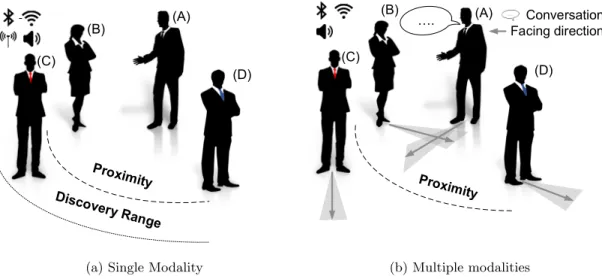
Figure 2.3: State-of-the-art social interaction detection approaches.
included in the inference process. Among these approaches are single modality that include coarse or fine grain distance estimation through Bluetooth and WiFi interfaces, audio-based distance or relative position estimation. There is alsomulti-modality where different modalities are combined in the inference process to indicate if people are interacting (See Figure 2.3).
2.4.1 Single modality
The majority of commercial off-the-shelf (COTS) smartphones today comprise wireless communication interfaces such as Bluetooth and WiFi. Due to their wide availabil-ity researchers often utilised them in order to detect when people are in proximavailabil-ity. By acquiring information about people being in proximity, researchers made a strong assumption of interpreting the knowledge of proximity into the existence of social inter-action. An implicit assumption is that every person is required to carry a smartphone. For the determination of proximity, several techniques have been proposed.
The most common approach is to perform discovery through one of the two interfaces, log the Bluetooth IDs (BTIDs) or WiFi Service Set Identifier (SSID) and classify all the detected nearby devices as social interactions. This method was applied in miscel-laneous works to estimate when people are interacting with each other. Some examples
of these works are Serendipity [44], CenceMe [38] and SoundSense [45]. [46] aggregated the discovered smartphones based on BTIDs with static nodes. The Bluetooth ranges were overlapping to improve social interaction detection and provide some information about coarse-grain localisation. The accuracy of this method is limited to the range of the communication mean i.e. for Bluetooth the minimum nominal range is around 10m [47] and for WiFi the typical range is approximate to 35m for indoor environment1. Thus, every device - person detected is classified as being in a social interaction. It should be noted that these works do not provide error analysis of this social interaction detection approach.
The previous method introduces a noticeable amount of error. For that reason re-searchers focused on developing distance estimation techniques that would remove a percentage of error from the previous approach by limiting the communication mean range. So, for detecting social interactions [48] developed a machine learning based technique to estimate if users were in proximity or not, by retrieving WiFi Received Signal Strength Indicator (RSSI). They trained a model based on maximum and mean value of a 20-sample window of WiFi RSSI achieving a median error of 0.5m for social interaction detection. In particular, they detected ongoing social interactions with 86% accuracy and true negatives with 84%.
Another approach for detecting social interactions through Bluetooth RSSI-based dis-tance estimation was presented in [49]. They developed a probabilistic model for indoor and outdoor environments. It utilised some predefined empirically calculated thresholds to compute the probability of being in proximity to socially interact, with a claimed error rate of 4.3%. In detail, they retrieved an RSSI measurement which was smoothed through exponential window moving average (EWMA) and a smoothing factor of 0.5. To compute the thresholds they retrieved Bluetooth RSSI measurement in different environments and distances. Bluetooth technology natively operates in a mode which allows the device to discover but also to be discoverable by other devices without any firmware modifications. A less complex approach was presented in [50], namelyMAUC. This work focused on detecting social interactions through Bluetooth RSSI thresholds,
1
Bluetooth and WiFi ranges are highly dependent on the surrounding environment and chipsets characteristics of devices performing the discovery and the detected devices.
showing a detection rate over 90%. As opposed to previous approaches, it incorporated an adaptive discovery interval scheme, dependent on user’s activity movement.
Discussion. Scientists tackled the detection of social interactions on mobile phones
with different granularity. The discovery of nearby devices (e.g. Serendipity [44], CenceMe [38] etc.) is easily implementable. However, it provides increased number of false positives due to inaccuracy in the interpersonal distance estimation, unawareness of spatial arrangement and conversation existence. As an example, Figure 2.3a shows four people in vicinity, where only (A) and (B) are interacting, although all four are in discovery range, thus classified as socially interacting. The WiFi interface on COTS smartphones cannot operate simultaneously in discovering and discoverable mode as opposed to WiFi Direct. For that reason, the authors [51] [52] were forced to modify the firmware of the devices to switch between the two modes. As an improvement, sev-eral works tried to estimate the interpersonal distance of users, to infer the existence of social interactions. For distance estimation based on RF (Bluetooth or WiFi) signals, RSSI has been leveraged in order to create empirical models, mainly due to simplicity in implementation. However, RSSI measurements received on mobile phones showcase great fluctuation which is affected by different environments, obstacles, human body absorption, reflections etc. Machine learning techniques constitute a notable effort to tackle the RSSI fluctuation [48]. Threshold-based approaches [49] [50] usually require adjustment of the algorithm’s boundaries based on the device and the environment. Other techniques such as Time Difference of Arrival (TDoA), Angle of Arrival (AoA) and Time of Arrival (ToA) showcase significant limitations such as firmware modifica-tion for device time synchronisamodifica-tion, lack of multiple antennas, the need for external hardware and therefore are not recommended for COTS mobile phones.
From simple discovery-based method, researchers have improved the social interaction detection through proximity. However, the assumption that when people are in prox-imity then are definitely interacting is strong. Hence, there is an imperative need to add other modalities in the inference process which will add new parameters such as spatial arrangement and conversation existence detection.
2.4.2 Multi-modality
To improve social interaction detection based on a single modality, researchers started to incorporate other modalities. These modalities enhanced social interaction detection by providing information about users’ relative orientations i.e. if they are facing each other or not and about the conversation existence i.e. if the users are really having a conversation and they are not two people having a spatial formation suitable for social interaction (See Figure 2.3b).
An important attempt to identify the relative spatial arrangement of the users combined with proximity detection wasVirtual Compass [53]. This system utilises multiple RF interfaces such as Bluetooth and WiFi in order to estimate the interpersonal distance among users but also create a 2D localisation map based on users’ relative distances. For distance estimation given RSSI measurements from both interfaces, they computed the average distance and the uncertainty based on the difference of 90th and 10th distance percentile. Then, the authors applied regression on these features for distance estimation and achieved an error margin of 1.41m. For relative map localisation they propose a quick technique to estimate the initial coordinates of each user then they apply an iterative method [54] to refine the initially reckoned coordinates.
Matic [52] argued about a slightly different multi-modal approach that incorporated interpersonal distance estimation merged with relative orientation calculation and con-versation detection. In this work, authors endeavoured to increase the accuracy of social interaction detection by taking into consideration users’ facing directions. The knowledge of user’s facing direction with respect to earth’s coordinates allowed them to compute the relative orientation of each pair of users, in order to understand if they had the appropriate spatial arrangement to interact. They estimated the interpersonal dis-tance of the users through an initial calibration phase which led to a proximity detection model. During that period, they collected WiFi RSSI measurements at 1m distance and then based on an indoor path loss model (PLM), they created an artificial dataset for distances 0.5m, 1m . . . , 5m. Based on this dataset they computed the mean and maximum value of a 20-sample window and trained a Na¨ıve Bayes with Kernel Density Estimator (KDE) model for proximity detection. An external accelerometer was
at-tached to a user’s chest to monitor his speech activity by performing spectral analysis of the signal it produced.
Discussion. In order to achieve higher accuracy and robustness in various
environ-ments, researchers combined various modalities. Virtual Compass [53] combined WiFi and Bluetooth to improve distance estimation and provide relative spatial arrangement detection. However, the simultaneous utilisation of these interfaces cannot be utilised for continuous sensing due to high energy consumption and lack of ad-hoc communi-cation in current available WiFi on COTS mobile phones. For further improvement of social interaction detection on smartphones, [52] designed a work that provides a relatively accurate approach. As Figure 2.3b indicates, this method is able to identify correctly that (A) and (B) are socially interacting while (C) and (D) are not. They tracked user’s orientation and logged speech activity through an accelerometer attached to a user’s chest. Yet, the smartphone was in a fixed body position and the external accelerometer was intrusive as it was placed on user’s chest.
2.4.3 Apposition of social interaction detection approaches
In this section, detection methods for social interactions among people were surveyed by presenting different approaches that researchers have developed to tackle this prob-lem. It is important to understand the strengths and the limitations of each method. As mentioned, the single modality works provide the benefit of low complexity, unob-trusiveness through limited constraints regarding the wearing position and the lack of external hardware. However, the approach is characterised by a large amount of false positive errors, which depending on the application could be neglected or require tack-ling. In case this error is not acceptable, a multi-modal approach is more suitable that incorporates the user’s facing direction and conversation detection. Although, these multiple modalities provide additional information to tackle the social interaction de-tection problem, researchers may consider the accumulated error introduced by each modality. Through efficient fusion of several modalities, the error of each individual modality may cancel each other out, driving the system to a less erroneous approach.
Figure 2.4: Behavioural cues emitted during a social interaction.
phones, currently there is no tool that may be utilised in a real-world environment, without any constraints and with minimum intrusiveness. Ideally the framework may not require any firmware modification. Also, it would be able to be deployed on off-the-shelf smartphones providing a realistic and robust accuracy in a real-world environment, depending on the target application given only the integrated sensors of the device. Fi-nally, both approaches are characterised by a trade-off among user friendliness, system complexity and accuracy [4] that should be considered by researchers depending on the needs of each application.
2.5
Behavioural cues extraction
Social interaction detection provides personalised information about who is interacting with whom. As Figure 2.4 shows, during a social interaction interlocutors emit cues such as spatial arrangement, posture and gestures indicating social signals such as intimacy, interest, mirroring etc. Acquiring this knowledge leads to the next stage of mining human behaviour on mobile devices, which is the extraction of behavioural cues. In this process, data obtained by sensing procedure are pre-processed or classified through a machine learning technique to retrieve some features that will be utilised in the next stage, the inference of social signals.
2.5.1 Auditory
In SSP, literature has focused mainly on extracting social signals from audio and vi-sual data. This fact procures a reasonable indication regarding the importance of be-havioural cues extracted from audio data. This section aims to provide a brief overview of the techniques applied on acoustic data recovered from ambient sensors and espe-cially from a mobile device’s microphone. The techniques are categorised based on the type of features extracted. The same classification was performed in [22]. Thus, following and extending that taxonomy for techniques applied on mobile devices was considered as a reasonable continuity. It is noted that social signals refer to non-verbal communication signals emitted when a person is socially interacting [25]. Hence, nat-ural language processing is excluded from Mobile SSP as it considered a separate field.
2.5.1.1 Prosody
This behavioural cue provides information about the characteristics of a person’s voice when socially interacting i.e. phrasing, stress, and intonation [55]. To infer about the prosody of a person’s voice on mobile devices, literature has focused on extracting certain features. Razak [56] extracted prosodic features such as energy, linear pre-dictive coding (LPC) coefficients, duration, pitch and jitter of each recorded frame.
VibeFones [4] focused on pitch, amplitude, mean energy, frequency of the fundamental
format and spectral entropy. AMMON [57] calculated zero crossing rate (ZCR), root mean square, frame energy, pitch, harmonics-to-noise ratio and Mel-Frequency Ceptral Co-efficients (MFCC).StressSense [58] reported that pitch and its derivatives were the most informative features, followed by jitter, spectral centroid, high frequency ratio, speaking rate and MFCCs. In SoundSense [45] authors extracted ZCRs, low energy frame rates and other spectral features which were fed in a J48 decision tree [59]. The most recent work SocioPhone [60] calculated prosodic features through pitch, energy, loudness, rhythm and spectral features (formants1, bandwidths, spectrum intensity).
Discussion. The optimal prosodic feature set varies based on the target application. [56] evaluated different prosodic feature sets. Those that included LPC coefficients had the
1
best performance while the set with speech energy, duration, pitch and jitter performed worst. Authors did not apply any feature reduction technique on the training data, based on various factors such as information gain to retrieve the most informative feature set [61]. VibeFones[4] require a long-term analysis to derive standard deviations of the features and do not describe the process of concluding to the particular feature
set. AMMON [57] showed the performance improvements achieved when combining
prosodic features with glottal timings1. However, the system was evaluated off-line on datasets created in constrained environments while the performance in real-world situations was not provided. StressSense [58] selected a particular feature set based on information gain. Authors did not provide any quantitative analysis of energy consumption of the system as they extract cumbersome features including MFCC. It should be noted that although MFCC improved the accuracy of the system, these features allow rebuilding of speech segments and further natural language processing. This fact induces some privacy issues as opposed to features such as pitch, speaking rate, jitter which do not allow derivation of speech segments. SoundSense [45] focused on features that are not affected by the volume; in spectral features they removed DC components. To preserve users’ privacy they performed data processing on the device and then discarded any raw audio readings. SocioPhone [60] is able to cope with ambient noise distributed uniformly to nearby devices but does not incorporate any on-body position detection mechanism of the device to discard positions such as bags that degrade the quality of raw sound signal.
In literature, many works inferred that features such as pitch and its statistics were considered as the most informative features. Additionally, features such as speaking rate, MFCCs, energy and spectral characteristics were also included in the process of detecting the vocal prosody of a user. The spectral-based features constitute a common ground in various works and especially formants, bandwidths and intensity. The disadvantage of these features is the requirement of transforming the time-based values into frequency based values before every inference, which induces additional computational burden. Only a specific set of the twenty MFCCs are mainly selected during the inference process depending on the classification target. Before including
1
MFCCs in the feature set, a designer may consider the accumulative burden of these coefficients due to a computational demanding extraction procedure.
2.5.1.2 Conversation vs silence
During a social interaction, speech and silence operate as regulators of a conversa-tion emitting social signals such as consensus, rejecconversa-tion and reveal interlocutors’ so-cial behaviour including their emotions [62]. One of the well-known and widely-used techniques to infer conversation existence was presented by Basu [63]. It specified a linked Hidden Markov Model (HMM) with three features: non-initial maximum of the normalized noisy autocorrelation, number of autocorrelation peaks, and normalised spectral entropy. The first layer of the model infers regarding voice existence and the second layer speech occurrence. This technique was adopted by [64],Vibefones [4],
StressSense[58],MeetingMediator[65], [66]. Another technique widely used by systems such as SpeakerSense [67] andAuditeur [43] is to calculate the ZCR of an audio frame and then apply a classification method to infer if the segment contains speech [68].
Matic [52] inducted a privacy-oriented approach that incorporated an accelerometer on a user’s chest. By analysing the sum of the power spectral densities, computing integral and mean of the frames (80 - 256Hz), and feeding it to Na¨ıve Bayes with KDE [69], they were able to detect when the user was speaking. CoenoFire [70], detects speech through Long-Term Signal Variability (LTSV) presented in [71]. Also, AutoSense [72] utilised a Respiratory Inductive Plethysmograph (RIP) in order to compute lung volume and breathing rate from which they detected conversation existence.
Discussion. For detecting conversation existence or absence through a mobile device,
research focused on audio-based and accelerometer-based data. The conversation detec-tion methods based on microphone data funnel on [63] or through some pre-processing steps they train a Gaussian Mixture Model (GMM) that identifies (non)conversation segments. [63] is a well-established approach for detecting speech in raw microphone data, which achieves less than 10% error estimations at 6.4m even with increased inter-personal distance. [43] brought together the most popular pre-processing steps in order to train a model for conversation and silence detection. A post-processing step may
![Figure 3.2: This figure shows the spatial arrangement of people including the con- con-cept of interaction zones [193]](https://thumb-us.123doks.com/thumbv2/123dok_us/10063155.2906033/97.918.278.668.127.479/figure-figure-shows-spatial-arrangement-people-including-interaction.webp)