The Effect of Higher Compression Ratio in Two-Stroke Engines
Yuh Motoyama and Tohru Gotoh Yamaha Motor Co, Ltd.
The effect of higher compression ratio on fuel consumption and power output was investigated for an air-cooled two-stroke motorcycle engine. The results show that actual fuel consumption can improve by 1-3% for each unit increase of compression ratio over the compression ratio range of 6.6 to 13.6. The rate of improvement is smaller however as compared to theoretical values. The discrepancies are mainly due to increased mechanical and cooling losses, short- circuiting at low loads, and increased time losses at heavy loads. Power output also improves, but the maximum compression ratio is limited due to knock and the increase in thermal load. In addition, the investigation covered the implementation of higher compression ratio in practical engines by retarding the full-load ignition timing.
INTRODUCTION
Adopting a higher compression ratio is one of 'the most important considerations regarding improved fuel consumption and power output in gasoline engines. Much research has been devoted to the effect of higher compression ratio in four-stroke engines, but little attention has been given to two-stroke engines. A two-stroke engine is different from a four-stroke engine in the gas exchange process and in the composition, pressure, and temperature characteristics of the working gases. Accordingly, the compression ratio has a different effect on the thermal efficiency for the respective engine types. T o address the shortfall of study on two-stroke motorcycle engines, the effect of higher compression ratio on fuel consumption and power output was investigated. This paper specifically
discusses thermal loads as well as knock problems at high speeds and heavy loads for higher compression ratios.
FUEL CONSUMPTION IMPROVEMENT WITH HIGHER COMPRESSION RATIO
The experiment was conducted on an air-cooled, Schnurle crankcase scavenged, single-cylinder, two-stroke engine. The engine specifications are detailed in Table 1. Compression ratios ranging from 6.6 to 13.6 in seven steps were attained by varying the combustion chamber dome depth. The compression ratio referred to in this paper represents the effective compression ratio calculated by assuming the exhaust port- close timing volume is the volume before compression.
T o a s c e r t a i n t h e s c a v e n g i n g characteristics, delivery ratio and air fuel
Table 1 Test Engine Specifications
,
i-Scavenging System
1
Crankcase Scavenging Bore and Stroke 154 x 50 mmEngine Type Displacement 1114.5 cm' Compression Ratio 16.6 (STD), 7.8, 8.4, 8.7, 2-Stroke, Air-Cooled, Sinale-Cvlinder Exhaust Timing Scavenaina Timina
ratio are calculated from the intake air capacity. Trapping efficiency is calculated
from the exhaust 0, concentration(1)'.
Unleaded regular gasoline (RON 91) is used
as the fuel.
9.5, 11.2, 13.6 91' A & B T D C
122- A & B TDC
*
-
(In the LA-4 mode, a motorcycle
equipped with an experimental engine is operated mostly at idle and the load range is
less than 3kW (350kPa BMEP) within 4000-
5000 rpm.(2) Consequently, the test engine speed was set to 4500rpm to investigate
engine characteristics. Figure 1 shows the
specific fuel consumption results at various
compression ratios. Figure 2 is the
improvement rate for fuel consumption at a
standard. compression ratio of 6.6. The effect
of increasing compression ratio can be seen in the results whereby the fuel consumption
improves by 1-3% for each unit increase in
compression ratio. At any particular
compression ratio and load, however, the measured values for the improvement rate are half as much as the theoretical values (air
cycle y = 1.40). This is considered to be as
a result of the following:
(i) Increased short-circuiting
(ii) Reduced specific heat ratio of the working gases
(iii) Increased mechanical loss (iv) Increased cooling loss (v) Increased time loss
The above factors are discussed in more detail below.
Combustion Chamber
Fig. 1 Fuel Consumption Characteristics at Practical Engine Speeds
Two-Staged Semi- S~herical T v ~ e AIR CYCLE k, = 1 . 4 1 6 5 0 0 rpm MBT A,F 1 5 / /
'
/ / / / / B M E P IkPal 6 a 1 0 i t I A COMPRESSION RATIO Fig. 2 Improvement Rate in FuelConsumption at Various Loads
INCREASED SHORT-CIRCUITING -
If the scavenging characteristics vary with compression ratio, fuel consumption will b e affected with the variation of closed-cycle
thermal efficiency as well as the variation of
scavenging characteristics. Figure 3 shows
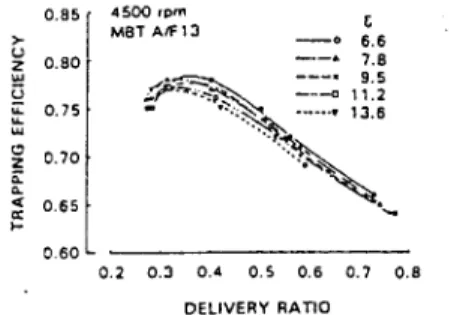
the relationship between the delivery ratio and the trapping efficiency. The trapping efficiency is reduced as the compression ratio rises within the tested delivery ratio range. More specifically, for the same fuel supply, increased short-circuiting is induced.
'Numbers in parentheses designate references at the end of paper
45W rom
r . . - - .
-
. , 6DELIVERY RAT10
Fig. 3 Relationship between the Delivery
Ratio and the Trapping Efficiency
BMEP IkPa) 4 5 0 0 rom C
0 . 8 5 M E T AlF13 n 6.6
Fig. 4 Relationship between the Trapping
Efficiency and BMEP
>
g 0 . 8 0 W y 0 7 5 W
Figure 4 shows the relationship between
the trapping efficiency and BMEP. The
trapping efficiency improves as the
compression ratio increases beyond a BMEP
of 360kPa. Figure 5 shows the improvement
in fuel consumption for a trapping efficiency equivalent to the standard compression ratio
( and assumes the trapping efficiency is
independent of the compression ratio). At 400kPa BMEP, the results show a increase in the improvement rate with reduced short- circuiting due to the higher compression ratios. At 200 and 300kPa BMEP, under actual operating conditions, however, the
improvement rate in fuel consumption
decreases with the increase in short-
. . circuiting. At a compression ratio of 12,
200kPa BMEP, for example, the
improvement rate would be 1.4% higher (an
increase from 9.8% to 11.2%) without an
increase in short-circuiting. --.-a 7 . 8
----.
9.5 - - . - 0 11.2 ...--..- r 1 3 . 6p,.a..+.-.
-
'I 4 5 0 0 r g m * f f 1 5 AIR CYCLE 1 7 ' 1 . 4--- EOUNALENT TRAPPlNG EFF. - TO STANDARD COMP. RATIO
/
- A C W A L ./ BMEP kP.1 0 L b '
6 8 1 0 1 2 14 C O M P R E S S I O N R A T I O
Fig. 5 lmprovement Rate in Fuel Consumption. with Trapping Efficiency
Equivalent to Standard Compression Ratio
REDUCED SPECIFIC HEAT RATIO
OF THE WORKING GASES - As observed
in many reports, working gas temperature is affected by an increase in compression ratio. The resultant specific heat ratio variation affects the overall thermal efficiency (3)(4). Two-stroke engines differ considerably from
four-stroke engines in temperature and
pressure behavior. ~ e ~ a r d i e s s of load
conditions, the pressure at the beginning of
compression approaches atmospheric
pressure; and the residual percentage of the working gases is high especially at low loads.
The thermal efficiency of the fuel-air
COMPRESSION RATIO
Fig. 6 lmprovement Rate of The Fuel-Air
cycle was then calculated to investigate the effect of the specific heat ratio of the working gases. The pressure, the temperature, and the composition at' the beginning of compression were set to the same values as in actual engines. Thermal dissociation was disregarded.
Figure 6 shows the improvement rate of the fuel-air cycle thermal efficiency with increasing compressiorl ratio. A compression ratio of 6.6 was used as the standard for the calculations. The fuel-air cycle exhibits a higher improvement rate than the air cycle value. Variation of the working gas specific heat ratio does not prevent the effect of higher compression ratios. To the contrary, the improvement of fuel consumption is enhanced.
INCREASED MECHANICAL LOSS
-
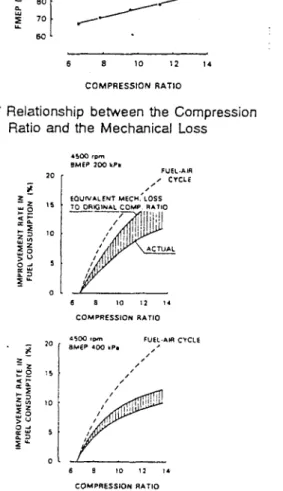
Figure 7 shows the variation of mechanical loss as measured by the motoring method. Mechanical loss increases by 27% as the compression ratio is raised from 6.6 to 13.6. The pumping work in the crankcase is excluded from the results.
Figure 8 shows the improvement rate in the fuel consumption assuming that the mechanical loss is independent of the compression ratio. The improvement rate shows a marked decrease especially at low loads. At a compression ratio of 12 and at 200kPa BMEP (the same conditions as the earlier example), a 4.5% decrease in improvement rate is observed, and is higher as compared to the increase caused by short- circuiting.
Crankcase pumping work varies closely in proportion to the scavenging volume in two-stroke engines. Therefore, the ratio of the pumping work to the indicated work is almost, but not completely, constant over all loads. The experimental engine also shows a small decrease (0.009-0.012) in brake thermal efficiency due to the pumping work. The effect of higher compression ratio is very small for the same load because of the
4 5 0 0 ,Dm
( W I D C R A N K C A S E PUMPING I
lool
C O M P R E S S I O N R A T I O
Fig. 7 Relationship between the Compression
Ratio and the Mechanical Loss
6 8 10 12 7 4 COMPRESSION RATIO 4 5 W rum BMEP 2 0 0 kPm 20
.
FlJEL.AIR 6 B 10 12 l a COMPRESSION RATIO-
r_ - l5Fig. 8 Improvement Rate in Fuel Consumption
without Increased Mechanical Loss
, CYCLE
EOUNALENT MECU.'LOSS
' 1 0 ORIGINAL COMP RATIO
reduced delivery ratio.
INCREASED COOLING LOSS
-
Figure9 shows the improvement rate in fuel consumption assuming the cooling loss is independent of the compression ratio. The cooling losses are calculated from cycle simulations. The heat transfer coefficient at compression stroke and at expansion stroke are calculated using the equations proposed by G. Woschini(5). The gas exchange process has only a slight effect on the cooling loss and is excluded from the
. - . . .
: P
I ACTUAL
Y OU
1 5 W r p m BMEP 1 0 0 kP. FUELAIR CYCLE .,' TO STANOARO C O W RATIO 6 8 1 0 12 14 COMPRESSION RATIO FUEL A R CYCLE lo
1
W E . ALWW I , COMPRESSION R A T 0Fig. 9 Improvement Rate in Fuel Consumption
wlthout Increased Cooling Loss
calculations. T h e results show that the
cooling loss considerably reduces the effect of high compression ratio especially at low loads, though the decreased rate due to cooling loss is not so high as compared to the mechanical loss. At a compression ratio
of 12 and at 200kPa BMEP, the improvement
rate is 3.8% less d u e . to the increase in
cooling loss.
INCREASED TIME LOSS
-
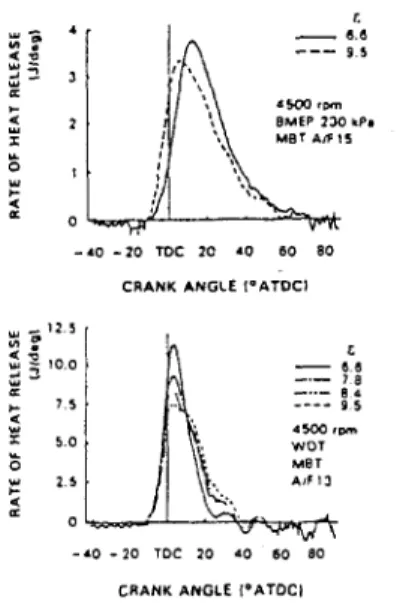
Time lossvariation was investigated using combustion pressure analysis. The results of the rate of the heat release are shown in Figure 10. At low loads, the greater the compression ratio, the shorter the combustion time. Time loss is subsequently reduced. At heavy loads, the
. .
combustion time is longer as compression
ratio increases. This is considered to be
caused by the flattened combustion chamber shape due to the increased compression ratio. In addition, it is necessary to retard the
ignition timing to avoid knocking above 300
- 4 0 - 2 0 TOC 2 0 4 0 6 0 8 0 CRANK ANGLE I ' A T D C I
- A 0 - 2 0 TOC 2 0 4 0 6 0 8 0 CRANK ANGLE I o A T D C I
Fig. 10 Rate of Heat Release
kPa BMEP and above a compression ratio of
10. Therefore, i t seems reasonable to
suppose that the improvement rate in fuel
consumption is smaller with high
compression ratio at heavy load.
The discussion above pertains to
improvement in fuel consumption with higher
compression ratios. However, because of
higher mechanical losses and higher cooling losses, the fuel consumption at very low loads seems to increase with an increase in compression ratio.
The results for idling fuel consumption
are shown in Figure 11. The fuel
consumption becomes disadvantaged as the compression ratio increases. It is clear from
COMPRESSION RATIO
C 50 L A . 4 MODE 0 6.6
-
3
4 0 - Z ! 30 6a
5 - E $ 20 4 5 0 3 0 6 10 2 "I a B 0 F C. HC COFig. 12 Fuel Consumption for LA-4 Mode
the results that the increase in the mechanical and the cooling losses are greater than that for thermal efficiency at such loads.
The fuel consumpfion was also measured in an actual motorcycle for the LA-4 mode. The compression ratio was set at 9.5 because severe knocking occurred at a compression ratio above 10. The test results are shown in Figure 12. The results show a 5.7% reduction in the fuel consumption and a
4.1% reduction in HC emissions at a
standard compression ratio of 6.6. These values are almost equal to the improvement rate in fuel consumption at 4500 rpm and 200kPa BMEP as shown in Figure 2.
POWER IMPROVEMENT WITH
HIGHER COMPRESSION RATIO
-
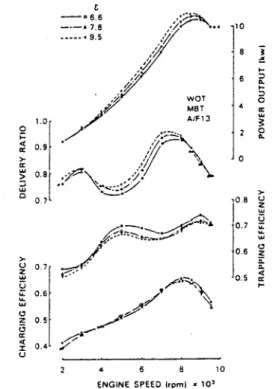
In typical gasoline engines, power output can be improved with a higher compression ratio unless e x c e s s i v e k n o c k p r o b l e m s predominate. Figure 13 shows the results of the full load performance and the scavenging characteristics for compression ratios of 6.6, 7.8, and 9.5. The performance output is improved within the tested speed range, but maximum power occurs at a speed slightly lower than maximum. This is a result of lower synchronizing speeds along with longer relative pressure pulsation due to the lower exhaust temperature. This tendency is evident in the delivery ratio results. The trapping efficiency is slightly decreased. The engine speeds exhibiting the greatest power output can be controlled by altering the exhaust system size.2 1 6 8 10
ENGINE SPEED Irpml 1 1 0 '
Fig. 13 Full-Load Performance and Scavenging Characteristics
FACTORS LIMITING COMPRESSION RATIO
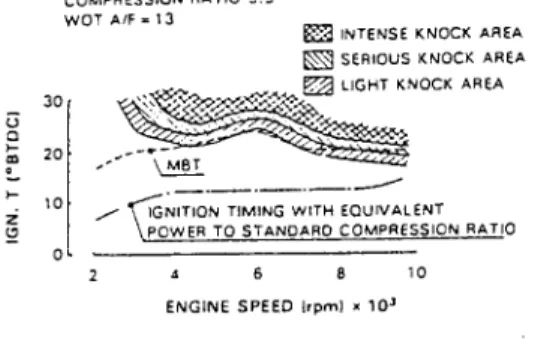
Higher compression ratio makes it possible to improve power output., but causes serious problems such as knock and piston thermal load increase. To solve the problems, several reports have proposed low compression ratio at high-speeds and heavy loads with variable combustion chamber volumes.(6)(7). In this paper, retarded ignition timing is discussed as a remedy for the problems.
Figure 14 shows the full-load knocking range for the compression ratio of 9.5. T h e knock intensity is estimated from the sum of the absolute values of the pressure differences(8). Under MBT operation, a very strong knock occurs above 8000 rprn which is apt to cause piston top erosion.
COMPRESSION RATIO 9 . 5 W O T A I F - 1 3
INTENSE KNOCK AREA SERIOUS KNOCK AREA LIGHT KNOCK AREA
e
/
l o / / ~ N I T l 0 N TIMING W I T H EOLIWALENT
I? POWER T O STANOARO COMPRESSION RATIO
E N G I N E S P E E D Irpml x 1 0 '
Fig. 14 Full-Load Knocking Range
The dashed line in the figure shows the
ignition timing with equivalent power at the
standard compression ratio. Knocking is
absent even at overspeed. Therefore, above
7000 rpm, using an ignition timing later than MBT, power output can remain advantaged
and knock problems can be solved. A
compression ratio of 9.5 is the maximum
limit at which knock can be avoided and power output ensured.
IMEP 5 5 0 kPa
I-
- 8 0 - 6 0 - 4 0 - 2 0 0 2 0 4 0 60 8 0 C R A N K A N G L E I o A T D C I - 8 0 - 6 0 - 6 0 - 2 0 0 20 4 0 6 0 8 0 C R A N K A N G L E l D A T D C lFig. 15 Calculated Cylinder Pressure and
Instantaneous Heat Flux
with Retarded Ignition
Timing
-
Concerning the thermal load, Figure 15
shows the cylinder pressure and the
instantaneous heat flux calculated from simulations. The results show that re.tarded ignition timing is more advantageous for equivalent power output levels since heat flux is reduced as well. The engine tests also indicate that the plug seat temperature is also lower by this method as compared to the results for the standard compression ratio.
The countermeasures taken for problems associated with high speeds and heavy loads
were discussed above. However, at a
compression ratio of 9.5, combustion
accompanied by a strong impact was observed in road tests at very low loads, and
at medium and high speeds. This
combustion under irregular conditions is called "low-load knock" or "high-speed and low-delivery ratio knock". These types of knocking are said to arise from the same principles as heavy-load knocking(9).
Figure 16 is an indicator diagram for
low-load knock. Figure 17 shows the
Fig. 16 Low-Load Knock
OCCURRENCE MORE FREOUENTLY
a
FREOUENTLV 0 LESS FREOUENTLY COMPRESSION RATIO 4 5 0 0 ,rn' L . I I 13 15 17 AIF 9 5 DELNERY RATIOFig. 17 Low-Load Knocking Rage
- 3 0 , 0 0 r P 20 - ,- . ',
knocking range for air-fuel ratio and ignition timing. The low-load knock can barely be controlled through ignition timing; so there are still problems with the avowed similarity between low-load and heavy-load knocks. However, removing the deposit shows no effect implying that this combustion is clearly not a kind of surface ignition. We consider that the results indicate a form of compressed self-ignition. T o remedy low- load knock, the use of premium gasoline and improving cooling are effective measures. If premium gasoline is not used, the permissible limit of the compression ratio is approximately 8.4 without liquid-cooling and 8.7 with liquid-cooling.
CONCLUSIONS
Investigations were conducted on the effect of higher compression ratio in air- cooled two-stroke motorcycle engines. The results can be summarized as follows:
(1) It is possible to improve fuel consumption with higher compression ratio, though, due to various losses, the improvement rate fails to achieve theoretically expected values. At very low loads, such as idling, increases in the losses surpass the increase in the thermal efficiency and this can cause unfavorable fuel
consumption in some cases.
(2) The increases in losses can be classified into increased short-circuiting and increased mechanical and cooling losses at low loads. At heavy loads, the time loss increases, but the influence of short- circuiting as well as mechanical and cooling losses are reduced. Varying the specific heat ratio of the working gases can be an effective countermeasure to contain losses.
(3) Higher compression ratios make it possible to improve power output, though there is a limit imposed by knocking and increased thermal load to the maximum compression ratio.
(4) As the compression ratio is increased, it is effective to use an ignition timing later than
MBT
in regards to knocking and thermal load avoidance. The maximum compression ratio needs to be reduced,' however, because of the occurrence unmanageable abnormal combustion at very low loads.REFERENCES
I. K. Tsuchiya and S. Hirano, "Characteristics of 2-stroke Motorcycle Exhaust HC Emission and Effects of Air- Fuel Ratio and Ignition Timing,"
SAE.
750908.
2. K. Nomura, S. Hirano,
T.
Gotoh, andY. Motoyama, "Improvement of Fuel Consumption with Variable Exhaust Port Timing in a Two-Stroke Gasoline Engine,"
SpLE. 850183.
3. S. Matsuoka and H. Tasaka, "The Thermal Efficiency and a Future Concept of Gasoline Engine and Diesel Engine from the View Point of Cqvcle Theory."
INTERNAL COMBUSTION
ENGINE,
Vol. 21, No. 258 (1982), pp. 85-96. (in Japanese)4. S. Muranaka, Y. Takagi,
T.
Ishida, "Factors Limiting the Improvement in Thermal Efficiency of S. I. Engine at Higher Compression Ratio,"SAE,
870548.5. G. Woschni, "A Universally Applicable Equation for the Instantaneous Heat Transfer Coefficient in the Internal Combustion Engine",
SAE.
670931.6. W. H. Adams, H. G, Hinrichs et al, "Analysis of the combustion Process of a Spark Ignition Engine with a Variable Compression Ratio,"
SAE,
870610.7. V. Harne and S. R. Marathe, "Variabie Compression Ratio Two-Stroke Engine,"
SAE.
891750.8. T. Fujikawa and S. Abe, "Abnormal Combustion of Two Stroke Cycle Gasoline Snowmobile Engine at High Speed and full Load," SAE, 790841.