Zurich Open Repository and Archive University of Zurich Main Library Strickhofstrasse 39 CH-8057 Zurich www.zora.uzh.ch Year: 2018
Efficient Processing and Reasoning of Semantic Streams
Gao, Shen
Abstract: The digitalization of our society creates a large number of data streams, such as stock tickers, tweets, and sensor data. Making use of these streams has tremendous values. In the Semantic Web context, live information is queried from the streams in real-time. Knowledge is discovered by integrating streams with data from heterogeneous sources. Moreover, insights hidden in the streams are inferred and extracted by logical reasoning. Handling large and complex streams in real-time challenges the capabilities of current systems. Therefore, this thesis studies how to improve the efficiency of processing and reasoning over semantic streams. It is composed of three projects that deal with different research problems motivated by real-world use cases. We propose new methods to address these problems and implement systems to test our hypotheses based on real datasets. The first project focuses on the problem that sudden increases in the input stream rate overload the system, causing a reduced or unacceptable performance. We propose an eviction technique that, when a spike in the input data rate happens, discards data from the system to ensure the response latency at the cost of a lower recall. The novelty of our solution lies in a data-aware approach that carefully prioritizes the data and evicts the less important ones to achieve a high result recall. The second project studies complex queries that need to integrate streams with remote and external background data (BGD). Accessing remote BGD is a very expensive process in terms of both latency and financial cost. We propose several methods to minimize the cost by exploiting the query and the data patterns. Our system only needs to retrieve data that are more critical to answer the query and avoids wasting resources on the remaining data in BGD. Lastly, as noise is inevitable in real-world semantic streams, the third project inves- tigates how to use logical reasoning to identify and exclude the noise from high-volume streams. We adopt a distributed stream processing engine (DSPE) to achieve scalability. On top of a DSPE, we optimize the reasoning procedures by balancing the costs of com- putation and communication. Therefore, reasoning tasks are compiled into efficient DSPE workflows that can be deployed across large-scale computing clusters.
Posted at the Zurich Open Repository and Archive, University of Zurich ZORA URL: https://doi.org/10.5167/uzh-162907
Dissertation Published Version Originally published at:
Gao, Shen. Efficient Processing and Reasoning of Semantic Streams. 2018, University of Zurich, Faculty of Economics.
Department of Informatics
Efficient Processing and Reasoning of
Semantic Streams
Dissertation submitted to the Faculty of Business, Economics and Informatics
of the University of Zurich to obtain the degree of
Doktor / Doktorin der Wissenschaften, Dr. sc. (corresponds to Doctor of Science, PhD)
presented by Shen Gao from China
approved in Feb 2018 at the request of
Prof. Abraham Bernstein, Ph.D. Prof. Jeff Z. Pan, Ph.D.
The Faculty of Business, Economics and Informatics of the University of Zurich hereby authorizes the printing of this dissertation, without indicating an opinion of the views expressed in the work.
Zurich, Feb 14, 2018
Abstract
The digitalization of our society creates a large number of data streams, such as stock tickers, tweets, and sensor data. Making use of these streams has tremendous values. In the Semantic Web context, live information is queried from the streams in real-time. Knowledge is discovered by integrating streams with data from heterogeneous sources. Moreover, insights hidden in the streams are inferred and extracted by logical reasoning. Handling large and complex streams in real-time challenges the capabilities of current systems. Therefore, this thesis studies how to improve the efficiency of processing and reasoning over semantic streams. It is composed of three projects that deal with different research problems motivated by real-world use cases. We propose new methods to address these problems and implement systems to test our hypotheses based on real datasets.
The first project focuses on the problem that sudden increases in the input stream rate overload the system, causing a reduced or unacceptable performance. We propose an eviction technique that, when a spike in the input data rate happens, discards data from the system to ensure the response latency at the cost of a lower recall. The novelty of our solution lies in a data-aware approach that carefully prioritizes the data and evicts the less important ones to achieve a high result recall.
The second project studies complex queries that need to integrate streams with remote and external background data (BGD). Accessing remote BGD is a very expensive process in terms of both latency and financial cost. We propose several methods to minimize the cost by exploiting the query and the data patterns. Our system only needs to retrieve data that are more critical to answer the query and avoids wasting resources on the remaining data in BGD.
Lastly, as noise is inevitable in real-world semantic streams, the third project inves-tigates how to use logical reasoning to identify and exclude the noise from high-volume streams. We adopt a distributed stream processing engine (DSPE) to achieve scalability. On top of a DSPE, we optimize the reasoning procedures by balancing the costs of com-putation and communication. Therefore, reasoning tasks are compiled into efficient DSPE workflows that can be deployed across large-scale computing clusters.
Zusammenfassung
Die Digitalisierung unserer Gesellschaft produziert massenweise Streams, wie beispiel-sweise Aktienkurse, Tweets und Sensordaten. Die Nutzung dieser Streams bringt enorme Vorteile mit sich. Im Kontext des Semantic Web wird Live-Information aus den Streams in Echtzeit abgefragt. Durch Integration mehrerer Streams aus unterschiedlichen Quellen kann Wissen entdeckt werden. Durch logische Schlüsse können verborgene Erkenntnisse aus den Streams gewonnen werden.
Bestehende Systeme sind mit der zeitnahen Verarbeitung von grossen und komplexen Streams herausgefordert. Diese Arbeit untersucht Effizienzsteigerungen von Prozessierung und Schlussfolgerung in semantischen Streams. Sie besteht aus drei Projekten, welche unterschiedliche, aus der Praxis entnommene Forschungsfragen adressieren. Wir schlagen neue Methoden vor um diese anzugehen und implementieren Systeme zum testen unsere Hypothesen aufgrund realer Datensätze.
Das erste Projekt konzentriert sich auf sprunghafte Anstiege der Eingangsrate, welche das System überlasten, und somit dessen Leistung bis in einen untragbaren Bereich her-absetzen können. Wir schlagen eine Methode vor, welche gezielt Daten aus dem System entfernt, um die Latenz auf Kosten des Recalls aufrechtzuerhalten. Neu an dieser Lösung ist der datenbezogene Ansatz, welcher Daten sorgfältig priorisiert und weniger wichtige Daten zuerst aussortiert, um den Recall des Resultates möglichst hoch zu halten.
Im zweiten Projekt studierten wir komplexe Anfragen, welche nur durch eine Kombina-tion von Stream und zusätzlichen, entfernt gespeicherten HintergrundinformaKombina-tion (HGI) beantwortet werden können. Zugriff auf HGI ist ein ebenso teurer wie zeitaufwändiger Prozess. Wir schlagen mehrere Methoden vor, welche Muster in Daten und Anfrage nutzen um die Kosten zu minimieren. Dadurch braucht unser System bloss Daten abzugreifen, welche für die Beantwortung der Anfrage kritisch sind, ohne wertvolle Ressourcen mit der Verarbeitung der restlichen HGI zu verschwenden.
Letztendlich, da Rauschen in Streams unvermeidbar ist, untersucht das dritte Projekt, wie durch logisches Schlussfolgern Rauschen identifiziert und es aus des Verarbeitung ausgeschlossen werden kann. Eine verteilte Stream Processing Engine (DSPE) wurde als Grundlage angenommen, um Skalierbarkeit zu gewährleisten. Darauf aufbauend opti-mierten wir die Reasoning-Prozedur, in dem Kommunikation und Berechnung gegeneinan-der ausbalanziert werden. Dadurch werden Reasoning-Aufgaben als effiziente Abläufe for-muliert, welche auf gross angelegten Rechenclustern eingesetzt werden können.
Acknowledgements
First of all, I want to express my sincere gratitude to my supervisor Prof. Abraham Bernstein (Avi) for the opportunity of allowing me to pursue a Ph.D. at the University of Zürich. He granted me great research freedom to explore the topics that I am interested in. His continuous support and guidance have taught me so many things. His contri-bution in terms of time, ideas, and mental support has made my study productive and fun. I would like to extend my gratitude to my co-examiner Dr. Jeff Z. Pan for his time and invaluable feedback on my research. I am also very grateful for his contributions as a co-author on one of the papers in the thesis.
I am fortunate to have learned a lot from my collaborators during my study. I would like to thank Dr. Daniele Dell’Aglio who devoted enormous effort to help me. The same thanks also go to my other collaborators and co-authors: Soheila Dehghanzadeh, Emanuele Della Valle, Alessandra Mileo, Thomas Scharrenbach, Jörg-Uwe Kietz, Michael Feldman, Marc Novel, and Katerina Papaioannou.
During the time at the Department of Computer Science (IFI), I met so many wonderful friends and colleagues. They have made my study very enjoyable. Thanks to all my friends: Bibek, Cosmin, Daniel (Spicar), Daniel (Strebel), Ela, Helen, Lorenz, Marc, Matthias, Patrick, Pengcheng, Philip, Timo, Tobias, and Wen.
Finally, thanks to my family’s love and understanding. Without my wife Yang’s sup-port, this dissertation would not have been possible.
Table of Contents
I
Synopsis
1 Introduction . . . 2
2 Background . . . 3
2.1 Semantic Streams . . . 3
2.2 Processing and Reasoning over Semantic Streams . . . 4
2.3 Distributed Stream Processing Engines (DSPEs) . . . 4
3 Problem Statement . . . 5
4 Research Questions and Hypotheses . . . 6
4.1 RQ 1: How can we use an eviction strategy to cope with the problem that a workload spike overwhelms the system? . . . 6
4.2 RQ 2: How can we plan the access of remote background data to improve the result freshness for complex queries? . . . 7
4.3 RQ 3: How can we use logical reasoning to check the consistency of large amounts of semantic streams w.r.t a conceptual model? . . . 8
5 Contributions . . . 9
5.1 TheClock Data-Aware Eviction Approach: Towards Processing Linked Data Streams with Limited Resources . . . 9
5.2 Planning Ahead: Stream-Driven Linked-Data Access under Update-Budget Constraints . . . 9
5.3 Distributed Stream Consistency Checking . . . 10
6 Limitations . . . 11
6.1 Individual Components vs. An Integrated System . . . 11
6.2 Key Features vs. A Full-fledged System . . . 12
7 Conclusions and Future Work . . . 12
II
Contributions of this thesis
The CLOCK Data-Aware Eviction Approach: Towards Processing Linked Data Streams with Limited Resources . . . 17Shen Gao, Thomas Scharrenbach, and Abraham Bernstein 1 Introduction . . . 17
2 System Model: A Conceptualization of Load Shedding and Eviction . . . 18
3 Eviction Strategies . . . 20
3.1 Baseline Eviction Strategies . . . 21
3.2 The Clock Strategy . . . 22
4 Evaluation . . . 23
4.1 Evaluation Setup . . . 23
4.2 RQ1: Real-world Systems are Subject to Stress . . . 25
8 Table of Contents
4.4 Tuning Clock via Varying Depreciation Weightsρ . . . . 27
5 Limitations . . . 27
6 Related Work . . . 28
7 Conclusion and Outlook . . . 30
Planning Ahead: Stream-Driven Linked-Data Access under Update-Budget Constraints . . . 32
Shen Gao, Daniele Dell’Aglio, Soheila Dehghanzadeh, Abraham Bernstein, Emanuele Della Valle, Alessandra Mileo 1 Introduction . . . 32 2 Background . . . 33 3 Related Work . . . 35 4 Problem Definition . . . 36 5 Maintenance Algorithms . . . 38 5.1 Selectivity-Based Maintenance (SBM) . . . 39
5.2 The Impact-Based Maintenance (IBM) . . . 39
5.3 Flexible Budget Allocation (FBA) . . . 41
5.4 Discussion . . . 41
6 Experiments . . . 42
7 Conclusions and Future Work . . . 47
Distributed Stream Consistency Checking. . . 49
Shen Gao, Daniele Dell’Aglio, Jeff Z. Pan, and Abraham Bernstein 1 Introduction . . . 49
2 Related Work . . . 50
2.1 Consistency Checking of a Knowledge Base . . . 50
2.2 Distributed Stream Processing . . . 51
2.3 RDF Stream Processing . . . 51
3 Preliminaries . . . 52
3.1 Static DL-litecore Ontology . . . 52
3.2 RDF and DL ontology streams . . . 52
3.3 Distributed Stream Processing Engines (DSPEs) . . . 53
3.4 Problem definition . . . 53
4 Solution . . . 54
4.1 Overview of the solutions . . . 56
4.2 The NIs Topology Method (NTM) . . . 58
4.3 The Pipeline Topology Method (LTM) . . . 58
4.4 Cost Model . . . 62
4.5 Limitations and Discussion . . . 64
5 Experiments . . . 65
6 Conclusions and Future Work . . . 68
Part I
Synopsis
2
1
Introduction
The digitalization of every aspect of our society brings a huge number of diverse data streams. People are continuously producing an enormous amount of streams on the Web. Today, thousands of tweets are written every second. Hours of video are uploaded to YouTube every minute. The rise of the Internet of Things (IoT) creates large amounts of high-speed streams from millions of intelligent devices [7]. Under the Smart City con-cept, widely-deployed sensor networks are producing real-time information about traffic, weather, power grid, and other topics [67]. Scientific research also creates streams at an unprecedented speed. The world’s largest particle physics lab, CERN, is generating petabyte-scale data every second1
.
Processing these streams in a timely manner has tremendous benefits. Our daily life has been improved by the real-time information. For example, live traffic information reduces people’s commuting time by providing up-to-the-minute travel plans. In some cases, processing streams promptly can save people’s lives. An earthquake monitoring system has large amounts of sensors deployed to monitor environmental and geological conditions. Their streams are processed as fast as possible to let people get immediate notification when earthquakes happen [81]. In this example, real-time processing is critical. Sending the notification earlier gives people a better chance to survive.
Integrating streams from different sources also has great value. For example, sensor data is coupled with social media streams to forecast smog-related health hazards [21]. The value of processing data from heterogeneous sources becomes even more prominent in the context of Semantic Web. The Linked Open Data (LOD) makes it possible to enrich streams with various kinds of background knowledge [15, 78].
Reasoning over streams can discover results with more insights. In Semantic Web, deductive reasoning techniques make hidden information explicit. Authors in [75] argue that reasoning over large amounts of semantic streams can support the decision process of extremely large numbers of concurrent users in real time.
Given its importance, this thesis considers the problem of handling streams in the Semantic Web context. The challenges of our study can be summarized by three Vs of “big data”2
: Velocity, the rapidly changing nature of the streams requires real-time processing; Variety, heterogeneous semantic streams and background data need to be integrated; Volume, the sheer amount of the streams requires a distributed solution, since no single computer is powerful enough to process them. As current systems cannot fully address these challenges, we, therefore, pose the central question that this thesis attempted to answer:
How to improve the efficiency of processing and reasoning over semantic streams?
1
https://cacm.acm.org/news/110048-cern-experiments-generating-one-petabyte-of-data-every-second/fulltext 2
2 Background 3
2
Background
To refine this overall question, it is of advantage to have some background introduction, which we present in this section. It introduces semantic streams and related processing and reasoning techniques. It also presents an overview of distributed stream processing engines.
The following is a running example of the semantic stream considered in this section.
Example 1 (Semantic streams) Consider an IPTV application that has a stream describing user behavior [36]:
(User1, joins, ChannelA,1) (User2, joins, ChannelB,3) (User1, leaves, ChannelA,5)
Each data element in the stream represents a user joining or leaving a TV channel at a time point (e.g.,User1joinsChannelAat time point1and leaves at time point5). By exploiting the stream, the application can answer questions like: "which channels have over 1000 viewers in the past five minutes?". It can also infer implicit information by combining this stream with other streams and/or background data. For example, assuming we know that:
(ChannelA, hasLanguage, German)
If User1 often watches ChannelA, the system is possible to infer that:
(User1, speaks, German)
2.1 Semantic Streams
As shown in Example 1, the semantic stream considered in this thesis is rooted in the Resource Description Framework (RDF) data model of the Semantic Web. The Semantic Web is an extension of the World Wide Web (WWW) with RDF as the standard data interchange model [23]. In the RDF model, anything in the real world can be called a
resource and denoted by Internationalized Resource Identifiers (IRIs) or literals. An RDF statement describes a relationship (called predicate) that holds between two resources
(called subject and object, respectively). An RDF statement has the form of a triple
(subject,predicate,object). In Example 1, (ChannelA, hasLanguage, German) is an RDF statement that represents the relationship hasLanguage between resources ChannelA and
German. The standard query language of RDF data is named SPARQL [41]. A SPARQL
endpoint is a service where users can query RDF data using SPARQL.
An RDF stream extends the model by considering the temporal dimension. It has the form of S = ((d1, t1), . . . ,(dn, tn), . . .), which is a potentially unbounded sequence
of timestamped informative units (di, ti) ordered by ti. For each data item di, ti is a
4
in [14,19,51], we consider timestamps as discrete. Specially,di is an RDF statement (e.g.,
the first three fields in each data element of Example 1 form an RDF statement). This thesis considers semantic streams that are serialized as RDF streams, as shown by the user behavior stream in Example 1.
2.2 Processing and Reasoning over Semantic Streams
RDF Stream Processing (RSP) performs various data manipulations over semantic streams, such as querying, aggregating, and transforming [28]. Many recent efforts have been devoted to this research topic. They adapt existing Semantic Web technologies to process RDF streams. Regarding the query language, SPARQL has been extended to several languages/systems, such as C-SPARQL [14], CQELS [51], and MorphStream [19]. These solutions share a common feature: they adopt the WINDOW operation to cre-ate time-varying views over the input RDF streams. Specifically, a WINDOW operation caches a portion of the most recent stream as a view, which can be processed by standard operators defined in SPARQL. Referring to Example 1, a WINDOW with a length of 4
time units at time point 6contains both statements at timestamps 3 and 5.
Reasoning, in the Semantic Web context, is the process of inferring logical consequences from a set of asserted facts. This process can discover information that is not explicitly stated in an ontology or a knowledge base. It can be performed for a variety of purposes like detecting inconsistencies or classifying data [80]. As with the development of RSP technologies, various reasoning techniques have been proposed to cope with semantic streams. For example, authors in [68] consider the case of reasoning over a dynamic ontology and define it as anevolving ontology. Some studies in this thesis also borrow this definition.
2.3 Distributed Stream Processing Engines (DSPEs)
Most existing RSP technologies are developed for a centralized system, which is not scal-able to multiple computing nodes. For this reason, some of our studies employ DSPEs to process large amounts of streams in a distributed fashion. DSPEs were designed to process generic streams in clusters and cloud services. One of the first popular DSPEs is Storm [79], initially proposed by Twitter and today maintained as an Apache project. Storm relies on the notion of topology, which is a user-defined processing workflow. It instantiates a conceptual topology to multiple computing tasks and distributes them to different nodes. Twitter recently proposed Heron [48] as a successor of Storm. Heron addresses some shortcomings of Storm, such as limited performance monitoring, difficul-ties of deploying and debugging in clusters with heterogeneous nodes. Other DSPEs are Apache Flink [20], Apache Samza [86], and Google MillWheel [2]. Each of these systems has a different design goal. For example, Apache Samza uses a key-value store to save and query processing states among nodes. Apache Flink has the advantage of combining batched-based and stream-based processing. Google MillWheel can cope with data that arrive out-of-order in the stream. Almost all of them share the same idea of letting the user define a workflow of operators, similar to a Storm’s topology.
3 Problem Statement 5
3
Problem Statement
As mentioned in Section1, the challenges of handling semantic streams can be summarized by the threeV of “Big Data”. In the following, we expand the threeVinto six challenges that lead to our central question. Each research project in this thesis aims at tackling one or several of these challenges.
Challenge 1. Ensure reactiveness. Unlike processing static data, a stream processing system must be reactive. Time-critical applications have to continuously process the incoming streams and provide answers within a latency threshold. Usually, the latency is strictly constrained to real-time (sub-seconds) or near real-time (minutes) [29]. The latency threshold has to be fulfilled under any circumstances. Sometimes, providing answers in a timely fashion is even preferred over providing the entire and accurate result [77]. Therefore, a semantic stream system always has to guarantee reactiveness.
Challenge 2. Handle workload spikes. In real-world applications, the incoming stream rate fluctuates over time. When a spike occurs in the input stream rate, the processing workload can be orders of magnitude higher than normal. The stream rate, however, is often difficult to predict in advance, which makes it impossible to decide how many processing resources the system needs [10,24]. This challenge requires RSP systems to handle peak workloads with limited resources during runtime.
Challenge 3. Combine streams with background data (BGD). To support com-plex queries, semantic streams are usually combined with BGD, such as a knowledge base hosted by a SPARQL endpoint on the Web. Querying BGD to enrich the streams allows users to harvest more insightful results [78]. For example, financial analysis queries usually need to combine stock tickers with company profiles. Therefore, an RSP system needs to handle both streams and BGD at the same time, to support complex queries.
Challenge 4. Acquire BGD efficiently. Closely related to Challenge 3, the cost of acquiring BGD can be prohibitively high in terms of both accessing time and money. Retrieving a large amount of BGD online takes a long time. It can be infeasible to access every required BGD element, when given a response-time constraint [34]. Furthermore, some BGD data providers may charge money for data access [26]. Therefore, we need to carefully plan the BGD accesses to avoid excessive acquiring costs.
Challenge 5. Handle high volume. Streams can arrive in a very high volume that is too large to fit into one computing node. As mentioned in Section 2.3, many DSPEs are proposed to process generic streams in a distributed fashion. However, how to employ such a DSPE to process large amounts of semantic streams still needs in-depth investigations.
Challenge 6. Exhibit robustness with noise. Noise is inevitable in real-world streams. Some simple noise is relatively easy to be found. For example, using data range filters can exclude outliers. However, semantic streams usually come with com-plex schemas. Implicit information hidden in the stream may violate the semantics of the underlying conceptual model. Although logical reasoning can help to solve this problem, efficiently reasoning over semantic streams remains a difficult problem.
6
4
Research Questions and Hypotheses
This section presents the three research questions (RQs) addressed in the three papers presented in Part II. For each RQ, we first introduce its motivation and give a concrete use case. Then, we derive and discuss the main hypotheses.
As an overview, Figure 1 illustrates an RSP system that takes semantic streams as input and produces output continuously. The three RQs share the goal of improving the overall system efficiency, while each RQ aims at one specific aspect of the system. On the left in Figure 1, RQ1 deals with spikes in the input stream. On the top, RQ2 optimizes the cost of access external BGD. RQ3 (on the right) develops a method that performs reasoning over semantic streams in a distributed fashion.
Fig. 1: The three RQs share the goal of improving the overall system efficiency, while each RQ aims at one specific aspect of the system.
4.1 RQ 1: How can we use an eviction strategy to cope with the problem that a workload spike overwhelms the system?
As discussed in Challenges 1 and 2 of Section3, stream systems must guarantee a constant response latency at all times. However, a sudden increase in the stream rate can abruptly lead to a heavy workload that overwhelms the system processing capacity.
Example 2 (Workload spikes) Consider an IPTV application, the number of viewers in a news channel can significantly fluctuate over time [35]. When break-ing news are bebreak-ing reported, the number of viewers will grow unexpectedly. Real-time applications that analyze viewer behaviors must be able to cope with this spike in the workload.
4 Research Questions and Hypotheses 7 Current methods handle this situation by limiting the scope of a query with a time window, as explained in Section 2.2. The window operation, however, does not solve the problem completely. It is still possible that a high stream data rate makes the window content too large to be processed within a given latency threshold. An eviction strategy can help solve the problem by selecting data based on some criteria and deleting them from those windows. It does so at the cost of introducing potential errors: mistakenly evicting data will lead to a lower result recall. Therefore, we asked the question of how to design an eviction strategy that can handle the workload spikes without significantly deteriorating the result recall.
When developing such an eviction strategy, we first need to understand existing meth-ods such as Random, First-In-First-Out (FIFO), and Least Recently Used (LRU). These methods are data-agnostic. They may cause poor result recalls since data are indiscrimi-nately chosen for eviction. To address this problem, we design a novel data-aware eviction strategy. The strategy uses a dynamic ranking mechanism to identify important data items according to the stream. These data must also be stored for a longer time than others. Above proposition covers the following hypothesis:
Hypothesis 1: A data-aware eviction strategy can improve the result recall when a
workload spike overwhelms the system processing capability.
4.2 RQ 2: How can we plan the access of remote background data to improve the result freshness for complex queries?
Challenge 3 in Section 3 shows that complex queries need to handle the join between streaming data and BGD. However, acquiring BGD can be very costly, since the target BGD is oftentimes large, maintained externally, and changing slowly, as discussed in Challenge 4 of Section 3.
Example 3 (Expensive BGD accesses) Consider the use case that a company wants to persuade influential users on social networks to post commercial endorse-ments. The company sets the criteria for the influential users as follows. First, they must be trendsetters with mentions of more than 1,000 posts in the past 20 minutes. Second, they must be important, i.e., they have more than 10,000 followers on their profile [26]. A complex query can identify those users by joining the post stream with the user profiles. However, querying user profiles is an expensive procedure. Each ac-cess may cost a certain amount of money. When the number of followers changes over time, it even requires frequently accessing the user profiles to get the most recent update.
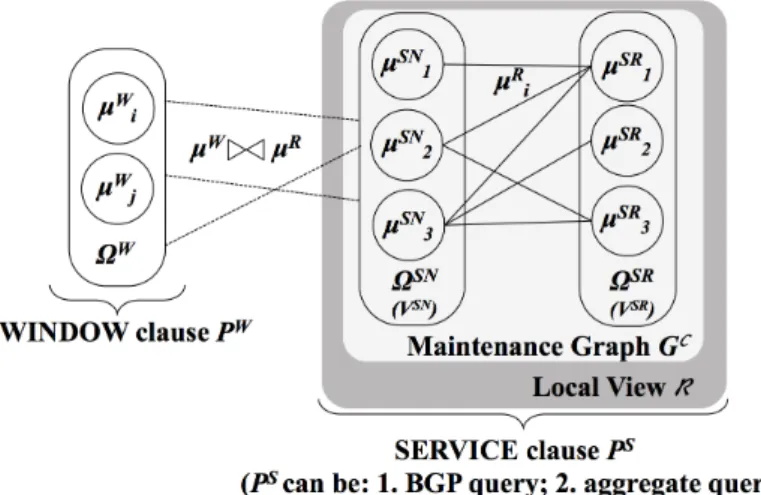
To reduce this cost, practical applications usually maintain a local view to cache the relevant BGD. As BGD can change slowly in the remote service, the local view has to be updated repeatedly to avoid stale data leading to wrong answers. However, accessing BGD is usually subject to some realistic update-budget constraints. For example, the number
8
of accesses within a time window cannot exceed a limit. Therefore, we investigated how to allocate an update budget to improve the result freshness.
To study this question, we first need to find a mathematical model to formally define the problem and formulate the optimization goal. Second, it is critical to understand how data and query patterns affect the result freshness over time so that the budget can be dynamically distributed. Third, different sub-query patterns require different optimization goals, the maintenance process must be able to handle different sub-query cases. In the context of these requirements, we investigated the hypothesis:
Hypothesis 2: A maintenance process that allocates the update budget according
to data and query patterns can improve the result freshness.
4.3 RQ 3: How can we use logical reasoning to check the consistency of large amounts of semantic streams w.r.t a conceptual model?
As discussed in the Challenges 5 and 6 of Section 3, semantic noise in streams is very complex and hard to find. This is because the streams are usually defined by an underlying conceptual model. The noise can implicitly violate constraints set by the model. Existing reasoning techniques can spot this kind of noise on static data. However, reasoning over streams is a difficult task because the system needs an incremental method to handle newly arrived data. The question becomes even more challenging when reasoning over large amounts of streams.
Example 4 (Complex noise) Consider a large e-commerce website that maintains its product catalog as a Knowledge Base (KB). Each product is represented as an entity with attributes describing its features. Thousands of sellers generate a huge amount of new entities every minute. However, a deceitful seller may intentionally provide fake product information. The company is interested in checking whether a newly added entity is consistent with an apriori model about the product. For example, a conceptual model of smart phones asserts that “iPhone” and “AndroidPhone" are disjoint classes. When a seller adds a new entity “xPhone" with exclusive attributes that can be inferred as an instance of both classes, the system should spot the inconsistency and stop adding it to the KB.
Existing reasoning tasks are mostly based on static data. We first need to adapt them to a dynamic setting. Given the huge volume of streams, employing a DSPE seems to be a good solution to improve scalability. However, it is still a challenging problem to perform stream reasoning on top of a DSPE. As discussed in Section 2.3, these engines require users to define a processing topology. Therefore, we need to study how to build and optimize reasoning topologies that can ensure the streams are confirmed with a given complex schema. This leads to the third hypothesis of this thesis:
Hypothesis 3: A DSPE topology, which implements reasoning procedures, can
ef-ficiently check the consistency of large amounts of semantic streams w.r.t a conceptual model.
5 Contributions 9
5
Contributions
This section gives an overview of the main outcomes of each project. The details of our solutions and results can be found in the corresponding paper in Part II.
5.1 The Clock Data-Aware Eviction Approach: Towards Processing Linked
Data Streams with Limited Resources
To answer RQ 1, we first studied two datasets to demonstrate the problem that stream-rate bursts can overload a system. We used the well-established SR-Bench dataset [85], as well as the real-world ViSTA-TV3
dataset that comes from the IPTV domain. Our study discovered that in both cases, RSP systems suffer from stream-rate fluctuations. The peak workload can easily overflow the working memory allocated to the system. For example, in the ViSTA-TV dataset, the start/end times of popular TV shows can lead to a sudden change in the rate of a user behavior stream. When many users join a channel at the same time, it quickly exhausts the working memory.
To verify Hypothesis 1, we implemented and tested several data-agnostic eviction approaches, such as Random, FIFO, and LRU. Results showed that these strategies save memory usage but cause a low result recall since they naïvely choose data to evict. Some data items that are expected to produce more results were evicted too early. Therefore, we proposed our eviction strategy named Clock. In Clock, each data item in the
memory is associated with a score, which prioritizes the data during an eviction. The score increases when the data produces more results and decreases with the time that it stays in memory. In this way, the score is dynamically adjusted according to the stream. It estimates the likelihood of producing future results based on the performance history and retains productive entries for a longer time. A variant of Clock is also proposed,
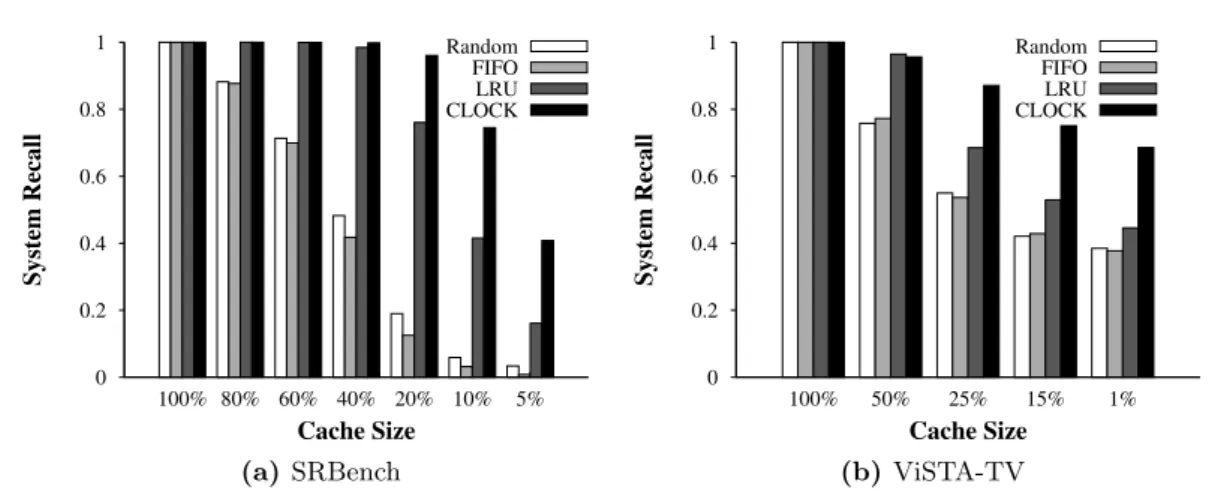
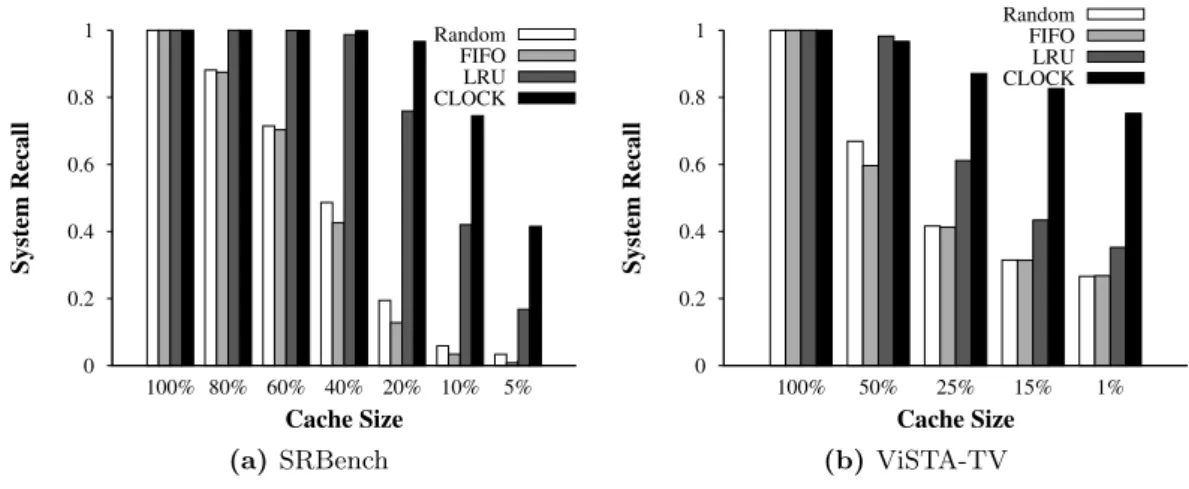
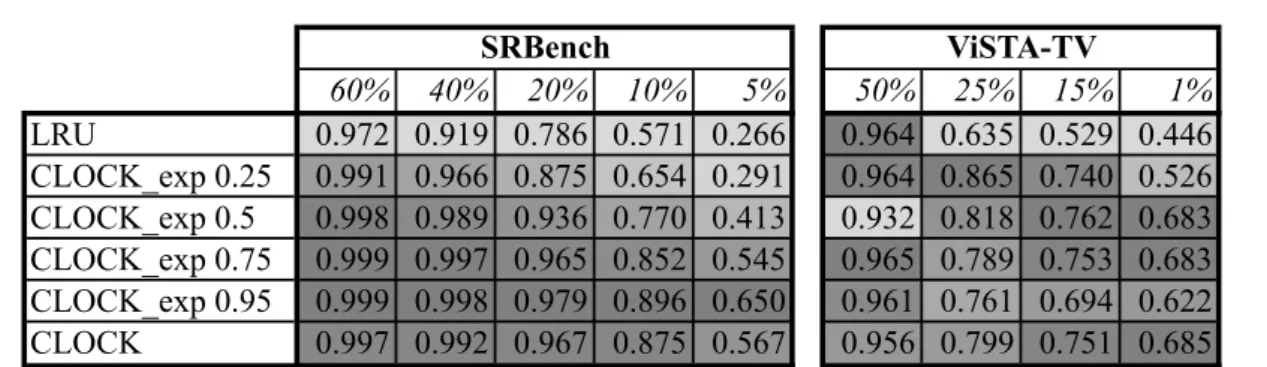
where a tunable parameter can control the weight of increasing and decreasing the score. Experimental results showed that existing data-agnostic approaches can curb the mem-ory consumption of workload spikes with a low result recall. Clock and its variant
out-perform the often-used LRU and FIFO strategies by factors between 1.5 and almost 3.
5.2 Planning Ahead: Stream-Driven Linked-Data Access under Update-Budget Constraints
To answer RQ 2, we first demonstrated that the budget in terms of allowed number of remote BGD accesses is usually very limited. In real scenarios, SPARQL endpoints are exposed over the Internet, and each request can take more than 500ms[60]. Given a very strict response time, the amount of possible accesses can be insufficient (e.g., a five-second response time only accommodates for at most ten sequential accesses).
As mentioned in Section 4.2, practical systems usually adopt a local view to cache relevant BGD. We defined that a maintenance process as the process of refreshing a portion of the local view. It decides which is the most desirable part of the local view to refresh under a given update budget. The budget is expressed in terms of the number of
3
10
accesses. We found that a bipartite graph can accurately model this problem. Under this model, data in the stream and the stale data in BGD form the vertices of the two disjoint sets; the join relationships between them create the edges. Then, the selection problem is converted into the problem of choosing a minimal set of BGD vertices to update so that it achieves the best response freshness, where the freshness is defined as the ratio of the number of up-to-date results over the total number of results in a window evaluation. We noticed that this optimization goal of achieving best response freshness could change according to the type of sub-query patterns. A basic solution named Selectivity-Based Maintenance (SBM) was proposed for two different sub-query patterns. When a query involves a Basic Graph Pattern (BGP) over the background data, a result corresponds to an edge in the graph. In this sub-query pattern, SBM is proven to be a locally optimal solution, which leverages the selectivity of the BGD data. It selects the BGD data with the highest number of edges so that it produces maximal amount of fresh results. When the sub-query is an aggregation over the BGD, the optimization goal is changed to achieve maximal amount of aggregated results. A fresh aggregated result can only be produced when a data item in the stream has all its associated edges updated. We modeled this problem with integer programming and showed that it is an NP-hard problem. SBM for the aggregation sub-query pattern is a heuristic algorithm that finds the stream data with the highest selectivity and updates their corresponding BGD.
Also, two extensions were proposed to improve SBM: the first one exploited the sliding window operation, which can be used to estimate how long a streamed data item will stay in the system. Based on this idea, our proposed algorithm, named Impact-Based Main-tenance (IBM), selects data items with longer impact. The impact is defined as the total number of expected results, which can be precisely calculated over the sliding window. Second, when the budget is allocated for a relatively longer time (multiple windows), we proposed a solution named Flexible Budget Allocation (FBA). FBA not only optimizes the current budget but also considers future ones. Therefore, it dynamically allocates an appropriate amount of budget to each query evaluation.
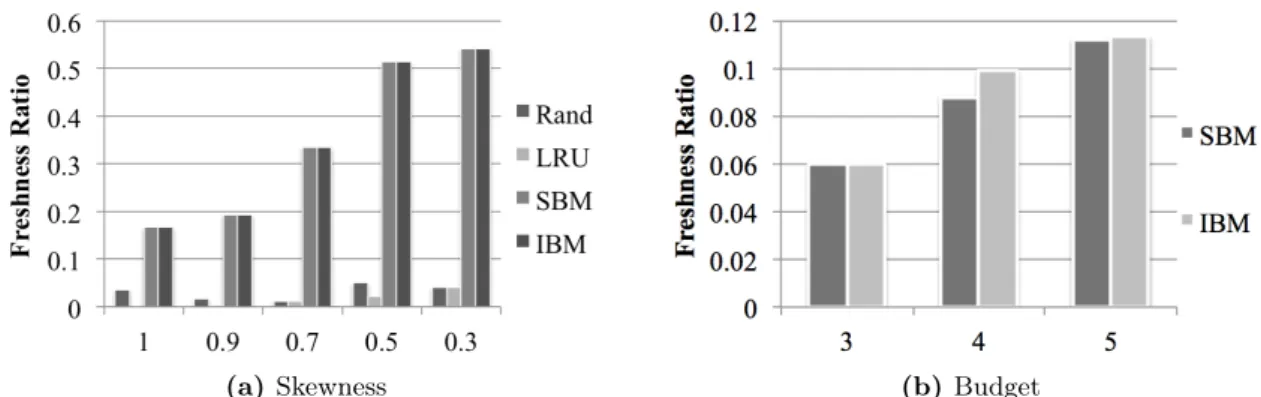
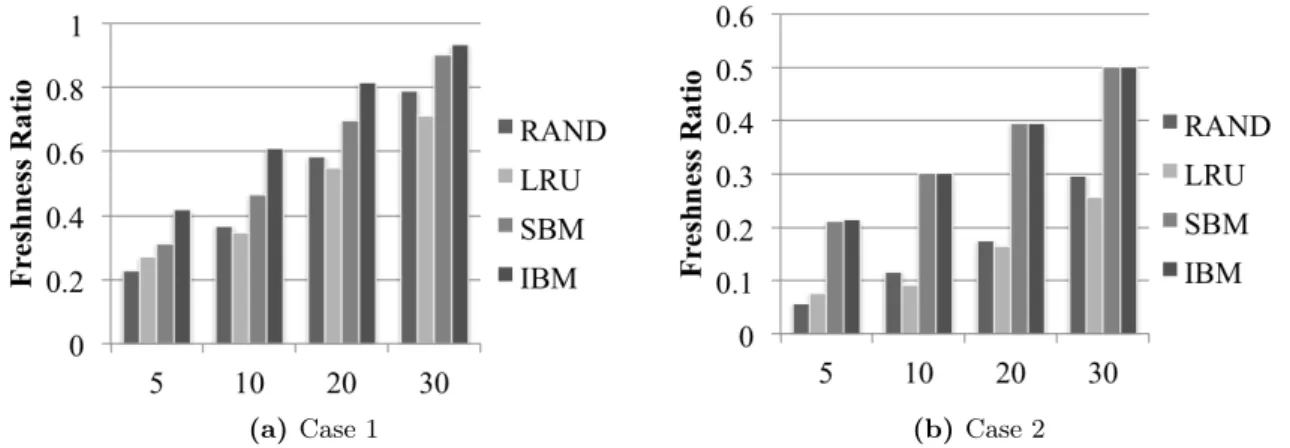
Lastly, our solutions are implemented in a real RSP engine, C-SPARQL. Experiments showed that our methods could efficiently allocate a given update budget and improve the result freshness by up to 93% over baseline algorithms such as Random Selection or Least Recently Updated.
5.3 Distributed Stream Consistency Checking
To address RQ 3, we explored how to use logical reasoning to check the consistency of the stream w.r.t. a conceptual model. We made the following three contributions.
Our first contribution is to formally define the consistency-checking task as a stream reasoning problem. Existing reasoning tasks are mainly based on a static ontology. We modeled the problem by adopting the evolving ontology notion based on the logic DL-litecore [16,68,82], where the TBox is static, and the ABox assertions arrive as a stream.
A window operation captures a portion of the ABox stream. The consistency checking task is performed over the window content against the TBox continuously.
6 Limitations 11 We designed algorithms to compile a TBox into consistency checking procedures that can be executed as a DSPE topology. We first proposed a baseline method named Negative-Inclusion Topology Method (NTM). NTM exhaustively compiles the TBox clo-sure into checking queries and registers them in a DSPE topology. This approach has the shortcoming of generating an excessive amount of checking queries. An improved method, named Pipeline Topology Method (LTM) has been developed, where the checking tasks are split into hierarchical groups that can be arranged as a pipeline. LTM has the benefit of reducing the total number of queries. However, this advantage comes at the cost of more communication load in the pipeline. To address this trade-off, we further proposed a performance model that balances the computation and communication costs and gives the best layout of the topology.
As the third contribution, we conducted a comparative study, based on the LUBM benchmark [40] using Twitter Heron [48]. Our experiments showed that the proposed solu-tion LTM improves the system throughput of the baseline method NTM by up to 139%. We also demonstrated that the cost model could correctly optimize workload distribu-tion by showing results in various metrics, such as the number of compiled operadistribu-tions, processing latency, and the memory cost.
6
Limitations
This section discusses some of the common limitations for the three projects in this dissertation. The specific limitations of each project can be found in the corresponding sections of Part II.
6.1 Individual Components vs. An Integrated System
Each research project of this thesis focuses on an individual component of an RSP system. However, complex applications may require an integrated system.
Studying each component separately allows us to understand the proposed techniques in-depth. Especially, it is fairly easy to disclose the impact of a tunable parameter on the system performance. For example, in the solution of RQ 1, we used a parameter to control the weight of the temporal recency and the past join history. By varying the value of this parameter, we can empirically reveal how it affects the result recall. When integrating different components together, the performance of the overall system depends on the interactions of many parameters. It becomes difficult to understand and optimize the system performance.
Given an individual component, we can usually design a deterministic performance model to guide the parameter tuning process. For example, our third project comes with a cost model that selects the best topology layout. However, after combining these com-ponents, the overall system performance cannot be accurately modeled anymore. The optimization goals in each method can even conflict each other, making the individual performance models obsolete. One possible solution is to apply black-box optimizations on the integrated system. Bayesian Optimization has shown its advantages in tuning pa-rameters of complex systems [25, 32]. Therefore, when integrating all the components in
12
this thesis into one system, we can rely on some black-box optimization engines, such as Spearmint and Google Vizier to optimize its performance [38,73].
6.2 Key Features vs. A Full-fledged System
Our studies only focused on some of the most important features in an RSP system. They still need to be generalized to become a full-fledged RSP system. Below, we list the key features in each project that need to be extended.
Methods in RQ 1 target on the join between two streams. Although it is one of the most important operators in an RSP engine. Other operations, like multi-way joins, projections, filters, and aggregation, should still be studied. In the paper, we briefly discussed how to adapt our method for these operations, but it still needs real implementations and performance comparisons.
The solutions of RQ 2 consider a complex query with two different sub-patterns: BGP and aggregation queries. Other RSP query components are not considered. For example, a FILTER clause can change the ranking method of data in the local view. Some recent efforts are extending the core idea of RQ2, such as [83, 84]. We believe there is still potential to further extend it, such as considering the OPTIONAL clause.
The reasoning procedure in RQ 3 only considers the DL-litecore logic. It needs to
be generalized to other advanced Description Logics. One of the closest extensions is DL-litehorn [6], where parts of our algorithms need to be adjusted to cope with concept
conjunctions. Another way to generalize our idea is to consider theEL++logic [8,9]. This logic involves transitive axioms that may cause loops in a topology. A possible solution is to manage these axioms as a separate procedure that can be executed before or after the topology.
7
Conclusions and Future Work
This thesis studies various methods to improve the efficiency of processing and reasoning of semantic streams. The three research projects address the challenges in the context of handling massive amounts of semantic streams. Each research project bears one of the
Vs as the primary target: the “Velocity” requirement is ensured by applying an eviction strategy to avoid system overloading; the “Variety” problem is addressed by an efficient maintenance process that accesses BGD with minimal cost; the “Volume” issue is resolved by performing scalable reasoning over significant amounts of streams to exclude implicit noise.
In the first project, we showed that the overloading problem occurred in two real-world datasets. The data-aware eviction strategy Clockaddresses this issue by combing
measures of recency with past performance history. It correctly retains the critical data and discards the less useful ones. Experimental results have shown that Clocktogether with
its variants substantially outperforms the often-used LRU and FIFO strategies regarding result recall. As an extension of RQ 1, the next step is to investigate the eviction problem in a distributed environment, where operators of a system reside on different machines. When spikes appear in the workload of one operator, we need to decide which of its
7 Conclusions and Future Work 13 upstream operators should perform eviction and how much data to evict. While our work is only a first step in investigating the overload problem, we believe it has a significant potential value of ensuring system reactiveness, especially on resource-limited systems.
In the second project, we showed that accessing remote BGD can be very expensive, waste resources, and deteriorate the response time. Refreshing a local view of BGD is necessary and subject to update-budget constraints. We propose different methods that efficiently allocate the budget to optimize the result freshness. Our solution relies on a bipartite graph to model the join between streams and BGD. It exploits the graph structure to improve response freshness for two kinds of sub-query patterns. We further proposed two extensions: the first one takes the future impact of each update into account. The second one flexibly allocates budget over different windows. Experiments have shown that our basic solution significantly improves the result freshness compared to the baseline algorithms (i.e., RAND and LRU). The two extensions further improve the performance of our basic solution. In future, we plan to extend our methods to other SPARQL operators as discussed in Section6.2. We believe that our study highlights an important problem in RSP—the joint evaluation of stream and BGD under budget constraints—and provides solutions for different subqueries. As such, it paves the way for real-world RSP systems, where the integration of stream and BGD is ubiquitous.
The third project is inspired by the observation that streaming data are growing in schema complexity. We employ reasoning techniques over streams to detect inconsisten-cies. While this problem is usually studied in the context of static knowledge bases, we formally adapted it for the streaming setting and proposed scalable solutions that can be deployed on a DSPE. Our methods can compile a reasoning procedures into a processing workflow of a DSPE. The baseline method NTM adopts query-rewriting techniques to generate continuous queries that assess the consistency. To reduce the excessive number of queries produced by NTM, we proposed LTM, where the workload of consistency check-ing is distributed across a pipeline. We analyzed the trade-offs between computation and communication costs in LTM and introduced a cost model to optimize it. Experimental results suggest that LTM significantly outperforms NTM in terms of system through-put, based on the LUBM benchmark. In future, we will consider dynamically adjusting topology during run time. This is an important issue since the stream rate in real-world is usually changing rapidly, which requires a topology to be re-optimized from time to time. The stop-and-restart approach in the current systems incurs a significant down time. Therefore, reconfiguring a topology on-the-fly is an impending challenge to avoid this problem. Our methods of compiling consistency-checking topologies tackle one of the most difficult issues in stream reasoning–the system scalability. We believe that this study lays down the foundation for future scalable-reasoning research.
In conclusion, we witnessed the rise of semantic streams and related technologies in the past few years. We believe that this trend will likely continue. Processing and reasoning of semantic streams will have a wider range of application areas. We hope that this study could contribute to the research of semantic streams in future and give insights for designing new stream-related systems.
Part II
The CLOCK Data-Aware Eviction Approach:
Towards Processing Linked Data Streams with Limited
Resources
This chapter is based on a submission that was accepted at the:
Proceedings of the 14th Extended Semantic Web Conference
The CLOCK Data-Aware Eviction Approach: Towards
Processing Linked Data Streams with Limited
Resources
Shen Gao, Thomas Scharrenbach, and Abraham Bernstein
Department of Informatics, University of Zurich, Switzerland
Abstract. Processing streams rather than static files of Linked Data has gained increasing im-portance in the web of data. When processing data-streams, system builders are faced with the conundrum of guaranteeing a constant maximum response time with limited resources and, possi-bly, no prior information on the data arrival frequency. One approach to address this issue is to delete data from a cache during processing – a process we calleviction. The goal of this paper is
to show that data-driven eviction outperforms today’s dominant data-agnostic approaches such as first-in-first-out or random deletion.
Specifically, we first introduce a method calledClockthat evicts data from a join cache based on the likelihood estimate of contributing to a join in the future. Second, using the well-established SR-Bench benchmark as well as a data set from the IPTV domain, we show thatClockoutperforms
data-agnostic approaches indicating its usefulness for resource-limited linked data stream processing.
1
Introduction
Streams of Data have become increasingly common in the Web of Data (WoD). Constant streams of weather data, stock ticker information, tweets, bids on an auction site, and TV viewers switching channels are all examples of such streams. When processing such streams, one typically attempts to answer queries or evaluate some functions as data comes along. To that end, SPARQL-like [41] languages such as SPARQLStream [18], C-SPARQL [12], CQELS [51], TEF-C-SPARQL [46], and EP-C-SPARQL [3] were proposed to allow joining elements of the stream with each other or some rich background data set.
In contrast to static data processing systems, stream processing systems need to be reactive: they must process continuously arriving new data within a given set of Quality of Service (QoS) constraints. Given that latency (or the delay by which newly incoming data impacts results) is usually among these constraints, Little’s law [55] ‘commands’ that we change from all-time semantics to one-time-semantics: data arriving after the accepted latency will not influence an answer produced by the system. Consequently, stream processing systems have to implement measures to cope with situations where the incoming data-rate overwhelms the systems’ processing capabilities – a situation we call a stressed system. Stress, in turn, occurs either because the constant data rate is overwhelming, hence the environment is overloaded, or bursts in the data-rate inundate the system.
Current systems typically try to avoid stress by limiting the scope of the query using a time-window – a language feature many systems support to define the context of a query. This solution is, however, limited to situations in which the window that is semantically relevant according to the application domain limits the arriving data to volumes that can
18
Shen Gao, Thomas Scharrenbach, and Abraham Bernstein
be handled by the system. Hence, even in the light of query contexts, it is easy to imagine a use case with a data rate that will overwhelm the system.
In order to deal with stress, stream processing systems can sample the incoming data, an operation called load shedding [10, 24, 77]. In this paper, we propose to delete data from the caches of the operators, as this operation can exploit the state of the operators in addition to data statistics to reduce stress. We refer to this as eviction, as it expels data items from the cache of operators. Both load-shedding and eviction allow maintaining the QoS constraints of a stream processing system in the light of limited resources. They do so at the cost of possibly introducing errors: mistakenly evicting data-items from intermediate caches that would lead to results can lower recall and even precision (when using the ‘non-open world assumption’ operators such as average).
This paper proposes the computationally efficient data-aware eviction strategy Clock
that evicts data from a join cache based on an estimate of contributing to a join in the future. Specifically, we show that our method outperforms data-agnostic strategies such as random or First-In-First-Out (FIFO) using both SRBench, a standard benchmark for evaluating the performance of Linked Data stream processing systems [85], and a real-world IPTV data set. As such, the paper extends a preliminary study that showed that an omniscient eviction strategy (i.e., a strategy that could look into the future) could outperform data-agnostic scheduling strategies [63] and makes it practical due to the removal of the reliance on future knowledge.
Consequently, we address the following Research Questions (RQ):
RQ 1: Real-world datasets, such as the ones in our study, can induce stress even when context limitations are present.
RQ 2: Eviction can curb memory consumption at the cost of a lower recall.
RQ 3: Our Clock data-aware eviction strategy outperforms data-agnostic eviction
strategies in terms of recall.
RQ 4: Clockoutperforms the Least Recently Used (LRU) strategy, which is often used
in cache management, in terms of recall.
Outline: After a conceptualization of load shedding and eviction for processing streams of data (cf. Section 2), Section 3 presents our Clock method, followed by a thorough
evaluation of our research questions on two real-world data sets (cf. Section 4). After a discussion of limitations (cf. Section 5) and related work (cf. Section 2) we close with a summary of our findings (cf. Section 7).
2
System Model: A Conceptualization of Load Shedding and
Eviction
A data stream processing system can be conceptualized as Processor P that continuously consumes one or more input data streams ISi and transforms them through a series of
operators O into one or more internal flows IFj, some of which are emitted as output
data streams OSj. Hence, P = (IS∪OS∪IF, O) can be seen as a directed graph, where
2 System Model: A Conceptualization of Load Shedding and Eviction 19 which are the nodes. All internal flows if ∈ IF connect two operators, whilst the input streams ISi and output streams OSj are only connected to one operator.
In the context of the WoD the input streams ISi typically consist of sequentially
arriving data tuples of the format < s, p, o > [tstart, tend], where < s, p, o > is a triple
representing a fact and tstart / tend denotes the start/end time of the triple’s validity.
Alternatively, when tstart =tend (i.e., the triple describes an event at time t rather than
a fact) the incoming tuples can be abbreviated as < s, p, o > t or, when only relative temporal order is implied by arrival time, t can be dropped. The output streams OSj
contain a continuous sequence of tuples either in the same format as the ones in the input stream or denoting bindings to a query. Note that all our considerations do not take the format of the input and output into account. Hence, our findings generalize to all stream processing systems.
System Stress This conceptualization indicates that a system can be stressed either by overwhelming the load on the operators or by inundating the bandwidth and latency constraints on the edges. This paper will focus uniquely on the former problem: It will assume that the bandwidth/latency constraints of the edges are adequate for tasks at hand. Note that operators can be overwhelmed either by time complexity (e.g., an operator that computes the factorial of large numbers) or by space complexity (e.g., a join that has to maintain a cache).
A context can curtail stress, as it allows the system ignoring nonsensical data-items and concentrating on data relevant for answering a query. A context is defined for an operator and defines which data is valid for evaluating the operator. One oftentimes used context is a time-window. Consider we want to count the audience for a certain TV channel based on a stream of events indicating which viewer switches to what TV channel. We need to know the set of data items the count is based on, i.e., the context of the operation. Prudent choices are, for example, time-based windows such as the last second (referring to the current TV ratings) or the past hour (referring to past ratings). For a detailed overview over windows and operators, we refer to [22]
Dealing with Stress We know of two approaches for dealing with stress: load shedding and eviction.
In load shedding the stream processing system samples the input streams and only considers part of the data. Formally, it is a sample operation s : ISi 7→ ISci, where
c
ISi ⊂ ISi. Figure 1 illustrates this for a join between stream ISx and stream ISy. Here
streamISxsheds its data itemx5 att= 3by deleting it from the considered input stream.
Load shedding strategies range from deleting data at random (e.g., useful for dealing with high-frequency sensor reporting averages per time unit), via a scheduling strategy such as FIFO, to estimating statistics of which data to delete and which not [10,24, 77].
In eviction the stream processing system removes data from the internal memory of the operators to preserve computational resources. Formally, eviction is the extension of the operatorsoi ∈O with one or more eviction strategieses:memory 7→memory, where
memory ⊂memory. Figure1illustrates two eviction strategies: First, it ‘garbage collects’ items that exit the context windows winnow of streams ISx and ISy. At time t = 2 for
20
Shen Gao, Thomas Scharrenbach, and Abraham Bernstein
due to the limited size of its join cache, it decides to remove data itemy3 of streamISy.
Note that this second strategy removes a data item which we observed at t = 3, i.e., a data item which would be still valid concerning the context of stream ISy.
This paper focuses on the impact of eviction strategies on the potential error in the resulting data. Specifically, the next section will introduce two traditional, data-agnostic evictions strategies (e.g., random eviction and FIFO ), one based on the nature of the data (e.g., garbage collection) as well as our Clockstrategy, which relies on the likelihood of
future joins.
3
Eviction Strategies
Eviction removes items from the internal memory (or cache) of an operator to save space. Most WoD stream processing systems extend the SPARQL algebra in order to allow evaluation of SPARQL operators on streams. As a consequence, the operators’ caches typically hold candidate variable bindings. Hence, the role of the eviction strategy is to choose variable bindings to delete from the cache.
Formally, an operator’s cache (or short cache)Cop with limit M and size N is a finite
set of variable bindings µ1, . . . , µN, whereN ≤M. We say there exists an overflow for C,
if and only if N > M, i.e., in case the number of items in the cache exceeds the cache’s
Fig. 1: Depiction of stress handling approaches in a join of two input streams. Load shed-ding on input stream ISy, garbage collection on both join caches, and other (unspecified)
eviction on join cache of stream ISx. Context is shown as windows (dashed: now, dotted:
past) and cache memory sizes are two items for the upper and one item for the lower stream.
3 Eviction Strategies 21 limit. An eviction strategyesremoves data items from a cacheCsuch thatC′ =es(C, M)
is a cache of limitM and|C′|≤M, i.e., it has no overflow. In the sequel, we define different
eviction strategies.
Note that in this study we consider eviction for caches of two-way-joins, i.e., joins with two join partners sharing one common join variable. We discuss possibilities for extensions to other operators in Section 5.
3.1 Baseline Eviction Strategies
In this section, we succinctly introduce the four baseline or traditional eviction strategies: random, FIFO, LRU, and garbage collection.
Random eviction deletes variable bindings from a cache according to a uniform distribu-tion U(0, N) over all cache entries. To deal with cache overflow, it requires to compute
O(N −M)random indices to delete from the cache.
First-In-First-Out (FIFO) maintains a queue of items, where the head of the queue is deleted whenever an overflow occurs. It requires O(N −M) calls to the queue. Together with random eviction FIFO has been adopted by today’s conventional systems [77].
Least-Recently-Used (LRU), a strategy widely adopted in cache management including the SASE+ stream management system [31], extends FIFO by moving items to the back of the deletion queue whenever they are accessed. As with FIFO, handling an overflow requires O(N −M)operations on the LRU queue.
Garbage Collection removes irrelevant data items from the operator cache. Relevancy may be determined via the context of a query. When processing TV viewership data, e.g., current viewers of a program are determined by joining the most recent program changes and user channel switches. Older channel switches by a user can, therefore, safely be garbage collected, as they are irrelevant to the query. Pure garbage collection is an incomplete eviction strategy, as it may not be able to remove enough items from the cache, when the context is not sufficiently restrictive.
Following the example of Section 2, random eviction would delete user sessions at random while FIFO would delete the oldest sessions – both while the session would be still valid. In a data agnostic way they ‘blindly’ follow their eviction strategies independent of possible future results. Garbage collection would delete all invalid sessions. It relies on data context but ignores the performance of the item in contributing to the operation. As a metric of past performance LRU deletes valid sessions with no recent activity. It favors temporal recency but ignores the magnitude of a binding’s past performance. In the next subsection we introduce ourClockapproach that estimates the future likelihood
of usefulness based on past performance. It extends LRU by considering both recency and magnitude of usefulness.
22
Shen Gao, Thomas Scharrenbach, and Abraham Bernstein
3.2 The Clock Strategy
Clock is a data-aware eviction strategy that considers both recency and magnitude
of past usefulness of a binding to estimate the likelihood of future usefulness, which it employs as criteria for eviction. Clock associates each binding with a score. Whenever
an item is matched, it increases that score. When it looks for items to evict, it first depreciates the bindings’ scores and then evicts those with lower scores. Thus, the score combines a measure of recency with a measure of magnitude.
Specifically, Clockmaintains a circular buffer cache of M slots containing the
bind-ings µwith their associated scoreswµ and a pointer to a positionp in the circle.
1
When a new data item arrives, it gets assigned an initial score wµ=w0. If there are empty slots,
it is added to one. Else the pointer depreciates the score of the item at position p using the depreciation function dep(). If the item’s new score is lower than some threshold τ, then it gets evicted, and the newly arrived binding takes its place. Otherwise, the pointer moves to the next position and repeats this procedure. Whenever a binding contributes to a join, its score gets increased by one (i.e., wµ:=wµ+ 1).
Following the example of Section2, Clock increases the count whenever we observe
a session activity, i.e., a user switches channels. At each point in time we decrease the count whenever we observed no activity.
Practically, we propose two different depreciation functions. The linear depreciation functiondeplin(w) =w−1just decreases the value of a score by one. It is associated with
the threshold τ = 0. Alternatively, we can depreciate exponentially with a depreciation rate ρ resulting in depexp(w) = w∗ρ (0 < ρ ≤ 1). In this case wµ will never reach 0.
Hence, we picked τ = 0.01 as a threshold. We call this extended version Clockexp.
In its baseline description without any extensions, Clock may have to circle around
the cache a number of times before finding a suitable candidate for eviction. With an extension containing the currently smallest score in the cache Clock needs at most
O(M) (limit of the cache) depreciation steps to find a victim for eviction. Clock also
requires a constant amount of additional memory (in particularM) for storing the scores
wµ of the bindings.
Observations: First, as mentioned, Clock can be seen as an extension of LRU that
considers both temporal recency and past join history. The weight between these two factors can by set by adjusting ρ.
Second, the initial scorew0 reflects the degree to which we give a bindingµ an initial
chance to find a join partner. It should be sufficiently high, such that it has a chance to survive initially. It should be sufficiently low to ensure the timely eviction of less useful bindings. In Clockexp it determines together with ρ how dynamic the eviction strategy
is.
Third, Clock could be easily extended to multi-way joins by using different-sized
increments for partial vs. full join results.
Fourth, theClockeviction strategy is founded on the following assumptions: in burst
streams, eviction only takes place eventually. As a result, cache entries for which we
1
4 Evaluation 23 observed no join partners could remain in the cache for a long time until eviction takes place. In an overloaded environment, there is only little chance that such items stay in the cache for long periods.
4
Evaluation
This paper argues that real-world and, hence, resource-limited WoD stream processing systems will be subject to stress even when using a use-case motivated context to limit the data that needs to be taken into consideration. To deal with stress, it proposes to employ eviction – an approach that removes data from the caches of the operators of the stream processor. Specifically, it suggests to employ a data-aware eviction strategy over (more traditional) data-agnostic eviction strategies and introduces the Clock approach
that is based on a likelihood estimate of future usefulness of an item.
To support this argumentation, this section will provide empirical evidence for the research questions (RQ) we defined in Section 1:
RQ 1: Real-world datasets, such as the ones in our study, can induce stress even when context limitations are present.
RQ 2: Eviction can curb memory consumption at the cost of a lower recall.
RQ 3: Our Clock data-aware eviction strategy outperforms data-agnostic eviction
strategies in terms of recall.
RQ 4: Clockoutperforms the Least Recently Used (LRU) strategy, which is often used
in cache management, in terms of recall.
As a consequence, this section will first lay out the experimental setup (Section 4.1) and then proceed to discuss each of these research questions in turn. We first show that our data sets can be used to evaluate RQ2 and RQ3 (Section4.2). We then evaluate these with two different experiments: first, we show the general performance of Clock versus
other strategies (Section 4.3), then we show that we can optimize Clock with regards
to learning its parameters (Section 4.4).
4.1 Evaluation Setup
To evaluate our research questions we built a stream processing simulator that allows to precisely measure, curb, and manipulate the memory consumption of the involved opera-tors via pluggable load shedding and eviction strategies. Whilst the system does correctly identify the bindings, we call the system a simulator rather than a full-fledged stream processing systems as it was built for experimentation rather than efficient processing and lacks elements such as a query parser/optimizer.
Given our research questions, theKey Performance Indicator (KPI) of our evaluation is recall, which is defined as the ratio between the number of results with a given cache size to that with unlimited cache size. We disregarded the time complexity of the eviction strategy as we found that all the strategies were faster than 40 ms (µ = 9.45ms, var = 15.03ms) per data item – a performance we deem sufficient for most applications.
24
Shen Gao, Thomas Scharrenbach, and Abraham Bernstein
To ensure realistic data, we employ two real-world data sets: SRBench and ViSTA-TV. SRBench [85] is a well-established benchmark for assessing the semantic streaming processing engines. It comprises the LinkedSensorData, GeoNames and DBpedia.2
Our test query focuses on the wind speed data set because it is reported by most of the sensor stations. To simplify our experiments, we preprocessed the SRBench dataset and extracted all of the 603’642 windspeed data entries, where each triple has the format:
< sensorID,reports, windSpeed > time. Since the queries of SRBench were designed to benchmark the functionality of different engines, we designed a new query focused on establishing the performance of eviction strategies. The query (cf. Listing 1), defined using the TEF-SPARQL [46] semantics, aims to find sensors with similar wind speeds using a self-join on the windSpeed entry – an operation, where recall depends greatly on the size of join-cache employed.
SELECT ?sensor1, ?sensor2 FROM STREAM windSpeed WHERE {
?sensor1 reports ?windSpeed ?T1 .
?sensor2 reports ?windSpeed ?T2 .
FILTER (?sensor1 != ?sensor2) . FILTER(?windSpeed >= 10^^xsd:int) . }
CONTEXT((?T1 - ?T2) <= 200^^xsd:millisecond) .
Listing 1: A self-join query inspired by SRBench
ViSTA-TV3
is a FP7 financed EU project that investigates the real-time process-ing of TV viewership information. The data set we employed for evaluation contains anonymous IPTV viewership logs (Log) in the format < userID,watches, channelID >
[tstartviewer, tendviewer] and Electronic Program Guide (EPG) data < channelID, plays, programID >[tstartEP G, tendEP G]. Each data entry is annotated by a starting time
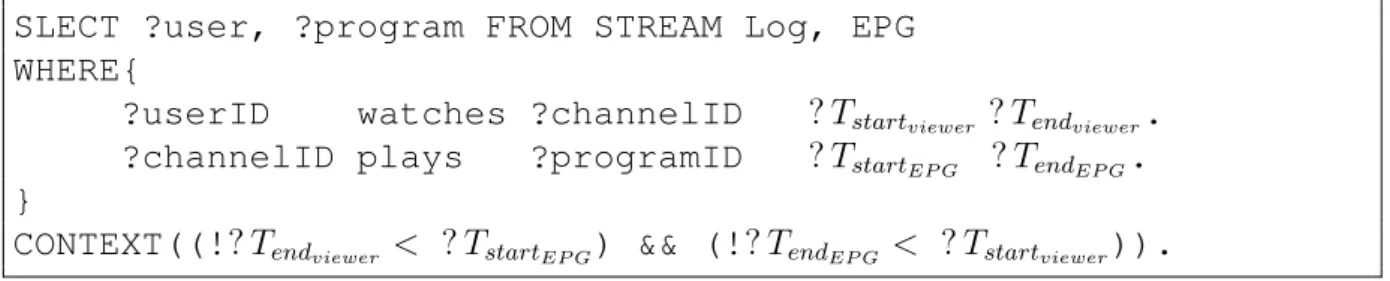
stamp and an ending time stamp. A data entry is consider to be expired when the system time has passed its ending time. We used three-day’s Log and EPG data, which contains 1’887’256 viewership events and 31’960 EPG entries. As defined in TEF-SPARQL [46], the query (cf. Listing2) is a two-way join operation, which represents the use case to find all users that are currently watching a specific TV-program. To ensure that all caches were in a steady state, first one-third amount of data in each data set are used to ‘warm up’ the system and the rest are reported here.
All experiments were conducted on a MacBookPro with a 2.7 GHz Intel Core i7, 16GB of RAM, and 256 GB of SSD disk space running Mac OX 10.9.1.
2
http://wiki.knoesis.org/index.php/LinkedSensorData, http://geonames.org, http://dbpedia.org
3