AN EXPLORATION INTO TEACHERS’ PEDAGOGICAL CONTENT
KNOWLEDGE (PCK) FOR TEACHING QUADRATIC FUNCTION IN GRADE 10
by
BALQIS OLAWUMI BANJO (STUDENT NUMBER: 53999991)
submitted in accordance with the requirements for the degree of
MASTER OF EDUCATION
In
MATHEMATICS EDUCATION
at the
UNIVERSITY OF SOUTH AFRICA
SUPERVISOR: PROF. M. F. MACHABA
i
DECLARATION
I declare that AN EXPLORATION INTO TEACHERS’ PEDAGOGICAL CONTENT KNOWLEDGE (PCK) FOR TEACHING QUADRATIC FUNCTION IN GRADE 10 is my own work and that all the sources that I have used or quoted have been indicated and acknowledged by means of complete references.
I further declare that I have not previously submitted this work, or part of it, for examination at UNISA for another qualification or at any other higher education institution.
_____________________ ______________________
ii
ACKNOWLEDGEMENT
Glory be to Almighty God for His abundant mercy over me, since the beginning of my educational career up till now, and for He also granted me good and sound health and inspiration to complete this task.
For every achievement in an individual’s life, there is always a backing from somebody, in terms of finance, moral or academic supports. I hereby place my gratitude to the people who have one way or another contributed to my success in the course of this study, most importantly my husband, Adv. S. B. Banjo and also my precious daughter, Fareedah. I cannot thank you both enough.
I am particularly much obligated to my supervisor, Prof. M. F. Machaba, for his inestimable and constructive comments, inspirations and guidance which benefited me so much in the successful completion of this research. My gratitude also goes to the following lecturers in the department, Mr J. F. Malatjie, Mrs S. M. Kodisang, Mr Mabotja, and Prof. M. M. Phoshoko, for their immeasurable contributions to this study. Thank you.
This package will be incomplete without acknowledging my former lecturer, Dr S. A. Aderibigbe, who always encourages me to further my education. Thank you for believing in me.
To my parents, Mr & Mrs Adedoyin, the joy of having you in my life serves as my engine fuel. I pray God Almighty grant you more healthy years on earth to witness many more success of your children.
iii
LIST OF ABBREVIATIONS
PCK Pedagogical Content Knowledge NCS National Curriculum Statement
CAPS Curriculum and Assessment Policy Statements DBE Department of Basic Education
Hon. Honours degree
KCT Knowledge of Content and Teaching
KMLS Knowledge of Mathematics Learning Standards KC Knowledge of Curriculum
CK Content Knowledge
AMESA Association for Mathematics Education of South Africa PPK Pedagogical-Psychological Knowledge
MPRA Model of Pedagogical Reasoning and Action GET General Education and Training
TEDS-M Teacher Education and Development Study in Mathematics
IEA International Association for the Evaluation of Educational Achievement
FET Further Education and Training ANA Annual National Assessment
SACE South African Council for Educators IQMS Integrated Quality Management System NOS Nature of Science
SPTD Senior Primary Teacher’s Diploma ACE Advanced Certificate in Education
iv BA Bachelor of Art
HOD Head of Department ATP Annual Teaching Plan
MTSK Mathematics Teacher’s Specialized Knowledge KCS Knowledge of Content and Learners
SMK Subject Matter Knowledge SCK Specialised Content Knowledge CCK Common Content Knowledge
MKT Mathematics Knowledge For Teaching UNISA University of South Africa
v ABSTRACT
The study’s purpose was to explore the components of pedagogical content knowledge (PCK) for teaching quadratic function in Grade 10 mathematics classrooms in Mogalakwena district, Limpopo. The study was mainly guided by Shulman’s PCK and it was categorised as content knowledge, knowledge of the curriculum, knowledge of learners and knowledge of teaching strategies. The researcher employed a qualitative case study research design to explore the teaching of three purposefully selected Grade 10 mathematics teachers regarding their knowledge of quadratic function, strategies employed to teach quadratic function and knowledge of Grade 10 mathematics learners in quadratic function. In this study the researcher argued that PCK strands are interwoven, and in order to teach mathematical concepts, such as quadratic function, effectively teachers should employ components of PCK to complement one another. Data were gathered by lesson observation and interviews. Findings revealed that concepts of quadratic function are inefficiently addressed in Grade 10 due to teachers’ lack or inadequacy in some aspects of PCK. Therefore, there is need to develop mathematics teachers’ PCK in the Mogalakwena district to enhance their teaching of Grade 10 quadratic function.
KEY TERMS: Teaching of quadratic function; Pedagogical content knowledge; Mathematics teachers’ content knowledge; Quadratic function; School mathematics curriculum; Instructional strategies; Connecting mathematics; Learners’ common error; Learners’ prior knowledge; Mathematics teacher.
vi TABLE OF CONTENTS
DECLARATION ... i
ACKNOWLEDGEMENT ... ii
LIST OF ABBREVIATIONS ... iii
ABSTRACT ... v
LIST OF FIGURES ... ix
LIST OF TABLES ... x
CHAPTER 1: INTRODUCTION TO THE STUDY ... 1
1.1 BACKGROUND TO THE STUDY ... 1
1.2 PROBLEM STATEMENT ... 3
1.3 AIM OF THE STUDY ... 5
1.4 RESEARCH QUESTIONS ... 5
1.5 RATIONALE AND SIGNIFICANCE OF THE STUDY ... 6
1.6 HOW MY INTEREST IN THIS RESEARCH TOPIC DEVELOPED ... 6
1.7 DEFINITION OF KEY TERMS ... 7
1.8 ORGANISATION OF THE DISSERTATION ... 8
1.9 CONCLUSION ... 9
CHAPTER 2: LITERATURE REVIEW ... 10
2.1 INTRODUCTION ... 10
2.2 THE PEDAGOGICAL CONTENT KNOWLEDGE (PCK) ... 10
2.3 THE THEORETICAL FRAMEWORK UNDERLYING THIS INQUIRY: SHULMAN’S PCK ... 12
2.3.1 Key components of PCK ... 13
2.3.2 Swan’s Principles of Teaching Mathematics ... 17
2.4 A SELECTION OF LITERATURE DRAWN FROM SHULMAN’S PCK CONSTRUCT ... 19
2.4.1 Mathematics knowledge for teaching (MKT) ... 19
2.4.2 Mathematics Teacher Specialised Knowledge (MTSK) ... 21
2.4.3 Knowledge of Discourse... 22
2.4.2 Conceptualising PCK for teaching quadratic function in grade 10 ... 24
2.5 SUMMARY ... 34
vii
3.1 INTRODUCTION ... 36
3.2 RATIONALE FOR RESEARCH APPROACH ... 37
3.2.1 Qualitative Research ... 37
3.2.2 Research Design ... 37
3.3 RESEARCH SETTING ... 38
3.4 RESEARCH SAMPLE AND DATA SOURCES ... 40
3.4.1 Population and Sampling Procedure ... 40
3.4.2 Characteristics and Size of Sample... 40
3.4.3 Ethical consideration ... 42
3.5 DATA COLLECTION METHODS ... 43
3.6 DATA ANALYSIS METHODS ... 45
3.7 ISSUES OF TRUSTWORTHINESS ... 46
3.8 LIMITATIONS AND DELIMITATIONS OF THE STUDY ... 46
3.9 SUMMARY ... 47
CHAPTER 4: DATA ANALYSIS AND INTERPRETATION ... 47
4.1 INTRODUCTION ... 47
4.2 DATA ANALYSIS PROCESS ... 49
4.2.1 Research question 1: What knowledge of Grade 10 quadratic function do teachers possess? ... 51
4.2.2 Research question 2: What are the teaching strategies teachers use to teach quadratic function? ... 60
4.2.3 Research question 3: How do teachers build learners knowledge of quadratic function? ... 92
4.2.4 Research question 4: How do teachers draw from their knowledge of curriculum when teaching quadratic function?... 106
4.3 SUMMARY ... 111
CHAPTER 5: CONCLUSIONS AND RECOMMENDATIONS ... 112
5.1 INTRODUCTION ... 112
viii
5.2.1 Content knowledge that teachers use for teaching quadratic function on Grade
10 113
5.2.2 The teaching strategies that teachers use in the teaching of quadratic function in
Grade 10... 116
5.2.3 How teachers build learners’ knowledge of quadratic function ... 118
5.2.4 How do teachers draw from their knowledge of the curriculum when teaching quadratic function in Grade 10? ... 121
5.3 CONCLUSIONS BASED ON THE FINDINGS ... 123
5.4 RECOMMENDATIONS ... 125
REFERENCES ... 127
LIST OF APPENDICES ... 132
Appendix A: Turnitin Report... 132
Appendix B: Ethical Clearance Certificate... 133
Appendix C: Language Editor’s Certificate ... 135
Appendix D: Requesting Permission of the Circuit Manager ... 135
Appendix E: Requesting Permission of the Principal... 137
Appendix F: Informed Consent Agreement with the Participant ... 139
Appendix G: Consent/Assent to Participate in this Study (Return Slip) ... 140
Appendix H: Lesson observation Instrument ... 142
Appendix I: Interviewing Protocol ... 143
Appendix J: Requesting Parental Consent for Minors to Participate in a Research Project 146 Appendix K: A Letter Requesting Assent from Learners in a Secondary School to Participate in a Research Project ... 148
ix LIST OF FIGURES
Figure 1. 1: Performance of candidates in 11 subjects from 2014 to 2018: Extracted from
NSC 2018 School Performance Report ... 2
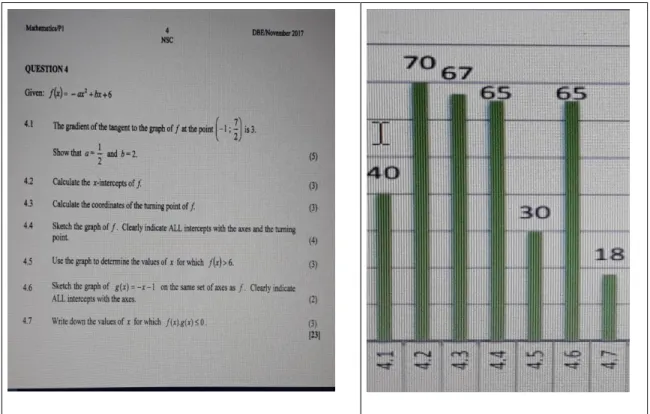
Figure 1. 2: Candidates performance in quadratic function: Extract from NSC 2017 Diagnostic Report ... 4
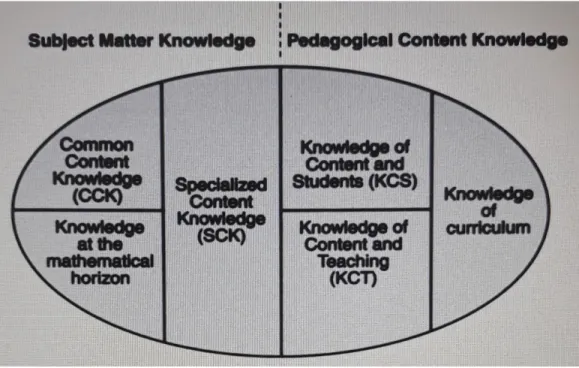
Figure 2. 1: MKT framework: Adapted from Ball’s (2008) Unpacking Pedagogical Content Knowledge ... 20
Figure 4. 1: Convert the algebraic formulae into tables: T1’s case ... 51
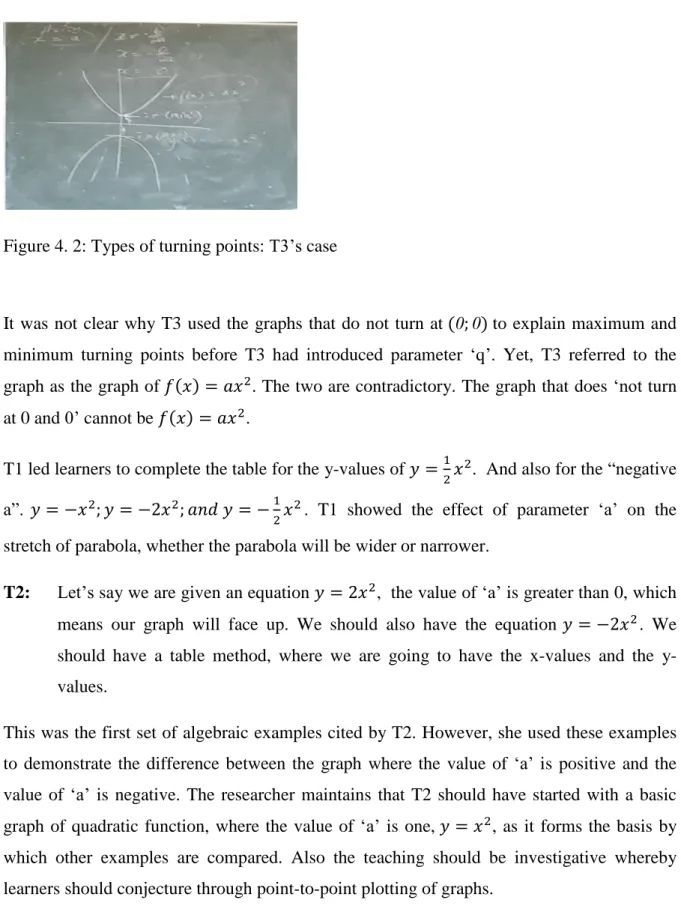
Figure 4. 2: Types of turning points: T3’s case ... 52
Figure 4. 3: Use different notations for output: T3’s case ... 53
Figure 4. 4: Interpretation of the graph: T2’s case ... 54
Figure 4. 5: Shapes of parabola: T2’s case ... 56
Figure 4. 6: The values of ‘a’ and their effects: T2’s case ... 56
Figure 4. 7: Definition of vertical shifts: T2’s case ... 57
Figure 4. 9: A copy of exercises used by T3 ... 59
Figure 4. 8: Calculation of y-intercept: T3’s case ... 58
Figure 4. 10: Definition of a function: T2’s case... 66
Figure 4. 11: Two forms of quadratic formulae: T3’s case ... 68
Figure 4. 12: Calculate ‘q’ to write equation of parabola: T2’s case ... 72
Figure 4. 13: Calculate ‘a’ to find equation of parabola: T2’s case ... 72
Figure 4. 14: Calculate x-intercepts: T2’s case ... 74
Figure 4. 15: The co-ordinates of key points on parabola: T2’s case ... 75
Figure 4. 16: Convert formula to table: T2’s case ... 81
Figure 4. 17: Stretch-effect of parameter ‘a’: T1’s case ... 86
Figure 4. 18: The graph of 𝒂 > 0: T2’s case ... 89
Figure 4. 19: Stretch-effect of parameter ‘a’: T3’s case ... 91
Figure 4. 20: ‘Sad’ and ‘Smile’ analogies: T1’s case ... 94
Figure 4. 21: Dual method for finding intercepts with axes: T1’s case ... 101
x
Figure 4. 23: Exercise from Siyavula Mathematics Learners’ book: T2’s case ... 107
LIST OF TABLES Table 2. 1: Malcolm Swan’s (2006) Eight Principles of Teaching Mathematics ... 17
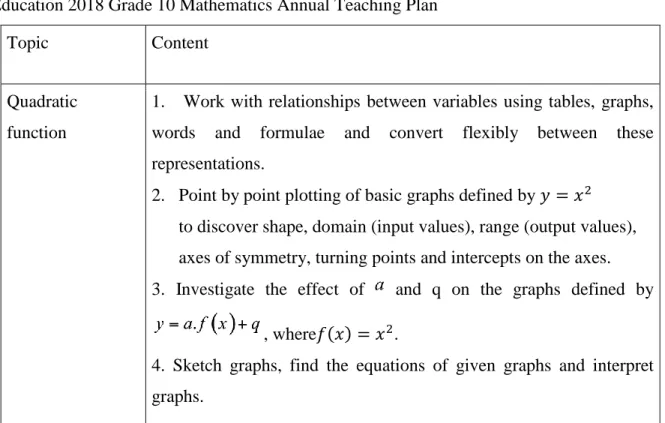
Table 2. 2: Content of quadratic function: Extract from Limpopo Department of Basic Education 2018 Grade 10 Mathematics Annual Teaching Plan ... 27
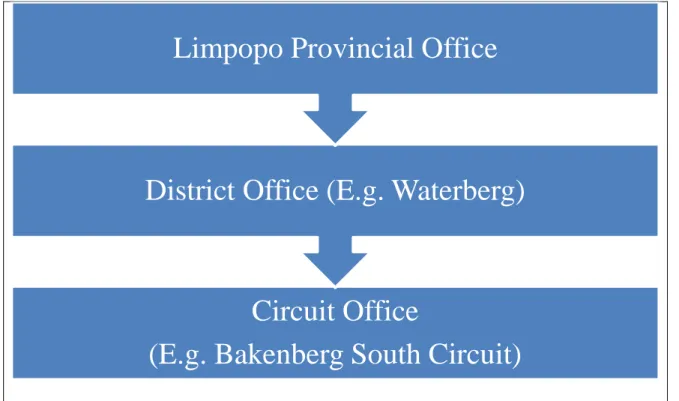
Table 3. 1: The Organisational Chart of Limpopo DBE ... 38
Table 3. 2: Selected Schools’ Performance: Extracted from School Subject Reports 2016 & 2017 ... 39
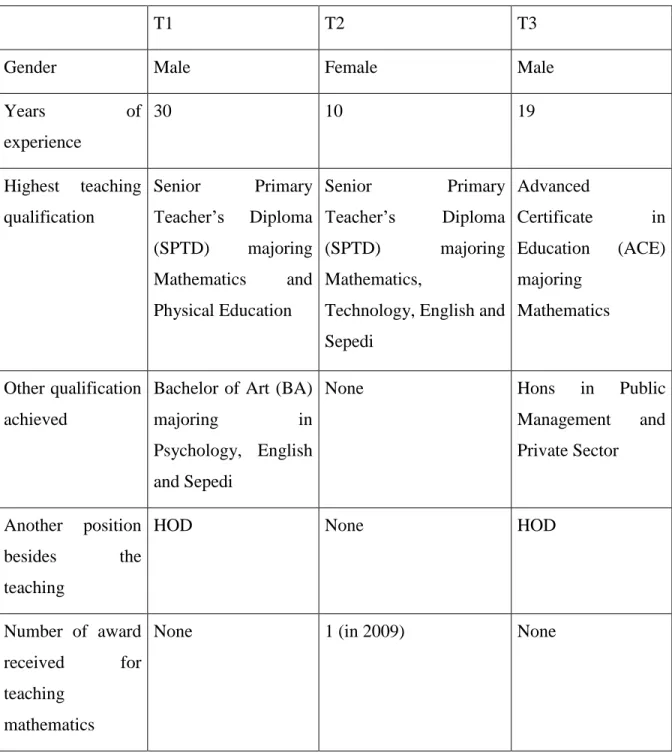
Table 3. 3: The profile of participants of this study ... 41
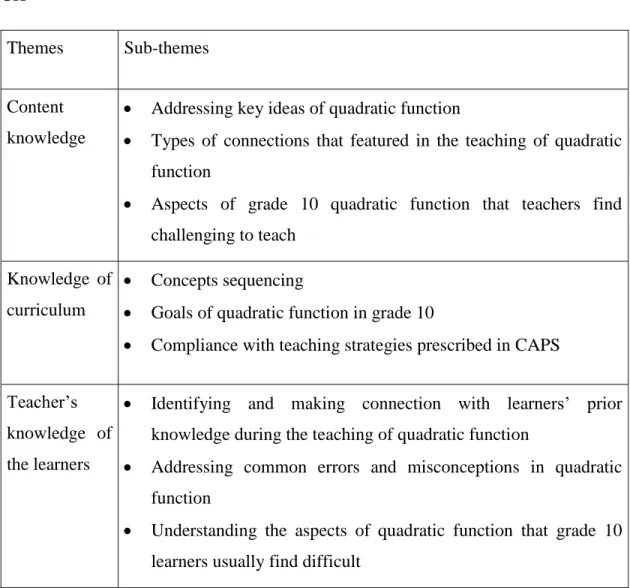
Table 4. 1: PCK framework used in this study: Adapted Shulman’s (1986, 1987) concepts of PCK ... 48
Table 4. 2: The key concepts of quadratic function in Grade 10: Adopted from Limpopo Department of Basic Education (2018) Grade 10 Mathematics ATP ... 50
Table 4. 3: Participants identify and organise key ideas of quadratic function ... 54
Table 4. 4: T2’s learners worked on the chalkboard ... 61
Table 4. 5: Activities on determining the equation of parabola: T2’s case ... 73
Table 4. 6: Two functions having the same y-intercept: T3’s case ... 76
Table 4. 7: Learners identify ‘difference of two squares’: T3’s case ... 77
Table 4. 8: T3’s calculation of x-intercepts for linear function ... 79
Table 4. 9: T3’s calculation of point of intersection of g(x) and f(x) ... 79
Table 4. 10: The shapes of parabola: T1’s case ... 81
Table 4. 11: Learner seating arrangement in T1’s class ... 83
Table 4. 12: Learner seating arrangement in T2’s class ... 83
Table 4. 13: Learner seatin arrangement in T3’s class ... 84
Table 4. 14: Methodical skill for filling the tables: T1’s case ... 87
Table 4. 15: T2’s learner filled the table for y= −𝟐𝒙𝟐... 89
Table 4. 16: T2’s calculation of point of intersection of f(x) and g(x) ... 91
xi
1
CHAPTER 1: INTRODUCTION TO THE STUDY
1.1 BACKGROUND TO THE STUDY
Teachers’ pedagogical content knowledge (PCK) is no longer a new concept in the teaching field, but the researcher posited the need to break it down into its basic-essential-elements that can be assessed in the teaching of quadratic functions in Grade 10. The concept of PCK is clearly related to knowledge about how specific content can be interpreted in teaching situations (Cooney 1994). The PCK in the current study focused on the knowledge of content and curriculum that the teacher uses in the teaching of the quadratic function; the teacher’s knowledge of a learner’s thinking and how the former applies it to the teaching of the quadratic function; and the teacher’s knowledge in choosing appropriate instructional strategies for teaching the quadratic function. This study is limited to the Mathematics National Curriculum Statement (NCS) of South Africa: The Curriculum and Assessment Policy Statements (CAPS) Grades R-12. Further, the researcher only explored the teaching of a unit concept in mathematics, the quadratic function. Mathematics teachers are faced with many challenges, including the use of appropriate teaching strategies for a specific lesson or class as a teacher needs to consider other factors that influence learning. It is important that teachers teach mathematics effectively to ensure that learners grasp the concept and the relevant curriculum outcomes. This is only possible if the teacher possesses the necessary knowledge required for teaching.
In South Africa, mathematics continues to demonstrate the lowest performance for the past five years among the ten key subjects: Accounting, Agricultural Sciences, Business Studies, Economics, Geography, Life Sciences, Mathematical Literacy, Mathematics and Physical Sciences (see Figure 1.1).
2
Figure 1. 1: Performance of candidates in 11 subjects from 2014 to 2018: Extracted from NSC 2018 School Performance Report
Quadratic function is one of the topics in Grade 10 Mathematics CAPS. This topic is given maximum attention in terms of allocation of time and assessment weight. It forms the heart of mathematics because of its relevance to other main topics in mathematics such as algebra, patterns and sequences, trigonometry, and analytical geometry (DBE, 2012). A key focus of this study was exploration of how teachers make connections among the topics of mathematics, during the teaching of quadratic function in Grade 10. According to the 2017 NSC diagnostic report, the teacher should use questions on quadratic functions that involve incorporation of different topics during teaching and in class-based assessment. The issue of connecting mathematics is also evidenced in 2016 NSC November examination where Grade 12 learners failed to connect the turning point of a parabola with its range. The diagnostic report states that some candidates did not recognise that the turning point, B(2;1), had to be used to write the range. According to the NCS Diagnostic Reports (Department of Basic Education [DBE], 2015:160):
Teachers should teach inequalities intensively and properly. They should integrate the algebra with functions, so that learners have a visual understanding of inequalities and stress the meaning of the inequality signs in the teaching of both algebra and functions...In teaching any function; teachers should expose learners to all aspects of the function. This includes sketching, interpretation of the equation and the graph, as well as finding the
3
equation from given information and transformations. The teaching should also include concepts such as roots, points of intersection, intervals where graphs are relative to one another under a given condition, gradients and equations of tangents.
In Grade 10 quadratic functions, “learners should be able to recognise relationships between variables in terms of numerical, graphical, verbal and symbolic representations, and convert flexibly between these representations” (DBE, 2012: 12). Grade 10 also forms the basis of proper ‘naming’ of the quadratic function (otherwise known as parabolic function) and the foundation through which it advances. Teachers should endeavour to spend adequate time on teaching the parabola and other basic concepts of quadratic function to ensure that learners gain understanding of the concept before they get to Grade 12. This may improve learners’ performance in functions and mathematics at large.
1.2 PROBLEM STATEMENT
The teaching of mathematics continues to be a great challenge in South Africa. Teachers do not cover curriculum content sufficiently and serious problems in the South African education system are linked to teacher knowledge, among others (Motshekga, 2012). The continuing poor learner performance in mathematics in South African public schools focuses attention on how teachers teach mathematical concepts in secondary schools. How do teachers teach mathematics in South African schools? How should they teach it?
In order to develop learners’ problem-solving and cognitive skills, teaching of the quadratic function should not be limited to “how” but should rather feature the “when” and “why” of problem types; learning procedures and proofs without a good understanding of why they are important will leave learners ill-equipped to use their knowledge in later life (DBE, 2012).
4
Figure 1. 2: Candidates performance in quadratic function: Extract from NSC 2017 Diagnostic Report
Figure 1.2 presents Question four of the Grade 12, NSC November examination paper of 2017, which deals with parabolic and linear functions, together with the analysis of candidates’ performance. According to the report, questions 4.5 and 4.7, which were based on quadratic equations, are higher order questions and required learners to read off intervals from graphs. The learners performed poorly in the questions 4.5 and 4.7. However, learners’ answers indicated that learners had used algebraic manipulation which resulted in making the problems more complicated and time consuming. Based on the researcher’s experience and the literature, some Grade 12 learners did not possess necessary algebraic skills, which were fundamental to solving quadratic function problems. Further, some could not differentiate between various types of function based on the equations or graphs. Learners should have developed conceptual understanding of these concepts from Grade 10 quadratic function. Hence, the current researcher found it important to explore how mathematics’ teachers teach quadratic function in Grade 10.
5 1.3 AIM OF THE STUDY
The aim of this study was to explore the concept of PCK with regard to the teaching of quadratic function in Grade 10 classrooms in the Mogalakwena district, Limpopo. The aim was to understand how mathematics teachers teach quadratic function in Grade 10 from participants’ perspectives. The main objectives of this research were:
• To explore teachers’ content knowledge required in the teaching of quadratic function in Grade 10;
• To explore strategies used for teaching quadratic function in Grade 10;
• To explore how teachers access learners’ prior knowledge in the teaching of quadratic function; and
• To explore how teachers draw from their knowledge of the curriculum when teaching quadratic function in Grade 10.
1.4 RESEARCH QUESTIONS
The study examined the elements of PCK employed in the teaching of quadratic function. The main research question of the study is: How do mathematics teachers teach quadratic function in Grade 10? To answer this question, the following sub-questions were pursued:
1. What content knowledge do teachers possess in teaching quadratic function in Grade 10?
2. What are the teaching strategies that teachers use in the teaching of quadratic function in Grade 10?
3. How do teachers build learners’ knowledge of quadratic function?
4. How do teachers draw from their knowledge of the curriculum when teaching quadratic function in Grade 10?
6
1.5 RATIONALE AND SIGNIFICANCE OF THE STUDY
The researcher sought to explore the concept of PCK for the teaching of quadratic function. The researcher studied the components of PCK of Grade 10 mathematics teachers and explored the interactions among these components, with regard to the teaching of quadratic function in Grade 10. The researcher believed that the information may assist to improve teachers’ knowledge, and hence improve learners’ performance in mathematics. In addition, this study:
• may provide guidelines for mathematics teacher development programmes;
• will increase the available literature in the area of PCK for teaching quadratic function;
• may serve as an eye-opener to mathematics teachers on the importance of PCK to the teaching of mathematics;
• may serve as a source of input to teachers in designing their teaching activities; • may proffer solutions to challenges of teaching quadratic function.
1.6 HOW MY INTEREST IN THIS RESEARCH TOPIC DEVELOPED
The researcher’s learning experiences, especially during the study of Honours Bachelor of Education Degree (Hon. B Ed) was the major source of interest which led to the current study. During that time, several activities required the learners (the researcher included) to apply/analyse educational theories or ideas to practical situations. Among others, learners were exposed to concepts such as teacher empowerment through curriculum studies, in which they learned about various implementation strategies; various models of teaching mathematics; and, most interestingly, connected mathematics. The researcher developed an interest in making connections within and across mathematics’ topics, within and across the grades, as well as outside mathematics. The researcher hence adopts a belief that mathematics is connected and the teacher should facilitate learners to be aware of the connections. The researcher believes that ability to connect mathematics forms the basis of understanding of such mathematics. Also, the researcher discovered, through observable experiences that she and many other teachers do not understand what PCK entails. Through
7
study she understood that the term, PCK, encompasses more than just teaching method, as often used by many teachers.
Of specific importance was when the researcher had to analyse in order to defend whether the CAPS is informed by the constructivist approach. The researcher chose quadratic function as a topic of choice and then analysed connections and progression of the concepts, within quadratic function, across quadratic function and across the grades. The researcher also highlighted the areas where CAPS acknowledges the importance of exposing learners to real-life situations in order to develop mathematical and creative skills. The researcher thereby believes that the teaching of quadratic function rests on teacher’s PCK, and that inadequacy in teacher’s PCK about this topic may jeopardize the aims and objectives of mathematics education in South Africa at large.
1.7 DEFINITION OF KEY TERMS
In this section the key terms that are used during the study are clearly defined.
• PCK: the knowledge required of every teacher to teach effectively. It simply implies the knowledge of content and pedagogy blended together. PCK is the transformation of content (e.g., quadratic function) into pedagogically multiple representations (Fernandez, 2014). Hill, Ball and Schilling (2008) find that PCK refers to the topic-specific knowledge base; as such they review its concepts with respect to a topic-specific topic of study. According to Cochran (1997), “PCK is a type of knowledge that is unique to teachers and is based on the way teachers relate their pedagogical knowledge (what they know about teaching) to their subject matter knowledge (what they know about what they teach)” (para. 4).
• Practical knowledge: an epistemology of teaching practice. This is the intellectual activity of a mathematics teacher that contributes to the construction of knowledge about teaching quadratic function. The teacher gains practical knowledge through the teaching of quadratic function.
• Teaching: the act of facilitating the learners’ learning of quadratic function. It is an activity carried out by the mathematics teacher with the aim a of transferring mathematical knowledge and skills to his/her learners. Teaching is the process of
8
attending to people’s needs, experiences and feelings and making specific interventions to help them learn particular things (William, 2017).
• Teacher: the secondary school mathematics teacher in the Mogalakwena district of Limpopo, South Africa.
• Learner: refers to a student in secondary school. In South African context, ‘learner’ should be used instead of ‘student’ as defined in the South African Schools Act. • Teacher’s knowledge: all the knowledge and beliefs of the mathematics teacher that
influences his/her teaching of quadratic function in Grade 10.
• Functions: a mathematics topic in the mathematics curriculum of South Africa. Siyavula Mathematics Learner’s Book 10 (2012) describes “functions as mathematical building blocks for designing machines, predicting natural disasters, curing diseases, understanding the world economies and or keeping airplanes in the air”.
• Quadratic function: a sub-topic in Functions. It is also known as parabolic functions. It is one of the forms 𝑦 = 𝑎𝑥2+ 𝑞where a and q are constants.
• Grade 10: a phase/stage/class in secondary school. It is formally known as ‘Form 3’ in the South African education context.
1.8 ORGANISATION OF THE DISSERTATION
It is recommended that a master’s dissertation should comprise five chapters [University of South Africa (UNISA), 2017]. This study was organised as follows:
• Chapter one: The Introduction
In this section the researcher discussed the background to the study; the statement of the problem; the purpose of the study; significance of study; research questions; limitation and delimitation of the study; and the definition of key terms.
• Chapter two: Literature review
This section seeks to give up-to-date information on what knowledge has already been established on the topic of research. The researcher gives a critical summary of related
9
resources. The researcher discusses in detail, the concept of PCK, teaching strategies and quadratics functions.
• Chapter three: Methodology
In this section the researcher discusses the research methodology; research design; population and sample; instrumentation and method of data collection; validity and reliability of the instruments; and data analysis.
• Chapter four: Presentation and analysis of data
In this chapter, the researcher discusses the findings and analysis of responses. • Chapter five: Conclusions and recommendations
This section deals with the summary, the conclusion and recommendations of the study. It also highlights suggestions for further research.
1.9 CONCLUSION
A better South Africa depends greatly on the quality of education provided to its citizens. Quality education implies quality teaching and learning and it is a function of the teacher’s knowledge. As a mathematics’ teacher, the researcher is charged with responsibility of contributing to finding lasting solutions to address the massive failure in mathematics in South Africa, most especially in her own community. She takes her inspiration from the words of Andre du Plessis: "Can I improve my mathematics teaching? Teacher Action Research holds the key to how!
10
CHAPTER 2: LITERATURE REVIEW
2.1 INTRODUCTION
In this chapter, the researcher first discussed the theoretical framework adopted as a guide to the exploration of PCK for teaching the quadratic function in Grade 10. PCK simply refers to how teachers teach a specific topic for learners’ understanding. It is concerned with what teachers do with curriculum materials, learners and instruction (Ball et al., 2005; par.1.7). The theoretical framework provides the structure to define philosophical, epistemological, methodological, and analytical approaches to a research study (Grant & Osanloo, 2014). The theoretical framework is the driver of research work. The main theoretical framework that underlies this study is PCK. Based on the experience and the study, the researcher opined that effective teaching of mathematics is influenced by several factors which fundamentally include the teacher’s knowledge of the subject matter, knowledge of the school mathematics curriculum and its instructional materials, ability to understand learners’ thinking, as well as good communication skills. All these attributes are embedded in the construct of PCK introduced by Shulman (1986; 1987). Secondly, in this chapter, the researcher reviewed related literature to explore the discussions on what constitutes the knowledge that mathematics teachers need to possess to teach quadratic functions in Grade 10. The discussions are based on the themes such as the background of study, components of PCK with respect to some selected scholars, the teacher’s knowledge of quadratic functions, as well as PCK for teaching of quadratic functions in Grade 10. The researcher chose to focus on how each of the sources communicates and/ or contributes to the understanding of the concept of PCK, rather than its theoretical positions or the historical development surrounding it.
11
Different terms have been used to describe the necessary knowledge that the teacher needs to know to teach mathematics. Gaps in teachers’ knowledge, among others, have been shown to impact negatively on mathematics curriculum implementation in South Africa (Motshekga, 2012). Motshekga (2012) remarked that her department (DBE) would intensify teacher development efforts on teacher PCK to improve the quality of teaching and learning of mathematics in South Africa.
Studies conducted by Carrillo, Climent, Conteras and Munoz-Catalan (2013); Charalambous (2016); and Ingvarson, Schwille, Tatto, Rowley, Peck, and Senk (2013) explored the knowledge required to teach mathematics since mathematics teachers need special knowledge that is essential to the discipline.
Fernandez (2014) defines teacher’s knowledge as “all a teacher’s knowledge and beliefs that influence his teaching practices. That practical knowledge is the result of what teachers know from their professional expertise”. He identifies practical knowledge as knowledge that teachers gain through teaching. Thus, this notion undergirds the epistemological belief of the present researcher that mathematics teachers develop their PCK through active teaching and the mastery of their own teaching. Shulman’s (1987) Model of Pedagogical Reasoning and Action (MPRA) describes the significant process of developing mathematics teachers’ PCK with emphasis on the importance of reflection on the teaching process. The current researcher concurs with Akerson, Pongsanon, Rogers, Carter and Galindo (2017) who posit that reflective practice plays an important role in the development of the mathematics teacher’s PCK. Carter (as cited in Fernandez, 2014) opines that practical knowledge and PCK are closely connected, yet the two are distinct. PCK forms part of professional knowledge but is broader and more formal than what characterises practical knowledge; practical knowledge is conceived to be more personal and situational. In this study, practical knowledge is understood to be a product of mathematics teachers’ PCK, which together impact on teachers’ professional teaching of quadratic function especially in Grade 10. Mathematics teachers of all grades acquire pedagogical skills through years of experience: the more time the teacher spends teaching mathematics and reflecting on his/her teaching practices, the stronger the impact on his/her pedagogical knowledge (Ingvarson et al., 2013). The current study focuses on Grade 10 mathematics teachers to fill a gap in the body of
12
related knowledge since most extant studies on PCK have been done on teachers in the early grades (Bansilal, Brijlall & Mkhanazi, 2014; Hauk, Toney, Jackson, Nair & Tsay, 2014). The issue of PCK is crucial to mathematics teacher professional development, its management and assessment. Failing to develop or/ and assess mathematics teachers’ PCK may result in poor teaching of mathematics and poor learner performance in mathematics as we currently experience in Limpopo province. The researcher believed that gathering information about PCK and the pedagogical demands of the CAPS mathematics curriculum is a necessity for quality teaching of mathematics (particularly of quadratic functions) in South Africa.
2.3 THE THEORETICAL FRAMEWORK UNDERLYING THIS INQUIRY: SHULMAN’S PCK
Shulman (1983) originally presented the construct of PCK to signify a special kind of teacher knowledge that differentiates a teacher in any given discipline from an expert of that discipline. Shulman introduced PCK at a conference at the University of Texas in 1983 in a paper titled: ‘The missing paradigm in research about teaching’. His research was first published in 1987 in which he defined PCK as the intersection of content and pedagogy that belongs only to teachers (Fernandez, 2014). Shulman (1987) outlined the seven categories of the knowledge base for teaching: Content knowledge; General pedagogical knowledge; Curriculum knowledge; PCK; Knowledge of learners and their characteristics; Knowledge of educational contexts; and the Knowledge of history and philosophy of education. He (1986: 9) further placed special stress on PCK, thus defined as:
… Knowledge, which goes beyond knowledge of subject matter per se to the dimension of subject matter knowledge for teaching. I still speak of content knowledge here, but of the form of content knowledge that embodies the aspects of content most germane to its teachability. Within the category of pedagogical content knowledge, I include, for the most regularly taught topics in one’s subject area, the most useful forms of representation of those ideas, the most powerful analogies, illustrations, examples, explanations, and demonstrations—in a word, the ways of representing and formulating the subject that make it comprehensible to others. since there are no single most powerful forms of representation, the teacher must have at hand a veritable armamentarium of alternative
13
forms of representation, some of which derive from research whereas others originate in the wisdom of practice.
PCK is specialised knowledge possessed by experienced teachers and used to make understanding of a topic accessible to learners. Shulman (1986) describes it as the ways of representing and formulating the subject that makes it comprehensible to others, including an understanding of what makes a specific mathematics topic easy or difficult to learn. The PCK framework has been widely proven as a model for investigating teachers’ knowledge for teaching mathematics. The epistemological study of elements of PCK that a mathematics teacher should possess to teach Grade 10 quadratic functions is based on Shulman’s construct of PCK, that is, the blending together of content and pedagogy into understanding of how the concepts of quadratic functions are organised, represented, and adapted to the diverse interests and abilities of Grade 10 learners, and presented for instruction. Thus, Shulman (1986) zoomed into two aspects of teacher’s capacities: content knowledge and pedagogical skills. However, these two are differentiated.
2.3.1 Key components of PCK
Deconstructing PCK into possible domains is significant to the current study to help the researcher understand participants’ opinions on each aspect in the discourse. Shulman (1987) “categorizes teacher’s knowledge into seven domains: general pedagogical knowledge; knowledge of learners and their characteristics; knowledge of educational context; knowledge of educational ends, purposes, and values, and their philosophical and historical grounds; content knowledge; PCK; and curriculum knowledge”. Some of these domains such as knowledge of learners and their characteristics, content knowledge, and curriculum knowledge, have been used to analyse data in the present study. By knowledge of learners and their characteristic, for example, the researcher looking into: how the teacher identified and used learners’ prior knowledge during the teaching of quadratic function; how the teacher addressed learners’ common errors and misconceptions in quadratic function; and how the teacher caters for learners’ different needs while teaching quadratic function.
Shulman lays emphasis on PCK domain, which he describes as the blending of content and pedagogy into quality teaching instruction. Shulman identifies two sub-elements of PCK: knowledge of representations of specific content and instructional strategies; and understanding of learning difficulties and learners’ conceptions of specific content
14
(Fernandez, 2014). Conversely, Charalambous (2016) identifies the components of PCK as the tasks in which teachers engage in teaching mathematics for learner understanding. Charalambous (2016) focuses more on teaching practices while identifying five categories of knowledge that are significant to teaching of mathematics: subject matter knowledge (SMK); providing and evaluating explanations; selecting and using representation; analysing learner errors, misconceptions and non-conventional solutions; and selecting tasks. However, the current study explores discussions in the literature about the content and curriculum, teaching strategies and instructional materials, and learners’ characteristics, as the researcher believed they form the key domains. Thus, the current study focuses on four categories of PCK, which are commonly discussed in the literature. These are: the content knowledge; the knowledge of curriculum; knowledge of learners; and knowledge of instructional strategies.
2.3.1.1 The content knowledge (CK)
Schulman’s work (1986; 1987) elaborated subject matter knowledge (also known as content knowledge or CK) as the fundamental knowledge base a teacher must possess. He identified CK as one of the knowledge bases which is a prerequisite to PCK and this influences the development of PCK. This view is in line with some other researchers (e.g., Pournara, 2014: Ball et al., 2008) who identified CK as mathematical knowledge and hence, different from PCK. It is understood from the literature that CK can only be considered as an element of PCK, if it is discussed in relation to teaching. Therefore, the CK in the current study was conceived as an element of PCK, as the researcher explored the CK for teaching quadratic function in Grade 10. One of the research questions of the current study (cf. 1.4) is: What content knowledge do teachers possess in teaching quadratic function in Grade 10?
Krauss, Baumert and Blum (2008 as cited in Pourana, 2014) describe CK as a kind of mathematical knowledge that is more advanced than the mathematics that the curriculum requires the teacher to teach. They add that CK allows the teacher to cope with mathematical challenging situations. With regard to the level of CK required in Grade 10 quadratic functions, the current study adopted Schulman’s (1986) suggestion that the CK of a teacher should be at least equal to that of his/her colleagues. According to Shulman, content knowledge includes: knowledge of concepts, theories, ideas, knowledge of proofs and evidences as well as practices and approaches to develop this knowledge (Fernandez, 2014).
15
This study reflects on teachers’ in-depth knowledge about the concepts of quadratic function taught in Grade 10 that may positively influence their instruction and the interaction between CK and teaching (and other forms of pedagogical knowledge and skills).
2.3.1.2 The knowledge of the curriculum
Teacher’s PCK also plays a significant role in the selection of curricular materials. For example, it enables the teacher to identify textbooks that the teacher finds problematic or flawed in their conception of the topic, or incomplete in their treatment or inadequate in explanation or use of examples. Knowledge of the curriculum demands that the teacher understands the structure of the subject matter. Curricular approaches in South Africa have changed from transmission-based teaching to a learner-centred approach. The curriculum requires mathematics teachers to give room for learner-initiated questions and independent thoughts and to ensure interactions among learners in the mathematics classroom environment. Sadly, the converse is the case in most South African classroom practices (Paulsen, 2009). The lack or inadequate professional knowledge at the grassroots level contributes to the poor implementation of the curriculum.
PCK is crucial for teaching of mathematics in general and quadratic function in particular. Teaching, generally, comprises intellectual activities which involve the ability to process knowledge and understanding and the ability to communicate it effectively. In other words, not only must a teacher have high competency of the subject matter but he/she must also be able to transform it into accessible forms for learner understanding. A good teacher must possess good communication skills among others.
Teachers must not only be capable of defining for learners the accepted truths in a domain. They must also be able to explain why a proposition is deemed warranted, why it is worth knowing, and how it relates to other propositions, both within the discipline and without, both in theory and in practice. (Shulman, 1986, p. 9)
Planning of lesson for quadratic function is a crucial activity that sets several knowledge domains of the teacher into play. During the planning, the teacher uses knowledge of curriculum to identify the main contents of quadratic function that learners supposed to learn in grade 10. Knowledge of curriculum also affords the teacher the opportunity to prepare for teaching strategies that is suitable for the learners’ characteristics.
16 2.3.1.3 Knowledge of instructional strategies
The concept of appropriate instructional strategies for teaching quadratic function in grade 10 is central to this study. Shulman (1986) suggests that knowledge of theories and methods of teaching is important. An effective teaching approach is closely associated with a high quality of PCK. Yusof, Zakaria and Abdullah (n.d.) stated that PCK enables a teacher to foresee challenges that learners may experience during the teaching and therefore get equipped with appropriate methods during planning of the lessons. Also, during the presentation (the teaching) the teacher combines several knowledge domains, such as content knowledge and knowledge of instructional strategies. At this stage the teacher relates the new knowledge to what learner already know. According to Brijlall (2011), knowledge of appropriate teaching approaches such as using an improved questioning and quality explanation is primary aspect of PCK. Studies, such as Kazima et.al’s (2008), categorise teacher’s knowledge of instructional strategies as a core pedagogical knowledge. The researcher endorsed activity-based learning in which the teachers dominantly work with learners’ ideas. The researcher opined that explanation should come after learners have explored and generated ideas. Kazima also emphasized on teacher’s ability to pose higher ordered questions that are capable of developing learners’ mathematical thinking and exposing their misconceptions. Researchers (such as Yusof, Zakaria & Abdullah, (n.d.); Even, 1990) identified enquiry approach, e.g. ‘investigation’, as a powerful instructional strategy for teaching quadratic function. The approach is an activity-based in which learners are required to check specific cases and the teacher assess learners’ understanding on the spot.
In this study, the researcher explored qualitative data to provide answer to the question: What are the teaching strategies that teachers use in the teaching of quadratic function in Grade 10? The researcher gained more access to the teachers’ knowledge of instructional strategies through lesson observation. This study adopted the most commonly shared characteristics of instructional strategies explored through the literature. Thus using variety of powerful representations; facilitating learners to investigate theories, explain their findings and make generalization; using an inclusive approach that ensures active participation of all the learners; and allowing the learners to work in group.
17 2.3.1.4 Knowledge of the learners
Bansilal (2012) stresses the importance of understanding mathematics learners. She highlights that learners conceive mathematical concepts in two ways: operationally – when learners see concepts as a process; and/ or structurally – when learners see mathematics concepts as an object. These can be related to action level and object levels discussed in another study (Bansilal et al., 2014). The two ways are crucial for deep understanding of mathematics. The above reveals the symbiotic relationship between the components of PCK: the content knowledge and the knowledge of the learners. Mathematics teachers need to be more sensitive to learners’ prior knowledge and individual differences. The teacher must provide opportunities that allow learners to play an active role in assimilating new knowledge into their existing knowledge. This aspect is related to the components of PCK: the importance of learners’ prior knowledge to quadratic functions and the selection of appropriate teaching strategies that afford learners active participation.
Olivier (as cited in Machaba, 2016:2) “defines misconceptions as errors or wrong answers that are systematic and are applied regularly in the same circumstances.” Several scholars (e.g., Machaba, 2016; Sapire, Shalem, Wilson-Thompson & Paulsen, 2016) show the importance of error analysis, as it forms an integral aspect of teacher knowledge. Learners often hold and express incomplete mathematical knowledge. This calls upon the teacher’s pedagogic skills to scrutinise, interpret, correct and extend this knowledge (Ball et al., 2005). Addressing common errors and misconceptions in quadratic function is one of the domains the present study explored. It represents an aspect of teacher’s knowledge of the learners. 2.3.2 Swan’s Principles of Teaching Mathematics
This study harmonizes Swan’s principles of teaching mathematics with PCK framework. Swan’s summaries of competent teachings of mathematics are similar to Shulman’s description of PCK and are specific about teaching of mathematics. Swan (2006) highlights competent teachings as those that are capable of the following principles:
Table 2. 1: Malcolm Swan’s (2006) Eight Principles of Teaching Mathematics
18 the knowledge learners
already have;
and adapting our teaching to accommodate individual learning needs (Black &Wiliam, 1998).
It should expose and
discuss common
misconceptions
Learning activities should expose current thinking, create ‘tensions’ by confronting learners with inconsistencies, and allow opportunities for resolution through discussion (Askew &Wiliam, 1995).
It must use higher-order questions
Questioning is more effective when it promotes explanation, application and synthesis rather than mere recall (Askew &Wiliam, 1995).
It must use cooperative small group work
Activities are more effective when they encourage critical, constructive discussion, rather than argumentation or uncritical acceptance (Mercer, 2000). Shared goals and group accountability are important (Askew &Wiliam, 1995).
It must encourage reasoning
rather than ‘answer getting’
Often, learners are more concerned with what they have ‘done’ than with what they have learned. It is better to aim for depth than for superficial ‘coverage’.
It must make use of rich, collaborative tasks
The tasks we use should be accessible, extendable, encourage decision making, promote discussion, encourage creativity, encourage ‘what if’ and ‘what if not?’ questions
It must create
connections between the topics
Learners often find it difficult to generalise and transfer their learning to other topics and contexts. Related concepts (such as division, fraction and ratio) remain unconnected. Effective teachers build bridges between ideas
19 It must make use of
technology in appropriate ways
Computers and interactive whiteboards allow us to present concept in visual dynamic and exciting ways that motivate learners.
The Swan’s principles summarise what characterise collaborative orientation approach. These include teacher’s ability to make connections among the concepts of the topic; facilitate learners to engage in productive discussions; ensuring non-linear dialogue between the teacher and the learners; and presenting problems before explanation.
2.4 A SELECTION OF LITERATURE DRAWN FROM SHULMAN’S PCK CONSTRUCT
The following literature is considered significant for the current study as it analyses or/ and seeks to expound the special knowledge that teachers need to teach mathematical concepts. The selected works are primarily based on Shulman’s construct of PCK, the theoretical framework for the current study.
2.4.1 Mathematics knowledge for teaching (MKT)
Mathematics Knowledge for Teaching (Ball et al., 2008) as presented in Figure 2.1 below, advances on the PCK construct of Schulman. Ball and colleagues continued to seek information on the sort of mathematical reasoning, insight, understanding and skills that are required for the teacher to teach mathematics. They created a test to measure teacher knowledge. The study initiated the concern about mathematics knowledge from the point of view of teaching. MKT was based on research among K to Grade 8 teachers in the United States (US). The researchers proposed two categories of teacher knowledge: Subject Matter Knowledge (SMK) and PCK. They argued that teaching requires complex management of instructional resources including teachers’ SMK and PCK. Each of which was further simplified into three broad categories.
20
Figure 2. 1: MKT framework: Adapted from Ball’s (2008) Unpacking Pedagogical Content Knowledge
The Common Content Knowledge (CCK) is associated with teaching in general. The knowledge is not particular to mathematics teachers, but also to other professions that use mathematics (Ball et al., 2008). This is synonymous with what Shulman describes as Subject Matter Knowledge, SMK. However, Specialised Content Knowledge (SCK) is a newer conceptualisation of SMK. To specialise in teaching and learning mathematics, Ball and partners see the need for mathematical knowledge that is specifically intended for mathematics teachers. This knowledge, according to the authors (2008), allows teachers to engage teaching tasks, for example, how to accurately represent mathematical ideas and provide mathematical explanations.
The CCK and SCK are both mathematical knowledge and belong to the group of SMK in the MKT model. Conceptualisation of the two does not require the knowledge of the learners or that of the teaching. This describes the boundaries between/among the components of MKT. On the other hand, Knowledge of Content and Learners (KCS) is an aspect of PCK. Ball (2008) defines KCS as content knowledge blended with knowledge of how learners think
21
about, know, or learn content, for example, quadratic functions. It is believed to be the same as what Shulman originally described as ‘understanding of what makes the learning of specific topic easy or difficult’. The knowledge of learners (ideas and thinking) or knowledge of content is different from KCS. KCS simply means when the teacher combines (blends together) understanding of learner thinking with a mathematical knowledge in view, and then uses it to enhance teaching of such concepts. KCS focuses mainly on how learners learn content rather than the broad mathematics’ curriculum.
2.4.2 Mathematics Teacher Specialised Knowledge (MTSK)
The MTSK model was developed by Carrillo et al. (2013). Their work draws on MKT (Ball et al., 2008). The authors suggest that there is mathematical knowledge shared by mathematics’ teachers and others (e.g., mathematicians) and there is a special kind of mathematical knowledge that is possessed by only the mathematics teacher. The latter, according to the authors, is referred to as PCK. It further draws a line between mathematical knowledge and the PCK for teaching mathematics. MTSK focuses exclusively on the mathematics teacher’s specific knowledge with regard to effective teaching of mathematics. The authors believe that effective teaching of mathematics is a product of integration between teacher’s mathematical knowledge and the PCK. They describe mathematical knowledge as that pertaining to the teacher’s understanding of the content (pure mathematics). These include: knowledge of the topics, which has to do with the mathematical concepts and procedures and their underpinning theories; the knowledge of the structure of mathematics, which refers to the structure of concepts and ways of proceeding in mathematics; and lastly, the knowledge of practice of mathematics as the teacher’s competency of mathematical language and ability to connect the concepts.
The current study investigated the MTSK’s characterisation of PCK to get closure on what comprises the mathematics teacher’s PCK with respect to teaching of quadratic functions in Grade 10. According to MTSK, PCK is the non-mathematical knowledge (but powered by mathematical knowledge) that allows the teacher to understand how the learners learn; choose appropriate materials and examples that best suit the teaching; as well as knowledge of assessment, especially by the external educational bodies. The elements of MTSK referring to PCK are built upon MKT as rightly pointed out in the beginning. The PCK elements are classified into three: (i) Knowledge of mathematics’ teaching which is
22
synonymous to Ball’s KCT. It is the knowledge that allows the teacher to choose appropriate teaching materials and examples that best illustrate the mathematical concept. (ii) Knowledge
of features of learning mathematics, which is concerned with knowledge of the teacher that
enables him/her to understand what learner think and how they learn mathematics. It draws on the KCS of the MKT, but is particularly concerned with the teaching and learning of mathematics. (iii) Knowledge of mathematics learning standards, which describes Ball’s KC or curriculum knowledge with an extension that the assessment and evaluation of relevant external bodies is paramount to the successful teaching and learning of mathematics. Knowledge of mathematics learning standards captures the knowledge of the mathematics curriculum and its supporting materials (Carrillo et al., 2013).
2.4.3 Knowledge of Discourse
Hauk et al. (2014) achieved a laudable landmark in mathematics education by building a model called “Knowledge of Discourse”. This model extends Ball’s MKT referring to PCK, with a focus on the original framing of PCK by Shulman. This model explains the key aspects of PCK with a focus on secondary and post-secondary contexts. While comparing their work to MKT, Hauk et al. (2014) acknowledge the correlation between MKT and quality of instruction as it indicates the powerful relationship between what and how teachers know about mathematics and what occurs during classroom instruction. With regard to Ball’s SMK, these researchers remarked that the nature of SMK for teachers varies according to the grades they teach, a view shared by Ingvarson et al. (2013). In other words, the SMK for secondary school teachers (specialists) is different from the SMK for primary school teachers (generalists). There is a need for mathematics teachers to possess knowledge of advanced mathematics content that includes, but is not limited to, the curricular knowledge and semiotics.
The view of PCK of Hauk et al. (2014) is generally about ‘how’ mathematics teachers use what they know to inform their mathematical understanding and thinking. On this note the authors endeavour to explain (and differentiate between) the three terminologies involved in the process: the knowledge, the understanding and the thinking; their pedagogic relevance to teaching; and the interplay among them. For instance, knowledge is embedded in the teacher’s ability to make coherent connections of what he/she ‘knows’. When teaching quadratic functions in the classroom, this is displayed in the teacher’s ability to connect
23
learners’ prior knowledge with the present situation for building learners’ mathematical knowledge and skills as well as understanding every ‘what’ aspect of the concepts of quadratic functions. Furthermore, Hauk et al. (2014) see PCK as the teacher’s dynamic understanding, that is, the vibrant co-existence of knowing and purpose. This illustrates the notion of Shulman that mathematics teachers must not only know how to define a concept, but also know why such a concept is worth knowing. Such a purpose must be stated in the lesson plan of quadratic functions in clear terms. Lastly, the authors define thinking as the mental activity of organising ideas and using knowledge. This can be viewed as an integral aspect of teaching.
For the three terms defined above, Hauk and colleagues (2014) use Ball’s three components of PCK (i.e., KCS, KCT and KC) to represent the knowledge, while they focus on the relational understanding and thinking that connect the knowledge of discourse with these three components. They define connection between knowledge of discourse and KCS as anticipatory thinking - the teacher’s thinking about strategies that guide learners to engage with content, process and concepts; knowledge of discourse and KCT as implementation thinking – the teacher’s thinking about teaching strategies that best suit a particular concept and class; knowledge of discourse and KC as curricular thinking – the teacher’s thinking about approaches to mathematical topics, procedures and concepts, and relationships among them.
The researchers differ with the MKT model as they posited that the relationship that exists among the components of PCK is interwoven and is more than an overlap of pedagogical and mathematical knowledge. Also, they extend the MKT referring to PCK by adding aspects of communication which the present researcher finds important to the discussion of PCK and teaching of quadratic functions in Grade 10. In the light of this communicative focus, Hauk et al. (2014) frame their work as “Knowledge of Discourse”. The term ‘discourse’ here encompasses verbal and non-verbal communications that are acceptable in the mathematics classroom. They highlight the key aspects of communication as thus: vocabulary (e.g., the mathematical register); discourse practices; gestures; and the setting of norms or talking about mathematics (socio mathematical norms).
The construct, PCK, is basically about teaching. Teaching is about effective communication. Hence, the current study also examined the ‘what’ and ‘how’ of communicating the concepts
24
of quadratic functions to Grade 10 learners. In a nutshell, the knowledge of discourse views PCK as relational interplay among advanced mathematical understandings, teaching, and culturally mediated communication. Of great importance is discussion and relevance of teacher orientation towards intercultural differences. In the classroom where quadratic functions are taught, for example, the discourses may differ from person to person. It is important that members of the class are aware of their differences, accept and learn to adapt in this situation. This describes the teacher’s knowledge of content and learners, especially the teacher’s ability to consider learners’ individual differences when making a decision about teaching, instructional materials and assessment. The ways that teachers and learners are aware and respond to multiple cultures is a consequence of their intercultural orientation (Hauk et al., 2014). Language and illustration aid conversation in the classroom. It is crucial to talk about the kind of teaching method that this model envisages in a mathematics classroom. A culturally mediated communication should be one that affords every individual learner a chance of participation. The teaching method envisaged here must be learner-centered, a dialogic relationship.
2.4.2 Conceptualising PCK for teaching quadratic function in grade 10
The researcher realized, through literature review, that majority of PCK studies are rooted in Shulman’s notion of PCK. In this study, the researcher conceptualised the PCK for teaching quadratic function in grade 10 particular to the teaching of quadratic function in Grade 10 as thus:
• Content knowledge for teaching • Knowledge of mathematics curriculum • Teacher’s knowledge of grade 10 learners • Knowledge of instructional strategies
2.4.2.1 Content knowledge for teaching quadratic functions
Research into content knowledge for teaching mathematics continues to focus on the connections between teacher’s content knowledge and teaching, and the kind of content knowledge needed for teaching mathematics. Hu, Son and Hodge (2018) elaborate that sound
25
content knowledge enables teachers to transform among different representations of quadratic function; to apply quadratic function to solve real life problems; and to give correct and complete explanations of the concepts of quadratic function.
The concept of quadratic functions is a crucial component of mathematics. This is substantiated by research. Even (1990) stated that quadratic function is fundamental and basic in the school mathematics curriculum. Hu et al. (2018) pointed to the significance of quadratic function and stated that quadratic function is a critical transition from straight line to curves. In the South African mathematics curriculum, it is suggested that a teacher should help learners develop the ability to recognise relationships between variables in terms of numerical, graphical, verbal and symbolic representations and convert flexibly between these representations (DBE, 2012). To do this, a mathematics teacher must have a good understanding of the concepts of quadratic functions and how to teach them. It affords teachers a definition of mathematics, specific aims, specific skills, focus of content areas and the weighting of content areas. Teachers should have good understanding of key characteristics that are particular to quadratic function in Grade 10. The current study gathered information about the role of the mathematics teacher’s content knowledge in the teaching of Grade 10 quadratic functions, and to understand the specific details of concepts of quadratic functions that they must understand to teach the concepts successfully. The current researcher opined that deep content knowledge of mathematics broadens teachers’ explanations of the concepts and their ability to choose different and relevant representations (which Shulman describes as PCK) and equips teachers with knowledge and skills that enable them to identify the level of engagement that learners are at and enables them to provide relevant progress opportunities. Ball et al. (2005) concur that the effective usage of instructional materials, knowledge of learner assessment and sound judgments about teaching and sequencing of concepts depend on the teacher’s understanding of the subject matter.
In South Africa, several studies (Bansilal, 2012; Bansilal et al., 2014) have revealed poor mathematics content knowledge of mathematics teachers. In their study, Bansilal and colleagues (2014) investigated the mathematics teachers’ knowledge of mathematics. The teacher participants wrote some of the questions of Grade 12, mathematics paper one. The
26
result shows that most teachers perform poorly in higher level questions: as the cognitive level of questions increased, teachers performed worse. Based on cognitive taxonomy, the overall average performance of the teachers is summarised as thus: level one – 84%; level two – 73%; level three – 47; and level four – 26%. The result on quadratic functions (parabola) shows that mathematics teachers find parabola more difficult than hyperbolic functions, as the average scores reveals 49% and 70% respectively. Teachers struggle with the concepts like writing the equation of the parabola; writing f(x) in the form of 𝑦 = 𝑎(𝑥 − 𝑝)2+ 𝑞 ; and the reflection of f(x). (Bansilal et al., 2014: 36-43)
Ball et al. (2005) proposed that mathematics teachers should study more mathematics. They suggested that teacher professional programmes should take the form of a practice-grounded approach that will prepare teachers in the mathematics they will use on the job. In a simplified form, Ingvarson et al. (2013) differentiate between the subject matter of a generalist teacher of mathematics and that of a specialist teacher of mathematics. They stated that the latter is likely to possess more mathematics content knowledge than the former. The CAPS recommends that GET mathematics teachers develop learners’ function and relationships competencies, among others, to prepare them for quadratic functions in Grade 10. Moreover, the Grade 10 mathematics teacher must assess the entry knowledge of learners by revising the necessary concepts with them before commencing with the concept of quadratic functions. One of the learning goals of quadratic functions in Grade 10 is that learners should be able to apply and transfer quadratic functions ideas to real life-situations (DBE, 2012). Unless a teacher possesses deep knowledge of quadratic function, he/ she may not be capable of handling the challenging situations in quadratic function in the classroom.
2.4.2.2 Knowledge of Grade 10 quadratic function in curriculum
As mentioned earlier, the teacher needs more than quadratic function’s contents as stipulated in the curriculum. CAPS was the third curriculum statement to be introduced since the post-apartheid era commenced. This is to ensure that mathematics education in South Africa conforms to socio-economic transformation and promotes efficiency and productivity among the citizens (DBE, 2012). Ten topics or main content areas comprise the FET mathematics curriculum: Functions; Number Patterns, Sequences and Series; Finance, Growth and Decay; Algebra; Differential Calculus; Probability; Euclidean Geometry and Measurement;