DISCUSSION PAPER SERIES
Forschungsinstitut zur Zukunft der Arbeit
Age at Migration and Social Integration
IZA DP No. 4263June 2009 Olof Åslund Anders Böhlmark Oskar Nordström Skans
Age at Migration and Social Integration
Olof Åslund
IFAU, Uppsala University, CReAM and IZA
Anders Böhlmark
SOFI and CReAMOskar Nordström Skans
IFAU, Uppsala University and IZADiscussion Paper No. 4263
June 2009
IZA P.O. Box 7240 53072 Bonn Germany Phone: +49-228-3894-0 Fax: +49-228-3894-180 E-mail: [email protected]Anyopinions expressed here are those of the author(s) and not those of IZA. Research published in this series may include views on policy, but the institute itself takes no institutional policy positions. The Institute for the Study of Labor (IZA) in Bonn is a local and virtual international research center and a place of communication between science, politics and business. IZA is an independent nonprofit organization supported by Deutsche Post Foundation. The center is associated with the University of Bonn and offers a stimulating research environment through its international network, workshops and conferences, data service, project support, research visits and doctoral program. IZA engages in (i) original and internationally competitive research in all fields of labor economics, (ii) development of policy concepts, and (iii) dissemination of research results and concepts to the interested public. IZA Discussion Papers often represent preliminary work and are circulated to encourage discussion. Citation of such a paper should account for its provisional character. A revised version may be available directly from the author.
IZA Discussion Paper No. 4263 June 2009
ABSTRACT
Age at Migration and Social Integration
*The paper studies childhood migrants and examines how age at migration affects their ensuing integration at the residential market, the labor market, and the marriage market. We use population-wide Swedish data and compare outcomes as adults among siblings arriving at different ages in order to ensure that the results can be given a causal interpretation. The results show that the children who arrived at a higher age had substantially lower shares of natives among their neighbors, coworkers and spouses as adults. The effects are mostly driven by higher exposure to immigrants of similar ethnic origin, in particular at the marriage market. We also find some effects on educational attainment, employment rates and wages, although these effects are much more limited in magnitude. We also analyze children of migrants and show that parents’ time in the host country before child birth matters, which implies that the outcomes of the social integration process are inherited. Inherited integration has a particularly strong impact on the marriage patterns of females.
JEL Classification: J12, J15, J13, J01
Keywords: immigration, integration, segregation, age at migration, siblings
Corresponding author: Olof Åslund IFAU Box 513 SE-751 20 Uppsala Sweden E-mail: [email protected]
1
Introduction
This paper concerns the social and economic integration of youths with immigrant background. This issue has received increasing political attention since many Western countries experience rapid changes in the demographic composition alongside a grow-ing fear that socioeconomic disparities between ethnic groups may be persistent over generations. However, although there is a large literature describing patterns of ethnic segregation and economic differences between groups, researchers have paid surpri-singly little attention to the situation for childhood migrants and the children of immi-grants (Zhou, 1997).
This paper studies how age at migration affects social integration among these groups. Social integration is a broad phenomenon which captures educational and eco-nomic outcomes as well as more subtle dimensions such as the composition of people with whom immigrants live, work, and form families (see e.g. Zhou 1997 and Waldinger & Feliciano 2004). Our analysis builds on a Swedish population-wide data set which allows us to analyze the integration on three different social arenas: the residential market (neighbors), the marriage market (spouses) and the labor market (col-leagues), all of which are areas which have never previously been studied in relation to the effects of age of migration. In addition we analyze the impact of age at migration on education, employment and wages.
In fact, to the best of our knowledge, no previous study has studied all these markets within a unified empirical framework. A second innovation is that we are able to study both childhood immigrants and children of migrants. The latter group allows us isolate the effects of parental time in the host country, and we are therefore able to study whether integration is inherited. A third advantage is that parent-child links in the data allow us to exploit the variation between siblings to control for all family-specific fac-tors which potentially affect the outcomes of the immigrant children. Thus, we are able to handle the impact of unobserved family characteristics which may be correlated with children’s age at migration.
A vast number of studies have depicted assimilation patterns among adult grants in Europe and the US. By and large, the results suggest that even though
immi-grants’ positions improve with years since migration the average immigrant will never catch up with the average native worker (see e.g. Borjas 1999).1 As described in the next section, the literature on segregation contains ample evidence that ethnic and im-migrant segregation is substantial in all the markets under study here and our purpose is to provide new evidence on the determinants of the individual choices which shape these societal patterns. It should be noted that it has proven difficult to isolate causal ef-fects of segregation on economic outcomes, partly due to methodological difficulties. Furthermore it has been argued that segregation is not necessarily bad unless it prevents immigrants from taking full part in the host-society’s economic and political life (e.g. Ghaffar-Kucher 2006). However, given the magnitude of the sorting patterns, providing a better understanding of the underlying processes is an interesting topic in its own right.
We study individuals who were born in 1960–1971 and who immigrated to Sweden before age 15, or whose parents arrived in Sweden 10 years or less before they were born. Although the time period covers some initial cohorts of refugees and family reuni-fication migrants from more distant countries, it precedes the large waves of refugees in the late 1980s and 1990s for which economic integration has proven particularly prob-lematic. The period we study is instead one of substantial labor migration, often from neighboring countries, and the adult migrants of the time are typically considered suc-cessful in terms of economic assimilation.
Our analysis reveals a substantial impact of age at migration on social integration in early adulthood (at age 31–34). The effects are strong: arriving five years later increases the fraction of immigrants at the workplace and neighborhood by about 2 percentage points each whereas the probability of having an immigrant spouse is increased by 12 percentage points. For males, employment and wages are also significantly affected, whereas the impact on marriage formation is more pronounced for women. We also show that effects on the probability of finding a spouse from the same region of origin
1
These studies typically assume integration to be a continuous and linear process. But this may not be true for childhood migrants and children of immigrants. According to e.g. Cunha et al (2007), investments at early ages are particularly important since they influence also later investments (“skill begets skill”); in other words the integration process in terms of e.g. language acquisition may not be linear. Theory also suggests that time spent in the host
fully drives the estimates for the marriage market, whereas the effects on the residential and workplace markets also are driven by increased exposure to other groups of immi-grants. When studying Swedish-born children of migrants we find that the fraction of immigrant neighbors, coworkers, and spouses are lower the more time the parent had spent in Sweden before the child’s birth.
The rest of the paper is outlined as follows. Section 2 first gives a general back-ground. Section 3 describes the data and section 4 presents some descriptive statistics. Section 5 describes the empirical setup, section 6 presents the results, and section 7 gives some concluding remarks.
2
Background
2.1 Age at migration and economic outcomes
Most empirical studies of child and adolescent migrants have focused on the potential importance of age at migration as a determinant on schooling outcomes. This aspect is potentially important, in particular since most schooling systems contain age-related checkpoints; children generally leave compulsory and secondary school at certain ages, and the grades received at these stages are an important determinant of which type of higher education they are able to pursue. Performing at these checkpoints may be diffi-cult for immigrants who arrive late due to language problems or other temporary prob-lems during the first few years after arrival. Failures at the checkpoints may have nega-tive effects that are difficult to repair later in life.
Recent empirical studies support the hypothesis that immigrants who arrive later perform worse at school. Cortes (2006) finds that the test score gaps between first and second generation immigrants narrow the longer the first generation have been in the US. Gonzalez (2003) finds that on average, individuals arriving to the US in early childhood will have more education than those arriving in their teens. This pattern, however, varies across region of origin, with the negative association being stronger for
country before e.g. entering the labor market or making marital decisions may be a factor of importance for social integration. See Zhou (2007) for references to theories on the social assimilation of immigrants.
Mexican and European immigrants. Van Ours and Veenman (2006) present similar findings for the Netherlands, showing that the level of education attained is lower for those who has immigrated at higher ages, but that the borderline age varies depending on region of origin.2 Schaafsma & Sweetman (2001) find an association between entry age and earnings in Canada and point out that the potential role of age at migration has typically been downplayed in studies of earnings assimilation. Bleakley & Chin (2008) conclude that English proficiency at adulthood declines with age at arrival (more sharply after age 9), which in turn affects educational performance in the second gener-ation (i.e. the children of childhood migrants).
Böhlmark (2008) uses an approach similar to ours and studies the impact of age at immigration on Swedish compulsory school grades. The results show that age at immi-gration has a strong negative impact on school performance, especially among those ar-riving at age 9 and older. Cross-section regressions give results quite similar to the fam-ily fixed effects specifications. In contrast to the substantial differences in early perfor-mance, Böhlmark (2009) finds that childhood immigrants tend to recover in terms of long-term educational achievement. However, age at immigration was nevertheless found to have a strong negative effect on male earnings.
While our primary focus is on social integration, there is some considerable value-added also for the economic outcome measures relative to Böhlmark (2008, 2009): we study also the importance of parental time in Sweden, measure outcomes at somewhat higher ages (which may be important to capture permanent differences), use family fixed effects for all outcomes, and have a much larger sample. It is also worth noting that we analyze a different wave of immigration, i.e., children of labor immigrants (the samples used in Böhlmark (2008, 2009) consist to a much larger extent of the children of refugees).
2
2.2 Age at migration and segregation
Despite the vast literature on segregation between immigrants and natives3 it is striking how little is known about the role of age at migration for the ensuing integration later in life. Here we present a brief discussion on segregation theory and the potential links to age at migration.
Segregation in the social dimensions could be driven by preferences. Minority (or majority) individuals may prefer to live and work with peers, and in the marriage mar-ket there is little doubt that cultural factors influence preferences and thereby the choices of partners.4 While it is certainly hard to determine at which age preferences are formed, it seems reasonable that feelings of belonging to the source country’s culture and people may be stronger for those migrating at older ages. Parental preferences may also change with time in the host country and this may in turn influence the preferences of the children. There is a large psychological literature looking at parental influences on marriage decisions (beginning with Freud, see e.g. Freud (1950)). Sociological and economic studies have considered how parental attitudes and behavior affect the labor market outcomes of the offspring and their spouses (Thornton, et al 1983, Fernandez et al 2004). Recent theoretical work also studies the mechanisms behind cultural transmis-sion across generations (Bisin & Verdier 2001), and how this interacts with other influ-ences on identity formation (Saez-Marti & Sjögren 2008).
At least in the labor market, efficiency is likely to be of some importance. If e.g. a common language makes it is easier to communicate and work together (Lazear 1999, den Butter et al 2004), we would expect some segregation based on region of origin. If there are systematic differences in skills across demographic groups (not necessarily in levels but in fields), workplace segregation is likely to occur. Social networks are im-portant for finding work (Ioannides and Loury, 2004), and to the extent that contacts are more common within groups than across groups, this could explain labor market
3
A description of residential segregation is provided by Iceland et al (2002), whereas Hellerstein & Neumark (2008) discuss workplace segregation, and Qian & Lichter (2001) and Kalmijn (1998) show evidence on intermarriage and homogamy. Corresponding Swedish evidence can be found in Bråmå (2006), Åslund & Skans (2009) and Dribe & Lundh (2008).
4
When preferences are against interacting with a certain minority rather than for interacting with peers, discrimination and exclusion occurs. Landlords or employers may consciously deter job-applicants belonging to
gation. Similarly, some studies argue that employers use ethnic networks to reduce the risk in hirings (Bailey and Waldinger 1991). In the residential market, living close to other immigrants or ethnic peers may decrease e.g. transportation costs associated with social life and activities in associations. In the marriage market, it may be considered ef-ficient to share language and background. On this market it is particularly clear that there is no clear line separating efficiency from preferences. This is especially true since marriages may serve purposes harder to define in terms of individual utility; e.g. pre-serving a group’s cultural characteristics (Kalmijn 1998; Bisin & Verdier 2000).
Segregation can also be due to more general social patterns of exclusion and seg-mentation. Naturally, negative consequences are more likely to occur if segregation is not by choice but by exclusion. Theories of labor market segmentation argue that certain groups are concentrated to unattractive jobs and have poor chances of moving on to better ones because discrimination or lack of suitable networks prevents them from ac-cessing other parts of the labor market. In the residential markets, a similar line of rea-soning implies that minority groups may be excluded from parts of the housing market and therefore concentrated to less attractive housing with limited chances of upward mobility. See e.g. Ovadia (2003) for a further discussion on theory and empirical find-ings.
A topic particularly relevant in a study of minority youth is the formation of opposi-tional cultures. Some scholars have suggested that minority youths may deliberately resist adaptation of majority behavior and therefore also reject the goal of upward social mobility (see e.g. Fordham & Ogbu 1986). More recently this “acting white” phenome-non has also been brought into economics (Austen-Smith & Fryer 2005). While one could argue that segregated environments could be a breeding-ground for such behavior, Bisin et al (2006) and Fryer & Torelli (2005) report that strong cultural identities are more likely to be observed in mixed neighborhoods compared to more homogeneous environments. Even though it is very hard to establish a causal link between identities and economic outcomes, there is evidence on an association; Clark & Drinkwater
certain groups. Similarly, parents may try to prevent their children from marrying individuals belonging to specific groups.
(2007) report that minority individuals with a preference for segregation have lower employment rates than those who prefer integrated areas.
2.3 Segregation and economic outcomes
Even though it is notoriously hard to pin down causal effects, many studies do indeed find a link between segregation and economic outcomes. The relationship between resi-dential segregation and economic outcomes is by far the most studied dimension; Durlauf (2004) and Ellen et al (2002) review the literature. Gullberg (2002) summarizes Swedish evidence. Ihlanfeldt (2006) and Gobillon et al (2007) discuss how residential segregation is related to labor market performance through so-called spatial mismatch, i.e. minorities are negatively affected by living separated from job opportunities. Other studies on the effects of ethnic residential concentration include Cutler & Glaeser (1997) for the US, and Edin et al (2003) for Sweden. The effects of labor market segre-gation are less well documented. Bayard et al (1999) and Åslund & Skans (2009) report a negative association between workplace segregation and wages. For the marriage market, Meng & Gregory (2005) find that intermarriage affects immigrant earnings as-similation.
3
Data
We base our analysis on population-wide register data from the IFAU database which builds on registers originally collected by Statistics Sweden. The main original sources are a residential register (RTB), a linked employer-employee database (RAMS), and an intergenerational register capturing links between parents and children (Flergenerations-registret) as well as information on marital status from registers in the LOUISE data-base. All these registers are linked by means of a personal identification number used by all Swedish residents in contacts with employers and government agencies.
The database contains information on all individuals aged 16–65 living in Sweden at some point between 1985 and 2005. For these individuals we can identify region of
birth, region of birth of each of the parents, year of immigration,5 gender, and year of birth. Furthermore, for each year we have information on place of residence, education, earnings, and an exhaustive list of employers (see more below). The intergenerational register also contains an indicator of each child birth, the identity of the father and the mother, and the order of the child for each parent.
3.1 Data restrictions
Our sample contains all who were born between 1960 and 1971 that either immigrated before age 15 or whose parents immigrated 10 years or less before they were born. Thus, we measure age of immigration in the [-10, 14] interval and the included years of immigration span from 1950 to 1985. We concentrate on youths who arrived before age 15 to make sure that none of the subjects have entered the labor market or the marriage market before migrating. We only include cases where none of the parents were born in Sweden6 and base age at immigration on the year when the mother arrived in order to pin down the timing for children born in Sweden. We define family fixed effects using the identity of the mother. We measure outcomes as averages of observations at ages 31–34; using several years to decrease the number of missing values for wages and composition of coworkers.
3.2 Exposure
Our main measure of integration/segregation is immigrant exposure defined as the frac-tion of others (within the neighborhood, the workplace or the marriage) that are foreign-born, i.e. the fraction of neighbours, co-workers and spouses who are immigrants. Note that the individual him-/herself is excluded when calculating the measure to avoid de-pendence on the size of the unit of interaction (e.g. the size of the workplace).7 We only calculate how exposed the youths are to individuals actually born outside of Sweden although our sample also includes Sweden-born children with parents who are recent immigrants. The reason is that we lack data on where parents of older individuals were
5
We only have access to the last year of immigration during our sample period (1985–2005) and we use, for each individual, the first recorded “last year of immigration”, i.e. for most individuals the year recorded in the 1985-file.
6
Individuals where the mother is foreign-born and father data are missing are also included.
7
See Åslund and Skans (2008) for a discussion of the use of this measure in comparison to other potential segregation measures, and for references to the vast methodological literature on the measurement of segregation.
born. Thus, we cannot calculate exposure to (older) “second-generation” immigrants. Although this choice reduces the level of measured exposure, it is unlikely to affect the time patterns we are interested in. For visibility we define exposure in percent rather than fractions.
We use information about the mother’s place of birth as a measure of specific origin. We use this information to separately analyze the exposure to immigrants of similar ori-gin (“own group”) and immigrants of other oriori-gin (“other group”). The underlying in-formation is grouped into 26 regions by Statistics Sweden for confidentiality reasons. The definitions of the regions can be found in the appendix.
3.3 The residential market
When analyzing residential integration we use data derived from the address where each individual is registered on the 31st of December each year. This information is aggre-gated into neighborhoods referred to as SAMS (Small Area Market Statistics) areas by Statistics Sweden. These neighborhoods are defined so as to cover “homogenous resi-dential areas”.8 In total there are 9,230 SAMS areas in Sweden, which means that ap-proximately 1,000 individuals inhabit the average neighborhood. Our analysis only use data on neighbors aged 16-64.
3.4 The labor market
We use three outcomes directly related to the labor market: (i) immigrant exposure at the workplace (the fraction of co-workers who are foreign-born, again excluding the subject him-/herself); (ii) employment; (iii) wages. The outcome variables are defined and created in the following way. The underlying data come from tax records filed by each firm every year and contain all employment relationships in the country during the year. There is an employer (workplace) indicator and an individual indicator linking this information to the rest of the data set.
In addition to annual earnings (by job), data contain information on the first and last remunerated month. We use this information for two purposes: Firstly, we wish to iden-tify workers who are employed within a workplace at the same time, and therefore only
8
include spells covering November each year. In addition, we calculate a measure of wages by dividing the annual earnings from a given employer by the length of the em-ployment spell (within the year). We only keep those individuals whose wages are at least 25 percent of the average janitor wage in order to get a reasonable estimate of wages.9 For each individual we only keep the observation giving the highest wage within each year. Employment is defined as fulfilling these criteria, and wages are ana-lyzed conditional on employment.
Co-workers are others employed at the same workplace according to the definition above. The workplace exposure sample is further restricted compared to the wage sam-ple, since individuals employed at workplaces with only one employee, as well as those lacking a stationary workplace (artists, freelance employees, employees doing services at other people’s homes etc) do not have any co-workers by definition.10 This reduces the sample by approximately 10 percent.
3.5 The marriage market
We measure exposure at the “marriage” market by whether the subject’s spouse is for-eign-born or native. Similarly to the analysis of wages and workplace exposure, we cannot measure marriage market exposure for those without a spouse. An individual’s spouse is defined using the following hierarchical criteria: (i) the partner in marriage if married; (ii) the cohabiting spouse if not married but cohabiting with common children; (iii) the other parent of one’s first child if living alone but having a child. Somewhat more than half (a quarter of) the sample is classified through the first (second) criterion. 3.6 Education
Our information about education is based on register data on the highest achieved level of education. This data is collected from Swedish schools and colleges at all levels in the education system. We impute years of schooling based on this information (the val-ues for assigning years of education are available on reqval-uest).
9
Skans et al (2009) use a similar procedure and show that the ensuing wage distribution is very similar to the actual distribution of monthly wages. The information on janitor wages are drawn from various publications by Statistics Sweden, detailed information is available upon request.
10
4
Description
Here we present a general description of the population under study. Table B 1 in the appendix gives some descriptive statistics on the sibling sample. The average years of parental schooling is below 10,11 which highlights the fact that the included individuals are to a large extent part of great wave of relatively low-qualified labor migrants who came to Sweden from the late 1950s to the early 1970s. This is also evident in the source country composition. Nordic migrants make up 60 percent of the sample, and within this group Finland constitutes 85 percent. Yugoslavia, Turkey, Germany and “Southern Europe” (i.e. Italy and Greece to a large extent) are other groups of signifi-cant size. It is thus worth noting that the sampling frame precedes the major flows from the Middle East beginning in the mid 1980s.
4.1 Is there segregation?
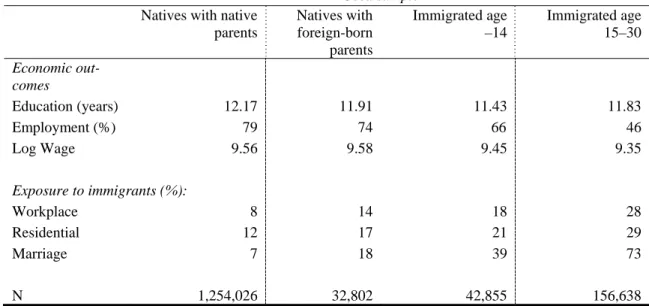
A natural starting point is to ask to what extent there is segregation in the studied mar-kets. Table 1 shows data for four populations: Natives with native parents, natives with foreign-born parents (arriving less than 10 years before birth), immigrants arriving be-fore age 15, and immigrants arriving later. The two intermediate populations together make up our population of interest. All statistics are measured as averages at ages 31– 34.
The table is quite informative about the situation for immigrants in Sweden. First, we see that the average level of education among immigrants, and children of immigrants, is similar to that of natives, a fact which is well-known from previous studies. Second, labor market performance is somewhat poorer among natives with foreign-born parents than among other natives, and a lot poorer among the foreign-born. Third, there are large immigrant-native differences in the degree of exposure to immigrants on all three markets. Note that people of different origin would be randomly allocated in all dimen-sions if immigrant background played no role.
11
The fraction with missing information on parental education is high, but less of a concern given that the baseline analysis employs family fixed effects and does thus not use parental education as a control variable.
Table 1 Outcomes in different markets and groups (individuals born 1960-1971).
Used sample
Natives with native parents Natives with foreign-born parents Immigrated age –14 Immigrated age 15–30 Economic out-comes Education (years) 12.17 11.91 11.43 11.83 Employment (%) 79 74 66 46 Log Wage 9.56 9.58 9.45 9.35 Exposure to immigrants (%): Workplace 8 14 18 28 Residential 12 17 21 29 Marriage 7 18 39 73 N 1,254,026 32,802 42,855 156,638
Note: Residential exposure is the fraction of neighbors that are foreign-born, workplace exposure is the fraction of co-workers that are foreign-born and Marriage exposure is the fraction of spouses that are foreign-born. For details on definitions, see the data section. Note that those who immigrated after age 15 may have spent substantially shorter time in Sweden at the time of observation.
This means that immigrants and natives would on average be equally exposed to people of immigrant (and native) background unless there is some systematic sorting.12 Thus, the fact that we see more immigrant exposure among those with an immigrant background is evidence of segregation.13 The level of segregation is not only strong but also seemingly increasing in age at migration. Those with “foreign background” have more immigrants among their colleagues and neighbors, and do more often marry im-migrants.14 The magnitudes are quite striking: those that immigrated as youths are more than twice as likely (39 percent) to have an immigrant spouse as those born in Sweden
12
Note that the size of the average unit does not matter for this argument. The fact that marriages contain fewer individuals than a workplace or a neighborhood is thus not a concern. For example, let there be 10 percent immigrants in a country (and for simplicity think of this fraction as uniform across the age distribution). Then we would expect each person (independent of origin) to pick an immigrant spouse with a 10 percent probability. Likewise he or she would “pick” an immigrant co-worker and an immigrant neighbor respectively with a 10 percent probability. Therefore we would find that both people with and without an immigrant background have (on average) 10 percent immigrants among their spouses, co-workers and neighbors.
13
See Åslund and Skans (2008) for a further discussion on comparisons between random and actual allocation distributions in a similar setting.
14
Note that the extremely high rate of mating with immigrants among those arriving after age 15 is likely to be driven by couples arriving together.
with two foreign born parents (18 percent). Compared to natives with two native par-ents, immigrant youths are more than 5 times as likely to marry an immigrant.
4.2 Correlations between different integration measures
In order to interpret our results, it is important that we understand how the three markets interact. If, for example, the segregation measures for the three social markets are per-fectly correlated, it is not meaningful to analyze them separately. Table 2 shows correla-tions between the outcomes using both raw data and after removing family fixed effects. All statistics are based on the sample of siblings whose families arrived when they were aged –10 to 14, i.e. the sample that will be used in the empirical analysis below.
Table 2 The correlation between the outcome measures.
Overall correlations Ed Em Wa W R M Economic out-comes Education (Ed) 1 -- -- -- -- -- Empl. (Em) 0.09 1 -- -- -- --
Log Wage (Wa) 0.24 n.a. 1 -- -- --
Exposure Workplace(W) –0.16 n.a. –0.14 1 -- -- Residential (R) –0.15 –0.11 –0.08 0.34 1 -- Marriage (M) –0.10 –0.10 –0.12 0.29 0.39 1 Within-family correlations Ed Em Wa W R M Economic out-comes Education (Ed) 1 -- -- -- -- -- Empl. (Em) 0.08 1 -- -- -- --
Log Wage (Wa) 0.13 n.a. 1 -- -- --
Exposure
Workplace(W) –0.09 n.a. –0.09 1 -- --
Residential (R) –0.06 –0.09 –0.04 0.14 1 -- Marriage (M) –0.02 –0.10 –0.08 0.12 0.18 1 Note: Data are for immigrants with two foreign born parents with siblings in the data. Samples sizes (available upon request) differ since the correlations are based on pair-wise comparisons of all pairs where we have data on both indicators.
We find a negative correlation between economic outcomes and the social integra-tion measures. Youths with more immigrants neighbors, coworkers and spouses have poorer economic and educational outcomes on average. This association is partly, but not fully, explained by the family fixed effects (lower panel).
Interestingly, we find relatively modest correlations between the measures of resi-dential exposure, workplace exposure, and marriage market exposure. The correlation coefficients are in the order of 0.3 and within families (i.e. the variation primarily used in the empirical analysis) it is less than 0.2 in all cases. In other words, people may be much more integrated in one dimension than in another.
5
The empirical setup
Here we set up an empirical model for estimating the impact of age at migration on out-comes at adulthood measured at a fixed age (in our case the early 30s). We define indi-vidual i:s age at migration as the family’s (j) year of arrival (C) minus the year of birth. As explained in the data section we use data where the family arrived between 10 years before and 14 years after the birth. Thus:
[
-10,14]
birth of Year -) (C arrival of Year j Im ≡ ∈ Age (1)To study the impact of age at migration it is useful to think of the following conceptual model: ) ( Im ) ( iji Arrival j c Outcome i t i i ij Age T C u y =
β
+δ
+γ
+ (2)where is the outcome of individual i belonging to family j. The outcome
de-pends on a dummy variable for each possible age at migration (Age) except age 0 which
serves as a reference point.
) (i ij
y
β
is the corresponding vector of parameters, one for eachage at migration. The model also accounts for effects from the calendar year of
poses two challenges. First, as standard in the literature (see e.g. Borjas, 1999), we face
a perfect linear dependency between age, cohort, and observation year.15 Second, we
need to deal with the impact of potentially important unobserved heterogeneity. OLS-estimates will confuse the impact of age at migration with an effect coming directly from the parents if e.g. parents who are particularly devoted to the success of their chil-dren adjust the timing of migration to the “optimal” age of the chilchil-dren. It is plausible that families who arrive with 14-year-old children are fundamentally different from those who arrive with small children, or those who give birth to their children when al-ready in the host country. Similarly, both the timing of when to have children among those who already migrated and return-migration choices may be influenced by the so-cial and economic integration into the host country.16
In order to address these problems we first include family-specific fixed effects to handle unobserved heterogeneity. This means that we remove the impact of endogen-ous in- and out migration as well as effects on the timing of child births as long as these are driven by factors at the family (rather than child) level.
j
α
17
Since year of arrival does not vary within families (by construction), this variable
makes C superfluous. Thus we can rewrite equation (2) as:
) ( Im ) ( j iji Outcome i t i i ij Age T y =β +δ +α +ε (3)
Since outcomes are observed at a common age, the variation in age at immigration and time of observation is identical for siblings. This means that when including the family fixed effects, we have a perfect multicollinearity between age at migration and time of observation. A frequently used strategy to deal with this issue in the assimilation
15
As is seen by replacing Year of birth in equation (1) by Year of outcome (T) minus “Age at outcome” where the latter is fixed by construction. Note though that the problem cannot be solved by looking at multiple outcome years.
16
One could interpret higher fertility rates after immigration as indicative of selection, although they are commonly seen as a “disruption effect” in the demographic literature. See Mayer & Riphahn (2000) for a general discussion on economic and demographic models and empirical studies of fertility among immigrant women, and Andersson (2004) for Swedish evidence.
17
The first paper to use this strategy to isolate the effects of age at migration was Böhlmark (2008), who studied schooling outcomes. Van den Berg et al (2009) use a similar approach in their study of the relationship between age at migration and height at adulthood. Both of these papers are based on Swedish data.
literature is to assume that observation time effects are the same for immigrants and na-tives. This approach is less appealing when studying social segregation (since the time-effects are likely to differ between immigrants and natives) and has also been ques-tioned for economic outcomes by e.g. Barth et al (2004, 2006).
In order to handle the effects of outcome years we instead assume that differences in
unobserved heterogeneity among age-0 migrants across birth cohorts are not
syste-matically related to the age structure of the cohort. Under this assumption we can
de-rive consistent estimates through the following transformation: First we calculate the average outcome among same-aged immigrants who arrived at age 0 by observation year (and source region). Then we transform the data by deducting this average from the individual outcome. Formally, we deduct:
0 0 Im Im= = t + t Age = Age t y δ α (4) from (3) to get ijt j i ijt Age u y =β Im +α + ~ (5) 0 0 and Im ~ where = = = − − = Age t it ijt age t ijt ijt y y u y
ε
α
Equation (5) shows that identification holds as long as the composition (in terms of e.g. the propensity for segregation) of immigrants arriving at age 0 in different cohorts is uncorrelated with age at immigration within families. A sufficient condition for this to hold is that the composition of age 0 immigrants is the same in all cohorts. We be-lieve that this assumption is relatively innocuous relative to the alternatives presented in the existing literature, especially considering that the between-year differences of equa-tion (4) are identified from individuals who immigrated in the period 1960–1971 when labor migration consistently dominated the migrant inflow to Sweden.
The baseline strategy is thus to estimate (5) explaining the transformed outcome by
age at migration in a family fixed effects model. Thus identification of
β
comes fromdifferences between siblings in their age at the time when their parents immigrated. We augment this specification by including an indicator for whether the subject is a
first-born child, and a gender dummy.18
To check the robustness of our results we also estimate equation (2) directly but ig-nore arrival cohort dummies. This model thus explains the outcomes as measured before the transformation and includes observation-time dummies instead of family fixed ef-fects. In this specification we also control for mother’s and father’s education, mother’s region of origin interacted with dummies for observation year, gender and the first-born indicator in order to capture heterogeneity as best we can. The assumptions then are: (i)
that the included covariates capture selection on the timing of migration; (ii) that there
are no effects of year of immigration conditional on the included covariates.
We will present models capturing age at migration (years) in two different ways: (i) as dummies; (ii) using a spline function where the impact is assumed to be linear but where the slope is allowed to change at age 0. Specification (i) is more flexible, whereas (ii) gives more precision and facilitates interpretation. We return to this issue below.
6
Results
6.1 Baseline estimates—family fixed effects
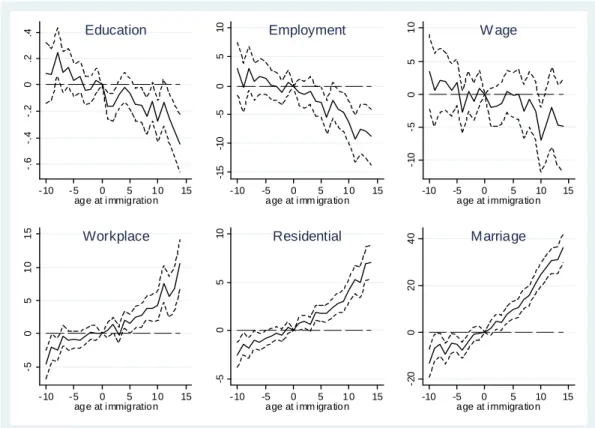
Figure 1 shows semi-parametric estimates from the family fixed effects specifications discussed in section 5. We impose no functional form on the pattern of how age at mi-gration affects segregation and economic outcomes. In all cases we use immimi-gration at the year of birth as the baseline. Starting in the upper panel of the figure, we see a ten-dency towards a negative relationship between age at migration and completed
educa-tion. However, the standard errors of the flexible specification are large. For
employ-ment there appears to be a negative slope among those born outside Sweden (and thus
18
immigrated after age 0), but the estimates are significant only after age 6–7. The wage specification exhibits no significant impact from age at migration.
The slopes change when we turn to the social segregation measures in the second row of the figure. Workplace, neighborhood and marriage exposure all increase with age at migration. The relationship is particularly strong among the foreign-born, but also appears to be present among those born in Sweden. This suggests that there is inhe-ritance in the integration process; the “capital” (broadly defined) acquired by parents be-fore the child is born seems to reduce segregation among their children.
-. 6 -. 4 -. 2 0 .2 .4 -10 -5 0 5 10 15 age at i mmigration Education -1 5 -1 0 -5 0 5 10 -10 -5 0 5 10 15 age at i mm igration Employment -1 0 -5 0 5 10 -10 -5 0 5 10 15 age at i mmigration W age -5 0 5 10 15 -10 -5 0 5 10 15 age at i mmigration Workplace -5 0 5 10 -10 -5 0 5 10 15 age at i mm igration Residential -2 0 0 20 40 -10 -5 0 5 10 15 age at i mmigration Marriage
Figure 1 The relationship between age at migration and outcomes – semiparametric estimates
Notes: Estimates and 95% confidence intervals from family fixed effects specifications described in sec-tion 2.3. The employment probability and workplace, residential and marriage exposure are measured at the scale 0 to 100. Education is years of schooling. Wage is 100 times log(monthly wage).
In order to gain precision we have estimated a more restrictive model presented in Table 3. Since the relationships in Figure 1 appear very close to linear in the pre-birth and post-birth intervals respectively we define a functional form with two separate
li-near segments divided by a spline at age 0. It is not obvious that the slope actually changes at age 0 in all specifications and Table 3 therefore also reports P-values from tests of the equivalence of pre- and post-birth slope parameters.
The table shows that there are statistically significant relationships between age at migration for the foreign-born for all outcomes except wages. The estimates for educa-tion are moderate; arriving 10 years later decreases expected educaeduca-tion by 0.2 years. This is a small effect compared to results found in e.g. van Ours & Veenman (2006) but in the vicinity of previous Swedish evidence presented in Böhlmark (2009). Interes-tingly, we find similar effects for children born in Sweden depending on how long the parents have resided in Sweden, suggesting that parental integration is an important channel for furthering educational attainment among immigrant youths.
Increasing age at arrival by 10 years gives 6 percentage points lower employment probability among the foreign-born, but there is no effect of parental time in the host country. We find no evidence of wage effects in either interval.
The estimated effects on the exposure measures are all substantial. An individual ar-riving 10 years later have about 4 percentage points higher share of immigrants at the workplace as well as in the neighborhood. Compared to the sample means of 16 and 19 percent respectively, this is a large impact. The marriage market effects are even larger: arriving at age 10 instead of age 0 almost doubles the probability of marrying an
immi-grant instead of a native.Interestingly, this means that the within-family differences
de-pending on age at migration are in the order of the descriptive differences presented in Table 1 above.
We have also investigated the “participation effects” in the marriage market from age at migration; arriving 1 year later increases the probability of having a spouse by about
1 percentage point, which should be related to the average marriage rate of 31 percent.19
This means that the absolute number of marriages between immigrants increases even more with immigration age than what is revealed by the estimates shown in Table 3.
The estimated effects of family time spent in the host country before birth for child-ren of immigrants are highly significant for all the social segregation outcomes. The
size of the estimates is about half that of the estimates for time spent in the country by childhood immigrants. The p-values for a test of slope coefficients being the same for child migrants and children of immigrants reject the null for all three outcomes. Thus, taken at face value the results suggest that roughly half of the integration due to earlier age at migration is an effect of parental integration and half is due to individual expe-riences.
Table 3 The impact of one year higher age at migration.
EDU EMP WAGE WORK RESID MARR
AoM (0,14) –.019** –0.593** –.003 .495** .416** 2.382** (.006) (0.135) (.002) (.082) (.047) (0.175) AoM (–10,0) –.021** –0.214 –.002 .235** .201** 0.961** (.007) (0.155) (.002) (.076) (.046) (0.206) Observations 47,625 47,890 36,753 32,696 47,890 29,685 R-squared .64 .52 .57 .59 .68 0.61
Same slope (p-val) .840 .045 .897 .011 .000 0.000 Family fixed
ef-fects 19,997 20,096 15,891 14,303 20,096 12,760
Df 27,624 27,790 20,858 18,389 27,790 16921
Mean Dep Var 11.52 69 9.50 16 19 31
Notes: Estimates from sibling regressions including family fixed effects; see 2.3 for further descrip-tion. AoM (–10,0) and AoM (0,14) indicate the coefficients on age at migration in the respective in-tervals. “EDU” is imputed years of schooling; “EMP” is employment; “WAGE” is log(monthly wage); “WORK”, “RESID” and “MARR” are immigrant exposure in the workplace, residential and marriage markets. The employment probability and workplace, residential and marriage exposure are measured at the scale 0 to 100. The outcome variables are described and defined in section 3. * (**) Statistically significant at the 5(1) percent level.
6.2 Alternative specifications
As discussed in section 2.3 an alternative way of approaching the methodological prob-lems is to parameterize the effects of family background (i.e. to control for e.g. parental education and country of origin) instead of using family fixed effects. This specification provides the opportunity to control for observation year effects directly, provided that one is willing to assume that conditional on the included covariates and observation
19
The corresponding coefficients (standard errors) on the probability to be married are 0.92 (0.19) for AoM (–10,0) and 1.21 (0.15) for AoM (0,14).
year, there is no bias due to a correlation between age at migration and unobserved background characteristics and/or immigration year.
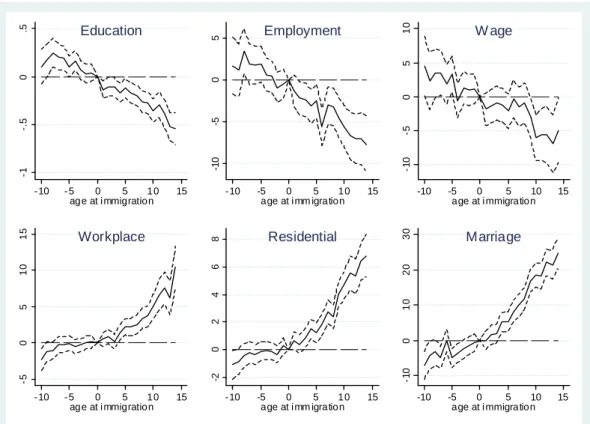
Figure B 1 and Table B 2 in Appendix B present results based on this alternative ap-proach. The results correspond to those in Figure 1 and Table 3. We see first of all that the OLS estimates for the sibling sample are very similar to those of the full sample which we interpret as the sibling sample being representative for immigrant youth in general. It is also evident that the (0,14) coefficients are reasonably similar to the family fixed effects estimates presented in Table 3. However, the estimated exposure effects are much smaller (and insignificant for residential segregation) in the (-10,0) interval when family fixed effects are left out. This suggest that parents who are more “prone” to segregation on average spend a longer time in the host country before giving birth. It is reasonable that parents who have a (sometimes never realized) wish to return the coun-try of origin wait longer before giving birth and have stronger preferences for living with other immigrants. If children inherit these preferences from their parents we would expect a bias in the observed direction. Another alternative is that people do not have children until their economic situation is sufficiently stable. If a tendency to live and work with immigrants is correlated with (or caused by) labor market potential, we would also see this pattern. Furthermore, the family fixed effects capture immigration cohort effects which might also bias the OLS results.
We have also experimented with further alternatives for controlling for observation
time effects in the sibling segregation analysis.20 Controlling for the pool of countrymen
gives similar patterns for workplace and residential exposure, and including controls for the number of other-sex countrymen does not alter the patterns for the marriage results. All results are also robust to including only siblings who are born not more than five years apart.
20
It is worth noting that using the standard approach from the assimilation literature where native outcomes are used to handle calendar time effects is not appropriate in our setting. For example, birth cohort differences (1960–71) in education are not as strong in the immigrant sample as they are among same-aged natives. This means that had we used the overall trend in education to correct for observation time differences, we would have underestimated the effect of age at migration (since older siblings perform better relative to natives than do younger siblings).
6.3 Heterogeneous effects and variations
Table 4 displays estimates from sibling models where the effects of age at migration are allowed to vary between men and women. The results suggest that labor market inte-gration among foreign-born males is substantially more affected by age at miinte-gration than what is the case for the female counterparts. We find a significant negative wage effect for males. The differences between men and women in effects in the (0,14) inter-val on employment, wages and workplace exposure are all statistically significant.
Table 4 Heterogeneous effects: gender
EDU EMP WAGE WORK RESID MARR
Men AoM (0,14) –.015* -0.705** –.009** .647** .450** 2.470** (.006) (0.147) (.002) (.092) (.051) (.193) Men AoM (-10,0) –.016+ -0.366* –.002 .238** .197** .604* (.008) (0.178) (.002) (.088) (.053) (.243) Women AoM (0,14) –.023** -0.472** .004* .327** .380** 2.304** (.006) (0.150) (.002) (.091) (.052) (.190) Women AoM (-10,0) –.025** -0.046 –.003 .222* .205** 1.291** (.009) (0.189) (.002) (.091) (.054) (.245) Observations 47,625 47,890 36,753 32,696 47,890 29,685 R–squared .64 .52 .58 .60 .68 .61
P(same slope for men) .871 .139 .022 .001 .001 .000 P(same slope for women) .861 .078 .029 .417 .018 .001 P(same slope for women and
men in AoM (0,14) interval)
.108 .061 .000 .000 .106 .291
P(same slope for women and men in AoM (-10,0) interval)
.332 .105 .725 .871 .886 .009
Family fixed effects 19,997 20,096 15,891 14,303 20,096 12,760
Df 27,622 27,788 20,856 18,387 27,788 16,919
Mean Dep Var, Men 11.43 73 9.65 17 20 26
Mean Dep Var, Women 11.61 65 9.33 15 19 34
Notes: Estimates from sibling regressions including family fixed effects; see 2.3 for further description. AoM (–10,0) and AoM (0,14) indicate the coefficients on age at migration in the respective intervals. “EDU” is imputed years of schooling; “EMP” is employment; “WAGE” is log(monthly wage); “WORK”, “RESID” and “MARR” are immigrant exposure in the workplace, residential and marriage markets. The employment probability and workplace, residential and marriage exposure are measured at the scale 0 to 100. The outcome variables are described and defined in section 3. * (**) Statistically sig-nificant at the 5(1) percent level.
For marriages, the estimates indicate that parental time in the host country is more in-fluential on the daughters’ choice of spouse. Interestingly, the effects are nearly identi-cal for children who migrated themselves. This suggest that the parental influence is larger for females, whereas the impact of own time in the country is larger for males. The latter could possibly be explained by the poorer economic performance among males who arrive late.
It is well known from previous research that labor market performance and social se-gregation vary heavily depending on region of origin. People of Nordic descent tend to manage best in the Swedish labor market, followed by other Western migrants, whereas Non-Westerners experience the biggest difficulties. This does not necessarily mean that the effects of age at migration are larger in the latter groups. Allowing the effects to vary by region of origin, reveals that the impact on employment and wages is relatively similar across groups, whereas the negative effect on education is driven by Nordic mi-grants. The effects on the measures of immigrant exposure are present for all groups at
all three markets, but more pronounced for the non-western migrants.21
A similar exercise suggests that the impact of age at migration is more or less inde-pendent of the mother’s level of education. Parental education does, however, affect the outcomes directly in the expected direction. The coefficients from the OLS estimates discussed above show that education, employment and wages increase with mother’s and father’s education, whereas the direction is the opposite for the three exposure out-comes (i.e. segregation decreases with parental education and wages). Interestingly, the influence of the mother’s and father’s education is very similar except for in the mar-riage specification, where the education of the mother is much more influential (i.e.
children of educated mothers marry natives more often).22
The baseline results suggest that parental integration matters for the integration of the offspring. An interesting question is then to what extent parental segregation at the time of market entry for the subject can explain the differences according to age at migration. Unfortunately we cannot measure residential segregation early on in life for the
21
The effects on workplace (residential; marriage) exposure in the 0-14 interval is 0.78 (0.64; 3.1) for migrants with a non-western origin. Detailed results are available upon request.
ren. After restricting the number of included cohorts we have experimented with con-trolling for the parental residential exposure when the child is aged 19 (and 25) but this had very little effect on the results. This suggests that differences in parents’ degree of integration when children are relatively old do not influence later child outcomes.
A related issue is the possibility that the impact on social integration is channeled through economic outcomes and/or education, which of course requires that the processes at the different markets are sequential rather than simultaneous. The results reported above give little support to this idea since we find comparatively small effects on economic outcomes, but large influences on social integration. Estimating the exposure models with controls for individual education, employment and wages confirms this impression; the results change very little.
6.4 Exposure to immigrants from different regions
To better understand the process of integration we separate exposure to immigrants from the same region of origin (“own-group” exposure) from exposure to other foreign-born (“other-group” exposure). While sorting along ethnic lines between immigrant groups in the residential (Bråmå 2006) and labor (Åslund & Skans 2009) markets are well documented, with the evidence suggesting that ethnic (own-group) sorting is more important on the labor market, there is little prior evidence of marriage market sorting. Our data show that the own-group component is the most prevalent at the marriage market: 19 percent of marriages are with a spouse born in the mother’s birth region, whereas 12 percent are with someone from another country outside Sweden. The latter is in fact not very far off from the 7 percent immigrant spouses we found among natives with native parents. Further scrutiny (see Table B 3) reveals cross-country connections that would be expected from linguistic and cultural ties (e.g. “South American”–Chile and “Middle East”–Turkey). But it is also apparent that supply matters, which is evident in the high fraction of marriages to Finns (the largest immigrant group) among other groups.
22
The impact on marriage exposure is -0.012 for each year of mother’s education and -0.007 for each year of father’s education. Detailed results are available upon request.
Table 5 presents estimates of how age at migration affects on own-group and other-group exposure on each of the three markets. In the residential market, age at migration affects both dimensions, but relative to the sample mean the estimates are somewhat larger for own-group exposure. The pattern is very much dominated by effects relative to the own group in terms of workplace exposure, but there are also some effects in terms of exposure to other immigrant groups. Most strikingly however, for marriages we find that the entire effect of age at migration goes through the probability of finding a spouse from the mother’s region of birth. Age at migration has no effect at all on the probability of finding a spouse of other immigrant origin.
Table 5 Own-group and other-group exposure: spline estimates
Other-group exposure Own-group exposure
WORK RESID MARR WORK RESID MARR
AoM (0,14) .140* .315** –.015 .363** .135** 2.397** (.056) (.041) (.136) (.067) (.015) (.167) AoM (-10,0) .056 .149** –.001 .185** .066** .962** (.054) (.042) (.152) (.055) (.014) (.160) Observations 32,637 47,798 29,685 32,637 47,798 29,685 R-squared .55 .67 .52 .58 .73 .63 P(same slope) .246 .002 .942 .024 .000 .000
Fam. fixed eff. 14,279 20,060 12,760 14,279 20,060 12,760
Df 18,354 27,734 16,921 18,354 27,734 16,921
Mean dep var 10 15 12 6 4 19
Notes: Estimates from sibling regressions including family fixed effects; see 2.3 for further description. AoM (–10,0) and AoM (0,14) indicate the coefficients on age at migration in the respective intervals. “Own-group” are people from the mother’s country of birth; “Other-group” are other foreign-born. “WORK”, “RESID” and “MARR” are immigrant exposure in the workplace, residential and marriage markets. The workplace, residential and marriage exposure are measured at the scale 0 to 100. The out-come variables are described and defined in section 3. * (**) Statistically significant at the 5(1) percent level.
7
Conclusions
This paper concerns the impact of age at migration on social integration and educational and economic outcomes in adulthood. We quantify integration by measuring the cha-racteristics of the people each subject is in contact with at different markets. Using pop-ulation-wide data, which include family links, allows us to handle methodological problems inherent to most empirical studies of the effects of age at migration.
Our results show that age at migration has a substantial effect on the social integra-tion of immigrant youths. Arriving later increases the probability to live among, work with, and marry foreign-born individuals. These effects are also present for those whose parents arrived to Sweden prior to their birth. There is noteworthy heterogeneity in the impact of age at migration on economic outcomes. Male wages and employment are substantially affected, whereas there is little effect on female labor market outcomes.
The fact that marriage patterns are the outcomes which is most strongly affected by parental time in the host country suggests that the social adaptation and acculturation of parents primarily feed onto the children’s outcomes in areas where preferences matter the most.
Interestingly, the effects of age at migration on marriage patterns are similar for males and females who immigrated themselves, but females are much more influenced then males by their parent’s time in the host country before birth when studying those born in Sweden. Since the first of these effects is affected by both individual and family integration, our results suggest that female marriage patterns are relatively more
af-fected by family exposure to the host country whereas male marriage patterns are more
affected by individual exposure to the host country.
We also find that the higher levels of segregation among those arriving at higher ages primarily is driven by increased exposure to countrymen rather than exposure other groups of immigrants. This, again, is particularly true in the marriage market where the entire effect is driven by exposure to immigrants from the mother’s region of birth. These results suggest that being older at arrival primarily means preserving ties to the source country and culture, rather than strengthening the ties to the overall immigrant community.
Taken together, the results show that although migrating at a higher age may not be a crucial determinant of long-term economic well-being, it does seem to have a very large influence on the composition of people the individual will interact with on many differ-ent social arenas. This dichotomy appears particularly true for females. Furthermore, we find that children’s integration depends on the time spent by the families in the source country before their birth––integration is inherited.
It is in this context worth noting that our study primarily covers children to economi-cally successful labor migrants, where social segregation has not been considered a major problem. The present policy debate focuses on the rapidly growing numbers of children to non-western immigrants, whose economic outcomes are much poorer and where the perceived cultural differences are greater. Our findings suggest that parental influences and early experiences are actually more important determinants of social in-tegration in these groups. In the formerly homogeneous countries which now experience an increasing ethnic diversity, it is thus essential to understand these processes for pre-dicting how the societies will develop.
References
Andersson G (2004) “Childbearing after Migration: Fertility Patterns of Foreign-born
Women in Sweden”, International Migration Review Volume 38 Number 2
(Summer 2004):747–775.
Åslund O & O N Skans (2008) “How to measure segregation conditional on the
distribution of covariates”, forthcoming in Journal of Population Economics.
Åslund O & O N Skans (2009) “Will I See You at Work? Ethnic Workplace
Segregation in Sweden 1985–2002”, forthcoming in Industrial and Labor Relations
Review.
Austen-Smith D & RG Fryer (2005) “An Economic Analysis of “Acting White”, Quarterly Journal of Economics, Volume 120, Number 2 (May 2005), pp. 551-583 Bailey T & R Waldinger (1991) “Primary, Secondary, and Enclave Labor Markets: A
Training Systems Approach” American Sociological Review, Vol. 56, No. 4., pp.
432–445.
Barth E, B Bratsberg & O Raaum (2004) ”Identifying Earnings Assimilation of
Immigrants under Changing Macroeconomic Conditions” Scandinavian Journal of
Economics 106 (1), 1–22.
Barth E, B Bratsberg & O Raaum (2006) ”Local Unemployment and the Relative
Wages of Immigrants: Evidence from the Current Population Surveys” Review of
Economics and Statistics May 2006, Vol. 88, No. 2, 243–263.
Bayard K, J Hellerstein, D Neumark & K Troske (1999) ”Why Are Racial and Ethnic Wage Gaps Larger for Men than for Women? Exploring the Role of Segregation Using the New Worker-Establishment Characteristics Database” in Haltiwanger J et
al. (eds.) The Creation and Analysis of Employer-Employee Matched Data,
Amsterdam: Elsevier Science, 175–203.
Bisin A & T Verdier (2000) “‘‘Beyond The Melting Pot’’: Cultural Transmission,
Marriage, And The Evolution Of Ethnic And Religious Traits”, Quarterly Journal of
Economics August 2000, Vol. 115, No. 3, 955–988.
Bisin A, E Patacchini, T Verdier & Y Zenou (2006) “‘Bend It Like Beckham’: Identity, Socialization, and Assimilation”, CEPR Discussion Paper No. 5662.
Bisin, A and T Verdier (2001) “The Economics of Cultural Transmission and the Dynamics of Preferences”, Journal of Economic Theory, 97, 298–319.
Bleakley H & A Chin, (2008) "What Holds Back the Second Generation?: The Intergenerational Transmission of Language Human Capital Among Immigrants,"
Journal of Human Resources, vol. 43(2), pages 267–298.
Böhlmark A (2008) “Age at Immigration and School Performance: A Siblings Analysis
Böhlmark A (2009) “Integration of Childhood Immigrants in the Short and Long Run
-Swedish Evidence”, International Migration Review 43(2), 387-409.
Borjas GJ (1999) “The Economic analysis of immigration” in Ashenfelter O., R. Layard
and D. Card, Handbook of Labor Economics, edition 1, volume 3, chapter 27, pages
1559–1695, Elsevier.
Bråmå Å (2006) Studies in the Dynamics of Residential Segregation, PhD Thesis
Uppsala University, Faculty of Social Sciences, Department of Social and Economic Geography.
Chiswick, B., & DebBurman, N. (2004). “Educational attainment: Analysis by
immigrant generation” Economics of Education Review, 23, 361–379.
Clark K & S Drinkwater (2007) “Segregation preferences and labor market outcomes”
Economics Letters 94 (2), 278–283.
Cortes, K. (2006) "The Effects of Age at Arrival and Enclave Schools on the Academic
Performance of Immigrant Children", Economics of Education Review 25 (2006)
121–132.
Cunha F, J Heckman, L Lochner & D Masterov (2007) ”Interpreting the Evidence on
Life Cycle Skill Formation” in Hanushek E & F Welch (eds) Handbook of the
Economics of Education, Volume 1, Elsevier.
Cutler, D. & Glaeser, E. (1997), Are Ghettos Good or Bad?, Quarterly Journal of
Economics, 112, pp. 827-872.
den Butter FAG, E Masurell & RHJ Mosch (2004) ”The Economics of Co-Ethnic Employment”, Tinbergen Institute Discussion Paper 2004–027/3.
Dribe M & C Lundh (2008) “Intermarriage and Immigrant Integration in Sweden”, Acta
Sociologica, Vol. 51, No. 4, 329-354.
Durlauf S (2004) “Neighborhood Effects” in Henderson JV and JE Thiss Handbook of
Regional and Urban Economics, Volume 4, Elsevier.
Edin, P.-A., Fredriksson, P. & Åslund, O. (2003), Ethnic Enclaves and the Economic
Success of Immigrants – Evidence from a Natural Experiment, Quarterly Journal of
Economics, 118, pp. 329-357.
Ellen IG, K O’Regan, AE Schwartz & L Stiefel (2002) ”Immigrant Children and New York City Schools: Segregation and Its Consequences”, Brookings-Wharton Papers on Urban Affairs: 2002, 183–214.
Fernandez R, A Fogli & C Olivetti (2004) “Mothers and Sons: Preference Formation
and Female Labor Force Dynamics”, Quarterly Journal of Economics 119(4), pp
1249–1299.
Fordham, S & J.U. Ogbu (1986) “Black Students’ School Success: Coping with the
Burden of ‘Acting White’”, Urban Review, 18: 176–206.
Freud, S (1950), Some Psychological Consequences of the Anatomical Distinction Between the Sexes, in J. Strachey, ed. and Trans. Standard Edition (Vol. 8, pp. 133– 142) (London: Hogart Press, 1927), pp. 133–142.
Fryer RG & P Torelli (2005) “An Empirical Analysis of `Acting White'”, NBER Working paper 11334.
Ghaffar-Kucher A (2006) “Assimilation, Integration, or Isolation? (Re-) Framing the
Education of Immigrants” in Ghaffar-Kucher A (ed.) Assimilation, Integration, or
Isolation? Framing the Education of Immigrants, Current Issues in Comparative
Education Vol. 9, No. 1.
Gobillon, L., Selod, H. & Zenou, Y. (2007), The Mechanisms of Spatial Mismatch,
Urban Studies, Vol. 44, No. 12, 2401–2427.
Gonzalez, A. (2003). “The education and wages of immigrant children: The impact of
age of arrival” Economics of Education Review, 22, 203–212.
Gullberg A (2002) “Housing Segregation”, International Journal of Social Welfare 11,
S90–S100.
Hellerstein J & D Neumark (2008), “Workplace Segregation in the United States: Race,
Ethnicity, and Skill.”, forthcoming in Review of Economics and Statistics.
Iceland J, DH. Weinberg & E Steinmetz (2002) Racial and Ethnic Residential
Segregation in the United States: 1980-2000, U.S. Census Bureau, Series CENSR-3,
U.S. Government Printing Office, Washington, DC, 2002.
Ihlanfeldt, K.R. (2006), A Primer on Spatial Mismatch within Urban Labor Markets, In:
A Companion to Urban Economics, R. Arnott and D. McMillen (Eds.), Boston:
Blackwell Publishing, pp. 404-417.
Ioannides Y and L Loury (2004) “Job information networks, neighborhood effects, and inequality”, Journal of Economic Literature 42 (4), 1056–1093.
Kalmijn M (1998) “Intermarriage And Homogamy: Causes, Patterns, Trends” Annual
Review of Sociology 1998 24, 395–421.
Kao, G., & Tienda, M. (1995). “Optimism and achievement: The educational
performance of immigrant youth”. Social Science Quarterly, 76, 1–19.
Lazear E (1999) “Culture and Language”, Journal of Political Economy 107(6), 95–
126.
Mayer & Riphahn (2000) “Fertility assimilation of immigrants: Evidence from count
data models”, Journal of Population Economics (2000) 13: 241–261.
Meng C & RG Gregory (2005) “Intermarriage and the Economic Assimilation of
Immigrants”, Journal of Labor Economics 23(1), 135–175.
Ovadia S (2003) “The Dimensions of Racial Inequality: Occupational and Residential
Segregation Across Metropolitan Areas in the United States”, City & Community
2(4), 313–333.
Pellizzari, M. (2004), ”Do Friends and Relatives Really Help in Getting a Good Job?” CEP Discussion Paper 623, London School of Economics.
Qian Z & DT Lichter (2001) “Measuring Marital Assimilation: Intermarriage among