This work is protected by copyright. This paper and all data and information contained in it, are owned
and protected by the ACC through its Center for the Polyurethanes Industry. Users are granted a
nonexclusive royalty-free license to reproduce and distribute this paper, subject to the following
limitations: (1) the work must be reproduced in its entirety, without alterations; and (2) copies of the work
may not be sold.
Copyright © 2013 Polyurethanes Technical Conference, American Chemistry Council.
CPI Ventilation Research Project Update
RICHARD WOOD, CIH
Air Products and Chemicals, Inc.
7201 Hamilton Blvd
Allentown, PA 18195
ABSTRACTThe Center for the Polyurethanes Industry (CPI) Product Stewardship Committee requested the CPI Ventilation Research Task Force develop test protocol and evaluate the effect of ventilation on airborne concentrations of specific Spray Polyurethane Foam (SPF) chemical components during application. The study evaluated vapor and particulate emissions from a generic low density high pressure formulation, medium density high pressure formulation, and low pressure kit formulation. Research elements included the development and testing of CPI generic formulations and monitoring of SPF components under controlled conditions to verify airborne
concentrations at specified ventilation rates. This paper will discuss the results of air sampling at ventilation rates of 10.4 Air Changes per Hour (ACH), 233 ACH, and 598 ACH.
INTRODUCTION/BACKGROUND
There is limited information related to the impact of changing ventilation rates on workplace emissions during the application of SPF formulations. By improving our understanding of the impact of air exhaust rates and air distribution during high and low pressure SPF application, appropriate ventilation controls aimed at containing emissions, may be established. The information may be used to recommend appropriate PPE for applicators and assistants, as well as provide baseline information for future studies to estimate re-entry times for workers involved in associated trades. The objective of this study was to evaluate the impact of changes in ventilation rates on the concentration of spray polyurethane foam (SPF) chemical vapor and particulates emitted during SPF application. The CPI Ventilation Research Task Force has developed generic SPF formulations and air monitoring protocol that
have been used to measure emissions from high pressure low density, medium-density, anda low pressure 2
component kit formulation in the laboratory environment. The specific chemicals monitored represent those typically present in SPF formulations. Chemical substances measured during the study include: methylene diphenyl diisocyanate (MDI), polymeric methylene diphenyl diisocyanate (pMDI), amine catalysts, chemical blowing agents, and flame retardants.
This work is protected by copyright. This paper and all data and information contained in it, are owned
and protected by the ACC through its Center for the Polyurethanes Industry. Users are granted a
nonexclusive royalty-free license to reproduce and distribute this paper, subject to the following
limitations: (1) the work must be reproduced in its entirety, without alterations; and (2) copies of the work
may not be sold.
Copyright © 2013 Polyurethanes Technical Conference, American Chemistry Council.
Phase 1: Development and testing of generic high pressure low density, medium density and low pressure kit formulations and the evaluation of spray foam equipment using the formulations under typical spray conditions.
Phase 2: Conduct air monitoring in a ventilated area to measure chemical emissions during application of the generic formulations under controlled environmental conditions.
Phase 3: Air monitoring in the field, such as a medium-sized residential building, to measure chemical emissions during SPF application.
PHASE 1
As reported previously, the purpose of this phase was to develop and test generic formulations that were representative of formulations currently available in the SPF marketplace. The second aspect of Phase 1 was to evaluate spray equipment to verify consistency of application and performance under similar operating conditions. Generic formulations representative of low density high pressure formulations, medium density high pressure formulations, and low pressure kit formulations were developed and prepared by members of the CPI Ventilation Research Task Force. The formulations do not reveal confidential information of formulations sold in the
marketplace today; rather they represent typical commercial systems in terms of their density, reactivity and volume ratios. While not completely optimized, these formulations were judged to be representative of commercial
formulations and are suitable for the proposed studies.
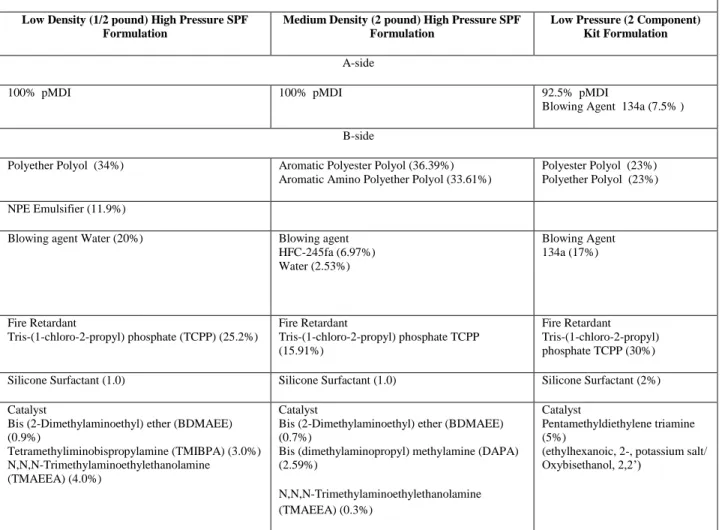
In 2011 following the development of the generic formulations, the second segment of Phase 1 was carried out by spraying the low density high pressure and medium density high pressure foam using standard spray equipment at five industry laboratories. Following testing, each industry laboratory reported test results to the Ventilation Research Task Force. Upon review, the Task Force approved the generic formulations listed in Table 1 for use in Phase 2 studies.
This work is protected by copyright. This paper and all data and information contained in it, are owned
and protected by the ACC through its Center for the Polyurethanes Industry. Users are granted a
nonexclusive royalty-free license to reproduce and distribute this paper, subject to the following
limitations: (1) the work must be reproduced in its entirety, without alterations; and (2) copies of the work
may not be sold.
Copyright © 2013 Polyurethanes Technical Conference, American Chemistry Council.
Table 1 : Generic SPF Formulations Low Density (1/2 pound) High Pressure SPF
Formulation
Medium Density (2 pound) High Pressure SPF Formulation
Low Pressure (2 Component) Kit Formulation
A-side
100% pMDI 100% pMDI 92.5% pMDI
Blowing Agent 134a (7.5% )
B-side
Polyether Polyol (34%) Aromatic Polyester Polyol (36.39%) Aromatic Amino Polyether Polyol (33.61%)
Polyester Polyol (23%) Polyether Polyol (23%)
NPE Emulsifier (11.9%)
Blowing agent Water (20%) Blowing agent HFC-245fa (6.97%) Water (2.53%) Blowing Agent 134a (17%) Fire Retardant Tris-(1-chloro-2-propyl) phosphate (TCPP) (25.2%) Fire Retardant Tris-(1-chloro-2-propyl) phosphate TCPP (15.91%) Fire Retardant Tris-(1-chloro-2-propyl) phosphate TCPP (30%)
Silicone Surfactant (1.0) Silicone Surfactant (1.0) Silicone Surfactant (2%)
Catalyst
Bis (2-Dimethylaminoethyl) ether (BDMAEE) (0.9%)
Tetramethyliminobispropylamine (TMIBPA) (3.0%) N,N,N-Trimethylaminoethylethanolamine (TMAEEA) (4.0%)
Catalyst
Bis (2-Dimethylaminoethyl) ether (BDMAEE) (0.7%)
Bis (dimethylaminopropyl) methylamine (DAPA) (2.59%) N,N,N-Trimethylaminoethylethanolamine (TMAEEA) (0.3%) Catalyst Pentamethyldiethylene triamine (5%)
(ethylhexanoic, 2-, potassium salt/ Oxybisethanol, 2,2’)
PHASE 2
During 2012 planned experiments were conducted at the 10.4 ACH rate to meet Phase 2 objectives. Subsequently, during the first half of 2013, additional Phase 2 studies were conducted using higher air exchange rates, 233 ACH and 598 ACH. The following summarizes the test protocol and findings associated with Phase 2 studies conducted during 2012 and the first half of 2013.
This work is protected by copyright. This paper and all data and information contained in it, are owned
and protected by the ACC through its Center for the Polyurethanes Industry. Users are granted a
nonexclusive royalty-free license to reproduce and distribute this paper, subject to the following
limitations: (1) the work must be reproduced in its entirety, without alterations; and (2) copies of the work
may not be sold.
Copyright © 2013 Polyurethanes Technical Conference, American Chemistry Council.
Air Sampling Protocol - 10 Air Changes per Hour
Personal and area air samples were collected as each of the three (3) generic SPF formulations were applied to cardboard inserts inside a ventilated spray room. The spray room was approximately 8 ft x 8ft x 8ft and supplied with make-up air introduced on one side of the room and exhausted though 4ft x 8ft filter bank on the opposite wall of the room. The spray substrate was located perpendicular to the air flow and consisted of five 2 x 6 inch studs, 7 feet in height, spaced 16 inches apart. This provided 2 cavities lined with cardboard for SPF application (Figure 1 and Figure 2).
The SPF applicator sprayed the formulation using a Graco Fusion Air Purge 01 round tip spray gun. The
formulation was applied under ambient conditions at an air temperature of 75°F with 50% relative humidity using manufacturer recommended pressure and temperature. The spray equipment pressure was approximately 1500 psi and the spray formulation temperature was set at 135°F. A 12 to 24 inch distance from the substrate was maintained while spraying. The applicator sprayed 2 inserts, removed the inserts, placed the sprayed inserts behind the
substrate structure, placed new cardboard inserts in the substrate, and repeated the process A maximum of 12 inserts were sprayed during each of the four monitoring sessions. The amount of foam used (lbs) and the densities of the foams sprayed were recorded.
The ventilated spray room is capable of ventilation rates ranging from 0.3 to 10 ACH; however the lower ventilation rates were assumed to be insufficient to control SPF emissions during application. Therefore the highest rate of 10 ACH was selected for the initial air sampling sessions. When confirming air flow rates prior to the study, the nearest rate to the proposed air flow of 10 ACH was determined to be 10.4 ACH. This air exchange corresponds to a calibrated volumetric flow rate of 86 cubic feet per minute (CFM).
Four (4) sessions of air sampling were completed during the application to the spray substrate of each generic SPF formulation (low density high pressure SPF, medium density high pressure SPF, and low pressure kit SPF) The SPF spray applicator wore portable air sampling pumps with the sampling media placed in the vicinity of the breathing zone. Area samples were located behind the applicator to approximate a worker’s breathing zone. SPF formulations were applied for 10 to 15 minutes for each air sampling session, with at least 2 hours between sessions. Each session included spray air sampling beginning 30 minutes after the completion of the spray session. The post-application samples were collected for a period of 1 hour while the ventilation continued to operate and sprayed inserts remained in the room. Photo 1 represents the location of personal samples on the spray foam applicator while Photo 2 represents air monitoring during SPF application.
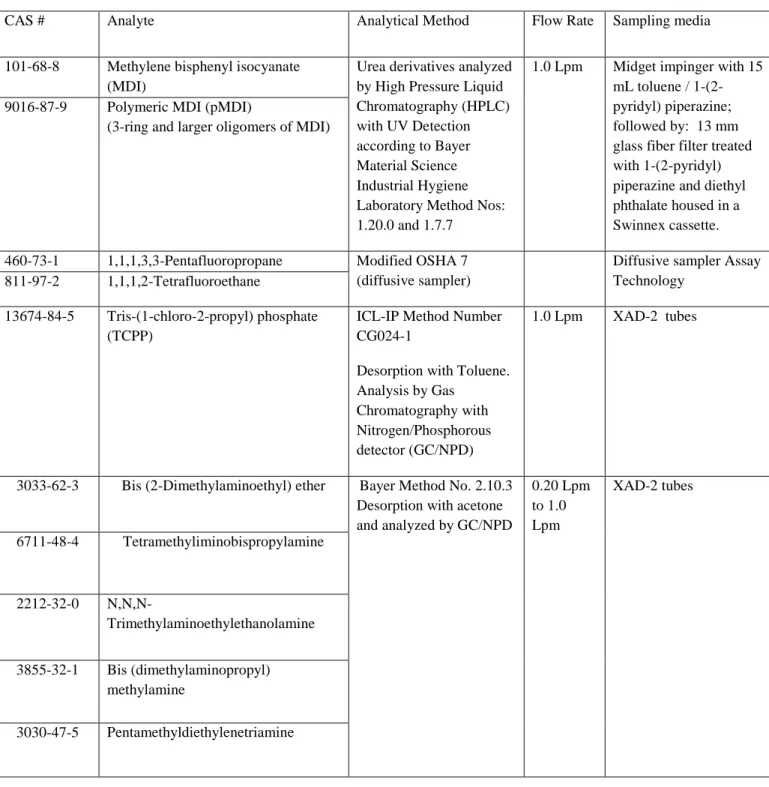
The industrial hygiene laboratories analyzed all samples according to the methods listed in Table 2. Concentrations of 2,4-MDI, 4,4-MDI, pMDI, amine catalyst, blowing agent, and fire retardant were measured during the
experiment. SKC Aircheck 52 (Model 224-52) and SKC AirLite pumps were used to collect MDI, pMDI, amine catalyst and fire retardant samples. Assay Technology passive air samplers (No. 548) were used collect blowing agent samples.
This work is protected by copyright. This paper and all data and information contained in it, are owned
and protected by the ACC through its Center for the Polyurethanes Industry. Users are granted a
nonexclusive royalty-free license to reproduce and distribute this paper, subject to the following
limitations: (1) the work must be reproduced in its entirety, without alterations; and (2) copies of the work
may not be sold.
Copyright © 2013 Polyurethanes Technical Conference, American Chemistry Council.
Figure 1 Ventilated Spray Room - Courtesy of Air Products and Chemicals, Inc.
This work is protected by copyright. This paper and all data and information contained in it, are owned
and protected by the ACC through its Center for the Polyurethanes Industry. Users are granted a
nonexclusive royalty-free license to reproduce and distribute this paper, subject to the following
limitations: (1) the work must be reproduced in its entirety, without alterations; and (2) copies of the work
may not be sold.
Copyright © 2013 Polyurethanes Technical Conference, American Chemistry Council.
Table 2: Air Sampling and Analytical Methodology for Select SPF Constituents.
CAS # Analyte Analytical Method Flow Rate Sampling media
101-68-8 Methylene bisphenyl isocyanate
(MDI)
Urea derivatives analyzed by High Pressure Liquid Chromatography (HPLC) with UV Detection according to Bayer Material Science Industrial Hygiene Laboratory Method Nos: 1.20.0 and 1.7.7
1.0 Lpm Midget impinger with 15
mL toluene / 1-(2-pyridyl) piperazine; followed by: 13 mm glass fiber filter treated with 1-(2-pyridyl) piperazine and diethyl phthalate housed in a Swinnex cassette.
9016-87-9 Polymeric MDI (pMDI)
(3-ring and larger oligomers of MDI)
460-73-1 1,1,1,3,3-Pentafluoropropane Modified OSHA 7
(diffusive sampler)
Diffusive sampler Assay Technology
811-97-2 1,1,1,2-Tetrafluoroethane
13674-84-5 Tris-(1-chloro-2-propyl) phosphate
(TCPP)
ICL-IP Method Number CG024-1
Desorption with Toluene. Analysis by Gas
Chromatography with Nitrogen/Phosphorous detector (GC/NPD)
1.0 Lpm XAD-2 tubes
3033-62-3 Bis (2-Dimethylaminoethyl) ether Bayer Method No. 2.10.3
Desorption with acetone and analyzed by GC/NPD 0.20 Lpm to 1.0 Lpm XAD-2 tubes 6711-48-4 Tetramethyliminobispropylamine 2212-32-0 N,N,N-Trimethylaminoethylethanolamine 3855-32-1 Bis (dimethylaminopropyl) methylamine 3030-47-5 Pentamethyldiethylenetriamine
This work is protected by copyright. This paper and all data and information contained in it, are owned
and protected by the ACC through its Center for the Polyurethanes Industry. Users are granted a
nonexclusive royalty-free license to reproduce and distribute this paper, subject to the following
limitations: (1) the work must be reproduced in its entirety, without alterations; and (2) copies of the work
may not be sold.
Copyright © 2013 Polyurethanes Technical Conference, American Chemistry Council.
Photo 1 - Air sampling media
This work is protected by copyright. This paper and all data and information contained in it, are owned
and protected by the ACC through its Center for the Polyurethanes Industry. Users are granted a
nonexclusive royalty-free license to reproduce and distribute this paper, subject to the following
limitations: (1) the work must be reproduced in its entirety, without alterations; and (2) copies of the work
may not be sold.
Copyright © 2013 Polyurethanes Technical Conference, American Chemistry Council.
Each set of findings was evaluated to determine if variations in concentrations were acceptable between applications of the same formula at the designated air exchange rate. Although sample size was small, variation in MDI results was minimal while greater variation was observed in amine catalyst results and to a lesser extent fire retardant and blowing agent. Overall, sample results were evaluated and shown to be log normally distributed.
Discussion - Results of air sampling at 10.4 ACH
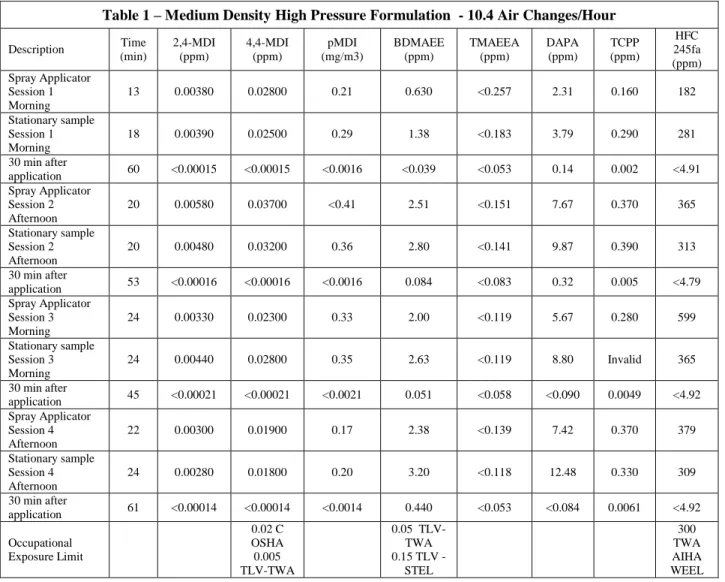
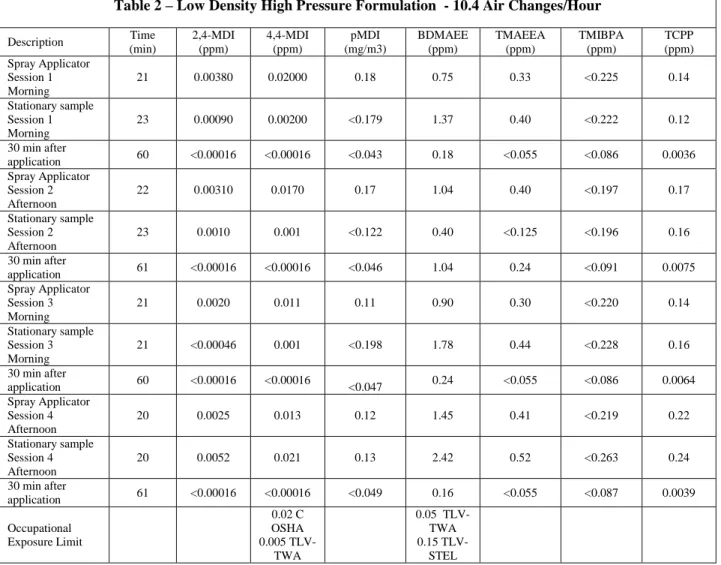
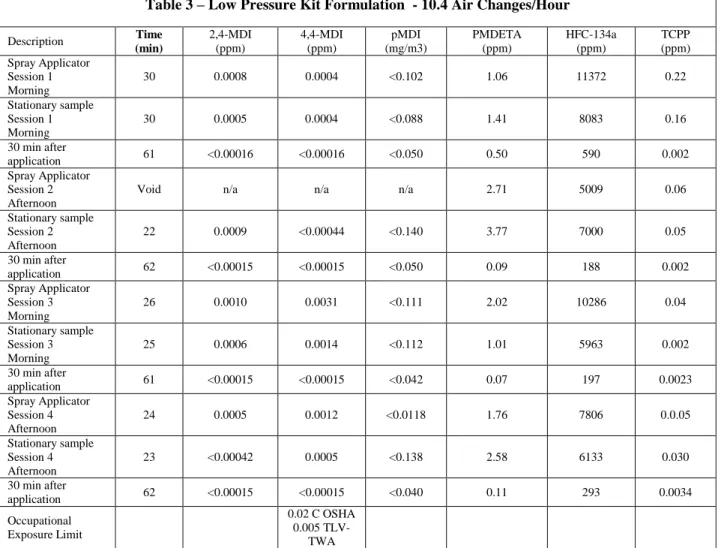
The results of analysis at 10.4 ACH are listed in Tables 1 – 3. The findings are also summarized as median concentrations representing the four (4) sampling sessions for each component analyzed in Figures 3 – 8. The results of analysis listed in Figure 3 indicate MDI was detected in personal and area samples during the application of all three formulations, while post spray concentrations for samples collected 30 minutes after application were below analytical detection MDI limits.
Vapor concentrations emitted from the closed cell medium density high pressure formulation were approximately 40 percent higher than the open cell low density high pressure formulation. There are several operational factors that likely account for the difference in MDI concentrations. One factor would be the difference in density between the generic formulations. The medium density foam is higher density foam that produces a higher exothermic
temperature (150-170°C) during the reaction/cure process. The low density high pressure system is open cell, however, water, used as the blowing agent reacts with MDI released from the foam. There is also excess amine catalyst in the generic formulations to react MDI. The temperature during the reaction is approximately 90°C. The low pressure kit formulation resulted in the lowest MDI emissions.
Since the kit formulation is low pressure, less material was sprayed during the 15 minute sample period. A total of six panels were sprayed with the low pressure kit formulation while 12 panels were sprayed with each of the high pressure systems. Spray equipment technology would be another factor that would reduce kit emissions. High pressure systems blend the “A” and “B” sides of the formulation at the tip of the spray gun, such that the materials begin to react as they leave the spray gun. The low pressure kit system is blended in the gun and is sprayed on the substrate as a froth or partially reacted foam.
This work is protected by copyright. This paper and all data and information contained in it, are owned
and protected by the ACC through its Center for the Polyurethanes Industry. Users are granted a
nonexclusive royalty-free license to reproduce and distribute this paper, subject to the following
limitations: (1) the work must be reproduced in its entirety, without alterations; and (2) copies of the work
may not be sold.
Copyright © 2013 Polyurethanes Technical Conference, American Chemistry Council.
Figure 3
2,4-MDI and 4,4–MDI
(Median conc./4 sessions - 15 min/session at 10.4 ACH)
0 0.005 0.01 0.015 0.02 0.025 0.03 2,4-MDI 4,4-MDI Co nc en tr at io n -ppm Medium Density Low Density
Low Pressure Kit
The polymeric MDI (pMDI) results listed in Figure 4 were similar to the 2, 4-MDI an 4,4-MDI results. The values are listed separately since pMDI is emitted as a solid where 2, 4-MDI and 4,4-MDI are emitted as vapors. pMDI was detected during application; however, post spray results indicate pMDI was not detected. The low pressure kit pMDI results were also below detection limits during application and post application. This outcome is likely due to reduced overspray due to the low pressure application and secondly to the mixing of material in the gun before spraying.
This work is protected by copyright. This paper and all data and information contained in it, are owned
and protected by the ACC through its Center for the Polyurethanes Industry. Users are granted a
nonexclusive royalty-free license to reproduce and distribute this paper, subject to the following
limitations: (1) the work must be reproduced in its entirety, without alterations; and (2) copies of the work
may not be sold.
Copyright © 2013 Polyurethanes Technical Conference, American Chemistry Council.
Figure 4
p-MDI
(Median conc./4 sessions - 15 min/session at 10.4 ACH)
Medium Density Low Density Low Pressure Kit
The amine catalyst results listed in Figure 5 indicate a wide range of median concentrations ranging from non-detect to over 9 ppm. Many of the factors the affect MDI emissions also impact amine catalyst. Such factors include the density of the formulation and reaction temperatures. In addition, certain non-reactive catalysts, such as bis (2-dimethylminoethyl ether (BDMAEE), bis (dimethylaminopropyl) methylamine (DAPA), and pentamethyldiethylene triamine (PMDETA) do not become bound in the formulation and can be emitted over time. Other reactive
catalysts, such as N,N,N-trimethylaminoethylethanolamine (TMAEEA) become chemically bound in the formation and is less likely to become airborne in significant concentrations. This difference in reactive and non-reactive catalyst is most evident in the findings for the medium density formulation. TMAEEA is a reactive catalyst while BDMAEE and DAPA are non-reactive. Unlike MDI, certain non-reactive catalysts are also present in the in air samples obtained 30 -90 minutes following SPF application.
Although one could conclude that using reactive catalysts will eliminate amine catalyst emissions during application, certain formulations, such as the generic low density high pressure formulation calls for an excess of catalyst to react all free MDI in the formulation. TMAEEA, a reactive catalyst can be seen in Figure 5 to be at a median concentration of approximately of 0.3 to 0.5 ppm.
This work is protected by copyright. This paper and all data and information contained in it, are owned
and protected by the ACC through its Center for the Polyurethanes Industry. Users are granted a
nonexclusive royalty-free license to reproduce and distribute this paper, subject to the following
limitations: (1) the work must be reproduced in its entirety, without alterations; and (2) copies of the work
may not be sold.
Copyright © 2013 Polyurethanes Technical Conference, American Chemistry Council.
Figure 5
Amine Catalysts
(Median conc./4 sessions - 15 min/session at 10.4 ACH)
0 1 2 3 4 5 6 7 8 9 10 Applicator Area Post-Spray Applicator Area Post-Spray Applicator Area Post-Spray Co nc en tr at io n -ppm BDMAEE TMAEEA DAPA TMIBPA PMDETA Medium Density Low Density
Low Pressure Kit
The fire retardant, tris-(1-choro-2-propyl) phosphate (TCPP) is present in each of the generic formulations ranging from 15 to 30 percent by weight. The median concentrations presented in Figure 6 follow similar pattern as the other components with the greatest emissions occurring in the medium density formulation and the lowest in the low pressure kit formulation. All concentrations were below 0.5 ppm.
This work is protected by copyright. This paper and all data and information contained in it, are owned
and protected by the ACC through its Center for the Polyurethanes Industry. Users are granted a
nonexclusive royalty-free license to reproduce and distribute this paper, subject to the following
limitations: (1) the work must be reproduced in its entirety, without alterations; and (2) copies of the work
may not be sold.
Copyright © 2013 Polyurethanes Technical Conference, American Chemistry Council.
Figure 6
TCPP – Fire Retardant
(Median conc./4 sessions - 15 min/session at 10.4 ACH)
0 0.05 0.1 0.15 0.2 0.25 0.3 0.35 Applicator Area
Post Spray Applicator Area Post Spray Applicator Area Post Spray TCPP Medium Density
Low Density Low Pressure Kit
Co n ce n tr ati o n -ppm
The blowing agents HFC-245fa and HFC 134a were present in the in the medium density high pressure system and the low pressure kit formulation respectively. The 7 percent concentration of HFC245fa in the high pressure system is substantially lower than the 28 percent concentration of the HFC-134a in the kit formulation. This concentration difference is a significant factor contributing to the large distribution in median concentrations. The Y-axis in Figure 7 is on a logarithmic scale to help display the wide range of blowing agent concentrations.
This work is protected by copyright. This paper and all data and information contained in it, are owned
and protected by the ACC through its Center for the Polyurethanes Industry. Users are granted a
nonexclusive royalty-free license to reproduce and distribute this paper, subject to the following
limitations: (1) the work must be reproduced in its entirety, without alterations; and (2) copies of the work
may not be sold.
Copyright © 2013 Polyurethanes Technical Conference, American Chemistry Council.
Figure 7
Blowing Agents
(Median conc./4 sessions - 15 min/session at 10.4 ACH)
1 10 100 1000 10000
Applicator Area Post Spray Applicator Area Post Spray
HFC-245fa HFC-134a Con ce n tr at io n -ppm
Medium Density Low Pressure Kit
Summary – 10.4 ACH Study
Following the completion of the 10.4 ACH study the CPI Ventilation Task Force reviewed the findings and concluded that the air exchange rates of 10 ACH or less would not adequately control SPF emissions during the application of the 3 generic formulations. It was therefore recommended further testing be conducted with increased ventilation. To achieve greater exhaust rates, modifications to the ventilate spray room were considered; however it was concluded that such modifications were impractical and a new location for the proposed experiments would be required. When considering locations to perform additional testing, the Task Force recommended the experiment be moved to an adjacent spray booth located in the laboratory housing the ventilated spray room. Conditioned make-up air supplied both the ventilated room and the spray booth and the booth would not require modification to achieve higher flow rates.
Ventilated Spray Booth Study
The ventilated spray booth (Photo 3, Photo 4 and Figure 8) is larger than the ventilated spray room having dimensions of 10 ft x 10.5 ft and 7 ft in height. The booth operates at two settings; full and reduced speed. At full speed the exhaust fan operates at 7,265 cfm or 598 ACH. This equates to an air exchange rate 10 air changes per minute, substantially higher than the ventilated room that operates at an air exchange rate of 1 air change every 10 minutes. The exhaust fan at the reduced rate is 2,828 cfm or 233 ACH. This 60 percent reduction in fan speed represents an air change rate of 4 ACH.
This work is protected by copyright. This paper and all data and information contained in it, are owned
and protected by the ACC through its Center for the Polyurethanes Industry. Users are granted a
nonexclusive royalty-free license to reproduce and distribute this paper, subject to the following
limitations: (1) the work must be reproduced in its entirety, without alterations; and (2) copies of the work
may not be sold.
Copyright © 2013 Polyurethanes Technical Conference, American Chemistry Council.
Photo 3 – Ventilated Spray Booth
This work is protected by copyright. This paper and all data and information contained in it, are owned
and protected by the ACC through its Center for the Polyurethanes Industry. Users are granted a
nonexclusive royalty-free license to reproduce and distribute this paper, subject to the following
limitations: (1) the work must be reproduced in its entirety, without alterations; and (2) copies of the work
may not be sold.
Copyright © 2013 Polyurethanes Technical Conference, American Chemistry Council.
Figure 8
Ventilated Spray Room and Spray Booth
Courtesy of Air Products and Chemicals, Inc.
Su b str ate X X Area Samples Applicator Ai r Fl o w 10.4 ACH 233/598 ACH 10 ‘ 10’ 6’’ Spray Booth
Work Process
The work process and air sampling procedures previously described (Phase 2 Air Sampling Protocol) for the ventilated spray room were followed during studies conducted in the spray booth. Air sampling was conducted as the applicator sprayed two inserts, removed them, stacked them in the work area, replaced inserts and repeated the process. Twelve (12) inserts were sprayed with the medium density formulation at 598 ACH. The medium density high pressure formulation and the low density high pressure formulation were sprayed at the 233 ACH rate.
Fourteen (14) inserts were sprayed using the open cell formulation. Spray time was limited to 15 minutes and a post spray sample was collected 30 minutes following application. Four (4) sessions of air sampling were completed during the application of the medium density formulation at 598 ACH and two (2) sessions of air sampling were completed during the application of low and medium density formulations at 233ACH.
Discussion – Results of air sampling at 233 ACH
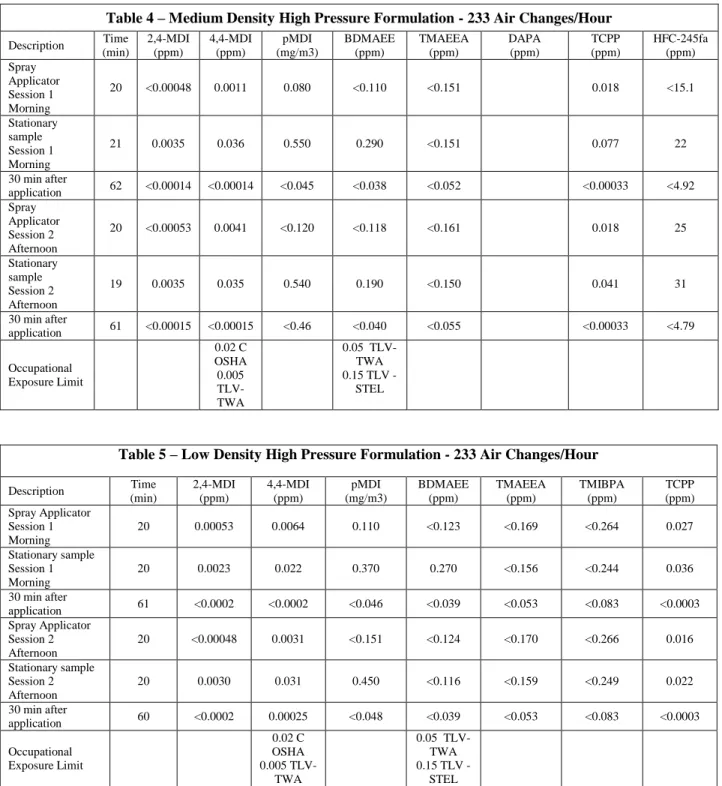
2,4-MDI, 4,4-MDI, and pMDI were detected in both personal and area samples; however post spray application samples were below detection limits. Area sample concentrations were significantly higher than applicator sample concentrations. These unanticipated findings were likely caused by the force of the overspray, the location of the air sampling devices, elevated foam temperature during initial cure, and air flow pattern in the booth. Similar findings were determined for the amine catalysts, TCPP and blowing agent; however, concentrations were significantly lower than those measured during the 10.4 ACH study. The results are listed in Tables 4 - 5 and Figures 9 – 13.
This work is protected by copyright. This paper and all data and information contained in it, are owned
and protected by the ACC through its Center for the Polyurethanes Industry. Users are granted a
nonexclusive royalty-free license to reproduce and distribute this paper, subject to the following
limitations: (1) the work must be reproduced in its entirety, without alterations; and (2) copies of the work
may not be sold.
Copyright © 2013 Polyurethanes Technical Conference, American Chemistry Council.
Figure 9
2,4-MDI and 4,4–MDI
(Median conc./2 sessions - 15 min/session at 233 ACH)
Figure 10
p-MDI
(Median conc./2 sessions - 15 min/session at 233 ACH)
0 0.1 0.2 0.3 0.4 0.5 0.6
Applicator Area Post Spray Applicator Area Post Spray
pMDI-233 ACH Con ce n tr at io n -mg /m3
This work is protected by copyright. This paper and all data and information contained in it, are owned
and protected by the ACC through its Center for the Polyurethanes Industry. Users are granted a
nonexclusive royalty-free license to reproduce and distribute this paper, subject to the following
limitations: (1) the work must be reproduced in its entirety, without alterations; and (2) copies of the work
may not be sold.
Copyright © 2013 Polyurethanes Technical Conference, American Chemistry Council.
Figure 11
Amine Catalysts
This work is protected by copyright. This paper and all data and information contained in it, are owned
and protected by the ACC through its Center for the Polyurethanes Industry. Users are granted a
nonexclusive royalty-free license to reproduce and distribute this paper, subject to the following
limitations: (1) the work must be reproduced in its entirety, without alterations; and (2) copies of the work
may not be sold.
Copyright © 2013 Polyurethanes Technical Conference, American Chemistry Council.
Figure 12
Blowing Agent
(Median conc./2 sessions - 15 min/session at 233 ACH)
1 10 100
Applicator Area Post Spray
HFC-245fa Con ce n tr at io n -ppm
Medium Density Formulation
Figure 13
TCPP – Fire Retardant
(Median conc./42 - 15 min/session at 233 ACH)
Co n ce n tr ati o n -ppm 0 0.01 0.02 0.03 0.04 0.05 0.06 Applicator Area Post Spray Applicator Area Post Spray TCPP Medium Density Low Density
This work is protected by copyright. This paper and all data and information contained in it, are owned
and protected by the ACC through its Center for the Polyurethanes Industry. Users are granted a
nonexclusive royalty-free license to reproduce and distribute this paper, subject to the following
limitations: (1) the work must be reproduced in its entirety, without alterations; and (2) copies of the work
may not be sold.
Copyright © 2013 Polyurethanes Technical Conference, American Chemistry Council.
Discussion – Results of air sampling at 598 ACH
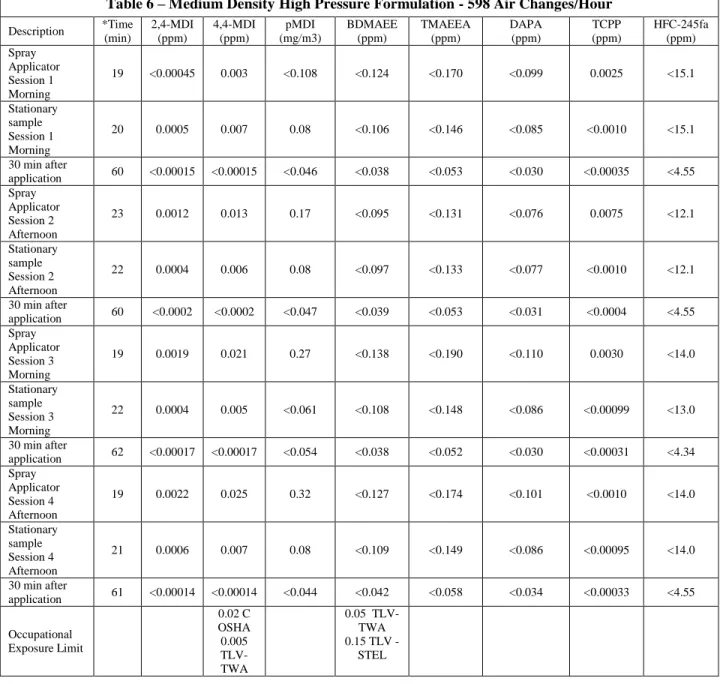
2,4-MDI, 4,4-MDI, and pMDI were detected in both personal and area samples; however post spray application samples were below detection limits. Amine catalysts, TCPP, and blowing agent concentrations were at or below analytical detection limits. The elevated exhaust ventilation rate was able to control measured B-side components; however the ventilation had a reduced affect on A-side MDI.
Although the data is limited, the MDI collected by the impinger method would efficiently collect both particulate and vapor. The particulate is typically reacting as it is collected, therefore both monomer and polymeric MDI would be detected. Therefore, one explanation for the detection of MDI at the very high air flow rate would be that in the short distance between the operator and the spray surface, the high pressure (>1500 psi) application creates a particulate and vapor overspray. The elevated ventilation rate was sufficient to capture vapor in the overspray, however was not sufficient to overcome the particulate inertia in the overspray.
The results of analysis are listed in Table 6 and Figures 14 and 15. Figure 14
2,4-MDI and 4,4–MDI
(Median conc./4 sessions - 15 min/session at 598 ACH)
0 0.002 0.004 0.006 0.008 0.01 0.012 0.014 0.016 0.018
Applicator Area Post Spray
2, 4-MDI 4,4-MDI Co n ce n tr ati o n -ppm
This work is protected by copyright. This paper and all data and information contained in it, are owned
and protected by the ACC through its Center for the Polyurethanes Industry. Users are granted a
nonexclusive royalty-free license to reproduce and distribute this paper, subject to the following
limitations: (1) the work must be reproduced in its entirety, without alterations; and (2) copies of the work
may not be sold.
Copyright © 2013 Polyurethanes Technical Conference, American Chemistry Council.
Figure 15
p-MDI
(Median conc./4 sessions - 15 min/session at 598 ACH)
0 0.05 0.1 0.15 0.2 0.25
Applicator Area Post Spray
pMDI-598 ACH Con ce n tr at io n -mg /m3
Medium Density Formulation
Summary
The median concentrations for the medium density formulation at the 3 ventilation rates; 10.4 ACH, 233ACH, and 598 ACH are summarized in Figures 16 – 21. It may be concluded that ventilation rate does impact chemical emissions during and shortly after application of medium density high pressure, low density high pressure and low pressure kit formulations. As ventilation is increased, emissions decrease. The results also indicate that there are factors beyond ventilation rate that impact emissions. Such factors include: chemical characteristics of the formulation (e.g.: reactive vs. non-reactive catalyst), the quantity of individual chemicals in the formulation, temperature of the formulation as it is applied, the temperature created during reaction, the density of the formulation the cell structure, and the air distribution of the ventilation. These application factors coupled with many environmental variables related to a residential or commercial site being sprayed make it difficult for workers directly involved in SPF application to be protected strictly though engineering controls. CPI continues to
recommend SPF applicators and personnel working in the proximity of the applicator be properly equipped with personal protective equipment (PPE) including respiratory protection, gloves, and protective clothing.
This work is protected by copyright. This paper and all data and information contained in it, are owned
and protected by the ACC through its Center for the Polyurethanes Industry. Users are granted a
nonexclusive royalty-free license to reproduce and distribute this paper, subject to the following
limitations: (1) the work must be reproduced in its entirety, without alterations; and (2) copies of the work
may not be sold.
Copyright © 2013 Polyurethanes Technical Conference, American Chemistry Council.
Figure 16
2,4-MDI and 4,4–MDI
(Median conc.-15 min/session at 10.4 ACH, 233 ACH, and 598 ACH)
0 0.005 0.01 0.015 0.02 0.025 0.03 0.035 0.04
Applicator Area Post Spray
2,4-MDI - 10.4 ACH 4,4-MDI - 10.4 ACH 2,4-MDI - 233 ACH 4,4-MDI - 233 ACH 2,4-MDI - 589 ACH 4,4-MDI - 598 ACH C o n cen tr ati o n -ppm
Medium Density Formulation
Figure 17
p-MDI
(Median conc.-15 min/session at 10.4 ACH, 233 ACH, and 598 ACH)
0 0.1 0.2 0.3 0.4 0.5 0.6
Applicator Area Post Spray
pMDI-10.4 ACH pMDI-233 ACH pMDI-598 ACH Con ce n tr at io n -mg /m3
This work is protected by copyright. This paper and all data and information contained in it, are owned
and protected by the ACC through its Center for the Polyurethanes Industry. Users are granted a
nonexclusive royalty-free license to reproduce and distribute this paper, subject to the following
limitations: (1) the work must be reproduced in its entirety, without alterations; and (2) copies of the work
may not be sold.
Copyright © 2013 Polyurethanes Technical Conference, American Chemistry Council.
Figure 18
Amine Catalysts
(Median conc. - 15 min/session at 10.4 ACH, 233 ACH, and 598 ACH)
0 1 2 3 4 5 6 7 8 9 10 Applicator Area Post-Spray C o n cen tr at io n -ppm BDMAEE - 10.4 ACH BDMAEE - 233 ACH BDMAEE - 598 ACH TMAEEA - 10.4 ACH TMAEEA - 233 ACH TMAEEA - 598 ACH DAPA - 10.4 ACH DAPA - 233 ACH DAPA - 598 ACH
Medium Density Formulation
Figure 19
TCPP
(Median conc.-15 min/session at 10.4 ACH, 233 ACH, and 598 ACH)
0 0.05 0.1 0.15 0.2 0.25 0.3 0.35
Applicator Area Post Spray
TCPP -10 ACH TCPP - 233 ACH TCPP - 598 ACH C o n cen tr at io n -ppm
This work is protected by copyright. This paper and all data and information contained in it, are owned
and protected by the ACC through its Center for the Polyurethanes Industry. Users are granted a
nonexclusive royalty-free license to reproduce and distribute this paper, subject to the following
limitations: (1) the work must be reproduced in its entirety, without alterations; and (2) copies of the work
may not be sold.
Copyright © 2013 Polyurethanes Technical Conference, American Chemistry Council.
Figure 20
Blowing Agent – HFC-245fa
(Median conc.-15 min/session at 10.4 ACH, 233 ACH, and 598 ACH)
0 50 100 150 200 250 300 350 400
Applicator Area Post Spray
HFC-245fa - 10.4 ACH HFC-245fa - 233ACH HFC-245fa - 598 ACH C o n cen tr at io n -ppm
This work is protected by copyright. This paper and all data and information contained in it, are owned
and protected by the ACC through its Center for the Polyurethanes Industry. Users are granted a
nonexclusive royalty-free license to reproduce and distribute this paper, subject to the following
limitations: (1) the work must be reproduced in its entirety, without alterations; and (2) copies of the work
may not be sold.
Copyright © 2013 Polyurethanes Technical Conference, American Chemistry Council.
Table 1 – Medium Density High Pressure Formulation - 10.4 Air Changes/HourDescription Time (min) 2,4-MDI (ppm) 4,4-MDI (ppm) pMDI (mg/m3) BDMAEE (ppm) TMAEEA (ppm) DAPA (ppm) TCPP (ppm) HFC 245fa (ppm) Spray Applicator Session 1 Morning 13 0.00380 0.02800 0.21 0.630 <0.257 2.31 0.160 182 Stationary sample Session 1 Morning 18 0.00390 0.02500 0.29 1.38 <0.183 3.79 0.290 281 30 min after application 60 <0.00015 <0.00015 <0.0016 <0.039 <0.053 0.14 0.002 <4.91 Spray Applicator Session 2 Afternoon 20 0.00580 0.03700 <0.41 2.51 <0.151 7.67 0.370 365 Stationary sample Session 2 Afternoon 20 0.00480 0.03200 0.36 2.80 <0.141 9.87 0.390 313 30 min after application 53 <0.00016 <0.00016 <0.0016 0.084 <0.083 0.32 0.005 <4.79 Spray Applicator Session 3 Morning 24 0.00330 0.02300 0.33 2.00 <0.119 5.67 0.280 599 Stationary sample Session 3 Morning 24 0.00440 0.02800 0.35 2.63 <0.119 8.80 Invalid 365 30 min after application 45 <0.00021 <0.00021 <0.0021 0.051 <0.058 <0.090 0.0049 <4.92 Spray Applicator Session 4 Afternoon 22 0.00300 0.01900 0.17 2.38 <0.139 7.42 0.370 379 Stationary sample Session 4 Afternoon 24 0.00280 0.01800 0.20 3.20 <0.118 12.48 0.330 309 30 min after application 61 <0.00014 <0.00014 <0.0014 0.440 <0.053 <0.084 0.0061 <4.92 Occupational Exposure Limit 0.02 C OSHA 0.005 TLV-TWA 0.05 TLV-TWA 0.15 TLV -STEL 300 TWA AIHA WEEL
This work is protected by copyright. This paper and all data and information contained in it, are owned
and protected by the ACC through its Center for the Polyurethanes Industry. Users are granted a
nonexclusive royalty-free license to reproduce and distribute this paper, subject to the following
limitations: (1) the work must be reproduced in its entirety, without alterations; and (2) copies of the work
may not be sold.
Copyright © 2013 Polyurethanes Technical Conference, American Chemistry Council.
Table 2 – Low Density High Pressure Formulation - 10.4 Air Changes/HourDescription Time (min) 2,4-MDI (ppm) 4,4-MDI (ppm) pMDI (mg/m3) BDMAEE (ppm) TMAEEA (ppm) TMIBPA (ppm) TCPP (ppm) Spray Applicator Session 1 Morning 21 0.00380 0.02000 0.18 0.75 0.33 <0.225 0.14 Stationary sample Session 1 Morning 23 0.00090 0.00200 <0.179 1.37 0.40 <0.222 0.12 30 min after application 60 <0.00016 <0.00016 <0.043 0.18 <0.055 <0.086 0.0036 Spray Applicator Session 2 Afternoon 22 0.00310 0.0170 0.17 1.04 0.40 <0.197 0.17 Stationary sample Session 2 Afternoon 23 0.0010 0.001 <0.122 0.40 <0.125 <0.196 0.16 30 min after application 61 <0.00016 <0.00016 <0.046 1.04 0.24 <0.091 0.0075 Spray Applicator Session 3 Morning 21 0.0020 0.011 0.11 0.90 0.30 <0.220 0.14 Stationary sample Session 3 Morning 21 <0.00046 0.001 <0.198 1.78 0.44 <0.228 0.16 30 min after application 60 <0.00016 <0.00016 <0.047 0.24 <0.055 <0.086 0.0064 Spray Applicator Session 4 Afternoon 20 0.0025 0.013 0.12 1.45 0.41 <0.219 0.22 Stationary sample Session 4 Afternoon 20 0.0052 0.021 0.13 2.42 0.52 <0.263 0.24 30 min after application 61 <0.00016 <0.00016 <0.049 0.16 <0.055 <0.087 0.0039 Occupational Exposure Limit 0.02 C OSHA 0.005 TLV-TWA 0.05 TLV-TWA 0.15 TLV-STEL
This work is protected by copyright. This paper and all data and information contained in it, are owned
and protected by the ACC through its Center for the Polyurethanes Industry. Users are granted a
nonexclusive royalty-free license to reproduce and distribute this paper, subject to the following
limitations: (1) the work must be reproduced in its entirety, without alterations; and (2) copies of the work
may not be sold.
Copyright © 2013 Polyurethanes Technical Conference, American Chemistry Council.
Table 3 – Low Pressure Kit Formulation - 10.4 Air Changes/HourDescription Time (min) 2,4-MDI (ppm) 4,4-MDI (ppm) pMDI (mg/m3) PMDETA (ppm) HFC-134a (ppm) TCPP (ppm) Spray Applicator Session 1 Morning 30 0.0008 0.0004 <0.102 1.06 11372 0.22 Stationary sample Session 1 Morning 30 0.0005 0.0004 <0.088 1.41 8083 0.16 30 min after application 61 <0.00016 <0.00016 <0.050 0.50 590 0.002 Spray Applicator Session 2 Afternoon
Void n/a n/a n/a 2.71 5009 0.06
Stationary sample Session 2 Afternoon 22 0.0009 <0.00044 <0.140 3.77 7000 0.05 30 min after application 62 <0.00015 <0.00015 <0.050 0.09 188 0.002 Spray Applicator Session 3 Morning 26 0.0010 0.0031 <0.111 2.02 10286 0.04 Stationary sample Session 3 Morning 25 0.0006 0.0014 <0.112 1.01 5963 0.002 30 min after application 61 <0.00015 <0.00015 <0.042 0.07 197 0.0023 Spray Applicator Session 4 Afternoon 24 0.0005 0.0012 <0.0118 1.76 7806 0.0.05 Stationary sample Session 4 Afternoon 23 <0.00042 0.0005 <0.138 2.58 6133 0.030 30 min after application 62 <0.00015 <0.00015 <0.040 0.11 293 0.0034 Occupational Exposure Limit 0.02 C OSHA 0.005 TLV-TWA
This work is protected by copyright. This paper and all data and information contained in it, are owned
and protected by the ACC through its Center for the Polyurethanes Industry. Users are granted a
nonexclusive royalty-free license to reproduce and distribute this paper, subject to the following
limitations: (1) the work must be reproduced in its entirety, without alterations; and (2) copies of the work
may not be sold.
Copyright © 2013 Polyurethanes Technical Conference, American Chemistry Council.
Table 4 – Medium Density High Pressure Formulation - 233 Air Changes/HourDescription Time (min) 2,4-MDI (ppm) 4,4-MDI (ppm) pMDI (mg/m3) BDMAEE (ppm) TMAEEA (ppm) DAPA (ppm) TCPP (ppm) HFC-245fa (ppm) Spray Applicator Session 1 Morning 20 <0.00048 0.0011 0.080 <0.110 <0.151 0.018 <15.1 Stationary sample Session 1 Morning 21 0.0035 0.036 0.550 0.290 <0.151 0.077 22 30 min after application 62 <0.00014 <0.00014 <0.045 <0.038 <0.052 <0.00033 <4.92 Spray Applicator Session 2 Afternoon 20 <0.00053 0.0041 <0.120 <0.118 <0.161 0.018 25 Stationary sample Session 2 Afternoon 19 0.0035 0.035 0.540 0.190 <0.150 0.041 31 30 min after application 61 <0.00015 <0.00015 <0.46 <0.040 <0.055 <0.00033 <4.79 Occupational Exposure Limit 0.02 C OSHA 0.005 TLV-TWA 0.05 TLV-TWA 0.15 TLV -STEL
Table 5 – Low Density High Pressure Formulation - 233 Air Changes/Hour
Description Time (min) 2,4-MDI (ppm) 4,4-MDI (ppm) pMDI (mg/m3) BDMAEE (ppm) TMAEEA (ppm) TMIBPA (ppm) TCPP (ppm) Spray Applicator Session 1 Morning 20 0.00053 0.0064 0.110 <0.123 <0.169 <0.264 0.027 Stationary sample Session 1 Morning 20 0.0023 0.022 0.370 0.270 <0.156 <0.244 0.036 30 min after application 61 <0.0002 <0.0002 <0.046 <0.039 <0.053 <0.083 <0.0003 Spray Applicator Session 2 Afternoon 20 <0.00048 0.0031 <0.151 <0.124 <0.170 <0.266 0.016 Stationary sample Session 2 Afternoon 20 0.0030 0.031 0.450 <0.116 <0.159 <0.249 0.022 30 min after application 60 <0.0002 0.00025 <0.048 <0.039 <0.053 <0.083 <0.0003 Occupational Exposure Limit 0.02 C OSHA 0.005 TLV-TWA 0.05 TLV-TWA 0.15 TLV -STEL
This work is protected by copyright. This paper and all data and information contained in it, are owned
and protected by the ACC through its Center for the Polyurethanes Industry. Users are granted a
nonexclusive royalty-free license to reproduce and distribute this paper, subject to the following
limitations: (1) the work must be reproduced in its entirety, without alterations; and (2) copies of the work
may not be sold.
Copyright © 2013 Polyurethanes Technical Conference, American Chemistry Council.
Table 6 – Medium Density High Pressure Formulation - 598 Air Changes/HourDescription *Time (min) 2,4-MDI (ppm) 4,4-MDI (ppm) pMDI (mg/m3) BDMAEE (ppm) TMAEEA (ppm) DAPA (ppm) TCPP (ppm) HFC-245fa (ppm) Spray Applicator Session 1 Morning 19 <0.00045 0.003 <0.108 <0.124 <0.170 <0.099 0.0025 <15.1 Stationary sample Session 1 Morning 20 0.0005 0.007 0.08 <0.106 <0.146 <0.085 <0.0010 <15.1 30 min after application 60 <0.00015 <0.00015 <0.046 <0.038 <0.053 <0.030 <0.00035 <4.55 Spray Applicator Session 2 Afternoon 23 0.0012 0.013 0.17 <0.095 <0.131 <0.076 0.0075 <12.1 Stationary sample Session 2 Afternoon 22 0.0004 0.006 0.08 <0.097 <0.133 <0.077 <0.0010 <12.1 30 min after application 60 <0.0002 <0.0002 <0.047 <0.039 <0.053 <0.031 <0.0004 <4.55 Spray Applicator Session 3 Morning 19 0.0019 0.021 0.27 <0.138 <0.190 <0.110 0.0030 <14.0 Stationary sample Session 3 Morning 22 0.0004 0.005 <0.061 <0.108 <0.148 <0.086 <0.00099 <13.0 30 min after application 62 <0.00017 <0.00017 <0.054 <0.038 <0.052 <0.030 <0.00031 <4.34 Spray Applicator Session 4 Afternoon 19 0.0022 0.025 0.32 <0.127 <0.174 <0.101 <0.0010 <14.0 Stationary sample Session 4 Afternoon 21 0.0006 0.007 0.08 <0.109 <0.149 <0.086 <0.00095 <14.0 30 min after application 61 <0.00014 <0.00014 <0.044 <0.042 <0.058 <0.034 <0.00033 <4.55 Occupational Exposure Limit 0.02 C OSHA 0.005 TLV-TWA 0.05 TLV-TWA 0.15 TLV -STEL
This work is protected by copyright. This paper and all data and information contained in it, are owned
and protected by the ACC through its Center for the Polyurethanes Industry. Users are granted a
nonexclusive royalty-free license to reproduce and distribute this paper, subject to the following
limitations: (1) the work must be reproduced in its entirety, without alterations; and (2) copies of the work
may not be sold.
Copyright © 2013 Polyurethanes Technical Conference, American Chemistry Council.
ACKNOWLEDGEMENTSThe author would like to thank Brent Altemose, Nicolle Pawelczyk, and Stephen Nowakowski, Sabre Health and Safety, Bulent Ozbas and Joel Rogers, Air Products and Chemicals, Scott Ecoff, Bayer MaterialScience, and Mary Bogdan, Honeywell Specialty Materials. The author would also like to thank the members of the CPI staff and Ventilation Research Task Force for their time, energy, and commitment to this complex project.
Richard Wood
Photo Richard Wood is a Certified Industrial Hygienist (CIH). He earned a BA in Biology and
Chemistry from Eastern Michigan University and a Master of Public Health degree specializing in Industrial and Environmental Health from the University of Michigan. Rick has worked for Air Product and Chemicals, Inc. for over 30 years as the Manager, Global Industrial Hygiene Services. He is responsible for managing industrial hygiene teams and activities for Air Products global operations as well as providing product stewardship support to the epoxy and polyurethane additives business areas.