Analysis of foreign physical activity recommendations and guidelines for schools
Jan Pavelka*, Erik Sigmund, Zdeněk Hamřík, and Michal Kalman
Faculty of Physical Culture, Palacký University, Olomouc, Czech RepublicCopyright: © 2014 J. Pavelka et al. This is an open access article licensed under the Creative Commons Attribution License (http:// creativecommons.org/licenses/by/4.0/).
Background: An adequate level of physical activity is an important part of children’s lifestyle. The school environ-ment plays a significant role in the area of interventions and strategies aiming to increase the level of physical activity in children. Objectives: The aim of this study is to analyse foreign recommendations leading to an increased level of physical activity in children and young people in Czech schools. Methods: A systematic search of studies published between 1988 and 2012 in the English language was completed in library databases Medline, Sport Discus, ProQuest, PsychInfo, ERIC, Wiley InterScience using the following keywords: physical activity, guidelines, recommendations, school and youth. The studies were then classified based on abstract and full-text analyses. Using a content analysis the expert team formulated the final recommendations to increase the level of physical activity for schools in the Czech Republic (CR). Results: Out of the total number of 91 identified foreign studies, 25 met the predetermined criteria and were used as a basis for formulating the recommendations. These foreign studies included 15 papers published in USA, two in Australia, two in Great Britain, two in Canada, one in the European Union, one in New Zealand and one international paper (an international consensus of experts from 34 countries). Based on the interpretation of the evidence, its justification and final consensus of the expert team, the basic areas for the recommendations to increase the level of physical activity in schools in the CR were identified. Conclusions:An analysis of foreign recommenda-tions to increase the level of physical activity designed for schools and school facilities is one of the possible methods of formulating domestic recommendations. This recommendation could contribute to deeper understanding of the issue of the deteriorating lifestyle of school-aged children in the CR and reflects the efforts for improvement.
Keywords: recommendations, physical activity, school environment, children, physical education
influence on children’s study results (Bailey et al., 2009; Cradock, Melly, Allen, Morris, & Gortmaker, 2007).
PA appears to be one of the effective tools in the fight against child overweight and obesity (Sigmund, El Ansari, & Sigmundová, 2012; Zabinski, Saelens, Stein, Hayden-Wade, & Wilfley, 2003). From a health perspective, lack of PA is, after smoking, high blood pressure and cholesterol, the fourth highest risk factor of non-communicable diseases (Bouchard, Blair, & Haskell, 2012). A change in lifestyle during childhood plays a significant role in further human development in adulthood (Hills, Andersen, & Byrne, 2011; Waters, Swinburn, Seidell, & Uauy, 2011). Risk periods affect-ing the lifestyle include even early childhood (Gunter, Almstedt, & Janz, 2012; Tremblay, Boudreau-Larivière, & Cimon-Lambert, 2012). Therefore, this age period offers a space for targeted interventions (Harris, Kura-moto, Schulzer, & Retallack, 2009; Pate & O’Neill, 2009).
Introduction
Overhelming evidence supports the importance of reg-ular physical activity (PA), which has a positive effect on the health of children and young people through preventing a number of diseases, preventing over-weight and obesity, decreasing high blood pressure and helping to improve mental health (Guillaume, Lapidus, Björntorp, & Lambert, 2012; Iannotti, Kogan, Janssen, & Boyce, 2009; Warburton, Charlesworth, Ivey, Nettle-fold, & Bredin, 2010).
PA promotion is one of the basic intervention strat-egies of improving the quality of life and the effort to decrease the risk and seriousness of chronic diseases. It is also an important element in increasing the effec-tiveness of the educational system and has a positive
A positive effect of PA on children is typically sup-ported by targeted interventions and a change in the environment where PA takes place (De Bourdeaudhuij et al., 2010). A significant role in an effort to change the behaviour in order to increase the level of PA in children is played by the family and school (Gorman, Lackney, Rollings, & Huang, 2012; Salmon, Timperio, Telford, Carver, & Crawford, 2012; Sigmund & Sig-mundová, 2011). Published studies indicate that the success rate of an intervention usually depends on the cultural and social environment of a particular school, attitude of the family and motivation invoked within the society (Kitzman-Ulrich et al., 2010; Kriemler et al., 2011).
Schools offer an optimal environment for design-ing, implementdesign-ing, and evaluating behavioural inter-ventions to promote PA. A school not only influences children’s attitude to PA but also informs of its impor-tance in human life (Haug, Torsheim, Sallis, & Samdal, 2010; Robertson-Wilson, Dargavel, Bryden, & Giles-Corti, 2012). One of the effective tools for increasing the level of PA in schools can be the development of evidence-based PA recommendations to promote a PA and healthy lifestyle in children (Kesäniemi, Riddoch, Reeder, Blair, & Sørensen, 2010; Warburton, Charles-worth, Ivey, Nettlefold, & Bredin, 2010).
The aim of this study was to, through foreign recom-mendations for PA promotion; formulate recommenda-tions for school managers in elementary and secondary schools in the Czech Republic leading to an increase in the level of PA in children in both the school and out of school environment.
Methods
Systematic literature search
The criteria applied in the selection of suitable foreign literature included the following:
• target group (children and young people aged 5 to 19 years),
• type of recommendation or intervention (physi-cal, nutrition, combined – physical + nutrition, organization),
• type of school (elementary and secondary), • results (duration, areas of recommendation,
appli-cation methods),
• year of publishing (period from 1988 to 2012).
The keywords used were physical activity, guide-lines, recommendations, school and children. We searched through six electronic databases – Medline, Sport Discus, ProQuest, PsychInfo, ERIC, Wiley InterScience using the following keywords – physical
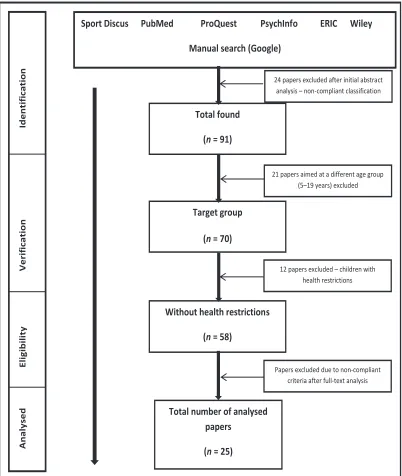
activity, guidelines, recommendations, school and youth. A prerequisite for including a study in the final content analysis was its classification as a recom-mendation/guideline designed for children and young people without health or other restrictions aged 5 to 19 years (Figure 1).
Content analysis
The content analysis method is recommended as a simple, adaptable, systematic and objective method (Granner, Sharpe, Burroughs, Fields, & Hallenbeck, 2010; Thomas, Nelson, Silverman, & Silverman, 2010) for data analysis and extraction. Data extraction was performed by two researchers (JP and MK). The third reviewer’s (ZH) role was to resolve any conflicts. The data was extracted independently for each included paper using the following keywords – physical activity, guidelines, recommendations, school and youth. We used a data collection form designed before the search. We collected information on participants and study characteristics (including age and setting), curricular activities (physical education and health education), extracurricular activities (community programmes, parents’ roles), policy (school strategies), school envi-ronment and teacher education. These specific areas of interest were selected in advance by the study team on the basis of accordance with previous expert papers focused on developing PA recommendations and guide-lines (Silveira, Taddei, Guerra, & Nobre, 2011; Trem-blay, Boudreau-Larivière, & Cimon-Lambert, 2012). After that we contacted independent experts to check any omissions (members of the team of authors and a foreign expert), then the recommendations to increase the level of PA in schools in the Czech Republic were developed.
Results
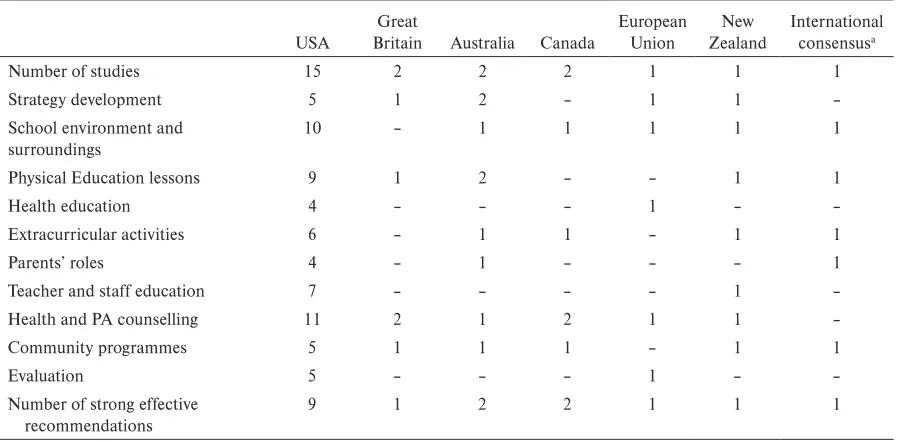
of the 25 included studies were organized by their fre-quency and strength of effect, see Table 1.
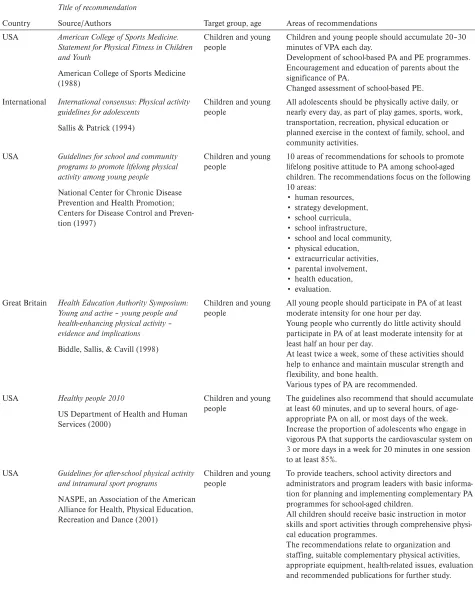
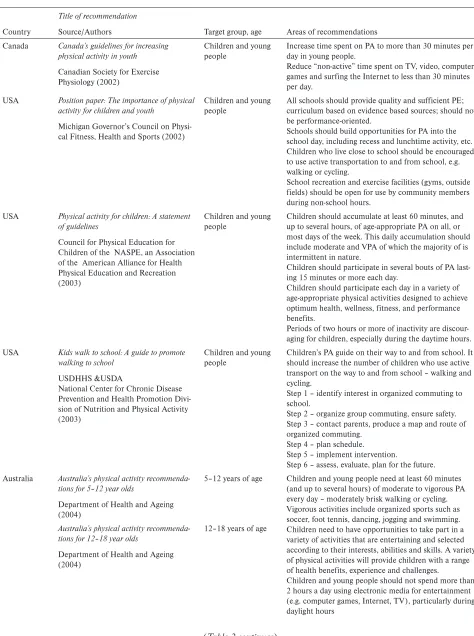
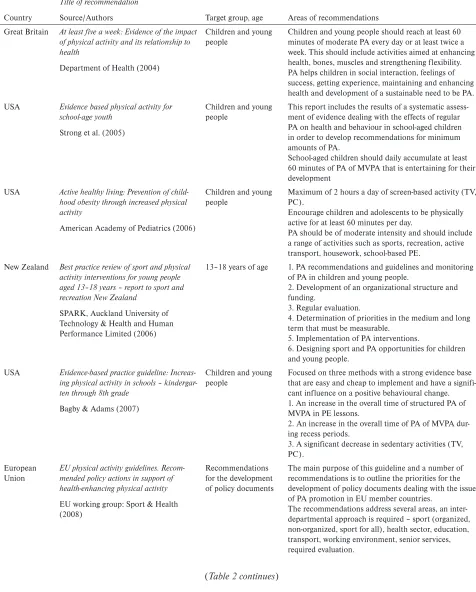
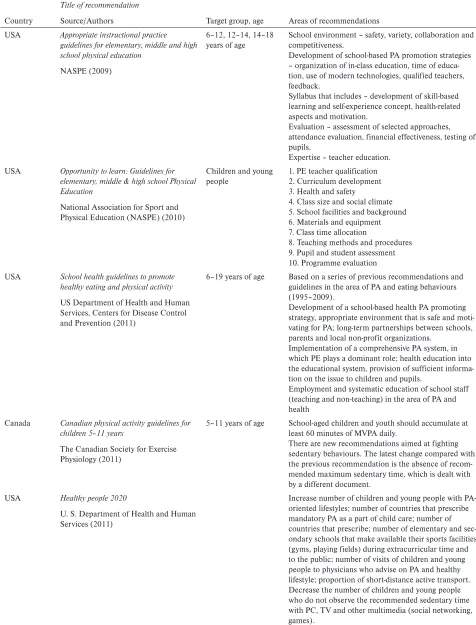
After the content analysis (Table 2) we identified a list of most frequently repeated recommendations in terms of content and type, and grouped them into the following areas.
Strategy development – use a coordinated approach to develop, implement, and evaluate school-based PA health promoting strategy for schools and school
facilities. The aim of school strategies is to provide formal as well as informal principles that schools and local organizations respect in planning, deliver-ing and evaluatdeliver-ing PA programmes for young people. PA school strategies should respect national as well as regional strategies and documents and recommen-dations. These strategies should be in the form of a written document containing information from school managers, teachers, lecturers, sports coaches, parents,
8VHGNH\ZRUGVSK\VLFDODFWLYLW\JXLGHOLQHVUHFRPPHQGDWLRQVVFKRROFKLOGUHQ 'RFXPHQWVLQ(QJOLVKEHWZHHQDQG
ϮϭƉĂƉĞƌƐĂŝŵĞĚĂƚĂĚŝĨĨĞƌĞŶƚĂŐĞŐƌŽƵƉ ;ϱʹϭϵLJĞĂƌƐͿĞdžĐůƵĚĞĚ dŽƚĂůĨŽƵŶĚ
;ŶсϵϭͿ
dĂƌŐĞƚŐƌŽƵƉ ;ŶсϳϬͿ
tŝƚŚŽƵƚŚĞĂůƚŚƌĞƐƚƌŝĐƚŝŽŶƐ
;ŶсϱϴͿ
ϭϮƉĂƉĞƌƐĞdžĐůƵĚĞĚʹĐŚŝůĚƌĞŶǁŝƚŚ ŚĞĂůƚŚƌĞƐƚƌŝĐƚŝŽŶƐ
dŽƚĂůŶƵŵďĞƌŽĨĂŶĂůLJƐĞĚ ƉĂƉĞƌƐ
;ŶсϮϱͿ
WĂƉĞƌƐĞdžĐůƵĚĞĚĚƵĞƚŽŶŽŶͲĐŽŵƉůŝĂŶƚ ĐƌŝƚĞƌŝĂĂĨƚĞƌĨƵůůͲƚĞdžƚĂŶĂůLJƐŝƐ
ϮϰƉĂƉĞƌƐĞdžĐůƵĚĞĚĂĨƚĞƌŝŶŝƚŝĂůĂďƐƚƌĂĐƚ ĂŶĂůLJƐŝƐʹŶŽŶͲĐŽŵƉůŝĂŶƚĐůĂƐƐŝĨŝĐĂƚŝŽŶ
ŶĂůLJƐĞĚ
ůŝŐŝďŝůŝƚLJ
sĞƌŝĨ
ŝĐĂƚ
ŝŽŶ
/ĚĞŶƚŝ
ĨŝĐ
ĂƚŝŽŶ
^ƉŽƌƚŝƐĐƵƐ WƵďDĞĚ WƌŽYƵĞƐƚ WƐLJĐŚ/ŶĨŽ Z/ tŝůĞLJ
DĂŶƵĂůƐĞĂƌĐŚ;'ŽŽŐůĞͿ
students and also healthcare providers, public health institutions, other schools and community workers.
School environment – establish PA-friendly and safe environment, where PA is possible without exces-sive restrictions. The primary objective in an effort to increase the level of PA in children and young people in schools is to make safe areas and school facilities (gyms, playing fields) available where children and pupils can perform PA. These areas should be available not only during classes but also at weekends, special days and holidays (including summer holidays). These areas and facilities should be easily available also for non-profit organizations which organize complemen-tary activities and physically-oriented programmes.
Physical Education (PE) lessons – implement PE curricula that appeal to the natural need of children and pupils for PA and that try to create a positive attitude to PA by developing knowledge of its health benefits. Such PE lessons should help change attitudes and behaviours and support self-confidence required to adopt and maintain a physically active lifestyle. In developing the curricula, educators should take into account particularly the age and education needs of pupils, their interests and schools conditions that are often very different. Provision of complementary pro-grammes (clubs) that motivate pupils to active partici-pation even after classes – cooperation with non-profit organizations, cities and local authorities where the schools are located.
Health education – implement a modification of health education curricula in order to help students
develop their knowledge, skills and self-confidence, and embrace behaviours and strengthen their attitudes required to adopt and maintain a physically-active lifestyle. Creating links among the educational compo-nents of health education, school PE and other subjects in the area of PA promotion – the class teacher of the class involved should be the coordinator – an example could be links among nutrition habits, which are the domain of health education and an adequate level of PA in order to maintain or reduce body weight.
Extracurricular activities – it is important to provide a sufficient offer of extracurricular activities (clubs, programmes) that meet the needs and interests of all students. Frequently offered programmes focus on competition and team sports, which can discourage less predisposed individuals in terms of physical and health fitness from participation. Undue emphasis on perfor-mance and competitiveness in childhood contributes, especially in early and late adulthood, to a decreased level of PA. Therefore, an effort should be exerted to provide a rich offer of PA programmes attractive to a wide range of pupils and students. Non-competitive activities should include walking (hiking, Nordic walk-ing), swimming, cycling (scooters, skateboard, etc.), or newly developing PA activities – Zumba, Frisbee, etc. Highlight effective cooperation with non-profit organi-zations that work with young people in the area of PA; significant support (financial, organizational, material, facilities) should be provided by the municipal or local authorities;
Table 1
General characteristic of the included studies, organized by frequency and strength of effect
USA
Great
Britain Australia Canada
European Union
New Zealand
International consensusa
Number of studies 15 2 2 2 1 1 1
Strategy development 5 1 2 – 1 1 –
School environment and surroundings
10 – 1 1 1 1 1
Physical Education lessons 9 1 2 – – 1 1
Health education 4 – – – 1 – –
Extracurricular activities 6 – 1 1 – 1 1
Parents’ roles 4 – 1 – – – 1
Teacher and staff education 7 – – – – 1 –
Health and PA counselling 11 2 1 2 1 1 –
Community programmes 5 1 1 1 – 1 1
Evaluation 5 – – – 1 – –
Number of strong effective recommendations
9 1 2 2 1 1 1
Table 2
Analysis of foreign recommendations to increase PA in order to promote health in children and young people – ordered by year of issue
Country
Title of recommendation
Source/Authors Target group, age Areas of recommendations
USA American College of Sports Medicine. Statement for Physical Fitness in Children and Youth
American College of Sports Medicine (1988)
Children and young
people Children and young people should accumulate 20–30 minutes of VPA each day.
Development of school-based PA and PE programmes. Encouragement and education of parents about the significance of PA.
Changed assessment of school-based PE.
International International consensus: Physical activity
guidelines for adolescents
Sallis & Patrick (1994)
Children and young
people All adolescents should be physically active daily, or nearly every day, as part of play games, sports, work, transportation, recreation, physical education or planned exercise in the context of family, school, and community activities.
USA Guidelines for school and community programs to promote lifelong physical activity among young people
National Center for Chronic Disease Prevention and Health Promotion; Centers for Disease Control and Preven-tion (1997)
Children and young
people 10 areas of recommendations for schools to promote lifelong positive attitude to PA among school-aged children. The recommendations focus on the following 10 areas:
• human resources, • strategy development, • school curricula, • school infrastructure, • school and local community, • physical education, • extracurricular activities, • parental involvement, • health education, • evaluation.
Great Britain Health Education Authority Symposium:
Young and active – young people and health-enhancing physical activity – evidence and implications
Biddle, Sallis, & Cavill (1998)
Children and young people
All young people should participate in PA of at least moderate intensity for one hour per day.
Young people who currently do little activity should participate in PA of at least moderate intensity for at least half an hour per day.
At least twice a week, some of these activities should help to enhance and maintain muscular strength and flexibility, and bone health.
Various types of PA are recommended.
USA Healthy people 2010
US Department of Health and Human Services (2000)
Children and young people
The guidelines also recommend that should accumulate at least 60 minutes, and up to several hours, of age-appropriate PA on all, or most days of the week. Increase the proportion of adolescents who engage in vigorous PA that supports the cardiovascular system on 3 or more days in a week for 20 minutes in one session to at least 85%.
USA Guidelines for after-school physical activity and intramural sport programs
NASPE, an Association of the American Alliance for Health, Physical Education, Recreation and Dance (2001)
Children and young
people To provide teachers, school activity directors and administrators and program leaders with basic informa-tion for planning and implementing complementary PA programmes for school-aged children.
All children should receive basic instruction in motor skills and sport activities through comprehensive physi-cal education programmes.
The recommendations relate to organization and staffing, suitable complementary physical activities, appropriate equipment, health-related issues, evaluation and recommended publications for further study.
Country
Title of recommendation
Source/Authors Target group, age Areas of recommendations
Canada Canada’s guidelines for increasing
physical activity in youth
Canadian Society for Exercise Physiology (2002)
Children and young
people Increase time spent on PA to more than 30 minutes per day in young people.
Reduce “non-active” time spent on TV, video, computer games and surfing the Internet to less than 30 minutes per day.
USA Position paper: The importance of physical activity for children and youth
Michigan Governor’s Council on Physi-cal Fitness, Health and Sports (2002)
Children and young
people All schools should provide quality and sufficient PE; curriculum based on evidence based sources; should not be performance-oriented.
Schools should build opportunities for PA into the school day, including recess and lunchtime activity, etc. Children who live close to school should be encouraged to use active transportation to and from school, e.g. walking or cycling.
School recreation and exercise facilities (gyms, outside fields) should be open for use by community members during non-school hours.
USA Physical activity for children: A statement of guidelines
Council for Physical Education for Children of the NASPE, an Association of the American Alliance for Health Physical Education and Recreation (2003)
Children and young people
Children should accumulate at least 60 minutes, and up to several hours, of age-appropriate PA on all, or most days of the week. This daily accumulation should include moderate and VPA of which the majority of is intermittent in nature.
Children should participate in several bouts of PA last-ing 15 minutes or more each day.
Children should participate each day in a variety of age-appropriate physical activities designed to achieve optimum health, wellness, fitness, and performance benefits.
Periods of two hours or more of inactivity are discour-aging for children, especially during the daytime hours. USA Kids walk to school: A guide to promote
walking to school
USDHHS &USDA
National Center for Chronic Disease Prevention and Health Promotion Divi-sion of Nutrition and Physical Activity (2003)
Children and young
people Children’s PA guide on their way to and from school. It should increase the number of children who use active transport on the way to and from school – walking and cycling.
Step 1 – identify interest in organized commuting to school.
Step 2 – organize group commuting, ensure safety. Step 3 – contact parents, produce a map and route of organized commuting.
Step 4 – plan schedule. Step 5 – implement intervention.
Step 6 – assess, evaluate, plan for the future.
Australia Australia’s physical activity
recommenda-tions for 5–12 year olds
Department of Health and Ageing (2004)
5–12 years of age Children and young people need at least 60 minutes
(and up to several hours) of moderate to vigorous PA every day – moderately brisk walking or cycling. Vigorous activities include organized sports such as soccer, foot tennis, dancing, jogging and swimming. Children need to have opportunities to take part in a variety of activities that are entertaining and selected according to their interests, abilities and skills. A variety of physical activities will provide children with a range of health benefits, experience and challenges.
Children and young people should not spend more than 2 hours a day using electronic media for entertainment (e.g. computer games, Internet, TV), particularly during daylight hours
Australia’s physical activity recommenda-tions for 12–18 year olds
Department of Health and Ageing (2004)
12–18 years of age
Country
Title of recommendation
Source/Authors Target group, age Areas of recommendations
Great Britain At least five a week: Evidence of the impact
of physical activity and its relationship to health
Department of Health (2004)
Children and young
people Children and young people should reach at least 60 minutes of moderate PA every day or at least twice a week. This should include activities aimed at enhancing health, bones, muscles and strengthening flexibility. PA helps children in social interaction, feelings of success, getting experience, maintaining and enhancing health and development of a sustainable need to be PA. USA Evidence based physical activity for
school-age youth
Strong et al. (2005)
Children and young
people This report includes the results of a systematic assess-ment of evidence dealing with the effects of regular PA on health and behaviour in school-aged children in order to develop recommendations for minimum amounts of PA.
School-aged children should daily accumulate at least 60 minutes of PA of MVPA that is entertaining for their development
USA Active healthy living: Prevention of child-hood obesity through increased physical activity
American Academy of Pediatrics (2006)
Children and young
people Maximum of 2 hours a day of screen-based activity (TV, PC).
Encourage children and adolescents to be physically active for at least 60 minutes per day.
PA should be of moderate intensity and should include a range of activities such as sports, recreation, active transport, housework, school-based PE.
New Zealand Best practice review of sport and physical
activity interventions for young people aged 13–18 years – report to sport and recreation New Zealand
SPARK, Auckland University of Technology & Health and Human Performance Limited (2006)
13–18 years of age 1. PA recommendations and guidelines and monitoring
of PA in children and young people.
2. Development of an organizational structure and funding.
3. Regular evaluation.
4. Determination of priorities in the medium and long term that must be measurable.
5. Implementation of PA interventions.
6. Designing sport and PA opportunities for children and young people.
USA Evidence-based practice guideline: Increas-ing physical activity in schools – kindergar-ten through 8th grade
Bagby & Adams (2007)
Children and young
people Focused on three methods with a strong evidence base that are easy and cheap to implement and have a signifi-cant influence on a positive behavioural change. 1. An increase in the overall time of structured PA of MVPA in PE lessons.
2. An increase in the overall time of PA of MVPA dur-ing recess periods.
3. A significant decrease in sedentary activities (TV, PC).
European Union
EU physical activity guidelines. Recom-mended policy actions in support of health-enhancing physical activity
EU working group: Sport & Health (2008)
Recommendations for the development of policy documents
The main purpose of this guideline and a number of recommendations is to outline the priorities for the development of policy documents dealing with the issue of PA promotion in EU member countries.
The recommendations address several areas, an inter-departmental approach is required – sport (organized, non-organized, sport for all), health sector, education, transport, working environment, senior services, required evaluation.
Country
Title of recommendation
Source/Authors Target group, age Areas of recommendations
USA Appropriate instructional practice guidelines for elementary, middle and high school physical education
NASPE (2009)
6–12, 12–14, 14–18
years of age School environment – safety, variety, collaboration and competitiveness.
Development of school-based PA promotion strategies – organization of in-class education, time of educa-tion, use of modern technologies, qualified teachers, feedback.
Syllabus that includes – development of skill-based learning and self-experience concept, health-related aspects and motivation.
Evaluation – assessment of selected approaches, attendance evaluation, financial effectiveness, testing of pupils.
Expertise – teacher education. USA Opportunity to learn: Guidelines for
elementary, middle & high school Physical Education
National Association for Sport and Physical Education (NASPE) (2010)
Children and young
people 1. PE teacher qualification2. Curriculum development
3. Health and safety
4. Class size and social climate 5. School facilities and background 6. Materials and equipment 7. Class time allocation
8. Teaching methods and procedures 9. Pupil and student assessment 10. Programme evaluation USA School health guidelines to promote
healthy eating and physical activity
US Department of Health and Human Services, Centers for Disease Control and Prevention (2011)
6–19 years of age Based on a series of previous recommendations and
guidelines in the area of PA and eating behaviours (1995–2009).
Development of a school-based health PA promoting strategy, appropriate environment that is safe and moti-vating for PA; long-term partnerships between schools, parents and local non-profit organizations.
Implementation of a comprehensive PA system, in which PE plays a dominant role; health education into the educational system, provision of sufficient informa-tion on the issue to children and pupils.
Employment and systematic education of school staff (teaching and non-teaching) in the area of PA and health
Canada Canadian physical activity guidelines for
children 5–11 years
The Canadian Society for Exercise Physiology (2011)
5–11 years of age School-aged children and youth should accumulate at
least 60 minutes of MVPA daily.
There are new recommendations aimed at fighting sedentary behaviours. The latest change compared with the previous recommendation is the absence of recom-mended maximum sedentary time, which is dealt with by a different document.
USA Healthy people 2020
U. S. Department of Health and Human Services (2011)
Increase number of children and young people with PA-oriented lifestyles; number of countries that prescribe mandatory PA as a part of child care; number of countries that prescribe; number of elementary and sec-ondary schools that make available their sports facilities (gyms, playing fields) during extracurricular time and to the public; number of visits of children and young people to physicians who advise on PA and healthy lifestyle; proportion of short-distance active transport. Decrease the number of children and young people who do not observe the recommended sedentary time with PC, TV and other multimedia (social networking, games).
Parents’ roles – parents should be encouraged and motivated to become a positive model and to further support their children’s participation in PA programmes. Joint active leisure of parents and chil-dren induces a positive family atmosphere but also allows parents to become partners of their children in acquiring knowledge and skills, shaping of behaviour and building their attitudes. School managers should actively communicate with parents through meetings and other occasions, educational materials but also by means of developing PA programmes that are based on parents-children cooperation. Parents can also act as volunteers in organizing and leading PA clubs, or supervising in gyms or on playing fields;
Teacher and staff education – encourage further education of teachers and other staff members in the area of healthy lifestyle of children and young people with an emphasis on the significance of PA. School staff should actively motivate students and, throughout the whole course of study, provide them with knowl-edge and skills required for an effective promotion of pleasant lifelong PA. Use of evidence-based data on the level of PA and healthy lifestyle of children and young people that must be applied in teacher education pro-grammes. Physical education and health education are the types of courses in which children and adolescents can be motivated to PA through practical demonstra-tions and performance of PA.
Health and PA counselling – each school should have a PA and health specialist who should be capable of providing well-founded information about suitable PA for various age groups of children and pupils, and monitoring the implementation of school programmes aimed at PA promotion and healthy lifestyle. Impor-tant is to minimise the absence of pupils in PE lessons. Community programmes – each school should closely cooperate with local organizations on the development of PA programmes designed not only for young people but also local citizens, provision of facili-ties (gym, outdoor playing field, swimming pool, ath-letic stadium) for performing PA. Extracurricular PA constitutes a significant part of all-day PA of children and adolescents. Therefore, PA promotion must also include a more focused and closer cooperation with non-profit organizations, citizens’ associations, inter-est groups and sports organizations in developing com-plementary extracurricular PA programmes. Financing of extracurricular programmes must be supported by local governments in cities and municipalities.
Evaluation – conduct regular evaluation of PA pro-motion activities and programmes in a school environ-ment. The evaluation should focus primarily on the processes in short-term as well as long-term perspec-tive in terms of both effecperspec-tiveness of the developed
strategies and intervention programmes and a change in and adoption of behaviours of pupils and students in order to embrace and maintain a physically active life-style. The most frequently used evaluation techniques for determining the level of PA include especially questionnaires and record sheets, often combined with pedometers and accelerometers or the International Physical Activity Questionnaire (IPAQ).
Discussion
The aim of the study is, through an analysis of for-eign recommendations, to formulate recommenda-tions for elementary and secondary school managers in the Czech Republic leading to an increase in the level of PA in pupils in both school and out of school environments.
Increasing the level of PA in school-aged children as well as preventing a further increase in overweight and obesity requires cooperation between parents, teach-ers, schools and school facility managers and children. In spite of the fact that partial physical interventions are effective in dealing with an insufficient level of PA and overweight and obesity reduction in children (Jan-sen et al., 2011; Sigmund, El Ansari, & Sigmundová, 2012), a more systematic and general approach must be implemented (Story, Kaphingst, Robinson-O’Brien, & Glanz, 2008). Regarding the fact that the school environment presents one of the key locations for vari-ous interventions, particularly of a physical nature, this setting must be focused on (Jansen et al., 2011; Kham-balia, Dickinson, Hardy, Gill, & Baur, 2012; Lavelle, Mackay, & Pell, 2012; Waters, de Silva-Sanigorski, et al., 2011).
recommendations (Baranowski et al., 1997; Michigan Department of Community Health, 2002; NASPE, 2001, 2009a, 2009b, 2009c, 2010; USDHHS & USDA, 2011). The role of the teacher and educator is perceived as one of the most significant areas in the process of increasing the level of PA (Cothran, Kulinna, & Garn, 2010; McDavid, Cox, & Amorose, 2012). One of the key elements to achieve this is a systematic process of teacher education in the areas of active lifestyle and PA (Schwarz, 2011; Tessier, Sarrazin, & Ntoumanis, 2010).
The performed analyses also show that one of the possibilities of systematically addressing the insuffi-cient level of PA in schools may be the development of school-based strategies that provide formal and informal principles governing school-based planning, implementation and assessment of PA promotion programmes (40% of recommendations) (Kropski, Keckley, & Jensen, 2012) and at the same time should comply with applicable national and regional strate-gies, documents and recommendations (Simovska, Dadaczynski, & Woynarowska, 2012). These strategies should be in the form of a written document that con-tains information provided by school managers, teach-ers, lecturteach-ers, sports coaches, parents, students, but also health care providers, public health, other schools and community workers (ACSM, 1988; Baranowski et al., 1997; EC, 2008; Kolt et al., 2006; NASPE, 2009a, 2009b, 2009c; USDHHS & USDA, 2003, 2011). The development of school strategies and action plans to promote and increase the level of PA in children and young people is considered one of the basic elements in an effective approach to address the issue (Brennan, Castro, Brownson, Claus, & Orleans, 2011; Evenson, Ballard, Lee, & Ammerman, 2009; Harris, Kuramoto, Schulzer, & Retallack, 2009). In the Czech Republic, however, such strategies and recommendations do not exist at the moment or are not comprehensive (Kal-man, Hamřík, & Pavelka, 2009).
The school environment is suitable for the imple-mentation of PA programmes (Dobbins, De Corby, Robeson, Husson, & Tirilis, 2009; Teufel-Shone, Fitzgerald, Teufel-Shone, & Gamber, 2009) through which PE (56% of recommendations) and health edu-cation curricula (20% of recommendations) can be implemented that appeal to the natural need for PA in children and young people and become a basis for an active lifelong learning (Donnelly et al., 2009). A significant element is also the blending of “school life” and “out of school life” and active development of the knowledge of PA and its significance for health, help-ing to change attitudes and behaviours and support self-confidence required for adopting and maintain-ing a physically active lifestyle (ACSM, 1988; Bagby
& Adams, 2007; Baranowski et al., 1997; Michigan Department of Community Health, 2002; NASPE, 2009a, 2009b, 2009c, 2010; Sallis & Patrick, 1994; USDHHS & USDA, 2011).
PA, which is an inseparable and cross-section part of school curricula also in the Czech Republic (Sigmund, Sigmundová, Frömel, & Vašíčková, 2010), can result in an increase in the natural need for PA and improved study results in schoolchildren (Donnelly et al., 2009; Kibbe et al., 2011). An important educative aspect that can have a positive influence on the level of PA in chil-dren includes school facilities and equipment, particu-larly the learning environment and material equipment that should be appropriate in terms of purpose, hygiene and aesthetics (Gorman, Lackney, Rollings, & Huang, 2012; Gronberg, Jansen, & Taylor, 2011). The provi-sion of a safe and appropriate environment for per-forming PA can be achieved by making school facilities accessible (gym, outdoor field), making sports facilities available outside school lessons (weekends, holidays), promoting active transport (bicycle stands, lockers), during school lessons and breaks – providing oppor-tunities to stretch on the carpet, do exercise, relax, PA should not be used as a form of punishment (ACSM, 1988; Baranowski et al., 1997; Department of Health and Ageing, 2004a, 2004b; Michigan Department of Community Health, 2002; NASPE, 2001, 2010; USD-HHS, 2011; USDHHS & USDA, 2011). The results of the foreign studies indicate (60% of analysed recom-mendations) that the quality of the environment and school surroundings plays an important role in promot-ing PA in school-aged children (Colabianchi, Kinsella, Coulton, & Moore, 2009; Haug, Torsheim, Sallis, & Samdal, 2010; Lanningham-Foster et al., 2008). Based on the comparison with the results of studies dealing with school conditions and background suitable for PA promotion in the Czech Republic, it is clear that this area must be addressed in a systematic way. This primarily includes insufficient material equipment, unsuitable conditions for the promotion of active transport and related safety around schools (Pavelka, Sigmundová, Hamřík, & Kalman, 2012).
a PA nature (ACSM, 1988; Baranowski et al., 1997; NASPE, 2010; USDHHS & USDA, 2011). Irrespective of gender and age, the correlations between parents’ and their children’s PA are positive, they are primarily found in the duration of everyday walking, followed by overall weekly PA and moderate-to-vigorous PA. It can be concluded that “more active parents, both fathers and mothers, bring up more physically active children” (Sigmund, Sigmundová, Frömel, & Vašíčková, 2010).
Strengths and limitations
An important strength is that we collected relevantly developed, research-based recommendations to iden-tify any gaps in existing knowledge and to establish the priorities for future research. The research rec-ommendations were formulated by experts for future iterative reviews and modifications. Our study also has several limitations. Firstly, because we did not include unpublished studies and studies that were published in a different language than English, and because we did not perform extensive cross-referencing of the refer-ence lists in the papers that were retrieved from elec-tronic databases, several relevant papers may have been excluded. Secondly, the review was limited to 10 main outcomes and did not include several other outcomes that may be relevant for children and youth (risky and aggressive behaviours and measures of mental health and well-being). Generally, these limitations may have biased the results and recommendations that were developed.
Conclusions and recommendations
The presented recommendations are intended for schools and school facility managers. They should facilitate the formulation and application of their own PA recommendations in schools and school facili-ties towards a sustainable increase in the level of PA in school-aged children. The proposed recommenda-tions reflect the need for a systematic approach to the unsatisfactory lifestyle of school-aged children in the Czech Republic. The formulated recommendations encourage further scientific discussions and construc-tive comments in order to develop recommendations acceptable on a national scale.
Acknowledgment
This study was supported by the ECOP project “Strengthening the scientific potential of research
teams in promoting physical activity at Palacký University” reg. no. CZ.1.07/2.3.00/20.0171 and research grant of Czech Science Foundation “Trends in overweight and obesity, physical activity and seden-tary behaviour among Czech schoolchildren: HBSC study between 2002 and 2014”, reg. no. GA14-02804S.
References
ACSM. (1988). American College of Sports Medicine opin-ion statement on physical fitness in children and youth.
Medicine & Science in Sports & Exercise, 20, 422–423. Bagby, K., & Adams, S. (2007). Evidence-based practice
guideline: Increasing physical activity in schools – kinder-garten through 8th grade. The Journal of School Nursing, 23, 137–143.
Bailey, R., Armour, K., Kirk, D., Jess, M., Pickup, I., Sand-ford, R., & Education, B. (2009). The educational benefits claimed for physical education and school sport: An aca-demic review. Research Papers in Education, 24, 1–27. Baranowski, T., Bar-Or, O., Blair, S., Corbin, C., Dowda,
M., Freedson, R., … Saunders, R. (1997). Guidelines for school and community programs to promote lifelong physi-cal activity among young people. Morbidity and Mortality Weekly Report, 50, 1–36.
Biddle, S. J. H., Sallis, J. F., & Cavill, N. (1998). Young and active – young people and health-enhancing physical activ-ity – evidence and implications. London: Health Education Authority.
Bouchard, C., Blair, S. N., & Haskell, W. L. (2012). Physical activity and health. Champaign, IL: Human Kinetics. Brennan, L., Castro, S., Brownson, R. C., Claus, J., &
Orleans, C. T. (2011). Accelerating evidence reviews and broadening evidence standards to identify effective, promis-ing, and emerging policy and environmental strategies for prevention of childhood obesity. Annual Review of Public Health, 32, 199–223.
Colabianchi, N., Kinsella, A. E., Coulton, C. J., & Moore, S. M. (2009). Utilization and physical activity levels at renovated and unrenovated school playgrounds. Preventive Medicine, 48, 140–143. doi:http://dx.doi.org/10.1016/j. ypmed.2008.11.005
Corbin, C., & Pangrazi, R. (2003). Physical activity for children: A statement of guidelines. Reston, VA: NASPE Publications. COSMF. (2006). Active healthy living: prevention of child-hood obesity through increased physical activity. Pediatrics, 117, 1834–1842. doi:10.1542/peds.2006-0472
Cothran, D. J., Kulinna, P. H., & Garn, A. C. (2010). Class-room teachers and physical activity integration. Teaching and Teacher Education, 26, 1381–1388. doi http://dx.doi. org/10.1016/j.tate.2010.04.003
Cradock, A., Melly, S., Allen, J., Morris, J., & Gortmaker, S. (2007). Characteristics of school campuses and physical activity among youth. American Journal of Preventive Medi-cine, 33, 106–113. doi:10.1016/j.amepre.2007.04.009. CSEP. (2002). Canada’s guidelines for increasing physical
activ-ity in youth. Otawa: Public Works and Government Services Canada.
activity and healthy eating in Europe: A systematic review within the HOPE project. Obesity Reviews, 12, 205–216. Department of Health and Ageing, Australia. (2004a).
Aus-tralia’s physical activity recommendations for 5–12 year olds.
Canberra: Author.
Department of Health and Ageing, Australia. (2004b). Aus-tralia’s physical activity recommendations for 12–18 year olds.
Canberra: Author.
Department of Health, U. K. (2004). At least five a week: Evi-dence on the impact of physical activity and its relationship to health. London: Author.
Dobbins, M., De Corby, K., Robeson, P., Husson, H., & Tirilis, D. (2009). School-based physical activity programs for promoting physical activity and fitness in children and adolescents aged 6–18. Cochrane Database of Systematic Reviews, 1, CD007651. doi:10.1002/14651858. CD007651 Donnelly, J. E., Greene, J. L., Gibson, C. A., Smith, B. K.,
Washburn, R. A., Sullivan, D. K., … Williams, S. L. (2009). Physical Activity Across the Curriculum (PAAC): A ran-domized controlled trial to promote physical activity and diminish overweight and obesity in elementary school children. Preventive Medicine, 49, 336–341. doi:10.1016/j. ypmed.2009.07.022
EC. (2008). EU physical activity guidelines. Recommended policy actions in support of health-enhancing physical activity.
Brussels: Author.
Evenson, K. R., Ballard, K., Lee, G., & Ammerman, A. (2009). Implementation of a school-based state policy to increase physical activity. Journal of School Health, 79, 231–238. doi:10.1111/j.1746-1561.2009.00403.x
Gorman, N., Lackney, J. A., Rollings, K., & Huang, T. T. K. (2012). Designer schools: The role of school space and architecture in obesity prevention. Obesity, 15, 2521–2530. Granner, M. L., Sharpe, P. A., Burroughs, E. L., Fields, R., & Hallenbeck, J. (2010). Newspaper content analysis in evaluation of a community-based participatory project to increase physical activity. Health Education Research, 25, 656–667.
Gronberg, T. J., Jansen, D. W., & Taylor, L. L. (2011). The impact of facilities on the cost of education. National Tax Journal, 64, 193–218.
Guillaume, M., Lapidus, L., Björntorp, P., & Lambert, A. (2012). Physical activity, obesity, and cardiovascular risk factors in children. The Belgian Luxembourg child study II.
Obesity Research, 5, 549–556.
Gunter, K. B., Almstedt, H. C., & Janz, K. F. (2012). Physical activity in childhood may be the key to optimizing lifespan skeletal health. Exercise and Sport Sciences Reviews, 40, 13–21. doi:10.1097/JES.0b013e318236e5ee
Harris, K. C., Kuramoto, L. K., Schulzer, M., & Retallack, J. E. (2009). Effect of school-based physical activity inter-ventions on body mass index in children: A meta-analysis.
Canadian Medical Association Journal, 180, 719–726. doi:10.1503/cmaj.080966
Haug, E., Torsheim, T., Sallis, J. F., & Samdal, O. (2010). The characteristics of the outdoor school environment associ-ated with physical activity. Health Education Research, 25, 248–256. doi:10.1093/her/cyn050
Hills, A. P., Andersen, L. B., & Byrne, N. M. (2011). Physi-cal activity and obesity in children. British Journal of Sports Medicine, 45, 866–870.
Iannotti, R. J., Kogan, M. D., Janssen, I., & Boyce, W. F. (2009). Patterns of adolescent physical activity, screen-based media use, and positive and negative health indicators
in the US and Canada. Journal of Adolescent Health, 44, 493–499. doi:10.1016/j.jadohealth.2008.10.142
Jansen, W., Borsboom, G., Meima, A., Zwanenburg, E. J.-V., Mackenbach, J. P., Raat, H., & Brug, J. (2011). Effective-ness of a primary school-based intervention to reduce over-weight. International Journal of Pediatric Obesity, 6, 70–77. doi:10.3109/17477166.2011.575151
Kalman, M., Hamřík, Z., & Pavelka, J. (2009). Podpora pohy-bové aktivity pro odbornou veřejnost [Physical activity pro-motion for professionals]. Olomouc: ORE institut, o. p. s. Kesäniemi, A., Riddoch, C. J., Reeder, B., Blair, S. N., &
Sørensen, T. I. (2010). Advancing the future of physical activity guidelines in Canada: An independent expert panel interpretation of the evidence. International Jour-nal of Behavioral Nutrition and Physical Activity, 41, 1–14. doi:10.1186/1479-5868-7-41
Khambalia, A. Z., Dickinson, S., Hardy, L. L., Gill, T., & Baur, L. A. (2012). A synthesis of existing systematic reviews and meta-analyses of school-based behavioural interventions for controlling and preventing obesity. Obesity Reviews, 13, 214–233. doi:10.1111/j.1467-789X.2011.00947.x
Kibbe, D. L., Hackett, J., Hurley, M., McFarland, A., Schubert, K. G., Schultz, A., & Harris, S. (2011). Ten years of TAKE 10!®: Integrating physical activity with academic concepts in elementary school classrooms. Preventive Medi-cine, 52(Suppl.), 43–50. doi:10.1016/j.ypmed.2011.01.025 Kitzman-Ulrich, H., Wilson, D. K., St. George, S. M., Law-man, H., Segal, M., & Fairchild, A. (2010). The integration of a family systems approach for understanding youth obe-sity, physical activity, and dietary programs. Clinical Child and Family Psychology Review, 13, 231–253.
Kolt, G., Schofield, G., Schofield, L., McLachlan, C., Svend-sen, C., & Mackay, L. (2006). Best practice review of sport and physical activity interventions for young people aged 13–18 years: Report to sport and recreation New Zealand vol-ume. Auckland: Auckland University of Technology. Kriemler, S., Meyer, U., Martin, E., van Sluijs, E. M. F.,
Andersen, L., & Martin, B. (2011). Effect of school-based interventions on physical activity and fitness in children and adolescents: A review of reviews and systematic update. British Journal of Sports Medicine, 45, 923–930. doi:10.1136/bjsports-2011-090186
Kropski, J. A., Keckley, P. H., & Jensen, G. L. (2012). School-based obesity prevention programs: An evidence-School-based review. Obesity, 16, 1009–1018. doi:10.1038/oby.2008.29 Lanningham-Foster, L., Foster, R. C., McCrady, S. K.,
Manohar, C. U., Jensen, T. B., Mitre, N.G., ... Levine, J. A. (2008). Changing the school environment to increase physical activity in children. Obesity, 16, 1849–1853. doi:10.1038/oby.2008.282
Lavelle, H. V., Mackay, D. F., & Pell, J. P. (2012). System-atic review and meta-analysis of school-based interventions to reduce body mass index. Journal of Public Health, 34, 360–369. doi:10.1093/pubmed/fdr116
McDavid, L., Cox, A. E., & Amorose, A. J. (2012). The relative roles of physical education teachers and parents in adolescents’ leisure-time physical activity motivation and behavior. Psychology of Sport and Exercise, 13, 99–107. doi:10.1016/j.psychsport.2011.10.003
NASPE. (2001). Quidelines for after-school physical activity and intramural sport programs. Reston, VA: Author. NASPE. (2009a). Appropriate instructional practice
guide-lines for elementary school physical education. Reston, VA: Author.
NASPE. (2009b). Appropriate instructional practice guidelines for high school physical education. Reston, VA: Author. NASPE. (2009c). Appropriate instructional practice guidelines
for middle school physical education. Reston, VA: Author. NASPE. (2010). Opportunity to learn guidelines for
elemen-tary, middle & high school physical education. Reston, VA: Author .
Pate, R. R., & O’Neill, J. (2009). After-school interventions to increase physical activity among youth. British Journal of Sports Medicine, 43, 14–18. doi:10.1136/bjsm.2008.055517 Pavelka, J., Sigmundová, D., Hamřík, Z., & Kalman, M.
(2012). Active transport among Czech school-aged chil-dren. Acta Universitatis Palackianae Olomucensis. Gymnica, 41(3), 17–26.
Robertson-Wilson, J. E., Dargavel, M. D., Bryden, P. J., & Giles-Corti, B. (2012). Physical activity policies and leg-islation in schools: A systematic review. American Jour-nal of Preventive Medicine, 43, 643–649. doi:10.1016/j. amepre.2012.08.022
Sallis, J., & Patrick, K. (1994). Physical activity guidelines for adolescents: Consensus statement. Pediatric Exercise Science, 6, 302.
Salmon, J., Timperio, A., Telford, A., Carver, A., & Craw-ford, D. (2012). Association of family environment with children’s television viewing and with low level of physical activity. Obesity Research, 13, 1939–1951. doi:10.1038/ oby.2005.239
Schwarz, R. (2011). The importance of physical education teachers in Germany: Theoretical and educational system considerations of the concept of profession. Baltic Journal of Health and Physical Activity, 3, 208–217.
Sigmund, E., El Ansari, W., & Sigmundová, D. (2012). Does school-based physical activity decrease overweight and obe-sity in children aged 6–9 years? A two year non-randomized longitudinal intervention study in the Czech Republic. BMC Public Health, 12, 1–13. doi:10.1186/1471-2458-12-570 Sigmund, E., & Sigmundová, D. (2011). Pohybová aktivita pro
podporu zdraví dětí a mládeže [Physical activity for health support of children and youth]. Olomouc: Univerzita Palackého.
Sigmund, E., Sigmundová, D., Frömel, K., & Vašíčková, J. (2010). Preferred contents in physical education lessons – positively evaluated means of higher intensity of physical activity by girls. Acta Universitatis Palackianae Olomucensis. Gymnica, 40(2), 7–16.
Silveira, J. A. C., Taddei, J. A. A. C., Guerra, P. H., & Nobre, M. R. C. (2011). Effectiveness of school-based nutrition education interventions to prevent and reduce excessive weight gain in children and adolescents: A systematic review. Jornal de Pediatria, 87, 382–392. doi:10.2223/ jped.2123
Simovska, V., Dadaczynski, K., & Woynarowska, B. (2012). Healthy eating and physical activity in schools in Europe: A toolkit for policy development and its implementation. Health Education, 112, 513–524. doi:10.1108/09654281211275863
Story, M., Kaphingst, K. M., Robinson-O’Brien, R., & Glanz, K. (2008). Creating healthy food and eating environments:
Policy and environmental approaches. Annual Review of Public Health, 29, 253–272.
Strong, W., Malina, R., Blimkie, C., Daniels, S., Dishman, R., Gutin, B., … Pivarnik, J. (2005). Evidence based physical activity for school-age youth. The Journal of Pediatrics, 146, 732–737. doi:10.1016/j.jpeds.2005.01.055
Tessier, D., Sarrazin, P., & Ntoumanis, N. (2010). The effect of an intervention to improve newly qualified teachers’ interpersonal style, students motivation and psychologi-cal need satisfaction in sport-based physipsychologi-cal education.
Contemporary Educational Psychology, 35, 242–253. doi: 0.1016/j.cedpsych.2010.05.005
Teufel-Shone, N. I., Fitzgerald, C., Teufel-Shone, L., & Gam-ber, M. (2009). Systematic review of physical activity inter-ventions implemented with American Indian and Alaska native populations in the United States and Canada. Ameri-can Journal of Health Promotion, 23, S8–S32. doi:10.4278/ ajhp.07053151
Thomas, J. R., Nelson, J. K., Silverman, S., & Silverman, S. J. (2010). Research methods in physical activity (6th ed.). Champaign, IL: Human Kinetics.
Tremblay, L., Boudreau-Larivière, C., & Cimon-Lambert, K. (2012). Promoting physical activity in preschoolers: A review of the guidelines, barriers, and facilitators for imple-mentation of policies and practices. Canadian Psychol-ogy/Psychologie Canadienne, 53, 280–290. doi:10.1037/ a0030210
Tremblay, M., Warburton, D., Janssen, I., Paterson, D., Lat-imer, A., Rhodes, R., … Zehr, L. (2011). New Canadian physical activity guidelines. Applied Physiology Nutrition and Metabolism, 36, 36–46. doi:10.1139/H11-009
USDHHS. (2000). Healthy people 2010: Understanding and improving health. Washington, DC: U.S. Government Print-ing Office.
USDHHS. (2011). Healthy people 2020. Washington, DC: U. S. Department of Health and Human Services.
USDHHS, & USDA. (2003). Kids walk to school: A guide to promote walking to school. Atlanta, GA: U. S. Department of Health and Human Services.
USDHHS, & USDA. (2011). School health guidelines to pro-mote healthy eating and physical activity. Atlanta, GA: U. S. Department of Health and Human Services.
Warburton, D., Charlesworth, S., Ivey, A., Nettlefold, L., & Bredin, S. S. (2010). A systematic review of the evidence for Canada’s physical activity guidelines for adults. Interna-tional Journal of Behavioral Nutrition and Physical Activity, 7(39), 1–220. doi:10.1186/1479-5868-7-39
Waters, E., de Silva-Sanigorski, A., Hall, B. J., Brown, T., Camp-bell, K. J., Gao, Y., … SummerCamp-bell, C. D. (2011). Interven-tions for preventing obesity in children. Cochrane Database of Systematic Reviews, 12, 1–224. doi:10.1002/14651858. CD001871.pub3
Waters, E., Swinburn, B., Seidell, J., & Uauy, R. (Eds.). (2011). Preventing childhood obesity: Evidence policy and practice (vol. 62). Chichester: Wiley-Blackwell.
Zabinski, M. F., Saelens, B. E., Stein, R. I., Hayden-Wade, H. A., & Wilfley, D. E. (2003). Overweight children’s barriers to and support for physical activity. Obesity Research, 11, 238–246. doi:10.1038/oby.2003.37