ISSN 0975-928X
Research Article
Identification and evaluation of aromatic short grain and coarse grain
potential restorers and maintainers in rice hybrids
Satyapal Singh, Parmeshwar Ku. Sahu and Deepak Sharma
Department of Genetics and Plant Breeding, College of Agriculture, Indira Gandhi Krishi Vishwavidyalaya, Raipur, Chhattisgarh-492012.
Email: [email protected]
(Received: 18 Mar 2014; Accepted:23 Mar 2014 )
Abstract
Three CMS lines IR58025A (Wild abortive (WA) cytoplasm of Oryza perennis), CRMS31A (WA- cytoplasm) and CRMS32A (“Kalinga”cytoplasm from „Dunghansali‟) and 20 diverse testers were crossed in line × tester fashion to generate 60 hybrids. The experiment was laid out in a complete randomized block design with two replications. Observations of pollen fertility and spikelet fertility were carried out for the identification of maintainers and restorers. Out of 60 test crosses 9 restorers exhibited more than 80 % pollen/spikelet fertility with heteroticmorphological attributes. Out of 9 restorers two are aromatic short grain type and others 7 are coarse grain type. One maintainer was also identified. Frequency of partial restorer (37) and partial maintainer (11) were high. All the F1 are semi tall except CRMS31A/Jaldubi and CRMS31A/Adhamchini. F1‟s viz. IR58025A/ IR72164-352-2-5-5 and IR58025A/ TOX 981-11-2-3 show high spikelet fertility. No effective maintainer was identified from aromatic short grain rices.
Key words: Rice, CMS, aromatic short grain, restorer, maintainer. Introduction
Cytoplasmic male sterility-fertility restoration (CMS) system based three line hybrid rice breeding is popular in rice production worldwide. Experience in China (Ma and Yuan 2003) IRRI (Virmani 2003, 2006), India (Mishra et al., 2003), Vietnam (Hoan and Naghia 2003), the Philippines (Redona et al., 2003), Bangladesh (Julfiquar and Virmani 2003) clearly shown that hybrid rice varieties have a 1-1.5 t ha-1 yield advantage over semi dwarf inbred high yielding varieties (HYVs) in farmer‟s fields. Cytoplasmic male sterility (CMS) is a common phenomenon that has been extensively used for production of hybrid seeds in various crops. Rf genes are needed for restoring fertility to CMS lines. The basic step in hybrid development program is identification of restorers and maintainers through test cross evaluation. Potential restorers will be utilized to develop hybrids whereas potential maintainers will be converted into new CMS lines through recurrent back cross. With this objective, a set of local and exotic germplasm were evaluated to identify restorers and maintainers with CMS lines in the background of locally adapted varieties/elite breeding lines to develop aromatic short grain and coarse grain rice hybrids.
Material and methods
Local and exotic germplasm was evaluated to identify the commercially usable restorers and maintainers in aromatic short grain and coarse rices at Research-cum-Instructional farm of Indira Gandhi Krishi Vishwavidyalaya, Raipur, Chhattisgarh during Kharif 2011 to Kharif 2012. Three CMS lines viz., IR58025A,
varieties including accessions viz., Swarna selection-1, Swarna selection-2, R1557-1317-1-580-1, Nagina-22, Tarun Bhog, R1659-3629-1-462-1, Mancha, R-1240-927-3-1056-1, Jaldubi, Adhamchini, MTU-1001, TOX 981-11-2-3, Chinikapoor, R1949-1196-2-1, IR73007-44-1-2-3, IR72164-352-2-5-5, IR72910-177-1-1-3, R1213-3, Mahsuri Sel-1 and HR-NPT-6-3 were used in this study. The 3 CMS lines have cytoplasm derived from a WA and Kalinga cytoplasmic sources. Lines (CMS) were crossed with 20 testers to generate 60 hybrid combinations in line x tester mating design. The hybrids were evaluated along with parents in a randomized complete block design with 2 replications.
Observation on pollen and spikelet fertility (%): Pollen fertility and seed-setting rate were used as the main criteria for the evaluation of fertile and sterile plants.
Estimation of pollen fertility: Pollen fertility test of test cross F1 was carried out for their fertility or sterility responses. The spikelets (5 to10) from the just emerged panicle of 3 randomly selected plants were collected in vial containing 70 percent ethanol (Tan et al., 2008). With the help of forceps, the anthers from the spikelet were placed on a glass slide containing 1% Iodine Potassium Iodide (IKI) stain (Sarial and Singh, 2000). Then the anthers were gently crushed by using needle to release the pollen grains. After removing the debris, a cover slip was put on the slide and observed under microscope.
ISSN 0975-928X
Estimation of spikelet fertility: Estimation was done on three panicles per plant (two selected at random and one from the main culm) from five randomly selected plants for each testcross hybrid at maturity. Spikelet fertility of hybrids was assessed by taking the count of well filled and chaffy spikelets in each panicle.
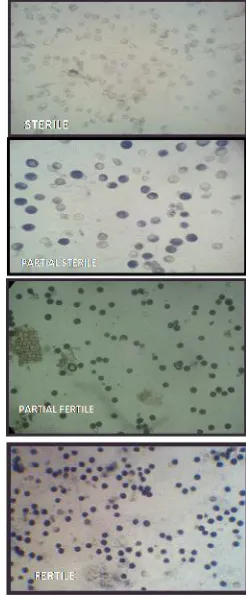
Spikelet fertility % = The panicles that emerged from the primary tiller were bagged before anthesis and the number of filled grains and chaffs in the panicle were counted at the time of maturity. The ratio of filled grains to the total number of spikelets was expressed as seed setting rate (He et al., 2006). The goodness of fit to Mendelian segregation pattern of fertile, partially fertile, partially sterile was assessed and completely sterile plants were classified in hybrids. Classification of pollen parents : The pollen parents were classified into four categories (Fig.1)
viz. Maintainers (M), Partial Maintainers (PM), Partial Restorer (PR) and Restorer (R) according to Virmani et al. (1997) and Sabar et al. (2007) (Table 1 ).
Results and discussion
Out of 60 tests crosses 9 restorers, 1 maintainer and 11 partial maintainers were found on the basis of pollen fertility, while 37 partial restorers were found on the basis of spikelet/pollen fertility studies under binocular microscope. The frequency of restorers, partial restorers, partial maintainers and maintainers were 17%, 62%, 18% and 3% respectively (Fig.2). Das et al. (2013) were also reported higher frequency of restorers (51.3%) than that of maintainer (6.3%) from evaluation of 224 test crosses and Khan et al. (2012) reported same higher frequency of restorers (27%) than that of maintainers (4%) from 100 test crosses. Raju et al. (2006) also reported the high frequency of restorers as compare to maintainers. But Akhter
et. al. (2008) reported higher frequency of
maintainers (17%) than that of restorers (11%) from 65 test crosses. Sri Krishnalatha and Sharma (2012) reported the equal frequency of restorers and maintainers out of 18 hybrids viz. two genotypes having restorer reaction, nine genotypes exhibited partial restorer reaction, five genotypes were partial maintainers and two genotypes were maintainers. Soni el al. (2012) stated the high frequency of potential restorers. They identified 3 partial maintainer, 6 partial restorers and 6 potential restorers and no effective maintainer could be identified in the material in their based on the pollen fertility and spikelet fertility percentage. Jayasudha and Sharma (2010) also concluded that the frequency of potential restorers was much higher in number and no effective maintainer could be identified.
Two aromatic short grain rice (ASG) and seven coarse lines were identified as effective restorers from the tested genotypes (Table 2). The maximum pollen fertility (97.60%) was observed in the cross of IR72164-352-2-5-5 / IR58025A, while the complete sterility (0.00) was observed in the cross of R1557-1317-1-580-1 / CRMS32A. Among these 9 restorers, two aromatic short slender rices viz. Chinikapoor and Tarun Bhog are the popular aromatic short grain varieties of Chhattisgarh state having good cooking quality traits.
Out of these 60 testcrosses only one was identified as effective maintainers) and others 9 were classified as partial maintainers (Table 3). No effective maintainer/partial maintainer was identified for aromatic short grain type. The morphological characters of identified maintainers are suitable for development of CMS lines and can be converted into new CMS lines for the development of local rice hybrids. Morphological attributes of hybrids having good restoration are presented in Table 4. In the present study it was revealed that nine combinations had more than 80% spikelet fertility with acceptable flowering days. Plant heights of all these hybrids were also less except CRMS31A/Jaldubi and CRMS31A/Adhamchini than check variety.
The fertility restoration performance of the genotypes varies with genetic background of CMS lines. More emphasis should be given to utilize proper rice cultivar in rice breeding as parental lines to achieve the goal of superior hybrid with better grain quality. The identified restorers and maintainers from this study are locally adopted. The identified restorer lines viz. IR72164-352-2-5-5, TOX 981-11-2-3, IR72164-352-2-5-IR72164-352-2-5-5, R1949-1196-2-1, Mahsuri-Sel-1, MTU-1001, and HR-NPT-6-3 will be utilized to develop coarse grain hybrids whereas Chinikapoor, Tarun Bhog will be utilized to develop aromatic short grain hybrids. New restorer may be also developed through crossing programme which can expand the genetic base of restorer by pyramiding complementary traits from diverse sources according to breeding objectives. It was also noticed that local germplasm had more frequency of restorer lines as compared to maintainers. New restorer lines should be developed using the local germplasm / aromatic short grain varieties for the development of good aromatic and non aromatic rice hybrids. From this study, it is evident that the frequency of partial restorers is quite higher than the restorers amongst the tested genotypes. Identified promising maintainer may be backcrossed to develop a cms lines with agronomic superiority and also for other desirable floral traits.
ISSN 0975-928X References
Akhter, M., Zahid, M.A., Ahamd, M. and Haider, Z. 2008. Selection of Restorers and Maintainers from Test crosses for the Development of Rice. Pakistan J. Sci.,60: 3-4.
Das, P., Mukharjee, B., Santra, C.K., Mukhopadhyay, S. and Dasgupta, T. 2013. Evaluation of genotypes for fertility restoration and maintaining behaviors in rice (oryza sativa L.).
Internat. J. Scientific & Technol. Res.,11(2) : 228-232.
Hoan N. T. and Nghia, N. H. 2003. Development and use of hybrid rice in Vietnam. In: Virmani SS., CX Mao., B Hardy., editors. Hybrid rice for food security, poverty alleviation, and environmental protection. Proceed. of the 4th
Internat. Symp. on Hybrid Rice, 14-17 May
2002, Hano, Vietnam, Los Banos (Philippines): International Rice Research Institute. P 357-371.
Jayasudha, S. and. Sharma, D. 2010. Identification of restorers and maintainers for CMS lines of rice (Oryza sativa L.) under shallow low land condition. Electron. J. Plant Breed., 1 (3):311-314
Julfiquar, A.W and Virmani, S. S. 2003. Research and development of hybrid rice in Bangladesh. In: Virmani SS, Mao CX, Hardy B. editors. Hybrid rice for food security, poverty alleviation, and environmental protection.
Proceed. of the 4th Internat. Symp. on Hybrid
Rice, 14-17 May 2002,Hanoi, Vietnam, Los
Banios (Philippines): International Rice Research Institute. P 235-245.
Khan, M.A., Malik, S. and Singh, S. 2012. Identification of maintainers and restorers for development of potential rice (Oryza sativa L.) Hybrid rice for tarai region. Vegetos.,25(1): 48-51. Ma, G.H. and Yuan, L.P. 2003. Hybrid rice
achievements and development in china. In: Virmani SS, Mao CX, Hardy B, editors. Hybrid rice for food security, poverty alleviation and environmental protection.
Proceed. of the 4th Internat. Symp. on Hybrid
Rice, 14-17 May 2002, Hanoi, Vietnam Los
Banos (Philippines): International Rice Research Institute. p 247-257.
Mishra, B., Viraktamath, B. C., Ilyas Ahmed, M., Ramesha, M. S. and Vijayakumar, C. H. 2003. Hybrid rice research and development in India. In:Virmani SS., CX Mao., B Hardy, editors. Hybrid rice for food security, poverty alleviation and environmental protection.
Proceed. of the 4th Internat. Symp. on Hybrid
Rice, 14-17 May 2002, Hanoi, Vietnam Los Banos (Philippines): International Rice Research Institute. p 265-283.
Raju, R., Sharma, D., Chaudhary, M., Sao, A. and Gauraha, D. 2006. Identification of restorers and maintainers for hybrid rice development in Chhattisgarh. Internat. J. Agric. Sci., 2(2): 654.
Redona, E.D., Malabanan, F.M., Gaspar, M. G., de Leon, J.C. and Sebastian, L. S. 2003. Hybrid rice development and use in the Philippines, 1998-2001. In: Virmani SS, CX Mao, B Hardy, editors. Hybrid rice for food security, poverty alleviation and environmental
on Hybrid Rice, 14-17 May 2002, Hanoi,
Vietnam Los Banos (Philippines): International Rice Research Institute. p 381-401
Sabar, M., Akhter, M., Faiz, F.A., Ali, S.S. and Ahmad, M. 2007. Identification of restorers and maintainers for developing hybrid rice. J.
Agric. Res. 45:19-24.
Sarial, A.K. and Singh, V.P. 2000. Identification of restorers and maintainers for developing basmati and non-basmati hybrids in rice, Oryza sativa. Plant Breeding119:243-247. Soni, S. and Sharma, D. 2012. Identification of
restorers and maintainers in new plant type lines of rice for developing super rice hybrid.
J. Soils and Crops, 22(2): 240-245
Sri Krishnalatha and Sharma, D. 2012.Identification of maintainers and restorers for WA and Kalinga sources of CMS lines in rice (Oryza
sativa L.). Electron. J. Plant Breed., 3(4):
949-951
Tan, YP., Li, SQ., Wang, L., Liu, G., Hu, J., Zhu, YG., 2008. Genetic analysis of fertility-restorer genes in rice. Biol. Planta., 52(3):469-474. Virmani, S. S. 2003. Advances in hybrid rice research
and development in the tropics. In: Virmani S.S., CX Mao., B Hardy., editors. Hybrid rice for food security, poverty alleviation and environmental protection. Proceed. of the 4th
Internat. Symp. on Hybrid Rice, 14-17 May
2002, Hanoi, Vietnam Los Banos (Philippines): International Rice Research Institute. p 2-20.
Virmani, S.S. 2006. Hybrid rice in the tropics: Where do we go from here? Paper presented in the 2nd International Rice Congress, New Delhi. Oct 9-13.
ISSN 0975-928X
Table 1. Classification of parental lines into restorers and maintainers (Virmani et al., 1997)
Category Pollen fertility (%) Spikelet fertility (%)
Maintainer (M) 0-1 0
Partial maintainer (PM) 1.1-50 0.1-50
Partial restorer (PR) 50.1-80 50.1-75
Restorer (R) >80 >75
Table 2. Genotypes identified as effective restorers and their pollen and spikelet fertility.
CMS used Effective Restorers Groups Pollen Fertility % Spikelet Fertility %
IR58025A IR72164-352-2-5-5 Coarse 97.60 95.52
IR58025A TOX 981-11-2-3 Coarse 94.75 93.71
CRMS31A IR72164-352-2-5-5 Coarse 93.78 90.89
IR58025A R1949-1196-2-1 Coarse 92.50 90.42
CRMS31A Chinikapoor ASG 89.50 90.14
CRMS32A Tarun Bhog ASG 87.25 89.53
CRMS31A Mahsuri Sel.-1 Coarse 86.40 87.74
CRMS31A MTU-1001 Coarse 86.14 86.67
IR58025A HR-NPT-6-3 Coarse 86.00 83.04
S.E. 1.45 1.23
C.D.(P=0.05) 3.54 2.85
ASG: Aromatic Slender Grain
Table 3. Genotypes identified as maintainer and partial maintainers
CMS used Effective Maintainers Groups Spikelet
Fertility%
Pollen Fertility %
CRMS32A R1557-1317-1-580-1 Coarse 0.00 0.00
CRMS32A R-1240-927-3-1056-1 Coarse 1.00 1.93
CRMS32A Swarna Selection-1 Coarse 2.63 2.40
IR58025A Jaldubi Coarse 3.65 4.65
IR58025A R-1240-927-3-1056-1 Coarse 4.54 3.44
IR58025A R1557-1317-1-580-1 Coarse 4.67 5.90
CRMS31A Nagina-22 Coarse 4.71 3.75
CRMS31A Jaldubi Coarse 5.16 7.65
CRMS31A IR73007-44-1-2-3 Coarse 5.30 9.00
CRMS31A Mancha Coarse 6.83 5.55
S.E. 0.66 0.86
ISSN 0975-928X
Table 4. Morphological attributes and spikelet fertility of cross combination with good spikelet’s fertility
Parentage Days to
Flowering
Plant Height (cm)
Tillers / Plant
Filled spikelets/
Panicle
Spikelet Fertility %
IR58025A / IR72164-352-2-5-5 97.00 113.95 13.75 254.85 95.52
IR58025A / TOX 981-11-2-3 95.25 116.40 6.50 304.80 93.71
CRMS31A / IR72164-352-2-5-5 105.90 94.20 7.55 195.25 90.89
IR58025A / R1949-1196-2-1 84.75 118 7.45 273.25 90.42
CRMS31A / Chinikapoor 92.00 108.80 8.50 325.60 90.14
CRMS32A / Tarun Bhog 107.75 75.93 7.68 371.25 89.53
CRMS31A / Mahsuri Sel.1 108.75 137.20 9.35 186.35 87.74
CRMS31A / MTU-1001 104.00 69.84 12.95 450.50 86.67
IR58025A / HR-NPT-6-3 96.00 124.40 4.70 195.50 83.04
KRH-2 (check) 104.77 133.03 11.40 156.20 79.90
S.E. 2.48 7.16 0.91 29.52 1.48
C.D.(P=0.05) 5.60 16.19 2.07 66.72 3.34
ISSN 0975-928X