Bio-inspired for Detection of Moving Objects
Using Three Sensors
Mario Alfredo Ibarra Carrillo
Dept. Telecommunications, F.I. UNAM, Ciudad de México, Mexico Email: [email protected]
Elizabeth Fonseca Chavez
ESCOM Polytechnic, Ciudad de Mexico, Mexico Email: [email protected]
Abstract—Reichardt proposed the basic model of the fly’s vision such as the correlation-based Elementary Motion Detector (EMD). The different variants of this detector attached mathematical models to improve detection. These models load with additional tasks to hardware. This excess load causes the delivery of results is made slow. We propose a modification that allows compensate for the delay in processing the signals. The heart of this modification focuses on use of three receivers, not two, as in the case of the original detector. In order to deliver free results of alien affects, only horizontal motion detectors are tested. Both models, the original and the proposed are simulated with MATLAB and probed with three templates that represent horizontal motion, rotation and scale. To know the efficiency of the proposed EMD against the efficiency of the original EMD, measurements are performed over the correctly categorized pixels in the images that delivered both motion detectors. This paper demonstrates that the proposed EMD detects moving with high speed than the original EMD, except in the case of zoom. The model proposed does not correct the problem of false detections due to lighting conditions.
Index Terms—Reichardt model, EMD, motion detection
I. INTRODUCTION
The biologically inspired vision systems have a neuromorphic system with electronic analog circuits to mimics neuro-biological architectures present in the nervous system [1]. For example, the fly have extraordinary abilities to detect movement. Reichardt (1956) proposed the basic model of the fly´s vision system such as the correlation-based Elementary Motion Detector (EMD) [2]. An EMD is driven by two neighboring photo receptors combination that transforms the motion of a contrasted object into two signals separated by a delay.
A modification of the EMD involves a 2-Quadrant-detector, as proposed by [3], only input combinations of same sign are processed (on-on, off, off). There is too a modified double channel motion detection model, this is, two separate detecting channels with weighted EMD
Manuscript received July 29, 2016; revised April 2, 2017.
(plus filter high pass) [4]. In [5] is proposed change the subtraction with a delay trimming. To improve the sensitivity of EMD, a logarithmic transformation for each channel is proposed in [6]. The EMD implementation in a micro controller, mounted on an air vehicle, is proposed in [7]. There are implementations with FPGA and real-time testing [6], [5] and [8] and other articles mentioned here, are simulations over MATLAB webcam or video recorded.
This paper utilizes the correlation-based elementary motion detector, modified with a triple channel for to improve motion detection at a higher speed than the classical model
II. EMD MODEL
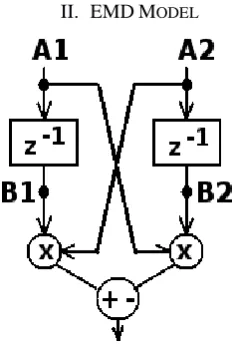
Figure 1. EMD classical model.
object moves from A1 to A2. The opposite case occurs when the EMD provides negative results.
III. THREE SENSOR MODEL
The classic model of EMD presents several problems when objects to detect are fast too: the speed of the object (the reader should consider that the unit of measurement of distance is the separation between adjacent sensors) is higher than the sampling frequency. In this case, there are three noticeable effects on the images delivered by the EMD. The first involves isolated pixels that are interpreted rather as noise. Another effect occurs when the resulting image shows distorted in size objects. The ultimate effect is aliasing, this is, false interpretations of captured signals, which comes to mean a motion is detected in the opposite direction.
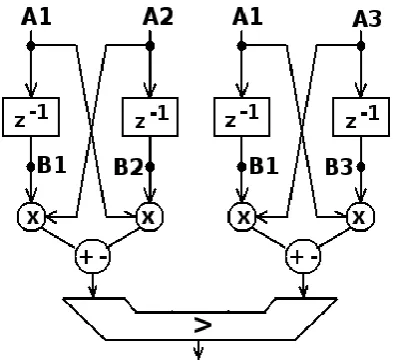
To compensate for the effects caused by rapid too many objects, you should only increase the separation between sensors. Thus, it is possible to have a pair of sensors for slow objects and have a pair of sensors for fast moving objects. Comparing the effects of both, it is possible to achieve a robust EMD. Fig. 2 illustrates how the EMD modified for fast moving objects: signal A1 is compared with A2 signal and further compared to signal A3, for detections of objects faster.
Figure 2. Three sensors EMD model.
IV. ANALYSIS
A study for the behavior of the pair of sensors to detect slow movements against behavior for the pair of sensors to detect rapid movements is shown in Fig. 3. In Fig. 3 is shown a pulse passing with different speeds. The reader can see the pulse shape, upper curve ofeach graph. Immediately below, the second curve is the same pulse but with different displacements observed as speed, in the eight graphs. The third curve of each graph illustrates what captures the pair of sensors for detections of slow movements. Finally, the fourth curve of each graph in Fig. 3 corresponds to the detection by the pair of sensors of rapid movements.
It is important to note the fourth shape of the graph seventh in Fig. 3. This illustrates that the proposed EMD still captures the movement of the pulse.
Figure 3. Comparative study between the classical EMD and the proposed enhanced for EMD.
Figure 4. Behavior of the EMD proposed in Fig. 2.
V. SIMULATION AND RESULTS
A. Probes with Horizontal Movement to Right
For testing, the pattern used is shown in Fig. 5.
Figure 5. Test pattern for horizontal movement.
To compare the effectiveness of the new EMD from its original version, is used the quantity of “true right” and quantity of “false left” [9].
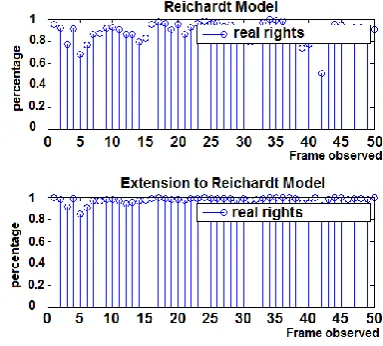
For the results, Fig. 6, upper graph, illustrates the results obtained with the original Reichardt model, this is, the quantity of real rights movements detected against the frame observed. Meanwhile, in Fig. 6, lower graph, shows the results of EMD with three sensors at the same situation. The reader can compare the graphs of both figures and noted that the proposed modifications to EMD gets a better detection of movements at each frame examinated.
Figure 6. Results obtained with horizontal movement to right..
In this probe, the results that MATLAB delivers are: Real rights detected: original Reichardt model. = 0.885849063035972
Real rights detected: modified Reichardt model. = 0.976492067981910
B. Probes with Rotational Movement to Right
For testing, the pattern used is shown in Fig. 7.
Figure 7. Test pattern for rotational movement.
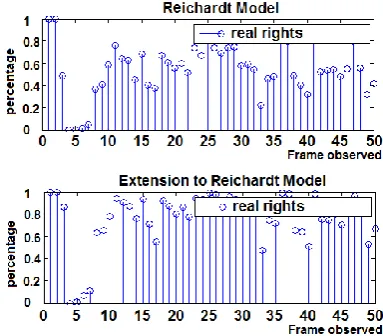
For the results, Fig. 8, upper graph, illustrates the results obtained with the original Reichardt model, this is, the quantity of real rights movements detected against the frame observed. Meanwhile, in Fig. 8, lower graph, shows the results of EMD with three sensors at the same situation. The reader can compare the graphs of both figures and noted that the proposed modifications to EMD gets a better detection of movements at each frame examinated.
In this probe, the results that MATLAB delivers are: Real rights detected: original Reichardt model. = 0.542833853795245
Real rights detected: modified Reichardt model. = 0.747254878593906
C. Probes with Zoom out Movement
For testing, the pattern used is shown in Fig. 9.
Figure 9. Test pattern for rotational movement.
For the results, Fig. 10, upper graph, illustrates the results obtained with the original Reichardt model, this is, the quantity of real rights movements detected against the frame observed. Meanwhile, in Fig. 10, lower graph, shows the results of EMD with three sensors at the same situation. The reader can compare the graphs of both figures and noted that the proposed modifications to EMD gets a better detection of movements at each frame examinated
In this probe, the results that MATLAB delivers are: Real rights detected: original Reichardt model. = 0.545876362888400
Real rights detected: modified Reichardt model. = 0.753561843790826
Figure 10. Results obtained with rotational movement to right
VI.CONCLUSIONS
The classic detector has been improved with recovery of three signals of photoreceptors, for motion detect in high velocity.
A microprocessor-based system can easily support this model, but taking into consideration that is necessary memory resources and it can take some delays.
If a real time processing is necessary, the reader mus consider working at clock frequencies involving hundreds of mega Hertz. In this case an FPGA is the solution.
For future work, it is necessary to implement the EMD in an embedded microprocessor based system. It is also expected to implement the EMD in a FPGA-based system, so that an ASIC system is proposed.
The proposed modification to the Reichardt EMD Model is dependent on lighting conditions. So the EMD can deliver erroneous results.
REFERENCES
[1] C. Mead, “Neuromorphic engineering: Overview and potential,” in Proc. IEEE International Joint Conference on Neural Networks, 2005.
[2] W. Reichardt, M. Egelhaaf, and R. W. Schlögl, “Movement detectors provide sufficient information for local computation of 2-D velocity field,” Naturwissenschaften, vol. 75, no. 6, pp. 313-315, 1988.
[3] H. Eichner, M. Joesch, B. Schnell, D. F. Reiff, and A Borst, “Internal structure of the fly elementary motion detector,” Neuron, vol. 70, no. 6, pp. 1155-1164, 2011.
[4] L. Dongguang, X. Peng, Q. Guojie, and Y. Daokun, “Detection of moving objects in infrared image sequences using two-dimensional modified double channel motion detector network,” in Proc. 6th International Conference on Circuits and Systems, 2014, pp. 135-141.
[5] A. Fabrice and F. Nicolas, “Optic flow sensors for robots: Elementary motion detectors based on FPGA,” in Proc. IEEE Workshop on Signal Processing Systems Design and Implementation, 2005,pp. 182-187.
[6] T. Zhang, H. Wu, A. Borst, K. Kuhnlenz, and M. Buss, “An FPGA implementation of insect-inspired motion detector for high-speed vision systems,” in Proc. IEEE International Conference on Robotics and Automation, 2008, pp. 335-340.
[7] J. Plett, A Bahl, M. Buss, K. Kühnlenz, and A. Borst, “Bio-inspired visual ego-rotation sensor for MAVs,” Biological Cybernetics, vol. 106, no. 1, pp. 51-63, 2012.
[8] J. Yin, D. G. Li, H. M. Fang, and Z. F. Liu, “Moving objects detection by imitating biologic vision based on fly's eyes,” in Proc. IEEE International Conference on Robotics and Biomimetics, 2004, pp. 763-766.
[9] S. M. Fernández, “Bio-inspired circuits for real-time motion evaluation,” thesis, Università Degli Studi di Cagliari, 2008.
Mario Alfredo Ibarra Carrillo, Mechanical