FOOD
AND
NUTRITION
International
Research Journal of
pISSN: 2663-7170, eISSN: 2663-7189
Study on Utilization Dates to Process Some
New Dietary Products (Marshmallow/Sheets) and
Their Acceptability Evaluation
1
Hamdy A. Shaaban,
2Nesreen M. El-Said Ali and
2Ashraf I. Nagib
1Department of Chemistry of Flavour and Aroma, NRC, Dokki, Giza, Egypt
2Food Technology Research Institute, Agricultural Research Center, Giza, Egypt
ARTICLE INFORMATION
Received: July 20, 2019
Accepted: September 02, 2019
Corresponding Author:
Hamdy A. Shaaban,
Department of Chemistry of Flavour and Aroma, NRC, Dokki, Giza, Egypt
ABSTRACT
This study is performed to investigate the possibility of producing new dietary products called dates marshmallow and sheets with a new technology. The study has been done to search the evaluation of possibility of maximizing utilization as value-added for date second degree types to produce natural marshmallow and sheets in both novels, an economical ways. Mixing the juice of dates with fruit juice such as golden berry and Tamaridus indica with ratio 50% led to reduce the content of sucrose and total sugars. Data were analyzed by Analysis of Variance using General Liner Model. Statistical analyses were made using the SAS software system program. The obtained results revealed that, total phenolic and flavonoid compounds were the highest value in samples dates. Also, carotenoids recorded the highest content in all samples. Objective testing color measurements; all treatments including both of controls were observed less in yellowness (***b) value. Physical properties - texture attributes for all samples were the best. On the other hand, fibers, total acidity and vitamin C were close and almost compatible with the control. It could be clearly observed that, treatment of date sheets product (zero time) were more in compared with control by increasing time of storage. Finally, It could be clearly concluded that, second degree types of dates are proper, successful, economic and applicable to produce as a new product marshmallows as well as it can be made in sheets form by heat concentrated drying which it gave an added value for dates that was very well for consumer palatability in general by sensory evaluation.
Key words: Dates, dietary products, golden berry, Tamardus indica, gelatin, pectin INTRODUCTION
Dates fruits are an extremely famous and oldest food known to human beings and it has been proven to contain high levels of carbohydrate, proteins, vitamins, crude fibers and essential minerals. Therefore, dates not only delicious with sweet taste and a fleshy mouth feel but also considered as an almost ideal food that provides a wide range of essential nutrients with many potential health benefits1.
It is well established that dates are rich in sugars (fructose, glucose and sucrose), minerals (potassium, calcium, magnesium, phosphorous and manganese), vitamins (particularly A and D) and natural fibers2-3. Dates are rich in carotenoids, polyphenols
Int. Res. J. Food Nutr., 1 (2): 38-46, 2019
Kalifa8 reported that, the date crop in Egypt is considered a
strategic crop and currently occupies the first place in date production at the world level before Iran and Saudi Arabia. The annual production is estimated at 1.465.030 t with 17.7% of the world production estimated at 7.5 million tons. The local varieties increased by 15.6%, in addition to the thousands that were introduced and represent a development of the sector. Date is among the fruits that characterized by high caloric value as one kg of dates contains around 3000 calories. Carbohydrates represent most of the chemical constitution of date (70%). Beside carbohydrates, date also contains proteins, fats, fibers, vitamins and mineral. Moisture content of dates ranged between 15 to 30% depending on different factors related to variety and maturity stage9.
Date fruit sheets (also called slaps) made by drying thin layers of pureed fruit in the oven or dehydrator10. The sheets are
characterized with their relative light weight therefore afford convenience in storage and handling. In addition the dehydration process decrease the moisture content of date sheets which lead to suppression of microbial growth and enhancement of the shelf life. In order to reconstitute date sheets into a date beverage, 1 part of the sheets is immersed in 5 parts of water with continuous stirring. Nutritional food values become concentrated in dried fruit and so do calories. Since moisture is removed, the residue is concentrated. They dehydrated fruit-based products eaten as candy or snacks and presented as flexible stripes or sheets. Due to its novel and attractive structure and for being products that do not require refrigeration, they constitute a practical way to incorporate fruit solids, especially for children and adolescents9.
Candy is one of favorite foods among people from a wide range of age. Confectionery products are food formulations made of aqueous dispersions of sugar syrups and are available in a broad variety of forms11,12 .
Marshmallow is sugar-candy with foam-like structure. Many studies have revealed the high nutritional value of bee pollen. Due to the nutritional composition of pollen and according to nonscientific studies, dried bee pollen has been used as an additive in human diets, which provides a well-being sensation and contributes to functional and harmonious balance of the body. Sensory evaluation and market research are an important part of developing a new product11.
Thus, the aim of this study was to evaluate the production of high quality natural marshmallow and sheets dates as new products for an added value for second degree types of dates. Value addition was another important segment in the date consumption pattern in the world. These value added products are highly viable commercially. It is also extended to
study the possibility of production of restructure by using pectin in processed sheets.
MATERIALS AND METHODS
Dates, semi dry variety, were purchased from a culture near Giza Governorate. (Gamar El-Dyne) or Commercial Apricot sheets and artificial marshmallows were purchased from a local market in Giza Governorate.
Preparation of each natural extracts: Semi dry dates were washed and squeeze, then prepared as puree mixed with hand blender.
Preparation of natural marshmallow: The producing recipe contains the following ingredients: golden berry juice (50%)/Tamardus indica soaked (50%)/semi-dry dates puree (100%) of main total (100 mL), coarse sugar (360 g), golden syrup (140 g), gelatin (25 g), vanilla, confectioners (powdered) sugar and corn starch or (corn flour).
Process and preparation of sheet products: The producing recipe contains the following ingredients: dates puree (500 mL), pectin (200 g) and sugar (15 g) by using heat-concentrated drying.
Main physical parameters and chemical composition of marshmallow (soft candies): The physicochemical analyses of samples were analyzed according to standards of AOAC13.
The method for determination of moisture content, crude fiber, total sugars/reducing sugars contents, total acidity (as citric acid), vitamin C and sucrose.
Tristimulus color measurement: Visual color was measured using a Hunter colorimeter model Color Flex (Hunter Associates Laboratory, Reston, VA) in terms of L (lightness), a (redness and Greenness) and b (yellowness and blueness). The instrument (45E/0E geometry, 10E observer) was calibrated with a standard black and white tile followed by measurement of samples14.
Phenols: Phenols were determined according to Maier and Metzler method15.
Phenols compound as gallic: These were determined according to Boligon et al.16.
Carotenoids as $-Carotene: These were determined according to Nagata and Yamashita18.
Physical properties: Textural Attributes such as texture profile parameters (Hardness, Cohesiveness, Springiness, Gumminess and Chewiness).
Texture profile analysis test of samples (which shape was 3×3×3 cylindrical) was done using a Universal Testing Machine (TMS-Pro) Food Technology Corporation, Sterling, Verginia, USA equipped with 1000 N (250 lbf) load cell and connected to a computer programmed with Texture Pro TM texture analysis software (program, DEV TPA With holding time between cycle two second). A flat rod probes uniaxially to compress the samples with the following parameters conduction to equivalent to a quarter of their original height. Each sample was subjected to two subsequent cycles of compression.
The texture profile parameters (Hardness, Cohesiveness, Springiness, Gumminess and Chewiness) were calculated from DEV TPA texture analyzer and computer interface. Calculation described by Szczesniak et al.19-20.
Water activity (aw): The major advantages of the chilled mirror
dew point methods are speed and accuracy. If there is a problem, the mirror is easily accessible and can be cleaned quickly in a few minutes. For some applications, fast readings allow manufacturers to perform at-line monitoring of a product s water activity21.
Rehydration of marshmallow (soft candies): Was determined according to the method stated by Von Loesecke22 as
following: 10 g the tested dry material samples were placed in 600 mL Pyrex beaker, 80 to 150 mL distillated water were added, covered with a watch glass, placed on electric heater, as boiled for 5 min, removed from the heater and dumped into a 75 min, buchner funnel which was covered with a coarsely porous filter paper. Suction was gently applied and drained with careful stirring for one min., or until the drip from the funnel has almost stopped. Samples were removed from the funnel and a weighted calculation was made to express in terms of "Reconstitution ration".
The drained weight of the rehydration sample (WR) Rehydration ratio 100
The origin weight of the dehydration sample (WD)
Sensory evaluations of marshmallows product: For the sensory analysis a simple hedonic scale with a small number of points (from 1 to 10 with 1- I don`t like it and 10 - i like it
very much) was used in order to evaluate the first impression, the aspect, the quality attributes (color, taste, flavor, texture, appearance and overall acceptability of the samples of soft candies compared with artificial marshmallows (control). Using suggested was evaluated for their sensory characteristics by ten panelists from the staff of the Processing Crops, Research Dep., Agric. Res. Center, Giza. Acceptability was giving numerical scores to each of their attributes from 10 panelists. The produced was organoleptically judged by groups of panel testers. The quality was scored on a scale (1 to 10). The following scale was applied to all samples for color, taste, flavor, Texture, Appearance and overall acceptability as follows: Excellent = (100), Very good = (8-9), Palatable = (6-7) and Unpalatable = (0-5). These proportion were scored on a scale from 1-10 according to Watts et al.23. Statistical analysis: Data were analyzed by Analysis of Variance using General Liner Model (GLM) procedure according to Sendecor and Cochran24. Means were separated
using Duncan s test at a degree of significance (p#0.05). Statistical analyses were made using the producer of the SAS software system program25.
RESULTS AND DISCUSSION
Marshmallow is a confection of foam-like structure due to the presence of gelatin, it possesses good chewing properties and demand for it is constantly growing on the world market. Although the nutritional value of the main types of marshmallow remains very poor, because of the most of them are synthetic, therefore a positive impact go beyond a good color, taste and smell. Marshmallows are simply described as air bubbles surrounded by sugar syrup. After both of (sucrose, corn syrup and water, is cooked at appropriate temperature to reach the desired water content, which allows air to be whipped into the matrix by mechanical agitation. During whipping, the density of the product decreases as the syrup and foam mixture expands into a light, fluffy marshmallow26-27.
Int. Res. J. Food Nutr., 1 (2): 38-46, 2019
Table 1: Main physical parameters and chemical composition of date marshmallows (means±SD)
Samples Moisture content (%) Total solids (TS) Fibers Reducing sugars Sucrose (%) Total sugars Imported control (1) 12.00±0.06 98.30±0.18 0.00±0.00 7.90±0.04 3.21±0.02 11.10±0.03
Local control (2) 13.00±0.10 94.10±0.14 0.00±0.00 9.16±0.02 3.20±0.01 12.36±0.01
Blank 11.07±0.25 94.50±0.17 0.00±0.00 7.53±0.01 4.41±0.02 11.94±0.04
Dates (100%) 18.41±0.12 81.59±0.08 0.00±0.00 9.72±0.26 2.17±0.10 11.89±0.02
Dates (50%)/Golden berry (50%) 17.50±0.17 82.50±0.15 0.00±0.00 9.66±0.12 1.53±0.04 11.19±0.02 Dates (50%)/Tamaridus indica (50%) 19.11±0.08 80.89±0.21 0.00±0.00 9.81±0.24 0.58±0.00 10.39±0.01 *All the values are means of triplicate ±SD
Table 2: Total phenolic, flavonoids and carotenoids of date marshmallow products (means±SD)
Samples Phenolic (mg gG1 gallic) Flavonoids (mg gG1 queratene) Carotenoids (mg gG1 as $-carotene)
Imported control (1) 0.122±0.02 0.086±0.01 0.5760±0.03
Local control (2) 0.048±0.00 0.094±0.01 0.7760±0.02
Blank 0.098±0.01 0.137±0.02 0.0017±0.00
Dates (100%) 0.098±0.01 0.217±0.03 0.7800±0.01
Dates (50%)/Golden berry (50%) 0.072±0.02 0.191±0.01 0.9290±0.02
Dates (50%)/Tamaridus indica (50%) 0.264±0.04 0.177±0.02 0.8500±0.01
*All the values are means of triplicate ±SD
Table 3: Objective testing color measurements for date marshmallows products (means±SD)
Color intensity
---Treatments *L **a ***b
Imported control (1) 73.03±0.15 0.12±0.01 5.33±0.02
Local control (2) 69.05±0.06 0.09±0.01 4.56±0.05
Blank 77.00±0.08 1.96±0.02 12.59±0.16
Dates (100%) 62.00±012 0.03±0.00 2.85±0.04
Dates (50%)/Golden berry (50%) 65.04±0.14 0.07±0.01 3.01±0.01
Dates (50%)/Tamaridus indica (50%) 66.60±0.09 0.08±0.02 3.95±0.02
*L: Lightness (0 = black-100 = white) **a: Redness and Greenness (0 = green-60 = red), ***b: Yellowness and Blueness (0 = bluer-60 yellow), *All the values are means of triplicate ±SD
samples than control and blank. Dates (100%) sample in its sucrose contain was less than two controls and blank but was more than two other samples which had mixed with (50%) both of golden berry and Tamaridus indica. This indicates that, mixing the juice of dates with fruit juice such as golden berry and Tamaridus indica with ratio 50% due to reduce it s the content of sucrose. Total sugars contain of samples were less than control (2), but reducing sugars recorded less value in both of blank and control (1) than other one. Total sugars containing all new types of natural source marshmallows were less including blank and control (1). These are also, mean that, the mixing with (50%) both of golden berry and Tamaridus indica benefit in reducing the percentage of total sugars for samples dates, but almost close to the proportion of imported control (1).
Table 2 showed that, the phenolic in both of the samples local Cont. (2) blank and dates, 100% as well as dates, 50%; golden berry, 50% were little, as for dates, 50%; Tamaridus indica, 50% was the higher than imported cont., (1). Flavonoids were the highest value in samples dates 100% followed by dates 50%; golden berry 50% and dates 50%; Tamaridus indica 50% compared with blank followed by both controls imported (1)
and local (2) their less content of flavonoids. It noticed that, carotenoids recorded the highest content in all samples including local cont., (2) except blank was less one4.
The hunter L, a, b color scale may be used on any object whose color may be measured. From Table 3 data shows that, it could be clearly observed, the lightness values (*L) for sample [dates 100%] equal (62.00) was less than both treatments of dates 50%; golden berry 50% and dates 50%;
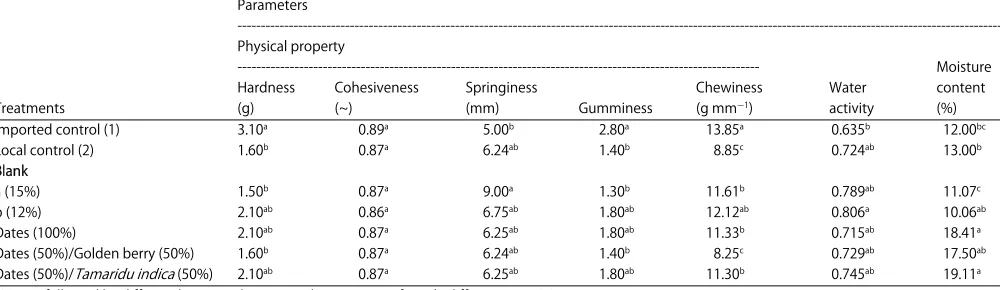
Table 4: Textural attributes such as texture profile parameters/water activity for date marshmallow products Parameters
---Physical property
--- Moisture
Hardness Cohesiveness Springiness Chewiness Water content
Treatments (g) ( ) (mm) Gumminess (g mmG1) activity (%)
Imported control (1) 3.10a 0.89a 5.00b 2.80a 13.85a 0.635b 12.00bc
Local control (2) 1.60b 0.87a 6.24ab 1.40b 8.85c 0.724ab 13.00b
Blank
a (15%) 1.50b 0.87a 9.00a 1.30b 11.61b 0.789ab 11.07c
b (12%) 2.10ab 0.86a 6.75ab 1.80ab 12.12ab 0.806a 10.06ab
Dates (100%) 2.10ab 0.87a 6.25ab 1.80ab 11.33b 0.715ab 18.41a
Dates (50%)/Golden berry (50%) 1.60b 0.87a 6.24ab 1.40b 8.25c 0.729ab 17.50ab Dates (50%)/Tamaridu indica (50%) 2.10ab 0.87a 6.25ab 1.80ab 11.30b 0.745ab 19.11a *Means followed by different letters in the same column are significantly different at p#0.05
(*** b) values for treatments dates, 100% followed by dates 50%; golden berry 50%, dates 50%; Tamaridus indica 50% and local cont., (2) as well as imported cont., (1) were less than blank, hence can be best represented by hunter color (***b) to distinguish the color difference of the resulting marshmallow dates. From those results, it was concluded that, there is a convergence in the color for the date marshmallow products with two controls samples, indicating that the process of mixing dates with (golden berry and Tamaridus indica) did not change the color significantly, so that the products produce in their original colors which refer to the original or basic product28.
Ergun et al.27 mentioned that, water is one of the most
important components of confections. Progressing from the use of water content to water activity and was to the principles of water mobility. One of the main functions of water in confectionery formulas is to dissolve the ingredients and help with mixing. In most candies, the water is used to dissolve and prepare the slurry of sugar and corn (glucose) syrup. Marshmallows may be either ungrained or grained, depending on the ratio of sucrose to corn syrup. Water content affects marshmallow hardness and flow properties. Ungrained marshmallows typically have moisture content of 15-18%. A fresh-made, ungrained marshmallow has fairly high aw, above 0.7, dependent on moisture content and composition. From Table 4 data showed that, physical properties-texture attributes are (hardness, cohesiveness, springiness, gumminess and chewiness). Physical structure is often altered by changes in water activity due to moisture gain resulting in a transition from the rubber to the glassy state. On the other side also, reveal that, there is a reverse relationship between marshmallow products hardness and its water content in Table 4. The data showed that, had significant difference for water content in all suggestion marshmallow, when fresh and throughout the ripening period.
From data shown in Table 4 the hardness attribute for imported cont., (1) marshmallow was the best followed by the marshmallow sample of the blank 12%; dates 100%; dates 50%; golden berry 50% and dates 50%; Tamaridus indica 50% but the lowest sample of marshmallow blank 15%. Cohesiveness; showed that, there is no significantly different between all samples marshmallow. Springiness; there is no significantly different for samples local cont., (2); blank 12%; dates 100%; dates 50%; golden berry 50% and dates 50%;
Tamaridus indica 50% marshmallows compared with imported control (1) followed by blank 15% and imported cont., (1) are the lowest with significantly differences between them. Gumminess; imported cont., (1) were the best followed by blank 12%; dates 100% and dates 50%; Tamaridus indica
50% but blank 15% and local cont., (2) as well as dates 50%; golden berry 50% marshmallow were the worst. Chewiness; imported cont., (1) followed by blank 12%; 15% and dates 100% as well as dates 50%; Tamaridus indica 50% marshmallow were the best one. On the other hand, local cont., (2) and dates 50; golden berry 50% were the worst by there are moderate significantly differences. Water activity (aw); both of local cont., (2) as well as both of samples dates
100%; dates 50%; golden berry 50% and dates 50%; Tamaridus indica 50% marshmallow had the highest values, this means the least quality. On the other hand, imported cont., (1) was the best one, followed by blank ratio (15%) was the lower values than ratio (12%) that means the best one. Lim et al.29
studied that, the initial water content of the marshmallow was 19.5% and though water activity was not measured, it was probably between 0.65 and 0.70 if not higher. After 20 weeks of storage, the marshmallow water content had decreased to 7.9% and hardness had increased.
Int. Res. J. Food Nutr., 1 (2): 38-46, 2019
Table 5: Rehydration ratio samples for date marshmallow products
Reconst./Time (every 1 h)
---Treatments 1 h 2 h 3 h 4 h 5 h 6 h
Imported control (1) 127.56a 138.95a 142.60a 146.24a 146.70a 150.80a
Local control (2) 101.55bc 83.51bc 69.24b 56.77b 42.39b 33.19b
Blank 90.23c 86.67bc 77.82b 67.47b 57.13b 47.59b
Dates 100% 72.18d 61.58c 55.79b 41.53b 32.06b 29.94b
Dates (50%)/Golden berry (50%) 81.41cd 69.72bc 58.32b 45.73b 33.73b 23.24b
Dates (50%)/Tamaridus indica (50%) 89.23cd 67.44bc 58.63b 46.04b 37.09b 29.83b *Means followed by different letters in the same column are significantly differentat p#0.05
Table 6: Sensory evaluation of date marshmallow products
Samples Color Taste Flavor Texture Acceptability
Imported control (1) 6.9ab 6.4b 6.3b 6.5b 6.9b
Local control (2) 6.6b 7.5ab 6.8ab 6.6b 6.7b
Blank 8.0a 8.5a 7.8a 7.4a 8.8a
Dates 100% 7.5ab 8.8a 7.6a 7.9a 8.9a
Dates (50%)/Golden Berry (50%) 8.0a 7.4ab 6.7ab 6.8b 7.9a
Dates (50%)/ Tamaridus indica (50%) 6.5b 6.8b 6.6b 7.5a 8.0a
*Means followed by different letters in the same column are significantly different at p#0.05
Table 7: Main physical parameters and chemical composition for date sheets after being storage at ambient temperature (25±2ºC) for 3 months Parameters
---Moisture Total solids Total phenolic Fibers Total acidity Vit. C/
Treatments content (%) (TS) compounds (mg) (g/100 g) (as citric acid) (mg/100 g)
Control (apricot sheets) 11.33 88.67 55.5 6.35 0.98 0.08
Date sheets product (zero time) 14.87 85.13 54.8 6.25 0.96 0.07
Date sheets product (3 months) 16.82 83.18 54.5 5.98 0.92 0.09
while the all of other samples as blank; dates 100%; dates 50%; golden berry 50% and dates 50%; Tamaridus indica 50% respectively, take to decrease including locally cont., (2). Finally, it is noticed that, more than (2 h) of the rehydration time had occurred deterioration for reconstitution ratio values of marshmallow samples by increasing time of soaking with no significant differences between them compared with imported control (1) and dates 50%; golden berry 50% and dates 50%; Tamaridus indica 50% as well as locally control (2) was the worst value, according to Kirtil et al.30.
The data showed that no significant difference in color in Dates, 100% and imported cont., (1) marshmallow. Taste showed no significant difference between local cont., (2) and dates 50%; golden berry 50%; blank; dates 100% as well as imported cont., (1) and dates 50%; Tamaridus indica 50% while flavor of marshmallow samples were recorded the same score in arrangement. Texture showed no difference between imported cont., (1) local cont., (2) and dates 50%; golden berry 50% also blank; dates 100% and dates 50%; Tamaridus indica
50%. Acceptability, all samples recorded highest score except imported cont., (1) and local cont., (2) showed lower score. It can be concluded that, the moderate scores of the sensory parameters showed in Table 6 suggestion marshmallow which contain imported cont., (1) and local cont., (2) as well as dates
50%; Tamaridus indica 50%. It could be observed that, samples blank; dates 100% and dates 50%; golden berry 50% marshmallow respectively, had the same record highest score of taste, flavor and palatability and the better than artificial marshmallows according to Artamonova et al.31-32.
Date fruits have a very high nutritional value. It consist of 70% carbohydrates (mostly sugars), making it one of the most nourishing natural foods available to man. It also contains proteins, fats, crude fibers, vitamins, mineral, enzymes and other useful substances. The water ranged between 15 to 30% depending on the variety and on the maturity stage of the fruit. Having characteristics of low fats, appropriate moisture contents, carbohydrates and other nutritional values with a sweet and supple taste and texture along with a chewing pleasure, dates are considered as complete food and are cherished all around the world. From Table 7, it could be observed that, moisture content of date sheets (zero-times and 3 months) were between 14.87 and 16.82%), these results were more than the moisture content of control. Most fruit leathers are dried at 30 to 80EC, especially at 50 to 60EC for up to 24 h or until they have reached the final moisture content of 12-20% (w.b.)10. Total phenol compounds for samples
and almost compatible with the control (6.35, 6.25 and 5.98 g/100 g) (0.98, 0.96 and 0.92) and (0.08, 0.07 and 0.09) respectively.
These results from Table 8 for effect of storage at (25±2EC) of shelf-life on soluble sugars of date sheets (zero-times and 3 months) compared with control (apricot sheets) were noticed that, the total sugar, reducing and non-reducing sugars were less the longer storage. Knowing that, we couldn t compare here with apricot sheets because originally is low in the content of soluble sugars as shown from the Table 8. The hunter L, a, b color scale may be used on any object whose color may be measured. From Table 9, it could be clearly observed that, treatment of [date sheets product (zero time)] for the lightness values (*L) equal (19.59±0.01) was less than date sheets product (3 months) which lightness had (*L) values of (20.12±0.04) compared with control as shown in the table that were appeared to have low (*L) value (indicating dark color). On other hand, the red (**a) value equal (3.95±0.00) for date sheets product (zero time) was
Table 8: Effect of storage for date sheets on soluble sugars after being at ambient temperature (25±2ºC) for 3 months
Parameters
---Total Reducing Non-Reducing
Treatments sugar sugars sugar
Control (apricot sheets) 69.6 46.1 23.5 Date sheets product (zero time) 72.8 46.6 26.2 Date sheets product (3 months) 71.5 46.1 25.4
Table 9: Objective testing color measurements for date sheets products after being storage atambient temperature (25±2ºC) for 3 months (means±SD)
Color intensity (Hunter calorimeter, L, A, B)
---Treatments *L **a ***b
Control 19.95±0.02 3.85±0.02 3.50±0.01
Date sheets product (zero time) 19.59±0.01 3.95±0.00 3.55±0.01 Date sheets product (3 months) 20.12±0.04 3.55±0.01 3.08±0.02 *L: Lightness (0 = black-100 = white), **a: Redness and Greenness (0 = green- 60 = red), ***b: Yellowness and Blueness (0 = bluer- 60 = yellow), *All the values are means of triplicate ±SD
more than value (3.55±0.01) for date sheets product (3 months) compared with control (3.85±0.02) as a result were observed. In fact red value (**a) decreased when the time of storage were increased, while the yellowness (***b) values (3.55±0.01) for date sheets product (zero time) was also, more than values (3.08±0.02) of date sheets product (3 months) in compared with control by increasing time of storage, that hence can be best represented by hunter color ***b to distinguish the color difference of the resulting sheets dates. From these results, it conclude that, there is a convergence in the color for the date sheets products with control sample, indicating that the storage at ambient temp., (25±2ºC) for 3 months did not change the color significantly, so that the products produce in their original colors which refer to stability of their color29-33.
From these results which is shown in Table 10, all samples were decreased by increasing time of the soaking. It can be concluded that, there are significantly difference of their constitution ratio parameters between samples of sheets (3 moths) and [control and samples (zero-time)] sheets samples which had showed in (10) suggestion sheets of samples. Lemuel et al.10 reported that, these ingredients are
mixed with the fruit puree to make fruit leathers with a higher quality, longer storage, or better organoleptic quality than the original fruit. Most fruit leathers are dried at 30 to 80EC, especially at 50 to 60EC for up to 24 h or until they have reached the final moisture content of 12-20% (w. b).
The data showed that, no significant difference in color, flavor and acceptability in all suggestion sample sheets. Texture showed no significant difference between samples (zero time and 3 months) while control sheets recorded the highest score. Taste showed difference between all samples. Control sample sheet recorded the highest score next (zero-time and 3 moths, respectively). It can be concluded that, taste had significantly different scores of the sensory parameters showed in Table 11 suggestion sheets of samples. It could be observed that all samples sheets have the same record score
Table 10: Rehydration ratio for date sheets products after being storage at ambient temperatue (25±2ºC) for 3 months Reconst./Time (min)
---Treatments 30 min 60 min 90 min 120 min 150 min
Control 85.71b 85.71b 71.42b 57.14b 42.86b
Date sheets product (zero time) 85.71b 85.71b 71.42b 57.14b 42.86b
Date sheets product (3 months) 114.29a 114.29a 100.00a 100.00a 85.71a
*Means followed by different letters in the same column are significantly different at p#0.05
Table 11: Sensory evaluation of date sheets products after being storage at ambient temperature (25±2ºC) for 3 months
Samples Color Taste Flavor Texture Acceptability
Control 7.6a 8.7a 8.1a 8.6a 8.5a
Date sheets product (zero time) 7.7a 8.4b 7.9a 7.9b 8.7a
Date sheets product (3 months) 7.7a 8.0c 7.8a 7.9b 8.8a
Int. Res. J. Food Nutr., 1 (2): 38-46, 2019
of flavor and acceptability but in taste and texture recorded no significant differences between them. According to Shivani Gupta et al.9-33.
CONCLUSION
Through this study it could be concluded that it is proper, successful economic and applicable to produce vegetables and fruits marshmallows giving the same amount of taste and aroma, hence must resort to natural sources which are very suitable to be taken as a good natural food or natural-food additive with many categories of healthy foodstuffs. The phytochemical analysis of the marshmallows and sheets dates revealed it being a good source of total phenolic and flavonoids. These compounds which found naturally in dates protect body from free radical, improve immune system and also have health benefits. Date marshmallow and sheets as new products had given added value for second degree dates.
REFERENCES
1. Alghamdi, A.A., A.M. Awadelkarem, A.B.M. Hossain, N.A. Ibrahim, M. Fawzi and S.M. Ashraf, 2018. Nutritional assessment of different date fruits (Phoenix dactylifera L.) varieties cultivated in Hail province, Saudi Arabia. Biosci. Biotech. Res. Comm., 11: 263-269.
2. Yousif, A.K. and A.S. Al-Ghamdi, 1998. Nutrient elements and vitamins content of some New Valley dates and certain date products. 1st International Conference on Date Palms, United Arab Emirates University, pp: 100-110.
3. Sawaya, W.N., J.K. Khalil, W.J. Safi and H.A. Khatchadourian, 1983. Date bars fortified with soy protein isolate and dry skim milk. J. Food Sci., 48: 1503-1506.
4. Al-Harthi, M.N., 1999. Production of concentrated date extracts (date dibbs) at a pilot scale level. M.Sc. Thesis, Department of Agricultural Engineering, College of Food and Agricultural Sciences, King Saud University, Saudi Arabia, pp: 50-100.
5. Al-Hooti, S., J.S. Sidhu and H. Qabazard, 1995. Studies on the Physio-chemical Characteristics of Date Fruits of Five UAE "Cultivars at Different Stages of Maturity. Arab Gulf J. Sci. Res., 13: 553-570.
6. Ali, M.I., M.M. Waly, S. Essa and S. Devarajan, 2012. Nutritional and Medicinal Value of Date Fruit. Eds., New York: CRC Press, pp: 361-375.
7. Besbes, S., L. Drira, C. Blecker, C. Deroanne and H. Attia, 2009. Adding value to hard date (Phoenix dactylifera L.): Compositional, functional and sensory characteristics of date jam. Food Chem., 112: 406-411.
8. Kalifa, A., 2017. The Bleesed Three-3rd Egyptation Date Palm
Festival in Siwa (15-18 Nov.), 9: 26-27.
9. Shivani Gupta, S., G. Nikhil, G. Naveen and J. Salil, 2016. Economic Analysis of Pumpkin and Papaya as Fruit Leathers and their Utilization as Protective Cover against Cancer in the Medical Science. Int. J. Food, Nutr. Diet., 4: 35-50.
10. Lemuel, M., X. Diamante and B. Janette, 2014. Fruit Leathers: Method of Preparation and Effect of Different Conditions on Qualities. Int. J. Food Sci., pp: 12.
11. Ungure, E., E. Straumîte, S. Muiþniece-Brasava and L. Dukaïska, 2013. Consumer Attitude and Sensory Evaluation of Marshmallow. Proc. Latvian Acad. Sci.,67: 442-447. 12. Utomo, B.S.B., M. Darmawan, A.H. Rahman and D.T. Ardi,
2014. Physicochemical Properties and Sensory Evaluation of Jelly Candy Made from Different Ratio of Carrageenan and Konjac. Squalen Bull. Mar. Fish. Postharvest Biotechnol., 9: 25-34.
13. AOAC., 2016. Official Methods of Analysis of the Association of Official Analytical Chemists. 20th Edn. AOAC Inc.,Washington: DC.
14. Ahmed, J. and H.S. Ramaswamy, 2006. Physico-chemical properties of commercial date pastes (Phoenix dactylifera). J. Food Eng., 76: 348-352.
15. Maier, V.P. and D.M.J. Metzler, 1965. Quantitative changes in date polyphenols and their relation to browning. Food Sci., 30: 80-84.
16. Boligon, A.A., R.P. Pereiera, A.C. Feltrin, M.M. Machado and M.L. Hayde, 2009. Antioxidant activities of flavonol derivatives from the leaves and stem bark of Scutia buxifolia Reiss. J. Bioresour. Technol., 100: 6592-6598.
17. Chen, I.J. and X.G. Li, 2007. Hypolipidemic effect of flavonoids from mulberry leaves in triton WR-1339 induced hyperlipidemic mice. Asia Pacific. J. Clin. Nutr., 16: 290-294. 18. Nagata, M. and I. Yamashita, 1992. Simple Method for
Simultaneous Determination of Chlorophyll and Carotenoids in Tomato Fruit. Nippon Shokuhinkogyo Gakkaish, 39: 925-928.
19. Szczesniak, A., M. Brandt and H. Freidman, 1963. Development of Standard Rating Scales for Mechanical Parameters of Texture and Correlation Between the Objective and the Sensory Methods of Texture Evaluation. Food Tech., 28: 397-403.
20. Bourne, M., 1978. Texture profile analysis. Food Tech., 32: 62-69.
21. Rockl, L.B. and S.K. Nishi, 1980. Influence of Water Activity on Food Product Quality and Stability. Food Tech., 34: 42-59. 22. Von Loesecke, K.W., 1955. Food Chemistry. Reinhold
publishing corporation New York Chapmanand Hall Ltd., London. Gulf J., 13: 553-569.
24. Sendecor, G.W. and W.C. Cochran, 1997. Statistical Methods; 7th Edn., Oxford and Journal B.H. Publishing Co., pp: 504. 25. SAS., 1997. SAS Institute. Statistical Analysis System, Gary, NC,
USA.
26. Sucharzewska, D., A. Stochmal and W. Oleszek, 2003. The effect of Yucca schidigera extract on the physical structure and on the oxidative stability of sugar-candy foam products. Lebensmit. Wiss. Technol., 36: 347-351.
27. Ergun, R., R. Lietha and R.W. Hartel, 2010. Moisture and Shelf Life in Sugar Confections. Food Sci. Nutr., 50:162-192. 28. Karim, A.A. and R. Baht, 2008. Gelatin alternatives for the food
industry: Recent developments, challenges and prospects. Food Sci. Technol., 19: 644-656.
29. Lim, M.H., J. Yin and S. Heenan, 2006. The mistery of Marshmallow Hardening. In: Food Preservation Technology Series-Water Properties of Food, Pharmaceutical and Biological Materials. Buera, P., J.O. Welti-Chanes, P.J. Lillford and H.R. Corti (Eds.). Taylor and Francis, New York, pp: 325-342.
30. Kirtil, E., A. Aydogdu and M.H. Oztop, 2017. Acta Horticulturae, 33: 243-248.
31. Artamonova, M., I. Piliugina, O. Samokhvalova, N. Murlykina, O. Kravchenko, I. Fomina and A. Grigorenko, 2017. A Study of Properties of Marshmallow with Natural Anthocyanin Dyes During Storage. Eastern-European J. Enterp. Technol., 87: 23-30.
32. Liana-Claudia, S., T. Maria, P. Carmen, S. Sonia, O.P. Anamaria and N. Melinda, 2015. Physicochemical Properties and Sensory Evaluation of Jelly Candy Made from Carrots and Strawberries. Bulletin UASVM Food Sci. Technol., Cluj-Napoca, Romania, 72: 139-140.